EP2249587A2 - Transposition en fréquence par réajustement à haute fréquence de l'enveloppe spectrale pour prothèses auditives - Google Patents
Transposition en fréquence par réajustement à haute fréquence de l'enveloppe spectrale pour prothèses auditives Download PDFInfo
- Publication number
- EP2249587A2 EP2249587A2 EP10250883A EP10250883A EP2249587A2 EP 2249587 A2 EP2249587 A2 EP 2249587A2 EP 10250883 A EP10250883 A EP 10250883A EP 10250883 A EP10250883 A EP 10250883A EP 2249587 A2 EP2249587 A2 EP 2249587A2
- Authority
- EP
- European Patent Office
- Prior art keywords
- signal
- frequency
- spectral envelope
- frequencies
- audio signal
- Prior art date
- Legal status (The legal status is an assumption and is not a legal conclusion. Google has not performed a legal analysis and makes no representation as to the accuracy of the status listed.)
- Granted
Links
Images







Classifications
-
- H—ELECTRICITY
- H04—ELECTRIC COMMUNICATION TECHNIQUE
- H04R—LOUDSPEAKERS, MICROPHONES, GRAMOPHONE PICK-UPS OR LIKE ACOUSTIC ELECTROMECHANICAL TRANSDUCERS; ELECTRIC HEARING AIDS; PUBLIC ADDRESS SYSTEMS
- H04R25/00—Electric hearing aids
- H04R25/35—Electric hearing aids using translation techniques
- H04R25/353—Frequency, e.g. frequency shift or compression
-
- H—ELECTRICITY
- H04—ELECTRIC COMMUNICATION TECHNIQUE
- H04R—LOUDSPEAKERS, MICROPHONES, GRAMOPHONE PICK-UPS OR LIKE ACOUSTIC ELECTROMECHANICAL TRANSDUCERS; ELECTRIC HEARING AIDS; PUBLIC ADDRESS SYSTEMS
- H04R2225/00—Details of deaf aids covered by H04R25/00, not provided for in any of its subgroups
- H04R2225/43—Signal processing in hearing aids to enhance the speech intelligibility
-
- H—ELECTRICITY
- H04—ELECTRIC COMMUNICATION TECHNIQUE
- H04R—LOUDSPEAKERS, MICROPHONES, GRAMOPHONE PICK-UPS OR LIKE ACOUSTIC ELECTROMECHANICAL TRANSDUCERS; ELECTRIC HEARING AIDS; PUBLIC ADDRESS SYSTEMS
- H04R2430/00—Signal processing covered by H04R, not provided for in its groups
- H04R2430/03—Synergistic effects of band splitting and sub-band processing
-
- H—ELECTRICITY
- H04—ELECTRIC COMMUNICATION TECHNIQUE
- H04R—LOUDSPEAKERS, MICROPHONES, GRAMOPHONE PICK-UPS OR LIKE ACOUSTIC ELECTROMECHANICAL TRANSDUCERS; ELECTRIC HEARING AIDS; PUBLIC ADDRESS SYSTEMS
- H04R25/00—Electric hearing aids
- H04R25/50—Customised settings for obtaining desired overall acoustical characteristics
- H04R25/505—Customised settings for obtaining desired overall acoustical characteristics using digital signal processing
Definitions
- This disclosure relates generally to hearing assistance devices, and more particularly to frequency translation by high-frequency spectral envelope warping in hearing assistance devices.
- Hearing assistance devices such as hearing aids
- Such devices have been developed to ameliorate the effects of hearing losses in individuals.
- Hearing deficiencies can range from deafness to hearing losses where the individual has impairment responding to different frequencies of sound or to being able to differentiate sounds occurring simultaneously.
- the hearing assistance device in its most elementary form usually provides for auditory correction through the amplification and filtering of sound provided in the environment with the intent that the individual hears better than without the amplification.
- Frequency translation processing recodes high-frequency sounds at lower frequencies where the individual's hearing loss is less severe, allowing them to receive auditory cues that cannot be made audible by amplification.
- a speech signal was synthesized by filtering the linear prediction residual with a vocal tract model that was modified so that any high frequency formants outside of the range of hearing of a hearing impaired person were transposed to lower frequencies at which they can be heard. They also suggested that formants in low-frequency regions may not be transposed. However, this approach is limited in the amount of transposition that can be performed without distorting the low frequency portion of the spectrum (e.g., containing the first two formants). Since the entire signal is represented by a formant model, and resynthesized from the modified (transposed) formant model, the entire signal may be considerably altered in the process, especially when large transposition factors are used for patients having severe hearing loss at mid and high frequencies. In such cases, even the part of the signal that was originally audible to the patient is significantly distorted by the transposition process.
- Leibman in U.S. Patent 5,014,319, Leibman relates a frequency transposition hearing aid that classifies incoming sound according to frequency content, and selects an appropriate transposition factor on the basis of that classification.
- the transposition is implemented using a variable-rate playback mechanism (the sound is played back at a slower rate to transpose to lower frequencies) in conjunction with a selective discard algorithm to minimize loss of information while keeping latency low.
- This scheme was implemented in the AVR TranSonicTM and ImpaCtTM hearing aids.
- this variable-rate playback approach has been shown to lack effectiveness in increasing speech intelligibility.
- this approach uses a switching system that enables transposition when the spectrum is dominated by high-frequency energy, as during consonants. This switching system may introduce errors, especially in noisy or complex audio environments, and may disable transposition for some signals which could benefit from it.
- Allegro et. al. relate a method for frequency transposition in a hearing aid in which a nonlinear frequency transposition function is applied to the spectrum.
- this algorithm does not involve any classification or switching, but instead transposes low frequencies weakly and linearly and high frequencies more strongly.
- One drawback of this method is that it may introduce distortion when transposing pitched signals having significant energy at high frequencies. Due to the nonlinear nature of the transposition function (the input-output frequency relationship), transposed harmonic structures become inharmonic. This artifact is especially noticeable when the inharmonic transposed signal overlaps the spectrum of the non-transposed harmonic structure at lower frequencies.
- the Allegro algorithm is described as a frequency domain algorithm, and resynthesis may be performed using a vocoder-like algorithm, or by inverse Fourier transform.
- Frequency domain transposition algorithms in which the transposition processing is applied to the Fourier transform of the input signal
- are the most-often cited in the patent and scholarly literature see for example Simpson et. al ., 2005, and Turner and Hurtig, 1999, U.S. Patent 6,577,739 , U.S. Patent Application Publication 2004 0264721 (issued as U.S. Patent 7,248,711 ) and PCT Patent Application WO 0075920 ).
- " Improvements in speech perception with an experimental nonlinear frequency compression hearing device” Simpson, A.; Hersbach, A.
- the present subject matter includes a method for processing an audio signal received by a hearing assistance device, including: filtering the audio signal to generate a high frequency filtered signal, the filtering performed at a splitting frequency; transposing at least a portion of an audio spectrum of the filtered signal to a lower frequency range by a transposition process to produce a transposed audio signal; and summing the transposed audio signal with the audio signal to generate an output signal, wherein the transposition process includes: estimating an all-pole spectral envelope of the filtered signal from a plurality of line spectral frequencies; applying a warping function to the all-pole spectral envelope of the filtered signal to translate the poles above a specified knee frequency to lower frequencies, thereby producing a warped spectral envelope; and exciting the warped spectral envelope with an excitation signal to synthesize the transposed audio signal
- the filtering includes, but is not limited to high pass filtering or high bandpass filtering.
- the estimating includes performing linear prediction. In various embodiments, the estimating is done in the frequency domain. In various embodiments the estimating is done in the time domain.
- the pole frequencies are translated toward the knee frequency and may be done so linearly using a warping factor or non-linearly, such as using a logarithmic or other non-linear function. Such translations may be limited to poles above the knee frequency.
- the excitation signal is a prediction error signal, produced by filtering the high-pass signal with an inverse of the estimated all-pole spectral envelope.
- the present subject matter in various embodiments includes randomizing a phase of the prediction error signal, including translating the prediction error signal to the frequency domain using a discrete Fourier Transform; randomizing a phase of components below a Nyquist frequency; replacing components above the Nyquist frequency by a complex conjugate of the corresponding components below the Nyquist frequency to produce a valid spectrum of a purely real time domain signal; inverting the DFT to produce a time domain signal; and using the time domain signal as the excitation signal.
- the prediction error signal is processed by using, among other things, a compressor, peak limiter, or other nonlinear distortion to reduce a peak dynamic range of the excitation signal.
- the excitation signal is a spectrally shaped or filtered noise signal.
- the system includes combining the transposed signal with a low-pass filtered version of the audio signal to produce a combined output signal, and in some embodiments the transposed signal is adjusted by a gain factor prior to combining.
- the system also provides the ability to modify pole magnitudes and frequencies.
- the system includes different uses of line spectral frequencies to simplify computations of the frequency translation process.
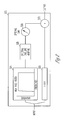
- FIG. 1 is a block diagram of a hearing assistance device including a frequency translation element according to one embodiment of the present subject matter.
- FIG. 2 is a signal flow diagram of a frequency translation system according to one embodiment of the present subject matter.
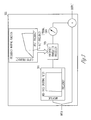
- FIG. 3 is a signal flow diagram of a frequency translation system according to one embodiment of the present subject matter.
- FIG. 4 illustrates a frequency warping function used in the frequency translation system according to one embodiment of the present subject matter.
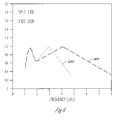
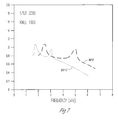
- FIGS. 5-7 demonstrate data for various frequency translations using different combinations of splitting frequency, knee frequency and warping ratio, according to various embodiments of the present subject matter.
- FIGS. 8A and 8B demonstrate one example of the effect of warping on the spectral envelope using a frequency translation system according to one embodiment of the present subject matter.
- FIG. 9 is a signal flow diagram demonstrating a time domain spectral envelope warping process for the frequency translation system according to one embodiment of the present subject matter.
- FIG. 10 is a signal flow diagram demonstrating a frequency domain spectral envelope warping process for the frequency translation system according to one embodiment of the present subject matter.
- FIG.11 is a signal flow diagram demonstrating a time domain spectral envelope warping process for the frequency translation system combining the whitening and shaping filters according to one embodiment of the present subject matter.
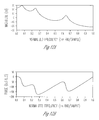
- FIGS. 12A and 12B show magnitude and frequency plots as a function of normalized frequency, according to one embodiment of the present subject matter.
- FIGS. 13A and 13B show spectral envelope (A(k)) roots before and after warping according to one embodiment of the present subject matter.
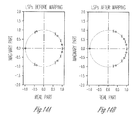
- FIGS. 14A and 14B show roots of P(k) (o's) and Q(k) (x's) before and after warping according to one embodiment of the present subject matter.
- FIG. 15 shows a plot of the roots of a spectral envelope constructed from warped line spectral frequencies according to one embodiment of the present subject matter.
- the present subject matter relates to improved speech intelligibility in a hearing assistance device using frequency translation by high-frequency spectral envelope warping.
- the system described herein implements an algorithm for performing frequency translation in an audio signal processing device for the purpose of improving perceived sound quality and speech intelligibility in an audio signal when presented using a system having reduced bandwidth relative to the original signal, or when presented to a hearing-impaired listener sensitive to only a reduced range of acoustic frequencies.
- One goal of the proposed system is to improve speech intelligibility in the reduced-bandwidth presentation of the processed signal, without compromising the overall sound quality, that is, without introducing undesirable perceptual artifacts in the processed signal.
- the system In embodiments implemented in a real-time listening device, such as a hearing aid, the system must conform to the computation, latency, and storage constraints of such real-time signal processing systems.
- FIG. 1 demonstrates a block diagram of a hearing assistance device including a frequency translation element according to one embodiment of the present subject matter.
- the hearing assistance device includes a microphone 110 which provides signals to the electronics 120.
- the electronics 120 provide a processed signal for speaker 112.
- the electronics 120 include, but are not limited to, hearing assistance device system 124 and frequency translation system 122. It is understood that such electronics and systems may be implemented in hardware, software, firmware, and various combinations thereof. It is also understood that certain applications may not employ this exact set of components and/or arrangement. For example, in the application of cochlear implants, no speaker 112 is necessary.
- speaker 112 is also referred to as a "receiver.”
- electronics 120 may be implemented in different embodiments, including analog hardware, digital hardware, or various combinations thereof.
- electronics 120 may be a digital signal processor or other form of processor. It is understood that electronics 120 in various embodiments may include additional devices such as memory or other circuits.
- hearing assistance device system 124 is implemented using a time domain approach. In one digital hearing aid embodiment, hearing assistance device system 124 is implemented using a frequency domain approach.
- the hearing assistance device system 124 may be programmed to perform hearing aid functions including, but not limited to, programmable frequency-gain, acoustic feedback cancellation, peak limiting, environment detection, and/or data logging, to name only a few.
- the frequency translation system 122 and hearing assistance device system 124 are implemented by programming the digital signal processor to perform the desired algorithms on the signal received from microphone 110.
- such systems include embodiments that perform both frequency translation and hearing aid processing in a common digital signal processor. It is understood that such systems include embodiments that perform frequency translation and hearing aid processing using different processors. Variations of hardware, firmware, and software may be employed without departing from the scope of the present subject matter.
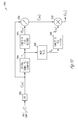
- FIG. 2 is a signal flow diagram of a frequency translation system 122 according to one embodiment of the present subject matter.
- the diagram in FIG. 2 depicts a two-branch algorithm in which the spectral envelope of the signal in the high-pass branch is warped such that peaks in the spectral envelope are translated to lower frequencies.
- the spectral envelope of the signal in the high-pass branch is estimated by linear predictive analysis, and the frequencies of the peaks in the spectral envelope are determined from the coefficients of the filter so derived.
- linear predictive analysis approaches are possible.
- One source of information about linear prediction is provided by John Makhoul in Linear Prediction: A tutorial Review, Proceedings of the IEEE, Vol. 63, No. 4, April 1975 , which is incorporated by reference in its entirety.
- Linear prediction includes, but is not limited to, autoregressive modeling or all-pole modeling.
- the peak frequencies are translated to new (lower) frequencies and used to specify a synthesis filter, which is applied to the residue signal obtained by inverse-filtering the analyzed signal by the unmodified (before warping) prediction filter.
- the (warped) filtered residue signal possibly with some gain applied, is combined with the signal in the lower branch (not processed by frequency translation) of the algorithm to produce the final output signal.
- the system of FIG. 2 includes two signal branches.
- the upper branch in the block diagram in FIG. 2 contains the frequency translation processing 220 performed on the audio signal.
- frequency translation processing 220 is applied only to the signal in a highpass (or high bandpass) region of the spectrum passed by filter 214.
- the signal in the lower branch is not processed by frequency translation.
- the filter 210 in the lower branch of the diagram may have a lowpass or allpass characteristic, and should, at a minimum, pass all of the energy rejected by the filter in the upper branch, so that all of the spectral energy in the signal is represented in at least one of the branches of the algorithm.
- the processed and unprocessed signals are combined in the summing block 212 at the right edge of the block diagram to produce the overall output of the system.
- a gain control 230 may be optionally included in the upper branch to regulate the amount of the processed signal energy in the final output.
- FIG. 3 shows more detail of one frequency translation system of FIG. 2 according to one embodiment of the present subject matter.
- the leftmost block of the processing branch of frequency translation system 322 is called a splitting filter 314.
- the function of the splitting filter 314 is to isolate the high-frequency part of the input audio signal for frequency translation processing.
- the cutoff frequency of this high-pass (or high bandpass) filter 314 is one of the parameters of the system, and we will call it the splitting frequency.
- a splitting filter 314 in our system is to leave unaltered the low-frequency part of the audio signal, which is the part that lies within the limited-bandwidth region in which the signal will be presented or received, and that usually dominates the sound quality of the overall signal.
- Frequency translation processing is to be applied primarily to parts of the signal that would otherwise be inaudible, or fall outside of the limited available bandwidth.
- speech processing applications it is intended that primarily the parts of speech having substantial high-frequency content, such as fricative and sibilant consonants, are frequency translated.
- spectral regions such as the lower-frequency regions containing harmonic information, critical for the perceived voice quality, and the first two vowel formants, critical for vowel perception, may be unaffected by the processing, because they will be suppressed by the splitting filter 314.
- the frequency translation processor 320 is programmed to perform a piecewise linear frequency warping function. Greater detail of one embodiment is provided in FIG. 4 , which depicts an input-output frequency relationship.
- the warping function consists of two regions: a low-frequency region 410 in which no warping is applied, and a high-frequency warping region 420, in which energy is translated from higher to lower frequencies.
- the frequency corresponding to the breakpoint in this function, dividing the two regions, is called the knee point, or knee frequency 430, in the warping curve.
- Energy above this frequency is translated towards, but not below, the knee frequency 430.
- the amount by which this energy is translated in frequency is determined by the slope of the frequency warping curve in the warping region called a warping ratio.
- the warping ratio is the inverse of the slope of the warping function above the knee point.
- the knee point and warping ratio are parameters of the frequency translation algorithm.
- FIGS. 5 through 7 depict the frequency translation processing for three different configurations of the three parameters.
- the abscissa represents increasing frequency, the units on the ordinate are arbitrary.
- the line having large dashes represents a hypothetical input frequency envelope, and the line with small dots represents the corresponding translated spectral envelope.
- the splitting frequency and knee frequency are both 2 kHz, so energy in the envelope above 2 kHz is warped toward that frequency. The overall signal bandwidth is reduced and the peaks in the envelope have been translated to lower frequencies.
- FIG. 5 depict the frequency translation processing for three different configurations of the three parameters.
- the abscissa represents increasing frequency, the units on the ordinate are arbitrary.
- the line having large dashes represents a hypothetical input frequency envelope, and the line with small dots represents the corresponding translated spectral envelope.
- the splitting frequency and knee frequency are both 2 kHz, so energy in the envelope above 2 kHz is warped toward that frequency.
- the overall signal bandwidth is reduced and the peaks in the envelope have been
- FIG. 6 depicts the case of the splitting frequency, at 1 kHz, being lower than the knee frequency in the warping function.
- energy above 1 kHz is processed by frequency translation, but energy below 2 kHz is not translated, so one of the peaks in the spectral envelope is translated as shown in FIG. 6 .
- some of the energy in the processing branch the energy between 1 kHz (the splitting frequency) and 2 kHz (the knee frequency) is not translated to lower frequencies because it is below the knee frequency.
- the knee frequency in the frequency warping curve is 1 kHz, lower in frequency than the splitting frequency, which remains at 2 kHz.
- FIGS. 5-7 show how the various settings of the algorithm parameters translate peaks in the spectral envelope. In various embodiments, these figures depict changes to the signal in the highpass branch only. In such embodiments, there is no overall signal bandwidth reduction in general, because the processed signal is ultimately mixed in with the original signal.
- the frequency warping function governs the behavior of the frequency translation processor, whose function is to alter the shape of the spectral envelope of the processed signal.
- the pitch of the signal is not changed, because the spectral envelope, and not the fine structure, is affected by the frequency translation process..
- FIGS. 8A and 8b shows the spectral envelope for a short segment of speech before ( FIG. 8A ) and after ( FIG. 8B ) frequency translation processing.
- the spectral envelope is estimated for a short-time segment of the input signal by a method of linear prediction (also known as autoregressive modeling), in which a signal is decomposed into an all-pole (recursive, or autoregressive) filter describing the spectral envelope of the signal, and a whitened (spectrally-flattened) excitation signal that can be processed by the all-pole filter to recover the original signal.
- the frequencies of the filter's complex pole pairs determine the location of peaks in the spectral envelope. There are three peaks in the spectral envelope depicted in FIGS 8A and 8B , corresponding to three pairs of poles (six non-trivial filter coefficients) in the estimated all-pole filter. Consequently, the number of coefficients used in the estimation of the spectral envelope is a parameter of the algorithm.
- a whitened excitation signal derived from linear predictive analysis, is processed using a warped spectral envelope filter to construct a new signal whose spectral envelope is a warped version of the envelope of the input signal, having peaks above the knee frequency translated to lower frequencies.
- the peak frequencies are computed directly from the values of the complex poles in the filter derived by linear prediction.
- the peak frequencies are estimated by examination of the frequency response of the filter. Other approaches for determining the peak frequencies are possible without departing from the scope of the present subject matter.
- a new warped spectral envelope is specified which is used to determine the coefficients of the warped spectral envelope filter.
- the filter pole frequencies can be modified directly, so that the spectral envelope described by the filter is warped, and peak frequencies above the knee frequency (such as 2 kHz shown in FIGS. 8A and 8B ) in the warping function are translated toward, but not below, that frequency. It is understood that in some cases, two filter poles can be close together in frequency, creating a peak in the spectral envelope at a frequency that is different from the two pole frequencies. It is understood that various approaches to translating peak frequencies can be applied. In one embodiment, new pole frequencies are specified to produce a desired translation of envelope peak frequencies. In one embodiment, a new envelope peak frequency is specified. Other approaches are possible without departing from the scope of the present subject matter.
- the whitened excitation signal may be subjected to further processing to mitigate artifacts that are introduced when the high-frequency part of the input signal contains very strong tonal or sinusoidal components.
- the excitation signal may be made maximally noise-like (and less impulsive) by a phase randomization process. This can be achieved in the frequency domain by computing the discrete Fourier transform (DFT) of the excitation signal, and expressing the complex spectrum in polar form (magnitude and phase, or angle).
- DFT discrete Fourier transform
- the excitation signal may be replaced by a shaped (filtered) noise signal.
- the noise may be shaped to behave like a speech-like spectrum, or may be shaped by a highpass filter, and possibly using the same splitting filter used to isolate the high-frequency part of the input signal. In such an implementation, it is generally not necessary to compute the excitation (prediction error) signal in the linear predictive analysis stage.
- the excitation signal may be subjected to dynamics processing, such as dynamic range compression or limiting, or to non-linear waveform distortion to reduce its impulsiveness, and the artifacts associated with frequency transposition of signals with strongly tonal high-frequency components.
- dynamics processing such as dynamic range compression or limiting, or to non-linear waveform distortion to reduce its impulsiveness, and the artifacts associated with frequency transposition of signals with strongly tonal high-frequency components.
- the output of the frequency translation processor consisting of the high-frequency part of the input signal having its spectral envelope warped so that peaks in the envelope are translated to lower frequencies, and optionally scaled by a gain control, is combined with the original, unmodified signal to produce the output of the algorithm.
- the present system provides the ability to govern in very specific ways the energy injected at lower frequencies according to the presence of energy at higher frequencies.
- FIG. 9 shows a time domain spectral envelope warping process according to one embodiment of the present subject matter. It is understood that this example is not intended to be limiting or exclusive, but rather demonstrative of one way to implement a time domain warping process.
- sound is sampled from a microphone or other sound source (x(t)) and provided to the spectral envelope warping system 900.
- the input samples are applied to a linear prediction analysis block 903 and a finite-impulse-response filter 904 ("FIR filter 904").
- the outputs of the linear prediction analysis block 902 are filter coefficients (h k ) which are used by the FIR filter 904 to filter the input samples (x(t)) to produce the prediction error, or excitation signal, e(t).
- the filter coefficients (h k ) are used to find polynomial roots (P k ) 905 which are then warped to provide warped poles ( ⁇ P k ⁇ ) 907.
- the excitation signal, e(t), and warped poles ( ⁇ P k ⁇ ) are used by an all pole filter 908, such as a biquad filter arrangement, to filter the excitation signal with the warped all pole filter.
- the resultant output is a sampled warped spectral envelope signal ( ⁇ x(t) ⁇ ).
- FIG. 10 shows a frequency domain spectral envelope warping process according to one embodiment of the present subject matter. It is understood that this example is not intended to be limiting or exclusive, but rather demonstrative of one way to implement a frequency domain warping process.
- the spectral domain pole estimation block 1003 is used to find polynomial roots (P k ) which are then converted into a complex frequency response H(w k ) by process 1005.
- the input sub-band signals X(w k ) are divided by the complex frequency response H(w k ) by divider 1004 to whiten the spectrum of the input sub-band signals X(w k ) and to produce a complex sub-band prediction error, or complex sub-band excitation signal, E(w k ).
- the polynomial roots (P k ) are then warped to provide warped poles ( ⁇ P k ⁇ ) 1007.
- the warped poles ( ⁇ P k ⁇ ) are converted to a complex frequency response ⁇ H(w k ) ⁇ 1009.
- the complex sub-band excitation signal, E(w k ), and complex frequency response ⁇ H(w k ) ⁇ are multiplied 1010 to provide a sampled warped spectral envelope signal in the frequency domain ⁇ X(w k ) ⁇ .
- This sampled warped spectral envelope signal in the frequency domain ⁇ X(w k ) ⁇ can be further processed in the frequency domain by other processes and ultimately converted into the time domain for transmission of processed sound according to one embodiment of present subject matter.
- computational savings can be achieved by combining the application of the all-zero FIR filter, to generate the prediction error signal, and the application of the all-pole warped spectral envelope filter to the excitation signal, into a single filtering step.
- the all-pole spectral envelope filter is normally implemented as a cascade (or sequence) of second-order filter sections, so-called biquad sections or biquads.
- biquad sections or biquads.
- Those practiced in the art will recognize that, for reasons of numerical stability and accuracy, as well as efficiency, high-order recursive filters should be implemented as a cascade of low-order filter sections.
- each biquad section has only two poles in its transfer functions, and no (non-trivial) zeros.
- the zeros in the FIR filter can be implemented in the biquad sections along with the spectral envelope poles, and in this case, the FIR filtering step in the original frequency translation algorithm can be eliminated entirely.
- An example is provided by the system 1100 in FIG. 11 .
- input samples x(t) are provided to the linear prediction block 1103 and biquad filters (or filter sections) 1108.
- the output of linear prediction block 1103 is provided to find the polynomial roots 1105, P k .
- the polynomial roots P k are provided to biquad filters 1108 and to the pole warping block 1107.
- the roots P k specify the zeros in the biquad filter sections.
- the resulting output of pole warping block 1107, ⁇ P k ⁇ is applied to the biquad filters 1108 to produce the warped output ⁇ x(t) ⁇ .
- the warped roots ⁇ P k ⁇ specify the poles in the biquad filter sections.
- the zeros corresponding to (unwarped) roots of the predictor polynomial should be paired in a single biquad section with their counterpart warped poles in the frequency translation algorithm. Since not all poles in the spectral envelope are transformed in the frequency translation algorithm (only complex poles above a specified knee frequency), some of the biquad sections that result from this pairing will have unity transfer functions (the zeros and unwarped poles will coincide). Since the application of these sections ultimately has no effect on a signal, they can be omitted entirely, resulting in computational savings and improved filter stability.
- the highpass splitting filter makes poles on the positive real axis uncommon, but it frequently happens that poles are found on the negative real axis (poles at the Nyquist frequency, or half the sampling frequency) and these poles should not be warped, but should rather remain real poles (at the Nyquist frequency) in the warped spectral envelope. Moreover, it may happen that a pole is found below the knee frequency in the warping function, and such a pole need not be warped. Poles such as these whose frequencies are not warped can be omitted entirely from the filter design.
- this modification may make the biquad filter sections more numerically stable.
- filter sections including both poles and zeros are implemented, rather than only poles.
- FIG. 11 can be implemented in the frequency domain by combining the frequency response H(w k ) and the warped frequency response ⁇ H(w k ) ⁇ of FIG. 10 before performing the multiply 1010.
- Other frequency domain variations are possible without departing from the scope of the present subject matter.
- the processes for performing frequency translation depicted in the block 122 of FIG. 1 can be performed using different approaches. Some embodiments provide less computational cost associated with the core frequency translation algorithm than others.
- a method is employed for warping the parameters of the spectral envelope that does not require that the predictor polynomial to be factored to identify its roots.
- the identification of spectral envelope poles requires finding the roots of the polynomial described by the predictor coefficients (for example, see block 905 of FIG. 9 ).
- Arbitrary polynomial roots are found using one of a variety of successive approximation algorithms, such as the Newton-Raphson algorithm or Laguerre's method. These algorithms may be more costly to implement, may be more sensitive to numerical errors and may have convergence issues or give erroneous results.
- the polynomials P and Q have at least two advantages over the predictor polynomial A.
- One advantage is that they are less sensitive to quantization errors.
- the corruption of the coefficients that occurs in quantization has little effect on the stability or shape of the polynomial function, whereas small errors in the coefficients of A may introduce large distortions in the spectral envelope, and may make the all-pole filter unstable (may move a pole outside the unit circle).
- all the coefficients of P and Q are approximately equally sensitive to errors, whereas in the polynomial A, the higher order coefficients are much more sensitive to errors.
- FIGS 12A and 12B show the magnitude and phase response of a spectral envelope having three prominent peaks.
- the poles of the corresponding all-pole filter are shown on the Z-plane plot of FIG 13A .
- the Z-plane plot of FIG. 13B shows the poles in the warped all-pole filter that would result from warping by a factor of 2 all poles in the original polynomial having frequency greater than Pi/10.
- the normalized (to the range 0...1) frequencies before warping are:
- FIGS. 14A and 14B show the roots of the corresponding polynomials P(k) and Q(k) before and after warping.
- the normalized frequencies for the polynomials P(k) and Q(k) are:
- the frequencies of the roots of P(k) are quite closely related to the frequencies of the poles of A(k), and therefore they undergo a very similar transformation.
- spectral envelope warping can be performed on the line spectral pairs, which are easy to find, rather than the poles of the predictor polynomial itself.
- the line spectral frequencies are warped in the same way as the linear prediction frequencies. This has the effect of sharpening all of the poles of the reconstructed polynomial (moving them closer to the unit circle).
- the difference between the line spectral frequencies that bracket a pole are preserved in the warping. This tends to preserve the shape of the peaks in the spectral envelope, but can introduce problems with surrounding line spectral frequencies. This method highlights the added benefit of omitting extra line spectral frequencies from the warped set.
- Line spectral frequencies is relatively computationally quick and efficient compared to the earlier methods of finding roots of the LPC polynomial.
- the line spectral frequencies are not exactly the roots or poles of the spectral envelope, but pairs of line spectral frequencies bracket spectral envelope poles. Larger magnitude poles are more tightly bracketed by pairs of line spectral frequencies.
- spectral envelope peaks are translated by translating the corresponding line spectral frequencies. Peaks can be sharpened by moving the corresponding line spectral frequencies closer together.
- line spectral frequencies that do not bracket a pole can be eliminated.
- B(n) are the coefficients of the predictor polynomial (the coefficients h K for at, for example, block 904 of FIG.9 ) and and A(n) are coefficients of a polynomial constructed from the warped line spectral frequencies.
- an N-order ARMA filter can be implemented directly, without conversion to biquad sections.
- some of the frequencies that do not correspond to poles can be optionally eliminated. This creates an A(n) of lower order than B(n). Further variations can remove the corresponding line spectral frequencies from the non-warped set to reduce the order of B(n).
- one variation of the present process includes a hybrid approach, which includes, but is not limited to:
- the present subject matter includes a method for processing an audio signal received by a hearing assistance device, including: filtering the audio signal to generate a high frequency filtered signal, the filtering performed at a splitting frequency; transposing at least a portion of an audio spectrum of the filtered signal to a lower frequency range by a transposition process to produce a transposed audio signal; and summing the transposed audio signal with the audio signal to generate an output signal, wherein the transposition process includes: estimating an all-pole spectral envelope of the filtered signal from a plurality of line spectral frequencies; applying a warping function to the all-pole spectral envelope of the filtered signal to translate the poles above a specified knee frequency to lower frequencies, thereby producing a warped spectral envelope; and exciting the warped spectral envelope with an excitation signal to synthesize the transposed audio signal.
- the filtering includes, but is not limited to high pass filtering or high bandpass filtering.
- the estimating includes performing linear prediction. In various embodiments, the estimating is done in the frequency domain. In various embodiments the estimating is done in the time domain.
- the excitation signal is a prediction error signal, produced by filtering the high-pass signal with an inverse of the estimated all-pole spectral envelope.
- the present subject matter in various embodiments includes randomizing a phase of the prediction error signal, including translating the prediction error signal to the frequency domain using a discrete Fourier Transform; randomizing a phase of components below a Nyquist frequency; replacing components above the Nyquist frequency by a complex conjugate of the corresponding components below the Nyquist frequency to produce a valid spectrum of a purely real time domain signal; inverting the DFT to produce a time domain signal; and using the time domain signal as the excitation signal.
- the prediction error signal is processed by using, among other things, a compressor, peak limiter, or other nonlinear distortion to reduce a peak dynamic range of the excitation signal.
- the excitation signal is a spectrally shaped or filtered noise signal.
- the system includes combining the transposed signal with a low-pass filtered version of the audio signal to produce a combined output signal, and in some embodiments the transposed signal is adjusted by a gain factor prior to combining.
- the system also provides the ability to modify pole magnitudes and frequencies.
- hearing assistance devices including, but not limited to, cochlear implant type hearing devices, hearing aids, such as behind-the-ear (BTE), in-the-ear (ITE), in-the-canal (ITC), or completely-in-the-canal (CIC) type hearing aids.
- BTE behind-the-ear
- ITE in-the-ear
- ITC in-the-canal
- CIC completely-in-the-canal
- hearing assistance devices including, but not limited to, cochlear implant type hearing devices, hearing aids, such as behind-the-ear (BTE), in-the-ear (ITE), in-the-canal (ITC), or completely-in-the-canal (CIC) type hearing aids.
- BTE behind-the-ear
- ITE in-the-ear
- ITC in-the-canal
- CIC completely-in-the-canal
- hearing assistance devices may fall within the scope of the present subject matter
Landscapes
- Health & Medical Sciences (AREA)
- General Health & Medical Sciences (AREA)
- Neurosurgery (AREA)
- Otolaryngology (AREA)
- Physics & Mathematics (AREA)
- Engineering & Computer Science (AREA)
- Acoustics & Sound (AREA)
- Signal Processing (AREA)
- Circuit For Audible Band Transducer (AREA)
- Compression, Expansion, Code Conversion, And Decoders (AREA)
Applications Claiming Priority (1)
| Application Number | Priority Date | Filing Date | Title |
|---|---|---|---|
| US17599309P | 2009-05-06 | 2009-05-06 |
Publications (3)
| Publication Number | Publication Date |
|---|---|
| EP2249587A2 true EP2249587A2 (fr) | 2010-11-10 |
| EP2249587A3 EP2249587A3 (fr) | 2012-02-22 |
| EP2249587B1 EP2249587B1 (fr) | 2017-08-30 |
Family
ID=42543401
Family Applications (1)
| Application Number | Title | Priority Date | Filing Date |
|---|---|---|---|
| EP10250883.5A Active EP2249587B1 (fr) | 2009-05-06 | 2010-05-06 | Transposition en fréquence par réajustement à haute fréquence de l'enveloppe spectrale& xA; pour prothèses auditives |
Country Status (3)
| Country | Link |
|---|---|
| US (2) | US8526650B2 (fr) |
| EP (1) | EP2249587B1 (fr) |
| DK (1) | DK2249587T3 (fr) |
Cited By (7)
| Publication number | Priority date | Publication date | Assignee | Title |
|---|---|---|---|---|
| CN103915101A (zh) * | 2012-12-31 | 2014-07-09 | Nxp股份有限公司 | 信号处理装置及其操作方法 |
| CN104217728A (zh) * | 2014-09-09 | 2014-12-17 | 联想(北京)有限公司 | 一种音频处理方法及电子设备 |
| CN104349258A (zh) * | 2013-08-08 | 2015-02-11 | 奥迪康有限公司 | 助听器装置及反馈降低方法 |
| EP2675191A3 (fr) * | 2012-06-15 | 2015-05-06 | Starkey Laboratories, Inc. | Translation de fréquence dans des dispositifs d'assistance auditive par synthèse spectrale additive |
| EP2965793A1 (fr) * | 2014-07-09 | 2016-01-13 | Kazutoshi Obana | Système de génération de vibrations, appareil de génération de vibrations, programme de génération de signaux de vibrations et procédé de génération de vibrations |
| US9843875B2 (en) | 2015-09-25 | 2017-12-12 | Starkey Laboratories, Inc. | Binaurally coordinated frequency translation in hearing assistance devices |
| US10575103B2 (en) | 2015-04-10 | 2020-02-25 | Starkey Laboratories, Inc. | Neural network-driven frequency translation |
Families Citing this family (6)
| Publication number | Priority date | Publication date | Assignee | Title |
|---|---|---|---|---|
| US8000487B2 (en) | 2008-03-06 | 2011-08-16 | Starkey Laboratories, Inc. | Frequency translation by high-frequency spectral envelope warping in hearing assistance devices |
| US8526650B2 (en) | 2009-05-06 | 2013-09-03 | Starkey Laboratories, Inc. | Frequency translation by high-frequency spectral envelope warping in hearing assistance devices |
| ES3051141T3 (en) | 2009-10-21 | 2025-12-26 | Dolby Int Ab | Oversampling in a combined transposer filter bank |
| US20120197643A1 (en) * | 2011-01-27 | 2012-08-02 | General Motors Llc | Mapping obstruent speech energy to lower frequencies |
| US10390147B2 (en) * | 2015-02-24 | 2019-08-20 | Gn Hearing A/S | Frequency mapping for hearing devices |
| EP4014513A1 (fr) | 2019-08-15 | 2022-06-22 | Starkey Laboratories, Inc. | Systèmes, dispositifs, et procédés permettant d'ajuster des dispositifs d'aide auditive |
Citations (5)
| Publication number | Priority date | Publication date | Assignee | Title |
|---|---|---|---|---|
| US5014319A (en) | 1988-02-15 | 1991-05-07 | Avr Communications Ltd. | Frequency transposing hearing aid |
| US5571299A (en) | 1995-04-28 | 1996-11-05 | Tonn; Harold H. | Dust collector |
| WO2000075920A1 (fr) | 1999-06-03 | 2000-12-14 | Telefonaktiebolaget Lm Ericsson (Publ) | Procede permettant d'ameliorer l'intelligibilite d'un signal sonore, et dispositif de reproduction d'un signal sonore |
| US6577739B1 (en) | 1997-09-19 | 2003-06-10 | University Of Iowa Research Foundation | Apparatus and methods for proportional audio compression and frequency shifting |
| US20040264721A1 (en) | 2003-03-06 | 2004-12-30 | Phonak Ag | Method for frequency transposition and use of the method in a hearing device and a communication device |
Family Cites Families (12)
| Publication number | Priority date | Publication date | Assignee | Title |
|---|---|---|---|---|
| US6169813B1 (en) * | 1994-03-16 | 2001-01-02 | Hearing Innovations Incorporated | Frequency transpositional hearing aid with single sideband modulation |
| US5771299A (en) | 1996-06-20 | 1998-06-23 | Audiologic, Inc. | Spectral transposition of a digital audio signal |
| US6238450B1 (en) | 1999-06-16 | 2001-05-29 | Saint-Gobain Industrial Ceramics, Inc. | Ceria powder |
| US7277554B2 (en) | 2001-08-08 | 2007-10-02 | Gn Resound North America Corporation | Dynamic range compression using digital frequency warping |
| AU2003904207A0 (en) * | 2003-08-11 | 2003-08-21 | Vast Audio Pty Ltd | Enhancement of sound externalization and separation for hearing-impaired listeners: a spatial hearing-aid |
| US7813931B2 (en) | 2005-04-20 | 2010-10-12 | QNX Software Systems, Co. | System for improving speech quality and intelligibility with bandwidth compression/expansion |
| AU2005201813B2 (en) | 2005-04-29 | 2011-03-24 | Phonak Ag | Sound processing with frequency transposition |
| US20080215330A1 (en) | 2005-07-21 | 2008-09-04 | Koninklijke Philips Electronics, N.V. | Audio Signal Modification |
| DK2177054T3 (en) | 2007-07-31 | 2014-05-26 | Phonak Ag | Method for adjusting a hearing device with frequency transposition and corresponding arrangement |
| US8000487B2 (en) | 2008-03-06 | 2011-08-16 | Starkey Laboratories, Inc. | Frequency translation by high-frequency spectral envelope warping in hearing assistance devices |
| US8526650B2 (en) | 2009-05-06 | 2013-09-03 | Starkey Laboratories, Inc. | Frequency translation by high-frequency spectral envelope warping in hearing assistance devices |
| US8787605B2 (en) | 2012-06-15 | 2014-07-22 | Starkey Laboratories, Inc. | Frequency translation in hearing assistance devices using additive spectral synthesis |
-
2010
- 2010-05-05 US US12/774,356 patent/US8526650B2/en active Active
- 2010-05-06 EP EP10250883.5A patent/EP2249587B1/fr active Active
- 2010-05-06 DK DK10250883.5T patent/DK2249587T3/en active
-
2013
- 2013-09-03 US US14/017,093 patent/US9060231B2/en active Active
Patent Citations (5)
| Publication number | Priority date | Publication date | Assignee | Title |
|---|---|---|---|---|
| US5014319A (en) | 1988-02-15 | 1991-05-07 | Avr Communications Ltd. | Frequency transposing hearing aid |
| US5571299A (en) | 1995-04-28 | 1996-11-05 | Tonn; Harold H. | Dust collector |
| US6577739B1 (en) | 1997-09-19 | 2003-06-10 | University Of Iowa Research Foundation | Apparatus and methods for proportional audio compression and frequency shifting |
| WO2000075920A1 (fr) | 1999-06-03 | 2000-12-14 | Telefonaktiebolaget Lm Ericsson (Publ) | Procede permettant d'ameliorer l'intelligibilite d'un signal sonore, et dispositif de reproduction d'un signal sonore |
| US20040264721A1 (en) | 2003-03-06 | 2004-12-30 | Phonak Ag | Method for frequency transposition and use of the method in a hearing device and a communication device |
Non-Patent Citations (9)
| Title |
|---|
| 1993 IEEE WORKSHOP, 17 October 1993 (1993-10-17), pages 89 - 92 |
| FRANCIS KUK; PETRI KORHONEN; HEIDI PEETERS; DENISE KEENAN; ANDERS JESSEN; HENNING ANDERSEN: "Linear Frequency Transposition: Extending the Audibility of High-Frequency Information", HEARING REVIEW, October 2006 (2006-10-01) |
| HERMANSEN, K.; FINK, F.K.; HARTMANN, U; HANSEN, V.M.: "Final Program and Paper Summaries", APPLICATIONS OF SIGNAL PROCESSING TO AUDIO AND ACOUSTICS, 1993 |
| HERMANSEN; FINK; HARTMANN, HEARING AIDS FOR PROFOUNDLY DEAF PEOPLE BASED ON A NEW PARAMETRIC CONCEPT, 1993 |
| JOHN MAKHOUL: "Linear Prediction: A Tutorial Review", PROCEEDINGS OF THE IEEE, vol. 63, no. 4, April 1975 (1975-04-01), XP000891549 |
| MCDERMOT, H. J.; DORKOS, V. P.; DEAN, M. R.; CHING, T. Y.: "Improvements in Speech Perception with use of the AVR TranSonic Frequency-Transposing Hearing Aid", J SPEECH LANG. HEAR. RES., vol. 42, no. 6, December 1999 (1999-12-01), pages 1323 - 35, XP008123792 |
| MCDERMOTT, H.J.; KNIGHT, M. R.: "Preliminary results with the AVR ImpaCt Frequency-Transposing Hearing Aid", J AM. ACAD. AUDIOL., vol. 12, no. 3, March 2001 (2001-03-01), pages 121 - 7 |
| SIMPSON, A.; HERSBACH, A. A.; MCDERMOTT, H.J.: "Improvements in speech perception with an experimental nonlinear frequency compression hearing device", INT JAUDIOL., vol. 44, no. 5, May 2005 (2005-05-01), pages 281 - 92 |
| TURNER, C.W.; HURTIG, R.R.: "Proportional frequency compression of speech for listeners with sensorineural hearing loss", J ACOUST SOC AM., vol. 106, no. 2, August 1999 (1999-08-01), pages 877 - 86, XP012001153, DOI: doi:10.1121/1.427103 |
Cited By (16)
| Publication number | Priority date | Publication date | Assignee | Title |
|---|---|---|---|---|
| EP2675191A3 (fr) * | 2012-06-15 | 2015-05-06 | Starkey Laboratories, Inc. | Translation de fréquence dans des dispositifs d'assistance auditive par synthèse spectrale additive |
| CN103915101A (zh) * | 2012-12-31 | 2014-07-09 | Nxp股份有限公司 | 信号处理装置及其操作方法 |
| US10136228B2 (en) | 2013-08-08 | 2018-11-20 | Oticon A/S | Hearing aid device and method for feedback reduction |
| CN104349258A (zh) * | 2013-08-08 | 2015-02-11 | 奥迪康有限公司 | 助听器装置及反馈降低方法 |
| US9344814B2 (en) | 2013-08-08 | 2016-05-17 | Oticon A/S | Hearing aid device and method for feedback reduction |
| EP2835985A1 (fr) * | 2013-08-08 | 2015-02-11 | Oticon A/s | Dispositif d'aide auditive et procédé de réduction de la rétroaction |
| CN104349258B (zh) * | 2013-08-08 | 2019-08-06 | 奥迪康有限公司 | 助听器装置及反馈降低方法 |
| US10319199B2 (en) | 2014-07-09 | 2019-06-11 | Nintendo Co., Ltd. | Vibration generation system, vibration generation apparatus, storage medium having stored therein vibration signal generation program, and vibration generation method |
| EP2965793A1 (fr) * | 2014-07-09 | 2016-01-13 | Kazutoshi Obana | Système de génération de vibrations, appareil de génération de vibrations, programme de génération de signaux de vibrations et procédé de génération de vibrations |
| CN104217728A (zh) * | 2014-09-09 | 2014-12-17 | 联想(北京)有限公司 | 一种音频处理方法及电子设备 |
| US10575103B2 (en) | 2015-04-10 | 2020-02-25 | Starkey Laboratories, Inc. | Neural network-driven frequency translation |
| US11223909B2 (en) | 2015-04-10 | 2022-01-11 | Starkey Laboratories, Inc. | Neural network-driven frequency translation |
| US11736870B2 (en) | 2015-04-10 | 2023-08-22 | Starkey Laboratories, Inc. | Neural network-driven frequency translation |
| US12149890B2 (en) | 2015-04-10 | 2024-11-19 | Starkey Laboratories, Inc. | Neural network-driven frequency translation |
| US10313805B2 (en) | 2015-09-25 | 2019-06-04 | Starkey Laboratories, Inc. | Binaurally coordinated frequency translation in hearing assistance devices |
| US9843875B2 (en) | 2015-09-25 | 2017-12-12 | Starkey Laboratories, Inc. | Binaurally coordinated frequency translation in hearing assistance devices |
Also Published As
| Publication number | Publication date |
|---|---|
| EP2249587B1 (fr) | 2017-08-30 |
| US8526650B2 (en) | 2013-09-03 |
| DK2249587T3 (en) | 2017-12-04 |
| US20100284557A1 (en) | 2010-11-11 |
| US20140169600A1 (en) | 2014-06-19 |
| EP2249587A3 (fr) | 2012-02-22 |
| US9060231B2 (en) | 2015-06-16 |
Similar Documents
| Publication | Publication Date | Title |
|---|---|---|
| EP2099235B1 (fr) | Transposition en fréquence par réajustement à haute fréquence de l'enveloppe spectrale pour prothèses auditives | |
| US9060231B2 (en) | Frequency translation by high-frequency spectral envelope warping in hearing assistance devices | |
| DK2375785T3 (en) | Stability improvements in hearing aids | |
| EP2579252B1 (fr) | Améliorations de l'audibilité de la parole et de la stabilité dans les dispositifs auditifs | |
| DE102008031150B3 (de) | Verfahren zur Störgeräuschunterdrückung und zugehöriges Hörgerät | |
| US8948424B2 (en) | Hearing device and method for operating a hearing device with two-stage transformation | |
| JP6391198B2 (ja) | 補聴器システムの動作方法および補聴器システム | |
| US8787605B2 (en) | Frequency translation in hearing assistance devices using additive spectral synthesis | |
| Drgas et al. | Dynamic processing neural network architecture for hearing loss compensation | |
| US9843875B2 (en) | Binaurally coordinated frequency translation in hearing assistance devices | |
| JPWO2019203127A1 (ja) | 情報処理装置、これを用いたミキシング装置、及びレイテンシ減少方法 | |
| JP6159570B2 (ja) | 音声強調装置、及びプログラム | |
| Madhavi et al. | A Thorough Investigation on Designs of Digital Hearing Aid. | |
| Girisha et al. | STFT ALGORITHM FOR IMPLEMENTATION OF AUDITORY COMPENSATION IN HEARING AIDS | |
| WO2013050605A1 (fr) | Améliorations de la stabilité et de l'audibilité de la parole dans des dispositifs auditifs | |
| Rutledge et al. | Performance of sinusoidal model based amplitude compression in fluctuating noise |
Legal Events
| Date | Code | Title | Description |
|---|---|---|---|
| PUAI | Public reference made under article 153(3) epc to a published international application that has entered the european phase |
Free format text: ORIGINAL CODE: 0009012 |
|
| 17P | Request for examination filed |
Effective date: 20100519 |
|
| AK | Designated contracting states |
Kind code of ref document: A2 Designated state(s): AL AT BE BG CH CY CZ DE DK EE ES FI FR GB GR HR HU IE IS IT LI LT LU LV MC MK MT NL NO PL PT RO SE SI SK SM TR |
|
| AX | Request for extension of the european patent |
Extension state: BA ME RS |
|
| PUAL | Search report despatched |
Free format text: ORIGINAL CODE: 0009013 |
|
| AK | Designated contracting states |
Kind code of ref document: A3 Designated state(s): AL AT BE BG CH CY CZ DE DK EE ES FI FR GB GR HR HU IE IS IT LI LT LU LV MC MK MT NL NO PL PT RO SE SI SK SM TR |
|
| AX | Request for extension of the european patent |
Extension state: BA ME RS |
|
| RIC1 | Information provided on ipc code assigned before grant |
Ipc: H04R 25/00 20060101AFI20120117BHEP |
|
| 17Q | First examination report despatched |
Effective date: 20130925 |
|
| GRAP | Despatch of communication of intention to grant a patent |
Free format text: ORIGINAL CODE: EPIDOSNIGR1 |
|
| INTG | Intention to grant announced |
Effective date: 20170310 |
|
| GRAS | Grant fee paid |
Free format text: ORIGINAL CODE: EPIDOSNIGR3 |
|
| GRAA | (expected) grant |
Free format text: ORIGINAL CODE: 0009210 |
|
| AK | Designated contracting states |
Kind code of ref document: B1 Designated state(s): AL AT BE BG CH CY CZ DE DK EE ES FI FR GB GR HR HU IE IS IT LI LT LU LV MC MK MT NL NO PL PT RO SE SI SK SM TR |
|
| REG | Reference to a national code |
Ref country code: GB Ref legal event code: FG4D |
|
| REG | Reference to a national code |
Ref country code: CH Ref legal event code: EP |
|
| REG | Reference to a national code |
Ref country code: CH Ref legal event code: NV Representative=s name: SERVOPATENT GMBH, CH Ref country code: AT Ref legal event code: REF Ref document number: 924693 Country of ref document: AT Kind code of ref document: T Effective date: 20170915 |
|
| REG | Reference to a national code |
Ref country code: IE Ref legal event code: FG4D |
|
| REG | Reference to a national code |
Ref country code: DE Ref legal event code: R096 Ref document number: 602010044795 Country of ref document: DE |
|
| REG | Reference to a national code |
Ref country code: DK Ref legal event code: T3 Effective date: 20171127 |
|
| REG | Reference to a national code |
Ref country code: NL Ref legal event code: MP Effective date: 20170830 |
|
| REG | Reference to a national code |
Ref country code: LT Ref legal event code: MG4D |
|
| REG | Reference to a national code |
Ref country code: AT Ref legal event code: MK05 Ref document number: 924693 Country of ref document: AT Kind code of ref document: T Effective date: 20170830 |
|
| PG25 | Lapsed in a contracting state [announced via postgrant information from national office to epo] |
Ref country code: NO Free format text: LAPSE BECAUSE OF FAILURE TO SUBMIT A TRANSLATION OF THE DESCRIPTION OR TO PAY THE FEE WITHIN THE PRESCRIBED TIME-LIMIT Effective date: 20171130 Ref country code: LT Free format text: LAPSE BECAUSE OF FAILURE TO SUBMIT A TRANSLATION OF THE DESCRIPTION OR TO PAY THE FEE WITHIN THE PRESCRIBED TIME-LIMIT Effective date: 20170830 Ref country code: FI Free format text: LAPSE BECAUSE OF FAILURE TO SUBMIT A TRANSLATION OF THE DESCRIPTION OR TO PAY THE FEE WITHIN THE PRESCRIBED TIME-LIMIT Effective date: 20170830 Ref country code: AT Free format text: LAPSE BECAUSE OF FAILURE TO SUBMIT A TRANSLATION OF THE DESCRIPTION OR TO PAY THE FEE WITHIN THE PRESCRIBED TIME-LIMIT Effective date: 20170830 Ref country code: HR Free format text: LAPSE BECAUSE OF FAILURE TO SUBMIT A TRANSLATION OF THE DESCRIPTION OR TO PAY THE FEE WITHIN THE PRESCRIBED TIME-LIMIT Effective date: 20170830 Ref country code: SE Free format text: LAPSE BECAUSE OF FAILURE TO SUBMIT A TRANSLATION OF THE DESCRIPTION OR TO PAY THE FEE WITHIN THE PRESCRIBED TIME-LIMIT Effective date: 20170830 |
|
| PG25 | Lapsed in a contracting state [announced via postgrant information from national office to epo] |
Ref country code: LV Free format text: LAPSE BECAUSE OF FAILURE TO SUBMIT A TRANSLATION OF THE DESCRIPTION OR TO PAY THE FEE WITHIN THE PRESCRIBED TIME-LIMIT Effective date: 20170830 Ref country code: IS Free format text: LAPSE BECAUSE OF FAILURE TO SUBMIT A TRANSLATION OF THE DESCRIPTION OR TO PAY THE FEE WITHIN THE PRESCRIBED TIME-LIMIT Effective date: 20171230 Ref country code: ES Free format text: LAPSE BECAUSE OF FAILURE TO SUBMIT A TRANSLATION OF THE DESCRIPTION OR TO PAY THE FEE WITHIN THE PRESCRIBED TIME-LIMIT Effective date: 20170830 Ref country code: BG Free format text: LAPSE BECAUSE OF FAILURE TO SUBMIT A TRANSLATION OF THE DESCRIPTION OR TO PAY THE FEE WITHIN THE PRESCRIBED TIME-LIMIT Effective date: 20171130 Ref country code: GR Free format text: LAPSE BECAUSE OF FAILURE TO SUBMIT A TRANSLATION OF THE DESCRIPTION OR TO PAY THE FEE WITHIN THE PRESCRIBED TIME-LIMIT Effective date: 20171201 |
|
| PG25 | Lapsed in a contracting state [announced via postgrant information from national office to epo] |
Ref country code: NL Free format text: LAPSE BECAUSE OF FAILURE TO SUBMIT A TRANSLATION OF THE DESCRIPTION OR TO PAY THE FEE WITHIN THE PRESCRIBED TIME-LIMIT Effective date: 20170830 |
|
| PG25 | Lapsed in a contracting state [announced via postgrant information from national office to epo] |
Ref country code: CZ Free format text: LAPSE BECAUSE OF FAILURE TO SUBMIT A TRANSLATION OF THE DESCRIPTION OR TO PAY THE FEE WITHIN THE PRESCRIBED TIME-LIMIT Effective date: 20170830 Ref country code: RO Free format text: LAPSE BECAUSE OF FAILURE TO SUBMIT A TRANSLATION OF THE DESCRIPTION OR TO PAY THE FEE WITHIN THE PRESCRIBED TIME-LIMIT Effective date: 20170830 Ref country code: PL Free format text: LAPSE BECAUSE OF FAILURE TO SUBMIT A TRANSLATION OF THE DESCRIPTION OR TO PAY THE FEE WITHIN THE PRESCRIBED TIME-LIMIT Effective date: 20170830 |
|
| PG25 | Lapsed in a contracting state [announced via postgrant information from national office to epo] |
Ref country code: SM Free format text: LAPSE BECAUSE OF FAILURE TO SUBMIT A TRANSLATION OF THE DESCRIPTION OR TO PAY THE FEE WITHIN THE PRESCRIBED TIME-LIMIT Effective date: 20170830 Ref country code: IT Free format text: LAPSE BECAUSE OF FAILURE TO SUBMIT A TRANSLATION OF THE DESCRIPTION OR TO PAY THE FEE WITHIN THE PRESCRIBED TIME-LIMIT Effective date: 20170830 Ref country code: SK Free format text: LAPSE BECAUSE OF FAILURE TO SUBMIT A TRANSLATION OF THE DESCRIPTION OR TO PAY THE FEE WITHIN THE PRESCRIBED TIME-LIMIT Effective date: 20170830 Ref country code: EE Free format text: LAPSE BECAUSE OF FAILURE TO SUBMIT A TRANSLATION OF THE DESCRIPTION OR TO PAY THE FEE WITHIN THE PRESCRIBED TIME-LIMIT Effective date: 20170830 |
|
| REG | Reference to a national code |
Ref country code: DE Ref legal event code: R097 Ref document number: 602010044795 Country of ref document: DE |
|
| PLBE | No opposition filed within time limit |
Free format text: ORIGINAL CODE: 0009261 |
|
| STAA | Information on the status of an ep patent application or granted ep patent |
Free format text: STATUS: NO OPPOSITION FILED WITHIN TIME LIMIT |
|
| 26N | No opposition filed |
Effective date: 20180531 |
|
| PG25 | Lapsed in a contracting state [announced via postgrant information from national office to epo] |
Ref country code: SI Free format text: LAPSE BECAUSE OF FAILURE TO SUBMIT A TRANSLATION OF THE DESCRIPTION OR TO PAY THE FEE WITHIN THE PRESCRIBED TIME-LIMIT Effective date: 20170830 |
|
| GBPC | Gb: european patent ceased through non-payment of renewal fee |
Effective date: 20180506 |
|
| REG | Reference to a national code |
Ref country code: BE Ref legal event code: MM Effective date: 20180531 |
|
| PG25 | Lapsed in a contracting state [announced via postgrant information from national office to epo] |
Ref country code: MC Free format text: LAPSE BECAUSE OF FAILURE TO SUBMIT A TRANSLATION OF THE DESCRIPTION OR TO PAY THE FEE WITHIN THE PRESCRIBED TIME-LIMIT Effective date: 20170830 |
|
| REG | Reference to a national code |
Ref country code: IE Ref legal event code: MM4A |
|
| PG25 | Lapsed in a contracting state [announced via postgrant information from national office to epo] |
Ref country code: LU Free format text: LAPSE BECAUSE OF NON-PAYMENT OF DUE FEES Effective date: 20180506 |
|
| PG25 | Lapsed in a contracting state [announced via postgrant information from national office to epo] |
Ref country code: FR Free format text: LAPSE BECAUSE OF NON-PAYMENT OF DUE FEES Effective date: 20180531 Ref country code: GB Free format text: LAPSE BECAUSE OF NON-PAYMENT OF DUE FEES Effective date: 20180506 Ref country code: IE Free format text: LAPSE BECAUSE OF NON-PAYMENT OF DUE FEES Effective date: 20180506 |
|
| PG25 | Lapsed in a contracting state [announced via postgrant information from national office to epo] |
Ref country code: BE Free format text: LAPSE BECAUSE OF NON-PAYMENT OF DUE FEES Effective date: 20180531 |
|
| PG25 | Lapsed in a contracting state [announced via postgrant information from national office to epo] |
Ref country code: MT Free format text: LAPSE BECAUSE OF NON-PAYMENT OF DUE FEES Effective date: 20180506 |
|
| PG25 | Lapsed in a contracting state [announced via postgrant information from national office to epo] |
Ref country code: TR Free format text: LAPSE BECAUSE OF FAILURE TO SUBMIT A TRANSLATION OF THE DESCRIPTION OR TO PAY THE FEE WITHIN THE PRESCRIBED TIME-LIMIT Effective date: 20170830 |
|
| PG25 | Lapsed in a contracting state [announced via postgrant information from national office to epo] |
Ref country code: HU Free format text: LAPSE BECAUSE OF FAILURE TO SUBMIT A TRANSLATION OF THE DESCRIPTION OR TO PAY THE FEE WITHIN THE PRESCRIBED TIME-LIMIT; INVALID AB INITIO Effective date: 20100506 Ref country code: PT Free format text: LAPSE BECAUSE OF FAILURE TO SUBMIT A TRANSLATION OF THE DESCRIPTION OR TO PAY THE FEE WITHIN THE PRESCRIBED TIME-LIMIT Effective date: 20170830 |
|
| REG | Reference to a national code |
Ref country code: CH Ref legal event code: PCAR Free format text: NEW ADDRESS: WANNERSTRASSE 9/1, 8045 ZUERICH (CH) |
|
| PG25 | Lapsed in a contracting state [announced via postgrant information from national office to epo] |
Ref country code: MK Free format text: LAPSE BECAUSE OF NON-PAYMENT OF DUE FEES Effective date: 20170830 Ref country code: CY Free format text: LAPSE BECAUSE OF FAILURE TO SUBMIT A TRANSLATION OF THE DESCRIPTION OR TO PAY THE FEE WITHIN THE PRESCRIBED TIME-LIMIT Effective date: 20170830 |
|
| PG25 | Lapsed in a contracting state [announced via postgrant information from national office to epo] |
Ref country code: AL Free format text: LAPSE BECAUSE OF FAILURE TO SUBMIT A TRANSLATION OF THE DESCRIPTION OR TO PAY THE FEE WITHIN THE PRESCRIBED TIME-LIMIT Effective date: 20170830 |
|
| PGFP | Annual fee paid to national office [announced via postgrant information from national office to epo] |
Ref country code: CH Payment date: 20220517 Year of fee payment: 13 |
|
| P01 | Opt-out of the competence of the unified patent court (upc) registered |
Effective date: 20230610 |
|
| REG | Reference to a national code |
Ref country code: CH Ref legal event code: PL |
|
| PG25 | Lapsed in a contracting state [announced via postgrant information from national office to epo] |
Ref country code: LI Free format text: LAPSE BECAUSE OF NON-PAYMENT OF DUE FEES Effective date: 20230531 Ref country code: CH Free format text: LAPSE BECAUSE OF NON-PAYMENT OF DUE FEES Effective date: 20230531 |
|
| PGFP | Annual fee paid to national office [announced via postgrant information from national office to epo] |
Ref country code: DE Payment date: 20250409 Year of fee payment: 16 |
|
| PGFP | Annual fee paid to national office [announced via postgrant information from national office to epo] |
Ref country code: DK Payment date: 20250411 Year of fee payment: 16 |