EP2249601B1 - Procédé de transfert, terminal mobile et station de base - Google Patents
Procédé de transfert, terminal mobile et station de base Download PDFInfo
- Publication number
- EP2249601B1 EP2249601B1 EP10161631.6A EP10161631A EP2249601B1 EP 2249601 B1 EP2249601 B1 EP 2249601B1 EP 10161631 A EP10161631 A EP 10161631A EP 2249601 B1 EP2249601 B1 EP 2249601B1
- Authority
- EP
- European Patent Office
- Prior art keywords
- base station
- mobile terminal
- carrier
- uplink
- handover
- Prior art date
- Legal status (The legal status is an assumption and is not a legal conclusion. Google has not performed a legal analysis and makes no representation as to the accuracy of the status listed.)
- Not-in-force
Links
Images


Classifications
-
- H—ELECTRICITY
- H04—ELECTRIC COMMUNICATION TECHNIQUE
- H04W—WIRELESS COMMUNICATION NETWORKS
- H04W36/00—Hand-off or reselection arrangements
- H04W36/02—Buffering or recovering information during reselection ; Modification of the traffic flow during hand-off
Definitions
- the present invention relates to mobile communication technology and particularly, to a handover method where a user moves from one cell to another under a CONNECTED mode, and to a mobile terminal and a base station involved in the handover.
- GSM Global System for Mobile Communication
- 3GPP 3rd Generation Partnership Project
- WCDMA Wide Code Division Multiple Access
- HSDPA High Speed Downlink Packet Access
- HSUPA High Speed Uplink Packet Access
- LTE Long Term Evolution
- LTE-A LTE-Advanced
- mobility management for the user under the CONNECTED state is particularly important.
- the concept of handover is defined in the mobile communication system, where a handover from the current serving cell to another cell is allowable for the user in the CONNECTED state when a certain condition is met. Without the handover, the user may encounter a situation that when moving out of the serving cell, he/she may experience a call drop before accessing a new cell, which may significantly affect the service satisfaction of the user.
- Figure 1 is a flow chart illustrating a handover method in an LTE system, which includes the following.
- Step 101 A mobile terminal measures the Reference Signal Received Power (RSRP) or the Reference Signal Received Quality (RSRQ) or other of the base station of an adjacent cell and a serving base station according to measurement configuration received from the serving base station, and sends a measurement report to the serving base station if a predetermined condition is met, thus to complete the handover measurement operation.
- RSRP Reference Signal Received Power
- RSRQ Reference Signal Received Quality
- Step 102 The serving base station determines whether it is required to perform a handover, and if yes, selects a target base station according to the signal intensity of each adjacent cell in the measurement report.
- Step 103 The serving base station sends a handover request to the selected target base station.
- Step 104 The target base station that receives the handover request determines whether the mobile terminal is allowed to access.
- Step 105 After determining that the mobile terminal is allowed to access, the target base station feeds back a handover request accept signal to the serving base station, and makes preparation for the handover. After receiving the handover request from the serving base station, the target base station may perform an access decision according to access control principles such as service privileges, loads and the like. If it is determined that the handover request of the mobile terminal is acceptable, the preparation for the handover is made by way of allocating a free random access preamble for the mobile terminal, reserving a data resource for the mobile terminal, etc.
- Step 106 The serving base station sends a handover command to the mobile terminal, informs the user to switch to the target base station, and meanwhile stops allocating the uplink and downlink transmission resource for the user.
- the handover execution command sent from the serving base station may include relevant information (e.g. the target cell number and the random access resource, and the like) of the target base station.
- Steps 102-106 complete the handover decision operation.
- Step 107 After receiving the handover command, the mobile terminal stops data transmission with the serving base station.
- Step 108 The mobile terminal initiates a random access process to the target base station, and establishes uplink synchronization with the target base station.
- Step 109 After obtaining the uplink synchronization information of the target base station, the mobile terminal sends a handover success message to the target base station.
- Step 110 After receiving the handover success message from the mobile terminal, the target base station returns a handover success acknowledgement message to the mobile terminal, to inform the mobile terminal that it may begin to send uplink data to the target base station.
- the handover execution operation is completed through the above Steps 107-110.
- the handover interruption time may lead to interruption in the user's data transmission, thus affecting the user's throughput and time delay, which if being more seriously, may lead to a call drop. Therefore, in order to ensure service quality for the user and to improve the handover performance, it is quite necessary to reduce the handover interruption time.
- the present invention provides a handover method, a mobile terminal and a base station, which can greatly reduce the handover interruption time, and improve the handover performance.
- An embodiment of the present invention provides a handover method, which includes: continuing, by a serving base station, allocating uplink and downlink transmission resource for a mobile terminal when sending a handover command to the mobile terminal enabling the mobile terminal keep a data communication with the serving base station after receiving the handover command, and meanwhile perform a random access process to a target base station to obtain uplink synchronization information of the target base station; wherein the mobile terminal performs the random access process to the target base station on a first carrier; the mobile terminal keeps a data communication with the serving base station on a second carrier; wherein the method further comprises: stopping, by the serving base station, allocating the uplink and downlink transmission resource for the mobile terminal on the second carrier when a communication terminating condition is met; and disconnecting the data communication between the mobile terminal and the serving base station on the second carrier; wherein stopping allocating the uplink and downlink transmission resource for the mobile terminal on the second carrier when a communication terminating condition is met includes: stopping, by the serving base station, allocating the uplink and downlink transmission
- Continuing allocating uplink and downlink transmission resource for a mobile terminal includes: allocating, by the serving base station, for the mobile terminal an uplink carrier and a resource block used by the mobile terminal for its uplink communication with the serving base station according to a channel condition, wherein the allocated resource block is different from the random access resource block on the first carrier selected by the target base station; and sending, by the serving base station, the carrier number of the uplink carrier and the position of the resource block allocated to the mobile terminal for the uplink communication with the serving base station, to the mobile terminal through a resource scheduling command enabling the mobile terminal send uplink data to the serving base station through the uplink carrier and the resource block allocated by the serving base station.
- Allocating for the mobile terminal an uplink carrier and a resource block used by the mobile terminal for its uplink communication with the serving base station includes: performing, by the serving base station, allocation for a cluster on an uplink carrier other than the first carrier enabling the mobile terminal send a random access preamble to the target base station over the random access resource block of the first carrier, wherein the cluster is multiple continuous resource blocks,, and meanwhile send the uplink data or signaling to the serving base station over the allocated cluster of the other uplink carrier.
- Selecting the first carrier for the mobile terminal includes: selecting the carrier on which the number of the resource blocks used by the mobile terminal is least as the first carrier.
- the target base station sends the uplink synchronization information to the mobile terminal through the serving base station, and wherein, the uplink synchronization information comprises: a timing advance adjustment value TA and a power adjustment value P; and stopping allocating the uplink and downlink transmission resource for the mobile terminal after the mobile terminal obtains the uplink synchronization information of the target base station includes: stopping, by the serving base station, allocating the uplink and downlink transmission resource for the mobile terminal after receiving and forwarding the uplink synchronization information sent from the target base station to the mobile terminal.
- the uplink synchronization information comprises: a timing advance adjustment value TA and a power adjustment value P
- stopping allocating the uplink and downlink transmission resource for the mobile terminal after the mobile terminal obtains the uplink synchronization information of the target base station includes: stopping, by the serving base station, allocating the uplink and downlink transmission resource for the mobile terminal after receiving and forwarding the uplink synchronization information sent from the target base station to the mobile terminal.
- the handover method further includes: sending, by the target base station, a data resource releasing instruction to the serving base station when sending the uplink synchronization information to the mobile terminal directly or receiving a handover success message sent from the mobile terminal or sending a handover success acknowledgement message to the mobile terminal directly; stopping allocating the uplink and downlink transmission resource for the mobile terminal after the mobile terminal obtains the uplink synchronization information of the target base station includes: stopping, by the serving base station, allocating the uplink and downlink transmission resource for the mobile terminal after receiving the data resource releasing instruction from the target base station.
- the handover method further includes: receiving and forwarding, by the serving base station, a handover success acknowledgement message sent from the target base station to the mobile terminal, and stopping allocating the uplink and downlink transmission resource for the mobile terminal after the mobile terminal obtains the uplink synchronization information of the target base station includes: stopping, by the serving base station, allocating the uplink and downlink transmission resource for the mobile terminal after forwarding the handover success acknowledgement message to the mobile terminal.
- a handover system comprising a serving base station, a target base station, and a mobile terminal
- the serving base station comprises a handover decision unit, an inter-base-station communication unit, and a resource allocating
- the handover decision unit is adapted to determine whether it is required to perform a handover according to a handover measurement result received from a mobile terminal on a second carrier, and if it is required to perform a handover, to select a target base station
- the inter-base-station communication unit is adapted to send a handover request to the target base station selected by the handover decision unit, and to receive a carrier number of a first carrier and a position of a random access resource block selected by the target base station, so that the serving base station sends to the mobile terminal on the second carrier the carrier number of the first carrier and the position of the random access resource block fed back from the target base station enabling the mobile terminal execute the random access process using the first carrier and the random access resource block fed back from the target base station; and the resource allocating unit is adapted to
- the mobile terminal does not disconnect the data transmission with the serving base station after receiving the handover command of the serving base station, but obtains the uplink synchronization information of the target base station first and disconnects the data transmission with the serving base station only when a communication terminating condition is met, therefore the handover interruption time may not include the time required for the random access process, thus the switching interruption time of the handover process can be greatly reduced, and the handover performance can be improved.
- the handover interruption time typically includes the time taken for executing Steps 108-110; while for the Contention-free random access manner, the handover interruption time typically includes only the time taken for executing Step 108.
- the Contention-free random access manner means that the target base station allocates a dedicated random access preamble for the mobile terminal. In this case, once Step 108 is executed, the uplink and downlink data transmission between the mobile terminal and the target base station may begin. Moreover, due to the dedicated random access preamble, there is no collision for the random access, which may succeed by being executed only once, and there is no need to retransmit the random access preamble.
- the handover interruption time typically includes the time taken for executing Step 108.
- the Contention-based random access manner means that the target base station does not allocate the dedicated random access preamble for the mobile terminal, where the mobile terminal needs to use the random access preamble common to the target base station to complete the random access process. As a result, the random access process of the mobile terminal may collide with that of another mobile terminal. In this case, before resending the random access preamble, the mobile terminal needs to carry out a backoff for a period of time.
- the handover interruption time typically includes the time taken for executing Steps 108-110.
- Steps 108-110 the time required for executing Steps 108-110 is estimated respectively.
- Step 108 the mobile terminal may initiate the random access process to the target base station, and performs the uplink synchronization with the target base station.
- the random access process includes four steps as follows:
- the uplink synchronization information may alternatively be called random access feedback information, which typically includes a timing advance adjustment value TA and a power adjustment value P.
- step (2) Summing up the time required in the above four steps obtains the average time (i.e. 12ms) required for completing the random access process. If the error of the waiting time in step (2) is taken into consideration, the time required for completing the random access process is about 12 ⁇ 2.5ms.
- the handover interruption time is typically 12 ⁇ 2.5ms.
- the mobile terminal While, for the Contention-based random access manner, if collision occurs in the random access process, the mobile terminal firstly needs to wait for a random backoff time, then to execute the above steps (2), (3) and (4). In this way, after a retransmission of the random access preamble, the time required for the random access process is lengthened at least 10 ⁇ 2.5ms, i.e. is about 22 ⁇ 2.5ms.
- the mobile terminal may send a handover success message to the target base station.
- the time for the transmission of the handover success message and the time for the target base station to process the handover success message take at least 5ms. Moreover, if the error rate is assumed to be 30%, it is required to take 1.5ms to resend the handover success message. Thus it is found that, the time required for executing Step 109 is 6.5ms in average.
- the target base station may send downlink data to the mobile terminal.
- the downlink handover interruption time is the time required for executing Step 108 and Step 109, which is at least 18.5 ⁇ 2.5ms (denoted as 18.5ms).
- the mobile terminal still can not send uplink data to the target base station. Therefore, in the Contention-based random access manner, the downlink handover interruption time is different from the uplink handover interruption time.
- Step 110 after receiving the handover success message from the mobile terminal, by returning a downlink handover success acknowledgement message to the mobile terminal, the target base station informs the mobile terminal that it may begin to send uplink data.
- the signaling transmission from the target base station to the user and the processing process of the user end take at least 5ms. If the error rate is assumed to be 30%, 1.5ms is required for resending, i.e. the required time is at least 6.5ms.
- the mobile terminal may send uplink data to the target base station.
- the uplink handover interruption time is the time required for executing Steps 108, 109 and 110, which is at least 25 ⁇ 2.5 ms (denoted as 25ms).
- Table 1 records the componential parts of the handover interruption time in the Contention-based random access manner and the Contention-free random access manner, where the time within the brackets refers to the handover interruption time required to be added when retransmission occurs.
- Table 1 Contention-based random access manner (ms)
- Table 2 records the uplink and the downlink handover interruption time in the Contention-based random access manner and the Contention-free random access manner that are estimated by way of the above method, where the time within the brackets refers to the handover interruption time when retransmission occurs.
- Table 2 Contention-based random access manner (ms) Contention-free random access manner (ms) Uplink handover interruption time 25 ⁇ 2.5 (35 ⁇ 2.5) 12 ⁇ 2.5 Downlink handover interruption time 18.5 ⁇ 2.5 (28.5 ⁇ 2.5) 12 ⁇ 2.5
- the main componential part of the handover interruption time is the time required for the random access process of Step 108.
- the embodiment of the present invention provides a new handover method.
- the serving base station when sending a handover command to the mobile terminal, the serving base station continues allocating the uplink and downlink transmission resource for the mobile terminal, so that the mobile terminal is capable of keeping the data transmission with the serving base station after receiving the handover command, and meanwhile executes the random access process to the target base station to obtain the uplink synchronization information of the target base station.
- the serving base station finishes transmitting all the data packets buffered or the mobile terminal is required to handover to the target base station on the second carrier, the serving base station stops allocating the uplink and downlink transmission resource for the mobile terminal, so that the mobile terminal disconnects the data transmission with the serving base station.
- the mobile terminal after receiving the handover command from the serving base station, the mobile terminal first executes the random access process to the target base station, establishes the uplink synchronization with the target base station, and meanwhile keeps the data transmission with the serving base station; and then disconnects the data transmission with the serving base station after obtaining the uplink synchronization information of the target base station, thus greatly reducing the handover interruption time of the handover process.
- FIG. 2 is a flow chart illustrating the handover method according to an embodiment of the present invention. As shown in Figure 2 , the handover method according to the present invention mainly includes the following.
- Step 201 A mobile terminal measures the RSRP of the base station of an adjacent cell and a serving base station according to measurement configuration from the serving base station, and sends a measurement report containing the handover measurement result to the serving base station if a predetermined condition (also called a handover condition) is met, thus to complete the handover measurement operation.
- a predetermined condition also called a handover condition
- Steps 202-203 The serving base station determines whether it is required to perform a handover, and if yes, selects a target base station according to the signal intensity of each adjacent cell in the measurement report, and sends a handover request to the selected target base station.
- the serving base station may have the context relationship information of the mobile terminal, e.g. the user identifier and the user service type corresponding to the mobile terminal, carried in the handover request sent to the target base station, so that the target base station determines whether the mobile terminal is allowed to access.
- the context relationship information of the mobile terminal e.g. the user identifier and the user service type corresponding to the mobile terminal, carried in the handover request sent to the target base station, so that the target base station determines whether the mobile terminal is allowed to access.
- the serving base station may have the uplink carrier usage information of the mobile terminal carried in the handover request, so that the target base station selects the carrier for the mobile terminal to send the random access preamble.
- the uplink carrier usage information may include one or more of the following information: the uplink carriers of the serving base station; the uplink carriers used, and those not used by the mobile terminal; the uplink carriers on which the mobile terminal uses more resources, and those on which it uses less resources; and an uplink carrier number for indicating that the mobile terminal uses less resources on this uplink carrier than on other uplink carriers.
- Step 204 The target base station that receives the handover request determines whether the mobile terminal is allowed to access.
- the target base station may perform an access decision according to access control principles such as service privileges, loads and the like, to determine whether the mobile terminal is allowed to access.
- access control principles such as service privileges, loads and the like
- Step 205 After determining that the mobile terminal is allowed to access, the target base station selects the uplink carrier used by the mobile terminal in sending the random access preamble according to the usage status of its own resource as well as the uplink carrier usage information of the mobile terminal provided by the serving base station (where the selected uplink carrier is called a random access carrier, and the resource block on the random access carrier used for sending the random access preamble is a random access resource block), and feeds back the carrier number of the selected random access carrier and the position of the random access resource block to the serving base station through a handover request accept message.
- the target base station selects the uplink carrier used by the mobile terminal in sending the random access preamble according to the usage status of its own resource as well as the uplink carrier usage information of the mobile terminal provided by the serving base station (where the selected uplink carrier is called a random access carrier, and the resource block on the random access carrier used for sending the random access preamble is a random access resource block), and feeds back the carrier number of the selected random access carrier and the position of
- the target base station may select the carrier on which the number of the resource blocks used by the mobile terminal is least as the random access carrier.
- the handover request accept message may further include the random access preamble allocated for the mobile terminal by the target base station.
- Step 206 The serving base station allocates the uplink and downlink transmission resource for the mobile terminal according to the channel condition, which includes allocating for the mobile terminal the uplink carrier and the resource block used by the mobile terminal for its uplink communication with the serving base station, determining resource scheduling information, and sending the resource scheduling information as well as the carrier number of the random access carrier and the position of the random access resource block to the mobile terminal.
- the channel condition includes allocating for the mobile terminal the uplink carrier and the resource block used by the mobile terminal for its uplink communication with the serving base station, determining resource scheduling information, and sending the resource scheduling information as well as the carrier number of the random access carrier and the position of the random access resource block to the mobile terminal.
- the resource scheduling information includes: the carrier number of the random access carrier and the position of the random access resource block used by the mobile terminal for its uplink communication with the serving base station that are selected by the serving base station.
- the serving base station may send the resource allocation result to the mobile terminal through a resource scheduling command, and send the carrier number of the random access carrier and the position of the random access resource block to the mobile terminal through a handover command.
- the resource block used by the mobile terminal for its uplink communication with the serving base station that is selected by the serving base station is a different resource block from the random access resource block.
- the handover command may further include the random access preamble allocated for the mobile terminal by the target base station.
- Step 207 After receiving the handover command from the serving base station, the mobile terminal executes the random access process to the target base station using the random access carrier and the random access resource block, to obtain the uplink synchronization information of the target base station, and meanwhile keeps the data transmission with the serving base station using the resource allocated in the resource scheduling command.
- the random access process of this step may specifically include: the mobile terminal sends the random access preamble to the target base station over the random access resource block on the random access carrier, and waits for the uplink synchronization information fed back from the target base station.
- the mobile terminal may send the dedicated random access preamble to the target base station; otherwise, the mobile terminal may send to the target base station the random access preamble common to the target base station.
- the target base station may send the uplink synchronization information to the mobile terminal.
- the uplink synchronization information may include the timing advance adjustment value TA, and may further include the power adjustment value P.
- the target base station may directly, or alternatively may through the serving base station, send the uplink synchronization information to the mobile terminal. If the uplink synchronization information is sent to the mobile terminal through the serving base station, there is no need for the mobile terminal to receive the signaling or data from the two stations (the serving base station and the target base station) at the same time, thus the complexity of the mobile terminal may be reduced.
- Step 208 After the mobile terminal receives the uplink synchronization information of the target base station, the serving base station stops allocating the uplink and downlink transmission resource for the mobile terminal, so that the mobile terminal disconnects the data transmission with the serving base station.
- the serving base station may stops allocating the uplink and downlink transmission resource for the mobile terminal, so that the mobile terminal disconnects the data transmission therewith. If the target base station sends the uplink synchronization information to the mobile terminal directly, the target base station may meanwhile sends a data resource releasing instruction to the serving base station, to inform the serving base station that it may stop allocating the uplink and downlink transmission resource for the mobile terminal. After receiving the data resource releasing instruction of the target base station, the serving base station may stop allocating the uplink and downlink transmission resource for the mobile terminal. Moreover, it may be the mobile terminal that sends the data resource releasing instruction to the serving base station after receiving the uplink synchronization information of the target base station, to request the serving base station to stop allocating the uplink and downlink transmission resource for it.
- Steps 209-210 The mobile terminal sends a handover success message to the target base station; and after receiving the handover success message from the mobile terminal, the target base station returns a handover success acknowledgement message to the mobile terminal.
- the mobile terminal does not disconnect the data transmission with the serving base station after receiving the handover command of the serving base station, but establishes the uplink synchronization with the target base station first and disconnects the data transmission with the serving base station only after obtaining the uplink synchronization information of the target base station, therefore in the handover method according to the embodiment, the handover interruption time may not include the time required for the random access process of Step 108.
- Table 3 records the uplink and the downlink handover interruption time in the Contention-based random access manner and the Contention-free random access manner in the case of utilizing the handover method according to the embodiment.
- Table 3 Contention-based random access manner (ms) Contention-free random access manner (ms) Uplink handover interruption time 13 0 Downlink handover interruption time 6.5 0
- the uplink and the downlink handover interruption time may be reduced to 0 ms, while for the Contention-based random access manner, the uplink and the downlink handover interruption time may also be greatly reduced, thus the handover method according to the embodiment can greatly reduce the handover interruption time, and improve the handover performance.
- Step 208 In order to further reduce the uplink and the downlink handover interruption time of the Contention-based random access manner, after Step 207, the execution of Step 208 may be delayed, but to execute Step 209 first and then to execute Step 208, thus the downlink handover interruption time is reduced to 0 ms, and the uplink handover interruption time is reduced to 6.5 ms.
- the mobile terminal when sending the handover success message to the target base station, the mobile terminal may meanwhile send the data resource releasing instruction to the serving base station, or alternatively, after receiving the handover success message from the mobile terminal, the target base station sends the data resource releasing instruction to the serving base station.
- the serving base station After receiving the data resource releasing instruction from the mobile terminal or the target base station, the serving base station may stop allocating the uplink and downlink transmission resource for the mobile terminal, so that the mobile terminal disconnects the data transmission with the serving base station.
- Step 208 may still be delayed, but to execute Step 210 first and then to execute step208, thus to further reduce both the uplink and the downlink interruption time to 0 ms.
- the target base station may directly, or alternatively through the serving base station, return the handover success acknowledgement message to the mobile terminal. If the target base station returns the handover success acknowledgement message through the serving base station, there is no need for the mobile terminal to receive the signaling or data from the two stations (the serving base station and the target base station) at the same time, thus the complexity of the mobile terminal may be reduced.
- the serving base station may stop allocating the uplink and downlink transmission resource for the mobile terminal after receiving and forwarding the handover success acknowledgement message from the target base station, so that the mobile terminal disconnects the data transmission therewith. If the target base station sends the handover success acknowledgement message to the mobile terminal directly, the target base station may meanwhile sends the resource releasing instruction to the serving base station, to inform the serving base station to release the resource with the mobile terminal. After receiving the resource releasing instruction of the target base station, the serving base station may stops allocating the uplink and downlink transmission resource for the mobile terminal. Moreover, it may be the mobile terminal that sends the data resource releasing instruction to the serving base station after receiving the handover success acknowledgement message of the target base station, to request the serving base station to stop allocating the uplink and downlink transmission resource for it.
- Step 206 the method that the serving base station of the LTE-A system executes Step 206 to perform resource allocation is described in detail.
- FIG 3 is a schematic diagram illustrating carrier integration in LTE-A techniques.
- LTE-A user after carrier integration, there may be multiple uplink carriers usable in parallel with respect to a cell, and moreover, the 3GPP Work Group has already reached an agreement for standardizing that multiple uplink carriers use the N*cluster Discrete Fourier Transform-Spread Orthogonal Frequency Division Multiplexing (N*cluster-DFT-S-OFDM).
- N*cluster-DFT-S-OFDM N*cluster-DFT-S-OFDM
- a transmission manner of multiple discontinuous clusters within the same uplink carrier is illustrated, where the cluster is multiple continuous resource blocks (RB), and a user may be allocated with multiple clusters at one time.
- RB resource blocks
- the cluster-DFT-S-OFDM manner renders the user being able to transmit the uplink signaling and data at the same time.
- Figure 5 illustrates the uplink transmission manner of two uplink carriers, where each of the carriers uses the cluster-DFT-S-OFDM manner to perform uplink transmission separately.
- the carrier integration corresponds to the continuous carrier integration manner, i.e. the positions of the multiple carriers are next to each other, multiple parallel uplink carrier signals may use the same transmitter to perform sending. If the multiple carriers correspond to discontinuous carrier integration, multiple transmitters are required to send multiple parallel uplink carrier signals.
- the physical resource blocks used for sending the random access preamble are 6 RBs, which may be regarded as a cluster the length of which is 6 RBs.
- the positions of the 6 RBs are fixed at a certain time, and their positions may be any position (e.g. at the two borders or in the middle of the uplink carrier) on the uplink carrier.
- the serving base station may complete the resource allocation by way of the following two methods.
- the serving base station determines the random access carrier and the position of the random access resource block according to the handover request accept message;
- the serving base station performs allocation for a cluster on the random access carrier other than the random access resource block, determines the resource scheduling information, so that the mobile terminal sends the random access preamble to the target base station over the random access resource block of the random access carrier, and meanwhile sends the uplink data or signaling to the serving base station over the allocated other resource block on the random access carrier;
- the serving base station sends the determined resource scheduling information to the mobile terminal through the resource scheduling command, and sends the carrier number of the random access carrier and the position of the random access resource block to the mobile terminal through the handover command.
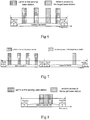
- Figure 6 is a schematic diagram illustrating resource allocation of Method 1.
- the cluster being filled with lattices represents the cluster allocated to the mobile terminal for communication with the serving base station
- the cluster being filled with inclined lines represents the cluster allocated to the mobile terminal for sending the random access preamble to the target base station.
- the uplink carrier #2 is the random access carrier.
- the mobile terminal uses the uplink carrier #2 to communicate with the serving base station, and may send control signaling to the serving base station, and may also send data to the serving base station, and meanwhile sends the random access preamble to the target base station using the uplink carrier #2.
- Method 1 is applicable to the following scenario: 1. when the serving cell and the target cell both only have the same uplink carrier, e.g. only have the uplink carrier #2, the mobile terminal may only communicate with the serving base station and the target base station using the same uplink carrier; 2.
- the target base station suggests the user to send the random access preamble over the uplink carrier #2, due to the reason that the collision rate on the uplink carrier #2 is low or another reason, while at the serving base station, the user requires higher uplink rate, or the channel condition of the uplink carrier #2 is better, the user can not release all resource blocks on the uplink carrier #2, but only can appropriately release the random access resource block used for emitting the random access preamble, the user also may only use the same uplink carrier to communicate with the serving base station and the target base station at the same time.
- the serving base station determines the random access carrier and the position of the random access resource block according to the handover request accept message;
- the serving base station performs allocation for the cluster on an uplink carrier other than the random access carrier, determines the resource scheduling information, so that the mobile terminal sends the random access preamble to the target base station over the random access resource block of the random access carrier, and meanwhile sends the uplink data or signaling to the serving base station over the allocated cluster of the other uplink carrier;
- the serving base station sends the determined resource scheduling information to the mobile terminal through the resource scheduling command, and sends the carrier number of the random access carrier and the position of the random access resource block to the mobile terminal through the handover command.
- Figure 7 is a schematic diagram illustrating resource allocation of Method 2.
- the cluster being filled with lattices represents the cluster allocated to the mobile terminal for communication with the serving base station
- the cluster being filled with inclined lines represents the cluster allocated to the mobile terminal for sending the random access preamble to the target base station.
- the uplink carrier #2 is the random access carrier.
- the mobile terminal uses the uplink carrier #1 to communicate with the serving base station, and may send control signaling to the serving base station, and may also send data to the serving base station, and the mobile terminal sends the random access preamble to the target base station using the uplink carrier #2.
- Method 2 is applicable to the following scenario: 1. when the serving cell and the target cell each have only one uplink carrier but the two uplink carriers are different from each other, e.g. the serving base station only has the uplink carrier #1 and the target base station only has the uplink carrier #2, the user may communicate with the serving base station and the target base station using different uplink carriers respectively at the same time; 2.
- the target base station suggests the user to send the random access preamble over the uplink carrier #2, due to the reason that the collision rate on the uplink carrier #2 is low or another reason, while at the serving base station, there is no uplink carrier #2, or the user requires low uplink rate, or the channel condition of the uplink carrier #2 is bad, the user may not use the uplink carrier #2 to communicate with the serving base station, the user may use different uplink carriers to communicate with the serving base station and the target base station respectively at the same time.
- the handover method it is required to send two signals (one to the serving base station, and another to the target base station) when the mobile terminal performs random access with the target base station.
- the signal to the serving base station is processed according to the timing advance adjustment value TA and the power adjustment value P given by the uplink synchronization control and power control of the serving base station. While, the timing advance adjustment value TA and the power adjustment value P is just what the random access preamble sent to the target base station seeks to obtain, thus the time adjustment value for sending the random access preamble to the target base station may be selected randomly.
- the user While, for the power adjustment value, if the power for the user's random access is designated in the handover request response of the target base station, the user performs sending in such a power. Otherwise, the user performs sending in the highest power. If the power is inadequate, the signal sending to the target base station is taken care of first.
- the mobile terminal through the random access process of Step 207, the mobile terminal has decoded the timing advance adjustment value TA and the power adjustment value P carried in the random access feedback from the target base station. Therefore, when the mobile terminal sends the handover success command in Step 209, it is required to add a timing advance adjustment value TA to the communication link with the target base station, and it is further required to adjust the transmission power according to the power adjustment value provided by the target base station. If the communication with the serving base station is still kept at this time, the signal to the serving base station is processed according to the timing advance adjustment value TA and the power adjustment value P given by the uplink synchronization control and power control of the serving base station. In other words, for the two signals (one to the serving base station, and another to the target base station) of the user, time adjustment and power adjustment are performed for the two signals respectively. If the power is inadequate, the signal sending to the target base station is taken care of first.
- the above method for carrier allocation is the carrier allocating method in the LTE-A system, which is applicable to the intra-frequency handover and inter-frequency handover from the LTE-A to the LTE-A.
- the carriers of the serving base station and the target base station are totally identical to each other in the case of intra-frequency handover, and the carriers of the serving base station and the target base station are not totally identical to each other in the case of inter-frequency handover.
- Step 206 the method that the serving base station of the LTE system performs resource allocation when implementing Step 206 is described in detail.
- the serving base station After receiving the handover request accept information fed back from the target base station, the serving base station firstly determines the random access carrier and the position of the random access resource block; then performs allocation for a resource block on the random access carrier other than the random access resource block, and determines the resource scheduling information, where the random access resource block is adjacent to the allocated resource block used for the mobile terminal to sending uplink data or signaling to the serving base station, so that the mobile terminal sends the random access preamble to the target base station at the position of the random access resource block on the random access carrier, and meanwhile sends the uplink data or signaling to the serving base station at the allocated other resource block; finally, the serving base station sends the determined resource scheduling information to the mobile terminal through the resource scheduling command, and sends the carrier number of the random
- Figure 8 is a schematic diagram illustrating resource allocation in the LTE system.
- the cluster being filled with lattices represents the cluster allocated to the mobile terminal for communication with the serving base station
- the cluster being filled with inclined lines represents the cluster allocated to the mobile terminal for sending the random access preamble to the target base station.
- the resource block allocated to the mobile terminal for communication with the serving base station is adjacent to the random access resource block to form a continuous resource block, so as to meet the characteristics of the uplink transmission manner of SC-FDMA.
- the above method is also applicable to the handover between the LTE and the LTE-A.
- the handover method is not only applicable to the case of continuous carrier integration where multiple carriers use the same transmitter, but also applicable to the case of discontinuous carrier integration where multiple carriers use multiple transmitters.
- the serving base station can either have only one carrier or multiple carriers.
- the mobile terminal would uses a resource block on the carrier to perform a random access to the target base station and uses a different resource block on the same carrier to communicate with the serving base station; if the serving base station and the target base station use different carriers, the mobile terminal would uses the carrier of the target base station to perform a random access to the target base station and uses the carrier of the serving base station to communicate with the serving base station.
- the serving base station having multiple carriers the mobile terminal would use different carriers or different resource blocks on a same carrier to perform the random access to the target base station and meanwhile communicates with the serving base station.
- the above handover methods are applicable to the scenario that all the carriers of the serving base station are getting worse.
- the mobile terminal in order to shorten the handover interruption time, the mobile terminal would perform the random access to the target base station and simultaneously keep communicating with the serving base station, and once the random access to the target base station is success, the data links are then handover to the target base station.
- the handover condition is met according to the RSRP or RSRQ of the serving base station and the target base station on a first carrier, while the handover condition is not met according to the RSRP or RSRQ of the serving base station and the target base station on a second carrier.
- the first carrier is the handover criterion which is possible when a broader coverage is provided by the first carrier, even if the communication quality with the target base station on the second carrier is bad, the mobile terminal still needs to handover from the serving base station to the target base station.
- the mobile terminal can only communicate with the target base station on the first and second carriers.
- the second carrier maybe can not be used by the mobile terminal. Therefore, from the view of the whole system, the second carrier is not utilized well.
- both the base station and the target base station have at least two carriers, and the handover condition is met on the first carrier, while the handover condition is not met on the second carrier.
- the serving base station continues allocating uplink and downlink transmitting resources on the second carrier to the mobile terminal, thus the mobile terminal can communicate with the serving base station on the second carrier after receiving the handover command.
- the mobile terminal can perform the random access to the target base station on the first carrier to obtain the uplink synchronous information of the target base station, and then communicate with the target base station on the first carrier after obtaining the uplink synchronous information of the target base station.
- the serving base station would not stop allocating uplink and downlink transmitting resources on the second carrier to the mobile terminal until the serving base station finishes transmitting all data packets buffered (the data packets here refer to all the data packets sent to the serving base station from a serving gateway before the mobile terminal handovers to the target base station, including all the data packets to be sent to the mobile terminal and all the data packets having been sent to the mobile terminal but without acknowledges) or the serving base station sends a handover command on the second carrier or indicates the mobile terminal to release the resource occupied on the second carrier when the serving base station receives a measurement report indicating the communication quality on the second carrier with the target base station is better than that with the serving base station and a handover condition on the second carrier is met. If there are still some data packets buffered in the serving base station, after the serving base station stops transmitting data packets to the mobile terminal on the second carrier, the data packets would be sent to the target base station.
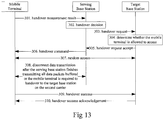
- FIG 13 is a flow chart illustrating the handover method according to the embodiment of the present invention. As shown in Figure 13 , the handover method according to the present invention mainly includes the following.
- Step 301 A mobile terminal measures the RSRP or RSRQ of the base station of an adjacent cell and a serving base station according to measurement configuration from the serving base station, and sends a measurement report containing the handover measurement result to the serving base station if a predetermined condition (also called a handover condition) is met, thus to complete the handover measurement operation.
- a predetermined condition also called a handover condition
- the above predetermined condition refers to the RSRP or RSRQ on the first carrier of an adjacent base station is higher than that of the serving base station, and the RSRP or RSRQ on the second carrier of the adjacent base station is lower than that of the serving base station.
- Steps 302-303 The serving base station determines that the mobile terminal is required to perform a handover on the first carrier, selects the adjacent base station as a target base station, and sends a handover request to the selected target base station.
- the serving base station may have the context relationship information of the mobile terminal, e.g. the user identifier and the user service type corresponding to the mobile terminal, carried in the handover request sent to the target base station, so that the target base station determines whether the mobile terminal is allowed to access.
- the context relationship information of the mobile terminal e.g. the user identifier and the user service type corresponding to the mobile terminal
- Step 304 The target base station that receives the handover request determines whether the mobile terminal is allowed to access. That is, after receiving the handover request from the serving base station, the target base station may perform an access decision according to access control principles such as service privileges, loads and the like, to determine whether the mobile terminal is allowed to access.
- access control principles such as service privileges, loads and the like
- steps 301-304 are similar and can be referred to the steps 201-204.
- Step 305 After determining that the mobile terminal is allowed to access, the target base station feeds back a handover request accept message carrying the position of the random access resource block on the first carrier to the serving base station.
- Step 306 The serving base station allocates the uplink and downlink transmission resource on the second carrier for the mobile terminal according to the channel condition, which includes allocating for the mobile terminal the uplink carrier (the second carrier) and the resource block used by the mobile terminal for its uplink communication with the serving base station, determining resource scheduling information, and sending the resource scheduling information as well as the carrier number of the random access carrier (the first carrier) and the position of the random access resource block to the mobile terminal.
- the channel condition which includes allocating for the mobile terminal the uplink carrier (the second carrier) and the resource block used by the mobile terminal for its uplink communication with the serving base station, determining resource scheduling information, and sending the resource scheduling information as well as the carrier number of the random access carrier (the first carrier) and the position of the random access resource block to the mobile terminal.
- Step 307 After receiving the handover command from the serving base station, the mobile terminal executes the random access process to the target base station using the random access resource block on the first carrier, to obtain the uplink synchronization information of the target base station, and meanwhile keeps the data transmission with the serving base station using the resource allocated in the resource scheduling command.
- Step 308 After the serving base station finishes transmitting all data packets buffered or the mobile terminal is required to handover to the target base station on the second carrier, the serving base station stops allocating the uplink and downlink transmission resource for the mobile terminal, so that the mobile terminal disconnects the data transmission with the serving base station.
- Steps 309-310 The mobile terminal sends a handover success message to the target base station; and after receiving the handover success message from the mobile terminal, the target base station returns a handover success acknowledgement message to the mobile terminal.
- step 308 is described before step 309 in Figure 13 , in actual applications, the execution order of steps 308 and 309 is not restricted, that is, step 309 can be executed before step 308.
- the communication terminating condition of the mobile terminal and the serving base station in the embodiment includes: the serving base station finishing transmitting all data packets for the mobile terminal buffered or the mobile terminal being required to handover to the target base station on the second carrier.
- the handover interruption time can be greatly reduced and meanwhile the data rate of the mobile terminal can be increased.
- the communication terminating condition of the mobile terminal and the serving base station in the previous embodiment is the mobile terminal receives the uplink synchronous information from the target base station.
- the serving base station would continue allocating uplink and downlink transmitting resources to the mobile terminal until a communication terminating condition is met.
- the embodiment of the present invention further provides a mobile terminal for implementing the handover method.
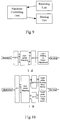
- Figure 9 illustrates an internal structure of a mobile terminal according to an embodiment of the present invention.
- the mobile terminal mainly includes: a receiving unit, a handover controlling unit and a sending unit. Specifically:
- the communication terminating condition includes: the receiving unit receiving the uplink synchronization information from the target base station, the serving base station finishing transmitting all data packets for the mobile terminal buffered, or the mobile terminal being required to handover to the target base station on the second carrier.
- the handover command from the serving base station includes: a carrier number of a random access carrier and a position of a random access resource block allocated to the mobile terminal for random access with the target base station, and may further includes a random access preamble allocated for the mobile terminal by the target base station.
- the receiving unit is further adapted to receive the resource scheduling information from the serving base station, where the resource scheduling information includes: the carrier number of an uplink carrier and the position of a resource block allocated to the mobile terminal for communication with the serving base station; in this case, the handover controlling unit is adapted to instruct the sending unit to send the uplink data and signaling to the serving base station over the uplink carrier and resource block allocated for communication with the serving base station, and send the random access preamble to the target base station over the random access resource block of the random access carrier allocated.
- Figure 10(a) and (b) are diagrams illustrating two structures of a sending unit when resource allocation is performed according to Method 1. Specifically, Figure 10(a) shows the case that the data sent to the serving base station and the target base station both use the same Inverse Fast Fourier Transform (IFFT) to perform transformation, and Figure 10(b) shows the case that the data sent to the serving base station and the target base station use different IFFT to perform transformation.
- IFFT Inverse Fast Fourier Transform
- the data sent to the serving base station and the target base station are sent out together after both equally being modulated, performed DFT transformation, sub-carrier mapped, performed IFFT transformation, and cyclic shifted as well as power adjusted based on the target base station and so on.
- time adjustment may be performed by performing the same time domain cyclic shift or frequency domain phase shift for all data. For example, when the random access preamble is sent, the signal sent to the serving base station and that sent to the target base station perform the time adjustment both using the timing advance adjustment value TA given by the serving base station.
- the time adjustment may be performed by performing the same time domain cyclic shift or frequency domain phase shift for all data, and it should be ensured that the difference between the shifted signal and the uplink synchronization signal of the serving base station as well as that between the shifted signal and the uplink synchronization signal of the target base station are both within the cyclic prefix range, thus to ensure that the uplink signal can be uplink synchronous with both the serving base station and the target base station.
- the power adjustment is sent according to the power required by the target base station.
- the data sent to the serving base station and the target base station are sent out together after both equally being modulated, performed DFT transformation, sub-carrier mapped, and then transformed using different IFFT respectively, and cyclic shifted as well as power adjusted respectively.
- the data sent to the serving base station and that to the target base station use different IFFT to perform transformation, time adjustment and power adjustment of the two signals can be performed separately.
- time and power adjustment is performed for the signal sent to the serving base station according to the value given by the uplink synchronization control and power control of the serving base station, and the signal sent to the target base station may use the highest transmission power, and may use a random timing advance adjustment value TA to perform time adjustment.
- the timing advance adjustment value TA and the power adjustment value P of the two signals may be adjusted respectively according to the timing advance adjustment value TA and the power adjustment value P given by the uplink synchronization control and power control of the serving base station and the timing advance adjustment value TA and the power adjustment value P contained in the uplink synchronization information of the target base station.
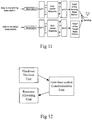
- Figure 11 is a diagram illustrating an internal structure of the sending unit when resource allocation is performed according to Method 2.
- the mobile terminal uses different carriers to communicate with the serving base station and the target base station, the signal sent to the serving base station and the target base station may be sent out together after respectively being modulated, performed DFT transformation, sub-carrier mapped, performed IFFT transformation, and cyclic shifted as well as power adjusted and so on.
- the time adjustment and the power adjustment of the two signals sent to the serving base station and the target base station may be carried out separately.
- time and power adjustment is performed for the signal sent to the serving base station according to the value given by the uplink synchronization control and power control of the serving base station, and the signal sent to the target base station may use the highest transmission power, and may use a random timing advance adjustment value TA to perform time adjustment.
- the timing advance adjustment value TA and the power adjustment value P of the two signals may be adjusted respectively according to the timing advance adjustment value TA and the power adjustment value P given by the uplink synchronization control and power control of the serving base station and the timing advance adjustment value TA and the power adjustment value P contained in the uplink synchronization information of the target base station.
- the embodiment of the present invention further provides the internal structure of the serving base station.
- the serving base station includes:
- the communication terminating condition includes: the mobile terminal receiving the uplink synchronization information from the target base station, the serving base station finishing transmitting all data packets for the mobile terminal buffered, or the mobile terminal being required to handover to the target base station on the second carrier.
- the resource allocating unit can use the resource allocating method provided by the embodiment of the present invention to complete the uplink communication resource allocation for the mobile terminal.
Landscapes
- Engineering & Computer Science (AREA)
- Computer Networks & Wireless Communication (AREA)
- Signal Processing (AREA)
- Mobile Radio Communication Systems (AREA)
Claims (8)
- Procédé de transfert, comprenant le fait de:continuer, par une station de base de desserte, à attribuer une ressource de transmission de liaison montante et de liaison descendante pour un terminal mobile lors de l'envoi d'une commande de transfert au terminal mobile (206, 306) permettant au terminal mobile de maintenir une communication de données avec la station de base de desserte après réception de la commande de transfert et entretemps d'effectuer un processus d'accès aléatoire à une station de base cible (207, 307) pour obtenir des informations de synchronisation de liaison montante de la station de base cible;dans lequel le terminal mobile effectue le processus d'accès aléatoire à la station de base cible sur une première porteuse;le terminal mobile maintient une communication de données avec la station de base de desserte sur une deuxième porteuse;dans lequel le procédé comprend par ailleurs le fait de:arrêter, par la station de base de desserte, d'attribuer la ressource de transmission de liaison descendante et de liaison montante pour le terminal mobile sur la deuxième porteuse de communication quand une condition de terminaison de communication est remplie; etdéconnecter la communication de données entre le terminal mobile et la station de base de desserte sur la deuxième porteuse (208);dans lequel le fait d'arrêter d'attribuer la ressource de transmission de liaison montante et de liaison descendante pour le terminal mobile sur la deuxième porteuse quand une condition de terminaison de communication est remplie comprend le fait de: arrêter, par la station de base de desserte, d'attribuer la ressource de transmission de liaison montante et de liaison descendante pour le terminal mobile sur la deuxième porteuse après que le terminal mobile ait obtenu les informations de synchronisation de liaison montante de la station de base cible sur la première porteuse;
dans lequel le procédé comprend par ailleurs le fait de:recevoir, par la station de base de desserte, un résultat de mesure de transfert rapporté depuis le terminal mobile sur la deuxième porteuse (201, 301);déterminer, par la station de base de desserte, une station de base cible, et envoyer une demande de transfert à la station de base cible déterminée (203, 303), après avoir déterminé qu'il est requis d'effectuer un transfert pour le terminal mobile en fonction du résultat de mesure de transfert reçu rapporté depuis le terminal mobile (202, 302);recevoir, par la station de base de desserte, un numéro de porteuse de la première porteuse et une position d'un bloc de ressources d'accès aléatoire rétro-alimentés depuis la station de base cible; etenvoyer, par la station de base de desserte, au terminal mobile sur la deuxième porteuse le numéro de porteuse de la première porteuse et la position du bloc de ressources d'accès aléatoire rétro-alimentés depuis la station de base cible permettant au terminal mobile d'exécuter le processus d'accès aléatoire à l'aide de la première porteuse et du bloc de ressources d'accès aléatoire rétro-alimentés depuis la station de base cible;la demande de transfert comprend des informations d'utilisation de porteuse de liaison montante du terminal mobile; et le procédé comprend par ailleurs le fait de:après avoir reçu la demande de transfert et déterminé que le terminal mobile est autorisé à accéder (204, 304), sélectionner, par la station de base cible, la première porteuse pour le terminal mobile en fonction des informations d'utilisation de la porteuse de liaison montante du terminal mobile, et rétro-alimenter le numéro de porteuse de la première porteuse et la position du bloc de ressources d'accès aléatoire vers la station de base de desserte au moyen d'un message d'acceptation de demande de transfert (205, 305). - Procédé de transfert selon la revendication 1, dans lequel le fait de continuer à attribuer une ressource de transmission de liaison montante et de liaison descendante pour un terminal mobile comprend le fait de:attribuer, par la station de base de desserte, pour le terminal mobile une porteuse de liaison montante et un bloc de ressources utilisés par le terminal mobile pour sa communication de liaison montante avec la station de base de desserte selon une condition de canal, où le bloc de ressources attribué est différent du bloc de ressources d'accès aléatoire sur la première porteuse sélectionnée par la station de base cible; etenvoyer, par la station de base de desserte, le numéro de porteuse de la porteuse de liaison montante et la position du bloc de ressources attribués au terminal mobile pour la communication de liaison montante avec la station de base de desserte, au terminal mobile au moyen d'une commande de planification de ressource permettant au terminal mobile d'envoyer des données de liaison montante à la station de base de desserte par l'intermédiaire de la porteuse de liaison montante et du bloc de ressources attribués par la station de base de desserte.
- Procédé de transfert selon la revendication 2, dans lequel l'attribution pour le terminal mobile d'une porteuse de liaison montante et d'un bloc de ressources utilisés par le terminal mobile pour sa communication de liaison montante avec la station de base de desserte comprend le fait de:effectuer, par la station de base de desserte, l'attribution pour un groupe sur une porteuse de liaison montante autre que la première porteuse permettant au terminal mobile d'envoyer un préambule d'accès aléatoire à la station de base cible sur le bloc de ressources d'accès aléatoire de la première porteuse, où le groupe est formé par des blocs de ressources continus multiples, et d'envoyer entretemps les données de liaison montante ou de signaler à la station de base de desserte sur le groupe attribué de l'autre porteuse de liaison montante.
- Procédé de transfert selon la revendication 1, dans lequel le fait de sélectionner la première porteuse pour le terminal mobile comprend le fait de: sélectionner la porteuse sur laquelle le nombre de blocs de ressources utilisés par le terminal mobile est inférieur à celui de la première porteuse.
- Procédé de transfert selon la revendication 1, dans lequel la station de base cible envoie les informations de synchronisation de liaison montante au terminal mobile à travers la station de base de desserte, et dans lequel les informations de synchronisation de liaison montante comprennent: une valeur de réglage d'avance temporelle TA, et une valeur de réglage de puissance P; et
le fait d'arrêter d'attribuer la ressource de transmission de liaison montante et de liaison descendante pour le terminal mobile après que le terminal mobile ait obtenu les informations de synchronisation de liaison montante de la station de base cible comprend le fait de: arrêter, par la station de base de desserte, d'attribuer la ressource de transmission de liaison montante et de liaison descendante pour le terminal mobile après réception et envoi des informations de synchronisation de liaison montante envoyées de la station de base cible au terminal mobile. - Procédé de transfert selon la revendication 1, comprenant par ailleurs le fait de: envoyer, par la station de base cible, une instruction de libération de ressource de données à la station de base de desserte lors de l'envoi direct des informations de synchronisation de liaison montante au terminal mobile ou recevoir un message de transfert réussi envoyé par le terminal mobile (209, 309) ou envoyer directement un message de confirmation de transfert réussi au terminal mobile (210, 310);
le fait d'arrêter d'attribuer la ressource de transmission de liaison montante et de liaison descendante pour le terminal mobile après que le terminal mobile ait obtenu les informations de synchronisation de liaison montante de la station de base cible comprend le fait de: arrêter, par la station de base de desserte, d'attribuer la ressource de transmission de liaison montante et de liaison descendante pour le terminal mobile après réception de l'instruction de libération de la ressource de données de la station de base cible. - Procédé de transfert selon la revendication 1, comprenant par ailleurs le fait de: recevoir et envoyer, par la station de base de desserte, un message de confirmation de transfert réussi envoyé de la station de base cible au terminal mobile, et
le fait d'arrêter d'attribuer la ressource de transmission de liaison montante et de liaison descendante pour le terminal mobile après que le terminal mobile ait obtenu les informations de synchronisation de liaison montante de la station de base cible comprend le fait de: arrêter, par la station de base de desserte, d'attribuer la ressource de transmission de liaison montante et de liaison descendante pour le terminal mobile après l'envoi du message de confirmation de transfert réussi au terminal mobile. - Système de transfert, comprenant une station de base de desserte et une station de base cible et un terminal mobile, dans lequel la station de base de desserte comprend une unité de décision de transfert, une unité de communication entre stations de base, et une unité d'attribution de ressource,
l'unité de décision de transfert est adaptée pour déterminer s'il est nécessaire d'effectuer un transfert en fonction d'un résultat de mesure de transfert reçu d'un terminal mobile sur une deuxième porteuse et, s'il est nécessaire d'effectuer un transfert, pour sélectionner une station de base cible;
l'unité de communication entre stations de base est adaptée pour envoyer une demande de transfert à la station de base cible sélectionnée par l'unité de décision de transfert, et pour recevoir un numéro de porteuse d'une première porteuse et une position d'un bloc de ressources d'accès aléatoire sélectionné par la station de base cible, de sorte que la station de base de desserte envoie au terminal mobile sur la deuxième porteuse le numéro de porteuse de la première porteuse et la position du bloc de ressources d'accès aléatoire rétro-alimentés depuis la station de base cible permettant au terminal mobile d'exécuter le processus d'accès aléatoire à l'aide de la première porteuse et du bloc de ressources d'accès aléatoire rétro-alimentés depuis la station de base cible; et
l'unité d'attribution de ressource est adaptée pour continuer à attribuer la ressource de transmission de liaison montante et de liaison descendante sur la deuxième porteuse pour le terminal mobile lors de l'envoi d'une commande de transfert au terminal mobile, où la commande de transfert comprend un numéro de porteuse de la première porteuse et la position du bloc de ressources d'accès aléatoire rétro-alimentés depuis la station de base cible, de sorte que le terminal mobile soit à même de maintenir une transmission de données avec la station de base de desserte sur la deuxième porteuse, et exécute entretemps un processus d'accès aléatoire à la station de base cible à l'aide de la première porteuse et du bloc de ressources d'accès aléatoire rétro-alimentés depuis la station de base cible pour obtenir des informations de synchronisation de liaison montante de la station de base cible sur la première porteuse; et pour arrêter d'attribuer la ressource de transmission de liaison montante et de liaison descendante pour le terminal mobile quand une condition de terminaison de communication est remplie, et pour déconnecter la communication de données entre le terminal mobile et la station de base de desserte sur la deuxième porteuse; où le fait d'arrêter d'attribuer la ressource de transmission de liaison montante et de liaison descendante pour le terminal mobile lorsque la condition de terminaison de communication est remplie comprend le fait de: arrêter, par la station de base de desserte, d'attribuer la ressource de transmission de liaison montante et de liaison descendante pour le terminal mobile après que le terminal mobile ait obtenu les informations de synchronisation de liaison montante de la station de base cible;
la demande de transfert comprend des informations d'utilisation de porteuse de liaison montante du terminal mobile; et
la station de base cible est adaptée pour sélectionner, après avoir reçu la demande de transfert et déterminé que le terminal mobile est autorisé à accéder (204, 304), la première porteuse pour le terminal mobile en fonction des informations d'utilisation de porteuse de liaison montante du terminal mobile, et rétro-alimenter le numéro de porteuse de la première porteuse et la position du bloc de ressources d'accès aléatoire vers la station de base de desserte par l'intermédiaire d'un message d'acceptation de demande de transfert (205, 305).
Applications Claiming Priority (2)
| Application Number | Priority Date | Filing Date | Title |
|---|---|---|---|
| CN200910136317 | 2009-05-07 | ||
| CN201010127164.2A CN101883406B (zh) | 2009-05-07 | 2010-03-16 | 一种切换方法、移动终端及基站 |
Publications (3)
| Publication Number | Publication Date |
|---|---|
| EP2249601A2 EP2249601A2 (fr) | 2010-11-10 |
| EP2249601A3 EP2249601A3 (fr) | 2014-06-25 |
| EP2249601B1 true EP2249601B1 (fr) | 2016-12-21 |
Family
ID=42537923
Family Applications (1)
| Application Number | Title | Priority Date | Filing Date |
|---|---|---|---|
| EP10161631.6A Not-in-force EP2249601B1 (fr) | 2009-05-07 | 2010-04-30 | Procédé de transfert, terminal mobile et station de base |
Country Status (3)
| Country | Link |
|---|---|
| EP (1) | EP2249601B1 (fr) |
| JP (1) | JP5538058B2 (fr) |
| CN (1) | CN101883406B (fr) |
Cited By (4)
| Publication number | Priority date | Publication date | Assignee | Title |
|---|---|---|---|---|
| CN105165082A (zh) * | 2013-10-28 | 2015-12-16 | 华为技术有限公司 | 一种资源调度的方法、装置及系统 |
| US11012901B2 (en) | 2017-08-11 | 2021-05-18 | Huawei Technologies Co., Ltd. | Wireless communication method and apparatus |
| US11438818B2 (en) | 2016-01-16 | 2022-09-06 | Huawei Technologies Co., Ltd. | Handover method, base station, and terminal device |
| US11856466B2 (en) | 2016-11-04 | 2023-12-26 | Telefonaktiebolaget Lm Ericsson (Publ) | Wireless handover |
Families Citing this family (35)
| Publication number | Priority date | Publication date | Assignee | Title |
|---|---|---|---|---|
| CN102624442B (zh) * | 2011-01-31 | 2016-06-22 | 中兴通讯股份有限公司 | 一种无线通信系统及其上行同步信道的发送方法 |
| CN103348756B (zh) | 2011-02-10 | 2016-10-26 | 富士通株式会社 | 无线通信系统、接收装置、发送装置以及无线通信方法 |
| CN102685827B (zh) * | 2011-03-14 | 2016-08-10 | 华为技术有限公司 | 接入方法、用户设备和基站 |
| CN102843777B (zh) * | 2011-06-20 | 2015-07-15 | 普天信息技术研究院有限公司 | 一种随机接入信号的控制方法 |
| JP5990586B2 (ja) * | 2011-08-19 | 2016-09-14 | エスシーエー アイピーエルエー ホールディングス インコーポレイテッド | 無線通信システム、方法、コンピュータプログラム、記憶媒体および装置 |
| CN102685829B (zh) * | 2012-05-11 | 2015-02-25 | 中国联合网络通信集团有限公司 | 基站直通架构下的用户切换方法、装置及设备 |
| JP5340450B2 (ja) * | 2012-05-15 | 2013-11-13 | シャープ株式会社 | 無線通信システム、基地局装置、移動局装置および無線通信方法 |
| CN103582110A (zh) * | 2012-07-23 | 2014-02-12 | 中国移动通信集团公司 | 一种上行同步的方法、终端、基站、系统和网络设备 |
| EP2890195B1 (fr) * | 2012-09-28 | 2018-09-19 | Huawei Technologies Co., Ltd. | Procédé de transmission de données, station de base et équipement d'utilisateur |
| WO2014059663A1 (fr) * | 2012-10-19 | 2014-04-24 | 华为技术有限公司 | Procédé et dispositif de commutation |
| CN103796315B (zh) * | 2012-11-02 | 2018-12-11 | 南京中兴软件有限责任公司 | 用户设备专用搜索空间的物理资源块配置方法和装置 |
| US9699825B2 (en) | 2013-01-16 | 2017-07-04 | Lg Electronics Inc. | Method and apparatus for transmitting indication in wireless communication system |
| CN113411851B (zh) * | 2013-06-18 | 2024-11-15 | 索尼公司 | 通信装置 |
| JP5542998B2 (ja) * | 2013-08-05 | 2014-07-09 | シャープ株式会社 | 無線通信システム、基地局装置、移動局装置および無線通信方法 |
| CN103874153A (zh) * | 2014-03-06 | 2014-06-18 | 华为技术有限公司 | 一种控制方法和基站 |
| WO2016065580A1 (fr) * | 2014-10-30 | 2016-05-06 | 华为技术有限公司 | Procédé, appareil et système de transfert intercellulaire |
| CN104602292B (zh) * | 2014-12-26 | 2021-03-19 | 珠海世纪鼎利科技股份有限公司 | 实现4g lte小区间切换测量的系统及装置 |
| CN107005905A (zh) * | 2015-05-13 | 2017-08-01 | 华为技术有限公司 | 一种反应业务连续性结果和质量的方法、设备及系统 |
| WO2017124433A1 (fr) * | 2016-01-22 | 2017-07-27 | 富士通株式会社 | Dispositif, procédé et système de communication permettant un accès aléatoire et une transmission de données |
| CN113423123B (zh) | 2016-04-01 | 2022-08-23 | 北京三星通信技术研究有限公司 | 一种支持无缝切换的方法及基站设备 |
| CN107371205B (zh) * | 2016-05-11 | 2022-11-08 | 中兴通讯股份有限公司 | 基站间切换方法及装置 |
| CN108112041A (zh) * | 2016-11-24 | 2018-06-01 | 中国移动通信有限公司研究院 | 一种切换方法、源基站、目标基站及终端 |
| CN108271214B (zh) * | 2017-01-04 | 2022-07-22 | 华为技术有限公司 | 一种通信方法及其终端设备、网络设备 |
| WO2018209582A1 (fr) * | 2017-05-17 | 2018-11-22 | 华为技术有限公司 | Procédé et appareil de gestion de transferts |
| WO2019010713A1 (fr) * | 2017-07-14 | 2019-01-17 | 深圳前海达闼云端智能科技有限公司 | Procédé, dispositif et station de base pour commutation de terminal et support d'informations |
| WO2019134329A1 (fr) * | 2018-01-03 | 2019-07-11 | Oppo广东移动通信有限公司 | Procédé et dispositif de transfert intersystème |
| CN110099419B (zh) * | 2018-01-31 | 2020-07-31 | 惠州Tcl移动通信有限公司 | 通信切换方法及装置 |
| CN109257152A (zh) * | 2018-08-27 | 2019-01-22 | 维沃移动通信有限公司 | 一种资源指示方法、网络侧设备及终端 |
| CN110972223A (zh) * | 2018-09-28 | 2020-04-07 | 电信科学技术研究院有限公司 | 一种链路释放方法、装置、终端及第二网络实体 |
| CN111294885B (zh) * | 2019-02-15 | 2022-10-11 | 北京紫光展锐通信技术有限公司 | 软切换方法及装置、存储介质、用户终端、源基站 |
| CN111294874A (zh) * | 2019-02-19 | 2020-06-16 | 北京展讯高科通信技术有限公司 | 切换方法及装置、存储介质、用户终端 |
| WO2020215340A1 (fr) * | 2019-04-26 | 2020-10-29 | Nokia Shanghai Bell Co., Ltd. | Procédure d'accès aléatoire |
| US11956845B2 (en) | 2019-07-22 | 2024-04-09 | Nokia Technologies Oy | Transmission of segments of information |
| CN110784901A (zh) * | 2019-10-12 | 2020-02-11 | 江苏久鑫铜业有限公司 | 一种lte系统软切换机制 |
| CN116419360B (zh) * | 2023-06-06 | 2023-09-19 | 成都爱瑞无线科技有限公司 | 通感一体化系统的移动性管理方法、装置及存储介质 |
Citations (1)
| Publication number | Priority date | Publication date | Assignee | Title |
|---|---|---|---|---|
| CA2664633A1 (fr) * | 2006-09-29 | 2008-04-17 | Zte Corporation | Procede et dispositif de transfert base sur un canal d'acces aleatoire |
Family Cites Families (11)
| Publication number | Priority date | Publication date | Assignee | Title |
|---|---|---|---|---|
| KR100893860B1 (ko) * | 2004-06-10 | 2009-04-20 | 엘지전자 주식회사 | 광대역 무선 접속 시스템에 적용되는 핸드오버 수행 방법및 핸드오버 실패시 통신 재개 방법 |
| KR101119096B1 (ko) * | 2004-11-04 | 2012-09-05 | 엘지전자 주식회사 | 광대역 무선접속 시스템에서 핸드오버시 적용되는 데이터전송 방법 |
| DK1891824T3 (da) * | 2005-06-03 | 2013-03-11 | Ericsson Telefon Ab L M | Celleskift i cellulære netværk |
| US7684799B2 (en) * | 2006-03-28 | 2010-03-23 | Motorola, Inc. | Method for data transfer with a mobile station while in discontinuous reception state |
| GB2437128B (en) * | 2006-04-12 | 2008-07-23 | Siemens Ag | A Method Of Operation In A Dual Carrier Communication System |
| US8131295B2 (en) * | 2006-06-20 | 2012-03-06 | Interdigital Technology Corporation | Methods and system for performing handover in a wireless communication system |
| KR101036985B1 (ko) * | 2006-09-28 | 2011-05-25 | 후지쯔 가부시끼가이샤 | 무선 통신 장치 |
| MX2009008666A (es) * | 2007-03-22 | 2009-08-21 | Ericsson Telefon Ab L M | Transferencia de control con alineacion de acceso aleatorio. |
| US20090047962A1 (en) * | 2007-08-14 | 2009-02-19 | Rao Anil M | Transfer-of uplink power control parameters during handovers |
| CN101370267B (zh) * | 2007-08-19 | 2012-06-06 | 中兴通讯股份有限公司 | 一种移动通信系统中的切换方法 |
| CN101217815B (zh) * | 2008-01-04 | 2010-09-01 | 北京北方烽火科技有限公司 | 一种移动台主动移动通信系统中移动台越区切换的方法 |
-
2010
- 2010-03-16 CN CN201010127164.2A patent/CN101883406B/zh not_active Expired - Fee Related
- 2010-04-30 EP EP10161631.6A patent/EP2249601B1/fr not_active Not-in-force
- 2010-05-07 JP JP2010107155A patent/JP5538058B2/ja not_active Expired - Fee Related
Patent Citations (1)
| Publication number | Priority date | Publication date | Assignee | Title |
|---|---|---|---|---|
| CA2664633A1 (fr) * | 2006-09-29 | 2008-04-17 | Zte Corporation | Procede et dispositif de transfert base sur un canal d'acces aleatoire |
Cited By (7)
| Publication number | Priority date | Publication date | Assignee | Title |
|---|---|---|---|---|
| CN105165082A (zh) * | 2013-10-28 | 2015-12-16 | 华为技术有限公司 | 一种资源调度的方法、装置及系统 |
| CN105165082B (zh) * | 2013-10-28 | 2019-05-28 | 华为技术有限公司 | 一种资源调度的方法、装置及系统 |
| US11438818B2 (en) | 2016-01-16 | 2022-09-06 | Huawei Technologies Co., Ltd. | Handover method, base station, and terminal device |
| EP3735034B1 (fr) * | 2016-01-16 | 2026-03-25 | Huawei Technologies Co., Ltd. | Methode de transfert et system de reseau |
| US11856466B2 (en) | 2016-11-04 | 2023-12-26 | Telefonaktiebolaget Lm Ericsson (Publ) | Wireless handover |
| US12284558B2 (en) | 2016-11-04 | 2025-04-22 | Telefonaktiebolaget Lm Ericsson (Publ) | Wireless handover |
| US11012901B2 (en) | 2017-08-11 | 2021-05-18 | Huawei Technologies Co., Ltd. | Wireless communication method and apparatus |
Also Published As
| Publication number | Publication date |
|---|---|
| JP5538058B2 (ja) | 2014-07-02 |
| CN101883406A (zh) | 2010-11-10 |
| CN101883406B (zh) | 2015-04-08 |
| EP2249601A3 (fr) | 2014-06-25 |
| EP2249601A2 (fr) | 2010-11-10 |
| JP2010263629A (ja) | 2010-11-18 |
Similar Documents
| Publication | Publication Date | Title |
|---|---|---|
| EP2249601B1 (fr) | Procédé de transfert, terminal mobile et station de base | |
| US12114365B2 (en) | User apparatus, base station and communication system | |
| EP4236616A2 (fr) | Système de communication | |
| EP3876637A1 (fr) | Système de communication et dispositif côté réception | |
| CN118354384A (zh) | 通信系统及通信终端装置 | |
| EP4478784A1 (fr) | Système de communication, et station de base | |
| CN112740799A (zh) | 无线电网络节点、用户设备(ue)以及无线通信网络中执行的方法 | |
| TW201127114A (en) | Method and apparatus for performing component carrier-specific reconfiguration | |
| JP2025098084A (ja) | 端末装置および通信システム | |
| US20150334704A1 (en) | Intra-cluster coordination for cell clustering interference mitigation | |
| CN115486134A (zh) | 通信系统、通信终端及基站 | |
| CN113412637A (zh) | 通信系统、通信终端及基站 | |
| US20240236792A9 (en) | Communication system and communication terminal | |
| CN114846836A (zh) | 通信系统、基站及通信终端 | |
| CN112470535A (zh) | 通信系统、基站和通信终端 | |
| WO2023000235A1 (fr) | Procédé et appareil de traitement de ressources | |
| EP4514013A1 (fr) | Système de communication | |
| WO2024007233A1 (fr) | Procédure de canal d'accès aléatoire dans une agrégation de porteuses inter-bandes avec porteuse sans bloc de signal de synchronisation | |
| KR20240036008A (ko) | 통신 시스템 | |
| WO2023138787A1 (fr) | Configuration dynamique de cellule de desserte | |
| US20260122560A1 (en) | Mobility during small data transmission (sdt) procedure | |
| US20230284162A1 (en) | Communication system and receiver | |
| WO2026096198A1 (fr) | Mobilité pendant une procédure de transmission de petites données (sdt) | |
| WO2025146774A1 (fr) | Système de communication | |
| WO2024185748A1 (fr) | Système de communication et station de base |
Legal Events
| Date | Code | Title | Description |
|---|---|---|---|
| PUAI | Public reference made under article 153(3) epc to a published international application that has entered the european phase |
Free format text: ORIGINAL CODE: 0009012 |
|
| AK | Designated contracting states |
Kind code of ref document: A2 Designated state(s): AT BE BG CH CY CZ DE DK EE ES FI FR GB GR HR HU IE IS IT LI LT LU LV MC MK MT NL NO PL PT RO SE SI SK SM TR |
|
| AX | Request for extension of the european patent |
Extension state: AL BA ME RS |
|
| PUAL | Search report despatched |
Free format text: ORIGINAL CODE: 0009013 |
|
| AK | Designated contracting states |
Kind code of ref document: A3 Designated state(s): AT BE BG CH CY CZ DE DK EE ES FI FR GB GR HR HU IE IS IT LI LT LU LV MC MK MT NL NO PL PT RO SE SI SK SM TR |
|
| AX | Request for extension of the european patent |
Extension state: AL BA ME RS |
|
| RIC1 | Information provided on ipc code assigned before grant |
Ipc: H04W 36/00 20090101AFI20140516BHEP |
|
| 17P | Request for examination filed |
Effective date: 20141218 |
|
| RBV | Designated contracting states (corrected) |
Designated state(s): AT BE BG CH CY CZ DE DK EE ES FI FR GB GR HR HU IE IS IT LI LT LU LV MC MK MT NL NO PL PT RO SE SI SK SM TR |
|
| 17Q | First examination report despatched |
Effective date: 20150703 |
|
| GRAP | Despatch of communication of intention to grant a patent |
Free format text: ORIGINAL CODE: EPIDOSNIGR1 |
|
| INTG | Intention to grant announced |
Effective date: 20160707 |
|
| GRAS | Grant fee paid |
Free format text: ORIGINAL CODE: EPIDOSNIGR3 |
|
| GRAA | (expected) grant |
Free format text: ORIGINAL CODE: 0009210 |
|
| AK | Designated contracting states |
Kind code of ref document: B1 Designated state(s): AT BE BG CH CY CZ DE DK EE ES FI FR GB GR HR HU IE IS IT LI LT LU LV MC MK MT NL NO PL PT RO SE SI SK SM TR |
|
| REG | Reference to a national code |
Ref country code: GB Ref legal event code: FG4D |
|
| REG | Reference to a national code |
Ref country code: CH Ref legal event code: EP |
|
| REG | Reference to a national code |
Ref country code: IE Ref legal event code: FG4D |
|
| REG | Reference to a national code |
Ref country code: AT Ref legal event code: REF Ref document number: 856426 Country of ref document: AT Kind code of ref document: T Effective date: 20170115 |
|
| REG | Reference to a national code |
Ref country code: DE Ref legal event code: R096 Ref document number: 602010038917 Country of ref document: DE |
|
| PG25 | Lapsed in a contracting state [announced via postgrant information from national office to epo] |
Ref country code: LV Free format text: LAPSE BECAUSE OF FAILURE TO SUBMIT A TRANSLATION OF THE DESCRIPTION OR TO PAY THE FEE WITHIN THE PRESCRIBED TIME-LIMIT Effective date: 20161221 |
|
| REG | Reference to a national code |
Ref country code: LT Ref legal event code: MG4D |
|
| REG | Reference to a national code |
Ref country code: NL Ref legal event code: MP Effective date: 20161221 |
|
| PG25 | Lapsed in a contracting state [announced via postgrant information from national office to epo] |
Ref country code: SE Free format text: LAPSE BECAUSE OF FAILURE TO SUBMIT A TRANSLATION OF THE DESCRIPTION OR TO PAY THE FEE WITHIN THE PRESCRIBED TIME-LIMIT Effective date: 20161221 Ref country code: LT Free format text: LAPSE BECAUSE OF FAILURE TO SUBMIT A TRANSLATION OF THE DESCRIPTION OR TO PAY THE FEE WITHIN THE PRESCRIBED TIME-LIMIT Effective date: 20161221 Ref country code: NO Free format text: LAPSE BECAUSE OF FAILURE TO SUBMIT A TRANSLATION OF THE DESCRIPTION OR TO PAY THE FEE WITHIN THE PRESCRIBED TIME-LIMIT Effective date: 20170321 Ref country code: GR Free format text: LAPSE BECAUSE OF FAILURE TO SUBMIT A TRANSLATION OF THE DESCRIPTION OR TO PAY THE FEE WITHIN THE PRESCRIBED TIME-LIMIT Effective date: 20170322 |
|
| REG | Reference to a national code |
Ref country code: AT Ref legal event code: MK05 Ref document number: 856426 Country of ref document: AT Kind code of ref document: T Effective date: 20161221 |
|
| PG25 | Lapsed in a contracting state [announced via postgrant information from national office to epo] |
Ref country code: FI Free format text: LAPSE BECAUSE OF FAILURE TO SUBMIT A TRANSLATION OF THE DESCRIPTION OR TO PAY THE FEE WITHIN THE PRESCRIBED TIME-LIMIT Effective date: 20161221 Ref country code: HR Free format text: LAPSE BECAUSE OF FAILURE TO SUBMIT A TRANSLATION OF THE DESCRIPTION OR TO PAY THE FEE WITHIN THE PRESCRIBED TIME-LIMIT Effective date: 20161221 |
|
| PG25 | Lapsed in a contracting state [announced via postgrant information from national office to epo] |
Ref country code: NL Free format text: LAPSE BECAUSE OF FAILURE TO SUBMIT A TRANSLATION OF THE DESCRIPTION OR TO PAY THE FEE WITHIN THE PRESCRIBED TIME-LIMIT Effective date: 20161221 |
|
| PG25 | Lapsed in a contracting state [announced via postgrant information from national office to epo] |
Ref country code: RO Free format text: LAPSE BECAUSE OF FAILURE TO SUBMIT A TRANSLATION OF THE DESCRIPTION OR TO PAY THE FEE WITHIN THE PRESCRIBED TIME-LIMIT Effective date: 20161221 Ref country code: EE Free format text: LAPSE BECAUSE OF FAILURE TO SUBMIT A TRANSLATION OF THE DESCRIPTION OR TO PAY THE FEE WITHIN THE PRESCRIBED TIME-LIMIT Effective date: 20161221 Ref country code: CZ Free format text: LAPSE BECAUSE OF FAILURE TO SUBMIT A TRANSLATION OF THE DESCRIPTION OR TO PAY THE FEE WITHIN THE PRESCRIBED TIME-LIMIT Effective date: 20161221 Ref country code: SK Free format text: LAPSE BECAUSE OF FAILURE TO SUBMIT A TRANSLATION OF THE DESCRIPTION OR TO PAY THE FEE WITHIN THE PRESCRIBED TIME-LIMIT Effective date: 20161221 Ref country code: IS Free format text: LAPSE BECAUSE OF FAILURE TO SUBMIT A TRANSLATION OF THE DESCRIPTION OR TO PAY THE FEE WITHIN THE PRESCRIBED TIME-LIMIT Effective date: 20170421 |
|
| PG25 | Lapsed in a contracting state [announced via postgrant information from national office to epo] |
Ref country code: BG Free format text: LAPSE BECAUSE OF FAILURE TO SUBMIT A TRANSLATION OF THE DESCRIPTION OR TO PAY THE FEE WITHIN THE PRESCRIBED TIME-LIMIT Effective date: 20170321 Ref country code: ES Free format text: LAPSE BECAUSE OF FAILURE TO SUBMIT A TRANSLATION OF THE DESCRIPTION OR TO PAY THE FEE WITHIN THE PRESCRIBED TIME-LIMIT Effective date: 20161221 Ref country code: BE Free format text: LAPSE BECAUSE OF FAILURE TO SUBMIT A TRANSLATION OF THE DESCRIPTION OR TO PAY THE FEE WITHIN THE PRESCRIBED TIME-LIMIT Effective date: 20161221 Ref country code: PL Free format text: LAPSE BECAUSE OF FAILURE TO SUBMIT A TRANSLATION OF THE DESCRIPTION OR TO PAY THE FEE WITHIN THE PRESCRIBED TIME-LIMIT Effective date: 20161221 Ref country code: IT Free format text: LAPSE BECAUSE OF FAILURE TO SUBMIT A TRANSLATION OF THE DESCRIPTION OR TO PAY THE FEE WITHIN THE PRESCRIBED TIME-LIMIT Effective date: 20161221 Ref country code: PT Free format text: LAPSE BECAUSE OF FAILURE TO SUBMIT A TRANSLATION OF THE DESCRIPTION OR TO PAY THE FEE WITHIN THE PRESCRIBED TIME-LIMIT Effective date: 20170421 Ref country code: SM Free format text: LAPSE BECAUSE OF FAILURE TO SUBMIT A TRANSLATION OF THE DESCRIPTION OR TO PAY THE FEE WITHIN THE PRESCRIBED TIME-LIMIT Effective date: 20161221 Ref country code: AT Free format text: LAPSE BECAUSE OF FAILURE TO SUBMIT A TRANSLATION OF THE DESCRIPTION OR TO PAY THE FEE WITHIN THE PRESCRIBED TIME-LIMIT Effective date: 20161221 |
|
| REG | Reference to a national code |
Ref country code: DE Ref legal event code: R097 Ref document number: 602010038917 Country of ref document: DE |
|
| PLBE | No opposition filed within time limit |
Free format text: ORIGINAL CODE: 0009261 |
|
| STAA | Information on the status of an ep patent application or granted ep patent |
Free format text: STATUS: NO OPPOSITION FILED WITHIN TIME LIMIT |
|
| 26N | No opposition filed |
Effective date: 20170922 |
|
| PG25 | Lapsed in a contracting state [announced via postgrant information from national office to epo] |
Ref country code: DK Free format text: LAPSE BECAUSE OF FAILURE TO SUBMIT A TRANSLATION OF THE DESCRIPTION OR TO PAY THE FEE WITHIN THE PRESCRIBED TIME-LIMIT Effective date: 20161221 |
|
| REG | Reference to a national code |
Ref country code: CH Ref legal event code: PL |
|
| REG | Reference to a national code |
Ref country code: IE Ref legal event code: MM4A |
|
| REG | Reference to a national code |
Ref country code: FR Ref legal event code: ST Effective date: 20171229 |
|
| PG25 | Lapsed in a contracting state [announced via postgrant information from national office to epo] |
Ref country code: FR Free format text: LAPSE BECAUSE OF NON-PAYMENT OF DUE FEES Effective date: 20170502 Ref country code: MC Free format text: LAPSE BECAUSE OF FAILURE TO SUBMIT A TRANSLATION OF THE DESCRIPTION OR TO PAY THE FEE WITHIN THE PRESCRIBED TIME-LIMIT Effective date: 20161221 |
|
| PG25 | Lapsed in a contracting state [announced via postgrant information from national office to epo] |
Ref country code: SI Free format text: LAPSE BECAUSE OF FAILURE TO SUBMIT A TRANSLATION OF THE DESCRIPTION OR TO PAY THE FEE WITHIN THE PRESCRIBED TIME-LIMIT Effective date: 20161221 Ref country code: LI Free format text: LAPSE BECAUSE OF NON-PAYMENT OF DUE FEES Effective date: 20170430 Ref country code: LU Free format text: LAPSE BECAUSE OF NON-PAYMENT OF DUE FEES Effective date: 20170430 Ref country code: CH Free format text: LAPSE BECAUSE OF NON-PAYMENT OF DUE FEES Effective date: 20170430 |
|
| PG25 | Lapsed in a contracting state [announced via postgrant information from national office to epo] |
Ref country code: IE Free format text: LAPSE BECAUSE OF NON-PAYMENT OF DUE FEES Effective date: 20170430 |
|
| PGFP | Annual fee paid to national office [announced via postgrant information from national office to epo] |
Ref country code: GB Payment date: 20180329 Year of fee payment: 9 |
|
| PGFP | Annual fee paid to national office [announced via postgrant information from national office to epo] |
Ref country code: DE Payment date: 20180417 Year of fee payment: 9 |
|
| PG25 | Lapsed in a contracting state [announced via postgrant information from national office to epo] |
Ref country code: MT Free format text: LAPSE BECAUSE OF NON-PAYMENT OF DUE FEES Effective date: 20170430 |
|
| PG25 | Lapsed in a contracting state [announced via postgrant information from national office to epo] |
Ref country code: HU Free format text: LAPSE BECAUSE OF FAILURE TO SUBMIT A TRANSLATION OF THE DESCRIPTION OR TO PAY THE FEE WITHIN THE PRESCRIBED TIME-LIMIT; INVALID AB INITIO Effective date: 20100430 |
|
| PG25 | Lapsed in a contracting state [announced via postgrant information from national office to epo] |
Ref country code: CY Free format text: LAPSE BECAUSE OF NON-PAYMENT OF DUE FEES Effective date: 20161221 |
|
| REG | Reference to a national code |
Ref country code: DE Ref legal event code: R119 Ref document number: 602010038917 Country of ref document: DE |
|
| PG25 | Lapsed in a contracting state [announced via postgrant information from national office to epo] |
Ref country code: MK Free format text: LAPSE BECAUSE OF FAILURE TO SUBMIT A TRANSLATION OF THE DESCRIPTION OR TO PAY THE FEE WITHIN THE PRESCRIBED TIME-LIMIT Effective date: 20161221 |
|
| GBPC | Gb: european patent ceased through non-payment of renewal fee |
Effective date: 20190430 |
|
| PG25 | Lapsed in a contracting state [announced via postgrant information from national office to epo] |
Ref country code: DE Free format text: LAPSE BECAUSE OF NON-PAYMENT OF DUE FEES Effective date: 20191101 Ref country code: GB Free format text: LAPSE BECAUSE OF NON-PAYMENT OF DUE FEES Effective date: 20190430 |
|
| PG25 | Lapsed in a contracting state [announced via postgrant information from national office to epo] |
Ref country code: TR Free format text: LAPSE BECAUSE OF FAILURE TO SUBMIT A TRANSLATION OF THE DESCRIPTION OR TO PAY THE FEE WITHIN THE PRESCRIBED TIME-LIMIT Effective date: 20161221 |