EP2252097A1 - Verfahren zum senden eines ankündigungssignals und mobilstation - Google Patents
Verfahren zum senden eines ankündigungssignals und mobilstation Download PDFInfo
- Publication number
- EP2252097A1 EP2252097A1 EP09713442A EP09713442A EP2252097A1 EP 2252097 A1 EP2252097 A1 EP 2252097A1 EP 09713442 A EP09713442 A EP 09713442A EP 09713442 A EP09713442 A EP 09713442A EP 2252097 A1 EP2252097 A1 EP 2252097A1
- Authority
- EP
- European Patent Office
- Prior art keywords
- notification signal
- notification
- verification
- security information
- mobile station
- Prior art date
- Legal status (The legal status is an assumption and is not a legal conclusion. Google has not performed a legal analysis and makes no representation as to the accuracy of the status listed.)
- Withdrawn
Links
Images




Classifications
-
- H—ELECTRICITY
- H04—ELECTRIC COMMUNICATION TECHNIQUE
- H04W—WIRELESS COMMUNICATION NETWORKS
- H04W4/00—Services specially adapted for wireless communication networks; Facilities therefor
- H04W4/90—Services for handling of emergency or hazardous situations, e.g. earthquake and tsunami warning systems [ETWS]
-
- H—ELECTRICITY
- H04—ELECTRIC COMMUNICATION TECHNIQUE
- H04M—TELEPHONIC COMMUNICATION
- H04M1/00—Substation equipment, e.g. for use by subscribers
- H04M1/72—Mobile telephones; Cordless telephones, i.e. devices for establishing wireless links to base stations without route selection
- H04M1/724—User interfaces specially adapted for cordless or mobile telephones
- H04M1/72403—User interfaces specially adapted for cordless or mobile telephones with means for local support of applications that increase the functionality
- H04M1/72418—User interfaces specially adapted for cordless or mobile telephones with means for local support of applications that increase the functionality for supporting emergency services
- H04M1/72421—User interfaces specially adapted for cordless or mobile telephones with means for local support of applications that increase the functionality for supporting emergency services with automatic activation of emergency service functions, e.g. upon sensing an alarm
-
- H—ELECTRICITY
- H04—ELECTRIC COMMUNICATION TECHNIQUE
- H04W—WIRELESS COMMUNICATION NETWORKS
- H04W12/00—Security arrangements; Authentication; Protecting privacy or anonymity
- H04W12/06—Authentication
-
- H—ELECTRICITY
- H04—ELECTRIC COMMUNICATION TECHNIQUE
- H04W—WIRELESS COMMUNICATION NETWORKS
- H04W12/00—Security arrangements; Authentication; Protecting privacy or anonymity
- H04W12/08—Access security
-
- H—ELECTRICITY
- H04—ELECTRIC COMMUNICATION TECHNIQUE
- H04W—WIRELESS COMMUNICATION NETWORKS
- H04W68/00—User notification, e.g. alerting and paging, for incoming communication, change of service or the like
- H04W68/02—Arrangements for increasing efficiency of notification or paging channel
-
- H—ELECTRICITY
- H04—ELECTRIC COMMUNICATION TECHNIQUE
- H04M—TELEPHONIC COMMUNICATION
- H04M1/00—Substation equipment, e.g. for use by subscribers
- H04M1/66—Substation equipment, e.g. for use by subscribers with means for preventing unauthorised or fraudulent calling
- H04M1/663—Preventing unauthorised calls to a telephone set
- H04M1/665—Preventing unauthorised calls to a telephone set by checking the validity of a code
-
- H—ELECTRICITY
- H04—ELECTRIC COMMUNICATION TECHNIQUE
- H04W—WIRELESS COMMUNICATION NETWORKS
- H04W12/00—Security arrangements; Authentication; Protecting privacy or anonymity
- H04W12/60—Context-dependent security
- H04W12/69—Identity-dependent
- H04W12/72—Subscriber identity
-
- H—ELECTRICITY
- H04—ELECTRIC COMMUNICATION TECHNIQUE
- H04W—WIRELESS COMMUNICATION NETWORKS
- H04W68/00—User notification, e.g. alerting and paging, for incoming communication, change of service or the like
-
- H—ELECTRICITY
- H04—ELECTRIC COMMUNICATION TECHNIQUE
- H04W—WIRELESS COMMUNICATION NETWORKS
- H04W76/00—Connection management
- H04W76/50—Connection management for emergency connections
Definitions
- the present invention relates to a notification signal transmission method by which a network note transmits a notification signal to multiple mobile stations and also relates to a mobile station for the same.
- EWS Earthquake and Tsunami Warning System
- PMS Public Warning System
- the ETWS includes a network node (including, for example, a radio base station eNB or the like) 1, an emergency information distribution server 3 and a mobile station UE.
- a network node including, for example, a radio base station eNB or the like
- an emergency information distribution server 3 and a mobile station UE.
- the emergency information distribution server 3 transmits a "Disaster Notification (emergency information)" indicating that a disaster has occurred, to the network node 1 in Step S1001.
- Step S1002 the network node 1 notifies multiple mobile stations UE that the disaster has occurred, by using a "First Notification (first notification signal)."
- the mobile stations UE When receiving the "first Notification,” the mobile stations UE each perform output (such as buzzer output, alarm output or displaying on a display) for the “First Notification. "
- Step S1003 the network node 1 notifies the multiple mobile stations UE of detailed information on the disaster by using a "Second Notification (second notification signal)."
- each mobile station UE receives the "Second Notification” based on information designated by the aforementioned “First Notifications, and displays the detailed information on the display, the detailed information being notified by using the "Second Notification.”
- the aforementioned ETWS has a possible threat such as transmission of a "Fake First Notification (fake first notification signal)" by an invalid radio base station, the aforementioned First Notification needs to be transmitted to the mobile station by secure communication.
- a radio link for security communication is not established between the network node 1 and the mobile station UE at the time of transmitting the "First Notification (first notification signal). " For this reason, the "First Notification (first notification signal)" cannot be transmitted by security communication, through the radio interface between the radio base station eNB and the mobile station UE.
- An object of the present invention is to provide a notification signal transmission method capable of transmitting a notification signal to multiple mobile stations by secure communication and to provide a mobile station for the same.
- a first aspect of the present invention is summarized as a notification signal transmission method by which a network node transmits a notification signal to a plurality of mobile stations, the method comprise verifying a received first notification signal at each of the plurality of mobile stations by comparing first security information managed by the each of the plurality of the mobile stations with second security information included in the first notification signal and outputting for the first notification signal from each of the plurality of mobile stations when the verification of the first notification signal succeeds at the each of the plurality of the mobile stations.
- the first notification signal includes a radio access technology identifier which identifies a radio access technology and each of the plurality of mobile stations receives a second notification signal corresponding to the first notification signal by using a radio access technology identified by the radio access technology identifier included in the first notification signal.
- each of the plurality of mobile stations determines whether or not to perform the verification, depending on a verification necessity identifier indicating a necessity of the verification.
- each of the plurality of mobile stations determines whether or not to perform the verification, depending on whether or not the first security information is managed.
- each mobile station performs output for a first notification signal for which the verification succeeds.
- the second security information included in the first notification signal is updated at predetermined timing by the network node.
- the first security information managed by each of the mobile stations is updated at predetermined timing or in response to a notification of the network node.
- the second security information is included in the communication identifier.
- the second security information is included in a region in the first notification signal, the region indicating a reason why the first notification signal is transmitted.
- a second aspect of the present invention is summarized as a mobile station used in a mobile communication system in which a network node transits a notification signal to a plurality of mobile stations, the mobile station comprise a verifier unit configured to perform verification of a received first notification signal by comparing first security information managed by the mobile station with second security information included in the first notification signal; and an output unit configured to perform output for the first notification signal when the verification of the first notification signal succeeds.
- the mobile station comprising a receiver configured to receive a second notification signal corresponding to the first notification signal by using a radio access technology identified by the radio access technology identifier included in the first notification signal.
- the verifier unit determines whether or not to perform the verification, depending on a verification necessity identifier indicating a necessity of the verification.
- the verifier unit determines whether or not to perform the verification, depending on whether or not the first security information is managed.
- the output unit performs output for a first notification signal for which the verification succeeds, among the plurality of first notification signals.
- the first security information is updated at predetermined timing or in response to a notification from the network node.
- the mobile communication system according to the first embodiment of the present invention has the same configuration as that of the ETWS shown in Fig. 7 , and the network node 1 is configured to transmit a notification signal (for example, emergency information) to the multiple mobile stations UE.
- a notification signal for example, emergency information
- the present invention is applicable to a mobile communication system employing any scheme, such as an LTE (Long Term Evolution) mobile communication system, a W-CDMA (Wideband-Code Division Multiple Access) mobile communication system, a 3GPP2 mobile communication system, a UMTS (Universal Mobile Telecommunications System) mobile communication system or a GSM (Global System for Mobile Communications) mobile communication system.
- LTE Long Term Evolution
- W-CDMA Wideband-Code Division Multiple Access
- 3GPP2 mobile communication system a 3GPP2 mobile communication system
- UMTS Universal Mobile Telecommunications System
- GSM Global System for Mobile Communications
- the network node 1 when the present invention is used for the LTE mobile communication system, the network node 1 is a radio base station eNB.
- the network node 1 is a radio control station RNC.
- the mobile station UE includes a first notification signal receiver 11, a security information manager 12, a verifier 13, an output unit 14 and a second notification signal receiver 15.
- the first notification signal receiver 11 is configured to receive a "First Notification (first notification signal)" transmitted by the network node 1.
- the first notification signal receiver 11 may be configured to receive the "First Notification (first notification signal) " through a paging channel (PCH), or may be configured to receive the "First Notification (first notification signal)” " through broadcast information (for example, SIB10/SIB11).
- PCH paging channel
- SIB10/SIB11 broadcast information
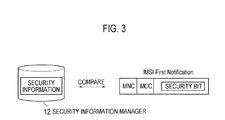
- the "First Notification (first notification signal) includes an "IMSI (International Mobile Subscriber Identity) constituted of an “MCC (Mobile Country Code),” an “MNC (Mobile Network Code)” and an “MSIN (Mobile Subscriber Identification Number).”
- IMSI International Mobile Subscriber Identity
- MCC Mobile Country Code
- MNC Mobile Network Code
- MSIN Mobile Subscriber Identification Number
- the "IMSI” is an identifier for globally identifying a mobile station UE.
- the "IMSI” also plays a role as a communication identifier indicating the presence of specific communication (for example, emergency information such as earthquake information or tsunami information) to be transmitted to each of the multiple mobile stations UE.
- the "MSIN" in the “IMSI” has, for example, a "Disaster type (two bits),” “RAT info (two bits),” a “Frequency (14 bits),” a “Channel Type (one bit),” a “Security on/off bit (one bit),” a “security bit (second security information),” and the like which are set therein.
- the "Disaster type” indicates the type of a disaster, such as an earthquake, a tsunami or terrorism
- the "RAPT info” indicates a radio access technology (such as the GSM scheme, the UMTS scheme, the LTE scheme and the 3GPP2 scheme) used for transmitting the "Second Notification.”
- the "Frequency” indicates the frequency used for transmitting the "Second Notification”
- the "Channel Type” indicates the type of a channel (a channel for CBS or a channel for MSMS) used for transmitting the "Second Notification.”
- the "Security on/off bit” indicates whether or not the mobile station UE needs to perform a verification of correctness of the "First Notification (first notification signal)" (in other words, indicates whether or not the security bit (second security information) is set in the "First Notification (first notification signal”).
- security bit (second security information) included in the “First Notification (first notification signal)” is configured to be updated at predetermined timing by the network node 1.
- part (for example, "security bit (second security information)" of the aforementioned information included in the "MSIN” in the “IMSI” maybe included in a “Paging Cause” indicating a reason why the “First Notification (first notification signal) " is transmitted, the “Paging Cause” being a region in the "First Notification (first notification signal).”
- the security information manager 12 is configured to manage security information (first security information).
- the security information manager 12 is configured to acquire the security information (first security information) from the network node 1 at the time of location registration processing (Attach procedure) by the mobile station UE, at the time of location registration update processing (TAU: Tracking Area Update procedure) by the mobile station UE, or the like.
- the security information manager 12 is configured to update the security information (first security information) at predetermined timing (for example, periodically) or in response to a notification from the network node 1.
- the verifier 13 is configured to perform the verification of the correctness of the "First Notification (first notification signal)" by comparing the security information (first security information) managed by the security information manager 12 with the "security bit (second security information)” included in the "First Notification (first notification signal) received by the first notification signal receiver 11.
- the verifier 13 may be configured to determine that the verification succeeds in a case where the security information (first security information) managed by the security information manager 12 matches the "security bit (second security information)" included in the "first Notification (first notification signal)."
- the verifier 13 may be configured to determine that the verification succeeds in a case where a security bit obtained in the following manner matches the "security bit (second security information)" included in the "First Notification (first notification signal).”
- the security bit is obtained in such a manner that the security information (first security information) managed by the security information manager 12, information (non-security bit) other than the "security bit (second security information)” included in the "First Notification (first notification signal)” and a predetermined key (for example, a fixed value previously distributed) are inputted in a predetermined security function.
- the verifier 13 may be configured as follows. The verifier 13 determines whether or not the mobile station UE should perform the verification of the correctness of the "First Notification (first notification signal), " defending on the "Security on/off bit (a verification necessity identifier) " included in the "First Notification (first notification signal).”
- the verifier 13 may be configured as follows. The verifier 13 determines that the mobile station UE should perform verification of the correctness of the "First Notification (first notification signal)," only in a case where the "security on/off bit (verification necessity identifier)" included in the "First Notification (first notification signal)" is "ON.”
- the verifier 13 may be configured as follows. The verifier 13 determines whether or not the mobile station UE should perform the verification of the correctness of the "First Notification (first notification signal)," depending on whether or not the security information (first security information) is managed by the security information manager 12.
- the verifier 13 may be configured as follows. The verifier 13 determines that the mobile station UE should perform verification of the correctness of the "First Notification (first notification signal), " only in a case where the security information (first security information) is managed by the security information manager 12.
- the output unit 14 is configured to perform output (such as buzzer output, alarm output or displaying on a display) for the "First Notification (first notification signal) " in a case where the verification of the correctness of the "First Notification (first notification signal)" by the verifier 13 succeeds.
- the output unit 14 may be configured to perform output in the following manner when a network node transmits multiple "First Notifications (notification signals)" through a single paging channel. Specifically, among the multiple "First Notifications (notification signals),” the output unit 14 performs output for a "First Notification (first notification signal)" for which the aforementioned verification succeeds.
- the output unit 14 is configured to display the detailed information (the "Second Notification (second notification signal) " corresponding to the "First Notification (first notification signal)") of the emergency information received by the second notification signal receiver 15, on the display.
- the detailed information may be small-volume text data or large-volume data.
- the second notification signal notification receiver 15 is configured to receive the aforementioned detailed information (second notification signal) when the aforementioned verification succeeds, the detailed information being received based on information designated by the aforementioned "First Notification (first notification signal)."
- the second notification signal receiver 15 may be configured as follows. When the aforementioned verification succeeds, the second notification signal receiver 15 receives the aforementioned detailed information (second notification signal) through a channel identified by the "Channel Type,” the "Frequency” or the like which is included in the aforementioned "First Notification (paging signal)."
- the second notification information receiver 15 may be configured as follows. When the aforementioned verification succeeds, the second notification information receiver 15 receives the aforementioned detailed information (second notification signal) by using a radio access technology (for example, the LTE scheme) identified by the "RAT info (radio access technology identifier)" included in the aforementioned "First Notification (first notification signal)."
- a radio access technology for example, the LTE scheme
- RAT info radio access technology identifier
- the second notification information receiver 15 may be configured to receive, when the aforementioned verification succeeds, the aforementioned detailed information (second notification signal) received simultaneously with the aforementioned "First Notification (first notification signal)."
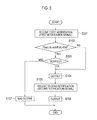
- the mobile station UE receives a "First Notification (first notification signal)" from the network node 1 in Step S101 as shown in Fig. 5 .
- the mobile station UE may receive the "First Notification (first notification signal)" included as "ETWS Information” in the broad cast information (SIB10/SIB11).
- the mobile station UE may receive the "First Notification (first notification signal)" included in a paging signal, through a PCH.
- Step S102 the mobile station UE determines whether or not the "Security on/off bit (verification necessity identifier) " included in the received "First Notification (first notification signal)" is "ON.”
- the mobile station UE may determine whether the security information is present or absent in the "First Notification (first notification signal)" in the received broadcast information (SIB10/SIB11).
- Step S103 When the "Security on/off bit” is "ON (or the security information is present)," the operation proceeds to Step S103.
- Step S104 When “Security on/off bit” is "OFF (or the security information is absent),” the operation proceeds to Step S104.
- Step S103 the mobile station UE performs the verification of the correctness of the "First Notification (first notification signal) " by the mobile station UE itself by using: the "security bit (second security information)" included in the “First Notification (first notification signal and paging signal) "; and the “security information (first security information) " managed by the mobile station UE itself.
- Step S104 When the verification succeeds, the operation proceeds to Step S107.
- Step S104 the mobile station UE performs output (for example, displaying an emergency information news flash or the like on the display) for the "First Notification (first notification signal)."
- the mobile station UE receives a "Second Notification (second notification signal)" corresponding to the "First Notification (first notification signal)" in Step S105, and displays detailed information notified by the "Second Notification (second notification signal)" on the display in Step S106.
- Step S107 the mobile station UE performs output indicating that the verification in Step S103 has failed.
- the mobile station UE determines whether or not the "security information (first security information) " is managed, in Step S202 as shown in Fig. 6 .
- the operation proceeds to Step S203.
- the operation proceeds to Step S204.
- the mobile station UE is configured to perform the verification of the correctness of the "First Notification (first notification signal)" on the basis of the "security bit (second security information)" included in the "First Notification (first notification signal)” and the “security information (first security information)” managed by the mobile station UE itself. Accordingly, transmission of the first notification signal by secure communication can be achieved.
- the mobile station UE since the "security bit (second security information) " is transmitted in the "First Notification (first notification signal)," the mobile station UE can promptly output emergency information after the emergency information occurs.
- the mobile station UE can output the emergency information about four seconds after the "First Notification (first notification signal)" is transmitted, as shown in Fig. 2 .
- operation of the above described mobile station UE and of the network node 1 may be implemented by means of hardware, a software module executed by a processor, or a combination of both.
- the software module may be provided in any type of storage medium such as an RAM (Random Access Memory), a flash memory, a ROM (Read Only Memory), an EPROM (Erasable Programmable ROM), an EEPROM (Electronically Erasable and Programmable ROM), a register, a hard disk, a removable disk, or a CD-ROM.
- RAM Random Access Memory
- flash memory a ROM (Read Only Memory)
- EPROM Erasable Programmable ROM
- EEPROM Electrically Erasable and Programmable ROM
- register a hard disk, a removable disk, or a CD-ROM.
- the storage medium is connected to the processor so that the processor can read and write information from and to the storage medium.
- the storage medium may be integrated into the processor.
- the storage medium and the processor may be provided in an ASPIC.
- the ASIC may be provided in the mobile station UE and the radio base station eNB.
- the storage medium and the processor may be provided in the mobile station UE and the radio base station eNB as a discrete component.
Landscapes
- Engineering & Computer Science (AREA)
- Signal Processing (AREA)
- Computer Networks & Wireless Communication (AREA)
- Emergency Management (AREA)
- Business, Economics & Management (AREA)
- Computer Security & Cryptography (AREA)
- Health & Medical Sciences (AREA)
- Environmental & Geological Engineering (AREA)
- Public Health (AREA)
- Human Computer Interaction (AREA)
- Mobile Radio Communication Systems (AREA)
- Telephonic Communication Services (AREA)
- Telephone Function (AREA)
Applications Claiming Priority (2)
| Application Number | Priority Date | Filing Date | Title |
|---|---|---|---|
| JP2008040735 | 2008-02-21 | ||
| PCT/JP2009/053075 WO2009104757A1 (ja) | 2008-02-21 | 2009-02-20 | 通知信号送信方法及び移動局 |
Publications (2)
| Publication Number | Publication Date |
|---|---|
| EP2252097A1 true EP2252097A1 (de) | 2010-11-17 |
| EP2252097A4 EP2252097A4 (de) | 2013-01-09 |
Family
ID=40985634
Family Applications (1)
| Application Number | Title | Priority Date | Filing Date |
|---|---|---|---|
| EP09713442A Withdrawn EP2252097A4 (de) | 2008-02-21 | 2009-02-20 | Verfahren zum senden eines ankündigungssignals und mobilstation |
Country Status (10)
| Country | Link |
|---|---|
| US (2) | US20110105156A1 (de) |
| EP (1) | EP2252097A4 (de) |
| JP (3) | JP4820448B2 (de) |
| KR (1) | KR20100127772A (de) |
| CN (1) | CN101953194A (de) |
| BR (1) | BRPI0908243A2 (de) |
| CA (1) | CA2716510A1 (de) |
| MX (1) | MX2010009211A (de) |
| RU (1) | RU2507712C2 (de) |
| WO (1) | WO2009104757A1 (de) |
Cited By (2)
| Publication number | Priority date | Publication date | Assignee | Title |
|---|---|---|---|---|
| EP2252089A4 (de) * | 2008-02-22 | 2013-01-09 | Ntt Docomo Inc | Paging-signalübertragungsverfahren und mobilstation |
| CN103581958A (zh) * | 2012-07-26 | 2014-02-12 | 中兴通讯股份有限公司 | 告警控制信息的处理方法、告警信息的接收方法及终端 |
Families Citing this family (4)
| Publication number | Priority date | Publication date | Assignee | Title |
|---|---|---|---|---|
| US20110014891A1 (en) * | 2008-03-18 | 2011-01-20 | Telefonaktiebolaget Lm Ericsson (Publ) | Earthquake and Tsunami Cellular Warning System |
| JP5578032B2 (ja) * | 2010-11-01 | 2014-08-27 | 株式会社デンソー | 通信装置 |
| JP5736954B2 (ja) * | 2011-05-17 | 2015-06-17 | 富士通株式会社 | 無線通信端末、無線通信システム及び無線通信方法 |
| CN113347575B (zh) * | 2020-02-18 | 2023-01-20 | 上海朗帛通信技术有限公司 | 一种被用于无线通信的方法和设备 |
Family Cites Families (11)
| Publication number | Priority date | Publication date | Assignee | Title |
|---|---|---|---|---|
| US5850444A (en) * | 1996-09-09 | 1998-12-15 | Telefonaktienbolaget L/M Ericsson (Publ) | Method and apparatus for encrypting radio traffic in a telecommunications network |
| JPH11234225A (ja) * | 1998-02-10 | 1999-08-27 | Toshiba Corp | 情報通信局、情報端末および情報通信システム |
| US7046992B2 (en) * | 2001-05-11 | 2006-05-16 | Telefonaktiebolaget Lm Ericsson (Publ) | Authentication of termination messages in telecommunications system |
| GB2390785B (en) * | 2002-07-12 | 2005-10-19 | Nokia Corp | Information service broadcasting or multicasting |
| WO2004098113A2 (en) * | 2003-04-25 | 2004-11-11 | Flarion Technologies, Inc. | Methods and apparatus for extending mobile ip |
| US8656480B2 (en) * | 2005-03-17 | 2014-02-18 | Samsung Electronics Co., Ltd | Method for negotiating security-related functions of subscriber station in wireless portable internet system |
| RU67800U1 (ru) * | 2005-10-31 | 2007-10-27 | Открытое акционерное общество "Ижевский радиозавод" | Беспроводная локальная система оповещения |
| JP4809433B2 (ja) * | 2006-06-19 | 2011-11-09 | 株式会社エヌ・ティ・ティ・ドコモ | 移動通信システム、移動通信方法、配信サーバ、無線回線制御局及び移動局 |
| US8072953B2 (en) * | 2007-04-24 | 2011-12-06 | Interdigital Technology Corporation | Wireless communication method and apparatus for performing home Node-B identification and access restriction |
| JP5147450B2 (ja) * | 2008-02-22 | 2013-02-20 | 株式会社エヌ・ティ・ティ・ドコモ | ページング信号送信方法及び移動局 |
| JP5156460B2 (ja) * | 2008-04-09 | 2013-03-06 | 株式会社エヌ・ティ・ティ・ドコモ | 同報情報通知方法、移動局及び認証機関システム |
-
2009
- 2009-02-20 WO PCT/JP2009/053075 patent/WO2009104757A1/ja not_active Ceased
- 2009-02-20 MX MX2010009211A patent/MX2010009211A/es active IP Right Grant
- 2009-02-20 BR BRPI0908243-3A patent/BRPI0908243A2/pt not_active IP Right Cessation
- 2009-02-20 CA CA2716510A patent/CA2716510A1/en not_active Abandoned
- 2009-02-20 RU RU2010137739/07A patent/RU2507712C2/ru not_active IP Right Cessation
- 2009-02-20 EP EP09713442A patent/EP2252097A4/de not_active Withdrawn
- 2009-02-20 CN CN2009801061423A patent/CN101953194A/zh active Pending
- 2009-02-20 KR KR1020107019756A patent/KR20100127772A/ko not_active Ceased
- 2009-02-20 US US12/918,737 patent/US20110105156A1/en not_active Abandoned
- 2009-02-20 JP JP2009554405A patent/JP4820448B2/ja not_active Expired - Fee Related
-
2011
- 2011-09-02 JP JP2011192056A patent/JP2012044674A/ja not_active Ceased
-
2012
- 2012-07-26 JP JP2012166034A patent/JP2012239210A/ja active Pending
- 2012-11-20 US US13/682,321 patent/US20130079042A1/en not_active Abandoned
Cited By (4)
| Publication number | Priority date | Publication date | Assignee | Title |
|---|---|---|---|---|
| EP2252089A4 (de) * | 2008-02-22 | 2013-01-09 | Ntt Docomo Inc | Paging-signalübertragungsverfahren und mobilstation |
| US8463236B2 (en) | 2008-02-22 | 2013-06-11 | Ntt Docomo, Inc. | Paging signal transmission method and mobile station for the same |
| CN103581958A (zh) * | 2012-07-26 | 2014-02-12 | 中兴通讯股份有限公司 | 告警控制信息的处理方法、告警信息的接收方法及终端 |
| CN103581958B (zh) * | 2012-07-26 | 2019-06-04 | 中兴通讯股份有限公司 | 告警控制信息的处理方法、告警信息的接收方法及终端 |
Also Published As
| Publication number | Publication date |
|---|---|
| CN101953194A (zh) | 2011-01-19 |
| WO2009104757A1 (ja) | 2009-08-27 |
| US20130079042A1 (en) | 2013-03-28 |
| JP2012044674A (ja) | 2012-03-01 |
| US20110105156A1 (en) | 2011-05-05 |
| MX2010009211A (es) | 2010-09-24 |
| RU2507712C2 (ru) | 2014-02-20 |
| JP4820448B2 (ja) | 2011-11-24 |
| JPWO2009104757A1 (ja) | 2011-06-23 |
| CA2716510A1 (en) | 2009-08-27 |
| JP2012239210A (ja) | 2012-12-06 |
| EP2252097A4 (de) | 2013-01-09 |
| KR20100127772A (ko) | 2010-12-06 |
| RU2010137739A (ru) | 2012-03-27 |
| BRPI0908243A2 (pt) | 2015-07-21 |
Similar Documents
| Publication | Publication Date | Title |
|---|---|---|
| US9654953B2 (en) | Method and apparatus for wireless emergency alerts | |
| CA2745931C (en) | Mobile communication method and radio base station | |
| US20130079042A1 (en) | Notification signal transmission method and mobile station for the same | |
| US8396448B2 (en) | Broadcast information notification method and network node | |
| US8463236B2 (en) | Paging signal transmission method and mobile station for the same | |
| JP2020501421A (ja) | 改善された公共情報システム | |
| US20110014891A1 (en) | Earthquake and Tsunami Cellular Warning System | |
| EP2915344B1 (de) | Verfahren, standortbestimmer, computerprogramm und computerprogrammprodukt zur bestimmung des standortes eines mobilen kommunikationsendgeräts | |
| US8577282B2 (en) | Method for reporting multi-address information, mobile station and authentication organization system | |
| CN112567780B (zh) | 一种伪基站识别方法及装置 | |
| Androulidakis et al. | An application free method to locate a mobile phone in a given area without user consent or provider help |
Legal Events
| Date | Code | Title | Description |
|---|---|---|---|
| PUAI | Public reference made under article 153(3) epc to a published international application that has entered the european phase |
Free format text: ORIGINAL CODE: 0009012 |
|
| 17P | Request for examination filed |
Effective date: 20100915 |
|
| AK | Designated contracting states |
Kind code of ref document: A1 Designated state(s): AT BE BG CH CY CZ DE DK EE ES FI FR GB GR HR HU IE IS IT LI LT LU LV MC MK MT NL NO PL PT RO SE SI SK TR |
|
| AX | Request for extension of the european patent |
Extension state: AL BA RS |
|
| RIN1 | Information on inventor provided before grant (corrected) |
Inventor name: ZUGENMAIER, ALF Inventor name: TANAKA, ITSUMA Inventor name: TANABE, AKIMICHI Inventor name: KOSHIMIZU, TAKASHI Inventor name: ISHII, MINAMI Inventor name: HAPSARI, WURI ANDARMAWANTI |
|
| DAX | Request for extension of the european patent (deleted) | ||
| A4 | Supplementary search report drawn up and despatched |
Effective date: 20121206 |
|
| RIC1 | Information provided on ipc code assigned before grant |
Ipc: H04L 9/32 20060101ALI20121130BHEP Ipc: H04W 68/00 20090101ALI20121130BHEP Ipc: H04M 1/665 20060101ALI20121130BHEP Ipc: H04W 4/22 20090101ALI20121130BHEP Ipc: H04W 12/08 20090101AFI20121130BHEP |
|
| STAA | Information on the status of an ep patent application or granted ep patent |
Free format text: STATUS: THE APPLICATION HAS BEEN WITHDRAWN |
|
| 18W | Application withdrawn |
Effective date: 20150310 |