EP2253918A2 - Gehäuse für Wärmeübertragungsvorrichtungen, Verfahren zur dessen Herstellung und dieses enthaltende Artikel - Google Patents
Gehäuse für Wärmeübertragungsvorrichtungen, Verfahren zur dessen Herstellung und dieses enthaltende Artikel Download PDFInfo
- Publication number
- EP2253918A2 EP2253918A2 EP10163002A EP10163002A EP2253918A2 EP 2253918 A2 EP2253918 A2 EP 2253918A2 EP 10163002 A EP10163002 A EP 10163002A EP 10163002 A EP10163002 A EP 10163002A EP 2253918 A2 EP2253918 A2 EP 2253918A2
- Authority
- EP
- European Patent Office
- Prior art keywords
- shell
- heat transfer
- transfer device
- seal ring
- disposed
- Prior art date
- Legal status (The legal status is an assumption and is not a legal conclusion. Google has not performed a legal analysis and makes no representation as to the accuracy of the status listed.)
- Withdrawn
Links
Images





Classifications
-
- F—MECHANICAL ENGINEERING; LIGHTING; HEATING; WEAPONS; BLASTING
- F28—HEAT EXCHANGE IN GENERAL
- F28D—HEAT-EXCHANGE APPARATUS, NOT PROVIDED FOR IN ANOTHER SUBCLASS, IN WHICH THE HEAT-EXCHANGE MEDIA DO NOT COME INTO DIRECT CONTACT
- F28D15/00—Heat-exchange apparatus with the intermediate heat-transfer medium in closed tubes passing into or through the conduit walls ; Heat-exchange apparatus employing intermediate heat-transfer medium or bodies
- F28D15/02—Heat-exchange apparatus with the intermediate heat-transfer medium in closed tubes passing into or through the conduit walls ; Heat-exchange apparatus employing intermediate heat-transfer medium or bodies in which the medium condenses and evaporates, e.g. heat pipes
- F28D15/04—Heat-exchange apparatus with the intermediate heat-transfer medium in closed tubes passing into or through the conduit walls ; Heat-exchange apparatus employing intermediate heat-transfer medium or bodies in which the medium condenses and evaporates, e.g. heat pipes with tubes having a capillary structure
- F28D15/046—Heat-exchange apparatus with the intermediate heat-transfer medium in closed tubes passing into or through the conduit walls ; Heat-exchange apparatus employing intermediate heat-transfer medium or bodies in which the medium condenses and evaporates, e.g. heat pipes with tubes having a capillary structure characterised by the material or the construction of the capillary structure
-
- F—MECHANICAL ENGINEERING; LIGHTING; HEATING; WEAPONS; BLASTING
- F28—HEAT EXCHANGE IN GENERAL
- F28D—HEAT-EXCHANGE APPARATUS, NOT PROVIDED FOR IN ANOTHER SUBCLASS, IN WHICH THE HEAT-EXCHANGE MEDIA DO NOT COME INTO DIRECT CONTACT
- F28D15/00—Heat-exchange apparatus with the intermediate heat-transfer medium in closed tubes passing into or through the conduit walls ; Heat-exchange apparatus employing intermediate heat-transfer medium or bodies
- F28D15/02—Heat-exchange apparatus with the intermediate heat-transfer medium in closed tubes passing into or through the conduit walls ; Heat-exchange apparatus employing intermediate heat-transfer medium or bodies in which the medium condenses and evaporates, e.g. heat pipes
- F28D15/0233—Heat-exchange apparatus with the intermediate heat-transfer medium in closed tubes passing into or through the conduit walls ; Heat-exchange apparatus employing intermediate heat-transfer medium or bodies in which the medium condenses and evaporates, e.g. heat pipes the conduits having a particular shape, e.g. non-circular cross-section, annular
-
- H—ELECTRICITY
- H10—SEMICONDUCTOR DEVICES; ELECTRIC SOLID-STATE DEVICES NOT OTHERWISE PROVIDED FOR
- H10W—GENERIC PACKAGES, INTERCONNECTIONS, CONNECTORS OR OTHER CONSTRUCTIONAL DETAILS OF DEVICES COVERED BY CLASS H10
- H10W40/00—Arrangements for thermal protection or thermal control
- H10W40/70—Fillings or auxiliary members in containers or in encapsulations for thermal protection or control
- H10W40/73—Fillings or auxiliary members in containers or in encapsulations for thermal protection or control for cooling by change of state
-
- F—MECHANICAL ENGINEERING; LIGHTING; HEATING; WEAPONS; BLASTING
- F28—HEAT EXCHANGE IN GENERAL
- F28F—DETAILS OF HEAT-EXCHANGE AND HEAT-TRANSFER APPARATUS, OF GENERAL APPLICATION
- F28F2230/00—Sealing means
-
- Y—GENERAL TAGGING OF NEW TECHNOLOGICAL DEVELOPMENTS; GENERAL TAGGING OF CROSS-SECTIONAL TECHNOLOGIES SPANNING OVER SEVERAL SECTIONS OF THE IPC; TECHNICAL SUBJECTS COVERED BY FORMER USPC CROSS-REFERENCE ART COLLECTIONS [XRACs] AND DIGESTS
- Y10—TECHNICAL SUBJECTS COVERED BY FORMER USPC
- Y10T—TECHNICAL SUBJECTS COVERED BY FORMER US CLASSIFICATION
- Y10T29/00—Metal working
- Y10T29/49—Method of mechanical manufacture
- Y10T29/4935—Heat exchanger or boiler making
-
- Y—GENERAL TAGGING OF NEW TECHNOLOGICAL DEVELOPMENTS; GENERAL TAGGING OF CROSS-SECTIONAL TECHNOLOGIES SPANNING OVER SEVERAL SECTIONS OF THE IPC; TECHNICAL SUBJECTS COVERED BY FORMER USPC CROSS-REFERENCE ART COLLECTIONS [XRACs] AND DIGESTS
- Y10—TECHNICAL SUBJECTS COVERED BY FORMER USPC
- Y10T—TECHNICAL SUBJECTS COVERED BY FORMER US CLASSIFICATION
- Y10T29/00—Metal working
- Y10T29/53—Means to assemble or disassemble
- Y10T29/53113—Heat exchanger
Definitions
- This disclosure relates to enclosures for heat transfer devices, methods of manufacture thereof and to articles comprising the same.
- Heat transfer devices such as, for example, a heat pipe, vapor chamber or thermal ground plane that are generally used in supercomputers and other facilities (e.g., nuclear plants, power generation facilities, and the like) are made from high thermal conductivity materials such as copper or aluminum and take the form of cylindrical tubes, flat spreaders or a combination thereof.
- the heat transfer device is intimately attached to a hot surface of an object that is to be cooled.
- Concerns can arise when there is a mismatch in the thermal expansion between the heat transfer device and the object to be cooled.
- a compliant layer is then be used between the heat transfer device and the object to be cooled to account for the mismatch and reduce the stresses brought on by the differences between the respective coefficients of thermal expansions.
- a heat transfer device that includes a shell; the shell being an enclosure that prevents matter from within the shell from being exchanged with matter outside the shell during the operation of the heat transfer device; the shell having an outer surface and an inner surface; and a porous layer disposed on the inner surface of the shell; the porous particle layer having a thickness effective to enclose a vapor space between opposing faces; the vapor space being effective to provide a passage for the transport of a fluid; the heat transfer device having a thermal conductivity of greater than or equal to about 10 watts per meter-Kelvin and a coefficient of thermal expansion that is substantially similar to that of a semiconductor.
- a method for manufacturing a heat transfer device comprising disposing a particle layer upon a first portion and a second portion of a shell; the particle layer being porous; the first portion and the second portion each having a thermal conductivity of greater than or equal to about 10 watts per meter-Kelvin and a coefficient of thermal expansion that is substantially similar to that of a semiconductor; and disposing a seal ring and/or a metal stack between the first portion and the second portion of the shell; where the first portion and the second portion are sealed in a manner to prevent matter from within the shell from being exchanged with matter outside the shell during the operation of the heat transfer device.
- first, second, third, and the like may be used herein to describe various elements, components, regions, layers and/or sections, these elements, components, regions, layers and/or sections should not be limited by these terms. These terms are only used to distinguish one element, component, region, layer or section from another region, layer or section. Thus, a first element, component, region, layer or section discussed below could be termed a second element, component, region, layer or section without departing from the teachings of the present invention.
- spatially relative terms such as “lower,” “under,” “upper” and the like, may be used herein for ease of description to describe the relationship of one element or feature to another element(s) or feature(s) as illustrated in the figures. It will be understood that the spatially relative terms are intended to encompass different orientations of the device in use or operation, in addition to the orientation depicted in the figures. For example, if the device in the figures is turned over, elements described as “lower” or “under” relative to other elements or features would then be oriented “upper” or “over” relative to the other elements or features. Thus, the exemplary term “under” can encompass both an orientation of above and below. The device may be otherwise oriented (rotated 90 degrees or at other orientations) and the spatially relative descriptors used herein interpreted accordingly.
- Embodiments are described herein with reference to cross-section illustrations that are schematic illustrations of idealized embodiments (and intermediate structures) of the invention. As such, variations from the shapes of the illustrations as a result, for example, of manufacturing techniques and/or tolerances, are to be expected. Thus, embodiments should not be construed as limited to the particular shapes of regions illustrated herein but are to include deviations in shapes that result, for example, from manufacturing.
- an implanted region illustrated as a rectangle will, typically, have rounded or curved features and/or a gradient of implant concentration at its edges rather than a binary change from implanted to non-implanted region.
- a buried region formed by implantation may result in some implantation in the region between the buried region and the surface through which the implantation takes place.
- the regions illustrated in the figures are schematic in nature and their shapes are not intended to illustrate the actual shape of a region of a device and are not intended to limit the scope of the invention.
- a heat transfer device having a shell that has a thermal conductivity of greater than or equal to about 10 watts per meter-kelvin (W/mK) while at the same time having a coefficient of thermal expansion that is substantially similar to that of typical semiconductor materials.
- the heat transfer device is an enclosed device that comprises a shell having a porous layer disposed thereon. The pores of the porous layer are completely or partially filled with liquid. Disposed between opposing faces of the porous layer is a vapor space that permits the transport of a vapor.
- the shell contacts a heat source and a heat sink and is closed, i.e., there is no exchange of matter from outside the shell with that inside the shell during the operation of the heat transfer device.
- the coefficient of thermal expansion is between about - 10 to +10 parts per million per degree Kelvin (ppm/K) when measured at room temperature (RT) of 25°C.
- the heat transfer device 100 comprises a shell 102.
- the shell comprises a first portion 110 and a second portion 120, with the first portion 110 being disposed upon and in contact with the second portion 120.
- Disposed at the interface where the first portion 110 contacts the second portion 120 is a seal ring 112 and a metal stack 108 for promoting adhesion with the seal ring 112.
- the metal stack 108 and the seal ring 112 facilitate the locking of the first portion 110 with the second portion 120.
- the first portion 110 and the second portion 120 (of the shell 102) each have an inner surface 109 and 119 and an outer surface 111 and 121 respectively.
- Both the respective inner surfaces 109 and 119 and the outer surfaces 111 and 121 can optionally have disposed upon them a passivation layer 130 and/or a stack for adhesion 140. While only a single passivation layer is depicted as being disposed on the inner surfaces 109 and 119 and the outer surfaces 111 and 121 respectively, it is understood that multiple passivation layers and/or adhesive layers can be disposed upon a given surface.
- a port 116 Disposed in the first portion 110 is a port 116 in which is disposed a plug 118. The port 116 facilitates refilling the heat transfer device with a fluid that enables heat and mass transfer during the operation of the heat transfer device.
- a space 150 Disposed between the first portion and the second portion is a space 150 through which fluid (e.g., liquid and/or vapors) travel and a particle layer 160 that contains the fluid (generally in is liquid state).
- fluid e.g., liquid and/or vapors
- particle layer 160 that contains the fluid (generally in is liquid state).
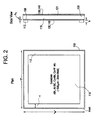
- the Figure 2 depicts a plan view and a side view of the second portion 120 of the shell when viewed along the section AA' of the Figure 1
- the Figure 3 depicts a plan view and a side view of the first portion 110 of the shell 102 when viewed along the section BB' of the Figure 1
- the surface area of the inner surface 119 of the second portion 120 of the shell 102 is slightly larger than the area that lies within the outer perimeter of the seal ring 112. This difference between these areas is referred to as an "inlet" in the Figure 2
- Disposed between the seal ring 112 and the first portion 110 is the metal stack 108.
- the passivation layer 130 and/or the stack for adhesion 140 are disposed on both sides of the second portion 120.
- Figure 3 depicts the first portion 110 of the shell 102 and shows a plurality of ports 116 disposed therein.
- the first portion 110 can contain two or more ports. In one embodiment, the first portion can contain 4 or more ports. Ports can be disposed in either the first portion 110 or in the second portion 120. In another embodiment, the first portion can contain 10 or more ports.
- the ports are used for filling and evacuating the heat transfer device with a fluid. Each port contains a plug 118 that can be removed when desired, but which provides an air-tight seal during operation of the heat transfer device. Alternatively, the port may be welded or soldered shut.
- the passivation layer 130 and/or the stack for adhesion 140 are disposed on both sides of the first portion 110 and the second portion 120 ( Figure 2 ).
- first portion 110 and the second portion 120 of the shell 102 in the Figures 1 , 2 and 3 are flat plates; each portion may have walls disposed on its periphery. This is not depicted in the Figures 1 , 2 and 3 .
- a seal ring 112 along with a metal stack 108 may be disposed between opposing walls that are disposed on the first portion 110 and the second portion 120 to form the heat transfer device 100.
- the wall can have a height of about 0.3 millimeter to about 2 millimeter. In one embodiment, the wall can have a height of about 0.5 millimeter to about 1 millimeter.
- the shell can be a cylinder, a pyramid, a cube, an ellipsoid, a sphere, a rectangular cuboid, a geodesic dome, an n-sided antiprism, a cupola, a rhombohedron, a prism, or the like. While the Figures 2 and 3 depict the geometry of the cross-sectional area of the first and second portions as being square, they can be rectangular, triangular, polygonal, circular, or the like. Combinations of the aforementioned geometries can be used. An exemplary cross-section is a square or a rectangle.
- the outer perimeter of the seal ring 112 is generally concentric to the outer perimeter of the shell 102.
- the outer perimeter of the seal ring 112 may have a similar geometry as the outer perimeter of the shell 102.
- the shell 102 has outer dimensions indicated as the length "1" and the width "w” in the Figure 2 . While these dimensions are equivalent to each other because the area depicted in the Figure 2 is a square, they may not always be identical.
- the length or width can be a length "1" of about 10 millimeters to about 1 meter.
- the shell can have a length "1" of about 30 millimeters (mm) to about 0.75 meter.
- the shell can have a length "1" of about 50 millimeters (mm) to about 0.50 meter.
- the shell can have a length "1" of about 75 millimeters (mm) to about 0.25 meter.
- An exemplary length and width is about 3 centimeters to about 20 centimeters.
- the shell 102 can have an aspect ratio of greater than or equal to about 1.
- the aspect ratio is equal to the length "1" of heat transfer device divided by the largest linear cross-sectional dimension of the heat transfer device measured perpendicular to the length.
- the shell 102 can have an aspect ratio of about 5 to about 10,000.
- the shell 102 can have an aspect ratio of to about 10 to about 5,000.
- the shell 102 can have an aspect ratio of to about 20 to about 1,000.
- the shell it is desirable for the shell to have a high thermal conductivity while having a coefficient of expansion that is substantially similar to that of a semiconductor.
- the material used in the shell features adequately high thermal conductivity for heat spreading, high strength to withstand external and internal working pressures, sufficient hermeticity for long life and compatibility with add-on circuitry build-up by low-temperature-co-fired-ceramic (LTCC) or flexible circuit lamination.
- Both the first portion 110 and the second portion 120 of the shell 102 can comprise metals, ceramics, organic polymers, or a combination comprising at least one of the foregoing materials.
- Other materials such as carbon in its various forms such as, for example, graphite, diamond, and graphite-like materials can be used in the shell.
- the shell can be manufactured from a laminate, a composite, or the like.
- the shell can comprise metals.
- suitable metals are gold, platinum, silver, palladium, copper, aluminum, nickel, cobalt, titanium, tin, or the like, or a combination comprising at least one of the foregoing metals.
- the shell can comprise a metal that is in the form of a laminate or in the form of a single unitary indivisible piece of metal.
- the shell can also comprise metal alloys. Exemplary metals that can be used in the shell are copper laminates, copper, tungsten alloys and copper-molybdenum laminates.
- suitable ceramics are oxides, nitrides, carbides, and the like.
- suitable oxides are silicon dioxide, titanium dioxide, aluminum oxide, zirconium dioxide, cerium oxide, or a combination comprising at least one of the foregoing oxides.
- suitable nitrides are aluminum nitride, gallium nitride, indium nitride, titanium nitride, boron nitride, silicon nitride, or a combination comprising at least one of the foregoing nitrides.
- suitable carbides are titanium carbide, silicon carbide, zirconium carbide, tantalum carbide, tungsten carbide, boron carbide, chromium carbide, molybdenum carbide, aluminum-silicon carbide or a combination comprising at least one of the foregoing carbides.
- An exemplary ceramic is aluminum nitride.
- the shell may comprise carbon in its various forms.
- the shell can comprise graphite composites, diamond composites, diamond-like carbon, carbon fiber composites, or a combination comprising at least one of the foregoing forms of carbon.
- Exemplary carbonaceous shells are those that comprise diamond, diamond-like carbon or graphite.
- An organic polymer may bind the carbon used in the shell. Examples of organic polymers are provided below.
- suitable organic polymers are polyacetals, polyolefins, polyacrylics, polycarbonates, polystyrenes, polyesters, polyamides, polyamideimides, polyarylates, polyarylsulfones, polyethersulfones, polyphenylene sulfides, polyvinyl chlorides, polysulfones, polyimides, polyetherimides, polytetrafluoroethylenes, polyetherketones, polyether etherketones, polyether ketone ketones, polybenzoxazoles, polyphthalides, polyacetals, polyanhydrides, polyvinyl ethers, polyvinyl thioethers, polyvinyl alcohols, polyvinyl ketones, polyvinyl halides, polyvinyl nitriles, polyvinyl esters, polysulfonates, polysulfides, polythioesters, polysulfones, polysulfonamides, polyureas, polyphospha
- the shell has a thermal conductivity greater than or equal to about 10 W/m-K. In one embodiment, the shell has a thermal conductivity of about 20 to about 2000 W/m-K. In another embodiment, the shell has a thermal conductivity of about 50 to about 1000 W/m-K. In yet another embodiment, the shell has a thermal conductivity of about 100 to about 400 W/m-K.
- the shell has a coefficient of thermal expansion of about -10 to about +10 ppm/degree Kelvin when measured at room temperature. In one embodiment, the shell has a coefficient of thermal expansion of about 0 to about 8 ppm/degree Kelvin. In another embodiment, the shell has a coefficient of thermal expansion of about 3 to about 6 ppm/degree Kelvin.
- the shell 102 may have a wall thickness of about 250 micrometers to about 3 millimeters. In one embodiment, the shell may have a wall thickness of about 1,000 micrometers to about 2.5 millimeters. In another embodiment, the shell may have a wall thickness of about 1,500 micrometers to about 2 millimeters.
- the heat transfer device may have a thickness "T" of greater than or equal to about 100 nanometers.
- the sides of the square can be about 200 nanometers to about 20 centimeters.
- the sides of the square can be about 500 nanometers to about 10 centimeters.
- the height of the square can be about 1,000 nanometers to about 1 centimeter.
- the heat transfer device can have a thickness "T" of up to about 1 micrometer to about 1 millimeter.
- the shell 102 may optionally be provided with ribs or support structures (e.g., pillars, posts, and the like) for enhancing mechanical stability of the heat transfer device. As the size of the heat transfer device increases, the need for internal support/joining structures may arise. Such structures could be individually placed or formed on either the first portion 110 or the second portion 120 of the shell 102 and joined during the assembly process, providing strength for the shell 102 to survive the internal and external pressures.
- ribs or support structures e.g., pillars, posts, and the like
- a single rib or a plurality of ribs may be disposed upon the surface of the shell.
- Figure 4 depicts ribs 170 disposed upon the inner surface of the first portion 110. While not specifically depicted, ribs may be disposed upon the inner surface of the second portion 120 as well. The ribs may be manufactured from the same material as the first portion or the second portion or they may be manufactured from another material.
- the seal ring 112 may be manufactured from materials that are chosen based on a matching of properties of the material used in the seal ring with that used in the first portion 110 and the second portion 120 of the shell 102. In one embodiment, it is desirable for the material used in the seal ring to have similar thermo-mechanical properties (elastic modulus, coefficient of thermal expansion) to that of the material used in the shell 102. In addition, it is desirable for the seal to display hermeticity and adhesion strength to bond the first portion 110 and the second portion 120 together to provide an air tight seal so that matter from inside the shell cannot be exchanged with the outside during the operation of the heat transfer device.
- thermo-mechanical properties elastic modulus, coefficient of thermal expansion
- the material used in the seal ring 112 and/or the metal stack 108 it is desirable for the material used in the seal ring 112 and/or the metal stack 108 to have a coefficient of thermal expansion (CTE) that is within 20% of the coefficient of thermal expansion of the material used for the first portion 110 and the second portion 120 of the shell 102. In another embodiment, it is desirable for the material used in the seal ring 112 and/or the metal stack 108 to have a coefficient of thermal expansion that is within 10% of the coefficient of thermal expansion of the material used for the first portion 110 and the second portion 120 of the shell 102.
- CTE coefficient of thermal expansion
- the material used in the seal ring 112 and/or the metal stack 108 may have a coefficient of thermal expansion that is within 5% of the coefficient of thermal expansion of the material used for the first portion 110 and the second portion 120 of the shell 102.
- higher coefficient of thermal expansion materials may be utilized if the material modulus is low enough such that the stress imparted to the envelope seal is minimized.
- Such materials may include solder alloys.
- the material used in the seal ring 112 and/or the metal stack 108 is desirable for the material used in the seal ring 112 and/or the metal stack 108 to have a low elastic modulus to minimize thermo-mechanical strain.
- the upper limit of the elastic modulus for the seal ring material is about 100x10 5 Kg/cm 2 .
- the material for the seal ring and/or the metal stack is a soldering material or a brazing material. Brazing materials and soldering materials are useful candidates for hermetic seals based on their compatibility with the materials used in the shell and also because of their operating temperatures, modulus and strength.
- the metal stack may comprise optional adhesion layers if desired.
- soldering materials comprise bismuth, silver, gold, tin, indium, copper, zinc, antimony, or the like, or a combination comprising at least one of the foregoing metals.
- Exemplary solders are those that comprise bismuth and tin, (Bi/Sn), gold and tin (Au/Sn), tin and lead (Sn/Pb), tin and silver (Sn/Ag), indium and tin (In/Sn), or the like, or a combination comprising at least one of the foregoing solders.
- brazing materials comprise aluminum, bronze, brass, tin, silicon, copper, nickel, silver, or the like, or a combination comprising at least one of the foregoing metals or non-metals.
- Exemplary brazing materials are aluminum and bronze (Al/bronze), aluminum and brass (Al/brass), tin and brass (Sn/brass), silicon and bronze (Si/bronze), copper and nickel (Cu/Ni), nickel and silver (Ni/Ag), or the like, or a combination comprising at least one of the foregoing metals or non-metals.
- Other suitable materials for the seal rings are glass frits (with lead or lead-free).
- the seal ring 112 comprises a glass frit, while the metal stack 108 can comprise the aforementioned soldering materials or the brazing materials.
- the adhesion promoting layers can include metals such as titanium (Ti), chromium (Cr), tungsten (W) and titanium-tungsten alloys (TiW).
- the adhesion promoting layers can have a thickness of about 100 to about 1000 nanometers. In one embodiment, the adhesion-promoting layer can have a thickness of about 125 to about 175 nanometers.
- the seal ring surface may be optionally subjected to chemical treatments and/or mechanical treatments to provide surface texture (roughness) or chemical compatibility with the materials used in the shell 102 or the metal stack 108.
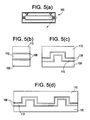
- the seal ring 112 and/or the metal stack 108 can have an untextured surface or a textured surface. While the Figure 5 depicts the groove as being in the first portion 110 and the second portion 120 of the shell 102, it is possible for the groove to be present in either the metal stack 108 or in the seal ring 112.
- a textured surface can include a variety of grooves for accurate interlocking of the first portion 110 with the second portion 120 of the shell 102.
- the seal ring can include a single groove or a plurality of grooves.
- the Figure 5(a) depicts the heat transfer device with a section that encloses the seal ring being encircled.
- the Figures 5(b), 5(c) and 5(d) are expanded views of the encircled regions.
- the Figure 5(b) depicts an untextured surface, while the Figure 5(c) and 5(d) depict textured surfaces.
- the Figure 5(c) depicts a single groove disposed between the first portion 110 and the second portion 120 of the shell 102, while the Figure 5(d) depicts a multiple grooves disposed between the first portion 110 and the second portion 120 of the shell 102.
- the textured surface can include a variety of different joints for locating and/or sealing the first portion 110 and the second portion 120 of the shell 102. These joints include dove tail joints, mortise and tenon joints, lap joints, finger joints, tongue and groove joints, miter joints, and the like. Dowels may also be used for location and sealing of the first portion 110 and the second portion 120 of the shell 102.
- the additional barrier coatings may include inorganic metal systems such as for example nickel (Ni), silica (SiO2), molybdenum (Mo), silicon nitride (Si 3 N 4 ), alumina (Al 2 O 3 ), or the like, or a combination comprising at least one of the foregoing barrier coatings.
- Additional organic coupling layers may also be provided between the seal ring and the shell 102 and/or the metal stack 108.
- the organic coupling layers include organic materials and polymers. Examples of organic polymers are provided above. Other examples of organic coupling materials are acrylate-containing polymers, methacrylate-containing polymers, parylene, bis-silanes, or the like, or a combination comprising at least one of the foregoing coupling materials.
- the seal ring 112 and/or the metal stack 108 disposed on the periphery of the first portion 110 and/or the second portion 120 can have a thickness "t" of about 1 to about 5 millimeters. In one embodiment, the seal ring 112 and/or the metal stack 108 disposed on the periphery of the first portion 110 and/or the second portion 120 can have a thickness of about 2 to about 4 millimeters.
- the seal ring 112 generally has a height "h” (see Figure 2 ) of about 50 to about 500 micrometers. In one embodiment, the seal ring 112 generally has a height "h” of about 100 to about 400 micrometers. In another embodiment, the seal ring 112 generally has a height "h” of about 150 to about 350 micrometers.
- the metal stack 108 generally has a thickness "h 1 " (see Figure 2 ) of about 500 nanometers to about 2 micrometers. In one embodiment, the metal stack has a thickness "h 1 " of about 500 nanometers to about 2 micrometers.
- the passivation layer 130 provides passivation against the formation of chemical erosion, which generally results from the formation of galvanic cells on the surface of the shell. As noted above, the passivation layer 130 is disposed on the outside of the shell 102 as well as on the inside of the shell 102.
- the passivation layer 130 generally comprises barrier coatings such as nickel, molybdenum, and the like, having a thickness of about 200 to about 5,000 nanometers.
- the stack for adhesion 140 facilitates the adhesion onto the heat source and the heat sink.
- the stack for adhesion can comprise metals such as chromium, titanium, tungsten, and the like.
- the stack for adhesion has a thickness of about 100 to about 200 nanometers.
- the ports 116 can be disposed on the first portion 110 and the second portion 120 to facilitate the charging and discharging of the fluid in the shell.
- the port 116 can be disposed in the particle layer 160 if desired. Alternatively, the port 116 can be disposed only in the first portion 110 and/or the second portion 120.
- a variety of fluids may be used in the shell.
- An exemplary fluid is water.
- the corresponding plug 118 is removed and an attachment such as a tube, a pipe, a syringe or a funnel may be disposed into the port.
- the Figure 6 exemplifies various methods that can be used to fill the shell.
- the Figures 6(a), (b), (c) and (d) depict various methods that can be employed to fill the shell with the fluid.
- the port 116 can have a minimum diameter of about 100 micrometers to about 5 millimeters. In one embodiment, the port 116 can have a minimum diameter of about 600 micrometers to about 3 millimeters. In yet another embodiment, the port 116 can have a minimum diameter of about 700 micrometers to about 1 millimeters.
- a particle layer 160 is disposed on the inner surfaces 109 and 119 of the first portion 110 and the second portion 120.
- the materials used in the particle layer as well as the dimensions of the particle layer are described in copending applications having serial numbers 12/470,624 and 12/470,723, the entire contents of which are hereby incorporated by reference.
- the Figure 7 depicts various exemplary parts of the heat transfer in their various configurations.
- the Figure 7 also depicts various methods for assembling and manufacturing the heat transfer device.
- the Figure 7 depicts various exemplary embodiments of the first portion 110 in the Figures 7(a) and 7(b) respectively.
- the Figure 7(a) depicts ribs 170 disposed upon the first portion 110 and in intimate contact with the first portion 110.
- the Figure 7(b) shows two embodiments that depict ribs 170 disposed upon the first portion 110 and in intimate contact with the first portion 110.
- the passivation layer 130 and/or a stack for adhesion 140 are disposed upon the first portion 110, but is disposed between the ribs 170 no under them.
- the passivation layer 130 and/or a stack for adhesion 140 are disposed upon the first portion 110 with the ribs 170 disposed upon the passivation layer 130 and/or the stack for adhesion 140.
- the ribs may either be disposed directly upon the first and/or the second portions of the shell, following which the passivation layer and/or the stack for adhesion may be disposed upon the first portion 110 and/or the second portion 120 (not shown).
- the passivation layer and/or the stack for adhesion may be first disposed upon the first portion 110 and/or the second portion 120 of the shell 102, following which the ribs are disposed on either the first and/or the second portion.
- first portion 110 and/or the second portion 120 may have a plurality of ports disposed in them prior to or after the disposing of the ribs, or prior to or after the disposing of the passivation layer 130 and/or the stack for adhesion 140.
- the particle layer 160 may then be disposed upon the first portion and/or the second portion. This is depicted in the Figure 7(c) , which depicts an exemplary embodiment of the assembly of the heat transfer device 100. From the Figure 7(c) , after the deposition of the particle layer 160, the seal ring 112 and the metal stack 108 (not shown) may be disposed on the periphery of the first portion 110 and/or the second portion 120. The first portion and or the second portion and then sealed together. The heat transfer device may be charged with a suitable fluid and the plug 118 is disposed in the optional ports 116 to seal of the device and to form an air tight heat transfer device.
- the heat transfer device thus formed may be disposed on a surface of a heat source (e.g., a semiconductor device, a nuclear plant heat pipe, or the like).
- a heat source e.g., a semiconductor device, a nuclear plant heat pipe, or the like.
- the matching coefficient of friction provides a suitable match between the heat source and the heat transfer device.
- the stack for adhesion 140 can be used to bond the heat transfer device with the heat source.
- a heat sink (not shown) can contact the heat transfer device to remove the heat transferred from the heat source.
- the functioning of the heat transfer device is described in copending applications having serial numbers 12/470,624 and 12/470,723, the entire contents of which are hereby incorporated by reference.
- the shape, size and strength of the heat transfer device provide it with numerous advantages. Since the heat transfer device generally has a flat shape and can have a thickness of less than or equal to about 1 millimeter, it can be disposed on a circuit board to dissipate heat generated by the integrated circuits and chips disposed on the circuit board.
- the heat transfer device has a high modulus and acts as a low coefficient of thermal expansion substrate for low warpage and improved interconnect reliability.
- the heat transfer device may be used in electronic devices, in nuclear facilities, as insulation on pipes in chemical plants or in supercomputers, or the like.
Landscapes
- Engineering & Computer Science (AREA)
- Life Sciences & Earth Sciences (AREA)
- Sustainable Development (AREA)
- Physics & Mathematics (AREA)
- Thermal Sciences (AREA)
- Mechanical Engineering (AREA)
- General Engineering & Computer Science (AREA)
- Cooling Or The Like Of Semiconductors Or Solid State Devices (AREA)
Applications Claiming Priority (1)
| Application Number | Priority Date | Filing Date | Title |
|---|---|---|---|
| US12/470,723 US20100294461A1 (en) | 2009-05-22 | 2009-05-22 | Enclosure for heat transfer devices, methods of manufacture thereof and articles comprising the same |
Publications (2)
| Publication Number | Publication Date |
|---|---|
| EP2253918A2 true EP2253918A2 (de) | 2010-11-24 |
| EP2253918A3 EP2253918A3 (de) | 2013-11-06 |
Family
ID=42537937
Family Applications (1)
| Application Number | Title | Priority Date | Filing Date |
|---|---|---|---|
| EP10163002.8A Withdrawn EP2253918A3 (de) | 2009-05-22 | 2010-05-17 | Gehäuse für Wärmeübertragungsvorrichtungen, Verfahren zur dessen Herstellung und dieses enthaltende Artikel |
Country Status (2)
| Country | Link |
|---|---|
| US (1) | US20100294461A1 (de) |
| EP (1) | EP2253918A3 (de) |
Cited By (1)
| Publication number | Priority date | Publication date | Assignee | Title |
|---|---|---|---|---|
| EP2806455A3 (de) * | 2013-05-21 | 2016-08-24 | Subtron Technology Co. Ltd. | Wärmeableitungsplatte |
Families Citing this family (9)
| Publication number | Priority date | Publication date | Assignee | Title |
|---|---|---|---|---|
| US8506105B2 (en) | 2010-08-25 | 2013-08-13 | Generla Electric Company | Thermal management systems for solid state lighting and other electronic systems |
| WO2015172136A1 (en) | 2014-05-09 | 2015-11-12 | Minco Products, Inc. | Thermal ground plane |
| US11035622B1 (en) * | 2014-05-09 | 2021-06-15 | Minco Products, Inc. | Thermal conditioning assembly |
| US10036599B1 (en) * | 2014-05-09 | 2018-07-31 | Minco Products, Inc. | Thermal energy storage assembly |
| US9693487B2 (en) | 2015-02-06 | 2017-06-27 | Caterpillar Inc. | Heat management and removal assemblies for semiconductor devices |
| KR20230136162A (ko) * | 2021-02-26 | 2023-09-26 | 교세라 가부시키가이샤 | 열디바이스 |
| TWI878479B (zh) | 2021-03-04 | 2025-04-01 | 宸寰科技有限公司 | 薄型化封裝接著結構 |
| CN116288313A (zh) * | 2023-03-20 | 2023-06-23 | 广东畅能达科技发展有限公司 | 一种超薄均热板及其加工方法以及u型直线电机 |
| WO2025197761A1 (ja) * | 2024-03-22 | 2025-09-25 | 京セラ株式会社 | 熱デバイス |
Citations (1)
| Publication number | Priority date | Publication date | Assignee | Title |
|---|---|---|---|---|
| US20050280162A1 (en) * | 2004-06-18 | 2005-12-22 | International Business Machines Corporation | Thermal interposer for thermal management of semiconductor devices |
Family Cites Families (22)
| Publication number | Priority date | Publication date | Assignee | Title |
|---|---|---|---|---|
| US5805430A (en) * | 1996-07-22 | 1998-09-08 | International Business Machines Corporation | Zero force heat sink |
| JP2000353892A (ja) * | 1999-06-11 | 2000-12-19 | Diamond Electric Mfg Co Ltd | 光透過ヒートパイプ |
| US6367543B1 (en) * | 2000-12-11 | 2002-04-09 | Thermal Corp. | Liquid-cooled heat sink with thermal jacket |
| US6639799B2 (en) * | 2000-12-22 | 2003-10-28 | Intel Corporation | Integrated vapor chamber heat sink and spreader and an embedded direct heat pipe attachment |
| US20030136550A1 (en) * | 2002-01-24 | 2003-07-24 | Global Win Technology | Heat sink adapted for dissipating heat from a semiconductor device |
| US6665187B1 (en) * | 2002-07-16 | 2003-12-16 | International Business Machines Corporation | Thermally enhanced lid for multichip modules |
| US6834713B2 (en) * | 2002-07-18 | 2004-12-28 | Delphi Technologies, Inc. | Thermosiphon for electronics cooling with nonuniform airflow |
| TW551612U (en) * | 2002-07-26 | 2003-09-01 | Tai Sol Electronics Co Ltd | Piercing type IC heat dissipating device |
| FR2850742B1 (fr) * | 2003-01-30 | 2005-09-23 | Snecma Propulsion Solide | Panneau de refroidissement actif en materiau composite thermostructural et procede pour sa fabrication |
| US6994152B2 (en) * | 2003-06-26 | 2006-02-07 | Thermal Corp. | Brazed wick for a heat transfer device |
| US6924170B2 (en) * | 2003-06-30 | 2005-08-02 | Intel Corporation | Diamond-silicon hybrid integrated heat spreader |
| US7025124B2 (en) * | 2003-10-24 | 2006-04-11 | Chin Wen Wang | Supporting structure for planar heat pipe |
| DK176137B1 (da) * | 2003-10-27 | 2006-09-25 | Danfoss Silicon Power Gmbh | Flowfordelingsenhed og köleenhed med bypassflow |
| WO2005053371A1 (en) * | 2003-11-27 | 2005-06-09 | Ls Cable Ltd. | Flat plate heat transfer device |
| TWI236870B (en) * | 2004-06-29 | 2005-07-21 | Ind Tech Res Inst | Heat dissipation apparatus with microstructure layer and manufacture method thereof |
| US7230334B2 (en) * | 2004-11-12 | 2007-06-12 | International Business Machines Corporation | Semiconductor integrated circuit chip packages having integrated microchannel cooling modules |
| DE102005014513B4 (de) * | 2005-03-30 | 2011-05-12 | Att Advanced Temperature Test Systems Gmbh | Vorrichtung und Verfahren zum Temperieren eines Substrats, sowie Verfahren zur Herstellung der Vorrichtung |
| TWI285252B (en) * | 2006-02-14 | 2007-08-11 | Yeh Chiang Technology Corp | Loop type heat conduction device |
| US20070204646A1 (en) * | 2006-03-01 | 2007-09-06 | Thomas Gagliano | Cold plate incorporating a heat pipe |
| US20080017237A1 (en) * | 2006-07-19 | 2008-01-24 | James William Bray | Heat transfer and power generation device |
| TWI325047B (en) * | 2006-09-29 | 2010-05-21 | Delta Electronics Inc | Heat pipe and manufacturing method thereof |
| US8356657B2 (en) * | 2007-12-19 | 2013-01-22 | Teledyne Scientific & Imaging, Llc | Heat pipe system |
-
2009
- 2009-05-22 US US12/470,723 patent/US20100294461A1/en not_active Abandoned
-
2010
- 2010-05-17 EP EP10163002.8A patent/EP2253918A3/de not_active Withdrawn
Patent Citations (1)
| Publication number | Priority date | Publication date | Assignee | Title |
|---|---|---|---|---|
| US20050280162A1 (en) * | 2004-06-18 | 2005-12-22 | International Business Machines Corporation | Thermal interposer for thermal management of semiconductor devices |
Cited By (1)
| Publication number | Priority date | Publication date | Assignee | Title |
|---|---|---|---|---|
| EP2806455A3 (de) * | 2013-05-21 | 2016-08-24 | Subtron Technology Co. Ltd. | Wärmeableitungsplatte |
Also Published As
| Publication number | Publication date |
|---|---|
| EP2253918A3 (de) | 2013-11-06 |
| US20100294461A1 (en) | 2010-11-25 |
Similar Documents
| Publication | Publication Date | Title |
|---|---|---|
| EP2253918A2 (de) | Gehäuse für Wärmeübertragungsvorrichtungen, Verfahren zur dessen Herstellung und dieses enthaltende Artikel | |
| JP5711459B2 (ja) | チャネル型冷却構造を備える冷却装置 | |
| US20100044014A1 (en) | Flat-plate loop heat conduction device and manufacturing method thereof | |
| US20200025462A1 (en) | Titanium-based thermal ground plane | |
| US8176972B2 (en) | Compliant vapor chamber chip packaging | |
| KR101801823B1 (ko) | 폴리머 기반 진동형 히트 파이프 및 제작방법 | |
| US20110108142A1 (en) | Vapor chamber and manufacturing method thereof | |
| JP5207961B2 (ja) | 反応装置、反応装置の組立方法 | |
| CN107532860A (zh) | 高性能两相冷却设备 | |
| CN107044791A (zh) | 导热装置及其制造方法 | |
| TWI542850B (zh) | Flat plate heat pipe structure and manufacturing method thereof | |
| CN111725144A (zh) | 基于气液相变的高温电子封装基板材料器件及其制备方法 | |
| JP2025026717A (ja) | 熱デバイス | |
| CN106482561B (zh) | 一种基于二次烧结成型的多支路热管及其制备方法 | |
| KR102883038B1 (ko) | 기포율 센서, 이것을 사용한 유량계 및 극저온 액체 이송관 | |
| CN110944493B (zh) | 一种基于气液相变的金属基复合材料器件及其制备方法 | |
| JP6754973B2 (ja) | グラファイト放熱板 | |
| US8646677B2 (en) | Method of joining graphite fibers to a substrate | |
| Deisenroth et al. | Direct bonding of a titanium header to an embedded two-phase FEEDS cooling device for high-flux electronics | |
| JP7248280B2 (ja) | 熱伝導構造体、熱拡散装置 | |
| CN111843165A (zh) | 一种金刚石微流道的扩散连接方法 | |
| JP7635360B2 (ja) | 熱デバイス | |
| JP6040570B2 (ja) | 熱交換器 | |
| CN112584674A (zh) | 新型散热元件 | |
| Adkins et al. | Silicon heat pipes for cooling electronics |
Legal Events
| Date | Code | Title | Description |
|---|---|---|---|
| PUAI | Public reference made under article 153(3) epc to a published international application that has entered the european phase |
Free format text: ORIGINAL CODE: 0009012 |
|
| AK | Designated contracting states |
Kind code of ref document: A2 Designated state(s): AL AT BE BG CH CY CZ DE DK EE ES FI FR GB GR HR HU IE IS IT LI LT LU LV MC MK MT NL NO PL PT RO SE SI SK SM TR |
|
| AX | Request for extension of the european patent |
Extension state: BA ME RS |
|
| PUAL | Search report despatched |
Free format text: ORIGINAL CODE: 0009013 |
|
| AK | Designated contracting states |
Kind code of ref document: A3 Designated state(s): AL AT BE BG CH CY CZ DE DK EE ES FI FR GB GR HR HU IE IS IT LI LT LU LV MC MK MT NL NO PL PT RO SE SI SK SM TR |
|
| AX | Request for extension of the european patent |
Extension state: BA ME RS |
|
| RIC1 | Information provided on ipc code assigned before grant |
Ipc: F28D 15/02 20060101ALI20130930BHEP Ipc: H01L 23/427 20060101ALI20130930BHEP Ipc: F28D 15/04 20060101AFI20130930BHEP |
|
| 17P | Request for examination filed |
Effective date: 20140506 |
|
| RBV | Designated contracting states (corrected) |
Designated state(s): AL AT BE BG CH CY CZ DE DK EE ES FI FR GB GR HR HU IE IS IT LI LT LU LV MC MK MT NL NO PL PT RO SE SI SK SM TR |
|
| 17Q | First examination report despatched |
Effective date: 20150901 |
|
| STAA | Information on the status of an ep patent application or granted ep patent |
Free format text: STATUS: THE APPLICATION IS DEEMED TO BE WITHDRAWN |
|
| 18D | Application deemed to be withdrawn |
Effective date: 20180103 |