EP2255802A1 - Hautpflaster und verpacktes produkt - Google Patents
Hautpflaster und verpacktes produkt Download PDFInfo
- Publication number
- EP2255802A1 EP2255802A1 EP09715019A EP09715019A EP2255802A1 EP 2255802 A1 EP2255802 A1 EP 2255802A1 EP 09715019 A EP09715019 A EP 09715019A EP 09715019 A EP09715019 A EP 09715019A EP 2255802 A1 EP2255802 A1 EP 2255802A1
- Authority
- EP
- European Patent Office
- Prior art keywords
- acid adduct
- ropinirole
- sensitive adhesive
- patch
- adhesive layer
- Prior art date
- Legal status (The legal status is an assumption and is not a legal conclusion. Google has not performed a legal analysis and makes no representation as to the accuracy of the status listed.)
- Granted
Links
Images
Classifications
-
- A—HUMAN NECESSITIES
- A61—MEDICAL OR VETERINARY SCIENCE; HYGIENE
- A61K—PREPARATIONS FOR MEDICAL, DENTAL OR TOILETRY PURPOSES
- A61K31/00—Medicinal preparations containing organic active ingredients
- A61K31/33—Heterocyclic compounds
- A61K31/395—Heterocyclic compounds having nitrogen as a ring hetero atom, e.g. guanethidine or rifamycins
- A61K31/40—Heterocyclic compounds having nitrogen as a ring hetero atom, e.g. guanethidine or rifamycins having five-membered rings with one nitrogen as the only ring hetero atom, e.g. sulpiride, succinimide, tolmetin, buflomedil
- A61K31/403—Heterocyclic compounds having nitrogen as a ring hetero atom, e.g. guanethidine or rifamycins having five-membered rings with one nitrogen as the only ring hetero atom, e.g. sulpiride, succinimide, tolmetin, buflomedil condensed with carbocyclic rings, e.g. carbazole
- A61K31/404—Indoles, e.g. pindolol
- A61K31/4045—Indole-alkylamines; Amides thereof, e.g. serotonin, melatonin
-
- A—HUMAN NECESSITIES
- A61—MEDICAL OR VETERINARY SCIENCE; HYGIENE
- A61K—PREPARATIONS FOR MEDICAL, DENTAL OR TOILETRY PURPOSES
- A61K9/00—Medicinal preparations characterised by special physical form
- A61K9/70—Web, sheet or filament bases ; Films; Fibres of the matrix type containing drug
- A61K9/7023—Transdermal patches and similar drug-containing composite devices, e.g. cataplasms
- A61K9/703—Transdermal patches and similar drug-containing composite devices, e.g. cataplasms characterised by shape or structure; Details concerning release liner or backing; Refillable patches; User-activated patches
- A61K9/7038—Transdermal patches of the drug-in-adhesive type, i.e. comprising drug in the skin-adhesive layer
- A61K9/7046—Transdermal patches of the drug-in-adhesive type, i.e. comprising drug in the skin-adhesive layer the adhesive comprising macromolecular compounds
- A61K9/7053—Transdermal patches of the drug-in-adhesive type, i.e. comprising drug in the skin-adhesive layer the adhesive comprising macromolecular compounds obtained by reactions only involving carbon to carbon unsaturated bonds, e.g. polyvinyl, polyisobutylene, polystyrene
-
- A—HUMAN NECESSITIES
- A61—MEDICAL OR VETERINARY SCIENCE; HYGIENE
- A61K—PREPARATIONS FOR MEDICAL, DENTAL OR TOILETRY PURPOSES
- A61K9/00—Medicinal preparations characterised by special physical form
- A61K9/70—Web, sheet or filament bases ; Films; Fibres of the matrix type containing drug
- A61K9/7023—Transdermal patches and similar drug-containing composite devices, e.g. cataplasms
- A61K9/703—Transdermal patches and similar drug-containing composite devices, e.g. cataplasms characterised by shape or structure; Details concerning release liner or backing; Refillable patches; User-activated patches
- A61K9/7038—Transdermal patches of the drug-in-adhesive type, i.e. comprising drug in the skin-adhesive layer
- A61K9/7076—Transdermal patches of the drug-in-adhesive type, i.e. comprising drug in the skin-adhesive layer the adhesive comprising ingredients of undetermined constitution or reaction products thereof, e.g. rosin or other plant resins
-
- A—HUMAN NECESSITIES
- A61—MEDICAL OR VETERINARY SCIENCE; HYGIENE
- A61P—SPECIFIC THERAPEUTIC ACTIVITY OF CHEMICAL COMPOUNDS OR MEDICINAL PREPARATIONS
- A61P25/00—Drugs for disorders of the nervous system
- A61P25/14—Drugs for disorders of the nervous system for treating abnormal movements, e.g. chorea, dyskinesia
- A61P25/16—Anti-Parkinson drugs
Definitions
- the present invention relates to a patch and a packaging product for packaging the patch.
- Ropinirole was developed as a drug which conquers the limit associated with L-Dopa therapy, and has been used for treating Parkinson's disease. Further, transdermal preparations containing ropinirole have been studied owing to the avoidance of adverse reactions on the stomach and intestines and the easy removal in case adverse reactions occur (Patent Documents 1 and 2).
- the drug is distributed in the market in the form of an acid adduct salt from the viewpoints of the handleability and stability thereof.
- a drug in the form of an acid adduct salt is directly applied for transdermal administration or the like, it is generally known that the absorbability tends to be decreased, but also known that a free form of a drug is preferred in terms of the absorbability.
- Patent Document 3 a technique wherein a drug acid adduct salt is used as a starting material for producing a transdermal preparation and the drug acid adduct salt is neutralized (desalted) in the preparation during the production or after the production so that a free form can be absorbed at the time of transdermal administration.
- Patent Document 1 Japanese Unexamined Patent Application Publication (Translation of PCT Application) No. 2001-518058
- Patent Document 2 Japanese Unexamined Patent Application Publication (Translation of PCT Application) No. H11-506462
- Patent Document 3 Japanese Unexamined Patent Application Publication No. 2007-16020
- an object of the present invention is to provide a patch which contains ropinirole and wherein the formation of the ropinirole analogue in the adhesive is prevented to a sufficient extent.
- the present invention provides a patch which comprises a backing layer and a pressure-sensitive adhesive layer formed on the backing layer wherein the pressure-sensitive adhesive layer contains (1) ropinirole and a metal salt produced by the reaction of a ropinirole acid adduct and a metal ion containing desalting agent in an equivalent mole or less to the acid adduct and (2) an adhesive base free of a hydroxyl group and a carboxy group.
- the patch of the present invention contains a ropinirole free form produced by reacting a ropinirole acid adduct and a metal ion containing desalting agent so that the desalting agent is an equivalent mole or less to the ropinirole acid adduct, the patch has excellent transdermal absorbability of ropinirole as a drug. Further, since the patch contains the metal salt produced by the reaction in the above molar ratio and contains an adhesive base free of a hydroxyl group and a carboxy group as an adhesive base, the formation of ropinirole analogues which have a different retention time from that of ropinirole when measured by liquid chromatography is prevented to a sufficient extent. It is preferable that the pressure-sensitive adhesive layer be uncrosslinked. In this context, the styrene block aggregation of styrene block copolymers is not considered as crosslinking.
- the metal salt produced during the production or after the production of the patch is applicable as the metal salt
- the preferable metal salt is at least one metal salt selected from the group consisting of metal chlorides, metal bromides, metal iodides and organic acid metal salts.
- the particularly preferable metal salt include at least one metal salt selected from the group consisting of sodium chloride, calcium chloride, aluminum chloride, stannous chloride, ferric chloride, magnesium chloride, potassium chloride, sodium citrate, sodium oxalate, sodium tartrate, sodium bromide and sodium succinate.
- the acid adduct be a hydrochloric acid adduct, an acetic acid adduct, a sulfuric acid adduct, a maleic acid adduct, an oxalic acid adduct, a citric acid adduct, a hydroiodic acid adduct, a hydrobromic acid adduct, a mesyl acid adduct, a tartaric acid adduct or a succinic acid adduct.
- metal chlorides, metal bromides, metal iodides and organic acid metal salts as listed as preferable metal salts can be easily obtained by using a metal ion containing desalting agent.
- the pressure-sensitive adhesive layer further contain an adsorbent which adsorbs a polar solvent contained in the layer.
- the adsorbent is preferably at least one adsorbent selected from the group consisting of talc, kaoline, bentonite, hydrous silica, fumed silica, polyvinylpyrrolidone, propylene glycol, aminoalkyl methacrylate copolymers, crospovidone, carboxy vinyl polymers, lactic acid, acetic acid, zinc oxide, dextrin and dried aluminum hydroxide gel.
- the patch described above be kept by being accommodated in a packaging product.
- a packaging product capable of packaging the patch and a deoxidizer can prevent the formation of ropinirole analogues in the pressure-sensitive adhesive layer for an extended period of time.
- a ropinirole containing patch wherein the formation of ropinirole analogues in the adhesive is prevented to a sufficient extent can be provided.
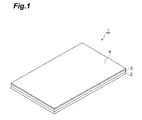
- Fig. 1 is a perspective view showing a preferable embodiment of the patch of the present invention.
- Fig. 1 is a perspective view showing a preferable embodiment of the patch of the present invention.
- the patch 1 is provided with a backing layer 2, a pressure-sensitive adhesive layer 3 laminated on the backing layer 2, and a release sheet 4 attached on the pressure-sensitive adhesive layer 3.
- the pressure-sensitive adhesive layer 3 contains ropinirole, a metal salt as well as an adhesive base free of a hydroxyl group and a carboxy group.
- the metal salt can be obtained by the reaction of a ropinirole acid adduct and a metal ion containing desalting agent in an equivalent mole or less to the acid adduct.
- the pressure-sensitive adhesive layer may be laminated to two or more layers, and may be laminated not only on one side but also on both sides of the backing layer. When a plurality of the pressure-sensitive adhesive layer are present, at least one of them may be the pressure-sensitive adhesive layer 3 described above. In the present embodiment, since the patch is provided with a release sheet 4, the release sheet 4 is removed at the time of application for use.
- the material for the backing layer 2 is not limited insofar as it is a material typically used for patches, and elastic or non-elastic materials can be used.
- Specific examples of the preferably used material include films or sheets formed with a synthetic resin such as polyethylene terephthalate, polyethylene, polypropylene, polybutadiene, ethylene vinyl acetate polymer, polyvinyl chlorides, polyesters, nylon, and polyurethane, or laminates thereof, porous membranes, foams, fabrics and nonwoven fabrics and paper materials.
- the adhesive base contained in the pressure-sensitive adhesive layer 3 is preferably those free of a hydroxyl group and a carboxy group.
- the pressure-sensitive adhesive layer contains a hydroxyl group or a carboxy group, the formation of ropinirole analogues in the adhesive cannot be prevented sufficiently.
- Examples of such an adhesive base include acrylic adhesive bases, rubber adhesive bases, and silicone adhesive bases.
- Examples of the preferably usable acrylic adhesive base include homopolymer or copolymer of (meth)acrylate ester, and copolymer of alkyl (meth)acrylate ester and other functional monomers.
- the (meth)acrylate ester is preferably alkyl (meth)acrylate ester, and the alkyl group in the compound has preferably 1 to 22 carbons, more preferably 2 to 18 carbons, further preferably 4 to 12 carbons.
- Other functional group monomers used for forming a copolymer include vinyl ester such as vinyl acetate, vinyl ether, styrene, and methyl styrene.
- the acrylic adhesive is preferably a copolymer of an acrylic ester and vinyl acetate.
- An example of such an acrylic adhesive is, among the National Starch and Chemical Company Duro-TAK acrylic adhesive series, the grade free of a hydroxyl group and a carboxy group (Non-Functional group).
- the rubber adhesive base natural rubbers and synthetic rubbers can be used, and examples that are preferably used include synthetic rubbers that are free of a hydroxyl group and a carboxy group such as styrene-isoprene-styrene block copolymer (hereinafter abbreviated as "SIS”), isoprene rubber, polyisobutylene (hereinafter abbreviated as "PIB”), styrene-butadiene-styrene block copolymer (hereinafter abbreviated as "SBS”), styrene-butadiene rubber (hereinafter abbreviated as "SBR”), and polybutene.
- SIS styrene-isoprene-styrene block copolymer
- PIB polyisobutylene
- SBS styrene-butadiene-styrene block copolymer
- SBR styrene-butadiene
- Usable silicone adhesive bases are those containing polydimethyl siloxane or the like as a main component, and usually used by adding a tackifier such as MQ resin thereto.
- SIS free of a hydroxyl group and a carboxy group and acrylic ester copolymers are preferable in respect of preventing the formation of ropinirole analogues.
- adhesive bases may be used singly, or two or more thereof may be used in combination.
- the mixture wherein SIS and PIB are mixed in a mass ratio of 9:1 to 1:1 is preferable.
- the amount of an adhesive base to be added is preferably 10 to 95% by mass, more preferably 15 to 80% by mass, particularly preferably 20 to 70% by mass, on the basis of the total mass of the pressure-sensitive adhesive layer 3 when considering the formation of the pressure-sensitive adhesive layer 3 and the tissue permeability of the active ingredients.
- ropinirole and the metal salt produced by the reaction of a ropinirole acid adduct and a metal ion containing desalting agent in an equivalent mole or less to the acid adduct are contained, in addition to the above-mentioned adhesive base.
- Ropinirole includes those remained in the form of salt due to an incomplete neutralization in addition to those which became a free form by a neutralization reaction during the production steps to be described later or in the preparation.
- the metal salt contained in the pressure-sensitive adhesive layer is preferably those produced during the production steps or in the preparation.
- the pressure-sensitive adhesive layer may contain a metal salt other than those produced during the production steps or in the preparation.
- ropinirole is added in a proportion of preferably 0.5 to 50% by mass, particularly preferably 1 to 30% by mass, on the basis of the total mass of the pressure-sensitive adhesive layer 3.
- the ropinirole free form with a higher tissue absorbability can be made present in the pressure-sensitive adhesive layer at the time of preparation application as a result of the neutralization reaction wherein a ropinirole acid adduct is used as a starting material of the production and mixed in a production step with a metal ion containing desalting agent (neutralizer) such as alkali metal hydroxides. Consequently, in the pressure-sensitive adhesive layer of the patch, the metal salt produced by the neutralization reaction is also present.
- a metal ion containing desalting agent neutralizer
- the metal salt is not limited insofar as it is produced by the above desalting (neutralization) reaction and is accordingly determined based on the metal ion containing desalting agent (neutralizer) for neutralizing a ropinirole acid adduct salt and a metal salt. It is preferred that the metal salt be at least one selected from metal chlorides, metal bromides, metal iodides and organic acid metal salts. Among these, it is particularly preferred that the metal salt be one or two or more selected from sodium chloride, calcium chloride, aluminum chloride, stannous chloride, ferric chloride, magnesium chloride, potassium chloride, sodium citrate, sodium oxalate, sodium tartrate, sodium bromide and sodium succinate.
- the metal ion containing desalting agent used in the desalting (neutralization) reaction of the patch is preferably an alkali metal hydroxide.
- the alkali metal hydroxide is added to convert a ropinirole acid adduct salt as a whole or a part to the state of free base.
- the metal ion containing desalting agent is preferably added within a range from 0.5 to 4 equivalent amounts to the equivalent amount of the drug acid base. The addition may be carried out once during the production steps, or carried out in several times in a divided manner.
- the metal ion containing desalting agent examples include sodium hydroxides, potassium hydroxides, magnesium hydroxides, with sodium hydroxides being preferable among these. These are added to convert a drug to a free form but when the metal ion containing desalting agent (sodium hydroxide or the like) is added in an amount exceeding the equivalent mole of a ropinirole acid adduct (ropinirole hydrochloride or the like), a large amount of analogues is formed and tends to cause the coloring of the base, whereas the desalting agent of less than an equivalent mole decreases the formation of the analogues and tends not to develop the coloring.
- sodium hydroxide sodium hydroxide or the like
- the metal ion containing desalting agent is preferably added during the production step within a range from 0.5 to 1 equivalent amount to the equivalent amount of the acid base of a ropinirole acid adduct, and, as a result, the metal salt is present in the equivalent mole or less of the drug in the pressure-sensitive adhesive layer of the patch as a final product.
- the addition of the metal ion containing desalting agent may be carried out several times in a divided manner during the production steps.
- the metal salt produced by the neutralization reaction as described above tends to aggregate and grow as crystals due to the polar solvent such as water which is used in the production steps and remained in a very small amount in the pressure-sensitive adhesive layer.
- the polar solvent such as water which is used in the production steps and remained in a very small amount in the pressure-sensitive adhesive layer.
- an adsorbent hygroscopic inorganic and/or organic substances
- an adsorbent be contained in the pressure-sensitive adhesive layer 3.
- an adsorbent By containing an adsorbent, the aggregation and growth of the metal salt crystal caused by the neutralization reaction can be prevented, and the crystal can be uniformly dispersed.
- the adsorbent is not limited insofar as it has the effect of the present invention, and among the additives listed in " Japanese Pharmaceutical Excipients Directory 2000 , published on April 28, 2000, 1st editi on", the inorganic substances and organic substances described as having hygroscopic properties, dampproofing properties and adsorptive properties are applicable as well as aminoalkyl methacrylate copolymer and zinc oxide, which are not described in the above " Japanese Pharmaceutical Excipients Directory 2000 " but have been known to have adsorptive properties.
- examples preferably usable include minerals such as talc, kaoline, and bentonite; silicone compounds such as fumed silica (Aerosil (registered trademark), etc.) and hydrous silica; metal compounds such as zinc oxide and dried aluminum hydroxide gel; weak acids such as lactic acid and acetic acid, sugars such as dextrin, and polymers such as polyvinylpyrrolidone, propylene glycol, aminoalkyl methacrylate copolymer, crospovidone, and carboxy vinyl polymer. These adsorbents may be used in combination of two or more as necessary.
- the content of the adsorbent contained in the pressure-sensitive adhesive layer 3 is preferably 0.5 to 50% by mass on the total mass basis of the pressure-sensitive adhesive layer 3.
- a content of 0.5% by mass or lower tends not to achieve sufficient effects to prevent the aggregation and growth of the metal salt crystal or to disperse the crystal uniformly.
- a content of 50% by mass or higher has a tendency of reducing the adhesion of the pressure-sensitive adhesive layer 3, likely making it difficult to apply the patch.
- the patch 1 of the present invention may contain as necessary, in addition to the above compositions, tackifier, plasticizer, absorption enhancer, antioxidant, filler, preservative, ultraviolet absorber and drug crystal precipitation inhibitor.
- Examples of the usable tackifier include rosin resins such as "Ester Gum (tradename, Arakawa Chemical Industries, Ltd.)", “Hariester (tradename, Harima Chemicals, Inc.)", “Pentalyn (tradename, Eastman Chemical Company)” and “Foral (tradename, Eastman Chemical Company)", terpene resins such as “YS resin (tradename, Yasuhara Chemical Co., Ltd.)” and “Piccolyte (tradename, Loos and Dilworth)", petroleum resins such as "Arkon (tradename, Arakawa Chemical Industries, Ltd.)”, “Regalrez (tradename, Eastman Chemical Company)", “Piccolastic (tradename, Eastman Chemical Company)”, “Escorez (tradename, ExxonMobil Chemical Company)", “Wingtack (tradename, Goodyear)” and “Quintone (tradename, Zeon Corporation)", phenol resins and xylene resins.
- rosin resins such as "Ester
- tackifiers may be used singly or in combination of two or more.
- the amount of the tackifier to be added is preferably 10 to 90% by mass, more preferably 15 to 70% by mass, particularly preferably 20 to 60% by mass, on the basis of the total mass of the pressure-sensitive adhesive layer 3, when considering the sufficient adhesion of and the local irritation when removing the patch 1.
- plasticizer examples include petroleum oils such as paraffin process oils, naphthene process oils, and aromatic process oils; squalane, squalene; plant oils such as olive oil, camellia oil, castor oil, tall oil, and peanut oil; dibasic esters such as dibutyl phthalate and dioctyl phthalate; liquid rubbers such as polybutene and liquid isoprene rubber; diethylene glycol, polyethylene glycol, propylene glycol, and dipropylene glycol. These plasticizers can be used singly or two or more can be used in combination. In the embodiment of the present invention, it is preferable to use the liquid paraffin and liquid polybutene.
- the content of the above plasticizer in the pressure-sensitive adhesive layer 3 is preferably 5 to 60% by mass, more preferably 10 to 50% by mass, particularly preferably 15 to 40% by mass, on the basis of the total mass of the pressure-sensitive adhesive layer 3, considering the maintenance of the sufficient adhesion as the patch 1.
- absorption enhancer examples include fatty alcohols such as isostearyl alcohol, fatty acids such as capric acid, fatty acid derivatives such as propyleneglycol monolaurate, isopropyl palmitate, and isopropyl myristate, propylene glycol, polyethylene glycol, and lauric acid diethanolamine.
- fatty alcohols such as isostearyl alcohol
- fatty acids such as capric acid
- fatty acid derivatives such as propyleneglycol monolaurate, isopropyl palmitate, and isopropyl myristate
- propylene glycol polyethylene glycol
- lauric acid diethanolamine examples include fatty alcohols such as isostearyl alcohol, fatty acids such as capric acid, fatty acid derivatives such as propyleneglycol monolaurate, isopropyl palmitate, and isopropyl myristate, propylene glycol, polyethylene glycol, and lauric acid diethanolamine.
- the content of the absorption enhancer to be added is preferably 1 to 30% by mass, more preferably 3 to 20% by mass, particularly preferably 5 to 15% by mass, on the basis of the total mass of the pressure-sensitive adhesive layer 3, considering sufficient permeability of the active ingredients to the tissue and the local irritation and the like, as a preparation.
- antioxidants examples include tocopherols and ester derivatives thereof, ascorbic acid, ascorbyl stearate, nordihydroguaiaretic acid, dibutylhydroxytoluene (hereinafter abbreviated as BHT), and butylated hydroxyanisole, with BHT being particularly preferably used.
- filler examples include aluminum hydroxide, calcium carbonate, magnesium carbonate; silicates such as aluminum silicate and magnesium silicate; silicic acid, barium sulfate, calcium sulfate, calcium zincate, zinc oxide, and titanium oxide.
- preservative examples include disodium edetate, tetrasodium edetate, ethyl parahydroxybenzoate, propyl parahydroxybenzoate, and butyl parahydroxybenzoate.
- ultraviolet absorber examples include p-aminobenzoic acid derivatives, anthranilic acid derivatives, salicylic acid derivatives, coumarin derivatives, amino acid compounds, imidazoline derivatives, pyrimidine derivatives, and dioxane derivatives.
- Examples of the drug crystallization inhibitor include fatty alcohols such as oleyl alcohol, lauryl alcohol, octyldodecanol, and isostearyl alcohol, macromolecules such as cyclodextrins, silicon dioxide, polyvinylpyrrolidone, and cellulose derivatives, with fatty alcohols being particularly preferable.
- fatty alcohols such as oleyl alcohol, lauryl alcohol, octyldodecanol, and isostearyl alcohol
- macromolecules such as cyclodextrins, silicon dioxide, polyvinylpyrrolidone, and cellulose derivatives, with fatty alcohols being particularly preferable.
- antioxidants, fillers, preservatives and ultraviolet absorbers can be added in a total amount of preferably 5% by mass or less, more preferably 3% by mass or less, particularly preferably 1% by mass or less, on the basis of the total mass of the pressure-sensitive adhesive layer 3.
- a mixture for forming a pressure-sensitive adhesive layer 3 is prepared.
- the above-mentioned adhesive base, a ropinirole acid adduct, a metal ion containing desalting agent and other optional ingredients are dissolved or dispersed in a solvent of the adhesive base to obtain a mixture for forming the pressure-sensitive adhesive layer 3.
- Examples of the usable solvent for the adhesive base include toluene, hexane, ethyl acetate, cyclohexane, heptane, butyl acetate, ethanol, methanol, and xylene, isopropanol. These are selected as necessary in accordance with the ingredients to be dissolved or dispersed, and may be used singly or in combination of two or more.
- the obtained mixture for forming the pressure-sensitive adhesive layer 3 is spread directly on a backing layer 2 to form the pressure-sensitive adhesive layer 3, or the mixture is spread on a release-treated paper or film to form the pressure-sensitive adhesive layer 3 and the backing layer 2 is placed thereon, followed by the press-bonding transfer of the pressure-sensitive adhesive layer 3 to the backing layer 2.
- a release sheet 4 for protecting the pressure-sensitive adhesive layer 3 is adhered on the pressure-sensitive adhesive layer 3 to obtain the patch 1.
- the thickness of the pressure-sensitive adhesive layer is preferably 30 to 250 ⁇ m, more preferably 50 to 150 ⁇ m. A thickness of 30 ⁇ m or less tends to diminish the sustainability of the drug release, whereas a thickness of 250 ⁇ m or more increases the amount of the drug contained in the pressure-sensitive adhesive layer despite the constant release and tends to make the production cost comparatively expensive.
- the formation of the ropinirole analogues can further be effectively prevented by containing a deoxidizer together with the patch. Accordingly, in the package for packaging the ropinirole containing patch, it is preferable to provide a ropinirole patch containing package in which a deoxidizer is further contained therewith.
- the package is not limited insofar as it is a common package for packaging a drug containing patch, and plastic packages, plastic packages with a metal layer (e.g., an aluminum layer) formed and metal packages (e.g., aluminum package) are preferable.
- plastic packages with a metal layer e.g., an aluminum layer
- metal packages e.g., aluminum package
- Applicable deoxidizers are those using iron powder and those containing vitamin C as the main ingredient. Specific examples include Ageless series (Mitsubishi Gas Chemical Company, Inc.) and PharmaKeep series (Mitsubishi Gas Chemical Company, Inc.).
- ropinirole hydrochloride sodium hydroxide (base), liquid paraffin and toluene (solvent) were mixed in advance, and a separately prepared mixed solution of SIS (JSR Corporation, SIS5000, a hydroxyl group and a carboxy group are not contained), an alicyclic hydrocarbon resin and toluene was added thereto and mixed to obtain an adhesive solution.
- the solution was spread on release-treated film to dry and remove the solvent, thereby forming a pressure-sensitive adhesive layer having a thickness of 100 ⁇ m.
- a backing layer was placed on the layer and the pressure-sensitive adhesive layer was subjected to press-bonding transfer to obtain a patch.
- the composition and the amount of the base to ropinirole hydrochloride are as shown in Table 1.
- a patch was produced in the same manner as in Example 1 except that the composition was made as shown in Table 1.
- the base amount to ropinirole hydrochloride is as shown in Table 1.
- a patch was produced in the same manner as in Example 1 except that the composition was made as shown in Table 1.
- the base amount to ropinirole hydrochloride is as shown in Table 1.
- Table 1 Example 1
- Example 2 Comparative Example 1
- Ropinirole hydrochloride 5.0 parts by mass 5.0 parts by mass 5.0 parts by mass 5.0 parts by mass Sodium hydroxide 0.5 parts by mass 0.6 parts by mass 0.8 parts by mass SIS 24.2 parts by mass 24.2 parts by mass 24.2 parts by mass Alicyclic hydrocarbon resin 41.2 parts by mass 41.2 parts by mass 41.2 parts by mass Liquid paraffin 29.1 parts by mass 29.1 parts by mass 29.1 parts by mass 29.1 parts by mass Base amount to ropinirole hydrochloride 0.75 times mole 0.9 times mole 1.1 times mole
- a patch punched out to 10 cm 2 was placed in a 50 mL centrifugation tube and 10 mL of tetrahydrofrane was added thereto to dissolve the pressure-sensitive adhesive layer. After adding a mixed solution of water/methanol thereto to give 50 mL, the mixture was subjected to high performance liquid chromatography (HPLC) and the content of ropinirole and the unknown compounds which appeared on the chromatochart was measured.
- HPLC high performance liquid chromatography
- the ropinirole content main drug content
- the indications of the unknown compounds in the table are shown by the retention time on the chromatochart (e.g.
- ropinirole hydrochloride, sodium hydroxide (base), liquid paraffin and methanol (solvent) were mixed in advance, and an acrylic adhesive solution Duro-TAK 87-900A (National Starch and Chemical Company, product name, no hydroxyl group or carboxy group contained) was added to and mixed with the mixture to obtain an adhesive solution.
- the solution was spread on a release-treated film to dry and remove the solvent, thereby forming a pressure-sensitive adhesive layer.
- a backing layer was placed on the layer and the pressure-sensitive adhesive layer was subjected to press-bonding transfer to obtain a patch.
- Example 3 A patch was obtained in the same manner as in Example 3 except that Duro-TAK 87-900A was replaced with Duro-TAK 87-2516 (National Starch and Chemical Company, product name, a hydroxyl group contained), and the same test as conducted in Example 3 was carried out.
- the base amount to ropinirole hydrochloride are as shown in Table 3 below and the test results are as shown in Table 4.
- Example 3 A patch was obtained in the same manner as in Example 3 except that Duro-TAK 87-900A was replaced with Duro-TAK 87-2194 (National Starch and Chemical Company, product name, a carboxy group contained), and the same test as conducted in Example 3 was carried out.
- the base amount to ropinirole hydrochloride are as shown in Table 3 below and the test results are as shown in Table 4.
- a patch was obtained in the same manner as in Example 1 except that Aerosil (registered tradename), an adsorbent, was added to the mixed solution of SIS, an alicyclic hydrocarbon resin and toluene as in Example 1. Further, the content of Aerosil was 5 parts by mass and other component ratios were the same as in Example 1.
Landscapes
- Health & Medical Sciences (AREA)
- Engineering & Computer Science (AREA)
- Bioinformatics & Cheminformatics (AREA)
- Life Sciences & Earth Sciences (AREA)
- Dermatology (AREA)
- Animal Behavior & Ethology (AREA)
- General Health & Medical Sciences (AREA)
- Chemical & Material Sciences (AREA)
- Public Health (AREA)
- Pharmacology & Pharmacy (AREA)
- Medicinal Chemistry (AREA)
- Veterinary Medicine (AREA)
- Epidemiology (AREA)
- Botany (AREA)
- Neurosurgery (AREA)
- Neurology (AREA)
- Biomedical Technology (AREA)
- Psychology (AREA)
- Organic Chemistry (AREA)
- Nuclear Medicine, Radiotherapy & Molecular Imaging (AREA)
- General Chemical & Material Sciences (AREA)
- Chemical Kinetics & Catalysis (AREA)
- Pharmaceuticals Containing Other Organic And Inorganic Compounds (AREA)
- Medicinal Preparation (AREA)
Applications Claiming Priority (2)
| Application Number | Priority Date | Filing Date | Title |
|---|---|---|---|
| JP2008046805 | 2008-02-27 | ||
| PCT/JP2009/052180 WO2009107478A1 (ja) | 2008-02-27 | 2009-02-09 | 貼付剤及び包装体 |
Publications (3)
| Publication Number | Publication Date |
|---|---|
| EP2255802A1 true EP2255802A1 (de) | 2010-12-01 |
| EP2255802A4 EP2255802A4 (de) | 2013-07-10 |
| EP2255802B1 EP2255802B1 (de) | 2018-01-17 |
Family
ID=41015880
Family Applications (1)
| Application Number | Title | Priority Date | Filing Date |
|---|---|---|---|
| EP09715019.7A Active EP2255802B1 (de) | 2008-02-27 | 2009-02-09 | Hautpflaster und verpacktes produkt |
Country Status (5)
| Country | Link |
|---|---|
| US (1) | US9155725B2 (de) |
| EP (1) | EP2255802B1 (de) |
| JP (1) | JP5546013B2 (de) |
| ES (1) | ES2661767T3 (de) |
| WO (1) | WO2009107478A1 (de) |
Cited By (6)
| Publication number | Priority date | Publication date | Assignee | Title |
|---|---|---|---|---|
| CN103561738A (zh) * | 2011-05-31 | 2014-02-05 | 久光制药株式会社 | 含有罗匹尼罗的贴附剂及其包装体 |
| CN103561737A (zh) * | 2011-05-31 | 2014-02-05 | 久光制药株式会社 | 含有罗匹尼罗的贴附剂及其包装体 |
| EP2561865A4 (de) * | 2010-04-23 | 2014-05-28 | Icure Pharm Inc | Präparat zur transdermalen absorption |
| WO2014084311A1 (ja) * | 2012-11-30 | 2014-06-05 | 帝國製薬株式会社 | ロピニロール含有貼付剤 |
| EP2786752A4 (de) * | 2011-12-01 | 2015-05-06 | Teikoku Seiyaku Kk | Ropinirolhaltige heftpflaster |
| US10149834B2 (en) | 2011-12-01 | 2018-12-11 | Teikoku Seiyaku Co., Ltd. | Ropinirole-containing adhesive patch |
Families Citing this family (14)
| Publication number | Priority date | Publication date | Assignee | Title |
|---|---|---|---|---|
| US9238025B2 (en) | 2009-05-21 | 2016-01-19 | Hisamitsu Pharmaceutical Co., Inc. | Transdermal preparation comprising a ropinirole derivative |
| US10076502B2 (en) | 2009-12-22 | 2018-09-18 | Luye Pharma Ag | Transdermal therapeutic system for administering rivastigmine or derivatives thereof |
| JP2012051875A (ja) * | 2010-08-03 | 2012-03-15 | Hisamitsu Pharmaceut Co Inc | 経皮・経粘膜吸収製剤の保存方法及び経皮・経粘膜吸収製剤包装体 |
| SI2468274T1 (sl) * | 2010-12-14 | 2015-10-30 | Acino Ag | Transdermalni terapevtski sistem za dajanje aktivne snovi |
| JP6292768B2 (ja) * | 2013-05-30 | 2018-03-14 | 帝國製薬株式会社 | 貼付剤及び貼付剤製品の製造方法 |
| JP5415645B1 (ja) * | 2013-06-28 | 2014-02-12 | 久光製薬株式会社 | 貼付剤の製造方法、貼付剤及び包装体 |
| JP6306594B2 (ja) * | 2013-08-21 | 2018-04-04 | 久光製薬株式会社 | 貼付剤 |
| WO2015025767A1 (ja) * | 2013-08-21 | 2015-02-26 | 久光製薬株式会社 | 貼付剤 |
| WO2016052617A1 (ja) * | 2014-09-30 | 2016-04-07 | 国立大学法人筑波大学 | ナルフラフィン含有局所適用製剤 |
| WO2016103956A1 (ja) * | 2014-12-25 | 2016-06-30 | ニプロ株式会社 | 経皮投与製剤 |
| ES2758350T3 (es) | 2015-04-15 | 2020-05-05 | Hisamitsu Pharmaceutical Co | Parche transdérmico que contiene ropinirol |
| KR102302583B1 (ko) | 2017-02-24 | 2021-09-14 | 히사미쓰 세이야꾸 가부시키가이샤 | 첩부제 및 그 포장체 |
| CN114641286A (zh) * | 2019-09-18 | 2022-06-17 | 久光制药株式会社 | 含有罗匹尼罗的贴附剂及罗匹尼罗的皮肤透过性提升方法 |
| KR102577838B1 (ko) | 2020-10-29 | 2023-09-12 | 히사미쓰 세이야꾸 가부시키가이샤 | 로피니롤 함유 첩부제 및 로피니롤의 피부 투과성 향상 방법 |
Family Cites Families (47)
| Publication number | Priority date | Publication date | Assignee | Title |
|---|---|---|---|---|
| US5059189A (en) | 1987-09-08 | 1991-10-22 | E. R. Squibb & Sons, Inc. | Method of preparing adhesive dressings containing a pharmaceutically active ingredient |
| DE69009540T2 (de) | 1989-03-15 | 1994-09-29 | Nitto Denko Corp | Arzneimittel enthaltendes Heftpflaster. |
| DE4210711A1 (de) | 1991-10-31 | 1993-05-06 | Schering Ag Berlin Und Bergkamen, 1000 Berlin, De | Transdermale therapeutische systeme mit kristallisationsinhibitoren |
| US5676968A (en) * | 1991-10-31 | 1997-10-14 | Schering Aktiengesellschaft | Transdermal therapeutic systems with crystallization inhibitors |
| JP3908795B2 (ja) * | 1994-11-29 | 2007-04-25 | 久光製薬株式会社 | ケトチフェン含有経皮投与製剤 |
| GB9511366D0 (en) | 1995-06-06 | 1995-08-02 | Smithkline Beecham Plc | Novel formulations |
| US5807570A (en) * | 1995-09-29 | 1998-09-15 | Cygnus, Inc. | Transdermal administration of ropinirole and analogs thereof |
| DE19546024C2 (de) * | 1995-12-09 | 1998-09-10 | Lohmann Therapie Syst Lts | Transdermale pharmazeutische Zubereitung und deren Herstellung |
| US7150881B2 (en) | 1997-06-26 | 2006-12-19 | Mylan Technologies, Inc. | Adhesive mixture for transdermal delivery of highly plasticizing drugs |
| JP4703795B2 (ja) * | 1997-07-15 | 2011-06-15 | 帝國製薬株式会社 | 皮膚疾患治療用シート製剤 |
| JPH1147233A (ja) * | 1997-07-30 | 1999-02-23 | Teikoku Seiyaku Co Ltd | 貼付剤および貼付剤の保存方法 |
| JPH11209271A (ja) | 1998-01-23 | 1999-08-03 | Nitto Denko Corp | 経皮吸収製剤 |
| JPH11209270A (ja) | 1998-01-22 | 1999-08-03 | Nitto Denko Corp | 経皮吸収製剤 |
| US6146656A (en) * | 1998-01-22 | 2000-11-14 | Nitto Denko Corporation | Percutaneous absorption preparation |
| DE19814084B4 (de) | 1998-03-30 | 2005-12-22 | Lts Lohmann Therapie-Systeme Ag | D2-Agonist enthaltendes transdermales therapeutisches System zur Behandlung des Parkinson-Syndroms und Verfahren zu seiner Herstellung |
| DE19814087A1 (de) * | 1998-03-30 | 1999-10-14 | Lohmann Therapie Syst Lts | Feuchtigkeitsaktivierbares therapeutisches System |
| DE19814083C2 (de) * | 1998-03-30 | 2002-02-07 | Lohmann Therapie Syst Lts | Verfahren zur Herstellung von transdermalen therapeutischen Systemen unter Verwendung von basischen Alkalimetallsalzen zur Umwandlung von Wirkstoffsalzen in die freien Basen |
| DE19828273B4 (de) * | 1998-06-25 | 2005-02-24 | Lts Lohmann Therapie-Systeme Ag | Transdermales therapeutisches System, enthaltend Hormone und Kristallisationsinhibitoren |
| US20050074487A1 (en) * | 1999-12-16 | 2005-04-07 | Tsung-Min Hsu | Transdermal and topical administration of drugs using basic permeation enhancers |
| US20030104041A1 (en) * | 1999-12-16 | 2003-06-05 | Tsung-Min Hsu | Transdermal and topical administration of drugs using basic permeation enhancers |
| AU2727801A (en) | 1999-12-16 | 2001-06-25 | Dermatrends, Inc. | Transdermal administration of phenylpropanolamine |
| US20020192243A1 (en) * | 1999-12-16 | 2002-12-19 | Tsung-Min Hsu | Transdermal and topical administration of drugs for the treatment of Alzheimer's disease using basic enhancers |
| US20020004065A1 (en) * | 2000-01-20 | 2002-01-10 | David Kanios | Compositions and methods to effect the release profile in the transdermal administration of active agents |
| US20040028724A1 (en) * | 2000-11-07 | 2004-02-12 | Takaaki Terahara | Pharmaceutical preparation of percutaneous absorption type |
| WO2002045701A2 (en) | 2000-12-05 | 2002-06-13 | Noven Pharmaceuticals, Inc. | Crystallization inhibition of drugs in transdermal drug delivery systems |
| KR100846642B1 (ko) | 2001-03-07 | 2008-07-16 | 히사미쓰 세이야꾸 가부시키가이샤 | 첩부제 |
| US7921999B1 (en) * | 2001-12-20 | 2011-04-12 | Watson Laboratories, Inc. | Peelable pouch for transdermal patch and method for packaging |
| US20030180347A1 (en) * | 2002-03-19 | 2003-09-25 | W.F. Young, Incorporated | Patch for the delivery of topical agents |
| DE10220230A1 (de) | 2002-05-06 | 2003-11-27 | Sanol Arznei Schwarz Gmbh | Verwendung von Rotigotine zur Behandlung des Restless Leg Syndroms |
| EP1386604A1 (de) * | 2002-07-30 | 2004-02-04 | Schwarz Pharma Ag | Verbessertes transdermales Verabreichungssystem |
| JP4792193B2 (ja) * | 2002-08-28 | 2011-10-12 | 久光製薬株式会社 | 貼付剤 |
| JP2005168898A (ja) * | 2003-12-12 | 2005-06-30 | Aruze Corp | 遊技機、遊技サーバおよび遊技システム |
| WO2005117886A1 (ja) * | 2004-06-01 | 2005-12-15 | Hisamitsu Pharmaceutical Co., Inc. | 貼付剤 |
| EP1802276A1 (de) | 2004-10-15 | 2007-07-04 | Pfizer Products Inc. | Zusammensetzungen und verfahren zur intranasalen, oralen, sublingualen und pulmonalen abgabe von vareniclin |
| US20080138388A1 (en) | 2005-02-04 | 2008-06-12 | Hisamitsu Pharmaceutical Co., Inc. | Transdermal Absorption Patch |
| WO2006114868A1 (ja) * | 2005-04-20 | 2006-11-02 | Nichiban Co., Ltd. | 経皮吸収製剤 |
| JP5025998B2 (ja) * | 2005-06-06 | 2012-09-12 | 日東電工株式会社 | 経皮吸収製剤 |
| JP4999366B2 (ja) | 2005-06-06 | 2012-08-15 | 日東電工株式会社 | 経皮吸収製剤 |
| ATE415153T1 (de) * | 2005-06-06 | 2008-12-15 | Nitto Denko Corp | Pharmazeutische zusammensetzung zur perkutane absorption unter verwendung von einem metalchlorid, vorzugsweise natriumchlorid, zur vorbeugung von kohäsionsschwäche |
| US20110086086A1 (en) * | 2005-07-26 | 2011-04-14 | Pfizer Inc | Transdermal system for varenicline |
| US9056061B2 (en) * | 2005-09-23 | 2015-06-16 | Alza Corporation | Transdermal nicotine salt delivery system |
| JP5684441B2 (ja) | 2005-12-28 | 2015-03-11 | 久光製薬株式会社 | インドメタシン含有貼付剤 |
| JP5037831B2 (ja) | 2006-02-15 | 2012-10-03 | 久光製薬株式会社 | 凝集力向上及び徐放化の外用貼付剤 |
| JP5097359B2 (ja) | 2006-05-09 | 2012-12-12 | 久光製薬株式会社 | ドネペジル経皮吸収型製剤 |
| CN101511371A (zh) | 2006-09-11 | 2009-08-19 | 救急药品工业株式会社 | 粘贴剂 |
| MX2009005043A (es) | 2006-11-09 | 2009-05-25 | Pfizer Prod Inc | Polimorfos de intermedios nicotinicos. |
| WO2008105038A1 (ja) * | 2007-02-23 | 2008-09-04 | Nichiban Company Limited | 抗真菌症用貼付剤 |
-
2009
- 2009-02-09 ES ES09715019.7T patent/ES2661767T3/es active Active
- 2009-02-09 US US12/919,743 patent/US9155725B2/en active Active
- 2009-02-09 EP EP09715019.7A patent/EP2255802B1/de active Active
- 2009-02-09 JP JP2010500639A patent/JP5546013B2/ja active Active
- 2009-02-09 WO PCT/JP2009/052180 patent/WO2009107478A1/ja not_active Ceased
Cited By (9)
| Publication number | Priority date | Publication date | Assignee | Title |
|---|---|---|---|---|
| EP2561865A4 (de) * | 2010-04-23 | 2014-05-28 | Icure Pharm Inc | Präparat zur transdermalen absorption |
| CN103561738A (zh) * | 2011-05-31 | 2014-02-05 | 久光制药株式会社 | 含有罗匹尼罗的贴附剂及其包装体 |
| CN103561737A (zh) * | 2011-05-31 | 2014-02-05 | 久光制药株式会社 | 含有罗匹尼罗的贴附剂及其包装体 |
| EP2716286A4 (de) * | 2011-05-31 | 2014-11-19 | Hisamitsu Pharmaceutical Co | Ropinirolhaltiges klebepflaster und verpackung dafür |
| CN103561738B (zh) * | 2011-05-31 | 2016-01-27 | 久光制药株式会社 | 含有罗匹尼罗的贴附剂及其包装体 |
| EP2786752A4 (de) * | 2011-12-01 | 2015-05-06 | Teikoku Seiyaku Kk | Ropinirolhaltige heftpflaster |
| US9849095B2 (en) | 2011-12-01 | 2017-12-26 | Teikoku Seiyaku Co., Ltd. | Ropinirole-containing adhesive patch |
| US10149834B2 (en) | 2011-12-01 | 2018-12-11 | Teikoku Seiyaku Co., Ltd. | Ropinirole-containing adhesive patch |
| WO2014084311A1 (ja) * | 2012-11-30 | 2014-06-05 | 帝國製薬株式会社 | ロピニロール含有貼付剤 |
Also Published As
| Publication number | Publication date |
|---|---|
| US20110195109A1 (en) | 2011-08-11 |
| ES2661767T3 (es) | 2018-04-03 |
| EP2255802A4 (de) | 2013-07-10 |
| JP5546013B2 (ja) | 2014-07-09 |
| EP2255802B1 (de) | 2018-01-17 |
| US9155725B2 (en) | 2015-10-13 |
| WO2009107478A1 (ja) | 2009-09-03 |
| JPWO2009107478A1 (ja) | 2011-06-30 |
Similar Documents
| Publication | Publication Date | Title |
|---|---|---|
| EP2255802B1 (de) | Hautpflaster und verpacktes produkt | |
| US8580281B2 (en) | Medicated patch | |
| US9155710B2 (en) | Ropinirole-containing patch and package thereof | |
| US9918945B2 (en) | Ropinirole-containing patch and package thereof | |
| JP6359014B2 (ja) | 貼付剤 | |
| JP6306594B2 (ja) | 貼付剤 | |
| TWI636800B (zh) | 含有可樂寧之貼劑 |
Legal Events
| Date | Code | Title | Description |
|---|---|---|---|
| PUAI | Public reference made under article 153(3) epc to a published international application that has entered the european phase |
Free format text: ORIGINAL CODE: 0009012 |
|
| 17P | Request for examination filed |
Effective date: 20100917 |
|
| AK | Designated contracting states |
Kind code of ref document: A1 Designated state(s): AT BE BG CH CY CZ DE DK EE ES FI FR GB GR HR HU IE IS IT LI LT LU LV MC MK MT NL NO PL PT RO SE SI SK TR |
|
| AX | Request for extension of the european patent |
Extension state: AL BA RS |
|
| DAX | Request for extension of the european patent (deleted) | ||
| RIC1 | Information provided on ipc code assigned before grant |
Ipc: A61K 47/02 20060101ALI20130528BHEP Ipc: A61K 47/12 20060101ALI20130528BHEP Ipc: A61K 9/70 20060101ALI20130528BHEP Ipc: A61K 47/34 20060101ALI20130528BHEP Ipc: A61P 25/16 20060101ALI20130528BHEP Ipc: A61K 47/04 20060101ALI20130528BHEP Ipc: A61K 47/22 20060101ALI20130528BHEP Ipc: A61K 47/36 20060101ALI20130528BHEP Ipc: A61K 31/4045 20060101AFI20130528BHEP Ipc: A61K 47/32 20060101ALI20130528BHEP |
|
| A4 | Supplementary search report drawn up and despatched |
Effective date: 20130612 |
|
| 17Q | First examination report despatched |
Effective date: 20160706 |
|
| GRAP | Despatch of communication of intention to grant a patent |
Free format text: ORIGINAL CODE: EPIDOSNIGR1 |
|
| INTG | Intention to grant announced |
Effective date: 20170811 |
|
| GRAS | Grant fee paid |
Free format text: ORIGINAL CODE: EPIDOSNIGR3 |
|
| GRAA | (expected) grant |
Free format text: ORIGINAL CODE: 0009210 |
|
| AK | Designated contracting states |
Kind code of ref document: B1 Designated state(s): AT BE BG CH CY CZ DE DK EE ES FI FR GB GR HR HU IE IS IT LI LT LU LV MC MK MT NL NO PL PT RO SE SI SK TR |
|
| REG | Reference to a national code |
Ref country code: GB Ref legal event code: FG4D |
|
| REG | Reference to a national code |
Ref country code: CH Ref legal event code: EP |
|
| REG | Reference to a national code |
Ref country code: IE Ref legal event code: FG4D |
|
| REG | Reference to a national code |
Ref country code: AT Ref legal event code: REF Ref document number: 963936 Country of ref document: AT Kind code of ref document: T Effective date: 20180215 |
|
| REG | Reference to a national code |
Ref country code: DE Ref legal event code: R096 Ref document number: 602009050434 Country of ref document: DE |
|
| REG | Reference to a national code |
Ref country code: FR Ref legal event code: PLFP Year of fee payment: 10 |
|
| REG | Reference to a national code |
Ref country code: ES Ref legal event code: FG2A Ref document number: 2661767 Country of ref document: ES Kind code of ref document: T3 Effective date: 20180403 |
|
| REG | Reference to a national code |
Ref country code: NL Ref legal event code: MP Effective date: 20180117 |
|
| REG | Reference to a national code |
Ref country code: LT Ref legal event code: MG4D |
|
| REG | Reference to a national code |
Ref country code: AT Ref legal event code: MK05 Ref document number: 963936 Country of ref document: AT Kind code of ref document: T Effective date: 20180117 |
|
| PG25 | Lapsed in a contracting state [announced via postgrant information from national office to epo] |
Ref country code: NL Free format text: LAPSE BECAUSE OF FAILURE TO SUBMIT A TRANSLATION OF THE DESCRIPTION OR TO PAY THE FEE WITHIN THE PRESCRIBED TIME-LIMIT Effective date: 20180117 |
|
| PG25 | Lapsed in a contracting state [announced via postgrant information from national office to epo] |
Ref country code: HR Free format text: LAPSE BECAUSE OF FAILURE TO SUBMIT A TRANSLATION OF THE DESCRIPTION OR TO PAY THE FEE WITHIN THE PRESCRIBED TIME-LIMIT Effective date: 20180117 Ref country code: CY Free format text: LAPSE BECAUSE OF FAILURE TO SUBMIT A TRANSLATION OF THE DESCRIPTION OR TO PAY THE FEE WITHIN THE PRESCRIBED TIME-LIMIT Effective date: 20180117 Ref country code: FI Free format text: LAPSE BECAUSE OF FAILURE TO SUBMIT A TRANSLATION OF THE DESCRIPTION OR TO PAY THE FEE WITHIN THE PRESCRIBED TIME-LIMIT Effective date: 20180117 Ref country code: NO Free format text: LAPSE BECAUSE OF FAILURE TO SUBMIT A TRANSLATION OF THE DESCRIPTION OR TO PAY THE FEE WITHIN THE PRESCRIBED TIME-LIMIT Effective date: 20180417 Ref country code: LT Free format text: LAPSE BECAUSE OF FAILURE TO SUBMIT A TRANSLATION OF THE DESCRIPTION OR TO PAY THE FEE WITHIN THE PRESCRIBED TIME-LIMIT Effective date: 20180117 |
|
| PG25 | Lapsed in a contracting state [announced via postgrant information from national office to epo] |
Ref country code: AT Free format text: LAPSE BECAUSE OF FAILURE TO SUBMIT A TRANSLATION OF THE DESCRIPTION OR TO PAY THE FEE WITHIN THE PRESCRIBED TIME-LIMIT Effective date: 20180117 Ref country code: SE Free format text: LAPSE BECAUSE OF FAILURE TO SUBMIT A TRANSLATION OF THE DESCRIPTION OR TO PAY THE FEE WITHIN THE PRESCRIBED TIME-LIMIT Effective date: 20180117 Ref country code: LV Free format text: LAPSE BECAUSE OF FAILURE TO SUBMIT A TRANSLATION OF THE DESCRIPTION OR TO PAY THE FEE WITHIN THE PRESCRIBED TIME-LIMIT Effective date: 20180117 Ref country code: BG Free format text: LAPSE BECAUSE OF FAILURE TO SUBMIT A TRANSLATION OF THE DESCRIPTION OR TO PAY THE FEE WITHIN THE PRESCRIBED TIME-LIMIT Effective date: 20180417 Ref country code: GR Free format text: LAPSE BECAUSE OF FAILURE TO SUBMIT A TRANSLATION OF THE DESCRIPTION OR TO PAY THE FEE WITHIN THE PRESCRIBED TIME-LIMIT Effective date: 20180418 Ref country code: IS Free format text: LAPSE BECAUSE OF FAILURE TO SUBMIT A TRANSLATION OF THE DESCRIPTION OR TO PAY THE FEE WITHIN THE PRESCRIBED TIME-LIMIT Effective date: 20180517 Ref country code: PL Free format text: LAPSE BECAUSE OF FAILURE TO SUBMIT A TRANSLATION OF THE DESCRIPTION OR TO PAY THE FEE WITHIN THE PRESCRIBED TIME-LIMIT Effective date: 20180117 |
|
| REG | Reference to a national code |
Ref country code: CH Ref legal event code: PL |
|
| REG | Reference to a national code |
Ref country code: DE Ref legal event code: R097 Ref document number: 602009050434 Country of ref document: DE |
|
| PG25 | Lapsed in a contracting state [announced via postgrant information from national office to epo] |
Ref country code: RO Free format text: LAPSE BECAUSE OF FAILURE TO SUBMIT A TRANSLATION OF THE DESCRIPTION OR TO PAY THE FEE WITHIN THE PRESCRIBED TIME-LIMIT Effective date: 20180117 Ref country code: EE Free format text: LAPSE BECAUSE OF FAILURE TO SUBMIT A TRANSLATION OF THE DESCRIPTION OR TO PAY THE FEE WITHIN THE PRESCRIBED TIME-LIMIT Effective date: 20180117 Ref country code: MC Free format text: LAPSE BECAUSE OF FAILURE TO SUBMIT A TRANSLATION OF THE DESCRIPTION OR TO PAY THE FEE WITHIN THE PRESCRIBED TIME-LIMIT Effective date: 20180117 |
|
| PLBE | No opposition filed within time limit |
Free format text: ORIGINAL CODE: 0009261 |
|
| STAA | Information on the status of an ep patent application or granted ep patent |
Free format text: STATUS: NO OPPOSITION FILED WITHIN TIME LIMIT |
|
| REG | Reference to a national code |
Ref country code: IE Ref legal event code: MM4A |
|
| REG | Reference to a national code |
Ref country code: BE Ref legal event code: MM Effective date: 20180228 |
|
| PG25 | Lapsed in a contracting state [announced via postgrant information from national office to epo] |
Ref country code: DK Free format text: LAPSE BECAUSE OF FAILURE TO SUBMIT A TRANSLATION OF THE DESCRIPTION OR TO PAY THE FEE WITHIN THE PRESCRIBED TIME-LIMIT Effective date: 20180117 Ref country code: SK Free format text: LAPSE BECAUSE OF FAILURE TO SUBMIT A TRANSLATION OF THE DESCRIPTION OR TO PAY THE FEE WITHIN THE PRESCRIBED TIME-LIMIT Effective date: 20180117 Ref country code: CH Free format text: LAPSE BECAUSE OF NON-PAYMENT OF DUE FEES Effective date: 20180228 Ref country code: LU Free format text: LAPSE BECAUSE OF NON-PAYMENT OF DUE FEES Effective date: 20180209 Ref country code: CZ Free format text: LAPSE BECAUSE OF FAILURE TO SUBMIT A TRANSLATION OF THE DESCRIPTION OR TO PAY THE FEE WITHIN THE PRESCRIBED TIME-LIMIT Effective date: 20180117 Ref country code: LI Free format text: LAPSE BECAUSE OF NON-PAYMENT OF DUE FEES Effective date: 20180228 |
|
| 26N | No opposition filed |
Effective date: 20181018 |
|
| PG25 | Lapsed in a contracting state [announced via postgrant information from national office to epo] |
Ref country code: IE Free format text: LAPSE BECAUSE OF NON-PAYMENT OF DUE FEES Effective date: 20180209 |
|
| PG25 | Lapsed in a contracting state [announced via postgrant information from national office to epo] |
Ref country code: BE Free format text: LAPSE BECAUSE OF NON-PAYMENT OF DUE FEES Effective date: 20180228 Ref country code: SI Free format text: LAPSE BECAUSE OF FAILURE TO SUBMIT A TRANSLATION OF THE DESCRIPTION OR TO PAY THE FEE WITHIN THE PRESCRIBED TIME-LIMIT Effective date: 20180117 |
|
| PG25 | Lapsed in a contracting state [announced via postgrant information from national office to epo] |
Ref country code: MT Free format text: LAPSE BECAUSE OF NON-PAYMENT OF DUE FEES Effective date: 20180209 |
|
| PG25 | Lapsed in a contracting state [announced via postgrant information from national office to epo] |
Ref country code: TR Free format text: LAPSE BECAUSE OF FAILURE TO SUBMIT A TRANSLATION OF THE DESCRIPTION OR TO PAY THE FEE WITHIN THE PRESCRIBED TIME-LIMIT Effective date: 20180117 |
|
| PG25 | Lapsed in a contracting state [announced via postgrant information from national office to epo] |
Ref country code: HU Free format text: LAPSE BECAUSE OF FAILURE TO SUBMIT A TRANSLATION OF THE DESCRIPTION OR TO PAY THE FEE WITHIN THE PRESCRIBED TIME-LIMIT; INVALID AB INITIO Effective date: 20090209 Ref country code: PT Free format text: LAPSE BECAUSE OF FAILURE TO SUBMIT A TRANSLATION OF THE DESCRIPTION OR TO PAY THE FEE WITHIN THE PRESCRIBED TIME-LIMIT Effective date: 20180117 |
|
| PG25 | Lapsed in a contracting state [announced via postgrant information from national office to epo] |
Ref country code: MK Free format text: LAPSE BECAUSE OF NON-PAYMENT OF DUE FEES Effective date: 20180117 |
|
| P01 | Opt-out of the competence of the unified patent court (upc) registered |
Effective date: 20230522 |
|
| PGFP | Annual fee paid to national office [announced via postgrant information from national office to epo] |
Ref country code: FR Payment date: 20251231 Year of fee payment: 18 |
|
| PGFP | Annual fee paid to national office [announced via postgrant information from national office to epo] |
Ref country code: GB Payment date: 20260106 Year of fee payment: 18 |
|
| PGFP | Annual fee paid to national office [announced via postgrant information from national office to epo] |
Ref country code: ES Payment date: 20260304 Year of fee payment: 18 |
|
| PGFP | Annual fee paid to national office [announced via postgrant information from national office to epo] |
Ref country code: DE Payment date: 20251230 Year of fee payment: 18 |
|
| PGFP | Annual fee paid to national office [announced via postgrant information from national office to epo] |
Ref country code: IT Payment date: 20260122 Year of fee payment: 18 |