EP2256123A2 - Cyclic siloxane compound, a material for forming Si-containing film, and its use - Google Patents
Cyclic siloxane compound, a material for forming Si-containing film, and its use Download PDFInfo
- Publication number
- EP2256123A2 EP2256123A2 EP10176573A EP10176573A EP2256123A2 EP 2256123 A2 EP2256123 A2 EP 2256123A2 EP 10176573 A EP10176573 A EP 10176573A EP 10176573 A EP10176573 A EP 10176573A EP 2256123 A2 EP2256123 A2 EP 2256123A2
- Authority
- EP
- European Patent Office
- Prior art keywords
- tris
- tetrakis
- general formula
- group
- cyclic siloxane
- Prior art date
- Legal status (The legal status is an assumption and is not a legal conclusion. Google has not performed a legal analysis and makes no representation as to the accuracy of the status listed.)
- Granted
Links
Images


Classifications
-
- B—PERFORMING OPERATIONS; TRANSPORTING
- B05—SPRAYING OR ATOMISING IN GENERAL; APPLYING FLUENT MATERIALS TO SURFACES, IN GENERAL
- B05D—PROCESSES FOR APPLYING FLUENT MATERIALS TO SURFACES, IN GENERAL
- B05D1/00—Processes for applying liquids or other fluent materials
- B05D1/62—Plasma-deposition of organic layers
-
- H—ELECTRICITY
- H10—SEMICONDUCTOR DEVICES; ELECTRIC SOLID-STATE DEVICES NOT OTHERWISE PROVIDED FOR
- H10P—GENERIC PROCESSES OR APPARATUS FOR THE MANUFACTURE OR TREATMENT OF DEVICES COVERED BY CLASS H10
- H10P14/00—Formation of materials, e.g. in the shape of layers or pillars
- H10P14/60—Formation of materials, e.g. in the shape of layers or pillars of insulating materials
- H10P14/69—Inorganic materials
- H10P14/692—Inorganic materials composed of oxides, glassy oxides or oxide-based glasses
- H10P14/6921—Inorganic materials composed of oxides, glassy oxides or oxide-based glasses containing silicon
- H10P14/6922—Inorganic materials composed of oxides, glassy oxides or oxide-based glasses containing silicon the material containing Si, O and at least one of H, N, C, F or other non-metal elements, e.g. SiOC, SiOC:H or SiONC
-
- C—CHEMISTRY; METALLURGY
- C07—ORGANIC CHEMISTRY
- C07F—ACYCLIC, CARBOCYCLIC OR HETEROCYCLIC COMPOUNDS CONTAINING ELEMENTS OTHER THAN CARBON, HYDROGEN, HALOGEN, OXYGEN, NITROGEN, SULFUR, SELENIUM OR TELLURIUM
- C07F7/00—Compounds containing elements of Groups 4 or 14 of the Periodic Table
- C07F7/02—Silicon compounds
- C07F7/21—Cyclic compounds having at least one ring containing silicon, but no carbon in the ring
-
- C—CHEMISTRY; METALLURGY
- C23—COATING METALLIC MATERIAL; COATING MATERIAL WITH METALLIC MATERIAL; CHEMICAL SURFACE TREATMENT; DIFFUSION TREATMENT OF METALLIC MATERIAL; COATING BY VACUUM EVAPORATION, BY SPUTTERING, BY ION IMPLANTATION OR BY CHEMICAL VAPOUR DEPOSITION, IN GENERAL; INHIBITING CORROSION OF METALLIC MATERIAL OR INCRUSTATION IN GENERAL
- C23C—COATING METALLIC MATERIAL; COATING MATERIAL WITH METALLIC MATERIAL; SURFACE TREATMENT OF METALLIC MATERIAL BY DIFFUSION INTO THE SURFACE, BY CHEMICAL CONVERSION OR SUBSTITUTION; COATING BY VACUUM EVAPORATION, BY SPUTTERING, BY ION IMPLANTATION OR BY CHEMICAL VAPOUR DEPOSITION, IN GENERAL
- C23C16/00—Chemical coating by decomposition of gaseous compounds, without leaving reaction products of surface material in the coating, i.e. chemical vapour deposition [CVD] processes
- C23C16/22—Chemical coating by decomposition of gaseous compounds, without leaving reaction products of surface material in the coating, i.e. chemical vapour deposition [CVD] processes characterised by the deposition of inorganic material, other than metallic material
- C23C16/30—Deposition of compounds, mixtures or solid solutions, e.g. borides, carbides, nitrides
- C23C16/40—Oxides
- C23C16/401—Oxides containing silicon
-
- C—CHEMISTRY; METALLURGY
- C23—COATING METALLIC MATERIAL; COATING MATERIAL WITH METALLIC MATERIAL; CHEMICAL SURFACE TREATMENT; DIFFUSION TREATMENT OF METALLIC MATERIAL; COATING BY VACUUM EVAPORATION, BY SPUTTERING, BY ION IMPLANTATION OR BY CHEMICAL VAPOUR DEPOSITION, IN GENERAL; INHIBITING CORROSION OF METALLIC MATERIAL OR INCRUSTATION IN GENERAL
- C23C—COATING METALLIC MATERIAL; COATING MATERIAL WITH METALLIC MATERIAL; SURFACE TREATMENT OF METALLIC MATERIAL BY DIFFUSION INTO THE SURFACE, BY CHEMICAL CONVERSION OR SUBSTITUTION; COATING BY VACUUM EVAPORATION, BY SPUTTERING, BY ION IMPLANTATION OR BY CHEMICAL VAPOUR DEPOSITION, IN GENERAL
- C23C16/00—Chemical coating by decomposition of gaseous compounds, without leaving reaction products of surface material in the coating, i.e. chemical vapour deposition [CVD] processes
- C23C16/44—Chemical coating by decomposition of gaseous compounds, without leaving reaction products of surface material in the coating, i.e. chemical vapour deposition [CVD] processes characterised by the method of coating
- C23C16/448—Chemical coating by decomposition of gaseous compounds, without leaving reaction products of surface material in the coating, i.e. chemical vapour deposition [CVD] processes characterised by the method of coating characterised by the method used for generating reactive gas streams, e.g. by evaporation or sublimation of precursor materials
- C23C16/452—Chemical coating by decomposition of gaseous compounds, without leaving reaction products of surface material in the coating, i.e. chemical vapour deposition [CVD] processes characterised by the method of coating characterised by the method used for generating reactive gas streams, e.g. by evaporation or sublimation of precursor materials by activating reactive gas streams before their introduction into the reaction chamber, e.g. by ionisation or addition of reactive species
-
- C—CHEMISTRY; METALLURGY
- C23—COATING METALLIC MATERIAL; COATING MATERIAL WITH METALLIC MATERIAL; CHEMICAL SURFACE TREATMENT; DIFFUSION TREATMENT OF METALLIC MATERIAL; COATING BY VACUUM EVAPORATION, BY SPUTTERING, BY ION IMPLANTATION OR BY CHEMICAL VAPOUR DEPOSITION, IN GENERAL; INHIBITING CORROSION OF METALLIC MATERIAL OR INCRUSTATION IN GENERAL
- C23C—COATING METALLIC MATERIAL; COATING MATERIAL WITH METALLIC MATERIAL; SURFACE TREATMENT OF METALLIC MATERIAL BY DIFFUSION INTO THE SURFACE, BY CHEMICAL CONVERSION OR SUBSTITUTION; COATING BY VACUUM EVAPORATION, BY SPUTTERING, BY ION IMPLANTATION OR BY CHEMICAL VAPOUR DEPOSITION, IN GENERAL
- C23C16/00—Chemical coating by decomposition of gaseous compounds, without leaving reaction products of surface material in the coating, i.e. chemical vapour deposition [CVD] processes
- C23C16/44—Chemical coating by decomposition of gaseous compounds, without leaving reaction products of surface material in the coating, i.e. chemical vapour deposition [CVD] processes characterised by the method of coating
- C23C16/50—Chemical coating by decomposition of gaseous compounds, without leaving reaction products of surface material in the coating, i.e. chemical vapour deposition [CVD] processes characterised by the method of coating using electric discharges
- C23C16/505—Chemical coating by decomposition of gaseous compounds, without leaving reaction products of surface material in the coating, i.e. chemical vapour deposition [CVD] processes characterised by the method of coating using electric discharges using radio frequency discharges
- C23C16/509—Chemical coating by decomposition of gaseous compounds, without leaving reaction products of surface material in the coating, i.e. chemical vapour deposition [CVD] processes characterised by the method of coating using electric discharges using radio frequency discharges using internal electrodes
- C23C16/5096—Flat-bed apparatus
-
- H—ELECTRICITY
- H10—SEMICONDUCTOR DEVICES; ELECTRIC SOLID-STATE DEVICES NOT OTHERWISE PROVIDED FOR
- H10P—GENERIC PROCESSES OR APPARATUS FOR THE MANUFACTURE OR TREATMENT OF DEVICES COVERED BY CLASS H10
- H10P14/00—Formation of materials, e.g. in the shape of layers or pillars
- H10P14/60—Formation of materials, e.g. in the shape of layers or pillars of insulating materials
- H10P14/63—Formation of materials, e.g. in the shape of layers or pillars of insulating materials characterised by the formation processes
- H10P14/6326—Deposition processes
- H10P14/6328—Deposition from the gas or vapour phase
- H10P14/6334—Deposition from the gas or vapour phase using decomposition or reaction of gaseous or vapour phase compounds, i.e. chemical vapour deposition
- H10P14/6336—Deposition from the gas or vapour phase using decomposition or reaction of gaseous or vapour phase compounds, i.e. chemical vapour deposition in the presence of a plasma [PECVD]
-
- H—ELECTRICITY
- H10—SEMICONDUCTOR DEVICES; ELECTRIC SOLID-STATE DEVICES NOT OTHERWISE PROVIDED FOR
- H10P—GENERIC PROCESSES OR APPARATUS FOR THE MANUFACTURE OR TREATMENT OF DEVICES COVERED BY CLASS H10
- H10P14/00—Formation of materials, e.g. in the shape of layers or pillars
- H10P14/60—Formation of materials, e.g. in the shape of layers or pillars of insulating materials
- H10P14/66—Formation of materials, e.g. in the shape of layers or pillars of insulating materials characterised by the type of materials
- H10P14/668—Formation of materials, e.g. in the shape of layers or pillars of insulating materials characterised by the type of materials the materials being characterised by the deposition precursor materials
- H10P14/6681—Formation of materials, e.g. in the shape of layers or pillars of insulating materials characterised by the type of materials the materials being characterised by the deposition precursor materials the precursor containing a compound comprising Si
- H10P14/6684—Formation of materials, e.g. in the shape of layers or pillars of insulating materials characterised by the type of materials the materials being characterised by the deposition precursor materials the precursor containing a compound comprising Si the compound comprising silicon and oxygen
- H10P14/6686—Formation of materials, e.g. in the shape of layers or pillars of insulating materials characterised by the type of materials the materials being characterised by the deposition precursor materials the precursor containing a compound comprising Si the compound comprising silicon and oxygen the compound being a molecule comprising at least one silicon-oxygen bond and the compound having hydrogen or an organic group attached to the silicon or oxygen, e.g. a siloxane
-
- H—ELECTRICITY
- H10—SEMICONDUCTOR DEVICES; ELECTRIC SOLID-STATE DEVICES NOT OTHERWISE PROVIDED FOR
- H10P—GENERIC PROCESSES OR APPARATUS FOR THE MANUFACTURE OR TREATMENT OF DEVICES COVERED BY CLASS H10
- H10P14/00—Formation of materials, e.g. in the shape of layers or pillars
- H10P14/60—Formation of materials, e.g. in the shape of layers or pillars of insulating materials
- H10P14/66—Formation of materials, e.g. in the shape of layers or pillars of insulating materials characterised by the type of materials
- H10P14/665—Porous materials
Definitions
- the present invention relates to a material for forming Si-containing film and the like, and particularly to a material for a low dielectric constant interlayer insulating film used in multilayer interconnect technology in logic ULSI. Especially, it relates to a material for forming Si-containing film containing a cyclic siloxane compound for plasma polymerization and its use.
- CVD chemical vapor deposition
- a method of forming the insulating film there are the following two methods.
- PECVD plasma enhanced chemical vapor deposition
- Patent Document 1 proposes a method of forming a trimethylsilane oxide thin film from trimethylsilane and oxygen by the PECVD method
- Patent Document 2 proposes a method of forming an alkylsilane oxide thin film from an alkoxysilane having a straight-chain alkyl such as methyl, ethyl and n-propyl, an alkynyl such as vinyl, phenyl, and an aryl group by the PECVD method.
- Those insulating films formed with the conventional PECVD method materials have good adhesion to a barrier metal and a copper wiring material which is a wiring material, whereas there were the cases that uniformity of a film becomes problem and film formation rate and dielectric constant are insufficient.
- Patent Document 3 proposes a method of using tetramethylcyclotetrasiloxane
- Patent Document 4 proposes a method of using tetraalkylcyclotetrasiloxane, tetraaminocyclotetrasiloxane, octaalkylcyclotetrasiloxane or octaaminocyclotetrasiloxane.
- Those methods intend to lower dielectric constant by using a cyclic siloxane as a raw material compound to form pores in a thin film formed, while maintaining its cyclic structure in the thin film formed.
- Patent Document 5 proposes a six-membered cyclic siloxane such as hexamethylcyclotrisiloxane and 1,3,5-trimethyl-1,3,5-trivinylcyclotrisiloxane
- Patent Document 6 proposes to copolymerize a bisbenzocyclobutene-substituted disiloxane compound and 1,3,5,7-tetramethyl-1,3,5,7-tetravinylcyclotetrasiloxane as an eight-membered cyclic siloxane under a plasma condition.
- a thin film having dielectric constant of less than 2.5 is not obtained by a method of using vinyl- and/or methyl-substituted cyclic siloxane as proposed by those.
- Patent Document 7 and Patent Document 8 propose a film formation method of a low dielectric constant thin film by PECVD method using a porogene.
- the former proposes a method of lowering dielectric constant by feeding triethoxysilane, diethoxymethylsilane and ⁇ -terpinene as a porogene in PECVD equipment chamber, forming PECVD film, and annealing at a temperature of 400°C or higher to vaporize a component derived from ⁇ -terpinene in a thin film, thereby making the thin film porous.
- the latter proposes a method of lowering dielectric constant by supplying cyclo-1,3,5,7-tetrasilylene-2,6-dioxy-4,8-dimethylene, vinylfuryl ether as porogene, and nitrous oxide as an oxidizing agent in PECVD equipment chamber, forming PECVD film, annealing at a temperature of 400°C or higher, and vaporizing a component derived from vinylfuryl ether in a thin film, thereby making the thin film porous.
- Those methods can expect to lower dielectric constant by pore formation.
- the component derived from porogene is removed from the inside of the thin film once formed, into the outside thereof by a post-treatment.
- a method of forming a porous material in order to form Ultra Low-k material having dielectric constant of 2.5 or lower, and further 2.0 or lower is proposed.
- Patent Document 9 proposes a method of obtaining an interlayer insulating film having dielectric constant of 2.4 or less using a coating solution obtained by hydrolytically polycondensing a silicon compound having an adamantyl group in the presence of an acidic aqueous solution by a sol-gel method, without forming pores.
- this material is a coating type material, and still has the problem of the film forming method by a coating type as described above.
- the present invention has been made in view of the above problems, and its object is to provide a material for forming novel Si-containing film, especially a material containing a cyclic siloxane compound suitable to a PECVD equipment for low dielectric constant insulating film, and to provide an Si-containing film using the same, and a semiconductor device containing those films.
- a cyclic siloxane compound having a substituent containing a hetero atom is suitable as an insulating film, especially a low dielectric constant interlayer insulating film material for a semiconductor device, and accomplished the present invention.
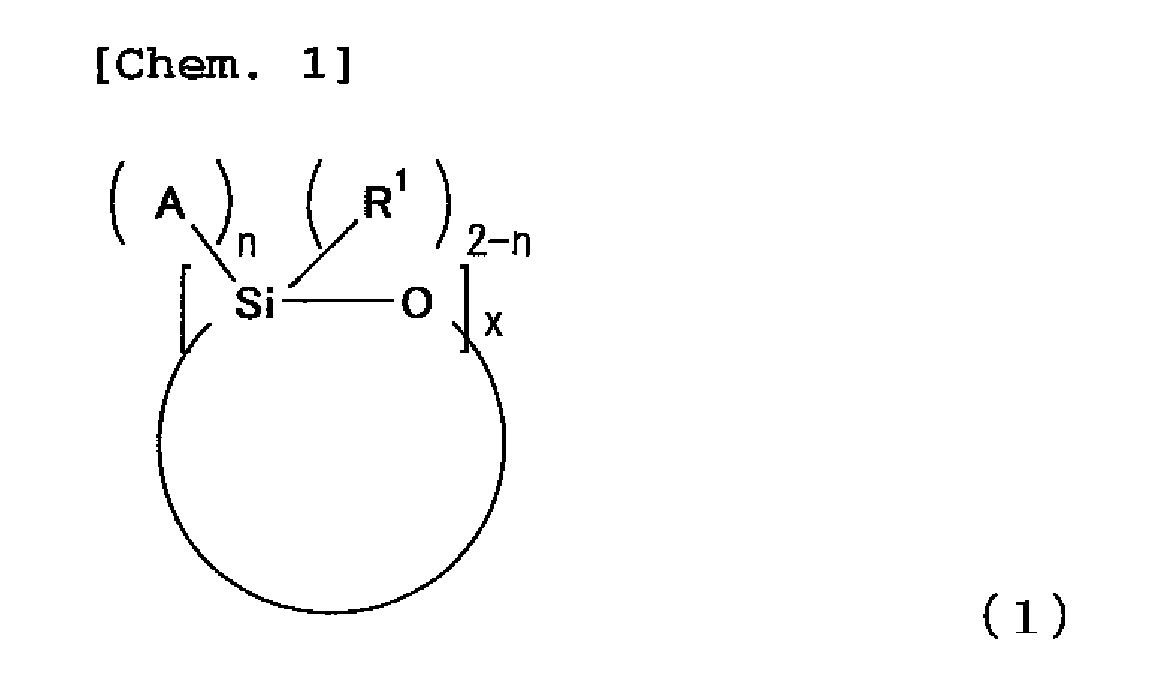
- the present invention relates to a material for forming Si-containing film, characterized by containing a cyclic siloxane compound represented by the following general formula (1)
- A represents a group containing at least one selected from the group consisting of an oxygen atom, a boron atom and a nitrogen atom, and R 1 represents a hydrogen atom or a hydrocarbon group.
- n is 1 or 2
- x is an integer of from 2 to 10.
- the present invention resides in a production method of an Si-containing film, characterized by using the above-described material for forming Si-containing film as a raw material. Further, the present invention relates to an Si-containing film, characterized by being obtained by the above-described method. Further, the present invention resides in a production method of an Si-containing film, characterized by subjecting the above-described Si-containing film to heat treatment, ultraviolet irradiation treatment or electron ray treatment. Further, the present invention resides in an Si-containing film, characterized by being obtained by the above-described production method. Further, the present invention resides in a semiconductor device, characterized by using the above-described Si-containing film as an insulating film.
- cyclic siloxane compound characterized by being represented by the following general formula (20)
- R 18 represents a hydrocarbon group
- R 19 represents a hydrogen atom or a hydrocarbon group.
- g is an integer of from 2 to 10
- h is an integer of from 1 to 3.
- a material having a low dielectric constant and high mechanical strength can be provided as a low dielectric constant material in an interlayer insulating film of a semiconductor device, by using the cyclic siloxane compound represented by the general formula (1) as a material for forming Si-containing film.
- the present invention can produce a cyclic siloxane compound represented by the general formula (1) which is useful as a PECVD method interlayer insulating film material in high purity with good efficiency.
- a hydrocarbon group shown by R 1 , and R 2 , R 4 , R 5 , R 8 , R 9 , R 10 , R 11 , R 12 , R 13 , R 14 , R 15 , R 16 , R 17 , R 18 and R 19 shown hereinafter is preferably a saturated or unsaturated hydrocarbon group, and may have any of straight-chain, branched-chain and cyclic structures. Further, in the general formulae (3), (5) and (7) shown below, when p, q or r is 2 or more, the respective formulae may be bonded with each other to form a cyclic structure.
- the hydrocarbon group shown by R 1 , and R 2 , R 4 , R 6 , R 8 , R 9 , R 10 , R 11 , R 12 , R 13 , R 14 , R 15 , R 16 , R 17 , R 18 and R 19 shown hereinafter is not particularly limited, but is preferably an alkyl group having from 1 to 6 carbon atoms, an aryl group, an arylalkyl group, an alkylaryl group, an alkenyl group, an arylalkenyl group, an alkenylaryl group, an alkynyl group, an arylalkynyl group and an alkynylaryl group, and more preferably an alkyl group having from 1 to 6 carbon atoms and an aryl group.
- alkyl groups such as methyl, ethyl, n-propyl, i-propyl, cyclopropyl, n-butyl, i-butyl, sec-butyl, tert-butyl, cyclobutyl, n-pentyl, tert-amyl, cyclopentyl, n-hexyl, cyclohexyl and 2-ethylhexyl; aryl groups such as phenyl, diphenyl and naphthyl; arylalkyl groups such as benzyl and methylbenzyl; and alkylaryl groups such as o-toluyl, m-toluyl, p-toluyl, 2,3-dimethylphenyl, 2,4-dimethylphenyl, 2,5-dimethylphenyl, 2,6-dimethylphenyl, 3,4-dimethylphenyl, 3,5-dimethylmethyl
- alkenyl groups such as vinyl, allyl, 1-propenyl, 1-butenyl, 1,3-butadienyl, 1-pentenyl, 1-cyclopentenyl, 2-cyclopentenyl, cyclopentadienyl, methylcyclopentadienyl, ethylcyclopentadienyl, 1-hexenyl, 1-cyclohexenyl, 2,4-cyclohexadienyl, 2,5-cyclohexadienyl, 2,4,6-cycloheptatrienyl and 5-norbornen-2-yl; arylalkenyl groups such as 2-phenyl-1-ethenyl; alkenylaryl groups such as o-styryl, m-styryl and p-styryl; alkynyl groups such as ethynyl, 1-propynyl, 2-propynyl, 1-butynyl, 2-butynyl
- an alkyl group having from 1 to 4 carbon atoms and phenyl group are particularly preferable.
- A represents a group containing at least one selected from the group consisting of an oxygen atom, a boron atom and a nitrogen atom, and may have any of straight-chain, branched-chain and cyclic structures.
- a containing oxygen is preferable, and the example thereof includes an oxygen-containing group represented by the following general formula (2)
- R 3 in the above general formula (3), and R 5 and R 7 shown hereinafter include hydrocarbon residues having structures in which p, q or r hydrogen atoms are eliminated from the structures of hydrocarbon groups shown as the examples of R 1 , R 2 , R 4 , R 6 , R 8 , R 9 , R 10 , R 11 , R 12 , R 13 , R 14 , R 15 , R 16 , R 17 , R 18 and R 19 , respectively.
- a saturated or unsaturated hydrocarbon residue having from 1 to 20 carbon atoms is preferable, and may have any of straight-chain, branched-chain and cyclic structures.
- the A containing oxygen is preferably an alkoxy group, a silanoxy group, an alkoxyaryl group or an alkoxyalkyl group, and more preferably an alkoxy group having from 1 to 4 carbon atoms, a phenyl group which has an alkoxy group having from 1 to 4 carbon atoms as a substituent, or an alkyl group having from 1 to 4 carbon atoms which has an alkoxy group having from 1 to 4 carbon atoms as a substituent.
- R 1 in this case is preferably an alkyl group having from 1 to 6 carbon atoms, and more preferably an alkyl group having from 1 to 4 carbon atoms.
- Example of the A containing nitrogen includes a nitrogen-containing group represented by the following general formula (4)
- R 4 is the same as defined above.
- R 5 represents a hydrocarbon residue.
- q is the number of NR 4 2 as a substituent on R 5 , and is an integer of 1 or more.).
- R 4 s may be the same or different.
- the A containing nitrogen is preferably an alkylamino group, a dialkylamino group, an arylamino group or a diarylamino group.
- Example of the A containing boron include a boron-containing group represented by the following general formula (6)
- R 6 is the same as defined above.
- R 7 represents a hydrocarbon residue.
- r is the number of BR 6 2 substituted on R 7 , and is an integer of 1 or more.).
- R 6 s may be the same or different.
- the A containing boron is preferably an alkylboron residue or an alkoxyboron residue.
- a material for forming Si-containing film characterized by containing a cyclic siloxane compound represented by the general formula (1) having a structure that substituents of the general formulae (2) to (7) are present as a mixture is included in the scope of the present invention.
- n is preferably 1
- x is preferably 3 to 4
- a molecular weight of the cyclic siloxane compound represented by the general formula (1) is preferably less than 1,000.
- cyclic siloxane compound represented by the general formula (1) examples include 2,4,6-tritert-butyl-2,4,6-trimethoxycyclotrisiloxane, 2,4,6-trisec-butyl-2,4,6-trimethoxycyclotrisiloxane, 2,4,6-triisobutyl-2,4,6-trimethoxycyclotrisiloxane, 2,4,6-tri-n-butyl-2,4,6-trimethoxycyclotrisiloxane, 2,4,6-tricyclo-butyl-2,4,6-trimethoxycyclotrisiloxane, 2,4,6-triisopropyl-2,4,6-trimethoxycyclotrisiloxane, 2,4,6-tri-n-propyl-2,4,6-trimethoxycyclotrisiloxane, 2,4,6-tricyclopropyl-2,4,6-trimethoxycyclotrisiloxane, 2,4,6-tricyclopropyl
- Further examples include 2,2,4,4,6,6-hexamethoxycyclotrisiloxane, 2,2,4,4,6,6-hexaethoxycyclotrisiloxane, 2,2,4,4,6,6-hexa-n-propoxycyclotrisiloxane, 2,2,4,4,6,6-hexaisopropoxycyclotrisiloxane, 2,2,4,4,6,6-hexacyclopropoxycyclotrisiloxane, 2,2,4,4,6,6-hexatert-butoxycyclotrisiloxane, 2,2,4,4,6,6-hexasecbutoxycyclotrisiloxane, 2,2,4,4,6,6-hexaisobutoxycyclotrisiloxane, 2,2,4,4,6,6-hexa-n-butoxycyclotrisiloxane and 2,2,4,4,6,6-hexacyclobutoxycyclotrisiloxane.
- Further examples include 2,4,6-tris(4-methoxyphenyl)-2,4,6-trimethylcyclotrisiloxane, 2,4,6-tris(4-tert-butoxyphenyl)-2,4,6-trimethylcyclotrisiloxane, 2,4,6,8-tetrakis(4-methoxyphenyl)-2,4,6,8-tetramethylcyclotetrasiloxane, 2,4,6,8-tetrakis(4-tert-butoxyphenyl)-2,4,6,8-tetramethylcyclotetrasiloxane, 2,4,6,8,10-pentakis(4-methoxyphenyl)-2,4,6,8,10-pentamethylcyclopentasiloxane and 2,4,6,8,10-pentakis(4-tert-butoxyphenyl)-2,4,6,8,10-pentamethylcyclopentasiloxane.
- Further examples include 2,4,6-tris(methoxymethyl)-2,4,6-trimethylcyclotrisiloxane, 2,4,6-tris(ethoxymethyl)-2,4,6-trimethylcyclotrisiloxane, 2,4,6-tris(n-propoxymethyl)-2,4,6-trimethylcyclotrisiloxane, 2,4,6-tris(isopropoxymethyl)-2,4,6-trimethylcyclotrisiloxane, 2,4,6-tris(n-butoxymethyl)-2,4,6-trimethylcyclotrisiloxane, 2,4,6-tris(iso-butoxymethyl)-2,4,6-trimethylcyclotrisiloxane and 2,4,6-tris(tert-butoxymethyl)-2,4,6-trimethylcyclotrisiloxane.
- Further examples include 2,4,6-tris(methoxymethyl)-2,4,6-triethylcyclotrisiloxane, 2,4,6-tris(ethoxymethyl)-2,4,6-triethylcyclotrisiloxane, 2,4,6-tris(n-propoxymethyl)-2,4,6-triethylcyclotrisiloxane, 2,4,6-tris(isopropoxymethyl)-2,4,6-triethylcyclotrisiloxane, 2,4,6-tris(n-butoxymethyl)-2,4,6-triethylcyclotrisiloxane, 2,4,6-tris(iso-butoxymethyl)-2,4,6-triethylcyolotrisiloxane and 2,4,6-tris(tert-butoxymethyl)-2,4,6-triethylcyclotrisiloxane.
- Further examples include 2,4,6-tris(methoxymethyl)-2,4,6-triisopropylcyclotrisiloxane, 2,4,6-tris(ethoxymethyl)-2,4,6-triisopropylcyclotrisiloxane, 2,4,6-tris(n-propoxymethyl)-2,4,6-triisopropylcyclotrisiloxane, 2,4,6-tris(isopropoxymethyl)-2,4,6-triisopropylcyclotrisiloxane, 2,4,6-tris(n-butoxymethyl)-2,4,6-triisopropylcyclotrisiloxane, 2,4,6-tris(iso-butoxymethyl)-2,4,6-triisopropylcyclotrisiloxane and 2,4,6-tris(tert-butoxymethyl)-2,4,6-triisopropylcyclotrisiloxane.
- Further examples include 2,4,6-tris(methoxymethyl)-2,4,6-tri-n-propylcyclotrisiloxane, 2,4,6-tris(ethoxymethyl)-2,4,6-tri-n-propylcyclotrisiloxane, 2,4,6-tris(n-propoxymethyl)-2,4,6-tri-n-propylcyclotrisiloxane, 2,4,6-tris(isopropoxymethyl)-2,4,6-tri-n-propylcyclotrisiloxane, 2,4,6-tris(n-butoxymethyl)-2,4,6-tri-n-propylcyclotrisiloxane, 2,4,6-tris(iso-butoxymethyl)-2,4,6-tri-n-propylcyclotrisiloxane and 2,4,6-tris(tert-butoxymethyl)-2,4,6-tri-n-propylcyclotrisiloxane.
- Further examples include 2,4,6-tris(methoxymethyl)-2,4,6-tritert-butylcyclotrisiloxane, 2,4,6-tris(ethoxymethyl)-2,4,6-tritert-butylcyclotrisiloxane, 2,4,6-tris(n-propoxymethyl)-2,4,6-tritert-butylcyclotrisiloxane, 2,4,6-tris(isopropoxymethyl)-2,4,6-tritert-butylcyclotrisiloxane, 2,4,6-tris(n-butoxymethyl)-2,4,6-tritert-butylcyclotrisiloxane, 2,4,6-tris(iso-butoxymethyl)-2,4,6-tritert-butylcyclotrisiloxane and 2,4,6-tris(tert-butoxymethyl)-2,4,6-tritert-butylcyclotrisiloxane.
- Further examples include 2,4,6-tris(methoxymethyl)-2,4,6-tricyclopentylcyclotrisiloxane, 2,4,6-tris(ethoxymethyl)-2,4,6-tricyclopentylcyclotrisiloxane, 2,4,6-tris(n-propoxymethyl)-2,4,6-tricyclopentylcyclotrisiloxane, 2,4,6-tris(isopropoxymethyl)-2,4,6-tricyclopentylcyclotrisiloxane, 2,4,6-tris(n-butoxymethyl)-2,4,6-tricyclopentylcyclotrisiloxane, 2,4,6-tris(iso-butoxymethyl)-2,4,6-tricyclopentylcyclotrisiloxane and 2,4,6-tris(tert-butoxymethyl)-2,4,6-tricyclopentylcyclotrisiloxane.
- Further examples include 2,4,6-tris(methoxymethyl)-2,4,6-tricyclohexylcyclotrisiloxane, 2,4,6-tris(ethoxymethyl)-2,4,6-tricyclohexylcyclotrisiloxane, 2,4,6-tris(n-propoxymethyl)-2,4,6-tricyclohexylcyclotrisiloxane, 2,4,6-tris(isopropoxymethyl)-2,4,6-tricyclohexylcyclotrisiloxane, 2,4,6-tris(n-butoxymethyl)-2,4,6-tricyclohexylcyclotrisiloxane, 2,4,6-tris(iso-butoxymethyl)-2,4,6-tricyclohexylcyclotrisiloxane and 2,4,6-tris(tert-butoxymethyl)-2,4,6-tricyclohexylcyclotrisiloxane.
- Further examples include 2,4,6-tris(methoxyethyl)-2,4,6-trimethylcyclotrisiloxane, 2,4,6-tris(ethoxyethyl)-2,4,6-trimethylcyclotrisiloxane, 2,4,6-tris(n-propoxyethyl)-2,4,6-trimethylcyclotrisiloxane, 2,4,6-tris(isopropoxyethyl)-2,4,6-trimethylcyclotrisiloxane, 2,4,6-tris(n-butoxyethyl)-2,4,6-trimethylcyclotrisiloxane, 2,4,6-tris(iso-butoxyethyl)-2,4,6-trimethylcyclotrisiloxane and 2,4,6-tris(tert-butoxyethyl)-2,4,6-trimethylcyclotrisiloxane.
- Further examples include 2,4,6-tris(methoxyethyl)-2,4,6-triethylcyclotrisiloxane, 2,4,6-tris(ethoxyethyl)-2,4,6-triethylcyclotrisiloxane, 2,4,6-tris(n-propoxyethyl)-2,4,6-triethylcyclotrisiloxane, 2,4,6-tris(isopropoxyethyl)-2,4,6-triethylcyclotrisiloxane, 2,4,6-tris(n-butoxyethyl)-2,4,6-triethylcyclotrisiloxane, 2,4,6-tris-(iso-butoxyethyl)-2,4,6-triethylcyclotrisiloxane and 2,4,6-tris(tert-butoxyethyl)-2,4,6-triethylcyclotrisiloxane.
- Further examples include 2,4,6-tris(methoxyethyl)-2,4,6-triisopropylcyclotrisiloxane, 2,4,6-tris(ethoxyethyl)-2,4,6-triisopropylcyclotrisiloxane, 2,4,6-tris(n-propoxyethyl)-2,4,6-triisopropylcyclotrisiloxane, 2,4,6-tris(isopropoxyethyl)-2,4,6-triisopropylcyclotrisiloxane, 2,4,6-tris(n-butoxyethyl)-2,4,6-triisopropylcyclotrisiloxane, 2,4,6-tris(iso-butoxyethyl)-2,4,6-triisopropylcyclotrisiloxane and 2,4,6-tris(tert-butoxyethyl)-2,4,6-triisopropylcyclotrisiloxane
- Further examples include 2,4,6-tris(methoxyethyl)-2,4,6-tricyclopentylcyclotrisiloxane, 2,4,6-tris(ethoxyethyl)-2,4,6-tricyclopentylcyclotrisiloxane, 2,4,6-tris(n-propoxyethyl)-2,4,6-tricyclopentylcyclotrisiloxane, 2,4,6-tris(isopropoxyethyl)-2,4,6-tricyclopentylcyclotrisiloxane, 2,4,6-tris(n-butoxyethyl)-2,4,6-tricyclopentylcyclotrisiloxane, 2,4,6-tris(iso-butoxyethyl)-2,4,6-tricyclopentylcyclotrisiloxane and 2,4,6-tris(tert-butoxyethyl)-2,4,6-tricyclopentylcyclotrisiloxane
- Further examples include 2,4,6-tris(methoxypropyl)-2,4,6-trimethylcyclotrisiloxane, 2,4,6-tris(methoxypropyl)-2,4,6-triethylcyclotrisiloxane, 2,4,6-tris(methoxypropyl)-2,4,6-triisopropylcyclotrisiloxane, 2,4,6-tris(methoxybutyl)-2,4,6-trimethylcyclotrisiloxane, 2,4,6-tris-(methoxypentyl)-2,4,6-trimethylcyclotrisiloxane and 2,4,6-tris(methoxyhexyl)-2,4,6-trimethylcyclotrisiloxane.
- Further examples include 2,4,6,8-tetrakis-(methoxypropyl)-2,4,6,8-tetramethylcyclotrisiloxane, 2,4,6,8-tetrakis(methoxypropyl)-2,4,6,8-tetraethylcyclotrisiloxane, 2,4,6,8-tetrakis(methoxypropyl)-2,4,6,8-tetraisopropylcyclotrisiloxane, 2,4,6,8-tetrakis(methoxybutyl)-2,4,6,8-tetramethylcyclotrisiloxane, 2,4,6,8-tetrakis(methoxypentyl)-2,4,6,8-tetramethylcyclotrisiloxane and 2,4,6,8-tetrakis (methoxyhexyl)-2,4,6,8-tetramethylcyclotrisiloxane.
- Further examples include 2,4,6,8,10-pentakis-(methoxymethyl)-2,4,6,8,10-pentamethylcyclopentasiloxane, 2,4,6,8,10-pentakis(methoxymethyl)-2,4,6,8,10-pentaethylcyclopentasiloxane and 2,4,6,8,10-pentakis(methoxymethyl)-2,4,6,8,10-pentaisopropylcyclopentasiloxane.
- Further examples include 2,4,6,8,10-pentakis-(methoxyethyl)-2,4,6,8,10-pentamethylcyclopentasiloxane, 2,4,6,8,10-pentakis(methoxyethyl)-2,4,6,8,10-pentaethylcyclopentasiloxane and 2,4,6,8,10-pentakis(methoxyethyl)-2,4,6,8,10-pentaisopropylcyclopentasiloxane.
- Further examples include 2,4,6-triisopropyl-2,4,6-tris(dimethylamino)cyclotrisiloxane, 2,4,6-triisopropyl-2,4,6-tris(diethylamino)cyclotrisiloxane, 2,4,6,8-tetraisopropyl-2,4,6,8-tetrakis(dimethylamino)cyclotetrasiloxane, 2,4,6,8-tetraisopropyl-2,4,6,8-tetrakis(diethylamino)-cyclotetrasiloxane, 2,4,6,8,10-pentaisopropyl-2,4,6,8,10-pentakis(dimethylamino)cyclopentasiloxane and 2,4,6,8,10-pentaisopropyl-2,4,6,8,10-pentakis(diethylamino)cyclopentasiloxane.
- Further examples include 2,4,6-trimethyl-2,4,6-tris(dimethylamino)cyclotrisiloxane, 2,4,6-trimethyl-2,4,6-tris(diethylamino)cyclotrisiloxane, 2,4,6,8-tetramethyl-2,4,6,8-tetrakis(dimethylamino)cyclotetrasiloxane, 2,4,6,8-tetramethyl-2,4,6,8-tetrakis(diethylamino)cyclotetrasiloxane, 2,4,6,8,10-pentamethyl-2,4,6,8,10-pentakis-(dimethylamino)cyclopentasiloxane and 2,4,6,8,10-pentamethyl-2,4,6,8,10-pentakis(diethylamino)cyclopentasiloxane.
- Further examples include 2,4,6-tris(4-dimethylaminophenyl)-2,4,6-trimethylcyclotrisiloxane, 2,4,6-tris(4-diethylaminophenyl)-2,4,6-trimethylcyclotrisiloxane, 2,4,6,8-tetrakis(4-dimethylaminophenyl)-2,4,6,8-tetramethylcyclotetrasiloxane, 2,4,6,8-tetrakis(4-diethylaminophenyl)-2,4,6,8-tetramethylcyclotetrasiloxane, 2,4,6,8,10-pentakis(4-dimethylaminophenyl)-2,4,6,8,10-pentamethylcyclopentasiloxane and 2,4,6,8,10-pentakis(4-diethylaminophenyl)-2,4,6,8,10-pentamethylcyclopentasiloxane.
- Further examples include 2,4,6-triisopropyl-2,4,6-tris(dimethylboro)cyclotrisiloxane, 2,4,6-triisopropyl-2,4,6-tris(diethylboro)cyclotrisiloxane, 2,4,6,8-tetraisopropyl-2,4,6,8-tetrakis(dimethylboro)cyclotetrasiloxane, 2,4,6,8-tetraisopropyl-2,4,6,8-tetrakis(diethylboro)-cyclotetrasiloxane, 2,4,6,8,10-pentaisopropyl-2,4,6,8,10-pentakis(dimethylboro)cyclopentasiloxane and 2,4,6,8,10-pentaisopropyl-2,4,6,8,10-pentakis(diethylboro)cyclopentasiloxane.
- Further examples include 2,4,6-trimethyl-2,4,6-tris(dimethylboro)cyclotrisiloxane, 2,4,6-trimethyl-2,4,6-tris(diethylboro)cyclotrisiloxane, 2,4,6,8-tetramethyl-2,4,6,8-tetrakis(dimethylboro)cyclotetrasiloxane, 2,4,6,8-tetramethyl-2,4,6,8-tetrakis(diethylboro)cyclotetrasiloxane, 2,4,6,8,10-pentamethyl-2,4,6,8,10-pentakis(dimethylboro)-cyclopentasiloxane and 2,4,6,8,10-pentamethyl-2,4,6,8,10-pentakis(diethylboro)cyclopentasiloxane.
- Further examples include 2,4,6-tris(4-dimethylborophenyl)-2,4,6-trimethylcyclotrisiloxane, 2,4,6-tris(4-diethylborophenyl)-2,4,6-trimethylcyclotrisiloxane, 2,4,6,8-tetrakis(4-dimethylborophenyl)-2,4,6,8-tetramethylcyclotetrasiloxane, 2,4,6,8-tetrakis(4-diethylborophenyl)-2,4,6,8-tetramethyl- cyclotetrasiloxane, 2,4,6,8,10-pentakis(4-dimethylborophenyl)-2,4,6,8,10-pentamethylcyclopentasiloxane and 2,4,6,8,10-pentakis(4-diethylborophenyl)-2,4,6,8,10-pentamethylcyclopentasiloxane.
- the material for forming Si-containing film of the present invention contains the cyclic siloxane compound represented by the general formula (1).
- the amount of impurities other than silicon, carbon, oxygen, hydrogen, nitrogen and boron is less than 10 ppb, and a water content is less than 50 ppm.
- the production method of the cyclic siloxane compound represented by the general formula (1) is not particularly limited, but the method of producing the cyclic siloxane compound having the structure of the general formula (2) can use, for example, a method of hydrolyzing an oxygen-containing silane compound represented by the following general formula (8)
- R 1 , n and x are the same as defined above), and alcohols in the presence of Pd, Ni or Rh catalyst.
- the method of producing the cyclic siloxane compound having the structure of the general formula (3) can use, for example, a method of hydrolyzing an oxygen-containing silane compound represented by the following general formula (10)
- R 1 , R 2 , R 3 , R 9 and p are the same as defined above. s is 1 or 2, t is 0 or 1, and s+t is 1 to 2.), obtained by reacting the corresponding Grignard reagent or organic lithium compound, and an organic silane compound, in the presence or absence of an acid or a base, and a method of producing by reacting the cyclic siloxane represented by the general formula (9) and an alkyne compound having R 2 O group in the presence of Pt catalyst.
- the method of producing the cyclic siloxane having the structure of the general formula (4) can use, for example, a method of hydrolyzing a nitrogen- or oxygen-containing silane compound represented by the following general formula (11)
- R 1 , R 4 and R 10 are the same as defined above. u is 1 or 2, v is 0 or 1, and u+v is 1 to 2.), in the presence or absence of an acid or a base.
- the method of producing the cyclic siloxane compound having the structure of the general formula (5) can use, for example, a method of hydrolyzing a nitrogen- or oxygen-containing silane compound represented by the following general formula (12)
- R 1 , R 4 , R 5 , R 11 and q are the same as defined above.
- y is 1 or 2
- z is 0 or 1
- y+z is 1 to 2.
- the method of producing the cyclic siloxane having the structure of the general formula (6) can use, for example, a method of hydrolyzing a boron- or oxygen-containing silane compound represented by the following general formula (13)
- R 1 , R 6 and R 12 are the same as defined above, a is 1 or 2, b is 0 or 1, and a+b is 1 to 2.), in the presence or absence of an acid or a base.
- the method of producing the cyclic siloxane having the structure of the general formula (7) can use, for example, a method of hydrolyzing a boron- or oxygen-containing silane compound represented by the following general formula (14)
- R 1 , R 6 , R 7 , R 13 and r are the same as defined above. c is 1 or 2, d is 0 or 1, and c+d is 1 to 2.), in the presence or absence of an acid or a base.
- inorganic acids such as hydrochloric acid, nitric acid and sulfuric acid, and organic acids such as toluenesulfonic acid can be used as an acid to be present.
- organic acids such as toluenesulfonic acid
- sodium hydroxide, potassium hydroxide, sodium methoxide, potassium methoxide, sodium ethoxide, potassium ethoxide, sodium tertiary butoxide, potassium tertiary butoxide or the like can be used as a base to be present.
- the Pd, Ni or Rh catalyst that can be used in reacting the cyclic siloxane compound of the general formula (9) and alcohols includes Pd(0), Ni(0) or Rh(0) catalyst supported on a high surface area activated carbon, and a heterogeneous or homogeneous catalyst represented by the following general formula (15)
- MX e L f (In the formula, M represents Pd, Ni or Rh, X represents fluorine, chlorine, bromine and iodine, and L represents an electron donating compound. e and f are a number of 0 or more, and e+f is a number satisfying the valency of M and coordination number).
- a phosphine compound, an amine compound and the like can be used as the electron donating compound represented by L in the general formula (15).
- R 15 is the same as defined above. R 15 s may be the same or different.), or an amine compound represented by the following general formula (18) or (19)
- R 17 is the same as defined above. R 17 s may be the same or different.), can be used.
- the reaction solvent that can be used in producing the cyclic siloxane compound represented by the general formula (1) is not particularly limited so far as it is used in the art of this field.
- the solvent that can be used include saturated hydrocarbons such as n-pentane, i-pentane, n-hexane, cyclohexane, n-heptane and n-decane; unsaturated hydrocarbons such as toluene, xylene and decene-1; ethers such as diethyl ether, dipropyl ether, tert-butyl methyl ether, dibutyl ether, cyclopentyl methyl ether and tetrahydrofuran; and alcohols such as methanol, ethanol, isopropanol, n-butanol, tert-butanol and 2-ethylhexanol. Mixed solvents of those can be used. Especially, when ethers or alcohols are used
- the reaction temperature in producing the cyclic siloxane compound represented by the general formula (1) is in a range of from -100 to 200°C which is a temperature generally used industrially, and preferably in a range of from -85 to 150°C.
- Pressure condition of the reaction can be under pressure, at normal pressures or under reduced pressure.
- Purification method of the cyclic siloxane compound represented by the general formula (1) produced can use a purification method such as distillation at normal pressures or under reduced pressure, or column separation using silica, alumina or polymer gel, in order to reduce a water content which is useful to use as an insulating film material to less than 50 ppm, and the amount of impurities other than silicon, carbon, oxygen and hydrogen, such as the amount of metal impurities, to less than 10 ppb.
- a purification method such as distillation at normal pressures or under reduced pressure, or column separation using silica, alumina or polymer gel, in order to reduce a water content which is useful to use as an insulating film material to less than 50 ppm, and the amount of impurities other than silicon, carbon, oxygen and hydrogen, such as the amount of metal impurities, to less than 10 ppb.
- those methods may be combined according to need.
- the production is conducted in a water-removed and deoxidized nitrogen or argon atmosphere, and water-removal operation is previously applied to a solvent used and a column filler for purification. Further, it is preferable that impurities such as metal residues and particles are removed.
- the cyclic siloxane compound represented by the general formula (1) of the present invention is used as a material for forming Si-containing film, and an Si-containing film can be produced using the same as a raw material.
- the film forming method is not limited, but it is preferable to conduct the method by CVD, and it is especially preferable to conduct by PECVD.
- PECVD uses the method generally used in this technical field such as semiconductor production field and liquid crystal display production field.
- the material for forming Si-containing film of the present invention is vaporized with a vaporizer and introduced into a film formation chamber, a voltage is applied to an electrode in the film formation chamber by a high frequency power source to generate plasma, thereby forming a plasma CVD thin film on a silicon substrate or the like in the film formation chamber.
- a gas such as argon or helium and an oxidizing agent such as oxygen or nitrous oxide may be introduced for the purpose of generating plasma.
- simultaneous introduction of an organic peroxide or an epoxy compound for the purpose of forming pores in a thin film is also included in the scope of the present invention.
- the plasma generation method of PECVD equipment is not particularly limited, and inductively coupled plasma, capacitively coupled plasma, ECR plasma, microwave plasma and the like that are used in the art can be used. Inductively coupled plasma and capacitively coupled plasma are preferable.
- a plasma generation source various types such as parallel plate type and antenna type can be used, and as an inert gas supplied to a chamber of the PECVD equipment, helium, argon, krypton, neon, xenon and the like that are used in this technical field can be used.
- a parallel plate capacitively coupled PECVD equipment 1 shown in Fig. 1 comprises a shower head upper electrode and a lower electrode capable of controlling temperature of a substrate in a PECVD equipment chamber, a vaporization equipment which vaporizes the general formula (1) and supplies to the chamber, a plasma generation equipment comprising a high frequency power source and a matching circuit, and an exhaust system comprising a vacuum pump.
- the PECVD equipment 1 comprises a PECVD chamber 2, an upper electrode 3 having a shower head for uniformly supplying the compound of the general formula (1) in the chamber, a lower electrode 4 having a temperature control device 8 for setting a thin film forming substrate 5 such as an Si substrate, vaporization equipment 9 to 15 for vaporizing the compound of the general formula (1), a matching circuit 6 and a RF power source 7, that are a plasma generation source, and an exhaust equipment 16 for exhausting an unreacted product and a by-product in the chamber. 17 and 18 are earth ground.
- the matching circuit 6 and RF power source 7, that are a plasma generation source are connected to the upper electrode 3, and plasma is generated by discharging.
- the standard of the RF power source 7 is not particularly limited, but the RF power source generally used in this technical field, having electric power of from 1W to 2,000W, and preferably from 10W to 1,000W, and a frequency of from 50 kHz to 2.5 GHz, preferably from 100 kHz to 100 MHz, and particularly preferably from 200 kHz to 50 MHz, can be used.
- Control of substrate temperature is not particularly limited, but the temperature is in a range of from -90 to 1, 000°C, and preferably from 0°C to 500°C.
- the vaporization equipment comprises a container 12 filled with the compound 13 of the general formula (1) which is liquid at ordinary temperature and normal pressures and equipped with a dip piping and a piping 15 which pressurizes by the insert gas, a liquid flow rate control device 10 which control flow rate of the compound 13 of the general formula (1) which is liquid, a vaporizer 9 which vaporizes the compound 13 of the general formula (1) which is liquid, a piping 14 for supplying the inert gas in the PECVD equipment chamber via the vaporizer, and a gas flow rate control equipment 11 which controls flow rate of the insert gas.
- the vaporization equipment is connected to the upper electrode 3 equipped with a shower head from the vaporizer 9 via piping.
- an inductive coupled remote PECVD equipment is shown in Fig. 2 .
- An inductive coupled remote PECVD equipment 19 shown in Fig. 2 comprises a plasma generation part wound in a coiled state around quartz at an upper portion of a PECVD equipment chamber, a temperature-controllable substrate setting part, a vaporization equipment which vaporizes the compound of the general formula (1) and supplies to the chamber, a plasma generation equipment comprising a high frequency power source and a matching circuit, and an exhaustion system comprising a vacuum pump.
- the PECVD equipment 19 comprises a PECVD chamber 20, a coil 21 and a quartz pipe 22 that are the plasma generation part, a heater part 23 for setting a thin film forming substrate 24 such as an Si substrate and a temperature control device 27, a vaporization equipment 28 to 35 for vaporizing the compound of the general formula (1), a matching circuit 25 and an RF power source 26, that are a plasma generation source, and an exhaust equipment 36 for exhausting an unreacted product and a by-product in the chamber. 37 is earth ground.
- the coil around quartz as a plasma generation part is connected to the matching circuit 25, and discharge is conducted at an antenna current magnetic field by RF current in a quartz pipe to generate plasma.
- Standard of the RF power source 26 is not particularly limited, but the RF power source generally used in this technical field, having electric power of from 1W to 2,000W, and preferably from 10W to 1,000W, and a frequency of from 50 kHz to 2.5 GHz, preferably from 100 kHz to 100 MHz, and particularly preferably from 200 kHz to 50 MHz, can be used.
- Control of a substrate temperature is not particularly limited, but the temperature is in a range of from -90 to 1,000°C, and preferably from 0°C to 500°C.
- the vaporization equipment comprises a container 32 filled with the compound 33 of the general formula (1) which is liquid at ordinary temperature and normal pressures and equipped with a dip piping and a piping 35 which pressurizes by the insert gas, a liquid flow rate control device 29 which controls flow rate of the compound 33 of the general formula (1) which is liquid, a vaporizer 28 which vaporizes the compound 33 of the general formula (1) which is liquid, a piping 34 for supplying the inert gas in the PECVD equipment chamber via the vaporizer, a gas flow rate control equipment 30 which controls flow rate of the insert gas, and a shower head 31 for uniformly supplying the inert gas and the gasified compound 33 of the formula (1) in the chamber.
- the compound represented by the general formula (1) is gasified using, for example, the PECVD equipment as exemplified above, and supplied in the chamber, according to need, together with the inert gas, and is formed into a film by PECVD.
- pressure in the chamber is not particularly limited, but is from 0.1 Pa to 10,000 Pa, and preferably from 1 Pa to 5,000 Pa.
- the film preferably has a cyclic siloxane structure.
- the cyclic siloxane structure may be a residual cyclic siloxane structure in the cyclic siloxane compound represented by the general formula (1) or may be newly formed by plasma.
- a film having a cyclic siloxane structure is a porous film having a main pore size of 1 nm or less. Further, pores are not continuous, a metal does not diffuse in the film, and the film has high mechanical properties and high heat conduction.
- the film is a thin film especially suitable as a low dielectric constant material (Low-k material) for semiconductor device. That is, it is further preferable that film formation is conducted under PECVD conditions so as not to disintegrate the cyclic siloxane structure in the cyclic siloxane compound represented by the general formula (1).
- Si-containing film When the above Si-containing film is subjected to heat treatment, ultraviolet irradiation treatment or electron ray treatment, a porous thin film or a thin film having improved mechanical strength can be obtained.
- the Si-containing film having been subjected to those treatments in combination is included in the scope of the present invention.
- the thin film obtained by those treatments is suitable as a low dielectric constant insulating material.
- the Si-containing films according to the present invention are all suitable as a low dielectric constant material, and those films can be used in a semiconductor device as an insulting film.
- those films are suitable in the production of ULSI using a multilayered interconnects.
- R 18 , R 19 , g and h are the same as defined above.
- R 18 is an alkyl group having from 1 to 6 carbon atoms
- R 19 is an alkyl group having from 1 to 6 carbon atoms
- g is 3 or 4
- h is 1 or 2
- R 18 is an alkyl group having from 1 to 4 carbon atoms
- R 19 is an alkyl group having from 1 to 4 carbon atoms.
- Specific examples of the compound represented by the general formula (20) include 2,4,6-triisopropyl-2,4,6-trimethyoxycyclotrisiloxane, 2,4,6-triisopropyl-2,4,6-triethyoxycyclotrisiloxane, 2,4,6-triisopropyl-2,4,6-tri-n-propoxycyclotrisiloxane, 2,4,6-triisopropyl-2,4,6-triisopropoxycyclotrisiloxane, 2,4,6-tris(methoxymethyl)-2,4,6-trimethylcyclotrisiloxane, 2,4,6,8-tetrakis(methoxymethyl)-2,4,6,8-tetramethylcyclotetrasiloxane, 2,4,6-tris(ethoxymethyl)-2,4,6-trimethylcyclotrisiloxane, 2,4,6,8-tetrakis-(ethoxymethyl)-2,4,6,8-tetramethylcyclotet
- Further examples include 2,4,6-tris(methoxyethyl)-2,4,6-trimethylcyclotrisiloxane, 2,4,6,8-tetrakis(methoxyethyl)-2,4,6,8-tetramethylcyclotetrasiloxane, 2,4,6-tris-(ethoxyethyl)-2,4,6-trimethylcyclotrisiloxane, 2,4,6,8-tetrakis(ethoxyethyl)-2,4,6,8-tetramethylcyclotetrasiloxane, 2,4,6-tris(isopropoxyethyl)-2,4,6-trimethylcyclotrisiloxane, and 2,4,6,8-tetrakis(isopropoxyethyl)-2,4,6,8-tetramethylcyclotetrasiloxane.
- Film thickness was measured using an interferometric thin film measurement device, a product of Horiba, Ltd.
- Dielectric constant (k value) was measured using a mercury prober, a product of Four Dimensions Inc., and rigidity and Young's modulus were measured using a nanoindentater, a product of Hysitron Inc.
- Methyl(4-methoxyphenyl)dimethoxysilane isolated was analyzed by 1 H-NMR, 13 C-NMR and GC-MS, and the following results were obtained.
- 2,4,6-Tris(4-methoxyphenyl)-2,4,6-trimethylcyclotrisiloxane synthesized in Example 1 was film-formed on a silicon substrate using the capacitively coupled PECVD equipment shown in Fig. 1 .
- the film formation conditions were that an argon gas as an inert gas is supplied at 10 sccm, vaporized 2,4,6-tris(4-methoxyphenyl)-2,4,6-trimethylcyclotrisiloxane was continued to supply such that a chamber inner pressure is 10 Pa, and a film is formed under the conditions that a substrate temperature is 150°C, RF power source power is 30W, and RF power source frequency is 13.56 MHz.
- a film formation rate was 4.3 nm/min, and dielectric constant (k value) was a value of 2.7.
- Mechanical properties were that rigidity is 1.3 GPa and Young's modulus is 13.9 GPa.
- PECVD thin film was obtained in the same manner as in Example 6, except that 2,4,6,8-tetramethyl-2,4,6,8-tetramethoxycyclotetrasiloxane synthesized in Example 3 was used in place of 2,4,6-tris(4-methoxyphenyl)-2,4,6-trimethylcyclotrisiloxane.
- a film formation rate was 12.8 nm/min, and dielectric constant (k value) was a value of 2.6.
- Mechanical properties were that rigidity is 1.36 GPa and Young's modulus is 15.2 GPa.
- PECVD thin film was obtained in the same manner as in Example 6, except that 2,4,6,8-tetramethyl-2,4,6,8-tetraisopropoxycyclotetrasiloxane synthesized in Example 4 was used in place of 2,4,6-tris(4-methoxyphenyl)-2,4,6-trimethylcyclotrisiloxane.
- a film formation rate was 11.2 nm/min, and dielectric constant (k value) was a value of 2.4.
- Mechanical properties were that rigidity is 1.1 GPa and Young's modulus is 17.1 GPa.
- PECVD thin film was obtained in the same manner as in Example 6, except that 2,4,6,8-tetrakis(methoxymethyl)-2,4,6,8-tetramethylcyclotetrasiloxane synthesized in Example 5 was used in place of 2,4,6-tris(4-methoxyphenyl)-2,4,6-trimethylcyclotrisiloxane.
- a film formation rate was 6.8 nm/min, and dielectric constant (k value) was a value of 1.8.
- Mechanical properties were that rigidity is 1.6 GPa and Young's modulus is 22.1 GPa.
- PECVD thin film was obtained in the same manner as in Example 6, except that 2,4,6,8-tetramethylcyclotetrasiloxane was used in place of 2,4,6-tris(4-methoxyphenyl)-2,4,6-trimethylcyclotrisiloxane.
- a film formation rate was 10.4 nm/min
- dielectric constant (k value) was a value of 2.9.
- Mechanical properties were that rigidity is 1.1 GPa and Young's modulus is 10.7 GPa.
- the present invention can provide a novel material for forming Si-containing film, especially a material for a low dielectric constant insulating film containing a cyclic siloxane compound suitable to PECVD equipment, and further provide an Si-containing film using the same and a semiconductor device containing those films.
Landscapes
- Chemical & Material Sciences (AREA)
- Engineering & Computer Science (AREA)
- Organic Chemistry (AREA)
- General Chemical & Material Sciences (AREA)
- Chemical Kinetics & Catalysis (AREA)
- Materials Engineering (AREA)
- Mechanical Engineering (AREA)
- Metallurgy (AREA)
- Physics & Mathematics (AREA)
- Plasma & Fusion (AREA)
- Inorganic Chemistry (AREA)
- Formation Of Insulating Films (AREA)
Abstract

A represents a group containing at least one selected from the group consisting of an oxygen atom (preferably an alkoxyalkyl group, an alkoxyaryl group, a silanoxy group), a boron atom or a nitrogen atom.
R1 represents a hydrogen atom or a hydrocarbon group,
n is 1 or 2, and
x is an integer of from 2 to 10,
and its use.
Description
- The present invention relates to a material for forming Si-containing film and the like, and particularly to a material for a low dielectric constant interlayer insulating film used in multilayer interconnect technology in logic ULSI. Especially, it relates to a material for forming Si-containing film containing a cyclic siloxane compound for plasma polymerization and its use.
- In production technology in the field of integrated circuit in an electronic industries, demand for high integration and speed-up is increasing. With respect to silicon ULSI, especially logic ULSI, rather than performance by miniaturization of MOSFET, performance of wiring connecting those has been problematic. Namely, reduction in wiring resistance and reduction in capacitance between wirings and in interlayer capacitance are required in order to solve the problem in wiring delay due to multilayer interconnects.
- Accordingly, at present, instead of aluminum wiring used for the most part of the in integrated circuit, introduction of copper wiring having a lower electric resistance and migration resistance is essential, and a process of conducting copper plating after seed formation by sputtering or chemical vapor deposition (hereinafter abbreviated as CVD) method has been used practically.
- There are various proposals as a low dielectric constant interlayer insulating film material. Heretofore as the inorganic system, silicon dioxide (SiO2), silicon nitride and a phosphosilicate glass have been used, and as the organic system a polyimide has been used. However, recently, with a purpose of obtaining a more homogenous interlayer insulating film, there are the proposal of previously hydrolyzing, that is, polycondensing, a tetraethoxysilane monomer to obtain SiO2, and using as a coating material called inorganic Spin on Glass (inorganic SOG), and the proposal of using a polysiloxane obtained by polycondensing an organic alkoxysilane monomer, as an organic SOG.
- Further, as a method of forming the insulating film, there are the following two methods. An application method of a coating method of coating an insulating film polymer solution with a spin coat or the like to form a film, and a CVD method of mainly plasma polymerizing in a plasma enhanced chemical vapor deposition (PECVD) equipment to form a film.
- As the proposal of the PECVD method, for example,
Patent Document 1 proposes a method of forming a trimethylsilane oxide thin film from trimethylsilane and oxygen by the PECVD method, andPatent Document 2 proposes a method of forming an alkylsilane oxide thin film from an alkoxysilane having a straight-chain alkyl such as methyl, ethyl and n-propyl, an alkynyl such as vinyl, phenyl, and an aryl group by the PECVD method. Those insulating films formed with the conventional PECVD method materials have good adhesion to a barrier metal and a copper wiring material which is a wiring material, whereas there were the cases that uniformity of a film becomes problem and film formation rate and dielectric constant are insufficient. - As the proposal of PECVD using a cyclic siloxane, Patent Document 3 proposes a method of using tetramethylcyclotetrasiloxane, and
Patent Document 4 proposes a method of using tetraalkylcyclotetrasiloxane, tetraaminocyclotetrasiloxane, octaalkylcyclotetrasiloxane or octaaminocyclotetrasiloxane. Those methods intend to lower dielectric constant by using a cyclic siloxane as a raw material compound to form pores in a thin film formed, while maintaining its cyclic structure in the thin film formed. However, according to the present inventors' finding, when a film is formed by PECVD using those substituted cyclic siloxanes, a thin film having dielectric constant of less than 2.7 is not obtained. This is considered due to that a cyclic structure of its cyclic siloxane compound is easily disintegrated in plasma to form a chain structure, and thus does not contribute to make a porous thin film. - Further,
Patent Document 5 proposes a six-membered cyclic siloxane such as hexamethylcyclotrisiloxane and 1,3,5-trimethyl-1,3,5-trivinylcyclotrisiloxane, andPatent Document 6 proposes to copolymerize a bisbenzocyclobutene-substituted disiloxane compound and 1,3,5,7-tetramethyl-1,3,5,7-tetravinylcyclotetrasiloxane as an eight-membered cyclic siloxane under a plasma condition. However, according to the present inventors' finding, a thin film having dielectric constant of less than 2.5 is not obtained by a method of using vinyl- and/or methyl-substituted cyclic siloxane as proposed by those. -
Patent Document 7 andPatent Document 8 propose a film formation method of a low dielectric constant thin film by PECVD method using a porogene. The former proposes a method of lowering dielectric constant by feeding triethoxysilane, diethoxymethylsilane and α-terpinene as a porogene in PECVD equipment chamber, forming PECVD film, and annealing at a temperature of 400°C or higher to vaporize a component derived from α-terpinene in a thin film, thereby making the thin film porous. The latter proposes a method of lowering dielectric constant by supplying cyclo-1,3,5,7-tetrasilylene-2,6-dioxy-4,8-dimethylene, vinylfuryl ether as porogene, and nitrous oxide as an oxidizing agent in PECVD equipment chamber, forming PECVD film, annealing at a temperature of 400°C or higher, and vaporizing a component derived from vinylfuryl ether in a thin film, thereby making the thin film porous. Those methods can expect to lower dielectric constant by pore formation. However, the component derived from porogene is removed from the inside of the thin film once formed, into the outside thereof by a post-treatment. Therefore, there are the problems that matrix of the thin film is disintegrated, a composition in the inside of the film becomes heterogenous, mechanical strength such as hardness and Young modulus deteriorates, pores formed become a continuous open pore, and diffusion of a metal component into a film is not prevented. - On the other hand, as the proposal of coating type, although uniformity of a film is good, three steps of coating, solvent removal and heat treatment are necessary, and this is economically disadvantageous than CVD material. Further, there are many cases that adhesion to a barrier metal and a copper wiring material as a wiring material, and uniform coating of a coating liquid to a miniaturized substrate structure become the problem.
- Further, in the coating type material, a method of forming a porous material in order to form Ultra Low-k material having dielectric constant of 2.5 or lower, and further 2.0 or lower is proposed. There are a method of forming pores by dispersing organic component fine particles which are easily thermally decomposed, in a matrix of an organic or inorganic material, and heat treating; a method of forming SiO2 ultrafine particle thin film by evaporating silicon and oxygen in a gas to deposit SiO2 ultrafine particles formed; and the like. However, those pore forming methods are effective to lower dielectric constant, but there were the cases that mechanical property deteriorates, Chemical Mechanical Polishing (CMP) becomes difficult, and water adsorption gives rises to heighten of a dielectric constant and wiring corrosion due to adsorption of moisture.
- Therefore, the market further requires materials having good balance satisfying all of the requirements of low dielectric constant, sufficient mechanical strength, adhesion to a barrier metal, prevention of copper diffusion, plasma ashing resistance, moisture resistance and the like. As a method of satisfying those requirements with good balance in a certain degree, a material is proposed which has intermediate properties between an organic polymer and an inorganic polymer by increasing carbon proportion of organic substituents to silane in an organic silane material. For example,
Patent Document 9 proposes a method of obtaining an interlayer insulating film having dielectric constant of 2.4 or less using a coating solution obtained by hydrolytically polycondensing a silicon compound having an adamantyl group in the presence of an acidic aqueous solution by a sol-gel method, without forming pores. However, this material is a coating type material, and still has the problem of the film forming method by a coating type as described above. -
- Patent Document 1:
JP-A-2002-110670 - Patent Document 2:
JP-A-11-288931 - Patent Document 3: Japanese Patent No.
2067801 - Patent Document 4:
JP-A-5-279856 - Patent Document 5:
WO 03/019645 - Patent Document 6:
JP-A-2004-47873 - Patent Document 7:
JP-A-2005-19980 - Patent Document 8:
JP-A-2001-298023 - Patent Document 9:
JP-A-2000-302791 - The present invention has been made in view of the above problems, and its object is to provide a material for forming novel Si-containing film, especially a material containing a cyclic siloxane compound suitable to a PECVD equipment for low dielectric constant insulating film, and to provide an Si-containing film using the same, and a semiconductor device containing those films.
- The present inventors have found that a cyclic siloxane compound having a substituent containing a hetero atom is suitable as an insulating film, especially a low dielectric constant interlayer insulating film material for a semiconductor device, and accomplished the present invention.
- That is, the present invention relates to a material for forming Si-containing film, characterized by containing a cyclic siloxane compound represented by the following general formula (1)
-
- Further, the present invention resides in a production method of an Si-containing film, characterized by using the above-described material for forming Si-containing film as a raw material. Further, the present invention relates to an Si-containing film, characterized by being obtained by the above-described method. Further, the present invention resides in a production method of an Si-containing film, characterized by subjecting the above-described Si-containing film to heat treatment, ultraviolet irradiation treatment or electron ray treatment. Further, the present invention resides in an Si-containing film, characterized by being obtained by the above-described production method. Further, the present invention resides in a semiconductor device, characterized by using the above-described Si-containing film as an insulating film.
- Further, the present invention resides in a cyclic siloxane compound, characterized by being represented by the following general formula (20)
-

- According to the present invention, the following remarkable effects are exhibited. That is, as a first advantage of the present invention, a material having a low dielectric constant and high mechanical strength can be provided as a low dielectric constant material in an interlayer insulating film of a semiconductor device, by using the cyclic siloxane compound represented by the general formula (1) as a material for forming Si-containing film. Further, the present invention can produce a cyclic siloxane compound represented by the general formula (1) which is useful as a PECVD method interlayer insulating film material in high purity with good efficiency.
-
- [
Fig. 1] Fig. 1 is a view showing a parallel plate capacitively coupled PECVD equipment. - [
Fig. 2] Fig. 2 is a view showing an inductively coupled PECVD equipment. -
- 1. PECVD equipment
- 2. PECVD chamber
- 3. Upper electrode
- 4. Lower electrode
- 5. Substrate for forming thin film
- 6. Matching circuit
- 7. RF power source
- 8. Temperature control equipment
- 9. Vaporizer
- 10. Liquid flow rate control equipment
- 11. Gas flow rate control equipment
- 12. Container
- 13. Compound represented by the general formula (1)
- 14. Piping
- 15. Piping
- 16. Exhaust equipment
- 17. Earth ground
- 18. Earth ground
- 19. PECVD equipment
- 20. PECVD chamber
- 21. Coil
- 22. Quartz pipe
- 23. Heater part
- 24. Substrate for forming thin film
- 25. Matching circuit
- 26. RF power source
- 27. Temperature control equipment
- 28. Vaporizer
- 29. Liquid flow rate control equipment
- 30. Gas flow rate control equipment
- 31. Shower head
- 32. Container
- 33. Compound represented by the general formula (1)
- 34. Piping
- 35. Piping
- 36. Exhaust equipment
- 37. Earth ground
- The present invention is described in detail below.
- In the present invention, a hydrocarbon group shown by R1, and R2, R4, R5, R8, R9, R10, R11, R12, R13, R14, R15, R16, R17, R18 and R19 shown hereinafter is preferably a saturated or unsaturated hydrocarbon group, and may have any of straight-chain, branched-chain and cyclic structures. Further, in the general formulae (3), (5) and (7) shown below, when p, q or r is 2 or more, the respective formulae may be bonded with each other to form a cyclic structure. Where the number of carbon atoms exceeds 20, it may be difficult to get a raw material such as the corresponding organic halide, and even if got, its purity may be low. Further, where considering stable use in a CVD equipment, a hydrocarbon group having from 1 to 6 carbon atoms is particularly preferable in the point that vapor pressure of an organic silane does not become too low.
- The hydrocarbon group shown by R1, and R2, R4, R6, R8, R9, R10, R11, R12, R13, R14, R15, R16, R17, R18 and R19 shown hereinafter is not particularly limited, but is preferably an alkyl group having from 1 to 6 carbon atoms, an aryl group, an arylalkyl group, an alkylaryl group, an alkenyl group, an arylalkenyl group, an alkenylaryl group, an alkynyl group, an arylalkynyl group and an alkynylaryl group, and more preferably an alkyl group having from 1 to 6 carbon atoms and an aryl group.
- Specific example include alkyl groups such as methyl, ethyl, n-propyl, i-propyl, cyclopropyl, n-butyl, i-butyl, sec-butyl, tert-butyl, cyclobutyl, n-pentyl, tert-amyl, cyclopentyl, n-hexyl, cyclohexyl and 2-ethylhexyl; aryl groups such as phenyl, diphenyl and naphthyl; arylalkyl groups such as benzyl and methylbenzyl; and alkylaryl groups such as o-toluyl, m-toluyl, p-toluyl, 2,3-dimethylphenyl, 2,4-dimethylphenyl, 2,5-dimethylphenyl, 2,6-dimethylphenyl, 3,4-dimethylphenyl, 3,5-dimethylphenyl, 2,4,6-trimethylphenyl, o-ethylphenyl, m-ethylphenyl and p-ethylphenyl.
- Further examples include alkenyl groups such as vinyl, allyl, 1-propenyl, 1-butenyl, 1,3-butadienyl, 1-pentenyl, 1-cyclopentenyl, 2-cyclopentenyl, cyclopentadienyl, methylcyclopentadienyl, ethylcyclopentadienyl, 1-hexenyl, 1-cyclohexenyl, 2,4-cyclohexadienyl, 2,5-cyclohexadienyl, 2,4,6-cycloheptatrienyl and 5-norbornen-2-yl; arylalkenyl groups such as 2-phenyl-1-ethenyl; alkenylaryl groups such as o-styryl, m-styryl and p-styryl; alkynyl groups such as ethynyl, 1-propynyl, 2-propynyl, 1-butynyl, 2-butynyl, 3-butynyl, 1-pentynyl, 2-pentynyl, 3-pentynyl, 4-pentynyl, 1-hexynyl, 3-hexynyl and 5-hexynyl; arylalkynyl groups such as 2-phenyl-1-ethynyl; and alkynylaryl groups such as 2-ethynyl-2-phenyl.
- Of those, an alkyl group having from 1 to 4 carbon atoms and phenyl group are particularly preferable.
- In the above general formula (1), A represents a group containing at least one selected from the group consisting of an oxygen atom, a boron atom and a nitrogen atom, and may have any of straight-chain, branched-chain and cyclic structures.
- Above all, A containing oxygen is preferable, and the example thereof includes an oxygen-containing group represented by the following general formula (2)
- [Chem. 3]
-O-R2 (2)
(In the formula, R2 are the same as defined above), or the following general formula (3) - [Chem. 4]
-R3-(-O-R2)p (3)
(In the formula, R2 are the same as defined above, R3 represents a hydrocarbon residue. p is the number of OR2 as a substituent on R3, and is an integer of 1 or more.). - Examples of R3 in the above general formula (3), and R5 and R7 shown hereinafter include hydrocarbon residues having structures in which p, q or r hydrogen atoms are eliminated from the structures of hydrocarbon groups shown as the examples of R1, R2, R4, R6, R8, R9, R10, R11, R12, R13, R14, R15, R16, R17, R18 and R19, respectively. A saturated or unsaturated hydrocarbon residue having from 1 to 20 carbon atoms is preferable, and may have any of straight-chain, branched-chain and cyclic structures.
- Where the number of carbon atoms exceeds 20, vapor pressure of an organic silane formed becomes low, and it may be difficult to use in a PECVD equipment, resulting in an unfavorable case. The A containing oxygen is preferably an alkoxy group, a silanoxy group, an alkoxyaryl group or an alkoxyalkyl group, and more preferably an alkoxy group having from 1 to 4 carbon atoms, a phenyl group which has an alkoxy group having from 1 to 4 carbon atoms as a substituent, or an alkyl group having from 1 to 4 carbon atoms which has an alkoxy group having from 1 to 4 carbon atoms as a substituent. R1 in this case is preferably an alkyl group having from 1 to 6 carbon atoms, and more preferably an alkyl group having from 1 to 4 carbon atoms.
- Example of the A containing nitrogen includes a nitrogen-containing group represented by the following general formula (4)
-

-

- Example of the A containing boron include a boron-containing group represented by the following general formula (6)
-

-

- Further, a material for forming Si-containing film, characterized by containing a cyclic siloxane compound represented by the general formula (1) having a structure that substituents of the general formulae (2) to (7) are present as a mixture is included in the scope of the present invention.
- In the general formula (1), when R1 is a secondary hydrocarbon group or a tertiary hydrocarbon group, directly bonded to Si atom, the cyclic siloxane compound represented by the general formula (1) is stabilized in plasma, and a thin film having a low dielectric constant value and high mechanical properties is obtained, which is preferable. Further, n is preferably 1, x is preferably 3 to 4, and a molecular weight of the cyclic siloxane compound represented by the general formula (1) is preferably less than 1,000.
- Specific examples of the cyclic siloxane compound represented by the general formula (1) include 2,4,6-tritert-butyl-2,4,6-trimethoxycyclotrisiloxane, 2,4,6-trisec-butyl-2,4,6-trimethoxycyclotrisiloxane, 2,4,6-triisobutyl-2,4,6-trimethoxycyclotrisiloxane, 2,4,6-tri-n-butyl-2,4,6-trimethoxycyclotrisiloxane, 2,4,6-tricyclo-butyl-2,4,6-trimethoxycyclotrisiloxane, 2,4,6-triisopropyl-2,4,6-trimethoxycyclotrisiloxane, 2,4,6-tri-n-propyl-2,4,6-trimethoxycyclotrisiloxane, 2,4,6-tricyclopropyl-2,4,6-trimethoxycyclotrisiloxane, 2,4,6-triethyl-2,4,6-tri-methoxycyclotrisiloxane and 2,4,6-trimethyl-2,4,6-trimethoxycyclotrisiloxane.
- Further examples include 2,4,6-tritert-butyl-2,4,6-triethoxycyclotrisiloxane, 2,4,6-trisec-butyl-2,4,6-tri-ethoxycyclotrisiloxane, 2,4,6-triisobutyl-2,4,6-triethoxy-cyclotrisiloxane, 2,4,6-tri-n-butyl-2,4,6-triethoxycyclo-trisiloxane, 2,4,6-tricyclobutyl-2,4,6-triethoxycyclo-trisiloxane, 2,4,6-triisopropyl-2,4,6-triethoxycyclotri-siloxane, 2,4,6-tri-n-propyl-2,4,6-triethoxycyclotri-siloxane, 2,4,6-tricyclopropyl-2,4,6-triethoxycyclotri-siloxane, 2,4,6-triethyl-2,4,6-triethoxycyclotrisiloxane and 2,4,6-trimethyl-2,4,6-triethoxycyclotrisiloxane.
- Further examples include 2,4,6-tritert-butyl-2,4,6-tri-n-propoxycyclotrisiloxane, 2,4,6-trisec-butyl-2,4,6-tri-n-propoxycyclotrisiloxane, 2,4,6-triisobutyl-2,4,6-tri-n-propoxycyclotrisiloxane, 2,4,6-tri-n-butyl-2,4,6-tri-n-propoxycyclotrisiloxane, 2,4,6-tricyclobutyl-2,4,6-tri-n-propoxycyclotrisiloxane, 2,4,6-triisopropyl-2,4,6-tri-n-propoxycyclotrisiloxane, 2,4,6-tri-n-propyl-2,4,6-tri-n-propoxycyclotrisiloxane, 2,4,6-tricyclopropyl-2,4,6-tri-n-propoxycyclotrisiloxane, 1,3,5-triethyl-1,3,5-tri-n-propoxycyclotrisiloxane and 2,4,6-trimethyl-2,4,6-tri-n-propoxycyclotrisiloxane.
- Further examples include 2,4,6-tritert-butyl-2,4,6-triisopropoxycyclotrisiloxane, 2,4,6-trisec-butyl-2,4,6-triisopropoxycyclotrisiloxane, 2,4,6-triisobutyl-2,4,6-triisopropoxycyclotrisiloxane, 2,4,6-tri-n-butyl-2,4,6-triisopropoxycyclotrisiloxane, 2,4,6-tricyclobutyl-2,4,6-triisopropoxycyclotrisiloxane, 2,4,6-triisopropyl-2,4,6-triisopropoxycyclotrisiloxane, 2,4,6-tri-n-propyl-2,4,6-triisopropoxycyclotrisiloxane, 2,4,6-tricyclopropyl-2,4,6-triisopropoxycyclotrisiloxane, 2,4,6-triethyl-2,4,6-triisopropoxycyclotrisiloxane and 2,4,6-trimethyl-2,4,6-triisopropoxycyclotrisiloxane.
- Further examples include 2,4,6,8-tetratert-butyl-2,4,6,8-tetramethoxycyclotetrasiloxane, 2,4,6,8-tetrasec-butyl-2,4,6,8-tetramethoxycyclotetrasiloxane, 2,4,6,8-tetraisobutyl-2,4,6,8-tetramethoxycyclotetrasiloxane, 2,4,6,8-tetra-n-butyl-2,4,6,8-tetramethoxycyclotetrasiloxane, 2,4,6,8-tetracyclobutyl-2,4,6,8-tetramethoxycyclotetrasiloxane, 2,4,6,8-tetraisopropyl-2,4,6,8-tetramethoxycyclotetrasiloxane, 2,4,6,8-tetra-n-propyl-2,4,6,8-tetramethoxycyclotetrasiloxane, 2,4,6,8-tetracyclopropyl-2,4,6,8-tetramethoxycyclotetrasiloxane, 2,4,6,8-tetraethyl-2,4,6,8-tetramethoxycyclotetrasiloxane and 2,4,6,8-tetramethyl-2,4,6,8-tetramethoxycyclotetrasiloxane.
- Further examples include 2,4,6,8-tetratert-butyl-2,4,6,8-tetraethoxycyclotetrasiloxane, 2,4,6,8-tetrasec-butyl-2,4,6,8-tetraethoxycyclotetrasiloxane, 2,4,6,8-tetraisobutyl-2,4,6,8-tetraethoxycyclotetrasiloxane, 2,4,6,8-tetra-n-butyl-2,4,6,8-tetraethoxycyclotetrasiloxane, 2,4,6,8-tetracyclobutyl-2,4,6,8-tetraethoxycyclotetrasiloxane, 2,4,6,8-tetraisopropyl-2,4,6,8-tetraethoxycyclotetrasiloxane, 2,4,6,8-tetra-n-propyl-2,4,6,8-tetraethoxycyclotetrasiloxane, 2,4,6,8-tetrcyclopropyl-2,4,6,8-tetraethoxycyclotetrasiloxane, 2,4,6,8-tetraethyl-2,4,6,8-tetraethoxycyclotetrasiloxane and 2,4,6,8-tetramethyl-2,4,6,8-tetraethoxycyclotetrasiloxane.
- Further examples include 2,4,6,8-tetratert-butyl-2,4,6,8-tetra-n-propoxycyclotetrasiloxane, 2,4,6,8-tetrasec-butyl-2,4,6,8-tetra-n-propoxycyclotetrasiloxane, 2,4,6,8-tetraisobutyl-2,4,6,8-tetra-n-propoxycyclotetrasiloxane, 2,4,6,8-tetra-n-butyl-2,4,6,8-tetra-n-propoxycyclotetrasiloxane, 2,4,6,8-tetracyclobutyl-2,4,6,8-tetran-propoxycyclotetrasiloxane, 2,4,6,8-tetraisopropyl-2,4,6,8-tetra-n-propoxycyclotetrasiloxane, 2,4,6,8-tetra-n-propyl-2,4,6,8-tetra-n-propoxycyclotetrasiloxane, 2,4,6,8-tetrcyclopropyl-2,4,6,8-tetra-n-propoxycyclotetrasiloxane, 2,4,6,8-tetraethyl-2,4,6,8-tetra-n-propoxycyclotetrasiloxane and 2,4,6,8-tetramethyl-2,4,6,8-tetra-n-propoxycyclotetrasiloxane.
- Further examples include 2,4,6,8-tetratert-butyl-2,4,6,8-tetraisopropoxycyclotetrasiloxane, 2,4,6,8-tetra-sec-butyl-2,4,6,8-tetraisopropoxycyclotetrasiloxane, 2,4,6,8-tetraisobutyl-2,4,6,8-tetraisopropoxycyclotetrasiloxane, 2,4,6,8-tetra-n-butyl-2,4,6,8-tetraisopropoxycyclotetrasiloxane, 2,4,6,8-tetracyclobutyl-2,4,6,8-tetraisopropoxycyclotetrasiloxane, 2,4,6,8-tetraisopropyl-2,4,6,8-tetraisopropoxycyclotetrasiloxane, 2,4,6,8-tetra-n-propyl-2,4,6,8-tetraisopropoxycyclotetrasiloxane, 2,4,6,8-tetracyclopropyl-2,4,6,8-tetraisopropoxycyclotetrasiloxane, 2,4,6,8-tetraethyl-2,4,6,8-tetraisopropoxycyclotetrasiloxane and 2,4,6,8-tetramethyl-2,4,6,8-tetraisopropoxycyclotetrasiloxane.
- Further examples include 2,4,6,8,10-pentatert-butyl-2,4,6,8,10-pentamethoxycyclopentasiloxane, 2,4,6,8,10-pentasec-butyl-2,4,6,8,10-pentamethoxycyclopentasiloxane, 2,4,6,8,10-pentaisobutyl-2,4,6,8,10-pentamethoxycyclopentasiloxane, 2,4,6,8,10-penta-n-butyl-2,4,6,8,10-pentamethoxycyclopentasiloxane, 2,4,6,8,10-pentacyclobutyl-2,4,6,8,10-pentamethoxycyclopentasiloxane, 2,4,6,8,10-pentaisopropyl-2,4,6,8,10-pentamethoxycyclopentasiloxane, 2,4,6,8,10-penta-n-propyl-2,4,6,8,10-pentamethoxycyclopentasiloxane, 2,4,6,8,10-pentacyclopropyl-2,4,6,8,10-pentamethoxycyclopentasiloxane, 2,4,6,8,10-pentaethyl-2,4,6,8,10-pentamethoxycyclopentasiloxane and 2,4,6,8,10-pentamethyl-2,4,6,8,10-pentamethoxycyclopentasiloxane.
- Further examples include 2,4,6,8,10-pentatert-butyl-2,4,6,8,10-pentaethoxycyclopentasiloxane, 2,4,6,8,10-pentasec-butyl-2,4,6,8,10-pentaethoxycyclopentasiloxane, 2,4,6,8,10-pentaisobutyl-2,4,6,8,10-pentaethoxycyclopentasiloxane, 2,4,6,8,10-penta-n-butyl-2,4,6,8,10-pentaethoxycyclopentasiloxane, 2,4,6,8,10-pentacyclobutyl-2,4,6,8,10-pentaethoxycyclopentasiloxane, 2,4,6,8,10-pentaisopropyl-2,4,6,8,10-pentaethoxycyclopentasiloxane, 2,4,6,8,10-pent-n-propyl-2,4,6,8,10-pentaethoxycyclopentasiloxane, 2,4,6,8,10-pentacyclopropyl-2,4,6,8,10-pentaethoxycyclopentasiloxane, 2,4,6,8,10-pentaethyl-2,4,6,8,10-pentaethoxycyclopentasiloxane and 2,4,6,8,10-pentamethyl-2,4,6,8,10-pentaethoxycyclopentasiloxane.
- Further examples include 2,4,6,8,10-pentatert-butyl-2,4,6,8,10-penta-n-propoxycyclopentasiloxane, 2,4,6,8,10-pentasec-butyl-2,4,6,8,10-penta-n-propoxycyclopentasiloxane, 2,4,6,8,10-pentaisobutyl-2,4,6,8,10-penta-n-propoxycyclopentasiloxane, 2,4,6,8,10-penta-n-butyl-2,4,6,8,10-penta-n-propoxycyclopentasiloxane, 2,4,6,8,10-pentacyclobutyl-2,4,6,8,10-penta-n-propoxycyclopentasiloxane, 2,4,6,8,10-pentaisopropyl-2,4,6,8,10-penta-n-propoxycyclopentasiloxane, 2,4,6,8,10-penta-n-propyl-2,4,6,8,10-penta-n-propoxycyclopentasiloxane, 2,4,6,8,10-pentacyclopropyl-2,4,6,8,10-penta-n-propoxycyclopentasiloxane, 2,4,6,8,10-pentaethyl-2,4,6,8,10-penta-n-propoxycyclopentasiloxane and 2,4,6,8,10-pentamethyl-2,4,6,8,10-penta-n-propoxycyclopentasiloxane.
- Further examples include 2,4,6,8,10-pentatert-butyl-2,4,6,8,10-pentaisopropoxycyclo-pentasiloxane, 2,4,6,8,10-pentasec-butyl-2,4,6,8,10-pentaisopropoxycyclopentasiloxane, 2,4,6,8,10-pentaisobutyl-2,4,6,8,10-pentaisopropoxycyclopentasiloxane, 2,4,6,8,10-penta-n-butyl-2,4,6,8,10-pentaisopropoxycyclopentasiloxane, 2,4,6,8,10-pentacyclobutyl-2,4,6,8,10-pentaisopropoxycyclopentasiloxane, 2,4,6,8,10-pentaisopropyl-2,4,6,8,10-pentaisopropoxycyclopentasiloxane, 2,4,6,8,10-penta-n-propyl-2,4,6,8,10-pentaisopropoxycyclopentasiloxane, 2,4,6,8,10-pentacyclopropyl-2,4,6,8,10-pentaisopropoxycyclopentasiloxane, 2,4,6,8,10-pentaethyl-2,4,6,8,10-pentaisopropoxycyclopenta-siloxane and 2,4,6,8,10-pentamethyl-2,4,6,8,10-pentaisopropoxycyclopentasiloxane,
- Further examples include 2,2,4,4,6,6-hexamethoxycyclotrisiloxane, 2,2,4,4,6,6-hexaethoxycyclotrisiloxane, 2,2,4,4,6,6-hexa-n-propoxycyclotrisiloxane, 2,2,4,4,6,6-hexaisopropoxycyclotrisiloxane, 2,2,4,4,6,6-hexacyclopropoxycyclotrisiloxane, 2,2,4,4,6,6-hexatert-butoxycyclotrisiloxane, 2,2,4,4,6,6-hexasecbutoxycyclotrisiloxane, 2,2,4,4,6,6-hexaisobutoxycyclotrisiloxane, 2,2,4,4,6,6-hexa-n-butoxycyclotrisiloxane and 2,2,4,4,6,6-hexacyclobutoxycyclotrisiloxane.
- Further examples include 2,2,4,4,6,6,8,8-octamethoxycyclotetrasiloxane, 2,2,4,4,6,6,8,8-octaethoxycyclotetrasiloxane, 2,2,4,4,6,6,8,8-octa-n-propoxycyclotetrasiloxane, 2,2,4,4,6,6,8,8-octaisopropoxycyclotetrasiloxane, 2,2,4,4,6,6,8,8-octacyclopropoxycyclotetrasiloxane, 2,2,4,4,6,6,8,8-octatert-butoxycyclotetrasiloxane, 2,2,4,4,6,6,8,8-octasec-botoxycyclotetrasiloxane, 2,2,4,4,6,6,8,8-octaisobutoxycyclotetrasiloxane, 2,2,4,4,6,6,8,8-octa-n-butoxycyclotetrasiloxane and 2,2,4,4,6,6,8,8-octacyclobutoxycyclotetrasiloxane.
- Further examples include 2,2,4,4,6,6,8,8,10,10-decamethoxycyclopentasiloxane, 2,2,4,4,6,6,8,8,10,10-decaethoxycyclopentasiloxane, 2,2,4,4,6,6,8,8,10,10-deca-n-propoxycyclopentasiloxane, 2,2,4,4,6,6,8,8,10,10-deca-isopropoxycyclopentasiloxane, 2,2,4,4,6,6,8,8,10,10-decacyclopropoxycyclopentasiloxane, 2,2,4,4,6,6,8,8,10,10-decatert-butoxycyclopentasiloxane, 2,2,4,4,6,6,8,8,10,10-decasec-butoxycyclopentasiloxane, 2,2,4,4,6,6,8,8,10,10-decapentaisobutoxycyclopentasiloxane, 2,2,4,4,6,6,8,8,10,10-deca-n-butoxycyclopentasiloxane and 2,2,4,4,6,6,8,8,10,10-decacyclobutoxycyclopentasiloxane.
- Further examples include 2,4,6-tris(2-methoxyethyl)-2,4,6-trimethylcyclotrisiloxane, 2,4,6-tris(2-tert-butoxyethyl)-2,4,6-trimethylcyclotrisiloxane, 2,4,6,8-tetrakis(2-methoxyethyl)-2,4,6,8-tetramethylcyclotetrasiloxane, 2,4,6,8-tetrakis(2-tert-butoxyethyl)-2,4,6,8-tetramethylcyclotetrasiloxane, 2,4,6,8,10-pentakis(2-methoxyethyl)-2,4,6,8,10-tentamethyl-cyclotpentasiloxane and 2,4,6,8,10-pentakis(2-tert-butoxyethyl)-2,4,6,8,10-pentamethylcyclotetrasiloxane,
- Further examples include 2,4,6-tris(4-methoxyphenyl)-2,4,6-trimethylcyclotrisiloxane, 2,4,6-tris(4-tert-butoxyphenyl)-2,4,6-trimethylcyclotrisiloxane, 2,4,6,8-tetrakis(4-methoxyphenyl)-2,4,6,8-tetramethylcyclotetrasiloxane, 2,4,6,8-tetrakis(4-tert-butoxyphenyl)-2,4,6,8-tetramethylcyclotetrasiloxane, 2,4,6,8,10-pentakis(4-methoxyphenyl)-2,4,6,8,10-pentamethylcyclopentasiloxane and 2,4,6,8,10-pentakis(4-tert-butoxyphenyl)-2,4,6,8,10-pentamethylcyclopentasiloxane.
- Further examples include 2,4,6-tris(methoxymethyl)-2,4,6-trimethylcyclotrisiloxane, 2,4,6-tris(ethoxymethyl)-2,4,6-trimethylcyclotrisiloxane, 2,4,6-tris(n-propoxymethyl)-2,4,6-trimethylcyclotrisiloxane, 2,4,6-tris(isopropoxymethyl)-2,4,6-trimethylcyclotrisiloxane, 2,4,6-tris(n-butoxymethyl)-2,4,6-trimethylcyclotrisiloxane, 2,4,6-tris(iso-butoxymethyl)-2,4,6-trimethylcyclotrisiloxane and 2,4,6-tris(tert-butoxymethyl)-2,4,6-trimethylcyclotrisiloxane.
- Further examples include 2,4,6-tris(methoxymethyl)-2,4,6-triethylcyclotrisiloxane, 2,4,6-tris(ethoxymethyl)-2,4,6-triethylcyclotrisiloxane, 2,4,6-tris(n-propoxymethyl)-2,4,6-triethylcyclotrisiloxane, 2,4,6-tris(isopropoxymethyl)-2,4,6-triethylcyclotrisiloxane, 2,4,6-tris(n-butoxymethyl)-2,4,6-triethylcyclotrisiloxane, 2,4,6-tris(iso-butoxymethyl)-2,4,6-triethylcyolotrisiloxane and 2,4,6-tris(tert-butoxymethyl)-2,4,6-triethylcyclotrisiloxane.
- Further examples include 2,4,6-tris(methoxymethyl)-2,4,6-triisopropylcyclotrisiloxane, 2,4,6-tris(ethoxymethyl)-2,4,6-triisopropylcyclotrisiloxane, 2,4,6-tris(n-propoxymethyl)-2,4,6-triisopropylcyclotrisiloxane, 2,4,6-tris(isopropoxymethyl)-2,4,6-triisopropylcyclotrisiloxane, 2,4,6-tris(n-butoxymethyl)-2,4,6-triisopropylcyclotrisiloxane, 2,4,6-tris(iso-butoxymethyl)-2,4,6-triisopropylcyclotrisiloxane and 2,4,6-tris(tert-butoxymethyl)-2,4,6-triisopropylcyclotrisiloxane.
- Further examples include 2,4,6-tris(methoxymethyl)-2,4,6-tri-n-propylcyclotrisiloxane, 2,4,6-tris(ethoxymethyl)-2,4,6-tri-n-propylcyclotrisiloxane, 2,4,6-tris(n-propoxymethyl)-2,4,6-tri-n-propylcyclotrisiloxane, 2,4,6-tris(isopropoxymethyl)-2,4,6-tri-n-propylcyclotrisiloxane, 2,4,6-tris(n-butoxymethyl)-2,4,6-tri-n-propylcyclotrisiloxane, 2,4,6-tris(iso-butoxymethyl)-2,4,6-tri-n-propylcyclotrisiloxane and 2,4,6-tris(tert-butoxymethyl)-2,4,6-tri-n-propylcyclotrisiloxane.
- Further examples include 2,4,6-tris(methoxymethyl)-2,4,6-tritert-butylcyclotrisiloxane, 2,4,6-tris(ethoxymethyl)-2,4,6-tritert-butylcyclotrisiloxane, 2,4,6-tris(n-propoxymethyl)-2,4,6-tritert-butylcyclotrisiloxane, 2,4,6-tris(isopropoxymethyl)-2,4,6-tritert-butylcyclotrisiloxane, 2,4,6-tris(n-butoxymethyl)-2,4,6-tritert-butylcyclotrisiloxane, 2,4,6-tris(iso-butoxymethyl)-2,4,6-tritert-butylcyclotrisiloxane and 2,4,6-tris(tert-butoxymethyl)-2,4,6-tritert-butylcyclotrisiloxane.
- Further examples include 2,4,6-tris(methoxymethyl)-2,4,6-tricyclopentylcyclotrisiloxane, 2,4,6-tris(ethoxymethyl)-2,4,6-tricyclopentylcyclotrisiloxane, 2,4,6-tris(n-propoxymethyl)-2,4,6-tricyclopentylcyclotrisiloxane, 2,4,6-tris(isopropoxymethyl)-2,4,6-tricyclopentylcyclotrisiloxane, 2,4,6-tris(n-butoxymethyl)-2,4,6-tricyclopentylcyclotrisiloxane, 2,4,6-tris(iso-butoxymethyl)-2,4,6-tricyclopentylcyclotrisiloxane and 2,4,6-tris(tert-butoxymethyl)-2,4,6-tricyclopentylcyclotrisiloxane.
- Further examples include 2,4,6-tris(methoxymethyl)-2,4,6-tricyclohexylcyclotrisiloxane, 2,4,6-tris(ethoxymethyl)-2,4,6-tricyclohexylcyclotrisiloxane, 2,4,6-tris(n-propoxymethyl)-2,4,6-tricyclohexylcyclotrisiloxane, 2,4,6-tris(isopropoxymethyl)-2,4,6-tricyclohexylcyclotrisiloxane, 2,4,6-tris(n-butoxymethyl)-2,4,6-tricyclohexylcyclotrisiloxane, 2,4,6-tris(iso-butoxymethyl)-2,4,6-tricyclohexylcyclotrisiloxane and 2,4,6-tris(tert-butoxymethyl)-2,4,6-tricyclohexylcyclotrisiloxane.
- Further examples include 2,4,6-tris(methoxyethyl)-2,4,6-trimethylcyclotrisiloxane, 2,4,6-tris(ethoxyethyl)-2,4,6-trimethylcyclotrisiloxane, 2,4,6-tris(n-propoxyethyl)-2,4,6-trimethylcyclotrisiloxane, 2,4,6-tris(isopropoxyethyl)-2,4,6-trimethylcyclotrisiloxane, 2,4,6-tris(n-butoxyethyl)-2,4,6-trimethylcyclotrisiloxane, 2,4,6-tris(iso-butoxyethyl)-2,4,6-trimethylcyclotrisiloxane and 2,4,6-tris(tert-butoxyethyl)-2,4,6-trimethylcyclotrisiloxane.
- Further examples include 2,4,6-tris(methoxyethyl)-2,4,6-triethylcyclotrisiloxane, 2,4,6-tris(ethoxyethyl)-2,4,6-triethylcyclotrisiloxane, 2,4,6-tris(n-propoxyethyl)-2,4,6-triethylcyclotrisiloxane, 2,4,6-tris(isopropoxyethyl)-2,4,6-triethylcyclotrisiloxane, 2,4,6-tris(n-butoxyethyl)-2,4,6-triethylcyclotrisiloxane, 2,4,6-tris-(iso-butoxyethyl)-2,4,6-triethylcyclotrisiloxane and 2,4,6-tris(tert-butoxyethyl)-2,4,6-triethylcyclotrisiloxane.
- Further examples include 2,4,6-tris(methoxyethyl)-2,4,6-triisopropylcyclotrisiloxane, 2,4,6-tris(ethoxyethyl)-2,4,6-triisopropylcyclotrisiloxane, 2,4,6-tris(n-propoxyethyl)-2,4,6-triisopropylcyclotrisiloxane, 2,4,6-tris(isopropoxyethyl)-2,4,6-triisopropylcyclotrisiloxane, 2,4,6-tris(n-butoxyethyl)-2,4,6-triisopropylcyclotrisiloxane, 2,4,6-tris(iso-butoxyethyl)-2,4,6-triisopropylcyclotrisiloxane and 2,4,6-tris(tert-butoxyethyl)-2,4,6-triisopropylcyclotrisiloxane.
- Further examples include 2,4,6-tris(methoxyethyl)-2,4,6-tri-n-propylcyclotrisiloxane, 2,4,6-tris(ethoxyethyl)-2,4,6-tri-n-propylcyclotrisiloxane, 2,4,6-tris(n-propoxyethyl)-2,4,6-tri-n-propylcyclotrisiloxane, 2,4,6-tris(isopropoxyethyl)-2,4,6-tri-n-propylcyclotrisiloxane, 2,4,6-tris(n-butoxyethyl)-2,4,6-tri-n-propylcyclotrisiloxane, 2,4,6-tris(iso-butoxyethyl)-2,4,6-tri-n-propylcyclotrisiloxane and 2,4,6-tris(tert-butoxyethyl)-2,4,6-tri-n-propylcyclotrisiloxane.
- Further examples include 2,4,6-tris(methoxyethyl)-2,4,6-tritert-butylcyclotrisiloxane, 2,4,6-tris(ethoxyethyl)-2,4,6-tritert-butylcyclotrisiloxane, 2,4,6-tris(n-propoxyethyl)-2,4,6-tritert-butylcyclotrisiloxane, 2,4,6-tris(isopropoxyethyl)-2,4,6-tritert-butylcyclotrisiloxane, 2,4,6-tris(n-butoxyethyl)-2,4,6-tritert-butylcyclotrisiloxane, 2,4,6-tris(iso-butoxyethyl)-2,4,6-tritert-butylcyclotrisiloxane and 2,4,6-tris(tert-butoxyethyl)-2,4,6-tritert-butylcyclotrisiloxane.
- Further examples include 2,4,6-tris(methoxyethyl)-2,4,6-tricyclopentylcyclotrisiloxane, 2,4,6-tris(ethoxyethyl)-2,4,6-tricyclopentylcyclotrisiloxane, 2,4,6-tris(n-propoxyethyl)-2,4,6-tricyclopentylcyclotrisiloxane, 2,4,6-tris(isopropoxyethyl)-2,4,6-tricyclopentylcyclotrisiloxane, 2,4,6-tris(n-butoxyethyl)-2,4,6-tricyclopentylcyclotrisiloxane, 2,4,6-tris(iso-butoxyethyl)-2,4,6-tricyclopentylcyclotrisiloxane and 2,4,6-tris(tert-butoxyethyl)-2,4,6-tricyclopentylcyclotrisiloxane.
- Further examples include 2,4,6-tris(methoxyethyl)-2,4,6-tricyclohexylcyclotrisiloxane, 2,4,6-tris(ethoxyethyl)-2,4,6-tricyclohexylcyclotrisiloxane, 2,4,6-tris(n-propoxyethyl)-2,4,6-tricyclohexylcyclotrisiloxane, 2,4,6-tris(isopropoxyethyl)-2,4,6-tricyclohexylcyclotrisiloxane, 2,4,6-tris(n-butoxyethyl)-2,4,6-tricyclohexylcyclotrisiloxane, 2,4,6-tris(iso-butoxyethyl)-2,4,6-tricyclohexylcyclotrisiloxane and 2,4,6-tris(tert-butoxyethyl)-2,4,6-tricyclohexylcyclotrisiloxane.
- Further examples include 2,4,6-tris(methoxypropyl)-2,4,6-trimethylcyclotrisiloxane, 2,4,6-tris(methoxypropyl)-2,4,6-triethylcyclotrisiloxane, 2,4,6-tris(methoxypropyl)-2,4,6-triisopropylcyclotrisiloxane, 2,4,6-tris(methoxybutyl)-2,4,6-trimethylcyclotrisiloxane, 2,4,6-tris-(methoxypentyl)-2,4,6-trimethylcyclotrisiloxane and 2,4,6-tris(methoxyhexyl)-2,4,6-trimethylcyclotrisiloxane.
- Further examples include 2,4,6,8-tetrakis-(methoxymethyl)-2,4,6,8-tetramethylcyclotetrasiloxane, 2,4,6,8-tetrakis(ethoxymethyl)-2,4,6,8-tetramethylcyclotetrasiloxane, 2,4,6,8-tetrakis(n-propoxymethyl)-2,4,6,8-tetramethylcyclotetrasiloxane, 2,4,6,8-tetrakis(isopropoxymethyl)-2,4,6,8-tetramethylcyclotetrasiloxane, 2,4,6,8-tetrakis(n-butoxymethyl)-2,4,6,8-tetramethylcyclotetrasiloxane, 2,4,6,8-tetrakis(isobutoxymethyl)-2,4,6,8-tetramethylcyclotetrasiloxane and 2,4,6,8-tetrakis(tert-butoxymethyl)-2,4,6,8-tetramethylcyclotetrasiloxane.
- Further examples include 2,4,6,8-tetrakis-(methoxymethyl)-2,4,6,8-tetraethylcyclotetrasiloxane, 2,4,6,8-tetrakis(ethoxymethyl)-2,4,6,8-tetraethylcyclotetrasiloxane, 2,4,6,8-tetrakis(n-propoxymethyl)-2,4,6,8-tetraethylcyclotetrasiloxane, 2,4,6,8-tetrakis(isopropoxymethyl)-2,4,6,8-tetraethylcyclotetrasiloxane, 2,4,6,8-tetrakis(n-butoxymethyl)-2,4,6,8-tetraethylcyclotetrasiloxane, 2,4,6,8-tetrakis(isobutoxymethyl)-2,4,6,8-tetraethylcyclotetrasiloxane and 2,4,6,8-tetrakis(tert-butoxymethyl)-2,4,6,8-tetraethylcyclotetrasiloxane.
- Further examples include 2,4,6,8-tetrakis-(methoxymethyl)-2,4,6,8-tetra-n-propylcyclotetrasiloxane, 2,4,6,8-tetrakis(ethoxymethyl)-2,4,6,8-tetra-n-propylcyclotetrasiloxane, 2,4,6,8-tetrakis(n-propoxymethyl)-2,4,6,8-tetra-n-propylcyclotetrasiloxane, 2,4,6,8-tetrakis(isopropoxymethyl)-2,4,6,8-tetra-n-propylcyclotetrasiloxane, 2,4,6,8-tetrakis(n-butoxymethyl)-2,4,6,8-tetra-n-propylcyclotetrasiloxane, 2,4,6,8-tetrakis(isobutoxymethyl)-2,4,6,8-tetra-n-propylcyclotetrasiloxane and 2,4,6,8-tetrakis(tert-butoxymethyl)-2,4,6,8-tetra-n-propylcyclotetrasiloxane.
- Further examples include 2,4,6,8-tetrakis-(methoxymethyl)-2,4,6,8-tetraisopropylcyclotetrasiloxane, 2,4,6,8-tetrakis(ethoxymethyl)-2,4,6,8-tetraisopropylcyclotetrasiloxane, 2,4,6,8-tetrakis(n-propoxymethyl)-2,4,6,8-tetraisopropylcyclotetrasiloxane, 2,4,6,8-tetrakis(isopropoxymethyl)-2,4,6,8-tetraisopropylcyclotetrasiloxane, 2,4,6,8-tetrakis(n-butoxymethyl)-2,4,6,8-tetraisopropylcyclotetrasiloxane, 2,4,6,8-tetrakis(isobutoxymethyl)-2,4,6,8-tetraisopropylcyclotetrasiloxane and 2,4,6,8-tetrakis(tert-butoxymethyl)-2,4,6,8-tetraisopropylcyclotetrasiloxane.
- Further examples include 2,4,6,8-tetrakis-(methoxymethyl)-2,4,6,8-tetratert-butylcyclotetrasiloxane, 2,4,6,8-tetrakis(ethoxymethyl)-2,4,6,8-tetratert-butylcyclotetrasiloxane, 2,4,6,8-tetrakis(n-propoxymethyl)-2,4,6,8-tetratert-butylcyclotetrasiloxane, 2,4,6,8-tetrakis(isopropoxymethyl)-2,4,6,8-tetratert-butylcyclotetrasiloxane, 2,4,6,8-tetrakis(n-butoxymethyl)-2,4,6,8-tetratert-butylcyclotetrasiloxane, 2,4,6,8-tetrakis(isobutoxymethyl)-2,4,6,8-tetratert-butylcyclotetrasiloxane and 2,4,6,8-tetrakis(tert-butoxymethyl)-2,4,6,8-tetratertbutylcyclotetrasiloxane.
- Further examples include 2,4,6,8-tetrakis-(methoxymethyl)-2,4,6,8-tetracyclopentylcyclotetrasiloxane, 2,4,6,8-tetrakis(ethoxymethyl)-2,4,6,8-tetracyclopentylcyclotetrasiloxane, 2,4,6,8-tetrakis(n-propoxymethyl)-2,4,6,8-tetracyclopentylcyclotetrasiloxane, 2,4,6,8-tetrakis(isopropoxymethyl)-2,4,6,8-tetracyclopentylcyclotetrasiloxane, 2,4,6,8-tetrakis(n-butoxymethyl)-2,4,6,8-tetracyclopentylcyclotetrasiloxane, 2,4,6,8-tetrakis(isobutoxymethyl)-2,4,6,8-tetracyclopentylcyclotetrasiloxane and 2,4,6,8-tetrakis(tert-butoxymethyl)-2,4,6,8-tetracyclopentylcyclotetrasiloxane.
- Further examples include 2,4,6,8-tetrakis-(methoxymethyl)-2,4,6,8-tetracyclohexylcyclotetrasiloxane, 2,4,6,8-tetrakis(ethoxymethyl)-2,4,6,8-tetracyclohexylcyclotetrasiloxane, 2,4,6,8-tetrakis(n-propoxymethyl)-2,4,6,8-tetracyclohexylcyclotetrasiloxane, 2,4,6,8-tetrakis(isopropoxymethyl)-2,4,6,8-tetracyclohexylcyclotetrasiloxane, 2,4,6,8-tetrakis(n-butoxymethyl)-2,4,6,8-tetracyclohexylcyclotetrasiloxane, 2,4,6,8-tetrakis(isobutoxymethyl)-2,4,6,8-tetracyclohexylcyclotetrasiloxane and 2,4,6,8-tetrakis(tert-butoxymethyl)-2,4,6,8-tetracyclohexylcyclotetrasiloxane.
- Further examples include 2,4,6,8-tetrakis-(methoxyethyl)-2,4,6,8-tetramethylcyclotetrasiloxane, 2,4,6,8-tetrakis(ethoxyethyl)-2,4,6,8-tetramethylcyclotetrasiloxane, 2,4,6,8-tetrakis(n-propoxyethyl)-2,4,6,8-tetramethylcyclotetrasiloxane, 2,4,6,8-tetrakis(isopropoxyethyl)-2,4,6,8-tetramethylcyclotetrasiloxane, 2,4,6,8-tetrakis(n-butoxyethyl)-2,4,6,8-tetramethylcyclotetrasiloxane, 2,4,6,8-tetrakis(isobutoxyethyl)-2,4,6,8-tetramethylcyclotetrasiloxane and 2,4,6,8-tetrakis(tert-butoxyethyl)-2,4,6,8-tetramethylcyclotetrasiloxane.
- Further examples include 2,4,6,8-tetrakis-(methoxyethyl)-2,4,6,8-tetraethylcyclotetrasiloxane, 2,4,6,8-tetrakis(ethoxyethyl)-2,4,6,8-tetraethylcyclotetrasiloxane, 2,4,6,8-tetrakis(n-propoxyethyl)-2,4,6,8-tetraethylcyclotetrasiloxane, 2,4,6,8-tetrakis(isopropoxyethyl)-2,4,6,8-tetraethylcyclotetrasiloxane, 2,4,6,8-tetrakis(n-butoxyethyl)-2,4,6,8-tetraethylcyclotetrasiloxane, 2,4,6,8-tetrakis(isobutoxyethyl)-2,4,6,8-tetraethylcyclotetrasiloxane and 2,4,6,8-tetrakis(tert-butoxyethyl)-2,4,6,8-tetraethylcyclotetrasiloxane.
- Further examples include 2,4,6,8-tetrakis-(methoxyethyl)-2,4,6,8-tetra-n-propylcyclotetrasiloxane, 2,4,6,8-tetrakis(ethoxyethyl)-2,4,6,8-tetra-n-propylcyclotetrasiloxane, 2,4,6,8-tetrakis(n-propoxyethyl)-2,4,6,8-tetra-n-propylcyclotetrasiloxane, 2,4,6,8-tetrakis(isopropoxyethyl)-2,4,6,8-tetra-n-propylcyclotetrasiloxane, 2,4,6,8-tetrakis(n-butoxyethyl)-2,4,6,8-tetra-n-propylcyclotetrasiloxane, 2,4,6,8-tetrakis(isobutoxyethyl)-2,4,6,8-tetra-n-propylcyclotetrasiloxane and 2,4,6,8-tetrakis(tert-butoxyethyl)-2,4,6,8-tetra-n-propylcyclotetrasiloxane.
- Further examples include 2,4,6,8-tetrakis-(methoxyethyl)-2,4,6,8-tetraisopropylcyclotetrasiloxane, 2,4,6,8-tetrakis(ethoxyethyl)-2,4,6,8-tetraisopropylcyclotetrasiloxane, 2,4,6,8-tetrakis(n-propoxyethyl)-2,4,6,8-tetraisopropylcyclotetrasiloxane, 2,4,6,8-tetrakis(isopropoxyethyl)-2,4,6,8-tetraisopropylcyclotetrasiloxane, 2,4,6,8-tetrakis(n-butoxyethyl)-2,4,6,8-tetraisopropylcyclotetrasiloxane, 2,4,6,8-tetrakis(isobutoxyethyl)-2,4,6,8-tetraisopropylcyclotetrasiloxane and 2,4,6,8-tetrakis(tert-butoxyethyl)-2,4,6,8-tetraisopropylcyclotetrasiloxane.
- Further examples include 2,4,6,8-tetrakis-(methoxyethyl)-2,4,6,8-tetratert-butylcyclotetrasiloxane, 2,4,6,8-tetrakis(ethoxyethyl)-2,4,6,8-tetratert-butylcyclotetrasiloxane, 2,4,6,8-tetrakis(n-propoxyethyl)-2,4,6,8-tetratert-butylcyclotetrasiloxane, 2,4,6,8-tetrakis(isopropoxyethyl)-2,4,6,8-tetratert-butylcyclotetrasiloxane, 2,4,6,8-tetrakis(n-butoxyethyl)-2,4,6,8-tetratert-butylcyclotetrasiloxane, 2,4,6,8-tetrakis(isobutoxyethyl)-2,4,6,8-tetratert-butylcyclotetrasiloxane and 2,4,6,8-tetrakis(tert-butoxyethyl)-2,4,6,8-tetratert-butylcyclotetrasiloxane.
- Further examples include 2,4,6,8-tetrakis-(methoxyethyl)-2,4,6,8-tetracyclopentylcyclotetrasiloxane, 2,4,6,8-tetrakis(ethoxyethyl)-2,4,6,8-tetracyclopentylcyclotetrasiloxane, 2,4,6,8-tetrakis(n-propoxyethyl)-2,4,6,8-tetracyclopentylcyclotetrasiloxane, 2,4,6,8-tetrakis(isopropoxyethyl)-2,4,6,8-tetracyclopentylcyclotetrasiloxane, 2,4,6,8-tetrakis(n-butoxyethyl)-2,4,6,8-tetracyclopentylcyclotetrasiloxane, 2,4,6,8-tetrakis(isobutoxyethyl)-2,4,6,8-tetracyclopentylcyclotetrasiloxane and 2,4,6,8-tetrakis(tert-butoxyethyl)-2,4,6,8-tetracyclopentylcyclotetrasiloxane.
- Further examples include 2,4,6,8-tetrakis-(methoxyethyl)-2,4,6,8-tetracyclohexylcyclotetrasiloxane, 2,4,6,8-tetrakis(ethoxyethyl)-2,4,6,8-tetracyclohexylcyclotetrasiloxane, 2,4,6,8-tetrakis(n-propoxyethyl)-2,4,6,8-tetracyclohexylcyclotetrasiloxane, 2,4,6,8-tetrakis(isopropoxyethyl)-2,4,6,8-tetracyclohexylcyclotetrasiloxane, 2,4,6,8-tetrakis(n-butoxyethyl)-2,4,6,8-tetracyclohexylcyclotetrasiloxane, 2,4,6,8-tetrakis(isobutoxyethyl)-2,4,6,8-tetracyclohexylcyclotetrasiloxane and 2,4,6,8-tetrakis(tert-butoxyethyl)-2,4,6,8-tetracyclohexylcyclotetrasiloxane.
- Further examples include 2,4,6,8-tetrakis-(methoxypropyl)-2,4,6,8-tetramethylcyclotrisiloxane, 2,4,6,8-tetrakis(methoxypropyl)-2,4,6,8-tetraethylcyclotrisiloxane, 2,4,6,8-tetrakis(methoxypropyl)-2,4,6,8-tetraisopropylcyclotrisiloxane, 2,4,6,8-tetrakis(methoxybutyl)-2,4,6,8-tetramethylcyclotrisiloxane, 2,4,6,8-tetrakis(methoxypentyl)-2,4,6,8-tetramethylcyclotrisiloxane and 2,4,6,8-tetrakis (methoxyhexyl)-2,4,6,8-tetramethylcyclotrisiloxane.
- Further examples include 2,4,6,8,10-pentakis-(methoxymethyl)-2,4,6,8,10-pentamethylcyclopentasiloxane, 2,4,6,8,10-pentakis(methoxymethyl)-2,4,6,8,10-pentaethylcyclopentasiloxane and 2,4,6,8,10-pentakis(methoxymethyl)-2,4,6,8,10-pentaisopropylcyclopentasiloxane.
- Further examples include 2,4,6,8,10-pentakis-(methoxyethyl)-2,4,6,8,10-pentamethylcyclopentasiloxane, 2,4,6,8,10-pentakis(methoxyethyl)-2,4,6,8,10-pentaethylcyclopentasiloxane and 2,4,6,8,10-pentakis(methoxyethyl)-2,4,6,8,10-pentaisopropylcyclopentasiloxane.
- Further examples include 2,4,6-tritert-butyl-2,4,6-tris(dimethylamino)cyclotrisiloxane, 2,4,6-tritert-butyl-2,4,6-tris(diethylamino)cyclotrisiloxane, 2,4,6,8-tetra-tert-butyl-2,4,6,8-tetrakis(dimethylamino)cyclotetrasiloxane, 2,4,6,8-tetratert-butyl-2,4,6,8-tetrakis-(diethylamino)cyclotetrasiloxane, 2,4,6,8,10-pentatert-butyl-2,4,6,8,10-pentakis(dimethylamino)cyclopentasiloxane and 2,4,6,8,10-pentatert-butyl-2,4,6,8,10-pentakis(diethylamino)cyclopentasiloxane.
- Further examples include 2,4,6-triisopropyl-2,4,6-tris(dimethylamino)cyclotrisiloxane, 2,4,6-triisopropyl-2,4,6-tris(diethylamino)cyclotrisiloxane, 2,4,6,8-tetraisopropyl-2,4,6,8-tetrakis(dimethylamino)cyclotetrasiloxane, 2,4,6,8-tetraisopropyl-2,4,6,8-tetrakis(diethylamino)-cyclotetrasiloxane, 2,4,6,8,10-pentaisopropyl-2,4,6,8,10-pentakis(dimethylamino)cyclopentasiloxane and 2,4,6,8,10-pentaisopropyl-2,4,6,8,10-pentakis(diethylamino)cyclopentasiloxane.
- Further examples include 2,4,6-trimethyl-2,4,6-tris(dimethylamino)cyclotrisiloxane, 2,4,6-trimethyl-2,4,6-tris(diethylamino)cyclotrisiloxane, 2,4,6,8-tetramethyl-2,4,6,8-tetrakis(dimethylamino)cyclotetrasiloxane, 2,4,6,8-tetramethyl-2,4,6,8-tetrakis(diethylamino)cyclotetrasiloxane, 2,4,6,8,10-pentamethyl-2,4,6,8,10-pentakis-(dimethylamino)cyclopentasiloxane and 2,4,6,8,10-pentamethyl-2,4,6,8,10-pentakis(diethylamino)cyclopentasiloxane.
- Further examples include 2,4,6-tris(4-dimethylaminophenyl)-2,4,6-trimethylcyclotrisiloxane, 2,4,6-tris(4-diethylaminophenyl)-2,4,6-trimethylcyclotrisiloxane, 2,4,6,8-tetrakis(4-dimethylaminophenyl)-2,4,6,8-tetramethylcyclotetrasiloxane, 2,4,6,8-tetrakis(4-diethylaminophenyl)-2,4,6,8-tetramethylcyclotetrasiloxane, 2,4,6,8,10-pentakis(4-dimethylaminophenyl)-2,4,6,8,10-pentamethylcyclopentasiloxane and 2,4,6,8,10-pentakis(4-diethylaminophenyl)-2,4,6,8,10-pentamethylcyclopentasiloxane.
- Further examples include 2,4,6-tritert-butyl-2,4,6-tris(dimethylboro)cyclotrisiloxane, 2,4,6-tritert-butyl-2,4,6-tris(diethylboro)cyclotrisiloxane, 2,4,6,8-tetratert-butyl-2,4,6,8-tetrakis(dimethylboro)cyclotetrasiloxane, 2,4,6,8-tetratert-butyl-2,4,6,8-tetrakis(diethylboro)-cyclotetrasiloxane, 2,4,6,8,10-pentatert-butyl-2,4,6,8,10-pentakis(dimethylboro)cyclopentasiloxane and 2,4,6,8,10-pentatert-butyl-2,4,6,8,10-pentakis(diethylboro)cyclopentasiloxane.
- Further examples include 2,4,6-triisopropyl-2,4,6-tris(dimethylboro)cyclotrisiloxane, 2,4,6-triisopropyl-2,4,6-tris(diethylboro)cyclotrisiloxane, 2,4,6,8-tetraisopropyl-2,4,6,8-tetrakis(dimethylboro)cyclotetrasiloxane, 2,4,6,8-tetraisopropyl-2,4,6,8-tetrakis(diethylboro)-cyclotetrasiloxane, 2,4,6,8,10-pentaisopropyl-2,4,6,8,10-pentakis(dimethylboro)cyclopentasiloxane and 2,4,6,8,10-pentaisopropyl-2,4,6,8,10-pentakis(diethylboro)cyclopentasiloxane.
- Further examples include 2,4,6-trimethyl-2,4,6-tris(dimethylboro)cyclotrisiloxane, 2,4,6-trimethyl-2,4,6-tris(diethylboro)cyclotrisiloxane, 2,4,6,8-tetramethyl-2,4,6,8-tetrakis(dimethylboro)cyclotetrasiloxane, 2,4,6,8-tetramethyl-2,4,6,8-tetrakis(diethylboro)cyclotetrasiloxane, 2,4,6,8,10-pentamethyl-2,4,6,8,10-pentakis(dimethylboro)-cyclopentasiloxane and 2,4,6,8,10-pentamethyl-2,4,6,8,10-pentakis(diethylboro)cyclopentasiloxane.
- Further examples include 2,4,6-tris(4-dimethylborophenyl)-2,4,6-trimethylcyclotrisiloxane, 2,4,6-tris(4-diethylborophenyl)-2,4,6-trimethylcyclotrisiloxane, 2,4,6,8-tetrakis(4-dimethylborophenyl)-2,4,6,8-tetramethylcyclotetrasiloxane, 2,4,6,8-tetrakis(4-diethylborophenyl)-2,4,6,8-tetramethyl- cyclotetrasiloxane, 2,4,6,8,10-pentakis(4-dimethylborophenyl)-2,4,6,8,10-pentamethylcyclopentasiloxane and 2,4,6,8,10-pentakis(4-diethylborophenyl)-2,4,6,8,10-pentamethylcyclopentasiloxane.
- The material for forming Si-containing film of the present invention contains the cyclic siloxane compound represented by the general formula (1). When it is used as an insulting film material, it is preferable that the amount of impurities other than silicon, carbon, oxygen, hydrogen, nitrogen and boron is less than 10 ppb, and a water content is less than 50 ppm.
- The production method of the cyclic siloxane compound represented by the general formula (1) is not particularly limited, but the method of producing the cyclic siloxane compound having the structure of the general formula (2) can use, for example, a method of hydrolyzing an oxygen-containing silane compound represented by the following general formula (8)
-

and a method of producing by reacting a cyclic siloxane represented by the following general formula (9) -

- The method of producing the cyclic siloxane compound having the structure of the general formula (3) can use, for example, a method of hydrolyzing an oxygen-containing silane compound represented by the following general formula (10)
-
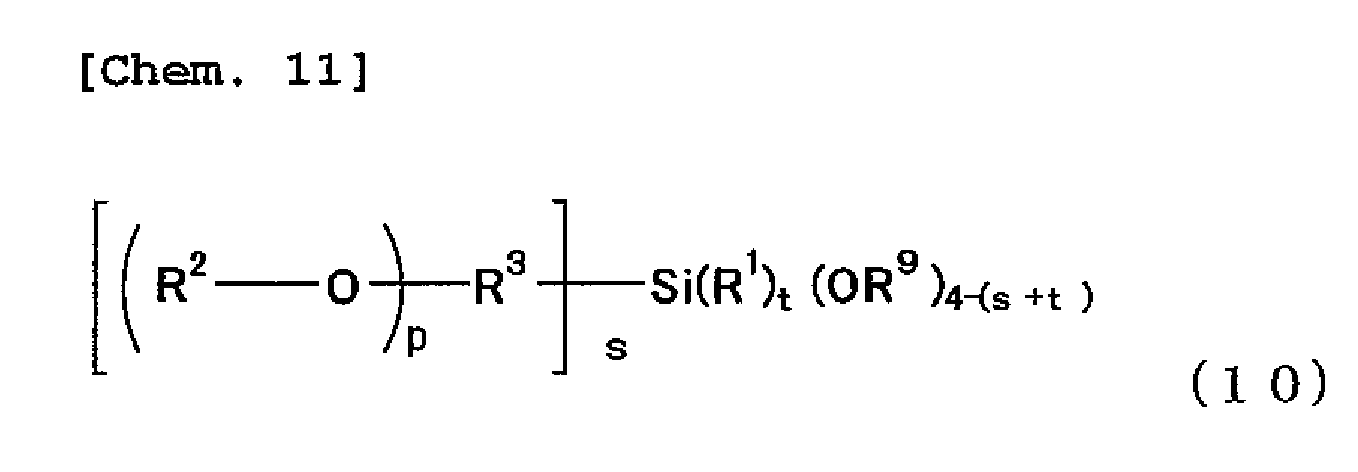
obtained by reacting the corresponding Grignard reagent or organic lithium compound, and an organic silane compound, in the presence or absence of an acid or a base, and a method of producing by reacting the cyclic siloxane represented by the general formula (9) and an alkyne compound having R2O group in the presence of Pt catalyst. - The method of producing the cyclic siloxane having the structure of the general formula (4) can use, for example, a method of hydrolyzing a nitrogen- or oxygen-containing silane compound represented by the following general formula (11)
-

in the presence or absence of an acid or a base. - The method of producing the cyclic siloxane compound having the structure of the general formula (5) can use, for example, a method of hydrolyzing a nitrogen- or oxygen-containing silane compound represented by the following general formula (12)
-
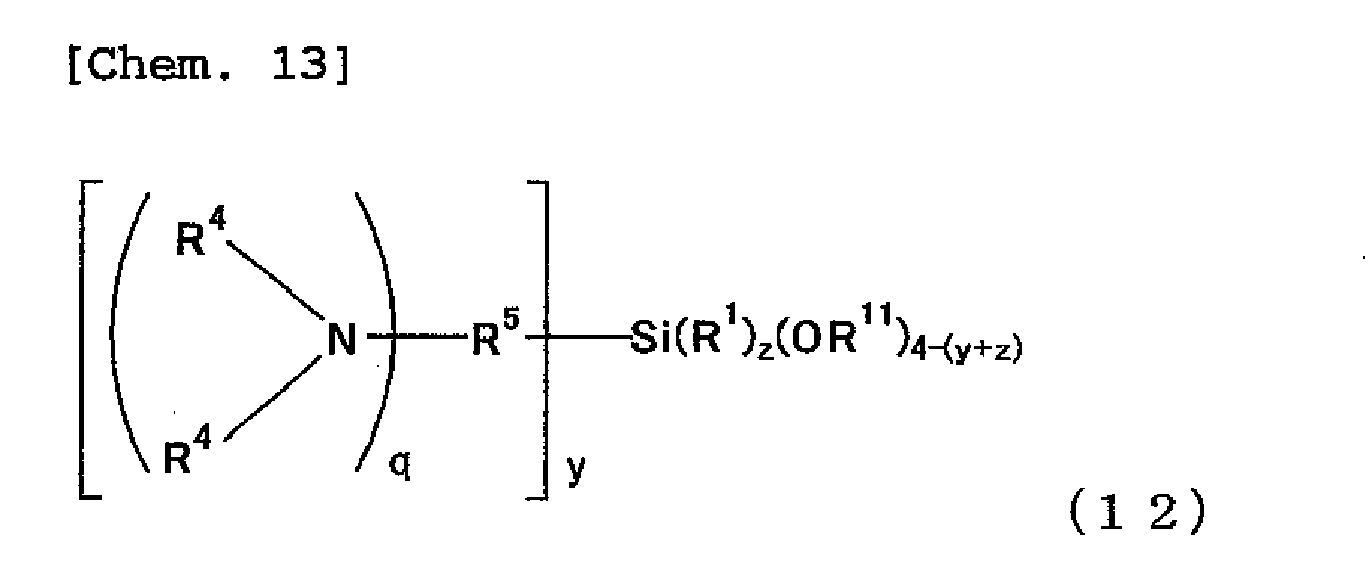
in the presence or absence of an acid or a base. - The method of producing the cyclic siloxane having the structure of the general formula (6) can use, for example, a method of hydrolyzing a boron- or oxygen-containing silane compound represented by the following general formula (13)
-

in the presence or absence of an acid or a base. - The method of producing the cyclic siloxane having the structure of the general formula (7) can use, for example, a method of hydrolyzing a boron- or oxygen-containing silane compound represented by the following general formula (14)
-

in the presence or absence of an acid or a base. - In conducting the reaction, inorganic acids such as hydrochloric acid, nitric acid and sulfuric acid, and organic acids such as toluenesulfonic acid can be used as an acid to be present. Further, in conducting the reaction, sodium hydroxide, potassium hydroxide, sodium methoxide, potassium methoxide, sodium ethoxide, potassium ethoxide, sodium tertiary butoxide, potassium tertiary butoxide or the like can be used as a base to be present.
- The Pd, Ni or Rh catalyst that can be used in reacting the cyclic siloxane compound of the general formula (9) and alcohols includes Pd(0), Ni(0) or Rh(0) catalyst supported on a high surface area activated carbon, and a heterogeneous or homogeneous catalyst represented by the following general formula (15)
- [Chem. 16]
MXeLf (15)
(In the formula, M represents Pd, Ni or Rh, X represents fluorine, chlorine, bromine and iodine, and L represents an electron donating compound. e and f are a number of 0 or more, and e+f is a number satisfying the valency of M and coordination number). - A phosphine compound, an amine compound and the like can be used as the electron donating compound represented by L in the general formula (15). Specifically, a phosphine compound represented by the following general formula (16) or general formula (17)
- [Chem. 17]
PR14 3 (16)
(In the formula, R14 is the same as defined above. R14s may be the same or different.) -

or an amine compound represented by the following general formula (18) or (19) - [Chem. 19]
NR16 3 (18)
(In the formula, R16 is the same as defined above. R16s may be the same or different.) -

can be used. - The reaction solvent that can be used in producing the cyclic siloxane compound represented by the general formula (1) is not particularly limited so far as it is used in the art of this field. Examples of the solvent that can be used include saturated hydrocarbons such as n-pentane, i-pentane, n-hexane, cyclohexane, n-heptane and n-decane; unsaturated hydrocarbons such as toluene, xylene and decene-1; ethers such as diethyl ether, dipropyl ether, tert-butyl methyl ether, dibutyl ether, cyclopentyl methyl ether and tetrahydrofuran; and alcohols such as methanol, ethanol, isopropanol, n-butanol, tert-butanol and 2-ethylhexanol. Mixed solvents of those can be used. Especially, when ethers or alcohols are used, there is the case that the cyclic siloxane compound represented by the general formula (1) having a specific molecular weight can be produced in high yield.
- The reaction temperature in producing the cyclic siloxane compound represented by the general formula (1) is in a range of from -100 to 200°C which is a temperature generally used industrially, and preferably in a range of from -85 to 150°C. Pressure condition of the reaction can be under pressure, at normal pressures or under reduced pressure.
- Purification method of the cyclic siloxane compound represented by the general formula (1) produced can use a purification method such as distillation at normal pressures or under reduced pressure, or column separation using silica, alumina or polymer gel, in order to reduce a water content which is useful to use as an insulating film material to less than 50 ppm, and the amount of impurities other than silicon, carbon, oxygen and hydrogen, such as the amount of metal impurities, to less than 10 ppb. In this case, those methods may be combined according to need.
- Where a water content, and the amount of impurities of elements other than silicon, carbon, oxygen and hydrogen, especially residue of metal impurities, in the cyclic siloxane compound represented by the general formula (1) finally obtained are high, such a compound is not suitable as an insulating film material.
- In the production, other conditions preferably follow the methods in the fields of organic synthesis and organic metal compound synthesis. Specifically, it is preferable that the production is conducted in a water-removed and deoxidized nitrogen or argon atmosphere, and water-removal operation is previously applied to a solvent used and a column filler for purification. Further, it is preferable that impurities such as metal residues and particles are removed.
- The cyclic siloxane compound represented by the general formula (1) of the present invention is used as a material for forming Si-containing film, and an Si-containing film can be produced using the same as a raw material. In this case, the film forming method is not limited, but it is preferable to conduct the method by CVD, and it is especially preferable to conduct by PECVD.
- The kind of PECVD and equipment used in this case are not particularly limited. For example, PECVD uses the method generally used in this technical field such as semiconductor production field and liquid crystal display production field.
- In the PECVD equipment, the material for forming Si-containing film of the present invention is vaporized with a vaporizer and introduced into a film formation chamber, a voltage is applied to an electrode in the film formation chamber by a high frequency power source to generate plasma, thereby forming a plasma CVD thin film on a silicon substrate or the like in the film formation chamber. In this case, a gas such as argon or helium and an oxidizing agent such as oxygen or nitrous oxide may be introduced for the purpose of generating plasma. Further, simultaneous introduction of an organic peroxide or an epoxy compound for the purpose of forming pores in a thin film is also included in the scope of the present invention. When a film is formed using the material for forming Si-containing film of the present invention by a PECVD equipment, a thin film suitable as a low dielectric constant material (Low-k material) for semiconductor device can be formed.
- The plasma generation method of PECVD equipment is not particularly limited, and inductively coupled plasma, capacitively coupled plasma, ECR plasma, microwave plasma and the like that are used in the art can be used. Inductively coupled plasma and capacitively coupled plasma are preferable. As a plasma generation source, various types such as parallel plate type and antenna type can be used, and as an inert gas supplied to a chamber of the PECVD equipment, helium, argon, krypton, neon, xenon and the like that are used in this technical field can be used.
- As one example of the PECVD equipment, a parallel plate capacitively coupled PECVD equipment is shown in
Fig. 1 . A parallel plate capacitively coupledPECVD equipment 1 shown inFig. 1 comprises a shower head upper electrode and a lower electrode capable of controlling temperature of a substrate in a PECVD equipment chamber, a vaporization equipment which vaporizes the general formula (1) and supplies to the chamber, a plasma generation equipment comprising a high frequency power source and a matching circuit, and an exhaust system comprising a vacuum pump. - Specifically, the
PECVD equipment 1 comprises aPECVD chamber 2, an upper electrode 3 having a shower head for uniformly supplying the compound of the general formula (1) in the chamber, alower electrode 4 having atemperature control device 8 for setting a thinfilm forming substrate 5 such as an Si substrate,vaporization equipment 9 to 15 for vaporizing the compound of the general formula (1), amatching circuit 6 and aRF power source 7, that are a plasma generation source, and anexhaust equipment 16 for exhausting an unreacted product and a by-product in the chamber. 17 and 18 are earth ground. - The
matching circuit 6 andRF power source 7, that are a plasma generation source are connected to the upper electrode 3, and plasma is generated by discharging. The standard of theRF power source 7 is not particularly limited, but the RF power source generally used in this technical field, having electric power of from 1W to 2,000W, and preferably from 10W to 1,000W, and a frequency of from 50 kHz to 2.5 GHz, preferably from 100 kHz to 100 MHz, and particularly preferably from 200 kHz to 50 MHz, can be used. - Control of substrate temperature is not particularly limited, but the temperature is in a range of from -90 to 1, 000°C, and preferably from 0°C to 500°C.
- The vaporization equipment comprises a
container 12 filled with thecompound 13 of the general formula (1) which is liquid at ordinary temperature and normal pressures and equipped with a dip piping and a piping 15 which pressurizes by the insert gas, a liquid flowrate control device 10 which control flow rate of thecompound 13 of the general formula (1) which is liquid, avaporizer 9 which vaporizes thecompound 13 of the general formula (1) which is liquid, a piping 14 for supplying the inert gas in the PECVD equipment chamber via the vaporizer, and a gas flowrate control equipment 11 which controls flow rate of the insert gas. The vaporization equipment is connected to the upper electrode 3 equipped with a shower head from thevaporizer 9 via piping. - As one example of the PECVD equipment, an inductive coupled remote PECVD equipment is shown in
Fig. 2 . An inductive coupledremote PECVD equipment 19 shown inFig. 2 comprises a plasma generation part wound in a coiled state around quartz at an upper portion of a PECVD equipment chamber, a temperature-controllable substrate setting part, a vaporization equipment which vaporizes the compound of the general formula (1) and supplies to the chamber, a plasma generation equipment comprising a high frequency power source and a matching circuit, and an exhaustion system comprising a vacuum pump. - Specifically, the
PECVD equipment 19 comprises aPECVD chamber 20, acoil 21 and aquartz pipe 22 that are the plasma generation part, aheater part 23 for setting a thinfilm forming substrate 24 such as an Si substrate and atemperature control device 27, avaporization equipment 28 to 35 for vaporizing the compound of the general formula (1), a matchingcircuit 25 and anRF power source 26, that are a plasma generation source, and anexhaust equipment 36 for exhausting an unreacted product and a by-product in the chamber. 37 is earth ground. - The coil around quartz as a plasma generation part is connected to the
matching circuit 25, and discharge is conducted at an antenna current magnetic field by RF current in a quartz pipe to generate plasma. Standard of theRF power source 26 is not particularly limited, but the RF power source generally used in this technical field, having electric power of from 1W to 2,000W, and preferably from 10W to 1,000W, and a frequency of from 50 kHz to 2.5 GHz, preferably from 100 kHz to 100 MHz, and particularly preferably from 200 kHz to 50 MHz, can be used. - Control of a substrate temperature is not particularly limited, but the temperature is in a range of from -90 to 1,000°C, and preferably from 0°C to 500°C.
- The vaporization equipment comprises a
container 32 filled with thecompound 33 of the general formula (1) which is liquid at ordinary temperature and normal pressures and equipped with a dip piping and a piping 35 which pressurizes by the insert gas, a liquid flowrate control device 29 which controls flow rate of thecompound 33 of the general formula (1) which is liquid, avaporizer 28 which vaporizes thecompound 33 of the general formula (1) which is liquid, a piping 34 for supplying the inert gas in the PECVD equipment chamber via the vaporizer, a gas flowrate control equipment 30 which controls flow rate of the insert gas, and ashower head 31 for uniformly supplying the inert gas and the gasifiedcompound 33 of the formula (1) in the chamber. - The compound represented by the general formula (1) is gasified using, for example, the PECVD equipment as exemplified above, and supplied in the chamber, according to need, together with the inert gas, and is formed into a film by PECVD. In this case, pressure in the chamber is not particularly limited, but is from 0.1 Pa to 10,000 Pa, and preferably from 1 Pa to 5,000 Pa.
- Thus, an Si-containing film is obtained. This film has a low dielectric constant, and depending on the conditions, a film having a dielectric constant of 2.0 or lower is obtained. Therefore, the film can be used as a low dielectric constant film. Further, the film preferably has a cyclic siloxane structure. The cyclic siloxane structure may be a residual cyclic siloxane structure in the cyclic siloxane compound represented by the general formula (1) or may be newly formed by plasma. As a result, a film having a cyclic siloxane structure is a porous film having a main pore size of 1 nm or less. Further, pores are not continuous, a metal does not diffuse in the film, and the film has high mechanical properties and high heat conduction. Therefore, the film is a thin film especially suitable as a low dielectric constant material (Low-k material) for semiconductor device. That is, it is further preferable that film formation is conducted under PECVD conditions so as not to disintegrate the cyclic siloxane structure in the cyclic siloxane compound represented by the general formula (1).
- When the above Si-containing film is subjected to heat treatment, ultraviolet irradiation treatment or electron ray treatment, a porous thin film or a thin film having improved mechanical strength can be obtained. The Si-containing film having been subjected to those treatments in combination is included in the scope of the present invention. The thin film obtained by those treatments is suitable as a low dielectric constant insulating material.
- The Si-containing films according to the present invention are all suitable as a low dielectric constant material, and those films can be used in a semiconductor device as an insulting film. In particular, those films are suitable in the production of ULSI using a multilayered interconnects.
- Of the compounds represented by the general formula (1) of the present invention, particularly the compound represented by the general formula (20) is a novel compound. Here, R18, R19, g and h are the same as defined above. Preferably, R18 is an alkyl group having from 1 to 6 carbon atoms, R19 is an alkyl group having from 1 to 6 carbon atoms, g is 3 or 4, and h is 1 or 2, and more preferably, R18 is an alkyl group having from 1 to 4 carbon atoms, and R19 is an alkyl group having from 1 to 4 carbon atoms.
- Specific examples of the compound represented by the general formula (20) include 2,4,6-triisopropyl-2,4,6-trimethyoxycyclotrisiloxane, 2,4,6-triisopropyl-2,4,6-triethyoxycyclotrisiloxane, 2,4,6-triisopropyl-2,4,6-tri-n-propoxycyclotrisiloxane, 2,4,6-triisopropyl-2,4,6-triisopropoxycyclotrisiloxane, 2,4,6-tris(methoxymethyl)-2,4,6-trimethylcyclotrisiloxane, 2,4,6,8-tetrakis(methoxymethyl)-2,4,6,8-tetramethylcyclotetrasiloxane, 2,4,6-tris(ethoxymethyl)-2,4,6-trimethylcyclotrisiloxane, 2,4,6,8-tetrakis-(ethoxymethyl)-2,4,6,8-tetramethylcyclotetrasiloxane, 2,4,6-tris(isopropoxymethyl)-2,4,6-trimethylcyclotrisiloxane, and 2,4,6,8-tetrakis(isoproxymethyl)-2,4,6,8-tetramethylcyclotetrasiloxane.
- Further examples include 2,4,6-tris(methoxyethyl)-2,4,6-trimethylcyclotrisiloxane, 2,4,6,8-tetrakis(methoxyethyl)-2,4,6,8-tetramethylcyclotetrasiloxane, 2,4,6-tris-(ethoxyethyl)-2,4,6-trimethylcyclotrisiloxane, 2,4,6,8-tetrakis(ethoxyethyl)-2,4,6,8-tetramethylcyclotetrasiloxane, 2,4,6-tris(isopropoxyethyl)-2,4,6-trimethylcyclotrisiloxane, and 2,4,6,8-tetrakis(isopropoxyethyl)-2,4,6,8-tetramethylcyclotetrasiloxane.
- The Examples are described below, but the invention is not limited by those Examples in any way. Film thickness was measured using an interferometric thin film measurement device, a product of Horiba, Ltd. Dielectric constant (k value) was measured using a mercury prober, a product of Four Dimensions Inc., and rigidity and Young's modulus were measured using a nanoindentater, a product of Hysitron Inc.
- 26.7g (2.20 mol) of metallic magnesium and 0.53 liter of dried tetrahydrofuran were charged in a 1 liter four-necked flask equipped with a dropping funnel and a stirring device under nitrogen stream, and cooled to 0°C. 187 g (1.00 mol) of 4-bromoanisole was added dropwise to the flask over 5 hours while stirring. Reaction was conducted at room temperature for 3 hours to obtain a tetrahydrofuran solution of 4-methoxyphenyl magnesium bromide. 130 g (0.952 mol) of methyl trimethoxysilane and 52.0 ml of dried tetrahydrofuran were charged in a 2 liter four-necked flask equipped with a dropping funnel and a stirring device under nitrogen stream and cooled to 0°C. 1.00 mol of the tetrahydrofuran solution of 4-methoxyphenyl magnesium bromide prepared above was added dropwise to the flask over 1 hour while stirring, and reaction was conducted at room temperature for 4 hours. After completion of the reaction, a magnesium methoxide residue by-produced was removed by filtration, and a filtrate obtained was distilled under reduced pressure to obtain 106 g (0.501 mol) of methyl(4-methoxyphenyl)dimethoxysilane as the desired product. The yield was 52.6%.
- Methyl(4-methoxyphenyl)dimethoxysilane isolated was analyzed by 1H-NMR, 13C-NMR and GC-MS, and the following results were obtained.
1H-NMR; δ0.33 ppm (s, 3H, CH 3-Si), δ3.55 ppm (s, 6H, 2CH 3-O-Si), δ3.81 ppm (s, 3H, CH 3-O-Ph), δ6.93 to 6.94 ppm (m, 2H, Ph-H), δ7.55 to 7.56 ppm (m, 2H, Ph-H)
13C-NMR; δ4.8 ppm (CH3-Si), 50.7 ppm (CH3-O-Si), 55.2 ppm (CH3-O-Ph), δ113.9 ppm (Ph), δ125.0 ppm (Ph), δ135.8 ppm (Ph), δ161.5 ppm (Ph)
GC-MS ; Mw=212, C10H16O3Si - 21.2 g (100 mmol) of methyl(4-methoxyphenyl)dimethoxysilane, 1.80 g (100 mmol) of pure water, 9.81 g (100 mmol) of sulfuric acid and 20 ml of tetrahydrofuran were charged in a 100 ml Schlenk flask, and reaction was conducted at room temperature for 1 hour under stirring. After completion of the reaction, THF and water were distilled away. An organic layer obtained was dried with a molecular sieve, and after distillation under reduced pressure, 2,4,6-tris(4-methoxyphenyl)-2,4,6-trimethylcyclotrisiloxane was obtained as the desired product. The yield was 11.3%, and the conversion of methyl(4-methoxyphenyl)dimethoxysilane was 33.8%.
- 2,4,6-Tris(4-methoxyphenyl)-2,4,6-trimethylcyclotrisiloxane isolated was analyzed by GC-MS, and the following results were obtained.
GC-MS; Mw=498, C24H30O6Si3 - 0.0141 g (0.0800 mmol) of palladium chloride and 20.5 g (640 mmol) of methanol were charged in a 50 ml Schlenk flask equipped with a stirring device and a dropping funnel and stirred. 4.81 g (20.0 mmol) of 2,4,6,8-tetramethylcyclotetrasiloxane was added dropwise from the dropping funnel at room temperature over 30 minutes. After completion of the dropwise addition, the resulting mixture was stirred at room temperature for 15 hours. After completion of the reaction, methanol was distilled away, Pd residue was filtered off with a glass filter, and 2,4,6,8-tetramethyl-2,4,6,8-tetramethoxycyclotetrasiloxane was obtained as the desired product. The yield by gas chromatography was 1.5%.
2,4,6,8-Tetramethyl-2,4,6,8-tetramethoxycyclotetrasiloxane isolated was analyzed by GC-MS, and the following results were obtained. - GC-MS; Mw=360, C8H24O8Si4
- 13.62 g (0.100 mol) of methyl trimethoxysilane and 100 ml of toluene were charged in a 200 ml Schlenk flask equipped with a stirring device and a dropping funnel and stirred, and temperature was 80°C. 1.35 g of pure water was added dropwise from the dropping funnel at 80°C over 10 minutes. After completion of the dropwise addition, the resulting mixture was stirred under reflux conditions for 2 hours. After completion of the reaction, toluene was distilled away, and 2,4,6,8-tetramethyl-2,4,6,8-tetramethoxycyclotetrasiloxane was obtained as the desired product. The yield was 4.6%, and the conversion of methyl trimethoxysilane was 13.8%.
2,4,6,8-Tetramethyl-2,4,6,8-tetramethoxycyclotetrasiloxane isolated was analyzed by GC-MS, and the following results were obtained. - GC-MS; Mw=360, C8H24O8Si4
- 96.2 g (1.6 mol) of isopropanol and 0.740 g (0.80 mmol) of chlorotris(triphenylphosphine)rhodium (I) were charged in a 200 ml Schlenk flask equipped with a stirring device and a dropping funnel and stirred. 48.1 g (0.20 mol) of 2,4,6,8-tetramethylcyclotetrasiloxane was added dropwise from the dropping funnel at room temperature over 20 minutes. After completion of the dropwise addition, the resulting mixture was stirred under isopropanol reflux conditions for 4 hours. After completion of the reaction, isopropanol was distilled away, and 2,4,6,8-tetramethyl-2,4,6,8-tetrisopropoxycyclotetrasiloxane was obtained as the desired product. The yield was 54.9%.
- 2,4,6,8-Tetramethyl-2,4,6,8-tetraisopropoxycyclotetrasiloxane isolated was analyzed by GC-MS, and the following results were obtained.
GC-MS; Mw=472, C16H40O8Si4 - 20.0 g (0.217 mol) of toluene and 2.4 g of 0.01N sulfuric acid aqueous solution were charged in a 200 ml Schlenk flask equipped with a stirring device and a dropping funnel and stirred. 20.0 g (0.133 mol) of methyl(methoxymethyl)dimethoxysilane was added dropwise from the dropping funnel at room temperature over 5 minutes. After completion of the dropwise addition, the resulting mixture was stirred at room temperature for 7 hours. After completion of the reaction, toluene was distilled away, and 2,4,6,8-tetrakis(methoxymethyl)-2,4,6,8-tetramethylcyclotetrasiloxane was obtained as the desired product. The yield was 15.3%, and the conversion of methyl-(methoxymethyl)dimethoxysilane was 61.2%.
- 2,4,6,8-Tetrakis(methoxymethyl)-2,4,6,8-tetramethylcyclotetrasiloxane isolated was analyzed by 1H-NMR, 13C-NMR and GC-MS, and the following results were obtained.
1H-NMR; δ0.17 to 0.19 ppm (m, 12H, 4CH 3-Si) δ3.04 to 3.07 ppm (m, 8H, 4CH3-O-CH 2Si) δ3.34 to 3.36 ppm (m, 12H, 4CH 3-O-CH2Si)
13C-NMR; δ-2.2 ppm (CH3-Si) δ62.9 ppm (CH3-O-CH2Si) δ65.8 ppm (CH3-O-CH2Si)
GC-MS; Mw=416, C12H32O8Si4 - 2,4,6-Tris(4-methoxyphenyl)-2,4,6-trimethylcyclotrisiloxane synthesized in Example 1 was film-formed on a silicon substrate using the capacitively coupled PECVD equipment shown in
Fig. 1 . The film formation conditions were that an argon gas as an inert gas is supplied at 10 sccm, vaporized 2,4,6-tris(4-methoxyphenyl)-2,4,6-trimethylcyclotrisiloxane was continued to supply such that a chamber inner pressure is 10 Pa, and a film is formed under the conditions that a substrate temperature is 150°C, RF power source power is 30W, and RF power source frequency is 13.56 MHz. As a result, a film formation rate was 4.3 nm/min, and dielectric constant (k value) was a value of 2.7. Mechanical properties were that rigidity is 1.3 GPa and Young's modulus is 13.9 GPa. - PECVD thin film was obtained in the same manner as in Example 6, except that 2,4,6,8-tetramethyl-2,4,6,8-tetramethoxycyclotetrasiloxane synthesized in Example 3 was used in place of 2,4,6-tris(4-methoxyphenyl)-2,4,6-trimethylcyclotrisiloxane. As a result, a film formation rate was 12.8 nm/min, and dielectric constant (k value) was a value of 2.6. Mechanical properties were that rigidity is 1.36 GPa and Young's modulus is 15.2 GPa.
- PECVD thin film was obtained in the same manner as in Example 6, except that 2,4,6,8-tetramethyl-2,4,6,8-tetraisopropoxycyclotetrasiloxane synthesized in Example 4 was used in place of 2,4,6-tris(4-methoxyphenyl)-2,4,6-trimethylcyclotrisiloxane. As a result, a film formation rate was 11.2 nm/min, and dielectric constant (k value) was a value of 2.4. Mechanical properties were that rigidity is 1.1 GPa and Young's modulus is 17.1 GPa.
- PECVD thin film was obtained in the same manner as in Example 6, except that 2,4,6,8-tetrakis(methoxymethyl)-2,4,6,8-tetramethylcyclotetrasiloxane synthesized in Example 5 was used in place of 2,4,6-tris(4-methoxyphenyl)-2,4,6-trimethylcyclotrisiloxane. As a result, a film formation rate was 6.8 nm/min, and dielectric constant (k value) was a value of 1.8. Mechanical properties were that rigidity is 1.6 GPa and Young's modulus is 22.1 GPa.
- PECVD thin film was obtained in the same manner as in Example 6, except that 2,4,6,8-tetramethylcyclotetrasiloxane was used in place of 2,4,6-tris(4-methoxyphenyl)-2,4,6-trimethylcyclotrisiloxane. As a result, a film formation rate was 10.4 nm/min, and dielectric constant (k value) was a value of 2.9. Mechanical properties were that rigidity is 1.1 GPa and Young's modulus is 10.7 GPa.
- While the invention has been described in detail and with reference to specific embodiments thereof, it will be apparent to one skilled in the art that various changes and modifications can be made therein without departing from the spirit and scope thereof.
This application is based on Japanese Patent Application (Patent Application No.2005-023256 2005-349432 - The present invention can provide a novel material for forming Si-containing film, especially a material for a low dielectric constant insulating film containing a cyclic siloxane compound suitable to PECVD equipment, and further provide an Si-containing film using the same and a semiconductor device containing those films.
Claims (20)
- A material for forming Si-containing film, characterized by containing a cyclic siloxane compound represented by the following general formula (1):

A represents an alkoxyalkyl group,
R1 represents a hydrogen atom or a hydrocarbon group,
n is 1 or 2, and
x is an integer of from 2 to 10. - A material for forming Si-containing film, characterized by containing a cyclic siloxane compound represented by the following general formula (1)

A represents an alkoxyaryl group,
R1 represents a hydrogen atom or a hydrocarbon group,
n is 1 or 2, and
x is an integer of from 2 to 10. - A material for forming Si-containing film, characterized by containing a
cyclic siloxane compound represented by the following general formula (1)
A represents a silanoxy group,
R1 represents a hydrogen atom or a hydrocarbon group,
n is 1 or 2, and
x is an integer of from 2 to 10. - A material for forming Si-containing film, characterized by containing a cyclic siloxane compound represented by the following general formula (1)

A represents a group containing at least one selected from the group consisting of a boron atom and a nitrogen atom,
R1 represents a hydrogen atom or a hydrocarbon group,
n is 1 or 2, and
x is an integer of from 2 to 10. - The material for forming Si-containing film as claimed in claim 4, characterized in that A in the cyclic siloxane compound represented by the general formula (1) is an alkylamino group, a dialkylamino group, an arylamino group or a diarylamino group.
- The material for forming Si-containing film as claimed in claim 4, characterized in that A in the cyclic siloxane compound represented by the general formula (1) is an alkylboron group or an alkoxyboron group.
- The material for forming Si-containing film as claimed in any one of claims 1 to 6, characterized in that n in the cyclic siloxane compound represented by the general formula (1) is 1, and R1 is an alkyl group having from 1 to 6 carbon atoms.
- The material for forming Si-containing film as claimed in any one of claims 1 to 7, characterized in that x in the cyclic siloxane compound represented by the general formula (1) is from 3 to 4.
- The material for forming Si-containing film as claimed in any one of claims 1 to 8, characterized in that the molecular weight of the cyclic siloxane compound represented by the general formula (1) is less than 1,000.
- The material for forming Si-containing film as claimed in any one of claims 1 to 9, characterized in that an amount of impurities other than silicon, carbon, oxygen, hydrogen, nitrogen and boron is less than 10 ppb, and a water content is less than 50 ppm.
- A production method of an Si-containing film, characterized by using the material for forming Si-containing film as claimed in any one of claims 1 to 10 as a raw material.
- The production method as claimed in claim 11, characterized in that film formation is conducted by a chemical vapor deposition.
- The production method as claimed in claim 12, characterized in that the chemical vapor deposition is a plasma enhanced chemical vapor deposition.
- An Si-containing film, characterized by being obtained by the production method as claimed in any one of claims 11 to 13.
- The Si-containing film as claimed in claim 14, characterized by containing a cyclic siloxane structure in the cyclic siloxane compound represented by the general formula (1).
- A production method of an Si-containing film, characterized by subjecting the Si-containing film as claimed in claim 14 or 15 to heat treatment, ultraviolet irradiation treatment or electron ray treatment.
- An Si-containing film, characterized by being obtained by the production method as claimed in claim 16.
- A semiconductor device, characterized by using the film as claimed in claim 14, 15 or 17 as an insulating film.
- A cyclic siloxane compound, characterized by being represented by the following general formula (20)

R18 represents a hydrocarbon atom,
R19 represents a hydrogen atom or a hydrocarbon group,
g is an integer of from 2 to 10, and
h is an integer of from 1 to 3. - The cyclic siloxane compound as claimed in claim 19, characterized in that the compound represented by the general formula (20) is 2,4,6-tris(methoxymethyl)-2,4,6-trimethylcyclotrisiloxane, 2,4,6,8-tetrakis(methoxymethyl)-2,4,6,8-tetramethylcyclotetrasiloxane, 2,4,6-tris(ethoxymethyl)-2,4,6-trimethylcyclotrisiloxane, 2,4,6,8-tetrakis(ethoxymethyl)-2,4,6,8-tetramethylcyclotetrasiloxane, 2,4,6-tris(isopropoxymethyl)-2,4,6-trimethylcyclotrisiloxane, 2,4,6,8-tetrakis(isopropoxymethyl)-2,4,6,8-tetramethylcyclotetrasiloxane, 2,4,6-tris(methoxyethyl)-2,4,6-trimethylcyclotrisiloxane, 2,4,6,8-tetrakis(methoxyethyl)-2,4,6,8-tetramethylcyclotetrasiloxane, 2,4,6-tris(ethoxyethyl)-2,4,6-trimethylcyclotrisiloxane, 2,4,6,8-tetrakis(ethoxyethyl)-2,4,6,8-tetramethylcyclotetrasiloxane, 2,4,6-tris(isopropoxyethyl)-2,4,6-trimethylcyclotrisiloxane or 2,4,6,8-tetrakis(isopropoxyethyl)-2,4,6,8-tetramethylcyclotetrasiloxane.
Applications Claiming Priority (2)
| Application Number | Priority Date | Filing Date | Title |
|---|---|---|---|
| JP2005023256 | 2005-01-31 | ||
| EP06711799A EP1845100A4 (en) | 2005-01-31 | 2006-01-17 | CYCLIC SILOXANE COMPOUND, FILMOGENIC MATERIAL CONTAINING SILICON AND USE THEREOF |
Related Parent Applications (1)
| Application Number | Title | Priority Date | Filing Date |
|---|---|---|---|
| EP06711799.4 Division | 2006-01-17 |
Publications (3)
| Publication Number | Publication Date |
|---|---|
| EP2256123A2 true EP2256123A2 (en) | 2010-12-01 |
| EP2256123A3 EP2256123A3 (en) | 2011-06-08 |
| EP2256123B1 EP2256123B1 (en) | 2013-08-14 |
Family
ID=36740239
Family Applications (2)
| Application Number | Title | Priority Date | Filing Date |
|---|---|---|---|
| EP10176573.3A Expired - Lifetime EP2256123B1 (en) | 2005-01-31 | 2006-01-17 | Cyclic siloxane compound, a material for forming Si-containing film, and its use |
| EP06711799A Withdrawn EP1845100A4 (en) | 2005-01-31 | 2006-01-17 | CYCLIC SILOXANE COMPOUND, FILMOGENIC MATERIAL CONTAINING SILICON AND USE THEREOF |
Family Applications After (1)
| Application Number | Title | Priority Date | Filing Date |
|---|---|---|---|
| EP06711799A Withdrawn EP1845100A4 (en) | 2005-01-31 | 2006-01-17 | CYCLIC SILOXANE COMPOUND, FILMOGENIC MATERIAL CONTAINING SILICON AND USE THEREOF |
Country Status (6)
| Country | Link |
|---|---|
| EP (2) | EP2256123B1 (en) |
| JP (1) | JP5353845B2 (en) |
| KR (1) | KR101237354B1 (en) |
| CN (1) | CN101111501B (en) |
| TW (1) | TWI380989B (en) |
| WO (1) | WO2006080205A1 (en) |
Families Citing this family (9)
| Publication number | Priority date | Publication date | Assignee | Title |
|---|---|---|---|---|
| US8513448B2 (en) | 2005-01-31 | 2013-08-20 | Tosoh Corporation | Cyclic siloxane compound, a material for forming Si-containing film, and its use |
| FR2887891B1 (en) * | 2005-07-01 | 2007-09-21 | Commissariat Energie Atomique | POLYSILOXANE - BASED MATERIAL WITH LOW HYSTERESIS AND METHOD OF DEPOSITING SUCH MATERIAL. |
| TW200844107A (en) * | 2006-11-01 | 2008-11-16 | Showa Denko Kk | Cyclic siloxane compound, organic electroluminescent element, and use thereof |
| EP2122007A4 (en) * | 2007-02-27 | 2011-10-26 | Sixtron Advanced Materials Inc | Method for forming a film on a substrate |
| CN104392957A (en) * | 2014-10-30 | 2015-03-04 | 苏州大学 | Preparation method for low dielectric constant thin-film layer |
| KR102577687B1 (en) * | 2018-04-17 | 2023-09-12 | 젤리스트 인코퍼레이티드 | Cyclotrisiloxane substituted with alkyl ether and method for producing the same |
| KR102373339B1 (en) * | 2018-08-10 | 2022-03-10 | 버슘머트리얼즈 유에스, 엘엘씨 | Silicon compound and method for depositing film using same |
| WO2021201910A1 (en) * | 2020-04-02 | 2021-10-07 | Versum Materials Us, Llc | Organoamino-functionalized cyclic oligosiloxanes for deposition of silicon-containing films |
| US20230279030A1 (en) * | 2020-07-24 | 2023-09-07 | Versum Materials Us, Llc | Cyclosiloxanes and films made therewith |
Citations (9)
| Publication number | Priority date | Publication date | Assignee | Title |
|---|---|---|---|---|
| JPH05279856A (en) | 1992-03-31 | 1993-10-26 | Nec Corp | Vapor growth method |
| JPH06177123A (en) | 1990-07-19 | 1994-06-24 | American Teleph & Telegr Co <Att> | Insulator deposition method |
| JPH11288931A (en) | 1998-02-05 | 1999-10-19 | Nippon Asm Kk | Insulating film and method of manufacturing the same |
| JP2000302791A (en) | 1999-04-20 | 2000-10-31 | Fujitsu Ltd | Silicon compound, insulating film forming material and semiconductor device |
| JP2001298023A (en) | 2000-01-18 | 2001-10-26 | Applied Materials Inc | Very low dielectric constant plasma enhanced CVD films |
| JP2002110670A (en) | 2000-04-19 | 2002-04-12 | Applied Materials Inc | Method for depositing low dielectric constant film using oxidizing plasma |
| WO2003019645A1 (en) | 2001-08-30 | 2003-03-06 | Tokyo Electron Limited | Method and apparatus for forming film |
| JP2004047873A (en) | 2002-07-15 | 2004-02-12 | Nec Corp | Organosiloxane copolymer film, method for producing the same, growth apparatus, and semiconductor device using the copolymer film |
| JP2005019980A (en) | 2003-05-29 | 2005-01-20 | Air Products & Chemicals Inc | Method for producing low dielectric constant organosilicate glass film |
Family Cites Families (19)
| Publication number | Priority date | Publication date | Assignee | Title |
|---|---|---|---|---|
| US3132117A (en) * | 1960-10-31 | 1964-05-05 | Gen Electric | Trifluoroalkoxyalkyl substituted organosilicon compounds |
| FR1437889A (en) * | 1964-07-29 | 1966-05-06 | Thomson Houston Comp Francaise | New cyclic polysiloxanes |
| US3876677A (en) * | 1974-06-06 | 1975-04-08 | Gen Electric | Cyclotri-siloxanes containing silicon-bonded fluoroalkoxyalkyl groups |
| FR2554649B1 (en) * | 1983-11-09 | 1986-01-24 | Saunier Duval | ELECTRICAL OR ELECTRONIC EQUIPMENT CABINET |
| JPH062821B2 (en) * | 1989-11-28 | 1994-01-12 | 信越化学工業株式会社 | Method for producing epoxy group-containing silicone elastomer fine powder and fine powder produced by the method |
| US5378790A (en) * | 1992-09-16 | 1995-01-03 | E. I. Du Pont De Nemours & Co. | Single component inorganic/organic network materials and precursors thereof |
| JP3580403B2 (en) * | 1997-06-11 | 2004-10-20 | 鐘淵化学工業株式会社 | Method for producing cyclic oligosiloxane |
| WO1998056795A1 (en) * | 1997-06-11 | 1998-12-17 | Kaneka Corporation | Process for preparing cyclic oligosiloxanes |
| JP2001291713A (en) * | 2000-04-07 | 2001-10-19 | Canon Sales Co Inc | Film forming method and semiconductor device |
| KR100432152B1 (en) * | 2001-04-12 | 2004-05-17 | 한국화학연구원 | Porogens with polyalkylene oxide multiarms and low dielectric films using them |
| JP4906207B2 (en) * | 2001-09-28 | 2012-03-28 | 東レ・ダウコーニング株式会社 | Method for producing polyorganosiloxane using solid acidic zirconia oxide catalyst |
| US7129311B2 (en) * | 2002-09-18 | 2006-10-31 | Arch Specialty Chemicals, Inc. | Additives to prevent degradation of alkyl-hydrogen siloxanes |
| JP2004161877A (en) * | 2002-11-13 | 2004-06-10 | Shin Etsu Chem Co Ltd | Composition for forming porous film, porous film and manufacturing method thereof, interlayer insulating film, and semiconductor device |
| TWI282124B (en) * | 2002-11-28 | 2007-06-01 | Tosoh Corp | Insulating film material containing an organic silane compound, its production method and semiconductor device |
| JP4465233B2 (en) * | 2003-06-30 | 2010-05-19 | 三星電子株式会社 | Polyfunctional cyclic siloxane compound, siloxane-based polymer produced from this compound, and method for producing insulating film using this polymer |
| KR100979355B1 (en) * | 2003-10-09 | 2010-08-31 | 삼성전자주식회사 | Polyreactive cyclic silicate compound, siloxane-based polymer prepared from the compound and insulating film production method using the polymer |
| KR101007807B1 (en) * | 2003-12-13 | 2011-01-14 | 삼성전자주식회사 | Polyreactive linear siloxane compound, a siloxane polymer prepared from the compound and a method for producing an insulating film using the polymer |
| JP2005294333A (en) * | 2004-03-31 | 2005-10-20 | Semiconductor Process Laboratory Co Ltd | Film forming method and semiconductor device |
| US20060199935A1 (en) * | 2005-03-02 | 2006-09-07 | Fuji Photo Film Co., Ltd. | Composition, insulating film and process for producing the same |
-
2006
- 2006-01-17 KR KR1020077019050A patent/KR101237354B1/en not_active Expired - Fee Related
- 2006-01-17 WO PCT/JP2006/300519 patent/WO2006080205A1/en not_active Ceased
- 2006-01-17 CN CN200680003726.4A patent/CN101111501B/en not_active Expired - Fee Related
- 2006-01-17 EP EP10176573.3A patent/EP2256123B1/en not_active Expired - Lifetime
- 2006-01-17 EP EP06711799A patent/EP1845100A4/en not_active Withdrawn
- 2006-01-27 TW TW095103485A patent/TWI380989B/en not_active IP Right Cessation
-
2010
- 2010-09-15 JP JP2010207028A patent/JP5353845B2/en not_active Expired - Fee Related
Patent Citations (9)
| Publication number | Priority date | Publication date | Assignee | Title |
|---|---|---|---|---|
| JPH06177123A (en) | 1990-07-19 | 1994-06-24 | American Teleph & Telegr Co <Att> | Insulator deposition method |
| JPH05279856A (en) | 1992-03-31 | 1993-10-26 | Nec Corp | Vapor growth method |
| JPH11288931A (en) | 1998-02-05 | 1999-10-19 | Nippon Asm Kk | Insulating film and method of manufacturing the same |
| JP2000302791A (en) | 1999-04-20 | 2000-10-31 | Fujitsu Ltd | Silicon compound, insulating film forming material and semiconductor device |
| JP2001298023A (en) | 2000-01-18 | 2001-10-26 | Applied Materials Inc | Very low dielectric constant plasma enhanced CVD films |
| JP2002110670A (en) | 2000-04-19 | 2002-04-12 | Applied Materials Inc | Method for depositing low dielectric constant film using oxidizing plasma |
| WO2003019645A1 (en) | 2001-08-30 | 2003-03-06 | Tokyo Electron Limited | Method and apparatus for forming film |
| JP2004047873A (en) | 2002-07-15 | 2004-02-12 | Nec Corp | Organosiloxane copolymer film, method for producing the same, growth apparatus, and semiconductor device using the copolymer film |
| JP2005019980A (en) | 2003-05-29 | 2005-01-20 | Air Products & Chemicals Inc | Method for producing low dielectric constant organosilicate glass film |
Also Published As
| Publication number | Publication date |
|---|---|
| CN101111501A (en) | 2008-01-23 |
| WO2006080205A1 (en) | 2006-08-03 |
| EP2256123B1 (en) | 2013-08-14 |
| EP2256123A3 (en) | 2011-06-08 |
| KR20070097583A (en) | 2007-10-04 |
| JP5353845B2 (en) | 2013-11-27 |
| JP2011006473A (en) | 2011-01-13 |
| TWI380989B (en) | 2013-01-01 |
| EP1845100A4 (en) | 2010-06-02 |
| CN101111501B (en) | 2015-07-15 |
| KR101237354B1 (en) | 2013-02-28 |
| EP1845100A1 (en) | 2007-10-17 |
| TW200640937A (en) | 2006-12-01 |
Similar Documents
| Publication | Publication Date | Title |
|---|---|---|
| JP5353845B2 (en) | Cyclic siloxane compound | |
| US6440876B1 (en) | Low-K dielectric constant CVD precursors formed of cyclic siloxanes having in-ring SI—O—C, and uses thereof | |
| JP4918190B2 (en) | Very low dielectric constant plasma enhanced CVD film | |
| WO2005098925A1 (en) | Techniques promoting adhesion of porous low k film to underlying barrier layer | |
| US8513448B2 (en) | Cyclic siloxane compound, a material for forming Si-containing film, and its use | |
| CN102770580A (en) | Ultra-low dielectric materials formed by plasma-enhanced chemical vapor deposition using hybrid precursors containing organofunctional silicon | |
| JP2009179640A (en) | Organosiloxane compound | |
| JP6079842B2 (en) | Carbon-containing silicon oxide film, sealing film and use thereof | |
| EP2163664A1 (en) | Method for depositing si-containing film, insulator film, and semiconductor device | |
| JP4333480B2 (en) | Si-containing film forming material and use thereof | |
| JP5019742B2 (en) | Cyclic siloxane compound, Si-containing film forming material, and use thereof | |
| JP4678304B2 (en) | Method for manufacturing silicon oxide film | |
| JP6007662B2 (en) | Film forming material, sealing film using the same, and use thereof | |
| JP4957037B2 (en) | Organosilane compound, Si-containing film-forming material containing the same, production method and use | |
| JP4341560B2 (en) | Si-containing film forming material, Si-containing film, method for producing Si-containing film, and semiconductor device | |
| JP5040162B2 (en) | Si-containing film forming material comprising alkenyl group-containing organosilane compound and use thereof | |
| JP4618086B2 (en) | Si-containing film and manufacturing method thereof | |
| JP2011116758A (en) | ORGANOSILANE COMPOUND, METHOD FOR PRODUCING THE SAME, Si-CONTAINING FILM-FORMING MATERIAL CONTAINING THE SAME AND METHOD FOR FORMING FILM | |
| KR20250091848A (en) | Precursor for forming silicon-containing thin film with high hardness and low dielectric constant and manufacfuring method for silicon-containing thin film using thereof | |
| CN121285651A (en) | Precursor for forming low dielectric constant silicon-containing film and method for forming low dielectric constant silicon-containing film using the same | |
| JP2012201658A (en) | Film-forming material, method of producing film using the same, and application thereof |
Legal Events
| Date | Code | Title | Description |
|---|---|---|---|
| PUAI | Public reference made under article 153(3) epc to a published international application that has entered the european phase |
Free format text: ORIGINAL CODE: 0009012 |
|
| 17P | Request for examination filed |
Effective date: 20100914 |
|
| AC | Divisional application: reference to earlier application |
Ref document number: 1845100 Country of ref document: EP Kind code of ref document: P |
|
| AK | Designated contracting states |
Kind code of ref document: A2 Designated state(s): DE FR GB IT NL |
|
| PUAL | Search report despatched |
Free format text: ORIGINAL CODE: 0009013 |
|
| AK | Designated contracting states |
Kind code of ref document: A3 Designated state(s): DE FR GB IT NL |
|
| 17Q | First examination report despatched |
Effective date: 20111109 |
|
| GRAP | Despatch of communication of intention to grant a patent |
Free format text: ORIGINAL CODE: EPIDOSNIGR1 |
|
| GRAP | Despatch of communication of intention to grant a patent |
Free format text: ORIGINAL CODE: EPIDOSNIGR1 |
|
| INTG | Intention to grant announced |
Effective date: 20130426 |
|
| GRAS | Grant fee paid |
Free format text: ORIGINAL CODE: EPIDOSNIGR3 |
|
| GRAA | (expected) grant |
Free format text: ORIGINAL CODE: 0009210 |
|
| AC | Divisional application: reference to earlier application |
Ref document number: 1845100 Country of ref document: EP Kind code of ref document: P |
|
| AK | Designated contracting states |
Kind code of ref document: B1 Designated state(s): DE FR GB IT NL |
|
| REG | Reference to a national code |
Ref country code: GB Ref legal event code: FG4D |
|
| REG | Reference to a national code |
Ref country code: NL Ref legal event code: T3 |
|
| REG | Reference to a national code |
Ref country code: DE Ref legal event code: R096 Ref document number: 602006037916 Country of ref document: DE Effective date: 20131010 |
|
| PLBE | No opposition filed within time limit |
Free format text: ORIGINAL CODE: 0009261 |
|
| STAA | Information on the status of an ep patent application or granted ep patent |
Free format text: STATUS: NO OPPOSITION FILED WITHIN TIME LIMIT |
|
| 26N | No opposition filed |
Effective date: 20140515 |
|
| REG | Reference to a national code |
Ref country code: DE Ref legal event code: R097 Ref document number: 602006037916 Country of ref document: DE Effective date: 20140515 |
|
| REG | Reference to a national code |
Ref country code: FR Ref legal event code: PLFP Year of fee payment: 11 |
|
| PGFP | Annual fee paid to national office [announced via postgrant information from national office to epo] |
Ref country code: NL Payment date: 20151210 Year of fee payment: 11 Ref country code: FR Payment date: 20151208 Year of fee payment: 11 |
|
| PGFP | Annual fee paid to national office [announced via postgrant information from national office to epo] |
Ref country code: DE Payment date: 20160112 Year of fee payment: 11 Ref country code: IT Payment date: 20160127 Year of fee payment: 11 |
|
| PGFP | Annual fee paid to national office [announced via postgrant information from national office to epo] |
Ref country code: GB Payment date: 20160113 Year of fee payment: 11 |
|
| REG | Reference to a national code |
Ref country code: DE Ref legal event code: R119 Ref document number: 602006037916 Country of ref document: DE |
|
| REG | Reference to a national code |
Ref country code: NL Ref legal event code: MM Effective date: 20170201 |
|
| GBPC | Gb: european patent ceased through non-payment of renewal fee |
Effective date: 20170117 |
|
| REG | Reference to a national code |
Ref country code: FR Ref legal event code: ST Effective date: 20170929 |
|
| PG25 | Lapsed in a contracting state [announced via postgrant information from national office to epo] |
Ref country code: FR Free format text: LAPSE BECAUSE OF NON-PAYMENT OF DUE FEES Effective date: 20170131 |
|
| PG25 | Lapsed in a contracting state [announced via postgrant information from national office to epo] |
Ref country code: GB Free format text: LAPSE BECAUSE OF NON-PAYMENT OF DUE FEES Effective date: 20170117 Ref country code: DE Free format text: LAPSE BECAUSE OF NON-PAYMENT OF DUE FEES Effective date: 20170801 Ref country code: NL Free format text: LAPSE BECAUSE OF NON-PAYMENT OF DUE FEES Effective date: 20170201 |
|
| PG25 | Lapsed in a contracting state [announced via postgrant information from national office to epo] |
Ref country code: IT Free format text: LAPSE BECAUSE OF NON-PAYMENT OF DUE FEES Effective date: 20170117 |
|
| P01 | Opt-out of the competence of the unified patent court (upc) registered |
Effective date: 20230523 |