EP2256177B1 - Scintillateur pour la détection de neutrons et détecteur de neutrons - Google Patents
Scintillateur pour la détection de neutrons et détecteur de neutrons Download PDFInfo
- Publication number
- EP2256177B1 EP2256177B1 EP09725054.2A EP09725054A EP2256177B1 EP 2256177 B1 EP2256177 B1 EP 2256177B1 EP 09725054 A EP09725054 A EP 09725054A EP 2256177 B1 EP2256177 B1 EP 2256177B1
- Authority
- EP
- European Patent Office
- Prior art keywords
- scintillator
- neutron
- lanthanoid
- neutron detection
- crystal
- Prior art date
- Legal status (The legal status is an assumption and is not a legal conclusion. Google has not performed a legal analysis and makes no representation as to the accuracy of the status listed.)
- Not-in-force
Links
Images

Classifications
-
- C—CHEMISTRY; METALLURGY
- C09—DYES; PAINTS; POLISHES; NATURAL RESINS; ADHESIVES; COMPOSITIONS NOT OTHERWISE PROVIDED FOR; APPLICATIONS OF MATERIALS NOT OTHERWISE PROVIDED FOR
- C09K—MATERIALS FOR MISCELLANEOUS APPLICATIONS, NOT PROVIDED FOR ELSEWHERE
- C09K11/00—Luminescent materials, e.g. electroluminescent or chemiluminescent
- C09K11/08—Luminescent materials, e.g. electroluminescent or chemiluminescent containing inorganic luminescent materials
-
- G—PHYSICS
- G01—MEASURING; TESTING
- G01T—MEASUREMENT OF NUCLEAR OR X-RADIATION
- G01T3/00—Measuring neutron radiation
- G01T3/06—Measuring neutron radiation with scintillation detectors
-
- C—CHEMISTRY; METALLURGY
- C09—DYES; PAINTS; POLISHES; NATURAL RESINS; ADHESIVES; COMPOSITIONS NOT OTHERWISE PROVIDED FOR; APPLICATIONS OF MATERIALS NOT OTHERWISE PROVIDED FOR
- C09K—MATERIALS FOR MISCELLANEOUS APPLICATIONS, NOT PROVIDED FOR ELSEWHERE
- C09K11/00—Luminescent materials, e.g. electroluminescent or chemiluminescent
- C09K11/08—Luminescent materials, e.g. electroluminescent or chemiluminescent containing inorganic luminescent materials
- C09K11/64—Luminescent materials, e.g. electroluminescent or chemiluminescent containing inorganic luminescent materials containing aluminium
- C09K11/644—Halogenides
- C09K11/645—Halogenides with alkali or alkaline earth metals
-
- G—PHYSICS
- G21—NUCLEAR PHYSICS; NUCLEAR ENGINEERING
- G21K—HANDLING OF PARTICLES OR IONISING RADIATION NOT OTHERWISE PROVIDED FOR; IRRADIATION DEVICES; GAMMA RAY OR X-RAY MICROSCOPES
- G21K4/00—Conversion screens for the conversion of the spatial distribution of X-rays or particle radiation into visible images, e.g. fluoroscopic screens
Definitions
- This invention relates to a scintillator for neutron detection which is used for detecting neutrons. More particularly, the invention relates to a scintillator for neutron detection which is composed of a metal fluoride crystal containing a lanthanoid.
- a scintillator is a substance which, when hit by radiation such as ⁇ rays, ⁇ rays, ⁇ rays, X-rays, or neutron rays, absorbs the radiation to emit fluorescence.
- the scintillator is used for radiation detection in combination with a photodetector, such as a photomultiplier tube, and has wide varieties of application fields such as the medical field, for example, tomography, the industrial field, for example, nondestructive inspection, the security field, for example, inspection of personal belongings, and the scientific field, for example, high energy physics.
- scintillators are various types of scintillators available according to the types of radiation and the purposes of use. They include inorganic crystals such as Bi 4 Ge 3 O 12 , Gd 2 SiO 5 :Ce, PbWO 4 , CsI, and KI, organic crystals such as anthracene, fluorescent substance-containing polymers such as polystyrene and polyvinyltoluene, and special scintillators including liquid scintillators and gas scintillators.
- inorganic crystals such as Bi 4 Ge 3 O 12 , Gd 2 SiO 5 :Ce, PbWO 4 , CsI, and KI
- organic crystals such as anthracene
- fluorescent substance-containing polymers such as polystyrene and polyvinyltoluene
- special scintillators including liquid scintillators and gas scintillators.
- Typical characteristics demanded of the scintillator include a large quantity of light (light emission intensity), high stopping power for radiation (detection efficiency), and fast decay of fluorescence (fast response).
- the scintillator designed to detect neutrons in particular, needs to have the ability to discriminate between neutrons and the ⁇ rays, because a radiation capture reaction tends to occur between neutrons and the absorbing substance, generating ⁇ rays.
- a 6 Li glass scintillator has so far been used as a scintillator for neutron detection.
- its manufacturing process has been very difficult and thus expensive, and there has been a limit to its upsizing.
- a scintillator for neutron detection comprising a fluoride crystal, on the other hand, is advantageous in that an upsized scintillator can be produced at a low cost.
- a scintillator comprising a lithium barium fluoride crystal has been proposed.
- this scintillator has high sensitivity to ⁇ rays, and its background noise attributed to ⁇ rays has been great.
- there has been need to take a complicated technique in using it as a scintillator for neutron detection see Non-Patent Document 1).
- Non-Patent Document 2 The 6 Li content (to be described later) in the crystals used in the above-mentioned publicly known technologies has only been of the order of 0.73 atom/nm 3 , and the inventors themselves have confirmed that such a content results in the insufficient efficiency of neutron detection.
- a material comprising a substance which absorbs the incident neutrons to emit fluorescence is called a scintillator for neutron detection.
- Non-Patent Document 1 C.W.E. van Eijik et al., "LiBaF3, a thermal neutron scintillator with optimal n-gamma discrimination", Nuclear Instruments and Methods in Physics Research A 374 (1996) 197-201 .
- Non-Patent Document 2 Kentaro Fukuda, Kenji Aoki, Akira Yoshikawa and Tsuguo Fukuda, Abstracts of Lectures at the 66th Congress of the Japan Society of Applied Physics, No. 1, 211 (2005 )
- the present invention provides a scintillator for neutron detection which has high sensitivity to neutron rays, is reduced in background noise attributed to ⁇ rays, that is, has low sensitivity to ⁇ rays, and is thus preferably adopted in a scintillation detector for neutrons.
- the inventors have prepared various metal fluoride crystals, and have evaluated their performance as scintillators for neutron detection by neutron irradiation experiments. As a result, the inventors have found that metal fluoride crystals having a 6 Li content and an effective atomic number in specific ranges can become high performance scintillators for neutron detection which have high sensitivity to neutron rays, and are reduced in a background noise attributed to ⁇ rays. This finding has led the inventors to accomplish the present invention.
- a scintillator for neutron detection comprising a metal fluoride crystal containing lithium, a metallic element having a valence of 2 or higher, and fluorine as constituent elements, the metal fluoride crystal containing 1.1 to 20 atoms per unit volume (atoms/nm 3 ) of 6 Li, having an effective atomic number of 10 to 40, and containing a lanthanoid.
- a neutron detector comprising the scintillator for neutron detection, and a photodetector which detects light emitted from the scintillator for neutron detection and converts the light into an electrical signal.
- the photodetector is preferably a photomultiplier tube.
- a method for producing a metal fluoride crystal for a scintillator for neutron detection comprising: melting a material mixture, composed of lithium fluoride having a 6 Li isotopic ratio of 20% or more, a fluoride of a metallic element having a valence of 2 or higher, and a fluoride of a lanthanoid, to form a material melt; and growing a single crystal from the material melt by the melt growth method.
- the above method for production is preferably adopted for the production of a lanthanoid-containing lithium calcium aluminum fluoride (M:LiCaAlF 6 (M is a lanthanoid) crystal or a lanthanoid-containing lithium yttrium fluoride (M:LiYF 4 (M is a lanthanoid) crystal.
- the scintillator of the present invention has high sensitivity to neutron rays, and is able to suppress background noise attributed to ⁇ rays. Moreover, the scintillator is highly transparent for the emitted light (scintillation light) to pass. Such a scintillator is useful as a scintillator for neutron detection, and can be used preferably in the industrial field, such as various nondestructive inspections, and the security field, such as inspection of personal belongings.
- the scintillator for neutron detection comprises a metal fluoride crystal containing lithium, a metallic element having a valence of 2 or higher, and fluorine, the metal fluoride crystal also containing a lanthanoid.
- the metal fluoride crystal is a lithium-containing metal fluoride crystal characterized maximally by having a specific 6 Li content and a specific effective atomic number, and containing a lanthanoid.
- the term "metal fluoride crystal” refers to a crystal containing all of the above-mentioned components
- matrix metal fluoride crystal refers to a crystal comprising components other than the lanthanoid.
- the above-mentioned 6 Li content refers to the number of Li elements contained in 1 nm 3 of the scintillator. Incident neutrons cause a nuclear reaction with this 6 Li to generate ⁇ rays which are secondary radiation. Thus, the 6 Li content affects sensitivity to neutron rays, and the higher the 6 Li content, the higher the sensitivity to neutron rays becomes.
- Such 6 Li content can be adjusted, as appropriate, by selecting the chemical composition of the scintillator for neutron detection and adjusting the percentage of 6 Li contained (referred to as 6 Li isotopic ratio) in lithium fluoride (LiF) or the like used as the lithium material.
- 6 Li isotopic ratio refers to the elemental ratio of the 6 Li isotope to all lithium elements, and is about 7.6% in natural lithium.
- the method of adjusting the 6 Li isotopic ratio is, for example, a method comprising using a general-purpose material having a natural isotopic ratio as a starting material, and concentrating the 6 Li isotope to the desired 6 Li isotopic ratio; or a method which makes preparations for a concentrated material having 6 Li concentrated beforehand to a ratio equal to or higher than the desired 6 Li isotopic ratio, and mixing the concentrated material and the above general-purpose material for adjustment.
- the aforementioned 6 Li content needs to be set at 1.1 atoms/nm 3 or more.
- the 6 Li content can be achieved by selecting the type of a metal fluoride crystal, without using the lithium material with a specially increased 6 Li isotopic ratio.
- a scintillator for neutron detection can be provided at a low cost.
- the 6 Li content be set at 2.9 atoms/nm 3 or more.
- This sensitivity to neutrons can be represented by a peak area in a pulse-height spectrum shown in Fig. 1 . This area (cps) is called a neutron detection efficiency. The larger its value, the higher the sensitivity to neutrons is.
- the upper limit of the 6 Li content is set at 20 atoms/nm 3 .
- the 6 Li content in excess of 20 atoms/nm 3 there is need to use a large amount of a special lithium material having 6 Li concentrated beforehand to a high level. This results in an extremely high cost of production.
- the selection of the type of the metal fluoride crystal is limited markedly.
- Li 6 content ⁇ ⁇ W ⁇ C / 700 - C ⁇ A ⁇ 10 - 23
- ⁇ represents the density of the scintillator [g/cm 3 ]
- W represents the mass fraction of the Li elements in the scintillator [mass %]
- C represents the 6 Li isotopic ratio of the material [%]
- A represents Avogadro's number [6.02 ⁇ 10 23 ].
- the matrix metal fluoride crystal in the present invention needs to contain a metallic element having a valence of 2 or higher as a constituent element.
- a lanthanoid replaces a part of the metallic element having a valence of 2 or higher in the crystal, and is thereby incorporated into the metal fluoride crystal.
- the metallic element having a valence of 2 or higher may be a metallic element which can form a fluoride crystal containing Li.
- a typical metallic element or a transition metallic element having an atomic number of 56 or lower, especially, 40 or lower is preferred.
- metallic elements having a valence of 2 such as magnesium, calcium, strontium and barium
- metallic elements having a valence of 3 such as aluminum, scandium and yttrium
- metallic elements having a valence of 4 such as zirconium.
- the matrix metal fluoride crystal containing a metallic element selected from the metallic elements having a valence of 2 to 4 is adopted preferably from the viewpoint of ease of production.
- One or two or more of the metallic elements having a valence of 2 or higher may be contained in the matrix metal fluoride crystal.
- the matrix metal fluoride crystal may also contain a monovalent metallic element other than lithium, such as sodium, potassium or rubidium.
- the scintillator for neutron detection needs to have an effective atomic number of 10 to 40 which is defined by Equation [2] indicated below.
- an effective atomic number 10 to 40 which is defined by Equation [2] indicated below.
- the effective atomic number is set at 40 or lower, it is possible to constitute a scintillator for neutron detection which can sufficiently reduce a background noise ascribed to ⁇ rays, and can measure neutron rays without undergoing disturbance by ⁇ rays.
- the effective atomic number is set at less than 10
- the noise reducing effect is not improved very greatly, and merely the selection of the type of the metal fluoride crystal is markedly restricted. This is not preferred.
- the effective atomic number is particularly preferred for the effective atomic number to be 10 to 30, from the aspect of the background noise reducing effect.
- the effective atomic number is an indicator defined by Equation [2] shown below.
- the effective atomic number affects the background noise attributed to ⁇ rays, and a phenomenon is observed in which the smaller the effective atomic number, the more greatly the background noise is reduced.
- Effective atomic number ⁇ W i Z i 4 1 / 4 where W i and Z i , respectively, represent the mass fraction and the atomic number of the ith element among the elements constituting the scintillator.
- the effective atomic number is specific to the chemical composition of the scintillator for neutron detection, as is clear from the above-mentioned Equation [2].
- the scintillator for neutron detection is characterized by containing a lanthanoid as a luminescence center.
- the lanthanoid is not limited, and cerium (Ce), praseodymium (Pr), neodymium (Nd), samarium (Sm), europium (Eu), gadolinium (Gd), terbium (Tb), dysprosium (Dy), holmium (Ho), erbium (Er), thulium (Tm) or ytterbium (Yb) can be selected and used, as appropriate, according to the desired light emission wavelength, light emission intensity and light emission lifetime.
- the content of the lanthanoid incorporated into the metal fluoride crystal is not limited, but its preferred range is 0.005 to 5 mols relative to 100 mols of lithium constituting the metal fluoride crystal.
- the lanthanoid content increases, the light emission intensity is enhanced. If the content is too high, however, the light emission intensity is decreased by concentration quenching. Because the effective atomic number is raised, moreover, the background noise due to ⁇ rays tends to increase.
- the lanthanoid contained in the crystal is assumed to be partly existent at the interstitial sites of the crystal lattice, and to be partly present as replacing some of the atoms of the element constituting the crystal lattice, for example, calcium, strontium or yttrium.
- C s kC 0 ⁇ 1 - g k - 1
- C s represents the content of the lanthanoid (M) in the metal fluoride crystal [mol%(M/Li)]
- k represents the effective segregation coefficient
- C 0 represents the content of the lanthanoid (M) in the starting material [mol%(M/Li)]
- g represents the solidification fraction.
- the effective segregation coefficient the value described in the literature (for example, Growth of Ce-doped LiCaAlF 6 and LiSrAlF 6 single crystals by the Czochralski technique under CF 4 atmosphere) may be adopted. If there is no value in the literature, the value can be determined by making measurements in accordance with the method described, for example, in the above document. If the matrix metal fluoride crystal is LiCaAlF 6 , for example, the effective segregation coefficient of Ce is 0.02. According to the results of experiments conducted by the inventors, when the matrix metal fluoride crystal is LiCaAlF 6 , the effective segregation coefficients of Pr and Eu are each 0.02. When the matrix metal fluoride crystal is LiYF 4 , the effective segregation coefficient of Ce is 1.
- the scintillator for neutron detection which contains Ce or Pr, in particular, has a light emission decay constant of generally 20 to 50 ns, showing an excellent fast response.
- this scintillator is adopted preferably in the detection of neutron rays in the atomic energy field, for example.
- Eu As the lanthanoid, on the other hand, a neutron scintillator having a maximum light emission intensity can be obtained.
- Such a scintillator can be used preferably in uses which do not require a fast response, for example, the field of imaging of transmitted radiation upon irradiation with neutron rays.
- the matrix metal fluoride crystal of the present invention is not limited, if it is a crystal which can fulfill the aforementioned 6 Li content and effective atomic number and can contain the lanthanoid as ions.
- Matrix metal fluoride crystals such as lithium calcium aluminum fluoride crystals (LiCaAlF 6 ), lithium strontium aluminum fluoride (LiSrAlF 6 ), and lithium yttrium fluoride (LiYF 4 ), are the most preferred, in view of the facts that they can achieve both of a particularly high 6 Li content and a particularly low effective atomic number and they are relatively easily producible, high quality crystals.
- the metal fluoride crystal of the present invention is a single crystal or a polycrystalline material, but a single crystal is preferred for the following reasons:
- a neutron scintillator with high light emission intensity can be produced, without involving a loss due to nonradiative transition attributed to a lattice defect or the dissipation of scintillation light at the grain boundary.
- the respective crystals have their characteristic crystal systems, and LiCaAlF 6 and LiSrAlF 6 are hexagonal systems, while LiYF 4 is a tetragonal system.
- the lanthanoid-containing metal fluoride crystal used in the present invention is a colorless or slightly colored transparent crystal, and is highly transparent to scintillation light.
- This crystal has satisfactory chemical stability and, when it is used in an ordinary manner, its performance does not deteriorate over a short term. Furthermore, its mechanical strength and processability are satisfactory, and it can be easily processed into a desired shape and used.
- the method of producing the metal fluoride crystal is not limited, and this crystal can be produced by a publicly known manufacturing method.
- the crystal is produced by the micro-pulling-down method or the Czochralski method.
- a metal fluoride crystal excellent in quality, such as transparency, can be produced by adopting the micro-pulling-down method or the Czochralski method.
- the micro-pulling-down method in particular, the crystal can be directly produced in a specific shape, and in a short time.
- the Czochralski method on the other hand, a large crystal several inches in diameter can be produced at a low cost.
- Predetermined amounts of materials are charged into a crucible 5 provided with a hole at its bottom.
- the shape of the hole provided in the bottom of the crucible is not limited, but is preferably a cylindrical shape having a diameter of 0.5 to 5 mm and a length of 0 to 2 mm.
- the purity of the materials is not limited, but is preferably 99.99% or higher.
- the purity of the resulting metal fluoride crystal can be increased, and the characteristics such as light emission intensity are improved.
- Such materials used may be powdery or particulate materials, or may be used after being sintered or melted and solidified beforehand.
- Metal fluorides such as lithium fluoride (LiF), calcium fluoride (CaF 2 ), aluminum fluoride (AlF 3 ), yttrium fluoride (YF 3 ), cerium fluoride (CeF 3 ), praseodymium fluoride (PrF 3 ), and europium fluoride (EuF 3 ), are used as the materials.
- LiF lithium fluoride
- CaF 2 calcium fluoride
- AlF 3 aluminum fluoride
- YF 3 yttrium fluoride
- CeF 3 cerium fluoride
- PrF 3 praseodymium fluoride
- EuF 3 europium fluoride
- the mixing ratio for these materials is preferably determined based on phase equilibrium. That is, if the intended metal fluoride crystal is congruently melted, it is preferred to render the mixing ratio a stoichiometric ratio. If the intended metal fluoride crystal is incongruently melted, it is preferred to adjust the mixing ratio so that the intended metal fluoride crystal becomes a primary crystal. If a segregation phenomenon is observed during incorporation of the lanthanoid, it is preferred to determine the mixing ratio of the materials with the use of the effective segregation coefficient, as stated above.
- the phase equilibrium of the desired metal fluoride crystal may be determined beforehand by experiments using the thermal analysis method, or may be referred to the exiting literature or database.
- the crucible 5 charged with the above materials, an after-heater 1, a heater 2, a heat insulating material 3, and a stage 4 are set as shown in Fig. 3 .
- the interior of a chamber 6 is evacuated up to 1.0x10 -3 Pa or lower using an evacuator, and then an inert gas such as high purity argon is introduced into the chamber for gas exchange.
- the pressure inside the chamber after gas exchange is not limited, but is generally atmospheric pressure.
- the gas exchange operation can remove water adhering to the materials or the interior of the chamber, and can prevent the deterioration of the crystal due to such water.
- a solid scavenger such as zinc fluoride or a gaseous scavenger such as tetrafluoromethane. If the solid scavenger is used, a method of mixing it into the materials beforehand is preferred. If the gaseous scavenger is used, a method of mixing it with the above inert gas and introducing the mixture into the chamber is preferred.
- the materials are heated by a high frequency coil 7 and the heater 2 until they are melted.
- the heating method is not limited, and a resistance heating type carbon heater, for example, can be used as appropriate in place of the high frequency coil-heater configuration, for example.
- a melt of the molten materials is pulled out through the hole of the crucible bottom to start the production of a crystal.
- the pulling-down speed is not limited, but is preferably in the range of 0.5 to 50 mm/hr.
- an annealing operation may be performed after the production of the crystal by the above-described micro-pulling down method or the like, for the purpose of eliminating a crystal defect due to a deficiency in the fluorine atoms or thermal strain.
- the resulting metal fluoride crystal has satisfactory processability, and is easy to process into a desired shape for use.
- a cutter such as a blade saw or a wire saw, a grinder, or a polishing apparatus, which is publicly known, can be used without any limitations.
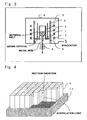
- the scintillator for neutron detection which comprises the metal fluoride crystal of the present invention, can be made into a highly efficient neutron detector in combination with a photodetector such as a photomultiplier tube. That is, light (scintillation light) emitted from a scintillator (9) for neutron detection upon irradiation with neutron rays is converted into an electrical signal by a photodetector (10), whereby the presence or absence of neutron rays can be found, and the intensity of the neutron rays can be determined from the electrical signal.
- a typical wavelength of the scintillation light emitted from the scintillator of the present invention is 250 to 400 nm.
- a photomultiplier tube, a silicon photodiode, or the like can be used preferably as the photodetector which can detect light in this region.
- a practical example is a method which comprises adhering a block of the metal fluoride crystal to a photo-cathode window of a photomultiplier tube by an optical grease or the like, supplying a high voltage to the photomultiplier tube, and observing an electrical signal outputted from the photomultiplier tube.
- An amplifier and a multichannel pulse height analyzer may be used to determine the intensity of neutron rays, etc. from the electrical signal.
- a position sensitive photodetector comprising an array of detecting units each having a sensitive area of several millimeters square is used as the photodetector, and the metal fluoride crystal of a size comparable to that of the sensitive area is joined to each of the detecting units of the position sensitive photodetector.
- a LiCaAlF 6 crystal containing Ce as a lanthanoid was produced using a crystal manufacturing apparatus by the micro-pulling-down method as shown in Fig. 3 .
- Lithium fluoride, calcium fluoride, aluminum fluoride and cerium fluoride each having purity of 99.99% or higher were used as materials.
- the 6 Li isotopic ratio of the lithium fluoride was 50%.
- the after-heater 1, the heater 2, the heat insulating material 3, the stage 4, and the crucible 5 made of high purity carbon were used, and the shape of the hole at the bottom of the crucible was a cylindrical shape of 2.2 mm in diameter and 0.5 mm in length.
- a high frequency current was applied to the high frequency coil 7 to heat the materials by induction heating and melt them.
- a W-Re wire at the top of a pulling-down rod 8 was inserted into the above hole of the bottom of the crucible 5 to pull down a melt of the materials from the hole and start crystallization. Adjusting the output power of the high frequency properly, the melt was pulled down continuously for 15 hours at a rate of 3 mm/hr to obtain a LiCaAlF 6 crystal containing cerium as a lanthanoid.
- the crystal was a high quality crystal 2.2 mm in diameter and 45 mm in length and free of turbidity or cracks.
- This metal fluoride crystal was cut to a length of 15 mm by a wire saw provided with a diamond wire, then ground and mirror-polished to be processed into a shape having a length of 15 mm, a width of 2 mm and a thickness of 1 mm, whereby the scintillator for neutron detection according to the present invention was obtained.
- the density of the scintillator, the mass fraction of the Li elements in the scintillator, and the 6 Li isotopic ratio in the lithium material were 3.0 g/cm 3 , 3.7 mass%, and 50%, respectively.
- the 6 Li content was found to be 5.1 atoms/nm 3 from the Equation [1].
- the composition of the neutron scintillator was Ce 0.0004 LiCaAlF 6 , and the effective atomic number calculated from the Equation [2] using this composition was 15.
- the prepared pulse-height spectrum is shown in Fig. 1 .
- the abscissa of the pulse-height spectrum represents the pulse-height value of the electrical signal, namely, the intensity of the scintillation light.
- the pulse-height value is expressed as a relative value, taking the peak value of this spectrum as 1.
- the ordinate represents the frequency of the electrical signal for each pulse-height value, which is indicated as counts per second (cps).
- cps counts per second
- the neutron detection efficiency expressed as the peak area in the pulse-height spectrum was 1.3 cps, showing that the neutron scintillator of the present invention has excellent sensitivity to neutrons. Further, the baseline of the pulse-height spectrum was constant in the vicinity of 0 cps, showing that the influence of a background noise resulting from ⁇ rays is negligible.
- the electrical signals outputted from the above photomultiplier tube were inputted into an oscilloscope (TDS3052B, produced by Tektronix, Inc.) for analysis of the pulse shape, whereby the decay constant of light emission from the scintillator for neutron detection according to the present invention was determined.
- the decay constant obtained was 24 ns, showing that the scintillator for neutron detection of the present invention has excellent time response characteristics.
- the metal fluoride crystals of the present invention were obtained in the same manner as in Example 1, except that the types and amounts of the materials were as shown in Table 1.
- Examples 1, 3 and 4 lithium fluoride with a 6 Li isotopic ratio of 50% was used.
- Example 2 lithium fluoride with a 6 Li isotopic ratio of 50% and lithium fluoride with a 6 Li isotopic ratio of 7.6% were mixed in equal amounts and used.
- Example 5 lithium fluoride with a 6 Li isotopic ratio of 7.6% was used.
- the densities of the resulting metal fluoride crystals, the mass fractions of the Li elements in the metal fluoride crystals, the 6 Li isotopic ratios in the lithium materials, and the 6 Li contents calculated from these parameters are shown in Table 2. Moreover, the compositions of the metal fluoride crystals and the effective atomic numbers calculated from them are shown in Table 2.
- the performance of the scintillators for neutron detection was evaluated by the same method as in Example 1.
- the pulse-height value was obtained from pulse-height spectrum and expressed as an indicator of the light emission intensity of the scintillator of each Example.
- the pulse-height value was shown as relative value to Example 1.
- the peak area in the above pulse-height spectrum was found.
- the decay constant of light emission was measured in the same manner as in Example 1. The results are shown in Table 3 along with the 6 Li content and effective atomic number of each scintillator, and the lanthanoid contained in each scintillator.
- the metal fluoride crystal of the present invention was obtained in the same manner as in Example 1, except that the types and amounts of the materials were as shown in Table 1. In the present Example, lithium fluoride with a 6 Li isotopic ratio of 50% was used.
- the density of the resulting metal fluoride crystal, the mass fraction of the Li elements in the metal fluoride crystal, the 6 Li isotopic ratio in the lithium material, and the 6 Li content calculated from these parameters are shown in Table 2.
- the composition of the metal fluoride crystal and the effective atomic number calculated therefrom are shown in Table 2.
- the performance of the scintillator for neutron detection was evaluated by the same method as in Example 1, except that R7600 produced by HAMAMATSU PHOTONICS K.K. was used as a photomultiplier tube.
- Pulse-height spectra prepared are shown in Fig. 2 .
- the solid line represents a spectrum prepared using the scintillator of the present invention
- the dashed line represents a spectrum prepared by irradiating only the photomultiplier tube with radiation, without using the scintillator of the present invention (the pulse-height values of the present Example cannot be directly compared with the pulse-height values of the other Examples and Comparative Examples, because the photomultiplier tubes used are different).
- the area of the shaded portion was found in the same manner as in Example 1. Furthermore, the decay constant of light emission was measured in the same manner as in Example 1. The results are shown in Table 3 along with the 6 Li content and effective atomic number of the scintillator, and the lanthanoid contained in the scintillator.
- Metal fluoride crystals having a 6 Li content at a hitherto known level of 0.73 atom/nm 3 were produced, and their performance was evaluated, in the same manner as in Example 1, except that the types and amounts of the materials were as shown in Table 1.
- lithium fluoride with a 6 Li isotopic ratio of 7.6% was used as a material.
- the compositions and effective atomic numbers of the resulting metal fluoride crystals are shown in Table 2, and their evaluation results are shown in Table 3.
- Example 3 having Eu as a lanthanoid was shown to have particularly high light emission intensity.
- Fig. 1 also shows the pulse-height spectrum of the LiCaAlF 6 crystal containing Eu as a lanthanoid which was obtained in Example 3.
- Table 1 Types/amounts of materials 6 Li isotopic ratio of material Ex. 1 LiF CalF 2 AlF 3 CeF 3 50% 68mg 203mg 219mg 10mg Ex. 2 LiF CaF 2 AlF 3 CeF 3 29% 68mg 203mg 219mg 10mg Comp.
- Ex. 1 LiF CaF 2 AlF 3 CeF 3 7.6% 68mg 203mg 219mg 10mg Ex.
Landscapes
- Chemical & Material Sciences (AREA)
- Engineering & Computer Science (AREA)
- Physics & Mathematics (AREA)
- High Energy & Nuclear Physics (AREA)
- Materials Engineering (AREA)
- Inorganic Chemistry (AREA)
- Organic Chemistry (AREA)
- General Engineering & Computer Science (AREA)
- Health & Medical Sciences (AREA)
- Life Sciences & Earth Sciences (AREA)
- General Physics & Mathematics (AREA)
- Molecular Biology (AREA)
- Spectroscopy & Molecular Physics (AREA)
- Luminescent Compositions (AREA)
- Measurement Of Radiation (AREA)
Claims (9)
- Scintillateur pour la détection de neutrons, comprenant un cristal de fluorure de métal contenant du lithium, un élément métallique ayant une valence de 2 ou supérieure, et du fluor en tant qu'éléments constituants, ledit cristal de fluorure de métal contenant 1,1 à 20 atomes par volume unitaire (atomes/nm3) de 6Li, ayant un numéro atomique efficace de 10 à 40, et contenant un lanthanide.
- Scintillateur pour la détection de neutrons selon la revendication 1, contenant 2,9 à 20 atomes par volume unitaire (atomes/nm3) de 6Li.
- Scintillateur pour la détection de neutrons selon la revendication 1, dans lequel le numéro atomique efficace est de 10 à 30.
- Scintillateur pour la détection de neutrons selon la revendication 1, dans lequel le lanthanide est le cérium ou le praséodyme.
- Scintillateur pour la détection de neutrons selon la revendication 1, dans lequel le lanthanide est l'europium.
- Détecteur de neutrons comprenant le scintillateur pour la détection de neutrons selon la revendication 1, et un photodétecteur qui détecte de la lumière émise depuis le scintillateur pour la détection de neutrons et convertit la lumière en un signal électrique.
- Détecteur de neutrons selon la revendication 6, dans lequel le photodétecteur est un tube photomultiplicateur.
- Procédé pour produire un cristal de fluorure de métal pour un scintillateur pour la détection de neutrons, comprenant :faire fusionner un mélange de matières, composé de fluorure de lithium ayant un rapport isotopique de 6Li de 20 % ou plus, un fluorure d'un élément métallique ayant une valence de 2 ou supérieure, et un fluorure d'un lanthanide, pour former un bain de matière ; etfaire croître un monocristal à partir du bain de matière par un procédé de croissance en bain.
- Procédé pour produire un cristal de fluorure de métal pour un scintillateur pour la détection de neutrons selon la revendication 8, dans lequel le cristal de fluorure de métal pour un scintillateur pour la détection de neutrons est un cristal de fluorure de lithium-aluminium-calcium contenant un lanthanide (M:LiCaAlF6 où M est le lanthanide) ou un cristal de fluorure de lithium-yttrium contenant un lanthanide (M:LiYF4 où M est le lanthanide).
Applications Claiming Priority (2)
| Application Number | Priority Date | Filing Date | Title |
|---|---|---|---|
| JP2008075323 | 2008-03-24 | ||
| PCT/JP2009/055122 WO2009119378A1 (fr) | 2008-03-24 | 2009-03-17 | Scintillateur pour la détection de neutrons et détecteur de neutrons |
Publications (3)
| Publication Number | Publication Date |
|---|---|
| EP2256177A1 EP2256177A1 (fr) | 2010-12-01 |
| EP2256177A4 EP2256177A4 (fr) | 2014-10-22 |
| EP2256177B1 true EP2256177B1 (fr) | 2016-01-13 |
Family
ID=41113575
Family Applications (1)
| Application Number | Title | Priority Date | Filing Date |
|---|---|---|---|
| EP09725054.2A Not-in-force EP2256177B1 (fr) | 2008-03-24 | 2009-03-17 | Scintillateur pour la détection de neutrons et détecteur de neutrons |
Country Status (8)
| Country | Link |
|---|---|
| US (1) | US8044367B2 (fr) |
| EP (1) | EP2256177B1 (fr) |
| JP (1) | JP5378356B2 (fr) |
| KR (1) | KR101538194B1 (fr) |
| CN (1) | CN101945974A (fr) |
| CA (1) | CA2717341C (fr) |
| RU (1) | RU2494416C2 (fr) |
| WO (1) | WO2009119378A1 (fr) |
Cited By (1)
| Publication number | Priority date | Publication date | Assignee | Title |
|---|---|---|---|---|
| EP4047398A1 (fr) | 2021-02-22 | 2022-08-24 | Vilnius University | Procédé et appareil de détection de grands flux pulsés de neutrons utilisant une réponse optique de cristaux |
Families Citing this family (56)
| Publication number | Priority date | Publication date | Assignee | Title |
|---|---|---|---|---|
| JP5158882B2 (ja) * | 2009-04-30 | 2013-03-06 | 国立大学法人大阪大学 | 中性子検出用シンチレータ及び中性子測定装置 |
| JP5652903B2 (ja) * | 2010-03-16 | 2015-01-14 | 日本結晶光学株式会社 | 中性子シンチレータ用酸化物結晶及び中性子検出器 |
| JP2013116926A (ja) * | 2010-03-19 | 2013-06-13 | Tokuyama Corp | 中性子検出用シンチレーター、中性子線検出器及び中性子線撮像装置 |
| JP5501088B2 (ja) * | 2010-04-30 | 2014-05-21 | 株式会社トクヤマ | 中性子用シンチレーターおよび中性子検出器 |
| US20130181137A1 (en) * | 2010-05-18 | 2013-07-18 | Kenichi Watanabe | Neutron Radiation Detector, Neutron Radiation Detection Scintillator and Method for Discriminating Between Neutron Radiation and Gamma Radiation |
| JP5894916B2 (ja) * | 2010-07-21 | 2016-03-30 | 国立大学法人広島大学 | ホスウィッチ型熱中性子検出器 |
| EP2597489A4 (fr) * | 2010-07-21 | 2014-04-23 | Univ Hiroshima | Détecteur de rayonnement |
| WO2012026584A1 (fr) * | 2010-08-27 | 2012-03-01 | 株式会社トクヤマ | Scintillateur de détection de neutrons et détecteur de rayonnement neutronique |
| JP5889201B2 (ja) * | 2010-11-02 | 2016-03-22 | 株式会社トクヤマ | 金属フッ化物共晶体及び中性子用シンチレーター |
| US9068114B2 (en) | 2010-11-02 | 2015-06-30 | Tokuyama Corporation | Metal fluoride eutectic, neutron scintillator and neutron imaging device |
| JP5877417B2 (ja) * | 2010-11-02 | 2016-03-08 | 株式会社トクヤマ | 中性子検出用シンチレーター及び中性子線検出器 |
| EP2636773A4 (fr) * | 2010-11-02 | 2014-03-19 | Tokuyama Corp | Cristal de fluorure métallique et élément émettant de la lumière |
| JP5761986B2 (ja) * | 2010-12-16 | 2015-08-12 | 株式会社トクヤマ | 中性子用シンチレーターおよび中性子検出器 |
| CN102129081B (zh) * | 2010-12-23 | 2016-04-06 | 中国原子能科学研究院 | 一种用于密封中子发生器的伴随α粒子探测器 |
| JP5634285B2 (ja) * | 2011-02-03 | 2014-12-03 | 株式会社トクヤマ | コルキライト型結晶、中性子検出用シンチレーター及び中性子線検出器 |
| JP5737978B2 (ja) * | 2011-02-03 | 2015-06-17 | 株式会社トクヤマ | 中性子検出用シンチレーター及び中性子線検出器 |
| JP5737974B2 (ja) * | 2011-02-03 | 2015-06-17 | 株式会社トクヤマ | 中性子検出用シンチレーター及び中性子線検出器 |
| WO2012104750A2 (fr) | 2011-02-04 | 2012-08-09 | Koninklijke Philips Electronics N.V. | Matériaux scintillateurs inédits pour détecteurs de neutrons |
| WO2012115234A1 (fr) * | 2011-02-24 | 2012-08-30 | 株式会社トクヤマ | Scintillateur pour la détection des neutrons et détecteur de rayonnement de neutrons |
| EP2685286A4 (fr) * | 2011-03-08 | 2014-09-10 | Tokuyama Corp | Dispositif de détection à faisceau de neutrons |
| WO2012121338A1 (fr) * | 2011-03-08 | 2012-09-13 | 株式会社トクヤマ | Détecteur de rayonnement et scintillateur |
| CN103403126B (zh) * | 2011-04-04 | 2016-03-16 | 株式会社德山 | 闪烁体、放射线检测装置及放射线检测方法 |
| JP5713810B2 (ja) * | 2011-06-13 | 2015-05-07 | 株式会社トクヤマ | 金属フッ化物結晶、発光素子及びシンチレーター |
| US9304226B2 (en) | 2011-06-26 | 2016-04-05 | Schlumberger Technology Corporation | Scintillator-based neutron detector for oilfield applications |
| CN102445706A (zh) * | 2011-09-26 | 2012-05-09 | 华瑞科学仪器(上海)有限公司 | 中子检测器 |
| US8878135B2 (en) | 2012-01-26 | 2014-11-04 | General Electric Company | Lithium based scintillators for neutron detection |
| JP5916421B2 (ja) | 2012-02-14 | 2016-05-11 | 株式会社トクヤマ | 中性子検出器 |
| JP5846960B2 (ja) | 2012-02-24 | 2016-01-20 | 株式会社トクヤマ | 放射線検出器 |
| EP2843088A4 (fr) * | 2012-04-26 | 2015-12-16 | Tokuyama Corp | Cristal de fluorure métallique, élément électroluminescent, scintillateur, procédé pour la détection de neutrons et procédé pour la production de cristal de fluorure métallique |
| US9024265B2 (en) * | 2012-09-30 | 2015-05-05 | Saint-Gobain Ceramics & Plastics, Inc. | Photosensor testing apparatus, a radiation detection apparatus including a photosensor and a method of selecting the photosensor for the radiation detection apparatus |
| EP2933660A4 (fr) * | 2012-12-12 | 2016-07-27 | Tokuyama Corp | Scintillateur à neutrons, procédé de détection de neutrons et détecteur de neutrons |
| CN104101895B (zh) * | 2013-04-09 | 2016-11-23 | 中国科学院高能物理研究所 | 中子探测器和中子探测方法 |
| ITRM20130254A1 (it) * | 2013-04-29 | 2014-10-30 | Infn Istituto Naz Di Fisica N Ucleare | "rivelatori di neutroni termici non facenti uso di 3he e metodo per la loro realizzazione" |
| WO2014192321A1 (fr) * | 2013-05-27 | 2014-12-04 | 住友重機械工業株式会社 | Dispositif de détection de rayonnement de neutrons et dispositif de traitement par capture de neutrons |
| US10018735B2 (en) | 2013-07-17 | 2018-07-10 | Koninklijke Philips N.V. | CE3+ activated luminescent compositions for application in imaging systems |
| JP6204750B2 (ja) * | 2013-08-27 | 2017-09-27 | 株式会社トクヤマ | 中性子シンチレーター及び中性子検出器 |
| JP6223749B2 (ja) * | 2013-08-30 | 2017-11-01 | 株式会社トクヤマ | 中性子シンチレーター及び中性子検出器 |
| US9784858B2 (en) | 2013-10-28 | 2017-10-10 | Tokuyama Corporation | Neutron scintillator, neutron detector and method for manufacturing neutron scintillator |
| JPWO2015064587A1 (ja) | 2013-10-28 | 2017-03-09 | 株式会社トクヤマ | 中性子シンチレーター及び中性子検出器 |
| GB201405556D0 (en) * | 2014-03-27 | 2014-05-14 | Kromek Ltd | Neutron detection |
| RU2553088C1 (ru) * | 2014-04-03 | 2015-06-10 | Федеральное государственное унитарное предприятие "Российский федеральный ядерный центр-Всероссийский научно-исследовательский институт технической физики имени академика Е.И. Забабахина" | Устройство для формирования импульсов тормозного излучения |
| KR101672488B1 (ko) | 2015-04-29 | 2016-11-04 | 한밭대학교 산학협력단 | 고속 고정밀 중성자 측정 시스템 |
| CN106324657B (zh) * | 2015-06-30 | 2019-04-23 | 中国辐射防护研究院 | 掺杂中子灵敏物质锂的塑料闪烁体及其测量热中子的方法 |
| RU2599672C1 (ru) * | 2015-11-24 | 2016-10-10 | федеральное государственное автономное образовательное учреждение высшего образования "Казанский (Приволжский) федеральный университет" (ФГАОУ ВО КФУ) | Устройство для выращивания монокристаллов фторидов и способ их получения |
| KR101893849B1 (ko) | 2017-03-02 | 2018-08-31 | 한국원자력연구원 | 고속중성자와 열중성자 동시 검출장치 및 그를 이용한 검출방법 |
| CN109143319B (zh) * | 2017-06-16 | 2023-04-28 | 中国辐射防护研究院 | 利用CeF3闪烁体降低γ射线干扰的中子探测方法及设备 |
| KR101975904B1 (ko) | 2017-09-27 | 2019-05-07 | 한국원자력연구원 | 기계적 접촉 방식에 의한 다이아몬드 중성자 검출기 |
| US10969504B2 (en) * | 2018-02-05 | 2021-04-06 | Rhombus Holdings Llc | Component configuration for a robust tunable sensor system for a high radiation environment |
| CN109542186B (zh) * | 2018-12-12 | 2024-06-25 | 深圳市福瑞康科技有限公司 | 一种机箱主箱体、机箱及闪烁检测装置 |
| CN109613603B (zh) * | 2018-12-25 | 2023-10-20 | 中国辐射防护研究院 | 一种掺铷玻璃测量中子的方法 |
| CN109613602A (zh) * | 2018-12-25 | 2019-04-12 | 中国辐射防护研究院 | 一种掺铟玻璃测量中子的方法 |
| CN114059160A (zh) * | 2020-08-06 | 2022-02-18 | 中国科学院上海硅酸盐研究所 | 一种制备稀土离子掺杂氟铝钙锂石闪烁晶体用多晶烧结料及其单晶的方法和应用 |
| CN113176604A (zh) * | 2021-04-30 | 2021-07-27 | 中国电子科技集团公司第二十六研究所 | 一种闪烁晶体阵列抗辐照加固结构及抗辐照加固方法 |
| CN113419270B (zh) * | 2021-06-23 | 2022-08-30 | 中国工程物理研究院激光聚变研究中心 | 一种在线式滤片堆栈谱仪 |
| CN117229772B (zh) * | 2023-08-14 | 2025-08-29 | 松山湖材料实验室 | 一种共晶闪烁体及其制备方法与应用 |
| CN119913604A (zh) * | 2024-12-25 | 2025-05-02 | 福建福晶科技股份有限公司 | 一种铬掺杂氟铝酸锶锂晶体及其生长方法和应用 |
Family Cites Families (14)
| Publication number | Priority date | Publication date | Assignee | Title |
|---|---|---|---|---|
| SU1551653A1 (ru) * | 1987-12-30 | 1990-03-23 | Институт Химии Дальневосточного Отделения Ан Ссср | Способ получени порошкообразного двойного фторида лити и иттри |
| RU2189057C2 (ru) * | 2000-11-13 | 2002-09-10 | Уральский государственный технический университет | Сцинтилляционный детектор нейтронного и гамма-излучения |
| JP4552020B2 (ja) * | 2001-01-29 | 2010-09-29 | 独立行政法人 日本原子力研究開発機構 | 放射線および中性子イメージ検出器 |
| US6529573B2 (en) * | 2001-03-09 | 2003-03-04 | The Regents Of The University Of California | Proton recoil scintillator neutron rem meter |
| JP2003248061A (ja) * | 2002-02-26 | 2003-09-05 | Japan Atom Energy Res Inst | 中性子検出用シンチレータ及びそれを用いた中性子検出器 |
| JPWO2004086089A1 (ja) * | 2003-03-24 | 2006-06-29 | 北辰工業株式会社 | 熱蛍光線量計用フッ化物単結晶材料及び熱蛍光線量計 |
| CN102888652B (zh) * | 2004-11-08 | 2016-09-21 | 东北泰克诺亚奇股份有限公司 | 含Pr的闪烁体用单晶及其制造方法和放射线检测器以及检查装置 |
| RU2276387C1 (ru) * | 2004-12-30 | 2006-05-10 | ГОУ ВПО Уральский государственный технический университет - УПИ | Сцинтиллятор для регистрации нейтронов |
| JP2006233185A (ja) * | 2005-01-27 | 2006-09-07 | Hokushin Ind Inc | 放射線検出用金属ハロゲン化物及びその製造方法並びにシンチレータ及び放射線検出器 |
| JP4587843B2 (ja) | 2005-02-28 | 2010-11-24 | 独立行政法人 日本原子力研究開発機構 | ガラス状化イメージングプレート |
| JP2007045869A (ja) * | 2005-08-08 | 2007-02-22 | Stella Chemifa Corp | 低吸湿性ハロゲン置換フッ化物シンチレータ材料、及び放射線検出器及び検査装置 |
| JP2007063065A (ja) | 2005-08-31 | 2007-03-15 | Ohara Inc | ガラス |
| JP5589196B2 (ja) * | 2005-09-07 | 2014-09-17 | 独立行政法人日本原子力研究開発機構 | ZnS蛍光体を用いた中性子検出用シンチレータ及び粒子線検出用シンチレータ |
| DE102005046108A1 (de) * | 2005-09-27 | 2007-04-05 | Forschungszentrum Jülich GmbH | Szintillator |
-
2009
- 2009-03-17 EP EP09725054.2A patent/EP2256177B1/fr not_active Not-in-force
- 2009-03-17 JP JP2010505548A patent/JP5378356B2/ja active Active
- 2009-03-17 CN CN2009801058990A patent/CN101945974A/zh active Pending
- 2009-03-17 KR KR1020107020724A patent/KR101538194B1/ko not_active Expired - Fee Related
- 2009-03-17 CA CA2717341A patent/CA2717341C/fr not_active Expired - Fee Related
- 2009-03-17 WO PCT/JP2009/055122 patent/WO2009119378A1/fr not_active Ceased
- 2009-03-17 US US12/866,863 patent/US8044367B2/en not_active Expired - Fee Related
- 2009-03-17 RU RU2010143421/05A patent/RU2494416C2/ru not_active IP Right Cessation
Cited By (1)
| Publication number | Priority date | Publication date | Assignee | Title |
|---|---|---|---|---|
| EP4047398A1 (fr) | 2021-02-22 | 2022-08-24 | Vilnius University | Procédé et appareil de détection de grands flux pulsés de neutrons utilisant une réponse optique de cristaux |
Also Published As
| Publication number | Publication date |
|---|---|
| CA2717341C (fr) | 2016-05-31 |
| JP5378356B2 (ja) | 2013-12-25 |
| CA2717341A1 (fr) | 2009-10-01 |
| EP2256177A1 (fr) | 2010-12-01 |
| CN101945974A (zh) | 2011-01-12 |
| WO2009119378A1 (fr) | 2009-10-01 |
| EP2256177A4 (fr) | 2014-10-22 |
| US20100314550A1 (en) | 2010-12-16 |
| RU2010143421A (ru) | 2012-04-27 |
| RU2494416C2 (ru) | 2013-09-27 |
| KR101538194B1 (ko) | 2015-07-20 |
| US8044367B2 (en) | 2011-10-25 |
| JPWO2009119378A1 (ja) | 2011-07-21 |
| KR20100125326A (ko) | 2010-11-30 |
Similar Documents
| Publication | Publication Date | Title |
|---|---|---|
| EP2256177B1 (fr) | Scintillateur pour la détection de neutrons et détecteur de neutrons | |
| US9834858B2 (en) | Pr-containing scintillator single crystal, method of manufacturing the same, radiation detector, and inspection apparatus | |
| CN103249805B (zh) | 包含掺杂稀土硅酸盐的发光材料 | |
| WO2011145651A1 (fr) | Détecteur de faisceau de neutrons, scintillateur de détection de faisceau de neutrons et procédé permettant d'effectuer une discrimination entre un faisceau de neutrons et un faisceau γ | |
| EP2685286A1 (fr) | Dispositif de détection à faisceau de neutrons | |
| US9920243B2 (en) | Scintillator, radiation detector, and method for detecting radiation | |
| US8778225B2 (en) | Iodide single crystal, production process thereof, and scintillator comprising iodide single crystal | |
| US8933408B2 (en) | Colquiriite-type crystal, scintillator for neutron detection and neutron detector | |
| JPWO2010140585A1 (ja) | シンチレーター | |
| EP2679652A1 (fr) | Scintillateur pour la détection des neutrons et détecteur de rayonnement de neutrons | |
| JP5737974B2 (ja) | 中性子検出用シンチレーター及び中性子線検出器 | |
| Kudina et al. | CsI (Tl)+ photodiode scintillation assemblies for γ-ray and proton detectors | |
| Pejchal et al. | Luminescence and Scintillation Properties of Scintillators Based on Orthorhombic and Monoclinic BaLu $ _ {2} $ F $ _ {8} $ Single Crystals | |
| WO2012026584A1 (fr) | Scintillateur de détection de neutrons et détecteur de rayonnement neutronique | |
| Yang et al. | Synthesis and scintillation properties of CsGd2Cl7: Ce3+ for gamma ray and neutron detection | |
| Yang et al. | Crystal growth and Scintillation properties of AGd 2 Cl 7: Ce 3+(A= Cs, K) for gamma and neutron detection |
Legal Events
| Date | Code | Title | Description |
|---|---|---|---|
| PUAI | Public reference made under article 153(3) epc to a published international application that has entered the european phase |
Free format text: ORIGINAL CODE: 0009012 |
|
| 17P | Request for examination filed |
Effective date: 20100802 |
|
| AK | Designated contracting states |
Kind code of ref document: A1 Designated state(s): AT BE BG CH CY CZ DE DK EE ES FI FR GB GR HR HU IE IS IT LI LT LU LV MC MK MT NL NO PL PT RO SE SI SK TR |
|
| AX | Request for extension of the european patent |
Extension state: AL BA RS |
|
| DAX | Request for extension of the european patent (deleted) | ||
| A4 | Supplementary search report drawn up and despatched |
Effective date: 20140922 |
|
| RIC1 | Information provided on ipc code assigned before grant |
Ipc: G21K 4/00 20060101ALI20140916BHEP Ipc: C09K 11/61 20060101AFI20140916BHEP Ipc: G01T 1/202 20060101ALI20140916BHEP Ipc: G01T 3/06 20060101ALI20140916BHEP Ipc: C09K 11/85 20060101ALI20140916BHEP Ipc: C09K 11/00 20060101ALI20140916BHEP Ipc: G01T 1/20 20060101ALI20140916BHEP |
|
| GRAP | Despatch of communication of intention to grant a patent |
Free format text: ORIGINAL CODE: EPIDOSNIGR1 |
|
| RIC1 | Information provided on ipc code assigned before grant |
Ipc: G01T 3/06 20060101ALI20150708BHEP Ipc: C09K 11/61 20060101AFI20150708BHEP Ipc: C09K 11/00 20060101ALI20150708BHEP Ipc: G01T 1/202 20060101ALI20150708BHEP Ipc: G21K 4/00 20060101ALI20150708BHEP Ipc: G01T 1/20 20060101ALI20150708BHEP Ipc: C09K 11/85 20060101ALI20150708BHEP |
|
| INTG | Intention to grant announced |
Effective date: 20150724 |
|
| GRAS | Grant fee paid |
Free format text: ORIGINAL CODE: EPIDOSNIGR3 |
|
| GRAA | (expected) grant |
Free format text: ORIGINAL CODE: 0009210 |
|
| AK | Designated contracting states |
Kind code of ref document: B1 Designated state(s): AT BE BG CH CY CZ DE DK EE ES FI FR GB GR HR HU IE IS IT LI LT LU LV MC MK MT NL NO PL PT RO SE SI SK TR |
|
| REG | Reference to a national code |
Ref country code: GB Ref legal event code: FG4D |
|
| REG | Reference to a national code |
Ref country code: CH Ref legal event code: EP |
|
| REG | Reference to a national code |
Ref country code: IE Ref legal event code: FG4D |
|
| REG | Reference to a national code |
Ref country code: AT Ref legal event code: REF Ref document number: 770517 Country of ref document: AT Kind code of ref document: T Effective date: 20160215 |
|
| REG | Reference to a national code |
Ref country code: DE Ref legal event code: R096 Ref document number: 602009035819 Country of ref document: DE |
|
| REG | Reference to a national code |
Ref country code: SE Ref legal event code: TRGR |
|
| REG | Reference to a national code |
Ref country code: LT Ref legal event code: MG4D |
|
| REG | Reference to a national code |
Ref country code: NL Ref legal event code: MP Effective date: 20160113 |
|
| REG | Reference to a national code |
Ref country code: AT Ref legal event code: MK05 Ref document number: 770517 Country of ref document: AT Kind code of ref document: T Effective date: 20160113 |
|
| PG25 | Lapsed in a contracting state [announced via postgrant information from national office to epo] |
Ref country code: NL Free format text: LAPSE BECAUSE OF FAILURE TO SUBMIT A TRANSLATION OF THE DESCRIPTION OR TO PAY THE FEE WITHIN THE PRESCRIBED TIME-LIMIT Effective date: 20160113 |
|
| PG25 | Lapsed in a contracting state [announced via postgrant information from national office to epo] |
Ref country code: FI Free format text: LAPSE BECAUSE OF FAILURE TO SUBMIT A TRANSLATION OF THE DESCRIPTION OR TO PAY THE FEE WITHIN THE PRESCRIBED TIME-LIMIT Effective date: 20160113 Ref country code: NO Free format text: LAPSE BECAUSE OF FAILURE TO SUBMIT A TRANSLATION OF THE DESCRIPTION OR TO PAY THE FEE WITHIN THE PRESCRIBED TIME-LIMIT Effective date: 20160413 Ref country code: GR Free format text: LAPSE BECAUSE OF FAILURE TO SUBMIT A TRANSLATION OF THE DESCRIPTION OR TO PAY THE FEE WITHIN THE PRESCRIBED TIME-LIMIT Effective date: 20160414 Ref country code: HR Free format text: LAPSE BECAUSE OF FAILURE TO SUBMIT A TRANSLATION OF THE DESCRIPTION OR TO PAY THE FEE WITHIN THE PRESCRIBED TIME-LIMIT Effective date: 20160113 Ref country code: ES Free format text: LAPSE BECAUSE OF FAILURE TO SUBMIT A TRANSLATION OF THE DESCRIPTION OR TO PAY THE FEE WITHIN THE PRESCRIBED TIME-LIMIT Effective date: 20160113 |
|
| PG25 | Lapsed in a contracting state [announced via postgrant information from national office to epo] |
Ref country code: LT Free format text: LAPSE BECAUSE OF FAILURE TO SUBMIT A TRANSLATION OF THE DESCRIPTION OR TO PAY THE FEE WITHIN THE PRESCRIBED TIME-LIMIT Effective date: 20160113 Ref country code: BE Free format text: LAPSE BECAUSE OF NON-PAYMENT OF DUE FEES Effective date: 20160331 Ref country code: LV Free format text: LAPSE BECAUSE OF FAILURE TO SUBMIT A TRANSLATION OF THE DESCRIPTION OR TO PAY THE FEE WITHIN THE PRESCRIBED TIME-LIMIT Effective date: 20160113 Ref country code: PT Free format text: LAPSE BECAUSE OF FAILURE TO SUBMIT A TRANSLATION OF THE DESCRIPTION OR TO PAY THE FEE WITHIN THE PRESCRIBED TIME-LIMIT Effective date: 20160513 Ref country code: IS Free format text: LAPSE BECAUSE OF FAILURE TO SUBMIT A TRANSLATION OF THE DESCRIPTION OR TO PAY THE FEE WITHIN THE PRESCRIBED TIME-LIMIT Effective date: 20160513 Ref country code: AT Free format text: LAPSE BECAUSE OF FAILURE TO SUBMIT A TRANSLATION OF THE DESCRIPTION OR TO PAY THE FEE WITHIN THE PRESCRIBED TIME-LIMIT Effective date: 20160113 Ref country code: PL Free format text: LAPSE BECAUSE OF FAILURE TO SUBMIT A TRANSLATION OF THE DESCRIPTION OR TO PAY THE FEE WITHIN THE PRESCRIBED TIME-LIMIT Effective date: 20160113 |
|
| REG | Reference to a national code |
Ref country code: DE Ref legal event code: R097 Ref document number: 602009035819 Country of ref document: DE |
|
| PG25 | Lapsed in a contracting state [announced via postgrant information from national office to epo] |
Ref country code: DK Free format text: LAPSE BECAUSE OF FAILURE TO SUBMIT A TRANSLATION OF THE DESCRIPTION OR TO PAY THE FEE WITHIN THE PRESCRIBED TIME-LIMIT Effective date: 20160113 Ref country code: EE Free format text: LAPSE BECAUSE OF FAILURE TO SUBMIT A TRANSLATION OF THE DESCRIPTION OR TO PAY THE FEE WITHIN THE PRESCRIBED TIME-LIMIT Effective date: 20160113 Ref country code: MC Free format text: LAPSE BECAUSE OF FAILURE TO SUBMIT A TRANSLATION OF THE DESCRIPTION OR TO PAY THE FEE WITHIN THE PRESCRIBED TIME-LIMIT Effective date: 20160113 Ref country code: LU Free format text: LAPSE BECAUSE OF FAILURE TO SUBMIT A TRANSLATION OF THE DESCRIPTION OR TO PAY THE FEE WITHIN THE PRESCRIBED TIME-LIMIT Effective date: 20160317 |
|
| REG | Reference to a national code |
Ref country code: CH Ref legal event code: PL |
|
| PLBE | No opposition filed within time limit |
Free format text: ORIGINAL CODE: 0009261 |
|
| STAA | Information on the status of an ep patent application or granted ep patent |
Free format text: STATUS: NO OPPOSITION FILED WITHIN TIME LIMIT |
|
| PG25 | Lapsed in a contracting state [announced via postgrant information from national office to epo] |
Ref country code: SK Free format text: LAPSE BECAUSE OF FAILURE TO SUBMIT A TRANSLATION OF THE DESCRIPTION OR TO PAY THE FEE WITHIN THE PRESCRIBED TIME-LIMIT Effective date: 20160113 Ref country code: CZ Free format text: LAPSE BECAUSE OF FAILURE TO SUBMIT A TRANSLATION OF THE DESCRIPTION OR TO PAY THE FEE WITHIN THE PRESCRIBED TIME-LIMIT Effective date: 20160113 Ref country code: RO Free format text: LAPSE BECAUSE OF FAILURE TO SUBMIT A TRANSLATION OF THE DESCRIPTION OR TO PAY THE FEE WITHIN THE PRESCRIBED TIME-LIMIT Effective date: 20160113 |
|
| 26N | No opposition filed |
Effective date: 20161014 |
|
| REG | Reference to a national code |
Ref country code: IE Ref legal event code: MM4A |
|
| PG25 | Lapsed in a contracting state [announced via postgrant information from national office to epo] |
Ref country code: BE Free format text: LAPSE BECAUSE OF FAILURE TO SUBMIT A TRANSLATION OF THE DESCRIPTION OR TO PAY THE FEE WITHIN THE PRESCRIBED TIME-LIMIT Effective date: 20160113 |
|
| REG | Reference to a national code |
Ref country code: FR Ref legal event code: ST Effective date: 20161130 |
|
| PG25 | Lapsed in a contracting state [announced via postgrant information from national office to epo] |
Ref country code: CH Free format text: LAPSE BECAUSE OF NON-PAYMENT OF DUE FEES Effective date: 20160331 Ref country code: IE Free format text: LAPSE BECAUSE OF NON-PAYMENT OF DUE FEES Effective date: 20160317 Ref country code: LI Free format text: LAPSE BECAUSE OF NON-PAYMENT OF DUE FEES Effective date: 20160331 Ref country code: FR Free format text: LAPSE BECAUSE OF NON-PAYMENT OF DUE FEES Effective date: 20160331 |
|
| PG25 | Lapsed in a contracting state [announced via postgrant information from national office to epo] |
Ref country code: BG Free format text: LAPSE BECAUSE OF FAILURE TO SUBMIT A TRANSLATION OF THE DESCRIPTION OR TO PAY THE FEE WITHIN THE PRESCRIBED TIME-LIMIT Effective date: 20160413 Ref country code: SI Free format text: LAPSE BECAUSE OF FAILURE TO SUBMIT A TRANSLATION OF THE DESCRIPTION OR TO PAY THE FEE WITHIN THE PRESCRIBED TIME-LIMIT Effective date: 20160113 |
|
| PG25 | Lapsed in a contracting state [announced via postgrant information from national office to epo] |
Ref country code: MT Free format text: LAPSE BECAUSE OF FAILURE TO SUBMIT A TRANSLATION OF THE DESCRIPTION OR TO PAY THE FEE WITHIN THE PRESCRIBED TIME-LIMIT Effective date: 20160113 |
|
| PGFP | Annual fee paid to national office [announced via postgrant information from national office to epo] |
Ref country code: GB Payment date: 20180314 Year of fee payment: 10 Ref country code: DE Payment date: 20180306 Year of fee payment: 10 |
|
| PG25 | Lapsed in a contracting state [announced via postgrant information from national office to epo] |
Ref country code: CY Free format text: LAPSE BECAUSE OF FAILURE TO SUBMIT A TRANSLATION OF THE DESCRIPTION OR TO PAY THE FEE WITHIN THE PRESCRIBED TIME-LIMIT Effective date: 20160113 Ref country code: HU Free format text: LAPSE BECAUSE OF FAILURE TO SUBMIT A TRANSLATION OF THE DESCRIPTION OR TO PAY THE FEE WITHIN THE PRESCRIBED TIME-LIMIT; INVALID AB INITIO Effective date: 20090317 |
|
| PGFP | Annual fee paid to national office [announced via postgrant information from national office to epo] |
Ref country code: SE Payment date: 20180313 Year of fee payment: 10 Ref country code: IT Payment date: 20180321 Year of fee payment: 10 |
|
| PG25 | Lapsed in a contracting state [announced via postgrant information from national office to epo] |
Ref country code: TR Free format text: LAPSE BECAUSE OF FAILURE TO SUBMIT A TRANSLATION OF THE DESCRIPTION OR TO PAY THE FEE WITHIN THE PRESCRIBED TIME-LIMIT Effective date: 20160113 Ref country code: MT Free format text: LAPSE BECAUSE OF FAILURE TO SUBMIT A TRANSLATION OF THE DESCRIPTION OR TO PAY THE FEE WITHIN THE PRESCRIBED TIME-LIMIT Effective date: 20160331 Ref country code: MK Free format text: LAPSE BECAUSE OF FAILURE TO SUBMIT A TRANSLATION OF THE DESCRIPTION OR TO PAY THE FEE WITHIN THE PRESCRIBED TIME-LIMIT Effective date: 20160113 |
|
| REG | Reference to a national code |
Ref country code: DE Ref legal event code: R119 Ref document number: 602009035819 Country of ref document: DE |
|
| REG | Reference to a national code |
Ref country code: SE Ref legal event code: EUG |
|
| PG25 | Lapsed in a contracting state [announced via postgrant information from national office to epo] |
Ref country code: SE Free format text: LAPSE BECAUSE OF NON-PAYMENT OF DUE FEES Effective date: 20190318 |
|
| GBPC | Gb: european patent ceased through non-payment of renewal fee |
Effective date: 20190317 |
|
| PG25 | Lapsed in a contracting state [announced via postgrant information from national office to epo] |
Ref country code: DE Free format text: LAPSE BECAUSE OF NON-PAYMENT OF DUE FEES Effective date: 20191001 Ref country code: GB Free format text: LAPSE BECAUSE OF NON-PAYMENT OF DUE FEES Effective date: 20190317 |
|
| PG25 | Lapsed in a contracting state [announced via postgrant information from national office to epo] |
Ref country code: IT Free format text: LAPSE BECAUSE OF NON-PAYMENT OF DUE FEES Effective date: 20190317 |