EP2257112A1 - Zeitschlitzzuweisungsverfahren in einem Kommunikationssystem - Google Patents
Zeitschlitzzuweisungsverfahren in einem Kommunikationssystem Download PDFInfo
- Publication number
- EP2257112A1 EP2257112A1 EP09305499A EP09305499A EP2257112A1 EP 2257112 A1 EP2257112 A1 EP 2257112A1 EP 09305499 A EP09305499 A EP 09305499A EP 09305499 A EP09305499 A EP 09305499A EP 2257112 A1 EP2257112 A1 EP 2257112A1
- Authority
- EP
- European Patent Office
- Prior art keywords
- time slot
- communication
- time
- slot allocation
- time slots
- Prior art date
- Legal status (The legal status is an assumption and is not a legal conclusion. Google has not performed a legal analysis and makes no representation as to the accuracy of the status listed.)
- Withdrawn
Links
Images


Classifications
-
- H—ELECTRICITY
- H04—ELECTRIC COMMUNICATION TECHNIQUE
- H04J—MULTIPLEX COMMUNICATION
- H04J3/00—Time-division multiplex systems
- H04J3/16—Time-division multiplex systems in which the time allocation to individual channels within a transmission cycle is variable, e.g. to accommodate varying complexity of signals, to vary number of channels transmitted
- H04J3/1694—Allocation of channels in TDM/TDMA networks, e.g. distributed multiplexers
Definitions
- the present invention relates generally to the field of communication, and more particularly, to a time slot allocation method in a Time Division Multiple Access (TDMA) communication system.
- TDMA Time Division Multiple Access
- a communication system includes a plurality of communication units that transmit and receive information over communication resources and a controller that allocates the communication resources to the communication units.
- time slots one important kind of communication resources
- a time slot allocation method of a TDMA communication system comprises a plurality of communication units numbered from 1 to n (n ⁇ 2) and a controller for allocating a number of time slots for communication to each of the communication units.
- the method comprises, at the level of the controller, the steps of: transmitting a time slot allocation message to the plurality of communication units, the message comprising in sequence the following n+1 items of information: initial time of the allocation, the number of time slots allocated to the 1 st communication unit, the accumulation of number of time slots allocated to the 1 st and the 2 nd communication units, ..., and the accumulation of number of time slots allocated to the 1 st to the n th communication units.
- a time slot allocation method of a TDMA communication system comprises a plurality of communication units numbered from 1 to n (n ⁇ 2) and a controller for allocating a number of time slots for communication to each of the communication units.
- the method comprises, at the level of the n th communication unit, the steps of: receiving from the controller a time slot allocation message comprising in sequence n+1 values; and setting its starting time of communication by adding the 1 st value to the result of the n th value multiplied by the length of a time slot, and setting its time duration of communication by multiplying the length of a time slot by the result of subtracting the n th value from the (n+11) th value.
- ADoC Asymmetric Data over Coaxial Cable
- TDF Time Division Function
- the TDF protocol is based on TDMA, which allows multiple users to share the same channel by dividing it into a plurality of time slots.
- the stations transmit for uplink traffic, one after another, each using its own time slot in a TDF supper frame assigned by the access point.
- the stations share the channels and select the data or management frames by comparing the destination address information in the frames with their addresses. In this way, the user at home can access the remote IP core network via the cable access network. Normally a time slot allocation scheme is decided by the access point and informed to the associated stations.
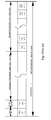
- FIG. 1 is an exemplary diagram showing the TDF superframe structure of an ADoC system. As shown in Figure 1 , each TDF superframe has a certain number of timeslots, represented by tdf Total TimeSlotNumber, which can be classified, according to their functionalities, into the following types of:
- the durations for the synchronization time slot, the contention time slot, time divisional uplink time slots and downlink time slots may be different from each other based on the requirements of practical access point application. However, every uplink or downlink time slot, which is named as common time slot, has the same duration represented by tdfCommonTimeSlotDuration.
- the number of allocated uplink time slots for the TDF stations in a TDF superframe may change from 1 to a threshold represented by tdfMaximumUplinkTimeSlotNumber. Accordingly, the available downlink time slots in a TDF superframe may change from (tdfTotalTimeSlotNumber - 2) to (tdfTotalTimeSlotNumber - 2 - tdfMaximumUplinkTimeSlotNumber).
- the TDF access point will deduce one or more time slots from the available downlink time slots, then allocate these time slots to the TDF station, as long as the uplink time slots number does not exceed tdfMaximumUplinkTimeSlotNumber.
- the value of tdfMaximumUplinkTimeSlotNumber may vary in different implementations. But it must be carefully chosen so that there is at least one downlink time slot available for an associated TDF station in order to guarantee the QoS of data service.
- all successive time slots that are used by the same TDF station or access point for the same direction of transmission can be merged to send MAC frames continuously to avoid the wastes at the edge of these time slots caused by the unnecessarily conversion and guarding.
- the tdfCommonTimeSlotDuration is usually about 300 us, during which it is enough for the TDF station to transmit at least one largest 802.11 PPDU for 54M data rate mode.
- each TDF station is guaranteed to access to 680kbps uplink data rate and shares 30Mbps (40 continuous time slots) downlink data rate. If there are 30 stations in the system, each will be guaranteed to access to 680kbps uplink data rate and shares 22.5Mbps (30 continuous time slots) downlink data rate.
- the tdfMaximumUplinkTimeSlotNumber is 30.
- the value of tdfSuperframeDuration which includes the total duration of 61 common time slots and 1 Sync time slot, is about 18.6ms. Different values can be defined for this parameter depending on the context. For example, if there is only 1 TDF station, the station can be guarantee to access to about 18Mbps uplink data rate with 4 time slots and owns 18Mbps downlink data rate with 4 continuous time slots. In this case, the value of tdfSuperframeDuration, which is the total duration of 9 data timeslots and 1 Sync timeslot, is about 4ms.
- a WiFi chipset operating in IEEE 802.11g mode with a frequency convertor is used.
- the IEEE 802.11g chipset supports data rate of up to 54 Mbit/s. It can also support several other data rates, such as 1 Mbit/s, 5.5Mbit/s, 11 Mbit/s, 24 Mbit/s and 48 Mbit/s. In most circumstances, the highest data rate, 54 Mbit/s, is used for the data transmission between an access point and a station due to good signal condition in cable network.
- the channel condition between the access point and different stations may vary due to the different attenuations between the access point and each station. Some signal channels might not be good enough to support the 54 Mbit/s data rate.
- the data rate (54M or lower) and the power to send the frames are adapted according to respective channel conditions which can be measured by some criteria such as packet loss.
- the bandwidth provided for the station must remain unchanged to be in line with the subscription agreement between the customer and the service operator. Therefore, a time slot reallocation mechanism for the stations is needed, in which the time slot number, typically uplink time slot number, of each STA can be dynamically and efficiently adjusted based on the varying data rate.
- a time slot allocation method according to an embodiment of the present invention for ADoC system will be described in detail.
- Figure 2 shows the time allocation method, at an access point side, according to an embodiment of the present invention.
- the access point in the first step S201, the access point generates a time allocation scheme for all stations STA 1 to STA n associated with it. That is, the access point will determine in this step the starting time and duration of each station. For example, in this embodiment, the access point determines the time slot allocation scheme according to the uplink bandwidth and data rate of respective stations, wherein the uplink bandwidth of each station can be determined by its subscription agreement and the data rate can be informed to the access point by each station.
- the time allocation can be implemented by assigning the number of equal-length time slots to each of the associated stations for uplink communication.
- the number of uplink time slots of each station is calculated by dividing the uplink bandwidth with the throughput supported by one time slot in the data rate.
- the method goes to the step S203, in which the access point broadcasts a time slot allocation message, including the above-mentioned allocated numbers of time slots of the stations, to all associated stations STA 1 to STA n.
- the time slot allocation message includes the initial time of the time slot allocation, allocated time slot number of STA1, sum of time slot number of STA1 and STA2, sum of time slot number of STA1 to STA3, ..., and sum of time slot number from STA1 to STA n.
- the time slot allocation message can be organised in a table as shown in Figure 3 . As shown in Figure 3 , for an N-station system, the table has N+1 columns for storing the time slot allocation message in the above-described order.
- the time slot allocation message can be carried in a management frame such as a synchronization frame during every superframe period to notify the stations.
- the method goes to the step S205, in which the access point determines whether a time slot reallocation is needed. For example, the access point receives from stations STA 1 to STA n information on the actual data rate of each station. In this embodiment, upon detection of a change of the data rate of any stations, the access point will determine that a time slot reallocation is needed. Then the method goes back to step S201 in which a new time slot allocation scheme is determined.
- FIG 4 shows the time allocation method, at a station side (the STA n in this case), according to the embodiment of the present invention.
- a station for example the STA n
- the STA n can easily obtain its allocated starting time and duration from the table organized according to the embodiment of the present invention. Specifically, in a step S403, the STA n can get and set the starting time of its time slot allocation by multiplication of the common length of one time slot which is known to all the stations with the time slot number indicated in the N column of the table. That is, the starting time could be calculated by the expression of Basiclength * (number in Nth column), wherein Basiclength represents the common length of one time slot.
- the STA n can easily get and set its time slot duration by calculation according to the expression of Basiclength * (number in (N+1)th column - number in Nth column)), as shown in the step S405.
- the starting time of the time slot allocation is set as "0".
- the STA n can also get its starting time according to the concept describe above with adding the initial time in the first column of the table to the value calculated by the expression of Basiclength * (number in Nth column).
- step 407 the STA n will notify the access point its new data rate, for example, via a dedicated management or control frame, or by setting a dedicated flag in a MAC frame to the access point.
- the STA n is taken as an example to illustrate the process of the stations. It can be understood that such a process can be carried out respectively by the STA 1 to STA n.
- the access point upon reception of the changed data rates informed by the stations, the access point can determine a new time slot allocation scheme to satisfy the required bandwidth, and then update the data in the time slot allocation table. Next, the access point sends the updated time slot allocation table with the synchronization frame to all the associated stations during the next superframe.
- the access point supposes by default that a station will use the maximal data rate to associate with it for communication.
- the access point will set the number of uplink time slots for this station at the maximal data rate, represented by BasicSlotNumber, by dividing the uplink bandwidth, represented by Bandwidth, with the throughput supported by one time slot in the maximal data rate mode.
- the calculation for the time slot reallocation can be made by the access point based on this BasicSlotNumber.
- the access point when the access point receives the updated data rate from a station, represented by OtherRate, then it can simply get the updated uplink time slot number for this station in the new data rate mode to satisfy the required bandwidth by the equation of ((MaxRate/OtherRate) * BasicSlotNumber).
- the present invention provides a time slot allocation method in TDMA communication system. With this invention, time slots are allocated to communication units in a more efficient manner.
Landscapes
- Engineering & Computer Science (AREA)
- Computer Networks & Wireless Communication (AREA)
- Signal Processing (AREA)
- Mobile Radio Communication Systems (AREA)
- Time-Division Multiplex Systems (AREA)
Priority Applications (1)
| Application Number | Priority Date | Filing Date | Title |
|---|---|---|---|
| EP09305499A EP2257112A1 (de) | 2009-05-29 | 2009-05-29 | Zeitschlitzzuweisungsverfahren in einem Kommunikationssystem |
Applications Claiming Priority (1)
| Application Number | Priority Date | Filing Date | Title |
|---|---|---|---|
| EP09305499A EP2257112A1 (de) | 2009-05-29 | 2009-05-29 | Zeitschlitzzuweisungsverfahren in einem Kommunikationssystem |
Publications (1)
| Publication Number | Publication Date |
|---|---|
| EP2257112A1 true EP2257112A1 (de) | 2010-12-01 |
Family
ID=41227161
Family Applications (1)
| Application Number | Title | Priority Date | Filing Date |
|---|---|---|---|
| EP09305499A Withdrawn EP2257112A1 (de) | 2009-05-29 | 2009-05-29 | Zeitschlitzzuweisungsverfahren in einem Kommunikationssystem |
Country Status (1)
| Country | Link |
|---|---|
| EP (1) | EP2257112A1 (de) |
Cited By (5)
| Publication number | Priority date | Publication date | Assignee | Title |
|---|---|---|---|---|
| DE102011100471A1 (de) * | 2011-05-04 | 2012-11-08 | Rheinmetall Defence Electronics Gmbh | Verfahren und Vorrichtung zur passiven Analyse einer Zweiwege-Kommunikation |
| WO2014141026A1 (en) * | 2013-03-13 | 2014-09-18 | Celeno Communications (Israel) Ltd. | Airtime-aware scheduling for wireless local-area network |
| KR20150085841A (ko) * | 2012-12-19 | 2015-07-24 | 후지쯔 가부시끼가이샤 | 무선 단말기, 무선 기지국, 무선 통신 시스템 및 무선 통신 방법 |
| CN107071786A (zh) * | 2015-12-17 | 2017-08-18 | 霍尼韦尔国际公司 | 在存在fmcw无线电测高计下使无线设备同步的系统和方法 |
| CN115801111A (zh) * | 2023-02-10 | 2023-03-14 | 成都戎星科技有限公司 | 一种实现mf-tdma信号用户时隙数据分离的方法 |
Citations (3)
| Publication number | Priority date | Publication date | Assignee | Title |
|---|---|---|---|---|
| US20040264428A1 (en) * | 2003-06-27 | 2004-12-30 | Samsung Electronics Co., Ltd. | Method and system for wireless local area network (LAN) communication using virtual time division multiple access (TDMA) |
| US7477621B1 (en) * | 2004-09-07 | 2009-01-13 | Marvell International Ltd. | System and method for estimating bandwidth requirements of and allocating bandwidth to communication devices operating in a network |
| WO2009026747A1 (en) * | 2007-08-31 | 2009-03-05 | Thomson Licensing | Method and apparatus for communicating over multiple networks |
-
2009
- 2009-05-29 EP EP09305499A patent/EP2257112A1/de not_active Withdrawn
Patent Citations (3)
| Publication number | Priority date | Publication date | Assignee | Title |
|---|---|---|---|---|
| US20040264428A1 (en) * | 2003-06-27 | 2004-12-30 | Samsung Electronics Co., Ltd. | Method and system for wireless local area network (LAN) communication using virtual time division multiple access (TDMA) |
| US7477621B1 (en) * | 2004-09-07 | 2009-01-13 | Marvell International Ltd. | System and method for estimating bandwidth requirements of and allocating bandwidth to communication devices operating in a network |
| WO2009026747A1 (en) * | 2007-08-31 | 2009-03-05 | Thomson Licensing | Method and apparatus for communicating over multiple networks |
Cited By (11)
| Publication number | Priority date | Publication date | Assignee | Title |
|---|---|---|---|---|
| DE102011100471A1 (de) * | 2011-05-04 | 2012-11-08 | Rheinmetall Defence Electronics Gmbh | Verfahren und Vorrichtung zur passiven Analyse einer Zweiwege-Kommunikation |
| KR20150085841A (ko) * | 2012-12-19 | 2015-07-24 | 후지쯔 가부시끼가이샤 | 무선 단말기, 무선 기지국, 무선 통신 시스템 및 무선 통신 방법 |
| EP2938151A4 (de) * | 2012-12-19 | 2015-12-30 | Fujitsu Ltd | Funkendgerät, funkbasisstation, funkkommunikationssystem und funkkommunikationsverfahren |
| US11765700B2 (en) | 2012-12-19 | 2023-09-19 | Fujitsu Limited | Wireless terminal, wireless base station, wireless communication system, and wireless communication method related to radio resource allocation within a communication period |
| WO2014141026A1 (en) * | 2013-03-13 | 2014-09-18 | Celeno Communications (Israel) Ltd. | Airtime-aware scheduling for wireless local-area network |
| CN105009491A (zh) * | 2013-03-13 | 2015-10-28 | 赛莱诺通信(以色列)有限公司 | 用于无线局域网的通信时间感知调度 |
| US9426810B2 (en) | 2013-03-13 | 2016-08-23 | Celeno Communications (Israel) Ltd. | Airtime-aware scheduling for wireless local-area network |
| US9775162B2 (en) | 2013-03-13 | 2017-09-26 | Celeno Communications (Israel) Ltd. | Prioritized airtime-aware scheduling for wireless local-area network |
| CN105009491B (zh) * | 2013-03-13 | 2018-04-10 | 赛莱诺通信(以色列)有限公司 | 用于无线局域网的通信时间感知调度 |
| CN107071786A (zh) * | 2015-12-17 | 2017-08-18 | 霍尼韦尔国际公司 | 在存在fmcw无线电测高计下使无线设备同步的系统和方法 |
| CN115801111A (zh) * | 2023-02-10 | 2023-03-14 | 成都戎星科技有限公司 | 一种实现mf-tdma信号用户时隙数据分离的方法 |
Similar Documents
| Publication | Publication Date | Title |
|---|---|---|
| US6940833B2 (en) | Two-dimensional scheduling scheme for a broadband wireless access system | |
| EP1838118B1 (de) | Vorrichtung und Verfahren zur Vermeidung von Interferenzen zwischen den Funkzellen eines WLAN | |
| US8873532B2 (en) | Apparatus and method for transmitting data in wireless communication system | |
| JP4413439B2 (ja) | 帯域幅を割当てるための方法および装置 | |
| EP2218202B1 (de) | Verbesserte konfliktbasierte kommunikation | |
| US20030109253A1 (en) | Digital communications system | |
| CN101350754B (zh) | 无线网络中实时业务调度的方法和设备 | |
| US9848420B2 (en) | Method and apparatus of dynamic Wi-Fi multi-channel switch based on data traffic context | |
| WO2009130650A1 (en) | Mac protocol for multi-channel wireless networks | |
| IL184490A (en) | Method and device for integrating transmissions according to various communication protocols in a wireless communication network | |
| CN109644502B (zh) | 一种点到多点的信道分配方法、装置及系统 | |
| EP2257112A1 (de) | Zeitschlitzzuweisungsverfahren in einem Kommunikationssystem | |
| US20210226742A1 (en) | Data transmission method and communications device | |
| US20170272696A1 (en) | Multi-Transceiver Configuration Method, Multi-Transceiver Channel Multiplexing Method, and Apparatus | |
| CN107710849B (zh) | Tsch无线通信网络中的自适应时隙分配 | |
| EP1760946B1 (de) | Verfahren und system zum integrieren von einem zellularen netz und einem allgegenwärtigen netz | |
| WO2008133453A1 (en) | Method for spectrum collaboration in dynamic frequency-hopping wireless regional area network | |
| CN1802801B (zh) | 为节点站与多个无线电终端之间通信调度数据的调度器和方法 | |
| US7924869B2 (en) | Time-division-based channel collision collaboration in a dynamic frequency hopping wireless regional area network (WRAN) | |
| US7016676B2 (en) | Method, network and control station for the two-way alternate control of radio systems of different standards in the same frequency band | |
| KR20130042443A (ko) | 채널 자원 관리 장치 및 방법 | |
| KR20130104426A (ko) | 다중 사용자 혼성 매체 접근 제어 기반의 무선 자원 관리 방법 | |
| JP3365970B2 (ja) | 無線回線割当方法 | |
| KR102883202B1 (ko) | 모바일 데이터 전송을 위한 대역폭 할당 방법 및 네트워크 장치 | |
| JPH07135502A (ja) | タイムスロット割り当て制御方法および装置 |
Legal Events
| Date | Code | Title | Description |
|---|---|---|---|
| PUAI | Public reference made under article 153(3) epc to a published international application that has entered the european phase |
Free format text: ORIGINAL CODE: 0009012 |
|
| AK | Designated contracting states |
Kind code of ref document: A1 Designated state(s): AT BE BG CH CY CZ DE DK EE ES FI FR GB GR HR HU IE IS IT LI LT LU LV MC MK MT NL NO PL PT RO SE SI SK TR |
|
| STAA | Information on the status of an ep patent application or granted ep patent |
Free format text: STATUS: THE APPLICATION IS DEEMED TO BE WITHDRAWN |
|
| 18D | Application deemed to be withdrawn |
Effective date: 20110602 |