EP2258501A2 - Mélange de poudre à base de fer pour la métallurgie des poudres et corps fritté obtenu a partir de ladite composition - Google Patents
Mélange de poudre à base de fer pour la métallurgie des poudres et corps fritté obtenu a partir de ladite composition Download PDFInfo
- Publication number
- EP2258501A2 EP2258501A2 EP10178282A EP10178282A EP2258501A2 EP 2258501 A2 EP2258501 A2 EP 2258501A2 EP 10178282 A EP10178282 A EP 10178282A EP 10178282 A EP10178282 A EP 10178282A EP 2258501 A2 EP2258501 A2 EP 2258501A2
- Authority
- EP
- European Patent Office
- Prior art keywords
- powder
- iron
- machinability
- sintered body
- machinability improvement
- Prior art date
- Legal status (The legal status is an assumption and is not a legal conclusion. Google has not performed a legal analysis and makes no representation as to the accuracy of the status listed.)
- Withdrawn
Links
Images


Classifications
-
- C—CHEMISTRY; METALLURGY
- C22—METALLURGY; FERROUS OR NON-FERROUS ALLOYS; TREATMENT OF ALLOYS OR NON-FERROUS METALS
- C22C—ALLOYS
- C22C33/00—Making ferrous alloys
- C22C33/02—Making ferrous alloys by powder metallurgy
- C22C33/0207—Using a mixture of pre-alloyed powders or a master alloy
- C22C33/0228—Using a mixture of pre-alloyed powders or a master alloy comprising other non-metallic compounds or more than 5% of graphite
-
- B—PERFORMING OPERATIONS; TRANSPORTING
- B22—CASTING; POWDER METALLURGY
- B22F—WORKING METALLIC POWDER; MANUFACTURE OF ARTICLES FROM METALLIC POWDER; MAKING METALLIC POWDER; APPARATUS OR DEVICES SPECIALLY ADAPTED FOR METALLIC POWDER
- B22F1/00—Metallic powder; Treatment of metallic powder, e.g. to facilitate working or to improve properties
- B22F1/10—Metallic powder containing lubricating or binding agents; Metallic powder containing organic material
Definitions
- This invention relates to the iron-based mixed powder for powder metallurgy, and relates to the iron-based mixed powder for powder metallurgy that enables especially the machinability improvement of a sintered body.
- the iron-based mixed powder for powder metallurgy is produced as follows. At first, iron-based mixed powder, which is produced by mixing a powder for an alloy and a lubricant with iron-based powder, is filled up in a die cavity.
- the powder for an alloy is one such as copper powder or graphite powder.
- the lubricant is one such as zinc stearate or lithium stearate. Second, they are pressurized to be formed, and subsequently they are subjected to sintering process to become a sintered body. Third, in accordance with the necessity, they are fabricated by cutting to be a final product.
- the sintered body that is manufactured in such a way has a high porosity.
- the sintered body has a high cutting-resistance (cutting-force), compared with metal materials produced by the melting method such as wrought steel and cast iron.
- cutting-force cutting-force
- metal materials produced by the melting method such as wrought steel and cast iron.
- Such treatment has been done in order to improve the machinability of a sintered body.
- inorganic compound powder of high hardness to the iron-based mixed powder, as a chipping promotion material.
- particles of the inorganic compound powder become a concentrating points of stress, when a part to be cut carries out plastic deformation at the time of cutting, and enforce the cut-scraps to be a small size, thereby reduce the contact surface area between a cutting tool and scraps to lower frictional resistance, and thereby prevent tool wear.
- the Japanese Unexamined Patent Application Publication No. 61-147801 it is proposed to mix 0.05 to 5 mass% of manganese sulfide (MnS) powder of 10 micrometers or less in size into iron powder.
- the Japanese Examined Patent Publication No. 46-39654 proposes a method for preparing a chipping promotion material, which means, adding BaSO 4 or BaS independently or in combination.
- fluorides of alkaline earth metals such as CaF 2 , MgF 2 , SrF, and BaF 2 . are proposed.
- addition of the molten mixture of CaF 2 and BaF 2 or the combination of MnS and molten mixture of CaF 2 and BaF 2 is proposed.
- chipping promotion material reduces the contact surface area between a cutting tool and scraps like the above and it is effective on lowering the frictional resistance, there is no function, which protects the tool surface, such as suppressing oxidization caused by frictional heat. (Here, the frictional heat generates on cutting.) And since an intermittent impact is further given to a tool at an intermittent collision between the tool and surfaces forming pores in a sintered body, there is a problem of quality-of-the-material degradation by oxidization on the surface of a tool, or a chip or fracture of the tool by generating the fine sized crack inside the tool by the intermittence impact.
- This invention aims at offering the iron-based mixed powder for powder metallurgy, which can improve machinability, without being accompanied by degrading the mechanical property of a sintered body.
- 'machinability' is defined as, in another word, 'easiness to be cut', at the time when cutting-work is done.
- Such machinability is expressed by the following factors. That is to say, cutting-resistance, durability of a tool (tool-life), degree of roughness on the finishing-surface, a figure of the cutting-scraps and so forth.
- the inventors of the present invention did investigation wholeheartedly, while taking notice on MnS as powder for machinability improvement, concerning how co-addition of the additional powder for machinability improvement influences on the further improvement in machinability.
- the inventors have conceived that as the powder for machinability improvement, additional to MnS, co-addition of calcium phosphate and/or the hydroxy apatite remarkably improves machinability without being accompanied by degradation of mechanical property, compared with adding MnS independently.
- the exact mechanism of this improvement in machinability does not appear to be clear at present, these inventors esteem and conclude as follows.
- the effect of the machinability improvement is caused by so-called a chipping effect that makes cutting-scraps a fine small size.
- the tool surface contacts a work material (the material to be cut) directly and generates heat by friction in the atmosphere, the quality of the material of a tool deteriorates by oxidization on the surface of a tool. Therefore, such a chipping effect cannot obtain a sufficient result such as remarkable reduction of tool wear, leading to a remarkable improvement of machinability.
- the inventors of the present invention have found out that addition of manganese sulfide powder and/or calcium fluoride powder, whose average particle diameter is 1 to 60 micrometers, are effective on attaining such a purpose.
- a part or all parts of the iron-based powder has a surface onto which at least one powder selected from the group consisting of the powder for an alloy and the powder for machinability improvement adheres by a binder.
- a part or all parts of the iron-based powder has a surface onto which at least one powder selected from the group consisting of the powder for an alloy and the powder for machinability improvement adheres by a binder.
- An iron-based mixed powder for powder metallurgy of this invention is an iron-based mixed powder made by mixing an iron-based powder, a powder for an alloy, a powder for machinability improvement, and a lubricant.
- a manganese sulfide powder is contained. Even furthermore, a calcium phosphate powder and/or a hydroxy apatite powder are contained. In addition, it may be a case, the fluoride of alkaline-earth metals, such as calcium fluoride, is further contained.
- the manganese sulfide powder for machinability improvement provides a concentrating point of stress when a sintered body is cut off. Therefore, the manganese sulfide powder enforces cutting-scraps to be a fine small size. And therefore the manganese sulfide powder reduces the contact surface area of a cutting tool and cutting-scraps, and further reduces friction-resistance that occurs on the contact surface, resulting in the function of improving machinability.
- the content of manganese sulfide it is desirable to be fallen within a range of 10 to 80 mass %, based on the sum total amount of the powder for machinability improvement.
- the average particle diameter size of 0.1 to 20 micrometers is preferable. Because, within a range of an average particle diameter of less than 0.1 micrometer, the distribution of stress concentration point gets to sparse, resulting in degrading the effect of enforcing fine small sized cutting-scraps. On the contrary, in case that an average particle diameter becomes large exceeding 20 micrometers, the compressibility of the iron-based mixed powder falls down unpreferably. More preferable minimum value of the average particle diameter is 1 micrometer. More preferable maximum value of the average particle diameter is 10 micrometers.
- a laser diffraction-scattering method measures the particle diameter of the powder. The respective average diameters are defined as a value acquired when accumulation percent by mass is 50%.
- the powder for machinability improvement additional to MnS, the calcium phosphate powder and/or hydroxy apatite powder are contained further.
- Calcium phosphate powder and/or hydroxy apatite powder distribute in a sintered body. And they expose to the working surface (cutting-surface) of a sintered body at the time of cutting, and calcium phosphate and a hydroxy apatite adhere to the tool surface at the time of cutting, and form a tool protective film. Deterioration of tools, such as oxidization, is prevented or suppressed by formation of a tool protective film. Resultantly, tool-durability becomes long, and machinability is improved.
- the sintered body contains calcium phosphate and a hydroxy apatite, very few degree of degrading in the mechanical property of a sintered body is observed, because no interaction occurs with the iron-based powder at the time of sintering.
- Calcium phosphate and a hydroxy apatite may be contained independently, or in combination. Addition in combination enables the corresponding effect to become more remarkable, than independent addition.
- the average particle diameter of the additive calcium phosphate powder and/or additive hydroxy apatite powder in the range of 0.1 to 20 micrometers is desirable, and in the range of 1 to 10 micrometers is more preferable. If the average particle diameter of calcium phosphate powder and/or hydroxy apatite powder is less than 0.1 micrometer, particles are buried in whole matrix of a sintered body. In consequence of it, a tool protective film becomes hard to be formed. On the other hand, in case that the average particle diameter exceeds 20 micrometers, it is hard to form a uniform film on the tool surface. Therefore, cutting temperature rises and oxidization of the tool surface advances. Furthermore, the softened cutting-scraps adhere to the edge of a blade. This enforces the roughness of machined surface to be coarse. It is not desirable.
- each of tricalcium phosphate (Ca 3 (PO4) 2 ), calcium hydrogen phosphate (CaHPO 4 , CaHPO 4 .2H 2 O), and calcium dihydrogen phosphate (Ca(H 2 PO 4 ) 2 , Ca(H 2 PO 4 ) 2 ⁇ H 2 O) can be used preferably.
- a hydroxy apatite (Ca 10 (PO4) 6 (OH) 2 ) has the same function as calcium phosphate.
- a hydroxy apatite can be used, alone or in combination with calcium phosphate.
- the fluoride of alkaline earth metals is further contained, in addition to MnS powder and calcium phosphate powder and/or hydroxy apatite powder.
- fluoride of alkaline earth metals calcium fluoride, magnesium fluoride, fluoridation strontium, barium fluoride, etc. can be illustrated.
- content of the fluoride of alkaline-earth metals it is desirable to be fallen within the range of the sum total content of the powder for a machinability improvement, described as follows.
- the powder for a machinability improvement has a content amount of 0.1 to 1.0 mass % in total based on the amount of sum totals of the iron-based powder, the powder for an alloy, and the powder for a machinability improvement. If the content of the sum total of the powder for a machinability improvement is less than 0.1 mass %, the remarkable improvement in machinability is not evident. On the other hand, in case that the content exceeds 1.0 mass %, degradation in compressibility and compressive rapture strength becomes unpreferably large.
- the content of the powder for a machinability improvement falls within the range of 0.1 to 1.0 mass %, the rate of a dimensional change of a sintered body also becomes small, resulting in no problem from a standing point of keeping accuracy of dimension.
- the content of the powder for a machinability improvement is, in total, taken as 0.1 to 1.0 mass % based on the amount of sum totals of the iron-based powder, the powder for an alloy, and the powder for a machinability improvement. It is preferable to keep the content within 0.3 to 0.5 mass % based on the amount of sum totals of iron-based powder, the powder for an alloy, and the powder for a machinability improvement.
- the maximum particle diameter of the powder for machinability improvement is preferable to be 45 micrometers or less. It is 20 micrometers or less more preferably.
- the average particle diameter of powder for machinability improvement such as MnS, as described above, it is preferable to be referred to as 0.1 to 20 micrometers, or more preferably, 1 to 10 micrometers.
- Iron-based powder, powder for an alloy, and lubricant >
- each pure iron powder such as atomized iron powder and reduced iron powder
- the following alloyed steel powder can be replaced with the iron powder. That is to say, a prealloyed steel powder that alloyed the alloying element beforehand, and a partially alloyed steel powder in which the alloying element powder was attached on the particle of pure iron powder or prealloyed steel powder beforehand.
- the powder for an alloy used in this invention following ones are exemplified. These are, a graphite powder, various metallic powders such as copper powder, nickel powder, molybdenum powder and so forth. It is desirable to select the sorts of the powders appropriately and to carry out the predetermined quantity content according to the respective required product characteristics. From a viewpoint of no deteriorating the mechanical strength of a sintered body, it is preferable to limit to the range of 0.1 to 4 mass % based on the amount of the sum total of the iron-based powder, the powder for an alloy, and the powder for machinability improvement. More preferable content is 2 mass % or less, and further preferable content is 1.0 mass % or less.
- the amount of the lubricant to be blended is not limited in particular by this invention, the blending amount of the lubricant is preferable to be a 0.2 to 1.5 mass part based on the amount of the sum total 100 mass part (Here, the sum total 100 mass part constitutes of iron-based powder, the powder for an alloy, and machinability improvement particle powder.).
- the reason why is; in case that the blending amount of the lubricant is under in 0.2 mass part, friction with a die increases, ejection force increases, and die life falls down. On the other hand, in case that blending amount of the lubricant exceeds 1.5 mass parts, green density decreases, resulting in reducing of sintered density.
- the iron-based mixed powder As a method for producing the iron-based mixed powder, it is preferable to blend the predetermined amount of the powder for an alloy, the powder for the machinability improvement, and the lubricant, into the above-mentioned iron-based powder, and it is preferable to use usually well-known blenders, such as V shaped blender or double-cone blender. Mixing can be done at once, or in two or more steps to be an iron-based mixed powder. In order to produce the iron-based mixed powder, it may be a case, the iron-based powder is used, which has already performed segregation-preventing treatment.
- such treatment is done in such a way that a part or all parts of the powder for an alloy and/or a part or all parts of the powder for machinability improvement adheres to the surface of a part or all parts of the iron-based powder, utilizing a binder.
- the iron-based mixed powder comes to have much less segregation, simultaneously with excelling in flowability to a great degree.
- the powder for an alloy and/or the powder for machinability improvement are mixed with the iron-based powder, while adding a particular organic matter that has the function of gluing powder particles (hereinafter simply named as 'binder'). Subsequently, it is heated up to 10 degrees C or more, in comparison with the melting point (minimum value of the melting points of binder in case that there are two or more sorts of the binders). Preferably, it is heated up to 15 degrees C or more.
- the above-mentioned heating method makes it possible to cool and solidify the binders, after at least one sort of the binders has been melted, resulting in enabling the powder for an alloy and/or the powder for machinability improvement to adhere to the surface the iron-based powder. Supplementary explaining, under the above-mentioned minimum temperature, the function for combining, which the binders have, is not exhibited.
- the heating temperature does not exceed the maximum value among the melting points of these binders.
- the temperature exceeds the above-mentioned maximum temperature, there is a fear that the adhering function reduces by thermal-decomposition of the lubricant and so forth. At the same moment, there is also a fear that the discharge-performance from hopper deteriorates.
- a binder As a binder, the following ones are exemplified. These are, at least one, or two or more, selected from the group consisting of stearic acid, oleamide, stearamide, ethylenebis stearamide, and melted mixture of stearamide acid ethylenebis stearamide, which are higher fatty acids or amides thereof.
- this is a heat-melted mixture with the following two sorts.
- One is at least one, or two or more, selected from the group consisting of the oleic acid, spindle oil, and turbine oil.
- the other is zinc stearate.
- a wax is also applicable as a binder in this invention.
- the content of the binder falls within a range of 0.1 to 1.0 mass part, based on the amount of the sum total 100 mass part (of iron-based powder, the powder for an alloy, and machinability improvement particle powder). Under 0.1 mass part, the segregation-preventing effect for such as powder for an alloy are not acknowledged. On the other hand, in case that the content exceeds 1.0 mass parts, the filling properties of the iron-based mixed powder reduces.
- iron-based mixed powder of this invention is not limited to the one made by above-mentioned production method.
- the iron-based mixed powder of this invention may be applicable to the manufacturing-method in a general powder metallurgy. It may be a case, provides manufacturing a various parts of a machine. Concretely explaining this invention, the compaction is done by filling up (packing up) with the iron-based mixed powder to die, and by pressing. In accordance with the necessity, the corresponding sizing-treatment is done. And the corresponding sintering is done to bring about a sintered body. After such a sintering, a heat-treatment is done, these are, carburizing/quenching (hardening), bright quenching, high frequency quenching and so forth. And then, a final product such as one of machine-parts is completed. It goes without saying that some sorts of working, such as cutting-work, is treated at the respective appropriate time, resulting in obtaining the final product having a required and accurate dimension.
- the above-mentioned-materials a) b) c) were mixed with lubricant. Afterwards, they were charged into V shaped blender, and mixed homogeneously to be an iron-based mixed powder.
- the blending amount of the powder for an alloy and the powder for a machinability improvement were determined in mass %, based on the amount of the sum total of iron-based powder, the powder for an alloy, and the powder for a machinability improvement.
- the applied lubricant was zinc stearate (average particle diameter: 20 micrometers), and the lubricant was determined to have the blending amount (weight part) shown in Table 1, based on the amount of sum totals 100 weight part of iron-based powder, the powder for an alloy, and the powder for a machinability improvement.
- the ring-shaped specimen A 35mm of outer diameter x 14mm of inner diameter x 10mm in height; the dimension in conformity with radial crashing test specimen in JIS 2507) was provided for compressive rupture test and for measuring the change-rate of dimension of outer diameter.
- the ring-shaped specimen B 60mm of outer diameter x 20mm of inner diameter x 25mm in height was provided for the turning test (cutting while the specimen is turning).
- the green density was fixed to 6.6 Mg/m 3 .
- the density was measured by the Archimedes method. (Note: Archimedes method is defined as a measurement method by using Archimedes Principle, such that solid existing in liquid receives buoyancy in terms of weight of the liquid as the same as the capacity of the solid.)
- the green compact was sintered under the condition at 1130 degree-C for 20min, while using the mesh-belt type furnace in RX gas (32vol%H 2 -24vol%CO-0.3vol%CO 2 -remainder N 2 ) atmosphere. Resultantly, the sintered body was obtained. With the obtained sintered body, the compressive radial crushing test and the turning test were performed.
- the radial crushing test was performed, in accordance with the regulation of JIS Z 2507, and compressive radial crushing strength was evaluated.
- the turning test is explained below.
- three pieces of the sintered pieces of the ring-shaped specimen B were piled up to become a cylindrical shape of 75 mm in length.
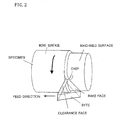
- the outside-surface of the cylindrical shape was cut, using hardmetal (HTi05T (TM)) byte, while the cylinder was roteted around the axis of symmetry as the central axis.
- TM hardmetal
- a cutting distance was evaluated.
- the cutting distance is defined as the distance that the byte has cut until the flank wear of clearance face (i.e. wear depth of clearance face) reaches 0.5mm.
- the respective examples clearly demonstrate that the sintered body has a high compressive radial crushing strength, a long cutting distance for indicating a tool-life, and excellency in machinability. Therefore, each of these examples of this invention has excellent characteristics as iron-based mixed powder. Moreover, these examples make it possible to reduce the surface roughness Rz after cutting, resulting in reducing the burden of the further finishing-work. On the other hand, the comparative example, which spins out from the appropriate range of this invention, has low compressive radial crushing strength, or degraded machinability.
- the blending amount of the powder for an alloy and the powder for a machinability improvement were determined in mass %, based on the amount of the sum total of iron-based powder, the powder for an alloy, and the powder for a machinability improvement.
- the blending amount of the binder was determined in a weight part, based on the amount of sum totals 100 weight part of iron-based powder, the powder for an alloy, and the powder for a machinability improvement.
- Lubricant was blended with the iron-based powder to which these segregation-preventing treatment had been performed. Afterwards, the material was charged into V shaped blender to be mixed homogeneously for obtaining an iron-based mixed powder.
- Lubricant was the kind shown in Table 2. And the blending amount (mass part) of the lubricant was shown in Table 2, based on the amount of the sum total 100 mass part of the iron-based powder, the powder for an alloy, and the powder for a machinability improvement.
- the obtained iron-based mixed powder was filled into the die.
- the compaction was carried out, and it came to be the green compact (ring-shaped specimen A, B) like Example 1.
- this green compact was sintered under the conditions at 1130 degree-C and for 20 min in RX gas atmosphere, while using the mesh-belt type furnace. Resultantly, the sintered body was obtained.
- the compressive rupture test and the turning test were carried out like Example 1.
- Table 3 Iron-based mixed powder No. Characteristics of sintered body Remarks Radial crushing strength (MPa) Machinability Cutting distance (m) Surface roughness Rz ( ⁇ m) 21 730 28000 9.0 Examples 22 727 27000 8.9 Examples 23 625 25000 9.3 Examples 24 623 28000 9.2 Examples 25 725 6000 13.8 Comparative examples 26 630 8000 15.2 Comparative examples
- Example 1 the whole of these examples of the present invention has the high compressive rapture strength of a sintered body.
- the cutting distance for judging the tool-life (durability) is long.
- Such an examples serves as a sintered body excellent in machinability. Therefore, the iron-based mixed powder has the characteristic, which is excellent as iron-based mixed powder.
- the present invention makes it possible for the sintered body to be improved about machinability. This improvement is done without degrading the mechanical properties of the sintered body. Such improvement enables the productivity of the sintered body, which requires the cutting-work, to become higher remarkably, resulting in a brilliant industrial effect to a great extent.
- the 2nd embodiment comprises an iron-based mixed powder, by mixing iron-based powder, the powder for an alloy, the powder for machinability improvement, and lubricant.
- the powder for machinability improvement comprises manganese sulfide powder and/or calcium fluoride powder, whose average particle diameter is 1 to 60 micrometers, and whose content is 0.1 to 1.5 mass % in total based on the amount of sum totals of iron-based powder, the powder for an alloy, and the powder for machinability improvement.
- the particle size distribution of the powder which consists of at least one sort of manganese sulfide powder and calcium fluoride powder, is substantially the same as the size distribution of pores of a sintered body, obtained by compacting the iron-based mixed powder without adding manganese sulfide powder or calcium fluoride powder and by sintering the formed iron-based mixed powder.
- the average particle diameter of manganese sulfide is 1 to 10 micrometers, and the average particle diameter of calcium fluoride is 20 to 60 micrometers. And the content of calcium fluoride is 20 to 80 mass % based on the amount of sum totals of manganese sulfide and calcium fluoride.
- This embodiment has the feature in average particle diameter using manganese sulfide powder and/or calcium fluoride powder, which are 1 to 60 micrometers as powder for machinability improvement.
- the machinability improvement effect of manganese sulfide powder and calcium fluoride powder is provided by the chipping effect as above-mentioned, i.e. making scraps a fine size.
- the chipping effect i.e. making scraps a fine size.
- the particle size distribution of the powder which consists of at least one sort of manganese sulfide powder and calcium fluoride powder, has a similarity or a resemblance to (or more preferably, is substantially the same as) the size distribution of pores of a sintered body obtained by compacting and sintering without adding manganese sulfide powder or calcium fluoride powder.
- the particles of manganese sulfide powder and/or calcium fluoride powder efficiently fill up with pores in the sintered body, which is created during compaction and sintering, resulting in decreasing pores. So, the intermittence impact given to a tool by the collision with the free surface, which form pores inside a sintered body, and tool can be eased.
- the following procedure is exemplified.
- the manganese sulfide powder and/or calcium fluoride powder is classified by mesh using ordinary sieving method.
- the sintered body of an iron-based mixed powder without any additive for the machinability improvement (such as the manganese sulfide powder or the calcium fluoride powder) is prepared by compacting and sintering in an appointed condition (i.e. equivalent to the predetermined condition for inventive mixed powder). A section of the sintered body observed by an optical microscope is photographed.
- a size for an area of the pore section can be defined as a diameter of the circle having the same area as the pore.
- the pore size distribution which is an original pore size distribution in the sintered body without any additive for the machinability improvement, is represented by the existence ratio of the number of pores in the aforesaid each mesh section to a total number of pores in the image. Then, the classified powders of manganese sulfide powder and/or calcium fluoride powder are blended by approximately the same ratio with the existence ratio (of the original pore size distribution) for each mesh section.
- the average particle diameter of manganese sulfide powder and/or calcium fluoride powder is substantially the same (or substantially equivalent) as the original pore size distribution.
- the particle size distribution of the aforesaid powder and the pore size distribution of the aforesaid compact be identical. Rather, a rough similarity (or resemblance) between the particle size distribution of the aforesaid powder and the pore size distribution of the aforesaid compact would have a sufficient effect.
- any process that improves similarity between the two distributions i.e. bring the two distributions closer to substantially the same
- enhances the machinability improvement effect enhances the machinability improvement effect. Therefore, in the above example method, the differences in the existence ratio in the mesh section is acceptable even for about 20% of the ratio or about 10 point in percentage. Same is applied for following simpler method.
- the aforesaid original pore size distribution is estimated by the existence ratio of two groups.
- the two groups are defined so that each of the two average particle diameters (of the manganese sulfide powder and the calcium fluoride powder) to be the representing value of each one of the groups.
- the two groups are divided by the arithmetic mean value or the logarithm mean value of the two average particle diameters.
- the manganese sulfide powder and the calcium fluoride powder are blended such that the ratio of them being approximately the same, or at least getting closer to the existence ratio (of the original pore size distribution).
- the component having the density of 6.0 to 7.0 Mg/m 3 which is the density of general-purpose iron-based sintered component
- An average particle diameter of manganese sulfide powder is 1 to 10 micrometers.
- that of calcium fluoride powder is 20 to 60 micrometers.
- the content of calcium fluoride is 20 to 80 mass % based on the amount of sum totals of manganese sulfide powder and calcium fluoride powder.
- a laser diffraction-scattering method using laser measures the particle diameter of the powder.
- the average particle diameter was defined by 50%-accumulation transmission particle diameter (d 50 ) by mass.
- the original pore size distribution is evaluated by the following procedure.
- Optical-microscope photograph of cross section of sintered body which is practically produced without any additives for machinability improving, is converted into electronic image by a scanner. Then, the brightness of the image is binarized into a clear part and a dark part. Then, the dark part is considered to be the pore, and the area (cross section) thereof is estimated by the number of pixels.
- Each pore size is defined as a diameter of the circle having the same area as the pore, and then, the existence ration by number for each size is evaluated.
- the powder for machinability improvement is in an amount of 0.1 to 1.5 mass % based on the total amounts of the iron-based powder, the powder for an alloy, and the powder for machinability improvement.
- iron-based mixed powders as comparative examples are prepared, in which a calcium phosphate powder or a hydroxy apatite powder was blended, or, no powders for machinability improvement were contained.
- the specimen green compact was sintered under the condition at 1150 degree-C and for 20min, while using the mesh-belt type furnace in a gas of 5vol%H 2 -remainder N 2 . Resultantly, the sintered body of sintered density of 6.5 to 6.7 Mg/m 3 was obtained. With the obtained sintered body (specimen), the radial crushing test in accordance with the regulation of JIS Z 2507 and the cutting test were performed.
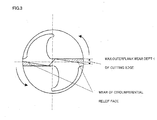
- Drill cutting test was done, using a drill of outer diameter: 3.0mm hardmetal (HTi05T (TM)). Drill cutting of the plane of the tablet-shaped sintered body was carried out on condition of rotational speed. 8000rpm and 0.02 mm/rev. Torque and amplitude of the vibration of torque were measured at the time of 200th hole working, as cutting force. Further, the (maximum) outer flank wear depth of the drill after 200 hole working was measured and compared. The appearance of wear of a drill circumferential part is shown in Fig. 3 .
- a work material was set to a tool dynamometer (a product of Kistler Japan Co. Ltd.).
- tool dynamometer a product of Kistler Japan Co. Ltd.
- the change of the torque was measured, when the time passed.
- Fig.4 shows the change of the torque on the time-passage.
- the torque was estimated based on the average value of the height of rectangular wave. Based on the amplitude of the vibration on a rectangular wave, the variation of the torque was estimated.
- the present invention brings about very little degradation of the strength of the sintered body.
- the outer flank wear of the drill is very few, which means, equal or less than 0.05 mm.
- the cutting power (torque) and the amplitude of the vibration thereof are very small.
- the amplitude of the vibration of the cutting force corresponds to the intermittence impact.
- pores inside a sintered body are effectively reduced, resulting in reducing intermittence impact.
- the comparative example (or the conventional example), which falls out of the range of the example of the present invention, show that the tool wear, the cutting power and the amplitude of the vibration of the cutting power increase to a great extent, resulting in a lot of difficultly to be cut.
- this embodiment makes it possible for the sintered body to be improved about machinability. This improvement is done without degrading the mechanical properties of the sintered body. Such improvement enables the productivity of the sintered body, which requires the cutting-work, and tool-life, to become higher remarkably, resulting in a brilliant industrial effect to a great extent.
- the disclosure includes the following numbered paragraphs.
Landscapes
- Chemical & Material Sciences (AREA)
- Engineering & Computer Science (AREA)
- Materials Engineering (AREA)
- Mechanical Engineering (AREA)
- Metallurgy (AREA)
- Organic Chemistry (AREA)
- Powder Metallurgy (AREA)
Applications Claiming Priority (2)
| Application Number | Priority Date | Filing Date | Title |
|---|---|---|---|
| JP2004279335A JP4412133B2 (ja) | 2004-09-27 | 2004-09-27 | 粉末冶金用鉄基混合粉 |
| EP05020812A EP1649953A3 (fr) | 2004-09-27 | 2005-09-23 | Mélange de poudre à base de fer pour la métallurgie des poudres et corps fritté obtenu a partir de ladite composition |
Related Parent Applications (1)
| Application Number | Title | Priority Date | Filing Date |
|---|---|---|---|
| EP05020812.3 Division | 2005-09-23 |
Publications (2)
| Publication Number | Publication Date |
|---|---|
| EP2258501A2 true EP2258501A2 (fr) | 2010-12-08 |
| EP2258501A3 EP2258501A3 (fr) | 2011-12-28 |
Family
ID=35539657
Family Applications (2)
| Application Number | Title | Priority Date | Filing Date |
|---|---|---|---|
| EP10178282A Withdrawn EP2258501A3 (fr) | 2004-09-27 | 2005-09-23 | Mélange de poudre à base de fer pour la métallurgie des poudres et corps fritté obtenu a partir de ladite composition |
| EP05020812A Withdrawn EP1649953A3 (fr) | 2004-09-27 | 2005-09-23 | Mélange de poudre à base de fer pour la métallurgie des poudres et corps fritté obtenu a partir de ladite composition |
Family Applications After (1)
| Application Number | Title | Priority Date | Filing Date |
|---|---|---|---|
| EP05020812A Withdrawn EP1649953A3 (fr) | 2004-09-27 | 2005-09-23 | Mélange de poudre à base de fer pour la métallurgie des poudres et corps fritté obtenu a partir de ladite composition |
Country Status (5)
| Country | Link |
|---|---|
| US (1) | US7300490B2 (fr) |
| EP (2) | EP2258501A3 (fr) |
| JP (1) | JP4412133B2 (fr) |
| CN (1) | CN1768985B (fr) |
| CA (1) | CA2520084C (fr) |
Cited By (1)
| Publication number | Priority date | Publication date | Assignee | Title |
|---|---|---|---|---|
| RU2597452C2 (ru) * | 2014-09-11 | 2016-09-10 | Павел Аркадьевич Киселёв | Антифрикционные материалы на основе железа |
Families Citing this family (30)
| Publication number | Priority date | Publication date | Assignee | Title |
|---|---|---|---|---|
| DE102007028109A1 (de) * | 2007-06-19 | 2008-12-24 | Märkisches Werk GmbH | Thermisch gespritzte, gasdichte Schutzschicht für metallische Substrate |
| CN101801566B (zh) * | 2007-09-14 | 2012-02-15 | 杰富意钢铁株式会社 | 粉末冶金用铁基粉末 |
| US20090162241A1 (en) * | 2007-12-19 | 2009-06-25 | Parker Hannifin Corporation | Formable sintered alloy with dispersed hard phase |
| BRPI0922422B1 (pt) | 2008-12-22 | 2017-12-19 | Höganäs Ab Publ | The invention relates to a powder-based composition of iron, the use of a silicon compound in an improvedability additive, and methods of producing an iron-based powder composition and to produce a sintered layer of iron |
| JP5663974B2 (ja) * | 2009-06-26 | 2015-02-04 | Jfeスチール株式会社 | 粉末冶金用鉄基混合粉末 |
| JP5504863B2 (ja) * | 2009-12-10 | 2014-05-28 | Jfeスチール株式会社 | 粉末冶金用混合粉および切削性に優れた金属粉末製焼結体 |
| CN102373359B (zh) * | 2010-08-20 | 2015-02-18 | 鞍钢重型机械有限责任公司 | 一种汽车发动机专用合金钢粉的生产方法 |
| JP2012052167A (ja) * | 2010-08-31 | 2012-03-15 | Toyota Motor Corp | 焼結用鉄基混合粉末及び鉄基焼結合金 |
| CN102034585B (zh) * | 2010-10-13 | 2012-10-17 | 莱州长和粉末冶金有限公司 | 发动机冷却风扇用铁芯的制造工艺 |
| JP5552031B2 (ja) * | 2010-11-09 | 2014-07-16 | 株式会社神戸製鋼所 | 粉末冶金用混合粉末 |
| CN102888562B (zh) * | 2012-10-17 | 2014-12-10 | 宁波拓发汽车零部件有限公司 | 减震器压缩阀及其制备方法 |
| CN102925807B (zh) * | 2012-10-26 | 2014-11-05 | 益阳世龙新材料有限公司 | 适用于高速镗削加工的粉末冶金铁基材料及制备方法 |
| CN104870125B (zh) * | 2012-12-28 | 2017-04-26 | 杰富意钢铁株式会社 | 粉末冶金用铁基粉末 |
| WO2015008406A1 (fr) * | 2013-07-18 | 2015-01-22 | Jfeスチール株式会社 | Poudre mélangée pour métallurgie des poudres, procédé pour la production de celle-ci et procédé pour la production de comprimé fritté de formulation de poudre à base de fer |
| CN103909269B (zh) * | 2014-04-16 | 2015-08-12 | 刘贵平 | 一种粉末冶金闭门器活塞及其加工工艺 |
| JP6372271B2 (ja) * | 2014-09-16 | 2018-08-15 | 新日鐵住金株式会社 | 製鉄用ペレットの還元粉化指数の推定方法 |
| KR102543070B1 (ko) | 2015-02-03 | 2023-06-12 | 회가내스 아베 (피유비엘) | 용이한 기계가공을 위한 분말 금속 조성물 |
| ES2986891T3 (es) | 2016-03-18 | 2024-11-13 | Hoeganaes Ab Publ | Composición metálica en polvo para un mecanizado fácil |
| CN106041099B (zh) * | 2016-06-23 | 2018-08-03 | 合肥工业大学 | 一种高强减摩双层铁基粉末冶金材料及其制备方法 |
| CN107245670A (zh) * | 2017-05-22 | 2017-10-13 | 东风汽车零部件(集团)有限公司东风粉末冶金公司 | 一种柴油发动机气门导管材料 |
| CN107099754A (zh) * | 2017-05-22 | 2017-08-29 | 东风汽车零部件(集团)有限公司东风粉末冶金公司 | 一种天然气发动机气门导管材料 |
| WO2018230568A1 (fr) * | 2017-06-16 | 2018-12-20 | Jfeスチール株式会社 | Mélange de poudre pour métallurgie des poudres et son procédé de fabrication |
| JP6648779B2 (ja) * | 2017-06-16 | 2020-02-14 | Jfeスチール株式会社 | 粉末冶金用粉末混合物およびその製造方法 |
| US20210262050A1 (en) * | 2018-08-31 | 2021-08-26 | Höganäs Ab (Publ) | Modified high speed steel particle, powder metallurgy method using the same, and sintered part obtained therefrom |
| CN109513938A (zh) * | 2018-11-20 | 2019-03-26 | 广州市光铭金属制品有限责任公司 | 一种用于木工机械设备的送料轮材料及其制备方法 |
| KR20210029582A (ko) * | 2019-09-06 | 2021-03-16 | 현대자동차주식회사 | 철계 예합금 분말, 철계 확산접합 분말 및 이를 이용하는 분말야금용 철계 합금 분말 |
| CN113122766A (zh) * | 2021-03-04 | 2021-07-16 | 安徽绿能技术研究院有限公司 | 一种铁基粉末烧结材料的制备工艺 |
| US11988294B2 (en) | 2021-04-29 | 2024-05-21 | L.E. Jones Company | Sintered valve seat insert and method of manufacture thereof |
| CN114470317A (zh) * | 2022-01-21 | 2022-05-13 | 江苏科技大学 | 一种颅骨修补用钛合金材料及其制备方法 |
| CN119216583B (zh) * | 2024-12-04 | 2025-03-18 | 烟台东一粉末冶金制造有限公司 | 一种重卡转向助力油泵定子的粉末冶金制造方法 |
Citations (4)
| Publication number | Priority date | Publication date | Assignee | Title |
|---|---|---|---|---|
| JPS61147801A (ja) | 1984-11-30 | 1986-07-05 | ヘーガネース アーベー | 硫化マンガン含有鉄粉混合物及びその製造方法 |
| JP3004800B2 (ja) | 1991-03-27 | 2000-01-31 | 川崎製鉄株式会社 | 粉末冶金用鉄基粉末混合物及びその製造方法 |
| JP3073526B2 (ja) | 1992-05-27 | 2000-08-07 | ホガナス アクチボラゲット | 鉄基粉末組成物、焼結製品および焼結製品の切削性を改善する方法 |
| JP2002155301A (ja) | 2000-11-17 | 2002-05-31 | Kawasaki Steel Corp | 粉末冶金用鉄基混合粉および鉄基焼結体 |
Family Cites Families (14)
| Publication number | Priority date | Publication date | Assignee | Title |
|---|---|---|---|---|
| US3297571A (en) * | 1962-09-14 | 1967-01-10 | Ilikon Corp | Lubricant composition and articles and process of preparing and using the same |
| US3823002A (en) * | 1972-05-05 | 1974-07-09 | Minnesota Mining & Mfg | Precision molded refractory articles |
| US4256489A (en) * | 1979-01-10 | 1981-03-17 | The Boeing Company | Low wear high current density sliding electrical contact material |
| JP3449110B2 (ja) | 1996-04-17 | 2003-09-22 | 株式会社神戸製鋼所 | 粉末冶金用鉄系混合粉末およびこれを用いた焼結体の製法 |
| JPH10226855A (ja) | 1996-12-11 | 1998-08-25 | Nippon Piston Ring Co Ltd | 耐摩耗焼結合金製内燃機関用バルブシート |
| JP3952344B2 (ja) | 1998-12-28 | 2007-08-01 | 日本ピストンリング株式会社 | バルブシート用耐摩耗性鉄基焼結合金材および鉄基焼結合金製バルブシート |
| JP2003034803A (ja) | 2000-08-29 | 2003-02-07 | Kawasaki Steel Corp | 粉末冶金用鉄基混合粉 |
| US6679932B2 (en) * | 2001-05-08 | 2004-01-20 | Federal-Mogul World Wide, Inc. | High machinability iron base sintered alloy for valve seat inserts |
| JP2003221602A (ja) | 2002-01-31 | 2003-08-08 | Jfe Steel Kk | 粉末冶金用鉄基混合粉 |
| CA2372780C (fr) | 2001-05-17 | 2007-02-13 | Kawasaki Steel Corporation | Melange de poudre a base de fer pour la metallurgie des poudres et pastille frittee a base de fer |
| JP3970060B2 (ja) * | 2002-03-12 | 2007-09-05 | 株式会社リケン | バルブシート用鉄基焼結合金 |
| US20030219617A1 (en) * | 2002-05-21 | 2003-11-27 | Jfe Steel Corporation, A Corporation Of Japan | Powder additive for powder metallurgy, iron-based powder mixture for powder metallurgy, and method for manufacturing the same |
| US6746506B2 (en) * | 2002-07-12 | 2004-06-08 | Extrude Hone Corporation | Blended powder solid-supersolidus liquid phase sintering |
| JP4115826B2 (ja) | 2002-12-25 | 2008-07-09 | 富士重工業株式会社 | アルミニウム合金鋳包み性に優れた鉄系焼結体およびその製造方法 |
-
2004
- 2004-09-27 JP JP2004279335A patent/JP4412133B2/ja not_active Expired - Fee Related
-
2005
- 2005-09-19 CA CA002520084A patent/CA2520084C/fr not_active Expired - Fee Related
- 2005-09-20 US US11/230,714 patent/US7300490B2/en not_active Expired - Fee Related
- 2005-09-23 EP EP10178282A patent/EP2258501A3/fr not_active Withdrawn
- 2005-09-23 EP EP05020812A patent/EP1649953A3/fr not_active Withdrawn
- 2005-09-27 CN CN2005101070801A patent/CN1768985B/zh not_active Expired - Lifetime
Patent Citations (4)
| Publication number | Priority date | Publication date | Assignee | Title |
|---|---|---|---|---|
| JPS61147801A (ja) | 1984-11-30 | 1986-07-05 | ヘーガネース アーベー | 硫化マンガン含有鉄粉混合物及びその製造方法 |
| JP3004800B2 (ja) | 1991-03-27 | 2000-01-31 | 川崎製鉄株式会社 | 粉末冶金用鉄基粉末混合物及びその製造方法 |
| JP3073526B2 (ja) | 1992-05-27 | 2000-08-07 | ホガナス アクチボラゲット | 鉄基粉末組成物、焼結製品および焼結製品の切削性を改善する方法 |
| JP2002155301A (ja) | 2000-11-17 | 2002-05-31 | Kawasaki Steel Corp | 粉末冶金用鉄基混合粉および鉄基焼結体 |
Cited By (1)
| Publication number | Priority date | Publication date | Assignee | Title |
|---|---|---|---|---|
| RU2597452C2 (ru) * | 2014-09-11 | 2016-09-10 | Павел Аркадьевич Киселёв | Антифрикционные материалы на основе железа |
Also Published As
| Publication number | Publication date |
|---|---|
| JP4412133B2 (ja) | 2010-02-10 |
| US7300490B2 (en) | 2007-11-27 |
| EP1649953A2 (fr) | 2006-04-26 |
| CA2520084A1 (fr) | 2006-03-27 |
| CN1768985B (zh) | 2010-11-24 |
| EP2258501A3 (fr) | 2011-12-28 |
| CN1768985A (zh) | 2006-05-10 |
| EP1649953A3 (fr) | 2006-11-22 |
| CA2520084C (fr) | 2009-06-23 |
| US20060065072A1 (en) | 2006-03-30 |
| JP2006089829A (ja) | 2006-04-06 |
Similar Documents
| Publication | Publication Date | Title |
|---|---|---|
| US7300490B2 (en) | Iron-based mixed powder for powder metallurgy and sintered body | |
| KR101101734B1 (ko) | 철기 혼합 분말 그리고 철기 분말 성형체 및 철기 분말 소결체의 제조 방법 | |
| KR100245511B1 (ko) | 피절삭성이 개선된 철-기지분말조성물및그소결제품 | |
| EP2475481B1 (fr) | Composition de poudre métallique | |
| EP2379764B1 (fr) | Procédé de production d'une poudre d'alliage de fer ou à base de fer formée par diffusion, poudre d'alliage formée par diffusion et composition comprenant cette poudre | |
| CA2059323C (fr) | Melange de poudre d'acier compose de poudres d'acier alliees distinctes d'alliages de fer | |
| JP2003514112A (ja) | 改善された冶金用粉末組成物およびその製造法並びに使用 | |
| US6355208B1 (en) | Die lubricant and iron-based powder mixture for warm compaction with die lubrication, and processes for producing high-density iron-based green and sintered compacts | |
| EP0861698A2 (fr) | Mélange de poudres métalliques à base de fer | |
| JP5504963B2 (ja) | 粉末冶金用混合粉および切削性に優れた金属粉末製焼結体 | |
| JP6392797B2 (ja) | 粉末冶金用鉄系粉末、及び粉末冶金用鉄系粉末の製造方法 | |
| JP5504971B2 (ja) | 粉末冶金用混合粉および切削性に優れた金属粉末製焼結体 | |
| JP4839275B2 (ja) | 粉末冶金用混合粉末および鉄粉焼結体 | |
| KR20080080304A (ko) | 금속 야금학적 분말 조성물 | |
| JP4640162B2 (ja) | 粉末冶金用鉄基混合粉および鉄基焼結体 | |
| JP2003034803A (ja) | 粉末冶金用鉄基混合粉 | |
| JP5504863B2 (ja) | 粉末冶金用混合粉および切削性に優れた金属粉末製焼結体 | |
| EP3978165A1 (fr) | Corps fritté en alliage à base de fer et poudre mixte à base de fer pour métallurgie des poudres | |
| JP3855899B2 (ja) | 粉末冶金用鉄基混合粉 | |
| JPS63137137A (ja) | 切削性に優れた焼結鋼 | |
| JP5310074B2 (ja) | 自動車の高強度焼結部品用の鉄基粉末混合物 | |
| EP3756790A1 (fr) | Poudre mélangée pour métallurgie des poudres | |
| JP2006348335A (ja) | 粉末冶金用鉄基混合粉 | |
| JP2007211329A (ja) | 粉末冶金用鉄基混合粉 |
Legal Events
| Date | Code | Title | Description |
|---|---|---|---|
| PUAI | Public reference made under article 153(3) epc to a published international application that has entered the european phase |
Free format text: ORIGINAL CODE: 0009012 |
|
| AC | Divisional application: reference to earlier application |
Ref document number: 1649953 Country of ref document: EP Kind code of ref document: P |
|
| AK | Designated contracting states |
Kind code of ref document: A2 Designated state(s): SE |
|
| PUAL | Search report despatched |
Free format text: ORIGINAL CODE: 0009013 |
|
| AK | Designated contracting states |
Kind code of ref document: A3 Designated state(s): SE |
|
| RIC1 | Information provided on ipc code assigned before grant |
Ipc: B22F 1/00 20060101AFI20111124BHEP Ipc: C22C 33/02 20060101ALI20111124BHEP |
|
| 17P | Request for examination filed |
Effective date: 20120216 |
|
| STAA | Information on the status of an ep patent application or granted ep patent |
Free format text: STATUS: THE APPLICATION HAS BEEN WITHDRAWN |
|
| 18W | Application withdrawn |
Effective date: 20131223 |