EP2259477A2 - Hybrides Brückenverfahren mit Signalkonstellation-Neuanordnung - Google Patents
Hybrides Brückenverfahren mit Signalkonstellation-Neuanordnung Download PDFInfo
- Publication number
- EP2259477A2 EP2259477A2 EP10178347A EP10178347A EP2259477A2 EP 2259477 A2 EP2259477 A2 EP 2259477A2 EP 10178347 A EP10178347 A EP 10178347A EP 10178347 A EP10178347 A EP 10178347A EP 2259477 A2 EP2259477 A2 EP 2259477A2
- Authority
- EP
- European Patent Office
- Prior art keywords
- symbol
- bit
- bits
- data packets
- predetermined
- Prior art date
- Legal status (The legal status is an assumption and is not a legal conclusion. Google has not performed a legal analysis and makes no representation as to the accuracy of the status listed.)
- Granted
Links
- 238000000034 method Methods 0.000 title claims abstract description 27
- 230000008707 rearrangement Effects 0.000 title description 6
- 230000005540 biological transmission Effects 0.000 claims abstract description 103
- 238000004891 communication Methods 0.000 claims abstract description 19
- 238000012937 correction Methods 0.000 claims abstract description 6
- 238000013507 mapping Methods 0.000 claims description 80
- 238000013459 approach Methods 0.000 description 5
- 238000012935 Averaging Methods 0.000 description 4
- 230000015556 catabolic process Effects 0.000 description 3
- 238000006731 degradation reaction Methods 0.000 description 3
- 238000004364 calculation method Methods 0.000 description 2
- 125000004122 cyclic group Chemical group 0.000 description 2
- 230000011664 signaling Effects 0.000 description 2
- 238000007476 Maximum Likelihood Methods 0.000 description 1
- 239000000654 additive Substances 0.000 description 1
- 230000000996 additive effect Effects 0.000 description 1
- 238000004458 analytical method Methods 0.000 description 1
- 230000009286 beneficial effect Effects 0.000 description 1
- 230000003247 decreasing effect Effects 0.000 description 1
- 238000010586 diagram Methods 0.000 description 1
- 238000005516 engineering process Methods 0.000 description 1
Images




Classifications
-
- H—ELECTRICITY
- H04—ELECTRIC COMMUNICATION TECHNIQUE
- H04L—TRANSMISSION OF DIGITAL INFORMATION, e.g. TELEGRAPHIC COMMUNICATION
- H04L1/00—Arrangements for detecting or preventing errors in the information received
- H04L1/12—Arrangements for detecting or preventing errors in the information received by using return channel
- H04L1/16—Arrangements for detecting or preventing errors in the information received by using return channel in which the return channel carries supervisory signals, e.g. repetition request signals
- H04L1/18—Automatic repetition systems, e.g. Van Duuren systems
- H04L1/1812—Hybrid protocols; Hybrid automatic repeat request [HARQ]
- H04L1/1816—Hybrid protocols; Hybrid automatic repeat request [HARQ] with retransmission of the same, encoded, message
-
- H—ELECTRICITY
- H04—ELECTRIC COMMUNICATION TECHNIQUE
- H04L—TRANSMISSION OF DIGITAL INFORMATION, e.g. TELEGRAPHIC COMMUNICATION
- H04L1/00—Arrangements for detecting or preventing errors in the information received
- H04L1/0001—Systems modifying transmission characteristics according to link quality, e.g. power backoff
- H04L1/0002—Systems modifying transmission characteristics according to link quality, e.g. power backoff by adapting the transmission rate
- H04L1/0003—Systems modifying transmission characteristics according to link quality, e.g. power backoff by adapting the transmission rate by switching between different modulation schemes
-
- H—ELECTRICITY
- H04—ELECTRIC COMMUNICATION TECHNIQUE
- H04L—TRANSMISSION OF DIGITAL INFORMATION, e.g. TELEGRAPHIC COMMUNICATION
- H04L1/00—Arrangements for detecting or preventing errors in the information received
- H04L1/12—Arrangements for detecting or preventing errors in the information received by using return channel
- H04L1/16—Arrangements for detecting or preventing errors in the information received by using return channel in which the return channel carries supervisory signals, e.g. repetition request signals
- H04L1/18—Automatic repetition systems, e.g. Van Duuren systems
- H04L1/1812—Hybrid protocols; Hybrid automatic repeat request [HARQ]
-
- H—ELECTRICITY
- H04—ELECTRIC COMMUNICATION TECHNIQUE
- H04L—TRANSMISSION OF DIGITAL INFORMATION, e.g. TELEGRAPHIC COMMUNICATION
- H04L1/00—Arrangements for detecting or preventing errors in the information received
- H04L1/12—Arrangements for detecting or preventing errors in the information received by using return channel
- H04L1/16—Arrangements for detecting or preventing errors in the information received by using return channel in which the return channel carries supervisory signals, e.g. repetition request signals
- H04L1/18—Automatic repetition systems, e.g. Van Duuren systems
- H04L1/1812—Hybrid protocols; Hybrid automatic repeat request [HARQ]
- H04L1/1819—Hybrid protocols; Hybrid automatic repeat request [HARQ] with retransmission of additional or different redundancy
-
- H—ELECTRICITY
- H04—ELECTRIC COMMUNICATION TECHNIQUE
- H04L—TRANSMISSION OF DIGITAL INFORMATION, e.g. TELEGRAPHIC COMMUNICATION
- H04L27/00—Modulated-carrier systems
- H04L27/32—Carrier systems characterised by combinations of two or more of the types covered by groups H04L27/02, H04L27/10, H04L27/18 or H04L27/26
- H04L27/34—Amplitude- and phase-modulated carrier systems, e.g. quadrature-amplitude modulated carrier systems
-
- H—ELECTRICITY
- H04—ELECTRIC COMMUNICATION TECHNIQUE
- H04L—TRANSMISSION OF DIGITAL INFORMATION, e.g. TELEGRAPHIC COMMUNICATION
- H04L27/00—Modulated-carrier systems
- H04L27/32—Carrier systems characterised by combinations of two or more of the types covered by groups H04L27/02, H04L27/10, H04L27/18 or H04L27/26
- H04L27/34—Amplitude- and phase-modulated carrier systems, e.g. quadrature-amplitude modulated carrier systems
- H04L27/345—Modifications of the signal space to allow the transmission of additional information
- H04L27/3461—Modifications of the signal space to allow the transmission of additional information in order to transmit a subchannel
- H04L27/3472—Modifications of the signal space to allow the transmission of additional information in order to transmit a subchannel by switching between alternative constellations
Definitions
- the present invention relates to a hybrid ARQ retransmission method in a communication system.
- a common technique in communication systems with unreliable and time-varying channel conditions is to correct errors based on automatic repeat request (ARQ) schemes together with a forward error correction (FEC) technique called hybrid ARQ (HARQ). If an error is detected by a commonly used cyclic redundancy check (CRC), the receiver of the communication system requests the transmitter to resend the erroneously received data packets.
- ARQ automatic repeat request
- FEC forward error correction
- HARQ hybrid ARQ
- Types II and III schemes are obviously more intelligent and show a performance gain with respect to Type I, because they provide the ability to reuse information from of previously received erroneous packets.
- the reliabilities of the transmitted bits will increase linearly with the number and power of received packets. From a decoder point of view the same FEC scheme (with constant code rate) will be employed over all transmissions. Hence, the decoder does not need to know how many retransmissions have been performed, since it sees only the combined soft-decision values. In this scheme all transmitted packets will have to carry the same number of symbols.
- Code-combining concatenates the received packets in order to generate a new code word (decreasing code rate with increasing number of transmission). Hence, the decoder has to be aware of the FEC scheme to apply at each retransmission instant. Code-combining offers a higher flexibility with respect to soft-combining, since the length of the retransmitted packets can be altered to adapt to channel conditions. However, this requires more signaling data to be transmitted with respect to soft-combining.
- the identical code-symbols are combined using soft-combing as described in the section titled "Soft Combining" while the remaining code-symbols will be combined using code-combining.
- the signaling requirements will be similar to code-combining.
- bit reliabilities within soft-combined symbols will be in a constant ratio over all retransmissions, i.e. bits which have been less reliable from previous received transmissions will still be less reliable after having received further transmissions and, analogous, bits which have been more reliable from previous received transmissions will still be more reliable after having received further transmissions.
- the varying bit reliabilities evolve from the constraint of two-dimensional signal constellation mapping, where modulation schemes carrying more than 2 bits per symbol cannot have the same mean reliabilities for all bits under the assumption that all symbols are transmitted equally likely.
- mean reliabilities is consequently meant as the reliability of a particular bit over all symbols of a signal constellation.
- bits mapped onto the symbols differ from each other in mean reliability in the first transmission of the packet.
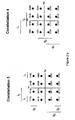
- bits i 1 and q 1 have a high mean reliability, as these bits are mapped to half spaces of the signal constellation diagram with the consequences that their reliability is independent from the fact of whether the bit transmits a one or a zero.
- bits i 2 and q 2 have a low mean reliability, as their reliability depends on the fact of whether they transmit a one or a zero. For example, for bit i 2 , ones are mapped to outer columns, whereas zeros are mapped to inner columns. Similarly, for bit q 2 , ones are mapped to outer rows, whereas zeros are mapped to inner rows.
- bit reliabilities will stay in a constant ratio to each other, which is defined by the signal constellation employed in the first transmission, i.e. bits i 1 and q 1 will always have a higher mean reliability than bits i 2 and q 2 after any number of retransmissions.
- the object underlying the present invention is to provide a hybrid ARQ retransmission method with an improved error correction performance. This object is solved by a method as set forth in claim 1.
- the method subject to the invention is based on the recognition that in order to enhance the decoder performance, it would be quite beneficial to have equal or near to equal mean bit reliabilities after each received transmission of a packet.
- the idea underlying the invention is to tailor the bit reliabilities over the retransmissions in a way that the mean bit reliabilities get averaged out. This is achieved by choosing a predetermined first and at least second signal constellation for the transmissions, such that the combined mean bit reliabilities for the respective bits of all transmissions are nearly equal.
- the signal constellation rearrangement results in a changed bit mapping, wherein the Euclidean distances between the modulation symbols can be altered from retransmission to retransmission due to the movement of the constellation points.
- the mean bit reliabilities can be manipulated in a desired manner and averaged out to increase the performance the FEC decoder at the receiver.
- LLR Log-Likelihood-Ratio
- Equation (1) the LLR depends on the signal-to-noise ratio E s / N 0 and the Euclidean distances d n,m between the signal constellation points.
- LLR s bit reliabilities
- the differences in mean reliabilities remain over all retransmissions and lead to a degradation in decoder performance.
- Level 1 Bit mapping for ones ( zeros ) separated into the positive (negative) real half space for the i-bits and the imaginary half space the q-bits. Here, there is no difference whether the ones are mapped to the positive or to the negative half space.
- Level 2 (Low Reliability, 2 bits): Ones ( zeros ) are mapped to inner (outer) columns for the i-bits or to inner (outer) rows for the q-bits. Since there is a difference for the LLR depending on the mapping to the inner (outer) columns and rows, Level 2 is further classified:
- Level 2a Mapping of i n to inner columns and q n to inner rows respectively.
- Level 2b Inverted mapping of Level 2a: Mapping of in to outer columns and q n to outer rows respectively.
- bit-mapping order is open prior initial transmission, but has to remain through retransmissions, e.g. bit-mapping for initial transmission: i 1 q 1 i 2 q 2 ⁇ bit-mapping all retransmissions: i 1 q 1 i 2 q 2 .
- Table 2 provides some examples how to combine the constellations for the transmissions 1 to 4 (using 4 different mappings).
- mappings Two algorithms are given which describe schemes using 2 or 4 mappings overall.
- the approach using 2 mappings results in less system complexity, however has some performance degradation with respect to the approach using 4 mappings.
- the mapping for i- and q-bits can be done independently and, hence, in the following the mapping for the i-bits only is described.
- the algorithms for the q-bits work analog.
- Step Choose Level 1 for i 2 ⁇ Level 2 for i 1 with following options
- Level 1 Bit mapping for ones ( zeros ) separated into the positive (negative) real half space for the i-bits and the imaginary half space for the q-bits. Here, there is no difference whether the ones are mapped to the positive or to the negative half space.
- Level 2 (Medium Reliability, 2 bits): Ones ( zeros ) are mapped to 4 inner and 2x2 outer columns for the i-bits or to 4 inner and 2x2 outer rows for the q-bits. Since there is a difference for the LLR depending on the mapping to the inner or outer column/row Level 2 is further classified:
- Level 2a Mapping of in to 4 inner columns and q n to 4 inner rows respectively.
- Level 2b Inverted mapping of 2a: i n , to outer columns and q n to outer rows respectively
- Level 3 (Low Reliability, 2 bits): Ones ( zeros ) are mapped to columns 1-4-5-8/2-3-6-7 for the i-bits or to rows 1-4-5-8/2-3-6-7 for the q-bits. Since there is a difference for the LLR depending on the mapping to columns/rows 1-4-5-8 or 2-3-6-7 Level 3 is further classified:
- Level 3a Mapping of in to columns 2-3-6-7 and q n to rows 2-3-6-7 respectively
- Level 3b Inverted mapping of 2a: in to columns 1-4-5-8 and q n to rows 1-4-5-8 respectively
- bit-mapping order is open prior initial transmission, but has to remain through retransmissions, e.g. bit-mapping for initial transmission: i 1 q 1 i 2 q 2 i 3 q 3 ⁇ bit-mapping all retransmissions: i 1 q 1 i 2 q 2 i 3 q 3 .
- Table 4 provides some examples how to combine the constellations for the transmissions 1 to 6 (using 6 different mappings).
- mapping for i- and q-bits can be done independently and, hence, in the following the mapping for the i-bits only is described.
- the algorithms for the q-bits work analog.
- Step Choose Level 1 for i 3 Choose Level 2 for i 1 (free choice if 2a or 2b) ⁇ Level 3 for i 2 - free choice if 3a or 3b if (b) in 2.
- Step Choose Level 1 for i 2 Choose Level 2 for i 3 (free choice if 2a or 2b) ⁇ Level 3 for i 1 - free choice if 3a or 3b
- Step Choose Level 1 for i 3 Choose Level 2 for i 1 (free choice if 2a or 2b) ⁇ Level 3 for i 2 - free choice if 3a or 3b if (b) in 2.
- Step Choose Level 1 for i 2 Choose Level 2 for i 3 (free choice if 2a or 2b) ⁇ Level 3 for i 1 - free choice if 3a or 3b
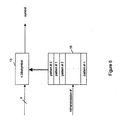
- Figure 5 shows an exemplary embodiment of a communication system to which the present invention can be applied. More specifically, the communication system comprises a transmitter 10 and a receiver 20 which communicate through a channel 30 which can either be wire-bound or wireless, i.e. an air interface.
- a channel 30 which can either be wire-bound or wireless, i.e. an air interface.
- data packets are supplied to a FEC encoder 12, where redundancy bits are added to correct errors.
- the n bits output from the FEC decoder are subsequently supplied to a mapping unit 13 acting as a modulator to output symbols formed according to the applied modulation scheme stored as a constellation pattern in a table 15.
- the receiver 20 checks the received data packets, for example, by means of a cyclic redundancy check (CRC) for correctness.
- CRC cyclic redundancy check
- the received data packets are erroneous, the same are stored in a temporary buffer 22 for subsequent soft combining with the retransmitted data packets.
- a retransmission is launched by an automatic repeat request issued by an error detector (not shown) with the result that an identical data packet is transmitted from the transmitter 10.
- the combining unit 21 the previously received erroneous data packets are soft-combined with the retransmitted data packets.
- the combining unit 21 also acts as a demodulator and the same signal constellation pattern stored in the table 15 is used to demodulate the symbol which was used during the modulation of that symbol.
- the table 15 stores a plurality of signal constellation patterns which are selected for the individual (re)-transmissions according to a predetermined scheme.
- the scheme i.e. the sequence of signal constellation patterns used for modulating/demodulating are either pre-stored in the transmitter and the receiver or are signaled by transmitter to the receiver prior to usage.
- the method underlying the invention rearranges the signal constellation patterns for the individual (re)-transmissions according to a predetermined scheme, such that the mean bit reliabilities are averaged out.
- the performance of the FEC decoder 23 is significantly improved, resulting in a low bit error rate (BER) output from the decoder.
- data packets being encoded with a forward error correction (FEC) technique prior to transmission are retransmitted based on an automatic repeat request and subsequently soft-combined with previously received erroneous data packets either on a symbol-by-symbol or a bit-by-bit basis, the symbols of said erroneous data packets being modulated employing a predetermined first signal constellation and the symbols of the retransmitted data packets being modulated employing at least a predetermined second signal constellation, each symbol bit having a mean bit reliability defined by the individual bit reliabilities over all symbols of the predetermined signal constellation characterized in that the predetermined first and the at least second signal constellation for the data packets are chosen such that the combined mean bit reliabilities for the respective bits of all transmissions are averaged out.
- FEC forward error correction
- the respective Euclidean distances between at least two modulated symbols of the first and respectively second signal constellation are different.
- the employed modulation scheme is Quadrature Amplitude Modulation (QAM), wherein more than two bits are mapped onto one symbol.
- QAM Quadrature Amplitude Modulation
- the symbol bits of the data packets are Gray encoded.
- the employed modulation scheme is 16 DAM and that during modulation one of two levels of mean bit reliabilities are assigned to each of the four symbol bits.
- two bits of a symbol are assigned a high mean bit reliability and the two remaining bits of the symbol are assigned a low mean bit reliability and that during modulation employing the second signal constellation inverted mean bit reliabilities are assigned to the respective symbol bits.
- the employed modulation scheme is 64 CAM and that during modulation one of three levels of mean bit reliabilities are assigned to each of the six symbol bits.
- two bits of a symbol are as signed a high mean bit reliability
- two further bits are assigned a medium mean bit reliability and two remaining bits of the symbol are assigned a low mean bit reliability and that during modulation employing the second signal constellation and a third signal constellation inverted mean bit reliabilities are assigned to respective symbol bits such that the sum of mean bit reliabilities for corresponding bits over all (re)-transmissions are near to equal.
- a receiver in a communication system embodied to carry out the method according to any of claims 1-8 further comprises table means to store the first and the at least second signal constellation pattern.
- the receiver further comprises storage means to store the sequence of signal constellations employed for modulating the symbol bits during all (re)-transmissions.
- the transmitter further comprises table means to store the first and the at least second signal constellation pattern.
- the transmitter further comprises means to signal the sequence of signal constellations employed for modulating the symbol bits for all (re)-transmissions to the receiver.
Landscapes
- Engineering & Computer Science (AREA)
- Computer Networks & Wireless Communication (AREA)
- Signal Processing (AREA)
- Quality & Reliability (AREA)
- Digital Transmission Methods That Use Modulated Carrier Waves (AREA)
- Detection And Prevention Of Errors In Transmission (AREA)
- Communication Control (AREA)
Priority Applications (2)
| Application Number | Priority Date | Filing Date | Title |
|---|---|---|---|
| DK10178347.0T DK2259477T3 (en) | 2001-02-21 | 2001-02-21 | Hybrid ARQ method with signal constellation arrangement |
| EP10178347.0A EP2259477B1 (de) | 2001-02-21 | 2001-02-21 | Hybrides Brückenverfahren mit Signalkonstellation-Neuanordnung |
Applications Claiming Priority (4)
| Application Number | Priority Date | Filing Date | Title |
|---|---|---|---|
| EP04001471A EP1427128B9 (de) | 2001-02-21 | 2001-02-21 | Hybrides ARQ-Verfahren mit Neuanordnung der Signalkonstellation |
| EP10178347.0A EP2259477B1 (de) | 2001-02-21 | 2001-02-21 | Hybrides Brückenverfahren mit Signalkonstellation-Neuanordnung |
| EP06021982A EP1760928B1 (de) | 2001-02-21 | 2001-02-21 | Hybrides ARQ-Verfahren mit Neuanordnung von der Abbildung der Signalkonstellation |
| EP01923594A EP1293059B1 (de) | 2001-02-21 | 2001-02-21 | Hybrides arq-verfahren mit neuanordnung der signalkonstellation |
Related Parent Applications (6)
| Application Number | Title | Priority Date | Filing Date |
|---|---|---|---|
| EP04001471A Division EP1427128B9 (de) | 2001-02-21 | 2001-02-21 | Hybrides ARQ-Verfahren mit Neuanordnung der Signalkonstellation |
| EP06021982A Division EP1760928B1 (de) | 2001-02-21 | 2001-02-21 | Hybrides ARQ-Verfahren mit Neuanordnung von der Abbildung der Signalkonstellation |
| EP01923594.4 Division | 2001-02-21 | ||
| EP01923594A Division EP1293059B1 (de) | 2001-02-21 | 2001-02-21 | Hybrides arq-verfahren mit neuanordnung der signalkonstellation |
| EP04001471.4 Division | 2004-01-23 | ||
| EP06021982.1 Division | 2006-10-19 |
Publications (3)
| Publication Number | Publication Date |
|---|---|
| EP2259477A2 true EP2259477A2 (de) | 2010-12-08 |
| EP2259477A3 EP2259477A3 (de) | 2011-05-11 |
| EP2259477B1 EP2259477B1 (de) | 2017-07-19 |
Family
ID=37636065
Family Applications (2)
| Application Number | Title | Priority Date | Filing Date |
|---|---|---|---|
| EP06021982A Expired - Lifetime EP1760928B1 (de) | 2001-02-21 | 2001-02-21 | Hybrides ARQ-Verfahren mit Neuanordnung von der Abbildung der Signalkonstellation |
| EP10178347.0A Expired - Lifetime EP2259477B1 (de) | 2001-02-21 | 2001-02-21 | Hybrides Brückenverfahren mit Signalkonstellation-Neuanordnung |
Family Applications Before (1)
| Application Number | Title | Priority Date | Filing Date |
|---|---|---|---|
| EP06021982A Expired - Lifetime EP1760928B1 (de) | 2001-02-21 | 2001-02-21 | Hybrides ARQ-Verfahren mit Neuanordnung von der Abbildung der Signalkonstellation |
Country Status (4)
| Country | Link |
|---|---|
| EP (2) | EP1760928B1 (de) |
| AT (1) | ATE532287T1 (de) |
| DK (1) | DK2259477T3 (de) |
| ES (1) | ES2373321T3 (de) |
Family Cites Families (2)
| Publication number | Priority date | Publication date | Assignee | Title |
|---|---|---|---|---|
| US6138260A (en) * | 1997-09-04 | 2000-10-24 | Conexant Systems, Inc. | Retransmission packet capture system within a wireless multiservice communications environment with turbo decoding |
| US6778558B2 (en) * | 1998-02-23 | 2004-08-17 | Lucent Technologies Inc. | System and method for incremental redundancy transmission in a communication system |
-
2001
- 2001-02-21 DK DK10178347.0T patent/DK2259477T3/en active
- 2001-02-21 ES ES06021982T patent/ES2373321T3/es not_active Expired - Lifetime
- 2001-02-21 EP EP06021982A patent/EP1760928B1/de not_active Expired - Lifetime
- 2001-02-21 AT AT06021982T patent/ATE532287T1/de active
- 2001-02-21 EP EP10178347.0A patent/EP2259477B1/de not_active Expired - Lifetime
Non-Patent Citations (5)
| Title |
|---|
| B.A. HARVEY; S. WICKER: "Packet Combining Systems based on the Viterbi Decoder", IEEE TRANSACTIONS ON COMMUNICATIONS, vol. 42, no. 2-4, April 1994 (1994-04-01) |
| D. CHASE: "Code combining: A maximum-likelihood decoding approach for combining an arbitrary number of noisy packets", IEEE TRANS. COMMUN., vol. COM-33, May 1985 (1985-05-01), pages 385 - 393, XP000758537, DOI: doi:10.1109/TCOM.1985.1096314 |
| M.P. SCHMITT: "Hybrid ARQ Scheme employing TCM and Packet Combining", ELECTRONICS LETTERS, vol. 34, no. 18, September 1998 (1998-09-01), XP006010263, DOI: doi:10.1049/el:19981232 |
| S. KALLEL: "Analysis of a type II hybrid ARQ scheme with code combining", IEEE TRANSACTIONS ON COMMUNICATIONS, vol. 38, no. 8, August 1990 (1990-08-01), XP002000135, DOI: doi:10.1109/26.58745 |
| S. KALLEL; R. LINK; S. BAKHTIYARI: "Throughput performance of Memory ARQ schemes", IEEE TRANSACTIONS ON VEHICULAR TECHNOLOGY, vol. 48, no. 3, May 1999 (1999-05-01), XP000906444, DOI: doi:10.1109/25.765006 |
Also Published As
| Publication number | Publication date |
|---|---|
| EP1760928A3 (de) | 2009-03-04 |
| EP2259477B1 (de) | 2017-07-19 |
| EP2259477A3 (de) | 2011-05-11 |
| EP1760928B1 (de) | 2011-11-02 |
| DK2259477T3 (en) | 2017-10-23 |
| ES2373321T3 (es) | 2012-02-02 |
| EP1760928A2 (de) | 2007-03-07 |
| ATE532287T1 (de) | 2011-11-15 |
Similar Documents
| Publication | Publication Date | Title |
|---|---|---|
| US6892341B2 (en) | Data transmission apparatus using a constellation rearrangement | |
| EP1830510B1 (de) | Hybrides ARQ-Verfahren zur Datenpaketübertragung | |
| EP1313250B1 (de) | Hybride ARQ Einrichtung zur Datenübertragung | |
| US7697565B2 (en) | Data transmission apparatus and communication system using a constellation rearrangement | |
| EP1427128B9 (de) | Hybrides ARQ-Verfahren mit Neuanordnung der Signalkonstellation | |
| EP1760928B1 (de) | Hybrides ARQ-Verfahren mit Neuanordnung von der Abbildung der Signalkonstellation | |
| CA2488267C (en) | Hybrid arq method with signal constellation rearrangement | |
| HK1066949B (en) | Hybrid arq method with signal constellation rearrangement | |
| HK1054138B (en) | Hybrid arq method for packet data transmission | |
| HK1056060B (en) | Hybrid arq method for packet data transmission |
Legal Events
| Date | Code | Title | Description |
|---|---|---|---|
| PUAI | Public reference made under article 153(3) epc to a published international application that has entered the european phase |
Free format text: ORIGINAL CODE: 0009012 |
|
| AC | Divisional application: reference to earlier application |
Ref document number: 1427128 Country of ref document: EP Kind code of ref document: P Ref document number: 1293059 Country of ref document: EP Kind code of ref document: P Ref document number: 1760928 Country of ref document: EP Kind code of ref document: P |
|
| AK | Designated contracting states |
Kind code of ref document: A2 Designated state(s): AT BE CH CY DE DK ES FI FR GB GR IE IT LI LU MC NL PT SE TR |
|
| PUAL | Search report despatched |
Free format text: ORIGINAL CODE: 0009013 |
|
| AK | Designated contracting states |
Kind code of ref document: A3 Designated state(s): AT BE CH CY DE DK ES FI FR GB GR IE IT LI LU MC NL PT SE TR |
|
| 17P | Request for examination filed |
Effective date: 20110929 |
|
| 17Q | First examination report despatched |
Effective date: 20140312 |
|
| RAP1 | Party data changed (applicant data changed or rights of an application transferred) |
Owner name: PANASONIC INTELLECTUAL PROPERTY CORPORATION OF AME |
|
| REG | Reference to a national code |
Ref country code: DE Ref legal event code: R079 Ref document number: 60150521 Country of ref document: DE Free format text: PREVIOUS MAIN CLASS: H04L0001180000 Ipc: H04L0001000000 |
|
| GRAP | Despatch of communication of intention to grant a patent |
Free format text: ORIGINAL CODE: EPIDOSNIGR1 |
|
| STAA | Information on the status of an ep patent application or granted ep patent |
Free format text: STATUS: GRANT OF PATENT IS INTENDED |
|
| RIC1 | Information provided on ipc code assigned before grant |
Ipc: H04L 1/18 20060101ALI20170309BHEP Ipc: H04L 1/00 20060101AFI20170309BHEP Ipc: H04L 27/34 20060101ALI20170309BHEP |
|
| INTG | Intention to grant announced |
Effective date: 20170324 |
|
| RIN1 | Information on inventor provided before grant (corrected) |
Inventor name: WENGERTER, CHRISTIAN Inventor name: GOLITSCHEK EDLER VON ELBWART, ALEXANDER Inventor name: SCHMITT, MICHAEL PHILIPP Inventor name: SEIDEL, EIKO |
|
| GRAS | Grant fee paid |
Free format text: ORIGINAL CODE: EPIDOSNIGR3 |
|
| GRAA | (expected) grant |
Free format text: ORIGINAL CODE: 0009210 |
|
| STAA | Information on the status of an ep patent application or granted ep patent |
Free format text: STATUS: THE PATENT HAS BEEN GRANTED |
|
| AC | Divisional application: reference to earlier application |
Ref document number: 1760928 Country of ref document: EP Kind code of ref document: P Ref document number: 1293059 Country of ref document: EP Kind code of ref document: P Ref document number: 1427128 Country of ref document: EP Kind code of ref document: P |
|
| AK | Designated contracting states |
Kind code of ref document: B1 Designated state(s): AT BE CH CY DE DK ES FI FR GB GR IE IT LI LU MC NL PT SE TR |
|
| REG | Reference to a national code |
Ref country code: GB Ref legal event code: FG4D |
|
| REG | Reference to a national code |
Ref country code: CH Ref legal event code: EP |
|
| REG | Reference to a national code |
Ref country code: IE Ref legal event code: FG4D |
|
| REG | Reference to a national code |
Ref country code: AT Ref legal event code: REF Ref document number: 911345 Country of ref document: AT Kind code of ref document: T Effective date: 20170815 |
|
| REG | Reference to a national code |
Ref country code: DE Ref legal event code: R096 Ref document number: 60150521 Country of ref document: DE |
|
| REG | Reference to a national code |
Ref country code: NL Ref legal event code: FP |
|
| REG | Reference to a national code |
Ref country code: SE Ref legal event code: TRGR |
|
| REG | Reference to a national code |
Ref country code: DK Ref legal event code: T3 Effective date: 20171018 |
|
| REG | Reference to a national code |
Ref country code: ES Ref legal event code: FG2A Ref document number: 2644213 Country of ref document: ES Kind code of ref document: T3 Effective date: 20171128 |
|
| REG | Reference to a national code |
Ref country code: AT Ref legal event code: MK05 Ref document number: 911345 Country of ref document: AT Kind code of ref document: T Effective date: 20170719 |
|
| PG25 | Lapsed in a contracting state [announced via postgrant information from national office to epo] |
Ref country code: AT Free format text: LAPSE BECAUSE OF FAILURE TO SUBMIT A TRANSLATION OF THE DESCRIPTION OR TO PAY THE FEE WITHIN THE PRESCRIBED TIME-LIMIT Effective date: 20170719 |
|
| REG | Reference to a national code |
Ref country code: FR Ref legal event code: PLFP Year of fee payment: 18 |
|
| PG25 | Lapsed in a contracting state [announced via postgrant information from national office to epo] |
Ref country code: GR Free format text: LAPSE BECAUSE OF FAILURE TO SUBMIT A TRANSLATION OF THE DESCRIPTION OR TO PAY THE FEE WITHIN THE PRESCRIBED TIME-LIMIT Effective date: 20171020 |
|
| REG | Reference to a national code |
Ref country code: DE Ref legal event code: R097 Ref document number: 60150521 Country of ref document: DE |
|
| PLBE | No opposition filed within time limit |
Free format text: ORIGINAL CODE: 0009261 |
|
| STAA | Information on the status of an ep patent application or granted ep patent |
Free format text: STATUS: NO OPPOSITION FILED WITHIN TIME LIMIT |
|
| 26N | No opposition filed |
Effective date: 20180420 |
|
| REG | Reference to a national code |
Ref country code: CH Ref legal event code: PL |
|
| PG25 | Lapsed in a contracting state [announced via postgrant information from national office to epo] |
Ref country code: MC Free format text: LAPSE BECAUSE OF FAILURE TO SUBMIT A TRANSLATION OF THE DESCRIPTION OR TO PAY THE FEE WITHIN THE PRESCRIBED TIME-LIMIT Effective date: 20170719 |
|
| REG | Reference to a national code |
Ref country code: IE Ref legal event code: MM4A |
|
| REG | Reference to a national code |
Ref country code: BE Ref legal event code: MM Effective date: 20180228 |
|
| PG25 | Lapsed in a contracting state [announced via postgrant information from national office to epo] |
Ref country code: LU Free format text: LAPSE BECAUSE OF NON-PAYMENT OF DUE FEES Effective date: 20180221 Ref country code: CH Free format text: LAPSE BECAUSE OF NON-PAYMENT OF DUE FEES Effective date: 20180228 Ref country code: LI Free format text: LAPSE BECAUSE OF NON-PAYMENT OF DUE FEES Effective date: 20180228 |
|
| PG25 | Lapsed in a contracting state [announced via postgrant information from national office to epo] |
Ref country code: IE Free format text: LAPSE BECAUSE OF NON-PAYMENT OF DUE FEES Effective date: 20180221 |
|
| PG25 | Lapsed in a contracting state [announced via postgrant information from national office to epo] |
Ref country code: BE Free format text: LAPSE BECAUSE OF NON-PAYMENT OF DUE FEES Effective date: 20180228 |
|
| PG25 | Lapsed in a contracting state [announced via postgrant information from national office to epo] |
Ref country code: TR Free format text: LAPSE BECAUSE OF FAILURE TO SUBMIT A TRANSLATION OF THE DESCRIPTION OR TO PAY THE FEE WITHIN THE PRESCRIBED TIME-LIMIT Effective date: 20170719 |
|
| PGFP | Annual fee paid to national office [announced via postgrant information from national office to epo] |
Ref country code: NL Payment date: 20200219 Year of fee payment: 20 Ref country code: DK Payment date: 20200224 Year of fee payment: 20 Ref country code: DE Payment date: 20200219 Year of fee payment: 20 Ref country code: FI Payment date: 20200220 Year of fee payment: 20 Ref country code: SE Payment date: 20200220 Year of fee payment: 20 Ref country code: ES Payment date: 20200322 Year of fee payment: 20 Ref country code: GB Payment date: 20200219 Year of fee payment: 20 Ref country code: IT Payment date: 20200225 Year of fee payment: 20 |
|
| PG25 | Lapsed in a contracting state [announced via postgrant information from national office to epo] |
Ref country code: PT Free format text: LAPSE BECAUSE OF FAILURE TO SUBMIT A TRANSLATION OF THE DESCRIPTION OR TO PAY THE FEE WITHIN THE PRESCRIBED TIME-LIMIT Effective date: 20170719 |
|
| PG25 | Lapsed in a contracting state [announced via postgrant information from national office to epo] |
Ref country code: CY Free format text: LAPSE BECAUSE OF FAILURE TO SUBMIT A TRANSLATION OF THE DESCRIPTION OR TO PAY THE FEE WITHIN THE PRESCRIBED TIME-LIMIT Effective date: 20170719 |
|
| PGFP | Annual fee paid to national office [announced via postgrant information from national office to epo] |
Ref country code: FR Payment date: 20200219 Year of fee payment: 20 |
|
| REG | Reference to a national code |
Ref country code: DE Ref legal event code: R071 Ref document number: 60150521 Country of ref document: DE |
|
| REG | Reference to a national code |
Ref country code: DK Ref legal event code: EUP Expiry date: 20210221 |
|
| REG | Reference to a national code |
Ref country code: NL Ref legal event code: MK Effective date: 20210220 |
|
| REG | Reference to a national code |
Ref country code: GB Ref legal event code: PE20 Expiry date: 20210220 |
|
| REG | Reference to a national code |
Ref country code: FI Ref legal event code: MAE |
|
| REG | Reference to a national code |
Ref country code: SE Ref legal event code: EUG |
|
| PG25 | Lapsed in a contracting state [announced via postgrant information from national office to epo] |
Ref country code: GB Free format text: LAPSE BECAUSE OF EXPIRATION OF PROTECTION Effective date: 20210220 |
|
| REG | Reference to a national code |
Ref country code: ES Ref legal event code: FD2A Effective date: 20220128 |
|
| PG25 | Lapsed in a contracting state [announced via postgrant information from national office to epo] |
Ref country code: ES Free format text: LAPSE BECAUSE OF EXPIRATION OF PROTECTION Effective date: 20210222 |