EP2259914B2 - Regenerationsflächeneigenschaften für ein teil einer windkraftanlage - Google Patents
Regenerationsflächeneigenschaften für ein teil einer windkraftanlage Download PDFInfo
- Publication number
- EP2259914B2 EP2259914B2 EP09717235.7A EP09717235A EP2259914B2 EP 2259914 B2 EP2259914 B2 EP 2259914B2 EP 09717235 A EP09717235 A EP 09717235A EP 2259914 B2 EP2259914 B2 EP 2259914B2
- Authority
- EP
- European Patent Office
- Prior art keywords
- particles
- gelcoat
- composite
- layer
- self
- Prior art date
- Legal status (The legal status is an assumption and is not a legal conclusion. Google has not performed a legal analysis and makes no representation as to the accuracy of the status listed.)
- Active
Links
Images


Classifications
-
- B—PERFORMING OPERATIONS; TRANSPORTING
- B29—WORKING OF PLASTICS; WORKING OF SUBSTANCES IN A PLASTIC STATE IN GENERAL
- B29C—SHAPING OR JOINING OF PLASTICS; SHAPING OF MATERIAL IN A PLASTIC STATE, NOT OTHERWISE PROVIDED FOR; AFTER-TREATMENT OF THE SHAPED PRODUCTS, e.g. REPAIRING
- B29C70/00—Shaping composites, i.e. plastics material comprising reinforcements, fillers or preformed parts, e.g. inserts
- B29C70/58—Shaping composites, i.e. plastics material comprising reinforcements, fillers or preformed parts, e.g. inserts comprising fillers only, e.g. particles, powder, beads, flakes, spheres
- B29C70/64—Shaping composites, i.e. plastics material comprising reinforcements, fillers or preformed parts, e.g. inserts comprising fillers only, e.g. particles, powder, beads, flakes, spheres the filler influencing the surface characteristics of the material, e.g. by concentrating near the surface or by incorporating in the surface by force
-
- B—PERFORMING OPERATIONS; TRANSPORTING
- B29—WORKING OF PLASTICS; WORKING OF SUBSTANCES IN A PLASTIC STATE IN GENERAL
- B29C—SHAPING OR JOINING OF PLASTICS; SHAPING OF MATERIAL IN A PLASTIC STATE, NOT OTHERWISE PROVIDED FOR; AFTER-TREATMENT OF THE SHAPED PRODUCTS, e.g. REPAIRING
- B29C70/00—Shaping composites, i.e. plastics material comprising reinforcements, fillers or preformed parts, e.g. inserts
- B29C70/04—Shaping composites, i.e. plastics material comprising reinforcements, fillers or preformed parts, e.g. inserts comprising reinforcements only, e.g. self-reinforcing plastics
- B29C70/06—Fibrous reinforcements only
- B29C70/08—Fibrous reinforcements only comprising combinations of different forms of fibrous reinforcements incorporated in matrix material, forming one or more layers, and with or without non-reinforced layers
- B29C70/086—Fibrous reinforcements only comprising combinations of different forms of fibrous reinforcements incorporated in matrix material, forming one or more layers, and with or without non-reinforced layers and with one or more layers of pure plastics material, e.g. foam layers
-
- B—PERFORMING OPERATIONS; TRANSPORTING
- B29—WORKING OF PLASTICS; WORKING OF SUBSTANCES IN A PLASTIC STATE IN GENERAL
- B29C—SHAPING OR JOINING OF PLASTICS; SHAPING OF MATERIAL IN A PLASTIC STATE, NOT OTHERWISE PROVIDED FOR; AFTER-TREATMENT OF THE SHAPED PRODUCTS, e.g. REPAIRING
- B29C70/00—Shaping composites, i.e. plastics material comprising reinforcements, fillers or preformed parts, e.g. inserts
- B29C70/04—Shaping composites, i.e. plastics material comprising reinforcements, fillers or preformed parts, e.g. inserts comprising reinforcements only, e.g. self-reinforcing plastics
- B29C70/28—Shaping operations therefor
- B29C70/40—Shaping or impregnating by compression not applied
- B29C70/42—Shaping or impregnating by compression not applied for producing articles of definite length, i.e. discrete articles
- B29C70/44—Shaping or impregnating by compression not applied for producing articles of definite length, i.e. discrete articles using isostatic pressure, e.g. pressure difference-moulding, vacuum bag-moulding, autoclave-moulding or expanding rubber-moulding
- B29C70/443—Shaping or impregnating by compression not applied for producing articles of definite length, i.e. discrete articles using isostatic pressure, e.g. pressure difference-moulding, vacuum bag-moulding, autoclave-moulding or expanding rubber-moulding and impregnating by vacuum or injection
-
- B—PERFORMING OPERATIONS; TRANSPORTING
- B29—WORKING OF PLASTICS; WORKING OF SUBSTANCES IN A PLASTIC STATE IN GENERAL
- B29K—INDEXING SCHEME ASSOCIATED WITH SUBCLASSES B29B, B29C OR B29D, RELATING TO MOULDING MATERIALS OR TO MATERIALS FOR MOULDS, REINFORCEMENTS, FILLERS OR PREFORMED PARTS, e.g. INSERTS
- B29K2027/00—Use of polyvinylhalogenides or derivatives thereof as moulding material
- B29K2027/12—Use of polyvinylhalogenides or derivatives thereof as moulding material containing fluorine
- B29K2027/18—PTFE, i.e. polytetrafluoroethylene, e.g. ePTFE, i.e. expanded polytetrafluoroethylene
-
- B—PERFORMING OPERATIONS; TRANSPORTING
- B29—WORKING OF PLASTICS; WORKING OF SUBSTANCES IN A PLASTIC STATE IN GENERAL
- B29K—INDEXING SCHEME ASSOCIATED WITH SUBCLASSES B29B, B29C OR B29D, RELATING TO MOULDING MATERIALS OR TO MATERIALS FOR MOULDS, REINFORCEMENTS, FILLERS OR PREFORMED PARTS, e.g. INSERTS
- B29K2995/00—Properties of moulding materials, reinforcements, fillers, preformed parts or moulds
- B29K2995/0037—Other properties
- B29K2995/0093—Other properties hydrophobic
-
- B—PERFORMING OPERATIONS; TRANSPORTING
- B29—WORKING OF PLASTICS; WORKING OF SUBSTANCES IN A PLASTIC STATE IN GENERAL
- B29L—INDEXING SCHEME ASSOCIATED WITH SUBCLASS B29C, RELATING TO PARTICULAR ARTICLES
- B29L2031/00—Other particular articles
- B29L2031/08—Blades for rotors, stators, fans, turbines or the like, e.g. screw propellers
-
- B—PERFORMING OPERATIONS; TRANSPORTING
- B29—WORKING OF PLASTICS; WORKING OF SUBSTANCES IN A PLASTIC STATE IN GENERAL
- B29L—INDEXING SCHEME ASSOCIATED WITH SUBCLASS B29C, RELATING TO PARTICULAR ARTICLES
- B29L2031/00—Other particular articles
- B29L2031/08—Blades for rotors, stators, fans, turbines or the like, e.g. screw propellers
- B29L2031/082—Blades, e.g. for helicopters
- B29L2031/085—Wind turbine blades
-
- B—PERFORMING OPERATIONS; TRANSPORTING
- B29—WORKING OF PLASTICS; WORKING OF SUBSTANCES IN A PLASTIC STATE IN GENERAL
- B29L—INDEXING SCHEME ASSOCIATED WITH SUBCLASS B29C, RELATING TO PARTICULAR ARTICLES
- B29L2031/00—Other particular articles
- B29L2031/30—Vehicles, e.g. ships or aircraft, or body parts thereof
- B29L2031/3067—Ships
- B29L2031/307—Hulls
-
- Y—GENERAL TAGGING OF NEW TECHNOLOGICAL DEVELOPMENTS; GENERAL TAGGING OF CROSS-SECTIONAL TECHNOLOGIES SPANNING OVER SEVERAL SECTIONS OF THE IPC; TECHNICAL SUBJECTS COVERED BY FORMER USPC CROSS-REFERENCE ART COLLECTIONS [XRACs] AND DIGESTS
- Y02—TECHNOLOGIES OR APPLICATIONS FOR MITIGATION OR ADAPTATION AGAINST CLIMATE CHANGE
- Y02E—REDUCTION OF GREENHOUSE GAS [GHG] EMISSIONS, RELATED TO ENERGY GENERATION, TRANSMISSION OR DISTRIBUTION
- Y02E10/00—Energy generation through renewable energy sources
- Y02E10/70—Wind energy
- Y02E10/72—Wind turbines with rotation axis in wind direction
-
- Y—GENERAL TAGGING OF NEW TECHNOLOGICAL DEVELOPMENTS; GENERAL TAGGING OF CROSS-SECTIONAL TECHNOLOGIES SPANNING OVER SEVERAL SECTIONS OF THE IPC; TECHNICAL SUBJECTS COVERED BY FORMER USPC CROSS-REFERENCE ART COLLECTIONS [XRACs] AND DIGESTS
- Y02—TECHNOLOGIES OR APPLICATIONS FOR MITIGATION OR ADAPTATION AGAINST CLIMATE CHANGE
- Y02P—CLIMATE CHANGE MITIGATION TECHNOLOGIES IN THE PRODUCTION OR PROCESSING OF GOODS
- Y02P70/00—Climate change mitigation technologies in the production process for final industrial or consumer products
- Y02P70/50—Manufacturing or production processes characterised by the final manufactured product
-
- Y—GENERAL TAGGING OF NEW TECHNOLOGICAL DEVELOPMENTS; GENERAL TAGGING OF CROSS-SECTIONAL TECHNOLOGIES SPANNING OVER SEVERAL SECTIONS OF THE IPC; TECHNICAL SUBJECTS COVERED BY FORMER USPC CROSS-REFERENCE ART COLLECTIONS [XRACs] AND DIGESTS
- Y10—TECHNICAL SUBJECTS COVERED BY FORMER USPC
- Y10T—TECHNICAL SUBJECTS COVERED BY FORMER US CLASSIFICATION
- Y10T428/00—Stock material or miscellaneous articles
- Y10T428/24—Structurally defined web or sheet [e.g., overall dimension, etc.]
- Y10T428/24355—Continuous and nonuniform or irregular surface on layer or component [e.g., roofing, etc.]
- Y10T428/24372—Particulate matter
-
- Y—GENERAL TAGGING OF NEW TECHNOLOGICAL DEVELOPMENTS; GENERAL TAGGING OF CROSS-SECTIONAL TECHNOLOGIES SPANNING OVER SEVERAL SECTIONS OF THE IPC; TECHNICAL SUBJECTS COVERED BY FORMER USPC CROSS-REFERENCE ART COLLECTIONS [XRACs] AND DIGESTS
- Y10—TECHNICAL SUBJECTS COVERED BY FORMER USPC
- Y10T—TECHNICAL SUBJECTS COVERED BY FORMER US CLASSIFICATION
- Y10T428/00—Stock material or miscellaneous articles
- Y10T428/24—Structurally defined web or sheet [e.g., overall dimension, etc.]
- Y10T428/24355—Continuous and nonuniform or irregular surface on layer or component [e.g., roofing, etc.]
- Y10T428/24372—Particulate matter
- Y10T428/24413—Metal or metal compound
-
- Y—GENERAL TAGGING OF NEW TECHNOLOGICAL DEVELOPMENTS; GENERAL TAGGING OF CROSS-SECTIONAL TECHNOLOGIES SPANNING OVER SEVERAL SECTIONS OF THE IPC; TECHNICAL SUBJECTS COVERED BY FORMER USPC CROSS-REFERENCE ART COLLECTIONS [XRACs] AND DIGESTS
- Y10—TECHNICAL SUBJECTS COVERED BY FORMER USPC
- Y10T—TECHNICAL SUBJECTS COVERED BY FORMER US CLASSIFICATION
- Y10T428/00—Stock material or miscellaneous articles
- Y10T428/24—Structurally defined web or sheet [e.g., overall dimension, etc.]
- Y10T428/24355—Continuous and nonuniform or irregular surface on layer or component [e.g., roofing, etc.]
- Y10T428/24372—Particulate matter
- Y10T428/24421—Silicon containing
Definitions
- the present invention relates to a use of a gelcoat for a part of a wind power plant, where a number of different material layers including at least one layer of gelcoat are applied in a mould, and where resin is applied for joining of the layers and with the purpose of obtaining self-regenerating self-cleaning properties of the composite.
- composite structures are used more and more in the manufacture of parts and finished goods in various industries such as in the wind turbine, automotive, trucking, aerospace, marine, rail, appliance, container, construction, anti-corrosion, electrical and medical industries as well as in athletic equipments, recreation vehicles and such.
- the properties of the surfaces play an important role such as for instance high resistance to UV-light, hardness, low friction coefficients in specific areas, surfaces that are easy to repair without visual impair, and low or high reflection coefficients etc. depending on the specific requirements and use of the component in question.
- Hydrophobic properties are very advantageous especially in many outdoor applications in yielding a self-cleaning and dirt-repelling effect as small particles, contaminants and insects etc are more easily washed off with the water being repelled from the hydrophobic surface due to its low surface energy.
- a similar self-cleaning effect is obtained on surfaces with the so-called lotus effect characterized by small elevations and depressions, or a very porous surface structure in the micro- and/or nano-scale containing trapped air.
- Such surfaces are also advantageous in reducing the noise, e.g. arising from the blades on a wind turbine, in use and in reducing the drag from a surrounding fluid.
- EP1283076 describes a method of obtaining a hydrophobic surface structure which is at least partly self-regenerating.
- the surface is formed by securing particles on and in a carrier layer.
- the coating is applied by spray, brush, a jet or the like which, however, is disadvantageous for a number of applications as only a relatively thin layer thickness can be obtained by these methods as the layer otherwise has a tendency to become wrinkled and uneven and the strength of the layer will be limited.
- the coating in order to obtain a thicker surface layer of a higher strength, the coating must be applied by a number of thin layer applications which then render the manufacturing method time-consuming and uneconomical.
- WO-A-2005/030893 discloses the features of the preamble of claim 1.
- the present invention relates to a method for manufacturing a part of a wind power plant as defined in claim 1.
- the proposed method is advantageous in being very time-saving as the process step of spraying or painting is completely avoided.
- the method therefore represents great savings on material and is far more inexpensive.
- no extra or new process steps or time are added in the manufacture and production which therefore is straight forward to implement and highly cost effective.
- adding the particles to the gelcoat is advantageous as thicker layer(s) hereby can be obtained compared to when a coating or paint is to be sprayed or painted onto a demoulded component, where only thin layers can be applied at a time.
- This in turn implies that a gelcoated composite manufactured according to the invention can possibly be worn or grinded down over a longer time (as the surface layer is thicker) and that the life time of the component becomes correspondingly longer.
- said manufacturing method further comprises abrading at least a part of the composite member thereby at least partly exposing some of said particles. This is advantageous in enhancing the hydrophobic properties and lotus effect of the surface in a very simple and fast manner.
- the abrading can be done for instance by polishing, sand blasting, grinding, etc.
- the adding of particles is done after and/or prior to the application of gelcoat in the mould.
- the manufacturing method further comprises applying a thin layer e.g. by spraying of at least a part of the surface with a fluorous compound, thus in a simple way improving the hydrophobic properties of the surface further.
- At least one material layer of the component is of a fibre reinforced material and/or a plastic foam material.
- the method according to the above is a vacuum forming process, which is a very common and effective method for the production of composite components of various sorts.
- the particles in the composite member according to the above are of one or more materials belonging to the group of TiO 2 , Al 2 O 3 , SiO 2 and ZrO 2 . These materials are all advantageous in resulting in surfaces with the previously described hydrophobic and lotus-like properties. Particles of TiO 2 are further advantageous in that organic impurities, dirt and grease are decomposed or broken down when the TiO 2 -particles are subjected to UV light from e.g. the sun. Thereby the dirt can more easily be washed off or swept away by fluids such as e.g. rain.
- a part of a wind power plant according to the above comprises surface areas both with and without the at least partly exposed particles.
- the particles can be added in the regions where the self-cleaning properties are advantageous.
- the surface hereby obtains ice repellant properties in that the exposed particles act as seeds where snow flakes and ice crystals will initiate and grow but then eventually fall off before a covering ice sheet is formed due to the surrounding particle-free areas.
- Said surface areas are arranged in a pattern.
- a gelcoat comprising particles of e.g. TiO 2 , Al 2 O 3 , SiO 2 and/or ZrO 2 is used for giving regenerating self-cleaning properties. This is advantageous for the same reasons as mentioned previously in relation to the method and the composite member.
- Figure 1 illustrates the manufacture of a composite member or laminate 101 in this case by resin injection or infusion or by resin transfer moulding as known in the art.
- the material layers 102 in the laminate are here impregnated with resin totally or partly by means of vacuum.
- the production method is very used for instance in the production of parts for wind turbine blades, ships, vehicles etc.
- the form part or mould 103 may first be coated on the inside with a waxy substance 109 to prevent adhesion between the moulded product and the mould. This waxed surface can be reused for more than one moulding processes before it needs to be reapplied. Thereafter, a layer of gelcoat 104 is applied to the surface and the gelcoat is allowed to gel. This gives a somewhat hard surface to the finished product with a high finish.
- a number of material layers 102 are laid in the mould 103, and in some areas a core material (e.g. balsawood) can be laid between the fibre layers as well, forming a sandwich construction.
- the material layers 102 can, for instance, comprise layers or mats of fibrous materials such as glass fibres or carbon fibres and can be both woven and/or non-woven or of chopped fibres and/or a plastic foam material.
- the resin is distributed and infused via a number of inlets 105 and a so-called resin distribution member or spacer (not shown) which most often are placed over the layers 102 as illustrated in the figure 1 .
- the layers are covered and the mould is closed with a vacuum bag or foil 106 which can be attached in several ways along the edges of the form part (not shown) so that the mould cavity between the vacuum foil and the mould is sealed. Negative pressure in the mould cavity is established prior to the injection, for instance from along the mould edge or from tubes in the form part.
- the resin is distributed from the inlets 105 and out and down through the resin distribution member impregnating the layers 102 by infusion caused by the vacuum and/or by injection where the resin supply is under pressure.
- the vacuum foil 106 is removed and often also the resin inlets and the resin distribution member or can optionally be left to become an integrated part of the finished laminate.
- 'gelcoat' 104 as used herein is well known to a person skilled in the art. It stands for a tough, protective layer of resin that is sprayed or brushed into the mould before the material layers optionally comprising reinforcing fibres are laid. The material layers are laid once the coating "gels", hence the name. Gelcoat also protects the underlying laminate from UV light, abrasion and hydrolysis. The gelcoat is often pigmented to provide a coloured, glossy surface which improves the aesthetic appearance of the article. The gelcoat is furthermore advantageous in providing good possibilities to repair the outer surface of the component if needed without serious visual impair or damage of its material properties. The gelcoat material can also include pigments to give a coloured product. Such products do therefore not need to be painted after the moulding process.
- the gelcoat 104 is generally applied in the mould 103 by spraying, painting or rolling in a single or optionally a very few relatively thick layers yielding a final thickness in the order of 0.4-0.8 mm.
- the gelcoat can - as mentioned - be applied to the mould in a single or a few thick layers. This is not possible if a paint or coating is applied to the exterior of an otherwise finished component where the paint will then have to be applied in a multiplicity of thin layers in order to obtain the same strength and adhesion of the layer and a high finish as obtainable by the gelcoat.
- Gelcoats for composite articles are generally multi-component formulations consisting of a base resin system having incorporated therein various fillers, pigments and other additives. While the selection of these constituents plays an important role in determining the end properties of the gelcoat and its suitability for a given application, the selection of the base resin system dictates the overall end use performance of the gelcoat as a whole. It is well known that unsaturated ester-based polymers are conventionally utilized as the primary backbone in composite gelcoat systems, especially due to demands of durability and aesthetics. Other common gelcoats are based on epoxies, vinyl esters, or polyurethane based resins.
- the composite component can be given an exterior surface with hydrophobic properties and/or a lotus effect by application of various special coatings, paints or films or by special surface treatment such as etching in order to obtain the lotus-like surface with depressions and elevations.
- a self-cleaning surface with hydrophobic properties is obtained as sketched in figure 2 illustrating the manufacture of a composite member 101.
- a close-up showing the part of the composite member the closest to the mould 103 with a few material layers 102 and the gelcoat layer 104 is shown to the right in the figure.
- the manufacturing method is unchanged and is as described in relation to figure 1 only here, the gelcoat layer 104 comprises particles 201 of another material.
- the particles 201 are added to the gelcoat 104 either prior or after applying the gelcoat to the mould 103 and are thereby distributed more or less throughout the thickness of the gelcoat.
- the particles can for instance be added to the gelcoat by simply mixing them into the gelcoat, by spraying or spreading the particles onto the gelcoat layer in the mould or by other methods known to the skilled person.
- the gelcoat layer 104 comprising the particles 201 then constitutes the outermost layer of the component as illustrated in the figures 3, 4 and 5 .
- Some of the particles 201 will then be exposed on the surface 301 forming elevations 302 in the micro and nano-scale.
- These particles 201 providing the composite surface with numerous small elevations render the surface of the composite component hydrophobic in leading to rapid droplet formations. As the droplets roll off the surface they absorb dirt particles, thus cleaning the surface.
- the particles 201 can for instance be of one or more of the groups of silicates, doped silicates, minerals, metal oxides, silicas, and polymers such as for instance of TiO 2 , Al 2 O 3 , SiO 2 , ZrO 2 , a mineral such as magadit, a silica such as Aerosil, or spray-dried polytetraflouroethylene (PTFE).
- particles of Rutile TiO 2 are used.
- the particles 201 which may advantageously be angular or edged are of sizes in the order of 200-800 nm. For instance Rutile TiO 2 particles with sizes of approximately 400 nm have been seen to work fine.
- the particles may be added to the gelcoat in an amount corresponding to approximately half the volume of the entire gelcoat layer including the particles. In order to improve the effect of the particles it is important that the particles are not lumped together or fully closed packed everywhere throughout the gelcoat layer. A minimum spacing between the particles can be ensured by adding particles of different sizes, for instance by using larger particles of sizes around 400 nm and a further amount of smaller particles with sizes in the order of say 40 nm. The smaller particles will then place themselves in between the bigger particles working as a filler material. The smaller particles could be of another material than the larger particles, but could also be of the same material.
- the composite component can be abraded or in other ways worn artificially.
- hydrophobic properties of the composite surface is further enhanced by spraying or in a similar way treating the surface with for instance a fluorous substance or compound.
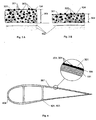
- the self-cleaning surface is regenerating as illustrated in figure 3 .
- a part of a composite is seen in a cross sectional view at an initial stage to the left in figure 3A and to the right ( figure 3B ) in a stage, where the composite has been subjected to a certain amount of wear and degradation either naturally or artificially.
- new particles 303 become exposed and protrude from the composite surface if the composite is worn and the thickness 304 of the gelcoat layer is decreased.
- the degradation of the composite surface layer can be caused by natural wear, salt in the surrounding atmosphere, dust particles, insects, friction from other components, etc.
- the hydrophobic and self-cleaning properties of the surface can also in one embodiment be renewed simply by abrading the composite, e.g. by polishing, grinding, sand-blasting or the like.
- the described regenerating surface with self-cleaning properties is advantageous on a gelcoated blade for a wind power plant as shown in a cross sectional view in figure 4 .
- a close-up of the surface is shown in details, where the outermost gelcoat layer 104 of the composite 101 can be seen with a number of particles 201 protruding from the surface 301 rendering the surface self-cleaning.
- the particles 201 are also present in the interior of the gelcoat 104 (not shown), whereby the advantageous hydrophobic surface properties become self-regenerating as new particles become exposed and protrude the surface as the old ones are worn off.
- the described gelcoat layer comprising particles is only applied to special areas of the composite component, where the self-cleaning properties are the most advantageous. This could for instance be in the region around the leading edge 404 of the wind turbine blade 401, where the blades are often seen to be worn and damaged the most during use due to dust particles, small insects and salt in the wind.
- gelcoat comprising particles according to invention could also advantageously be applied for the tower, nacelle or the like for wind power plants.
- Figure 5 illustrates a composite member 101, 401 resulting from the use of a gelcoat according to the invention (in this case a blade for a wind power plant) and a close-up 501 of its surface 301 with particles 201 partially exposed and embedded in the gelcoat layer of the composite.
- the particles 201 are added to the gelcoat in a way such that they are arranged in a pattern with areas 502 comprising particles and other areas 503 without particles.
- the particles can act as seeds, whereupon ice and snowflakes in some weather conditions will start to grow.
- the areas 502 comprising the exposed particles are delimited and surrounded by areas 503 without particles, the built-up ice and/or snow will eventually fall off the surface and a sheet of ice fully covering the composite component is thereby prevented.
- the effect will be snowflakes created on the blade surfaces which then fall off behind the rotating blades. The same effect is obtained if the exposed particles 201 are placed considerable distances apart.
Landscapes
- Chemical & Material Sciences (AREA)
- Engineering & Computer Science (AREA)
- Composite Materials (AREA)
- Mechanical Engineering (AREA)
- Wind Motors (AREA)
- Application Of Or Painting With Fluid Materials (AREA)
- Laminated Bodies (AREA)
Claims (1)
- Verwendung eines Gelcoats (104) für ein Teil einer Windkraftanlage, wie z. B.
ein Rotorblatt oder eine Nazelle,
dadurch gekennzeichnet,
dass der Gelcoat Partikel (201) aufweist, die beispielsweise aus TiO2, Ai2O3, SiO2 und/oder ZrO2 bestehen, welche in einem Muster angeordnet sind, um regenerierende Selbstreinigungseigenschaften zu erzeugen und das Aufbauen von Eis und/oder Schnee zu verhindern.
Priority Applications (1)
| Application Number | Priority Date | Filing Date | Title |
|---|---|---|---|
| EP09717235.7A EP2259914B2 (de) | 2008-03-04 | 2009-03-04 | Regenerationsflächeneigenschaften für ein teil einer windkraftanlage |
Applications Claiming Priority (3)
| Application Number | Priority Date | Filing Date | Title |
|---|---|---|---|
| EP08003954A EP2098359A1 (de) | 2008-03-04 | 2008-03-04 | Eigenschaften zur Flächenregeneration von Verbundstoffen |
| EP09717235.7A EP2259914B2 (de) | 2008-03-04 | 2009-03-04 | Regenerationsflächeneigenschaften für ein teil einer windkraftanlage |
| PCT/DK2009/000060 WO2009109193A2 (en) | 2008-03-04 | 2009-03-04 | Regenerating surface properties for composites |
Publications (3)
| Publication Number | Publication Date |
|---|---|
| EP2259914A2 EP2259914A2 (de) | 2010-12-15 |
| EP2259914B1 EP2259914B1 (de) | 2011-09-21 |
| EP2259914B2 true EP2259914B2 (de) | 2016-11-23 |
Family
ID=39862964
Family Applications (2)
| Application Number | Title | Priority Date | Filing Date |
|---|---|---|---|
| EP08003954A Withdrawn EP2098359A1 (de) | 2008-03-04 | 2008-03-04 | Eigenschaften zur Flächenregeneration von Verbundstoffen |
| EP09717235.7A Active EP2259914B2 (de) | 2008-03-04 | 2009-03-04 | Regenerationsflächeneigenschaften für ein teil einer windkraftanlage |
Family Applications Before (1)
| Application Number | Title | Priority Date | Filing Date |
|---|---|---|---|
| EP08003954A Withdrawn EP2098359A1 (de) | 2008-03-04 | 2008-03-04 | Eigenschaften zur Flächenregeneration von Verbundstoffen |
Country Status (7)
| Country | Link |
|---|---|
| US (1) | US9254613B2 (de) |
| EP (2) | EP2098359A1 (de) |
| CN (1) | CN101984751B (de) |
| AT (1) | ATE525197T1 (de) |
| CA (1) | CA2717281C (de) |
| DK (1) | DK2259914T4 (de) |
| WO (1) | WO2009109193A2 (de) |
Families Citing this family (7)
| Publication number | Priority date | Publication date | Assignee | Title |
|---|---|---|---|---|
| ES2710439T3 (es) * | 2005-01-21 | 2019-04-25 | Genentech Inc | Dosificación fija de anticuerpos HER |
| DE102010034406A1 (de) * | 2009-08-17 | 2011-02-24 | Ebm-Papst St. Georgen Gmbh & Co. Kg | Lüfter |
| WO2011147416A2 (en) * | 2010-05-26 | 2011-12-01 | Vestas Wind Systems A/S | A wind turbine component having a surface layer to prevent adhesion of ice |
| ITMI20110329A1 (it) * | 2011-03-02 | 2012-09-03 | Wilic Sarl | Aerogeneratore provvisto di dispositivi antighiaccio e metodo per prevenire la formazione di ghiaccio su pale di un aerogeneratore |
| US9637658B2 (en) * | 2013-06-24 | 2017-05-02 | The Boeing Company | Coatings, coating compositions, and methods of delaying ice formation |
| US20170304815A1 (en) * | 2014-09-09 | 2017-10-26 | David John Vachon | Antimicrobial And Biological Active Polymer Composites And Related Methods, Materials and Devices |
| ES2705088B2 (es) * | 2017-09-20 | 2020-03-30 | Liderkit S L | Nuevo gel-coat aditivado con particulas de dioxido de titanio y alumina |
Citations (12)
| Publication number | Priority date | Publication date | Assignee | Title |
|---|---|---|---|---|
| DE1045810B (de) † | 1957-05-17 | 1958-12-04 | Allgaier Werke G M B H | Aus faserverstaerkten Kunststoffschalen oder -platten bestehender Koerper, insbesondere Trag- oder Antriebsfluegel, und Verfahren und Werkzeug zu seiner Herstellung |
| JPS58199120A (ja) † | 1982-05-18 | 1983-11-19 | Mitsui Toatsu Chem Inc | 強化プラスチツクの成形法 |
| FR2572023A1 (fr) † | 1984-10-23 | 1986-04-25 | Arib | Procede de realisation d'un revetement retroreflechissant a surface lisse sur une piece moulee ainsi qu'un element moule obtenu selon ledit procede |
| GB2254382A (en) † | 1991-02-07 | 1992-10-07 | Lawson Tancred Sir Henry Bert | Wind turbine blades |
| DE29923485U1 (de) † | 1998-12-09 | 2000-12-07 | Wobben Aloys | Rotorblatt für eine Windenergieanlage |
| US20030013795A1 (en) † | 2001-07-16 | 2003-01-16 | Creavis Gesellschaft F. Techn. U. Innovation Mbh | Surfaces rendered self-cleaning by hydrophobic structures and a process for their production |
| DE10134362A1 (de) † | 2001-07-14 | 2003-01-30 | Creavis Tech & Innovation Gmbh | Strukturierte Oberflächen mit Lotus-Effekt |
| WO2003076090A1 (de) † | 2002-03-12 | 2003-09-18 | Degussa Ag | Formgebungsverfahren zur herstellung von formkörpern mit zumindest einer oberfläche, die selbstreinigende eigenschaften aufweist sowie mit diesem verfahren hergestellte formkörper |
| EP0881384B1 (de) † | 1997-05-28 | 2004-10-20 | Firma Holger Müller | Rotor für eine Windkraftmaschine |
| WO2005044749A2 (de) † | 2003-11-04 | 2005-05-19 | Schott Ag | Gegenstand mit leicht reinigbarer oberfläche und verfahren zu seiner herstellung |
| WO2005071262A1 (en) † | 2004-01-23 | 2005-08-04 | Lm Glasfiber A/S | A method of manufacturing a blade for a wind turbine and blade comprising segmented conductor means |
| EP1707594A1 (de) † | 2005-03-31 | 2006-10-04 | Cytec Surface Specialties Austria GmbH | Gelcoat-zusammensetzungen |
Family Cites Families (10)
| Publication number | Priority date | Publication date | Assignee | Title |
|---|---|---|---|---|
| EP0772514B1 (de) | 1994-07-29 | 1998-12-23 | Wilhelm Barthlott | Selbstreinigende oberflächen von gegenständen sowie verfahren zur herstellung derselben |
| CN1206302C (zh) * | 1999-03-09 | 2005-06-15 | 东陶机器株式会社 | 亲水性材料、制备它的方法以及用于制备它的涂料和装置 |
| DE10106213A1 (de) * | 2001-02-10 | 2002-08-22 | Dmc2 Degussa Metals Catalysts Cerdec Ag | Selbstreinigende Lackbeschichtungen und Verfahren und Mittel zur Herstellung derselben |
| EP1386951B1 (de) * | 2001-04-02 | 2007-08-15 | Matsushita Electric Industrial Co., Ltd. | Wasserabweisender film und verfahren zu seiner herstellung sowie damit ausgerüsteter tintenstrahlkopf und entsprechendes tintenstrahldruckverfahren |
| GB2374818B (en) * | 2001-04-23 | 2005-01-12 | Secr Defence | Surface for promoting droplet formation |
| DE10344379B4 (de) * | 2003-09-23 | 2008-09-11 | Mankiewicz Gebr. & Co (Gmbh & Co Kg) | Verwendung einer Zweikomponenten-Zusammensetzung zur Herstellung von flexiblen Polyurethan-Gelcoats für Kunstharz-Verbundwerkstoffe, Verfahren zur Herstellung der Verbundwerkstoffe und Verbundwerkstoffe |
| US7258731B2 (en) | 2004-07-27 | 2007-08-21 | Ut Battelle, Llc | Composite, nanostructured, super-hydrophobic material |
| DE102004037812B4 (de) | 2004-08-04 | 2007-07-19 | Fraunhofer-Gesellschaft zur Förderung der angewandten Forschung e.V. | Verwendung eines ausgehärteten Gemisches enthaltend ein Matrixpolymer und eine hydrophobe und/oder oleophobe Komponente als schmutzabweisende Schutzschicht |
| US20060216476A1 (en) * | 2005-03-28 | 2006-09-28 | General Electric Company | Articles having a surface with low wettability and method of making |
| CN1903961B (zh) * | 2006-07-20 | 2011-05-18 | 上海申真企业发展有限公司 | 一种荷叶效应自清洁氟碳涂料 |
-
2008
- 2008-03-04 EP EP08003954A patent/EP2098359A1/de not_active Withdrawn
-
2009
- 2009-03-04 CA CA2717281A patent/CA2717281C/en active Active
- 2009-03-04 CN CN200980107742.1A patent/CN101984751B/zh active Active
- 2009-03-04 AT AT09717235T patent/ATE525197T1/de not_active IP Right Cessation
- 2009-03-04 EP EP09717235.7A patent/EP2259914B2/de active Active
- 2009-03-04 WO PCT/DK2009/000060 patent/WO2009109193A2/en not_active Ceased
- 2009-03-04 US US12/920,830 patent/US9254613B2/en active Active
- 2009-03-04 DK DK09717235.7T patent/DK2259914T4/en active
Patent Citations (12)
| Publication number | Priority date | Publication date | Assignee | Title |
|---|---|---|---|---|
| DE1045810B (de) † | 1957-05-17 | 1958-12-04 | Allgaier Werke G M B H | Aus faserverstaerkten Kunststoffschalen oder -platten bestehender Koerper, insbesondere Trag- oder Antriebsfluegel, und Verfahren und Werkzeug zu seiner Herstellung |
| JPS58199120A (ja) † | 1982-05-18 | 1983-11-19 | Mitsui Toatsu Chem Inc | 強化プラスチツクの成形法 |
| FR2572023A1 (fr) † | 1984-10-23 | 1986-04-25 | Arib | Procede de realisation d'un revetement retroreflechissant a surface lisse sur une piece moulee ainsi qu'un element moule obtenu selon ledit procede |
| GB2254382A (en) † | 1991-02-07 | 1992-10-07 | Lawson Tancred Sir Henry Bert | Wind turbine blades |
| EP0881384B1 (de) † | 1997-05-28 | 2004-10-20 | Firma Holger Müller | Rotor für eine Windkraftmaschine |
| DE29923485U1 (de) † | 1998-12-09 | 2000-12-07 | Wobben Aloys | Rotorblatt für eine Windenergieanlage |
| DE10134362A1 (de) † | 2001-07-14 | 2003-01-30 | Creavis Tech & Innovation Gmbh | Strukturierte Oberflächen mit Lotus-Effekt |
| US20030013795A1 (en) † | 2001-07-16 | 2003-01-16 | Creavis Gesellschaft F. Techn. U. Innovation Mbh | Surfaces rendered self-cleaning by hydrophobic structures and a process for their production |
| WO2003076090A1 (de) † | 2002-03-12 | 2003-09-18 | Degussa Ag | Formgebungsverfahren zur herstellung von formkörpern mit zumindest einer oberfläche, die selbstreinigende eigenschaften aufweist sowie mit diesem verfahren hergestellte formkörper |
| WO2005044749A2 (de) † | 2003-11-04 | 2005-05-19 | Schott Ag | Gegenstand mit leicht reinigbarer oberfläche und verfahren zu seiner herstellung |
| WO2005071262A1 (en) † | 2004-01-23 | 2005-08-04 | Lm Glasfiber A/S | A method of manufacturing a blade for a wind turbine and blade comprising segmented conductor means |
| EP1707594A1 (de) † | 2005-03-31 | 2006-10-04 | Cytec Surface Specialties Austria GmbH | Gelcoat-zusammensetzungen |
Non-Patent Citations (1)
| Title |
|---|
| "Composite Materials Handbook", vol. 1, article "Polymer Matric Composites Guidel" † |
Also Published As
| Publication number | Publication date |
|---|---|
| WO2009109193A2 (en) | 2009-09-11 |
| ATE525197T1 (de) | 2011-10-15 |
| EP2098359A1 (de) | 2009-09-09 |
| EP2259914A2 (de) | 2010-12-15 |
| DK2259914T4 (en) | 2017-01-23 |
| CN101984751A (zh) | 2011-03-09 |
| WO2009109193A3 (en) | 2009-11-26 |
| CA2717281C (en) | 2017-06-20 |
| CN101984751B (zh) | 2016-03-30 |
| EP2259914B1 (de) | 2011-09-21 |
| DK2259914T3 (da) | 2012-01-16 |
| US20110129646A1 (en) | 2011-06-02 |
| US9254613B2 (en) | 2016-02-09 |
| CA2717281A1 (en) | 2009-09-11 |
Similar Documents
| Publication | Publication Date | Title |
|---|---|---|
| EP2259914B1 (de) | Regenerationsflächeneigenschaften für ein teil einer windkraftanlage | |
| KR100704808B1 (ko) | Cfrp제 판재 및 그의 제조 방법 | |
| EP2274514B1 (de) | Windturbinenschaufel | |
| EP1830992B1 (de) | Verfahren zur herstellung eines faserverstärkten teils für eine windenergieanlage | |
| CA3087165C (en) | REMOVAL OF SURFACE FILM AND PRIMER FROM COMPOSITE SUBSTRATES THANKS TO A LAYER OF PAINT WITH SIMULTANEOUS HARDENING | |
| JPH10507695A (ja) | 物体の自己浄化性表面とその形成方法 | |
| CN108495998B (zh) | 抗腐蚀方法、抗腐蚀表面部件及制造抗腐蚀表面部件方法 | |
| HUP0200452A2 (en) | Method of producing self-cleaning detachable surfaces | |
| CN108656417B (zh) | 一种风电叶片表面涂层的涂覆方法 | |
| US20120269645A1 (en) | Wind turbine component having an exposed surface made of a hydrophobic material | |
| ES2231917T3 (es) | Rotor para una turbina eolica. | |
| CN223794268U (zh) | 一种海上风电叶片及其前缘防护系统 | |
| WO2011147416A2 (en) | A wind turbine component having a surface layer to prevent adhesion of ice | |
| US20120202024A1 (en) | Product Compositions, Product Walls, And Molding Processes | |
| EP4613465A1 (de) | Strukturmaterial für automobil und verfahren zur herstellung davon | |
| CN111017206A (zh) | 一种直升机桨叶的防护方法 | |
| JPH10505552A (ja) | エンジン部品の耐浸食特性改善方法 |
Legal Events
| Date | Code | Title | Description |
|---|---|---|---|
| PUAI | Public reference made under article 153(3) epc to a published international application that has entered the european phase |
Free format text: ORIGINAL CODE: 0009012 |
|
| 17P | Request for examination filed |
Effective date: 20100929 |
|
| AK | Designated contracting states |
Kind code of ref document: A2 Designated state(s): AT BE BG CH CY CZ DE DK EE ES FI FR GB GR HR HU IE IS IT LI LT LU LV MC MK MT NL NO PL PT RO SE SI SK TR |
|
| AX | Request for extension of the european patent |
Extension state: AL BA RS |
|
| GRAP | Despatch of communication of intention to grant a patent |
Free format text: ORIGINAL CODE: EPIDOSNIGR1 |
|
| RTI1 | Title (correction) |
Free format text: REGENERATING SURFACE PROPERTIES FOR A PART OF A WIND POWER PLANT |
|
| DAX | Request for extension of the european patent (deleted) | ||
| GRAS | Grant fee paid |
Free format text: ORIGINAL CODE: EPIDOSNIGR3 |
|
| GRAA | (expected) grant |
Free format text: ORIGINAL CODE: 0009210 |
|
| AK | Designated contracting states |
Kind code of ref document: B1 Designated state(s): AT BE BG CH CY CZ DE DK EE ES FI FR GB GR HR HU IE IS IT LI LT LU LV MC MK MT NL NO PL PT RO SE SI SK TR |
|
| REG | Reference to a national code |
Ref country code: GB Ref legal event code: FG4D |
|
| REG | Reference to a national code |
Ref country code: CH Ref legal event code: EP |
|
| REG | Reference to a national code |
Ref country code: IE Ref legal event code: FG4D |
|
| REG | Reference to a national code |
Ref country code: DE Ref legal event code: R096 Ref document number: 602009002713 Country of ref document: DE Effective date: 20111201 |
|
| REG | Reference to a national code |
Ref country code: SE Ref legal event code: TRGR |
|
| REG | Reference to a national code |
Ref country code: DK Ref legal event code: T3 |
|
| REG | Reference to a national code |
Ref country code: NL Ref legal event code: VDEP Effective date: 20110921 |
|
| PG25 | Lapsed in a contracting state [announced via postgrant information from national office to epo] |
Ref country code: FI Free format text: LAPSE BECAUSE OF FAILURE TO SUBMIT A TRANSLATION OF THE DESCRIPTION OR TO PAY THE FEE WITHIN THE PRESCRIBED TIME-LIMIT Effective date: 20110921 Ref country code: HR Free format text: LAPSE BECAUSE OF FAILURE TO SUBMIT A TRANSLATION OF THE DESCRIPTION OR TO PAY THE FEE WITHIN THE PRESCRIBED TIME-LIMIT Effective date: 20110921 Ref country code: LT Free format text: LAPSE BECAUSE OF FAILURE TO SUBMIT A TRANSLATION OF THE DESCRIPTION OR TO PAY THE FEE WITHIN THE PRESCRIBED TIME-LIMIT Effective date: 20110921 Ref country code: NO Free format text: LAPSE BECAUSE OF FAILURE TO SUBMIT A TRANSLATION OF THE DESCRIPTION OR TO PAY THE FEE WITHIN THE PRESCRIBED TIME-LIMIT Effective date: 20111221 |
|
| LTIE | Lt: invalidation of european patent or patent extension |
Effective date: 20110921 |
|
| PG25 | Lapsed in a contracting state [announced via postgrant information from national office to epo] |
Ref country code: LV Free format text: LAPSE BECAUSE OF FAILURE TO SUBMIT A TRANSLATION OF THE DESCRIPTION OR TO PAY THE FEE WITHIN THE PRESCRIBED TIME-LIMIT Effective date: 20110921 Ref country code: SI Free format text: LAPSE BECAUSE OF FAILURE TO SUBMIT A TRANSLATION OF THE DESCRIPTION OR TO PAY THE FEE WITHIN THE PRESCRIBED TIME-LIMIT Effective date: 20110921 Ref country code: GR Free format text: LAPSE BECAUSE OF FAILURE TO SUBMIT A TRANSLATION OF THE DESCRIPTION OR TO PAY THE FEE WITHIN THE PRESCRIBED TIME-LIMIT Effective date: 20111222 Ref country code: AT Free format text: LAPSE BECAUSE OF FAILURE TO SUBMIT A TRANSLATION OF THE DESCRIPTION OR TO PAY THE FEE WITHIN THE PRESCRIBED TIME-LIMIT Effective date: 20110921 Ref country code: CY Free format text: LAPSE BECAUSE OF FAILURE TO SUBMIT A TRANSLATION OF THE DESCRIPTION OR TO PAY THE FEE WITHIN THE PRESCRIBED TIME-LIMIT Effective date: 20110921 |
|
| REG | Reference to a national code |
Ref country code: AT Ref legal event code: MK05 Ref document number: 525197 Country of ref document: AT Kind code of ref document: T Effective date: 20110921 |
|
| PG25 | Lapsed in a contracting state [announced via postgrant information from national office to epo] |
Ref country code: BE Free format text: LAPSE BECAUSE OF FAILURE TO SUBMIT A TRANSLATION OF THE DESCRIPTION OR TO PAY THE FEE WITHIN THE PRESCRIBED TIME-LIMIT Effective date: 20110921 |
|
| PG25 | Lapsed in a contracting state [announced via postgrant information from national office to epo] |
Ref country code: SK Free format text: LAPSE BECAUSE OF FAILURE TO SUBMIT A TRANSLATION OF THE DESCRIPTION OR TO PAY THE FEE WITHIN THE PRESCRIBED TIME-LIMIT Effective date: 20110921 Ref country code: CZ Free format text: LAPSE BECAUSE OF FAILURE TO SUBMIT A TRANSLATION OF THE DESCRIPTION OR TO PAY THE FEE WITHIN THE PRESCRIBED TIME-LIMIT Effective date: 20110921 Ref country code: IS Free format text: LAPSE BECAUSE OF FAILURE TO SUBMIT A TRANSLATION OF THE DESCRIPTION OR TO PAY THE FEE WITHIN THE PRESCRIBED TIME-LIMIT Effective date: 20120121 |
|
| PLBI | Opposition filed |
Free format text: ORIGINAL CODE: 0009260 |
|
| PG25 | Lapsed in a contracting state [announced via postgrant information from national office to epo] |
Ref country code: EE Free format text: LAPSE BECAUSE OF FAILURE TO SUBMIT A TRANSLATION OF THE DESCRIPTION OR TO PAY THE FEE WITHIN THE PRESCRIBED TIME-LIMIT Effective date: 20110921 Ref country code: PT Free format text: LAPSE BECAUSE OF FAILURE TO SUBMIT A TRANSLATION OF THE DESCRIPTION OR TO PAY THE FEE WITHIN THE PRESCRIBED TIME-LIMIT Effective date: 20120123 Ref country code: IT Free format text: LAPSE BECAUSE OF FAILURE TO SUBMIT A TRANSLATION OF THE DESCRIPTION OR TO PAY THE FEE WITHIN THE PRESCRIBED TIME-LIMIT Effective date: 20110921 Ref country code: NL Free format text: LAPSE BECAUSE OF FAILURE TO SUBMIT A TRANSLATION OF THE DESCRIPTION OR TO PAY THE FEE WITHIN THE PRESCRIBED TIME-LIMIT Effective date: 20110921 Ref country code: RO Free format text: LAPSE BECAUSE OF FAILURE TO SUBMIT A TRANSLATION OF THE DESCRIPTION OR TO PAY THE FEE WITHIN THE PRESCRIBED TIME-LIMIT Effective date: 20110921 Ref country code: PL Free format text: LAPSE BECAUSE OF FAILURE TO SUBMIT A TRANSLATION OF THE DESCRIPTION OR TO PAY THE FEE WITHIN THE PRESCRIBED TIME-LIMIT Effective date: 20110921 |
|
| 26 | Opposition filed |
Opponent name: SIEMENS AKTIENGESELLSCHAFT Effective date: 20120509 |
|
| PLAX | Notice of opposition and request to file observation + time limit sent |
Free format text: ORIGINAL CODE: EPIDOSNOBS2 |
|
| REG | Reference to a national code |
Ref country code: DE Ref legal event code: R026 Ref document number: 602009002713 Country of ref document: DE Effective date: 20120509 |
|
| PG25 | Lapsed in a contracting state [announced via postgrant information from national office to epo] |
Ref country code: MC Free format text: LAPSE BECAUSE OF NON-PAYMENT OF DUE FEES Effective date: 20120331 |
|
| PLBB | Reply of patent proprietor to notice(s) of opposition received |
Free format text: ORIGINAL CODE: EPIDOSNOBS3 |
|
| REG | Reference to a national code |
Ref country code: FR Ref legal event code: ST Effective date: 20121130 |
|
| REG | Reference to a national code |
Ref country code: IE Ref legal event code: MM4A |
|
| PG25 | Lapsed in a contracting state [announced via postgrant information from national office to epo] |
Ref country code: IE Free format text: LAPSE BECAUSE OF NON-PAYMENT OF DUE FEES Effective date: 20120304 Ref country code: FR Free format text: LAPSE BECAUSE OF NON-PAYMENT OF DUE FEES Effective date: 20120402 |
|
| PG25 | Lapsed in a contracting state [announced via postgrant information from national office to epo] |
Ref country code: MK Free format text: LAPSE BECAUSE OF FAILURE TO SUBMIT A TRANSLATION OF THE DESCRIPTION OR TO PAY THE FEE WITHIN THE PRESCRIBED TIME-LIMIT Effective date: 20110921 |
|
| PG25 | Lapsed in a contracting state [announced via postgrant information from national office to epo] |
Ref country code: ES Free format text: LAPSE BECAUSE OF FAILURE TO SUBMIT A TRANSLATION OF THE DESCRIPTION OR TO PAY THE FEE WITHIN THE PRESCRIBED TIME-LIMIT Effective date: 20120101 |
|
| PG25 | Lapsed in a contracting state [announced via postgrant information from national office to epo] |
Ref country code: BG Free format text: LAPSE BECAUSE OF FAILURE TO SUBMIT A TRANSLATION OF THE DESCRIPTION OR TO PAY THE FEE WITHIN THE PRESCRIBED TIME-LIMIT Effective date: 20111221 |
|
| PG25 | Lapsed in a contracting state [announced via postgrant information from national office to epo] |
Ref country code: MT Free format text: LAPSE BECAUSE OF FAILURE TO SUBMIT A TRANSLATION OF THE DESCRIPTION OR TO PAY THE FEE WITHIN THE PRESCRIBED TIME-LIMIT Effective date: 20110921 |
|
| REG | Reference to a national code |
Ref country code: CH Ref legal event code: PL |
|
| PG25 | Lapsed in a contracting state [announced via postgrant information from national office to epo] |
Ref country code: CH Free format text: LAPSE BECAUSE OF NON-PAYMENT OF DUE FEES Effective date: 20130331 Ref country code: LI Free format text: LAPSE BECAUSE OF NON-PAYMENT OF DUE FEES Effective date: 20130331 |
|
| PG25 | Lapsed in a contracting state [announced via postgrant information from national office to epo] |
Ref country code: TR Free format text: LAPSE BECAUSE OF FAILURE TO SUBMIT A TRANSLATION OF THE DESCRIPTION OR TO PAY THE FEE WITHIN THE PRESCRIBED TIME-LIMIT Effective date: 20110921 |
|
| PG25 | Lapsed in a contracting state [announced via postgrant information from national office to epo] |
Ref country code: LU Free format text: LAPSE BECAUSE OF NON-PAYMENT OF DUE FEES Effective date: 20120304 |
|
| PG25 | Lapsed in a contracting state [announced via postgrant information from national office to epo] |
Ref country code: HU Free format text: LAPSE BECAUSE OF FAILURE TO SUBMIT A TRANSLATION OF THE DESCRIPTION OR TO PAY THE FEE WITHIN THE PRESCRIBED TIME-LIMIT Effective date: 20090304 |
|
| PLAB | Opposition data, opponent's data or that of the opponent's representative modified |
Free format text: ORIGINAL CODE: 0009299OPPO |
|
| R26 | Opposition filed (corrected) |
Opponent name: SIEMENS AKTIENGESELLSCHAFT Effective date: 20120509 |
|
| APBM | Appeal reference recorded |
Free format text: ORIGINAL CODE: EPIDOSNREFNO |
|
| APBP | Date of receipt of notice of appeal recorded |
Free format text: ORIGINAL CODE: EPIDOSNNOA2O |
|
| APAH | Appeal reference modified |
Free format text: ORIGINAL CODE: EPIDOSCREFNO |
|
| APBU | Appeal procedure closed |
Free format text: ORIGINAL CODE: EPIDOSNNOA9O |
|
| PUAH | Patent maintained in amended form |
Free format text: ORIGINAL CODE: 0009272 |
|
| STAA | Information on the status of an ep patent application or granted ep patent |
Free format text: STATUS: PATENT MAINTAINED AS AMENDED |
|
| 27A | Patent maintained in amended form |
Effective date: 20161123 |
|
| AK | Designated contracting states |
Kind code of ref document: B2 Designated state(s): AT BE BG CH CY CZ DE DK EE ES FI FR GB GR HR HU IE IS IT LI LT LU LV MC MK MT NL NO PL PT RO SE SI SK TR |
|
| REG | Reference to a national code |
Ref country code: DE Ref legal event code: R102 Ref document number: 602009002713 Country of ref document: DE |
|
| REG | Reference to a national code |
Ref country code: DK Ref legal event code: T4 Effective date: 20170119 |
|
| PG25 | Lapsed in a contracting state [announced via postgrant information from national office to epo] |
Ref country code: LV Free format text: LAPSE BECAUSE OF FAILURE TO SUBMIT A TRANSLATION OF THE DESCRIPTION OR TO PAY THE FEE WITHIN THE PRESCRIBED TIME-LIMIT Effective date: 20161123 |
|
| REG | Reference to a national code |
Ref country code: SE Ref legal event code: RPEO |
|
| P01 | Opt-out of the competence of the unified patent court (upc) registered |
Effective date: 20230522 |
|
| PGFP | Annual fee paid to national office [announced via postgrant information from national office to epo] |
Ref country code: SE Payment date: 20260219 Year of fee payment: 18 |
|
| PGFP | Annual fee paid to national office [announced via postgrant information from national office to epo] |
Ref country code: GB Payment date: 20260220 Year of fee payment: 18 |
|
| PGFP | Annual fee paid to national office [announced via postgrant information from national office to epo] |
Ref country code: DE Payment date: 20260219 Year of fee payment: 18 Ref country code: DK Payment date: 20260219 Year of fee payment: 18 |