EP2260476B1 - Ausgereifte automatisierte beziehungshinweisvorrichtung - Google Patents
Ausgereifte automatisierte beziehungshinweisvorrichtung Download PDFInfo
- Publication number
- EP2260476B1 EP2260476B1 EP20080799342 EP08799342A EP2260476B1 EP 2260476 B1 EP2260476 B1 EP 2260476B1 EP 20080799342 EP20080799342 EP 20080799342 EP 08799342 A EP08799342 A EP 08799342A EP 2260476 B1 EP2260476 B1 EP 2260476B1
- Authority
- EP
- European Patent Office
- Prior art keywords
- user
- anonymous user
- indicia
- communication device
- information
- Prior art date
- Legal status (The legal status is an assumption and is not a legal conclusion. Google has not performed a legal analysis and makes no representation as to the accuracy of the status listed.)
- Not-in-force
Links
Images


Classifications
-
- H—ELECTRICITY
- H04—ELECTRIC COMMUNICATION TECHNIQUE
- H04L—TRANSMISSION OF DIGITAL INFORMATION, e.g. TELEGRAPHIC COMMUNICATION
- H04L67/00—Network arrangements or protocols for supporting network services or applications
- H04L67/01—Protocols
- H04L67/10—Protocols in which an application is distributed across nodes in the network
-
- G—PHYSICS
- G08—SIGNALLING
- G08B—SIGNALLING SYSTEMS, e.g. PERSONAL CALLING SYSTEMS; ORDER TELEGRAPHS; ALARM SYSTEMS
- G08B5/00—Visible signalling systems, e.g. visible personal calling systems or remote indication of seats occupied
- G08B5/22—Visible signalling systems, e.g. visible personal calling systems or remote indication of seats occupied using electric transmission; using electromagnetic transmission
- G08B5/36—Visible signalling systems, e.g. visible personal calling systems or remote indication of seats occupied using electric transmission; using electromagnetic transmission using visible light sources
-
- G—PHYSICS
- G06—COMPUTING OR CALCULATING; COUNTING
- G06Q—INFORMATION AND COMMUNICATION TECHNOLOGY [ICT] SPECIALLY ADAPTED FOR ADMINISTRATIVE, COMMERCIAL, FINANCIAL, MANAGERIAL OR SUPERVISORY PURPOSES; SYSTEMS OR METHODS SPECIALLY ADAPTED FOR ADMINISTRATIVE, COMMERCIAL, FINANCIAL, MANAGERIAL OR SUPERVISORY PURPOSES, NOT OTHERWISE PROVIDED FOR
- G06Q10/00—Administration; Management
- G06Q10/40—Business processes related to social networking or social networking services
-
- G—PHYSICS
- G06—COMPUTING OR CALCULATING; COUNTING
- G06Q—INFORMATION AND COMMUNICATION TECHNOLOGY [ICT] SPECIALLY ADAPTED FOR ADMINISTRATIVE, COMMERCIAL, FINANCIAL, MANAGERIAL OR SUPERVISORY PURPOSES; SYSTEMS OR METHODS SPECIALLY ADAPTED FOR ADMINISTRATIVE, COMMERCIAL, FINANCIAL, MANAGERIAL OR SUPERVISORY PURPOSES, NOT OTHERWISE PROVIDED FOR
- G06Q10/00—Administration; Management
- G06Q10/40—Business processes related to social networking or social networking services
- G06Q10/42—Determination of affinities or common interests between users
-
- H—ELECTRICITY
- H04—ELECTRIC COMMUNICATION TECHNIQUE
- H04W—WIRELESS COMMUNICATION NETWORKS
- H04W4/00—Services specially adapted for wireless communication networks; Facilities therefor
- H04W4/80—Services using short range communication, e.g. near-field communication [NFC], radio-frequency identification [RFID] or low energy communication
-
- H—ELECTRICITY
- H04—ELECTRIC COMMUNICATION TECHNIQUE
- H04W—WIRELESS COMMUNICATION NETWORKS
- H04W76/00—Connection management
- H04W76/10—Connection setup
- H04W76/14—Direct-mode setup
-
- G—PHYSICS
- G08—SIGNALLING
- G08B—SIGNALLING SYSTEMS, e.g. PERSONAL CALLING SYSTEMS; ORDER TELEGRAPHS; ALARM SYSTEMS
- G08B1/00—Systems for signalling characterised solely by the form of transmission of the signal
- G08B1/08—Systems for signalling characterised solely by the form of transmission of the signal using electric transmission ; transformation of alarm signals to electrical signals from a different medium, e.g. transmission of an electric alarm signal upon detection of an audible alarm signal
- G08B2001/085—Partner search devices
-
- H—ELECTRICITY
- H04—ELECTRIC COMMUNICATION TECHNIQUE
- H04L—TRANSMISSION OF DIGITAL INFORMATION, e.g. TELEGRAPHIC COMMUNICATION
- H04L51/00—User-to-user messaging in packet-switching networks, transmitted according to store-and-forward or real-time protocols, e.g. e-mail
- H04L51/52—User-to-user messaging in packet-switching networks, transmitted according to store-and-forward or real-time protocols, e.g. e-mail for supporting social networking services
-
- H—ELECTRICITY
- H04—ELECTRIC COMMUNICATION TECHNIQUE
- H04L—TRANSMISSION OF DIGITAL INFORMATION, e.g. TELEGRAPHIC COMMUNICATION
- H04L67/00—Network arrangements or protocols for supporting network services or applications
- H04L67/50—Network services
- H04L67/52—Network services specially adapted for the location of the user terminal
-
- H—ELECTRICITY
- H04—ELECTRIC COMMUNICATION TECHNIQUE
- H04L—TRANSMISSION OF DIGITAL INFORMATION, e.g. TELEGRAPHIC COMMUNICATION
- H04L67/00—Network arrangements or protocols for supporting network services or applications
- H04L67/50—Network services
- H04L67/535—Tracking the activity of the user
-
- H—ELECTRICITY
- H04—ELECTRIC COMMUNICATION TECHNIQUE
- H04W—WIRELESS COMMUNICATION NETWORKS
- H04W4/00—Services specially adapted for wireless communication networks; Facilities therefor
- H04W4/02—Services making use of location information
Definitions
- the present invention relates to a method and mobile communication apparatus for associating relationship information about friends and known and/or potential acquaintances through a local interface adapter in a user friendly manner.
- Electronic equipment such as, for example, mobile communication devices, mobile telephones, personal digital assistants, etc. are typically equipped to communicate with mobile or cellular telephone communication networks. Such electronic equipment is increasingly being equipped with adapters to support advanced communications in a variety of media other than or in addition to such mobile telephone networks.
- Such advanced communication media may include, for example, Ethernet, Bluetooth, 802.11, wireless local area networks (WLANs), WiFi, WiMax and the like, in addition to a mobile telephone network.
- WLANs wireless local area networks
- WiFi Wireless Fidelity
- WiMax wireless local area networks
- the identification is not very useful outside a closed group of frequent contacts already known to the user. Based upon this rather ambiguous identification, a person using electronic equipment has to accept or not accept a request to connect to the ambiguously identified device based upon this limited information.
- Another problem associated with conventional identification of discovered devices is that the identification may not be associated with the electronic equipment user's electronic phonebook.
- a number of global relationship networking applications such as Orkut, Friendster, Linkedln and Facebook, have developed on the Internet.
- One problem with such sites is that they require a lot of administration, another is that they require access to the Internet, and another is that they represent social networking online instead of in real life, in one's immediate surroundings.
- Such networking applications are too cumbersome to allow for immediate contact with a new acquaintance, such as a friend of a friend, or a further professional contact known from a first professional contact, or a relative of a friend or relative.
- the present invention relates to a process for determining and alerting a user of the existence of nearby acquaintance, including: providing a first electronic communication device having near-field transmitting and receiving communications capability, a user interface and control circuitry; transmitting from the first communication device an inquiry to determine the presence in the near-field of a compatible second electronic communication device; upon receipt of a positive response to the inquiry, transmitting from the first communication device anonymous user indicia; receiving anonymous user indicia from the second communication device; coordinating the received anonymous user indicia to determine the presence of any matches between the transmitted anonymous user information and the received anonymous user indicia; and providing either a list of matches or an indication of no matches to the user via the user interface. Based on the information exchanged, the users can determine whether a relationship between the users exists or might be created.
- the present invention relates to an electronic communication device, including:
- control circuitry further activates the communications circuitry to determine near-field presence of the second electronic communication device prior to (c).
- control circuitry further updates the friends list and/or the meetings log.
- the second anonymous user information includes information relating to one or more of the plurality of individual persons on the friends list.
- the meetings log further includes information relating to contacts between pairs of the individual persons on the friends list.
- the device is a mobile telephone and the communications circuitry further comprises voice communications capability.
- the present invention relates to a process for determining and alerting a user of the existence of known and/or prospective acquaintances in a near-field, including:
- the process further includes reviewing the list of matches and determining whether to further communicate with the second communications device.
- the process further includes communicating with the second communications device to exchange more detailed information relating to at least a portion of the first, second and/or third anonymous user indicia.
- the process further includes reviewing the list of matches and determining whether to add any item from the third anonymous user indicia to the friends list and/or to update the meetings log with information based on the third anonymous user indicia.
- the process further includes communicating with the second communications device to exchange more detailed information relating to at least a portion of the first, second and/or third anonymous user indicia, and adding the more detailed information to the friends list and/or updating the meetings log.
- the second anonymous user information includes information relating to one or more of the plurality of individual persons on the friends list.
- the meetings log further includes information relating to contacts between pairs of the individual persons on the friends list.
- the present invention relates to a process for establishing communication between first and second electronic communication devices and determining whether a relationship exists between users of the first and second devices, the first and second devices each including compatible near-field communications capability, a memory, a processor, a user interface and being programmed to maintain information relating first and second anonymous user information with secure detailed user information for a plurality of known individual persons, including:
- the first device includes control circuitry to (a) maintain a friends list including the first anonymous user indicia and associated real user information for a plurality of known individual persons, wherein the associated real user information further includes anonymous user indicia for additional individual persons known to any of the plurality of known individual persons on the friends list, and (b) to maintain a meetings log of contacts between the user and the known individual persons and contacts between pairs of the additional individual persons on the friends list.
- the process further includes reviewing the list of matches and determining whether to further communicate with the second communications device.
- the process further includes communicating with the second communications device to exchange more detailed information relating to at least a portion of the first, second and/or third anonymous user indicia.
- the more detailed information includes a portion of the real user information associated with one of the anonymous user indicia.
- the process further includes reviewing the list of matches and determining whether to add any item from the third anonymous user indicia to the friends list.
- the process further includes communicating with the second communications device to exchange more detailed information relating to at least a portion of the first, second and/or third anonymous user indicia, and adding the more detailed information to the friends list.
- the more detailed information includes a portion of the real user information associated with one of the anonymous user indicia.
- the process further includes reviewing the list of matches and determining whether to update the meetings log with information based on the third anonymous user indicia. In one embodiment, the process further includes updating the friends list and/or the meetings log based on new information received during the process.
- the process further includes communicating with the second communications device to exchange more detailed information relating to at least a portion of the first, second and/or third anonymous user indicia, and adding the more detailed information to the meetings log.
- the more detailed information includes a portion of the real user information associated with one of the anonymous user indicia.
- the present invention relates to a program stored on a machine readable medium, the program for controlling operation of an electronic device and including executable logic to:
- the program further includes executable logic to activate the communications circuitry to determine near-field presence of the second electronic communication device prior to activating the communications circuitry to transmit the anonymous user indicia. This determination may be made automatically or by manual activation of the communications circuitry.
- the program further includes executable logic to update the friends list and/or the meetings log.
- the program further includes executable logic to control operation of the control circuitry to coordinate informations relating to one or more of the plurality of known individual persons on the friends list and/or in the meetings log.
- the program further includes executable logic to control operation of the control circuitry to coordinate information relating to contacts between pairs of the individual persons on the friends list and/or in the meetings log.
- the program further includes executable logic to control operation of the communication circuitry to exchange with the second communications device more detailed information relating to at least a portion of the first, second and/or third anonymous user indicia.
- the program further includes executable logic to control operation of the control circuitry to add the more detailed information to the friends list and/or to the meetings log.
- the term “electronic equipment” includes portable radio communication equipment.
- portable radio communication equipment which herein after is referred to as a mobile radio terminal, includes all equipment such as mobile telephones, pagers, communicators, i.e., electronic organizers, personal digital assistants (PDAs), portable communication apparatus, smart phones or the like.
- PDAs personal digital assistants
- the present invention is directed to electronic equipment, sometimes referred to herein as a communication device, mobile telephone, portable telephone and electronic device having an improved method for association and/or discovery through a local interface adapter (e.g. a wired and/or wireless local interface adapter) with other electronic equipment.
- a local interface adapter e.g. a wired and/or wireless local interface adapter
- a mobile telephone initiates a search for electronic equipment having a predetermined modality and within communication range of the mobile telephone.
- This may include a cellular telephone carrier's system.
- Electronic equipment capable of responding to the request e.g., another near-field user's electronic equipment such as a second mobile telephone
- transmit information through a local interface adapter Such information may include, for example, an inquiry including information such as a unique identifier and, optionally, additional unique identifiers of friends known to the inquiring user.
- the unique identifier may be any unique characteristic, item or feature that may be assigned to a contact, and the unique identifier is anonymous in that while it is unique to any individual person, it does not actually identify that person, except to others who know the individual person and have that person's anonymous unique identifier associated with the person's actual identity.
- the unique identifier is referred to as the person's anonymous identity, or ANON_ID.
- the ANON_ID could, for example, be a unique identifier such as a telephone number, a session initiation protocol (SIP) address, or an encrypted name of the person, or a 128-bit unique identification number encrypting, e.g., a name.
- SIP session initiation protocol
- the ANON_ID is unique to the individual person, so that each individual using the system of the present invention is uniquely identified by the ANON_ID.
- Each individual user of the system of the present invention has stored in the user's electronic equipment a list of ANON_IDs and an associated list of additional, variously detailed information about the actual person associated with a given ANON_ID. Such detailed information or portions of it is not shared until such time as the user and the new contact have confirmed each other's actual identification and made a decision to meet and/or to share detailed information with each other.
- the detailed information may include, for example, personal and/or business and/or professional information, biometric information such as fingerprints, retinal scans, iris scans, hand measurements, voice recognition, photographs of the face, anatomical traits, etc.
- the detailed information may include other specific information known to the user, such as a record of previous meetings, a list of the contact's known friends and acquaintances (also stored and associated with their own ANON_ID) and other details, which may include, e.g., personal, business and/or professional information, social security number, E-mail address, IP address, audio recordings, video recordings, passwords, and the like.
- Some or all of the detailed information may or may not be shared, at the discretion of the individual user, in any given situation.
- the present invention provides to the user control of the level or degree of identification provided to any new or old contact.
- the level of identification may range, for example, from nothing more than anonymous information such as the ANON_ID of the user only, to a list of ANON_IDs of the user and of selected friends and acquaintances, to a list of ANON_IDs and full or partial history of previous meetings with the persons associated with the ANON_ID, to any level of identification, including the above-mentioned personal information.
- the user of the mobile telephone may search an associated database, such as an electronic phonebook application, having stored unique identifying information associated with each user's ANON_ID to identify contact information associated with the ANON_ID and to the real person. For example, if a received unique identifier is stored in the electronic phonebook of the mobile telephone, the mobile telephone may display a user-friendly designation corresponding to contact information previously stored in the electronic phonebook to the associated user of the mobile telephone.
- an electronic phonebook application having stored unique identifying information associated with each user's ANON_ID to identify contact information associated with the ANON_ID and to the real person.
- the communication described herein is directly between users of mobile telephones configured to carry out the functions and operations described herein.
- there is no central server or network connection involved in the communication and the communication is directly peer-to-peer.
- a central server or network through which connections and communications are made.
- the user would make a connection, for example, through a mobile telephone network, or in another embodiment, through a Wi-Fi network in an institution such as a university.
- the central server may be used to create and store unique ANON_IDs, so that every user has his or her own unique ANON_ID across the network. This embodiment would thus facilitate making a given user's ANON_ID more widely known and to allow for association of specific information or individual status that may be of further interest to other users.
- a dating service could provide the central server on which members can store their ANON_ID and any selected information, and through which members may discover and contact each other directly when in near-field range of one another.
- members could be alerted to the presence in the near-field of other members sharing common interests or meeting previously determined specific criteria. In this way pairs of members who did not previously know each other could more easily make contact, even though they did not share any other friends and are not listed on each other's friends list or meeting log.
- any or all of the information may be stored on a central server and the communication described herein between users of mobile telephones configured to carry out the functions and operations described herein takes place over a network, such as a mobile telephone network.
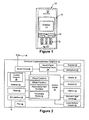
- the electronic equipment 10 is shown in accordance with an exemplary embodiment of the present invention.
- the electronic equipment 10 in the exemplary embodiment is a mobile telephone and will be referred to as the mobile telephone 10.
- the electronic equipment may be any known electronic equipment, but is exemplified herein as a mobile telephone.
- the mobile telephone 10 is shown as having a "brick" or "block” design type housing, but it will be appreciated that other type housings, such as clamshell housing or a slide-type housing, may be utilized without departing from the scope of the invention.
- the electronic equipment 10 may include a user interface 12 (identified by dotted lines) that enables the user easily and efficiently to perform one or more communication tasks (e.g., identify a contact, select a contact, make a telephone call, receive a telephone call, establish and manage local wireless and/or wired exchanges of information, etc.).
- the user interface 12 of the mobile telephone 10 generally includes one or more of the following components: a display 14, an alphanumeric keypad 16, function keys 18, a navigation tool 19, a speaker 20, and/or a microphone 22.
- the user interface 12 of the mobile telephone 10 includes components configured to carry out the processes and to activate the programs of the present invention.
- the display 14 presents information in a viewable format to a user. Such information may include operating state, time, telephone numbers, contact information, unique identifiers, various navigational menus, status of one or more functions, photographs, multimedia, etc., which enable the user to utilize the various features of the mobile telephone 10.
- the display 14 may also be used to visually present content accessible by the mobile telephone 10, as well as display contact information from an electronic phonebook in accordance with aspects of the present invention.
- the displayed content may include E-mail messages, audio and/or video presentations stored locally in memory 24 ( Figure 2 ) of the mobile telephone 10 and/or stored remotely and download to the mobile telephone 10 (e.g., from a remote storage device, a mail server, remote personal computer, etc.).
- Such presentations may be derived, for example, from multimedia files stored on a remote web server, received through E-mail messages, etc.
- the multimedia files may include any type of multimedia content (e.g., video, audio, graphics, songs, movies, television broadcasts, radio broadcasts, satellite radio broadcasts, etc.).
- the audio component of such presentations including an end-user code, may be broadcast to the user with speaker 60 of the mobile telephone 10. Alternatively, the audio component may be broadcast to the user though a headset speaker (not shown). In one embodiment, operation of the mobile telephone 10 may be fully or partially controlled by inputs directly to the display 14.
- the mobile telephone 10 further includes a keypad 16 that provides for a variety of user input operations.
- the keypad 16 may include alphanumeric keys for allowing entry of alphanumeric information such as user-friendly identification of contacts, E-mail addresses, distribution lists, telephone numbers, phone lists, contact information, notes, etc.
- the keypad 16 typically may include special function keys such as a "call send” key for transmitting an E-mail, initiating or answering a call, and a "call end” key for ending, or "hanging up” a call.
- Special function keys may also include menu navigation keys, for example, for navigating through a menu displayed on the display 14 to select different telephone functions, profiles, settings, etc., as is conventional.
- keys associated with the mobile telephone 10 may include a volume key, audio mute key, an on/off power key, a web browser launch key, a local adapter association key (e.g., for wired and/or wireless communications), an E-mail application launch key, a camera key, etc. Keys or key-like functionality may also be embodied as a touch screen associated with the display 14.
- the mobile telephone 10 may also include conventional call circuitry that enables the mobile telephone 10 to establish a call, transmit and/or receive E-mail messages, and/or exchange signals with a called/calling device, typically another mobile telephone or landline telephone.
- a called/calling device typically another mobile telephone or landline telephone.
- the called/calling device need not be another telephone, but may be some other electronic device such as an electronic device compliant with one or more communication protocols, Internet web server, E-mail server, content providing server, etc.
- the mobile telephone 10 includes a primary control circuit 30 that is configured to carry out overall control of the functions and operations of the mobile telephone 10.
- the control circuit 30 may include a processing device 32, such as a CPU, microcontroller or microprocessor.
- the processing device 32 executes code stored in memory (not shown) within the control circuit 30 and/or in a separate memory, such as memory 24, in order to carry out operation of the mobile telephone 10 and perform all of the functionality disclosed herein.
- the control circuit may include functionality to control the main device functions, such as those of the mobile telephone 10, to control additional device functions such as media functions, and the relationship alerter functions in accordance with embodiments of the present invention.
- the memory 24 may be any suitable memory device.
- the memory 24 may be, for example, random access memory, read only memory, a buffer, a flash memory, a hard drive, a removable media, a volatile memory and/or a non-volatile memory or a combination of any of the foregoing.
- the memory 24 may include one or more computer applications (or sub-applications), including a control program 26 programmed to achieve the functionality described herein.
- the mobile telephone 10 includes an antenna 34 coupled to a radio circuit 36.
- the radio circuit 36 includes a radio frequency transmitter and receiver for transmitting and receiving signals via the antenna 34 as is conventional.
- the mobile telephone 10 generally utilizes the radio circuit 36 and antenna 34 for voice, Internet and/or E-mail communications over a cellular telephone network.
- the mobile telephone 10 further includes a sound signal processing circuit 38 for processing the audio signal transmitted by/received from the radio circuit 36. Coupled to the sound processing circuit 38 are the speaker 20 and a microphone 22 that enable a user to listen and speak via the mobile telephone 10 as is conventional.
- the radio circuit 36 and sound processing circuit 38 are each coupled to the control circuit 30 so as to carry out overall operation.
- the mobile telephone 10 also includes the aforementioned display 14 and keypad 16 coupled to the control circuit 30.
- the mobile telephone 10 further includes an I/O interface 42.
- the I/O interface 42 may be in the form of typical mobile telephone I/O interfaces, such as a multi-element connector at the base of the mobile telephone 10. As is typical, the I/O interface 42 may be used to couple the mobile telephone 10 to a battery charger to charge a power supply unit (PSU) 44 within the mobile telephone 10. In addition, or in the alternative, the I/O interface 42 may serve to connect the mobile telephone 10 to a wired personal hands-free adapter, to a personal computer or other device via a data cable, etc.
- the mobile telephone 10 may also include a timer 46 for carrying out timing functions. Such functions may include timing the duration of calls, generating the content of time and date stamps, etc.
- the mobile telephone 10 may also include various built-in accessories, such as a camera 48 for taking digital pictures. Image files corresponding to the pictures may be stored in the memory 24.
- the mobile telephone 10 also may include a position data receiver (not shown), such as a global positioning satellite (GPS) receiver, Galileo satellite system receiver or the like.
- the mobile telephone 10 may include a biometric input device 49 for entering biometric information that may be used for scanning and/or otherwise obtaining biometric information associated with the user of the mobile telephone 10 and/or contacts maintained in the memory 24.
- the mobile telephone 10 may include a local interface adapter 50.
- the local interface adapter 50 may be any adapter operable to facilitate communication between the mobile telephone 10 and at least one electronic device.
- the local interface adapter 50 may be wired and/or wireless and may support communications utilizing any communication protocol (e.g., Ethernet, Bluetooth, 802.11, WLAN, WiFi, WiMax, Infrared, etc.).
- the mobile telephone 10 may be configured additionally to operate in a wide area communications system (e.g. 2G, 3G, GPRS, etc.) (not illustrated).
- the system may include one or more servers for managing calls, Internet access and/or E-mails placed by and/or destined to the mobile telephone 10, transmitting content (e.g., image files, audio files, video files, etc.) to and/or from the mobile telephone 10 and carrying out any other support functions.
- the server generally communicates with the mobile telephone 10 via a network and a transmission medium.
- the transmission medium may be any appropriate device or assembly, including, for example, a communications tower, another mobile telephone, a wireless access point, a satellite, the Internet, etc. Portions of the network may include wireless and/or wired transmission pathways.
- FIG. 3 illustrates an exemplary communication system 60 in accordance with the present invention.
- the system 60 includes a first mobile telephone 10 and a second mobile telephone 10' at a near-field distance "d".
- both devices are shown as mobile telephones, the electronic devices each may be any electronic device capable of supporting communication with communications through interface adapter 50 of the electronic device.
- the electronic device may be electronic equipment, a mobile telephone, a personal digital assistant (PDA), a personal computer (PC), a pager, etc.
- PDA personal digital assistant
- PC personal computer
- pager etc.
- the first mobile telephone 10 and the second mobile telephone 10' are adapted to communicate with each other through wireless and/or wired local interface adapters.
- the first mobile telephone 10 and the second mobile telephone 10' are capable of communicating with each other using Bluetooth or any other desirable wired and/or wireless local communication protocols.
- the following discussion will focus on communications between the first mobile telephone 10 and the second mobile telephone 10' using Bluetooth compatible protocols.
- other communication protocols and/or specifications may also be implemented in accordance with the present invention (e.g., 802.11 compliant standards (e.g. 802.11(a), 802.11(b), 802.11(g), etc.), WiFi, WiMax, infrared, Ultra Wideband, near-field communications, radio frequency identification, Ethernet, etc.).
- the first mobile telephone 10, associated with Client A, and the second mobile telephone 10', associated with Client B illustrate communication devices that include a mobile ad hoc communication network.
- Client A and Client B may be, for example, patrons in a coffee shop, participants in a professional meeting, or people in some other environment, such as a sporting event or a nightclub.
- the mobile ad hoc communications network is a Bluetooth piconet that includes one master device and up to seven active slave devices.
- the local interface adapter 50 which may be Bluetooth compatible, is activated to conduct an inquiry process to discover all Bluetooth enabled devices in its coverage area (also referred to herein as the communication range).
- the inquiry process is limited to only those devices previously stored in the control program 26 of the mobile telephone 10. In another embodiment, the inquiry process is limited to a subset of devices previously specified in the control program 26. In another embodiment, the inquiry process is limited to a subset of persons listed in the control program 26. For examples, the inquiry process may be limited to professional contacts only, or to personal contacts only, or to family contacts only. In one embodiment, the inquiry may be limited to a single person.
- the first mobile telephone 10 and the second mobile telephone 10' are within an operative distance "d" from each other, as illustrated in Figure 3 .
- the distance “d” is within near-field communication range of the first mobile telephone 10 and the second mobile telephone 10'.
- the operative near-field distance "d” will vary depending on, among other things, the modality used for communication.
- the operative range for Bluetooth communication may be less than about 10 meters.
- the near-field distance in which the present invention operates is in the range from less than 10 meters to about 500 meters, and in another embodiment, is in the range from less than 10 meters to about 100 meters. Longer distances may also be within the scope of the invention, for example, distances within mobile telephone communications capabilities.
- the first mobile telephone 10 enters into a discovery substate to discover other Bluetooth devices within the operative range. Typically, this occurs by the mobile telephone 10 entering the inquiry substate to discover other Bluetooth devices.
- the Bluetooth specification defines inquiry access codes that allow a device to specify the type of device it is seeking, such as PDA's, mobile telephones, printers, LAN access points, etc.
- the first mobile telephone 10 generates an inquiry hopping sequence. This inquiry hopping sequence is derived from the first mobile telephone 10 clock and the chosen inquiry access code. Once the first mobile telephone 10 generates an inquiry hopping sequence, it broadcasts inquiry messages as it sequentially switches to each channel defined in the hopping sequence.
- discoverable devices periodically enter the inquiry scan substate.
- devices hop according to the inquiry scan hopping sequence, which is also based on the inquiry access code and the local clock. If the device performing the inquiry scan (e.g., the second mobile telephone 10') receives an inquiry message, it enters the inquiry response substate and replies with an inquiry response message.
- the inquiry response includes the remote device's address and clock, a unique identifier (e.g., telephone number, SIP address, etc.).
- only discoverable devices within the operative broadcast range "d" that recognize the one or more ANON_ID transmitted by the mobile telephone 10 will respond to the device inquiry.
- the first mobile telephone 10 and the second mobile telephone 10' are capable transmitting a unique identifier, such as the ANON_ID disclosed above.
- this unique identifier is referred to as "ANON_ID”
- ANON_ID a unique identifier
- a plurality of ANON_IDs may be referred to, e.g., by sequential numbers appended, such as "ANON_ID_34”.
- FIG. 4 there is shown a schematic illustration of elements of an exemplary system, such as software programmed and hardware included in a mobile telephone, in accordance with an embodiment of the present invention.
- the mobile telephone illustrated in Figure 4 is associated with Client A and, as shown, may communicate with Client B via an electronic device (ED) which may be, for example, the second mobile telephone 10'.
- ED electronic device
- the system includes a friends list, which stores the ANON_IDs and the real names and details of the friends, in which each ANON_ID is mapped to the associated real name and other personal information known to the user of the mobile telephone 10.
- the system further includes a meetings log, containing records of meetings between the user of the mobile telephone 10 and the friends listed in the friends list.
- the meetings log may be arranged, for example, simply by associating each ANON_ID with a record of the meetings between the user and the owner of each ANON_ID listed.
- the meetings log may be used as a reference to earlier meetings with a given friend, and as a reminder of significant details regarding the meeting and/or friend.
- the system further includes Search and Coordination Software which, as its name implies, controls the search and transmission functions of the mobile telephone, coordinates the contents of the friends list and the meetings log, and provides input and control of information provided to the User Interface, which may include items such as a mobile telephone display, a keyboard, a laptop computer screen, a desktop computer monitor, etc.
- the system further includes a Near-Field Transmitter and Receiver, which operates, for example, Bluetooth communication capability. As shown in Figure 4 , the Near-Field Transmitter and Receiver provides communications to, e.g., the electronic device of Client B, such as the second mobile phone 10'.
- the friends list includes a list of contact's ANON_IDs, associated private information regarding the real person associated with each of the ANON_IDs, and a list of friends shared by each of the contacts on the ANON_ID list.
- portions of the friends list, each friend identified only by its own respective ANON_ID may be shared when communicating in accordance with the invention.
- the private information associated with each contact is not shared.
- the private information, or portions thereof may be shared with another used in communication in accordance with the invention, depending on individual circumstances.
- This feature of the invention provides for the user to select the degree of confidentiality as appropriate for any given circumstance.
- the exchange of information may be more extensive than for a new contact, made with a previously unknown person.
- FIG 6 is an example of the contents of a meetings log for an exemplary mobile telephone system, such as that shown in Figure 4 , in accordance with an embodiment of the present invention.
- the meetings log stored in the user's mobile telephone includes a list of ANON_IDs for all the contacts listed, and associated information such as details of past meetings with each contact, and/or such as friends in common, and cross-references between various members of the contact list known to be acquainted with one another, and other details of previous meetings with the various contacts.
- FIG. 7 there is shown a software program flow chart 700 illustrating the operation of one electronic device, such as the first mobile telephone 10 in contact with the second mobile telephone 10', in accordance with one embodiment of the present invention.
- the user powers on the first mobile telephone 10, and then sends a search inquiry or discovery request.
- the search inquiry may simply be an attempt to contact any capable device having an appropriate near-field transmitter and receiver, such as that shown in Figure 4 , and being within the near-field distance "d".
- the search inquiry may also include initially only the ANON_ID of the person using the first mobile telephone 10 or it may include both the ANON_ID of the person and one or more additional ANON_IDs, e.g., of the person's friends or contacts.
- the software determines whether it has successfully discovered and made contact with another electronic device, e.g., the second mobile telephone 10'. If "yes", the first mobile telephone 10 has discovered and made contact with the second mobile telephone 10', then as shown in step 730, the first mobile telephone 10 transmits a Friends Inquiry to the second electronic device 10'.
- the transmitted Friends Inquiry may include, for example, a list of all or some subset of all the ANON_IDs stored in the friends list of first mobile telephone 10.
- the subset of ANON_IDs transmitted may include any selected grouping, such as friends, professional associates or family members, as determined by the user.
- the process terminates and returns to the first step 710.
- the user may simply stop, or may switch to another frequency or communication method to carry out a search for other devices in the near-field.
- the steps 720 and 730 may be combined, or may be carried out simultaneously.
- the program determines whether a response including friends in common, or identifying the user of the contacted device as a friend, is received from the contacted device, e.g., from the second mobile telephone 10' as illustrated in step 740. If “Yes”, then the process proceeds to step 750. If "No”, then the process terminates and returns to the first step 710.
- the user of the first mobile telephone 10 compares the returned list of ANON_IDs received from the second mobile telephone 10' to its own friends list to determine whether either the user of the second mobile telephone 10' or any of that user's friends have an ANON_ID that has already been stored in the first user's friends list.
- the software carries out a search of its friends list and/or meetings log to determine if there are any matches, as shown in step 760.
- the software If one or more matches is found at step 760, the answer to the inquiry at the step 760 is "Yes", then the software generates a list of the matching ANON_IDs, as shown in step 770.
- the list of the matching ANON_IDs is displayed to the user. After matching ANON_IDs are found and an output generated, the user may be notified if the user of the second mobile telephone 10' is a friend already and if there are any friends in common, based on the search of the friends list and/or meetings log.
- the user can determine whether to add to its friends list or update its meetings log with the information relating to the contact made and the ANON_IDs included in the contact.
- the list of matches automatically is added to the friends list and/or the meetings log automatically is updated, as appropriate.
- step 760 If no match is found at step 760, the answer to the inquiry at step 760 is "No", then the software skips the step 770, and proceeds to step 780, where the user can inquire whether the new contact might want to make friends. If the answer to the inquiry at the step 780 is "No", then the process terminates and returns to the first step 710. If the answer to the inquiry at the step 780 is "Yes”, then the user of the first mobile telephone 10 proceeds to step 790, to add the new friend to its friends list and/or to update its meetings log to record the events having just transpired. Following the step 790, the process terminates and returns to the step 710. At this point, the users of the first mobile telephone 10 and the second mobile telephone 10' may meet, talk, etc., as may be appropriate. At this point, the respective users may also elect to update the personal information in their friends list, based on the new contact and/or on new information received from this meeting with the contact where the contacts were previously known to one another.
- a first user's mobile telephone (or other electronic device capable of near-field communication) initiates a discovery request and transmits the first user's ANON_ID and, optionally, the ANON_ID of one or more of the first user's friends, to a second electronic device (ED) in the near-field, which may constitute a new contact.
- MT may be the first mobile telephone 10
- ED may be the second mobile telephone 10'.
- the first step 810 may be preceded by a step in which the first user's mobile telephone MT transmits an inquiry to determine the presence of one or more second electronic device ED, such as a mobile telephone or other compatible near-field communication device, and upon receipt of a positive response, then initiates the step 810.
- the control circuitry activates the communications circuitry to determine near-field presence of the second electronic communication device prior to step 810.
- the control circuitry may carry out this determination automatically or by the user manually activating the communications circuitry to carry out this determination. In the embodiment in which this determination is automatically carried out, it may occur in a manner corresponding to the maintenance of a local connection to a mobile telephone network.
- the second electronic device ED received the discovery request transmitted by the first user's mobile telephone MT and responds with the second device ED's ANON_ID and, optionally, with the ANON_ID of one or more friend of the user of the second device ED, which is transmitted back to the first user's mobile telephone MT.
- the first user's mobile telephone MT receives the ANON_ID from the second user's electronic device ED, which is transmitted by the second electronic device to the first electronic device.
- the first mobile telephone MT determines whether any of the one or more ANON_ID received from the second electronic device ED correspond to any ANON_ID listed by a friends list stored in a memory associated with the first user's mobile telephone MT.
- the first user's mobile telephone MT determines whether any matches exist and displays in a user sensible format the contact information for any known ANON_ID of either the second user's electronic device ED or of any of the second user's friends for any such matches.
- the user sensible format in the step 850 may include, for example, a user interface such as a display on the mobile telephone or, optionally, in an audio format from a speaker on the mobile telephone MT.
- the first user of the mobile telephone MT and the second user of the electronic device ED decide whether to establish a communication link between the devices MT and ED based either on knowing each other or on any friends in common.
- the first user of the mobile telephone MT and the second user of the electronic device ED can each decide whether to add each other to their respective friends list, based on either the new contact between the two users or based on any friends they have in common.
- the first and second users may already be listed in each other's friends list, in which case the method of the present invention is used by them to discover their present proximity to each other and to make contact based on that proximity.
- both the first and second users may already be friends and may independently arrive at a common venue, such as a shopping mall or an outdoor event, and thence may use the invention to discover the near-by presence of their friend at the same venue and to make contact with the friend.
- a common venue such as a shopping mall or an outdoor event
- the present invention may be used both to make contact with "old” friends and to discover "new" friends, with the new contact being based on, e.g., friends or acquaintances in common and listed in one or both of the users' friends list, or on common interests determined from one or both of the users' meetings log.
- Computer program elements of the invention may be embodied in hardware and/or in software (including firmware, resident software, micro-code, etc.).
- the invention may take the form of a computer program product, which can be embodied by a computer-usable or computer-readable storage medium having computer-usable or computer-readable program instructions, "code” or a "computer program” embodied in the medium for use by or in connection with the instruction execution system.
- a computer-usable or computer-readable medium may be any medium that can contain, store, communicate, propagate, or transport the program for use by or in connection with the instruction execution system, apparatus, or device.
- the computer-usable or computer-readable medium may be, for example but not limited to, an electronic, magnetic, optical, electromagnetic, infrared, or semiconductor system, apparatus, device, or propagation medium such as the Internet.
- the computer-usable or computer-readable medium could even be paper or another suitable medium upon which the program is printed, as the program can be electronically captured, via, for instance, optical scanning of the paper or other medium, then compiled, interpreted, or otherwise processed in a suitable manner.
- the computer program product and any software and hardware described herein form the various means for carrying out the functions of the invention in the example embodiments.
Landscapes
- Engineering & Computer Science (AREA)
- Physics & Mathematics (AREA)
- Signal Processing (AREA)
- Computer Networks & Wireless Communication (AREA)
- General Physics & Mathematics (AREA)
- Business, Economics & Management (AREA)
- Electromagnetism (AREA)
- Marketing (AREA)
- Human Resources & Organizations (AREA)
- Tourism & Hospitality (AREA)
- Quality & Reliability (AREA)
- General Business, Economics & Management (AREA)
- Operations Research (AREA)
- Theoretical Computer Science (AREA)
- Strategic Management (AREA)
- Economics (AREA)
- Entrepreneurship & Innovation (AREA)
- Telephonic Communication Services (AREA)
- Computing Systems (AREA)
- Data Exchanges In Wide-Area Networks (AREA)
- Computer And Data Communications (AREA)
Claims (15)
- Elektronische Kommunikationseinrichtung, umfassend:eine Kommunikationsschaltung, um Nahfeld-Übertragungs- und Empfangs-Kommunikationen bereitzustellen;eine Benutzerschnittstelle; undeine Steuerschaltung, um (a) eine Freundesliste zu halten, die erste anonyme Benutzerzeichen und assoziierte echte Benutzerinformation für eine Vielzahl von individuellen Personen, die einem Benutzer der Einrichtung bekannt sind, und assoziierte zweite anonyme Benutzerzeichen umfasst, (b) eine Treffprotokoll von Kontakten zwischen dem Benutzer und den individuellen Personen zu halten, (c) die Kommunikationsschaltung zu aktivieren, um zu einer zweiten elektronischen Kommunikationseinrichtung in einem Nahfeld einen Teil der ersten und/oder zweiten anonymen Benutzerzeichen zu übertragen, (d) dieKommunikationsschaltung zu aktivieren, um von der zweiten elektronischen Kommunikationseinrichtung dritte anonyme Benutzerzeichen zu empfangen, (e) die dritte anonyme Benutzerzeichen mit Information auf der Freundesliste und in dem Treffprotokoll zu koordinieren, um die Anwesenheit von Übereinstimmung zwischen der ersten und/oder zweiten anonymen Benutzerinformation und den dritten anonymen Benutzerzeichen zu bestimmen; und (f) zu der Benutzerschnittstelle eine Liste der bestehenden Übereinstimmungen bereitzustellen.
- Elektronische Kommunikationseinrichtung nach Anspruch 1, wobei die Steuerschaltung ferner die
Kommunikationsschaltung aktiviert, um Nahfeld-Anwesenheit der zweiten elektronischen Kommunikationseinrichtung vor (c) zu bestimmen. - Elektronische Kommunikationseinrichtung nach einem der Ansprüche 1 bis 2, wobei die Steuerschaltung ferner die Freundesliste und/oder das Treffprotokoll aktualisiert.
- Elektronische Kommunikationseinrichtung nach einem der Ansprüche 1 bis 3, wobei die Einrichtung ein Mobiltelefon ist.
- Verfahren zum Bestimmen und Alarmieren eines Benutzers über die Existenz eines bekannten und/oder potentiell Bekannten in einem Nahfeld, umfassend:Bereitstellen einer ersten elektronischen Kommunikationseinrichtung, welche eine Schaltung aufweist, um Kommunikationen in einem Nahfeld zu übertragen und zu empfangen, eine Benutzerschnittstelle, und eine Steuerschaltung, um (a) eine Freundesliste zu halten umfassend erste anonyme Benutzerzeichen und assoziierte echte Benutzerinformation für eine Vielzahl von individuellen Personen, die dem Benutzer bekannt sind, und assoziierte zweite anonyme Benutzerzeichen, und (b) Halten eines Treffprotokolls von Kontakten zwischen dem Benutzer und den individuellen Personen;Übertragen, von der ersten Kommunikationseinrichtung, einer Anfrage, um die Anwesenheit einer kompatiblen zweiten elektronischen Kommunikationseinrichtung in dem Nahfeld zu bestimmen;bei Empfangen einer positiven Antwort auf die Anfrage, Übertragen, von der ersten Kommunikationseinrichtung, der anonymen Benutzerzeichen für einen Teil der Freundesliste;Empfangen dritter anonymer Benutzerzeichen von der zweiten Kommunikationseinrichtung;Koordinieren der dritten anonymen Benutzerzeichen mit Information auf der Freundesliste, um die Anwesenheit von Übereinstimmung zwischen der ersten und/oder zweiten anonymen Benutzerinformation und der dritten anonymen Benutzerzeichen zu bestimmen; undBereitstellen entweder einer Liste von Übereinstimmungen oder eines Hinweises von keinen Übereinstimmungen zu dem Benutzer über die Benutzerschnittstelle.
- Verfahren nach Anspruch 5, ferner umfassend Überprüfen der Liste von Übereinstimmungen und Bestimmen, ob weiter mit der zweiten Kommunikationseinrichtung kommuniziert werden soll.
- Verfahren nach Anspruch 6, ferner umfassend Kommunizieren mit der zweiten Kommunikationseinrichtung, um detailliertere Information bezüglich mindestens eines Teils der ersten, zweiten und/oder dritten anonymen Benutzerzeichen auszutauschen.
- Verfahren nach einem der Ansprüche 5 bis 7, ferner umfassend Überprüfen der Liste von Übereinstimmungen und Bestimmen, ob ein neues Element von den dritten anonymen Benutzerzeichen zu der Freundesliste hinzugefügt werden soll und/oder das Treffprotokoll mit Information basierend auf den dritten anonymen Benutzerzeichen aktualisiert werden soll.
- Verfahren nach Anspruch 8, ferner umfassend Kommunizieren mit der zweiten Kommunikationseinrichtung, um detailliertere Information bezüglich mindestens eines Teils der ersten, zweiten und/oder dritten anonymen Benutzerzeichen auszutauschen, und Hinzufügen der detaillierteren Information zu der Freundesliste und/oder Aktualisieren des Treffprotokolls.
- Programm, welches auf einem maschinenlesbaren Medium gespeichert ist, wobei das Programm geeignet ist zum Steuern eines Betriebs einer elektronischen Einrichtung und ausführbare Logik umfasst zum:Steuern eines Betriebs einer Kommunikationsschaltung, die Nahfeld-Übertragung und Empfangskommunikation bereitstellt, einer Benutzerschnittstelle, uns Steuerschaltung;Steuern eines Betriebs der Steuerschaltung, um (a) eine Freundesliste zu erhalten, die erste anonyme Benutzerzeichen und assoziierte echte Benutzerinformation für eine Vielzahl von bekannten individuellen Personen und assoziierte zweite anonyme Benutzerzeichen umfasst, (b) ein Treffprotokoll von Kontakten zwischen dem Benutzer und den bekannten individuellen Personen zu halten;Aktivieren der Kommunikationsschaltung, um einen Teil der ersten und/oder zweiten anonymen Benutzerzeichen zu einer zweiten elektronischen Kommunikationseinrichtung in einem Nahfeld zu übertragen;Aktivieren der Kommunikationsschaltung, um von der zweiten elektronischen Kommunikationseinrichtung dritte anonyme Benutzerzeichen zu empfangen;Steuern eines Betriebs der Steuerschaltung, um die dritten anonymen Benutzerzeichen mit Information auf der Freundesliste und in dem Treffprotokoll zu koordinieren, um die Anwesenheit von Übereinstimmungen zwischen der ersten und/oder zweiten anonymen Benutzerinformation und der dritten anonymen Benutzerzeichen zu bestimmen; und, um zu der Benutzerschnittstelle eine Liste von bestehenden Übereinstimmungen bereitzustellen.
- Programm nach Anspruch 10, wobei das Programm ferner ausführbare Logik umfasst, um die Kommunikationsschaltung zu aktivieren, um die Nahfeld-Anwesenheit der zweiten elektronischen Kommunikationseinrichtung zu bestimmen vor dem Aktivieren der Kommunikationsschaltung, um die anonymen Benutzerzeichen zu übertragen.
- Programm nach einem der Ansprüche 10 bis 11, wobei das Programm ferner ausführbare Logik umfasst, um die Freundesliste und/oder das Treffprotokoll zu aktualisieren.
- Programm nach einem der Ansprüche 10 bis 12, wobei das Programm ferner ausführbare Logik umfasst, um einen Betrieb der Steuerschaltung zu steuern, um Information bezüglich einer oder mehrerer der Vielzahl von bekannten individuellen Personen auf der Freundesliste und/oder in dem Treffprotokoll zu koordinieren.
- Programm nach einem der Ansprüche 10 bis 13, wobei das Programm ferner ausführbare Logik umfasst, um einen Betrieb der Steuerschaltung zu steuern, um Information bezüglich Kontakten zwischen Paaren der individuellen Personen auf der Freundesliste und/oder in dem Treffprotokoll zu koordinieren.
- Programm nach einem der Ansprüche 10 bis 14, wobei das Programm ferner ausführbare Logik umfasst, um einen Betrieb der Kommunikationsschaltung zu steuern, um mit der zweiten Kommunikationseinrichtung detailliertere Information bezüglich mindestens eines Teils der ersten, zweiten und/oder dritten anonymen Benutzerzeichen auszutauschen.
Applications Claiming Priority (2)
| Application Number | Priority Date | Filing Date | Title |
|---|---|---|---|
| US12/050,451 US9047743B2 (en) | 2008-03-18 | 2008-03-18 | Sophisticated automated relationship alerter |
| PCT/US2008/075669 WO2009117017A1 (en) | 2008-03-18 | 2008-09-09 | Sophisticated automated relationship alerter |
Publications (2)
| Publication Number | Publication Date |
|---|---|
| EP2260476A1 EP2260476A1 (de) | 2010-12-15 |
| EP2260476B1 true EP2260476B1 (de) | 2011-08-10 |
Family
ID=40070605
Family Applications (1)
| Application Number | Title | Priority Date | Filing Date |
|---|---|---|---|
| EP20080799342 Not-in-force EP2260476B1 (de) | 2008-03-18 | 2008-09-09 | Ausgereifte automatisierte beziehungshinweisvorrichtung |
Country Status (4)
| Country | Link |
|---|---|
| US (2) | US9047743B2 (de) |
| EP (1) | EP2260476B1 (de) |
| AT (1) | ATE520110T1 (de) |
| WO (1) | WO2009117017A1 (de) |
Families Citing this family (23)
| Publication number | Priority date | Publication date | Assignee | Title |
|---|---|---|---|---|
| US8949343B2 (en) * | 2008-08-28 | 2015-02-03 | Microsoft Corporation | Email confirmation page for social network notifications |
| US8090359B2 (en) | 2008-09-08 | 2012-01-03 | Proctor Jr James Arthur | Exchanging identifiers between wireless communication to determine further information to be exchanged or further services to be provided |
| US20120019365A1 (en) * | 2009-02-20 | 2012-01-26 | Solocem Systems Oy | Short-range communication-enabled mobile device, method and related server arrangement |
| JP5647418B2 (ja) * | 2009-09-11 | 2014-12-24 | 京セラ株式会社 | 無線通信システム、無線基地局及びハンドオーバ制御方法 |
| US8666812B1 (en) * | 2009-11-10 | 2014-03-04 | Google Inc. | Distributing content based on transaction information |
| US20110276628A1 (en) * | 2010-05-05 | 2011-11-10 | Microsoft Corporation | Social attention management |
| US8998076B2 (en) | 2011-06-03 | 2015-04-07 | Arthur Chang | Establishing connections among electronic devices |
| US11194462B2 (en) * | 2011-08-03 | 2021-12-07 | Avaya Inc. | Exclusion of selected data from access by collaborators |
| US8559980B2 (en) * | 2011-09-02 | 2013-10-15 | John J. Pujol | Method and system for integrated messaging and location services |
| WO2013166651A1 (en) * | 2012-05-08 | 2013-11-14 | Nokia Corporation | A method and apparatus of secure recognization for pervasive face-to-face social communications |
| US10387780B2 (en) | 2012-08-14 | 2019-08-20 | International Business Machines Corporation | Context accumulation based on properties of entity features |
| JP5656945B2 (ja) * | 2012-09-18 | 2015-01-21 | ヤフー株式会社 | 端末装置、位置登録方法及び位置登録プログラム |
| US10785630B2 (en) | 2012-12-10 | 2020-09-22 | Nokia Technologies Oy | Method and apparatus for low energy discovery |
| JP5693622B2 (ja) * | 2013-01-09 | 2015-04-01 | ヤフー株式会社 | ソーシャルネットワーキングサービスシステム、サーバ、処理方法及びプログラム |
| FR3030052A1 (fr) * | 2014-12-04 | 2016-06-17 | Arnaud Roquel | Dispositif electronique pour la localisation proche d'un objet terrestre et procede de localisation d'un tel objet |
| US10122805B2 (en) * | 2015-06-30 | 2018-11-06 | International Business Machines Corporation | Identification of collaborating and gathering entities |
| JP6184580B1 (ja) * | 2016-01-29 | 2017-08-23 | キヤノン株式会社 | 情報処理装置、制御方法およびプログラム |
| JP6619682B2 (ja) | 2016-03-31 | 2019-12-11 | キヤノン株式会社 | 情報処理装置、制御方法およびプログラム |
| US10608972B1 (en) | 2016-08-23 | 2020-03-31 | Microsoft Technology Licensing, Llc | Messaging service integration with deduplicator |
| US10185738B1 (en) | 2016-08-31 | 2019-01-22 | Microsoft Technology Licensing, Llc | Deduplication and disambiguation |
| US10541881B2 (en) * | 2017-12-14 | 2020-01-21 | Disney Enterprises, Inc. | Automated network supervision including detecting an anonymously administered node, identifying the administrator of the anonymously administered node, and registering the administrator and the anonymously administered node |
| US10861454B2 (en) * | 2018-06-12 | 2020-12-08 | Mastercard Asia/Pacific Pte. Ltd | Interactive voice-activated bot with visual cue |
| EP4161210A4 (de) * | 2020-05-28 | 2023-12-13 | Panasonic Intellectual Property Corporation of America | Steuerungsverfahren, mobiler knoten und programm |
Family Cites Families (19)
| Publication number | Priority date | Publication date | Assignee | Title |
|---|---|---|---|---|
| US7890581B2 (en) * | 1996-12-16 | 2011-02-15 | Ip Holdings, Inc. | Matching network system for mobile devices |
| US6269369B1 (en) | 1997-11-02 | 2001-07-31 | Amazon.Com Holdings, Inc. | Networked personal contact manager |
| US20040122810A1 (en) * | 2000-06-22 | 2004-06-24 | Yaron Mayer | System and method for searching, finding and contacting dates on the Internet in instant messaging networks and/or in other methods that enable immediate finding and creating immediate contact |
| US8117281B2 (en) * | 2006-11-02 | 2012-02-14 | Addnclick, Inc. | Using internet content as a means to establish live social networks by linking internet users to each other who are simultaneously engaged in the same and/or similar content |
| US20040203363A1 (en) | 2002-04-19 | 2004-10-14 | Carlton Stephen J. | Portable communication apparatus and method for match-making with unique user ID |
| GB2389742B (en) | 2002-06-11 | 2006-03-01 | Adam Raff | Communications device and method |
| US7475244B2 (en) * | 2002-11-05 | 2009-01-06 | Kabushiki Kaisha Toshiba | Wireless communication device, portable terminal, communication control program and communication system |
| US7593740B2 (en) * | 2004-05-12 | 2009-09-22 | Google, Inc. | Location-based social software for mobile devices |
| EP1825430A4 (de) * | 2004-10-19 | 2009-08-26 | Yahoo Inc | System und verfahren für soziale vernetzung auf ortsbasis |
| US20060234631A1 (en) * | 2005-04-15 | 2006-10-19 | Jorge Dieguez | System and method for generation of interest -based wide area virtual network connections |
| WO2007019877A1 (en) * | 2005-08-19 | 2007-02-22 | Telecom Italia S.P.A. | Managing anonymous communications between users based on short-range wireless connection identifiers |
| US7725492B2 (en) * | 2005-12-23 | 2010-05-25 | Facebook, Inc. | Managing information about relationships in a social network via a social timeline |
| US7634463B1 (en) * | 2005-12-29 | 2009-12-15 | Google Inc. | Automatically generating and maintaining an address book |
| US8989778B2 (en) * | 2006-06-01 | 2015-03-24 | Green Dot Corporation | Secure and private location sharing for location-aware mobile communication devices |
| US20070282621A1 (en) * | 2006-06-01 | 2007-12-06 | Flipt, Inc | Mobile dating system incorporating user location information |
| WO2008056000A2 (en) * | 2006-11-10 | 2008-05-15 | Maeglin Software | Methods and systems for community-wide information exchange via individual communications terminals |
| US8108414B2 (en) * | 2006-11-29 | 2012-01-31 | David Stackpole | Dynamic location-based social networking |
| US20080154895A1 (en) * | 2006-12-23 | 2008-06-26 | Carmony Kevin B | System and method for anonymous dating compatibility determination |
| US20090228513A1 (en) * | 2008-03-06 | 2009-09-10 | Nokia Corporation | Methods, apparatuses, and computer program products for modeling contact networks |
-
2008
- 2008-03-18 US US12/050,451 patent/US9047743B2/en not_active Expired - Fee Related
- 2008-09-09 WO PCT/US2008/075669 patent/WO2009117017A1/en not_active Ceased
- 2008-09-09 AT AT08799342T patent/ATE520110T1/de not_active IP Right Cessation
- 2008-09-09 EP EP20080799342 patent/EP2260476B1/de not_active Not-in-force
-
2015
- 2015-05-29 US US14/725,589 patent/US10924531B2/en not_active Expired - Fee Related
Also Published As
| Publication number | Publication date |
|---|---|
| US20090239467A1 (en) | 2009-09-24 |
| US10924531B2 (en) | 2021-02-16 |
| WO2009117017A1 (en) | 2009-09-24 |
| US9047743B2 (en) | 2015-06-02 |
| EP2260476A1 (de) | 2010-12-15 |
| US20150264736A1 (en) | 2015-09-17 |
| ATE520110T1 (de) | 2011-08-15 |
Similar Documents
| Publication | Publication Date | Title |
|---|---|---|
| US10924531B2 (en) | Sophisticated automated relationship alerter | |
| US11477604B2 (en) | Location-based discovery of network members | |
| KR101089687B1 (ko) | 단거리 무선 접속 식별자에 기초한 사용자들 사이의 익명통신의 관리 | |
| US7668507B2 (en) | Short range connectivity usability by using contact information | |
| CN101061739B (zh) | 用于指示邻近共存的方法和装置 | |
| US8914024B2 (en) | Discovery of network members by personal attributes | |
| US20100040217A1 (en) | System and method for identifying an active participant in a multiple user communication session | |
| US20080247345A1 (en) | Devices, systems and methods for ad hoc wireless communication | |
| US10834035B2 (en) | Instant messaging for mobile device with offline and online mode | |
| US20100250135A1 (en) | Method and Device for Determining Proximity of a Social Network Service Acquaintance | |
| US9661092B2 (en) | Method and apparatus for providing presence information | |
| CN104050231A (zh) | 用于好友发现的方法和设备 | |
| US9026096B2 (en) | Systems and methods for facilitating identification of communication originators | |
| WO2012109826A1 (zh) | 一种社交网络的实现方法及系统 | |
| WO2013016910A1 (zh) | 一种利用蓝牙无线技术的数据传输方法及系统 | |
| JP2004054340A (ja) | インスタントメッセージング装置、インスタントメッセージングシステム、インスタントメッセージング方法、プログラム及び記録媒体 | |
| US8954036B2 (en) | Data arrival control server and method for notifying a communication terminal of a plurality of communication terminals of data arrival at a certain communication terminal of the plurality of communication terminals | |
| KR20100018415A (ko) | 근거리 무선통신을 이용하여 버디 그룹을 형성하는 방법 및그 단말기 | |
| CN102006594A (zh) | 根据短程无线连接标识符管理用户之间的匿名通信 |
Legal Events
| Date | Code | Title | Description |
|---|---|---|---|
| PUAI | Public reference made under article 153(3) epc to a published international application that has entered the european phase |
Free format text: ORIGINAL CODE: 0009012 |
|
| 17P | Request for examination filed |
Effective date: 20100707 |
|
| AK | Designated contracting states |
Kind code of ref document: A1 Designated state(s): AT BE BG CH CY CZ DE DK EE ES FI FR GB GR HR HU IE IS IT LI LT LU LV MC MT NL NO PL PT RO SE SI SK TR |
|
| AX | Request for extension of the european patent |
Extension state: AL BA MK RS |
|
| GRAP | Despatch of communication of intention to grant a patent |
Free format text: ORIGINAL CODE: EPIDOSNIGR1 |
|
| DAX | Request for extension of the european patent (deleted) | ||
| GRAS | Grant fee paid |
Free format text: ORIGINAL CODE: EPIDOSNIGR3 |
|
| GRAA | (expected) grant |
Free format text: ORIGINAL CODE: 0009210 |
|
| AK | Designated contracting states |
Kind code of ref document: B1 Designated state(s): AT BE BG CH CY CZ DE DK EE ES FI FR GB GR HR HU IE IS IT LI LT LU LV MC MT NL NO PL PT RO SE SI SK TR |
|
| REG | Reference to a national code |
Ref country code: GB Ref legal event code: FG4D |
|
| REG | Reference to a national code |
Ref country code: CH Ref legal event code: EP |
|
| REG | Reference to a national code |
Ref country code: NL Ref legal event code: T3 |
|
| REG | Reference to a national code |
Ref country code: IE Ref legal event code: FG4D |
|
| REG | Reference to a national code |
Ref country code: DE Ref legal event code: R096 Ref document number: 602008008803 Country of ref document: DE Effective date: 20111020 |
|
| LTIE | Lt: invalidation of european patent or patent extension |
Effective date: 20110810 |
|
| PG25 | Lapsed in a contracting state [announced via postgrant information from national office to epo] |
Ref country code: NO Free format text: LAPSE BECAUSE OF FAILURE TO SUBMIT A TRANSLATION OF THE DESCRIPTION OR TO PAY THE FEE WITHIN THE PRESCRIBED TIME-LIMIT Effective date: 20111110 Ref country code: FI Free format text: LAPSE BECAUSE OF FAILURE TO SUBMIT A TRANSLATION OF THE DESCRIPTION OR TO PAY THE FEE WITHIN THE PRESCRIBED TIME-LIMIT Effective date: 20110810 Ref country code: HR Free format text: LAPSE BECAUSE OF FAILURE TO SUBMIT A TRANSLATION OF THE DESCRIPTION OR TO PAY THE FEE WITHIN THE PRESCRIBED TIME-LIMIT Effective date: 20110810 Ref country code: LT Free format text: LAPSE BECAUSE OF FAILURE TO SUBMIT A TRANSLATION OF THE DESCRIPTION OR TO PAY THE FEE WITHIN THE PRESCRIBED TIME-LIMIT Effective date: 20110810 Ref country code: PT Free format text: LAPSE BECAUSE OF FAILURE TO SUBMIT A TRANSLATION OF THE DESCRIPTION OR TO PAY THE FEE WITHIN THE PRESCRIBED TIME-LIMIT Effective date: 20111212 Ref country code: IS Free format text: LAPSE BECAUSE OF FAILURE TO SUBMIT A TRANSLATION OF THE DESCRIPTION OR TO PAY THE FEE WITHIN THE PRESCRIBED TIME-LIMIT Effective date: 20111210 Ref country code: SE Free format text: LAPSE BECAUSE OF FAILURE TO SUBMIT A TRANSLATION OF THE DESCRIPTION OR TO PAY THE FEE WITHIN THE PRESCRIBED TIME-LIMIT Effective date: 20110810 |
|
| REG | Reference to a national code |
Ref country code: AT Ref legal event code: MK05 Ref document number: 520110 Country of ref document: AT Kind code of ref document: T Effective date: 20110810 |
|
| PG25 | Lapsed in a contracting state [announced via postgrant information from national office to epo] |
Ref country code: LV Free format text: LAPSE BECAUSE OF FAILURE TO SUBMIT A TRANSLATION OF THE DESCRIPTION OR TO PAY THE FEE WITHIN THE PRESCRIBED TIME-LIMIT Effective date: 20110810 Ref country code: GR Free format text: LAPSE BECAUSE OF FAILURE TO SUBMIT A TRANSLATION OF THE DESCRIPTION OR TO PAY THE FEE WITHIN THE PRESCRIBED TIME-LIMIT Effective date: 20111111 Ref country code: CY Free format text: LAPSE BECAUSE OF FAILURE TO SUBMIT A TRANSLATION OF THE DESCRIPTION OR TO PAY THE FEE WITHIN THE PRESCRIBED TIME-LIMIT Effective date: 20110810 Ref country code: SI Free format text: LAPSE BECAUSE OF FAILURE TO SUBMIT A TRANSLATION OF THE DESCRIPTION OR TO PAY THE FEE WITHIN THE PRESCRIBED TIME-LIMIT Effective date: 20110810 Ref country code: AT Free format text: LAPSE BECAUSE OF FAILURE TO SUBMIT A TRANSLATION OF THE DESCRIPTION OR TO PAY THE FEE WITHIN THE PRESCRIBED TIME-LIMIT Effective date: 20110810 Ref country code: PL Free format text: LAPSE BECAUSE OF FAILURE TO SUBMIT A TRANSLATION OF THE DESCRIPTION OR TO PAY THE FEE WITHIN THE PRESCRIBED TIME-LIMIT Effective date: 20110810 |
|
| PG25 | Lapsed in a contracting state [announced via postgrant information from national office to epo] |
Ref country code: BE Free format text: LAPSE BECAUSE OF FAILURE TO SUBMIT A TRANSLATION OF THE DESCRIPTION OR TO PAY THE FEE WITHIN THE PRESCRIBED TIME-LIMIT Effective date: 20110810 |
|
| PG25 | Lapsed in a contracting state [announced via postgrant information from national office to epo] |
Ref country code: SK Free format text: LAPSE BECAUSE OF FAILURE TO SUBMIT A TRANSLATION OF THE DESCRIPTION OR TO PAY THE FEE WITHIN THE PRESCRIBED TIME-LIMIT Effective date: 20110810 Ref country code: CZ Free format text: LAPSE BECAUSE OF FAILURE TO SUBMIT A TRANSLATION OF THE DESCRIPTION OR TO PAY THE FEE WITHIN THE PRESCRIBED TIME-LIMIT Effective date: 20110810 Ref country code: MC Free format text: LAPSE BECAUSE OF NON-PAYMENT OF DUE FEES Effective date: 20110930 |
|
| PG25 | Lapsed in a contracting state [announced via postgrant information from national office to epo] |
Ref country code: EE Free format text: LAPSE BECAUSE OF FAILURE TO SUBMIT A TRANSLATION OF THE DESCRIPTION OR TO PAY THE FEE WITHIN THE PRESCRIBED TIME-LIMIT Effective date: 20110810 Ref country code: RO Free format text: LAPSE BECAUSE OF FAILURE TO SUBMIT A TRANSLATION OF THE DESCRIPTION OR TO PAY THE FEE WITHIN THE PRESCRIBED TIME-LIMIT Effective date: 20110810 Ref country code: IT Free format text: LAPSE BECAUSE OF FAILURE TO SUBMIT A TRANSLATION OF THE DESCRIPTION OR TO PAY THE FEE WITHIN THE PRESCRIBED TIME-LIMIT Effective date: 20110810 |
|
| PLBE | No opposition filed within time limit |
Free format text: ORIGINAL CODE: 0009261 |
|
| STAA | Information on the status of an ep patent application or granted ep patent |
Free format text: STATUS: NO OPPOSITION FILED WITHIN TIME LIMIT |
|
| REG | Reference to a national code |
Ref country code: IE Ref legal event code: MM4A |
|
| PG25 | Lapsed in a contracting state [announced via postgrant information from national office to epo] |
Ref country code: DK Free format text: LAPSE BECAUSE OF FAILURE TO SUBMIT A TRANSLATION OF THE DESCRIPTION OR TO PAY THE FEE WITHIN THE PRESCRIBED TIME-LIMIT Effective date: 20110810 |
|
| 26N | No opposition filed |
Effective date: 20120511 |
|
| PG25 | Lapsed in a contracting state [announced via postgrant information from national office to epo] |
Ref country code: IE Free format text: LAPSE BECAUSE OF NON-PAYMENT OF DUE FEES Effective date: 20110909 |
|
| REG | Reference to a national code |
Ref country code: DE Ref legal event code: R097 Ref document number: 602008008803 Country of ref document: DE Effective date: 20120511 |
|
| PG25 | Lapsed in a contracting state [announced via postgrant information from national office to epo] |
Ref country code: MT Free format text: LAPSE BECAUSE OF FAILURE TO SUBMIT A TRANSLATION OF THE DESCRIPTION OR TO PAY THE FEE WITHIN THE PRESCRIBED TIME-LIMIT Effective date: 20110810 |
|
| PG25 | Lapsed in a contracting state [announced via postgrant information from national office to epo] |
Ref country code: ES Free format text: LAPSE BECAUSE OF FAILURE TO SUBMIT A TRANSLATION OF THE DESCRIPTION OR TO PAY THE FEE WITHIN THE PRESCRIBED TIME-LIMIT Effective date: 20111121 |
|
| REG | Reference to a national code |
Ref country code: CH Ref legal event code: PL |
|
| PG25 | Lapsed in a contracting state [announced via postgrant information from national office to epo] |
Ref country code: LU Free format text: LAPSE BECAUSE OF NON-PAYMENT OF DUE FEES Effective date: 20110909 |
|
| PG25 | Lapsed in a contracting state [announced via postgrant information from national office to epo] |
Ref country code: BG Free format text: LAPSE BECAUSE OF FAILURE TO SUBMIT A TRANSLATION OF THE DESCRIPTION OR TO PAY THE FEE WITHIN THE PRESCRIBED TIME-LIMIT Effective date: 20111110 |
|
| PG25 | Lapsed in a contracting state [announced via postgrant information from national office to epo] |
Ref country code: CH Free format text: LAPSE BECAUSE OF NON-PAYMENT OF DUE FEES Effective date: 20120930 Ref country code: LI Free format text: LAPSE BECAUSE OF NON-PAYMENT OF DUE FEES Effective date: 20120930 |
|
| PG25 | Lapsed in a contracting state [announced via postgrant information from national office to epo] |
Ref country code: TR Free format text: LAPSE BECAUSE OF FAILURE TO SUBMIT A TRANSLATION OF THE DESCRIPTION OR TO PAY THE FEE WITHIN THE PRESCRIBED TIME-LIMIT Effective date: 20110810 |
|
| PG25 | Lapsed in a contracting state [announced via postgrant information from national office to epo] |
Ref country code: HU Free format text: LAPSE BECAUSE OF FAILURE TO SUBMIT A TRANSLATION OF THE DESCRIPTION OR TO PAY THE FEE WITHIN THE PRESCRIBED TIME-LIMIT Effective date: 20110810 |
|
| REG | Reference to a national code |
Ref country code: FR Ref legal event code: PLFP Year of fee payment: 9 |
|
| REG | Reference to a national code |
Ref country code: FR Ref legal event code: PLFP Year of fee payment: 10 |
|
| REG | Reference to a national code |
Ref country code: FR Ref legal event code: PLFP Year of fee payment: 11 |
|
| PGFP | Annual fee paid to national office [announced via postgrant information from national office to epo] |
Ref country code: NL Payment date: 20210818 Year of fee payment: 14 |
|
| PGFP | Annual fee paid to national office [announced via postgrant information from national office to epo] |
Ref country code: FR Payment date: 20210819 Year of fee payment: 14 |
|
| PGFP | Annual fee paid to national office [announced via postgrant information from national office to epo] |
Ref country code: GB Payment date: 20210820 Year of fee payment: 14 Ref country code: DE Payment date: 20210818 Year of fee payment: 14 |
|
| REG | Reference to a national code |
Ref country code: GB Ref legal event code: 746 Effective date: 20211105 |
|
| REG | Reference to a national code |
Ref country code: DE Ref legal event code: R119 Ref document number: 602008008803 Country of ref document: DE |
|
| REG | Reference to a national code |
Ref country code: NL Ref legal event code: MM Effective date: 20221001 |
|
| GBPC | Gb: european patent ceased through non-payment of renewal fee |
Effective date: 20220909 |
|
| PG25 | Lapsed in a contracting state [announced via postgrant information from national office to epo] |
Ref country code: NL Free format text: LAPSE BECAUSE OF NON-PAYMENT OF DUE FEES Effective date: 20221001 |
|
| PG25 | Lapsed in a contracting state [announced via postgrant information from national office to epo] |
Ref country code: FR Free format text: LAPSE BECAUSE OF NON-PAYMENT OF DUE FEES Effective date: 20220930 Ref country code: DE Free format text: LAPSE BECAUSE OF NON-PAYMENT OF DUE FEES Effective date: 20230401 |
|
| PG25 | Lapsed in a contracting state [announced via postgrant information from national office to epo] |
Ref country code: GB Free format text: LAPSE BECAUSE OF NON-PAYMENT OF DUE FEES Effective date: 20220909 |