EP2260838A1 - Médicament pour empêcher la resténose vasculaire et instrument à intégrer dans le vaisseau revêtu par le médicament - Google Patents
Médicament pour empêcher la resténose vasculaire et instrument à intégrer dans le vaisseau revêtu par le médicament Download PDFInfo
- Publication number
- EP2260838A1 EP2260838A1 EP20100008615 EP10008615A EP2260838A1 EP 2260838 A1 EP2260838 A1 EP 2260838A1 EP 20100008615 EP20100008615 EP 20100008615 EP 10008615 A EP10008615 A EP 10008615A EP 2260838 A1 EP2260838 A1 EP 2260838A1
- Authority
- EP
- European Patent Office
- Prior art keywords
- compound
- macroglobulin
- vascular restenosis
- drug
- composition
- Prior art date
- Legal status (The legal status is an assumption and is not a legal conclusion. Google has not performed a legal analysis and makes no representation as to the accuracy of the status listed.)
- Withdrawn
Links
Images



Classifications
-
- A—HUMAN NECESSITIES
- A61—MEDICAL OR VETERINARY SCIENCE; HYGIENE
- A61K—PREPARATIONS FOR MEDICAL, DENTAL OR TOILETRY PURPOSES
- A61K31/00—Medicinal preparations containing organic active ingredients
- A61K31/16—Amides, e.g. hydroxamic acids
- A61K31/17—Amides, e.g. hydroxamic acids having the group >N—C(O)—N< or >N—C(S)—N<, e.g. urea, thiourea, carmustine
-
- A—HUMAN NECESSITIES
- A61—MEDICAL OR VETERINARY SCIENCE; HYGIENE
- A61K—PREPARATIONS FOR MEDICAL, DENTAL OR TOILETRY PURPOSES
- A61K31/00—Medicinal preparations containing organic active ingredients
-
- A—HUMAN NECESSITIES
- A61—MEDICAL OR VETERINARY SCIENCE; HYGIENE
- A61K—PREPARATIONS FOR MEDICAL, DENTAL OR TOILETRY PURPOSES
- A61K31/00—Medicinal preparations containing organic active ingredients
- A61K31/13—Amines
- A61K31/131—Amines acyclic
-
- A—HUMAN NECESSITIES
- A61—MEDICAL OR VETERINARY SCIENCE; HYGIENE
- A61K—PREPARATIONS FOR MEDICAL, DENTAL OR TOILETRY PURPOSES
- A61K31/00—Medicinal preparations containing organic active ingredients
- A61K31/16—Amides, e.g. hydroxamic acids
- A61K31/165—Amides, e.g. hydroxamic acids having aromatic rings, e.g. colchicine, atenolol, progabide
- A61K31/166—Amides, e.g. hydroxamic acids having aromatic rings, e.g. colchicine, atenolol, progabide having the carbon of a carboxamide group directly attached to the aromatic ring, e.g. procainamide, procarbazine, metoclopramide, labetalol
-
- A—HUMAN NECESSITIES
- A61—MEDICAL OR VETERINARY SCIENCE; HYGIENE
- A61K—PREPARATIONS FOR MEDICAL, DENTAL OR TOILETRY PURPOSES
- A61K31/00—Medicinal preparations containing organic active ingredients
- A61K31/33—Heterocyclic compounds
- A61K31/335—Heterocyclic compounds having oxygen as the only ring hetero atom, e.g. fungichromin
- A61K31/34—Heterocyclic compounds having oxygen as the only ring hetero atom, e.g. fungichromin having five-membered rings with one oxygen as the only ring hetero atom, e.g. isosorbide
- A61K31/343—Heterocyclic compounds having oxygen as the only ring hetero atom, e.g. fungichromin having five-membered rings with one oxygen as the only ring hetero atom, e.g. isosorbide condensed with a carbocyclic ring, e.g. coumaran, bufuralol, befunolol, clobenfurol, amiodarone
-
- A—HUMAN NECESSITIES
- A61—MEDICAL OR VETERINARY SCIENCE; HYGIENE
- A61K—PREPARATIONS FOR MEDICAL, DENTAL OR TOILETRY PURPOSES
- A61K31/00—Medicinal preparations containing organic active ingredients
- A61K31/33—Heterocyclic compounds
- A61K31/395—Heterocyclic compounds having nitrogen as a ring hetero atom, e.g. guanethidine or rifamycins
- A61K31/40—Heterocyclic compounds having nitrogen as a ring hetero atom, e.g. guanethidine or rifamycins having five-membered rings with one nitrogen as the only ring hetero atom, e.g. sulpiride, succinimide, tolmetin, buflomedil
- A61K31/4015—Heterocyclic compounds having nitrogen as a ring hetero atom, e.g. guanethidine or rifamycins having five-membered rings with one nitrogen as the only ring hetero atom, e.g. sulpiride, succinimide, tolmetin, buflomedil having oxo groups directly attached to the heterocyclic ring, e.g. piracetam, ethosuximide
-
- A—HUMAN NECESSITIES
- A61—MEDICAL OR VETERINARY SCIENCE; HYGIENE
- A61K—PREPARATIONS FOR MEDICAL, DENTAL OR TOILETRY PURPOSES
- A61K31/00—Medicinal preparations containing organic active ingredients
- A61K31/70—Carbohydrates; Sugars; Derivatives thereof
- A61K31/7028—Compounds having saccharide radicals attached to non-saccharide compounds by glycosidic linkages
- A61K31/7034—Compounds having saccharide radicals attached to non-saccharide compounds by glycosidic linkages attached to a carbocyclic compound, e.g. phloridzin
- A61K31/7036—Compounds having saccharide radicals attached to non-saccharide compounds by glycosidic linkages attached to a carbocyclic compound, e.g. phloridzin having at least one amino group directly attached to the carbocyclic ring, e.g. streptomycin, gentamycin, amikacin, validamycin, fortimicins
-
- A—HUMAN NECESSITIES
- A61—MEDICAL OR VETERINARY SCIENCE; HYGIENE
- A61K—PREPARATIONS FOR MEDICAL, DENTAL OR TOILETRY PURPOSES
- A61K31/00—Medicinal preparations containing organic active ingredients
- A61K31/74—Synthetic polymeric materials
- A61K31/785—Polymers containing nitrogen
-
- A—HUMAN NECESSITIES
- A61—MEDICAL OR VETERINARY SCIENCE; HYGIENE
- A61K—PREPARATIONS FOR MEDICAL, DENTAL OR TOILETRY PURPOSES
- A61K38/00—Medicinal preparations containing peptides
- A61K38/16—Peptides having more than 20 amino acids; Gastrins; Somatostatins; Melanotropins; Derivatives thereof
- A61K38/55—Protease inhibitors
- A61K38/57—Protease inhibitors from animals; from humans
-
- A—HUMAN NECESSITIES
- A61—MEDICAL OR VETERINARY SCIENCE; HYGIENE
- A61K—PREPARATIONS FOR MEDICAL, DENTAL OR TOILETRY PURPOSES
- A61K45/00—Medicinal preparations containing active ingredients not provided for in groups A61K31/00 - A61K41/00
- A61K45/06—Mixtures of active ingredients without chemical characterisation, e.g. antiphlogistics and cardiaca
-
- A—HUMAN NECESSITIES
- A61—MEDICAL OR VETERINARY SCIENCE; HYGIENE
- A61L—METHODS OR APPARATUS FOR STERILISING MATERIALS OR OBJECTS IN GENERAL; DISINFECTION, STERILISATION OR DEODORISATION OF AIR; CHEMICAL ASPECTS OF BANDAGES, DRESSINGS, ABSORBENT PADS OR SURGICAL ARTICLES; MATERIALS FOR BANDAGES, DRESSINGS, ABSORBENT PADS OR SURGICAL ARTICLES
- A61L31/00—Materials for other surgical articles, e.g. stents, stent-grafts, shunts, surgical drapes, guide wires, materials for adhesion prevention, occluding devices, surgical gloves, tissue fixation devices
- A61L31/08—Materials for coatings
- A61L31/10—Macromolecular materials
-
- A—HUMAN NECESSITIES
- A61—MEDICAL OR VETERINARY SCIENCE; HYGIENE
- A61L—METHODS OR APPARATUS FOR STERILISING MATERIALS OR OBJECTS IN GENERAL; DISINFECTION, STERILISATION OR DEODORISATION OF AIR; CHEMICAL ASPECTS OF BANDAGES, DRESSINGS, ABSORBENT PADS OR SURGICAL ARTICLES; MATERIALS FOR BANDAGES, DRESSINGS, ABSORBENT PADS OR SURGICAL ARTICLES
- A61L31/00—Materials for other surgical articles, e.g. stents, stent-grafts, shunts, surgical drapes, guide wires, materials for adhesion prevention, occluding devices, surgical gloves, tissue fixation devices
- A61L31/14—Materials characterised by their function or physical properties, e.g. injectable or lubricating compositions, shape-memory materials, surface modified materials
- A61L31/16—Biologically active materials, e.g. therapeutic substances
-
- A—HUMAN NECESSITIES
- A61—MEDICAL OR VETERINARY SCIENCE; HYGIENE
- A61P—SPECIFIC THERAPEUTIC ACTIVITY OF CHEMICAL COMPOUNDS OR MEDICINAL PREPARATIONS
- A61P43/00—Drugs for specific purposes, not provided for in groups A61P1/00-A61P41/00
-
- A—HUMAN NECESSITIES
- A61—MEDICAL OR VETERINARY SCIENCE; HYGIENE
- A61P—SPECIFIC THERAPEUTIC ACTIVITY OF CHEMICAL COMPOUNDS OR MEDICINAL PREPARATIONS
- A61P9/00—Drugs for disorders of the cardiovascular system
-
- A—HUMAN NECESSITIES
- A61—MEDICAL OR VETERINARY SCIENCE; HYGIENE
- A61P—SPECIFIC THERAPEUTIC ACTIVITY OF CHEMICAL COMPOUNDS OR MEDICINAL PREPARATIONS
- A61P9/00—Drugs for disorders of the cardiovascular system
- A61P9/10—Drugs for disorders of the cardiovascular system for treating ischaemic or atherosclerotic diseases, e.g. antianginal drugs, coronary vasodilators, drugs for myocardial infarction, retinopathy, cerebrovascula insufficiency, renal arteriosclerosis
Definitions
- the present invention relates to a vascular restenosis preventing agent and an implantable intravascular device coated therewith. More particularly, the invention relates to a drug for preventing vascular restenosis after coronary intervention, and an implantable intravascular device coated therewith.
- Typical coronary artery intervention is a percutaneous transluminal coronary angioplasty (PTCA) in which a lumen of a blood vessel is expanded by inserting a catheter with an inflatable balloon at a distal end thereof and then inflating the balloon at a stenosed area of a coronary artery.
- PTCA percutaneous transluminal coronary angioplasty
- the therapy only by PTCA provides postoperative restenosis at a high frequency of about 40%, which has need of another therapy, causing the patient great mental and physical sufferings.
- stent placement of placing a stent or a coiled or meshed cylindrical support of a metal or plastic at a widened stenosed area, has widely been brought into effect. This procedure has reduced the vascular restenosis rate to the halves.
- the stent placement enables to prevent elastic recoil and vascular remodeling, but it is difficult to completely prevent the patient from vascular restenosis in the chronic stage.
- the stent placement provides about 20% probabilities of occurrence of an In-Stent Restenosis (ISR) after treatment.
- ISR In-Stent Restenosis
- ISR intimal hyperplasia resulting from migration of smooth muscle cells from media to the intima.
- radiotherapies irradiating the coronary artery disease sites with ⁇ -rays or ⁇ -rays to inhibit the neointimal hyperplasia have been put into practical use with good results.
- the radiotherapy has not yet been popularized since it causes some complications such as edge effects or late thrombosis and is difficult to control an exposed dose and radiation source.
- a drug for preventing vascular restenosis which comprises, as an active constituent, a compound that deactivates ⁇ 1 -protease inhibitor.
- the above compound that deactivates ⁇ 1 -protease inhibitor is a compound, or a salt thereof, represented by the general formula: wherein X is halogen, R 1 is hydrogen or an alkaline metal, R 2 is hydrogen or arylsulfonyl which may be being substituted, R 1 and R 2 taken together, can form a group represented by the general formulas: or -CO-R 3 -CO- (II-4) wherein R 3 is a divalent group or bond of linear or branched C 1 - C 5 hydrocarbons which may have one or more unsaturated bonds which may have one or more unsaturated bonds.
- halogen atom expressed by X includes, for example, fluorine atom, chlorine atom, bromine atom and iodine atom, and a preferred halogen atom is chlorine atom.
- alkaline metal represented by R 1 are lithium, sodium and potassium, but a preferred alkaline metal is sodium.
- the arylsulfonyl represented by R 2 may have 1-5 substituents, preferably, 1-3 substituents, which may be the same or different with one another, at substitutable positions thereof.
- the arylsulfonyl includes phenylsulfonyl, naphtylsulfonyl and the like.
- C 3 -C 10 cycloalkyl such as cyclopropyl, cyclobutyl, cyclopentyl and cyclohexyl
- C 2 -C 10 alkenyl such as vinyl, allyl, 2-methylallyl, 2-butenyl, 3-butenyl, 3-octenyl
- C 2 -C 10 alkynyl such as ethynyl, 2-propynyl, 3-hexynyl
- C 3 -C 10 cycloalkenyl such as cyclopropenyl, cyclopentenyl and cyclohexenyl
- C 6 -C 10 aryl such as phenyl and naphthyl
- C 7 -C 11 aralkyl such as benzyl and phenylethyl
- the above substituent may also have one or more substituents that may be the same or different from one another in the same or different substitutable positions. In that case, the further substituents are equivalent to the aforesaid substituents. If two or more substituents are used, their two substituents taken together, may form a divalent group such as, for example, C 1 -C 6 alkylene (e.g., methylene, ethylene, trimethylene, tetramethylene, propenylene), 3-oxapentamethylene, vinylene, benzylidene, methylenedioxy, 2-thiatrimethylene, oxalyl, malonyl, succinyl, maleoyl, phthaloyl, oxygen, sulfur, imino, azo, hydrazo and the like.
- C 1 -C 6 alkylene e.g., methylene, ethylene, trimethylene, tetramethylene, propenylene
- 3-oxapentamethylene vinylene,
- substituents are divalent groups such as, for example, aryl, aralkyl, cycloalkyl, cycloalkenyl, aryloxy, arylthio, arylsulfinyl, arylsulfonyl, arylcarbamoyl, aryloxycarbonyl, aryloxysulfonyl, arylamino, cycloalkylamino, carboxylic acyl, carboxylic acylamino, tri-substituted silyl, and heterocyclic groups
- 1 to 5 atoms of the substituents may further be substituted by one or more groups selected from the group consisting of halogen such as fluorine, chlorine, bromine and iodine; hydroxyl; nitro; cyano; C 1 -C 4 alkyl such as methyl, ethyl, propyl, isopropyl, butyl, isobutyl, sec-butyl and ter
- substituents are groups selected from the group consisting of alkyl, alkenyl, alkynyl, alkoxy, alkylthio, alkylsulfinyl, alkylsulfonyl, alkylcarbamoyl, alkoxycarbonyl, alkoxysulfonyl, amino and alkylamino
- 1 to 5 atoms of the substituent may further be substituted by one or more groups selected from the group consisting of halogen as mentioned above, hydroxyl, nitro; cyano; C 1 -C 4 alkoxy and C 1 -C 4 alkylthio groups.
- the divalent hydrocarbon group represented by R3 i.e., "the divalent group of linear or branched C 1 -C 5 hydrocarbons which may have one or more unsaturated bonds"
- C 1 -C 5 alkylene such ethylene, trimethylene, tetramethylene, pentamethylene
- C 2 -C 5 alkenylene such as vinylene, propenylene and the like.
- the halogen atom in the above general formula (I) is chlorine atom.
- the compound that deactivates ⁇ 1 -protease inhibitor is at least one of N-chlorsuccinimides.
- a drug for preventing vascular restenosis comprising as an active constituent, a compound that deactivates ⁇ 2 -macroglobulin.
- a compound or a salt thereof represented by the general formula: or (NH 4 ) p (Y - ) p (III-2) wherein R 4 is hydrogen or amino, R 5 is hydrogen, C 1 -C 5 alkyl that may be being substituted or carbamoyl that may be being substituted, p is an integer ranging from 1 to 3, Y is an acid radical, R 4 and R 5 taken together, may form a group represented by the general formula: wherein m is an integer ranging from 1 to 6, in that case the ⁇ 2 -macroglobulin-deactivating compound may be being polymerized by ring-opening polymerization as represented by the general formula (V): -(CH 2 CH 2 NH) n - (V) wherein n is an integer ranging from 10 to 2500.
- V general formula
- the amino group represented by R 4 in the above general formula includes, for example, a primary amino group, a secondary group or a ternary amino group.
- the alkyl in unsubstituted or substituted alkyl represented by R 5 includes, for example, C 1 -C 5 alkyl such as methyl, ethyl, propyl, isopropyl, butyl, isobutyl, sec-butyl, tert-butyl and pentyl.
- the alkyl or carbamoyl represented by R5 may have one or more substituents, which may be the same or different with one another, in substitutable positions thereof.
- substituents there may be used, for example, C 3 -C 10 cycloalkyl such as cyclopropyl, cyclobutyl, cyclopentyl and cyclohexyl; C 2 -C 10 alkenyl such as vinyl, allyl, 2-methylallyl, 2-butenyl, 3-butenyl, 3-octenyl; C 2 -C 10 alkynyl such as ethynyl, 2-propynyl, 3-hexynyl; C 3 -C 10 cycloalkenyl such as cyclopropenyl, cyclobutenyl, cyclopentenyl and cyclohexenyl; C 6 -C 10 aryl such as phenyl and naphthyl; C 7 -C 11
- the above substituent may also have one or more substituents that may be the same with or different from the other, in the same or different substitutable positions. In that case, the further substituents are equivalent to the aforesaid substituents. If two or more substituents are used, their two substituents taken together, may form a divalent group such as, for example, C 1 -C 6 alkylene (e.g., methylene, ethylene, trimethylene, tetramethylene, propenylene), 3-oxapentamethylene, vinylene, benzylidene, methylenedioxy, 2-thiatrimethylene, oxalyl, malonyl, succinyl, maleoyl, phthaloyl, oxygen, sulfur, imino, azo, hydrazo and the like.
- C 1 -C 6 alkylene e.g., methylene, ethylene, trimethylene, tetramethylene, propenylene
- 3-oxapentamethylene vinylene
- substituents are divalent groups such as, for example, aryl, aralkyl, cycloalkyl, cycloalkenyl, aryloxy, arylthio, arylsulfinyl, arylsulfonyl, arylcarbamoyl, aryloxycarbonyl, aryloxysulfonyl, arylamino, cycloalkylamino, carboxylic acyl, carboxylic acylamino, tri-substituted silyl, and heterocyclic groups
- 1 to 5 atoms of the substituents may further be substituted by one or more groups selected from the group consisting of halogen such as fluorine, chlorine, bromine and iodine; hydroxyl; nitro; cyano; C 1 -C 4 alkyl such as methyl, ethyl, propyl, isopropyl, butyl, isobutyl, sec-butyl and ter
- substituents are groups selected from the group consisting of alkyl, alkenyl, alkynyl, alkoxy, alkylthio, alkylsulfinyl, alkylsulfonyl, alkylcarbamoyl, alkoxycarbonyl, alkoxysulfonyl, amino and alkylamino
- 1 to 5 atoms of the substituent may further be substituted by one or more groups selected from the group consisting of halogen as mentioned above, hydroxyl, nitro; cyano; C 1 -C 4 alkoxy and C 1 -C 4 alkylthio groups.
- the acid radical represented by Y includes chloro, carbonate, sulfate, nitrate and borate groups.
- Preferred acid radical is sulfate.
- the compound that deactivates ⁇ 2 -macroglobulin includes compounds containing an amino group.
- an amino-containing compound includes, for example, ammonia, amine compounds and salts thereof, urea, hydrazine and salts thereof, ammonium salts, imine and salts thereof, tobramycin, polylysines and lysozyme chloride, and the compound used is at least one compound selected from the group consisting of these compounds.
- imine is used as the compound that deactivates ⁇ 2 -macroglobulin, it is preferred to use polyethylene imine having a molecular weight ranging from 500 to 100000, measured by gel filtration technique.
- ammonium sulfate is employed as the compound that deactivates ⁇ 2 -macroglobulin.
- the above compound that deactivates ⁇ 2 -macroglobulin may constitute a drug for prevention of vascular restenosis in combination with the above compound that deactivates ⁇ 1 -protease inhibitor.
- an implantable intravascular device coated with a drug for prevention of vascular restenosis that comprises, as an active constituent, a compound that deactivates ⁇ 1 -protease inhibitor and/or a compound that deactivates ⁇ 2 -macroglobulin.
- a stent As an implantable intravascular device, it is preferred to use a stent.
- the compound that deactivates ⁇ 1 -protease inhibitor there is no limit to the compound that deactivates ⁇ 1 -protease inhibitor, provided that the compound is able to deactivate the ⁇ 1 -protease inhibitor. Since an active center of the ⁇ 1 -protease inhibitor is considered to be blocked by an oxide, it is sufficient for the compound that deactivates ⁇ 1 -protease inhibitor to have a behavior to attack the oxide.
- the compounds having such a partial structure are cyclic imides or salts thereof derived from acyl of dibasic acids such as N-chloroxalimido, N-chlormalonimido, N-chlorsuccinimide, N-chlorphthalimide, N-chlormaleimide, N-chlorglutarimide; chloramine compounds obtained by replacing at least one hydrogen atom of ammonia with chlorine atom, or salts thereof. It is preferred to employ chlorsuccinimide. These compounds may be used singly or in combination.
- ⁇ 2 -macroglobulin there is no limit to the compound of the present invention that deactivates ⁇ 2 -macroglobulin, provided that the compound is able to deactivate ⁇ 2 -macroglobulin. Since it is considered that ⁇ 2 -macroglobulin is deactivated by the formation of a covalent bond between glutamic acid present in an active center of ⁇ 2 -macroglobulin and an amino group, it is preferred to use a compound having an amino group.
- ammonia there may be used ammonia; amine compounds or salts thereof having C 1 -C 5 alkyl replaced for one hydrogen atom of ammonia; urea having a carbamoyl group replaced for one hydrogen atom of ammonia; hydrazine or salts thereof having an amino group replaced for one hydrogen atom of ammonia; ammonium salts; and cyclic secondary amines having a divalent hydrocarbon replaced for two hydrogen atoms of ammonia, i.e., imines or salts thereof.
- amine compound it is preferred to use primary amine, in particular, methylamine or ethylamine, especially, methylamine.
- amines may be used in the form of a salt thereof.
- an ammonium salt there may be used those such as, for example, ammonium hydrochloride, ammonium sulfate, ammonium carbonate, ammonium hydrogen carbonate, ammonium nitrate, ammonium borate. The most preferred ammonium salt is ammonium sulfate.
- the cyclic secondary amines having a divalent hydrocarbon replaced for two hydrogen atoms of ammonia includes imines represented by the general formula: wherein k is an integer ranging from 1 to 6, such as, for example, ethylene imine, pyrrolidine and piperidine.
- a preferred imine is ethylene imine.
- the ethylene imine may be used in the form of polyethylene imine obtained by ring opening polymerization and expressed by the general formula: -(CH 2 CH 2 NH) n - (V) wherein n is an integer ranging from 10 to 2500.
- preferred ethylene imine is polyethylene imine having a molecular weight ranging from 500 to 100000, measured by gel filtration technique.
- examples of such a compounds include tobramycin polylysine, elcatonin and lysozyme chloride.
- the compound that deactivates ⁇ 1 -protease inhibitor and the compound that deactivates ⁇ 2 -macroglobulin may be administered in the form of bulk powder, but they are generally administered in the form of preparations prepared by mixing the component with any component selected from the group consisting of additives, fillers (e.g., calcium carbonate, lactose, crystallized cellulose, starches, porous materials, etc.), disintegrants(e.g., low-substituted hydroxypropylcellulose, carboxymethylcellulose calcium, etc.), binders(e.g., dextrin, gelatine, pullulans, etc.), lubricants(e.g., magnesium stearate, calcium stearate, etc.), coating agents(e.g., methyl cellulose, ethyl cellulose and the like), surfactants(e.g., polyoxyethylene hydrogenated castor oils, polysorbate, etc.), elasticizer(e.g., triethyl citrate, triace
- the dosage form includes, for example, tablets, balls, capsules, granules, subtle granules, powder, syrup, injectable solutions, suspensions, fat emulsion preparations, inhalants, ointment, etc., any of which may be prepared in the ordinary manner, for example, as described in Japanese Pharmacopoeia.
- a dosage form suitable for parenteral and topical administration such as injectable solutions, suspensions and fat emulsion preparations.
- a more preferred process is administration of a drug to an affected area directly with a drug delivery catheter or an implantable intravascular device coated with the drug.
- the most preferred process is placement of a stent coated with an drug for prevention of restenosis in the affected area.
- a process employing a stent is simple and easy in insertion, so that it requires no specialized technique and is short in time required for implantation of the stent in the affected area.
- the stent coated with an drug for prevention of restenosis is locally implanted in the affected area, a dosage of the drug for regular adult is small and causes no side issues such as side effects.
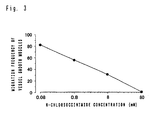
- the dosage of drug for prevention of restenosis according to the present invention varies with administration routes, a patient's symptoms, age or weight. It is preferred to administer the drug such that a local concentration of the compound at the narrowed area of the vessel ranges from 1 to 100 mM. The concentration less than 1 mM does not have much effect on prevention of vascular restenosis, while the concentration exceeding 100 mM may cause side effects.
- the local concentration of the active component of the drug for prevention of vascular restenosis ranges from, preferably, 70 to 90 mM and, most preferably, is about 80 mM.
- the drug for prevention of vascular restenosis of the present invention has been explained as above, the vascular restenosis can be effectively prevented by use of a drug delivery balloon or a stent coated with the drug for prevention of vascular restenosis of the present invention to perform local administration of the drug.
- a stent which is a preferred embodiment of implantable intravascular device of the present invention is characterized by the fact that a surface of the stent is coated with a drug for prevention of vascular restenosis.
- the stent has a cylindrical form, has a coiled body portion or a meshed body portion having plural slots.
- the stent is not limited to these configurations and may take any configuration, provided that it can maintain a size of the lumen after widening the narrowed area of the vessel.
- the stent may have an expansion mechanism of a self-expandable type or a balloon expandable type.
- Suitable materials for the stent includes metals such as stainless steel, titanium, tantalum, alminum, tungsten and nitinol; plastics such as polyamides, polyethylene, polypropylene and hardly-hydrolyzable polyether polyurethane.
- metals such as stainless steel, titanium, tantalum, alminum, tungsten and nitinol
- plastics such as polyamides, polyethylene, polypropylene and hardly-hydrolyzable polyether polyurethane.
- the material for the stent there is no limit to the material for the stent, provided that the material is biocompatible and has been proved as a material for medical use.
- stents examples include Palmaz-Schatz (trademark) stent of Johnson & Johnson, MULTI-LINK (trademark) stent of Advanced cardiovascular systems, Cordis (trademark) stent of Cordis Corporation and Microstent-GFX (trademark) of Medotronic Arterial Vascular Enginerering, Inc., which can be used with good results.
- the stent of the present invention may be obtained by applying a coating mixture containing the drug for prevention of vascular restenosis of the present invention to the above stent in the conventionally known manner.
- Methods for coating to stents are described in Japanese patent unexamined publications JP2000-350786 A and JP2000-51367A , which are hereby incorporated by reference. However, these coating methods can be applied to implantable intravascular devices other than stent. The following is explanation of a method for coating a drug for prevention of vascular restenosis to the stent.
- the drug-coated stent may be obtained by (1) a method comprising steps of mixing a drug for prevention of vascular restenosis with any one of various polymers to prepare a coating mixture, and then spraying the resultant mixture on a stent or dipping the stent into the resultant mixture, or (2) a method comprising steps of providing a hydrophilic coating of a polymer on surface of a stent and then spraying the drug for prevention of vascular restenosis on a stent or dipping the stent into the drug for prevention of vascular restenosis.
- the drug for prevention of vascular restenosis is used after formulation to a suitable dosage form such as a solution, powder or the like, to make it easy to mix the drug with any one of the various polymers.
- a powder type drug for prevention of vascular restenosis is mixed with polymer, it is necessary to sufficiently reduce granularity (primary particles and secondary particles such as aggregates or lumps) to provide the stent with smooth surfaces after coating as well as to prevent slots of the stent from being clogged with the drug.
- the above coating mixture may includes one or more additives such as, for example, diluents, carriers, fillers, stabilizing agents and the like.
- one or more hydrophilic polymers selected from biocompatible hydrophilic polymers may be added to a biocompatible hydrophobic coating agent to modify release profile of the drug.
- one or more hydrophobic polymers may be added to a biocompatible hydrophilic coating agent to modify release profile of the drug.
- the release profile may be modified by incorporating a hydrophilic polymer selected from the group consisting of polyethylene oxide, polyvinyl pyrrolidone, polyethylene glycols, carboxymethylcellulose, hydroxymethylcellulose and combination thereof into an aliphatic polyester coating agent.
- An appropriate amount of the hydrophilic polymer added to the hydrophobic coating agent or that of hydrophobic polymer added to the hydrophilic coating agent is determined according to the release profile of the drug for prevention of vascular restenosis in vitro or in vivo.
- polymers used in the present invention are biocompatible.
- the polymers are polyamides, polyolefines (including polypropylene, polyethylene), nonabsorbable polyesters (including polyethylene terephthalate and the like) and biologically absorbable aliphatic polyesters (lactic acid, glycolic acid, lactide, glycollide, p-dioxane, trimethylenecarbonates, ⁇ -caprolactam, homopolymers thereof and copolymers derived from a mixture of these materials).
- the polymer may be mixed with a highly flexible, high molecular elastomer to provide coating layers with flexibility.
- the elastomers that can be used include, for example, various elastomers of polystyrene, polyolefine, polyesters, polyamides, silicone, polyurethane, fluorinated elastomer, natural rubber, and copolymers or polymer alloys of these materials.
- the most preferred material is a segmented polyurethane polymer film with a high flexibility and a high strength.
- segmented polyurethane polymer films including flexible polyether soft-segments and hard segments of aromatic and urea bond-rich portions, the soft segments and hard segments forming a microstructure based on phase separation.
- Such segmented polyurethane polymer films have sufficient strength and are excellent in antithrombogenicity.
- the segmented polyurethane polymer films are biocompatible and can be expanded sufficiently without causing rupture.
- An amount of the drug for prevention of vascular restenosis to be coated on the stent varies with the administration route, a patient's symptoms, age or weight.
- the quantity consumed of the drug for prevention of vascular restenosis ranges from about 0.001 w/v% to about 70 w/v%, more generally, from about 0.001 w/v% to about 60 w/v% and, most generally, from about 0.001 w/v% to about 45 w/v% with respect to the total amount of the coating mixture.
- the stent explained above makes it possible to provide low invasive means for prevention of vascular restenosis in a short time after coronary interventions as well as to effectively prevent the vascular restenosis, thus making it possible to reduce mental and physical pains of the patient.
- the coronary interventions with possibility of postoperative vascular restenosis include, without being limited thereto, Directional Coronary Atherectomy (DCA), Transluminal Extraction Catheter(TEC), rotating atherectomy coronary angioplasty (Rotablator) and Laser Angioplasty, in addition to the aforesaid PTCA and stent placement.
- DCA Directional Coronary Atherectomy
- TEC Transluminal Extraction Catheter
- Rotablator rotating atherectomy coronary angioplasty
- Laser Angioplasty in addition to the aforesaid PTCA and stent placement.
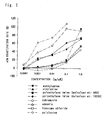
- each of methylamine, ethylamine, polyethyleneimines with molecular weights of 600 and 10000, tobramycin, ammonia, lysozyme chloride and polylysine was diluted to 0.0001 w/v%, 0.001w/v%, 0.01 w/v%, 0.1 w/v% and 1 w/v% to prepare a series of diluted solutions as sample solutions.
- 50 ⁇ L of each sample solution was added with 50 ⁇ L of 2.5 ⁇ 10 -4 w/v% ⁇ 2 -macroglobulin and left for 5 minutes at room temperature.
- the sample solution was added with 50 ⁇ L of a 5 w/v% trypsin EDTA solution, left for 5 minutes at room temperature, and then added with 10 ⁇ L of the coloring matrix S2222.
- the sample solution was added with 50 ⁇ L of 10 w/v% acetic acid solution to stop reactions, and then subjected to measurement of absorption of light with a wave length of 405 nm, using 50 mM tris(hydroxymethyl)aminomethane buffer solution of pH 8.0 as the blank.
- the dilution of all the samples and agents was carried out by a 50 mM tris(hydroxymethyl)aminomethane buffer solution of pH 8.0. Results are shown in Fig. 5 , in which the ordinate denotes the deactivation rate of ⁇ 2 -macroglobulin, and the abscissa denotes the concentrations of respective compounds.
- the vascular restenosis preventing agent according to the present invention and the implantable intravascular device coated therewith deactivate ⁇ 1 -protease inhibitor and ⁇ 2 -macroglobulin, which are factors being closely related to generation of vascular restenosis, thus making it possible to effectively prevent and treat the restenosis of the blood vessel expanded by coronary artery intervention.
- the above restenosis preventing agents provide sufficient effects even at low concentrations, have very little side effects, and in particular work on diabetic patients effectively.
- the above restenosis preventing agents is locally applied to the affected area with an implantable intravascular device, in particular, a stents coated with the agent, the effects of the agent increase greatly and a risk of side effects is considerably lowered.
Landscapes
- Health & Medical Sciences (AREA)
- Life Sciences & Earth Sciences (AREA)
- Animal Behavior & Ethology (AREA)
- General Health & Medical Sciences (AREA)
- Public Health (AREA)
- Veterinary Medicine (AREA)
- Chemical & Material Sciences (AREA)
- Medicinal Chemistry (AREA)
- Epidemiology (AREA)
- Pharmacology & Pharmacy (AREA)
- Engineering & Computer Science (AREA)
- Bioinformatics & Cheminformatics (AREA)
- Heart & Thoracic Surgery (AREA)
- Vascular Medicine (AREA)
- Surgery (AREA)
- Molecular Biology (AREA)
- Nuclear Medicine, Radiotherapy & Molecular Imaging (AREA)
- Chemical Kinetics & Catalysis (AREA)
- General Chemical & Material Sciences (AREA)
- Organic Chemistry (AREA)
- Biomedical Technology (AREA)
- Cardiology (AREA)
- Proteomics, Peptides & Aminoacids (AREA)
- Zoology (AREA)
- Gastroenterology & Hepatology (AREA)
- Immunology (AREA)
- Urology & Nephrology (AREA)
- Medicines That Contain Protein Lipid Enzymes And Other Medicines (AREA)
- Materials For Medical Uses (AREA)
- Pharmaceuticals Containing Other Organic And Inorganic Compounds (AREA)
- Acyclic And Carbocyclic Compounds In Medicinal Compositions (AREA)
- Media Introduction/Drainage Providing Device (AREA)
- Saccharide Compounds (AREA)
- Pyrrole Compounds (AREA)
Applications Claiming Priority (3)
| Application Number | Priority Date | Filing Date | Title |
|---|---|---|---|
| JP2001354931 | 2001-11-20 | ||
| JP2002328138A JP3990972B2 (ja) | 2001-11-20 | 2002-11-12 | 血管再狭窄防止薬及び該防止薬がコーティングされた血管内埋め込み器具 |
| EP02781819A EP1459763A4 (fr) | 2001-11-20 | 2002-11-20 | Medicament pour prevenir une restenose vasculaire et instrument a inserer dans un vaisseau enrobe de ce medicament |
Related Parent Applications (1)
| Application Number | Title | Priority Date | Filing Date |
|---|---|---|---|
| EP02781819.4 Division | 2002-11-20 |
Publications (1)
| Publication Number | Publication Date |
|---|---|
| EP2260838A1 true EP2260838A1 (fr) | 2010-12-15 |
Family
ID=26624618
Family Applications (2)
| Application Number | Title | Priority Date | Filing Date |
|---|---|---|---|
| EP20100008615 Withdrawn EP2260838A1 (fr) | 2001-11-20 | 2002-11-20 | Médicament pour empêcher la resténose vasculaire et instrument à intégrer dans le vaisseau revêtu par le médicament |
| EP02781819A Withdrawn EP1459763A4 (fr) | 2001-11-20 | 2002-11-20 | Medicament pour prevenir une restenose vasculaire et instrument a inserer dans un vaisseau enrobe de ce medicament |
Family Applications After (1)
| Application Number | Title | Priority Date | Filing Date |
|---|---|---|---|
| EP02781819A Withdrawn EP1459763A4 (fr) | 2001-11-20 | 2002-11-20 | Medicament pour prevenir une restenose vasculaire et instrument a inserer dans un vaisseau enrobe de ce medicament |
Country Status (7)
| Country | Link |
|---|---|
| US (2) | US20050038008A1 (fr) |
| EP (2) | EP2260838A1 (fr) |
| JP (1) | JP3990972B2 (fr) |
| KR (1) | KR100907971B1 (fr) |
| CN (1) | CN100352503C (fr) |
| AU (1) | AU2002349693A1 (fr) |
| WO (1) | WO2003043656A1 (fr) |
Families Citing this family (6)
| Publication number | Priority date | Publication date | Assignee | Title |
|---|---|---|---|---|
| US20100063585A1 (en) * | 2006-07-03 | 2010-03-11 | Hemoteq Ag | Manufacture, method and use of active substance-releasing medical products for permanently keeping blood vessels open |
| MX2011013903A (es) * | 2009-06-17 | 2012-05-08 | Amgen Inc | Polipeptidos quimericos y usos de los mismos. |
| US20100324645A1 (en) * | 2009-06-17 | 2010-12-23 | John Stankus | Drug coated balloon catheter and pharmacokinetic profile |
| US9375223B2 (en) | 2009-10-06 | 2016-06-28 | Cardioprolific Inc. | Methods and devices for endovascular therapy |
| US11039845B2 (en) | 2009-10-06 | 2021-06-22 | Cardioprolific Inc. | Methods and devices for endovascular therapy |
| US20110105960A1 (en) * | 2009-10-06 | 2011-05-05 | Wallace Michael P | Ultrasound-enhanced Stenosis therapy |
Citations (7)
| Publication number | Priority date | Publication date | Assignee | Title |
|---|---|---|---|---|
| WO1990008837A1 (fr) * | 1989-01-30 | 1990-08-09 | Athens Research And Technology, Inc. | Analyse rapide de l'inhibiteur fonctionnel humain alpha1-proteinase |
| JP2000051367A (ja) | 1998-06-30 | 2000-02-22 | Ethicon Inc | ステントコ―ティング方法 |
| JP2000095706A (ja) | 1998-07-21 | 2000-04-04 | Ajinomoto Co Inc | 経皮的冠動脈形成術後再狭窄防止用薬剤 |
| JP2000249709A (ja) | 1999-02-26 | 2000-09-14 | Maruha Corp | 冠血管インターベンション施行後の再狭窄の予測方法 |
| JP2000350786A (ja) | 1999-05-17 | 2000-12-19 | Zerbini E J Fundacao | 外側枝の起始部を含む又は冠状動脈の血液循環の分岐部に位置する動脈硬化の病巣を閉塞させないデバイス及びそのようなデバイスを配置する夫々のデバイスの介在方法 |
| JP3146009B2 (ja) | 1993-07-29 | 2001-03-12 | クアドラ ロジック テクノロジーズ,インコーポレイテッド | 再狭窄を阻害する方法 |
| WO2001043743A1 (fr) * | 1999-12-15 | 2001-06-21 | Celgene Corp. | Methodes et compositions de prevention et de traitement de l'atherosclerose, de la restenose et des troubles associes |
Family Cites Families (19)
| Publication number | Priority date | Publication date | Assignee | Title |
|---|---|---|---|---|
| JPS5413694A (en) * | 1977-07-01 | 1979-02-01 | Sumitomo Electric Industries | Composite blood vessel prosthesis and method of producing same |
| DE3722082A1 (de) * | 1987-07-03 | 1989-01-12 | Behringwerke Ag | Verfahren zur bestimmung der aktivitaet von serinproteasen oder serinproteaseinhibitoren |
| US5847007A (en) * | 1993-05-13 | 1998-12-08 | Neorx Corporation | Prevention and treatment of pathologies associated with abnormally proliferative smooth muscle cells |
| US5376633A (en) * | 1992-09-30 | 1994-12-27 | Lezdey; John | Method for deactivating viruses in blood component containers |
| US5340813A (en) * | 1992-11-09 | 1994-08-23 | Cell Therapeutics, Inc. | Substituted aminoalkyl xanthine compounds |
| US6749868B1 (en) * | 1993-02-22 | 2004-06-15 | American Bioscience, Inc. | Protein stabilized pharmacologically active agents, methods for the preparation thereof and methods for the use thereof |
| US5308862A (en) * | 1993-03-05 | 1994-05-03 | Boehringer Mannheim Pharmaceuticals Corporation - Smithkline Beecham Corp., Ltd. Partnership No. 1 | Use of, and method of treatment using, carbazolyl-(4)-oxypropanolamine compounds for inhibition of smooth muscle cell proliferation |
| IL109254A (en) * | 1993-04-29 | 1999-03-12 | Zeneca Ltd | Tetrahydropyran and tetrahydrofuran ether derivatives their preparation and pharmaceutical compositions comprising them |
| CA2162587C (fr) * | 1993-05-13 | 2008-07-08 | Kunz, Lawrence Leroy | Inhibiteur therapeutique des cellules vasculaires du muscle lisse |
| US5457113A (en) * | 1993-10-15 | 1995-10-10 | Eli Lilly And Company | Methods for inhibiting vascular smooth muscle cell proliferation and restinosis |
| US5562652A (en) * | 1994-10-07 | 1996-10-08 | Davis; William M. | Antiseptic medical apparatus |
| CA2223595C (fr) * | 1995-06-07 | 2008-08-05 | Neorx Corporation | Prevention et traitement de pathologies cardio-vasculaires au moyen d'analogues de tamoxifene |
| US5672638A (en) * | 1995-08-22 | 1997-09-30 | Medtronic, Inc. | Biocompatability for solid surfaces |
| DE19712565A1 (de) * | 1997-03-25 | 1998-10-01 | Thomas W Dr Stief | Arzneimittel auf der Basis eines Singulett-Sauerstoff erzeugenden Agenzes |
| JP2002515932A (ja) * | 1997-04-18 | 2002-05-28 | カリフォルニア インスティチュート オブ テクノロジー | 多機能性ポリマー性組織コーティング |
| DE19950386A1 (de) * | 1999-10-19 | 2001-05-10 | Miladin Lazarov | Biokompatibler Gegenstand |
| US6613432B2 (en) * | 1999-12-22 | 2003-09-02 | Biosurface Engineering Technologies, Inc. | Plasma-deposited coatings, devices and methods |
| JP2001213983A (ja) * | 2000-02-01 | 2001-08-07 | Ion Engineering Research Institute Corp | 高分子材料表面への抗血栓性付与方法 |
| DE10065710A1 (de) * | 2000-12-29 | 2002-07-04 | Bayer Ag | Arzneimittel enthaltend ein Polyamin als Wirksubstanz |
-
2002
- 2002-11-12 JP JP2002328138A patent/JP3990972B2/ja not_active Expired - Lifetime
- 2002-11-20 AU AU2002349693A patent/AU2002349693A1/en not_active Abandoned
- 2002-11-20 EP EP20100008615 patent/EP2260838A1/fr not_active Withdrawn
- 2002-11-20 US US10/496,107 patent/US20050038008A1/en not_active Abandoned
- 2002-11-20 EP EP02781819A patent/EP1459763A4/fr not_active Withdrawn
- 2002-11-20 CN CNB028273656A patent/CN100352503C/zh not_active Expired - Fee Related
- 2002-11-20 KR KR1020047007744A patent/KR100907971B1/ko not_active Expired - Fee Related
- 2002-11-20 WO PCT/JP2002/012091 patent/WO2003043656A1/fr not_active Ceased
-
2009
- 2009-09-11 US US12/558,168 patent/US20100003302A1/en not_active Abandoned
Patent Citations (7)
| Publication number | Priority date | Publication date | Assignee | Title |
|---|---|---|---|---|
| WO1990008837A1 (fr) * | 1989-01-30 | 1990-08-09 | Athens Research And Technology, Inc. | Analyse rapide de l'inhibiteur fonctionnel humain alpha1-proteinase |
| JP3146009B2 (ja) | 1993-07-29 | 2001-03-12 | クアドラ ロジック テクノロジーズ,インコーポレイテッド | 再狭窄を阻害する方法 |
| JP2000051367A (ja) | 1998-06-30 | 2000-02-22 | Ethicon Inc | ステントコ―ティング方法 |
| JP2000095706A (ja) | 1998-07-21 | 2000-04-04 | Ajinomoto Co Inc | 経皮的冠動脈形成術後再狭窄防止用薬剤 |
| JP2000249709A (ja) | 1999-02-26 | 2000-09-14 | Maruha Corp | 冠血管インターベンション施行後の再狭窄の予測方法 |
| JP2000350786A (ja) | 1999-05-17 | 2000-12-19 | Zerbini E J Fundacao | 外側枝の起始部を含む又は冠状動脈の血液循環の分岐部に位置する動脈硬化の病巣を閉塞させないデバイス及びそのようなデバイスを配置する夫々のデバイスの介在方法 |
| WO2001043743A1 (fr) * | 1999-12-15 | 2001-06-21 | Celgene Corp. | Methodes et compositions de prevention et de traitement de l'atherosclerose, de la restenose et des troubles associes |
Non-Patent Citations (6)
| Title |
|---|
| ANDRES V: "CONTROL OF VASCULAR SMOOTH MUSCLE CELL GROWTH AND ITS IMPLICATION IN ATHEROSCLEROSIS AND RESTENOSIS (REVIEW)", INTERNATIONAL JOURNAL OF MOLECULAR MEDICINE, SPANDIDOS PUBLICATIONS, GR, vol. 2, no. 1, 1 July 1998 (1998-07-01), pages 81 - 89, XP001070318, ISSN: 1107-3756 * |
| BARRETT A J ET AL: "ELECTROPHORETICALLY SLOW AND FAST FORMS OF THE ALPHA-2 MACRO GLOBULIN MOLECULE", BIOCHEMICAL JOURNAL, vol. 181, no. 2, 1979, pages 401 - 418, XP002605054, ISSN: 0264-6021 * |
| IKARI Y ET AL: "Alpha(1)-proteinase inhibitor, alpha(1)-antichymotrypsin, or alpha(2)-macroglobulin is required for vascular smooth muscle cell spreading in three-dimensional fibrin gel.", THE JOURNAL OF BIOLOGICAL CHEMISTRY 28 APR 2000, vol. 275, no. 17, 28 April 2000 (2000-04-28), pages 12799 - 12805, XP002464490, ISSN: 0021-9258 * |
| LARSSON L-J ET AL: "KINETICS OF APPEARANCE OF SULFHYDRYL GROUPS IN ALPHA-2 MACRO GLOBULIN ON REACTION OF THE INHIBITOR WITH AMINES", BIOCHEMISTRY, AMERICAN CHEMICAL SOCIETY, US, vol. 23, no. 12, 1 June 1984 (1984-06-01), pages 2802 - 2807, XP009139851, ISSN: 0006-2960 * |
| YUJI IKARI ET AL., JOURNAL OF BIOLOGICAL CHEMISTRY, vol. 276, no. 15, April 2001 (2001-04-01), pages 11798 - 11803 |
| YUJI IKARI ET AL., JOURNAL OF BIOLOGICAL. CHEMISTRY, vol. 275, no. 17, April 2000 (2000-04-01), pages 12799 - 12805 |
Also Published As
| Publication number | Publication date |
|---|---|
| EP1459763A4 (fr) | 2008-03-05 |
| KR20050044563A (ko) | 2005-05-12 |
| WO2003043656A1 (fr) | 2003-05-30 |
| AU2002349693A1 (en) | 2003-06-10 |
| JP3990972B2 (ja) | 2007-10-17 |
| EP1459763A1 (fr) | 2004-09-22 |
| US20100003302A1 (en) | 2010-01-07 |
| JP2003221347A (ja) | 2003-08-05 |
| CN100352503C (zh) | 2007-12-05 |
| KR100907971B1 (ko) | 2009-07-16 |
| CN1615153A (zh) | 2005-05-11 |
| US20050038008A1 (en) | 2005-02-17 |
Similar Documents
| Publication | Publication Date | Title |
|---|---|---|
| JP4850985B2 (ja) | 微小管安定化剤を用いたアテローム性動脈硬化症または再狭窄症の治療方法 | |
| US7875073B2 (en) | Block copolymers of acrylates and methacrylates with fluoroalkenes | |
| JP5523670B2 (ja) | ステント様インプラントにコートされたヘパリンを含有するブロックコポリマー | |
| JP5452832B2 (ja) | 医療用インプラントのための薬剤溶出コーティング | |
| US7563780B1 (en) | Heparin prodrugs and drug delivery stents formed therefrom | |
| US20100003302A1 (en) | Vascular restenosis preventing agent and implantable intravascular device coated therewith | |
| PT1986711E (pt) | Dispositivo médico implantável com revestimento de poliéster de erosão superficial para entrega de fármacos | |
| JP2007532197A (ja) | 生物活性物質のための被覆組成物 | |
| JP2003501151A (ja) | 動脈再狭窄治療用装置および化合物 | |
| US20060099235A1 (en) | Medical devices and compositions useful for treating or inhibiting restenosis | |
| AU2016210726A1 (en) | Coating | |
| US20040213826A1 (en) | Medical devices and methods for inhibiting proliferation of smooth muscle cells | |
| JP2009543659A (ja) | 滅菌中に薬物を保護するためのフリーラジカルスカベンジャーを用いた薬剤溶出性埋め込み型医療機器及び関連する方法 | |
| Brooks et al. | Non-steroidal anti-inflammatory drugs (NSAIDs) inhibit vascular smooth muscle cell proliferation via differential effects on the cell cycle | |
| JP2007527265A (ja) | 平滑筋細胞増殖を阻害するための医療装置及び方法 | |
| US20050154451A1 (en) | Medical devices to treat or inhibit restenosis | |
| US20040121981A1 (en) | Method for controlling angiogenesis in animals | |
| US7494665B1 (en) | Polymers containing siloxane monomers | |
| US20050214343A1 (en) | Medical devices comprising a protein-tyrosine kinase inhibitor to inhibit restonosis | |
| JP2005538756A (ja) | 再狭窄を阻害するためのタンパク質−チロシンキナーゼ阻害物質を含んでなる医療デバイス | |
| CN101361686A (zh) | 一种血管药物支架 | |
| Taite et al. | Sustained delivery of nitric oxide from poly (ethylene glycol) hydrogels enhances endothelialization in a rat carotid balloon injury model | |
| US20070160642A1 (en) | Implantable medical devices coated with a polymer-bound superoxide dismutase mimic |
Legal Events
| Date | Code | Title | Description |
|---|---|---|---|
| PUAI | Public reference made under article 153(3) epc to a published international application that has entered the european phase |
Free format text: ORIGINAL CODE: 0009012 |
|
| AC | Divisional application: reference to earlier application |
Ref document number: 1459763 Country of ref document: EP Kind code of ref document: P |
|
| AK | Designated contracting states |
Kind code of ref document: A1 Designated state(s): AT BE BG CH CY CZ DE DK EE ES FI FR GB GR IE IT LI LU MC NL PT SE SK TR |
|
| 17P | Request for examination filed |
Effective date: 20110509 |
|
| 17Q | First examination report despatched |
Effective date: 20110829 |
|
| STAA | Information on the status of an ep patent application or granted ep patent |
Free format text: STATUS: THE APPLICATION IS DEEMED TO BE WITHDRAWN |
|
| 18D | Application deemed to be withdrawn |
Effective date: 20120110 |