EP2261585A2 - Appareil de réfrigération et/ou de refroidissement - Google Patents
Appareil de réfrigération et/ou de refroidissement Download PDFInfo
- Publication number
- EP2261585A2 EP2261585A2 EP10005537A EP10005537A EP2261585A2 EP 2261585 A2 EP2261585 A2 EP 2261585A2 EP 10005537 A EP10005537 A EP 10005537A EP 10005537 A EP10005537 A EP 10005537A EP 2261585 A2 EP2261585 A2 EP 2261585A2
- Authority
- EP
- European Patent Office
- Prior art keywords
- refrigerator
- control
- freezer
- energy signal
- energy
- Prior art date
- Legal status (The legal status is an assumption and is not a legal conclusion. Google has not performed a legal analysis and makes no representation as to the accuracy of the status listed.)
- Withdrawn
Links
Images

Classifications
-
- F—MECHANICAL ENGINEERING; LIGHTING; HEATING; WEAPONS; BLASTING
- F25—REFRIGERATION OR COOLING; COMBINED HEATING AND REFRIGERATION SYSTEMS; HEAT PUMP SYSTEMS; MANUFACTURE OR STORAGE OF ICE; LIQUEFACTION SOLIDIFICATION OF GASES
- F25D—REFRIGERATORS; COLD ROOMS; ICE-BOXES; COOLING OR FREEZING APPARATUS NOT OTHERWISE PROVIDED FOR
- F25D29/00—Arrangement or mounting of control or safety devices
-
- F—MECHANICAL ENGINEERING; LIGHTING; HEATING; WEAPONS; BLASTING
- F25—REFRIGERATION OR COOLING; COMBINED HEATING AND REFRIGERATION SYSTEMS; HEAT PUMP SYSTEMS; MANUFACTURE OR STORAGE OF ICE; LIQUEFACTION SOLIDIFICATION OF GASES
- F25D—REFRIGERATORS; COLD ROOMS; ICE-BOXES; COOLING OR FREEZING APPARATUS NOT OTHERWISE PROVIDED FOR
- F25D11/00—Self-contained movable devices, e.g. domestic refrigerators
- F25D11/006—Self-contained movable devices, e.g. domestic refrigerators with cold storage accumulators
-
- F—MECHANICAL ENGINEERING; LIGHTING; HEATING; WEAPONS; BLASTING
- F25—REFRIGERATION OR COOLING; COMBINED HEATING AND REFRIGERATION SYSTEMS; HEAT PUMP SYSTEMS; MANUFACTURE OR STORAGE OF ICE; LIQUEFACTION SOLIDIFICATION OF GASES
- F25D—REFRIGERATORS; COLD ROOMS; ICE-BOXES; COOLING OR FREEZING APPARATUS NOT OTHERWISE PROVIDED FOR
- F25D2700/00—Means for sensing or measuring; Sensors therefor
- F25D2700/02—Sensors detecting door opening
-
- F—MECHANICAL ENGINEERING; LIGHTING; HEATING; WEAPONS; BLASTING
- F25—REFRIGERATION OR COOLING; COMBINED HEATING AND REFRIGERATION SYSTEMS; HEAT PUMP SYSTEMS; MANUFACTURE OR STORAGE OF ICE; LIQUEFACTION SOLIDIFICATION OF GASES
- F25D—REFRIGERATORS; COLD ROOMS; ICE-BOXES; COOLING OR FREEZING APPARATUS NOT OTHERWISE PROVIDED FOR
- F25D2700/00—Means for sensing or measuring; Sensors therefor
- F25D2700/14—Sensors measuring the temperature outside the refrigerator or freezer
Definitions
- the invention relates to a refrigerator and / or freezer
- Time-based electricity tariffs are being pushed forward politically and could become mandatory in a few years' time, as electricity consumption can be better utilized and power generation costs reduced by optimizing the consumption of electricity over time. Therefore, it is desirable to move most of the energy consumption of devices as possible into the night hours. This would reduce the energy costs for operating various household appliances, including refrigerators, for time-dependent electricity tariffs.
- Cooling devices of the prior art orient their cooling capacity (and thus their instantaneous power consumption) at the internal temperature in order to achieve optimum storage conditions. Variable electricity tariffs can not be used in this way.
- Cooling devices with heat accumulators are also known from the prior art.
- the DE 38 06 205 C2 describes a refrigerator, which has a heat storage.
- This cooling unit is designed to consume power by adjusting the operation to the ambient temperature averaged over a period of time.
- the usable space is above a certain ambient temperature under power consumption via an evaporator, and cooled below via a heat storage.
- the DE 27 26 954 A1 discloses a cooling device, which has a latent heat storage to keep the temperature of the cooling device Stromtarifconnect below a maximum value.
- a disadvantage of refrigerators off DE 27 26 954 A1 is the low flexibility, with only a distinction between the on and off state of the refrigeration unit (full or no power) and a yes / no decision between cheaper and more expensive electricity tariff. When the capacity of the aggregates is exhausted, normal operation takes place in the expensive period until the cheap period starts again.
- the present invention has for its object to provide a refrigerator or freezer that allows the most cost-saving or resource-saving operation.
- the refrigerator and / or freezer is designed with at least one power consumer, as well as at least one memory which forms a part of the device or with which the device is connectable or in communication, wherein in the memory at least one time-dependent Energy signal stored or can be stored and wherein the device has at least one control or control unit or is connected to this or connectable, which is designed such that it carries out the control or control of the device operation, taking into account the stored energy in the memory signal.
- the energy signal can represent a standardized signal on the part of the energy supplier or can also be adapted individually by the consumer.
- the energy signal for the efficient operation of electrical equipment includes important data, such as the current electricity price, the current CO 2 emissions per unit of energy generated, the network load or other relevant values of energy production and distribution. Since these values fluctuate, eg due to renewable energies depending on weather conditions, the device can apply its control algorithm to this data and thus minimize energy costs and / or CO 2 emissions.
- a time-dependent temperature curve is stored for each regulator position, which is optimized for the daytime course of the energy signal.
- control algorithm stores time-dependent cooling power profiles. These are optimized by the algorithm on the basis of various parameters and / or other data inputs. Thus, the power consumption under a variety of boundary conditions and requirements can be determined and optimized in advance.
- These cooling performance profiles in one embodiment in their digital form, may take the form of polynomials with cooling performance as a dependent variable and time as an independent variable.
- the central parameter of the algorithm is the internal temperature of the working space. This is either set by the user or can be varied within a certain range depending on the application.
- the algorithm can set a maximum and / or minimum temperature which may not be exceeded or fallen short of. Furthermore, a maximum fluctuation range of the temperature, also a time-dependent fluctuation range, can be determined.
- the invention comprises an embodiment, which can be selected via input to the operating device of the device or on an electronically connected control panel between constant temperature and maximum cost savings, continuously or with any intermediate stages. This achieves optimum adaptation to short-term or long-term storage and to the type of stored goods.
- the optimization preferably takes place on the basis of the energy signal on a percentage scale from 0% (constant temperature) to 100% (complete optimization) and / or particularly preferably on a scale with at most 10 steps.
- the running time of the refrigeration unit and / or the loading state of the power and / or heat storage are also taken into account in the control algorithm.
- the course of the energy signal during the course of the day is stored in the device electronics.
- This deposit can be made via the user or an employee of the energy provider or the device provider via a data interface (for example via USB) or via the display and the operating devices of the device according to the specifications of the energy provider.
- the device can receive the energy signal, ie the data of the energy costs or via the CO 2 emission, via a, inter alia, wireless data connection (WLAN, Powerline, Bus, GSM ...) from a server.
- WLAN Wireless Local Area Network
- GSM Global System for Mobile Communications
- the control electronics be executed with an internal, absolute clock.
- the time signal can be transmitted together with the tariff data.
- the outside temperature can also serve as a parameter for the control algorithm. This can easily be measured by an outdoor thermometer and, if necessary, averaged over a user-defined period of time.
- electronics are also provided which generate independent forecasts on the basis of temperature data from the past, which are evaluated according to specific patterns and support the control algorithm when creating the cooling power profiles.
- An apparatus according to the invention also includes such embodiments in which forecast data for the near future (such as weather reports) can be fed manually or preferably online into the control algorithm in order to further optimize the energy utilization for the following days.
- the number of door openings in a daytime period also contributes significantly to the temperature in the usable space and the required cooling capacity.
- the occurrence of door openings usually has a certain regularity in a household. Thus this number can be statistically ascertained depending on the time of day and the statistics of the door openings can also be taken into account by the control algorithm.
- the loading of the working space also has an influence on its cooling requirements.
- the algorithm according to the invention can also take into account the loading. It is also conceivable in one embodiment that the algorithm takes into account inputs according to which the device should not use any current in a certain period of time, for example for acoustic reasons or due to a temporary disconnection of the power supply.
- the device detects its own power or CO 2 consumption, determines the cost or the CO 2 emissions and displays on the display of the device.
- the device receives data from a power company via a so-called smart meter or other electronic assembly (eg digitalStrom) that logically between the electronics and the intelligent meter, the device can also receive energy costs via this meter and determine the total costs or other energy-relevant data itself. Forecasts of operating costs and other relevant values of energy production and distribution at various intermediate stages between maximum temperature stability in the workspace and maximum cost savings are also possible based on algorithmic cooling performance profiles. This, in turn, allows the user to match the quality of the cooling to a target for the total cost or energy efficiency of the device, and not just vice versa.
- One or more heat and / or electricity storage can be permanently integrated in the unit or enclosed loose.
- suitable stores include sensitive heat storage, latent heat storage, thermochemical heat storage or sorption storage.
- latent heat accumulators are used as the heat accumulator.
- the storage media of the latent heat storage have a phase transition temperature of slightly below the nominal temperature of the work space.
- the melting temperature of the storage medium should be in the range between about 5 ° C above and about 10 ° C below, preferably between about 2 ° C above and about 5 ° C below, and more preferably between about 1 ° C above and about 3 ° C below the nominal temperature of the device are.
- a latent heat storage designed for a value below the nominal temperature has a larger Flexibility in setting the desired temperature for the work space allowed, however, the temperature setting will be subject to greater fluctuations. In one embodiment of the invention, therefore, several latent heat storage with different storage media in the same space are used. Typical values for setpoint temperatures are, for example, 5 ° C (refrigerators) or -18 ° C (freezers).
- refrigerators or freezers have electricity storage.
- power storage for example, offer batteries, electrolyzers, fuel cells or capacitors. These are preferably charged in phases with favorable energy signal and give off electrical energy in periods with unfavorable energy signal. This allows, in contrast to the latent heat storage, especially an energy storage, which is independent of the internal temperature, and an operation of electrical components of the device, such as meters, control units or screens.
- the algorithm regulates only a portion of the device, in a combined refrigerator with freezer, for example, only the refrigerating compartment, the freezer compartment or the cold storage compartment.
- an apparatus according to the invention can have different control algorithms for different subregions. This also applies to the type and distribution of heat and / or electricity storage, which may be generally freely distributed within a useful space and / or over several cold rooms and are freely combinable, should this be expedient.
- a plurality of energy signals can be taken into account in parallel and / or optionally weighted by the control and regulation unit if necessary.
- the electronic components for the detection of the energy signal and its at least partial evaluation and analysis at least Partially be outsourced into an external module and connected to a refrigerator or freezer or connected.
- the devices can be easily retrofitted or expanded.
- control and regulation unit comprises at least one P and / or I and / or PI and / or PD, and / or ID and / or PID controller.
- the regulation and control unit is designed such that at least one offset value can be determined from the energy signal by means of a control algorithm. Additionally or alternatively, it can be provided that at least one offset value can be determined from the setpoint and / or the actual temperature of the refrigerator or freezer. The offset values influence the actually used switching values for controlling the specific device components.
- the offset value can represent a control-technical possible deviation of the actual shift value by the offset value, as a result of which an optimized operation of the refrigerator or freezer can be achieved. This corresponds for example to the definition of an allowable tolerance range for the switching value of the refrigerator or freezer.
- the offset preferably allows a deviation of the switching value in the positive as well as in the negative direction.
- At least one offset value and / or the sum of the offset values can be limited according to corresponding specifications and / or can be added to at least one switching value of the refrigerator or freezer. If appropriate, at least one offset value or the sum of the offset values may be weighted by the set utilization of the optimization.
- the control algorithm it is advisable to extend the control algorithm to the defrost heater. It is advantageous to activate the heater at a time with favorable energy signal or to start a defrosting phase.
- a shift in defrosting may preferably be permitted only in the direction of earlier times, wherein the maximum value of the shift is limited.
- the control algorithm can also be changed in such a way that a shift is only permitted in the direction of later times, whereby this shift can also be limited.
- the shift of the defrost phase can also be limited only in the direction of earlier and later times.
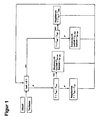
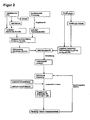
- FIGS. 1 and 2 Information on embodiments of a refrigerator and / or freezer according to the invention are shown, wherein the energy signal represents information about the current electricity tariffs.
- a first query in FIG. 1 refers to whether at the moment the electricity tariff is below or above average. This query relates the current electricity price of a clock and a table or online. If the instantaneous rate to be below average, so it is first checked whether the instantaneous internal temperature T set above the range T - T low to between the target temperature T and the defined as the lower limit temperature T is low. If this is the case, the refrigerator is operated in normal operation to cool down in this area. If this is not the case, the operation is continued via the experimentally determined cooling performance profile for the economy time with running and standing times t off, low and t on, low .
- the instantaneous rate to be higher than average it is checked whether the instantaneous internal temperature T over the range T to T + High between the desired temperature is T and the predetermined upper limit temperature T is high. If this is the case, the refrigerator is operated in normal operation to cool down in this area. If this does not apply then the operation will be over that of the algorithm Experimentally determined cooling performance profile with running and stopping times t off, high and t on, high continued.
- the temperature corridor in the range T - T Low to T - T High is determined by the user's specifications regarding the desired cost savings.
- the times t off, loW , t on, low , t off, high and t on, high to be protected are determined experimentally and are in the range of approximately 5 to 1000 minutes.
- the electronics in FIG. 2 first collects tariff data K online from the energy supply company (top left), connects them with the current time, statistically evaluates the tariff data over a period of 24 hours and thus receives a profile of tariff data. A user then specifies certain parameters such as the desired economy or allowable temperature corridor T High to T Low . This entry can be changed at any time.
- An external air sensor generates an outdoor temperature profile T over a period of 24 hours and a constantly updatable heat input Q, which is influenced by temperature differences and the quality of the insulation.
- An additional heat input is estimated by the time-dependent measurement of the door openings and the subsequent statistical evaluation (top right).
- the specifications are used by the algorithm to create a cooling performance profile that is implemented and iteratively optimized and adjusted by measuring the trend in the temperature history (below).
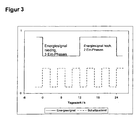
- FIG. 3 shows the stored or received time course of the energy signal.
- the energy signal represents a two-stage electricity tariff, the first stage of which has a low energy signal and symbolizes a low-cost electricity tariff, and whose second stage has a high energy signal, which is associated with a high electricity tariff.
- the control of the refrigerator or freezer takes place with an odd number of cycles per day.
- By cleverly selected switching times can be a duty cycle more fall in the low tariff than in the high tariff.
- a total of 5 cycles are optimized for cooling the device (switch-on phases) per day to the respective energy signal state. In concrete terms, this means that during the phase with low energy signal, three cycles (switch-on phases) are switched for cooling the device, with only the two being switched during the phase with a high energy signal.
- the optimized regulation of the refrigerator or freezer responds to the incoming energy signal that the values calculated by an algorithm for raising and / or lowering the switch-on and switch-off values leads to changed running times of the refrigeration unit with an energy consumption optimized with respect to the energy signal.
- the required components for receiving the energy signal and the algorithm for its at least partial evaluation are preferably integrated in the device electronics. This calculates the raising and lowering of the switch-on and switch-off values on the basis of the received energy signal and takes these values into account when controlling the device.
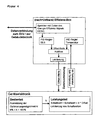
- FIG. 4 Another embodiment of the refrigerator and / or freezer according to the invention follows an alternative control algorithm of the control and regulation unit of the device, based on FIG. 4 will be explained in more detail.
- the necessary components for receiving the energy signal and the algorithm for its evaluation are alternatively integrated into an outsourced module (energy efficiency box), which communicates with the device electronics via a communication protocol.
- the module calculates the raising and lowering of the switch-on and switch-off values on the basis of the received energy signal and forwards them to the device electronics by means of a transfer protocol, which takes these values into account when controlling the refrigerator or freezer.
- the retrofittable energy efficiency box receives the energy efficiency signal (energy signal) from a power supply company via a data connection for a certain period of time. From this period, an algorithm based on a PID controller calculates the offset values. Another PID controller reads the actual and set temperature from the device electronics and calculates offset values from it as well. The offset values of both PID controllers are added together, limited according to specifications and then transmitted to the device electronics. The device electronics calculates the switching values of the device depending on the utilization of the optimization desired by the customer, taking into account the offset values obtained. These switching values are also limited according to specifications. This ensures a safe function of the device.
- energy efficiency signal energy signal
- Another PID controller reads the actual and set temperature from the device electronics and calculates offset values from it as well.
- the offset values of both PID controllers are added together, limited according to specifications and then transmitted to the device electronics.
- the device electronics calculates the switching values of the device depending on the utilization of the optimization desired by the customer, taking into account the offset values obtained. These switching
- the dynamics of the energy efficiency signal influences the time constants of the controller used. As a result, it is possible to react to the change of the signal at different speeds.
- the electronics of the efficiency box can also be integrated into a single module of the appliance electronics of the refrigerator or freezer.
- the offset value is determined from a table that depicts a temperature offset based on the incoming energy signal. Furthermore, the average value is taken into account via the energy signal in the determination of the offset.
- the obtained offset value is limited by the stored absolute maximum and minimum switch-on and switch-off values, as in FIG. 4 weighted with the use of optimization k and added to the switching value of the device electronics.
- the control algorithms of FIGS. 4 and 5 Of course, you can work in parallel in a refrigerator or freezer.
- the control algorithm it is advisable to extend the control algorithm also on the defrost heater. It is advantageous to activate the heater at a time with favorable energy signal or to start a defrosting phase. For the function of the device it is important that the defrosting phase is not delayed too late.
- the rule of the FIGS. 4 or 5 controls in this embodiment the time shift of the defrosting phase.
- An early defrost should be carried out as far as possible with a favorable energy signal.
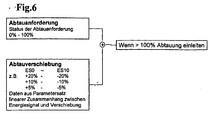
- the parameters taken into account in the calculation are changed by adding further values as a function of the current energy signal FIG. 6 is to be taken explicitly.
- a change in the period between defrosting periods may be less than ⁇ 20%, which may optionally be limited to a period of less than ⁇ 10%.
Landscapes
- Engineering & Computer Science (AREA)
- Chemical & Material Sciences (AREA)
- Combustion & Propulsion (AREA)
- Physics & Mathematics (AREA)
- Mechanical Engineering (AREA)
- Thermal Sciences (AREA)
- General Engineering & Computer Science (AREA)
- Devices That Are Associated With Refrigeration Equipment (AREA)
- Cold Air Circulating Systems And Constructional Details In Refrigerators (AREA)
Applications Claiming Priority (2)
| Application Number | Priority Date | Filing Date | Title |
|---|---|---|---|
| DE102009023655 | 2009-05-28 | ||
| DE102009033642A DE102009033642A1 (de) | 2009-05-28 | 2009-07-17 | Kühl- und/oder Gefriergerät |
Publications (2)
| Publication Number | Publication Date |
|---|---|
| EP2261585A2 true EP2261585A2 (fr) | 2010-12-15 |
| EP2261585A3 EP2261585A3 (fr) | 2016-11-30 |
Family
ID=43028639
Family Applications (1)
| Application Number | Title | Priority Date | Filing Date |
|---|---|---|---|
| EP10005537.5A Withdrawn EP2261585A3 (fr) | 2009-05-28 | 2010-05-27 | Appareil de réfrigération et/ou de refroidissement |
Country Status (2)
| Country | Link |
|---|---|
| EP (1) | EP2261585A3 (fr) |
| DE (1) | DE102009033642A1 (fr) |
Cited By (5)
| Publication number | Priority date | Publication date | Assignee | Title |
|---|---|---|---|---|
| EP2587727B1 (fr) | 2010-06-22 | 2015-03-04 | LG Electronics Inc. | Système réseau |
| EP2587445B1 (fr) | 2010-06-22 | 2015-04-15 | LG Electronics Inc. | Système de réseau |
| EP2476984A3 (fr) * | 2011-01-18 | 2017-01-25 | Liebherr-Hausgeräte Ochsenhausen GmbH | Appareil de réfrigération et/ou de congélation |
| DE102017210772A1 (de) | 2017-06-27 | 2018-12-27 | BSH Hausgeräte GmbH | Verfahren zum Betreiben eines Haushaltskältegeräts mit einem Kältespeicher, der abhängig von spezifische Strompreistarifen aufgeladen wird, sowie Haushaltskältegerät |
| CN117806154A (zh) * | 2024-02-27 | 2024-04-02 | 山东丰斯工程技术有限公司 | 一种用于篦式冷却机的pid控制器参数优化方法及系统 |
Families Citing this family (3)
| Publication number | Priority date | Publication date | Assignee | Title |
|---|---|---|---|---|
| DE102010055903A1 (de) | 2010-10-20 | 2012-04-26 | Liebherr-Hausgeräte Ochsenhausen GmbH | System umfassend wenigstens ein Kühl-und/oder Gefriergerät |
| DE102014008600A1 (de) * | 2013-09-12 | 2015-03-12 | Liebherr-Hausgeräte Ochsenhausen GmbH | Kühl- und/oder Gefriergerät |
| DE102014001856A1 (de) | 2013-12-16 | 2015-06-18 | Liebherr-Hausgeräte Ochsenhausen GmbH | Kühl- und/oder Gefriergerät |
Citations (2)
| Publication number | Priority date | Publication date | Assignee | Title |
|---|---|---|---|---|
| DE2726954A1 (de) | 1977-06-15 | 1979-01-04 | Walter Holzer | Tiefkuehlgeraet mit kaeltespeicher |
| DE3806205C2 (fr) | 1987-02-27 | 1990-12-20 | Kabushiki Kaisha Toshiba, Kawasaki, Kanagawa, Jp |
Family Cites Families (7)
| Publication number | Priority date | Publication date | Assignee | Title |
|---|---|---|---|---|
| DE610450C (de) * | 1933-02-08 | 1935-03-11 | Alfred Teves Dr | Vollautomatische elektrische Schaltung fuer Speicherungskuehlanlagen |
| DE20110633U1 (de) * | 2001-06-27 | 2002-01-17 | Phocos AG, 89171 Illerkirchberg | Energiemanagement für speicherbetriebenes Kühlgerät |
| DE102005001143A1 (de) * | 2005-01-11 | 2006-07-20 | Bernhard Beck | Verfahren und Vorrichtung zur verbraucherindividuellen Lieferung an elektrischer Energie |
| US7266962B2 (en) * | 2005-05-17 | 2007-09-11 | Whirlpool Corporation | Battery supplemented refrigerator and method for using same |
| US7274975B2 (en) * | 2005-06-06 | 2007-09-25 | Gridpoint, Inc. | Optimized energy management system |
| DE102007032052A1 (de) * | 2007-07-10 | 2009-01-15 | Abröll, Andreas | Vorrichtung und Verfahren zur Regulierung des Stromverbrauchs eines elektrischen Geräts |
| DE102007032053A1 (de) * | 2007-07-10 | 2009-01-15 | Abröll, Andreas | Vorrichtung und Verfahren zur Regulierung des Stromverbrauchs eines elektrischen Geräts |
-
2009
- 2009-07-17 DE DE102009033642A patent/DE102009033642A1/de not_active Withdrawn
-
2010
- 2010-05-27 EP EP10005537.5A patent/EP2261585A3/fr not_active Withdrawn
Patent Citations (2)
| Publication number | Priority date | Publication date | Assignee | Title |
|---|---|---|---|---|
| DE2726954A1 (de) | 1977-06-15 | 1979-01-04 | Walter Holzer | Tiefkuehlgeraet mit kaeltespeicher |
| DE3806205C2 (fr) | 1987-02-27 | 1990-12-20 | Kabushiki Kaisha Toshiba, Kawasaki, Kanagawa, Jp |
Cited By (6)
| Publication number | Priority date | Publication date | Assignee | Title |
|---|---|---|---|---|
| EP2587727B1 (fr) | 2010-06-22 | 2015-03-04 | LG Electronics Inc. | Système réseau |
| EP2587445B1 (fr) | 2010-06-22 | 2015-04-15 | LG Electronics Inc. | Système de réseau |
| EP2476984A3 (fr) * | 2011-01-18 | 2017-01-25 | Liebherr-Hausgeräte Ochsenhausen GmbH | Appareil de réfrigération et/ou de congélation |
| DE102017210772A1 (de) | 2017-06-27 | 2018-12-27 | BSH Hausgeräte GmbH | Verfahren zum Betreiben eines Haushaltskältegeräts mit einem Kältespeicher, der abhängig von spezifische Strompreistarifen aufgeladen wird, sowie Haushaltskältegerät |
| CN117806154A (zh) * | 2024-02-27 | 2024-04-02 | 山东丰斯工程技术有限公司 | 一种用于篦式冷却机的pid控制器参数优化方法及系统 |
| CN117806154B (zh) * | 2024-02-27 | 2024-05-03 | 山东丰斯工程技术有限公司 | 一种用于篦式冷却机的pid控制器参数优化方法及系统 |
Also Published As
| Publication number | Publication date |
|---|---|
| EP2261585A3 (fr) | 2016-11-30 |
| DE102009033642A1 (de) | 2010-12-02 |
Similar Documents
| Publication | Publication Date | Title |
|---|---|---|
| EP2261585A2 (fr) | Appareil de réfrigération et/ou de refroidissement | |
| DE102012103081B4 (de) | Optimiertes Lastmanagement | |
| EP2615385B1 (fr) | Gestionnaire système pour convertisseurs d'énergie réglés en fonction de la puissance | |
| Henze et al. | Guidelines for improved performance of ice storage systems | |
| EP2360353A2 (fr) | Système et procédé de commande d'unités de production d'énergie, de stockage et/ou de consommation couplées les unes avec les autres | |
| DE102016015503A1 (de) | Heiz- und/oder Kühlsystem mit prädiktivem Energiemanagement | |
| CN112815473A (zh) | 一种用于蓄冷空调系统的优化控制装置及控制方法 | |
| WO2016138885A1 (fr) | Procédé de commande de la consommation d'énergie d'une unité d'immeuble et unité de distribution décentralisée d'énergie | |
| EP2476984B1 (fr) | Appareil de réfrigération et/ou de congélation | |
| WO1994009327A1 (fr) | Unite d'entrainement commandable comprenant un moteur a combustion interne et un generateur | |
| EP2875560B1 (fr) | Procédé de réglage du rapport entre l'énergie électrique injectée et prélevée dans un réseau d'alimentation en énergie électrique | |
| EP2685580A2 (fr) | Dispositif de détermination et/ou de commande d'un temps de fonctionnement d'un consommateur couplé à une centrale, en particulier une centrale photovoltaïque, et à un accumulateur d'énergie, et procédé de fonctionnement d'un accumulateur d'énergie couplé à une centrale. | |
| EP2458310B1 (fr) | Procédé de fonctionnement d'un appareil de refroidissement et/ou de réfrigération et appareil de refroidissement et/ou de réfrigération | |
| DE102007043888B4 (de) | Vorrichtung zur Versorgung eines Verbrauchers | |
| EP2896900B1 (fr) | Procédé de contrôle d'une puissance de refroidissement ou de chauffage pour un système de chauffage / refroidissement avec plusieurs sources et unité de contrôle pour executer le procédé | |
| EP2525624B1 (fr) | Capacité opérationnelle dépendante de la tension | |
| EP2444765B1 (fr) | Système comprenant au moins un appareil de refroidissement et/ou de congélation | |
| EP2728707A2 (fr) | Dispositif d'alimentation électrique de secours | |
| WO2020058172A1 (fr) | Système de commande/régulation d'un réseau électrique et module de commande/régulation d'un système de commande/régulation d'un réseau électrique | |
| DE102011101891A1 (de) | Spannungsabhängiges Vorschaltgerät | |
| DE102012211357A1 (de) | Verfahren zum Steuern eines Kühlmöbelsystems und Kühlmöbelsystem | |
| EP4446660A1 (fr) | Régulation de température de départ optimisée par cop pour une pompe à chaleur | |
| WO2022223549A1 (fr) | Système de commande de bâtiment pour au moins un bâtiment | |
| EP2857640A1 (fr) | Dispositif doté d'au moins une unité d'accumulation de la chaleur latente | |
| EP4621521A1 (fr) | Procédé et système de commande d'un appareil de chauffage et/ou de refroidissement alimenté en courant |
Legal Events
| Date | Code | Title | Description |
|---|---|---|---|
| PUAI | Public reference made under article 153(3) epc to a published international application that has entered the european phase |
Free format text: ORIGINAL CODE: 0009012 |
|
| AK | Designated contracting states |
Kind code of ref document: A2 Designated state(s): AL AT BE BG CH CY CZ DE DK EE ES FI FR GB GR HR HU IE IS IT LI LT LU LV MC MK MT NL NO PL PT RO SE SI SK SM TR |
|
| AX | Request for extension of the european patent |
Extension state: BA ME RS |
|
| RIN1 | Information on inventor provided before grant (corrected) |
Inventor name: GERNER, HERBERT Inventor name: LOCHER, ERWIN Inventor name: ERTEL, THOMAS Inventor name: SCHICK, MICHAEL |
|
| PUAL | Search report despatched |
Free format text: ORIGINAL CODE: 0009013 |
|
| AK | Designated contracting states |
Kind code of ref document: A3 Designated state(s): AL AT BE BG CH CY CZ DE DK EE ES FI FR GB GR HR HU IE IS IT LI LT LU LV MC MK MT NL NO PL PT RO SE SI SK SM TR |
|
| AX | Request for extension of the european patent |
Extension state: BA ME RS |
|
| RIC1 | Information provided on ipc code assigned before grant |
Ipc: F25D 29/00 20060101AFI20161021BHEP |
|
| 17P | Request for examination filed |
Effective date: 20170523 |
|
| R17P | Request for examination filed (corrected) |
Effective date: 20170523 |
|
| RIN1 | Information on inventor provided before grant (corrected) |
Inventor name: SCHICK, MICHAEL Inventor name: GERNER, HERBERT Inventor name: ERTEL, THOMAS Inventor name: LOCHER, ERWIN |
|
| STAA | Information on the status of an ep patent application or granted ep patent |
Free format text: STATUS: THE APPLICATION IS DEEMED TO BE WITHDRAWN |
|
| 18D | Application deemed to be withdrawn |
Effective date: 20191203 |