EP2262001B1 - Dichtfilmpaar und das dichtfilmpaar verwendende solarbatterie - Google Patents
Dichtfilmpaar und das dichtfilmpaar verwendende solarbatterie Download PDFInfo
- Publication number
- EP2262001B1 EP2262001B1 EP09722647.6A EP09722647A EP2262001B1 EP 2262001 B1 EP2262001 B1 EP 2262001B1 EP 09722647 A EP09722647 A EP 09722647A EP 2262001 B1 EP2262001 B1 EP 2262001B1
- Authority
- EP
- European Patent Office
- Prior art keywords
- weight
- sealing film
- sealing
- parts
- vinyl acetate
- Prior art date
- Legal status (The legal status is an assumption and is not a legal conclusion. Google has not performed a legal analysis and makes no representation as to the accuracy of the status listed.)
- Active
Links
Images
Classifications
-
- B—PERFORMING OPERATIONS; TRANSPORTING
- B32—LAYERED PRODUCTS
- B32B—LAYERED PRODUCTS, i.e. PRODUCTS BUILT-UP OF STRATA OF FLAT OR NON-FLAT, e.g. CELLULAR OR HONEYCOMB, FORM
- B32B17/00—Layered products essentially comprising sheet glass, or glass, slag, or like fibres
- B32B17/06—Layered products essentially comprising sheet glass, or glass, slag, or like fibres comprising glass as the main or only constituent of a layer, next to another layer of a specific material
- B32B17/10—Layered products essentially comprising sheet glass, or glass, slag, or like fibres comprising glass as the main or only constituent of a layer, next to another layer of a specific material of synthetic resin
- B32B17/10005—Layered products essentially comprising sheet glass, or glass, slag, or like fibres comprising glass as the main or only constituent of a layer, next to another layer of a specific material of synthetic resin laminated safety glass or glazing
- B32B17/10807—Making laminated safety glass or glazing; Apparatus therefor
- B32B17/10816—Making laminated safety glass or glazing; Apparatus therefor by pressing
- B32B17/10825—Isostatic pressing, i.e. using non rigid pressure-exerting members against rigid parts
- B32B17/10834—Isostatic pressing, i.e. using non rigid pressure-exerting members against rigid parts using a fluid
- B32B17/10844—Isostatic pressing, i.e. using non rigid pressure-exerting members against rigid parts using a fluid using a membrane between the layered product and the fluid
- B32B17/10853—Isostatic pressing, i.e. using non rigid pressure-exerting members against rigid parts using a fluid using a membrane between the layered product and the fluid the membrane being bag-shaped
-
- B—PERFORMING OPERATIONS; TRANSPORTING
- B32—LAYERED PRODUCTS
- B32B—LAYERED PRODUCTS, i.e. PRODUCTS BUILT-UP OF STRATA OF FLAT OR NON-FLAT, e.g. CELLULAR OR HONEYCOMB, FORM
- B32B17/00—Layered products essentially comprising sheet glass, or glass, slag, or like fibres
- B32B17/06—Layered products essentially comprising sheet glass, or glass, slag, or like fibres comprising glass as the main or only constituent of a layer, next to another layer of a specific material
- B32B17/10—Layered products essentially comprising sheet glass, or glass, slag, or like fibres comprising glass as the main or only constituent of a layer, next to another layer of a specific material of synthetic resin
- B32B17/10005—Layered products essentially comprising sheet glass, or glass, slag, or like fibres comprising glass as the main or only constituent of a layer, next to another layer of a specific material of synthetic resin laminated safety glass or glazing
- B32B17/1055—Layered products essentially comprising sheet glass, or glass, slag, or like fibres comprising glass as the main or only constituent of a layer, next to another layer of a specific material of synthetic resin laminated safety glass or glazing characterized by the resin layer, i.e. interlayer
- B32B17/10678—Layered products essentially comprising sheet glass, or glass, slag, or like fibres comprising glass as the main or only constituent of a layer, next to another layer of a specific material of synthetic resin laminated safety glass or glazing characterized by the resin layer, i.e. interlayer comprising UV absorbers or stabilizers, e.g. antioxidants
-
- B—PERFORMING OPERATIONS; TRANSPORTING
- B32—LAYERED PRODUCTS
- B32B—LAYERED PRODUCTS, i.e. PRODUCTS BUILT-UP OF STRATA OF FLAT OR NON-FLAT, e.g. CELLULAR OR HONEYCOMB, FORM
- B32B17/00—Layered products essentially comprising sheet glass, or glass, slag, or like fibres
- B32B17/06—Layered products essentially comprising sheet glass, or glass, slag, or like fibres comprising glass as the main or only constituent of a layer, next to another layer of a specific material
- B32B17/10—Layered products essentially comprising sheet glass, or glass, slag, or like fibres comprising glass as the main or only constituent of a layer, next to another layer of a specific material of synthetic resin
- B32B17/10005—Layered products essentially comprising sheet glass, or glass, slag, or like fibres comprising glass as the main or only constituent of a layer, next to another layer of a specific material of synthetic resin laminated safety glass or glazing
- B32B17/1055—Layered products essentially comprising sheet glass, or glass, slag, or like fibres comprising glass as the main or only constituent of a layer, next to another layer of a specific material of synthetic resin laminated safety glass or glazing characterized by the resin layer, i.e. interlayer
- B32B17/10688—Adjustment of the adherence to the glass layers
-
- B—PERFORMING OPERATIONS; TRANSPORTING
- B32—LAYERED PRODUCTS
- B32B—LAYERED PRODUCTS, i.e. PRODUCTS BUILT-UP OF STRATA OF FLAT OR NON-FLAT, e.g. CELLULAR OR HONEYCOMB, FORM
- B32B17/00—Layered products essentially comprising sheet glass, or glass, slag, or like fibres
- B32B17/06—Layered products essentially comprising sheet glass, or glass, slag, or like fibres comprising glass as the main or only constituent of a layer, next to another layer of a specific material
- B32B17/10—Layered products essentially comprising sheet glass, or glass, slag, or like fibres comprising glass as the main or only constituent of a layer, next to another layer of a specific material of synthetic resin
- B32B17/10005—Layered products essentially comprising sheet glass, or glass, slag, or like fibres comprising glass as the main or only constituent of a layer, next to another layer of a specific material of synthetic resin laminated safety glass or glazing
- B32B17/1055—Layered products essentially comprising sheet glass, or glass, slag, or like fibres comprising glass as the main or only constituent of a layer, next to another layer of a specific material of synthetic resin laminated safety glass or glazing characterized by the resin layer, i.e. interlayer
- B32B17/10788—Layered products essentially comprising sheet glass, or glass, slag, or like fibres comprising glass as the main or only constituent of a layer, next to another layer of a specific material of synthetic resin laminated safety glass or glazing characterized by the resin layer, i.e. interlayer containing ethylene vinylacetate
-
- C—CHEMISTRY; METALLURGY
- C08—ORGANIC MACROMOLECULAR COMPOUNDS; THEIR PREPARATION OR CHEMICAL WORKING-UP; COMPOSITIONS BASED THEREON
- C08J—WORKING-UP; GENERAL PROCESSES OF COMPOUNDING; AFTER-TREATMENT NOT COVERED BY SUBCLASSES C08B, C08C, C08F, C08G or C08H
- C08J5/00—Manufacture of articles or shaped materials containing macromolecular substances
- C08J5/18—Manufacture of films or sheets
-
- H—ELECTRICITY
- H10—SEMICONDUCTOR DEVICES; ELECTRIC SOLID-STATE DEVICES NOT OTHERWISE PROVIDED FOR
- H10F—INORGANIC SEMICONDUCTOR DEVICES SENSITIVE TO INFRARED RADIATION, LIGHT, ELECTROMAGNETIC RADIATION OF SHORTER WAVELENGTH OR CORPUSCULAR RADIATION
- H10F19/00—Integrated devices, or assemblies of multiple devices, comprising at least one photovoltaic cell covered by group H10F10/00, e.g. photovoltaic modules
- H10F19/80—Encapsulations or containers for integrated devices, or assemblies of multiple devices, having photovoltaic cells
- H10F19/804—Materials of encapsulations
-
- B—PERFORMING OPERATIONS; TRANSPORTING
- B32—LAYERED PRODUCTS
- B32B—LAYERED PRODUCTS, i.e. PRODUCTS BUILT-UP OF STRATA OF FLAT OR NON-FLAT, e.g. CELLULAR OR HONEYCOMB, FORM
- B32B2367/00—Polyesters, e.g. PET, i.e. polyethylene terephthalate
-
- C—CHEMISTRY; METALLURGY
- C08—ORGANIC MACROMOLECULAR COMPOUNDS; THEIR PREPARATION OR CHEMICAL WORKING-UP; COMPOSITIONS BASED THEREON
- C08J—WORKING-UP; GENERAL PROCESSES OF COMPOUNDING; AFTER-TREATMENT NOT COVERED BY SUBCLASSES C08B, C08C, C08F, C08G or C08H
- C08J2323/00—Characterised by the use of homopolymers or copolymers of unsaturated aliphatic hydrocarbons having only one carbon-to-carbon double bond; Derivatives of such polymers
- C08J2323/02—Characterised by the use of homopolymers or copolymers of unsaturated aliphatic hydrocarbons having only one carbon-to-carbon double bond; Derivatives of such polymers not modified by chemical after treatment
- C08J2323/04—Homopolymers or copolymers of ethene
- C08J2323/08—Copolymers of ethene
-
- C—CHEMISTRY; METALLURGY
- C08—ORGANIC MACROMOLECULAR COMPOUNDS; THEIR PREPARATION OR CHEMICAL WORKING-UP; COMPOSITIONS BASED THEREON
- C08K—Use of inorganic or non-macromolecular organic substances as compounding ingredients
- C08K3/00—Use of inorganic substances as compounding ingredients
- C08K3/18—Oxygen-containing compounds, e.g. metal carbonyls
- C08K3/20—Oxides; Hydroxides
- C08K3/22—Oxides; Hydroxides of metals
-
- C—CHEMISTRY; METALLURGY
- C08—ORGANIC MACROMOLECULAR COMPOUNDS; THEIR PREPARATION OR CHEMICAL WORKING-UP; COMPOSITIONS BASED THEREON
- C08K—Use of inorganic or non-macromolecular organic substances as compounding ingredients
- C08K5/00—Use of organic ingredients
- C08K5/0008—Organic ingredients according to more than one of the "one dot" groups of C08K5/01 - C08K5/59
- C08K5/0025—Crosslinking or vulcanising agents; including accelerators
-
- C—CHEMISTRY; METALLURGY
- C08—ORGANIC MACROMOLECULAR COMPOUNDS; THEIR PREPARATION OR CHEMICAL WORKING-UP; COMPOSITIONS BASED THEREON
- C08K—Use of inorganic or non-macromolecular organic substances as compounding ingredients
- C08K5/00—Use of organic ingredients
- C08K5/49—Phosphorus-containing compounds
- C08K5/51—Phosphorus bound to oxygen
- C08K5/52—Phosphorus bound to oxygen only
- C08K5/524—Esters of phosphorous acids, e.g. of H3PO3
-
- C—CHEMISTRY; METALLURGY
- C08—ORGANIC MACROMOLECULAR COMPOUNDS; THEIR PREPARATION OR CHEMICAL WORKING-UP; COMPOSITIONS BASED THEREON
- C08K—Use of inorganic or non-macromolecular organic substances as compounding ingredients
- C08K5/00—Use of organic ingredients
- C08K5/54—Silicon-containing compounds
- C08K5/541—Silicon-containing compounds containing oxygen
- C08K5/5425—Silicon-containing compounds containing oxygen containing at least one C=C bond
-
- C—CHEMISTRY; METALLURGY
- C08—ORGANIC MACROMOLECULAR COMPOUNDS; THEIR PREPARATION OR CHEMICAL WORKING-UP; COMPOSITIONS BASED THEREON
- C08L—COMPOSITIONS OF MACROMOLECULAR COMPOUNDS
- C08L23/00—Compositions of homopolymers or copolymers of unsaturated aliphatic hydrocarbons having only one carbon-to-carbon double bond; Compositions of derivatives of such polymers
- C08L23/02—Compositions of homopolymers or copolymers of unsaturated aliphatic hydrocarbons having only one carbon-to-carbon double bond; Compositions of derivatives of such polymers not modified by chemical after-treatment
- C08L23/04—Homopolymers or copolymers of ethene
- C08L23/08—Copolymers of ethene
- C08L23/0846—Copolymers of ethene with unsaturated hydrocarbons containing atoms other than carbon or hydrogen
- C08L23/0853—Ethylene vinyl acetate copolymers
-
- Y—GENERAL TAGGING OF NEW TECHNOLOGICAL DEVELOPMENTS; GENERAL TAGGING OF CROSS-SECTIONAL TECHNOLOGIES SPANNING OVER SEVERAL SECTIONS OF THE IPC; TECHNICAL SUBJECTS COVERED BY FORMER USPC CROSS-REFERENCE ART COLLECTIONS [XRACs] AND DIGESTS
- Y02—TECHNOLOGIES OR APPLICATIONS FOR MITIGATION OR ADAPTATION AGAINST CLIMATE CHANGE
- Y02E—REDUCTION OF GREENHOUSE GAS [GHG] EMISSIONS, RELATED TO ENERGY GENERATION, TRANSMISSION OR DISTRIBUTION
- Y02E10/00—Energy generation through renewable energy sources
- Y02E10/50—Photovoltaic [PV] energy
Definitions
- the present invention relates to a pair of sealing films comprising ethylene-vinyl acetate copolymer as a main component, and a solar battery comprising the pair of sealing films.
- a solar battery includes a light-receipt side transparent protection member, and a back side protection member (back cover).
- a plurality of solar cells such as silicone power generating elements are provided between the light-receipt side and back side protection members by way of a first sealing film provided on the light receipt side, and a second sealing film provided on the back side of the solar battery.
- Ethylene-vinyl acetate copolymer (EVA) is preferably used as light-receipt side and back side sealing films, because the copolymer is low-priced and has excellent transparency and adhesion property (Patent literature 1).
- a solar battery When a solar battery is used outdoors in a circumstance including a high temperature, high humidity and wind and rain exposure for a long time, it is possible that moisture or water will penetrate the solar battery.
- a solar battery comprises EVA, vinyl acetate is included as the structural component. It was found that vinyl acetate is liable to gradually hydrolyze to acetic acid over time, by moisture/water penetration to the solar battery at a high temperature. When the acetic acid contacts a conductor or electrode in the solar battery, the rust generation/corrosion is accelerated.
- Patent literature 2 discloses an EVA film as a transparent film to be used as a sealing film for a solar battery.
- the EVA film comprises an acid acceptor having a mean particle diameter of 5 ⁇ m or less in an amount of 0.5 wt.% or less.
- the EVA film comprising the acid acceptor prevents the formation of acetic acid, and the longevity of the solar battery comprising the EVA will be improved.
- WO 2008/056730 (an Article 54(3) EPC citation) discloses a solar battery comprising sealing films.
- an acid acceptor For restricting rust generation on a conductor or electrode in a solar battery, and hence improving the durability of the solar battery, as discussed above, it is effective to add an acid acceptor to a first or a second sealing film.
- the addition of an inorganic powder such as the acid acceptor sometimes decreases the transparency of the sealing film. That is to say, it is possible to decrease the power generation performance of a solar battery, when a large amount of an acid acceptor is simply added to the sealing film.
- the object of the present invention is solved by a pair of sealing films for sealing a seal target member configured to be interposed between the sealing films.
- the pair of sealing films are characterized by comprising ethylene-vinyl acetate copolymer, the first sealing film comprising magnesium hydroxide in an amount of 0.2 parts by weight or less based on 100 parts by weight of the ethylene-vinyl acetate copolymer, and the second sealing film comprising magnesium hydroxide in an amount of 0.01 parts by weight or more based on 100 parts by weight of the ethylene-vinyl acetate copolymer, wherein the second sealing film comprises a lubricant.
- a solar battery comprising a light-receipt side transparent protection member, a first sealing film comprising ethylene-vinyl acetate copolymer which covers the light-receipt side transparent protection member, a back-side protection member, and a second sealing film comprising ethylene-vinyl acetate copolymer which covers the back-side protection member, and solar cells provided between the first and the second sealing films.
- the first sealing film comprises 0.2 parts by weight or less of magnesium hydroxide based on 100 parts by weight of the ethylene-vinyl acetate copolymer; and the second sealing film comprising 0.01 parts by weight or more of magnesium hydroxide based on 100 parts by weight of the ethylene-vinyl acetate copolymer wherein the second sealing film comprises a lubricant.
- the pair of sealing film or the solar battery of the present invention it is possible to prevent rust generation on a conductor or an electrode provided in a solar battery without decreasing electrical power generation properties even by the addition of an acid acceptor to the sealing films.
- the solar battery of the present invention exhibits excellent power generation properties over a long time period, and has improved durability.
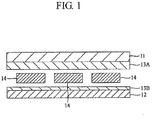
- Fig. 1 is a cross section of a solar battery.
- a solar battery as an embodiment of the present invention is configured by comprising a light-receipt side transparent protection member 11 and a back side protection member 12, and a pair of sealing films provided between the protection members 11 and 12, as shown in Fig. 1 .
- the pair of sealing films comprises a first sealing film 13A to be provided at a light-receipt side of the solar battery, and a second sealing film 13B to be provided at a back side thereof.
- a plurality of solar cells 14 are sealed by the pair of sealing films by being interposed therebetween.
- the solar battery comprises a member to be sealed such as solar cells between the pair of sealing films.
- a side of a solar cell from which the light is irradiated is referred to as "light-receipt side", and a reversed side, with respect to the light-receipt side, of solar cell is referred to as "bask side”.
- Both the first and the second sealing films comprise ethylene-vinyl acetate copolymer. Therefore, the sealing films of the present have an excellent adhesion property with respect to the light-receipt side and the back side protection members.
- the sealing films of the invention are economically obtained, and restricts water penetration into an inner part of the solar battery.
- the first and the second sealing films comprise magnesium hydroxide as the acid acceptor.
- Each of the first and the second sealing films contains magnesium hydroxide in an optimized content.
- the first sealing film to be provided on the light-receipt side comprises 0.2 parts by weight or less of magnesium hydroxide based on 100 parts by weight of the ethylene-vinyl acetate copolymer.
- the second sealing film to be provided on the back side comprises 0.01 part by weight or more of magnesium hydroxide based on 100 parts by weight of the ethylene-vinyl acetate copolymer.
- the first sealing film can maintain the transparency, without decreasing the power generation property. Hence, it is possible to provide a solar battery wherein the rust generation on a conductor or an electrode in the cell is highly restricted.
- the first sealing film comprises magnesium hydroxide in the range of 0.05 to 0.15 parts by weight, based on 100 parts by weight of the ethylene-vinyl acetate copolymer included in the first sealing film. Accordingly, the first sealing film to be provided on the light-receipt side maintains excellent transparency, with restricting rust generation in the solar battery. As a result, the power generation performance of the solar battery can be further improved.
- the second sealing film comprises magnesium hydroxide usually 0.01 parts by weight or more, preferably in the range of 0.1 to 0.5 parts by weight, more preferably more than 0.1 part by weight and 0.5 parts by weight or less, and further preferably more than 0.2 parts by weight and 0.5 parts by weight or less, based on 100 parts by weight of the ethylene-vinyl acetate copolymer included in the second sealing film. Accordingly, rust generation in the solar battery is highly restricted.
- the acid acceptor used in the first and the second sealing films of invention has an excellent function for absorbing and/or neutralizing acids such as acetic acid.
- magnesium hydroxide (Mg(OH) 2 ) are used.
- the magnesium hydroxide has a mean particle diameter in the range of 0.01 to 10 ⁇ m.
- the mean particle diameter of magnesium hydroxide is preferably in the range of 1 to 5 ⁇ m, particularly in the range of 2 to 3 ⁇ m, since the magnesium hydroxide is difficult to scatter light and the sealing film comprising magnesium hydroxide maintains high transparency and provides an enhanced acid receiving performance.
- the second sealing film further comprises a coloring agent.
- a coloring agent e.g., a coloring agent that is a coloring agent.
- an incident light irradiated to parts between the solar cells or transmitted through the cells is subjected to a diffused light reflection, and the diffused light is irradiated to the cells again as incident light. Accordingly, the efficiency for using light irradiated to the solar battery and power generation capability are improved.
- coloring agent white coloring agents based on titanium oxide, calcium carbonate, zinc oxide, white lead, lithopone, barite, precipitated barium sulfate and calcium sulphate; blue coloring agents based on ultramarine; black pigments based on carbon black; and translucent pigments such as glass beads and a light scattering agent are used.
- white coloring agents are preferably used.
- the coloring agent is preferably in the range of 2 to 10 parts by weight, more preferably in the range of 3 to 6 parts by weight, based on 100 parts by weight of the ethylene-vinyl acetate copolymer in the second sealing film.
- the mean particle diameter of the coloring agent is preferably in the range of 0.01 to 10 ⁇ m, and particularly in the range of 0.1 to 5 ⁇ m. By the particle diameter, efficiency for using light is improved.
- the mean particle diameters of the acid acceptor and coloring agent are obtained as follows: A cross section of the sealing film is observed by a transmission electron microscope with a magnitude of about 1,000,000. Equivalent circle diameters of projected area, with respect to at least 100 particles of the acid acceptor or the coloring agent, are obtained. Then, the average value of the particle diameters is obtained, as the mean particle diameter.
- the second sealing film comprises a lubricant.
- the adhesion property of the sealing film is further enhanced, and it is made possible to prevent water content from penetrating the solar battery.
- phosphite compound is preferably used as the lubricant.
- the phosphite compound include alkyl phosphite such as decyl phosphite; alkyl and aryl acid phosphites such as decyl acid phosphite and phenyl acid phosphite; trialkyl phosphite and triaryl phosphite such as trihexyl phosphate and tricresyl phosphate and zinc dithiophosphate.
- the lubricant is contained preferably in the range of 0.01 to 5.0 parts by weight, and particularly in the range of 0.1 to 0.4 parts by weight, based on 100 parts by weight of the ethylene-vinyl acetate copolymer contained in the sealing film.
- Each of the first and the second sealing film of the invention includes ethylene-vinyl acetate copolymer.
- the vinyl acetate content of ethylene-vinyl acetate copolymer is preferably in the range of 20 to 35 parts by weight, more preferably in the range of 22 to 30 parts by weight, particularly preferably in the range of 24 to 28 parts by weight, based on 100 parts by weight of the ethylene-vinyl acetate copolymer.
- the vinyl acetate content is less than 20 parts by weight, it is possible that the transparency of the sealing film, which has been obtained after being crosslinked/cured at a high temperature, will become insufficient.
- the vinyl acetate content exceeds 35 pars by weight, carboxylic acid, alcohol, amine or the like would be readily produced.
- the pair of sealing film comprises ethylene-vinyl acetate copolymer and magnesium hydroxide, as mentioned above. It is preferable that the first and the second sealing films further comprise a crosslinking agent. Accordingly, it is possible to crosslink and cure the ethylene-vinyl acetate copolymer, and to improve the durability of the film.
- organic peroxide is preferably used as a crosslinking agent.
- the organic peroxide is preferably used for obtaining a sealing film having improved adhesion property, transparency, moisture-resistance and temperature dependency of penetration property is obtained.
- an organic peroxide to be used is selected, with the film forming temperature, conditions for formulating the composition, curing temperature, heat resistance of the application target material/member, and storage stability thereof taking into account.
- a material having a decomposition temperature of 70°C or more in a 10-hour half-life period is preferable to use.
- the content of the organic peroxide in each of the first and the second sealing films is preferably in the range of 0.1 to 5 parts by weight, more preferably in the range of 0.5 to 2.0 parts by weight, based on 100 parts by weight of the ethylene-vinyl acetate copolymer.
- the content of the organic peroxide is smaller than in the above range, it is possible that the transparency of the sealing film is decreased.
- the content of the organic peroxide is greater than in the above range, it is possible that miscibility of the crosslinking agent with respect to the copolymer is decreased.
- the first and the second sealing films may further comprise a crosslinking auxiliary agent.
- the crosslinking auxiliary agent increases the gel fraction of ethylene-vinyl acetate copolymer and durability of the sealing film.
- crosslinking auxiliary agent examples include tri-functional crosslinking auxiliary agents such as triallyl cyanurate and triallyl isocyanurate; and mono- or di-functional crosslinking auxiliary agents such as (meth)acrylic esters (e.g., NK esters).
- tri-functional crosslinking auxiliary agents such as triallyl cyanurate and triallyl isocyanurate
- mono- or di-functional crosslinking auxiliary agents such as (meth)acrylic esters (e.g., NK esters).
- triallyl cyanurate and triallyl isocyanurate are preferably used, and triallyl isocyanurate is particularly preferably used.
- the content of the crosslinking auxiliary agent in each of the first and the second sealing films is preferably in the range of 0.1 to 3.0 parts by weight, and in particular in the range of 0.1 to 2.5 parts by weight, based on 100 parts by weight of the ethylene-vinyl acetate copolymer.
- the pair of sealing films have excellent adhesion properties, with the sealing properties in the solar battery taking into account. Therefore, the first and the second sealing films preferably further comprise an adhesion promoter.
- a silane coupling agent can be used as the adhesion promoter.
- the silane coupling agent include ⁇ -chloropropylmethoxysilane, vinylethoxysilane, vinyltris( ⁇ -methoxyethoxy)silane, ⁇ -methacryloxypropyltrimethoxysilane, vinyltriacetoxysilane, ⁇ -glycidoxypropyltrimethoxysilane, ⁇ -glycidoxypropyltriethoxysilane, ⁇ -(3,4-epoxycyclohexyl)ethyltrimethoxysilane, vinyltrichlorosilane, ⁇ -mercaptopropyltrimethoxysilane, ⁇ -aminopropyltriethoxysilane, and N- ⁇ -(aminoethyl)- ⁇ -aminopropyltrimethoxy
- the content of the silane coupling agent in each of the first and the second sealing films is preferably in the range of 0.1 to 0.7 parts by weight, and particularly preferably in the range of 0.15 to 0.65 parts by weight, based on 100 parts by weight of the ethylene-vinyl acetate copolymer.
- the pair of sealing films may further include various additives, if necessary, such as a plasticizer, acryloxy-group containing compound, methacryloxy-group containing compound and/or epoxy-group containing compound, for improving or adjusting various properties of the film (mechanical strength, optical properties such as transparency, heat resistance, light resistance, and crosslinking rate, etc).
- various additives such as a plasticizer, acryloxy-group containing compound, methacryloxy-group containing compound and/or epoxy-group containing compound, for improving or adjusting various properties of the film (mechanical strength, optical properties such as transparency, heat resistance, light resistance, and crosslinking rate, etc).
- plasticizer examples include dioctyl phthalate, dihexyladipate, triethylene glycol-di-2-ethylbutylate, butyl sebacate, tetraethylene glycol heptanoate and triethylene glycol dipelargonate.
- the plasticizer can be used singly, or in combination of two or more kinds.
- the plasticizer is used preferably in an amount of not more than 5 parts by weight, based on 100 parts by weight of the ethylene-vinyl acetate copolymer, in each of the first and the second sealing films.
- acrylic acid or methacrylic acid derivatives for instance, esters or amides of acrylic acid or methacrylic acid are used as the above-mentioned acryloxy-group containing compound and the methacryloxy-group containing compound.
- ester residue are straight-chain alkyl groups such as methyl, ethyl, dodecyl, stearyl, and lauryl, and cyclohexyl group, tetrahydrofurfuryl group, amino ethyl group, 2-hydroxyethyl group, 3-hydroxypropyl group, and 3-chloro-2-hydroxypropyl group.
- the amide are diacetone acrylamide.
- esters obtained from a polyhydric alcohol such as ethylene glycol, triethylene glycol, polypropylene glycol, polyethylene glycol, triemthylol propane or pentaerythritol, and acrylic acid or methacrylic acid.
- epoxy-group-containing compound triglycidyl tris(2-hydroxyethyl)isocyanurate, neopentylglycol diglycidyl ether, 1,6-hexanediol diglycidyl ether, allyl glycidyl ether, 2-ethylhexyl glycidyl ether, phenyl glycidyl ether, phenol(ethyleneoxy)glycidyl ether, p-tert-butylphenyl glycidyl ether, diglycidyl adipate, diglycidyl phthalate, glycidyl methacrylate or butyl glycidyl ether can be used.
- the acryloxy group-containing compound, methacryloxy group-containing compound or epoxy group-containing compound is preferably contained in each of the first and the second sealing films in an amount of 0.5 to 5.0 parts by weight, and preferably 1.0 to 4.0 parts by weight, based on 100 parts by weight of the ethylene-vinyl acetate copolymer.
- the pair of sealing films may further comprise an ultraviolet absorber, a light stabilizer, and an anti-aging agent.
- the ultraviolet absorber By adding the ultraviolet absorber to the pair of sealing films, it is possible to prevent ethylene-vinyl acetate copolymer from being deteriorated as the effect of light irradiation or the like, and the sealing films from yellowing.
- the ultraviolet absorber there is no particular restriction to the ultraviolet absorber to be used in the present invention.
- the ultraviolet absorber are benzophenone-based ultraviolet absorbers such as 2-hydroxy-4-methoxybenzophenone, 2-hydroxy-4-n-dodecyloxybenzophenone, 2,4-dihydroxybenzophenone, 2,2'-dihydroxy-4-methoxybenzophenone, and 2-hydroxy-4-n-octoxybanzophenone.
- the content of the benzophenone-based ultraviolet absorber in each of the first and the second sealing films is preferably in the range of 0.01 to 5 parts by weight, based on 100 parts by weight of the ethylene-vinyl acetate copolymer.
- a hindered amine photostabilizer can be used as the photostabilizer.
- photostabilizer examples include LA-52, LA-57, LA-62, LA-63, LA-63p, LA-67 and LA-68 (each manufactured by ADEKA Co., Ltd.), Tinuvin 744, Tinuvin 770, Tinuvin 765, Tinuvin 144, Tinuvin 622LD, and CHIMASSORB 944LD (each manufactured by Ciba Specialty Chemicals Co., Ltd.), and UV-3034 (each manufactured by B. F. Goodrich).
- the amount of the light stabilizer to be blended to each of the first and the second sealing films is preferably in the range of 0.01 to 5 parts by weight based on 100 parts by weight of the ethylene-vinyl acetate copolymer.
- anti-aging agent examples include hindered phenol antioxidants such as N,N'-hexan-1,6-diyl-bis[3-(3,5-di-tert-butyl-4-hydroxyphenyl) propionamide], phosphorus-type heat stabilizers, lactone-type heat stabilizers, vitamin E-type heat stabilizers and sulfur-type heat stabilizers.
- the thickness of the first sealing film is preferably greater than that of the second sealing film.
- stress applied to a solar battery including the sealing films is absorbed by the sealing film(s).
- the first sealing film preferably has a thickness in the range of 0.4 mm to 1.4 mm, and particularly in the range of 0. 6 mm to 1.2 mm.
- the second sealing film preferably has a thickness in the range of 0.2 mm to 1.0 mm, and particularly in the range of 0.4 mm to 0.8 mm.
- the sealing films are prepared in accordance with a conventional method.
- the composition including the above-discussed materials is molded into a sheet-shaped article by extrusion molding, or calendar molding (calendaring).
- calendar molding calendaring
- the heat application temperature is generally in the range of 50 to 90°C.
- the coloring agent can be highly dispersed. It is preferable to prepare a master batch, in advance, by mixing a coloring agent having a high concentration with ethylene-vinyl acetate copolymer, and to prepare a composition by further adding the above-mentioned other components to the master batch.
- the above-mentioned composition is dissolved to a solvent, and the solution is applied to a proper substrate by using an appropriate coater, and dried to form a coated layer.
- a sheet-shaped article can be obtained.
- the pair of sealing films is used for sealing a seal target member by providing the seal target member such as solar cells between the first sealing film and the second sealing film. Electrical power is generated by the solar cells upon the receipt of light.
- the seal target member such as solar cells between the first sealing film and the second sealing film.
- Electrical power is generated by the solar cells upon the receipt of light.
- a plurality of solar cells are connected with each other in parallel or in series. The solar cells are provided between the first and the second sealing films and sealed by the films.
- the pair of sealing films is preferably used also for sealing a metal film in a laminated glass for heat ray shield, wherein the metal film is interposed between two transparent substrates.
- the pair of sealing films of the present invention rust generation on the metal film is highly restricted.
- the pair of sealing films of the invention can be preferably used for sealing a metal member by providing the same between the films within products such as a watch, calculator, computer, and mobile phone.
- the pair of sealing films of the invention is used particularly preferably in solar batteries.
- the solar battery comprising the pair of sealing films is not particularly restricted.
- the solar battery includes a back side protection member 12, a second sealing film (back side sealing film) 13B, solar cell(s) 14, first sealing film (light-receipt side sealing film) 13A, and light-receipt side transparent protection member 11, successively in this order.
- the solar battery includes in the structure the first sealing film 13A which covers the light-receipt side transparent protection member 11 and the second sealing film 13B which covers the back side protection member 12.
- the solar cells 14 are provided between the first and the second sealing films so that the solar cells contact the fist sealing film 13A and the second sealing film 13B.
- the solar cells 14 can be sealed with the sealing films 13A and 13B by interposing the sells therebetween, and crosslinking/curing ethylene-vinyl acetate copolymer included in the first sealing film 13A and the second sealing film 13B.
- the solar cells 14 can be manufactured not only from silicon monocrystalline or polycrystalline substrate such as silicon power generation element, but also from thin film material such as amorphous silicon, CIGS, CdTe or the like.
- the light-receipt side transparent protection member 11, first sealing film 13A, solar cells 14, second sealing film 13B and back side protection member 12 are successively overlaid in this order.
- the thus obtained laminate is treated by a conventional method such as application of heat and pressure.
- the first and the second sealing films are crosslinked and cured.
- the thus obtained laminate is subjected to heat and pressure application at a temperature of 135 to 180°C, more preferably 140 to 180°C, in particular 155 to 180°C, by using a vacuum laminator with a degassing time of 0.1 to 5 minutes, with a pressure of 0.1 to 1.5 kg/cm 2 , and a press time of 5 to 15 minutes.
- the light-receipt side transparent protection member of the solar battery of the invention is usually a glass substrate such as silicate glass.
- the thickness of the glass substrate is generally in the range of 0.1 to 10 mm, preferably 0. 3 to 5 mm.
- the glass plate can be thermally or chemically tempered.
- the back side protection member for use in the present invention is a plastic film such as PET.
- a laminate film including fluorinated polyethylene film, in particular fluorinated polyethylene film, Al film, and fluorinated polyethylene film in this order is preferable.
- the members except for the sealing films e.g., light-receipt side transparent protection member, back side protection member and solar cells.
- the members except for the sealing films can have the same structure as that of a conventional solar battery.
- EVA (vinyl acetate content of 26 parts by weight based on 100 parts by weight of EVA) 100 parts by weight Acid acceptor (Mg(OH) 2 , mean particle diameter 3 ⁇ m) 0.1 part by weight Crosslinking agent (2,5-dimethyl-2,5-bis(2-ethylhexanoylperoxy)hexane) 1.0 part by weight Crosslinking auxiliary agent (triallyl isocyanurate) 2.0 parts by weight Silane coupling agent ( ⁇ -methacryloxypropyltrimethoxysilane) 0.3 parts by weight
- Acid acceptor Mg(OH) 2 , mean particle diameter 3 ⁇ m
- Crosslinking agent (2,5-dimethyl-2,5-bis(2-ethylhexanoylperoxy)hexane)
- Crosslinking auxiliary agent triallyl isocyanurate
- Silane coupling agent ⁇ -methacryloxypropyltrimethoxysilane
- EVA (vinyl acetate content of 26 parts by weight based on 100 parts by weight of EVA) 100 parts by weight Acid acceptor (Mg(OH) 2 , mean particle diameter 3 ⁇ m) 0.5 parts by weight Coloring agent (titanium oxide, mean particle diameter of 0.1 ⁇ m) 4.2 parts by weight Crosslinking agent (2,5-dimethyl-2,5-bis(2-ethylhexanoylperoxy)hexane) 1.0 part by weight Crosslinking auxiliary agent (triallyl isocyanurate) 2.0 parts by weight Silane coupling agent ( ⁇ -methacryloxypropyltrimethoxysilane) 0.15 parts by weight Lubricant (trisisodecyl phosphite) 0.3 parts by weight
- the determination of the content of Mg(OH) 2 was carried out by using scanning X-ray fluorescence analyzer (ZSX Primus II, Rigaku Industrial Co.).
- the first sealing film and the second sealing film prepared as explained above were used.
- a light-receiving side transparent protection member made of glass plate (thickness: 0.3 mm), the first sealing film, solar cells made of silicone power generation element, the second sealing films, and a back side protection member made of fluorinated polyethylene film (thickness: 50 ⁇ m) were successively overlaid in this order.
- the thus obtained laminate was introduced to a rubber bag and subjected to vacuum degassing and preliminary pressure contact treatment at a temperature of 100°C. Subsequently, the laminate was placed into an oven, and pressure and heat were applied to the laminate for 30 minutes under a pressure of 13 ⁇ 10 5 Pa and a temperature of 140°C.
- Sealing films were prepared by repeating Example 1 except that the concentrations of the acid acceptor included in the first and the second sealing films were changed as shown in Table 1.
- nominal maximum power A 2 [W] was determined in the same way as discussed above.
- the difference of the nominal maximum powers between the solar battery before and after leaving the solar batteries in the above-discussed condition, i.e., the rate of change (difference) between the nominal maximum powers [(A 2 -A 1 )/A 1 ⁇ 100] was obtained. The results are shown in Table 1.
- Example 1 Example 2 a Comp. Ex. 1 Comp. Ex. 2 Comp. Ex. 3 Mg(OH) 2 content in First Sealing Film [parts by weight] 0.1 0 0.1 0.05 0 Mg(OH) 2 content in Second Sealing Film [parts by weight] 0.5 0.5 0 0 0 Difference between nominal maximum powers [%] -8.59 -10.12 -10.41 -10.62 -50 or more
- a solar battery which includes a pair of sealing films of the present invention exhibits excellent power generating property for a long time and is excellent in durability.
- a pair of sealing films of the invention is preferably used for sealing a metal member provided between the sealing films, which are provided in electronic products such as a solar battery, watch, calculator, computer, and mobile phone, and other products such as a laminated glass for heat ray shield.
Landscapes
- Chemical & Material Sciences (AREA)
- Engineering & Computer Science (AREA)
- Manufacturing & Machinery (AREA)
- Medicinal Chemistry (AREA)
- Health & Medical Sciences (AREA)
- Chemical Kinetics & Catalysis (AREA)
- Materials Engineering (AREA)
- Polymers & Plastics (AREA)
- Organic Chemistry (AREA)
- Life Sciences & Earth Sciences (AREA)
- Biochemistry (AREA)
- Photovoltaic Devices (AREA)
- Compositions Of Macromolecular Compounds (AREA)
- Sealing Material Composition (AREA)
Claims (10)
- Dichtfilmpaar zum dichten Verschließen eines Dichtfilm-Zielgliedes, konfiguriert, um zwischen den Dichtfilmen eingelegt zu werden, wobei das Dicht-Zielglied aus Solarzellen besteht, Folgendes umfassend:einen ersten Dichtfilm, umfassend Ethylen-Vinylacetat-Copolymer und Magnesiumhydroxid in einer Konzentration von 0,05 bis 0,15 Gewichtsanteilen, basierend auf 100 Gewichtsanteilen des Ethylen-Vinylacetat-Copolymers; undeinen zweiten Dichtfilm, umfassend Ethylen-Vinylacetat-Copolymer und 0,01 Gewichtsanteil Magnesiumhydroxid, basierend auf 100 Gewichtsanteilen des Ethylen-Vinylacetat-Copolymers, wobei der zweite Dichtfilm ein Schmiermittel umfasst.
- Dichtfilmpaar nach Anspruch 1, bei welchem der zweite Dichtfilm Magnesiumhydroxid in einer Konzentration von 0,1 bis 0,5 Gewichtsanteilen umfasst, basierend auf 100 Gewichtsanteilen Ethylen-Vinylacetat-Copolymer.
- Dichtfilmpaar nach Anspruch 1 oder 2, bei welchem der zweite Dichtfilm ein Färbemittel umfasst.
- Dichtfilmpaar nach einem der Ansprüche 1 bis 3, bei welchem das Schmiermittel eine Phosphitverbindung ist.
- Dichtfilmpaar nach einem der Ansprüche 1 bis 4, bei welchem die Dicke des ersten Dichtfilms größer als diejenige des zweiten Dichtfilms ist.
- Solarbatterie, Folgendes umfassend:ein transparentes Schutzglied auf der lichtempfangenden Seite;einen ersten Dichtfilm, umfassend ein Ethylen-Vinylacetat-Copolymer, welcher das transparente Schutzglied auf der lichtempfangenden Seite bedeckt;ein Schutzglied auf der Rückseite;einen zweiten Dichtfilm, umfassend ein Ethylen-Vinylacetat-Copolymer, welcher das Schutzglied auf der Rückseite bedeckt;Solarzelle, welche zwischen dem ersten und dem zweiten Dichtfilm bereitgestellt sind;wobei der erste Dichtfilm an der lichtempfangenden Seite der Solarzellen bereitgestellt ist, umfassend Magnesiumhydroxid in einer Konzentration von 0,05 bis 0,15 Gewichtsanteilen, basierend auf 100 Gewichtsanteilen des Ethylen-Vinylacetat-Copolymers, und der zweite Dichtfilm an der Rückseite der Solarzellen bereitgestellt ist, umfassend Magnesiumhydroxid in einer Konzentration von 0,01 Gewichtsanteilen oder darüber, basierend auf 100 Gewichtsanteilen des Ethylen-Vinylacetat-Copolymers, wobei der zweite Dichtfilm ein Schmiermittel umfasst.
- Solarbatterie nach Anspruch 6, bei welcher der zweite Dichtfilm Magnesiumhydroxid in einer Konzentration von 0,1 bis 0,5 Gewichtsanteilen umfasst, basierend auf 100 Gewichtsanteilen des Ethylen-Vinylacetat-Copolymers.
- Solarbatterie nach Anspruch 6 oder 7, bei welcher der zweite Dichtfilm ein Färbemittel umfasst.
- Solarbatterie nach einem der Ansprüche 6 bis 8, bei welcher das Schmiermittel eine Phosphitverbindung ist.
- Solarbatterie nach einem der Ansprüche 6 bis 9, bei welchem die Dicke des ersten Dichtfilms größer als diejenige des zweiten Dichtfilms ist.
Applications Claiming Priority (2)
| Application Number | Priority Date | Filing Date | Title |
|---|---|---|---|
| JP2008074128 | 2008-03-21 | ||
| PCT/JP2009/055488 WO2009116638A1 (ja) | 2008-03-21 | 2009-03-19 | 一対の封止膜、及びこれを用いた太陽電池 |
Publications (3)
| Publication Number | Publication Date |
|---|---|
| EP2262001A1 EP2262001A1 (de) | 2010-12-15 |
| EP2262001A4 EP2262001A4 (de) | 2014-04-09 |
| EP2262001B1 true EP2262001B1 (de) | 2018-07-25 |
Family
ID=41091036
Family Applications (1)
| Application Number | Title | Priority Date | Filing Date |
|---|---|---|---|
| EP09722647.6A Active EP2262001B1 (de) | 2008-03-21 | 2009-03-19 | Dichtfilmpaar und das dichtfilmpaar verwendende solarbatterie |
Country Status (5)
| Country | Link |
|---|---|
| US (1) | US20110100416A1 (de) |
| EP (1) | EP2262001B1 (de) |
| JP (1) | JP5385896B2 (de) |
| CN (1) | CN101978511A (de) |
| WO (1) | WO2009116638A1 (de) |
Families Citing this family (15)
| Publication number | Priority date | Publication date | Assignee | Title |
|---|---|---|---|---|
| CN101809086B (zh) | 2007-09-28 | 2012-10-10 | 三洋化成工业株式会社 | 聚合物多元醇、其制造方法以及聚氨酯树脂的制造方法 |
| US20100043871A1 (en) * | 2008-04-14 | 2010-02-25 | Bp Corporation North America Inc. | Thermal Conducting Materials for Solar Panel Components |
| JP5820151B2 (ja) * | 2011-06-09 | 2015-11-24 | 株式会社ブリヂストン | 太陽電池モジュールの製造方法 |
| CN103087643B (zh) * | 2011-11-03 | 2015-10-14 | 天津彩达新材料科技有限公司 | 一种太阳能光伏组件封装用eva胶膜及其制备方法 |
| JP5409966B2 (ja) * | 2011-11-15 | 2014-02-05 | 京セラ株式会社 | 太陽電池モジュール |
| KR102004567B1 (ko) * | 2012-02-06 | 2019-07-26 | 다이니폰 인사츠 가부시키가이샤 | 태양 전지용 봉지 시트 |
| EP2858822A1 (de) * | 2012-06-08 | 2015-04-15 | Corning Incorporated | Verfahren zur herstellung dünner glaslaminate |
| JP2014027198A (ja) * | 2012-07-30 | 2014-02-06 | Mitsui Chemicals Tohcello Inc | 太陽電池封止シート、並びに太陽電池モジュール及びその製造方法 |
| US20160013342A1 (en) * | 2013-02-27 | 2016-01-14 | Zeon Corporation | Solar cell module and method for manufacturing same |
| US20170253726A1 (en) * | 2014-09-08 | 2017-09-07 | Nitto Denko Corporation | Encapsulant composition for solar cell, solar cell encapsulant layer produced therewith, and solar cell module produced therewith |
| JP6026683B2 (ja) * | 2016-02-08 | 2016-11-16 | 日東電工株式会社 | 太陽電池用封止材組成物、およびそれを用いた太陽電池用封止材層ならびに太陽電池モジュール |
| JP2017025334A (ja) * | 2016-10-12 | 2017-02-02 | 日東電工株式会社 | 太陽電池用封止材組成物、およびそれを用いた太陽電池用封止材層ならびに太陽電池モジュール |
| CN111344348B (zh) * | 2017-11-17 | 2022-08-09 | 住友电气工业株式会社 | 树脂成形体以及接片引线 |
| CN108148517B (zh) * | 2017-12-27 | 2021-01-08 | 苏州赛伍应用技术股份有限公司 | 一种太阳能电池用封装胶膜及其制备方法和应用 |
| JP7678089B2 (ja) * | 2020-09-07 | 2025-05-15 | ダウ グローバル テクノロジーズ エルエルシー | 紫外線安定化ポリマー組成物 |
Family Cites Families (25)
| Publication number | Priority date | Publication date | Assignee | Title |
|---|---|---|---|---|
| JPS4913616B1 (de) * | 1968-11-08 | 1974-04-02 | ||
| JPS60181147A (ja) * | 1984-02-29 | 1985-09-14 | Dainippon Printing Co Ltd | 放射線殺菌包装用フイルム |
| JPH03137145A (ja) * | 1989-10-23 | 1991-06-11 | Mitsubishi Petrochem Co Ltd | エチレン・酢酸ビニル共重合体組成物 |
| JPH06104729B2 (ja) * | 1992-01-16 | 1994-12-21 | 三菱油化株式会社 | 太陽電池モジュール用接着シート |
| JP3687701B2 (ja) * | 1995-05-08 | 2005-08-24 | 株式会社ブリヂストン | 太陽電池モジュール |
| JP3722867B2 (ja) * | 1995-05-12 | 2005-11-30 | 三井・デュポンポリケミカル株式会社 | 太陽電池封止用難燃シートの製造方法 |
| US6093757A (en) * | 1995-12-19 | 2000-07-25 | Midwest Research Institute | Composition and method for encapsulating photovoltaic devices |
| JPH11103087A (ja) * | 1997-09-26 | 1999-04-13 | Sekisui Chem Co Ltd | 光熱ハイブリッドパネル |
| JPH11177110A (ja) * | 1997-12-11 | 1999-07-02 | Canon Inc | 太陽電池モジュール及びその製造方法 |
| JPH11317475A (ja) * | 1998-02-27 | 1999-11-16 | Canon Inc | 半導体用封止材樹脂および半導体素子 |
| JP2000315810A (ja) * | 1999-04-28 | 2000-11-14 | Kyocera Corp | 太陽電池モジュール |
| JP4533483B2 (ja) * | 1999-05-20 | 2010-09-01 | 三井・デュポンポリケミカル株式会社 | 熱可塑性樹脂組成物 |
| WO2001061763A1 (en) | 2000-02-18 | 2001-08-23 | Bridgestone Corporation | Sealing film for solar cell and method for manufacturing solar cell |
| JP4122766B2 (ja) * | 2001-12-18 | 2008-07-23 | 東ソー株式会社 | エチレン系共重合体ペレット及びホットメルト接着剤 |
| JP4376066B2 (ja) * | 2002-03-14 | 2009-12-02 | ダイキン工業株式会社 | 含フッ素共重合体、含フッ素共重合体製造方法、含フッ素共重合体硬化用組成物及び硬化体 |
| JP4768217B2 (ja) * | 2003-07-07 | 2011-09-07 | 株式会社ブリヂストン | 透明フィルム |
| US20070221268A1 (en) * | 2006-03-21 | 2007-09-27 | Hasch Bruce M | Encapsulants for electronic components |
| JP4989115B2 (ja) * | 2006-06-07 | 2012-08-01 | 株式会社ブリヂストン | 太陽電池モジュール |
| JP4863812B2 (ja) * | 2006-08-03 | 2012-01-25 | 株式会社ブリヂストン | 太陽電池用封止膜組成物、太陽電池用封止膜、およびこれを用いた太陽電池 |
| JP2008053377A (ja) * | 2006-08-23 | 2008-03-06 | Bridgestone Corp | 太陽電池封止膜用組成物及びこれを用いた太陽電池封止膜 |
| JP2008118073A (ja) * | 2006-11-08 | 2008-05-22 | Bridgestone Corp | 太陽電池用受光面側封止膜 |
| ES2377997T3 (es) * | 2006-11-08 | 2012-04-04 | Bridgestone Corporation | Películas de estanqueidad para célula solar |
| JP2008115344A (ja) * | 2006-11-08 | 2008-05-22 | Bridgestone Corp | 太陽電池用裏面側封止膜 |
| CN101960616B (zh) * | 2008-03-05 | 2013-12-18 | 株式会社普利司通 | 太阳能电池用密封膜和使用其的太阳能电池 |
| JP4522478B2 (ja) * | 2009-05-20 | 2010-08-11 | 株式会社ブリヂストン | 一対の太陽電池用封止膜 |
-
2009
- 2009-03-19 EP EP09722647.6A patent/EP2262001B1/de active Active
- 2009-03-19 JP JP2010503935A patent/JP5385896B2/ja active Active
- 2009-03-19 WO PCT/JP2009/055488 patent/WO2009116638A1/ja not_active Ceased
- 2009-03-19 US US12/933,625 patent/US20110100416A1/en not_active Abandoned
- 2009-03-19 CN CN2009801101223A patent/CN101978511A/zh active Pending
Non-Patent Citations (1)
| Title |
|---|
| None * |
Also Published As
| Publication number | Publication date |
|---|---|
| EP2262001A4 (de) | 2014-04-09 |
| JPWO2009116638A1 (ja) | 2011-07-21 |
| US20110100416A1 (en) | 2011-05-05 |
| EP2262001A1 (de) | 2010-12-15 |
| JP5385896B2 (ja) | 2014-01-08 |
| CN101978511A (zh) | 2011-02-16 |
| WO2009116638A1 (ja) | 2009-09-24 |
Similar Documents
| Publication | Publication Date | Title |
|---|---|---|
| EP2262001B1 (de) | Dichtfilmpaar und das dichtfilmpaar verwendende solarbatterie | |
| JP5222004B2 (ja) | 封止膜及びこれを用いた太陽電池 | |
| CN101542748B (zh) | 太阳能电池用密封膜 | |
| EP2808906B1 (de) | Versiegelungsfilm für solarzellen und solarzelle damit | |
| US9368663B2 (en) | Solar cell sealing film and solar cell using the sealing film | |
| US9112081B2 (en) | Sealing film for solar cell and solar cell obtained by use of the sealing film | |
| EP2087526B1 (de) | Dichtfilme für solarzellen | |
| EP2398066B1 (de) | Verkapselungsfolie für ein solarzellenmodul und solarzellenmodul mit der verkapselungsfolie | |
| JP2008205448A (ja) | 太陽電池用封止膜及びこれを用いた太陽電池 | |
| JP2009256459A (ja) | 太陽電池用封止膜及びこれを用いた太陽電池 | |
| WO2011102242A1 (ja) | 太陽電池用封止膜及びこれを用いた太陽電池 | |
| JP2008115344A (ja) | 太陽電池用裏面側封止膜 | |
| EP2117049A1 (de) | Solarzellenabdichtfilm und diesen benutzende solarzelle | |
| JP4522478B2 (ja) | 一対の太陽電池用封止膜 | |
| JP4918329B2 (ja) | 太陽電池の選別方法 | |
| JP2008041800A (ja) | 太陽電池用封止膜組成物、太陽電池用封止膜、およびこれを用いた太陽電池 | |
| JP5409966B2 (ja) | 太陽電池モジュール | |
| JP2013008761A (ja) | 太陽電池封止膜及びこれを用いた太陽電池 | |
| JP2009188425A (ja) | 一対の太陽電池用封止膜 | |
| WO2010013659A1 (ja) | 太陽電池用封止膜、及びこれを用いた太陽電池 | |
| JP2010177398A (ja) | 太陽電池用封止膜、及びこれを用いた太陽電池 |
Legal Events
| Date | Code | Title | Description |
|---|---|---|---|
| PUAI | Public reference made under article 153(3) epc to a published international application that has entered the european phase |
Free format text: ORIGINAL CODE: 0009012 |
|
| 17P | Request for examination filed |
Effective date: 20101018 |
|
| AK | Designated contracting states |
Kind code of ref document: A1 Designated state(s): AT BE BG CH CY CZ DE DK EE ES FI FR GB GR HR HU IE IS IT LI LT LU LV MC MK MT NL NO PL PT RO SE SI SK TR |
|
| AX | Request for extension of the european patent |
Extension state: AL BA RS |
|
| DAX | Request for extension of the european patent (deleted) | ||
| A4 | Supplementary search report drawn up and despatched |
Effective date: 20140311 |
|
| RIC1 | Information provided on ipc code assigned before grant |
Ipc: B32B 17/10 20060101ALI20140305BHEP Ipc: H01L 31/048 20140101AFI20140305BHEP Ipc: C08K 3/20 20060101ALI20140305BHEP Ipc: C08J 5/18 20060101ALN20140305BHEP Ipc: C08L 23/08 20060101ALI20140305BHEP Ipc: C08K 5/524 20060101ALI20140305BHEP |
|
| STAA | Information on the status of an ep patent application or granted ep patent |
Free format text: STATUS: EXAMINATION IS IN PROGRESS |
|
| 17Q | First examination report despatched |
Effective date: 20170403 |
|
| REG | Reference to a national code |
Ref country code: DE Ref legal event code: R079 Ref document number: 602009053435 Country of ref document: DE Free format text: PREVIOUS MAIN CLASS: H01L0031042000 Ipc: H01L0031048000 |
|
| GRAP | Despatch of communication of intention to grant a patent |
Free format text: ORIGINAL CODE: EPIDOSNIGR1 |
|
| STAA | Information on the status of an ep patent application or granted ep patent |
Free format text: STATUS: GRANT OF PATENT IS INTENDED |
|
| RIC1 | Information provided on ipc code assigned before grant |
Ipc: H01L 31/048 20140101AFI20171108BHEP Ipc: C08K 3/22 20060101ALI20171108BHEP Ipc: C08K 5/524 20060101ALI20171108BHEP Ipc: C08J 5/18 20060101ALN20171108BHEP Ipc: C08L 23/08 20060101ALI20171108BHEP Ipc: B32B 17/10 20060101ALI20171108BHEP |
|
| RIC1 | Information provided on ipc code assigned before grant |
Ipc: H01L 31/048 20140101AFI20171113BHEP Ipc: C08K 5/524 20060101ALI20171113BHEP Ipc: B32B 17/10 20060101ALI20171113BHEP Ipc: C08K 3/22 20060101ALI20171113BHEP Ipc: C08J 5/18 20060101ALN20171113BHEP Ipc: C08L 23/08 20060101ALI20171113BHEP |
|
| RIC1 | Information provided on ipc code assigned before grant |
Ipc: C08L 23/08 20060101ALI20171123BHEP Ipc: H01L 31/048 20140101AFI20171123BHEP Ipc: C08J 5/18 20060101ALN20171123BHEP Ipc: C08K 5/524 20060101ALI20171123BHEP Ipc: B32B 17/10 20060101ALI20171123BHEP Ipc: C08K 3/22 20060101ALI20171123BHEP |
|
| INTG | Intention to grant announced |
Effective date: 20171206 |
|
| GRAS | Grant fee paid |
Free format text: ORIGINAL CODE: EPIDOSNIGR3 |
|
| GRAA | (expected) grant |
Free format text: ORIGINAL CODE: 0009210 |
|
| STAA | Information on the status of an ep patent application or granted ep patent |
Free format text: STATUS: THE PATENT HAS BEEN GRANTED |
|
| RAP1 | Party data changed (applicant data changed or rights of an application transferred) |
Owner name: KYOCERA CORPORATION |
|
| AK | Designated contracting states |
Kind code of ref document: B1 Designated state(s): AT BE BG CH CY CZ DE DK EE ES FI FR GB GR HR HU IE IS IT LI LT LU LV MC MK MT NL NO PL PT RO SE SI SK TR |
|
| REG | Reference to a national code |
Ref country code: GB Ref legal event code: FG4D |
|
| REG | Reference to a national code |
Ref country code: CH Ref legal event code: EP |
|
| REG | Reference to a national code |
Ref country code: AT Ref legal event code: REF Ref document number: 1022674 Country of ref document: AT Kind code of ref document: T Effective date: 20180815 |
|
| REG | Reference to a national code |
Ref country code: DE Ref legal event code: R096 Ref document number: 602009053435 Country of ref document: DE |
|
| REG | Reference to a national code |
Ref country code: IE Ref legal event code: FG4D |
|
| REG | Reference to a national code |
Ref country code: NL Ref legal event code: MP Effective date: 20180725 |
|
| REG | Reference to a national code |
Ref country code: LT Ref legal event code: MG4D |
|
| PG25 | Lapsed in a contracting state [announced via postgrant information from national office to epo] |
Ref country code: NL Free format text: LAPSE BECAUSE OF FAILURE TO SUBMIT A TRANSLATION OF THE DESCRIPTION OR TO PAY THE FEE WITHIN THE PRESCRIBED TIME-LIMIT Effective date: 20180725 |
|
| REG | Reference to a national code |
Ref country code: AT Ref legal event code: MK05 Ref document number: 1022674 Country of ref document: AT Kind code of ref document: T Effective date: 20180725 |
|
| PG25 | Lapsed in a contracting state [announced via postgrant information from national office to epo] |
Ref country code: GR Free format text: LAPSE BECAUSE OF FAILURE TO SUBMIT A TRANSLATION OF THE DESCRIPTION OR TO PAY THE FEE WITHIN THE PRESCRIBED TIME-LIMIT Effective date: 20181026 Ref country code: SE Free format text: LAPSE BECAUSE OF FAILURE TO SUBMIT A TRANSLATION OF THE DESCRIPTION OR TO PAY THE FEE WITHIN THE PRESCRIBED TIME-LIMIT Effective date: 20180725 Ref country code: BG Free format text: LAPSE BECAUSE OF FAILURE TO SUBMIT A TRANSLATION OF THE DESCRIPTION OR TO PAY THE FEE WITHIN THE PRESCRIBED TIME-LIMIT Effective date: 20181025 Ref country code: NO Free format text: LAPSE BECAUSE OF FAILURE TO SUBMIT A TRANSLATION OF THE DESCRIPTION OR TO PAY THE FEE WITHIN THE PRESCRIBED TIME-LIMIT Effective date: 20181025 Ref country code: LT Free format text: LAPSE BECAUSE OF FAILURE TO SUBMIT A TRANSLATION OF THE DESCRIPTION OR TO PAY THE FEE WITHIN THE PRESCRIBED TIME-LIMIT Effective date: 20180725 Ref country code: PL Free format text: LAPSE BECAUSE OF FAILURE TO SUBMIT A TRANSLATION OF THE DESCRIPTION OR TO PAY THE FEE WITHIN THE PRESCRIBED TIME-LIMIT Effective date: 20180725 Ref country code: FI Free format text: LAPSE BECAUSE OF FAILURE TO SUBMIT A TRANSLATION OF THE DESCRIPTION OR TO PAY THE FEE WITHIN THE PRESCRIBED TIME-LIMIT Effective date: 20180725 Ref country code: IS Free format text: LAPSE BECAUSE OF FAILURE TO SUBMIT A TRANSLATION OF THE DESCRIPTION OR TO PAY THE FEE WITHIN THE PRESCRIBED TIME-LIMIT Effective date: 20181125 Ref country code: AT Free format text: LAPSE BECAUSE OF FAILURE TO SUBMIT A TRANSLATION OF THE DESCRIPTION OR TO PAY THE FEE WITHIN THE PRESCRIBED TIME-LIMIT Effective date: 20180725 |
|
| PG25 | Lapsed in a contracting state [announced via postgrant information from national office to epo] |
Ref country code: LV Free format text: LAPSE BECAUSE OF FAILURE TO SUBMIT A TRANSLATION OF THE DESCRIPTION OR TO PAY THE FEE WITHIN THE PRESCRIBED TIME-LIMIT Effective date: 20180725 Ref country code: HR Free format text: LAPSE BECAUSE OF FAILURE TO SUBMIT A TRANSLATION OF THE DESCRIPTION OR TO PAY THE FEE WITHIN THE PRESCRIBED TIME-LIMIT Effective date: 20180725 Ref country code: ES Free format text: LAPSE BECAUSE OF FAILURE TO SUBMIT A TRANSLATION OF THE DESCRIPTION OR TO PAY THE FEE WITHIN THE PRESCRIBED TIME-LIMIT Effective date: 20180725 |
|
| REG | Reference to a national code |
Ref country code: DE Ref legal event code: R097 Ref document number: 602009053435 Country of ref document: DE |
|
| PG25 | Lapsed in a contracting state [announced via postgrant information from national office to epo] |
Ref country code: IT Free format text: LAPSE BECAUSE OF FAILURE TO SUBMIT A TRANSLATION OF THE DESCRIPTION OR TO PAY THE FEE WITHIN THE PRESCRIBED TIME-LIMIT Effective date: 20180725 Ref country code: EE Free format text: LAPSE BECAUSE OF FAILURE TO SUBMIT A TRANSLATION OF THE DESCRIPTION OR TO PAY THE FEE WITHIN THE PRESCRIBED TIME-LIMIT Effective date: 20180725 Ref country code: CZ Free format text: LAPSE BECAUSE OF FAILURE TO SUBMIT A TRANSLATION OF THE DESCRIPTION OR TO PAY THE FEE WITHIN THE PRESCRIBED TIME-LIMIT Effective date: 20180725 Ref country code: RO Free format text: LAPSE BECAUSE OF FAILURE TO SUBMIT A TRANSLATION OF THE DESCRIPTION OR TO PAY THE FEE WITHIN THE PRESCRIBED TIME-LIMIT Effective date: 20180725 |
|
| PG25 | Lapsed in a contracting state [announced via postgrant information from national office to epo] |
Ref country code: SK Free format text: LAPSE BECAUSE OF FAILURE TO SUBMIT A TRANSLATION OF THE DESCRIPTION OR TO PAY THE FEE WITHIN THE PRESCRIBED TIME-LIMIT Effective date: 20180725 Ref country code: DK Free format text: LAPSE BECAUSE OF FAILURE TO SUBMIT A TRANSLATION OF THE DESCRIPTION OR TO PAY THE FEE WITHIN THE PRESCRIBED TIME-LIMIT Effective date: 20180725 |
|
| PLBE | No opposition filed within time limit |
Free format text: ORIGINAL CODE: 0009261 |
|
| STAA | Information on the status of an ep patent application or granted ep patent |
Free format text: STATUS: NO OPPOSITION FILED WITHIN TIME LIMIT |
|
| 26N | No opposition filed |
Effective date: 20190426 |
|
| PG25 | Lapsed in a contracting state [announced via postgrant information from national office to epo] |
Ref country code: SI Free format text: LAPSE BECAUSE OF FAILURE TO SUBMIT A TRANSLATION OF THE DESCRIPTION OR TO PAY THE FEE WITHIN THE PRESCRIBED TIME-LIMIT Effective date: 20180725 |
|
| PG25 | Lapsed in a contracting state [announced via postgrant information from national office to epo] |
Ref country code: MC Free format text: LAPSE BECAUSE OF FAILURE TO SUBMIT A TRANSLATION OF THE DESCRIPTION OR TO PAY THE FEE WITHIN THE PRESCRIBED TIME-LIMIT Effective date: 20180725 |
|
| REG | Reference to a national code |
Ref country code: CH Ref legal event code: PL |
|
| PG25 | Lapsed in a contracting state [announced via postgrant information from national office to epo] |
Ref country code: LU Free format text: LAPSE BECAUSE OF NON-PAYMENT OF DUE FEES Effective date: 20190319 |
|
| REG | Reference to a national code |
Ref country code: BE Ref legal event code: MM Effective date: 20190331 |
|
| PG25 | Lapsed in a contracting state [announced via postgrant information from national office to epo] |
Ref country code: CH Free format text: LAPSE BECAUSE OF NON-PAYMENT OF DUE FEES Effective date: 20190331 Ref country code: LI Free format text: LAPSE BECAUSE OF NON-PAYMENT OF DUE FEES Effective date: 20190331 Ref country code: IE Free format text: LAPSE BECAUSE OF NON-PAYMENT OF DUE FEES Effective date: 20190319 |
|
| PG25 | Lapsed in a contracting state [announced via postgrant information from national office to epo] |
Ref country code: FR Free format text: LAPSE BECAUSE OF NON-PAYMENT OF DUE FEES Effective date: 20190331 Ref country code: BE Free format text: LAPSE BECAUSE OF NON-PAYMENT OF DUE FEES Effective date: 20190331 |
|
| PG25 | Lapsed in a contracting state [announced via postgrant information from national office to epo] |
Ref country code: TR Free format text: LAPSE BECAUSE OF FAILURE TO SUBMIT A TRANSLATION OF THE DESCRIPTION OR TO PAY THE FEE WITHIN THE PRESCRIBED TIME-LIMIT Effective date: 20180725 |
|
| PG25 | Lapsed in a contracting state [announced via postgrant information from national office to epo] |
Ref country code: PT Free format text: LAPSE BECAUSE OF FAILURE TO SUBMIT A TRANSLATION OF THE DESCRIPTION OR TO PAY THE FEE WITHIN THE PRESCRIBED TIME-LIMIT Effective date: 20181125 Ref country code: MT Free format text: LAPSE BECAUSE OF NON-PAYMENT OF DUE FEES Effective date: 20190319 |
|
| PG25 | Lapsed in a contracting state [announced via postgrant information from national office to epo] |
Ref country code: CY Free format text: LAPSE BECAUSE OF FAILURE TO SUBMIT A TRANSLATION OF THE DESCRIPTION OR TO PAY THE FEE WITHIN THE PRESCRIBED TIME-LIMIT Effective date: 20180725 |
|
| PG25 | Lapsed in a contracting state [announced via postgrant information from national office to epo] |
Ref country code: HU Free format text: LAPSE BECAUSE OF FAILURE TO SUBMIT A TRANSLATION OF THE DESCRIPTION OR TO PAY THE FEE WITHIN THE PRESCRIBED TIME-LIMIT; INVALID AB INITIO Effective date: 20090319 |
|
| PG25 | Lapsed in a contracting state [announced via postgrant information from national office to epo] |
Ref country code: MK Free format text: LAPSE BECAUSE OF FAILURE TO SUBMIT A TRANSLATION OF THE DESCRIPTION OR TO PAY THE FEE WITHIN THE PRESCRIBED TIME-LIMIT Effective date: 20180725 |
|
| P01 | Opt-out of the competence of the unified patent court (upc) registered |
Effective date: 20230505 |
|
| REG | Reference to a national code |
Ref country code: DE Ref legal event code: R079 Ref document number: 602009053435 Country of ref document: DE Free format text: PREVIOUS MAIN CLASS: H01L0031048000 Ipc: H10F0019800000 |
|
| PGFP | Annual fee paid to national office [announced via postgrant information from national office to epo] |
Ref country code: GB Payment date: 20260202 Year of fee payment: 18 |
|
| PGFP | Annual fee paid to national office [announced via postgrant information from national office to epo] |
Ref country code: DE Payment date: 20260128 Year of fee payment: 18 |