EP2263552A1 - Dispositif de collecte de cellule à libération de fermeture - Google Patents
Dispositif de collecte de cellule à libération de fermeture Download PDFInfo
- Publication number
- EP2263552A1 EP2263552A1 EP20090162923 EP09162923A EP2263552A1 EP 2263552 A1 EP2263552 A1 EP 2263552A1 EP 20090162923 EP20090162923 EP 20090162923 EP 09162923 A EP09162923 A EP 09162923A EP 2263552 A1 EP2263552 A1 EP 2263552A1
- Authority
- EP
- European Patent Office
- Prior art keywords
- collection device
- snap
- cell collection
- longitudinal handle
- collecting cells
- Prior art date
- Legal status (The legal status is an assumption and is not a legal conclusion. Google has not performed a legal analysis and makes no representation as to the accuracy of the status listed.)
- Withdrawn
Links
Images

Classifications
-
- A—HUMAN NECESSITIES
- A61—MEDICAL OR VETERINARY SCIENCE; HYGIENE
- A61B—DIAGNOSIS; SURGERY; IDENTIFICATION
- A61B10/00—Instruments for taking body samples for diagnostic purposes; Other methods or instruments for diagnosis, e.g. for vaccination diagnosis, sex determination or ovulation-period determination; Throat striking implements
- A61B10/02—Instruments for taking cell samples or for biopsy
- A61B10/0291—Instruments for taking cell samples or for biopsy for uterus
-
- A—HUMAN NECESSITIES
- A61—MEDICAL OR VETERINARY SCIENCE; HYGIENE
- A61B—DIAGNOSIS; SURGERY; IDENTIFICATION
- A61B10/00—Instruments for taking body samples for diagnostic purposes; Other methods or instruments for diagnosis, e.g. for vaccination diagnosis, sex determination or ovulation-period determination; Throat striking implements
- A61B10/02—Instruments for taking cell samples or for biopsy
-
- A—HUMAN NECESSITIES
- A46—BRUSHWARE
- A46B—BRUSHES
- A46B3/00—Brushes characterised by the way in which the bristles are fixed or joined in or on the brush body or carrier
- A46B3/005—Bristle carriers and bristles moulded as a unit
-
- A—HUMAN NECESSITIES
- A61—MEDICAL OR VETERINARY SCIENCE; HYGIENE
- A61B—DIAGNOSIS; SURGERY; IDENTIFICATION
- A61B10/00—Instruments for taking body samples for diagnostic purposes; Other methods or instruments for diagnosis, e.g. for vaccination diagnosis, sex determination or ovulation-period determination; Throat striking implements
- A61B10/0045—Devices for taking samples of body liquids
- A61B2010/0074—Vaginal or cervical secretions
-
- A—HUMAN NECESSITIES
- A61—MEDICAL OR VETERINARY SCIENCE; HYGIENE
- A61B—DIAGNOSIS; SURGERY; IDENTIFICATION
- A61B10/00—Instruments for taking body samples for diagnostic purposes; Other methods or instruments for diagnosis, e.g. for vaccination diagnosis, sex determination or ovulation-period determination; Throat striking implements
- A61B10/02—Instruments for taking cell samples or for biopsy
- A61B2010/0216—Sampling brushes
-
- A—HUMAN NECESSITIES
- A61—MEDICAL OR VETERINARY SCIENCE; HYGIENE
- A61B—DIAGNOSIS; SURGERY; IDENTIFICATION
- A61B17/00—Surgical instruments, devices or methods
- A61B2017/0046—Surgical instruments, devices or methods with a releasable handle; with handle and operating part separable
Definitions
- the present invention relates to a device for sampling a collection of cells, in particular for obtaining a sample from a body cavity such as the uterus mouth or cervix.
- the sampled cells can be retrieved by smearing the specimen collection device onto a microscope slide and discarding the entire device. Most of the sampled cells are not transferred and discarded as waste together with the device. The transferred cells may be unrepresentative of a patient's actual condition.
- a liquid-based method of transferring and storing sampled cells may be used. Instead of "smearing" cervical cells onto a slide, the portion of the collection device carrying the sampled cells is dipped into a preservative solution and swirled to release the sampled cells to the solution. The transferred cells are contained in the vial with the preservative solution and sent to a lab for analysis. This is more accurate than the traditional PAP smear. However, sample transfer depends on the time allowed and the force applied for transferring sampled cells to the preservative solution.
- the portion of the cell collection device carrying the cells can be separated from the remainder of the device. For instance, in case a wooden spatula is used, part of the sampling device can be broken off. This process requires the use of both hands to break the spatula or the use of a tool to cut off part of the spatula. This is tedious, cumbersome and unhygienic.
- a cell collection device may be used with a shaft comprising a region thinner than the shaft.
- the cell carrying portion is then separated from the shaft by cutting or breaking the shaft in the thinner region.
- the exertion of a force on the shaft to break off the cell carrying portion is often excessive, causing a sampling pot containing the sample collection vial to tip over. As preservative solution is spilled, sampled cells are lost.
- Sampling devices have been developed with a removable sampling head on a longitudinal handle.
- the head can be released from the longitudinal handle by tearing off the head from the longitudinal handle. That is, by applying lateral and opposing forces to obtain that longitudinal handle and sampling head move in opposite directions. These forces are applied by taking the longitudinal handle in one hand and removing the head of the shaft by using the other hand and applying a force moving the head way from the longitudinal handle. With this method the head risks to be contaminated when touched. Moreover sampled cells may transfer causing sample losses. In order not to contaminate the preservative solution, or cause liquid spills and consequently sample losses, the head needs to be removed from the longitudinal handle prior to transfer of the head to the vial. This is a tedious and messy process.
- sampling devices which allow easy and reliably transfer of sampled material and which are relatively durable, will not easily break and are available through a straightforward and cost effective manufacturing process.
- the inventor has found that concerns related to the transfer of sampled cells from a sampling device can be minimized by providing a novel and inventive sampling device.
- the present invention relates to a cell collection device, comprising a means for collecting cells and a longitudinal handle whereby said means for collecting cells is attachable to the longitudinal handle using a snap release joint.
- a cell collection device as described above is provided, whereby said means comprises a distal end and a proximal end and said distal end is adapted to engage the means for collecting cells (2) in a snap-release relation.
- a cell collection device whereby the snap-release joint (4) comprises a dovetail (10) and a dovetailed slot (11); the dovetail is positioned at said distal end and is adapted to receive the dovetailed slot.
- a cell collection device as described above is provided, whereby said means for collecting cells (2) is releasable from said longitudinal handle by means of a pressure force applied on the snap-release joint (4).
- a cell collection device as described above whereby the cell collection device (1) is a cervical brush.
- the cell collection device (1) is a cervical brush.
- a cell collection device as described above is provided, whereby said means for collecting cells (2) comprises a fortification zone (11).
- said means for collecting cells (2) comprises a fortification zone (11).
- a cell collection device as described above is provided, whereby said longitudinal handle (3) and/or said means for collecting cells are made from an elastic material.
- the longitudinal handle acts as a lever.
- a cell collection device as described above is provided, whereby longitudinal handle (3) has an area with a means for providing grip (14). This has for advantage that additional grip is provided to the instrument. The force applied to disengage longitudinal handle and means for sampling cells can be decoupled more accurately.
- a cell collection device as described above is provided, obtainable by co-moulding.
- This has for advantage that the instrument is easily obtainable, with well-known manufacturing techniques, in a minimum of manufacturing steps, hence at affordable prices.
- This has for advantage that the construction is easy to manufacture. Furthermore it allows for exchangeable parts.
- means for collecting cells (2) comprising a fortification zone (11) and a shape suitable for being secured to a longitudinal handle (3) to form a snap-release joint (4).
- This has for advantage that an improved head portion is provided for a cell collection device, in particular the sampling device of the invention.
- the wall thickness of the material of the fortification zone and shape provides additional support. Risk of a torn connection between longitudinal handle and the means for collecting cells is reduced.
- a method of collecting a sample with a cell collection device comprising the steps of:
- the cell collection device can be transferred to a fixation fluid, prior to the disconnection of the sampling head from the longitudinal handle. Consequently, the transfer of sampled cells is maximized; the risk of loosing cells is reduced.
- a method as described above whereby the pressure force provides an angle between the longitudinal axis of said longitudinal handle (3) and the longitudinal axis of said means for collecting cells.
- a method as described above whereby the pressure force provides an angle of between 175° to 160° prior to release of said longitudinal handle from said means for collecting cells.
- endpoints includes all integer numbers and, where appropriate, fractions subsumed within that range (e.g. 1 to 5 can include 1, 2, 3, 4 when referring to, for example, degrees, and can also include 1.5, 2, 2.75 and 3.80, when referring to, for example, measurements).
- the recitation of end points also includes the end point values themselves (e.g. from 1.0 to 5.0 includes both 1.0 and 5.0).
- the present invention relates to a tool for sampling cells, in particular human tissue cells, more in particular cells collected from a body cavity such as the cervix.
- the sampling tool or cell collection device according to the invention comprises a longitudinal handle, a portion equipped for the collection of cells and a snap-release joint.
- snap-release joint is meant a mechanical decoupling system where part-to-part attachment accomplished with locating and locking features that are homogenous with one or the other of the components when joined. Decoupling requires the flexible locking features to move aside for disengagement with the mating part, followed by return of the locking feature toward its original position. The joint is executed so that a locking feature is releasable by the application of a pressure force on the joint.
- a snap-release type of joint has for advantage that it requires no additional pieces, materials or tools to carry out the attaching function.
- Snap-releases eliminate screws, clips, adhesives, or other joining methods. They provide simplified assemblies and associated costs.
- the snap-release joint of the invention is of a size allowing separation of the joined parts that is the means for collecting cells and the longitudinal handle, when applying pressure on the snap-release joint. This pressure can be obtained by flexing the longitudinal axis of the handle towards the longitudinal axis of the means for collecting cells.
- flexing as used herein, is meant, the act or an instance of flexing; bending, reducing the angle between two axes.
- flexing force is meant the application of a force that bends a joint; especially a joint between a longitudinal handle and a means for collecting cells, so that the angle between them is decreased.
- the pressure force and/or flexing force provides an angle between the longitudinal axis of said longitudinal handle (3) and the longitudinal axis of said means for collecting cells.
- the pressure force and/or flexing force provides an angle of between 175° to 160° prior to release of said longitudinal handle from said means for collecting cells. In a preferred embodiment of a method of the invention the pressure force and/or flexing force provides an angle of at least 175°, at least 170°, at least 165°, or at least 160° prior to release of said longitudinal handle from said means for collecting cells.
- CMOS complementary metal-oxide-semiconductor
- the longitudinal handle and the means for collecting cells are joined together by a snap-fit connection. Separation of the longitudinal handle or shaft and the means for collecting cells can then be achieved by the application of lateral forces moving in opposite direction.
- the means for collecting cells is grasped with one hand and the longitudinal handle is grasped with a second hand. Both these parts are then moved in opposite direction to obtain detachment.
- the carrier 16 can be V-shaped. This provides support for tearing off the means for collecting cells from the longitudinal handle.
- this device could be improved by providing a connection of a different type, in particular, one in which a means for collecting cells and a longitudinal handle can be releasably connected and can be released upon flexing of the longitudinal handle towards the means for collecting cells.
- snap-release joint it is meant a first and second part that mate together to form a snap-release connection.
- the first part is snapped out and released from the second part by the application of a flexing force on the joint.
- the inventors have named this type of connection a snap-fit joint.
- the first part of the snap-release connection is positioned at one extreme end of the longitudinal handle. It is adapted to receive a counterpart which is provided to receive the first part and provide a form matching connection. Preferably, the counterpart is attached to a fortification zone.
- one part is a dovetail; another part is a dovetailed slot.
- the dovetail and dovetailed slot together form a snap-release joint.
- the configuration of a part as dovetail has the advantage that it is easy to make in a manufacturing process.
- the presence of rounded corners reduces the requirement for additional tooling to make edges and corners in a part well defined and fitting for their counterpart.
- a dovetail structure is robust.
- the dovetailed slot is positioned at one extreme end of the means for collecting cells. Consequently, when snapped-in to the longitudinal handle, the cell collection means is attached to the longitudinal handle and they can function together as part of the whole cell collection device.
- the width of the first part of the snap-release joint is between 2-6 mm and the height is between 2-6 mm. In an embodiment of the invention, the width of the first part of the snap-release joint about equals its height. In a preferred embodiment of the invention, the width of the first part of the snap-release joint is about 3 mm and the height is about 3 mm.
- the snap-release joint is positioned in a cell collection device where the means for collecting cells ends and the longitudinal handle begins. That is, the snap-release connection is provided such that an extreme end of the longitudinal handle is joined to an extreme end of the means for collecting cells.
- a large area of the part which is kept for further processing comprises sampled tissue cells. Upon transfer to a collection vial with liquid, their will be less space that is covered with liquid without cells being present. This reduces solvent consumption and hence costs. It can also reduce the weight of the samples for transfer to a lab, further reducing costs.
- the longitudinal handle of the cell collection device as described above has an elastic construction.
- the longitudinal handle of the cell collection device is made from an elastic material, for instance plastic, such that bending the longitudinal handle or longitudinal handle does not result in a breakage of the material. This provides safety to the device. Additionally it has for effect that upon bending the longitudinal handle a force is also translated further down the longitudinal handle onto the snap-release joint. With a force sufficient to move the one part out of the receiving counter-part of the snap-release joint, the parts comprising the snap-release connection will disconnect. A separate longitudinal handle and means for cell collection are the result. The longitudinal handle can leverage that the parts of the snap-release joint are moved apart and the connection is released.
- the longitudinal handle of the cell collection device has a portion including one or more means for providing grip (14).
- grip enhancing means can be structures protruding from the surface of the longitudinal handle, such as for instance ribs, edges, or buds.
- the surface of a longitudinal handle can comprise holes, so that the surface is made less smooth and easier to grip.
- Such structures can easily be obtained by manufacturing techniques such as injection moulding or extrusion.
- Longitudinal handles with a means for improved gripping provide enhanced dexterity. A longitudinal handle and hence cell collection device can be manipulated and positioned more accurately.
- the cell collection device of the invention is obtainable by well-known manufacturing techniques. Suitable manufacturing techniques can be injection moulding and extrusion.
- injection moulding as used herein a manufacturing technique is meant for making parts from thermoplastic and thermosetting plastic materials in production. Molten plastic is injected at high pressure into a mould, which is the inverse of the product's shape. After a product is designed, moulds are made from for instance metal, usually either steel or aluminium, and precision-machined to form the features of the desired part.
- the cell collection device is obtained by co-moulding.
- the application of co-moulding to manufacture the device of the invention has the advantage that the assembly of the parts comprising the cell collection device is done in the mould.
- Co-moulding or in-mould assembly has the advantage that it brings a downstream action into the molding process, hence eliminating secondary operations. Or in other words, components which would otherwise be produced separately and then put together are now produced in the mould.
- the use of co-moulding can provide a more consistent product that is not subject to the same warpage or shrinkage issues seen when consecutive operations are employed, especially when two or more portions of a part are to be mated.
- the co-moulding technique can avoid the need for separate presses and moulds, reducing labour and floorspace requirements.
- the in-mould assembly can be obtained by multiple shots.
- the longitudinal handle provided with a shape at its extremity for forming a snap-release joint is moulded in a first moulding step.
- the means for collecting cells is moulded over the shape to form a snap-release joint. In this way the hardest material is formed first, followed by a covering of softer material.
- the longitudinal handle and/or means for collecting cells can be made from an elastic material or a rigid material. In a preferred embodiment of the invention the longitudinal handle and/or means for collecting cells are made from an elastic material.
- elastic material as used herein it is meant, a material that is flexible and/or bendable.
- rigid material a material that is stiff.
- the longitudinal handle of the cell collection device is manufactured from a material selected from the group comprising polypropylene, acrylonitrille-butadiene-styrene polymer or polyamide.
- the sample collection means is manufactured from a material selected from the group comprising low-density polyethylene, high-density polyethylene or ethylene vinyl acetate polymer.
- a cell collection device obtained with these materials provides an integrally connected device yet with movable and detachable parts.
- the cell collection device is a device for obtaining a sample from a body cavity, in particular the uterus mouth or cervix.
- the cell collection device as described above is a cervical brush.
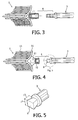
- the cell collection device is as depicted in Figure 1 .
- This device comprises a longitudinal handle 3 having a circular transverse section, one end thereof being provided with a means for sampling cells 2, which caries a plurality of bristles 15 extending parallel to the longitudinal handle 3, so that a brush is formed.
- the bristles are of different types: the bristles 15' located outwardly of the transverse centre of the carrier 16 are somewhat smaller than the bristles 15" provided in the longitudinal plane in the centre of the carrier.
- the invention relates to a method of collecting a sample with a cell collection device of the invention.
- a cell collection device is used whereby the longitudinal handle is removably attached to the means for collecting cells by means release joint.
- the means for collecting cells is positioned against a surface. This surface is preferably the bottom surface of a sample collection vial so that upon detachment of the sampling portion, a transfer is no longer required.
- the sample collection vial can already be filled with sample fluid. The movement the means for collecting cells makes by snapping out of the joint can contribute to the detachment and collection of sampled cells.
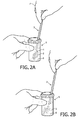
- a method of the invention is as depicted in Figures 2A and 2B .
- a sampling device of the invention is positioned inside a sample collection vial 5.
- the means for collecting cells 2 is detached from the longitudinal handle 3 by positioning the sample brush against the bottom surface 6 of the vial and applying a slight pressure on the longitudinal handle with one hand 7.
- the means for collecting cells detaches from the longitudinal handle ( Figure 2B ).
- the longitudinal handle is removed and discarded.
- the sampling vial is filled with liquid prior to or after the head and longitudinal handle are disengaged.
- the vial is closed and sent to a lab for further processing.
- the invention relates to a means for collecting cells comprising a fortification zone and a shape suitable for being secured to a longitudinal handle by means of a snap-release joint.
- means for collecting cells comprising a fortification zone and a shape suitable for being secured to a longitudinal handle by means of a snap-release joint are as depicted in Figure 4 .
- the head of a cervical brush 2 is displayed.
- a portion 10 is positioned. This portion is in the shape a dovetail slot 10. Together with a form matching portion 9, the portion 10 is capable of forming a snap-release fit. Attached to the dovetail slot is a fortification zone 11.
- the fortification zone provides support to the carrier of the bristles 15. It also serves to position the means for collecting cells against a surface.
- Figure 5 a detailed representation of the form matching portion 9 is displayed.
- the width 12 of the form matching portion 9 is about equal to the height 13 of the form matching portion.
Landscapes
- Health & Medical Sciences (AREA)
- Life Sciences & Earth Sciences (AREA)
- Surgery (AREA)
- Animal Behavior & Ethology (AREA)
- Biomedical Technology (AREA)
- Heart & Thoracic Surgery (AREA)
- Medical Informatics (AREA)
- Molecular Biology (AREA)
- Pathology (AREA)
- Engineering & Computer Science (AREA)
- General Health & Medical Sciences (AREA)
- Public Health (AREA)
- Veterinary Medicine (AREA)
- Gynecology & Obstetrics (AREA)
- Reproductive Health (AREA)
- Apparatus Associated With Microorganisms And Enzymes (AREA)
- Investigating Or Analysing Biological Materials (AREA)
- Sampling And Sample Adjustment (AREA)
Priority Applications (1)
| Application Number | Priority Date | Filing Date | Title |
|---|---|---|---|
| EP20090162923 EP2263552A1 (fr) | 2009-06-17 | 2009-06-17 | Dispositif de collecte de cellule à libération de fermeture |
Applications Claiming Priority (1)
| Application Number | Priority Date | Filing Date | Title |
|---|---|---|---|
| EP20090162923 EP2263552A1 (fr) | 2009-06-17 | 2009-06-17 | Dispositif de collecte de cellule à libération de fermeture |
Publications (1)
| Publication Number | Publication Date |
|---|---|
| EP2263552A1 true EP2263552A1 (fr) | 2010-12-22 |
Family
ID=41131804
Family Applications (1)
| Application Number | Title | Priority Date | Filing Date |
|---|---|---|---|
| EP20090162923 Withdrawn EP2263552A1 (fr) | 2009-06-17 | 2009-06-17 | Dispositif de collecte de cellule à libération de fermeture |
Country Status (1)
| Country | Link |
|---|---|
| EP (1) | EP2263552A1 (fr) |
Cited By (10)
| Publication number | Priority date | Publication date | Assignee | Title |
|---|---|---|---|---|
| EP2594334A1 (fr) | 2011-11-21 | 2013-05-22 | Drive O2 | Fiole à échantillon pour analyse holographique numérique d'un échantillon de cellules liquides |
| WO2014011534A3 (fr) * | 2012-07-10 | 2014-07-10 | Lifeline Scientific, Inc. | Canule |
| CN103919578A (zh) * | 2014-04-09 | 2014-07-16 | 王西平 | 宫颈疾病筛查刷 |
| WO2014189130A1 (fr) * | 2013-05-24 | 2014-11-27 | ニプロ株式会社 | Dispositif de prélèvement de cellules |
| WO2015066750A1 (fr) * | 2013-11-07 | 2015-05-14 | Genetic Technologies Limited | Dispositif de prélèvement d'échantillon biologique |
| JP2017532549A (ja) * | 2014-09-17 | 2017-11-02 | ホロジック, インコーポレイテッドHologic, Inc. | 分離可能な試料収集デバイス |
| CN107811657A (zh) * | 2017-11-23 | 2018-03-20 | 北京海普威生物技术有限公司 | 一种子宫颈细胞采样刷 |
| WO2018162716A1 (fr) * | 2017-03-10 | 2018-09-13 | Aprovix Ab | Dispositif d'auto-échantillonnage pour la collecte de fluide vaginal |
| RU2721649C2 (ru) * | 2017-03-10 | 2020-05-21 | Апровикс АБ | Устройство для самостоятельного отбора образцов для сбора влагалищной жидкости |
| CN113116403A (zh) * | 2021-05-17 | 2021-07-16 | 上海市第十人民医院 | 一种子宫内膜拭子及其子宫内膜取样方法 |
Citations (4)
| Publication number | Priority date | Publication date | Assignee | Title |
|---|---|---|---|---|
| US2835246A (en) * | 1954-12-22 | 1958-05-20 | Boettger Paul | Handling medical specimens |
| WO2006129195A2 (fr) * | 2005-05-31 | 2006-12-07 | Aprovix Ab | Systeme d'echantillonnage |
| US20070073186A1 (en) * | 2005-09-27 | 2007-03-29 | Decker | A Combination Self Adjusting Endocervical / Exocervical Sampling Device and Cell Transport / Preservation System |
| US20090012424A1 (en) * | 2004-03-03 | 2009-01-08 | Georg-August-Universitaet Goettingen | Device for removing and smearing cells |
-
2009
- 2009-06-17 EP EP20090162923 patent/EP2263552A1/fr not_active Withdrawn
Patent Citations (4)
| Publication number | Priority date | Publication date | Assignee | Title |
|---|---|---|---|---|
| US2835246A (en) * | 1954-12-22 | 1958-05-20 | Boettger Paul | Handling medical specimens |
| US20090012424A1 (en) * | 2004-03-03 | 2009-01-08 | Georg-August-Universitaet Goettingen | Device for removing and smearing cells |
| WO2006129195A2 (fr) * | 2005-05-31 | 2006-12-07 | Aprovix Ab | Systeme d'echantillonnage |
| US20070073186A1 (en) * | 2005-09-27 | 2007-03-29 | Decker | A Combination Self Adjusting Endocervical / Exocervical Sampling Device and Cell Transport / Preservation System |
Cited By (20)
| Publication number | Priority date | Publication date | Assignee | Title |
|---|---|---|---|---|
| WO2013076089A2 (fr) | 2011-11-21 | 2013-05-30 | DRIVE O2 bvba | Flacon pour milieu liquide et échantillon destiné à un procédé de détection de cellules cancéreuses dans un échantillon de cellules. |
| WO2013076082A1 (fr) | 2011-11-21 | 2013-05-30 | DRIVE O2 bvba | Flacon à échantillon pour analyse holographique numérique d'un échantillon liquide de cellules |
| EP2594334A1 (fr) | 2011-11-21 | 2013-05-22 | Drive O2 | Fiole à échantillon pour analyse holographique numérique d'un échantillon de cellules liquides |
| CN104602514B (zh) * | 2012-07-10 | 2017-09-22 | 生命线科学有限公司 | 插管 |
| WO2014011534A3 (fr) * | 2012-07-10 | 2014-07-10 | Lifeline Scientific, Inc. | Canule |
| US10085441B2 (en) | 2012-07-10 | 2018-10-02 | Lifeline Scientific, Inc. | Cannula |
| CN104602514A (zh) * | 2012-07-10 | 2015-05-06 | 生命线科学有限公司 | 插管 |
| JP2015527995A (ja) * | 2012-07-10 | 2015-09-24 | ライフライン サイエンティフック インコーポレイテッドLifeline Scientific, Inc. | カニューレ |
| US9259562B2 (en) | 2012-07-10 | 2016-02-16 | Lifeline Scientific, Inc. | Cannula |
| WO2014189130A1 (fr) * | 2013-05-24 | 2014-11-27 | ニプロ株式会社 | Dispositif de prélèvement de cellules |
| JPWO2014189130A1 (ja) * | 2013-05-24 | 2017-02-23 | ニプロ株式会社 | 細胞採取装置 |
| WO2015066750A1 (fr) * | 2013-11-07 | 2015-05-14 | Genetic Technologies Limited | Dispositif de prélèvement d'échantillon biologique |
| CN103919578B (zh) * | 2014-04-09 | 2016-04-27 | 王西平 | 宫颈疾病筛查刷 |
| CN103919578A (zh) * | 2014-04-09 | 2014-07-16 | 王西平 | 宫颈疾病筛查刷 |
| JP2017532549A (ja) * | 2014-09-17 | 2017-11-02 | ホロジック, インコーポレイテッドHologic, Inc. | 分離可能な試料収集デバイス |
| WO2018162716A1 (fr) * | 2017-03-10 | 2018-09-13 | Aprovix Ab | Dispositif d'auto-échantillonnage pour la collecte de fluide vaginal |
| RU2721649C2 (ru) * | 2017-03-10 | 2020-05-21 | Апровикс АБ | Устройство для самостоятельного отбора образцов для сбора влагалищной жидкости |
| CN107811657A (zh) * | 2017-11-23 | 2018-03-20 | 北京海普威生物技术有限公司 | 一种子宫颈细胞采样刷 |
| CN107811657B (zh) * | 2017-11-23 | 2024-06-04 | 北京海普威生物技术有限公司 | 一种子宫颈细胞采样刷 |
| CN113116403A (zh) * | 2021-05-17 | 2021-07-16 | 上海市第十人民医院 | 一种子宫内膜拭子及其子宫内膜取样方法 |
Similar Documents
| Publication | Publication Date | Title |
|---|---|---|
| EP2263552A1 (fr) | Dispositif de collecte de cellule à libération de fermeture | |
| EP2349659B1 (fr) | Manche pour rasoir à prise améliorée | |
| AU2015317690B2 (en) | Separable specimen collection device | |
| AU2006272969B2 (en) | Sampling means | |
| US20100050439A1 (en) | Utensil | |
| US20030060714A1 (en) | Medical ultrasound transducer with interchangeable handle | |
| JP6749938B2 (ja) | ねじ付きコネクタポートのクリーニングシステム、方法、及び装置 | |
| TW201004763A (en) | Razor handle | |
| JP2019090754A (ja) | 臨床検査用検体沈渣容器とこれを用いた検体沈渣方法 | |
| US20130205922A1 (en) | Laboratory instrument | |
| JP6674963B2 (ja) | 使い捨てのケリソン骨鉗子 | |
| EP3592244A1 (fr) | Dispositif d'auto-échantillonnage pour la collecte de fluide vaginal | |
| BE1020171A5 (nl) | Klik-los celbemonsteringsinrichting. | |
| CN217611179U (zh) | 一种活检钳钳头及其活检钳 | |
| CN210843542U (zh) | 一种便捷型种植牙印模托盘 | |
| KR102025842B1 (ko) | 조직 세포의 추출 및 액체의 흡입이 한 손으로 가능하도록 한 주사기 보조구 | |
| AU2009270322B2 (en) | A specimen container | |
| CN206556898U (zh) | 大便标本采集夹 | |
| CN110975956A (zh) | 一种防倒吸电子移液器 | |
| JP4858735B1 (ja) | 盛り塩成形器 | |
| CN213580139U (zh) | 筷子式大便取样器 | |
| RU96480U1 (ru) | Гинекологический набор для взятия биологического материала при диагностическом исследовании | |
| CN207821844U (zh) | 耳组织采样钳 | |
| US20030072678A1 (en) | Systems for diagnostic testing | |
| CN210108745U (zh) | 滚动式脱落细胞粘取器 |
Legal Events
| Date | Code | Title | Description |
|---|---|---|---|
| PUAI | Public reference made under article 153(3) epc to a published international application that has entered the european phase |
Free format text: ORIGINAL CODE: 0009012 |
|
| AK | Designated contracting states |
Kind code of ref document: A1 Designated state(s): AT BE BG CH CY CZ DE DK EE ES FI FR GB GR HR HU IE IS IT LI LT LU LV MC MK MT NL NO PL PT RO SE SI SK TR |
|
| AX | Request for extension of the european patent |
Extension state: AL BA RS |
|
| 17P | Request for examination filed |
Effective date: 20110622 |
|
| 17Q | First examination report despatched |
Effective date: 20110713 |
|
| STAA | Information on the status of an ep patent application or granted ep patent |
Free format text: STATUS: THE APPLICATION IS DEEMED TO BE WITHDRAWN |
|
| 18D | Application deemed to be withdrawn |
Effective date: 20171214 |