EP2265013A1 - Datenübertragung zu einem Kundengerät, das mit mindestens einem Dekodiermodul und einem Sicherheitsmodul ausgestattet ist - Google Patents
Datenübertragung zu einem Kundengerät, das mit mindestens einem Dekodiermodul und einem Sicherheitsmodul ausgestattet ist Download PDFInfo
- Publication number
- EP2265013A1 EP2265013A1 EP10166001A EP10166001A EP2265013A1 EP 2265013 A1 EP2265013 A1 EP 2265013A1 EP 10166001 A EP10166001 A EP 10166001A EP 10166001 A EP10166001 A EP 10166001A EP 2265013 A1 EP2265013 A1 EP 2265013A1
- Authority
- EP
- European Patent Office
- Prior art keywords
- module
- content
- identifier
- access control
- repudiated
- Prior art date
- Legal status (The legal status is an assumption and is not a legal conclusion. Google has not performed a legal analysis and makes no representation as to the accuracy of the status listed.)
- Ceased
Links
Images


Classifications
-
- H—ELECTRICITY
- H04—ELECTRIC COMMUNICATION TECHNIQUE
- H04N—PICTORIAL COMMUNICATION, e.g. TELEVISION
- H04N7/00—Television systems
- H04N7/16—Analogue secrecy systems; Analogue subscription systems
- H04N7/161—Constructional details of the subscriber equipment
-
- H—ELECTRICITY
- H04—ELECTRIC COMMUNICATION TECHNIQUE
- H04H—BROADCAST COMMUNICATION
- H04H60/00—Arrangements for broadcast applications with a direct linking to broadcast information or broadcast space-time; Broadcast-related systems
- H04H60/09—Arrangements for device control with a direct linkage to broadcast information or to broadcast space-time; Arrangements for control of broadcast-related services
- H04H60/14—Arrangements for conditional access to broadcast information or to broadcast-related services
- H04H60/23—Arrangements for conditional access to broadcast information or to broadcast-related services using cryptography, e.g. encryption, authentication, key distribution
-
- H—ELECTRICITY
- H04—ELECTRIC COMMUNICATION TECHNIQUE
- H04N—PICTORIAL COMMUNICATION, e.g. TELEVISION
- H04N21/00—Selective content distribution, e.g. interactive television or video on demand [VOD]
- H04N21/20—Servers specifically adapted for the distribution of content, e.g. VOD servers; Operations thereof
- H04N21/21—Server components or server architectures
-
- H—ELECTRICITY
- H04—ELECTRIC COMMUNICATION TECHNIQUE
- H04N—PICTORIAL COMMUNICATION, e.g. TELEVISION
- H04N21/00—Selective content distribution, e.g. interactive television or video on demand [VOD]
- H04N21/20—Servers specifically adapted for the distribution of content, e.g. VOD servers; Operations thereof
- H04N21/23—Processing of content or additional data; Elementary server operations; Server middleware
-
- H—ELECTRICITY
- H04—ELECTRIC COMMUNICATION TECHNIQUE
- H04N—PICTORIAL COMMUNICATION, e.g. TELEVISION
- H04N21/00—Selective content distribution, e.g. interactive television or video on demand [VOD]
- H04N21/20—Servers specifically adapted for the distribution of content, e.g. VOD servers; Operations thereof
- H04N21/25—Management operations performed by the server for facilitating the content distribution or administrating data related to end-users or client devices, e.g. end-user or client device authentication, learning user preferences for recommending movies
- H04N21/258—Client or end-user data management, e.g. managing client capabilities, user preferences or demographics, processing of multiple end-users preferences to derive collaborative data
- H04N21/25808—Management of client data
- H04N21/2585—Generation of a revocation list, e.g. of client devices involved in piracy acts
-
- H—ELECTRICITY
- H04—ELECTRIC COMMUNICATION TECHNIQUE
- H04N—PICTORIAL COMMUNICATION, e.g. TELEVISION
- H04N21/00—Selective content distribution, e.g. interactive television or video on demand [VOD]
- H04N21/20—Servers specifically adapted for the distribution of content, e.g. VOD servers; Operations thereof
- H04N21/25—Management operations performed by the server for facilitating the content distribution or administrating data related to end-users or client devices, e.g. end-user or client device authentication, learning user preferences for recommending movies
- H04N21/266—Channel or content management, e.g. generation and management of keys and entitlement messages in a conditional access system, merging a VOD unicast channel into a multicast channel
- H04N21/26606—Channel or content management, e.g. generation and management of keys and entitlement messages in a conditional access system, merging a VOD unicast channel into a multicast channel for generating or managing entitlement messages, e.g. Entitlement Control Message [ECM] or Entitlement Management Message [EMM]
-
- H—ELECTRICITY
- H04—ELECTRIC COMMUNICATION TECHNIQUE
- H04N—PICTORIAL COMMUNICATION, e.g. TELEVISION
- H04N21/00—Selective content distribution, e.g. interactive television or video on demand [VOD]
- H04N21/40—Client devices specifically adapted for the reception of or interaction with content, e.g. set-top-box [STB]; Operations thereof
- H04N21/41—Structure of client; Structure of client peripherals
- H04N21/418—External card to be used in combination with the client device, e.g. for conditional access
- H04N21/4181—External card to be used in combination with the client device, e.g. for conditional access for conditional access
-
- H—ELECTRICITY
- H04—ELECTRIC COMMUNICATION TECHNIQUE
- H04N—PICTORIAL COMMUNICATION, e.g. TELEVISION
- H04N21/00—Selective content distribution, e.g. interactive television or video on demand [VOD]
- H04N21/40—Client devices specifically adapted for the reception of or interaction with content, e.g. set-top-box [STB]; Operations thereof
- H04N21/41—Structure of client; Structure of client peripherals
- H04N21/418—External card to be used in combination with the client device, e.g. for conditional access
- H04N21/4182—External card to be used in combination with the client device, e.g. for conditional access for identification purposes, e.g. storing user identification data, preferences, personal settings or data
-
- H—ELECTRICITY
- H04—ELECTRIC COMMUNICATION TECHNIQUE
- H04N—PICTORIAL COMMUNICATION, e.g. TELEVISION
- H04N21/00—Selective content distribution, e.g. interactive television or video on demand [VOD]
- H04N21/40—Client devices specifically adapted for the reception of or interaction with content, e.g. set-top-box [STB]; Operations thereof
- H04N21/45—Management operations performed by the client for facilitating the reception of or the interaction with the content or administrating data related to the end-user or to the client device itself, e.g. learning user preferences for recommending movies, resolving scheduling conflicts
- H04N21/462—Content or additional data management e.g. creating a master electronic programme guide from data received from the Internet and a Head-end or controlling the complexity of a video stream by scaling the resolution or bit-rate based on the client capabilities
- H04N21/4623—Processing of entitlement messages, e.g. ECM [Entitlement Control Message] or EMM [Entitlement Management Message]
-
- H—ELECTRICITY
- H04—ELECTRIC COMMUNICATION TECHNIQUE
- H04N—PICTORIAL COMMUNICATION, e.g. TELEVISION
- H04N21/00—Selective content distribution, e.g. interactive television or video on demand [VOD]
- H04N21/60—Network structure or processes for video distribution between server and client or between remote clients; Control signalling between clients, server and network components; Transmission of management data between server and client, e.g. sending from server to client commands for recording incoming content stream; Communication details between server and client
- H04N21/63—Control signaling related to video distribution between client, server and network components; Network processes for video distribution between server and clients or between remote clients, e.g. transmitting basic layer and enhancement layers over different transmission paths, setting up a peer-to-peer communication via Internet between remote STB's; Communication protocols; Addressing
- H04N21/633—Control signals issued by server directed to the network components or client
- H04N21/6332—Control signals issued by server directed to the network components or client directed to client
- H04N21/6334—Control signals issued by server directed to the network components or client directed to client for authorisation, e.g. by transmitting a key
- H04N21/63345—Control signals issued by server directed to the network components or client directed to client for authorisation, e.g. by transmitting a key by transmitting keys
-
- H—ELECTRICITY
- H04—ELECTRIC COMMUNICATION TECHNIQUE
- H04N—PICTORIAL COMMUNICATION, e.g. TELEVISION
- H04N7/00—Television systems
- H04N7/16—Analogue secrecy systems; Analogue subscription systems
- H04N7/162—Authorising the user terminal, e.g. by paying; Registering the use of a subscription channel, e.g. billing
- H04N7/163—Authorising the user terminal, e.g. by paying; Registering the use of a subscription channel, e.g. billing by receiver means only
-
- H—ELECTRICITY
- H04—ELECTRIC COMMUNICATION TECHNIQUE
- H04N—PICTORIAL COMMUNICATION, e.g. TELEVISION
- H04N7/00—Television systems
- H04N7/16—Analogue secrecy systems; Analogue subscription systems
- H04N7/167—Systems rendering the television signal unintelligible and subsequently intelligible
- H04N7/1675—Providing digital key or authorisation information for generation or regeneration of the scrambling sequence
Definitions
- the invention relates to the transmission of contents in a conditional access system, for example in the context of pay-TV.
- a stream of data relating to a content is encrypted using a secret encryption key, usually called " control word ", or "control word”, before being transmitted to a or more client equipment across a network for example the Internet.
- Access to the content is subject to verification of one or more access criteria by the client equipment.
- the control word, in encrypted form, and the access criterion or criteria for the content are transmitted to the client equipment in an access control message, called "ECM” ( Entitlement Control Message ).
- ECM Entitlement Control Message
- the key for decrypting the control word, in encrypted form, as well as the information necessary for managing the rights of the user, is transmitted to the client equipment, prior to the content, in a management message called "EMM" ( Entitlement Management Message ).
- ECM When transmitting content, a continuous flow of ECM messages is transmitted synchronously and concomitantly with the transmission of the data flow relating to the content.
- the value of the control word transported by the successive ECMs of the stream changes regularly, for example every 10 seconds.
- An ECM, carrying a given control word may be repeated several times during the validity period of this control word to allow new equipment wishing to access the content to quickly obtain the current control word to decrypt the control word. data flow of the content without waiting.
- the client equipment generally comprises a decoding module, commonly called a set-top-box decoder, and at least one security module such as a smart card and / or a "chipset" (that is to say a or multiple processors) secure embedded in the set-top-box.
- a decoding module commonly called a set-top-box decoder
- a security module such as a smart card and / or a "chipset" (that is to say a or multiple processors) secure embedded in the set-top-box.
- the control words received are over-encrypted (that is to say, twice encrypted) and intended to be decrypted, of on the one hand, by the smart card and, on the other hand, by the chipset.
- These decoding and security modules are adapted to interact with each other.
- the security module stores the rights of the user provided by one or more received EMM message (s).
- this security module Upon receipt of an ECM message, this security module has the role of checking whether the access criteria or criteria present in this ECM are satisfied by comparison with the rights of the user stored. If the check is positive, the security module decrypts the received ECM control word and transmits it to the decoding module which can then decrypt data from the received content data stream.
- the transmission of these in decoded form from the security module to the decoding module is protected by cryptographic encryption.
- the security module and the module of decoding agree to use an encryption cryptographic key during a process called "key lock" prior to any dialogue between the two modules.
- the security module and the decoding module can perform mutual authentication.
- This authentication can be based on a Public Key Infrastructure (PKI) and requires a certificate exchange between the decoding module and the security module.
- PKI Public Key Infrastructure
- Each module receiving the certificate of the other module must then perform various checks, including a non-repudiation check of the other module.
- the non-repudiation verification by one module of the other module consists of checking whether this module is listed in a blacklist of repudiated module identifiers.
- This list contains identifiers of a set of repudiated modules such as a compromised module of which there are non-legitimate clones, a treacherous module that allows to redistribute system data, such as control words, to a community.
- This revocation blacklist can be bulky. Storage in a security module such as a smart card is therefore problematic given the limited storage capacity of the card.
- the present invention aims to improve the situation.
- all the identifiers of the revocation list is transmitted by the transmission of a set of access control messages.
- the revocation list may contain, in a first exemplary embodiment, repudiation of decoded module identifiers or, in a second exemplary embodiment, renamed security module identifiers.
- the security module and the decoding module can be separated or integrated in the same device.
- the invention it is no longer necessary to store the identifiers of the revocation list in the client equipment. For example, it is possible to consider inserting an identifier of the revocation list in each access control message.
- the sending of N distinct successive messages makes it possible to transmit the entire revocation list to the client equipment. Given the frequency of sending successive access control messages and the size of such a list, it allows, in any case, to quickly transmit to the client equipment all this revocation list.
- the identifiers transmitted in the control messages are those of decoding modules repudiated. Thanks to this, it is avoided to memorize the black list of revocation of the decoding modules in the security module. This is particularly interesting in the case where it has limited storage capacity.
- the security module upon receipt of a control message containing an identifier of the decoder module blacklist, for example, the security module compares this decoded module identifier repudiated with the current decoding module identifier. If it turns out that there is a match, the security module can prohibit any dialogue with the decoding module or only the transmission of certain data such as control words.
- one of the two modules of the client equipment storing the identifier of at least one previous module with which it has previously discussed it is expected, during the comparison step, to compare each module identifier repudiated received at the previous module identifier stored.
- the security module can immediately take into account the repudiation of the previous decoding module. The security module can then refuse any subsequent dialogue with this repudiation decoding module, without waiting for a new reception of the identifier of this repudiated decoding module transmitted in an access control message.
- the invention also relates to a server for generating and transmitting via an access control message communication network, comprising means for generating access control messages to a digital content and means for transmitting messages.
- access control messages generated in the form of a stream synchronized with the transmission of a data stream of the content, characterized in that a revocation list containing repudiated customer equipment module identifiers having been established the means for generating access control messages are arranged to insert in at least part of the access control messages at least one repudiated module identifier of said message revocation list.
- FIG. 1 there is shown a system 4 for transmitting conditional access digital content to a plurality of client equipment.
- the system 4 is a system for broadcasting digital television programs through a network 7, in this case the Internet.
- a network 7 in this case the Internet.
- the transmission system 4 comprises a server 5 for transmitting digital contents, in this case television programs, and a server 6 for transmitting content access control messages, which will be called thereafter ECM ( Entitlement Control Message ) messages.
- ECM Entitlement Control Message
- a succession of control words denoted CW i with i equaling 1, 2, 3, ...., intended to encrypt successive frames of the content C, are provided parallel to both the content transmission server 5 and the ECM message transmission server 6 by a control word generation system, not shown.
- a control word CW i corresponds to a secret key intended to be used for encrypting and decrypting media data of a content.
- the media data of a content here includes audio data, video data and, where appropriate, text data of the content C.
- the control words used to encrypt the data of the stream F 1 (C) of the content change regularly, for example every ten seconds.
- the ECM transmission server 6 receives, in addition to the succession of control words associated with the content C, one or more criteria for access to the content.
- C noted CA k with k ⁇ 1
- K CW a control code encryption key
- the ECM broadcast server 6 receives only a key K CW control word encryption (without access criteria).
- the ECM broadcast server 6 has access to a revocation blacklist containing repudiate decoder identifiers.
- This blacklist is established by a network entity, not shown, and is regularly updated. The server 6 can receive it at each update or retrieve it from the network entity that established it on request.
- the entirety of the identifiers of the revocation blacklist is contained in a group of N successive ECM messages i ECM message flow sent by the server 6, where N corresponds to the number of reporters decoded reporters blacklisted.
- the transmission of the ECM message flow by the server 6 and the transmission of the encrypted media stream F 1 '(C) of the content C by the server 5 are synchronized.
- the transmission period of the message ECM it starts slightly before that of transmission of the corresponding frame T i (C) of the media data of the content C.
- the client equipment 1 includes a decoding module 2, in this case a set-top-box TV decoder, and a security module 3, in this case a smart card.
- the TV decoder 2 and the smart card 3 are intended to be connected to each other and dialogue together after performing mutual authentication.
- This authentication is based on a public key infrastructure in which the decoder 2 and card 3 each have a certificate.
- the two modules 2 and 3 exchange their respective certificates and perform various checks well known to those skilled in the art: verification of the cryptographic integrity of the certificate, verification of the certificate format, verification of the semantics certificate (validity period, etc.), verification of non-repudiation of the card by the decoder.
- the card 3 does not perform a non-repudiation verification of the decoder 2. This check is made later, during the dialogue, as will be explained later.
- the smart card 3 stores the rights of the client user and the key K CW for decrypting the control words present in the ECM control messages. Its role is to check whether the access criteria present in an ECM presented by the decoder 2 to the card 3 are satisfied by the user rights stored in the card 3 and, if necessary, to decipher the word control present in the ECM message before transmitting it to the decoder 2.
- the duration ⁇ of a frame is equal to 10 seconds.
- the content transmission server 5 encrypts the stream of media data relating to the content C, F 1 (C), using successive control words, denoted CW i , with i equal to 1, 2, etc ..
- a control word CW i own is used to encrypt each frame ⁇ T (C) of the flow F 1 (C).
- the successive content frames T 1 (C), T 2 (C), ..., T i (C), ... are thus encrypted using successive successive control words CW 1 , CW 2 ,. .., CW i , ....
- the encrypted media stream relating to the content C, F 1 '(C), is sent by the server 5, through the Internet, to the client equipment 1, according to the frames T 1 (C ), T 2 (C), ..., T i (C), ....
- the transmission is carried out here in “streaming” mode (that is to say in streaming mode) and in “ multicast "(ie in point-to-multipoint broadcast mode).
- the ECM message sending server 6 generates a stream F 2 [ECM (C)] containing a succession of content access control messages C, denoted ECM i , with i equal at 1, 2, etc.
- Each access control message ECM i here contains a criterion of access to the content C, denoted CA, a control word CW i and here an identifier, denoted ID n (with 1 ⁇ n ⁇ N ), of a decoder repudiated by blacklist revocation.
- the message flow ECM F 2 [ECM (C)] comprises a succession of frames P i (with i equal to 1, 2, ...) of duration substantially equal to ⁇ .
- Each frame P i of the ECM stream corresponds to the transmission period of the ECM message i given.
- the message ECM i is transmitted repeatedly.
- the server 6 transmits the stream F 2 [ECM (C)] containing the successive content access control messages C (ECM 1 , ECM 2 , ....), through the Internet 7, to the client equipment 1.
- the transmission operation of the F 2 stream [ECM (C)] of ECM messages is denoted E'1 on the figure 2 .
- the identifiers of the revocation blacklist are respectively transmitted in the successive ECM messages i of the stream F 2 [ECM (C)].
- the revocation blacklist here contains N repudiated decoder identifiers.
- the entirety of the N decoded module identifiers repudiated from the blacklist revocation is transmitted to the client equipment 1 by sending a group of N successive access control messages.
- Each group of N messages comprising, for example, the messages ECM jN + 1 to ECM jN + N (j being equal to 0, 1, ...), contains, in a distributed manner, the N identifiers of the blacklist of revocation, each message ECM containing an identifier of the revocation blacklist.
- the revocation blacklist is, if necessary, transmitted several times during the transmission time of parallel F 2 [ECM (C)] and F 1 '(C) streams.
- the list can also be updated at any time by the server 6.
- the transmission E'1 of the flow F 2 [ECM (C)] of ECM access control messages is synchronized with the transmission E1 of the stream F ' 1 (C) of encrypted media data of the content C.
- the synchronization of the flows F 1 (C) and F 2 [ECM (C)] is such that when the client device 1 receives the frame T i of media data content C encrypted with the control word CW i , it receives in parallel the data frame P i containing the message ECM i which itself contains the control word CW i in encrypted form.
- the decoder 2 receives the protected media stream F ' 1 (C) relative to the content C, during a step E2, and concomitantly, during a step E2', the stream F 2 [ECM (C) ] ECM content access control messages.
- the two modules 2 and 3 exchange their respective certificates, during a step E3 .
- the decoder 2 and the card 3 exchange their respective certificates and carry out certain mutual checks, well known to those skilled in the art: verification of the cryptographic integrity of the certificate, verification of the format of the certificate, verification of the semantics of the certificate (period of validity, ).
- the decoder 2 verifies the non-repudiation of the card 3.
- the decoder 2 transmits to the card 3 a first ECM received from the stream F 2 [ECM (C)], for example ECM 1 .
- ECM ECM 1
- the first received ECM is a posterior ECM i with i> 1.
- the card 3 extracts the identifier, here ID 1 , decoder repudiated ECM message 1 and compares it to the identifier of the current decoding module 2 present in the certificate previously received at step E3.
- the dialogue between the card 3 and the decoder 2 is here interrupted during a step E8.
- the card 3 could interrupt only the transmission of decrypted control words (using the key K cw ) to the decoder 2.
- the card 3 checks the access criterion CA to the content C, present in the message ECM 1 by comparison with the user rights stored in the card 3, during a step E9.
- the card 3 decrypts the control word CW 1 present in the message ECM 1 , using the key K cw stored, during a step E10, and transmits the control word decrypted CW 1 to the decoder 2, during a step E11.
- the transmission of the control word CW 1 in decrypted form from the card 3 to the decoder 2 is protected by cryptography using the shared key ⁇ established during the step E5.
- the decoder 2 decrypts the frame T 1 (C) of the stream F1 '(C) corresponding to the received message ECM 1 , using the control word CW 1 , during a step E12.
- the steps E6-E7 and E9 to E11 are repeated if the identifier of the decoder 2 does not correspond to the identifier ID n received, or the E6 to E8 are executed if the identifier of the decoder 2 corresponds to the identifier ID n received.
- the card 3 can thus compare the identifier of the current decoder 2 with the N identifiers of the revocation blacklist by processing N distinct successive ECM messages i , for example the messages ECM 1 to ECM N.
- the revocation blacklist can be transmitted several times in a row, depending on the duration of the C content transmission.
- the card 3 has been successively connected to several separate decoders. At each connection with a decoder, the card 3 stores the identifier of this decoder. As a result, the card 3 stores in memory the identifier of one or more previous decoder (s) as well as the identifier of the current decoder to which it is currently connected.
- the card 3 On receipt of each i ECM message containing an identifier ID of repudiated decoder, the card 3 compares the identifier ID received at both the current decoder identifier and each stored previous decoder identifier.
- the card 3 If the decoded identifier repudiated ID n received corresponds to the identifier of a previous decoder, the card 3 stores this identifier ID n as a decoder repudiated, to prohibit any future new dialogue with this decoder. As a variant, the card 3 could only prohibit the transmission of decrypted control words to this repudiated decoder during a subsequent connection.
- the card 3 prohibits the continuation of the dialogue with the current decoder. Alternatively, the card 3 could prohibit only the transmission of decrypted control words to this repudiated decoder.
- the test is negative, in other words if the repudiated decoder identifier ID n does not correspond to the identifier of the current decoder or to that of a previous decoder, the dialogue between the decoder 2 and the card 3 is continued normally. .
- the card 3 checks the content access criterion C present in the message ECM i and, if it is satisfied, decrypts the control word and sends it to the current decoder. It then decrypts the corresponding media data frame of the stream F 1 '(C) received.
- the server 5 is adapted to implement those steps of the previously described method which are performed by the content transmission server, namely the steps E0 and E1.
- the five receiving modules 60-64 are connected to the database 65, which is itself connected to the generation module 64.
- the generation module 64 is adapted to implement the step E0 'for generating ECM messages associated with a content C, according to the previously described method. More precisely, the module 64 is adapted to generate a stream F 2 [ECM (C)] containing a succession of content access control messages C, denoted ECM i , with i equal to 1, 2, etc. In each access control message ECM i , the generation module 64 is adapted to insert one or more criterion (s) for access to the content C, a control word CW i in encrypted form and here an identifier ID n ( with 1 ⁇ n ⁇ N ) of decoder repudiated from the revocation blacklist.
- the ECM message flow F 2 [ECM (C)] generated comprises a succession of frames P i (with i equal to 1, 2, ...) of duration substantially equal to ⁇ , each frame of the ECM stream corresponding to the transmission period of the same message ECM i repeatedly given.
- the transmission module 67 connected to the generation module 66, is adapted to transmit the ECM message flow F 2 [ECM (C)] synchronously with the transmission of the media data stream relating to the content C.
- the content server 5 and the ECM server 6 communicate with each other to synchronize the transmission of the encrypted stream F 1 '(C) of media data of a content C and the transmission of the stream F 2 [ECM (C) ] ECM messages associated with this content C.
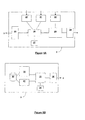
- the client equipment 1 includes a Set-Top-Box TV decoder 2 represented on the Figure 5A and a smart card 3 shown on the Figure 5B .
- the dialogue modules 26 and 33 are arranged to store the encryption key ⁇ and to encrypt or decrypt, in the direction of transmission, the data exchanged between the decoder 2 and the card 3 during the dialogue between the two modules.
- the ECM message processing module 35 of the card 3 is adapted to implement the steps E7 and E9 to E11 or the steps E7 and E8, on receipt of each ECM message. More specifically, on receiving an ECM message, the processing module 35 is adapted to check whether the identifier ID n of the repudiated decoder present in the ECM corresponds here to the identifier of the current decoder to which the card 3 is connected. . If the verification is positive, the module 35 controls an interruption of the dialogue with this decoder (alternatively, it could control only an interruption of the transmission of the decrypted control words to the decoder). If the verification is negative, the processing module 35 is arranged to check the access criteria or criteria present in the ECM according to the user rights stored and, if the access criteria are met, decipher the control word present in the ECM and transmit it to the decoder.
- the decryption module 23 of the decoder 2 is adapted to receive the decrypted control words transmitted by the card 3 through the interfaces 25 and 30 between the card and the decoder and to decode received content media data C, in accordance with FIG. step E12 of the method described above.
- the modules 23, 26 of the decoder 2 and 31, 33 and 35 of the card are here software modules comprising program instructions for carrying out corresponding process steps.
- the blacklist identifiers of the repudiated decoders are transmitted in different access control messages transmitted synchronously with the transmission of the media data stream of the content C. It could be envisaged to transmit in the same manner renamed card identifiers from a black card revocation list.
- the decoding module and the security module lock after having performed mutual authentication.
- the keying process could be performed by a third party server, in a known manner, without mutual authentication between the two modules.
- the third-party server upon request from each module, the third-party server sends modulates the shared key ⁇ for the dialogue between the two modules.
- This process can be accompanied by an authentication of each of the two modules by the server.
- the shared key ⁇ can be inserted in an EMM message that is transmitted in the data stream from the content C to the decoding module and in another EMM message that is transmitted in the data stream from the content C to the security module.
- the client equipment includes a decoder and an external smart card.
- the client equipment could include a decoder, an external smart card and a secure chipset integrated in the decoder.
- the control words are over-encrypted (that is to say encrypted twice) and intended to be decrypted by the smart card on the one hand and by the secure chipset on the other hand.
- the ECM messages could carry repacked secure chipset identifiers, to enable the card to check the non-repudiation of the chipset of the client equipment, or conversely of the smart card identifiers repudiated to allow the chipset to verify the non-repudiation of the smart card.
- the client equipment could also include a decoder and, instead of the external smart card, an integrated secure chipset.
- ECM messages could also convey the identifiers of a smart card revocation list or a chipset revocation list.
- a revocation list containing a plurality of repudiated client equipment module identifiers has been established, a plurality - a group - of transmitted access control messages each contain at least one repudiated module identifier. of this revocation list, so that all the identifiers of the revocation list is transmitted to a module of the client equipment, noted here A for the sake of clarity, by the transmission of access control messages of this group.
- another module of the client equipment, noted here B for the sake of clarity, for dialogue with the module A can check if the module B is repudiated.
- the present invention is applicable not only to the transmission of a data stream through an IP communication network such as the Internet, as described above, but also to the transmission of a data stream through a mobile network or any other communication network.
- the decoding module may comprise a decoder integrated in the mobile terminal and the security module comprises a SIM card connected to the mobile terminal or a secure chipset integrated in the mobile terminal.
Landscapes
- Engineering & Computer Science (AREA)
- Signal Processing (AREA)
- Multimedia (AREA)
- Databases & Information Systems (AREA)
- Computer Security & Cryptography (AREA)
- Computer Networks & Wireless Communication (AREA)
- Computer Graphics (AREA)
- Computing Systems (AREA)
- General Engineering & Computer Science (AREA)
- Theoretical Computer Science (AREA)
- Storage Device Security (AREA)
Applications Claiming Priority (1)
| Application Number | Priority Date | Filing Date | Title |
|---|---|---|---|
| FR0954201 | 2009-06-19 |
Publications (1)
| Publication Number | Publication Date |
|---|---|
| EP2265013A1 true EP2265013A1 (de) | 2010-12-22 |
Family
ID=41429401
Family Applications (1)
| Application Number | Title | Priority Date | Filing Date |
|---|---|---|---|
| EP10166001A Ceased EP2265013A1 (de) | 2009-06-19 | 2010-06-15 | Datenübertragung zu einem Kundengerät, das mit mindestens einem Dekodiermodul und einem Sicherheitsmodul ausgestattet ist |
Country Status (1)
| Country | Link |
|---|---|
| EP (1) | EP2265013A1 (de) |
Citations (6)
| Publication number | Priority date | Publication date | Assignee | Title |
|---|---|---|---|---|
| US20040101138A1 (en) * | 2001-05-22 | 2004-05-27 | Dan Revital | Secure digital content delivery system and method over a broadcast network |
| FR2850822A1 (fr) * | 2003-02-04 | 2004-08-06 | Canal Plus Technologies | Systeme de television a peage, procede de revocation de droits dans un tel systeme, decodeur et carte a puce associes, et message transmis a un tel decodeur |
| FR2866773A1 (fr) * | 2004-02-20 | 2005-08-26 | Viaccess Sa | Procede d'appariement d'un nombre n de terminaux recepteurs avec un nombre m de cartes de controle d'acces conditionnel |
| EP1631085A1 (de) * | 2004-08-31 | 2006-03-01 | Kabushiki Kaisha Toshiba | Rundfunkempfangsgerät, Rundfunkempfangsverfahren und Rundfunkempfangssystem |
| US20060126839A1 (en) * | 2004-11-05 | 2006-06-15 | Masakazu Koike | Digital broadcasting receiving apparatus |
| US20070180231A1 (en) * | 2006-01-31 | 2007-08-02 | Widevine Technologies, Inc. | Preventing entitlement management message (EMM) filter attacks |
-
2010
- 2010-06-15 EP EP10166001A patent/EP2265013A1/de not_active Ceased
Patent Citations (6)
| Publication number | Priority date | Publication date | Assignee | Title |
|---|---|---|---|---|
| US20040101138A1 (en) * | 2001-05-22 | 2004-05-27 | Dan Revital | Secure digital content delivery system and method over a broadcast network |
| FR2850822A1 (fr) * | 2003-02-04 | 2004-08-06 | Canal Plus Technologies | Systeme de television a peage, procede de revocation de droits dans un tel systeme, decodeur et carte a puce associes, et message transmis a un tel decodeur |
| FR2866773A1 (fr) * | 2004-02-20 | 2005-08-26 | Viaccess Sa | Procede d'appariement d'un nombre n de terminaux recepteurs avec un nombre m de cartes de controle d'acces conditionnel |
| EP1631085A1 (de) * | 2004-08-31 | 2006-03-01 | Kabushiki Kaisha Toshiba | Rundfunkempfangsgerät, Rundfunkempfangsverfahren und Rundfunkempfangssystem |
| US20060126839A1 (en) * | 2004-11-05 | 2006-06-15 | Masakazu Koike | Digital broadcasting receiving apparatus |
| US20070180231A1 (en) * | 2006-01-31 | 2007-08-02 | Widevine Technologies, Inc. | Preventing entitlement management message (EMM) filter attacks |
Similar Documents
| Publication | Publication Date | Title |
|---|---|---|
| EP2027667B1 (de) | Verfahren zum senden und empfangen eines verwürfelten multimediaprogramms, netzwerkkopf, endgerät, empfänger und sicherheitsprozessor für diese verfahren | |
| EP2055102B1 (de) | Verfahren zur übertragung eines zusätzlichen datum zu einem empfangsendgerät | |
| EP2052539B1 (de) | Verfahren für den widerruf von sicherheitsmodulen zur sicherung von rundfunknachrichten | |
| EP2520042B1 (de) | Verfahren für entschlüsselung, übertragung und empfang von steuerworten, speichermedium und server für diese verfahren | |
| EP1479233B1 (de) | Verarbeitungsvorrichtung und übertragungsverfahren für daten, die für einen ersten bereich verschlüsselt sind, in einem netzwerk, welches zu einem zweiten bereich gehört | |
| EP2567500B1 (de) | Verfahren, aufzeichnungsmedium und server zur verschlüsselung, zum senden und zum empfangen von steuerwörtern | |
| EP2659613B1 (de) | Verfahren zum senden und empfangen von multimedia-inhalten | |
| EP1479234B1 (de) | Verarbeitungsverfahren für daten, die für einen ersten bereich verschlüsselt sind und in einem zu einem zweiten bereich gehörenden netzwerk empfangen wurden | |
| WO2015007549A1 (fr) | Methode pour la protection de cles de dechiffrement dans un decodeur et decodeur pour la mise en oeuvre de cette methode | |
| EP1595399B1 (de) | Pay-fernsehen, verfahren zum entziehen von rechten in einem solchen system, assoziierter decoder und chipkarte und an einen solchen decoder übertragene nachricht | |
| WO2009112771A1 (fr) | Procédé d'affichage de contenus multimédia à perturbations variables en fonction de droits locaux de récepteurs/décodeurs | |
| EP2326035B1 (de) | Verarbeitungsverfahren durch ein Nachrichtensicherheitsmodul mit Zugriffskontrolle auf einen Inhalt, und damit verbundenes Sicherheitsmodul | |
| EP2334007A1 (de) | Verfahren zur Datenentschlüsselung durch eine Benutzereinrichtung bestehend aus einem Endgerät und einem Sicherheitsmodul | |
| EP2328316B1 (de) | Zugriffskontrolle auf einen digitalen Inhalt | |
| WO2010037940A1 (fr) | Procede pour verifier l'acces a un contenu, terminal, module d'acces et dispositif fournisseur de guide electronique de services associes | |
| FR2981182A1 (fr) | Controle d'acces a des donnees d'un contenu chiffre | |
| FR2843257A1 (fr) | Procede et systeme d'acces conditionnel applique a la protection de contenu | |
| FR3110263A1 (fr) | Procédé et système pour authentifier une application informatique, ou une fonction de l’application, exécutée par un récepteur multimédia | |
| FR2846831A1 (fr) | Pseudo video a la demande(pvod) | |
| WO2003077555A2 (fr) | Protocole de commande a distance d'une action locale de generation d'un message d'ordre | |
| FR2967852A1 (fr) | Ensemble de diffusion par reseau ip de flux video numeriques embrouilles vers des terminaux ip directement relies a ce reseau |
Legal Events
| Date | Code | Title | Description |
|---|---|---|---|
| PUAI | Public reference made under article 153(3) epc to a published international application that has entered the european phase |
Free format text: ORIGINAL CODE: 0009012 |
|
| AK | Designated contracting states |
Kind code of ref document: A1 Designated state(s): AL AT BE BG CH CY CZ DE DK EE ES FI FR GB GR HR HU IE IS IT LI LT LU LV MC MK MT NL NO PL PT RO SE SI SK SM TR |
|
| AX | Request for extension of the european patent |
Extension state: BA ME RS |
|
| RIN1 | Information on inventor provided before grant (corrected) |
Inventor name: BECKER, CLAUDIA Inventor name: VIVOLO, OLIVIER |
|
| 17P | Request for examination filed |
Effective date: 20110621 |
|
| 17Q | First examination report despatched |
Effective date: 20110901 |
|
| STAA | Information on the status of an ep patent application or granted ep patent |
Free format text: STATUS: THE APPLICATION HAS BEEN REFUSED |
|
| 18R | Application refused |
Effective date: 20130227 |