EP2265689B1 - Nouveaux matériaux pour des dispositifs électroluminescents organiques - Google Patents
Nouveaux matériaux pour des dispositifs électroluminescents organiques Download PDFInfo
- Publication number
- EP2265689B1 EP2265689B1 EP09732312.5A EP09732312A EP2265689B1 EP 2265689 B1 EP2265689 B1 EP 2265689B1 EP 09732312 A EP09732312 A EP 09732312A EP 2265689 B1 EP2265689 B1 EP 2265689B1
- Authority
- EP
- European Patent Office
- Prior art keywords
- organic
- compounds
- layers
- atoms
- compound
- Prior art date
- Legal status (The legal status is an assumption and is not a legal conclusion. Google has not performed a legal analysis and makes no representation as to the accuracy of the status listed.)
- Active
Links
- 0 CC(*)C1C2=C(*)c3ccc(C(*4*)(C(C)=C)c5c(cccc6)c6ccc5C)c4c3C(*)(*)C(*)=C2C1(*)C(*)=C Chemical compound CC(*)C1C2=C(*)c3ccc(C(*4*)(C(C)=C)c5c(cccc6)c6ccc5C)c4c3C(*)(*)C(*)=C2C1(*)C(*)=C 0.000 description 14
- NVZWEEGUWXZOKI-UHFFFAOYSA-N Cc1c(C=C)cccc1 Chemical compound Cc1c(C=C)cccc1 NVZWEEGUWXZOKI-UHFFFAOYSA-N 0.000 description 2
- SZYWOMWWGLPFDD-UHFFFAOYSA-N C(C1)C=CC=C1c1c(cc(c2c3)-c4ccccc4C2(c(cc2)ccc2-c2nc(cccc4)c4[n]2-c2ccccc2)c(cc2)ccc2-c2nc(cccc4)c4[n]2-c2ccccc2)c3c(-c2ccccc2)c2ccccc12 Chemical compound C(C1)C=CC=C1c1c(cc(c2c3)-c4ccccc4C2(c(cc2)ccc2-c2nc(cccc4)c4[n]2-c2ccccc2)c(cc2)ccc2-c2nc(cccc4)c4[n]2-c2ccccc2)c3c(-c2ccccc2)c2ccccc12 SZYWOMWWGLPFDD-UHFFFAOYSA-N 0.000 description 1
- SPAXAGFSFGMSFU-UHFFFAOYSA-N c(cc1)ccc1-c(cc1)ccc1-c1c(ccc2c3[o]c4c2cccc4)c3c(-c(cc2)ccc2-c2ccccc2)c(cc2)c1c1c2c2ccccc2[o]1 Chemical compound c(cc1)ccc1-c(cc1)ccc1-c1c(ccc2c3[o]c4c2cccc4)c3c(-c(cc2)ccc2-c2ccccc2)c(cc2)c1c1c2c2ccccc2[o]1 SPAXAGFSFGMSFU-UHFFFAOYSA-N 0.000 description 1
Images
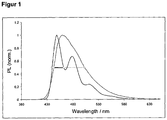
Classifications
-
- C—CHEMISTRY; METALLURGY
- C09—DYES; PAINTS; POLISHES; NATURAL RESINS; ADHESIVES; COMPOSITIONS NOT OTHERWISE PROVIDED FOR; APPLICATIONS OF MATERIALS NOT OTHERWISE PROVIDED FOR
- C09K—MATERIALS FOR MISCELLANEOUS APPLICATIONS, NOT PROVIDED FOR ELSEWHERE
- C09K11/00—Luminescent materials, e.g. electroluminescent or chemiluminescent
- C09K11/06—Luminescent materials, e.g. electroluminescent or chemiluminescent containing organic luminescent materials
-
- C—CHEMISTRY; METALLURGY
- C07—ORGANIC CHEMISTRY
- C07C—ACYCLIC OR CARBOCYCLIC COMPOUNDS
- C07C13/00—Cyclic hydrocarbons containing rings other than, or in addition to, six-membered aromatic rings
- C07C13/28—Polycyclic hydrocarbons or acyclic hydrocarbon derivatives thereof
- C07C13/32—Polycyclic hydrocarbons or acyclic hydrocarbon derivatives thereof with condensed rings
- C07C13/54—Polycyclic hydrocarbons or acyclic hydrocarbon derivatives thereof with condensed rings with three condensed rings
- C07C13/573—Polycyclic hydrocarbons or acyclic hydrocarbon derivatives thereof with condensed rings with three condensed rings with three six-membered rings
- C07C13/58—Completely or partially hydrogenated anthracenes
-
- C—CHEMISTRY; METALLURGY
- C07—ORGANIC CHEMISTRY
- C07C—ACYCLIC OR CARBOCYCLIC COMPOUNDS
- C07C13/00—Cyclic hydrocarbons containing rings other than, or in addition to, six-membered aromatic rings
- C07C13/28—Polycyclic hydrocarbons or acyclic hydrocarbon derivatives thereof
- C07C13/32—Polycyclic hydrocarbons or acyclic hydrocarbon derivatives thereof with condensed rings
- C07C13/62—Polycyclic hydrocarbons or acyclic hydrocarbon derivatives thereof with condensed rings with more than three condensed rings
-
- C—CHEMISTRY; METALLURGY
- C07—ORGANIC CHEMISTRY
- C07D—HETEROCYCLIC COMPOUNDS
- C07D213/00—Heterocyclic compounds containing six-membered rings, not condensed with other rings, with one nitrogen atom as the only ring hetero atom and three or more double bonds between ring members or between ring members and non-ring members
- C07D213/02—Heterocyclic compounds containing six-membered rings, not condensed with other rings, with one nitrogen atom as the only ring hetero atom and three or more double bonds between ring members or between ring members and non-ring members having three double bonds between ring members or between ring members and non-ring members
- C07D213/04—Heterocyclic compounds containing six-membered rings, not condensed with other rings, with one nitrogen atom as the only ring hetero atom and three or more double bonds between ring members or between ring members and non-ring members having three double bonds between ring members or between ring members and non-ring members having no bond between the ring nitrogen atom and a non-ring member or having only hydrogen or carbon atoms directly attached to the ring nitrogen atom
- C07D213/24—Heterocyclic compounds containing six-membered rings, not condensed with other rings, with one nitrogen atom as the only ring hetero atom and three or more double bonds between ring members or between ring members and non-ring members having three double bonds between ring members or between ring members and non-ring members having no bond between the ring nitrogen atom and a non-ring member or having only hydrogen or carbon atoms directly attached to the ring nitrogen atom with substituted hydrocarbon radicals attached to ring carbon atoms
- C07D213/36—Radicals substituted by singly-bound nitrogen atoms
- C07D213/38—Radicals substituted by singly-bound nitrogen atoms having only hydrogen or hydrocarbon radicals attached to the substituent nitrogen atom
-
- C—CHEMISTRY; METALLURGY
- C07—ORGANIC CHEMISTRY
- C07D—HETEROCYCLIC COMPOUNDS
- C07D235/00—Heterocyclic compounds containing 1,3-diazole or hydrogenated 1,3-diazole rings, condensed with other rings
- C07D235/02—Heterocyclic compounds containing 1,3-diazole or hydrogenated 1,3-diazole rings, condensed with other rings condensed with carbocyclic rings or ring systems
- C07D235/04—Benzimidazoles; Hydrogenated benzimidazoles
- C07D235/06—Benzimidazoles; Hydrogenated benzimidazoles with only hydrogen atoms, hydrocarbon or substituted hydrocarbon radicals, directly attached in position 2
- C07D235/08—Radicals containing only hydrogen and carbon atoms
-
- C—CHEMISTRY; METALLURGY
- C07—ORGANIC CHEMISTRY
- C07D—HETEROCYCLIC COMPOUNDS
- C07D307/00—Heterocyclic compounds containing five-membered rings having one oxygen atom as the only ring hetero atom
- C07D307/77—Heterocyclic compounds containing five-membered rings having one oxygen atom as the only ring hetero atom ortho- or peri-condensed with carbocyclic rings or ring systems
- C07D307/78—Benzo [b] furans; Hydrogenated benzo [b] furans
- C07D307/79—Benzo [b] furans; Hydrogenated benzo [b] furans with only hydrogen atoms, hydrocarbon or substituted hydrocarbon radicals, directly attached to carbon atoms of the hetero ring
- C07D307/80—Radicals substituted by oxygen atoms
-
- C—CHEMISTRY; METALLURGY
- C07—ORGANIC CHEMISTRY
- C07D—HETEROCYCLIC COMPOUNDS
- C07D307/00—Heterocyclic compounds containing five-membered rings having one oxygen atom as the only ring hetero atom
- C07D307/94—Heterocyclic compounds containing five-membered rings having one oxygen atom as the only ring hetero atom spiro-condensed with carbocyclic rings or ring systems, e.g. griseofulvins
-
- C—CHEMISTRY; METALLURGY
- C07—ORGANIC CHEMISTRY
- C07D—HETEROCYCLIC COMPOUNDS
- C07D317/00—Heterocyclic compounds containing five-membered rings having two oxygen atoms as the only ring hetero atoms
- C07D317/08—Heterocyclic compounds containing five-membered rings having two oxygen atoms as the only ring hetero atoms having the hetero atoms in positions 1 and 3
- C07D317/72—Heterocyclic compounds containing five-membered rings having two oxygen atoms as the only ring hetero atoms having the hetero atoms in positions 1 and 3 spiro-condensed with carbocyclic rings
-
- C—CHEMISTRY; METALLURGY
- C07—ORGANIC CHEMISTRY
- C07D—HETEROCYCLIC COMPOUNDS
- C07D333/00—Heterocyclic compounds containing five-membered rings having one sulfur atom as the only ring hetero atom
- C07D333/02—Heterocyclic compounds containing five-membered rings having one sulfur atom as the only ring hetero atom not condensed with other rings
- C07D333/04—Heterocyclic compounds containing five-membered rings having one sulfur atom as the only ring hetero atom not condensed with other rings not substituted on the ring sulphur atom
- C07D333/06—Heterocyclic compounds containing five-membered rings having one sulfur atom as the only ring hetero atom not condensed with other rings not substituted on the ring sulphur atom with only hydrogen atoms, hydrocarbon or substituted hydrocarbon radicals, directly attached to the ring carbon atoms
- C07D333/14—Radicals substituted by singly bound hetero atoms other than halogen
- C07D333/18—Radicals substituted by singly bound hetero atoms other than halogen by sulfur atoms
-
- C—CHEMISTRY; METALLURGY
- C07—ORGANIC CHEMISTRY
- C07D—HETEROCYCLIC COMPOUNDS
- C07D335/00—Heterocyclic compounds containing six-membered rings having one sulfur atom as the only ring hetero atom
- C07D335/04—Heterocyclic compounds containing six-membered rings having one sulfur atom as the only ring hetero atom condensed with carbocyclic rings or ring systems
-
- C—CHEMISTRY; METALLURGY
- C07—ORGANIC CHEMISTRY
- C07D—HETEROCYCLIC COMPOUNDS
- C07D471/00—Heterocyclic compounds containing nitrogen atoms as the only ring hetero atoms in the condensed system, at least one ring being a six-membered ring with one nitrogen atom, not provided for by groups C07D451/00 - C07D463/00
- C07D471/02—Heterocyclic compounds containing nitrogen atoms as the only ring hetero atoms in the condensed system, at least one ring being a six-membered ring with one nitrogen atom, not provided for by groups C07D451/00 - C07D463/00 in which the condensed system contains two hetero rings
- C07D471/04—Ortho-condensed systems
-
- C—CHEMISTRY; METALLURGY
- C07—ORGANIC CHEMISTRY
- C07D—HETEROCYCLIC COMPOUNDS
- C07D495/00—Heterocyclic compounds containing in the condensed system at least one hetero ring having sulfur atoms as the only ring hetero atoms
- C07D495/02—Heterocyclic compounds containing in the condensed system at least one hetero ring having sulfur atoms as the only ring hetero atoms in which the condensed system contains two hetero rings
- C07D495/04—Ortho-condensed systems
-
- H—ELECTRICITY
- H05—ELECTRIC TECHNIQUES NOT OTHERWISE PROVIDED FOR
- H05B—ELECTRIC HEATING; ELECTRIC LIGHT SOURCES NOT OTHERWISE PROVIDED FOR; CIRCUIT ARRANGEMENTS FOR ELECTRIC LIGHT SOURCES, IN GENERAL
- H05B33/00—Electroluminescent light sources
- H05B33/12—Light sources with substantially two-dimensional [2D] radiating surfaces
- H05B33/14—Light sources with substantially two-dimensional [2D] radiating surfaces characterised by the chemical or physical composition or the arrangement of the electroluminescent material, or by the simultaneous addition of the electroluminescent material in or onto the light source
-
- H—ELECTRICITY
- H10—SEMICONDUCTOR DEVICES; ELECTRIC SOLID-STATE DEVICES NOT OTHERWISE PROVIDED FOR
- H10K—ORGANIC ELECTRIC SOLID-STATE DEVICES
- H10K50/00—Organic light-emitting devices
-
- H—ELECTRICITY
- H10—SEMICONDUCTOR DEVICES; ELECTRIC SOLID-STATE DEVICES NOT OTHERWISE PROVIDED FOR
- H10K—ORGANIC ELECTRIC SOLID-STATE DEVICES
- H10K85/00—Organic materials used in the body or electrodes of devices covered by this subclass
- H10K85/60—Organic compounds having low molecular weight
- H10K85/615—Polycyclic condensed aromatic hydrocarbons, e.g. anthracene
- H10K85/623—Polycyclic condensed aromatic hydrocarbons, e.g. anthracene containing five rings, e.g. pentacene
-
- H—ELECTRICITY
- H10—SEMICONDUCTOR DEVICES; ELECTRIC SOLID-STATE DEVICES NOT OTHERWISE PROVIDED FOR
- H10K—ORGANIC ELECTRIC SOLID-STATE DEVICES
- H10K85/00—Organic materials used in the body or electrodes of devices covered by this subclass
- H10K85/60—Organic compounds having low molecular weight
- H10K85/615—Polycyclic condensed aromatic hydrocarbons, e.g. anthracene
- H10K85/624—Polycyclic condensed aromatic hydrocarbons, e.g. anthracene containing six or more rings
-
- C—CHEMISTRY; METALLURGY
- C09—DYES; PAINTS; POLISHES; NATURAL RESINS; ADHESIVES; COMPOSITIONS NOT OTHERWISE PROVIDED FOR; APPLICATIONS OF MATERIALS NOT OTHERWISE PROVIDED FOR
- C09K—MATERIALS FOR MISCELLANEOUS APPLICATIONS, NOT PROVIDED FOR ELSEWHERE
- C09K2211/00—Chemical nature of organic luminescent or tenebrescent compounds
- C09K2211/10—Non-macromolecular compounds
- C09K2211/1003—Carbocyclic compounds
- C09K2211/1007—Non-condensed systems
-
- C—CHEMISTRY; METALLURGY
- C09—DYES; PAINTS; POLISHES; NATURAL RESINS; ADHESIVES; COMPOSITIONS NOT OTHERWISE PROVIDED FOR; APPLICATIONS OF MATERIALS NOT OTHERWISE PROVIDED FOR
- C09K—MATERIALS FOR MISCELLANEOUS APPLICATIONS, NOT PROVIDED FOR ELSEWHERE
- C09K2211/00—Chemical nature of organic luminescent or tenebrescent compounds
- C09K2211/10—Non-macromolecular compounds
- C09K2211/1003—Carbocyclic compounds
- C09K2211/1011—Condensed systems
-
- C—CHEMISTRY; METALLURGY
- C09—DYES; PAINTS; POLISHES; NATURAL RESINS; ADHESIVES; COMPOSITIONS NOT OTHERWISE PROVIDED FOR; APPLICATIONS OF MATERIALS NOT OTHERWISE PROVIDED FOR
- C09K—MATERIALS FOR MISCELLANEOUS APPLICATIONS, NOT PROVIDED FOR ELSEWHERE
- C09K2211/00—Chemical nature of organic luminescent or tenebrescent compounds
- C09K2211/10—Non-macromolecular compounds
- C09K2211/1003—Carbocyclic compounds
- C09K2211/1014—Carbocyclic compounds bridged by heteroatoms, e.g. N, P, Si or B
-
- C—CHEMISTRY; METALLURGY
- C09—DYES; PAINTS; POLISHES; NATURAL RESINS; ADHESIVES; COMPOSITIONS NOT OTHERWISE PROVIDED FOR; APPLICATIONS OF MATERIALS NOT OTHERWISE PROVIDED FOR
- C09K—MATERIALS FOR MISCELLANEOUS APPLICATIONS, NOT PROVIDED FOR ELSEWHERE
- C09K2211/00—Chemical nature of organic luminescent or tenebrescent compounds
- C09K2211/10—Non-macromolecular compounds
- C09K2211/1018—Heterocyclic compounds
- C09K2211/1022—Heterocyclic compounds bridged by heteroatoms, e.g. N, P, Si or B
-
- C—CHEMISTRY; METALLURGY
- C09—DYES; PAINTS; POLISHES; NATURAL RESINS; ADHESIVES; COMPOSITIONS NOT OTHERWISE PROVIDED FOR; APPLICATIONS OF MATERIALS NOT OTHERWISE PROVIDED FOR
- C09K—MATERIALS FOR MISCELLANEOUS APPLICATIONS, NOT PROVIDED FOR ELSEWHERE
- C09K2211/00—Chemical nature of organic luminescent or tenebrescent compounds
- C09K2211/10—Non-macromolecular compounds
- C09K2211/1018—Heterocyclic compounds
- C09K2211/1025—Heterocyclic compounds characterised by ligands
- C09K2211/1029—Heterocyclic compounds characterised by ligands containing one nitrogen atom as the heteroatom
-
- C—CHEMISTRY; METALLURGY
- C09—DYES; PAINTS; POLISHES; NATURAL RESINS; ADHESIVES; COMPOSITIONS NOT OTHERWISE PROVIDED FOR; APPLICATIONS OF MATERIALS NOT OTHERWISE PROVIDED FOR
- C09K—MATERIALS FOR MISCELLANEOUS APPLICATIONS, NOT PROVIDED FOR ELSEWHERE
- C09K2211/00—Chemical nature of organic luminescent or tenebrescent compounds
- C09K2211/10—Non-macromolecular compounds
- C09K2211/1018—Heterocyclic compounds
- C09K2211/1025—Heterocyclic compounds characterised by ligands
- C09K2211/1044—Heterocyclic compounds characterised by ligands containing two nitrogen atoms as heteroatoms
-
- C—CHEMISTRY; METALLURGY
- C09—DYES; PAINTS; POLISHES; NATURAL RESINS; ADHESIVES; COMPOSITIONS NOT OTHERWISE PROVIDED FOR; APPLICATIONS OF MATERIALS NOT OTHERWISE PROVIDED FOR
- C09K—MATERIALS FOR MISCELLANEOUS APPLICATIONS, NOT PROVIDED FOR ELSEWHERE
- C09K2211/00—Chemical nature of organic luminescent or tenebrescent compounds
- C09K2211/10—Non-macromolecular compounds
- C09K2211/1018—Heterocyclic compounds
- C09K2211/1025—Heterocyclic compounds characterised by ligands
- C09K2211/1088—Heterocyclic compounds characterised by ligands containing oxygen as the only heteroatom
-
- C—CHEMISTRY; METALLURGY
- C09—DYES; PAINTS; POLISHES; NATURAL RESINS; ADHESIVES; COMPOSITIONS NOT OTHERWISE PROVIDED FOR; APPLICATIONS OF MATERIALS NOT OTHERWISE PROVIDED FOR
- C09K—MATERIALS FOR MISCELLANEOUS APPLICATIONS, NOT PROVIDED FOR ELSEWHERE
- C09K2211/00—Chemical nature of organic luminescent or tenebrescent compounds
- C09K2211/10—Non-macromolecular compounds
- C09K2211/1018—Heterocyclic compounds
- C09K2211/1025—Heterocyclic compounds characterised by ligands
- C09K2211/1092—Heterocyclic compounds characterised by ligands containing sulfur as the only heteroatom
-
- H—ELECTRICITY
- H10—SEMICONDUCTOR DEVICES; ELECTRIC SOLID-STATE DEVICES NOT OTHERWISE PROVIDED FOR
- H10K—ORGANIC ELECTRIC SOLID-STATE DEVICES
- H10K50/00—Organic light-emitting devices
- H10K50/10—OLEDs or polymer light-emitting diodes [PLED]
- H10K50/11—OLEDs or polymer light-emitting diodes [PLED] characterised by the electroluminescent [EL] layers
-
- H—ELECTRICITY
- H10—SEMICONDUCTOR DEVICES; ELECTRIC SOLID-STATE DEVICES NOT OTHERWISE PROVIDED FOR
- H10K—ORGANIC ELECTRIC SOLID-STATE DEVICES
- H10K50/00—Organic light-emitting devices
- H10K50/10—OLEDs or polymer light-emitting diodes [PLED]
- H10K50/14—Carrier transporting layers
-
- Y—GENERAL TAGGING OF NEW TECHNOLOGICAL DEVELOPMENTS; GENERAL TAGGING OF CROSS-SECTIONAL TECHNOLOGIES SPANNING OVER SEVERAL SECTIONS OF THE IPC; TECHNICAL SUBJECTS COVERED BY FORMER USPC CROSS-REFERENCE ART COLLECTIONS [XRACs] AND DIGESTS
- Y02—TECHNOLOGIES OR APPLICATIONS FOR MITIGATION OR ADAPTATION AGAINST CLIMATE CHANGE
- Y02E—REDUCTION OF GREENHOUSE GAS [GHG] EMISSIONS, RELATED TO ENERGY GENERATION, TRANSMISSION OR DISTRIBUTION
- Y02E10/00—Energy generation through renewable energy sources
- Y02E10/50—Photovoltaic [PV] energy
- Y02E10/549—Organic PV cells
-
- Y—GENERAL TAGGING OF NEW TECHNOLOGICAL DEVELOPMENTS; GENERAL TAGGING OF CROSS-SECTIONAL TECHNOLOGIES SPANNING OVER SEVERAL SECTIONS OF THE IPC; TECHNICAL SUBJECTS COVERED BY FORMER USPC CROSS-REFERENCE ART COLLECTIONS [XRACs] AND DIGESTS
- Y10—TECHNICAL SUBJECTS COVERED BY FORMER USPC
- Y10S—TECHNICAL SUBJECTS COVERED BY FORMER USPC CROSS-REFERENCE ART COLLECTIONS [XRACs] AND DIGESTS
- Y10S428/00—Stock material or miscellaneous articles
- Y10S428/917—Electroluminescent
Definitions
- the present invention relates to organic semiconductors and their use in organic electronic devices.
- Organic semiconductors are being developed for a variety of electronic applications.
- OLEDs organic electroluminescent devices
- the construction of organic electroluminescent devices (OLEDs) in which these organic semiconductors are used as functional materials is described, for example, in US Pat US 4539507 . US 5151629 . EP 0676461 and WO 98/27136 described.
- further improvements are desirable in order to use these devices for high quality and durable displays.
- the lifetime and efficiency of blue-emitting organic electroluminescent devices is currently still a problem in which there is still room for improvement.
- the compounds have a high thermal stability and a high glass transition temperature and can sublime undecomposed. In particular, for use at elevated temperature, a high glass transition temperature is essential for achieving high lifetimes.
- anthracene derivatives are in WO 01/076323 , in WO 01/021729 , in WO 04/013073 , in WO 04/018588 , in WO 03/087023 or in WO 04/018587 disclosed.
- Host materials based on aryl-substituted pyrenes and chrysenes are used in WO 04/016575 discloses host materials based on benzanthracenes in WO 08/145239 , In US 2004/131881
- fluorene derivatives containing at least one condensed aromatic are disclosed for use in OLEDs. It is desirable for high quality applications to have improved host materials available. The same applies to host materials for green and red fluorescent dopants.
- the prior art in blue-emitting compounds may be the use of arylvinylamines (eg. WO 04/013073 . WO 04/016575 . WO 04/018587 ).
- arylvinylamines eg. WO 04/013073 . WO 04/016575 . WO 04/018587 .
- these compounds are thermally unstable and can not evaporate without decomposition, which requires a high technical complexity for the OLED production and thus represents a technical disadvantage. Therefore, it is necessary for high-quality applications to have improved emitters especially with regard to device and sublimation stability as well as emission color. Furthermore, it would be advantageous to have emitters available which have a narrower emission spectrum.
- anthracene derivatives which are substituted in the 9- or 9,10-position and which are in 1,2-position or 2,3-position or 3,4-position and / or in 5,6-position or 6,7-position or 7,8-position condensed an indeno group, are very suitable for use in organic electroluminescent devices.
- This also applies if, instead of the indeno group, corresponding heterocyclic groups, such as, for example, indolo groups or benzothienyl groups, have been condensed.
- these compounds it is possible to increase the efficiency and, above all, the lifetime of the organic electronic device in comparison with materials according to the prior art. This is especially true for blue fluorescent devices.
- these compounds have a high thermal stability. In general, these materials are very well suited for use in organic electronic devices since they have a high glass transition temperature. These materials and their Use in organic electronic devices are therefore the subject of the present invention.
- the emitter known is 9,10-diphenylanthracene. Although this has 100% fluorescence quantum efficiency ( H. Du et al., Photochemistry and Photobiology 1998, 68, 141-142 ), but the emission is too far blue, so this compound can not be used as a blue emitter.
- the group Ar binds to the anthracene via one carbon atom and the group X binds to an adjacent carbon atom of the group Ar and to an adjacent carbon atom of the anthracene.
- n 1, structures of the formula (1) leading to trans derivatives and structures of the formula (2) to cis derivatives.
- the compounds of the formula (1) preferably have a glass transition temperature T G of greater than 70 ° C., more preferably greater than 100 ° C., very particularly preferably greater than 130 ° C.
- An aryl group for the purposes of this invention contains 6 to 40 carbon atoms;
- a heteroaryl group contains 2 to 40 C atoms and at least 1 heteroatom, with the proviso that the sum of C atoms and heteroatoms gives at least 5.
- the heteroatoms are preferably selected from N, O and / or S.
- an aryl group or heteroaryl group either a simple aromatic cycle, ie benzene, or a simple heteroaromatic cycle, for example pyridine, pyrimidine, thiophene, etc., or a fused aryl or heteroaryl group, for example naphthalene, anthracene, pyrene, quinoline, isoquinoline, etc. , Understood.
- An aromatic ring system in the sense of this invention contains 6 to 40 carbon atoms in the ring system.
- a heteroaromatic ring system in the sense of this invention contains 2 to 40 C atoms and at least one heteroatom in the ring system, with the proviso that the sum of C atoms and heteroatoms gives at least 5.
- the heteroatoms are preferably selected from N, O and / or S.
- An aromatic or heteroaromatic ring system in the sense of this invention is to be understood as meaning a system which does not necessarily contain only aryl or heteroaryl groups but in which also several aryl or heteroaryl groups a short, non-aromatic moiety (preferably less than 10% of the atoms other than H), e.g.
- N or O atom may be interrupted.
- systems such as 9,9'-spirobifluorene, 9,9-diaryl fluorene, triarylamine, diaryl ether, stilbene, benzophenone, etc. are to be understood as aromatic ring systems in the context of this invention.
- aromatic or heteroaromatic ring system is understood as meaning systems in which a plurality of aryl or heteroaryl groups are linked together by single bonds, for example biphenyl, terphenyl or bipyridine.
- a C 1 - to C 40 -alkyl group in which also individual H atoms or CH 2 groups can be substituted by the abovementioned groups particularly preferably the radicals methyl, ethyl, n-propyl, i-propyl, n-butyl, i-butyl, s-butyl, t-butyl, 2-methylbutyl, n-pentyl, s-pentyl, cyclopentyl, n-hexyl, cyclohexyl, n-heptyl, cycloheptyl, n-octyl, Cyclooctyl, 2-ethylhexyl, trifluoromethyl, pentafluoroethyl or 2,2,2-trifluoroethyl understood.
- an alkenyl group is preferably understood as meaning the radicals ethenyl, propenyl, butenyl, pentenyl, cyclopentenyl, hexenyl, cyclohexenyl, heptenyl, cycloheptenyl, octenyl or cyclooctenyl.
- an alkynyl group is preferably understood to mean ethynyl, propynyl, butynyl, pentynyl, hexynyl, heptynyl or octynyl.
- a C 1 - to C 40 -alkoxy group is particularly preferably understood as meaning methoxy, trifluoromethoxy, ethoxy, n-propoxy, isopropoxy, n-butoxy, isobutoxy, s-butoxy, t-butoxy or 2-methylbutoxy.
- An aromatic or heteroaromatic ring system having 5-40 aromatic ring atoms, which may be substituted in each case by the abovementioned radicals R and which may be linked via any position on the aromatic or heteroaromatic radical is understood in particular to mean groups which are derived from benzene, Naphthalene, anthracene, phenanthrene, benzanthracene, pyrene, chrysene, perylene, fluoranthene, naphthacene, pentacene, benzpyrene, biphenyl, biphenylene, terphenyl, terphenyls, fluorene, spirobifluorene, dihydrophenanthrene, dihydropyrene, tetrahydropyrene, cis- or trans-indenofluorene, truxene, isotruxene , Spirotruxene, spiroisotruxene, furan, benzofuran,
- a preferred embodiment of the compounds of the formula (1) and (2) are the compounds of the formulas (3) to (15), wherein in the anthracene moiety also one or more unsubstituted carbon atoms may be replaced by nitrogen and wherein the symbols and indices have the meanings given above.
- the symbol Ar is the same or different at each occurrence for benzene, naphthalene, thiophene, pyrrole, furan, pyridine, pyrimidine, pyrazine, pyridazine, quinoline, quinoxaline, triazine, triazole, imidazole, benzimidazole, benzothiophene, indole and benzofuran, especially for benzene, naphthalene or thiophene.
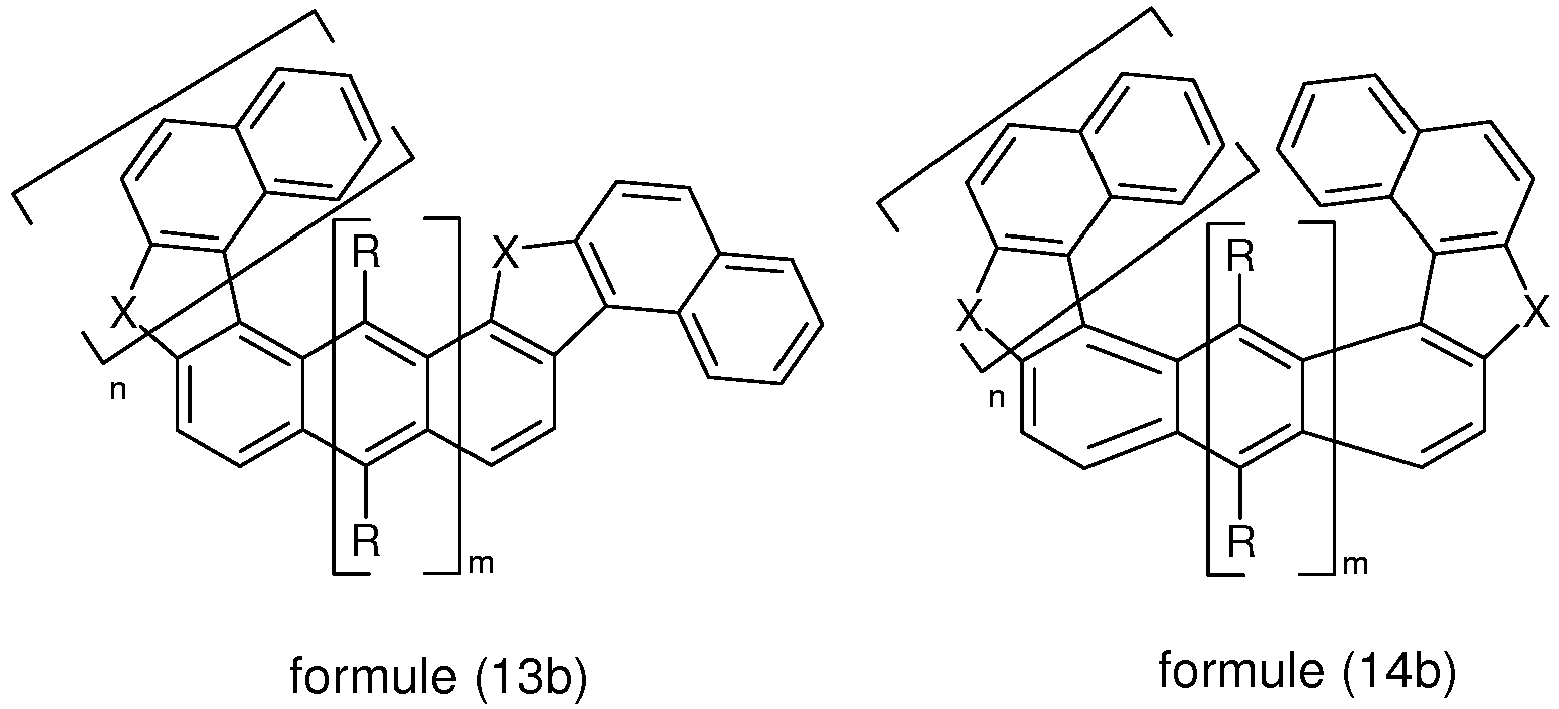
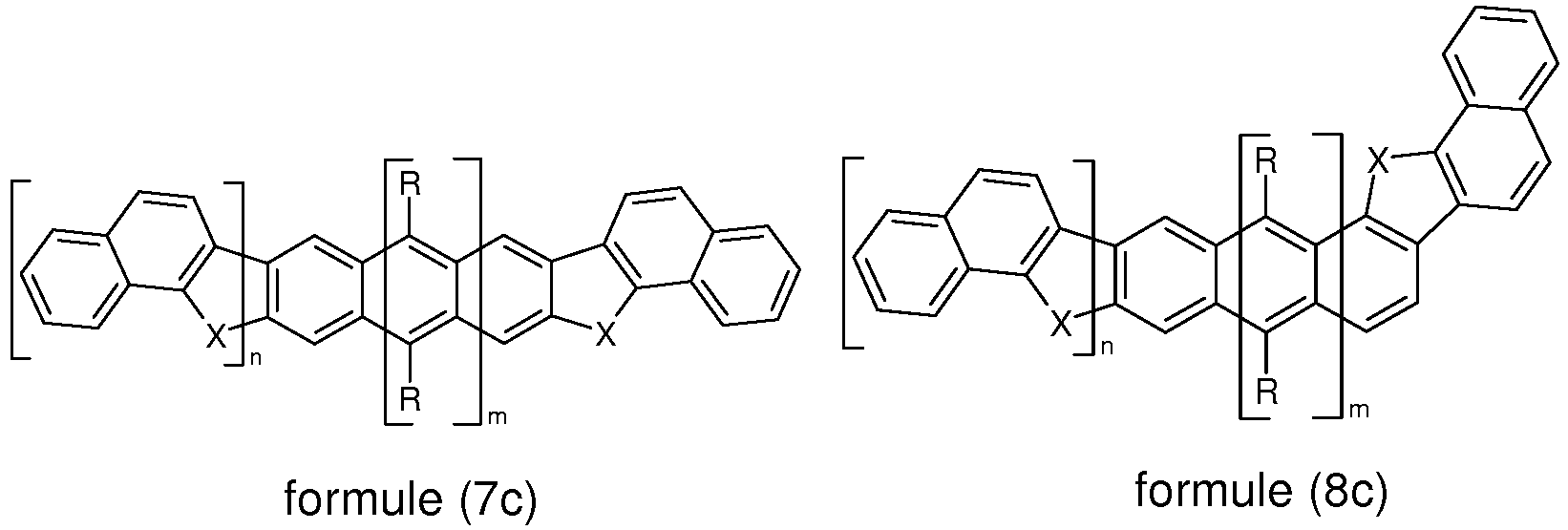
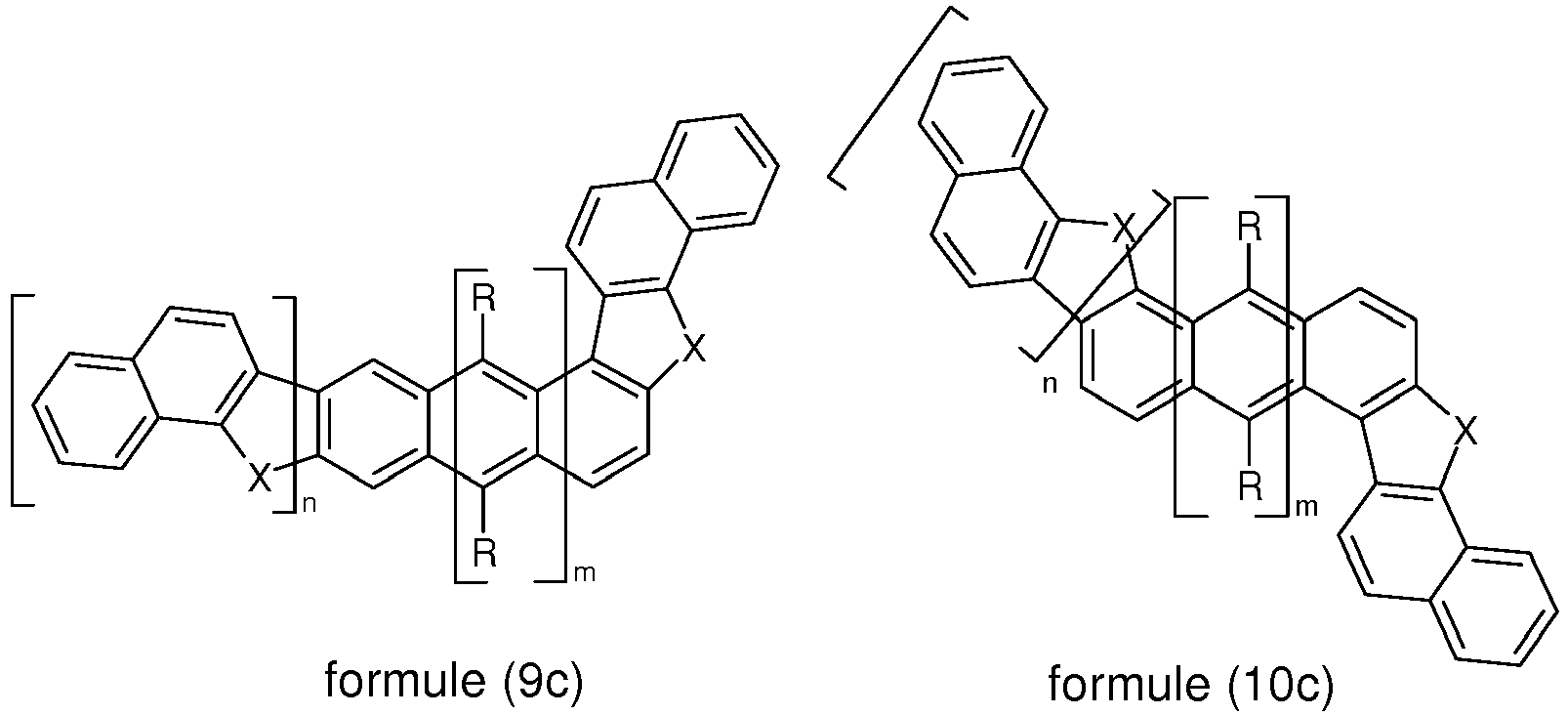
- a particularly preferred embodiment of the compounds according to the formulas (3) to (15) are the compounds of the formulas (3a) to (15a), (3b) to (15b) and (3c) to (15c) where the symbols and indices have the meanings listed above.
- Particularly preferred are the compounds depicted above of the formula (3a) to (15a), in particular the compounds of the formula (3a), (4a) and (5a).
- the index m 1, d. H. the central unit is an anthracene.
- the formation of such spiro structures by formation of ring systems between two groups R 1 to C (R 1 ) 2 is another preferred embodiment of the invention. This is especially true when R 1 is a substituted or unsubstituted phenyl group and the two phenyl groups form a ring system together with the C atom of the bridge.
- Examples of preferred compounds according to the formulas (1) to (15) or (3a) to (15a) and (3b) to (15b) and (3c) to (15c) are the structures (1) depicted below. to (134) (* not according to the invention).
- the compounds according to the invention of the formula (1) and (2) can be prepared by synthesis steps known to the person skilled in the art.
- the synthesis is shown by way of example in the following Scheme 1.
- Suitable starting compound is 2,6-dibromoanthraquinone, which can be obtained from 2,6-diaminoanthraquinone by diazotization and reaction with CuBr 2 .
- the R groups may be introduced in the form of an aryl metal compound, for example, an aryl lithium compound or an aryl Grignard compound, followed by reduction of the alcohols formed.
- the bromide can be converted into the corresponding boronic acid derivative by reaction with a diboron compound, for example bis (pinacolato) diborane, under palladium catalysis, which can be reacted in a Suzuki coupling with a 2-haloalkyl benzoate.
- a diboron compound for example bis (pinacolato) diborane
- the residues on the bridge X are then introduced by reaction with an aryllithium compound or an aryl Grignard compound, and the cyclization to the compound of the formula (1) or (2) is carried out under acidic conditions.
- mixtures may also be formed during the cyclization which can either be separated or used as a mixture in the organic electroluminescent device.
- the compounds according to the invention described above in particular compounds which react with reactive leaving groups, such as bromine, iodine, Boronic acid or boronic acid esters, can be used as monomers for generating corresponding dimers, trimers, tetramers, pentamers, oligomers, polymers or as the core of dendrimers use.
- the oligomerization or polymerization is preferably carried out via the halogen functionality or the boronic acid functionality.
- the invention therefore further provides dimers, trimers, tetramers, pentamers, oligomers, polymers or dendrimers containing one or more compounds of the formula (1) and / or (2), where one or more radicals R, R 1 or R 2 form bonds between represent the compounds of formula (1) or (2) in the dimer, trimer, tetramer or pentamer or bonds of the compound of formula (1) or (2) to the polymer, oligomer or dendrimer.
- An oligomer in the context of this invention is understood as meaning a compound which has at least six units of the formula (1) and / or (2).
- the polymers, oligomers or dendrimers may be conjugated, partially conjugated or non-conjugated.
- the trimers, tetramers, pentamers, oligomers or polymers can be linear or branched.
- the units of formula (1) and / or (2) may both be directly linked or may have a divalent group, for example a substituted or unsubstituted alkylene group, a heteroatom or a bivalent aromatic or heteroaromatic group Group, linked together.
- three or more units of the formula (1) and / or (2) may have a trivalent or higher valent group, for example, a trivalent or higher valent aromatic or heteroaromatic group, a branched trimer, tetramer, pentamer, oligomer or polymer be linked.
- the monomers according to the invention are homopolymerized or copolymerized with further monomers.
- Suitable and preferred comonomers are selected from Fluoren (eg EP 842208 or WO 00/22026 ), Spirobifluorenes (eg according to EP 707020 . EP 894107 or WO 06/061181 ), Paraphenylenes (eg according to WO 92/18552 ), Carbazoles (eg according to WO 04/070772 or WO 04/113468 ), Thiophenes (eg according to EP 1028136 ), Dihydrophenanthrenes (e.g.
- WO 05/014689 cis and trans indenofluorenes (eg according to WO 04/041901 or WO 04/113412 ), Ketones (eg according to WO 05/040302 ), Phenanthrenes (eg according to WO 05/104264 or WO 07/017066 ) or several of these units.
- the polymers, oligomers and dendrimers usually also contain further units, for example emitting (fluorescent or phosphorescent) units, such as.
- Vinyl triarylamines e.g. WO 07/068325
- phosphorescent metal complexes eg according to WO 06/003000
- charge transport units especially those based on triarylamines.
- the compounds of the formula (1) and (2) according to the invention are suitable for use in electronic devices, in particular in organic electroluminescent devices (OLEDs, PLEDs). Depending on the substitution, the compounds are used in different functions and layers.
- OLEDs organic electroluminescent devices
- PLEDs organic electroluminescent devices
- Another object of the invention is therefore the use of compounds of formula (1) or formula (2) in electronic devices, in particular in organic electroluminescent devices.
- organic electronic devices containing at least one compound according to formula (1) and / or (2), in particular organic electroluminescent devices containing anode, cathode and at least one emitting layer, characterized in that at least one organic layer, which may be an emitting layer or another layer, contains at least one compound according to formula (1) and / or (2).
- the organic electroluminescent device may contain further layers. These are selected, for example, from one or more hole injection layers, hole transport layers, hole blocking layers, electron transport layers, electron injection layers, electron blocking layers, charge generation layers (IDMC 2003, Taiwan, Session 21 OLED (5), T. Matsumoto, T. Nakada, J. Endo). K. Mori, N. Kawamura, A. Yokoi, J. Kido, Multiphoton Organic EL Device Having Charge Generation Layer ) and / or Organic or Inorganic P / N Transitions. It should be noted, however, that not necessarily each of these layers must be present and the choice of layers always depends on the compounds used and in particular also on the fact that it is a fluorescent or phosphorescent electroluminescent device.
- the organic electroluminescent device contains a plurality of emitting layers, wherein at least one organic layer contains at least one compound according to formula (1) or (2). More preferably, these emission layers have a total of several emission maxima between 380 nm and 750 nm, so that a total of white emission results, ie in the emitting layers different emitting compounds are used, which can fluoresce or phosphoresce and emit the blue and yellow, orange or red light , Particularly preferred are three-layer systems, ie systems with three emitting layers, wherein at least one of these layers contains at least one compound according to formula (1) or (2) and wherein the three layers show blue, green and orange or red emission (for the basic structure see eg WO 05/011013 ). Also suitable for white emission emitters, which have broadband emission bands and thereby show white emission.
- the compounds according to formulas (1) and (2) are used as host material for fluorescent dopants, in particular for green and red fluorescent dopants.
- the group X is preferably one C (R 1 ) 2 - group
- the group Ar is an aryl group and the groups R are H, an alkyl group or an aryl group, wherein at least one group R represents an alkyl or aryl group; both groups R preferably represent aryl groups.
- the same preferences apply to the groups X, Ar and R in structures according to formulas (3) to (15), (3a) to (15a), (3b) to (15b) and (3c) to (15c).
- a host material in a system of host and dopant is understood to mean the component which is present in the system in the higher proportion.
- the host is understood to be that component whose proportion is the highest in the mixture.
- the proportion of the host material according to formula (1) or (2) in the emitting layer is between 50.0 and 99.9% by volume, preferably between 80.0 and 99.5% by volume, particularly preferably between 90.0 and 99.0% by volume. Accordingly, the proportion of the dopant is between 0.1 and 50.0% by volume, preferably between 0.5 and 20.0% by volume, particularly preferably between 1.0 and 10.0% by volume.
- Preferred dopants in fluorescent devices are selected from the class of monostyrylamines, distyrylamines, tristyrylamines, tetrastyrylamines and arylamines.
- a monostyrylamine is meant a compound containing a styryl group and at least one amine, which is preferably aromatic.
- a distyrylamine is meant a compound containing two styryl groups and at least one amine, which is preferably aromatic.
- a tristyrylamine is understood as meaning a compound which contains three styryl groups and at least one amine, which is preferably aromatic.
- a tetrastyrylamine is meant a compound containing four styryl groups and at least one amine, which is preferably aromatic.
- An arylamine or an aromatic amine in the context of this invention is understood to mean a compound which contains three aromatic or heteroaromatic ring systems bonded directly to the nitrogen, of which at least one condensed ring system having at least 14 aromatic ring atoms is preferred.
- the styryl groups are particularly preferred stilbenes, which may also be further substituted on the double bond or on the aromatic. Examples of such dopants are substituted or unsubstituted tristilbenamines or further dopants, which are described, for example, in US Pat WO 06/000388 . WO 06/058737 .
- WO 06/000389 WO 07/065549 and WO 07/115610 are described. Furthermore, compounds are according to WO 06/122630 as dopants preferred.
- Examples of arylamines are diarylaminoanthracenes, where the diarylamino group is bonded in the 2- or 9-position, bis (diarylaminoanthracenes), where the diarylamino groups are bonded in the 2,6- or in the 9,10-position, diarylamino-pyrene, bis (diarylamino) pyrene, Diarylaminochrysenes or bis (diarylamino) chrysenes.
- Preferred dopants are furthermore diarylamine derivatives or bis (diarylamine) derivatives of monobenzoindenofluorene or dibenzoindenofluorene, for example according to WO 08/006449 or WO 07/140847 ,
- Suitable dopants for which the compound according to formula (1) or formula (2) is a suitable host material are furthermore the structures depicted in the following table as well as those described in US Pat JP 06/001973 . WO 04/047499 . WO 06/098080 . WO 07/065678 . US 2005/0260442 and WO 04/092111 disclosed derivatives of these structures.
- the compounds of the formula (1) and (2) are used as emitting materials.
- the compounds are particularly preferred when the radicals R are an aromatic or heteroaromatic ring system. This leads to emitting compounds which show deep blue emission with a very narrow emission spectrum.
- the compounds are furthermore suitable as emitting compounds if at least one substituent R contains at least one vinylaryl unit, at least one vinylarylamine unit and / or at least one arylamino or diarylamino unit.
- Preferred arylamino units are the groups of the formulas (16) and (17) shown above. The same preferences apply to the groups R in structures of the formulas (3) to (15) and (3a) to (15a) and (3b) to (15b) and (3c) to (15c), respectively.
- Particularly preferred dopants are those in which either two radicals R are groups of the formula (16) or (17) or in which one radical R is a group of the formula (16) or (17) and the other radicals R is H , an alkyl group or an aryl group.
- the proportion of the compound according to formula (1) or (2) in the mixture of the emitting layer is between 0.1 and 50.0% by volume, preferably between 0.5 and 20.0% by volume, particularly preferably between 1.0 and 10.0% by volume , Accordingly, the proportion of the host material between 50.0 and 99.9 vol .-%, preferably between 80.0 and 99.5 vol .-%, more preferably between 90.0 and 99.0 vol .-%.
- Suitable host materials for this materials come in different classes.
- Preferred host materials are selected from the classes of oligoarylenes (e.g., 2,2 ', 7,7'-tetraphenylspirobifluorene according to U.S. Pat EP 676461 or dinaphthylanthracene), in particular the oligoarylenes containing condensed aromatic groups, of the oligoarylenevinylenes (for example DPVBi or spiro-DPVBi according to US Pat EP 676461 ), the polypodal metal complexes (eg according to WO 04/081017 ), the hole-conducting compounds (eg according to WO 04/058911 ), the electron-conducting compounds, in particular ketones, phosphine oxides, sulfoxides, etc. (for example according to US Pat WO 05/084081 and WO 05/084082 ), the atropisomers (eg according to WO 06/048268
- WO 06/117052 or the benzanthracene derivatives (eg according to WO 08/145239 ).
- host materials are the compounds according to the invention described above.
- particularly preferred host materials are selected from the classes of the oligoarylenes containing naphthalene, anthracene, benzanthracene and / or pyrene or atropisomers of these compounds, the oligoarylenevinylenes, the ketones, the phosphine oxides and the sulphoxides.
- Very particularly preferred host materials are, in addition to the compounds according to the invention, selected from the classes of oligoarylenes containing anthracene, benzanthracene and / or pyrene or atropisomers of these compounds.
- an oligoarylene is to be understood as meaning a compound in which at least three aryl or arylene groups are bonded to one another.
- Suitable host materials further include the materials depicted in the following table, as well as derivatives of these materials as described in U.S. Pat WO 04/018587 . WO 08/006449 . US 5935721 . US 2005/0181232 . JP 2000/273056 . EP 681019 . US 2004/0247937 and US 2005/0211958 be revealed.
- the compounds according to formula (1) and (2) are used as hole transport material or as hole injection material.
- the compounds are then preferably substituted with at least one group N (Ar 1 ) 2 , preferably with at least two groups N (Ar 1 ) 2 and / or they contain further groups which improve the hole transport.
- the groups N (Ar 1 ) 2 are preferably selected from the above-described formulas (16) or (17). This applies in particular to the radicals R on the structures of the formulas (3) to (15) or (3a) to (15a) or (3b) to (15b) or (3c) to (15c).
- Further preferred groups which improve the hole transport are, for example, the groups N (R 1 ), S or O, in particular N (R 1 ) as bridging unit X or electron-rich heteroaromatics, in particular thiophene, pyrrole or furan as group Ar.
- the compound is preferably used in a hole transport or in a hole injection layer.
- a hole injection layer in the sense of this invention is a layer which is directly adjacent to the anode.
- a hole transport layer in the sense of this invention is a layer that lies between a hole injection layer and an emission layer.
- the compounds according to formula (1) or (2) are used as hole-transporting or hole-injecting material, it may be preferable if they are doped with electron-accepting compounds, for example with F 4 -TCNQ or with compounds as in EP 1476881 or EP 1596445 described.
- the compounds of the formula (1) and (2) are used as electron transport material.
- the bridging groups X are C (R 1 ) 2 and one or both of the substituents R contains an electron-poor heterocycle, for example imidazole, pyrazole, thiazole, benzimidazole, benzothiazole, triazole, oxadiazole, benzothiadiazole, phenanthroline, etc.
- the compound is doped with electron donor compounds.
- Suitable charge transport materials are, in addition to the materials according to the invention, for example those disclosed in US Pat Y. Shirota et al., Chem. Rev. 2007, 107 (4), 953-1010 disclosed compounds or other materials, as used in the prior art in these layers.
- Suitable hole transport or hole injection materials which can be used in the electroluminescent device according to the invention comprising a compound of the formula (1) or (2) are, for example, the materials listed in the table below.
- Suitable electron transport or electron injection materials which can be used in the electroluminescent device according to the invention comprising a compound of the formula (1) or (2) are, for example, the materials listed in the table below.
- repeating units according to formulas (1) and (2) can also be used either as a polymer backbone, as an emissive unit, as a hole-transporting unit and / or as an electron-transporting unit.
- the preferred substitution patterns correspond to those described above.
- an organic electroluminescent device characterized in that one or more layers are coated with a sublimation process.
- the materials are vapor-deposited in vacuum sublimation systems at an initial pressure of usually less than 10 -5 mbar, preferably less than 10 -6 mbar. But it is also possible that the initial pressure is even lower, for example less than 10 -7 mbar.
- an organic electroluminescent device characterized in that one or more layers are coated with the OVPD (Organic Vapor Phase Deposition) method or with the aid of a carrier gas sublimation.
- the materials are applied at a pressure between 10 -5 mbar and 1 bar.
- OVJP Organic Vapor Jet Printing
- OVJP Organic Vapor Jet Printing
- an organic electroluminescent device characterized in that one or more layers of solution, such. B. by spin coating, or with any printing process, such. B. screen printing, flexographic printing or offset printing, but particularly preferably LITI (Light Induced Thermal Imaging, thermal transfer printing) or ink-jet printing (ink jet printing) can be produced.
- LITI Light Induced Thermal Imaging, thermal transfer printing
- ink-jet printing ink jet printing
- soluble compounds are needed. High solubility can be achieved by suitable substitution of the compounds.
- the starting materials can be obtained from ALDRICH.
- OLEDs are carried out by a process that is in WO 04/058911 is generally described and adapted in each case to the particular circumstances (eg layer thickness variation in order to achieve optimum efficiency or color).
- the OLEDs consist of the following layer sequence: substrate / hole injection layer (HTM1) 60 nm / hole transport layer (HTM2) 20 nm / emission layer (EML) 30 nm / electron transport layer (ETM) 20 nm and finally a cathode.
- HTM1 substrate / hole injection layer
- HTM2 hole transport layer
- EML emission layer
- ETM electron transport layer
- cathode The materials are thermally evaporated in a vacuum chamber.
- the emission layer always consists of a matrix material (host) and a dopant (dopant), which is mixed by cover evaporation to the host.
- the cathode is formed by a 1 nm thin LiF layer and a 100 nm Al layer deposited thereon. Table 1 shows the chemical structures of the materials used to construct the OLEDs.
- OLEDs are characterized by default; For this purpose, the electroluminescence spectra, the efficiency (measured in cd / A), the power efficiency (measured in lm / W) as a function of the brightness, calculated from current-voltage-brightness characteristics (IUL characteristics), and the lifetime determined.
- the lifetime is defined as the time after which the initial brightness of 25000 cd / m 2 has fallen to half.
- the half-width (FWHM full width half maximum) is determined from the electroluminescence spectra.
- Table 1 summarizes the results of some OLEDs (Examples 4 to 7).
- the host materials or emitter materials according to the invention the compounds of Examples 1 and 2 are used.
- the host H1 and the emitter material D1 according to the prior art are used.
- organic electroluminescent devices containing the compounds of the invention have a longer lifetime in the case of the matrix example.
- organic electroluminescent devices comprising the compounds according to the invention as dopants have a significantly improved half-width in comparison with the prior art.
- Table 1 ⁇ / b> HTM1 HTM 2 ETM1 HTM 3 H1 D1 D2 Ex. 2
Landscapes
- Chemical & Material Sciences (AREA)
- Organic Chemistry (AREA)
- Engineering & Computer Science (AREA)
- Materials Engineering (AREA)
- Physics & Mathematics (AREA)
- Spectroscopy & Molecular Physics (AREA)
- Optics & Photonics (AREA)
- Electroluminescent Light Sources (AREA)
- Organic Low-Molecular-Weight Compounds And Preparation Thereof (AREA)
- Photovoltaic Devices (AREA)
- Indole Compounds (AREA)
Claims (10)
- Composés des formules (1) et (2) :

 X est pour chaque occurrence, de manière identique ou différente, un pont divalent qui est sélectionné parmi C(R1)2 ;Ar est pour chaque occurrence, de manière identique ou différente, un groupe aryle qui comporte de 6 à 10 atomes de C ou un groupe hétéroaryle qui comporte de 4 à 9 atomes de C ;R1 est pour chaque occurrence, de manière identique ou différente, méthyle, éthyle, isopropyle, tert-butyle, où un atome de H ou une pluralité d'atomes de H peut/peuvent être remplacé(s) par F, ou un groupe aryle qui comporte de 6 à 14 atomes de C, le-quel peut dans chaque cas être substitué par un radical ou par plusieurs radicaux R2 ; deux substituants R1 adjacents ou plus peuvent également former un système de cycle aliphatique ou aromatique mono- ou polycyclique l'un avec l'autre ou les uns avec les autres ;R est pour chaque occurrence, de manière identique ou différente, un système de cycle aromatique ou hétéroaromatique qui com-porte de 5 à 14 atomes de cycle aromatique, lequel peut dans chaque cas être substitué par un radical ou par plusieurs radi-caux R2 ;R2 est pour chaque occurrence, de manière identique ou différente, H, D, F, Cl, méthyle, éthyle, n-propyle, i-propyle, n-butyle, i-butyle, s-butyle, t-butyle, où un ou plusieurs atome(s) de H peut/peuvent être remplacé(s) par F, Cl ou CN ;m est 1 ;n est 0 ou 1 ;caractérisés en ce que les groupes Ar sont non substitués.
 - Composés selon la revendication 1 des formules (3) à (15) :

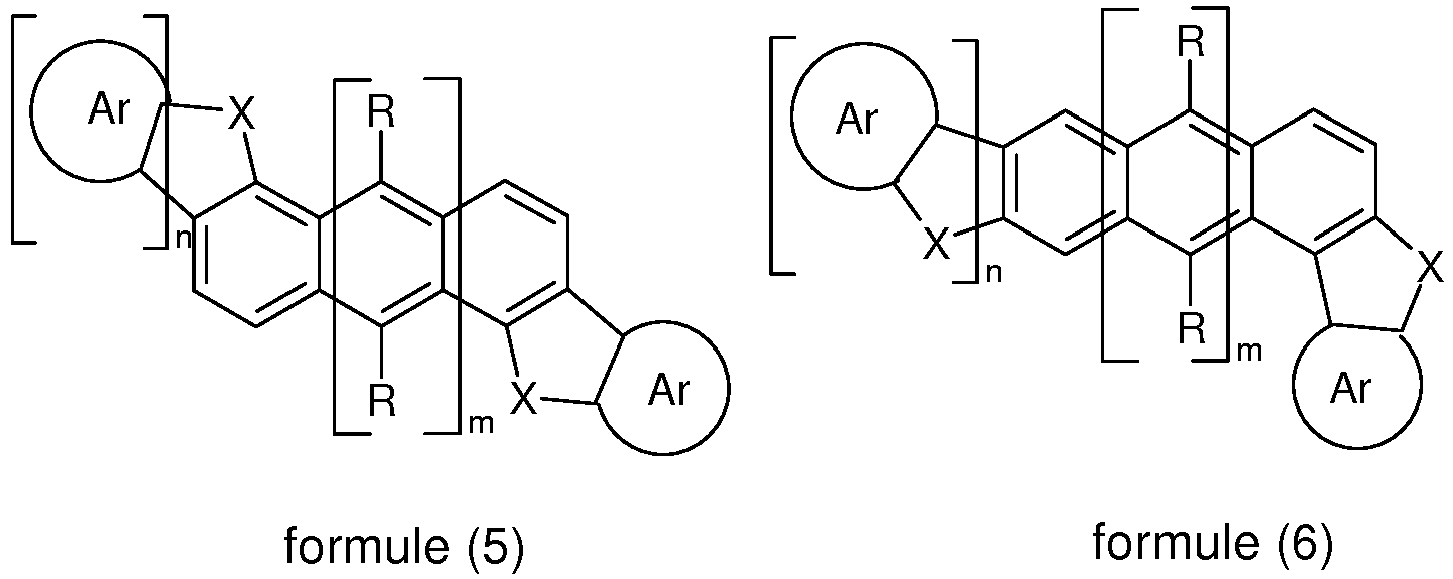

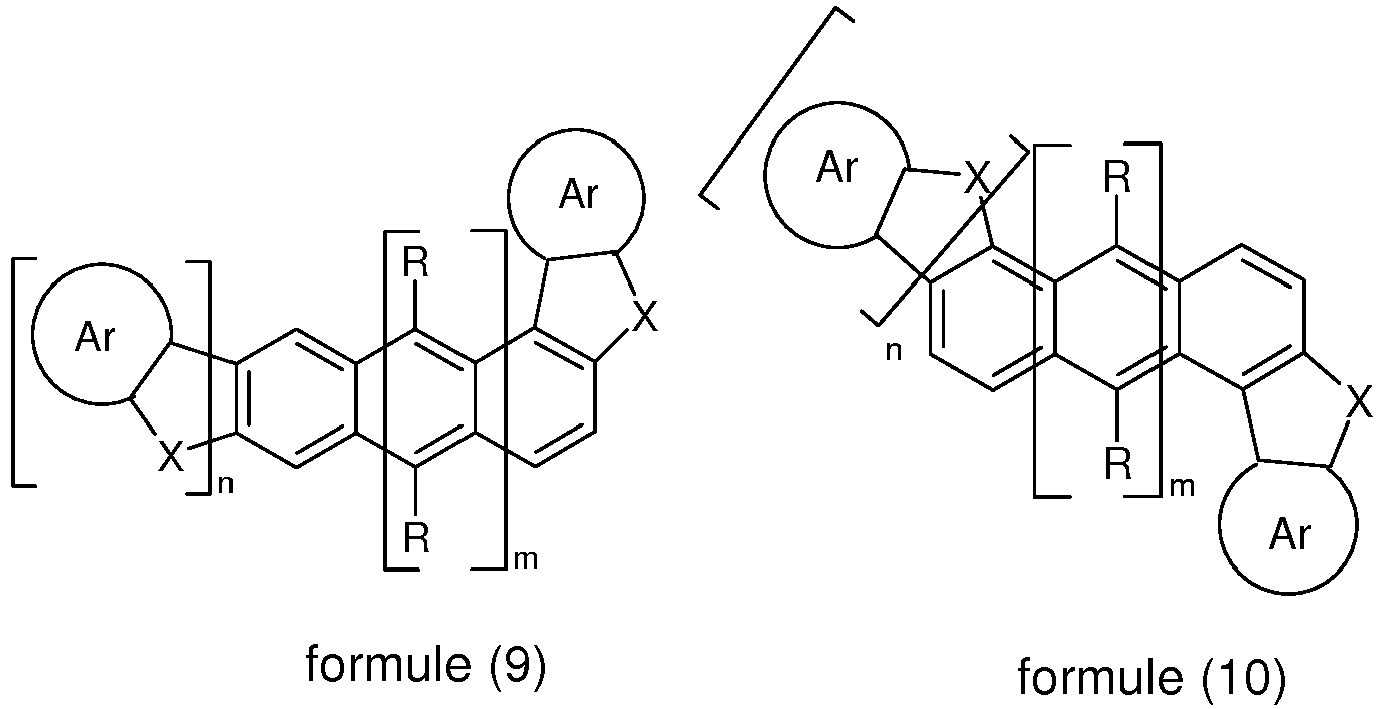


- Composés selon la revendication 1 ou 2, caractérisés en ce que le symbole Ar représente, de manière identique ou différente pour chaque occurrence, benzène, naphtalène, thiophène, pyrrole, furane, pyridine, pyrimidine, pyrazine, pyridazine, quinoline, quinoxaline, benzothiophène, indole ou benzofurane.
- Composés selon une ou plusieurs des revendications 1 à 3 des formules (3a) à (15a), (3b) à (15b) et (3c) à (15c) :

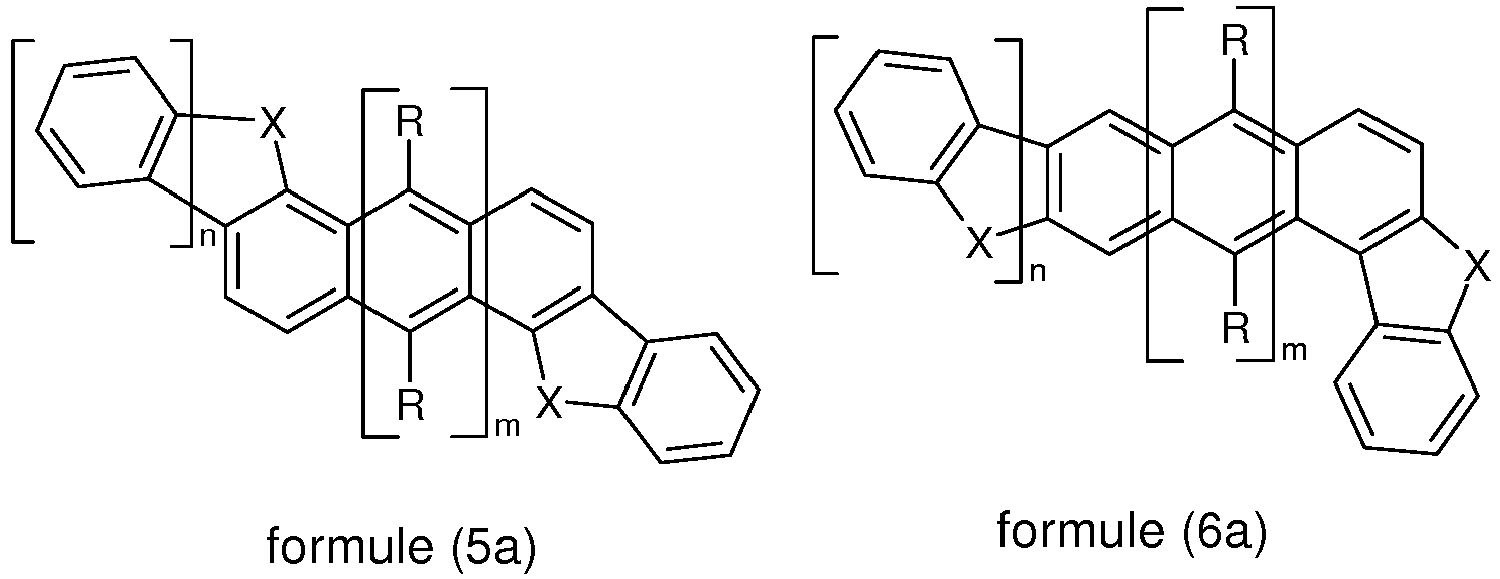






- Procédé pour la préparation de composés selon une ou plusieurs des revendications 1 à 4 à partir d'un dihaloanthraquinone, comprenant les étapes de réaction qui suivent :a) une réaction d'addition d'un composé arylmétal ;b) une réduction selon l'anthracène ;c) un couplage sur un composé aromatique fonctionnarisé, en option après conversion du groupe halogène selon un dérivé d'acide boron-ique ; etd) une fermeture de cycle, de préférence sous des conditions acides.
- Dimères, trimères, tétramères, pentamères, oligomères, polymères ou dendrimères comprenant un ou plusieurs composé(s) selon une ou plusieurs des revendications 1 à 4, où un radical ou plusieurs radicaux R, R1 ou R2 représente/représentent des liaisons entre les composés de la formule (1) ou (2) dans le dimère, le trimère, le tétramère ou le pentamère ou des liaisons depuis le composé de la formule (1) ou (2) sur le polymère, l'oligomère ou le dendrimère.
- Utilisation de composés selon une ou plusieurs des revendications 1 à 4 ou 6 dans des dispositifs électroniques, en particulier dans des dispositifs électroluminescents organiques (OLED, PLED), des transistors à effet de champ organiques (O-FET), des transistors à film mince organiques (O-TFT), des transistors à émission de lumière organiques (O-LET), des circuits intégrés organiques (O-IC), des cellules solaires organiques (O-SC), des dispositifs à extinction de champ organiques (O-FQD), des cellules électrochimiques à émission de lumière (LEC), des diodes laser organiques (O-laser) ou des photorécepteurs organiques.
- Dispositif électronique, en particulier sélectionné parmi les dispositifs électroluminescents organiques (OLED, PLED), les transistors à effet de champ organiques (O-FET), les transistors à film mince organiques (O-TFT), les transistors à émission de lumière organiques (O-LET), les circuits intégrés organiques (O-IC), les cellules solaires organiques (O-SC), les dispositifs à extinction de champ organiques (O-FQD), les cellules électrochimiques à émission de lumière (LEC), les diodes laser organiques (O-laser) et les photorécepteurs organiques, comprenant au moins un composé selon une ou plusieurs des revendications 1 à 4 ou 6.
- Dispositif électroluminescent organique selon la revendication 8, caractérisé en ce que, indépendamment d'une anode, d'une cathode et de la couche d'émission, il comprend également d'autres couches qui sont sélectionnées parmi, dans chaque cas, une ou plusieurs couches d'injection de trous, une ou plusieurs couches de transport de trous, une ou plusieurs couches de blocage de trous, une ou plusieurs couches de transport d'électrons, une ou plusieurs couches d'injection d'électrons, une ou plusieurs couches de blocage d'électrons, une ou plusieurs couches de génération de charges et/ou d'autres couches d'émission, où chacune de ces couches ne doit pas nécessairement être présente.
- Dispositif électroluminescent organique selon la revendication 8 ou 9, caractérisé en ce que le composé selon une ou plusieurs des revendications 1 à 4 est utilisé en tant que matériau hôte pour des dopants fluorescents, en tant que dopant fluorescent, en tant que matériau de transport de trous, en tant que matériau d'injection de trous ou en tant que matériau de transport d'électrons.
Applications Claiming Priority (2)
| Application Number | Priority Date | Filing Date | Title |
|---|---|---|---|
| DE102008018670A DE102008018670A1 (de) | 2008-04-14 | 2008-04-14 | Neue Materialien für organische Elektrolumineszenzvorrichtungen |
| PCT/EP2009/001938 WO2009127307A1 (fr) | 2008-04-14 | 2009-03-17 | Nouveaux matériaux pour des dispositifs électroluminescents organiques |
Publications (2)
| Publication Number | Publication Date |
|---|---|
| EP2265689A1 EP2265689A1 (fr) | 2010-12-29 |
| EP2265689B1 true EP2265689B1 (fr) | 2018-06-20 |
Family
ID=40651770
Family Applications (1)
| Application Number | Title | Priority Date | Filing Date |
|---|---|---|---|
| EP09732312.5A Active EP2265689B1 (fr) | 2008-04-14 | 2009-03-17 | Nouveaux matériaux pour des dispositifs électroluminescents organiques |
Country Status (8)
| Country | Link |
|---|---|
| US (1) | US8927117B2 (fr) |
| EP (1) | EP2265689B1 (fr) |
| JP (1) | JP5788313B2 (fr) |
| KR (2) | KR101708507B1 (fr) |
| CN (1) | CN102007194B (fr) |
| DE (1) | DE102008018670A1 (fr) |
| TW (1) | TW201004899A (fr) |
| WO (1) | WO2009127307A1 (fr) |
Families Citing this family (25)
| Publication number | Priority date | Publication date | Assignee | Title |
|---|---|---|---|---|
| KR101115760B1 (ko) * | 2008-05-14 | 2012-03-07 | 주식회사 두산 | 안트라센 유도체 및 이를 이용한 유기 전계 발광 소자 |
| KR101561479B1 (ko) * | 2008-12-05 | 2015-10-19 | 롬엔드하스전자재료코리아유한회사 | 신규한 유기 발광 화합물 및 이를 채용하고 있는 유기 발광소자 |
| JP5398397B2 (ja) * | 2009-07-21 | 2014-01-29 | 出光興産株式会社 | 有機薄膜太陽電池用材料及びそれを用いた有機薄膜太陽電池 |
| KR101097313B1 (ko) * | 2009-08-10 | 2011-12-23 | 삼성모바일디스플레이주식회사 | 유기 발광 소자 |
| KR101805913B1 (ko) * | 2009-11-13 | 2017-12-07 | 주식회사 두산 | 안트라센 유도체 및 이를 이용한 유기 전계 발광 소자 |
| KR101247956B1 (ko) | 2009-12-30 | 2013-04-03 | (주)씨에스엘쏠라 | 유기 발광 소자 및 이를 위한 유기 발광 화합물 |
| EP2603499A2 (fr) * | 2010-08-13 | 2013-06-19 | Merck Patent GmbH | Dérivés d'anthra[2,3-b:7,6-b']dithiophène et leur utilisation comme semiconducteurs organiques |
| CN102796244B (zh) * | 2011-05-25 | 2014-08-06 | 海洋王照明科技股份有限公司 | 含蒽醌单元的共轭聚合物及其制备方法和应用 |
| US9373793B2 (en) | 2011-06-27 | 2016-06-21 | Lg Chem, Ltd. | Compound and organic light-emitting device using same |
| JP5753027B2 (ja) | 2011-08-22 | 2015-07-22 | ユー・ディー・シー アイルランド リミテッド | 有機電界発光素子、化合物、並びに該素子を用いた発光装置、表示装置及び照明装置 |
| WO2014025370A1 (fr) | 2012-08-10 | 2014-02-13 | Hallstar Innovations Corp. | Composés tricycliques extincteurs d'énergie pour la réduction de la génération d'oxygène singulet |
| US9125829B2 (en) | 2012-08-17 | 2015-09-08 | Hallstar Innovations Corp. | Method of photostabilizing UV absorbers, particularly dibenzyolmethane derivatives, e.g., Avobenzone, with cyano-containing fused tricyclic compounds |
| US9145383B2 (en) | 2012-08-10 | 2015-09-29 | Hallstar Innovations Corp. | Compositions, apparatus, systems, and methods for resolving electronic excited states |
| KR101537005B1 (ko) * | 2012-09-28 | 2015-07-20 | 제일모직 주식회사 | 유기광전자소자용 화합물, 이를 포함하는 유기발광소자 및 상기 유기발광소자를 포함하는 표시장치 |
| KR102203102B1 (ko) * | 2014-03-05 | 2021-01-15 | 삼성디스플레이 주식회사 | 화합물 및 이를 포함한 유기 발광 소자 |
| KR102269132B1 (ko) | 2014-06-10 | 2021-06-25 | 삼성디스플레이 주식회사 | 반방향족성 화합물 및 이를 포함하는 유기 발광 소자 |
| US10084141B2 (en) | 2014-06-13 | 2018-09-25 | Samsung Display Co., Ltd. | Antiaromatic compound and organic light-emitting device including the same |
| US9951270B2 (en) * | 2014-10-30 | 2018-04-24 | Lg Chem, Ltd. | Multicyclic compound and organic electronic device using the same |
| JP6468818B2 (ja) | 2014-11-27 | 2019-02-13 | キヤノン株式会社 | 1位,1’位,3位,3’位に縮合環を有する2,2’−ビベンゾ[d]イミダゾリデン化合物、それを有する有機発光素子、表示装置、画像情報処理装置、照明装置、画像形成装置、露光装置 |
| US9773988B2 (en) * | 2015-04-10 | 2017-09-26 | University Of Oregon | Diindenoanthracene and diindenopentacene |
| JP6224028B2 (ja) * | 2015-05-21 | 2017-11-01 | ユー・ディー・シー アイルランド リミテッド | 有機電界発光素子、化合物、並びに該素子を用いた発光装置、表示装置及び照明装置 |
| TWI564294B (zh) | 2015-08-24 | 2017-01-01 | 國立清華大學 | 載子產生材料與有機發光二極體 |
| CN108675975A (zh) | 2017-10-17 | 2018-10-19 | 默克专利有限公司 | 用于有机电致发光器件的材料 |
| US11021489B2 (en) | 2019-03-01 | 2021-06-01 | University Of Oregon | Polycyclic aromatic compound embodiments and methods of making and using the same |
| US12191004B2 (en) | 2022-06-27 | 2025-01-07 | Microsoft Technology Licensing, Llc | Machine learning system with two encoder towers for semantic matching |
Citations (1)
| Publication number | Priority date | Publication date | Assignee | Title |
|---|---|---|---|---|
| US20040131881A1 (en) * | 2002-12-31 | 2004-07-08 | Eastman Kodak Company | Complex fluorene-containing compounds for use in OLED devices |
Family Cites Families (60)
| Publication number | Priority date | Publication date | Assignee | Title |
|---|---|---|---|---|
| US4539507A (en) | 1983-03-25 | 1985-09-03 | Eastman Kodak Company | Organic electroluminescent devices having improved power conversion efficiencies |
| DE4111878A1 (de) | 1991-04-11 | 1992-10-15 | Wacker Chemie Gmbh | Leiterpolymere mit konjugierten doppelbindungen |
| US5151629A (en) | 1991-08-01 | 1992-09-29 | Eastman Kodak Company | Blue emitting internal junction organic electroluminescent device (I) |
| EP0676461B1 (fr) | 1994-04-07 | 2002-08-14 | Covion Organic Semiconductors GmbH | Composés spiro et leur application comme matières électroluminescentes |
| DE4436773A1 (de) | 1994-10-14 | 1996-04-18 | Hoechst Ag | Konjugierte Polymere mit Spirozentren und ihre Verwendung als Elektrolumineszenzmaterialien |
| JP3865406B2 (ja) | 1995-07-28 | 2007-01-10 | 住友化学株式会社 | 2,7−アリール−9−置換フルオレン及び9−置換フルオレンオリゴマー及びポリマー |
| DE19614971A1 (de) | 1996-04-17 | 1997-10-23 | Hoechst Ag | Polymere mit Spiroatomen und ihre Verwendung als Elektrolumineszenzmaterialien |
| DE19652261A1 (de) | 1996-12-16 | 1998-06-18 | Hoechst Ag | Arylsubstituierte Poly(p-arylenvinylene), Verfahren zur Herstellung und deren Verwendung in Elektroluminszenzbauelementen |
| WO1998051757A1 (fr) * | 1997-05-15 | 1998-11-19 | Sanyo Electric Co., Ltd. | Element electroluminescent organique |
| US5942340A (en) * | 1997-10-02 | 1999-08-24 | Xerox Corporation | Indolocarbazole electroluminescent devices |
| US5935721A (en) | 1998-03-20 | 1999-08-10 | Eastman Kodak Company | Organic electroluminescent elements for stable electroluminescent |
| DE19846766A1 (de) | 1998-10-10 | 2000-04-20 | Aventis Res & Tech Gmbh & Co | Konjugierte Polymere, enthaltend spezielle Fluorenbausteine mit verbesserten Eigenschaften |
| US6166172A (en) | 1999-02-10 | 2000-12-26 | Carnegie Mellon University | Method of forming poly-(3-substituted) thiophenes |
| KR100738762B1 (ko) | 1999-09-21 | 2007-07-12 | 이데미쓰 고산 가부시키가이샤 | 유기 전자발광 소자 및 유기 발광 매체 |
| JP4094203B2 (ja) | 2000-03-30 | 2008-06-04 | 出光興産株式会社 | 有機エレクトロルミネッセンス素子及び有機発光媒体 |
| US6479172B2 (en) | 2001-01-26 | 2002-11-12 | Xerox Corporation | Electroluminescent (EL) devices |
| US7072347B2 (en) | 2001-02-23 | 2006-07-04 | International Business Machines Corporation | Assignment of packet descriptor field positions in a network processor |
| CN1239447C (zh) * | 2002-01-15 | 2006-02-01 | 清华大学 | 一种有机电致发光材料 |
| DE10207859A1 (de) | 2002-02-20 | 2003-09-04 | Univ Dresden Tech | Dotiertes organisches Halbleitermaterial sowie Verfahren zu dessen Herstellung |
| US7049011B2 (en) * | 2002-03-14 | 2006-05-23 | Tdk Corporation | Organic electroluminescent device |
| JP4170655B2 (ja) | 2002-04-17 | 2008-10-22 | 出光興産株式会社 | 新規芳香族化合物及びそれを利用した有機エレクトロルミネッセンス素子 |
| AU2003230308A1 (en) | 2002-05-07 | 2003-11-11 | Lg Chem, Ltd. | New organic compounds for electroluminescence and organic electroluminescent devices using the same |
| CN1192684C (zh) * | 2002-06-05 | 2005-03-09 | 谢爽 | 有机电致发光器件 |
| ATE529494T1 (de) | 2002-07-19 | 2011-11-15 | Idemitsu Kosan Co | Organische elektrolumineszente vorrichtungen und organisches lichtemittierendes medium |
| JP4025137B2 (ja) | 2002-08-02 | 2007-12-19 | 出光興産株式会社 | アントラセン誘導体及びそれを利用した有機エレクトロルミネッセンス素子 |
| JP2004075567A (ja) | 2002-08-12 | 2004-03-11 | Idemitsu Kosan Co Ltd | オリゴアリーレン誘導体及びそれを利用した有機エレクトロルミネッセンス素子 |
| US7839074B2 (en) | 2002-08-23 | 2010-11-23 | Idemitsu Kosan Co., Ltd. | Organic electroluminescence device and anthracene derivative |
| GB0226010D0 (en) | 2002-11-08 | 2002-12-18 | Cambridge Display Tech Ltd | Polymers for use in organic electroluminescent devices |
| US20060063027A1 (en) | 2002-12-23 | 2006-03-23 | Covion Organic Semiconductors Gmbh | Organic electroluminescent element |
| US6849348B2 (en) * | 2002-12-31 | 2005-02-01 | Eastman Kodak Company | Complex fluorene-containing compounds |
| DE10304819A1 (de) | 2003-02-06 | 2004-08-19 | Covion Organic Semiconductors Gmbh | Carbazol-enthaltende konjugierte Polymere und Blends, deren Darstellung und Verwendung |
| DE10310887A1 (de) | 2003-03-11 | 2004-09-30 | Covion Organic Semiconductors Gmbh | Matallkomplexe |
| EP1491568A1 (fr) | 2003-06-23 | 2004-12-29 | Covion Organic Semiconductors GmbH | Polymères semi-conducteurs |
| DE10328627A1 (de) | 2003-06-26 | 2005-02-17 | Covion Organic Semiconductors Gmbh | Neue Materialien für die Elektrolumineszenz |
| DE10333232A1 (de) | 2003-07-21 | 2007-10-11 | Merck Patent Gmbh | Organisches Elektrolumineszenzelement |
| DE10337346A1 (de) | 2003-08-12 | 2005-03-31 | Covion Organic Semiconductors Gmbh | Konjugierte Polymere enthaltend Dihydrophenanthren-Einheiten und deren Verwendung |
| JP2007517079A (ja) | 2003-10-22 | 2007-06-28 | メルク パテント ゲーエムベーハー | エレクトロルミネセンスのための新規材料、およびそれらの使用 |
| DE10357044A1 (de) | 2003-12-04 | 2005-07-14 | Novaled Gmbh | Verfahren zur Dotierung von organischen Halbleitern mit Chinondiiminderivaten |
| DE102004008304A1 (de) | 2004-02-20 | 2005-09-08 | Covion Organic Semiconductors Gmbh | Organische elektronische Vorrichtungen |
| DE102004020298A1 (de) | 2004-04-26 | 2005-11-10 | Covion Organic Semiconductors Gmbh | Elektrolumineszierende Polymere und deren Verwendung |
| TW200613515A (en) * | 2004-06-26 | 2006-05-01 | Merck Patent Gmbh | Compounds for organic electronic devices |
| DE102004031000A1 (de) * | 2004-06-26 | 2006-01-12 | Covion Organic Semiconductors Gmbh | Organische Elektrolumineszenzvorrichtungen |
| DE102004032527A1 (de) | 2004-07-06 | 2006-02-02 | Covion Organic Semiconductors Gmbh | Elektrolumineszierende Polymere |
| EP1655359A1 (fr) | 2004-11-06 | 2006-05-10 | Covion Organic Semiconductors GmbH | Dispositif organique électroluminescent |
| TW200639140A (en) | 2004-12-01 | 2006-11-16 | Merck Patent Gmbh | Compounds for organic electronic devices |
| EP1669386A1 (fr) | 2004-12-06 | 2006-06-14 | Covion Organic Semiconductors GmbH | Polymères conjugués, leur représentation et utilisation |
| JP4790260B2 (ja) * | 2004-12-22 | 2011-10-12 | 出光興産株式会社 | アントラセン誘導体を用いた有機エレクトロルミネッセンス素子 |
| EP1888706B1 (fr) | 2005-05-03 | 2017-03-01 | Merck Patent GmbH | Dispositif electroluminescent organique, et derives d'acide boronique et d'acide borinique utilises pour produire ce dispositif electroluminescent organique |
| DE102005023437A1 (de) | 2005-05-20 | 2006-11-30 | Merck Patent Gmbh | Verbindungen für organische elektronische Vorrichtungen |
| DE102005037734B4 (de) | 2005-08-10 | 2018-02-08 | Merck Patent Gmbh | Elektrolumineszierende Polymere, ihre Verwendung und bifunktionelle monomere Verbindungen |
| KR100828173B1 (ko) * | 2005-11-22 | 2008-05-08 | (주)그라쎌 | 유기 발광 화합물 및 이를 발광재료로 채용하고 있는 표시소자 |
| DE102005058557A1 (de) * | 2005-12-08 | 2007-06-14 | Merck Patent Gmbh | Organische Elektrolumineszenzvorrichtung |
| US8795847B2 (en) * | 2005-12-08 | 2014-08-05 | Merck Patent Gmbh | Materials for organic electroluminescent devices |
| DE102005058543A1 (de) | 2005-12-08 | 2007-06-14 | Merck Patent Gmbh | Organische Elektrolumineszenzvorrichtungen |
| DE102005060473A1 (de) | 2005-12-17 | 2007-06-28 | Merck Patent Gmbh | Konjugierte Polymere, deren Darstellung und Verwendung |
| DE102006015183A1 (de) | 2006-04-01 | 2007-10-04 | Merck Patent Gmbh | Materialien für organische Elektrolumineszenzvorrichtungen |
| DE102006025846A1 (de) | 2006-06-02 | 2007-12-06 | Merck Patent Gmbh | Neue Materialien für organische Elektrolumineszenzvorrichtungen |
| DE102006031990A1 (de) * | 2006-07-11 | 2008-01-17 | Merck Patent Gmbh | Neue Materialien für organische Elektrolumineszenzvorrichtungen |
| DE102006035035A1 (de) * | 2006-07-28 | 2008-01-31 | Merck Patent Gmbh | Neue Materialien für organische Elektrolumineszenzvorrichtungen |
| JP2009203183A (ja) * | 2008-02-27 | 2009-09-10 | Tosoh Corp | ヘテロアセン誘導体の製造方法 |
-
2008
- 2008-04-14 DE DE102008018670A patent/DE102008018670A1/de not_active Withdrawn
-
2009
- 2009-03-17 JP JP2011504338A patent/JP5788313B2/ja active Active
- 2009-03-17 KR KR1020107025456A patent/KR101708507B1/ko active Active
- 2009-03-17 US US12/937,794 patent/US8927117B2/en active Active
- 2009-03-17 KR KR1020167008357A patent/KR101739241B1/ko active Active
- 2009-03-17 EP EP09732312.5A patent/EP2265689B1/fr active Active
- 2009-03-17 WO PCT/EP2009/001938 patent/WO2009127307A1/fr not_active Ceased
- 2009-03-17 CN CN200980112965.7A patent/CN102007194B/zh active Active
- 2009-04-09 TW TW098111833A patent/TW201004899A/zh unknown
Patent Citations (1)
| Publication number | Priority date | Publication date | Assignee | Title |
|---|---|---|---|---|
| US20040131881A1 (en) * | 2002-12-31 | 2004-07-08 | Eastman Kodak Company | Complex fluorene-containing compounds for use in OLED devices |
Also Published As
| Publication number | Publication date |
|---|---|
| CN102007194B (zh) | 2015-01-14 |
| WO2009127307A1 (fr) | 2009-10-22 |
| KR101739241B1 (ko) | 2017-05-23 |
| TW201004899A (en) | 2010-02-01 |
| KR101708507B1 (ko) | 2017-02-20 |
| KR20160038088A (ko) | 2016-04-06 |
| JP2011520784A (ja) | 2011-07-21 |
| JP5788313B2 (ja) | 2015-09-30 |
| US8927117B2 (en) | 2015-01-06 |
| KR20100133485A (ko) | 2010-12-21 |
| CN102007194A (zh) | 2011-04-06 |
| EP2265689A1 (fr) | 2010-12-29 |
| DE102008018670A1 (de) | 2009-10-15 |
| US20110037063A1 (en) | 2011-02-17 |
Similar Documents
| Publication | Publication Date | Title |
|---|---|---|
| EP2265689B1 (fr) | Nouveaux matériaux pour des dispositifs électroluminescents organiques | |
| DE112009003904B4 (de) | Materialien für organische Elektrolumineszenzvorrichtungen | |
| EP2024310B1 (fr) | Materiaux pour dispositifs electroluminescents organiques | |
| DE112010003082B4 (de) | Neue materialien für organische elektrolumineszenzvorrichtungen | |
| EP2148909B1 (fr) | Derive benzanthracene pour des dispositifs électroluminescents organiques | |
| EP2046915B1 (fr) | Nouveaux matériaux pour dispositifs organiques électroluminescents | |
| DE102008008953B4 (de) | Neue Materialien für organische Elektrolumineszenzvorrichtungen | |
| EP2663567B1 (fr) | Composés pour des dispositifs électroluminescents organiques | |
| EP2038370B1 (fr) | Nouveaux matériaux destinés à des dispositifs électroluminescents organiques | |
| EP1999226B1 (fr) | Nouveaux materiaux pour disposifs electroluminescents organiques | |
| EP2340290B1 (fr) | Nouveaux matériaux pour dispositifs électroluminescents organiques | |
| EP1957606B1 (fr) | Nouvelles matieres pour dispositifs electroluminescents organiques | |
| EP3211058B1 (fr) | Nouveaux matériaux pour dispositifs électroluminescents organiques | |
| WO2010006680A1 (fr) | Matériaux pour dispositifs électroluminescents organiques | |
| DE102010048607A1 (de) | Verbindungen für elektronische Vorrichtungen | |
| WO2010094378A1 (fr) | Dispositif électronique organique | |
| DE112011102056B4 (de) | Verbindungen für elektronische Vorrichtungen | |
| DE102008050841B4 (de) | Neue Materialien für organische Elektrolumineszenzvorrichtungen |
Legal Events
| Date | Code | Title | Description |
|---|---|---|---|
| PUAI | Public reference made under article 153(3) epc to a published international application that has entered the european phase |
Free format text: ORIGINAL CODE: 0009012 |
|
| 17P | Request for examination filed |
Effective date: 20100813 |
|
| AK | Designated contracting states |
Kind code of ref document: A1 Designated state(s): AT BE BG CH CY CZ DE DK EE ES FI FR GB GR HR HU IE IS IT LI LT LU LV MC MK MT NL NO PL PT RO SE SI SK TR |
|
| AX | Request for extension of the european patent |
Extension state: AL BA RS |
|
| DAX | Request for extension of the european patent (deleted) | ||
| STAA | Information on the status of an ep patent application or granted ep patent |
Free format text: STATUS: EXAMINATION IS IN PROGRESS |
|
| 17Q | First examination report despatched |
Effective date: 20161107 |
|
| RIC1 | Information provided on ipc code assigned before grant |
Ipc: H01L 51/50 20060101ALI20180103BHEP Ipc: C09K 11/06 20060101AFI20180103BHEP |
|
| GRAP | Despatch of communication of intention to grant a patent |
Free format text: ORIGINAL CODE: EPIDOSNIGR1 |
|
| STAA | Information on the status of an ep patent application or granted ep patent |
Free format text: STATUS: GRANT OF PATENT IS INTENDED |
|
| INTG | Intention to grant announced |
Effective date: 20180209 |
|
| GRAS | Grant fee paid |
Free format text: ORIGINAL CODE: EPIDOSNIGR3 |
|
| GRAA | (expected) grant |
Free format text: ORIGINAL CODE: 0009210 |
|
| STAA | Information on the status of an ep patent application or granted ep patent |
Free format text: STATUS: THE PATENT HAS BEEN GRANTED |
|
| AK | Designated contracting states |
Kind code of ref document: B1 Designated state(s): AT BE BG CH CY CZ DE DK EE ES FI FR GB GR HR HU IE IS IT LI LT LU LV MC MK MT NL NO PL PT RO SE SI SK TR |
|
| REG | Reference to a national code |
Ref country code: GB Ref legal event code: FG4D Free format text: NOT ENGLISH |
|
| REG | Reference to a national code |
Ref country code: IE Ref legal event code: FG4D Free format text: LANGUAGE OF EP DOCUMENT: GERMAN |
|
| REG | Reference to a national code |
Ref country code: AT Ref legal event code: REF Ref document number: 1010593 Country of ref document: AT Kind code of ref document: T Effective date: 20180715 |
|
| REG | Reference to a national code |
Ref country code: DE Ref legal event code: R096 Ref document number: 502009015039 Country of ref document: DE |
|
| REG | Reference to a national code |
Ref country code: NL Ref legal event code: MP Effective date: 20180620 |
|
| PG25 | Lapsed in a contracting state [announced via postgrant information from national office to epo] |
Ref country code: SE Free format text: LAPSE BECAUSE OF FAILURE TO SUBMIT A TRANSLATION OF THE DESCRIPTION OR TO PAY THE FEE WITHIN THE PRESCRIBED TIME-LIMIT Effective date: 20180620 Ref country code: LT Free format text: LAPSE BECAUSE OF FAILURE TO SUBMIT A TRANSLATION OF THE DESCRIPTION OR TO PAY THE FEE WITHIN THE PRESCRIBED TIME-LIMIT Effective date: 20180620 Ref country code: NO Free format text: LAPSE BECAUSE OF FAILURE TO SUBMIT A TRANSLATION OF THE DESCRIPTION OR TO PAY THE FEE WITHIN THE PRESCRIBED TIME-LIMIT Effective date: 20180920 Ref country code: BG Free format text: LAPSE BECAUSE OF FAILURE TO SUBMIT A TRANSLATION OF THE DESCRIPTION OR TO PAY THE FEE WITHIN THE PRESCRIBED TIME-LIMIT Effective date: 20180920 Ref country code: FI Free format text: LAPSE BECAUSE OF FAILURE TO SUBMIT A TRANSLATION OF THE DESCRIPTION OR TO PAY THE FEE WITHIN THE PRESCRIBED TIME-LIMIT Effective date: 20180620 |
|
| REG | Reference to a national code |
Ref country code: LT Ref legal event code: MG4D |
|
| PG25 | Lapsed in a contracting state [announced via postgrant information from national office to epo] |
Ref country code: LV Free format text: LAPSE BECAUSE OF FAILURE TO SUBMIT A TRANSLATION OF THE DESCRIPTION OR TO PAY THE FEE WITHIN THE PRESCRIBED TIME-LIMIT Effective date: 20180620 Ref country code: HR Free format text: LAPSE BECAUSE OF FAILURE TO SUBMIT A TRANSLATION OF THE DESCRIPTION OR TO PAY THE FEE WITHIN THE PRESCRIBED TIME-LIMIT Effective date: 20180620 Ref country code: GR Free format text: LAPSE BECAUSE OF FAILURE TO SUBMIT A TRANSLATION OF THE DESCRIPTION OR TO PAY THE FEE WITHIN THE PRESCRIBED TIME-LIMIT Effective date: 20180921 |
|
| PG25 | Lapsed in a contracting state [announced via postgrant information from national office to epo] |
Ref country code: NL Free format text: LAPSE BECAUSE OF FAILURE TO SUBMIT A TRANSLATION OF THE DESCRIPTION OR TO PAY THE FEE WITHIN THE PRESCRIBED TIME-LIMIT Effective date: 20180620 |
|
| PG25 | Lapsed in a contracting state [announced via postgrant information from national office to epo] |
Ref country code: PL Free format text: LAPSE BECAUSE OF FAILURE TO SUBMIT A TRANSLATION OF THE DESCRIPTION OR TO PAY THE FEE WITHIN THE PRESCRIBED TIME-LIMIT Effective date: 20180620 Ref country code: SK Free format text: LAPSE BECAUSE OF FAILURE TO SUBMIT A TRANSLATION OF THE DESCRIPTION OR TO PAY THE FEE WITHIN THE PRESCRIBED TIME-LIMIT Effective date: 20180620 Ref country code: IS Free format text: LAPSE BECAUSE OF FAILURE TO SUBMIT A TRANSLATION OF THE DESCRIPTION OR TO PAY THE FEE WITHIN THE PRESCRIBED TIME-LIMIT Effective date: 20181020 Ref country code: CZ Free format text: LAPSE BECAUSE OF FAILURE TO SUBMIT A TRANSLATION OF THE DESCRIPTION OR TO PAY THE FEE WITHIN THE PRESCRIBED TIME-LIMIT Effective date: 20180620 Ref country code: RO Free format text: LAPSE BECAUSE OF FAILURE TO SUBMIT A TRANSLATION OF THE DESCRIPTION OR TO PAY THE FEE WITHIN THE PRESCRIBED TIME-LIMIT Effective date: 20180620 Ref country code: EE Free format text: LAPSE BECAUSE OF FAILURE TO SUBMIT A TRANSLATION OF THE DESCRIPTION OR TO PAY THE FEE WITHIN THE PRESCRIBED TIME-LIMIT Effective date: 20180620 |
|
| PG25 | Lapsed in a contracting state [announced via postgrant information from national office to epo] |
Ref country code: ES Free format text: LAPSE BECAUSE OF FAILURE TO SUBMIT A TRANSLATION OF THE DESCRIPTION OR TO PAY THE FEE WITHIN THE PRESCRIBED TIME-LIMIT Effective date: 20180620 Ref country code: IT Free format text: LAPSE BECAUSE OF FAILURE TO SUBMIT A TRANSLATION OF THE DESCRIPTION OR TO PAY THE FEE WITHIN THE PRESCRIBED TIME-LIMIT Effective date: 20180620 |
|
| REG | Reference to a national code |
Ref country code: DE Ref legal event code: R097 Ref document number: 502009015039 Country of ref document: DE |
|
| PLBE | No opposition filed within time limit |
Free format text: ORIGINAL CODE: 0009261 |
|
| STAA | Information on the status of an ep patent application or granted ep patent |
Free format text: STATUS: NO OPPOSITION FILED WITHIN TIME LIMIT |
|
| 26N | No opposition filed |
Effective date: 20190321 |
|
| PG25 | Lapsed in a contracting state [announced via postgrant information from national office to epo] |
Ref country code: DK Free format text: LAPSE BECAUSE OF FAILURE TO SUBMIT A TRANSLATION OF THE DESCRIPTION OR TO PAY THE FEE WITHIN THE PRESCRIBED TIME-LIMIT Effective date: 20180620 |
|
| PG25 | Lapsed in a contracting state [announced via postgrant information from national office to epo] |
Ref country code: SI Free format text: LAPSE BECAUSE OF FAILURE TO SUBMIT A TRANSLATION OF THE DESCRIPTION OR TO PAY THE FEE WITHIN THE PRESCRIBED TIME-LIMIT Effective date: 20180620 |
|
| PG25 | Lapsed in a contracting state [announced via postgrant information from national office to epo] |
Ref country code: MC Free format text: LAPSE BECAUSE OF FAILURE TO SUBMIT A TRANSLATION OF THE DESCRIPTION OR TO PAY THE FEE WITHIN THE PRESCRIBED TIME-LIMIT Effective date: 20180620 |
|
| REG | Reference to a national code |
Ref country code: CH Ref legal event code: PL |
|
| GBPC | Gb: european patent ceased through non-payment of renewal fee |
Effective date: 20190317 |
|
| PG25 | Lapsed in a contracting state [announced via postgrant information from national office to epo] |
Ref country code: LU Free format text: LAPSE BECAUSE OF NON-PAYMENT OF DUE FEES Effective date: 20190317 |
|
| REG | Reference to a national code |
Ref country code: BE Ref legal event code: MM Effective date: 20190331 |
|
| PG25 | Lapsed in a contracting state [announced via postgrant information from national office to epo] |
Ref country code: LI Free format text: LAPSE BECAUSE OF NON-PAYMENT OF DUE FEES Effective date: 20190331 Ref country code: GB Free format text: LAPSE BECAUSE OF NON-PAYMENT OF DUE FEES Effective date: 20190317 Ref country code: CH Free format text: LAPSE BECAUSE OF NON-PAYMENT OF DUE FEES Effective date: 20190331 Ref country code: IE Free format text: LAPSE BECAUSE OF NON-PAYMENT OF DUE FEES Effective date: 20190317 |
|
| PG25 | Lapsed in a contracting state [announced via postgrant information from national office to epo] |
Ref country code: FR Free format text: LAPSE BECAUSE OF NON-PAYMENT OF DUE FEES Effective date: 20190331 Ref country code: BE Free format text: LAPSE BECAUSE OF NON-PAYMENT OF DUE FEES Effective date: 20190331 |
|
| PG25 | Lapsed in a contracting state [announced via postgrant information from national office to epo] |
Ref country code: TR Free format text: LAPSE BECAUSE OF FAILURE TO SUBMIT A TRANSLATION OF THE DESCRIPTION OR TO PAY THE FEE WITHIN THE PRESCRIBED TIME-LIMIT Effective date: 20180620 |
|
| PG25 | Lapsed in a contracting state [announced via postgrant information from national office to epo] |
Ref country code: PT Free format text: LAPSE BECAUSE OF FAILURE TO SUBMIT A TRANSLATION OF THE DESCRIPTION OR TO PAY THE FEE WITHIN THE PRESCRIBED TIME-LIMIT Effective date: 20181022 Ref country code: MT Free format text: LAPSE BECAUSE OF FAILURE TO SUBMIT A TRANSLATION OF THE DESCRIPTION OR TO PAY THE FEE WITHIN THE PRESCRIBED TIME-LIMIT Effective date: 20180620 |
|
| REG | Reference to a national code |
Ref country code: AT Ref legal event code: MM01 Ref document number: 1010593 Country of ref document: AT Kind code of ref document: T Effective date: 20190317 |
|
| PG25 | Lapsed in a contracting state [announced via postgrant information from national office to epo] |
Ref country code: AT Free format text: LAPSE BECAUSE OF NON-PAYMENT OF DUE FEES Effective date: 20190317 |
|
| PG25 | Lapsed in a contracting state [announced via postgrant information from national office to epo] |
Ref country code: CY Free format text: LAPSE BECAUSE OF FAILURE TO SUBMIT A TRANSLATION OF THE DESCRIPTION OR TO PAY THE FEE WITHIN THE PRESCRIBED TIME-LIMIT Effective date: 20180620 |
|
| PG25 | Lapsed in a contracting state [announced via postgrant information from national office to epo] |
Ref country code: HU Free format text: LAPSE BECAUSE OF FAILURE TO SUBMIT A TRANSLATION OF THE DESCRIPTION OR TO PAY THE FEE WITHIN THE PRESCRIBED TIME-LIMIT; INVALID AB INITIO Effective date: 20090317 |
|
| PG25 | Lapsed in a contracting state [announced via postgrant information from national office to epo] |
Ref country code: MK Free format text: LAPSE BECAUSE OF FAILURE TO SUBMIT A TRANSLATION OF THE DESCRIPTION OR TO PAY THE FEE WITHIN THE PRESCRIBED TIME-LIMIT Effective date: 20180620 |
|
| P01 | Opt-out of the competence of the unified patent court (upc) registered |
Effective date: 20230518 |
|
| REG | Reference to a national code |
Ref country code: DE Ref legal event code: R081 Ref document number: 502009015039 Country of ref document: DE Owner name: IDEMITSU KOSAN CO., LTD., JP Free format text: FORMER OWNER: MERCK PATENT GMBH, 64293 DARMSTADT, DE |
|
| PGFP | Annual fee paid to national office [announced via postgrant information from national office to epo] |
Ref country code: DE Payment date: 20260128 Year of fee payment: 18 |