EP2266902A1 - Kurserzeugungssystem und kurserzeugungsverfahren - Google Patents
Kurserzeugungssystem und kurserzeugungsverfahren Download PDFInfo
- Publication number
- EP2266902A1 EP2266902A1 EP09725397A EP09725397A EP2266902A1 EP 2266902 A1 EP2266902 A1 EP 2266902A1 EP 09725397 A EP09725397 A EP 09725397A EP 09725397 A EP09725397 A EP 09725397A EP 2266902 A1 EP2266902 A1 EP 2266902A1
- Authority
- EP
- European Patent Office
- Prior art keywords
- course
- delivery
- time
- delivery points
- evaluation value
- Prior art date
- Legal status (The legal status is an assumption and is not a legal conclusion. Google has not performed a legal analysis and makes no representation as to the accuracy of the status listed.)
- Withdrawn
Links
Images










Classifications
-
- G—PHYSICS
- G06—COMPUTING OR CALCULATING; COUNTING
- G06Q—INFORMATION AND COMMUNICATION TECHNOLOGY [ICT] SPECIALLY ADAPTED FOR ADMINISTRATIVE, COMMERCIAL, FINANCIAL, MANAGERIAL OR SUPERVISORY PURPOSES; SYSTEMS OR METHODS SPECIALLY ADAPTED FOR ADMINISTRATIVE, COMMERCIAL, FINANCIAL, MANAGERIAL OR SUPERVISORY PURPOSES, NOT OTHERWISE PROVIDED FOR
- G06Q10/00—Administration; Management
- G06Q10/08—Logistics, e.g. warehousing, loading or distribution; Inventory or stock management
-
- G—PHYSICS
- G06—COMPUTING OR CALCULATING; COUNTING
- G06Q—INFORMATION AND COMMUNICATION TECHNOLOGY [ICT] SPECIALLY ADAPTED FOR ADMINISTRATIVE, COMMERCIAL, FINANCIAL, MANAGERIAL OR SUPERVISORY PURPOSES; SYSTEMS OR METHODS SPECIALLY ADAPTED FOR ADMINISTRATIVE, COMMERCIAL, FINANCIAL, MANAGERIAL OR SUPERVISORY PURPOSES, NOT OTHERWISE PROVIDED FOR
- G06Q10/00—Administration; Management
- G06Q10/08—Logistics, e.g. warehousing, loading or distribution; Inventory or stock management
- G06Q10/083—Shipping
- G06Q10/08355—Routing methods
-
- G—PHYSICS
- G06—COMPUTING OR CALCULATING; COUNTING
- G06Q—INFORMATION AND COMMUNICATION TECHNOLOGY [ICT] SPECIALLY ADAPTED FOR ADMINISTRATIVE, COMMERCIAL, FINANCIAL, MANAGERIAL OR SUPERVISORY PURPOSES; SYSTEMS OR METHODS SPECIALLY ADAPTED FOR ADMINISTRATIVE, COMMERCIAL, FINANCIAL, MANAGERIAL OR SUPERVISORY PURPOSES, NOT OTHERWISE PROVIDED FOR
- G06Q10/00—Administration; Management
- G06Q10/04—Forecasting or optimisation specially adapted for administrative or management purposes, e.g. linear programming or "cutting stock problem"
- G06Q10/047—Optimisation of routes or paths, e.g. travelling salesman problem
-
- G—PHYSICS
- G06—COMPUTING OR CALCULATING; COUNTING
- G06Q—INFORMATION AND COMMUNICATION TECHNOLOGY [ICT] SPECIALLY ADAPTED FOR ADMINISTRATIVE, COMMERCIAL, FINANCIAL, MANAGERIAL OR SUPERVISORY PURPOSES; SYSTEMS OR METHODS SPECIALLY ADAPTED FOR ADMINISTRATIVE, COMMERCIAL, FINANCIAL, MANAGERIAL OR SUPERVISORY PURPOSES, NOT OTHERWISE PROVIDED FOR
- G06Q10/00—Administration; Management
- G06Q10/06—Resources, workflows, human or project management; Enterprise or organisation planning; Enterprise or organisation modelling
- G06Q10/063—Operations research, analysis or management
- G06Q10/0631—Resource planning, allocation, distributing or scheduling for enterprises or organisations
- G06Q10/06316—Sequencing of tasks or work
-
- G—PHYSICS
- G06—COMPUTING OR CALCULATING; COUNTING
- G06Q—INFORMATION AND COMMUNICATION TECHNOLOGY [ICT] SPECIALLY ADAPTED FOR ADMINISTRATIVE, COMMERCIAL, FINANCIAL, MANAGERIAL OR SUPERVISORY PURPOSES; SYSTEMS OR METHODS SPECIALLY ADAPTED FOR ADMINISTRATIVE, COMMERCIAL, FINANCIAL, MANAGERIAL OR SUPERVISORY PURPOSES, NOT OTHERWISE PROVIDED FOR
- G06Q10/00—Administration; Management
- G06Q10/06—Resources, workflows, human or project management; Enterprise or organisation planning; Enterprise or organisation modelling
- G06Q10/063—Operations research, analysis or management
- G06Q10/0633—Workflow analysis
-
- G—PHYSICS
- G06—COMPUTING OR CALCULATING; COUNTING
- G06Q—INFORMATION AND COMMUNICATION TECHNOLOGY [ICT] SPECIALLY ADAPTED FOR ADMINISTRATIVE, COMMERCIAL, FINANCIAL, MANAGERIAL OR SUPERVISORY PURPOSES; SYSTEMS OR METHODS SPECIALLY ADAPTED FOR ADMINISTRATIVE, COMMERCIAL, FINANCIAL, MANAGERIAL OR SUPERVISORY PURPOSES, NOT OTHERWISE PROVIDED FOR
- G06Q10/00—Administration; Management
- G06Q10/06—Resources, workflows, human or project management; Enterprise or organisation planning; Enterprise or organisation modelling
- G06Q10/063—Operations research, analysis or management
- G06Q10/0637—Strategic management or analysis, e.g. setting a goal or target of an organisation; Planning actions based on goals; Analysis or evaluation of effectiveness of goals
Definitions
- the course refining unit may repeat a process of making the evaluation value calculation unit calculate the evaluation values for the respective cases when the delivery point with the low frequency of delivery rank is inserted respectively in the courses each of along which the commodities are delivered to the delivery points with higher frequency of delivery rank, and of inserting the delivery point with the low frequency of delivery rank into a course capable of yielding a higher evaluation value.
- the order determination unit may select locations where the delivery point is insertable based on the time specification of its own, may make the evaluation value calculation unit calculate the evaluation values for respective cases where the delivery point is inserted to the respective locations, and may insert the delivery point into one of the locations capable of maximizing the evaluation value. In this way, since the process of calculating the evaluation value may be carried out after the locations to be inserted with the delivery point is narrowed, so that the process may be simplified.
- the order determination unit may respectively handle all of the time specifications as the time specification of the delivery point, and may determine a time specification, capable of maximizing the evaluation value calculated by the evaluation value calculation unit, with respect to the individual conditions, as the time specification of the delivery point.
- the method of course creation of the present invention may further include a step of counting, based on the time of arrival calculated in the step of calculating the time, the number of delivery points which are characterized by the time of arrival thereto fallen in a zone of the time specification, and are therefore capable of keeping the time specification, among all delivery points assigned with the time specification, and in the step of calculating the evaluation value, a higher evaluation value may be calculated corresponding to a course which contains a larger number of delivery points capable of keeping the time specification calculated in the step of calculating the number of the delivery points.
- a course which contains a plurality of delivery points characterized by different frequencies of delivery and assigned with or without time specification which indicates an acceptable time of delivery, can be created, so that the delivery points assigned with the time specification may be visited in a highly punctual and efficient manner.
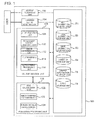
- the condition setting acceptance unit 104 accepts various setting of conditions necessary for creating a course from the user.
- the condition setting acceptance unit 104 accepts setting of conditions such as daily reference working time of the individual workers, minimum working time, start time of working, loading time of commodities, rest time, working time after coming back to the base, standard working time at each shop, standard travel speed between each shops, standard travel speed between the base and the shops, maximum load and minimum load of trucks, allowable ratio of loading and so forth.
- the condition setting acceptance unit 104 may also accept setting of maximum and minimum values of course time.
- the condition storage unit T4 stores the thus-set conditions.
- the shop information storage unit T3 stores shop information data.
- the shop information data includes shop-related information including identification codes of bases, identification codes of shops, names of shops, locations of shops (latitude, longitude and altitude, or, X-coordinate, Y-coordinate and Z-coordinate), quantity of delivery per one round, monthly number of times of delivery, date/hour conditions for delivery, working time (min.) per one round, travel speed (km/h) from base, travel speed (km/h) between shops, monthly sales (yen), monthly sales volume (unit) and so forth.
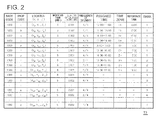
- FIG. 2 is a drawing illustrating a part of a data structure of the shop information storage unit in T3 this embodiment.
- the shop information storage unit T3 herein typically contains a base code column, a shop code column, a location column, a working time column, a quantity-of-delivery column, a frequency-of-delivery column, an assigned time column, a time zone column, a reference time column, and a rank column.
- a shop assigned with shop code "a” belongs to a base characterized by a base code of "1000", a location of "(X 1 ,Y 1 ,Z 1 )", a working time at this shop of "5 min.”, a quantity of delivery per one round of "0.001 t", a frequency of delivery of "4/4", a time specification (assigned time) of "10:00-11:00", a time zone of "1 h", a reference time of "10:30”, and a rank of "1".
- a frequency of delivery of "4/4” herein means four times per four weeks, representing that weekly delivery is necessary.
- a frequency of delivery of "2/4" means twice per four weeks, representing that biweekly delivery is necessary.
- a time specification of "10:00-11:00” herein means that a point of time which indicates an acceptable time of delivery is assigned between 10:00 to 21:00.
- a middle point of the assigned delivery time is defined as the reference time.
- the shops having "-" in the time specification column are those having no time specification assigned thereto.
- the individual shops are ranked up depending on presence or absence of the time specification, and on the frequencies of delivery, assuming the presence of time specification as the first priority condition, and the highness of frequency of delivery as the second priority condition. More specifically, first, according to the first priority condition, the shops with the shop codes "a" to "j" assigned with the time specification are selected. Next, according to the second priority condition, among these shops, the shops with the shop codes “a” to “g” having the highest frequency of delivery are ranked at "1", which is the highest rank. Next, among the shops assigned with the time specification, the shops with the shop codes "h” to "j” having the second highest frequency of delivery are ranked at "2", which is the second highest rank.
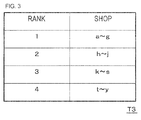
- the shop information storage unit T3 may contain a table which correlates the ranks with the shops.
- FIG. 3 is a drawing illustrating this sort of table.
- the course creation unit 106 creates a course along which a worker delivers commodities from a delivery base to a plurality of shops and comes back to the delivery base.
- the shop selection unit 108 (delivery point selection unit) repeats a process such as sequentially selecting the shops in decreasing order of rank until a predetermined condition is satisfied, and, once the predetermined condition is satisfied, selecting the shops ranked at the next.
- a predetermined condition may be defined as a case where all shops ranked at the same level and stored in the shop information storage unit T3 are selected.
- the preliminary course creation unit 110 creates a preliminary course which contains these shops.
- the order determination unit 112 determines an order of visiting the shops contained in the preliminary course and the course. In this embodiment, if the shops are assigned with the time specification, the order determination unit 112 determines an order of visiting the shops according to the time specification. In this process, the order determination unit 112 may determine the order typically based on the reference time of the individual shops, so as to align the shops in the order of the reference time. Alternatively, the order determination unit 112 may appropriately determine the order, referring to the evaluation value described later.
- the evaluation processing unit 118 evaluates the course created by the course creation unit 106.
- the time calculation unit 120 calculates time of arrival to the individual shops contained in the preliminary course and the course, when these shops are visited according to the order determined by the order determination unit 112, and course time necessary for visiting round the course.
- the time calculation unit 120 calculates the travel time between the base and each shop, and between the shops, while optimising the route therebetween.
- the time-zone-keepable shop counting unit 122 calculates the number of shops which are characterized by the time of arrival thereto fallen in a zone of the time specification, and are therefore capable of keeping the time specification, among the shops assigned with the time specification, assuming that the shops contained in the preliminary course and the course are visited according to the order determined by the order determination unit 112.
- the time-zone-keepable shop counting unit 122 may be configured to calculate the evaluation value according to the procedures (1) and (2) in the above, by calculating respective differences between the arrival of the times and the respective assigned times of all shops incapable of keeping the time specification, judging a smaller total value of the differences as a larger number of delivery points capable of keeping the time specification, and posting the result of judgment to the evaluation value calculation unit 124.
- the improvement processing unit 116 improves the course created by the course refining unit 114. Process for the improvement operations will be described later.
- the course is created by the course refining unit 114 according to the procedures below.
- the preliminary course creation unit 110 creates a preliminary course which contains the selected shops.
- the order determination unit 112 determines an order of visiting the shops, according to the time specification of the individual shops contained in the preliminary course.
- the order determination unit 12 herein may determine the order by aligning the individual shops typically according to an order of the reference time.
- the shop selection unit 108 sequentially selects the shops ranked at "2", which is the next rank, until to the predetermined condition is satisfied.
- the shops ranked at "2" are characterized by a frequency of delivery lower than that of the shops ranked at "1" contained in the preliminary course. It is therefore necessary for the course refining unit 114 to determine in which week the selected shops should be visited for delivery.
- the process may be determined by duplicating the preliminary course created by the preliminary course creation unit 110 to produce two courses, one of which being assumed as a first-week course and the other as a second-week course, and by judging which course gives a higher evaluation value of the course when a selected shop is contained therein.
- the order determination unit 112 determines in which order the shop should be inserted when the shop is respectively included therein.
- the order determination unit 112 may determine to which location in each course the selected shop should be inserted, based on the time specification of the shop.
- the order determination unit 112 may determine a location of insertion of a selected shop, also based on the evaluation value determined by the evaluation value calculation unit 124. In this case, the order determination unit 112 first selects a location to which the shop can be inserted, based on the time specification of the individual shops. Next, the order determination unit 112 makes the evaluation value calculation unit 124 calculate the evaluation values for the cases where the shops are respectively inserted to the selected locations. Based on the result, the shop is inserted into one of the locations capable of yielding a higher the evaluation value.
- the course refining unit 114 selects one of the courses, capable of yielding a higher evaluation value when evaluated by the evaluation value calculation unit 124 according to the order determined by the order determination unit 112, as a course to which the shop will be added. By repeating the above-described processes, the shops ranked at "2" are selected until the predetermined condition is satisfied, so as to be included into either course.
- the shop selection unit 108 sequentially selects the shops ranked at "4", which is the next rank, until the predetermined condition is satisfied.
- the shops ranked at "4" have the frequency of delivery lower than that of the shops ranked at "1" contained in the preliminary course. It is therefore necessary for the course refining unit 114 to determine to which course the selected shop should be included.
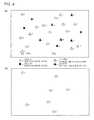
- FIGs. 4(a) and 4(b) are drawings illustrating the shops to be included into a course.
- FIG. 4(a) is a drawing illustrating the shops ranked at "1" to "4", contained in the shop information storage unit T3 illustrated in FIG. 2 .
- FIG. 4(b) is a drawing illustrating the shops ranked at "1". Symbols given to the individual shops correspond to the shop codes contained in the shop information storage unit T3 in FIG. 2 . In the description below, a shop assigned with shop code "a" will be expressed as "shop a".
- the shop selection unit 108 selects the shops "a" to “g” ranked at 1.
- the preliminary course creation unit 110 creates a preliminary course which contains the shops "a” to "g”.
- the order determination unit 112 determines an order along which the shops selected by the shop selection unit 108 are visited based on the time specification of the individual shops.
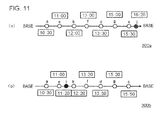
- FIGs. 5(a) to 5(d) are drawings illustrating procedures of determining an order along which the shops are visited, executed by the order determination unit 112. Each numeral surrounded by a broken line represents the reference time of each shop.
- the order determination unit 112 aligns the shops in increasing order of the assigned time zone, based on the reference time.
- FIG. 5(a) illustrates a state in which the shops "a", “b” and “d” characterized by a time zone of one hour are selected, and placed in line based on the reference time.
- the reference time of the shop “a” is 10:30
- the reference time of the shop “b” is 12:00
- the reference time of the shop “d” is 13:30, so that the shops are aligned in this order.
- the order determination unit 112 selects the shop "g” characterized by a time zone of two hours, which is the second narrowest, and places the shop next to the shop “d” while assuming the reference time as 15:00, as illustrated in FIG. 5(b) .
- the order determination unit 112 selects the shop "c” characterized by a time zone of three hours, which is the next narrowest, and placers the shop next to the shop “g” while assuming the reference time as 15:30, as illustrated in FIG. 5(c) .
- the shop “e” and the shop “f” are sequentially selected in a similar manner, and the individual shops are aligned in line as illustrated in FIG. 5(d) , to thereby create a preliminary course 300.
- the time calculation unit 120 calculates time of arrival to the individual shops contained in the preliminary course 300, when these shops are visited according to the order determined by the order determination unit 112, and the course time necessary for travelling round the course.
- FIG. 6 is a drawing illustrating the time of arrival to the individual shops calculated by the time calculation unit 120. In this example, all shops can be visited within the assigned time.
- numerals surrounded by squares in the drawing represent the time of arrival to the individual shops calculated by the time calculation unit 120.
- FIG. 7 is a drawing illustrating the shops ranked at "2".
- the frequency of delivery to the shops ranked at “2" is half of the frequency of delivery of the shops ranked at "1".
- the shops ranked at "2" may therefore be included only once every two rounds of delivery to the shops ranked at "1".
- the course refining unit 114 therefore duplicates the preliminary course 300 as illustrated in FIGs. 8(a) and 8(b) to thereby create a first duplicated course 300a and a second duplicated course 300b.
- the first duplicated course 300a and the second duplicated course 300b are same as the preliminary course 300.
- the first duplicated course 300a herein may be assumed as a first-week course
- the second duplicated course 300b may be assumed as a second-week course.
- the course refining unit 114 adds the shop either to the first duplicated course 300a or the second duplicated course 300b. To which course should the shop be added may be determined by the procedures below.
- the shop selection unit 108 may select shops from the shops “h” to "j", in increasing order of the assigned time zone. In this example, the shop selection unit 108 selects the shops "j", "i” and "h” in this order. Upon selection of the shop "j" by the shop selection unit 108, the order determination unit 112 determines in which order should the shop "j" be inserted in the course, while giving priority to the time specification of the shop "j". Since the first shop selected first will give the same state as a result of insertion thereof into whichever course of the first duplicated course 300a and the second duplicated course 300b, so that it is inserted into the first duplicated course 300a, for example.
- the order determination unit 112 determines in which order in each course should the shop “i” be inserted, while placing a priority on the time specification of the shop “i".
- the shop “i” has a reference time of 11:00.
- both of the first duplicated course 300a and the second duplicated course 300b already contain the shop "e” having the same reference time of 11:00.
- the order determination unit 112 determines insertion of the shop "i" to a location capable of maximizing the evaluation value, for each of the first duplicated course 300a and the second duplicated course 300b.
- the course refining unit 114 determines insertion of the shop "i" to either course capable of yielding a higher evaluation value, based on the decision that which of the first duplicated course 300a and the second duplicated course 300b yields a higher evaluation value after being inserted with the shop "i".
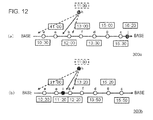
- the order determination unit 112 determines in which order in each course should the shop “h” be inserted, while placing a priority on the time specification of the shop “h". Since the reference time of the shop “h” is 11:30 as illustrated in FIGs. 12 (a) and 12(b) , it may be allowable for the order determination unit 112 to add the shop “h” typically between the shop “e” and the shop “b".
- the order determination unit 112 may alternatively select a plurality of locations to which the shop “h” is insertable, based on the time of arrival to the individual shops calculated by the time calculation unit 120, and the zone "10:00 to 13:00" of time specification of the shop “h”, and may determine insertion of the shop “h” to a location capable of yielding the highest evaluation value, based on the evaluation value evaluated by the evaluation processing unit 118 for the cases where the shop "h” is respectively inserted to each of the locations.
- the order determination unit 112 executes the process for each of the first duplicated course 300a and second duplicated course 300b.
- the course refining unit 114 determines insertion of the shop "h" to either course capable of yielding a higher evaluation value, based on a decision about which of the first duplicated course 300a and the second duplicated course 300b yields a higher evaluation value after being inserted with the shop "h".
- the shop “h” is inserted next to the shop “e” in the first duplicated course 300a yields the highest evaluation value.
- the first duplicated course 300a and the second duplicated course 300b are respectively given as illustrated in FIGs. 13 (a) and 13(b) .
- the time of arrivals to the shop "b" and the succeeding shops are delayed, due to insertion of the shop "h". In this way, selection of the shops up to those ranked at "2" completes.
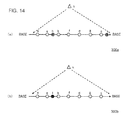
- FIGs. 15(a) and 15(b) are drawings illustrating states of addition of the shop "k" respectively to the first duplicated course 300a and the second duplicated course 300b.
- the order determination unit 112 determines a location where the shop is added, based on a decision about which location in the first duplicated course 300a and the second duplicated course 300b yields the highest evaluation value after being respectively inserted with the shop.
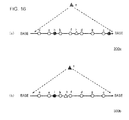
- FIGs. 17(a) and 17(b) are drawings illustrating an exemplary state of addition of the shop "t" to the second duplicated course 300b.
- the shop selection unit 108 sequentially selects the shops ranked at "4" until a predetermined condition is satisfied, and the order determination unit 112 determines to which location in each course should the shop be added, every time the shop selection unit 108 selects the shop, and the course refining unit 114 decides to which course should the shop be added, to thereby create the course.
- the course is thus creased by the processes described in the above.
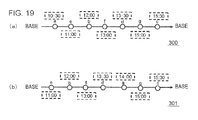
- FIGs. 19(a) and 19(b) are drawings illustrating an exemplary preliminary course.
- the preliminary course 300 illustrated in FIG. 19(a) relates to an exemplary case where the time specification of the shop "a” is assumed as 10:30, which is the reference time of the zone "10:00 to 11:00", similarly as explained referring to FIGs. 5 (a) to 5(d) .
- the preliminary course 301 illustrated in FIG. 19(b) relates to an exemplary case where the time specification of the shop "a” is assumed as 14:00, which is the reference time of the zone "13:00 to 15:00".
- the shop is assumed to have the respective time specifications assigned thereto, thereby a course is respectively created for each of the cases, and either one of the courses capable of yielding the higher evaluation value as a result of evaluation by the evaluation value calculation unit 124 may be adopted.
- a duplicated course is created also for the preliminary course 301, by the process similar to that explained with respect to the preliminary course 300 referring to FIG. 6 to FIGs. 17(a) and 17(b) , and either one of the cases using the preliminary course 300 and the preliminary course 301, capable of yielding the higher evaluation value of the course, may be adoptable.
- FIG. 20 is a flow chart illustrating procedures of the above-described process. First, for the case where a plurality of time specifications are assigned, the individual cases are categorized as described in the above (S100). The processes thereafter are executed for each case.
- the 2/4 shops assigned with the time specification and characterized by the next highest frequency of delivery are inserted (S120).
- the 2/4 shops herein are characterized by the frequency of delivery which is half of that of the 4/4 shops, so that it may be good enough for the 2/4 shops to be visited once every two rounds of delivery to the 4/4 shops. Accordingly, the preliminary course created in step S110 is duplicated to produce two duplicated courses, and the 2/4 shops are sequentially inserted while determining in which courses should the shops be included.
- the 4/4 shops not assigned with the time specification and characterized by a high frequency of delivery are selected and sequentially inserted into the duplicated courses (S130).
- the shops herein are characterized by the frequency of delivery same as that of the 4/4 shops assigned with the time specification and selected in step S110, and are necessarily included into all duplicated courses, where the location of insertion into each course is determined so that a higher evaluation value may be obtained.
- the 2/4 shops having no time specification and characterized by a low frequency of delivery are then selected, and sequentially inserted into the duplicated courses (S140). Since the frequency of delivery in this case is low, to which duplicated course created in step S120 should the shops be added is determined, so as to obtain a higher evaluation value. Thereafter, among the duplicated courses, any of those having an identical pattern is deleted (S150). This is a measure for avoiding overlapping in the improvement operations thereafter. The improvement operations described later are then executed (S160).
- the improvement processing unit 116 repeats a process of creating an improvement candidate course in which the order of visiting of the shops contained in the course created by the course refining unit 114 is modified, judging whether the evaluation value calculated by the revaluation value calculation unit 124 increases or not, and if it increases, determining the improvement candidate course as the improved course.
- the improvement processing unit 116 creates an improvement candidate course by reversing the order of shops contained in the course created by the course refining unit 114, from the order determined by the order determination unit 112.
- the shop capable of keeping either of the time specifications may be calculated as the shop capable of keeping the time specification.
- the smallest value of difference of time obtained with respect to any of the time specifications may be adoptable as a representative of the difference of time with respect to the assigned time of this shop.
- the improvement processing unit 116 relocates the shops characterized by low frequencies of delivery into a course different from the course currently selected, to thereby create an improvement candidate course.
- the evaluation value calculation unit 124 evaluates the improvement candidate course by the procedures below.
- FIG. 21 is a flow chart illustrating procedures of the operation by the improvement processing unit 116.
- the first improvement is executed (S200). In this process, if the evaluation value of the improvement candidate course is found to be higher (YES in S202), the improvement candidate course is determined as the improved course, and then adopted (S204). If the evaluation value of the improvement candidate course is not found to elevate but to remain unimproved (NO in S202), the original course is kept.
- the second improvement operation (S206), the third improvement operation (S208), and the fourth improvement operation (S210) are respectively executed. These operations may be executed in parallel, or may arbitrarily be selected and partially be executed. Whichever the case may be, the evaluation value of the improvement candidate course is calculated, and if the value is found to be improved (YES in S212), the improvement candidate course which yields the highest evaluation value is determined as an improved course, and adopted (S214). The improvement operation is repeated, and terminated if further improvement is found to be no more achievable (NO in S212), and thereby the course is determined (S216).
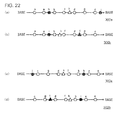
- FIG. 22 (c) is a drawing illustrating an improvement candidate course 302a, obtained by reversing the order of visiting in the first duplicated course 300a.
- the evaluation value for this case is calculated by the evaluation processing unit 118, and if the evaluation value is found to be larger than that of the first duplicated course 300a, the improvement candidate course 302a is adopted as the improved course of the first duplicated course 300a.
- FIG. 22 (d) is a drawing illustrating an improvement candidate course 302b, obtained by reversing the order of visiting in the second duplicated course 300b.
- the evaluation value for this case is calculated by the evaluation processing unit 118, and if the evaluation value is found to be larger than that of the second duplicated course 300b, the improvement candidate course 302b is adopted as the improved course of the second duplicated course 300b.
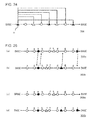
- FIG. 23(b) is a drawing illustrating an exemplary operation of selecting two shops and inserting them between other shops. Now two shops surrounded by broken line B are inserted to all locations indicated by arrows on the trial basis, the evaluation value is calculated by the evaluation processing unit 118 for each case, and the case capable of yielding the highest evaluation value is adopted as the improvement candidate course. If the evaluation value of the improvement candidate course is found to be higher than that of the original course, the improvement candidate course is adopted as the improved course.
- FIG. 23(c) is a drawing illustrating an exemplary operation of selecting three shops and inserting them between other shops. Now three shops surrounded by broken line C are inserted to all locations indicated by arrows on the trial basis, the evaluation value is calculated by the evaluation processing unit 118 for each case, and the case capable of yielding the highest evaluation value is adopted as the improvement candidate course. If the evaluation value of the improvement candidate course is found to be higher than that of the original course, the improvement candidate course is adopted as the improved course.
- FIG. 24 is a drawing explaining the third improvement operation.
- the shop "D" is selected, and all shops pointed by arrows are respectively replaced with the shop "D".
- the evaluation value is calculated by the evaluation processing unit 118 for each case, and the case capable of yielding the highest evaluation value is adopted as the improvement candidate course. If the evaluation value of the improvement candidate course is found to be higher than that of the original course, the improvement candidate course is adopted as the improved course. Replacement of the shop "D" with the adjacent shop may be omissible, since the operation gives the same result with the second improvement operation.
- FIGs. 25(a) to 25(d) are drawings explaining the fourth improvement operation.
- the shop "h”, the shop “j", the shop “i”, and the shop “t”, characterized by a low frequency of delivery are respectively relocated into the other course on the trial basis.
- the evaluation value is calculated by the evaluation processing unit 118 for each case. If the evaluation value is found to be higher than that of the original course, the relocated course is adopted as the improved course.
- FIG. 25(c) and FIG. 25(d) are drawings respectively illustrating improved course 308a and the improved course 308b, obtained by moving the shop "j", which was contained in the first duplicated course 300a before the improvement, into the second duplicated course 300b.
- course creation system 100 of this embodiment a course, which contains a plurality of delivery points characterized by different frequencies of delivery and assigned with or without time specification, may be created, so that the delivery points assigned with the time specification may be visited in a highly punctual and efficient manner.
- the individual constituents of the course creation system 100 illustrated in FIG. 1 represent blocks on the functional basis, rather than on the hardware basis.
- the individual constituents of the course creation system 100 may be embodied by arbitrary combinations of software and hardware, typically represented by CPU of arbitrary computer, memory, program which embodies the constituents in this drawing loaded on the memory, memory unit such as hard disk which stores the program, and so forth.
- CPU central processing unit
- memory volatile and non-volatile memory
- program which embodies the constituents in this drawing loaded on the memory
- memory unit such as hard disk which stores the program, and so forth.
- FIGs. 26(a) and 26(b) and FIG. 27 are drawings illustrating an example of this case of creating a shuttle course.
- a course similar to the first duplicated course 300a or the second duplicated course 300b is created, similarly as described in the above.
- An exemplary course is shown in FIG. 26 (a) .
- the shops up to which the quantity of commodity does not exceed the loadable quantity are detected respectively for the normal order and the reversed order. It is assumed now that, as illustrated in FIG.
- the shop “E” is the furthest shop up to which the quantity of commodity does not exceed the loadable quantity in the normal order
- the shop “F” is the furthest shop up to which the quantity of commodity does not exceed the loadable quantity in the reverse order.
- the quantity of commodities to be delivered to the shops contained in each course may be adjusted so as not to exceed the loadable quantity of commodity.
- FIG. 27 is a drawing illustrating an exemplary case where the course is divided into two courses for direction "A" and direction "B", to thereby create shuttle courses.
- the time calculation unit 120 may calculate the time taking this sort of time period into consideration.
- the shops of a certain rank can occupy may be set in advance, and attainment of that value may be defined as a predetermined condition. For example, if the shops ranked at 1 are selected up to the upper limit of the course time or the upper limit of the total quantity of commodity is reached, the course no longer possible to contain the shops ranked at lower levels. However, by preliminarily setting the predetermined condition for every level, the course is now able to contain the shops under various conditions in a well-balanced manner.
- the shop selection unit 108 may be configured to sequentially select the shops, typically based on information on location of the base, information on location of the individual shops, quantity of delivery of commodities to the individual shops, and so forth.
Landscapes
- Business, Economics & Management (AREA)
- Engineering & Computer Science (AREA)
- Human Resources & Organizations (AREA)
- Economics (AREA)
- Strategic Management (AREA)
- Entrepreneurship & Innovation (AREA)
- Development Economics (AREA)
- Marketing (AREA)
- Operations Research (AREA)
- Quality & Reliability (AREA)
- Tourism & Hospitality (AREA)
- Physics & Mathematics (AREA)
- General Business, Economics & Management (AREA)
- General Physics & Mathematics (AREA)
- Theoretical Computer Science (AREA)
- Game Theory and Decision Science (AREA)
- Educational Administration (AREA)
- Management, Administration, Business Operations System, And Electronic Commerce (AREA)
- Navigation (AREA)
Applications Claiming Priority (2)
| Application Number | Priority Date | Filing Date | Title |
|---|---|---|---|
| JP2008085113 | 2008-03-28 | ||
| PCT/JP2009/001180 WO2009119040A1 (ja) | 2008-03-28 | 2009-03-17 | コース作成システムおよびコース作成方法 |
Publications (2)
| Publication Number | Publication Date |
|---|---|
| EP2266902A1 true EP2266902A1 (de) | 2010-12-29 |
| EP2266902A4 EP2266902A4 (de) | 2011-06-29 |
Family
ID=41113251
Family Applications (1)
| Application Number | Title | Priority Date | Filing Date |
|---|---|---|---|
| EP09725397A Withdrawn EP2266902A4 (de) | 2008-03-28 | 2009-03-17 | Kurserzeugungssystem und kurserzeugungsverfahren |
Country Status (7)
| Country | Link |
|---|---|
| US (1) | US20110029449A1 (de) |
| EP (1) | EP2266902A4 (de) |
| JP (1) | JP5190110B2 (de) |
| KR (1) | KR20100134057A (de) |
| CN (1) | CN101980938A (de) |
| TW (1) | TW201003445A (de) |
| WO (1) | WO2009119040A1 (de) |
Families Citing this family (7)
| Publication number | Priority date | Publication date | Assignee | Title |
|---|---|---|---|---|
| JP5016115B2 (ja) * | 2008-09-29 | 2012-09-05 | 日本たばこ産業株式会社 | 配送コース数算出システムおよび配送コース数算出方法 |
| WO2013128558A1 (ja) * | 2012-02-28 | 2013-09-06 | 三菱電機株式会社 | ナビゲーション装置およびサーバ装置 |
| CN104751237A (zh) * | 2015-03-03 | 2015-07-01 | 厦门锐特信息技术有限公司 | 一种行程控制方法及装置 |
| JP7114031B2 (ja) * | 2018-07-20 | 2022-08-08 | Kii株式会社 | 巡回経路探索装置、巡回経路生成方法、及びプログラム |
| JP7163820B2 (ja) * | 2019-02-27 | 2022-11-01 | トヨタ自動車株式会社 | 情報処理装置、情報処理方法、及び、プログラム |
| CN112801586B (zh) * | 2021-01-29 | 2022-12-27 | 青岛海信智慧生活科技股份有限公司 | 一种物流末端配送方法、装置及计算设备 |
| KR102820459B1 (ko) * | 2022-08-17 | 2025-06-16 | 쿠팡 주식회사 | 배송 관련 정보 제공 방법 및 이를 위한 전자 장치 |
Family Cites Families (5)
| Publication number | Priority date | Publication date | Assignee | Title |
|---|---|---|---|---|
| US7139721B2 (en) * | 2000-05-10 | 2006-11-21 | Borders Louis H | Scheduling delivery of products via the internet |
| JP2003137438A (ja) * | 2001-11-05 | 2003-05-14 | Hitachi Ltd | 輸送計画作成方法およびシステム |
| JP3911225B2 (ja) | 2002-10-03 | 2007-05-09 | 日本たばこ産業株式会社 | エリア分割システム |
| JP2004250124A (ja) * | 2003-02-18 | 2004-09-09 | Japan Tobacco Inc | 配達エリアシミュレーションシステムおよびそのプログラムと方法 |
| JP4322156B2 (ja) * | 2004-03-31 | 2009-08-26 | 富士通株式会社 | 集配ルート設定方法および集配ルート設定プログラム |
-
2009
- 2009-03-17 CN CN2009801109935A patent/CN101980938A/zh active Pending
- 2009-03-17 JP JP2010505310A patent/JP5190110B2/ja active Active
- 2009-03-17 KR KR1020107023502A patent/KR20100134057A/ko not_active Ceased
- 2009-03-17 WO PCT/JP2009/001180 patent/WO2009119040A1/ja not_active Ceased
- 2009-03-17 US US12/934,883 patent/US20110029449A1/en not_active Abandoned
- 2009-03-17 EP EP09725397A patent/EP2266902A4/de not_active Withdrawn
- 2009-03-19 TW TW098108974A patent/TW201003445A/zh unknown
Non-Patent Citations (2)
| Title |
|---|
| See also references of WO2009119040A1 * |
| The technical aspects identified in the present application (Art. 56 EPC) are considered part of common general knowledge. Due tot heir notoriety no documentary evidence is found to be required. For further details see the accompanying Opinion and the reference below. XP002456414 * |
Also Published As
| Publication number | Publication date |
|---|---|
| KR20100134057A (ko) | 2010-12-22 |
| WO2009119040A1 (ja) | 2009-10-01 |
| JP5190110B2 (ja) | 2013-04-24 |
| EP2266902A4 (de) | 2011-06-29 |
| JPWO2009119040A1 (ja) | 2011-07-21 |
| CN101980938A (zh) | 2011-02-23 |
| TW201003445A (en) | 2010-01-16 |
| US20110029449A1 (en) | 2011-02-03 |
Similar Documents
| Publication | Publication Date | Title |
|---|---|---|
| EP2266902A1 (de) | Kurserzeugungssystem und kurserzeugungsverfahren | |
| EP2345990A1 (de) | System zur unterstützung der bestimmung eines liefersystems, system zur erzeugung einer lieferroute, verfahren zur unterstützung der bestimmung eines liefersystems und verfahren zur erzeugung einer lieferroute | |
| US7813961B2 (en) | System and method for planning, allocation, and purchasing | |
| JP2011198353A (ja) | 作業者割付装置、作業者割付プログラム、作業者割付システム及び作業者割付方法 | |
| Michel et al. | A column-generation based tactical planning method for inventory routing | |
| KR100691642B1 (ko) | 에어리어 분할시스템 | |
| JP5016115B2 (ja) | 配送コース数算出システムおよび配送コース数算出方法 | |
| US20250173634A1 (en) | Delivery plan creation system, method, and program | |
| JP4610161B2 (ja) | コース作成システムおよびコース作成方法 | |
| Zhao et al. | Managing Multitier Inventory Networks with Expediting Under Normal and Disrupted Modes | |
| KR100742683B1 (ko) | 에어리어 분할 시스템 | |
| JP5870637B2 (ja) | 運用支援方法および運用支援装置 | |
| JP4801132B2 (ja) | コース作成システムおよびコース作成方法 | |
| JP2004110341A (ja) | エリア分割方法 | |
| JP2023157662A (ja) | 配送計画生成装置、および配送計画生成方法 | |
| CN114169488A (zh) | 基于混合元启发式算法的带容量约束的车辆路径获取方法 | |
| JP4055987B2 (ja) | 経路調整装置 | |
| Kogan | Scheduling parallel machines by the dynamic newsboy problem | |
| JP2023155962A (ja) | 配送計画作成システム、配送計画作成方法および配送計画作成プログラム | |
| van den Heuvel | A two stage approach to solving a robust vehicle routing problem under demand uncertainty | |
| JP4364507B2 (ja) | コース作成システムおよびコース作成方法 | |
| JP4278375B2 (ja) | コース作成システムおよびコース作成方法 | |
| Cederhout | The impact on the final delivery schedule of different procedures that handle arriving customers during route optimization in a realtime Dynamic Time Slot Management system | |
| JP2023155961A (ja) | 配送計画作成システム、配送計画作成方法および配送計画作成プログラム | |
| JP2003137438A (ja) | 輸送計画作成方法およびシステム |
Legal Events
| Date | Code | Title | Description |
|---|---|---|---|
| PUAI | Public reference made under article 153(3) epc to a published international application that has entered the european phase |
Free format text: ORIGINAL CODE: 0009012 |
|
| 17P | Request for examination filed |
Effective date: 20101012 |
|
| AK | Designated contracting states |
Kind code of ref document: A1 Designated state(s): AT BE BG CH CY CZ DE DK EE ES FI FR GB GR HR HU IE IS IT LI LT LU LV MC MK MT NL NO PL PT RO SE SI SK TR |
|
| AX | Request for extension of the european patent |
Extension state: AL BA RS |
|
| REG | Reference to a national code |
Ref country code: DE Ref legal event code: R079 Free format text: PREVIOUS MAIN CLASS: B65G0061000000 Ipc: G06Q0010000000 |
|
| A4 | Supplementary search report drawn up and despatched |
Effective date: 20110527 |
|
| RIC1 | Information provided on ipc code assigned before grant |
Ipc: G06Q 50/00 20060101ALI20110523BHEP Ipc: G06F 19/00 20110101ALI20110523BHEP Ipc: B65G 61/00 20060101ALI20110523BHEP Ipc: G06Q 10/00 20060101AFI20110523BHEP |
|
| DAX | Request for extension of the european patent (deleted) | ||
| STAA | Information on the status of an ep patent application or granted ep patent |
Free format text: STATUS: THE APPLICATION HAS BEEN WITHDRAWN |
|
| 18W | Application withdrawn |
Effective date: 20130306 |