EP2267709A2 - Aufzeichnungsgerät und -verfahren sowie plattenförmiges Aufzeichnungsmedium - Google Patents
Aufzeichnungsgerät und -verfahren sowie plattenförmiges Aufzeichnungsmedium Download PDFInfo
- Publication number
- EP2267709A2 EP2267709A2 EP10182171A EP10182171A EP2267709A2 EP 2267709 A2 EP2267709 A2 EP 2267709A2 EP 10182171 A EP10182171 A EP 10182171A EP 10182171 A EP10182171 A EP 10182171A EP 2267709 A2 EP2267709 A2 EP 2267709A2
- Authority
- EP
- European Patent Office
- Prior art keywords
- data
- recorded
- area
- recording
- bit map
- Prior art date
- Legal status (The legal status is an assumption and is not a legal conclusion. Google has not performed a legal analysis and makes no representation as to the accuracy of the status listed.)
- Withdrawn
Links
Images




Classifications
-
- G—PHYSICS
- G11—INFORMATION STORAGE
- G11B—INFORMATION STORAGE BASED ON RELATIVE MOVEMENT BETWEEN RECORD CARRIER AND TRANSDUCER
- G11B20/00—Signal processing not specific to the method of recording or reproducing; Circuits therefor
-
- G—PHYSICS
- G11—INFORMATION STORAGE
- G11B—INFORMATION STORAGE BASED ON RELATIVE MOVEMENT BETWEEN RECORD CARRIER AND TRANSDUCER
- G11B27/00—Editing; Indexing; Addressing; Timing or synchronising; Monitoring; Measuring tape travel
- G11B27/10—Indexing; Addressing; Timing or synchronising; Measuring tape travel
- G11B27/19—Indexing; Addressing; Timing or synchronising; Measuring tape travel by using information detectable on the record carrier
- G11B27/28—Indexing; Addressing; Timing or synchronising; Measuring tape travel by using information detectable on the record carrier by using information signals recorded by the same method as the main recording
- G11B27/32—Indexing; Addressing; Timing or synchronising; Measuring tape travel by using information detectable on the record carrier by using information signals recorded by the same method as the main recording on separate auxiliary tracks of the same or an auxiliary record carrier
- G11B27/327—Table of contents
- G11B27/329—Table of contents on a disc [VTOC]
-
- G—PHYSICS
- G11—INFORMATION STORAGE
- G11B—INFORMATION STORAGE BASED ON RELATIVE MOVEMENT BETWEEN RECORD CARRIER AND TRANSDUCER
- G11B20/00—Signal processing not specific to the method of recording or reproducing; Circuits therefor
- G11B20/10—Digital recording or reproducing
- G11B20/12—Formatting, e.g. arrangement of data block or words on the record carriers
- G11B20/1217—Formatting, e.g. arrangement of data block or words on the record carriers on discs
-
- G—PHYSICS
- G11—INFORMATION STORAGE
- G11B—INFORMATION STORAGE BASED ON RELATIVE MOVEMENT BETWEEN RECORD CARRIER AND TRANSDUCER
- G11B20/00—Signal processing not specific to the method of recording or reproducing; Circuits therefor
- G11B20/10—Digital recording or reproducing
- G11B2020/10861—Finalising a record carrier after a recording operation, e.g. to ensure compatibility with a ROM medium
-
- G—PHYSICS
- G11—INFORMATION STORAGE
- G11B—INFORMATION STORAGE BASED ON RELATIVE MOVEMENT BETWEEN RECORD CARRIER AND TRANSDUCER
- G11B20/00—Signal processing not specific to the method of recording or reproducing; Circuits therefor
- G11B20/10—Digital recording or reproducing
- G11B2020/10916—Seeking data on the record carrier for preparing an access to a specific address
-
- G—PHYSICS
- G11—INFORMATION STORAGE
- G11B—INFORMATION STORAGE BASED ON RELATIVE MOVEMENT BETWEEN RECORD CARRIER AND TRANSDUCER
- G11B20/00—Signal processing not specific to the method of recording or reproducing; Circuits therefor
- G11B20/10—Digital recording or reproducing
- G11B20/12—Formatting, e.g. arrangement of data block or words on the record carriers
- G11B2020/1264—Formatting, e.g. arrangement of data block or words on the record carriers wherein the formatting concerns a specific kind of data
- G11B2020/1265—Control data, system data or management information, i.e. data used to access or process user data
- G11B2020/1277—Control data, system data or management information, i.e. data used to access or process user data for managing gaps between two recordings, e.g. control data in linking areas, run-in or run-out fields, guard or buffer zones
-
- G—PHYSICS
- G11—INFORMATION STORAGE
- G11B—INFORMATION STORAGE BASED ON RELATIVE MOVEMENT BETWEEN RECORD CARRIER AND TRANSDUCER
- G11B20/00—Signal processing not specific to the method of recording or reproducing; Circuits therefor
- G11B20/10—Digital recording or reproducing
- G11B20/12—Formatting, e.g. arrangement of data block or words on the record carriers
- G11B2020/1264—Formatting, e.g. arrangement of data block or words on the record carriers wherein the formatting concerns a specific kind of data
- G11B2020/1265—Control data, system data or management information, i.e. data used to access or process user data
- G11B2020/1285—Status of the record carrier, e.g. space bit maps, flags indicating a formatting status or a write permission
Definitions
- the present invention relates to a recording apparatus for use with an optical disc or the like, a recording method thereof, and a disc-shaped recording medium.
- Disc-shaped record mediums for example, DVDs
- DVDs can be categorized as rewritable mediums (DVD+RW) and read-only mediums (DVD-ROM) depending on their characteristics. Since their physical formats are similar, it is preferable to allow a DVD-ROM drive to reproduce data from a DVD+RW disc.
- the DVD+RW drive and the DVD-ROM drive in a spindle servo signal and a method for obtaining a position signal (address) of a medium.
- the DVD+RW disc has a wobbling groove.
- the DVD+RW drive obtains a position signal from a reproduced signal of the wobbling groove.
- the DVD-ROM disc does not have such a wobbling groove.
- the DVD-ROM drive obtains a position signal from a frame synchronous signal and an address signal reproduced from the DVD-ROM disc.
- a frame synchronous signal and a position signal are placed in data of the DVD+RW disc.
- the DVD+RW disc has a non-recorded portion before or after recorded data, it is difficult for the DVD-ROM drive to reproduce data from the DVD+RW disc.
- the DVD-ROM drive cannot reproduce the frame synchronous signal from the DVD+RW disc, the DVD-ROM cannot stably operate the spindle servo and perform the seek operation for reading a desired sector from the DVD+RW disc.
- the seek operation is performed in a combination of a coarse seek operation and a fine seek operation.
- a coarse servo operation many tracks are jumped at a time.
- a fine servo operation a desired sector is acquired in the vicinity of a target position. Due to the eccentricity of the disc, when the seek operation is performed in the fine servo operation, a deviation of several ten tracks to several hundred tracks normally takes place. If the jumped position is a non-recorded area, the target track cannot be acquired.
- the seek operation is performed, data containing a frame synchronous signal and a position signal should have been recorded in the vicinity of the target sector.
- the finalizing process can be performed in the following two methods.
- a file system is analyzed.
- a file system has a space bit map for allocating a user area.
- a UDF system that is often used for DVD discs has a space bit map and information that represents whether or not each entry of each file has been recorded.
- a position of user data namely, a position to which dummy data should be written
- This method is performed by an application program of a host computer.
- a blank area is detected.
- all blocks of the DVD+RW disc are read.
- a block can be read, it is treated as a recorded block.
- the hardware of the drive determines whether an RF signal is absent (namely, data has been recorded) or data that has been recorded cannot be reproduced.
- the RF signal cannot be obtained, since data has not been recorded, dummy data is recorded. Even if the RF signal is obtained, when data cannot be read, the drive determines whether the relevant block is unchanged or dummy data is overwritten depending on the amount of an ECC error or the like.
- the first method (for analyzing a file system for use) can be effectively performed as long as the number of directories/files is small. However, when the number of directories/files is as large as several thousands, it takes a long time to perform the process. Thus, this method is not effective. In the file system other than the UDF system, this method cannot be used because available information is limited to allocation information. In other words, depending on a file system for use, the feasibility of this method is restricted.
- the second method (for detecting a blank area) can be used regardless of a file system for use. However, since all blocks of the disc should be read, it takes a long time to perform the process.
- a certificateing process may be required.
- a certification pattern is recorded on the entire disc. By reproducing the data, it is determined whether or not there is a defect on the disc.
- the finalizing process is not required.
- the storage capacity of the DVD+RW disc is large, it takes around one hour to perform the certificating process.
- this method is not effective, it is improper to require the user to perform the certificating process.
- a recording apparatus for use with a disc- shaped record medium having a user data area and a management area, comprises recording means for recording at least one conventional bit map that represent whether or not each data unit for recording/reproducing has been recorded; and processing means for recording the bit map to the management area of the disc-shaped record medium (1), and referencing the bit map and adding a predetermined amount of data that contains at least one of servo information and position information to a non-recorded area in the vicinity of recorded data so as to allow a reproducing apparatus that reproduces data from a read-only disc-shaped medium and obtains at least one of the servo information and the position information from a reproduced signal to reproduce data from a rewritable disc-shaped record medium.
- the management area has a plurality of conventional bit maps and an update counter each of the bit maps has a value of an update counter that represents the number of update times of each of bit maps, and the processing means rewriting the plurality of bit maps successively and rewriting the value of the update counters of the bit map rewritten corresponding to what represents the number of update times.
- the management area has a plurality of the bit map, and the processing means rewrites redundantly the plurality of bit maps at a time.
- the management area having user data bit map which the conventional bit map is paired with, and the user data bit map represents whether or not the user data has been recorded for each record/reproduction data unit.
- the conventional bit map comprises a user data bit map
- the user data bit map has a first bit and a second bit for each record/reproduction data unit, and one of the first bit and the second bit represents whether or not each record/reproduction data unit has been recorded and the other of the first bit and the second bit represents whether or not the user data has been recorded for each record/reproduction data unit.
- the recording means stores bit map data corresponding to the conventional bit map
- the processing means performs an updating process which rewrites the bit map data whenever a write operation is performed and which records the bit map data to the management area at a predetermined timing of which a write operation and a read operation are not performed.
- the predetermined timing is an eject state of the disc-shaped record medium.
- the predetermined timing is a flush cache state.
- the predetermined timing is a background state in which a command is not received from the outside of the recording apparatus.
- the processing means references the bit map, lists up a non-recorded area in the vicinity of recorded data, and records a predetermined amount of data that contains at least one of the servo information and the position information to the verified non-recorded area after verifying the non-recorded state of the non-recorded area by reproducing the listed non-recorded area.
- the processing means verifies whether or not a partial area preceded by a recorded area is a non-recorded area before performing a write operation by referencing the bit map.
- the processing means performs a write operation for the verified non-recorded area without performing a read operation of a read modified write operation.
- a recording method for use with a disc-shaped record medium 1 having a user data area and a management area comprising the steps of: creating a bit map composed of bits that represent whether or not each record/reproduction data unit has been recorded; recording the bit map to the management area of the disc-shaped record medium; and referencing the bit map and adding a predetermined amount of data that contains at least one of servo information and position information to a non-recorded area in the vicinity of recorded data so as to allow a reproducing apparatus that reproduces data from a read-only disc-shaped medium and obtains at least one of the servo information and the position information from a reproduced signal to reproduce data from a rewritable disc-shaped record medium.
- a disc-shaped record medium having a first rewritable area for recording user data and a second rewritable area for recording management data, wherein at least one of servo information and position information is pre-recorded as wobbling information in a wobbling groove, and wherein the second rewritable area has a bit map that represents whether or not each data unit for recording/reproducing for the first rewritable area has been recorded.
- dummy data is added in the vicinity of recorded data in the first rewritable area and the second rewritable area.
- the dummy data has servo information and position information which are necessary for a reproducing apparatus that reproduces data from a read-only disc-shaped medium.
- a phase change type disc is used as a rewritable optical disc.
- two discs whose diameters are 120 mm and whose thicknesses are 0.6 mm are adhered to form a rewritable optical disc.
- the rewritable optical disc has a wobbling groove.
- the wobbling groove is wobbled with a signal of which an address (a position signal) is wobbled.
- a clock signal for signal processing and an absolute address on the disc can be extracted from the reproduced signal of the wobbling groove.
- the disc is rotated at CAV (Constant Angular Velocity).
- Data is recorded in a groove.
- CAV Constant Angular Velocity
- Data is recorded at CLD (Constant Linear Density) on the disc.
- the linear density is 0.35 ⁇ m/bit.
- a predetermined range of linear densities is designated.
- a rewritable area of the disc is divided into many zones. In each zone, a linear density is defined.
- This type of disc is referred to as DVD+RW disc.
- the present invention is not limited to a DVD+RW disc.
- the present invention can be applied to optical discs such as a groove/land record type disc and a magnetic optical (MO) record disc.
- reference numeral 1 is a phase change type optical disc.
- the optical disc 1 is rotated at CAV by a spindle motor 2.
- An optical pickup 3 is disposed so as to record data on the optical disc 1 and to reproduce data therefrom.
- Data of an external host processor 10 is supplied to the disc drive through an interface 4.
- a controller 5 is connected to the interface 4.
- a buffer memory 6 is connected to the controller 5.
- the buffer memory 6 stores write data or read data.
- Write data is supplied from the controller 5 to an encoder 7.
- the encoder 7 converts the write data into sector-structured data, encodes each ECC block that is composed of 16 sectors with an error correction code, and adds a frame synchronous signal and a linking section.
- the frame-structured data is supplied to a recording system 8.
- the recording system 8 performs a digital modulating process and so forth.
- the recording system 8 supplies record data to a laser drive 9.
- the laser drive 9 generates a drive waveform corresponding to a predetermined level necessary for recording data to the optical disc 1.
- Output data of the laser drive 9 is supplied to the optical pickup 3.
- the optical pickup 3 reproduces data on the optical disc 1.
- the reproduced data is detected by a photo detector.
- the detected signal is supplied to an amplifying circuit 11.
- An output signal of the amplifying circuit 11 is supplied to a reproducing system 12 and a servo system 14.
- the amplifying circuit 11 calculates the detected signal of the photo detector and generates an RF signal, a tracking error signal, and a focus error signal.
- the RF signal is supplied to a reproducing system 12.
- the tracking error signal and the focus error signal are supplied to a servo system 14.
- the reproducing system 12 performs a digital demodulating process.
- the reproducing system 12 processes a reproduced signal of a wobbling groove and demodulates an address.
- the separated frame synchronous signal and the address are supplied to the servo system 14.
- the servo system 14 performs a tracking servo operation and a focus servo operation for the optical pickup 3.
- the servo system 14 performs a spindle servo operation and a sled servo operation for the optical pickup 3. In the sled servo operation, the servo system 14 moves the optical pickup 3 in the radius direction of the disc.
- the reproduced data of the reproducing system 12 is supplied to a decoder 13.
- the decoder 13 decodes an error correction code (namely, corrects an error of the reproduced data), disassembles the reproduced data into sector-structured data, and performs another process.
- the reproduced data of the decoder 13 is supplied to the controller 5. Thereafter, the reproduced data is stored in the buffer memory 6.
- read data is sent to the host processor 10 through the interface 4.
- a CPU 21 To drive the entire operation of the disc drive, a CPU 21 is disposed. A RAM 23 and a ROM 24 are connected to the CPU 21 through a bus 22. The ROM 24 stores a program. A reproduced address of the reproducing system 12 is supplied to the bus 22. In addition, the controller 5 is connected to the bus 22.
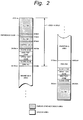
- Fig. 2 shows the structure of areas from the inner periphery side (lead-in side) to the outer periphery side (lead-out side) of the disc.
- the radius position and absolute address (in hexadecimal notation) of each area of the disc are denoted on the left side and the right side of the diagram.
- Emboss pits are recorded in the hatched areas on the innermost periphery side (from radius position 22.6 mm to radius position 24.0 mm) and the outermost periphery side (after radius position 58.00 mm).
- emboss area also referred to as ROM area
- all "00h” data, a reference code for 2 ECC blocks (from absolute address "2F00h"), and 186 blocks of control data (from absolute address "2F200h”) are recorded.
- An ECC block is a data unit that composes an error correction block.
- Control data and reference code are recorded when a master disc is cut.
- the control data and reference code are read-only pit data.
- the control data includes physical management information and so forth of the optical disc.
- Areas other than the emboss area are rewritable areas of which tracks are formed with grooves (namely, groove area).
- a user area is from radius position 24.19 mm to radius position 57.9 mm (from absolute address "31000h” to absolute address "1A0BFh").
- a guard zone In the rewritable areas on the inner periphery side and the outer periphery side of the user area, a guard zone, a disc test zone, a drive test zone, and a DMA (defect management area) are formed.
- the guard zone is formed so as to allow data written to the disc test zone and DMA to synchronize with a write clock.
- the disc test zone is formed so as to check the disc condition.
- the drive test zone is formed so as to check the condition of the recording/reproducing drive.
- DMA1 and DMA2 are formed on the inner periphery side of the disc.
- DAM3 and DAM4 are formed on the outer periphery side of the disc. Same information is recorded in each of the DMA1 to DMA4.
- a detected result of a defect in the recordable area and information of a substitute sector are recorded in the DMA. Since the recording/reproducing operation is performed with reference to the contents of the DMA, a defective area can be skipped.
- the inner periphery areas of the rewritable area (other than the user area) and the emboss area on the innermost periphery side structure a lead-in area as a management area.
- tracks are pre-formed with wobbling grooves.
- the wobbling grooves represent absolute addresses.
- the recording/reproducing apparatus can obtain information of absolute addresses and so forth with reproduced signals of grooves.
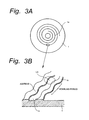
- Figs. 3A and 3B show examples of the structure of grooves of the optical disc 1. As shown in Fig. 3A , a pre-groove is spirally formed from the inner periphery to the outer periphery in a groove area of the optical disc 1.
- the left and right side walls of the pre-groove 1a are wobbled corresponding to address information.
- the pre-groove 1a is wobbled at a predetermined period of a wobbling signal generated corresponding to an address.
- a land 1b is formed between adjacent grooves 1a.
- Data is recorded on a groove 1a.
- the track pitch is the distance between the centers of adjacent grooves 1a.
- the track pitch is for example 0.8 ⁇ m.
- the groove width (the width of the bottom portion of each groove 1a) is for example 0.48 ⁇ m.
- the width of each groove 1a is larger than the width of each land 1b.
- the wobbling amount of each groove 1a is defined as the value of the wobble width WW.
- the wobble width WW is 12.5 nm.
- One track (one turn of the disc) has a plurality of wobbling address frames.
- Each wobbling address frame is divided into eight portions in the direction of the rotation of the disc.
- the eight portions are servo elements (segment 0 to segment 7).
- Each servo segment (hereinafter simply referred to as segment) contains 48-bit information that is mainly an absolute address.
- the wobbling of each segment is composed of 360 waves.
- Fine clock marks are formed on a wobbling groove at equal intervals. With the fine clock marks, a PLL circuit generates a reference clock signal so as to record data. 96 fine clock marks are formed per rotation of the disc. Thus, 12 fine clock marks are formed per segment.
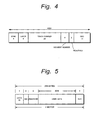
- Fig. 4 shows the structure of each wobbling address frame as segments (segment 0 to segment 7).
- the first four bits are used for a synchronous signal that represents the start of the wobbling address frame.
- the four-bit synchronous pattern is bi-phase data of which four-bit data is composed of eight channel bits.
- the next four bits are used for layer information that represents a layer number of a plurality of record layers or a layer structure of the disc.
- the next 20 bits are used for a track address (track number) as an absolute address.
- the next four bits are used for a segment number.
- the segment number is a value in the range from "0" to "7" corresponding to segment 0 to segment 7. In other words, the segment number represents the circumference position of the disc.
- the next two bits are reserved.
- an error detection code CRC
- fine clock marks are formed in each wobbling address frame at equal intervals.
- ECC Error Correction Code
- One sector is composed of for example 2 kbytes.
- One block is composed of for example 32 kbytes.
- Fig. 5 shows the structure of one sector.
- the data ID contains a track number and a sector number corresponding to an address of the wobbling groove.
- the IED is an error detection parity corresponding to a data ID (for example, CRC).
- the EDC is an error detection parity (for example, CRC) that is used so as to determine whether or not user data that has been error-corrected has an error.
- an ECC block shown in Fig. 6 is composed. Each sector is composed of 2064 bytes (172 bytes x 12).
- 16 sectors each of which is composed of 172 bytes x 12
- the user data of 192 x 172 bytes is encoded with a product code.
- data of each line (172 bytes) is encoded with an inner code (for example, Reed Solomon code).
- an inner code parity of 10 bytes (PI) is generated.
- data of each column (192 bytes) is encoded with an outer code (for example, Reed Solomon code).
- an outer code parity of 16 bytes (PO) is generated.
- a frame synchronous signal (FS) of two byes is added.
- data of one frame is composed of a total of 93 bytes. Consequently, one block is composed of 221 (rows) x 93 x 2 bytes.
- one block (record/reproduction data unit) is composed of 442 frames.
- one block is composed of 16 sectors.
- One sector is composed of 26 frames.
- a linking section is formed between two adjacent blocks. The linking section functions as an area for allowing data that is recorded or reproduced to synchronize with a clock signal.
- the present invention relates to a finalizing process necessary for allowing a ROM drive (for example, a DVD-ROM drive) to reproduce data from an optical disc (for example, a DVD+RW disc).
- the data has been recorded on the optical disc by the above-described drive.
- Fig. 9 shows the concept of the finalizing process according to the present invention.
- data is recorded as blocks in a user area of a rewritable area in which a wobbling groove is formed.
- the DVD-ROM drive accesses the DVD+RW disc and reads data therefrom, the DVD-ROM drive repeats a coarse seek operation and a fine seek operation several times and obtains a target track.
- the DVD-ROM drive performs the spindle servo operation and reads the data ID of each sector, if the data ID has not been recorded, the DVD-ROM drive cannot obtain a frame synchronous information as servo information. In this case, the spindle servo becomes out-of-control state.
- the DVD-ROM drive cannot obtain position information.
- the DVD-ROM drive should always seek a recorded data area.
- the finalization data contains servo information (frame synchronous signal) and position information (ID).
- Fig. 9 shows an example of the state of which as the result of the finalizing process, finalization data is recorded before and after a recorded area of a user area, a rewritable area (test zone, DMA, and so forth) of a lead-in area, and a rewritable area (DMA) of a lead-out area.
- the data amount of finalization data that is recorded is equivalent to the width of several hundred tracks although it depends on the seek accuracy of the drive, the amount of eccentricity of the disc, and so forth.
- a bit map table that has bits that correspond to all blocks of the rewritable area and that represent whether the relevant blocks are recorded blocks or non-recorded blocks is created.
- a recorded block and a non-recorded block are denoted by "1" and "0", respectively.
- WBBM Write Block Bit Map
- the CPU 21 receives information corresponding to a write command from the controller 5. Under the control of the CPU 21, a WBBM is formed in the RAM 23. At a predetermined timing (that will be described later), the CPU 21 reads the WBBM from the RAM 23. The controller 5 records the WBBM to a predetermined area of the lead-in area of the optical disc 1 as with the user data. When the user issues to the host processor 10 (or the disc drive) a command for executing the finalizing process that causes, the command is sent to the CPU 21. Thus, the CPU 21 causes the disc drive to write a predetermined amount of finalization data before and after each recorded block corresponding to the latest WBBM.
- the WBBM is placed in the lead-in area along with a test zone, a DMA, and so forth.
- the WBBM can be placed in the range from 30000h to 31000h of the lead-in area.
- Guard zones are preferably placed before and after the WBBM.
- the finalizing process can be performed with one WBBM.
- WBBM-1 to WBBM-N it is very effective to provide a plurality of WBBMs (WBBM-1 to WBBM-N). Since the number of times of the write operation is limited in phase change type disc mediums (around 100,000 times), if the write operation is repeatedly performed in the same area, the life of the medium is shortened.
- one block is composed of 16 sectors (32 kbytes). Since one DVD+RW disc has a storage capacity of around 3 Gbytes, the disc has 90,000 to 100,000 blocks. When each block is correlated with one bit, a bit map of around 12 kbytes is required. By adding management information to the bit map, one WBBM is structured. When a WBBM is recorded on the disc, as with user data, an encoding process with a product code and a frame structuring process are performed. In other words, one ECC block is composed of one WBBM.
- a WBBM identifier in one WBBM, a WBBM identifier, a ring number, an update counter, and zone information are added to bit map data.
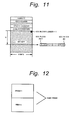
- the bit map is composed of bytes.
- the upper right corner of the bit map represents a bit corresponding to a block of which the ECC block number is 1.
- the ECC block number increases in the left direction of each byte.
- the ECC block number increases in the lower direction of the bit map.
- the left portion of Fig. 11 shows an enlarged view of the N-th byte.
- the N-th byte includes bits whose ECC block numbers are 8N to 8N+7.
- a bit whose value is "0" represents that an ECC block corresponding thereto is a non-recorded block.
- a bit whose value is "1” represents that an ECC block corresponding thereto is a recorded block.
- the management information includes the following items each of which is composed of one byte.
- WBBM identifier A numeric value representing that a relevant ECC block is a WBBM (for example, 0C0Ch).
- Ring number Represents the number of WBBMs that are treated as one set and the order of a particular WBBM in the set.
- Update counter A value that is incremented whenever a WBBM is updated.
- a WBBM with the maximum value of the update counter in the set of WBBMs is determined as the latest WBBM.
- a WBBM with the minimum value of the update counter is updated to the latest WBBM.
- Zone information When the finalizing process is performed, it is not effective to check all bits. To solve such a problem, all the rewritable area is divided into a plurality of zones. When data has been written to all blocks of each zone, a flag that represents that data has been recorded to all blocks is set. Once the flag is set, the finalizing process is not performed for the zone.
- a plurality of WBBMs with the same content may be written. In this case, whenever a WBBM is updated, all the WBBMs are rewritten.
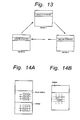
- Fig. 13 shows an example of the ring structure of a plurality of WBBMs (WBBM-1, WBBM-2, ..., and WBBM-N).
- the update counter of each WBBM is initialized to for example "0".
- the WBBM-1 is updated, the value of only the update counter thereof becomes "1".
- the WBBM-2 is updated, the value of only the update counter thereof becomes "2".
- the WBBM-3 is updated, the value of only the update counter thereof becomes "3".
- a WBBM with the minimum value of the update counter is updated. If the values of the update counters of two WBBMs are the same, a WBBM with a lower WBBM number is updated.
- a WBBM with the maximum value of the update counter is determined as the latest WBBM.
- the WBBM is effective information.
- the ECC block is checked before finalization data is written to an ECC block that is determined as an non-recorded block corresponding to the WBBM. Even if the bit corresponding to the ECC block is incorrect, since the finalization data is written, recorded data is not destroyed.
- later WBBMs remain.
- a WBBM with the maximum value of the update counter is defined as the latest WBBM, when the drive spins up and reads a WBBM, it can determine the latest WBBM.
- the medium can be suppressed from deteriorating.
- a method for creating a plurality of WBBMs with the same content can be used (redundant write operation (see Fig. 12 )).
- This method is the simplest countermeasures against a power failure.
- the values of all the update counters should be the same. If the counter value of a particular WBBM is different from the counter values of the other WBBMs, it can be supposed that while a WBBM was being updated, a power failure took place. In this case, a WBBM with a larger value of the update counter is the latest WBBM.
- the ring structure and the redundant write operation can be used together.
- a WBBM user data map
- conventional WBBM WBBM
- a bit "1" is set to a block to which user data is written.
- a bit corresponding to a block to which finalization data is written is still "0".
- a DVD+RW drive can write data to the DVD+RW disc.
- finalization data should be written to the DVD+RW disc. Since a conventional WBBM is composed of a bit map of user data and a bit map of finalization data (namely, the WBBM represents whether recorded blocks), the user data and the finalization data cannot be distinguished with the WBBM. As a result, finalization data is redundantly written. On the other hand, with both a user WBBM and a conventional WBBM, finalization can be prevented from being redundantly written.
- a portion corresponding to each block on the bit map may be composed of two bits so as to distinguish a record block of user data and a record block of finalization data as shown in Fig. 14B .
- a WBBM is written to a predetermined area of the lead-in area of the DVD+RW disc.
- a blank DVD+RW disc is formatted, if the certificating process is not performed, all the user area becomes non-recorded state. On the other hand, if the certificating process is performed, all the user area becomes recorded state.
- the DVD+RW disc is reformatted, since recorded data resides in the user area, the existing WBBM is used.
- a WBBM is read to a memory (RAM 23 shown in Fig. 1 ) of the drive.
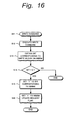
- Fig. 15 is a flow chart showing a process of the CPU 21 performed when a medium is loaded to the drive.
- the medium is loaded to the drive.
- the drive spins up and reproduces a DMA and a WBBM in the lead-in area.
- the drive reads the first WBBM (at step S3) and checks the ring number (management information) of the WBBM (at step S4).
- the drive When the WBBM is ring-structured, since there are a plurality of WBBMs, the drive reads all WBBMs in the RAM 23 and reads values of update counters thereof (at step S5). The drive compares the values of the update counters of all the WBBMs and leaves a WBBM with the maximum value of the update counter in the RAM 23 (at step S6). When the certificating process has been completed or data has been written to all the user area, it is not necessary to leave the WBBM in the RAM 23 or update the WBBM. This determination is performed by the CPU 21 of the drive. A flag is controlled corresponding to the determined result.
- the drive obtains a bit of the WBBM in the RAM 23 corresponding to the block on the bit map (at step S13), and determines whether or not the bit is "0" (at step S14).
- the bit When the bit is "1", it represent that the block is a recorded block. Since it is not necessary to update the bit, the process is completed. In contrast, when the bit is "0", the bit corresponding to the block on the WBBM stored in the RAM 23 is set to "1" (at step S15). In addition, a flag that represents that the WBBM stored in the RAM 23 has been updated is set (this flag is referred to as WBBM update request flag). In this case, the flag is set to "1". At a predetermined timing (in an eject state of the optical disc 1, in a flash cache process, or in a background state), the WBBM of the optical disc 1 is updated. After the WBBM has been updated, the WBBM update request flag is cleared. In the flag cache process, whenever a write command is received, data is temporarily stored in the write cache. Thus, a predetermined number of times of the write command can be executed at a time.
- the background state is a nonbusy state of the CPU of the drive.
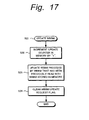
- Fig. 17 is a flow chart showing a process of the CPU 21 when WBBMs are updated. This process is executed at a predetermined timing. In this example, it is assumed that WBBMs are ring-structured.
- the WBBM update request flag is "1”
- a WBBM is updated (at step S21).
- the update counter of the WBBM stored in the RAM 23 is incremented by "1" (at step S22).
- a WBBM preceded by a WBBM that has been previously read is updated with the WBBM stored in the RAM 23.
- a ring number corresponding to a WBBM with the minimum value of the update counter is set.
- a WBBM with the minimum value of the update counter is replaced with the latest WBBM stored in the RAM 23. Since the updating process is completed, the WBBM update request flag is cleared at step S24.
- the user issues a command that causes the drive to execute a finalizing process.
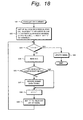
- a finalizing process of the CPU 21 performed by the drive will be described.
- step S31 when the drive receives the finalization command from the host processor 10, a WBBM on the optical disc 1 is replaced with a WBBM stored in the RAM 23.
- the WBBM stored in the RAM 23 is the latest WBBM.
- the latest WBBM may be read from the optical disc 1.
- the listed blocks are denoted by B(0), B(1), B(2), ... and B(N-1).
- the initial value of the variable I is (0).
- step S33 it is determined whether or not the variable I is N.
- the updating process for the WBBM is preformed (at step S34) as described above (see Fig. 17 ).
- step S36 it is determined whether or not data has been read.
- the finalization data is not recorded.
- the finalization data (dummy data) is recorded to the non-recorded block B(I) (at step S37).
- the variable I is incremented.
- the bit corresponding to the recorded block on the WBBM is set to "1".
- the reading operation for verifying an non-recorded block, the recording operation of the finalization data for a verified non-recorded block, the incrementing operation for the variable I, and the process for setting the bit corresponding to the block on the WBBM to "1" are performed for all non-recorded blocks that have been listed up. Thereafter, at step S34, the bit corresponding to a block that has been determined as a recorded block on the WBBM is set to "1".
- the WBBM stored in the RAM 23 is written to the optical disc 1.
- a plurality of blocks that have been listed up are processed one after the other.
- all blocks that have been listed up may be read and determined whether or not they are recorded blocks.
- finalization data may be written to all non-recorded blocks. In this case, the process can be effectively performed and thereby preferably implemented.
- a WBBM is used to effectively perform the finalizing process.
- the WBBM can be used to effectively perform the read modified write operation.
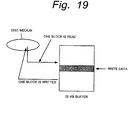
- a DVD-RW disc is accessed for data of 2 kbytes (one sector) at a time by the host processor.
- the buffer memory of the drive is accessed.
- the disc is accessed for data of 32 kbytes of a ECC block at a time by the drive.
- the drive receives a read command for data of 2 kbytes, it reads a block (32 kbytes) including the sector and sends the data of 2 kbytes to the host. In this case, the drive discards the remaining data of 30 kbytes.
- the write operation is more complicated than the read operation.
- the drive when the drive writes data of 2 kbytes to a particular block of the disc, if data has been recorded in the block, the drive should read the block, replace data of 2 kbytes of the relevant sector with write data received from the host processor, and then write data of 32 kbytes to the original block.
- This process is referred to as read modified write operation.
- the drive to write data of 2 kbytes to the disc, the drive reads data of 32 kbytes from the disc and then writes data of 32 kbytes thereto.
- the drive temporarily stores write data in a buffer memory (the buffer memory 6 shown in Fig. 1 ) and completes the write command. This operation is referred to as write cache operation.
- the host computer tends to write successive sectors.
- data of one block may take place.
- the drive only performs the write operation for data of 32 kbytes without the read operation.
- the drive can write a plurality of blocks at a time.
- the drive may write data of 2 kbytes at a time.
- the drive when the drive writes long data, it should perform the read modified write operation at the beginning and the end of the data.
- the block When the drive performs the read modified write operation for a particular block, the block may be a non-recorded block. Generally, when the drive cannot read a block, it determines that the block is a non-recorded block corresponding to information such as a signal level. When the block is a non-recorded block, the drive places all "0" data in the block except for write data received from the host processor. In this case, when the drive can determine that the block is a non-recorded block, it can perform the write operation without the read operation. In other words, the performance can be improved two times. To improve the efficiency of the read modified write operation, a WBBM can be used.
- the CPU 21 when the CPU 21 receives a write command for the area, it can immediately perform the write operation without the read modified write operation.
- the host processor 10 While the host processor 10 is not accessing the CPU 21, it checks a WBBM in the RAM 23, reads a portion preceded by a recorded area of the optical disc 1, and determines that the portion is a non-recorded portion. This operation may be performed in a relatively narrow range for the next write command.
- the CPU 21 When the CPU 21 receives a write command for the area (or caches the write command), if it has determined that the area is a non-recorded area, it places all "0" data as data in the same block other than the write data and performs the write operation, for example, without the read modified write operation. Alternatively, after the CPU 21 has performed the write operation, it updates the WBBM in the RAM 23. Thus, the drive determines whether or not the next area is a non-recorded area.
- the present invention is not limited to the above-described embodiment. Instead, various modifications are available.
- the present invention can be applied to a rewritable disc-shaped record medium other than the DVD+RW medium and to a WO (Write Once) disc-shaped record medium.
- the present invention can be applied to a disc of which address information is recorded in other than wobbling groove format.
- the servo information may be information for either CAV or CLV.
- finalization data may be recorded before or after a recorded block.
- the drive since a bit map that represents that each block is a recorded block or a non-recorded block is provided, in comparison with a method for analyzing a file system, the drive can execute a finalizing process regardless of a file system for use. In addition, even if the number of directories/files is large, the drive can effectively perform the finalizing process.
- the drive in comparison with a method for reading all blocks and determining whether they are recorded blocks or non-recorded blocks, the drive can quickly perform the finalizing process.
- the user is not requested to perform the certifying process. Since the period necessary for the finalizing process is much shorter than the period necessary for the certifying process, the efficiency is very high for the user.
Landscapes
- Engineering & Computer Science (AREA)
- Signal Processing (AREA)
- Optical Recording Or Reproduction (AREA)
- Signal Processing For Digital Recording And Reproducing (AREA)
- Management Or Editing Of Information On Record Carriers (AREA)
Applications Claiming Priority (2)
| Application Number | Priority Date | Filing Date | Title |
|---|---|---|---|
| JP25071297A JP3855390B2 (ja) | 1997-09-16 | 1997-09-16 | 記録装置、記録方法およびディスク状記録媒体 |
| EP98117491A EP0908882A3 (de) | 1997-09-16 | 1998-09-15 | Aufzeichnungsgerät und -verfahren sowie plattenförmiges Aufzeichnungsmedium |
Related Parent Applications (1)
| Application Number | Title | Priority Date | Filing Date |
|---|---|---|---|
| EP98117491.5 Division | 1998-09-15 |
Publications (2)
| Publication Number | Publication Date |
|---|---|
| EP2267709A2 true EP2267709A2 (de) | 2010-12-29 |
| EP2267709A3 EP2267709A3 (de) | 2012-05-23 |
Family
ID=17211938
Family Applications (2)
| Application Number | Title | Priority Date | Filing Date |
|---|---|---|---|
| EP10182171A Withdrawn EP2267709A3 (de) | 1997-09-16 | 1998-09-15 | Aufzeichnungsgerät und -verfahren sowie plattenförmiges Aufzeichnungsmedium |
| EP98117491A Ceased EP0908882A3 (de) | 1997-09-16 | 1998-09-15 | Aufzeichnungsgerät und -verfahren sowie plattenförmiges Aufzeichnungsmedium |
Family Applications After (1)
| Application Number | Title | Priority Date | Filing Date |
|---|---|---|---|
| EP98117491A Ceased EP0908882A3 (de) | 1997-09-16 | 1998-09-15 | Aufzeichnungsgerät und -verfahren sowie plattenförmiges Aufzeichnungsmedium |
Country Status (5)
| Country | Link |
|---|---|
| US (1) | US6243338B1 (de) |
| EP (2) | EP2267709A3 (de) |
| JP (1) | JP3855390B2 (de) |
| KR (1) | KR100540110B1 (de) |
| CN (4) | CN1627373A (de) |
Families Citing this family (101)
| Publication number | Priority date | Publication date | Assignee | Title |
|---|---|---|---|---|
| DE69938855D1 (de) * | 1998-10-21 | 2008-07-10 | Matsushita Electric Industrial Co Ltd | Optisches Informationsaufzeichnungsmedium, Verfahren und Gerät zur Aufzeichnung und Wiedergabe |
| KR100544175B1 (ko) * | 1999-05-08 | 2006-01-23 | 삼성전자주식회사 | 링킹 타입 정보를 저장하는 기록 매체와 결함 영역 처리 방법 |
| US6904229B1 (en) * | 1999-08-20 | 2005-06-07 | Canon Kabushiki Kaisha | Apparatus for recording signals on disk recording medium |
| JP2001134949A (ja) * | 1999-11-09 | 2001-05-18 | Sony Corp | ディスク状記録媒体及びその製造方法、その製造装置 |
| KR100395155B1 (ko) * | 2000-01-27 | 2003-08-21 | 엘지전자 주식회사 | 광디스크 기록기의 기록가능시간 표시방법 |
| WO2001075877A1 (en) * | 2000-03-31 | 2001-10-11 | Doug Carson & Associates, Inc. | Sequencing data blocks to provide hidden data on a recording medium |
| US7151729B1 (en) * | 2000-06-29 | 2006-12-19 | Samsung Electronics Co., Ltd. | Optical recording medium having read-only storage area and writeable storage area and recording/reproducing apparatus and method therefor |
| US20080123491A1 (en) * | 2000-09-07 | 2008-05-29 | Samsung Electronics Co., Ltd | Optical recording medium having read-only storage area and writeable storage area and recording/reproducing apparatus and method therefor |
| WO2002023542A1 (en) * | 2000-09-13 | 2002-03-21 | Matsushita Electric Industrial Co., Ltd. | Optical information recording medium and optical information recording method, optical information recording device |
| RU2287863C2 (ru) * | 2001-04-24 | 2006-11-20 | Конинклейке Филипс Электроникс Н.В. | Отображение последовательных секций для блоков информации |
| JP2002324363A (ja) * | 2001-04-25 | 2002-11-08 | Ricoh Co Ltd | 情報記録再生装置 |
| JP2003223763A (ja) * | 2001-11-20 | 2003-08-08 | Ricoh Co Ltd | 情報記録再生装置、情報記録再生ユニット、情報記録再生方法、プログラム及び記憶媒体 |
| KR20030065160A (ko) * | 2002-01-31 | 2003-08-06 | 삼성전자주식회사 | 파이널라이즈 이후 추가 데이터 기록이 가능한 저장매체,그 기록 및 재생 장치와 방법 |
| AU2003201840A1 (en) * | 2002-04-01 | 2003-10-23 | Sony Corporation | Reproducing method, reproducing apparatus, recording method, recording apparatus, and method for generating a management table |
| JP2003317387A (ja) * | 2002-04-16 | 2003-11-07 | Matsushita Electric Ind Co Ltd | 情報記録装置および記録媒体への情報記録方法 |
| JP2004014088A (ja) * | 2002-06-11 | 2004-01-15 | Sony Corp | ディスク記録媒体、記録方法、ディスクドライブ装置 |
| AU2003264977B2 (en) | 2002-09-26 | 2009-03-26 | Lg Electronics Inc. | Optical disc, method and apparatus for managing a defective area on an optical disc of write once type |
| KR20040027259A (ko) | 2002-09-26 | 2004-04-01 | 엘지전자 주식회사 | 1 회 기록 가능한 광디스크의 디펙트 영역 관리방법 |
| US7233550B2 (en) | 2002-09-30 | 2007-06-19 | Lg Electronics Inc. | Write-once optical disc, and method and apparatus for recording management information on write-once optical disc |
| KR20040028469A (ko) | 2002-09-30 | 2004-04-03 | 엘지전자 주식회사 | 1 회 기록 가능한 광디스크의 디펙트 영역 관리방법 |
| KR100667749B1 (ko) | 2002-10-18 | 2007-01-11 | 삼성전자주식회사 | 임시 결함 관리 영역을 사용한 결함 관리 방법, 그 장치및 그디스크 |
| JP3867038B2 (ja) * | 2002-10-23 | 2007-01-10 | 株式会社リコー | 情報記録装置と情報記録方法とプログラムと記録媒体 |
| JP2006510160A (ja) | 2002-12-11 | 2006-03-23 | エルジー エレクトロニクス インコーポレーテッド | 追記型光ディスクへの上書きの管理方法及び装置 |
| ATE462184T1 (de) | 2002-12-11 | 2010-04-15 | Lg Electronics Inc | Überschreibverfahren und informationsaufzeichnungsverfahren für eine einmalig beschreibbare optische diskette |
| KR101019924B1 (ko) * | 2002-12-25 | 2011-03-08 | 파나소닉 주식회사 | 정보 기록 매체, 정보 기록 매체 생성 방법, 정보 재생방법, 정보 기록 방법, 및 그 방법들의 각각을 수행하기위한 컴퓨터 프로그램 |
| US7372788B2 (en) | 2003-01-14 | 2008-05-13 | Lg Electronics Inc. | Method for managing defective area on write-once optical recording medium, and optical recording medium using the same |
| TWI314315B (en) | 2003-01-27 | 2009-09-01 | Lg Electronics Inc | Optical disc of write once type, method, and apparatus for managing defect information on the optical disc |
| US7672204B2 (en) | 2003-01-27 | 2010-03-02 | Lg Electronics Inc. | Optical disc, method and apparatus for managing a defective area on an optical disc |
| US20040160799A1 (en) | 2003-02-17 | 2004-08-19 | Park Yong Cheol | Write-once optical disc, and method and apparatus for allocating spare area on write-once optical disc |
| US7643390B2 (en) | 2003-02-21 | 2010-01-05 | Lg Electronics Inc. | Write-once optical recording medium and defect management information management method thereof |
| US7499383B2 (en) | 2003-02-21 | 2009-03-03 | Lg Electronics Inc. | Write-once optical disc and method for managing spare area thereof |
| TWI291168B (en) | 2003-02-25 | 2007-12-11 | Lg Electronics Inc | Defect management method for optical recording medium and optical recording medium using the same |
| US7188271B2 (en) | 2003-02-25 | 2007-03-06 | Lg Electronics Inc. | Write-once optical disc, and method and apparatus for recording management information on write-once optical disc |
| US7675828B2 (en) | 2003-02-25 | 2010-03-09 | Lg Electronics Inc. | Recording medium having data structure for managing at least a data area of the recording medium and recording and reproducing methods and apparatuses |
| US7385889B2 (en) | 2003-03-03 | 2008-06-10 | Samsung Electronics Co., Ltd. | Method and apparatus for managing disc defect using temporary DFL and temporary DDS including drive and disc information disc with temporary DFL and temporary DDS |
| BRPI0318160B1 (pt) * | 2003-03-04 | 2016-05-31 | Lg Electronics Inc | método para gravação em meio de gravação óptica, aparelho para gravação em e reprodução de um meio de gravação óptica e meio de gravação óptica |
| EP1547069B1 (de) * | 2003-03-08 | 2017-03-01 | Samsung Electronics Co., Ltd. | Verfahren zum erhalten des datenaufzeichnungsstatus eines einmalbeschreibbaren aufzeichnungsmediums und einmalbeschreibbares aufzeichnungsmedium dafür |
| SG151111A1 (en) * | 2003-03-08 | 2009-04-30 | Samsung Electronics Co Ltd | An apparatus for reproducing and/or recording from and/or to a recording medium |
| CN101261869B (zh) * | 2003-03-08 | 2010-09-22 | 三星电子株式会社 | 记录和/或再现装置 |
| JP4026517B2 (ja) | 2003-03-12 | 2007-12-26 | ソニー株式会社 | 記録媒体、記録装置、記録方法 |
| JP4026519B2 (ja) | 2003-03-12 | 2007-12-26 | ソニー株式会社 | 記録媒体、記録装置、再生装置、記録方法、再生方法 |
| RU2321080C2 (ru) | 2003-03-13 | 2008-03-27 | Самсунг Электроникс Ко. Лтд | Однократно записываемый диск, способ распределения области данных однократно записываемого диска и способ воспроизведения данных с такого диска |
| EP1814114A1 (de) * | 2003-03-13 | 2007-08-01 | Samsung Electronics Co., Ltd. | Plattenförmiger einmal beschreibbarer Datenträger, Verfahren zur Verwaltung eines Datenbereichs eines solchen Datenträgers sowie Vorrichtung und Verfahren zur Wiedergabe von Daten von einem solchen Datenträger |
| TWI328805B (en) | 2003-03-13 | 2010-08-11 | Lg Electronics Inc | Write-once recording medium and defective area management method and apparatus for write-once recording medium |
| BRPI0407517A (pt) * | 2003-03-13 | 2006-02-14 | Samsung Electronics Co Ltd | disco do tipo de instáncia única de gravação, método de gerenciamento de uma área de dados de um disco do tipo de instáncia única de gravação, aparelho de gravação/reprodução, método para reprodução de dados de um disco do tipo de instáncia única de gravação, aparelho para reprodução de dados de um disco do tipo de instáncia única de gravação, disco do tipo de instáncia única de gravação com pelo menos uma camada de gravação, e mìdia de gravação |
| EP1616332B1 (de) | 2003-04-14 | 2017-06-14 | Koninklijke Philips N.V. | Gerät und verfahren zur informationsaufzeichnung |
| US8184513B2 (en) | 2003-04-15 | 2012-05-22 | Samsung Electronics Co., Ltd. | Recording/reproducing method, recording/reproducing apparatus, optical recording medium, and computer readable recording medium having recorded thereon program for the recording/reproducing method |
| KR100739674B1 (ko) | 2003-05-01 | 2007-07-13 | 삼성전자주식회사 | 결함 관리 방법, 그 장치 및 그 디스크 |
| MXPA05012044A (es) | 2003-05-09 | 2006-02-03 | Lg Electronics Inc | Disco optico de una sola escritura, metodo y aparato par recuperacion de informacion de administracion de disco del disco optico de una sola escritura. |
| EP1826761A3 (de) * | 2003-05-09 | 2008-07-09 | LG Electronics Ltd. | Speicherung der Aufzeichnungsmodeinformation in der Fehlerverwaltungsbereich eines BD-WO mediums |
| EP1623422A1 (de) | 2003-05-09 | 2006-02-08 | LG Electronics Inc. | Aufzeichnungsmedium mit einer datenstruktur zur verwaltung mindestens eines datenbereichs des aufzeichnungsmediums und aufzeichnungs- und wiedergabeverfahren und vorrichtungen |
| MY141431A (en) | 2003-05-09 | 2010-04-30 | Lg Electronics Inc | Recording medium having data structure for managing at least a data area of the recording medium and recording and reproducing methods and apparatuses |
| TWI405191B (zh) | 2003-05-09 | 2013-08-11 | Lg Electronics Inc | 單寫型光碟及由單寫型光碟回復碟片管理資訊的方法與裝置 |
| US20050007914A1 (en) * | 2003-05-28 | 2005-01-13 | Samsung Electronics Co., Ltd. | Apparatus and method of recording a record map and write-once disc therefor |
| KR100607967B1 (ko) * | 2003-05-28 | 2006-08-03 | 삼성전자주식회사 | 레코드 맵 기록 방법, 그 장치 및 그 한번 기록 디스크 |
| JP3861856B2 (ja) * | 2003-06-13 | 2006-12-27 | ソニー株式会社 | 記録再生装置、記録再生方法 |
| JP2005032413A (ja) | 2003-06-19 | 2005-02-03 | Nec Corp | 光ディスクの未記録領域への記録方法、光デイスクの記録装置,光ディスク及び光ディスクのデータ記録用プログラム |
| KR20060026065A (ko) * | 2003-06-26 | 2006-03-22 | 코닌클리케 필립스 일렉트로닉스 엔.브이. | 1회 기록형 기록매체 위에 정보를 기록하는 레코더 및 방법 |
| KR20050001976A (ko) | 2003-06-28 | 2005-01-07 | 삼성전자주식회사 | 정보 저장 매체 |
| JP4533892B2 (ja) | 2003-07-04 | 2010-09-01 | エルジー エレクトロニクス インコーポレイティド | 追記型光ディスクの上書きを管理する方法及び装置 |
| TW200502932A (en) * | 2003-07-07 | 2005-01-16 | Hitachi Ltd | A recording medium, recording method and recording apparatus |
| DE602004020992D1 (de) | 2003-07-14 | 2009-06-18 | Lg Electronics Inc | Einmalbeschreibbarer optischer datenträger, verfahren und vorrichtung zum aufzeichnen von verwaltungsinformationen auf einem einmalbeschreibbaren optischen datenträger |
| KR101014703B1 (ko) | 2003-07-15 | 2011-02-21 | 엘지전자 주식회사 | 광디스크의 결함영역 관리방법 및 광디스크의 기록방법과기록재생장치 |
| KR20050009031A (ko) | 2003-07-15 | 2005-01-24 | 엘지전자 주식회사 | 1회 기록 가능한 광디스크 및 광디스크의 관리정보 기록방법 |
| JP3828095B2 (ja) | 2003-07-15 | 2006-09-27 | パイオニア株式会社 | 情報記録媒体、情報記録装置及び方法 |
| ES2341859T3 (es) | 2003-08-05 | 2010-06-29 | Lg Electronics, Inc. | Disco optico de escritura unica y metodo y aparato para grabar/reproducir informacion de gestion en/desde el disco optico. |
| US7313065B2 (en) | 2003-08-05 | 2007-12-25 | Lg Electronics Inc. | Write-once optical disc, and method and apparatus for recording/reproducing management information on/from optical disc |
| BRPI0414213A (pt) | 2003-09-08 | 2006-10-31 | Lg Electronics Inc | método e aparelho de gerenciar meio fìsico de gravação e meio fìsico de gravação |
| EP1665261B1 (de) | 2003-09-08 | 2013-11-27 | LG Electronics Inc. | Einmal beschreibbarer optischer datenträger und verfahren und vorrichtung zum aufzeichnen von managementinformationen auf dem einmal beschreibbaren optischen datenträger |
| KR101049137B1 (ko) | 2003-09-08 | 2011-07-15 | 엘지전자 주식회사 | 1회 기록가능한 광디스크, 및 1회 기록가능한광디스크상에서 관리 정보를 기록하는 방법 및 장치 |
| KR20050027787A (ko) * | 2003-09-16 | 2005-03-21 | 삼성전자주식회사 | 데이터 기록 상태 정보를 제공하는 광 디스크 |
| US7386754B2 (en) * | 2003-10-16 | 2008-06-10 | Seagate Technology Llc | Method and apparatus to improve magnetic disc drive reliability using excess un-utilized capacity |
| US7916588B2 (en) * | 2003-10-20 | 2011-03-29 | Panasonic Corporation | Control apparatus, control method, access apparatus, access method, program, and write-once recording medium |
| KR100964685B1 (ko) | 2003-10-20 | 2010-06-21 | 엘지전자 주식회사 | 1회 기록가능한 광디스크 및 광디스크의 기록재생방법과기록재생장치 |
| US7590032B2 (en) * | 2003-11-19 | 2009-09-15 | Panasonic Corporation | Recording medium, access apparatus, access method, and program |
| JP2005196904A (ja) * | 2004-01-09 | 2005-07-21 | Hitachi Ltd | データ記録方法 |
| JP4262611B2 (ja) | 2004-02-05 | 2009-05-13 | 株式会社日立製作所 | データ記録方法、及びデータ記録装置 |
| KR101113866B1 (ko) | 2004-03-19 | 2012-03-02 | 엘지전자 주식회사 | 기록매체내에 기록되는 데이터 구조 및 데이터 기록방법과기록장치 |
| KR101024916B1 (ko) | 2004-03-19 | 2011-03-31 | 엘지전자 주식회사 | 1회 기록 가능한 고밀도 광디스크의 데이터 기록 방법 및장치 |
| JP2005302143A (ja) | 2004-04-12 | 2005-10-27 | Ricoh Co Ltd | 初期化方法、再生方法、プログラム及び記録媒体、データ構造、情報記録装置、並びに情報再生装置 |
| KR100619035B1 (ko) * | 2004-04-17 | 2006-08-31 | 삼성전자주식회사 | 정보 저장 매체, 기록/재생 장치 및 그 방법을 수행하는 프로그램이 기록된 컴퓨터 판독가능한 기록매체 |
| EP1600965A3 (de) | 2004-05-25 | 2006-04-19 | Nec Corporation | Aufzeichnungssystem für optische Platte |
| KR101049117B1 (ko) | 2004-06-08 | 2011-07-14 | 엘지전자 주식회사 | 1회 기록 가능한 광디스크 및 광디스크의 관리정보 기록방법, 디스크 클로징 방법 및 기록재생 장치 |
| CN101894576B (zh) * | 2004-06-15 | 2013-03-13 | 松下电器产业株式会社 | 驱动装置 |
| KR101014727B1 (ko) | 2004-06-23 | 2011-02-16 | 엘지전자 주식회사 | 1회 기록 가능한 광디스크의 중첩 기록 방법 및 장치 |
| KR101041811B1 (ko) | 2004-08-02 | 2011-06-17 | 엘지전자 주식회사 | 광 저장매체의 기록 재생 방법 및 장치 |
| KR101012378B1 (ko) | 2004-08-16 | 2011-02-09 | 엘지전자 주식회사 | 광 저장매체의 기록 재생 방법 및 장치 |
| JP2006065915A (ja) * | 2004-08-25 | 2006-03-09 | Hitachi Ltd | 放送番組の記録方法及び放送受信装置、並びに、そのための情報記録装置 |
| KR101215370B1 (ko) | 2004-09-14 | 2012-12-26 | 엘지전자 주식회사 | 기록매체 및 기록매체의 기록 재생 방법 및 장치 |
| JP4144597B2 (ja) | 2005-01-05 | 2008-09-03 | ソニー株式会社 | 光ディスク記録装置及び方法並びにカメラ一体型ディスク記録装置 |
| JP4989861B2 (ja) * | 2005-06-29 | 2012-08-01 | ヒタチグローバルストレージテクノロジーズネザーランドビーブイ | データ書き込み方法及びディスク装置 |
| KR100713972B1 (ko) * | 2005-08-08 | 2007-05-02 | 엘지전자 주식회사 | 기록매체의 신속한 파이널라이즈를 지원하는 방법 및 장치 |
| KR100805177B1 (ko) * | 2005-08-12 | 2008-02-21 | 가부시끼가이샤 도시바 | 정보 기록 매체, 정보 기록 장치, 및 정보 기록 방법 |
| KR101244907B1 (ko) * | 2005-09-29 | 2013-03-18 | 삼성전자주식회사 | 프리피트가 형성된 정보 저장 매체 및 기록/재생 장치 및기록/재생 방법 |
| KR101227485B1 (ko) | 2005-11-25 | 2013-01-29 | 엘지전자 주식회사 | 기록매체 및 기록매체의 결함관리 정보 기록방법과기록장치 |
| KR20070058292A (ko) | 2005-12-02 | 2007-06-08 | 엘지전자 주식회사 | 기록매체, 기록매체 기록재생 방법 및 장치와 기록매체클로징 방법 |
| JP2007323695A (ja) * | 2006-05-30 | 2007-12-13 | Nec Corp | 書き換え型光ディスクの記録制御方法およびその記録再生用のドライブ装置 |
| JP2008047212A (ja) * | 2006-08-15 | 2008-02-28 | Nec Corp | 情報記録媒体、情報記録媒体の記録方法、及び情報記録再生装置 |
| JP4957149B2 (ja) * | 2006-09-27 | 2012-06-20 | ソニー株式会社 | 情報処理装置、情報記録媒体、および情報処理方法、並びにコンピュータ・プログラム |
| JP4939307B2 (ja) * | 2007-05-29 | 2012-05-23 | キヤノン株式会社 | アダプタ装置及びその制御方法、コンピュータプログラム |
| JP2009104687A (ja) * | 2007-10-22 | 2009-05-14 | Fujitsu Ltd | 記憶装置及び制御回路 |
Citations (1)
| Publication number | Priority date | Publication date | Assignee | Title |
|---|---|---|---|---|
| US5568423A (en) * | 1995-04-14 | 1996-10-22 | Unisys Corporation | Flash memory wear leveling system providing immediate direct access to microprocessor |
Family Cites Families (9)
| Publication number | Priority date | Publication date | Assignee | Title |
|---|---|---|---|---|
| NL8800152A (nl) * | 1988-01-22 | 1989-08-16 | Philips Nv | Optische uitleesbare registratiedrager van het beschrijfbare type, een inrichting voor het vervaardigen van een dergelijke registratiedrager, en inrichtingen voor het optekenen en/of uitlezen van informatie op/uit een dergelijke registratiedrager. |
| US5107481A (en) * | 1988-03-16 | 1992-04-21 | Matsushita Electric Industrial Co., Ltd. | Recording area management system for writable type optional disk |
| US5271018A (en) * | 1990-04-27 | 1993-12-14 | Next, Inc. | Method and apparatus for media defect management and media addressing |
| JP2888958B2 (ja) * | 1990-10-20 | 1999-05-10 | 富士通株式会社 | 部分書き換え可能な記憶媒体におけるファイル管理方式 |
| EP0920005B1 (de) * | 1992-09-03 | 2003-04-16 | Sony Corporation | Datenaufzeichnungsgerät und -verfahren |
| US5740435A (en) * | 1994-10-31 | 1998-04-14 | Sony Corporation | Data management apparatus and method for managing data of variable lengths recorded on a record medium |
| MX9700730A (es) * | 1995-05-31 | 1997-08-30 | Sony Corp | Medio de registro, aparato de registro, metodo de reproduccion, y aparato de reproduccion. |
| JP3552223B2 (ja) * | 1996-02-05 | 2004-08-11 | ソニー株式会社 | 光記録方法 |
| CN1126102C (zh) * | 1996-11-18 | 2003-10-29 | 皇家菲利浦电子有限公司 | 写入装置、写入信息块的方法以及用于读出信息块的读出装置 |
-
1997
- 1997-09-16 JP JP25071297A patent/JP3855390B2/ja not_active Expired - Lifetime
-
1998
- 1998-09-08 US US09/149,212 patent/US6243338B1/en not_active Expired - Lifetime
- 1998-09-15 EP EP10182171A patent/EP2267709A3/de not_active Withdrawn
- 1998-09-15 KR KR1019980037987A patent/KR100540110B1/ko not_active Expired - Lifetime
- 1998-09-15 EP EP98117491A patent/EP0908882A3/de not_active Ceased
- 1998-09-16 CN CNA2004100956897A patent/CN1627373A/zh active Pending
- 1998-09-16 CN CN2006101011013A patent/CN1877730B/zh not_active Expired - Fee Related
- 1998-09-16 CN CNB2006101004005A patent/CN100552797C/zh not_active Expired - Fee Related
- 1998-09-16 CN CNB981205402A patent/CN100345188C/zh not_active Expired - Lifetime
Patent Citations (1)
| Publication number | Priority date | Publication date | Assignee | Title |
|---|---|---|---|---|
| US5568423A (en) * | 1995-04-14 | 1996-10-22 | Unisys Corporation | Flash memory wear leveling system providing immediate direct access to microprocessor |
Also Published As
| Publication number | Publication date |
|---|---|
| CN1213124A (zh) | 1999-04-07 |
| EP0908882A3 (de) | 2005-01-26 |
| JP3855390B2 (ja) | 2006-12-06 |
| CN1877730A (zh) | 2006-12-13 |
| JPH1186418A (ja) | 1999-03-30 |
| EP0908882A2 (de) | 1999-04-14 |
| CN1901069A (zh) | 2007-01-24 |
| KR100540110B1 (ko) | 2006-04-17 |
| CN100345188C (zh) | 2007-10-24 |
| KR19990029805A (ko) | 1999-04-26 |
| EP2267709A3 (de) | 2012-05-23 |
| CN100552797C (zh) | 2009-10-21 |
| CN1877730B (zh) | 2012-09-05 |
| US6243338B1 (en) | 2001-06-05 |
| CN1627373A (zh) | 2005-06-15 |
Similar Documents
| Publication | Publication Date | Title |
|---|---|---|
| US6243338B1 (en) | Recording apparatus, recording method, and disc-shaped record medium | |
| US7082092B2 (en) | Device and method for recording information | |
| KR100971813B1 (ko) | 기록 매체, 기록 장치 및 기록 방법 | |
| US7274634B2 (en) | Information recording medium capable of defect management, information recording apparatus capable of defect management, and information playback apparatus for playing back information from defect-managed medium | |
| KR101155824B1 (ko) | 기록 방법, 기록 장치, 재생 방법 및 재생 장치 | |
| JP3875492B2 (ja) | 情報記録媒体、情報記録装置、情報記録方法、情報再生装置、及び情報再生方法 | |
| JP2002312950A (ja) | 情報記録媒体、情報記録装置、情報記録方法、情報再生装置、及び情報再生方法 | |
| US7830769B2 (en) | Recording apparatus and recording method | |
| TW201706985A (zh) | 記錄裝置、記錄方法、記錄媒體 | |
| JP4713140B2 (ja) | デジタルデータ記録方法、記録装置及び再生装置 | |
| JP4124250B2 (ja) | 記録装置、記録方法、記録媒体および記録データ生成装置 | |
| JP4169061B2 (ja) | 記録装置、記録方法、記録媒体および記録データ生成装置 | |
| JP4124251B2 (ja) | 記録装置、記録方法、記録媒体および記録データ生成装置 | |
| JP4835623B2 (ja) | 記録装置、記録方法および記録データ生成装置 | |
| JP2006040454A (ja) | 追記型光ディスク装置 | |
| JP5136678B2 (ja) | 記録または再生する方法 | |
| JP2686802B2 (ja) | 光ディスクに対する記録方法 | |
| JP2012009130A (ja) | 記録または再生する方法 | |
| JP2012009131A (ja) | 記録または再生する方法 |
Legal Events
| Date | Code | Title | Description |
|---|---|---|---|
| PUAI | Public reference made under article 153(3) epc to a published international application that has entered the european phase |
Free format text: ORIGINAL CODE: 0009012 |
|
| 17P | Request for examination filed |
Effective date: 20100929 |
|
| AC | Divisional application: reference to earlier application |
Ref document number: 0908882 Country of ref document: EP Kind code of ref document: P |
|
| AK | Designated contracting states |
Kind code of ref document: A2 Designated state(s): AT BE DE ES FR GB IT NL PT |
|
| PUAL | Search report despatched |
Free format text: ORIGINAL CODE: 0009013 |
|
| AK | Designated contracting states |
Kind code of ref document: A3 Designated state(s): AT BE DE ES FR GB IT NL PT |
|
| RIC1 | Information provided on ipc code assigned before grant |
Ipc: G11B 20/10 20060101AFI20120416BHEP Ipc: G11B 20/12 20060101ALI20120416BHEP Ipc: G11B 27/32 20060101ALI20120416BHEP |
|
| 17Q | First examination report despatched |
Effective date: 20131107 |
|
| STAA | Information on the status of an ep patent application or granted ep patent |
Free format text: STATUS: THE APPLICATION IS DEEMED TO BE WITHDRAWN |
|
| 18D | Application deemed to be withdrawn |
Effective date: 20180817 |