EP2267726A2 - Coeur de réacteur à eau légère et assemblage de combustible - Google Patents
Coeur de réacteur à eau légère et assemblage de combustible Download PDFInfo
- Publication number
- EP2267726A2 EP2267726A2 EP10009458A EP10009458A EP2267726A2 EP 2267726 A2 EP2267726 A2 EP 2267726A2 EP 10009458 A EP10009458 A EP 10009458A EP 10009458 A EP10009458 A EP 10009458A EP 2267726 A2 EP2267726 A2 EP 2267726A2
- Authority
- EP
- European Patent Office
- Prior art keywords
- fuel
- reactor core
- rods
- uranium
- rod
- Prior art date
- Legal status (The legal status is an assumption and is not a legal conclusion. Google has not performed a legal analysis and makes no representation as to the accuracy of the status listed.)
- Granted
Links
- 239000000446 fuel Substances 0.000 title claims abstract description 345
- XLYOFNOQVPJJNP-UHFFFAOYSA-N water Substances O XLYOFNOQVPJJNP-UHFFFAOYSA-N 0.000 title claims abstract description 56
- JFALSRSLKYAFGM-UHFFFAOYSA-N uranium(0) Chemical compound [U] JFALSRSLKYAFGM-UHFFFAOYSA-N 0.000 claims abstract description 86
- 229910052778 Plutonium Inorganic materials 0.000 claims abstract description 65
- OYEHPCDNVJXUIW-UHFFFAOYSA-N plutonium atom Chemical compound [Pu] OYEHPCDNVJXUIW-UHFFFAOYSA-N 0.000 claims abstract description 65
- 230000000712 assembly Effects 0.000 claims abstract description 59
- 238000000429 assembly Methods 0.000 claims abstract description 59
- 229910052770 Uranium Inorganic materials 0.000 claims abstract description 54
- 238000010521 absorption reaction Methods 0.000 claims abstract description 21
- 238000004033 diameter control Methods 0.000 claims description 74
- 239000011800 void material Substances 0.000 claims description 38
- 238000009395 breeding Methods 0.000 claims description 35
- 230000001488 breeding effect Effects 0.000 claims description 35
- 230000007246 mechanism Effects 0.000 claims description 19
- 239000000126 substance Substances 0.000 claims description 17
- 230000002093 peripheral effect Effects 0.000 claims description 10
- 238000009826 distribution Methods 0.000 description 30
- 230000000694 effects Effects 0.000 description 20
- 229910052768 actinide Inorganic materials 0.000 description 12
- 150000001255 actinides Chemical class 0.000 description 12
- OKTJSMMVPCPJKN-UHFFFAOYSA-N Carbon Chemical compound [C] OKTJSMMVPCPJKN-UHFFFAOYSA-N 0.000 description 10
- 229910052799 carbon Inorganic materials 0.000 description 10
- 230000003247 decreasing effect Effects 0.000 description 10
- 239000010935 stainless steel Substances 0.000 description 10
- 229910001220 stainless steel Inorganic materials 0.000 description 10
- 238000009835 boiling Methods 0.000 description 9
- 238000006243 chemical reaction Methods 0.000 description 8
- 238000010276 construction Methods 0.000 description 8
- 239000000463 material Substances 0.000 description 7
- 230000007774 longterm Effects 0.000 description 6
- 238000004519 manufacturing process Methods 0.000 description 6
- 238000000034 method Methods 0.000 description 5
- 239000002826 coolant Substances 0.000 description 4
- 230000004992 fission Effects 0.000 description 3
- 230000001052 transient effect Effects 0.000 description 3
- XLYOFNOQVPJJNP-ZSJDYOACSA-N Heavy water Chemical compound [2H]O[2H] XLYOFNOQVPJJNP-ZSJDYOACSA-N 0.000 description 2
- 238000005452 bending Methods 0.000 description 2
- 238000005516 engineering process Methods 0.000 description 2
- 238000001704 evaporation Methods 0.000 description 2
- 230000004048 modification Effects 0.000 description 2
- 238000012986 modification Methods 0.000 description 2
- 238000010248 power generation Methods 0.000 description 2
- 239000000941 radioactive substance Substances 0.000 description 2
- 230000009257 reactivity Effects 0.000 description 2
- JFALSRSLKYAFGM-OIOBTWANSA-N uranium-235 Chemical compound [235U] JFALSRSLKYAFGM-OIOBTWANSA-N 0.000 description 2
- OYEHPCDNVJXUIW-FTXFMUIASA-N 239Pu Chemical compound [239Pu] OYEHPCDNVJXUIW-FTXFMUIASA-N 0.000 description 1
- 102000052567 Anaphase-Promoting Complex-Cyclosome Apc1 Subunit Human genes 0.000 description 1
- 101000890325 Homo sapiens Anaphase-promoting complex subunit 1 Proteins 0.000 description 1
- UFHFLCQGNIYNRP-UHFFFAOYSA-N Hydrogen Chemical compound [H][H] UFHFLCQGNIYNRP-UHFFFAOYSA-N 0.000 description 1
- OYEHPCDNVJXUIW-AHCXROLUSA-N Plutonium-240 Chemical compound [240Pu] OYEHPCDNVJXUIW-AHCXROLUSA-N 0.000 description 1
- 229910001093 Zr alloy Inorganic materials 0.000 description 1
- 230000002159 abnormal effect Effects 0.000 description 1
- 230000009471 action Effects 0.000 description 1
- 229910052790 beryllium Inorganic materials 0.000 description 1
- ATBAMAFKBVZNFJ-UHFFFAOYSA-N beryllium atom Chemical compound [Be] ATBAMAFKBVZNFJ-UHFFFAOYSA-N 0.000 description 1
- 239000003054 catalyst Substances 0.000 description 1
- 230000008859 change Effects 0.000 description 1
- 230000000052 comparative effect Effects 0.000 description 1
- 230000010485 coping Effects 0.000 description 1
- 238000005260 corrosion Methods 0.000 description 1
- 230000007797 corrosion Effects 0.000 description 1
- 230000001419 dependent effect Effects 0.000 description 1
- 238000013461 design Methods 0.000 description 1
- 238000011156 evaluation Methods 0.000 description 1
- 230000008020 evaporation Effects 0.000 description 1
- 230000004907 flux Effects 0.000 description 1
- 229910052739 hydrogen Inorganic materials 0.000 description 1
- 239000001257 hydrogen Substances 0.000 description 1
- 238000003780 insertion Methods 0.000 description 1
- 230000037431 insertion Effects 0.000 description 1
- 238000005025 nuclear technology Methods 0.000 description 1
- 238000012958 reprocessing Methods 0.000 description 1
- 230000005514 two-phase flow Effects 0.000 description 1
Images










Classifications
-
- G—PHYSICS
- G21—NUCLEAR PHYSICS; NUCLEAR ENGINEERING
- G21C—NUCLEAR REACTORS
- G21C3/00—Reactor fuel elements and their assemblies; Selection of substances for use as reactor fuel elements
- G21C3/30—Assemblies of a number of fuel elements in the form of a rigid unit
- G21C3/32—Bundles of parallel pin-, rod-, or tube-shaped fuel elements
-
- G—PHYSICS
- G21—NUCLEAR PHYSICS; NUCLEAR ENGINEERING
- G21C—NUCLEAR REACTORS
- G21C1/00—Reactor types
- G21C1/04—Thermal reactors ; Epithermal reactors
- G21C1/06—Heterogeneous reactors, i.e. in which fuel and moderator are separated
- G21C1/08—Heterogeneous reactors, i.e. in which fuel and moderator are separated moderator being highly pressurised, e.g. boiling water reactor, integral super-heat reactor, pressurised water reactor
-
- G—PHYSICS
- G21—NUCLEAR PHYSICS; NUCLEAR ENGINEERING
- G21C—NUCLEAR REACTORS
- G21C3/00—Reactor fuel elements and their assemblies; Selection of substances for use as reactor fuel elements
- G21C3/30—Assemblies of a number of fuel elements in the form of a rigid unit
- G21C3/32—Bundles of parallel pin-, rod-, or tube-shaped fuel elements
- G21C3/326—Bundles of parallel pin-, rod-, or tube-shaped fuel elements comprising fuel elements of different composition; comprising, in addition to the fuel elements, other pin-, rod-, or tube-shaped elements, e.g. control rods, grid support rods, fertile rods, poison rods or dummy rods
-
- G—PHYSICS
- G21—NUCLEAR PHYSICS; NUCLEAR ENGINEERING
- G21C—NUCLEAR REACTORS
- G21C5/00—Moderator or core structure; Selection of materials for use as moderator
- G21C5/02—Details
-
- G—PHYSICS
- G21—NUCLEAR PHYSICS; NUCLEAR ENGINEERING
- G21C—NUCLEAR REACTORS
- G21C7/00—Control of nuclear reaction
- G21C7/06—Control of nuclear reaction by application of neutron-absorbing material, i.e. material with absorption cross-section very much in excess of reflection cross-section
- G21C7/08—Control of nuclear reaction by application of neutron-absorbing material, i.e. material with absorption cross-section very much in excess of reflection cross-section by displacement of solid control elements, e.g. control rods
- G21C7/10—Construction of control elements
- G21C7/117—Clusters of control rods; Spider construction
-
- Y—GENERAL TAGGING OF NEW TECHNOLOGICAL DEVELOPMENTS; GENERAL TAGGING OF CROSS-SECTIONAL TECHNOLOGIES SPANNING OVER SEVERAL SECTIONS OF THE IPC; TECHNICAL SUBJECTS COVERED BY FORMER USPC CROSS-REFERENCE ART COLLECTIONS [XRACs] AND DIGESTS
- Y02—TECHNOLOGIES OR APPLICATIONS FOR MITIGATION OR ADAPTATION AGAINST CLIMATE CHANGE
- Y02E—REDUCTION OF GREENHOUSE GAS [GHG] EMISSIONS, RELATED TO ENERGY GENERATION, TRANSMISSION OR DISTRIBUTION
- Y02E30/00—Energy generation of nuclear origin
- Y02E30/30—Nuclear fission reactors
Definitions
- the present invention relates to a light water reactor core and fuel assemblies composing a reactor core and, more particularly, to a light water reactor core wherein in a boiling water reactor (BWR), the BWR has the same levels in cost efficiency and degree of safety as those of an existing BWR under operation now, that is, the BWR is oriented to plutonium (Pu) multi-recycle having a breeding ratio near 1.0 or slightly larger and having a negative void coefficient with minimizing modification of the reactor core structure of the existing BWR under operation now, and to fuel assemblies used for the boiling water reactor.
- BWR boiling water reactor
- fissionable materials such as uranium-235 and plutonium-239 are being consumed by fission reaction
- fertile materials such as uranium-238 and plutonium-240 are being converted to fissionable materials.
- the ratio of an amount of fissionable materials contained in the fuel unloaded from the reactor core to an amount of fissionable materials contained in the fuel loaded from the reactor core is called as a breeding ratio.
- the breeding ratio in a conventional light water reactor is approximately 0.5. Methods of improving the breeding are studied in order to effectively use the uranium resources.
- Japanese Patent Application Laid-Open No. 55-10591 and Nuclear Technology, Vol.59, pages 212-227 (1982 ) propose a method that the breeding ratio is improved in a pressurized water reactor by densely arranging fuel assemblies in a triangular lattice to decrease the water-to-fuel volume ratio.
- the obtained breeding ratio is 0.9 at maximum, and accordingly the fissionable material needs to be supplied in order to continue operation without reducing the output power.
- it can be considered to further decrease the water-to-fuel ratio by narrowing the gap between the fuel rods.
- it is difficult to narrow the gap between the fuel rods because there are limitations in manufacturing the fuel assembly and in securing thermal margin.
- Japanese Patent Application Laid-Open No. 1-227993 proposes a method that the water-to-fuel ratio is effectively decreased by making use of steam void generated in the reactor core which characterizes a boiling water reactor. It is shown that this conventional technology can increase the plutonium multiplication ratio (the ratio of amount of fissionable plutonium contained in fuel unloaded from the reactor core to an amount of fissionable plutonium contained in fuel loaded in the reactor core, that is, the breeding ratio to fissionable plutonium) up to nearly 1, but it is not shown that the breeding ratio (which is smaller by 4 to 5 % than the plutonium multiplication ratio in the case where natural uranium is enriched by adding plutonium) can be increased approximately 1 or larger.
- the plutonium multiplication ratio the ratio of amount of fissionable plutonium contained in fuel unloaded from the reactor core to an amount of fissionable plutonium contained in fuel loaded in the reactor core, that is, the breeding ratio to fissionable plut
- the words that the breeding ratio is larger than near 1 in the present invention means that the breeding ratio is larger than 0.98.
- Japanese Patent Application Laid-Open No. 8-21890 discloses that in a reactor core comprising fuel which is enriched by adding plutonium or plutonium and an actinide to a uranium containing at least one of a depleted uranium, natural uranium, a degraded uranium and a low enriched uranium, the reactor core has a breeding ratio of near 1.0 or larger than 1.0 and a negative void coefficient.
- the prior art is not a technology which is intended to further improve the ability of a control rod to be manufactured and the cost performance of the control rod.
- An object of the present invention is to provide a reactor core which has the same levels in power generation cost, thermal margin and degree of safety as those of a light water reactor under operation now with reduced manufacturing costs and an improved mechanical strength of the control rods, as well as fuel assemblies used for the reactor core.
- a first preferable embodiment is a fuel assembly comprising fuel which is enriched by adding plutonium and the like to depleted uranium and the like, wherein a breeding ratio of the fuel assembly is near 1.0 or larger than 1.0.
- the first effect can be attained. Since it is possible to attain the breeding ratio near 1.0 or larger than 1.0 using the fuel enriched by adding plutonium to depleted uranium, the depleted uranium and the like can be burned as if the plutonium would be used as a catalyst, which can contribute to the long-term stable energy supply.
- the light water reactor core comprises fuel assemblies having fuel rods arranged in a triangular lattice configuration; and large-diameter control rods to be inserted into the fuel assemblies, the large-diameter control rod comprising at least one absorption rod having a transverse cross-sectional area larger than a cross-sectional area of a unit lattice cell of the fuel rod.
- a preferable embodiment is a light water reactor core comprising a water-excluding region on a surface of the guide tube, the water-excluding region being formed of a substance having a slowing down power smaller than a slowing down power of light water. According to this embodiment, the second effect can be attained.
- another preferable embodiment is a fuel assembly which comprises fuel rods closely arranged in a triangular lattice configuration, a gap between the rods being within the range of 0.7 to 2.0 mm.
- the light water reactor core may be constructed using the fuel assemblies.
- still another preferable embodiment is a fuel assembly of which an effective water-to-fuel volume ratio is within the range of 0.1 to 0.6.
- the light water reactor core may be constructed using the fuel assemblies.
- the fuel assembly of closely-compact lattice having the fuel formed by adding plutonium to depleted uranium and the like and the large-diameter control rod to make the effective water-to-fuel volume ratio within the range of 0.1 to 0.6 it is possible to attain the breeding ratio near 1.0 or larger than 1.0 and to contribute to the long-term stable energy supply.
- another embodiment is a light water reactor core wherein all the large-diameter control rods connected to one control drive mechanism are inserted into one fuel assembly, and the large-diameter control rods are inserted into all of the fuel assemblies loaded in a region except for an outermost peripheral of the reactor core.
- still another preferable embodiment is a light water reactor core wherein all the large-diameter control rods connected to one control drive mechanism are inserted into one hexagonal or square fuel assembly, and the large-diameter control rods are inserted into all of the fuel assemblies loaded in a region except for an outermost peripheral of the reactor core.
- Still another preferable embodiment is a light water reactor core wherein the plurality of large-diameter control rods connected to one control drive mechanism are inserted into three hexagonal fuel assemblies, and the large-diameter control rods are inserted into all of the fuel assemblies loaded in a region except for an outermost peripheral of the reactor core.
- another preferable embodiment is a light water reactor core wherein the plurality of large-diameter control rods connected to one control drive mechanism are inserted into four square fuel assemblies, and the large-diameter control rods are inserted into all of the fuel assemblies loaded in a region except for an outermost peripheral of the reactor core.
- another preferable embodiment is a light water reactor core wherein the large-diameter control rod comprises a follower portion in a top end portion, the follower portion being made of a substance such as carbon, heavy water, beryllium, a zirconium alloy, a stainless steel or the like having a slowing down power smaller than a slowing down power of light water.
- the effective water-to-fuel volume ratio (Vm/Vf)eff is a value obtained by modifying a geometrical water-to-fuel volume ratio (Vm/Vf)geo (a water-to-fuel volume ratio without generation of steam void) in taking generation of steam void into consideration.
- Vm/Vf eff F Vm / Vf geo
- the ratio F relates to a core-average steam void fraction V (%) as follows.
- F 100 - V / 100 + fV / 100 , where f is a ratio of a density of saturation steam to a density of saturation water.
- the ratio F can be approximated as follows. F ⁇ 100 - V / 100
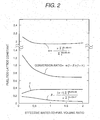
- FIG. 2 shows the relationship among the effective water-to-fuel volume ratio, the conversion ratio defined from neutron balance and three factors composing the conversion ratio. Conversion ratio ⁇ ⁇ 1 + ⁇ - 1 + ⁇ where
- the existing light water reactor under operation now has an effective water-to-fuel volume ratio of approximately 2.0 and a breading ratio of approximately 0.5.
- the breeding ratio near 1 can be attained with a conversion ratio above 0.85 by increasing the fissionable plutonium enrichment within a range to be described later and by increasing neutron leakage to the blanket.
- the effective water-to-fuel volume ratio for satisfying the above is below 0.6.
- the core-average steam void fraction needs to be a value exceeding 70 % in order to make the effective water-to-fuel volume ratio below 0.1, the two-phase flow condition at the reactor core exit can not be kept at a transient event.
- the effective water-to-fuel volume ratio of 0.1 to 0.6 can be attained by closely arranging the fuel rods, or by making use of the steam void produced in the reactor core, or by excluding the moderator by inserting a follower in an inserting position of the control rod when the control rod is not placed in the inserting position, or by combining the above three methods.
- FIG. 3 shows an example of relationship between gap between rods and geometrical water-to-fuel volume ratio.
- FIG. 3 shows the cases where the diameters of the fuel rod are within the range of approximately 9.5 to 12.3 mm which are used in the existing light water reactors and the fuel rod lattice is regular triangular.
- the (Vm/Vf)geo of the fuel rod lattice becomes below approximately 0.9.
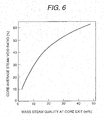
- the (Vm/Vf)geo of the fuel assembly system becomes a value larger than the (Vm/Vf)geo of the fuel rod lattice by 0.1 to 0.2 when the gap region between the fuel assemblies and the control rod insertion region are taken into consideration. Therefore, in order to realize the effective water-to-fuel volume ratio below 0.6 under the condition of the geometrical water-to-fuel volume ratio, it can be understood from Equation 1 that the core-average steam void fraction needs to be above 45 % (it can be understood from the relationship shown in FIG.
- the ratio (Vm/Vf)geo can be made smaller than approximately 0.6 with the steam void fraction of 0 %.
- FIG. 4 shows the relationship between fissile PU enrichment and breeding ratio.
- the breeding ratio is decreased as the fissionable plutonium enrichment is increased, it has been found that the breeding ratio of near 1 can be attained up to the fissionable plutonium enrichment of 20 wt% by increasing neutron leakage to the blanket in making use of increase of the excessive reactivity, as described above.
- a method considered is that a large-diameter control rod composed of an absorption rod having a cross-sectional area larger than a cross-sectional area of the fuel rod unit lattice cell is inserted into the fuel assembly.
- the reactor core structure of closely arranging the fuel rods in the regular triangle lattice configuration can be realized by the large-diameter control rod into the fuel
- possible reactor core construction are that all the large-diameter control rods connected to one control rod drive mechanism are inserted into one hexagonal fuel assembly, and the large-diameter control rods are inserted into all the hexagonal fuel assemblies loaded in a region except for the outermost periphery of the reactor core, and that a plurality of large-diameter control rods connected to one control rod drive mechanism are inserted into three hexagonal fuel assemblies, and the large-diameter control rods are inserted into all the hexagonal fuel assemblies loaded in a region except for the outermost periphery of the reactor core.
- Both of the reactor core structures can secure the reactor shut-down margin, and the former can reduce number of assemblies loaded to the reactor core by making the fuel assembly large in size, and the latter can reduce number of the control rod drive mechanisms. Further, according to the studies of the inventors of the present invention, in a case of combination of the square fuel assembly and the large-diameter control rod, the reactor core structure of closely arranging the fuel rods in a regular triangular lattice configuration can be realized.
- the reactor cores of electric power of 1350 MW class are described in the following embodiments, the output power capacity is not limited to 1350 MW. It should be recognized that the present invention may be applied to the reactor cores having the other output power capacity by changing number of the fuel assemblies.
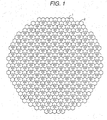
- FIG. 1 is a cross-sectional plan view showing the first embodiment of a reactor core having an electric output power of 1356 MW.
- FIG. 1 shows 504 fuel assemblies 1; and 157 control rod drive mechanisms 2 each of which operates three large-diameter control rods to be inserted into three fuel assemblies, respectively.
- FIG. 7 shows the cross section of the fuel assembly lattice.
- fuel rods 4 of 10.1 mm diameter are arranged in a regular triangular configuration with a 1.3 mm gap between the rods to form an equilateral hexagonal assembly having 12 fuel rod rows.
- a guide tube 6 to insert the large-diameter control rod 5 thereinto is disposed in the region having an area equivalent to 3 fuel rod rows, that is, an area equivalent to 19 fuel rod unit lattice cells.
- the large-diameter control rod is formed of an absorption rod of a stainless steel tube filled with B 4 C. Further, the large-diameter control rod has a follower portion in the top end portion, the follower portion being made of carbon which is a substance having a slowing-down power smaller than that of light water.
- FIG. 8 shows an arrangement of fuel assemblies under the equilibrium core state.
- Each of the numerals written in each of the fuel assemblies 1 indicates a period staying in the reactor core by cycle numbers.
- the 5 cycle fuels staying in the reactor core for the longest period are loaded in the outermost periphery of the reactor core where the neutron importance is low.
- the fuels of 1 cycle staying period in the reactor core having the highest neutron infinite multiplication factor are loaded in the outer region of the reactor core in the inner side of the outermost periphery to flatten the power distribution in the radial direction of the reactor core.
- the fuels of 2 to 4 cycle staying periods in the reactor core are distributively loaded to flatten the power distribution in the radial direction of the reactor core.
- FIG 9 shows an orifice distribution in the equilibrium reactor core state, and the numeral written in the fuels indicates difference in opening degree of an orifice placed in the fuel supporting portion, and there are two regions for the orifice opening degree.
- the orifice diameter in the reactor outermost peripheral region (number 1) where the fuel assembly power is small is smaller than the orifice diameter in the inner region.
- FIG. 10 shows the axial distribution of fissionable plutonium enrichment averaged over the horizontal cross section of the fuel assembly for the equilibrium reactor core.
- the uranium to be added with plutonium is the depleted uranium.
- the height of the reactor core is 70 cm, and the reactor core is divided into three regions at the levels of 20 cm and 49 cm from the bottom end of the reactor core, and the fissionable plutonium enrichments are 19 wt%, 0 wt% and 19 wt%, respectively, and the average fissionable plutonium enrichment is 11.1 wt%.
- depleted uranium blankets having heights of 20 cm and 25 cm are attached to the top and the bottom of the reactor core portion, respectively.
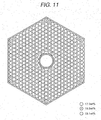
- FIG. 11 is a horizontal cross-sectional view showing the 19 wt% fissionable plutonium enrichment region of the fuel assembly.
- the fissionable plutonium enrichments are three kinds of 19.1 wt%, 18.5 wt% and 17.5 wt%, and the average enrichment is 19 wt%.
- FIG. 12 shows the distributions of core-average output power and core-average void fraction in the axial direction of the reactor core.
- the core-average void fraction is 60 %
- the mass steam quality at reactor core exit is 32 wt%.
- the output power of the present reactor core is 1350 MW which is equal to that of the existing ABWR, and the circumscribed radius of the reactor core is 2.9 m which is nearly equal to that of the ABWR.
- the height of the reactor core is 70 cm, and the blankets having heights of 20 cm and 25 cm are attached to the top and the bottom of the reactor core to form a short-length fuel assembly.
- the total length of the fuel rod is nearly equal to that of ABWR fuel and the MCPR is 1.31 which sufficiently satisfies the thermal design standard value of 1.24.
- the plutonium inventory converted to the amount of fissionable plutonium per 1000 MW output power is as small as 6.0 tons though the fuel rods are closely packed. Even including the period of plutonium staying outside the reactor core such as fuel reprocessing, the plutonium inventory is less than 10 tons per 1000 MW.
- the portions having the fissionable plutonium enrichment of 19 wt% in the upper and the lower positions there are the portions having the fissionable plutonium enrichment of 19 wt% in the upper and the lower positions, and the middle portion between them is formed of depleted uranium not containing the fissionable plutonium.
- the steam void fraction in the reactor core is increased.
- the power distribution in the upper portion of the reactor core is swung to the middle region of the reactor core where the fissionable plutonium enrichment is not contained. Thereby, the negative void coefficient is inserted.
- the mass steam quality at the reactor core exit is 32 wt%, and accordingly all the coolant does not become vapor and the coolant can be maintained in a two-phase state even when an abnormal transient event occurs. Therefore, similar to the existing BWR, the radioactive substances accumulated in the reactor core such as corrosion products are enclosed in the reactor core by evaporation operation of boiling and prevented from being transported to the turbine side.
- the BWR of the present embodiment is capable of coping with the long-term stable energy supply under the degree of safety comparative with that of the fuel burning-only light water reactor under operation now and using the pressure vessel having a size nearly equal to that of the ABWR under construction now.
- the BWR of the present embodiment outputs the amount of power equal to that of the ABWR, and can attain burn-up of 65 GWd/t.
- a void coefficient of the existing BWR under operation now (a value at present) is -7.0 X 10 -4 ⁇ k/k/% void.
- the value for the present embodiment is designed to be -0.5 X 10 -4 ⁇ k/k/% void of which the absolute value is smaller than the value at present.
- the thermal margin to an event of increasing pressure or to an event of decreasing coolant temperature is relatively large. From the above reason, the BWR reactor core of the present embodiment has safety margins for various kinds of transient events which are larger than those of the existing BWR under operation now.
- the large-diameter control rod having an outer diameter larger than that of the fuel rod is employed as the absorption rod.
- the mechanical strength of the control rod can be increased and accordingly bending and buckling of the control rod can be suppressed when the control rod is inserted or withdrawn.
- number of absorption rods per fuel assembly can be reduced, and accordingly the control rod can be easily manufactured to reduce the manufacturing cost.
- the breeding ratio of 1.01 can be realized by the fuel enriched by adding the fissile PU of average 11.1 wt% to the depleted uranium, and 1500 units of 1000 MW reactors can be operated for 10 thousands years using the uranium reserves of 15 million tons in the world, and accordingly the long-term stable energy supply can be established.
- the diameter of the pressure vessel the operating conditions such as output power and the used materials are the same as those of the existing BWR under operation, the electric power generation cost can be suppressed to the same level as that of the existing BWR even though the performance is largely progressed.
- the safety margin can be secured in the same level as that of the existing BWR by maintaining the evaporating function by boiling to enclose the radioactive substances in the pressure vessel.
- the same or more effects can be obtained by the fuel enriched by adding plutonium to natural uranium or the degraded uranium recovered from used fuel or the low enriched uranium instead of the depleted uranium.
- the fissile PU enrichment can be reduced by 0.5 wt% or more compared to the case of using the depleted uranium due to increase in an amount of uranium-235 contained in the fuel.
- the breeding ratio to the fissile PU can be increased by nearly 3 % or more, and the void coefficient can be made negative.
- the Pu inventory can be reduced, number of the RBWRs capable of being operated can be further increased.
- the power coefficient including the Doppler coefficient can be made negative even if the void coefficient is 0 or slightly positive. According to the study of the inventors of the present invention, it has been shown from an evaluation result on the safety that the negative or positive void coefficient is essentially no problem if the power coefficient is negative. Therefore, the thermal margin can be increased by increasing the length of the reactor core portion. Further, the breeding ratio can be increased by narrowing the gap between the fuel rods.
- the other actinides can be added together with Pu.
- the RBWR is high in the average energy of neutrons
- plutonium is hardly converted to actinides having higher mass numbers and at the same time the actinides can be eliminated by nuclear fission reaction.
- the depleted uranium region is arranged in the position slightly higher than the middle position of the reactor core in the present embodiment, but it is not limited to that position.
- the values of axial power peaking can be made equal by combining the fissile PU enrichments in the upper and the lower portions and the position of the depleted uranium region.
- the present embodiment is a reactor core of an electric power output of 1356 MW, and has further shortened fuel assemblies.
- the horizontal cross section and the cross section of the fuel assembly lattice of the present embodiment are the same as FIG. 1 and FIG. 7 of Embodiment 1, respectively.
- FIG. 13 shows the axial distribution of fissionable plutonium enrichment averaged over the horizontal cross section of the fuel assembly for the equilibrium reactor core.
- the uranium to be added with plutonium is the depleted uranium.
- the height of the reactor core is 45 cm, and the reactor core is divided into two regions at the levels of 8/12 from the bottom end of the reactor core, and the fissionable plutonium enrichment in the upper region is 13 wt% and the fissionable plutonium enrichment in the upper region is 12 wt%. Further, depleted uranium blankets having heights of 25 cm and 20 cm are attached to the top and the bottom of the reactor core portion, respectively.
- the construction of the fuel assembly is the same as that of Embodiment 1.
- the regular triangular lattice closed-compact hexagonal fuel assembly having a gap between rods of 1.3 mm, the core-average void fraction of 60 % and the large-diameter control rod, an effective water-to-fuel volume ratio of 0.27 was attained, and a breeding ratio of 1.01 was realized.
- the present embodiment does not have the depleted uranium region not containing the fissile PU, and the reactor core portion is as short as 45 cm.
- the fuel assembly is an upper-and-lower two region fuel having different fissile PU enrichments at the levels of 15 cm from the top end of the reactor core, and the fissionable plutonium enrichment in the upper region is 13 wt% and the fissionable plutonium enrichment in the upper region is 12 wt%.
- the RBWR of the present embodiment outputs the amount of power equal to that of the ABWR, and can attain burn-up of 45 GWd/t using the pressure vessel having a size nearly equal to that of the ABWR under construction now.
- the same or more effects can be also obtained by the fuel enriched by adding plutonium to natural uranium or the degraded uranium recovered from used fuel or the low enriched uranium instead of the depleted uranium.
- the other actinides can be added together with Pu.
- FIG. 14 is a reactor core in which the electric output power is the same as that of Embodiment 1, and number of fuel assemblies and the structure of the fuel assembly are changed from Embodiment 1.
- FIG. 14 is a cross-sectional plan view showing the present embodiment of a reactor core having an electric output power of 1356 MW.
- FIG. 14 shows 609 fuel assemblies 7; and 193 control rod drive mechanisms 8 each of which operates large-diameter control rods to be inserted into three fuel assemblies.
- FIG. 15 shows the cross section of the fuel assembly lattice.
- fuel rods 4 of 10.1 mm diameter are arranged in a regular triangular configuration with a 1.3 mm gap between the rods to form an equilateral hexagonal assembly having 11 fuel rod rows.
- two guide tubes 11 to insert the large-diameter control rods 10 thereinto are disposed in the regions having an area equivalent to 2 fuel rod rows, that is, an area equivalent to 7 fuel rod unit lattice cells.
- the large-diameter control rod is formed of an absorption rod of a stainless steel tube filled with B 4 C. Further, the large-diameter control rod has a follower portion in the top end portion, the follower portion being made of carbon which is a substance having a slowing-down power smaller than that of light water.
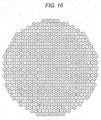
- FIG. 16 shows an arrangement of fuel assemblies under the equilibrium core state.
- Each of the numerals written in each of the fuel assemblies 7 indicates a period staying in the reactor core by cycle numbers.
- the 5 cycle fuels staying in the reactor core for the longest period are loaded in the outermost periphery of the reactor core where the neutron importance is low.
- the fuels of 1 cycle staying period in the reactor core having the highest neutron infinite multiplication factor are loaded in the outer region of the reactor core in the inner side of the outermost periphery to flatten the power distribution in the radial direction of the reactor core.
- the fuels of 2 to 4 cycle staying periods in the reactor core are distributively loaded to flatten the power distribution in the radial direction of the reactor core.
- FIG. 17 shows an orifice distribution in the equilibrium reactor core state, and the numeral written in the fuels indicates difference in opening degree of an orifice placed in the fuel supporting portion, and there are two regions for the orifice opening degree.
- the orifice diameter in the reactor outermost peripheral region (number 1) where the fuel assembly power is small is smaller than the orifice diameter in the inner region.
- the axial distribution of the fissile PU enrichment averaged with the horizontal cross section of the fuel assembly is the same as that of FIG. 10 of Embodiment 1.
- the area of the region occupied by the control rod in the present embodiment is decreased from one region of 19 fuel rod unit lattice cells to two regions of 7 fuel rod unit lattice cells, but the control rod value is nearly equal to that of Embodiment 1 because the absorption rods are distributively inserted into the fuel assembly.
- number of fuel rods loaded in the reactor core is increased compared to Embodiment 1, and accordingly the average linear power density is reduced to improve the thermal margin.
- an effective water-to-fuel volume ratio of 0.28 is also attained.
- the reactor core characteristics are the same as those of Embodiment 1 and the same effect can be obtained.
- the same or more effects can be also obtained by the fuel enriched by adding plutonium to natural uranium or the degraded uranium recovered from used fuel or the low enriched uranium instead of the depleted uranium.
- the other actinides can be added together with Pu.
- the present embodiment is a reactor core of which the reactor core performance is improved on the base of the structure of Embodiment 1.
- the present embodiment is of 1356 MW electric output power, and the reactor core cross section is the same as that of FIG. 1 of Embodiment 1.
- FIG. 18 shows the cross section of the fuel assembly lattice.
- fuel rods 4 of 10.1 mm diameter are arranged in a regular triangular configuration with a 1.3 mm gap between the rods to form an equilateral hexagonal assembly having 12 fuel rod rows.
- a guide tube 6 to insert the large-diameter control rod 5 thereinto is disposed in the region having an area equivalent to 3 fuel rod rows, that is, an area equivalent to 19 fuel rod unit lattice cells.
- the large-diameter control rod is formed of an absorption rod of a stainless steel tube filled with B 4 C. Further, the large-diameter control rod has a follower portion in the top end portion, the follower portion being made of carbon which is a substance having a slowing-down power smaller than that of light water. All of the configuration of fuel assemblies in the reactor core, the orifice state and the axial distribution of fissionable plutonium enrichment averaged over the horizontal cross section of the fuel assembly for the equilibrium reactor core are the same as FIG. 8 , FIG. 9 and FIG. 10 of Embodiment 1, respectively.
- Embodiment 1 comparing with Embodiment 1 the effective water-to-fuel volume ratio can be improved and the power peaking in the fuel assembly can be suppressed by excluding the moderator around the guide tube.
- the reactor core characteristics are the same as those of Embodiment 1 and the same effect can be obtained.
- the same or more effects can be also obtained by the fuel enriched by adding plutonium to natural uranium or the degraded uranium recovered from used fuel or the low enriched uranium instead of the depleted uranium.
- the other actinides can be added together with Pu.
- the present embodiment is a reactor core of which the reactor core performance is improved on the base of the structure of Embodiment 1.
- the present embodiment is of 1356 MW electric output power, and the reactor core cross section is the same as that of FIG. 1 of Embodiment 1.
- FIG. 19 shows the cross section of the fuel assembly lattice.
- fuel rods 4 of 10.1 mm diameter are arranged in a regular triangular configuration with a 1.3 mm gap between the rods to form an equilateral hexagonal assembly having 12 fuel rod rows.
- the large-diameter control rod is formed of an absorption rod of a stainless steel tube filled with B 4 C. Further, the large-diameter control rod has a follower portion in the top end portion, the follower portion being made of carbon which is a substance having a slowing-down power smaller than that of light water.
- the area of the region occupied by the control rod in the present embodiment is decreased from one region of 19 fuel rod unit lattice cells of Embodiment 1 to three regions of 7 fuel rod unit lattice cells.
- the absorption rods can be distributively inserted into the fuel assembly, and consequently the control rod value is improved compared to Embodiment 1.
- the other reactor core characteristics are the same as those of Embodiment 1 and the same effect can be obtained.
- the same or more effects can be also obtained by the fuel enriched by adding plutonium to natural uranium or the degraded uranium recovered from used fuel or the low enriched uranium instead of the depleted uranium.
- the other actinides can be added together with Pu.
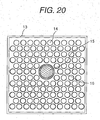
- FIG. 20 shows the construction of the present embodiment of the fuel assembly.
- fuel rods 14 of 10.8 mm diameter are closely arranged in a regular triangular configuration with a 1.3 mm minimum gap between the rods.
- a guide tube 16 to insert the large-diameter control rod 15 thereinto is disposed in the region having an area equivalent to 2 fuel rod rows, that is, an area equivalent to 7 fuel rod unit lattice cells.
- the large-diameter control rod is formed of an absorption rod of a stainless steel tube filled with B 4 C, and the large-diameter control rod has a follower portion in the top end portion, the follower portion being made of carbon which is a substance having a slowing-down power smaller than that of light water.
- the large-diameter control rods to be inserted into four of the fuel assemblies are operated by one control rod driving mechanism.
- the fissile PU enrichment of fuel rods facing the channel box and fuel rods facing the guide tube is made lower than that of the other fuel rods.
- the same or more effects can be also obtained by the fuel enriched by adding plutonium to natural uranium or the degraded uranium recovered from used fuel or the low enriched uranium instead of the depleted uranium.
- the other actinides can be added together with Pu.
- FIG. 21 is a reactor core in which the electric output power is the same as that of Embodiment 1, and the number of fuel assemblies, the structure of the fuel assembly and the control rod drive mechanism are changed from Embodiment 1.
- FIG. 21 is a cross-sectional plan view showing the present embodiment of a reactor core having an electric output power of 1356 MW.
- FIG. 21 shows 313 fuel assemblies 18; and 313 control rod drive mechanisms 18 each of which operates a large-diameter control rod to be inserted into one fuel assembly.
- FIG. 22 shows the cross section of the fuel assembly lattice.
- fuel rods 4 of 10.1 mm diameter are arranged in a regular triangular configuration with a 1.3 mm gap between the rods to form an equilateral hexagonal assembly having 15 fuel rod rows.
- a guide tube 21 to insert the large-diameter control rod 20 thereinto is disposed in the region having an area equivalent to 4 fuel rod rows, that is, an area equivalent to 37 fuel rod unit lattice cells.
- the large-diameter control rod is formed of an absorption rod of a stainless steel tube filled with B 4 C. Further, the large-diameter control rod has a follower portion in the top end portion, the follower portion being made of carbon which is a substance having a slowing-down power smaller than that of light water.
- FIG. 23 shows an arrangement of fuel assemblies under the equilibrium core state.
- Each of the numerals written in each of the fuel assemblies 17 indicates a period staying in the reactor core by cycle numbers.
- the 5 cycle fuels staying in the reactor core for the longest period are loaded in the outermost periphery of the reactor core where the neutron importance is low.
- the fuels of 1 cycle staying period in the reactor core having the highest neutron infinite multiplication factor are loaded in the outer region of the reactor core in the inner side of the outermost periphery to flatten the power distribution in the radial direction of the reactor core.
- the fuels of 2 to 4 cycle staying periods in the reactor core are distributively loaded in the inner region of the reactor core, and one 5 cycle fuel staying in the reactor core is loaded at the center of the reactor core. By doing so, the power distribution in the inner region is flattened.
- FIG. 24 shows an orifice distribution in the equilibrium reactor core state.
- the numeral written in the fuels indicates difference in opening degree of an orifice placed in the fuel supporting portion.
- the orifice diameter in the reactor outermost peripheral region (number 5) where the fuel assembly output power is small is smaller than the orifice diameters in the inner region.
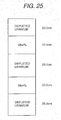
- FIG. 25 shows the axial distribution of the fissile PU enrichment averaged with the horizontal cross section of the fuel assembly.
- the uranium to be added with Pu is depleted uranium.
- number of fuel assemblies to be loaded in the reactor core is reduced from 504 assemblies of Embodiment 1 to 313 assemblies by increasing number of fuel rods per one fuel assembly to make the fuel assembly large in size, and thereby the reactor core is made small in size.
- the control rod value is made nearly equivalent to that of Embodiment 1.
- one unit of the control rod drive mechanism is used for each of the control rods to be inserted into the fuel assembly.
- the reactor core is constructed so that the large-diameter control rod is also inserted into the fuel assembly loaded in the outermost periphery of the reactor core.
- a reactor core may be designed so that the control rod is not inserted into the fuel assembly in the outermost periphery which has a small effect on securing reactor shut-down margin.
- the same or more effects can be also obtained by the fuel enriched by adding plutonium to natural uranium or the degraded uranium recovered from used fuel or the low enriched uranium instead of the depleted uranium.
- the other actinides can be added together with Pu.
- the present embodiment is a reactor core in which the electric output power is the same as that of Embodiment 1, and number of fuel assemblies, the structure of the fuel assembly and the control rod drive mechanism are changed from Embodiment 1.
- the present embodiment has an electric output power of 1356 MW, and the reactor core is the same as FIG. 21 of Embodiment 7.
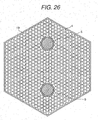
- FIG. 26 shows the cross section of the fuel assembly lattice.
- fuel rods 4 of 10.1 mm diameter are arranged in a regular triangular configuration with a 1.3 mm gap between the rods to form an equilateral hexagonal assembly having 15 fuel rod rows.
- two guide tubes 6 to insert the large-diameter control rods 5 thereinto are disposed in the regions having an area equivalent to 3 fuel rod rows, that is, an area equivalent to 19 fuel rod unit lattice cells.
- the large-diameter control rod is formed of an absorption rod of a stainless steel tube filled with B 4 C. Further, the large-diameter control rod has a follower portion in the top end portion, the follower portion being made of carbon which is a substance having a slowing-down power smaller than that of light water. All of the configuration of fuel assemblies in the reactor core, the orifice state and the axial distribution of fissionable plutonium enrichment averaged over the horizontal cross section of the fuel assembly for the equilibrium reactor core are the same as FIG. 23 , FIG. 24 and FIG. 25 of Embodiment 7, respectively.
- the area of the region occupied by the control rod in the present embodiment is decreased from one region of 37 fuel rod unit lattice cells of Embodiment 7 to two regions of 19 fuel rod unit lattice cells.
- the absorption rods can be distributively inserted into the fuel assembly, and consequently the control rod value is improved compared to Embodiment 7.
- the other reactor core characteristics are the same as those of Embodiment 7 and the same effect can be obtained.
- the same or more effects can be also obtained by the fuel enriched by adding plutonium to natural uranium or the degraded uranium recovered from used fuel or the low enriched uranium instead of the depleted uranium.
- the other actinides can be added together with Pu.
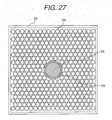
- FIG. 27 shows the construction of the present embodiment of the fuel assembly.
- fuel rods 23 of 9.8 mm diameter are closely arranged in a regular triangular configuration with a 1.3 mm minimum gap between the rods.
- a guide tube 25 to insert the large-diameter control rod 24 thereinto is disposed in the region having an area equivalent to 4 fuel rod rows, that is, an area equivalent to 37 fuel rod unit lattice cells.
- the large-diameter control rod is formed of an absorption rod of a stainless steel tube filled with B 4 C, and the large-diameter control rod has a follower portion in the top end portion, the follower portion being made of carbon which is a substance having a slowing-down power smaller than that of light water.
- the large-diameter control rods to be inserted into four of the fuel assemblies are operated by one control rod driving mechanism.
- the fissile PU enrichment of fuel rods facing the channel box and fuel rods facing the guide tube is made lower than that of the other fuel rods.
- the same or more effects can be also obtained by the fuel enriched by adding plutonium to natural uranium or the degraded uranium recovered from used fuel or the low enriched uranium instead of the depleted uranium.
- the other actinides can be added together with Pu.
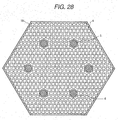
- FIG. 28 shows a cross-section of a fuel assembly lattice. Inside a channel box 19, fuel rods 4 of diameter 10.1 mm are arranged in a regular triangular configuration with a gap of 1.3 mm between the fuel rods to form an equilateral hexagonal fuel assembly having 15 fuel rod rows.
- guide tubes 6, in each of which a large-diameter control rod 5 is inserted, are arranged at six locations, and each guide tube 6 is disposed in a region having an area equivalent to two fuel rod rows, that is, an area equivalent to 7 fuel rod unit lattice cells.
- the large-diameter control rod is formed of an absorption rod of a stainless steel tube filled with B 4 C. Further, the large-diameter control rod has a follower portion in the top end portion, the follower portion being made of carbon which is a substance having a slowing-down power smaller than that of light water. All of the configuration of fuel assemblies in the reactor core, the orifice state and the axial distribution of fissionable plutonium enrichment averaged over the horizontal cross section of the fuel assembly for the equilibrium reactor core are the same as FIG. 23 , FIG. 24 and FIG. 25 of Embodiment 7, respectively.
- the area of the region occupied by the control rod in the present embodiment is decreased from one region of 37 fuel rod unit lattice cells of Embodiment 7 to six regions of 7 fuel rod unit lattice cells.
- the absorption rods can be distributively inserted into the fuel assembly, and consequently the control rod value is improved compared to Embodiment 7.
- the other reactor core characteristics are the same as those of Embodiment 7 and the same effect can be obtained.
Landscapes
- Physics & Mathematics (AREA)
- Engineering & Computer Science (AREA)
- Plasma & Fusion (AREA)
- General Engineering & Computer Science (AREA)
- High Energy & Nuclear Physics (AREA)
- Monitoring And Testing Of Nuclear Reactors (AREA)
- Fuel Cell (AREA)
Applications Claiming Priority (3)
| Application Number | Priority Date | Filing Date | Title |
|---|---|---|---|
| JP25989199 | 1999-09-14 | ||
| JP33546799 | 1999-11-26 | ||
| EP00119440.6A EP1085525B1 (fr) | 1999-09-14 | 2000-09-14 | Coeur de réacteur à eau légère et assemblage de combustible |
Related Parent Applications (2)
| Application Number | Title | Priority Date | Filing Date |
|---|---|---|---|
| EP00119440.6 Division | 2000-09-14 | ||
| EP00119440.6A Division EP1085525B1 (fr) | 1999-09-14 | 2000-09-14 | Coeur de réacteur à eau légère et assemblage de combustible |
Publications (3)
| Publication Number | Publication Date |
|---|---|
| EP2267726A2 true EP2267726A2 (fr) | 2010-12-29 |
| EP2267726A3 EP2267726A3 (fr) | 2012-12-26 |
| EP2267726B1 EP2267726B1 (fr) | 2015-05-13 |
Family
ID=26544336
Family Applications (2)
| Application Number | Title | Priority Date | Filing Date |
|---|---|---|---|
| EP20100009458 Expired - Lifetime EP2267726B1 (fr) | 1999-09-14 | 2000-09-14 | Coeur de réacteur à eau légère et assemblage de combustible |
| EP00119440.6A Expired - Lifetime EP1085525B1 (fr) | 1999-09-14 | 2000-09-14 | Coeur de réacteur à eau légère et assemblage de combustible |
Family Applications After (1)
| Application Number | Title | Priority Date | Filing Date |
|---|---|---|---|
| EP00119440.6A Expired - Lifetime EP1085525B1 (fr) | 1999-09-14 | 2000-09-14 | Coeur de réacteur à eau légère et assemblage de combustible |
Country Status (2)
| Country | Link |
|---|---|
| US (1) | US6512805B1 (fr) |
| EP (2) | EP2267726B1 (fr) |
Families Citing this family (33)
| Publication number | Priority date | Publication date | Assignee | Title |
|---|---|---|---|---|
| RU2241263C1 (ru) * | 2003-03-11 | 2004-11-27 | Федеральное государственное унитарное предприятие "Научно-исследовательский и конструкторский институт энерготехники им. Н.А. Доллежаля" | Активная зона ядерного реактора на тепловых нейтронах |
| EP2447952B1 (fr) | 2003-03-20 | 2014-05-14 | Hitachi, Ltd. | Coeur de réacteur à eau bouillante et assemblage de combustible correspondant |
| US8971474B2 (en) | 2006-11-28 | 2015-03-03 | Terrapower, Llc | Automated nuclear power reactor for long-term operation |
| US9214246B2 (en) * | 2006-11-28 | 2015-12-15 | Terrapower, Llc | System and method for operating a modular nuclear fission deflagration wave reactor |
| US20080123797A1 (en) * | 2006-11-28 | 2008-05-29 | Searete Llc, A Limited Liability Corporation Of The State Of Delaware | Automated nuclear power reactor for long-term operation |
| US9275759B2 (en) * | 2006-11-28 | 2016-03-01 | Terrapower, Llc | Modular nuclear fission reactor |
| US20090080587A1 (en) * | 2006-11-28 | 2009-03-26 | Searete Llc, A Limited Liability Corporation Of The State Of Delaware | Nuclear fission igniter |
| US20090080588A1 (en) * | 2006-11-28 | 2009-03-26 | Searete Llc, A Limited Liability Corporation Of The State Of Delaware | Nuclear fission igniter |
| US20090175402A1 (en) * | 2006-11-28 | 2009-07-09 | Searete Llc, A Limited Liability Corporation Of The State Of Delaware | Method and system for providing fuel in a nuclear reactor |
| US9831004B2 (en) | 2006-11-28 | 2017-11-28 | Terrapower, Llc | Controllable long term operation of a nuclear reactor |
| US9734922B2 (en) | 2006-11-28 | 2017-08-15 | Terrapower, Llc | System and method for operating a modular nuclear fission deflagration wave reactor |
| US20080123795A1 (en) * | 2006-11-28 | 2008-05-29 | Searete Llc, A Limited Liability Corporation Of The State Of Delaware | Controllable long term operation of a nuclear reactor |
| US9230695B2 (en) * | 2006-11-28 | 2016-01-05 | Terrapower, Llc | Nuclear fission igniter |
| US7860207B2 (en) | 2006-11-28 | 2010-12-28 | The Invention Science Fund I, Llc | Method and system for providing fuel in a nuclear reactor |
| JP4516085B2 (ja) * | 2007-02-28 | 2010-08-04 | 株式会社日立製作所 | 軽水炉 |
| US7804077B2 (en) * | 2007-10-11 | 2010-09-28 | Neucon Technology, Llc | Passive actinide self-burner |
| US20090285348A1 (en) * | 2008-05-15 | 2009-11-19 | Searete Llc, A Limited Liability Corporation Of The State Of Delaware | Heat pipe fission fuel element |
| US9793014B2 (en) * | 2008-05-15 | 2017-10-17 | Terrapower, Llc | Heat pipe fission fuel element |
| JP4739379B2 (ja) * | 2008-08-08 | 2011-08-03 | 日立Geニュークリア・エナジー株式会社 | 軽水炉の炉心 |
| WO2011008732A1 (fr) * | 2009-07-14 | 2011-01-20 | Babcock & Wilcox Technical Services Y-12, Llc | Dispositif de simulation de materiau nucleaire special |
| JP5970375B2 (ja) * | 2009-11-02 | 2016-08-17 | テラパワー, エルエルシー | 核分裂炉 |
| US9691511B1 (en) * | 2009-11-09 | 2017-06-27 | Sandia Corporation | Target-fueled nuclear reactor for medical isotope production |
| JP5497426B2 (ja) | 2009-12-28 | 2014-05-21 | 日立Geニュークリア・エナジー株式会社 | 軽水炉の炉心及び燃料集合体 |
| US20110243293A1 (en) * | 2010-03-31 | 2011-10-06 | Peter Ray Diller | Systems and Methods for Servicing a Fuel Assembly in a Light Water Reactor |
| KR20170038129A (ko) | 2010-09-03 | 2017-04-05 | 아토믹 에너지 오브 캐나다 리미티드 | 토륨을 함유하는 핵연료 다발 및 그것을 포함하는 원자로 |
| RO129197B1 (ro) | 2010-11-15 | 2021-10-29 | Atomic Energy Of Canada Limited | Combustibil nuclear conţinând uraniu reciclat şi sărăcit, şi fascicul de combus- tibil nuclear şi reactor nuclear cuprinzând un astfel de fascicul |
| RO129195B1 (ro) | 2010-11-15 | 2019-08-30 | Atomic Energy Of Canada Limited | Combustibil nuclear conţinând un absorbant de neutroni |
| CN109192333B (zh) * | 2018-09-13 | 2020-06-23 | 中国核动力研究设计院 | 六边形套管型燃料组件核设计可靠性检验堆芯及验证方法 |
| CN109273108B (zh) * | 2018-09-13 | 2020-06-23 | 中国核动力研究设计院 | 六边形套管型燃料堆芯孔道核设计检验堆芯及试验方法 |
| CN110111913B (zh) * | 2018-09-13 | 2022-02-11 | 中国核动力研究设计院 | 六边形套管型燃料堆芯中子注量率测量的试验堆芯及方法 |
| CN109192331B (zh) * | 2018-09-13 | 2020-06-23 | 中国核动力研究设计院 | 六边形套管型燃料组件核设计可靠性检验堆芯及调整方法 |
| CN113012826B (zh) * | 2021-03-02 | 2022-11-22 | 上海交通大学 | 小型铅冷快堆堆芯 |
| CN119964852B (zh) * | 2025-04-11 | 2025-07-22 | 中核龙原科技有限公司 | 一种快堆堆芯 |
Citations (3)
| Publication number | Priority date | Publication date | Assignee | Title |
|---|---|---|---|---|
| JPS5510591A (en) | 1978-05-05 | 1980-01-25 | Kernforschungsz Karlsruhe | Nuclear reactor |
| JPH01227993A (ja) | 1988-03-09 | 1989-09-12 | Hitachi Ltd | 沸騰水型原子炉及びその燃料装荷方法 |
| JPH0821890A (ja) | 1994-07-08 | 1996-01-23 | Hitachi Ltd | 軽水炉炉心及び燃料集合体並びに制御棒 |
Family Cites Families (12)
| Publication number | Priority date | Publication date | Assignee | Title |
|---|---|---|---|---|
| BE633135A (fr) * | 1962-06-04 | |||
| US3640844A (en) | 1969-11-07 | 1972-02-08 | Atomic Energy Commission | Power-flattened seed-blanket reactor core |
| US3671392A (en) | 1971-03-15 | 1972-06-20 | Atomic Energy Commission | Light-water breeder reactor |
| US4001078A (en) * | 1975-03-07 | 1977-01-04 | General Atomic Company | Control apparatus |
| US4235669A (en) | 1978-03-30 | 1980-11-25 | The United States Of America As Represented By The United States Department Of Energy | Nuclear reactor composite fuel assembly |
| FR2517869B1 (fr) * | 1981-12-04 | 1986-08-08 | Framatome Sa | Dispositif d'arret complementaire pour un reacteur nucleaire sous-modere |
| US4968476A (en) | 1982-05-14 | 1990-11-06 | Touro College | Light water breeder reactor using a uranium-plutonium cycle |
| JPH02228591A (ja) * | 1989-03-01 | 1990-09-11 | Hitachi Ltd | 燃料集合体および原子炉 |
| JPH07119818B2 (ja) | 1990-03-14 | 1995-12-20 | 株式会社日立製作所 | 燃料集合体および原子炉 |
| US5164153A (en) * | 1990-09-14 | 1992-11-17 | Hitachi, Ltd. | Control rod assembly for a boiling water reactor |
| US5737375A (en) | 1994-08-16 | 1998-04-07 | Radkowsky Thorium Power Corporation | Seed-blanket reactors |
| FR2800360B1 (fr) | 1999-10-29 | 2002-01-18 | Valois Sa | Distributeur de melange de produit extemporane |
-
2000
- 2000-09-12 US US09/660,356 patent/US6512805B1/en not_active Expired - Lifetime
- 2000-09-14 EP EP20100009458 patent/EP2267726B1/fr not_active Expired - Lifetime
- 2000-09-14 EP EP00119440.6A patent/EP1085525B1/fr not_active Expired - Lifetime
Patent Citations (3)
| Publication number | Priority date | Publication date | Assignee | Title |
|---|---|---|---|---|
| JPS5510591A (en) | 1978-05-05 | 1980-01-25 | Kernforschungsz Karlsruhe | Nuclear reactor |
| JPH01227993A (ja) | 1988-03-09 | 1989-09-12 | Hitachi Ltd | 沸騰水型原子炉及びその燃料装荷方法 |
| JPH0821890A (ja) | 1994-07-08 | 1996-01-23 | Hitachi Ltd | 軽水炉炉心及び燃料集合体並びに制御棒 |
Non-Patent Citations (1)
| Title |
|---|
| NUCLEAR TECHNOLOGY, vol. 59, 1982, pages 212 - 227 |
Also Published As
| Publication number | Publication date |
|---|---|
| EP2267726A3 (fr) | 2012-12-26 |
| EP1085525A1 (fr) | 2001-03-21 |
| US6512805B1 (en) | 2003-01-28 |
| EP2267726B1 (fr) | 2015-05-13 |
| EP1085525B1 (fr) | 2013-04-17 |
Similar Documents
| Publication | Publication Date | Title |
|---|---|---|
| EP2267726B1 (fr) | Coeur de réacteur à eau légère et assemblage de combustible | |
| EP0856852B1 (fr) | Coeur de réacteur nucléaire refroidi à l'eau légère et barre de commande destiné à un tel coeur | |
| US4285769A (en) | Control cell nuclear reactor core | |
| US4968479A (en) | Fuel assembly for nuclear reactor | |
| US4994233A (en) | Fuel rod with axial regions of annular and standard fuel pellets | |
| US4629599A (en) | Burnable absorber arrangement for fuel bundle | |
| JPH0640137B2 (ja) | 燃料集合体および沸騰水型原子炉 | |
| US10020079B2 (en) | Core of light water reactor and fuel assembly | |
| EP2447952B1 (fr) | Coeur de réacteur à eau bouillante et assemblage de combustible correspondant | |
| US5009840A (en) | Fuel assembly for nuclear reactor | |
| JPH04143694A (ja) | 燃料集合体 | |
| JP3828345B2 (ja) | 軽水炉炉心及び燃料集合体 | |
| US5610959A (en) | Hafnium doped replacement rod for nuclear fuel reconstitution | |
| JP3847701B2 (ja) | 軽水炉炉心及び燃料集合体並びに制御棒 | |
| EP0664546A1 (fr) | Assemblage combustible | |
| JP2765848B2 (ja) | 沸騰水型原子炉及びその燃料装荷方法 | |
| JP3514869B2 (ja) | 沸騰水型原子炉用燃料集合体 | |
| JP2610254B2 (ja) | 沸騰水型原子炉 | |
| JPS60201284A (ja) | 燃料集合体 | |
| JPH0415436B2 (fr) | ||
| JP2509625B2 (ja) | 高速増殖炉の炉心構成 | |
| JP4351798B2 (ja) | 燃料集合体および原子炉 | |
| JP2632726B2 (ja) | 沸騰水型原子炉用燃料集合体 | |
| JP2656279B2 (ja) | 沸騰水型原子炉用燃料集合体 | |
| JPH0527066A (ja) | 燃料集合体 |
Legal Events
| Date | Code | Title | Description |
|---|---|---|---|
| PUAI | Public reference made under article 153(3) epc to a published international application that has entered the european phase |
Free format text: ORIGINAL CODE: 0009012 |
|
| AC | Divisional application: reference to earlier application |
Ref document number: 1085525 Country of ref document: EP Kind code of ref document: P |
|
| AK | Designated contracting states |
Kind code of ref document: A2 Designated state(s): DE FR SE |
|
| 17P | Request for examination filed |
Effective date: 20110114 |
|
| RIN1 | Information on inventor provided before grant (corrected) |
Inventor name: MIWA, JUNICHI Inventor name: AOYAMA, MOTOO Inventor name: IKEGAWA, TOMOHIKO Inventor name: TAKEDA, RENZO |
|
| PUAL | Search report despatched |
Free format text: ORIGINAL CODE: 0009013 |
|
| AK | Designated contracting states |
Kind code of ref document: A3 Designated state(s): DE FR SE |
|
| RIC1 | Information provided on ipc code assigned before grant |
Ipc: G21C 5/02 20060101ALI20121119BHEP Ipc: G21C 3/326 20060101ALI20121119BHEP Ipc: G21C 1/08 20060101AFI20121119BHEP Ipc: G21C 3/32 20060101ALI20121119BHEP Ipc: G21C 7/117 20060101ALN20121119BHEP |
|
| 17Q | First examination report despatched |
Effective date: 20130729 |
|
| GRAP | Despatch of communication of intention to grant a patent |
Free format text: ORIGINAL CODE: EPIDOSNIGR1 |
|
| RIC1 | Information provided on ipc code assigned before grant |
Ipc: G21C 3/32 20060101ALI20141001BHEP Ipc: G21C 7/117 20060101ALN20141001BHEP Ipc: G21C 1/08 20060101AFI20141001BHEP Ipc: G21C 5/02 20060101ALI20141001BHEP Ipc: G21C 3/326 20060101ALI20141001BHEP |
|
| INTG | Intention to grant announced |
Effective date: 20141022 |
|
| RIC1 | Information provided on ipc code assigned before grant |
Ipc: G21C 7/117 20060101ALN20141013BHEP Ipc: G21C 3/32 20060101ALI20141013BHEP Ipc: G21C 5/02 20060101ALI20141013BHEP Ipc: G21C 3/326 20060101ALI20141013BHEP Ipc: G21C 1/08 20060101AFI20141013BHEP |
|
| RIN1 | Information on inventor provided before grant (corrected) |
Inventor name: AOYAMA, MOTOO Inventor name: TAKEDA, RENZO Inventor name: MIWA, JUNICHI Inventor name: IKEGAWA, TOMOHIKO |
|
| GRAS | Grant fee paid |
Free format text: ORIGINAL CODE: EPIDOSNIGR3 |
|
| GRAA | (expected) grant |
Free format text: ORIGINAL CODE: 0009210 |
|
| AC | Divisional application: reference to earlier application |
Ref document number: 1085525 Country of ref document: EP Kind code of ref document: P |
|
| AK | Designated contracting states |
Kind code of ref document: B1 Designated state(s): DE FR SE |
|
| REG | Reference to a national code |
Ref country code: DE Ref legal event code: R096 Ref document number: 60048961 Country of ref document: DE Effective date: 20150625 |
|
| REG | Reference to a national code |
Ref country code: DE Ref legal event code: R097 Ref document number: 60048961 Country of ref document: DE |
|
| PLBE | No opposition filed within time limit |
Free format text: ORIGINAL CODE: 0009261 |
|
| STAA | Information on the status of an ep patent application or granted ep patent |
Free format text: STATUS: NO OPPOSITION FILED WITHIN TIME LIMIT |
|
| REG | Reference to a national code |
Ref country code: DE Ref legal event code: R119 Ref document number: 60048961 Country of ref document: DE |
|
| 26N | No opposition filed |
Effective date: 20160216 |
|
| REG | Reference to a national code |
Ref country code: FR Ref legal event code: ST Effective date: 20160531 |
|
| PG25 | Lapsed in a contracting state [announced via postgrant information from national office to epo] |
Ref country code: DE Free format text: LAPSE BECAUSE OF NON-PAYMENT OF DUE FEES Effective date: 20160401 |
|
| PG25 | Lapsed in a contracting state [announced via postgrant information from national office to epo] |
Ref country code: FR Free format text: LAPSE BECAUSE OF NON-PAYMENT OF DUE FEES Effective date: 20150930 |
|
| PG25 | Lapsed in a contracting state [announced via postgrant information from national office to epo] |
Ref country code: SE Free format text: LAPSE BECAUSE OF FAILURE TO SUBMIT A TRANSLATION OF THE DESCRIPTION OR TO PAY THE FEE WITHIN THE PRESCRIBED TIME-LIMIT Effective date: 20150513 |