EP2268715B1 - Procédé de production d'un corps moulé rapidement mouillable - Google Patents
Procédé de production d'un corps moulé rapidement mouillable Download PDFInfo
- Publication number
- EP2268715B1 EP2268715B1 EP09731782.0A EP09731782A EP2268715B1 EP 2268715 B1 EP2268715 B1 EP 2268715B1 EP 09731782 A EP09731782 A EP 09731782A EP 2268715 B1 EP2268715 B1 EP 2268715B1
- Authority
- EP
- European Patent Office
- Prior art keywords
- gelatin
- plasma
- sponges
- sponge
- hydrocolloid
- Prior art date
- Legal status (The legal status is an assumption and is not a legal conclusion. Google has not performed a legal analysis and makes no representation as to the accuracy of the status listed.)
- Active
Links
Images

Classifications
-
- C—CHEMISTRY; METALLURGY
- C08—ORGANIC MACROMOLECULAR COMPOUNDS; THEIR PREPARATION OR CHEMICAL WORKING-UP; COMPOSITIONS BASED THEREON
- C08J—WORKING-UP; GENERAL PROCESSES OF COMPOUNDING; AFTER-TREATMENT NOT COVERED BY SUBCLASSES C08B, C08C, C08F, C08G or C08H
- C08J7/00—Chemical treatment or coating of shaped articles made of macromolecular substances
- C08J7/12—Chemical modification
- C08J7/123—Treatment by wave energy or particle radiation
-
- A—HUMAN NECESSITIES
- A23—FOODS OR FOODSTUFFS; TREATMENT THEREOF, NOT COVERED BY OTHER CLASSES
- A23L—FOODS, FOODSTUFFS OR NON-ALCOHOLIC BEVERAGES, NOT OTHERWISE PROVIDED FOR; PREPARATION OR TREATMENT THEREOF
- A23L29/00—Foods or foodstuffs containing additives; Preparation or treatment thereof
- A23L29/20—Foods or foodstuffs containing additives; Preparation or treatment thereof containing gelling or thickening agents
- A23L29/275—Foods or foodstuffs containing additives; Preparation or treatment thereof containing gelling or thickening agents of animal origin, e.g. chitin
- A23L29/281—Proteins, e.g. gelatin or collagen
- A23L29/284—Gelatin; Collagen
-
- A—HUMAN NECESSITIES
- A61—MEDICAL OR VETERINARY SCIENCE; HYGIENE
- A61L—METHODS OR APPARATUS FOR STERILISING MATERIALS OR OBJECTS IN GENERAL; DISINFECTION, STERILISATION OR DEODORISATION OF AIR; CHEMICAL ASPECTS OF BANDAGES, DRESSINGS, ABSORBENT PADS OR SURGICAL ARTICLES; MATERIALS FOR BANDAGES, DRESSINGS, ABSORBENT PADS OR SURGICAL ARTICLES
- A61L27/00—Materials for grafts or prostheses or for coating grafts or prostheses
- A61L27/14—Macromolecular materials
- A61L27/22—Polypeptides or derivatives thereof, e.g. degradation products
- A61L27/222—Gelatin
-
- A—HUMAN NECESSITIES
- A61—MEDICAL OR VETERINARY SCIENCE; HYGIENE
- A61L—METHODS OR APPARATUS FOR STERILISING MATERIALS OR OBJECTS IN GENERAL; DISINFECTION, STERILISATION OR DEODORISATION OF AIR; CHEMICAL ASPECTS OF BANDAGES, DRESSINGS, ABSORBENT PADS OR SURGICAL ARTICLES; MATERIALS FOR BANDAGES, DRESSINGS, ABSORBENT PADS OR SURGICAL ARTICLES
- A61L27/00—Materials for grafts or prostheses or for coating grafts or prostheses
- A61L27/50—Materials characterised by their function or physical properties, e.g. injectable or lubricating compositions, shape-memory materials, surface modified materials
- A61L27/52—Hydrogels or hydrocolloids
-
- A—HUMAN NECESSITIES
- A61—MEDICAL OR VETERINARY SCIENCE; HYGIENE
- A61P—SPECIFIC THERAPEUTIC ACTIVITY OF CHEMICAL COMPOUNDS OR MEDICINAL PREPARATIONS
- A61P7/00—Drugs for disorders of the blood or the extracellular fluid
- A61P7/04—Antihaemorrhagics; Procoagulants; Haemostatic agents; Antifibrinolytic agents
-
- C—CHEMISTRY; METALLURGY
- C08—ORGANIC MACROMOLECULAR COMPOUNDS; THEIR PREPARATION OR CHEMICAL WORKING-UP; COMPOSITIONS BASED THEREON
- C08J—WORKING-UP; GENERAL PROCESSES OF COMPOUNDING; AFTER-TREATMENT NOT COVERED BY SUBCLASSES C08B, C08C, C08F, C08G or C08H
- C08J2389/00—Characterised by the use of proteins; Derivatives thereof
Definitions
- the present invention is a process for producing a rapidly wettable shaped body from a natural hydrocolloid-containing material.
- Hydrocolloids are a number of different polymeric substances, which are mostly of natural origin (in particular polysaccharides and proteins), but partly also synthetically produced. They are distinguished by the property of forming gels or viscous solutions in aqueous systems, some hydrocolloids (depending on the temperature) being water-soluble, while others are in the form of colloidal solutions, dispersions or emulsions. These and other properties of the hydrocolloids may in some cases be influenced by the degree of hydrolysis, for example in the preparation of soluble insoluble collagen gelatin.
- hydrocolloids find wide use in the preparation of foods and cosmetics as thickeners or stabilizers, i. to adjust a certain consistency or texture of the products.
- hydrocolloids or hydrocolloid-containing materials are also used in medicine, e.g. in the wound care or as a substrate for living cells, where also the good physiological compatibility, the biodegradability and the gelation properties of many hydrocolloids can be advantageously exploited.
- hydrocolloids are used in the form of moldings. Again, such hydrocolloid-containing materials are generally desirable, which are rapidly wetted on contact with aqueous media, in particular body fluids.
- the US 2003/0232071 A1 discloses a biomimetic composite as a bone substitute material.
- This composite comprises an organic, liquid-swellable matrix and an inorganic mineral phase, wherein the swellable matrix may include, for example, collagen.
- a surface modification of the swellable matrix is disclosed inter alia by a plasma treatment.
- a method of the aforementioned type is proposed according to the invention, in which a gelatin-containing material in the form of a shaped body is exposed to a plasma.
- the invention relates to a method for producing a rapidly wettable shaped article from a gelatin-containing material, wherein a molded article of a gelatin-containing material having a cell structure is first mechanically compressed and then exposed to a plasma. chemical modification of the hydrocolloid, but which is sufficient to significantly improve the wettability.
- the hydrocolloid is selected from gelatin.
- the hydrocolloid-containing material consists predominantly of hydrocolloid, i. to more than 50% by weight.
- water-soluble components are included in the material, poor wettability may result due to the hydrocolloid content.
- Other components which may preferably be included in the hydrocolloid-containing material are detailed below in connection with particular embodiments of the invention.
- the material comprises greater than about 80 weight percent, preferably greater than about 90 weight percent hydrocolloid.
- the material may also consist essentially entirely of hydrocolloid.
- the hydrocolloid may contain a certain amount of water which is bound in equilibrium with the ambient air from the hydrocolloid.
- the hydrocolloid-containing material can be used in this form for the inventive method.
- the water content of the hydrocolloid prior to the plasma treatment can be reduced by drying, whereby in some cases an increased liquid holding capacity of the material produced can be achieved.
- the hydrocolloid-containing material may be present for carrying out the process according to the invention in the form of a powder, granules or agglomerate. Hydrocolloids in such a form are used in particular in the food and cosmetics industries as raw materials.
- the inventive method corresponding powders, granules or agglomerates can be prepared, which are rapidly wetted and thus can be processed faster and cheaper.
- the hydrocolloid-containing material according to the invention is present as a shaped body.
- a shaped body according to the present invention has a predetermined spatial structure, in contrast to something to a powder.
- the shaped bodies can be solid or hollow or have a cell structure.
- Some examples of shaped articles include films, sponges, fabrics, nonwovens, tubes, particles or spheres. Preferred embodiments of such shaped bodies and their use are described in detail below.
- the plasma in the method of the invention is preferably a low pressure plasma, i. a plasma whose pressure is well below the normal pressure of 1013.25 mbar.
- the process can be carried out with a low-pressure plasma of about 1 mbar or less, preferably about 0.5 mbar or less, more preferably about 0.2 mbar or less.
- the plasma is an O 2 plasma and / or a H 2 O plasma.
- the generation of corresponding plasmas is known from the prior art.
- the process is preferably carried out by exposing the hydrocolloid-containing material in a closed space in which the plasma is generated.
- the process according to the invention can be carried out in particular in a commercially available plasma system.
- the length of time the hydrocolloid-containing material is exposed to the plasma can be varied depending on the type of hydrocolloid and the shape and size of the material to achieve the desired wettability effect. In most cases, the material should be exposed to the plasma for longer than about 1 minute for a noticeable effect.
- the time period is preferably about 5 to about 180 minutes, more preferably about 20 to about 60 minutes.
- the process according to the invention is carried out such that at least part of the surface of the hydrocolloid-containing material is exposed to the plasma. Preferably, however, the entire surface is exposed to the plasma.
- the hydrocolloid comprises gelatin.
- Gelatine plays a prominent role among hydrocolloids not only in the production of food, but is also particularly suitable as a starting material for various materials for medical use.
- gelatine with corresponding purity is characterized by a very good tissue and cell compatibility and a substantially complete biodegradability. These properties remain substantially unaffected by the plasma treatment according to the invention.
- the plasma-treated material is very well cell-compatible and there is no measurable change in the pH the surface, which is important, for example, when using gelatin-containing materials as a substrate for living cells.
- the gelatin used for the process according to the invention may be chemically modified.
- the modification may be to provide individual amino acid side chains with additional functional groups to increase or reduce the affinity of the gelatin-containing material for particular tissue or cell types.
- the gelatin is at least partially crosslinked.
- crosslinking the gelatin which can be done chemically and / or enzymatically, it is converted into an insoluble form, so that the corresponding, crosslinked gelatin-containing materials do not dissolve immediately upon contact with an aqueous medium at elevated temperature (eg 37 ° C) but are hydrolytically degraded only over a certain period of time.
- the length of this degradation time can be varied via the degree of crosslinking.
- Such crosslinking to reduce the solubility of the material can be carried out in an analogous manner with other water-soluble hydrocolloids.
- a particular aspect of the present invention relates to the application of the method to a gelatin-containing material having a cell structure.
- Such cell-structured materials will hereinafter be referred to as sponges.
- Gelatin sponges are used in medicine especially to promote hemostasis, i. for the control of bleeding (e.g., as a wound dressing or in surgery) or as a substrate for living cells (e.g., in the manufacture of tissue implants). In all of these cases, complete wetting and hydration of the sponge before or during use is desired so that rapidly wettable gelatin sponges prepared by the method of the present invention can be used much more effectively.
- gelatin sponges must be moistened beforehand by immersion in water due to their poor wettability before they are used e.g. can be used as a wound dressing, since they have a noticeable absorption capacity only in the wet state.
- gelatin sponges prepared by the process according to the invention have a surprisingly high absorption capacity against blood already in the dry state. The absorption capacity is also significantly higher in comparison to non-plasma-treated gelatin sponges, i. Overall, a larger amount of blood is absorbed over time.
- Gelatin sponges as such, for example, by the in the DE 10 2004 024 635 A1 described method are prepared in which an aqueous gelatin solution is foamed and then dried.
- Crosslinking of the gelatin can be carried out by adding a crosslinking agent in the gelatin solution and / or by the action of a crosslinking agent on the produced sponge.
- the gelatin sponge may also contain other components such as plasticizers.
- the gelatin sponges may be in various forms depending on the desired site of application. Preferred shapes are, for example, cuboids with different dimensions as wound dressing or for operations, Cylinders for use as tampons, sponge films for the treatment of large wounds or sponges in the form of spheres.
- the cell structure of the gelatin sponges preferably has an average pore diameter of less than about 300 microns. Pore diameters in this range are well suited for the applications mentioned above, in particular for colonization of the sponge with living cells.
- the method of the invention comprises mechanically compressing the gelatin-containing material.
- a gelatin sponge By compressing a gelatin sponge brittle in the dry state, partial disruption of the cell structure is effected and an open-pore material is obtained. This disruption of the cell structure occurs without affecting the structural integrity of the sponge and losing its integrity.
- the plasma treatment which not only improves the wettability of the outer, but preferably the entire inner surface of the cell structure, can be prepared in this way a gelatin sponge, which absorbs quickly on contact with an aqueous medium this and completely wetted and is hydrated.
- the mechanical compression of the material is performed before the plasma treatment, since in this case the plasma treatment is more effective with respect to the inner surface of the cell structure.
- the gelatin sponge is preferably compressed in at least one direction by about 40% or more, more preferably by about 50% or more. Compressing in only one direction, eg by rolling the material, is often sufficient, but it is also possible to compress the material in several directions.
- Such highly compressed, rapidly wettable gelatin sponges are not only able to take up particularly large amounts of blood or other bodily fluids, but can also provide support or occlusion to the surrounding tissue.
- Such gelatin sponges offer excellent preconditions compared with nonabsorbable materials, since the biodegradability of gelatin requires no further removal of the material.
- Particularly rapidly wettable gelatin sponges with high expansion capacity can also be used as nasal tampons, both for emergency care in cases of heavy cases of nosebleeds and in operations in the nasal area (especially in functional endoscopic sinus surgery as well as in the turbinoplasty).
- relatively large amounts of blood must be absorbed as quickly as possible.
- the compression can take place in several directions (for example, a radial compression can be performed on a cylindrical sponge, in particular a nasal tampon).
- tonsillectomy removal of the palatine tonsils. Also in this case, such bleeding can be treated with the help of rapidly wettable gelatine sponges.
- gelatin sponges with a higher or lower hardness in the hydrated state may be desired.
- soft as possible materials are preferred, for example, from the viewpoint of preventing scarring in the case of functional endoscopic sinus surgery, while in the turbo-plastic gelatin sponges having a somewhat higher strength are advantageous for exerting some pressure on the nasal artery.
- the hardness of the gelatin sponges in the hydrated state can be influenced in particular by the density of the material and the cell structure.
- the gelatin-containing material comprises one or more active pharmaceutical ingredients, which may be selected according to the application.
- gelatin sponges may in particular comprise hemostats.
- the gelatin sponges may also be colored to facilitate differentiation of different products. This applies equally to other gelatin-containing materials which are described below.
- the present invention further provides a rapidly wettable, natural hydrocolloid-containing material in the form of a shaped body, which is obtainable according to the method described above.
- a rapidly wettable, natural hydrocolloid-containing material in the form of a shaped body, which is obtainable according to the method described above.
- the material of the present invention may also be defined by its initial wettability, which is reflected in the rate at which a certain amount of aqueous medium is absorbed by the material.
- the invention relates to a rapidly wettable, hydrocolloid-containing material having a cell structure, wherein the material has such initial wettability that it absorbs 50 .mu.l of an aqueous medium within a maximum of 10 seconds, especially a maximum of 5 seconds.
- the hydrocolloid-containing material is particularly a gelatin-containing material in the form of a gelatin sponge.
- this material also has such a swelling capacity that it increases its volume by at least 200% when immersed in water within a maximum of 6 seconds.
- such a material can be obtained by the prior compression of the material with the cell structure.
- the invention further relates to the use of a hydrocolloid-containing material according to the invention in the production and / or processing of foods, as stated above.
- the invention relates to the use of the materials according to the invention in human or veterinary medicine, in particular for promoting haemostasis (ie to stop bleeding), as a wound dressing and / or as a nasal tampon, as well as a substrate for living cells and / or for the production of tissue implants ,
- haemostasis ie to stop bleeding
- a wound dressing ie to stop bleeding
- a nasal tampon ie to stop bleeding
- a substrate for living cells and / or for the production of tissue implants for details of the respective uses, reference is also made to the above description of the method according to the invention.
- This example describes the use of the process according to the invention for producing a rapidly wettable, hydrocolloid-containing material in the form of a gelatin sponge.
- gelatin sponges As starting material commercial gelatin sponges were used, which are used as a wound dressing. By crosslinking the gelatin, these sponges are insoluble in water but degradable under physiological conditions.
- the individual gelatine sponges which originally had dimensions of 80x50x10 mm, were rolled in a first step to a thickness of 4 mm, resulting in dimensions of 80x50x4 mm.
- the cell structure was partially broken to allow the highest possible efficiency of the subsequent plasma treatment with respect to the entire inner surface of the sponges.
- the sponges were dried in vacuo ( ⁇ 1 mbar) for 2 hours at 50 ° C in order to reduce the water content of the gelatin, which is usually about 8 to about 12 wt .-%, as far as possible, e.g. to 2-7 wt .-%.
- gelatin sponges were stored during the plasma treatment so that they were uniformly exposed to plasma from all six sides.
- the time required for the absorption of a certain amount of an aqueous solution by the dry sponge was measured (initial wettability).
- FIG. 1 The execution of the experiment is in the FIG. 1 shown schematically.
- 50 ⁇ l of a PBS buffer containing 0.03% by weight of methylene blue (10) was added with a pipette (12) to a location of the sponge surface (14).
- the endpoint was visually determined by recognizing the sponge structure below the sinking drop (16).
- Example 1 In contrast, the initial wettability of the untreated gelatin sponges used as starting material in Example 1 was so low that the surface-applied drop of PBS buffer had not yet penetrated the sponge even after 20 minutes.
- the blood absorption capacity of a gelatin sponge according to the invention was determined quantitatively in comparison to the non-plasma-treated starting material.
- the dry sponges were each weighed and then placed on the surface of a blood sample (human blood with a hematocrit of about 50%) for 20 seconds. Subsequently, the sponges were placed on a filter paper for 60 seconds to drain off excess blood. The sponges with the absorbed blood were weighed again and the difference in the original weight was used to calculate the amount of absorbed blood relative to the weight of the sponge material. In each case, the average of three measurements was formed.
- the rapid wettability of the gelatin sponge according to the invention thus leads to a significantly higher blood absorption capacity when contacting the dry sponge with blood.
- the untreated sponge and the plasma-treated sponge according to Example 1 were used, both dry and in a moistened or wetted state. For moistening the sponges they were completely immersed in water before the experiment and then expressed.
- the investigated sponges (20) each had a length of 80 mm, a width of 20 mm and a thickness of 10 or 4 mm (see Example 1).
- the sponges dry or moistened
- the ruler with the sponge was held at an angle of 25 ° to the horizontal and the lower end of the sponge (ie the 20 mm wide side) in a diluted with 0.9 wt .-% saline blood concentrate (hematocrit of about 50% ) (24).
- the height of rise of the blood in the gelatin sponge was measured as a function of time, i. the distance was read off the ruler scale that the blood had covered by absorption in the sponge.
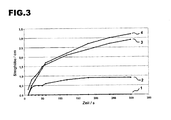
- FIG. 3 shows a diagram showing the rise in height of the blood in cm as a function of the time in seconds for the four examined gelatine sponges.
- non-plasma-treated sponge (curve 1) there was no detectable absorption of the blood into the sponge during the entire observation period of 5 minutes. If this sponge was previously moistened (curve 2), blood absorption took place during the first three minutes up to a climbing height of just under 1 cm, which then remained constant. This shows that the non-plasma-treated gelatin sponge must be pre-moistened due to its poor wettability in order to show any absorption effect at all.
- the plasma-treated gelatin sponge plasma-treated according to the invention shows a significantly faster absorption of the blood, both in the wet state (curve 3) and in the dry state (curve 4). a higher absorbency.
- the blood rose continuously during the observation period to a height of about 3 cm, i. more than 3 times the height of the wet, non-plasma-treated sponge.
- gelatin sponge according to the prior art has to be moistened beforehand in order to be able to be used at all for absorption of blood (ie as a wound dressing), this is not necessary with the gelatin sponge according to the invention since it already has a significantly higher absorption effect in a dry state. Suction power has.
- the haemostatic (hemostatic) effect of the plasma-treated gelatin sponge according to Example 1 and the non-plasma-treated reference material (GELITA-SPON) was investigated under standardized conditions using a validated ex vivo venous model.
- the non-plasma treated gelatin sponge had an average time to complete hemostasis 5.5 minutes, with an average blood loss of about 8 ml.
- the plasma treatment of the gelatin sponge according to the invention led to a considerable shortening of the average hemostasis time to about 3 minutes and to a halving of the average blood loss to about 4 ml.
- the experiment shows that the haemostatic effect of gelatin sponges can surprisingly be significantly improved by the plasma treatment according to the invention.
- the solution was tempered after a reaction time of 5 minutes to about 45 ° C and mechanically foamed with air.
- the foamed gelatin solution which had a wet density of 120 g / l, was poured into a mold measuring 40x20x6 cm and at a relative humidity of 10% initially at 20 ° C for 2 hours and then at 26 for 5 to 7 days ° C dried.
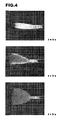
- the compressed and plasma-treated gelatin sponges prepared according to Example 5 were immersed in water, resulting in rapid wetting and swelling of the sponges. The duration of the swelling, the dimensions of the sponges before and after swelling and the volume increase were measured. From each sample, two specimens were examined.
- Table 2 source duration Dimensions before swelling (mm) Dimensions after swelling (mm) volume increase Sample 1-1 5 seconds 40x7x11 42x6x40 227% 1-2 4 seconds 40x7x11 42x7x40 282% Sample 2-1 6 seconds 50x5x16 53x5x39 158% 2-2 6 seconds 50x5x16 53x4x40 112% Sample 3-1 4 seconds 79x9x11 82x9x39 268% 3-2 5 seconds 79x9x12 83x10x42 309%
- FIG. 4 The swelling of a highly compressed gelatine sponge when immersed in water is in the FIG. 4 shown photographically.
- the sponge is held on the right side by tweezers, which prevents swelling in this area.
- the considerable volume increase within a short time clearly shows.
- Such highly expanding gelatin sponges are particularly suitable for use as nasal tampon, for example.
- the starting point for the preparation was a 20 wt .-% aqueous solution of pork rind gelatin (300 g Bloom), by means of a rotary spinning device, as for example, in the DE 10 2005 048 939 A1 has been spun into a gelatin fiber entanglement gel.
- Several layers of the interference layer were laid flat on a gelatin nonwoven with a thickness of about 1.7 mm.
- the gelatin in the web was then crosslinked by exposure to the equilibrium vapor pressure of a 10% by weight formaldehyde solution for 17 hours. Subsequently, the web was annealed for 48 hours at about 50 ° C and about 70% relative humidity to complete the crosslinking reaction and to remove the excess amount of unused formaldehyde.
- Gelatin nonwovens may be used to promote hemostasis and / or wound care in the medical field in a manner similar to the gelatin sponges described above.
Landscapes
- Health & Medical Sciences (AREA)
- Chemical & Material Sciences (AREA)
- Life Sciences & Earth Sciences (AREA)
- Medicinal Chemistry (AREA)
- Veterinary Medicine (AREA)
- Animal Behavior & Ethology (AREA)
- Public Health (AREA)
- General Health & Medical Sciences (AREA)
- Transplantation (AREA)
- Oral & Maxillofacial Surgery (AREA)
- Dermatology (AREA)
- Epidemiology (AREA)
- Polymers & Plastics (AREA)
- Dispersion Chemistry (AREA)
- Organic Chemistry (AREA)
- General Chemical & Material Sciences (AREA)
- Chemical Kinetics & Catalysis (AREA)
- Engineering & Computer Science (AREA)
- Food Science & Technology (AREA)
- Zoology (AREA)
- Nutrition Science (AREA)
- Bioinformatics & Cheminformatics (AREA)
- Hematology (AREA)
- Pharmacology & Pharmacy (AREA)
- Nuclear Medicine, Radiotherapy & Molecular Imaging (AREA)
- Diabetes (AREA)
- Materials For Medical Uses (AREA)
- Medicinal Preparation (AREA)
- Immobilizing And Processing Of Enzymes And Microorganisms (AREA)
- Jellies, Jams, And Syrups (AREA)
- Cosmetics (AREA)
- Compositions Of Macromolecular Compounds (AREA)
- Treatments Of Macromolecular Shaped Articles (AREA)
Claims (8)
- Procédé de fabrication d'un corps moulé rapidement mouillable constitué d'une matière contenant de la gélatine, dans lequel un corps moulé constitué d'une matière contenant de la gélatine ayant une structure cellulaire est d'abord comprimé mécaniquement et ensuite soumis à un plasma.
- Procédé selon la revendication 1, dans lequel la matière est entièrement constituée de gélatine.
- Procédé selon l'une des revendications précédentes, dans lequel la matière contenant de la gélatine est séchée avant de la soumettre au plasma.
- Procédé selon l'une des revendications précédentes, dans lequel le plasma est un plasma basse pression.
- Procédé selon l'une des revendications précédentes, dans lequel la matière est soumise au plasma pendant plus de 1 minute.
- Procédé selon l'une des revendications précédentes, dans lequel la structure cellulaire présente un diamètre moyen de pores inférieur à 300 µm.
- Procédé selon l'une des revendications précédentes, dans lequel le corps moulé est comprimé à 40 % ou plus dans au moins une direction.
- Procédé selon l'une des revendications précédentes, dans lequel la matière comprend une ou plusieurs substances actives pharmaceutiques.
Priority Applications (1)
| Application Number | Priority Date | Filing Date | Title |
|---|---|---|---|
| PL09731782T PL2268715T3 (pl) | 2008-04-15 | 2009-04-15 | Sposób wytwarzania szybko zwilżalnej kształtki |
Applications Claiming Priority (2)
| Application Number | Priority Date | Filing Date | Title |
|---|---|---|---|
| DE102008020197A DE102008020197A1 (de) | 2008-04-15 | 2008-04-15 | Schnell benetzbares, Hydrokolloid enthaltendes Material, Verfahren zu dessen Herstellung sowie dessen Verwendung |
| PCT/EP2009/054452 WO2009127653A1 (fr) | 2008-04-15 | 2009-04-15 | Matériau contenant de l’hydrocolloïde naturel, rapidement réticulable, son procédé de production et son utilisation |
Publications (2)
| Publication Number | Publication Date |
|---|---|
| EP2268715A1 EP2268715A1 (fr) | 2011-01-05 |
| EP2268715B1 true EP2268715B1 (fr) | 2015-07-15 |
Family
ID=40810624
Family Applications (1)
| Application Number | Title | Priority Date | Filing Date |
|---|---|---|---|
| EP09731782.0A Active EP2268715B1 (fr) | 2008-04-15 | 2009-04-15 | Procédé de production d'un corps moulé rapidement mouillable |
Country Status (11)
| Country | Link |
|---|---|
| US (1) | US20110071227A1 (fr) |
| EP (1) | EP2268715B1 (fr) |
| JP (1) | JP2011523425A (fr) |
| CN (1) | CN102007169B (fr) |
| BR (1) | BRPI0911246A2 (fr) |
| CA (1) | CA2721283A1 (fr) |
| DE (1) | DE102008020197A1 (fr) |
| ES (1) | ES2546652T3 (fr) |
| MX (1) | MX2010011297A (fr) |
| PL (1) | PL2268715T3 (fr) |
| WO (1) | WO2009127653A1 (fr) |
Cited By (1)
| Publication number | Priority date | Publication date | Assignee | Title |
|---|---|---|---|---|
| US11998654B2 (en) | 2018-07-12 | 2024-06-04 | Bard Shannon Limited | Securing implants and medical devices |
Families Citing this family (13)
| Publication number | Priority date | Publication date | Assignee | Title |
|---|---|---|---|---|
| CN102247810B (zh) * | 2011-04-26 | 2013-01-30 | 浙江大学 | 一种壳聚糖表面修饰的方法及其应用 |
| JP2012237083A (ja) * | 2011-05-13 | 2012-12-06 | Kansai Univ | ゼラチンおよび多価アルコールを含む水溶液を用いた繊維および中空糸の乾式紡糸法 |
| DE102012224379A1 (de) * | 2012-12-27 | 2014-07-03 | Aesculap Ag | Faserprodukt und Verfahren zu seiner Herstellung |
| DE102013111322A1 (de) | 2013-05-03 | 2014-11-06 | Ars Arthro Bioteknoloji A.S. | Verfahren zur Herstellung von Hydrokolloid-Schwämmen |
| CN105146237B (zh) * | 2015-08-06 | 2019-04-09 | 华南理工大学 | 一种淀粉基低分子量食品增稠剂及其制备方法 |
| EP3135309A1 (fr) | 2015-08-27 | 2017-03-01 | Hans U. Baer | Procédé de préparation d'un échafaudage polymère tridimensionnel pour le génie tissulaire |
| CN105560081B (zh) * | 2016-03-10 | 2018-04-20 | 东华大学 | 一种含壳聚糖/胶原蛋白微球的保湿面膜的制备方法 |
| US20210213157A1 (en) * | 2020-01-09 | 2021-07-15 | Ethicon, Inc. | Flexible Gelatin Sealant Dressing with Reactive Components |
| JP7691682B2 (ja) * | 2020-12-22 | 2025-06-12 | 日本毛織株式会社 | 創傷被覆材 |
| US12440599B2 (en) | 2022-05-06 | 2025-10-14 | Pramand LLC | Water activated hydrogel-based medical patches, and methods of making and using such patches |
| CN115531620B (zh) * | 2022-10-30 | 2023-07-07 | 北京医院 | 缓释氟米龙的泪小管栓及其制备方法 |
| CN115531619B (zh) * | 2022-10-30 | 2023-07-21 | 北京医院 | 缓释奥洛他定的泪小管栓及其制备方法 |
| CN116269060B (zh) * | 2023-05-23 | 2023-08-25 | 科沃斯家用机器人有限公司 | 清洁装置和清洁组件 |
Citations (3)
| Publication number | Priority date | Publication date | Assignee | Title |
|---|---|---|---|---|
| EP0122289A1 (fr) | 1982-10-19 | 1984-10-24 | House Food Industrial Co., Ltd. | Procede d'amelioration de la solubilite d'un agent de gelification difficilement soluble |
| US20030028140A1 (en) | 2001-03-12 | 2003-02-06 | Greff Richard J. | Cross-linked gelatin composition comprising a wetting agent |
| WO2005111121A2 (fr) | 2004-05-12 | 2005-11-24 | Gelita Ag | Procede de production de corps moules a base de gelatine reticulee |
Family Cites Families (18)
| Publication number | Priority date | Publication date | Assignee | Title |
|---|---|---|---|---|
| JPS58141220A (ja) * | 1982-02-16 | 1983-08-22 | Toyo Roshi Kk | 繊維素系微細多孔性フイルムの処理方法 |
| JPS6015135A (ja) * | 1983-07-06 | 1985-01-25 | Fujitsu Ltd | 濡れ性向上方法 |
| JPH03290446A (ja) * | 1990-04-07 | 1991-12-20 | Fukui Pref Gov | 多孔性フィルムの加工法 |
| JP2818021B2 (ja) * | 1990-10-16 | 1998-10-30 | 鐘紡株式会社 | 布帛の捺染方法 |
| EP0741637B1 (fr) * | 1994-01-31 | 1999-07-28 | Bausch & Lomb Incorporated | Traitement des lentilles de contact avec du fluide supercritique |
| JP2000279804A (ja) * | 1999-03-31 | 2000-10-10 | Toppan Printing Co Ltd | 吸臭、吸水材 |
| DE10037048A1 (de) * | 2000-07-29 | 2002-02-21 | Sanders Gmbh & Co Geb | Verfahren zur Herstellung hydrophiler Gewebe |
| JP2002322558A (ja) * | 2001-04-25 | 2002-11-08 | Konica Corp | 薄膜形成方法、光学フィルム、偏光板及び画像表示装置 |
| US7514248B2 (en) * | 2002-04-18 | 2009-04-07 | University Of Florida Research Foundation, Inc. | Process for making organic/inorganic composites |
| US20050142965A1 (en) * | 2003-12-29 | 2005-06-30 | Kimberly-Clark Worldwide, Inc. | Surface charge manipulation for improved fluid intake rates of absorbent composites |
| DE102004027802A1 (de) * | 2004-06-08 | 2006-01-05 | Tex Innovation Ltd. | Wirkstoffkörper aus Baumwollfasern oder Fasermischungen |
| DE102005048939A1 (de) | 2005-07-01 | 2007-01-11 | Carl Freudenberg Kg | Vorrichtung, Anordnung und Verfahren zur Herstellung von Fasern und eine solche Fasern umfassende Anordnung |
| US20080006536A1 (en) * | 2006-05-18 | 2008-01-10 | North Carolina State University | Processing cellulosic material utilizing atmospheric-pressure plasma |
| EP1886699B1 (fr) * | 2006-08-07 | 2012-04-25 | The Procter & Gamble Company | Articles absorbants comprenant des polymères superabsorbants et un matériau ayant une hydrophilicité induite par radiation |
| CN100496619C (zh) * | 2007-01-11 | 2009-06-10 | 南京零一新材料工程研究中心 | 可生物降解的壳聚糖多孔止血材料及其制备方法 |
| US8546333B2 (en) * | 2007-02-01 | 2013-10-01 | Technion Research & Development Foundation Limited | Albumin fibers and fabrics and methods of generating and using same |
| DE102007011606A1 (de) | 2007-03-02 | 2008-09-04 | Carl Freudenberg Kg | Faser-Wirrgelege |
| DE102007051059B4 (de) * | 2007-10-18 | 2014-04-03 | NMI Naturwissenschaftliches und Medizinisches Institut an der Universität Tübingen | Bioverbundmaterial für die kontrollierte Freisetzung von Wirkstoffen |
-
2008
- 2008-04-15 DE DE102008020197A patent/DE102008020197A1/de not_active Withdrawn
-
2009
- 2009-04-15 PL PL09731782T patent/PL2268715T3/pl unknown
- 2009-04-15 CN CN2009801132895A patent/CN102007169B/zh not_active Expired - Fee Related
- 2009-04-15 CA CA2721283A patent/CA2721283A1/fr not_active Abandoned
- 2009-04-15 MX MX2010011297A patent/MX2010011297A/es unknown
- 2009-04-15 ES ES09731782.0T patent/ES2546652T3/es active Active
- 2009-04-15 EP EP09731782.0A patent/EP2268715B1/fr active Active
- 2009-04-15 JP JP2011504446A patent/JP2011523425A/ja not_active Withdrawn
- 2009-04-15 WO PCT/EP2009/054452 patent/WO2009127653A1/fr not_active Ceased
- 2009-04-15 BR BRPI0911246A patent/BRPI0911246A2/pt not_active IP Right Cessation
-
2010
- 2010-10-04 US US12/897,255 patent/US20110071227A1/en not_active Abandoned
Patent Citations (3)
| Publication number | Priority date | Publication date | Assignee | Title |
|---|---|---|---|---|
| EP0122289A1 (fr) | 1982-10-19 | 1984-10-24 | House Food Industrial Co., Ltd. | Procede d'amelioration de la solubilite d'un agent de gelification difficilement soluble |
| US20030028140A1 (en) | 2001-03-12 | 2003-02-06 | Greff Richard J. | Cross-linked gelatin composition comprising a wetting agent |
| WO2005111121A2 (fr) | 2004-05-12 | 2005-11-24 | Gelita Ag | Procede de production de corps moules a base de gelatine reticulee |
Cited By (1)
| Publication number | Priority date | Publication date | Assignee | Title |
|---|---|---|---|---|
| US11998654B2 (en) | 2018-07-12 | 2024-06-04 | Bard Shannon Limited | Securing implants and medical devices |
Also Published As
| Publication number | Publication date |
|---|---|
| CN102007169A (zh) | 2011-04-06 |
| ES2546652T3 (es) | 2015-09-25 |
| CN102007169B (zh) | 2013-05-29 |
| PL2268715T3 (pl) | 2015-12-31 |
| JP2011523425A (ja) | 2011-08-11 |
| EP2268715A1 (fr) | 2011-01-05 |
| CA2721283A1 (fr) | 2009-10-22 |
| US20110071227A1 (en) | 2011-03-24 |
| MX2010011297A (es) | 2010-11-12 |
| WO2009127653A1 (fr) | 2009-10-22 |
| DE102008020197A1 (de) | 2009-10-22 |
| BRPI0911246A2 (pt) | 2015-10-06 |
Similar Documents
| Publication | Publication Date | Title |
|---|---|---|
| EP2268715B1 (fr) | Procédé de production d'un corps moulé rapidement mouillable | |
| EP2726113B2 (fr) | Produit de soin pour plaies | |
| DE69326809T2 (de) | Alginatgel | |
| DE2657684C2 (fr) | ||
| DE60203264T2 (de) | Mikrobieller Cellulose-Wundverband zur Behandlung chronischer Wunden | |
| EP1747247A2 (fr) | Procede de production de corps moules a base de gelatine reticulee | |
| JPH08260310A (ja) | 微生物多糖製品及びその製造方法 | |
| DE102012111691A1 (de) | Tamponstruktur | |
| DE112013006917T5 (de) | Carboxymethylcelluloseschaum zur hämostatischen Behandlung und zur Wundbehandlung und Verfahren zur Herstellung desselben | |
| DE1811290C3 (de) | Verfahren zur Herstellung von Kollagenfasergeflechten in Form von filzartigen Membranen oder schwammartigen Schichten | |
| JP2021518803A (ja) | キトサン繊維性スポンジ構造の医療用ドレッシング材及びその製造方法 | |
| WO2002009789A2 (fr) | Produit technique medical, son procede de production et de preparation pour la chirurgie | |
| EP0633789B1 (fr) | Bande de pansement, pansement ou matrice de support | |
| EP2098255B1 (fr) | Procédé de fabrication de matériau collagène | |
| DE60302326T2 (de) | Wundauflage mit amorphem Hydrogel auf Basis mikrobiell veränderter Cellulose | |
| CH615099A5 (fr) | ||
| EP1948257A1 (fr) | Corps moule a fabrique a partir d'un materiau reticule, contenant de la gelatine, procede de production et d'utilisation associes | |
| EP1919528A2 (fr) | Corps moule permettant de traiter des blessures | |
| DE102004047115B9 (de) | Verfahren zur Herstellung einer Wundauflage | |
| DE202023100113U1 (de) | Dreidimensional vernetztes Hydrogel | |
| EP3587456A1 (fr) | Procédé de fabrication d'un polymère antibactérien contenant du chitosane à usage médicale, notamment pour le traitement des plaies | |
| EP4452343B1 (fr) | Pansements, gel pour les plaies et produit cosmétique | |
| DE102022117861A1 (de) | Hydrogel zur Reduktion von Biofilmen | |
| EP3838301A1 (fr) | Procédé de fabrication d'un polymère contenant un dérivé de cellulose à des fins médicales, en particulier pour le traitement des plaies | |
| EP1948143A2 (fr) | Substrat favorisant l'angiogenese |
Legal Events
| Date | Code | Title | Description |
|---|---|---|---|
| PUAI | Public reference made under article 153(3) epc to a published international application that has entered the european phase |
Free format text: ORIGINAL CODE: 0009012 |
|
| 17P | Request for examination filed |
Effective date: 20100909 |
|
| AK | Designated contracting states |
Kind code of ref document: A1 Designated state(s): AT BE BG CH CY CZ DE DK EE ES FI FR GB GR HR HU IE IS IT LI LT LU LV MC MK MT NL NO PL PT RO SE SI SK TR |
|
| AX | Request for extension of the european patent |
Extension state: AL BA RS |
|
| 17Q | First examination report despatched |
Effective date: 20110309 |
|
| DAX | Request for extension of the european patent (deleted) | ||
| GRAJ | Information related to disapproval of communication of intention to grant by the applicant or resumption of examination proceedings by the epo deleted |
Free format text: ORIGINAL CODE: EPIDOSDIGR1 |
|
| RIC1 | Information provided on ipc code assigned before grant |
Ipc: A61L 15/60 20060101ALI20150225BHEP Ipc: C08J 3/00 20060101AFI20150225BHEP Ipc: C08J 3/28 20060101ALI20150225BHEP Ipc: C08J 7/12 20060101ALI20150225BHEP Ipc: A61L 27/22 20060101ALI20150225BHEP Ipc: A23L 1/0562 20060101ALI20150225BHEP Ipc: C08J 9/00 20060101ALI20150225BHEP Ipc: A61L 27/52 20060101ALI20150225BHEP |
|
| GRAP | Despatch of communication of intention to grant a patent |
Free format text: ORIGINAL CODE: EPIDOSNIGR1 |
|
| INTG | Intention to grant announced |
Effective date: 20150407 |
|
| GRAS | Grant fee paid |
Free format text: ORIGINAL CODE: EPIDOSNIGR3 |
|
| GRAA | (expected) grant |
Free format text: ORIGINAL CODE: 0009210 |
|
| AK | Designated contracting states |
Kind code of ref document: B1 Designated state(s): AT BE BG CH CY CZ DE DK EE ES FI FR GB GR HR HU IE IS IT LI LT LU LV MC MK MT NL NO PL PT RO SE SI SK TR |
|
| REG | Reference to a national code |
Ref country code: CH Ref legal event code: EP Ref country code: GB Ref legal event code: FG4D Free format text: NOT ENGLISH |
|
| REG | Reference to a national code |
Ref country code: DE Ref legal event code: R082 Ref document number: 502009011261 Country of ref document: DE Representative=s name: HOEGER, STELLRECHT & PARTNER PATENTANWAELTE MB, DE |
|
| REG | Reference to a national code |
Ref country code: IE Ref legal event code: FG4D Free format text: LANGUAGE OF EP DOCUMENT: GERMAN |
|
| REG | Reference to a national code |
Ref country code: AT Ref legal event code: REF Ref document number: 736765 Country of ref document: AT Kind code of ref document: T Effective date: 20150815 |
|
| REG | Reference to a national code |
Ref country code: DE Ref legal event code: R096 Ref document number: 502009011261 Country of ref document: DE |
|
| REG | Reference to a national code |
Ref country code: CH Ref legal event code: NV Representative=s name: ISLER AND PEDRAZZINI AG, CH |
|
| REG | Reference to a national code |
Ref country code: SE Ref legal event code: TRGR |
|
| REG | Reference to a national code |
Ref country code: ES Ref legal event code: FG2A Ref document number: 2546652 Country of ref document: ES Kind code of ref document: T3 Effective date: 20150925 |
|
| REG | Reference to a national code |
Ref country code: NL Ref legal event code: FP |
|
| REG | Reference to a national code |
Ref country code: LT Ref legal event code: MG4D |
|
| REG | Reference to a national code |
Ref country code: PL Ref legal event code: T3 |
|
| PG25 | Lapsed in a contracting state [announced via postgrant information from national office to epo] |
Ref country code: FI Free format text: LAPSE BECAUSE OF FAILURE TO SUBMIT A TRANSLATION OF THE DESCRIPTION OR TO PAY THE FEE WITHIN THE PRESCRIBED TIME-LIMIT Effective date: 20150715 Ref country code: LT Free format text: LAPSE BECAUSE OF FAILURE TO SUBMIT A TRANSLATION OF THE DESCRIPTION OR TO PAY THE FEE WITHIN THE PRESCRIBED TIME-LIMIT Effective date: 20150715 Ref country code: GR Free format text: LAPSE BECAUSE OF FAILURE TO SUBMIT A TRANSLATION OF THE DESCRIPTION OR TO PAY THE FEE WITHIN THE PRESCRIBED TIME-LIMIT Effective date: 20151016 Ref country code: NO Free format text: LAPSE BECAUSE OF FAILURE TO SUBMIT A TRANSLATION OF THE DESCRIPTION OR TO PAY THE FEE WITHIN THE PRESCRIBED TIME-LIMIT Effective date: 20151015 Ref country code: LV Free format text: LAPSE BECAUSE OF FAILURE TO SUBMIT A TRANSLATION OF THE DESCRIPTION OR TO PAY THE FEE WITHIN THE PRESCRIBED TIME-LIMIT Effective date: 20150715 |
|
| PG25 | Lapsed in a contracting state [announced via postgrant information from national office to epo] |
Ref country code: PT Free format text: LAPSE BECAUSE OF FAILURE TO SUBMIT A TRANSLATION OF THE DESCRIPTION OR TO PAY THE FEE WITHIN THE PRESCRIBED TIME-LIMIT Effective date: 20151116 Ref country code: HR Free format text: LAPSE BECAUSE OF FAILURE TO SUBMIT A TRANSLATION OF THE DESCRIPTION OR TO PAY THE FEE WITHIN THE PRESCRIBED TIME-LIMIT Effective date: 20150715 |
|
| REG | Reference to a national code |
Ref country code: FR Ref legal event code: PLFP Year of fee payment: 8 |
|
| REG | Reference to a national code |
Ref country code: DE Ref legal event code: R026 Ref document number: 502009011261 Country of ref document: DE |
|
| PLBI | Opposition filed |
Free format text: ORIGINAL CODE: 0009260 |
|
| PG25 | Lapsed in a contracting state [announced via postgrant information from national office to epo] |
Ref country code: SK Free format text: LAPSE BECAUSE OF FAILURE TO SUBMIT A TRANSLATION OF THE DESCRIPTION OR TO PAY THE FEE WITHIN THE PRESCRIBED TIME-LIMIT Effective date: 20150715 Ref country code: CZ Free format text: LAPSE BECAUSE OF FAILURE TO SUBMIT A TRANSLATION OF THE DESCRIPTION OR TO PAY THE FEE WITHIN THE PRESCRIBED TIME-LIMIT Effective date: 20150715 Ref country code: DK Free format text: LAPSE BECAUSE OF FAILURE TO SUBMIT A TRANSLATION OF THE DESCRIPTION OR TO PAY THE FEE WITHIN THE PRESCRIBED TIME-LIMIT Effective date: 20150715 Ref country code: EE Free format text: LAPSE BECAUSE OF FAILURE TO SUBMIT A TRANSLATION OF THE DESCRIPTION OR TO PAY THE FEE WITHIN THE PRESCRIBED TIME-LIMIT Effective date: 20150715 |
|
| PLAX | Notice of opposition and request to file observation + time limit sent |
Free format text: ORIGINAL CODE: EPIDOSNOBS2 |
|
| 26 | Opposition filed |
Opponent name: LIFEBOND LTD. Effective date: 20160412 |
|
| PG25 | Lapsed in a contracting state [announced via postgrant information from national office to epo] |
Ref country code: RO Free format text: LAPSE BECAUSE OF FAILURE TO SUBMIT A TRANSLATION OF THE DESCRIPTION OR TO PAY THE FEE WITHIN THE PRESCRIBED TIME-LIMIT Effective date: 20150715 |
|
| PG25 | Lapsed in a contracting state [announced via postgrant information from national office to epo] |
Ref country code: SI Free format text: LAPSE BECAUSE OF FAILURE TO SUBMIT A TRANSLATION OF THE DESCRIPTION OR TO PAY THE FEE WITHIN THE PRESCRIBED TIME-LIMIT Effective date: 20150715 Ref country code: BE Free format text: LAPSE BECAUSE OF NON-PAYMENT OF DUE FEES Effective date: 20160430 |
|
| PLAF | Information modified related to communication of a notice of opposition and request to file observations + time limit |
Free format text: ORIGINAL CODE: EPIDOSCOBS2 |
|
| PLBB | Reply of patent proprietor to notice(s) of opposition received |
Free format text: ORIGINAL CODE: EPIDOSNOBS3 |
|
| PG25 | Lapsed in a contracting state [announced via postgrant information from national office to epo] |
Ref country code: LU Free format text: LAPSE BECAUSE OF FAILURE TO SUBMIT A TRANSLATION OF THE DESCRIPTION OR TO PAY THE FEE WITHIN THE PRESCRIBED TIME-LIMIT Effective date: 20160415 |
|
| REG | Reference to a national code |
Ref country code: IE Ref legal event code: MM4A |
|
| REG | Reference to a national code |
Ref country code: FR Ref legal event code: PLFP Year of fee payment: 9 |
|
| PG25 | Lapsed in a contracting state [announced via postgrant information from national office to epo] |
Ref country code: IE Free format text: LAPSE BECAUSE OF NON-PAYMENT OF DUE FEES Effective date: 20160415 |
|
| REG | Reference to a national code |
Ref country code: AT Ref legal event code: MM01 Ref document number: 736765 Country of ref document: AT Kind code of ref document: T Effective date: 20160415 |
|
| PG25 | Lapsed in a contracting state [announced via postgrant information from national office to epo] |
Ref country code: AT Free format text: LAPSE BECAUSE OF NON-PAYMENT OF DUE FEES Effective date: 20160415 |
|
| REG | Reference to a national code |
Ref country code: DE Ref legal event code: R100 Ref document number: 502009011261 Country of ref document: DE |
|
| PLCK | Communication despatched that opposition was rejected |
Free format text: ORIGINAL CODE: EPIDOSNREJ1 |
|
| STAA | Information on the status of an ep patent application or granted ep patent |
Free format text: STATUS: THE PATENT HAS BEEN GRANTED |
|
| REG | Reference to a national code |
Ref country code: FR Ref legal event code: PLFP Year of fee payment: 10 |
|
| PG25 | Lapsed in a contracting state [announced via postgrant information from national office to epo] |
Ref country code: HU Free format text: LAPSE BECAUSE OF FAILURE TO SUBMIT A TRANSLATION OF THE DESCRIPTION OR TO PAY THE FEE WITHIN THE PRESCRIBED TIME-LIMIT; INVALID AB INITIO Effective date: 20090415 Ref country code: CY Free format text: LAPSE BECAUSE OF FAILURE TO SUBMIT A TRANSLATION OF THE DESCRIPTION OR TO PAY THE FEE WITHIN THE PRESCRIBED TIME-LIMIT Effective date: 20150715 |
|
| PLBN | Opposition rejected |
Free format text: ORIGINAL CODE: 0009273 |
|
| STAA | Information on the status of an ep patent application or granted ep patent |
Free format text: STATUS: OPPOSITION REJECTED |
|
| PG25 | Lapsed in a contracting state [announced via postgrant information from national office to epo] |
Ref country code: MK Free format text: LAPSE BECAUSE OF FAILURE TO SUBMIT A TRANSLATION OF THE DESCRIPTION OR TO PAY THE FEE WITHIN THE PRESCRIBED TIME-LIMIT Effective date: 20150715 Ref country code: IS Free format text: LAPSE BECAUSE OF FAILURE TO SUBMIT A TRANSLATION OF THE DESCRIPTION OR TO PAY THE FEE WITHIN THE PRESCRIBED TIME-LIMIT Effective date: 20150715 Ref country code: MC Free format text: LAPSE BECAUSE OF FAILURE TO SUBMIT A TRANSLATION OF THE DESCRIPTION OR TO PAY THE FEE WITHIN THE PRESCRIBED TIME-LIMIT Effective date: 20150715 Ref country code: MT Free format text: LAPSE BECAUSE OF FAILURE TO SUBMIT A TRANSLATION OF THE DESCRIPTION OR TO PAY THE FEE WITHIN THE PRESCRIBED TIME-LIMIT Effective date: 20150715 |
|
| 27O | Opposition rejected |
Effective date: 20180206 |
|
| PG25 | Lapsed in a contracting state [announced via postgrant information from national office to epo] |
Ref country code: BG Free format text: LAPSE BECAUSE OF FAILURE TO SUBMIT A TRANSLATION OF THE DESCRIPTION OR TO PAY THE FEE WITHIN THE PRESCRIBED TIME-LIMIT Effective date: 20150715 |
|
| REG | Reference to a national code |
Ref country code: DE Ref legal event code: R082 Ref document number: 502009011261 Country of ref document: DE Representative=s name: HOEGER, STELLRECHT & PARTNER PATENTANWAELTE MB, DE |
|
| PGFP | Annual fee paid to national office [announced via postgrant information from national office to epo] |
Ref country code: GB Payment date: 20220224 Year of fee payment: 14 Ref country code: CH Payment date: 20220215 Year of fee payment: 14 |
|
| PGFP | Annual fee paid to national office [announced via postgrant information from national office to epo] |
Ref country code: IT Payment date: 20220310 Year of fee payment: 14 |
|
| PGFP | Annual fee paid to national office [announced via postgrant information from national office to epo] |
Ref country code: ES Payment date: 20220506 Year of fee payment: 14 Ref country code: DE Payment date: 20220502 Year of fee payment: 14 |
|
| PGFP | Annual fee paid to national office [announced via postgrant information from national office to epo] |
Ref country code: TR Payment date: 20220413 Year of fee payment: 14 |
|
| PGFP | Annual fee paid to national office [announced via postgrant information from national office to epo] |
Ref country code: NL Payment date: 20230215 Year of fee payment: 15 |
|
| PGFP | Annual fee paid to national office [announced via postgrant information from national office to epo] |
Ref country code: FR Payment date: 20230208 Year of fee payment: 15 |
|
| PGFP | Annual fee paid to national office [announced via postgrant information from national office to epo] |
Ref country code: SE Payment date: 20230210 Year of fee payment: 15 Ref country code: PL Payment date: 20230215 Year of fee payment: 15 |
|
| REG | Reference to a national code |
Ref country code: DE Ref legal event code: R119 Ref document number: 502009011261 Country of ref document: DE |
|
| REG | Reference to a national code |
Ref country code: CH Ref legal event code: PL |
|
| GBPC | Gb: european patent ceased through non-payment of renewal fee |
Effective date: 20230415 |
|
| PG25 | Lapsed in a contracting state [announced via postgrant information from national office to epo] |
Ref country code: GB Free format text: LAPSE BECAUSE OF NON-PAYMENT OF DUE FEES Effective date: 20230415 |
|
| PG25 | Lapsed in a contracting state [announced via postgrant information from national office to epo] |
Ref country code: LI Free format text: LAPSE BECAUSE OF NON-PAYMENT OF DUE FEES Effective date: 20230430 Ref country code: GB Free format text: LAPSE BECAUSE OF NON-PAYMENT OF DUE FEES Effective date: 20230415 Ref country code: DE Free format text: LAPSE BECAUSE OF NON-PAYMENT OF DUE FEES Effective date: 20231103 Ref country code: CH Free format text: LAPSE BECAUSE OF NON-PAYMENT OF DUE FEES Effective date: 20230430 |
|
| PG25 | Lapsed in a contracting state [announced via postgrant information from national office to epo] |
Ref country code: IT Free format text: LAPSE BECAUSE OF NON-PAYMENT OF DUE FEES Effective date: 20230415 |
|
| REG | Reference to a national code |
Ref country code: ES Ref legal event code: FD2A Effective date: 20240529 |
|
| PG25 | Lapsed in a contracting state [announced via postgrant information from national office to epo] |
Ref country code: ES Free format text: LAPSE BECAUSE OF NON-PAYMENT OF DUE FEES Effective date: 20230416 |
|
| PG25 | Lapsed in a contracting state [announced via postgrant information from national office to epo] |
Ref country code: ES Free format text: LAPSE BECAUSE OF NON-PAYMENT OF DUE FEES Effective date: 20230416 |
|
| REG | Reference to a national code |
Ref country code: SE Ref legal event code: EUG |
|
| REG | Reference to a national code |
Ref country code: NL Ref legal event code: MM Effective date: 20240501 |
|
| PG25 | Lapsed in a contracting state [announced via postgrant information from national office to epo] |
Ref country code: NL Free format text: LAPSE BECAUSE OF NON-PAYMENT OF DUE FEES Effective date: 20240501 |
|
| PG25 | Lapsed in a contracting state [announced via postgrant information from national office to epo] |
Ref country code: FR Free format text: LAPSE BECAUSE OF NON-PAYMENT OF DUE FEES Effective date: 20240430 |
|
| PG25 | Lapsed in a contracting state [announced via postgrant information from national office to epo] |
Ref country code: NL Free format text: LAPSE BECAUSE OF NON-PAYMENT OF DUE FEES Effective date: 20240501 Ref country code: FR Free format text: LAPSE BECAUSE OF NON-PAYMENT OF DUE FEES Effective date: 20240430 |
|
| PG25 | Lapsed in a contracting state [announced via postgrant information from national office to epo] |
Ref country code: PL Free format text: LAPSE BECAUSE OF NON-PAYMENT OF DUE FEES Effective date: 20240415 |
|
| PG25 | Lapsed in a contracting state [announced via postgrant information from national office to epo] |
Ref country code: SE Free format text: LAPSE BECAUSE OF NON-PAYMENT OF DUE FEES Effective date: 20240416 |