EP2270020B1 - Composé époxy et procédé de fabrication du composé époxy - Google Patents
Composé époxy et procédé de fabrication du composé époxy Download PDFInfo
- Publication number
- EP2270020B1 EP2270020B1 EP09724479.2A EP09724479A EP2270020B1 EP 2270020 B1 EP2270020 B1 EP 2270020B1 EP 09724479 A EP09724479 A EP 09724479A EP 2270020 B1 EP2270020 B1 EP 2270020B1
- Authority
- EP
- European Patent Office
- Prior art keywords
- carbon atoms
- epoxy compound
- formula
- hydrogen atom
- group
- Prior art date
- Legal status (The legal status is an assumption and is not a legal conclusion. Google has not performed a legal analysis and makes no representation as to the accuracy of the status listed.)
- Not-in-force
Links
- 150000001875 compounds Chemical class 0.000 title claims description 284
- 239000004593 Epoxy Substances 0.000 title claims description 208
- 238000000034 method Methods 0.000 title description 17
- 125000004432 carbon atom Chemical group C* 0.000 claims description 110
- 125000004435 hydrogen atom Chemical group [H]* 0.000 claims description 91
- 125000000217 alkyl group Chemical group 0.000 claims description 66
- 125000002496 methyl group Chemical group [H]C([H])([H])* 0.000 claims description 63
- 125000004665 trialkylsilyl group Chemical group 0.000 claims description 44
- 238000004519 manufacturing process Methods 0.000 claims description 26
- 125000001495 ethyl group Chemical group [H]C([H])([H])C([H])([H])* 0.000 claims description 19
- 125000001997 phenyl group Chemical group [H]C1=C([H])C([H])=C(*)C([H])=C1[H] 0.000 claims description 15
- 239000007788 liquid Substances 0.000 claims description 12
- 125000003118 aryl group Chemical group 0.000 claims description 11
- 238000006459 hydrosilylation reaction Methods 0.000 claims description 7
- PXBRQCKWGAHEHS-UHFFFAOYSA-N dichlorodifluoromethane Chemical compound FC(F)(Cl)Cl PXBRQCKWGAHEHS-UHFFFAOYSA-N 0.000 claims description 6
- 238000002156 mixing Methods 0.000 claims description 4
- 229910020487 SiO3/2 Inorganic materials 0.000 claims description 3
- 238000006243 chemical reaction Methods 0.000 description 43
- YXFVVABEGXRONW-UHFFFAOYSA-N Toluene Chemical compound CC1=CC=CC=C1 YXFVVABEGXRONW-UHFFFAOYSA-N 0.000 description 35
- -1 siloxane skeleton Chemical group 0.000 description 28
- OKTJSMMVPCPJKN-UHFFFAOYSA-N Carbon Chemical compound [C] OKTJSMMVPCPJKN-UHFFFAOYSA-N 0.000 description 22
- 239000000243 solution Substances 0.000 description 20
- 238000003756 stirring Methods 0.000 description 20
- 125000003700 epoxy group Chemical group 0.000 description 19
- 238000005530 etching Methods 0.000 description 19
- 239000000203 mixture Substances 0.000 description 18
- XKRFYHLGVUSROY-UHFFFAOYSA-N Argon Chemical compound [Ar] XKRFYHLGVUSROY-UHFFFAOYSA-N 0.000 description 16
- 229910052799 carbon Inorganic materials 0.000 description 16
- 230000000052 comparative effect Effects 0.000 description 16
- 238000000113 differential scanning calorimetry Methods 0.000 description 15
- 239000011521 glass Substances 0.000 description 15
- 239000010409 thin film Substances 0.000 description 15
- 239000003054 catalyst Substances 0.000 description 14
- IZXLUEMTVRPVBL-UHFFFAOYSA-N ac1nbpy7 Chemical compound O1[Si](O[Si](O[SiH](C)C)(O2)O[Si](O[SiH](C)C)(O3)O4)(O[SiH](C)C)O[Si]4(O[SiH](C)C)O[Si]4(O[SiH](C)C)O[Si]1(O[SiH](C)C)O[Si]2(O[SiH](C)C)O[Si]3(O[SiH](C)C)O4 IZXLUEMTVRPVBL-UHFFFAOYSA-N 0.000 description 13
- 238000002329 infrared spectrum Methods 0.000 description 12
- 239000000758 substrate Substances 0.000 description 12
- CCEFMUBVSUDRLG-KXUCPTDWSA-N (4R)-limonene 1,2-epoxide Natural products C1[C@H](C(=C)C)CC[C@@]2(C)O[C@H]21 CCEFMUBVSUDRLG-KXUCPTDWSA-N 0.000 description 11
- WEEGYLXZBRQIMU-UHFFFAOYSA-N 1,8-cineole Natural products C1CC2CCC1(C)OC2(C)C WEEGYLXZBRQIMU-UHFFFAOYSA-N 0.000 description 11
- CCEFMUBVSUDRLG-XNWIYYODSA-N Limonene-1,2-epoxide Chemical compound C1[C@H](C(=C)C)CCC2(C)OC21 CCEFMUBVSUDRLG-XNWIYYODSA-N 0.000 description 11
- 239000002904 solvent Substances 0.000 description 11
- 125000002723 alicyclic group Chemical group 0.000 description 10
- QVGXLLKOCUKJST-UHFFFAOYSA-N atomic oxygen Chemical compound [O] QVGXLLKOCUKJST-UHFFFAOYSA-N 0.000 description 10
- 125000000484 butyl group Chemical group [H]C([*])([H])C([H])([H])C([H])([H])C([H])([H])[H] 0.000 description 10
- 239000007789 gas Substances 0.000 description 10
- 239000001301 oxygen Substances 0.000 description 10
- 229910052760 oxygen Inorganic materials 0.000 description 10
- 125000004430 oxygen atom Chemical group O* 0.000 description 10
- BASFCYQUMIYNBI-UHFFFAOYSA-N platinum Chemical compound [Pt] BASFCYQUMIYNBI-UHFFFAOYSA-N 0.000 description 10
- 239000002994 raw material Substances 0.000 description 10
- 238000010992 reflux Methods 0.000 description 10
- XEKOWRVHYACXOJ-UHFFFAOYSA-N Ethyl acetate Chemical compound CCOC(C)=O XEKOWRVHYACXOJ-UHFFFAOYSA-N 0.000 description 9
- CTQNGGLPUBDAKN-UHFFFAOYSA-N O-Xylene Chemical compound CC1=CC=CC=C1C CTQNGGLPUBDAKN-UHFFFAOYSA-N 0.000 description 9
- 239000008096 xylene Substances 0.000 description 9
- IJGRMHOSHXDMSA-UHFFFAOYSA-N Atomic nitrogen Chemical compound N#N IJGRMHOSHXDMSA-UHFFFAOYSA-N 0.000 description 8
- 229910052786 argon Inorganic materials 0.000 description 8
- DSVRVHYFPPQFTI-UHFFFAOYSA-N bis(ethenyl)-methyl-trimethylsilyloxysilane;platinum Chemical compound [Pt].C[Si](C)(C)O[Si](C)(C=C)C=C DSVRVHYFPPQFTI-UHFFFAOYSA-N 0.000 description 8
- 238000001460 carbon-13 nuclear magnetic resonance spectrum Methods 0.000 description 8
- 230000003287 optical effect Effects 0.000 description 8
- 238000001020 plasma etching Methods 0.000 description 8
- 238000000425 proton nuclear magnetic resonance spectrum Methods 0.000 description 8
- 210000002966 serum Anatomy 0.000 description 8
- 125000000026 trimethylsilyl group Chemical group [H]C([H])([H])[Si]([*])(C([H])([H])[H])C([H])([H])[H] 0.000 description 8
- 0 CCC*(C(C1C2C3C4OC4C1C3)=O)*2=O Chemical compound CCC*(C(C1C2C3C4OC4C1C3)=O)*2=O 0.000 description 7
- 238000001382 dynamic differential scanning calorimetry Methods 0.000 description 7
- VYPSYNLAJGMNEJ-UHFFFAOYSA-N Silicium dioxide Chemical compound O=[Si]=O VYPSYNLAJGMNEJ-UHFFFAOYSA-N 0.000 description 6
- 125000003055 glycidyl group Chemical group C(C1CO1)* 0.000 description 6
- 125000001449 isopropyl group Chemical group [H]C([H])([H])C([H])(*)C([H])([H])[H] 0.000 description 6
- 238000005259 measurement Methods 0.000 description 6
- 125000001147 pentyl group Chemical group C(CCCC)* 0.000 description 6
- 229920000647 polyepoxide Polymers 0.000 description 6
- 125000001436 propyl group Chemical group [H]C([*])([H])C([H])([H])C([H])([H])[H] 0.000 description 6
- 239000000741 silica gel Substances 0.000 description 6
- 229910002027 silica gel Inorganic materials 0.000 description 6
- TXEYQDLBPFQVAA-UHFFFAOYSA-N tetrafluoromethane Chemical compound FC(F)(F)F TXEYQDLBPFQVAA-UHFFFAOYSA-N 0.000 description 6
- XUIMIQQOPSSXEZ-UHFFFAOYSA-N Silicon Chemical group [Si] XUIMIQQOPSSXEZ-UHFFFAOYSA-N 0.000 description 5
- 238000010538 cationic polymerization reaction Methods 0.000 description 5
- 239000002131 composite material Substances 0.000 description 5
- 238000004821 distillation Methods 0.000 description 5
- 239000003822 epoxy resin Substances 0.000 description 5
- 238000011156 evaluation Methods 0.000 description 5
- 238000004817 gas chromatography Methods 0.000 description 5
- 239000000463 material Substances 0.000 description 5
- 239000011259 mixed solution Substances 0.000 description 5
- 239000003505 polymerization initiator Substances 0.000 description 5
- WRGWYAZIVRHPFP-UHFFFAOYSA-N prop-2-enyl 7-oxabicyclo[4.1.0]heptane-4-carboxylate Chemical compound C1C(C(=O)OCC=C)CCC2OC21 WRGWYAZIVRHPFP-UHFFFAOYSA-N 0.000 description 5
- 229910052710 silicon Inorganic materials 0.000 description 5
- MHAJPDPJQMAIIY-UHFFFAOYSA-N Hydrogen peroxide Chemical compound OO MHAJPDPJQMAIIY-UHFFFAOYSA-N 0.000 description 4
- KDLHZDBZIXYQEI-UHFFFAOYSA-N Palladium Chemical compound [Pd] KDLHZDBZIXYQEI-UHFFFAOYSA-N 0.000 description 4
- 239000011248 coating agent Substances 0.000 description 4
- 238000000576 coating method Methods 0.000 description 4
- 238000010586 diagram Methods 0.000 description 4
- 125000004051 hexyl group Chemical group [H]C([H])([H])C([H])([H])C([H])([H])C([H])([H])C([H])([H])C([H])([H])* 0.000 description 4
- 125000000959 isobutyl group Chemical group [H]C([H])([H])C([H])(C([H])([H])[H])C([H])([H])* 0.000 description 4
- 239000012778 molding material Substances 0.000 description 4
- 229910052697 platinum Inorganic materials 0.000 description 4
- 238000001179 sorption measurement Methods 0.000 description 4
- RTZKZFJDLAIYFH-UHFFFAOYSA-N Diethyl ether Chemical compound CCOCC RTZKZFJDLAIYFH-UHFFFAOYSA-N 0.000 description 3
- 238000007259 addition reaction Methods 0.000 description 3
- 239000000853 adhesive Substances 0.000 description 3
- 230000001070 adhesive effect Effects 0.000 description 3
- 239000012298 atmosphere Substances 0.000 description 3
- 238000004440 column chromatography Methods 0.000 description 3
- 230000000694 effects Effects 0.000 description 3
- 239000011261 inert gas Substances 0.000 description 3
- 125000000325 methylidene group Chemical group [H]C([H])=* 0.000 description 3
- VLKZOEOYAKHREP-UHFFFAOYSA-N n-Hexane Chemical compound CCCCCC VLKZOEOYAKHREP-UHFFFAOYSA-N 0.000 description 3
- 229910052757 nitrogen Inorganic materials 0.000 description 3
- 229920001296 polysiloxane Polymers 0.000 description 3
- LLHKCFNBLRBOGN-UHFFFAOYSA-N propylene glycol methyl ether acetate Chemical compound COCC(C)OC(C)=O LLHKCFNBLRBOGN-UHFFFAOYSA-N 0.000 description 3
- 239000003566 sealing material Substances 0.000 description 3
- 239000004065 semiconductor Substances 0.000 description 3
- 239000007787 solid Substances 0.000 description 3
- CXWXQJXEFPUFDZ-UHFFFAOYSA-N tetralin Chemical compound C1=CC=C2CCCCC2=C1 CXWXQJXEFPUFDZ-UHFFFAOYSA-N 0.000 description 3
- SLJFKNONPLNAPF-UHFFFAOYSA-N 3-Vinyl-7-oxabicyclo[4.1.0]heptane Chemical compound C1C(C=C)CCC2OC21 SLJFKNONPLNAPF-UHFFFAOYSA-N 0.000 description 2
- YNQLUTRBYVCPMQ-UHFFFAOYSA-N Ethylbenzene Chemical compound CCC1=CC=CC=C1 YNQLUTRBYVCPMQ-UHFFFAOYSA-N 0.000 description 2
- YCKRFDGAMUMZLT-UHFFFAOYSA-N Fluorine atom Chemical compound [F] YCKRFDGAMUMZLT-UHFFFAOYSA-N 0.000 description 2
- PXHVJJICTQNCMI-UHFFFAOYSA-N Nickel Chemical compound [Ni] PXHVJJICTQNCMI-UHFFFAOYSA-N 0.000 description 2
- OFBQJSOFQDEBGM-UHFFFAOYSA-N Pentane Chemical compound CCCCC OFBQJSOFQDEBGM-UHFFFAOYSA-N 0.000 description 2
- GWEVSGVZZGPLCZ-UHFFFAOYSA-N Titan oxide Chemical compound O=[Ti]=O GWEVSGVZZGPLCZ-UHFFFAOYSA-N 0.000 description 2
- MCMNRKCIXSYSNV-UHFFFAOYSA-N Zirconium dioxide Chemical compound O=[Zr]=O MCMNRKCIXSYSNV-UHFFFAOYSA-N 0.000 description 2
- 239000002253 acid Substances 0.000 description 2
- PNEYBMLMFCGWSK-UHFFFAOYSA-N aluminium oxide Inorganic materials [O-2].[O-2].[O-2].[Al+3].[Al+3] PNEYBMLMFCGWSK-UHFFFAOYSA-N 0.000 description 2
- 150000004945 aromatic hydrocarbons Chemical class 0.000 description 2
- IISBACLAFKSPIT-UHFFFAOYSA-N bisphenol A Chemical compound C=1C=C(O)C=CC=1C(C)(C)C1=CC=C(O)C=C1 IISBACLAFKSPIT-UHFFFAOYSA-N 0.000 description 2
- 125000002915 carbonyl group Chemical group [*:2]C([*:1])=O 0.000 description 2
- 125000002091 cationic group Chemical group 0.000 description 2
- 239000004927 clay Substances 0.000 description 2
- NNBZCPXTIHJBJL-UHFFFAOYSA-N decalin Chemical compound C1CCCC2CCCCC21 NNBZCPXTIHJBJL-UHFFFAOYSA-N 0.000 description 2
- DIOQZVSQGTUSAI-UHFFFAOYSA-N decane Chemical compound CCCCCCCCCC DIOQZVSQGTUSAI-UHFFFAOYSA-N 0.000 description 2
- 238000001938 differential scanning calorimetry curve Methods 0.000 description 2
- 229910001873 dinitrogen Inorganic materials 0.000 description 2
- 238000005516 engineering process Methods 0.000 description 2
- 150000002148 esters Chemical class 0.000 description 2
- 150000002170 ethers Chemical class 0.000 description 2
- 229910052731 fluorine Inorganic materials 0.000 description 2
- 239000011737 fluorine Substances 0.000 description 2
- 125000000524 functional group Chemical group 0.000 description 2
- 239000002648 laminated material Substances 0.000 description 2
- 239000003921 oil Substances 0.000 description 2
- 229910052763 palladium Inorganic materials 0.000 description 2
- 238000006116 polymerization reaction Methods 0.000 description 2
- 239000000843 powder Substances 0.000 description 2
- 238000002360 preparation method Methods 0.000 description 2
- 238000012545 processing Methods 0.000 description 2
- 230000035484 reaction time Effects 0.000 description 2
- 239000010948 rhodium Substances 0.000 description 2
- 238000007151 ring opening polymerisation reaction Methods 0.000 description 2
- 238000003980 solgel method Methods 0.000 description 2
- 238000003860 storage Methods 0.000 description 2
- 238000009281 ultraviolet germicidal irradiation Methods 0.000 description 2
- MGRVRXRGTBOSHW-UHFFFAOYSA-N (aminomethyl)phosphonic acid Chemical compound NCP(O)(O)=O MGRVRXRGTBOSHW-UHFFFAOYSA-N 0.000 description 1
- STMDPCBYJCIZOD-UHFFFAOYSA-N 2-(2,4-dinitroanilino)-4-methylpentanoic acid Chemical compound CC(C)CC(C(O)=O)NC1=CC=C([N+]([O-])=O)C=C1[N+]([O-])=O STMDPCBYJCIZOD-UHFFFAOYSA-N 0.000 description 1
- QWMFKVNJIYNWII-UHFFFAOYSA-N 5-bromo-2-(2,5-dimethylpyrrol-1-yl)pyridine Chemical compound CC1=CC=C(C)N1C1=CC=C(Br)C=N1 QWMFKVNJIYNWII-UHFFFAOYSA-N 0.000 description 1
- ZAMOUSCENKQFHK-UHFFFAOYSA-N Chlorine atom Chemical compound [Cl] ZAMOUSCENKQFHK-UHFFFAOYSA-N 0.000 description 1
- XDTMQSROBMDMFD-UHFFFAOYSA-N Cyclohexane Chemical compound C1CCCCC1 XDTMQSROBMDMFD-UHFFFAOYSA-N 0.000 description 1
- NHTMVDHEPJAVLT-UHFFFAOYSA-N Isooctane Chemical compound CC(C)CC(C)(C)C NHTMVDHEPJAVLT-UHFFFAOYSA-N 0.000 description 1
- KJTLSVCANCCWHF-UHFFFAOYSA-N Ruthenium Chemical compound [Ru] KJTLSVCANCCWHF-UHFFFAOYSA-N 0.000 description 1
- 239000006087 Silane Coupling Agent Substances 0.000 description 1
- PMZURENOXWZQFD-UHFFFAOYSA-L Sodium Sulfate Chemical compound [Na+].[Na+].[O-]S([O-])(=O)=O PMZURENOXWZQFD-UHFFFAOYSA-L 0.000 description 1
- NINIDFKCEFEMDL-UHFFFAOYSA-N Sulfur Chemical compound [S] NINIDFKCEFEMDL-UHFFFAOYSA-N 0.000 description 1
- 239000003463 adsorbent Substances 0.000 description 1
- 230000002411 adverse Effects 0.000 description 1
- 150000001298 alcohols Chemical class 0.000 description 1
- 150000001412 amines Chemical class 0.000 description 1
- 229940045985 antineoplastic platinum compound Drugs 0.000 description 1
- 239000007864 aqueous solution Substances 0.000 description 1
- 230000015572 biosynthetic process Effects 0.000 description 1
- 239000007809 chemical reaction catalyst Substances 0.000 description 1
- 239000012295 chemical reaction liquid Substances 0.000 description 1
- 239000007810 chemical reaction solvent Substances 0.000 description 1
- 239000003795 chemical substances by application Substances 0.000 description 1
- 239000000460 chlorine Substances 0.000 description 1
- 229910052801 chlorine Inorganic materials 0.000 description 1
- 238000007796 conventional method Methods 0.000 description 1
- 238000007865 diluting Methods 0.000 description 1
- 239000004205 dimethyl polysiloxane Substances 0.000 description 1
- JVSWJIKNEAIKJW-UHFFFAOYSA-N dimethyl-hexane Natural products CCCCCC(C)C JVSWJIKNEAIKJW-UHFFFAOYSA-N 0.000 description 1
- KPUWHANPEXNPJT-UHFFFAOYSA-N disiloxane Chemical class [SiH3]O[SiH3] KPUWHANPEXNPJT-UHFFFAOYSA-N 0.000 description 1
- 238000001312 dry etching Methods 0.000 description 1
- 239000012776 electronic material Substances 0.000 description 1
- 230000002708 enhancing effect Effects 0.000 description 1
- 238000006735 epoxidation reaction Methods 0.000 description 1
- 239000000945 filler Substances 0.000 description 1
- LNEPOXFFQSENCJ-UHFFFAOYSA-N haloperidol Chemical compound C1CC(O)(C=2C=CC(Cl)=CC=2)CCN1CCCC(=O)C1=CC=C(F)C=C1 LNEPOXFFQSENCJ-UHFFFAOYSA-N 0.000 description 1
- 238000006460 hydrolysis reaction Methods 0.000 description 1
- 239000012535 impurity Substances 0.000 description 1
- 230000002401 inhibitory effect Effects 0.000 description 1
- 238000011835 investigation Methods 0.000 description 1
- 229910052741 iridium Inorganic materials 0.000 description 1
- GKOZUEZYRPOHIO-UHFFFAOYSA-N iridium atom Chemical compound [Ir] GKOZUEZYRPOHIO-UHFFFAOYSA-N 0.000 description 1
- 150000002576 ketones Chemical class 0.000 description 1
- 239000004850 liquid epoxy resins (LERs) Substances 0.000 description 1
- 229920002521 macromolecule Polymers 0.000 description 1
- AUHZEENZYGFFBQ-UHFFFAOYSA-N mesitylene Substances CC1=CC(C)=CC(C)=C1 AUHZEENZYGFFBQ-UHFFFAOYSA-N 0.000 description 1
- 125000001827 mesitylenyl group Chemical group [H]C1=C(C(*)=C(C([H])=C1C([H])([H])[H])C([H])([H])[H])C([H])([H])[H] 0.000 description 1
- 238000000199 molecular distillation Methods 0.000 description 1
- IZCXRHJRUQKMPT-UHFFFAOYSA-N n,n-dioctyloctan-1-amine;methyl hydrogen sulfate Chemical compound COS(O)(=O)=O.CCCCCCCCN(CCCCCCCC)CCCCCCCC IZCXRHJRUQKMPT-UHFFFAOYSA-N 0.000 description 1
- 229910052759 nickel Inorganic materials 0.000 description 1
- 230000000704 physical effect Effects 0.000 description 1
- 150000003058 platinum compounds Chemical class 0.000 description 1
- 229920000435 poly(dimethylsiloxane) Polymers 0.000 description 1
- 239000011541 reaction mixture Substances 0.000 description 1
- 238000007670 refining Methods 0.000 description 1
- 229910052703 rhodium Inorganic materials 0.000 description 1
- MHOVAHRLVXNVSD-UHFFFAOYSA-N rhodium atom Chemical compound [Rh] MHOVAHRLVXNVSD-UHFFFAOYSA-N 0.000 description 1
- 238000007142 ring opening reaction Methods 0.000 description 1
- 229910052707 ruthenium Inorganic materials 0.000 description 1
- 229930195734 saturated hydrocarbon Natural products 0.000 description 1
- 238000000926 separation method Methods 0.000 description 1
- 238000010898 silica gel chromatography Methods 0.000 description 1
- AKHNMLFCWUSKQB-UHFFFAOYSA-L sodium thiosulfate Chemical class [Na+].[Na+].[O-]S([O-])(=O)=S AKHNMLFCWUSKQB-UHFFFAOYSA-L 0.000 description 1
- 239000000126 substance Substances 0.000 description 1
- 229910052717 sulfur Inorganic materials 0.000 description 1
- 239000011593 sulfur Substances 0.000 description 1
- 238000003786 synthesis reaction Methods 0.000 description 1
- 238000004809 thin layer chromatography Methods 0.000 description 1
- 229910052723 transition metal Inorganic materials 0.000 description 1
- 150000003624 transition metals Chemical class 0.000 description 1
- PXXNTAGJWPJAGM-UHFFFAOYSA-N vertaline Natural products C1C2C=3C=C(OC)C(OC)=CC=3OC(C=C3)=CC=C3CCC(=O)OC1CC1N2CCCC1 PXXNTAGJWPJAGM-UHFFFAOYSA-N 0.000 description 1
Images


Classifications
-
- C—CHEMISTRY; METALLURGY
- C07—ORGANIC CHEMISTRY
- C07F—ACYCLIC, CARBOCYCLIC OR HETEROCYCLIC COMPOUNDS CONTAINING ELEMENTS OTHER THAN CARBON, HYDROGEN, HALOGEN, OXYGEN, NITROGEN, SULFUR, SELENIUM OR TELLURIUM
- C07F7/00—Compounds containing elements of Groups 4 or 14 of the Periodic Table
- C07F7/02—Silicon compounds
- C07F7/21—Cyclic compounds having at least one ring containing silicon, but no carbon in the ring
Definitions
- the present invention relates to a novel epoxy compound and a process for producing the above epoxy compound, more specifically to an epoxy compound which is useful as a sealing material and a coating material for electric, electronic and optical parts and a raw material for adhesives, coating materials, silane coupling agents, modified silicones and the like and useful as a resist in a semiconductor production process, a magnetic recording medium production process for patterned media and the like and a process for producing the above epoxy compound.
- Epoxy compounds provide cured products which are excellent in mechanical properties, a moisture resistance, electric properties and the like by curing with various curing agents, and therefore they are used in wide fields such as sealing materials, molding materials, cast molding materials, laminated materials, composite materials, adhesives, powder coating materials and the like for electric, electronic and optical parts.
- epoxy compounds have been requested to be provided with high performances regarding a curing property, a processing facility and the like.
- resist materials in a semiconductor production process are requested to have an etching selectivity.
- siloxane skeleton into an epoxy compound for the purpose of providing such an etching selectivity that a durability against specific gases among various etching gases is high
- organopolysiloxane and cyclic siloxane each having a 3-glycidoxypropyl group or a 2-(3,4-epoxycyclohexyl)ethyl group at an end of a molecular chain or a side chain of a molecular chain are proposed (refer to a patent document 1).
- epoxy compounds having a glycidyl group require relatively longer curing time as compared with those of epoxy compounds having other curable functional groups, and therefore they are desired to be epoxy compounds having a characteristic in which they are cured in a shorter period.
- a conventional production process for siloxane compounds having a curable functional group includes a so-called sol-gel process in which alkoxysilanes are synthesized by hydrolysis reaction, but the product obtained is a mixture, and it is difficult to control components thereof. Particularly when stored for long time, the product is likely to be gelatinized, and therefore epoxy compounds which do not bring about the above problems and a production process for the same are required.
- Patent document 1 Japanese Patent Application Laid-Open No. 255130/1991 CHOI J. ET AL.: "Organic/Inorganic Hybrid Composites from Cubic Silsesquioxanes. Epoxy Resins of Octa (dimethylsiloxyethylcyclohexylepoxide) Silsesquioxane", MACROMOLECULES, vol. 36, no. 15, 2003, pages 5666-5682 . relates to an organic/inorganic hybrid composite having a cage-like silsesquioxane structure.
- the document describes that changing the organic component can alter physical properties of the composite (first sentence of abstract).
- An object of the present application is to provide an epoxy compound which solves the problems described above and which is excellent in a curing property and an etching selectivity. Further, an object thereof is to provide an epoxy compound which is liquid at room temperature in addition to having the characteristics described above from the viewpoint of a processing facility.
- the present invention relates to the following items [1] to [15].
- the epoxy compound of the present invention is a so-called alicyclic epoxy compound having an alicyclic epoxy group and has a high storage stability as compared with that of an epoxy compound of a glycidyl type, and it is easily used in an industrial scale. Further, an alicyclic epoxy group contained in the epoxy compound of the present invention has a higher cationic polymerizability than a usual glycidyl group. Accordingly, the above epoxy compound is very suitable for electronic materials which are required to be cured at lower temperature for shorter time.
- the epoxy compound of the present invention exerts an excellent etching durability as a resist used in a dry etching step in a semiconductor production process, a magnetic recording medium production process for patterned media and the like. That is, the above epoxy compound is useful in wide fields such as molding materials and sealing materials for electric, electronic and optical parts, cast molding materials, laminated materials, composite materials, adhesives, powder coating materials and the like.
- a production process for the epoxy compound of the present invention comprises a step in which the specific epoxy compound is reacted with the specific polysilicone compound on prescribed conditions, and therefore the epoxy compound having a high stability as compared with that of an epoxy compound produced by a process according to a conventionally known sol-gel method can be obtained.
- the epoxy compound of the present invention in a production process for the epoxy compound of the present invention, a so-called alicyclic epoxy compound such as limonene oxide, allyl 3,4-epoxycyclohexane-1-carboxylate is used as the specific epoxy compound, and therefore the epoxy compound of the present invention can be obtained as a liquid. Accordingly, the above epoxy compound is suitable as well for uses such as UV nanoimprint which is required to be liquid.
- the epoxy compound of the present invention is characterized by being represented by Formula (I):
- groups of Y represent groups represented by any of Formulas (1a) to (5a) shown below, and (n - p) groups of Y represent a hydrogen atom or a -OSiR 1 2 H group; n represents an integer of 2 to 500, preferably an even number of 6 to 18 and more preferably 8.
- R 2 and R 3 each represent independently a hydrogen atom, an alkyl group having 1 to 6 carbon atoms or a trialkylsilyl group having 1 to 4 carbon atoms.
- R 2 and R 3 include, to be specific, a hydrogen atom, methyl, ethyl, propyl, isopropyl, butyl, isobutyl, tertiary butyl, pentyl, hexyl, trimethylsilyl, triethylsilyl and tertiary butyldimethylsilyl, but they shall not be restricted to the above groups.
- R 2 and R 3 may be the same as or different from each other, and they are preferably the same.
- R 4 represents a hydrogen atom, an alkyl group having 1 to 6 carbon atoms or a trialkylsilyl group having 1 to 4 carbon atoms.
- R 4 includes, to be specific, a hydrogen atom, methyl, ethyl, propyl, isopropyl, butyl, isobutyl, tertiary butyl, pentyl, hexyl, trimethylsilyl, triethylsilyl and tertiary butyldimethylsilyl, but it shall not be restricted to the above groups.
- a hydrogen atom, methyl, trimethylsilyl and tertiary butyldimethylsilyl are preferred, and a hydrogen atom and methyl are more preferred.
- R 5 to R 11 each represent independently a hydrogen atom, an alkyl group having 1 to 6 carbon atoms or a trialkylsilyl group having 1 to 4 carbon atoms.
- R 5 to R 11 include, to be specific, a hydrogen atom, methyl, ethyl, propyl, isopropyl, butyl, isobutyl, tertiary butyl, pentyl, hexyl, trimethylsilyl, triethylsilyl and tertiary butyldimethylsilyl, but they shall not be restricted to the above groups.
- R 5 to R 11 may be the same as or different from each other, and they are preferably the same.
- R 12 represents a hydrogen atom, an alkyl group having 1 to 6 carbon atoms, a trialkylsilyl group having 1 to 4 carbon atoms or an aryl group.
- R 12 includes, to be specific, a hydrogen atom, methyl, ethyl, propyl, isopropyl, butyl, isobutyl, tertiary butyl, pentyl, hexyl, trimethylsilyl, triethylsilyl, tertiary butyldimethylsilyl and phenyl, but it shall not be restricted to the above groups.
- a hydrogen atom, methyl, trimethylsilyl, tertiary butyldimethylsilyl and phenyl are preferred, and a hydrogen atom, methyl and phenyl are more preferred.
- R 1 represents an alkyl group having 1 to 5 carbon atoms, and it is preferably an alkyl group having 1 or 2 carbon atoms.
- R 1 includes, to be specific, methyl, ethyl, propyl, isopropyl, butyl and pentyl, but it shall not be restricted to the above groups. Among them, methyl and ethyl are preferred.
- the epoxy compound represented by Formula (I) has n groups of Y. At least one of them, that is, p (p is a natural number equal to n or less) groups of Y are, as described above, groups represented by any of Formulas (1a) to (5a). Among them, Y is preferably a group represented by any of Formulas (1a), (4a) and (5a), more preferably a group represented by Formula (4a).
- the epoxy compounds of the present invention represented by Formula (I) are preferred. Also, the epoxy compounds in which R 2 to R 11 each are independently a hydrogen atom or methyl and in which R 12 is a hydrogen atom, methyl or phenyl are preferred. Further, the epoxy compounds in which at the same time as R 1 is methyl or ethyl, R 2 to R 11 each are independently a hydrogen atom or methyl and in which R 12 is a hydrogen atom, methyl or phenyl are more preferred.
- the epoxy compound of the present invention is, as represented by Formula (I), a so-called alicyclic epoxy compound having an alicyclic epoxy group. Further, the epoxy compound of the present invention is preferably an epoxy compound having a cage-like silsesquioxane structure or a ladder-like silsesquioxane structure.
- the epoxy compound represented by Formula (I) has (n - p) groups of Y different from the groups represented by Formulas (1a) to (5a).
- the above (n - p) groups of Y are a hydrogen atom or -OSiR 1 2 H.
- R 1 represents the same alkyl group having 1 to 5 carbon atoms as R 1 in Formula (x).
- (n - p) groups of Y are a residue originating in the polysilicone compound which is a raw material for producing the epoxy compound represented by Formula (I).
- the epoxy compound having a cage-like silsesquioxane structure preferably includes, for example, an epoxy compound represented by Formula (II) shown below, that is, the epoxy compound in which n is 8 in Formula (I) described above:
- R 2 and R 3 each represent independently a hydrogen atom, an alkyl group having 1 to 6 carbon atoms or a trialkylsilyl group having 1 to 4 carbon atoms and have the same meanings as those of R 2 and R 3 in Formula (1a) to (5a) described above.
- R 4 represents a hydrogen atom, an alkyl group having 1 to 6 carbon atoms or a trialkylsilyl group having 1 to 4 carbon atoms and has the same meaning as that of R 4 in Formula (1a) to (5a) described above.
- R 5 to R 11 each represent independently a hydrogen atom, an alkyl group having 1 to 6 carbon atoms or a trialkylsilyl group having 1 to 4 carbon atoms and have the same meanings as those of R 5 to R 11 in Formula (1a) to (5a) described above.
- R 12 represents a hydrogen atom, an alkyl group having 1 to 6 carbon atoms, a trialkylsilyl group having 1 to 4 carbon atoms or an aryl group and has the same meaning as that of R 12 in Formula (1a) to (5a) described above.
- Y 1 is, as described above, a group represented by any of Formulas (1b) to (5b) shown below, and among them, it is preferably a group represented by any of Formulas (1b), (4b) and (5b), more preferably a group represented by Formula (4b).
- the epoxy compounds of the present invention represented by Formula (II) are preferred. Also, the epoxy compounds in which R 2 to R 11 each are independently a hydrogen atom or methyl and in which R 12 is a hydrogen atom, methyl or phenyl are preferred. Further, the epoxy compounds in which at the same time as R 1 is methyl or ethyl, R 2 to R 11 each are independently a hydrogen atom or methyl and in which R 12 is a hydrogen atom, methyl or phenyl are more preferred.
- the epoxy compound represented by Formula (II) has (8 - q) groups of Z different from the groups represented by Formulas (1b) to (5b).
- the above (8 - q) groups of Z are -OSiR 1 2 H.
- R 1 represents the same alkyl group having 1 to 5 carbon atoms as R 1 in Formula (x).
- (8 - q) groups of Z are a residue originating in the polysilicone compound which is a raw material for producing the epoxy compound represented by Formula (II).
- the epoxy compound having a ladder-like silsesquioxane structure preferably includes, for example, an epoxy compound represented by Formula (II') shown below, but it shall not be restricted to these compounds: [Ka 16]
- m is an integer of 2 to 125, preferably 2 to 50 and more preferably 2 to 30.
- Z has the same meaning as in Formula (II) described above. That is, the epoxy compound represented by Formula (II') corresponds to the epoxy compound in which n is 8 to 500 in Formula (I) described above.
- the compound represented by Formula (II') has 4m groups of Z, and in a case other than a case where all 4m groups of Z are the groups represented by any of Formulas (1b) to (5b) described above, the epoxy compound represented by Formula (II') has Z different from the groups represented by any of Formulas (1b) to (5b) described above.
- Z different from the groups represented by any of Formulas (1b) to (5b) described above is -OSiR 1 2 H.
- R 1 represents the same alkyl group having 1 to 5 carbon atoms as R 1 in Formula (x).
- Z different from the groups represented by any of Formulas (1b) to (5b) is a residue originating in the polysilicone compound which is a raw material for producing the epoxy compound represented by Formula (II').
- the epoxy compound of the present invention is a so-called alicyclic epoxy compound having an alicyclic epoxy group, and therefore it has a high storage stability as compared with that of an epoxy compound of a glycidyl type and is easily used in an industrial scale. Further, the above alicyclic epoxy group has a higher cationic polymerizability than a usual glycidyl group and therefore can be cured at lower temperature for shorter time.
- the epoxy compound of the present invention is liquid at room temperature, that is, 10 to 30°C. Accordingly, it can suitably be used for applications such as UV nanoimprint which is required to be liquid.
- the term "to be liquid” means that the viscosity (mPa ⁇ s) can be measured, after removing a solvent and the like, by means of a viscosity measuring equipment (VISCOMETER DV-II+Pro, manufactured by BROOKFIELD ENGINEERING LABORATORIES, INC.), and the above viscosity is usually 1000 to 30000 mPa•s, preferably 5000 to 20000 mPa•s.
- the process for producing the epoxy compound of the present invention is characterized by comprising the step of reacting the polysilicone compound represented by Formula (III) or the polysilicone compound represented by Formula (IV) with the epoxy compound represented by any of Formulas (6) to (10) shown below at 10 to 200°C. That is, the above reaction is hydrosilylation reaction and can be allowed to proceed sufficiently even at about room temperature.
- Y 1 represents a hydrogen atom or - OSiR 1 2 H; R 1 represents an alkyl group having 1 to 5 carbon atoms.
- n represents an integer of 2 to 500, preferably an even number of 6 to 18 and more preferably 8.
- Z 1 represents -OSiR 1 2 H, and R 1 represents an alkyl group having 1 to 5 carbon atoms.
- R 2 and R 3 each represent independently a hydrogen atom, an alkyl group having 1 to 6 carbon atoms or a trialkylsilyl group having 1 to 4 carbon atoms and have the same meanings as those of R 2 and R 3 in Formula (1a) to (5a) described above.
- R 4 represents a hydrogen atom, an alkyl group having 1 to 6 carbon atoms or a trialkylsilyl group having 1 to 4 carbon atoms and has the same meaning as that of R 4 in Formula (1a) to (5a) described above.
- R 5 to R 11 each represent independently a hydrogen atom, an alkyl group having 1 to 6 carbon atoms or a trialkylsilyl group having 1 to 4 carbon atoms and have the same meanings as those of R 5 to R 11 in Formula (1a) to (5a) described above.
- R 12 represents a hydrogen atom, an alkyl group having 1 to 6 carbon atoms, a trialkylsilyl group having 1 to 4 carbon atoms or an aryl group and has the same meaning as that of R 12 in Formula (1a) to (5a) described above.
- the polysilicone compound represented by Formula (III) described above is preferably a polysilicone compound having a cage-like silsesquioxane structure or a ladder-like silsesquioxane structure.
- the polysilicone compound having a ladder-like silsesquioxane structure includes, for example, a polysilicone compound represented by Formula (III') shown below, but it shall not be restricted thereto:
- m is an integer of 2 to 125, preferably 2 to 50 and more preferably 2 to 30. That is, it corresponds to the polysilicone compound in which n is 8 to 500 in Formula (III) described above.
- a polysilicone compound having a cage-like silsesquioxane structure other than the polysilicone compound having a cage-like silsesquioxane structure represented by Formula (III) described above includes preferably, for example, a polysilicone compound represented by Formula (IV) shown below:
- Z 1 represents -OSiR 1 2 H
- R 1 is an alkyl group having 1 to 5 carbon atoms, and it is preferably an alkyl group having 1 or 2 carbon atoms.
- R 1 includes, to be specific, methyl, ethyl, propyl, isopropyl, butyl and pentyl, but it shall not be restricted to the above groups. Among them, methyl and ethyl are preferred.
- the epoxy compound described above is a compound having a double bond represented by any of Formulas (6) to (10), and among them, it is preferably a compound represented by any of Formulas (6), (9) and (10), more preferably a compound represented by Formula (9).
- R 2 to R 11 each are independently a hydrogen atom or methyl and in which R 12 is a hydrogen atom, methyl or phenyl is preferred.
- a combination of the polysilicone compound and the polysilicone compound each described above is preferably a combination of the polysilicone compound represented by Formula (IV) in which R 1 is methyl or ethyl and the polysilicone compound in which R 2 to R 11 each are independently a hydrogen atom or methyl and in which R 12 is a hydrogen atom, methyl or phenyl.
- a blending ratio of the polysilicone compound represented by Formula (III) or (IV) to the epoxy compound having a double bond represented by any of Formulas (6) to (10) described above is optional and shall not specifically be restricted, and a SiH group in the polysilicone compound described above is blended in an equivalent of usually 0.3 to 1.5 time, preferably 0.3 to 1.1 time based on 1 equivalent of an ethylenical double bond in the epoxy compound described above. If the blending amount thereof falls outside the range described above, one of the above compounds remains as it is unreacted, and therefore it is economically disadvantageous in a certain case.
- An addition reaction catalyst comprising transition metals such as platinum, rhodium, palladium, nickel, iridium, ruthenium and the like or compounds thereof can be selected as a catalyst used for reaction of the polysilicone compound with the epoxy compound, that is, hydrosilylation reaction.
- chloroplatinic acid various complexes of platinum, complexes of platinum and vinylsiloxane excluding chlorine
- Karsted catalysts various solutions of platinum compounds (solutions prepared by dissolving or dispersing the compounds in alcohols, ketones, ethers, esters, aromatic hydrocarbons and the like), Speier catalysts, catalysts prepared by carrying components on various solid supports (silica gel, activated carbon and the like), Rh catalysts such as Wilkinson complexes and the like and various complex catalysts of palladium, and the kind or the form thereof shall not be restricted.
- an amount of a platinum atom is usually 1 ⁇ 10 -2 to 10 -8 time mole, preferably 1 ⁇ 10 -3 to 10 -6 time mole based on a mole number of hydroalkoxysilane. If an amount of a platinum atom is less than the lower limit value described above, the reaction rate is extremely reduced in a certain case. If it exceeds the upper limit value described above, the reaction rate is elevated, but a ring opening reaction of the epoxy group is likely to be brought about, and it is economically disadvantageous in a certain case.
- a solvent does not necessarily have to be used in the production process of the present invention, but the solvent may be used, if necessary, as a reaction solvent or a medium for the catalyst solution.
- the solvent can be used according to necessity such as dissolving or diluting the polysilicone compound or the epoxy compound described above, controlling a temperature of the reaction system, securing a volume necessary for stirring and facilitating addition of the catalyst.
- the above solvent includes, to be specific, saturated hydrocarbons such as pentane, hexane, isooctane, decane, cyclohexane and the like, aromatic hydrocarbons such as toluene, xylene, mesitylene, ethylbenzene, decalin, tetralin and the like, ethers such as diethyl ether, THF and the like, esters and various silicones such as polydimethylsiloxane and the like.
- the solvent can optionally be selected, and a use amount thereof may optionally be determined.
- the above solvents may be used alone or in a mixture of two or more kinds thereof.
- a reaction vessel filled sufficiently with an inert gas such as a dried nitrogen gas and the like is first charged usually with the epoxy compound represented by any of Formulas (6) to (10) and the catalyst.
- solvents may be added thereto if necessary.
- the reaction vessel is heated up to a prescribed temperature while stirring, the polysilicone compound represented by Formula (III) or (IV) is dropwise added to the mixture described above to subject them to addition reaction, and after finishing dropwise addition, the solution is ripened until the reaction is completed.
- reaction vessel described above is first charged with the polysilicone compound represented by Formula (III) or (IV) and in which the epoxy compound represented by any of Formulas (6) to (10) is then added thereto.
- a mixed solution of the polysilicone compound represented by Formula (III) or (IV) and the epoxy compound represented by any of Formulas (6) to (10) is added to the catalyst and/or the solvent, and a method in which the reaction vessel is charged with all of the raw materials in a lump sum and then heated may be employed as well.
- the production process of the present invention can be applied in a reaction manner of any of a batch system, a continuous system and a semi-continuous system.
- the reaction temperature falls in a range of 10 to 200°C, particularly preferably 10 to 150°C. If the reaction temperature is lower than the lower limit value described above, the reaction rate is reduced, and the reaction is not completed within a practical process time in a certain case. Further, if the reaction temperature exceeds the upper limit value described above, the reaction rate is elevated, but a ring opening polymerization of an epoxy group of the epoxy compound represented by any of Formulas (6) to (10) or the epoxy compound which is the targeted product is brought about a certain case.
- an atmospheric pressure condition is sufficient for the pressure condition, and this condition is preferred in terms of the operability and the economical efficiency.
- the reaction may be carried out, if necessary, under applied pressure.
- An atmosphere in the reaction vessel is preferably an atmosphere of an inert gas such as a nitrogen gas and the like. Mixing-in of moisture (or air containing moisture) not only exerts an adverse effect on the reaction but also hydrolyzes the polysilicone compound represented by Formula (III), and a yield of the epoxy compound which is the targeted product is likely to be reduced.
- a publicly known technique in which dried air or an inert gas containing oxygen is introduced into the reaction atmosphere for the purpose of enhancing the catalyst activity in the addition reaction may be applied.
- the reaction time can be varied according to the reaction temperature, the pressure conditions, the catalyst concentration and the concentrations of the raw materials in the reaction system and is usually 0.1 to 100 hours, and the reaction time can optionally be selected in the range described above.
- the epoxy compound of the present invention represented by Formula (I) or (II) is obtained by subjecting the polysilicone compound represented by Formula (III) or the polysilicone compound represented by Formula (IV) to hydrosilylation reaction with the epoxy compound represented by any of Formulas (6) to (10) at 10 to 200°C.
- the epoxy compound represented by Formula (I) which is obtained by the above reaction has n groups of Y but includes as well a case other than a case where all n groups of Y are groups originating in the compounds represented by any of Formulas (6) to (10). That is, the epoxy compound obtained by the above reaction is at least one of the compounds in which p (p is a natural number equal to n or less, that is, a natural number of 1 to n) groups out of n groups of Y contained in the above compound are the groups represented by any of Formulas (1a) to (5a), and it is obtained in the form of a mixture of the epoxy compounds having different p in many cases.
- the above epoxy compound has (n - p) groups of Y different from the groups represented by Formulas (1a) to (5a).
- (n - p) groups of Y are hydrogen atoms of the polysilicone compound represented by Formula (III) which is the raw material in the above reaction, and they are unreacted hydrogen atoms.
- the epoxy compound represented by Formula (II) which is obtained by the above reaction has 8 groups of Z but includes a case other than a case where all 8 groups of Z are the compounds represented by any of Formulas (6) to (10). That is, the epoxy compound obtained by the above reaction is at least one of the compounds in which q (q is a natural number equal to 8 or less, that is, a natural number of 1 to 8) groups out of 8 groups of Z contained in the above compound are the groups represented by any of Formulas (1a) to (5a), and a mixture of the epoxy compounds having different q is obtained in many cases.
- the above epoxy compound has (8 - q) groups of Z different from the groups represented by Formulas (1a) to (5a).
- (8 - q) groups of Z are Z 1 of the polysilicone compound represented by Formula (IV) which is the raw material in the above reaction, that is, -OSiR 1 2 H, and they are unreacted Z 1 .
- a conventional method can be used for refining the products. It includes, for example, an adsorption separation method and includes, to be specific, a method in which an adsorbent such as activated carbon, acid clay, activated clay and the like is used. In addition to the above method, it includes an adsorption removing method for impurities and colored substances or column chromatography and thin layer chromatography.
- the adsorption removing method includes, to be specific, an adsorption removing method in which silica gel, hydrous silica gel, alumina, activated carbon, titania and zirconia are used.
- the column chromatography includes column chromatography in which the above silica gel, hydrous silica gel and alumina are used as a filler.
- the products can be refined as well by distillation such as distillation under reduced pressure, molecular distillation and the like.
- a small amount of amines, sulfur-containing compounds and the like may be added to the reaction liquid before distillation as a publicly known means for inhibiting ring-opening polymerization of the epoxy groups of the epoxy compound of the present invention under distillation and the epoxy compound represented by any of Formulas (6) to (10) which is the raw material.
- the products are not necessarily required to be refined depending on the use purposes of the epoxy compound of the present invention, and they may be used in the form of the reaction mixture.
- a reaction vessel in the present invention shall not specifically be restricted, but it is preferably equipped with devices such as a stirring device, a thermometer, a reflux condenser, a dropping device and the like.
- a three neck flask of 500 mL equipped with a reflux condenser, a thermometer, a stirring device, a dropping funnel and an oil bath was charged with 100.0 g of allyl 3-cyclohexene-1-carboxylate, 2.34 g of methyl hydrogensulfate trioctylammonium, 3.96 g of sodium tungstate dihydrate and 0.45 g of aminomethylphosphonic acid.
- the flask was heated on the oil bath maintained at 90°C, and 80 ml of 30 % aqueous hydrogen peroxide was dropwise added thereto through the dropping funnel in 180 minutes to ripen the solution as it was for 4 hours.
- the flask was cooled on an ice bath, and surplus hydrogen peroxide was removed by 300 ml of a saturated sodium thiosulfate aqueous solution. Then, the solution was extracted twice with 200 ml of ethyl acetate. The ethyl acetate solution thus obtained was dried on anhydrous sodium sulfate for a night, and ethyl acetate which was the solvent was removed by means of a rotary evaporator. Then, the residue was refined by a silica gel chromatography filled with 25 % hydrous silica gel to obtain 79.6 g of allyl 3,4-epoxycyclohexane-1-carboxylate.
- a bisphenol A type liquid epoxy resin (Epikote 828US, hereinafter referred to as an epoxy resin X, manufactured by Japan Epoxy Resins Co., Ltd.) was used in place of the epoxy compound.
- the epoxy compound (V) obtained in Example 1 was dissolved in propylene glycol monomethyl ether acetate so that a nonvolatile component concentration was 10 % by mass, and triphenylsulfonium hexafluoroantimonate which was an optical cationic polymerization initiator was added to the solution in an amount of 1 part by mass based on 100 parts by mass of the nonvolatile component and dissolved therein. Then, the solution was filtrated through a filter of 0.2 ⁇ m, and 0.5 ml thereof was dropped on a glass substrate set in a spin coater.
- the glass substrate was rotated at 500 rpm for 5 seconds, then at 3000 rpm for 2 seconds and further at 5000 rpm for 20 seconds, whereby a thin film of the epoxy compound (V) was formed on the glass substrate.
- the glass substrate on which a thin film of the epoxy compound (V) was formed was irradiated with a UV ray under nitrogen flow.
- a cured thin film of the epoxy compound (V) thus obtained was used to measure a reactive ion etching rate with a CF 4 gas and oxygen. The results thereof are shown in Table 1.
- the thin film prepared by using the epoxy compound (V) obtained in Example 1 has a low rate of oxygen etching and a high rate of fluorine base etching as compared with those of the thin film prepared by using the epoxy resin X obtained in Comparative Example 1. As shown above, it can be found that the epoxy compound (V) has a high durability against oxygen etching, so that it has a very high selectivity and can suitably be used as a resist.
- a three neck flask of 100 ml equipped with a reflux condenser, a thermometer, a stirring device and a serum cap was charged with 1.0 g (0.98 mmol) of PSS-octakis(dimethylsilyloxy) substituted, 0.897 g (7.84 mmol) of allyl glycidyl ether and 5.0 ml of toluene, and the mixture was stirred at room temperature (25°C) under argon flow.
- Triphenylsulfonium hexafluoroantimonate 1 part by mass which was an optical cationic polymerization initiator was added to the epoxy compound (V) 100 parts by mass obtained in Example 1 to measure DSC.
- the UV illuminance was set to 6.0 mw/cm 2 .
- the charts of DSC and DDSC thus obtained are shown in Fig. 1 .
- a comparison chart obtained by superposing the respective charts shown in Fig. 1 and Fig. 2 is shown in Fig. 3 .
- a comparison chart obtained by superposing the respective charts shown in Fig. 1 and Fig. 2 is shown in Fig. 3 .
- an end point of an exothermic peak is present at a shorter time in a DSC curve of the epoxy compound (V) obtained in Example 1 than in a DSC curve of the epoxy compound (VI) obtained in Comparative Example 2, and it can be found from the above matter that the polymerization reaction is finished earlier in the epoxy compound (V).
- an end point of an exothermic change is present at a shorter time in a DDSC curve of the epoxy compound (V) obtained in Example 1 than in a DDSC curve of the epoxy compound (VI) obtained in Comparative Example 2, and it can be found as well from the above matter that the polymerization reaction is finished earlier in the epoxy compound (V).
- the epoxy compound (V) of the present invention having an alicyclic epoxy group is cured by UV more quickly than the epoxy compound (VI) having an epoxy group of a glycidyl type.
- the epoxy compound (VII) obtained in Example 2 was dissolved in propylene glycol monomethyl ether acetate so that a nonvolatile component concentration was 10 % by mass, and triphenylsulfonium hexafluoroantimonate which was an optical cationic polymerization initiator was added to the solution in an amount of 1 part by mass based on 100 parts by mass of the nonvolatile component and dissolved therein. Then, the solution was filtrated through a filter of 0.2 ⁇ m, and 0.5 ml thereof was dropped on a glass substrate set in a spin coater.
- the glass substrate was rotated at 500 rpm for 5 seconds, then at 3000 rpm for 2 seconds and further at 5000 rpm for 20 seconds, whereby a thin film of the epoxy compound (VII) was formed on the glass substrate.
- the glass substrate on which a thin film of the epoxy compound (VII) was formed was irradiated with a UV ray under nitrogen flow.
- a cured thin film of the epoxy compound (VII) thus obtained was used to measure a reactive ion etching rate with a CF 4 gas and oxygen. The results thereof are shown in Table 2.
- Table 2 Example 2 O 2 etching rate (nm/sec) 0.03 CF 4 etching rate (nm/sec) 0.78
- Triphenylsulfonium hexafluoroantimonate 1 part by mass which was an optical cationic polymerization initiator was added to the epoxy compound (VII) 100 parts by mass obtained in Example 2 to measure DSC.
- the UV illuminance was set to 7.8 mw/cm 2 .
- the DSC chart obtained is shown in Fig. 4 .
- the thin film prepared by using the epoxy compound (VII) obtained in Example 2 has an excellent etching performance to oxygen etching and is shorter in a curing time.
- a three neck flask of 100 ml equipped with a reflux condenser, a thermometer, a stirring device and a serum cap was charged with 1.0 g (0.98 mmol) of PSS-octakis(dimethylsilyloxy) substituted, 0.9759 g (7.84 mmol) of 4-vinylcyclohexene oxide and 5.0 ml of toluene, and the mixture was stirred at room temperature (25°C) under argon flow.
- the epoxy compounds prepared in Examples 1 and 2 are liquid at room temperature, and it can be found that they are suited to uses such as resists for UV nanoimprint.
- a three neck flask of 100 ml equipped with a reflux condenser, a thermometer, a stirring device and a serum cap was charged with 1.429 g (7.84 mmol) of allyl 3,4-epoxycyclohexane-1-carboxylate and 0.00093 g (0.02 mol %) of a 2 % divinyltetramethyldisiloxane platinum complex xylene solution, and the mixture was stirred at 60°C under argon flow.
- peaks marked with (a) to (d) are peaks corresponding respectively to parts shown by (a) to (d) marked on the structural formulas. The same shall apply as well to Fig. 6 and the subsequent figures.
- a peak marked with (x) is a peak corresponding to H of an unreacted Si-H group
- peaks marked with (y) are peaks corresponding to H of groups other than the above group.
- peaks characteristic to the nonvolatile component obtained were a peak of carbon of a carbonyl group in the vicinity of 175.8 ppm, a peak of carbon of methylene adjacent to an oxygen atom in the vicinity of 67.2 ppm, a peak of carbon adjacent to oxygen of an epoxy group in the vicinity of 50 ppm, a peak of carbon of methylene adjacent to a silicon atom in the vicinity of 14.0 ppm and a peak of carbon of methyl adjacent to a silicon atom in the vicinity of 0 ppm.
- the nonvolatile component obtained was a mixture of epoxy compounds in which 1 to 8 groups out of 8 groups of A in the epoxy compound (hereinafter referred to as the epoxy compound (V)) represented by Formula (V) shown below were reacted:
- a three neck flask of 100 ml equipped with a reflux condenser, a thermometer, a stirring device and a serum cap was charged with 0.897 g (5.88 mmol) of limonene oxide and 0.00093 g (0.02 mol %) of a 2 % divinyltetramethyldisiloxane platinum complex xylene solution, and the mixture was stirred at 110°C under argon flow. Then, 1.0 g (0.98 mmol) of PSS-octakis(dimethylsilyloxy) substituted dissolved in 5.0 ml of toluene was slowly added thereto by means of a dropping funnel.
- a peak marked with (x) is a peak corresponding to H of an unreacted Si-H group
- a peak marked with (y) is a peak corresponding to H of two CH 3 bonded to Si of an unreacted Si-H group.
- peaks characteristic to the nonvolatile component obtained were a peak of carbon adjacent to an oxygen atom of an epoxy group in the vicinity of 60.9 ppm, a peak of carbon which is adjacent to an oxygen atom of an epoxy group and which has methyl in the vicinity of 57 ppm and a peak of carbon of methyl adjacent to a silicon atom in the vicinity of 0 ppm.
- the nonvolatile component obtained was an epoxy compound in which 6 groups out of 8 groups of J in the epoxy compound (hereinafter referred to as the epoxy compound (VII)) represented by Formula (VII) shown below were reacted: [Ka 27]
- a three neck flask of 100 ml equipped with a reflux condenser, a thermometer, a stirring device and a serum cap was charged with 0.598 g (3.92 mmol) of limonene oxide and 0.00093 g (0.02 mol %) of a 2 % divinyltetramethyldisiloxane platinum complex xylene solution, and the mixture was stirred at 110°C under argon flow. Then, 1.0 g (0.98 mmol) of PSS-octakis(dimethylsilyloxy) substituted dissolved in 5.0 ml of toluene was slowly added thereto by means of a dropping funnel.
- a peak marked with (x) is a peak corresponding to H of an unreacted Si-H group
- a peak marked with (y) is a peak corresponding to H of two CH 3 bonded to Si of an unreacted Si-H group.
- peaks characteristic to the nonvolatile component obtained were a peak of carbon adjacent to an oxygen atom of an epoxy group in the vicinity of 61.0 ppm, a peak of carbon which is adjacent to an oxygen atom of an epoxy group and which has methyl in the vicinity of 57 ppm and a peak of carbon of methyl adjacent to a silicon atom in the vicinity of 0 ppm.
- the nonvolatile component obtained was an epoxy compound in which 4 groups out of 8 groups of J in the epoxy compound (hereinafter referred to as the epoxy compound (VII)) represented by Formula (VII) shown below were reacted:
- a three neck flask of 100 ml equipped with a reflux condenser, a thermometer, a stirring device and a serum cap was charged with 1.196 g (7.84 mmol) of limonene oxide and 0.00093 g (0.02 mol %) of a 2 % divinyltetramethyldisiloxane platinum complex xylene solution, and the mixture was stirred at 110°C under argon flow.
- a 1 H-NMR spectrum, a 13 C-NMR spectrum and an IR spectrum of the nonvolatile component thus obtained are shown respectively in Fig. 14 , Fig. 15 and Fig. 16 .
- peaks characteristic to the nonvolatile component obtained were a peak of carbon adjacent to an oxygen atom of an epoxy group in the vicinity of 61.0 ppm, a peak of carbon which is adjacent to an oxygen atom of an epoxy group and which has methyl in the vicinity of 57 ppm and a peak of carbon of methyl adjacent to a silicon atom in the vicinity of 0 ppm.
- the nonvolatile component obtained was an epoxy compound in which all 8 groups of J in the epoxy compound (hereinafter referred to as the epoxy compound (VII)) represented by Formula (VII) shown below were reacted: [Ka 29]
Landscapes
- Chemical & Material Sciences (AREA)
- Organic Chemistry (AREA)
- Epoxy Resins (AREA)
- Silicon Polymers (AREA)
- Epoxy Compounds (AREA)
Claims (15)
- Composé époxy représenté par la formule (I) :[Ka 1]
(YSiO3/2)n (I)
(dans la formule (I), p (p est un nombre naturel inférieur ou égal à n) groupes de Y parmi les n groupes de celui-ci représentent des groupes représentés par l'une quelconque des formules (1a) à (5a) représentées ci-dessous, et (n - p) groupes de Y représentent un atome d'hydrogène ou -OSiR1 2H ; n représente un nombre entier de 2 à 500 ; R1 décrit ci-dessus représente chaque fois indépendamment un groupe alkyle ayant de 1 à 5 atomes de carbone) :[Ka 2]

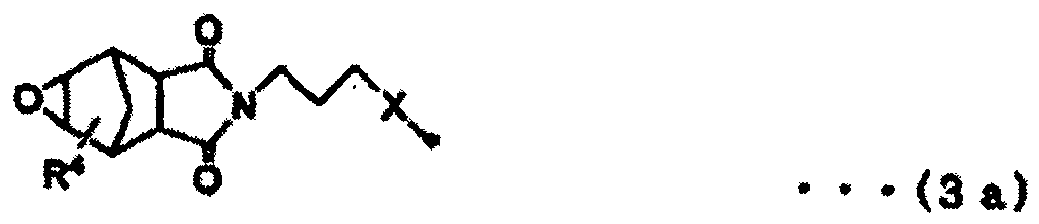
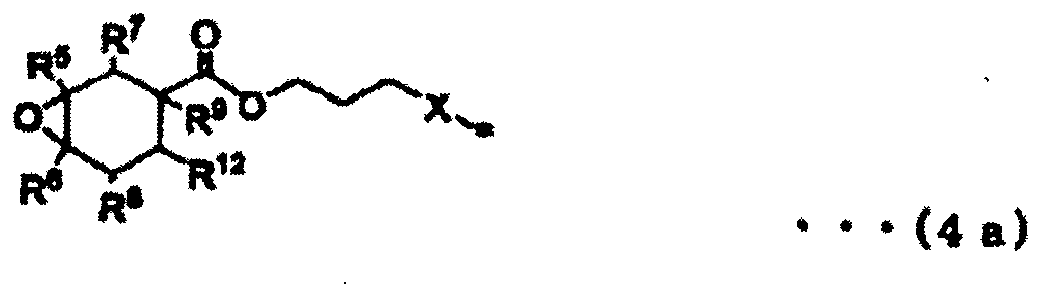
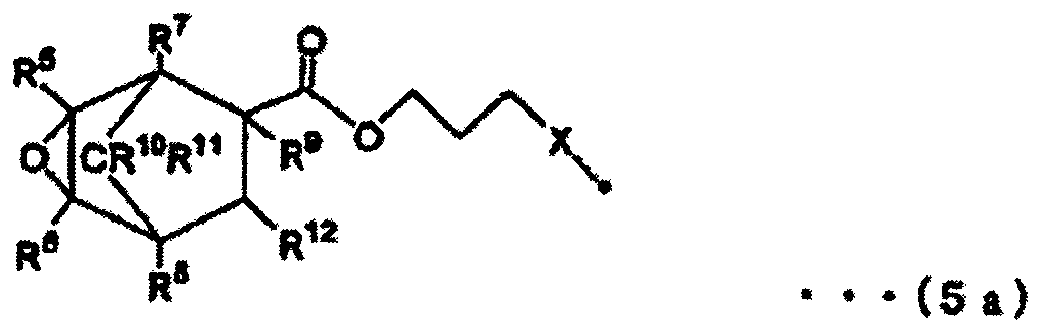 (dans les formules (1a) à (5a), R2 et R3 représentent chacun indépendamment un atome d'hydrogène, un groupe alkyle ayant de 1 à 6 atomes de carbone ou un groupe trialkylsilyle ayant de 1 à 4 atomes de carbone ;R4 représente un atome d'hydrogène, un groupe alkyle ayant de 1 à 6 atomes de carbone ou un groupe trialkylsilyle ayant de 1 à 4 atomes de carbone ; R5 à R11 représentent chacun indépendamment un atome d'hydrogène, un groupe alkyle ayant de 1 à 6 atomes de carbone ou un groupe trialkylsilyle ayant de 1 à 4 atomes de carbone ;R12 représente un atome d'hydrogène, un groupe alkyle ayant de 1 à 6 atomes de carbone, un groupe trialkylsilyle ayant de 1 à 4 atomes de carbone ou un groupe aryle ;* représente une partie de liaison avec Si représentée dans la formule (I), et -X-* représente -* où X est une liaison simple ou un groupe représenté par la formule (x) représentée ci-dessous) :[Ka 3]

- Composé époxy selon la revendication 1, dans lequel le composé époxy est un composé époxy présentant une structure silsesquioxane semblable à une cage ou une structure silsesquioxane semblable à une échelle.
- Composé époxy selon la revendication 1 ou 2, dans lequel dans les formules (1a) à (5a), -X-* est le groupe représenté par la formule (x) décrite ci-dessus, et dans la formule (x), R1 est un groupe méthyle ou éthyle.
- Composé époxy selon l'une quelconque des revendications 1 à 3, dans lequel dans les formules (1a) à (5a), R2 à R11 sont chacun indépendamment un atome d'hydrogène ou un groupe méthyle, et R12 est un atome d'hydrogène, un groupe méthyle ou phényle.
- Composé époxy selon la revendication 1 représenté par la formule (II) :[Ka 4]
 (dans la formule (II), q (q est un nombre naturel inférieur ou égal à 8) groupes parmi les huit Z représentent -OSiR1 2Y1, et (8 - q) groupes de Z représentent un atome d'hydrogène ou -OSiR1 2H ; R1 représente un groupe alkyle ayant de 1 à 5 atomes de carbone ; et Y1 représente un groupe représenté par l'une quelconque des formules (1b) à (5b) représentées ci-dessous) :[Ka 5]


 (dans les formules (1b) à (5b), R2 et R3 représentent chacun indépendamment un atome d'hydrogène, un groupe alkyle ayant de 1 à 6 atomes de carbone ou un groupe trialkylsilyle ayant de 1 à 4 atomes de carbone ;R4 représente un atome d'hydrogène, un groupe alkyle ayant de 1 à 6 atomes de carbone ou un groupe trialkylsilyle ayant de 1 à 4 atomes de carbone ; R5 à R11 représentent chacun indépendamment un atome d'hydrogène, un groupe alkyle ayant de 1 à 6 atomes de carbone ou un groupe trialkylsilyle ayant de 1 à 4 atomes de carbone ;R12 représente un atome d'hydrogène, un groupe alkyle ayant de 1 à 6 atomes de carbone, un groupe trialkylsilyle ayant de 1 à 4 atomes de carbone ou un groupe aryle).
- Composé époxy selon la revendication 5, dans lequel dans la formule (II), R1 est un groupe méthyle ou éthyle.
- Composé époxy selon la revendication 5 ou 6, dans lequel dans les formules (1b) à (5b), R2 à R11 sont chacun indépendamment un atome d'hydrogène ou un groupe méthyle, et R12 est un atome d'hydrogène, un groupe méthyle ou phényle.
- Composé époxy selon l'une quelconque des revendications 1 à 7, dans lequel il est liquide à de 10 à 30°C.
- Procédé de production pour le composé époxy selon la revendication 1, comprenant l'étape :de réaction d'un composé de polysilicone représenté par la formule (III) ou (IV) :[Ka 6]
(Y1SiO3/2)n (III)
(dans la formule (III), Y1 représente un atome d'hydrogène ou -OSiR1 2H ;R1 représente un groupe alkyle ayant de 1 à 5 atomes de carbone ; et n représente un nombre entier de 2 à 500) ;[Ka 7] (dans la formule (IV), Z1 représente -OSiR1 2H, et R1 représente un groupe alkyle ayant de 1 à 5 atomes de carbone) avec un composé époxy représenté par l'une quelconque des formules (6) à (10) représentées ci-dessous :[Ka 8]


 (dans les formules (6) à (10), R2 et R3 représentent chacun indépendamment un atome d'hydrogène, un groupe alkyle ayant de 1 à 6 atomes de carbone ou un groupe trialkylsilyle ayant de 1 à 4 atomes de carbone ;R4 représente un atome d'hydrogène, un groupe alkyle ayant de 1 à 6 atomes de carbone ou un groupe trialkylsilyle ayant de 1 à 4 atomes de carbone ; R5 à R11 représentent chacun indépendamment un atome d'hydrogène, un groupe alkyle ayant de 1 à 6 atomes de carbone ou un groupe trialkylsilyle ayant de 1 à 4 atomes de carbone ;R12 représente un atome d'hydrogène, un groupe alkyle ayant de 1 à 6 atomes de carbone, un groupe trialkylsilyle ayant de 1 à 4 atomes de carbone ou un groupe aryle) à de 10 à 200°C.
- Procédé de production pour le composé époxy selon la revendication 9, dans lequel le composé de polysilicone décrit ci-dessus est le composé de polysilicone représenté par la formule (III), et le composé de polysilicone ci-dessus est un composé de polysilicone ayant une structure silsesquioxane semblable à une cage ou une structure silsesquioxane semblable à une échelle.
- Procédé de production pour le composé époxy selon la revendication 9, dans lequel le composé de polysilicone décrit ci-dessus est le composé de polysilicone représenté par la formule (IV), et dans la formule (IV) décrite ci-dessus, R1 est un groupe méthyle ou éthyle.
- Procédé de production pour le composé époxy selon l'une quelconque des revendications 9 à 11, dans lequel dans les formules (6) à (10), R2 à R11 sont chacun indépendamment un atome d'hydrogène ou un groupe méthyle, et R12 est un atome d'hydrogène, un groupe méthyle ou phényle.
- Procédé de production pour le composé époxy selon l'une quelconque des revendications 9 à 12, dans lequel le composé époxy et le composé de polysilicone sont combinés de sorte qu'un équivalent d'un groupe -SiH contenu dans le composé de polysilicone est de 0,3 à 1,5 sur la base de 1 équivalent d'une double liaison éthylénique contenue dans le composé époxy.
- Composé époxy selon la revendication 5 obtenu en combinant un composé de polysilicone représenté par la formule (IV) :[Ka 9]
 (dans la formule (IV), Z1 représente -OSiR1 2H, et R1 représente un groupe alkyle ayant de 1 à 5 atomes de carbone) avec un composé époxy représenté par l'une quelconque des formules (6) à (10) représentées ci-dessous :[Ka 10]


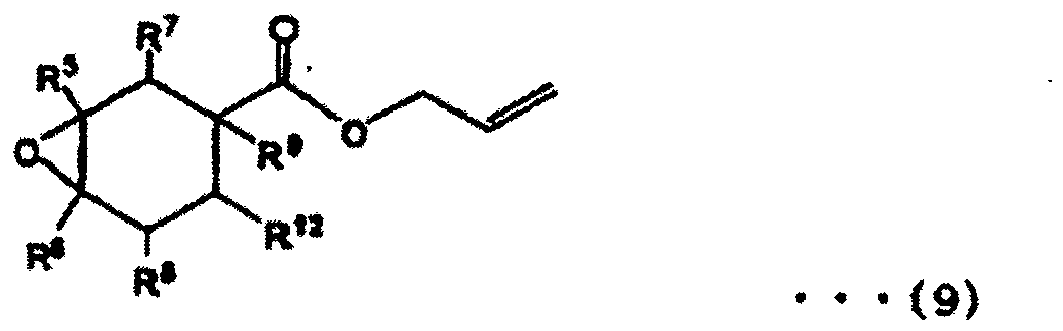
 (dans les formules (6) à (10), R2 et R3 représentent chacun indépendamment un atome d'hydrogène, un groupe alkyle ayant de 1 à 6 atomes de carbone ou un groupe trialkylsilyle ayant de 1 à 4 atomes de carbone ;R4 représente un atome d'hydrogène, un groupe alkyle ayant de 1 à 6 atomes de carbone ou un groupe trialkylsilyle ayant de 1 à 4 atomes de carbone ; R5 à R11 représentent chacun indépendamment un atome d'hydrogène, un groupe alkyle ayant de 1 à 6 atomes de carbone ou un groupe trialkylsilyle ayant de 1 à 4 atomes de carbone ;R12 représente un atome d'hydrogène, un groupe alkyle ayant de 1 à 6 atomes de carbone, un groupe trialkylsilyle ayant de 1 à 4 atomes de carbone ou un groupe aryle) de sorte qu'un équivalent d'un groupe -SiH contenu dans le composé de polysilicone est de 0,3 à 1,5 sur la base de 1 équivalent d'une double liaison éthylénique contenue dans le composé époxy eten les soumettant à une réaction d'hydrosilylation à de 10 à 200°C.
- Composé époxy selon la revendication 14, dans lequel R1 dans le composé de polysilicone représenté par la formule (IV) est un groupe méthyle, et le composé époxy décrit ci-dessus est le composé époxy représenté par la formule (6) ou (9).
Applications Claiming Priority (2)
| Application Number | Priority Date | Filing Date | Title |
|---|---|---|---|
| JP2008075344 | 2008-03-24 | ||
| PCT/JP2009/055576 WO2009119469A1 (fr) | 2008-03-24 | 2009-03-23 | Composé époxy et procédé de fabrication du composé époxy |
Publications (3)
| Publication Number | Publication Date |
|---|---|
| EP2270020A1 EP2270020A1 (fr) | 2011-01-05 |
| EP2270020A4 EP2270020A4 (fr) | 2012-04-18 |
| EP2270020B1 true EP2270020B1 (fr) | 2014-03-19 |
Family
ID=41113662
Family Applications (1)
| Application Number | Title | Priority Date | Filing Date |
|---|---|---|---|
| EP09724479.2A Not-in-force EP2270020B1 (fr) | 2008-03-24 | 2009-03-23 | Composé époxy et procédé de fabrication du composé époxy |
Country Status (6)
| Country | Link |
|---|---|
| US (1) | US8426614B2 (fr) |
| EP (1) | EP2270020B1 (fr) |
| JP (1) | JP5325206B2 (fr) |
| KR (1) | KR101215736B1 (fr) |
| CN (1) | CN101977919B (fr) |
| WO (1) | WO2009119469A1 (fr) |
Families Citing this family (8)
| Publication number | Priority date | Publication date | Assignee | Title |
|---|---|---|---|---|
| CA2220945C (fr) | 1995-05-18 | 2000-10-24 | Northern Telecom Limited | Systeme de messagerie telephonique avec messages contenant des salutations selectionnees |
| JP5611544B2 (ja) * | 2008-06-20 | 2014-10-22 | 昭和電工株式会社 | (メタ)アクリロイルオキシ基含有篭状シルセスキオキサン化合物およびその製造方法 |
| JP2010013513A (ja) * | 2008-07-02 | 2010-01-21 | Fujifilm Corp | ナノインプリント用硬化性組成物、これを用いた硬化物、並びに、液晶表示装置用部材 |
| JP5168485B2 (ja) * | 2008-08-27 | 2013-03-21 | 日油株式会社 | 熱硬化性樹脂組成物 |
| JP5168491B2 (ja) * | 2008-09-30 | 2013-03-21 | 日油株式会社 | 熱硬化性樹脂組成物 |
| US8957136B2 (en) | 2010-08-11 | 2015-02-17 | Showa Denko K.K. | Epoxysilicone condensate, curable composition comprising condensate, and cured product thereof |
| JP5821761B2 (ja) * | 2011-04-20 | 2015-11-24 | セントラル硝子株式会社 | シロキサン化合物およびその硬化物 |
| KR20160006403A (ko) * | 2014-07-09 | 2016-01-19 | 동우 화인켐 주식회사 | 접착제 조성물 및 이를 포함하는 편광판 |
Family Cites Families (26)
| Publication number | Priority date | Publication date | Assignee | Title |
|---|---|---|---|---|
| US5206328A (en) * | 1990-02-08 | 1993-04-27 | Shin-Etsu Chemical Co., Ltd. | Process for the production of an organopolysiloxane |
| JPH03255130A (ja) | 1990-03-05 | 1991-11-14 | Shin Etsu Chem Co Ltd | エポキシ基含有オルガノポリシロキサンの製造方法 |
| US5484950A (en) * | 1992-12-21 | 1996-01-16 | Polyset Company, Inc. | Process for selective monoaddition to silanes containing two silicon-hydrogen bonds and products thereof |
| US5484867A (en) * | 1993-08-12 | 1996-01-16 | The University Of Dayton | Process for preparation of polyhedral oligomeric silsesquioxanes and systhesis of polymers containing polyhedral oligomeric silsesqioxane group segments |
| US5516823A (en) * | 1994-05-10 | 1996-05-14 | Dow Corning Corporation | Adhesion promoting compositions and curable organosiloxane compositions containing same |
| US5468826A (en) * | 1994-05-10 | 1995-11-21 | Dow Corning Corporation | Adhesion promoting additives and curable organosiloxane compositions containing same |
| SG48462A1 (en) * | 1995-10-26 | 1998-04-17 | Ibm | Lead protective coating composition process and structure thereof |
| US6790473B2 (en) * | 1995-10-26 | 2004-09-14 | International Business Machines Corporation | Lead protective coating composition, process and structure thereof |
| US5863970A (en) * | 1995-12-06 | 1999-01-26 | Polyset Company, Inc. | Epoxy resin composition with cycloaliphatic epoxy-functional siloxane |
| JP3505889B2 (ja) * | 1995-12-18 | 2004-03-15 | 東洋インキ製造株式会社 | 紫外線硬化型樹脂組成物およびこれを含む被覆剤 |
| US6210790B1 (en) * | 1998-07-15 | 2001-04-03 | Rensselaer Polytechnic Institute | Glass-like composites comprising a surface-modified colloidal silica and method of making thereof |
| US6265459B1 (en) * | 1998-12-31 | 2001-07-24 | 3M Innovative Properties Company | Accelerators useful for energy polymerizable compositions |
| US6482868B1 (en) * | 1998-12-31 | 2002-11-19 | 3M Innovative Properties Company | Accelerators useful for energy polymerizable compositions |
| FR2818989B1 (fr) * | 2000-12-29 | 2004-03-19 | Rhodia Chimie Sa | Utilisation d'un polyorganosiloxane fonctionnalise epoxy et/ou carboxy, a titre de matiere active dans une composition silicone liquide d'hydrofugation de materiaux de construction |
| US7049044B2 (en) * | 2002-12-19 | 2006-05-23 | The University Of North Carolina At Charlotte | Nanocomposite negative resists for next generation lithographies |
| JP2004029126A (ja) * | 2002-06-21 | 2004-01-29 | Toyo Metallizing Co Ltd | 帯電防止性反射防止フィルム |
| WO2004029126A1 (fr) | 2002-09-26 | 2004-04-08 | Toagosei Co., Ltd. | Accelerateur de durcissement pour composition de type a polymerisation cationique |
| US7034089B2 (en) * | 2002-12-20 | 2006-04-25 | National Starch And Chemical Investment Holding Corporation | Epoxy-functional hybrid copolymers |
| US6962948B2 (en) * | 2003-08-07 | 2005-11-08 | Polyset Company, Inc. | Solventless, non-polluting radiation and thermal curable coatings |
| JP4491283B2 (ja) * | 2004-06-10 | 2010-06-30 | 信越化学工業株式会社 | 反射防止膜形成用組成物を用いたパターン形成方法 |
| JP4645803B2 (ja) | 2004-10-05 | 2011-03-09 | 信越化学工業株式会社 | かご状オリゴシロキサン構造を有する一官能性モノマー及びその製造方法 |
| US7732552B2 (en) * | 2006-01-27 | 2010-06-08 | Momentive Performance Materials Inc. | Low VOC epoxy silane oligomer and compositions containing same |
| EP2029653B1 (fr) * | 2006-06-07 | 2009-09-30 | Showa Denko K.K. | Nouveaux composés époxy et leur procédé de production |
| JP5052209B2 (ja) * | 2006-06-07 | 2012-10-17 | 昭和電工株式会社 | 新規エポキシ化合物とその製造方法 |
| WO2008020637A1 (fr) | 2006-08-15 | 2008-02-21 | Showa Denko K.K. | Nouveau composé époxy et son procédé de fabrication |
| US8653294B2 (en) * | 2011-02-17 | 2014-02-18 | Gelest Technologies, Inc. | Silicones derived from 2-propenyl functional cyclic terpenes and methods of preparation |
-
2009
- 2009-03-23 KR KR1020107023613A patent/KR101215736B1/ko not_active Expired - Fee Related
- 2009-03-23 WO PCT/JP2009/055576 patent/WO2009119469A1/fr not_active Ceased
- 2009-03-23 US US12/933,828 patent/US8426614B2/en not_active Expired - Fee Related
- 2009-03-23 EP EP09724479.2A patent/EP2270020B1/fr not_active Not-in-force
- 2009-03-23 JP JP2010505608A patent/JP5325206B2/ja not_active Expired - Fee Related
- 2009-03-23 CN CN200980110402.4A patent/CN101977919B/zh not_active Expired - Fee Related
Also Published As
| Publication number | Publication date |
|---|---|
| CN101977919B (zh) | 2014-04-23 |
| JP5325206B2 (ja) | 2013-10-23 |
| US20110021788A1 (en) | 2011-01-27 |
| CN101977919A (zh) | 2011-02-16 |
| KR101215736B1 (ko) | 2012-12-26 |
| JPWO2009119469A1 (ja) | 2011-07-21 |
| EP2270020A1 (fr) | 2011-01-05 |
| KR20100125438A (ko) | 2010-11-30 |
| WO2009119469A1 (fr) | 2009-10-01 |
| US8426614B2 (en) | 2013-04-23 |
| EP2270020A4 (fr) | 2012-04-18 |
Similar Documents
| Publication | Publication Date | Title |
|---|---|---|
| US8426614B2 (en) | Epoxy compound and process for producing the epoxy compound | |
| CN114929784B (zh) | 低硅氧烷环含量的官能化q-t-硅氧烷基聚合物材料和制备方法 | |
| JP6434388B2 (ja) | モノ官能性分岐型オルガノシロキサン化合物及びその製造方法 | |
| JP5821761B2 (ja) | シロキサン化合物およびその硬化物 | |
| JP5153635B2 (ja) | 新規エポキシ化合物およびその製造方法 | |
| WO2001046295A1 (fr) | Silsesquioxanes, silicates et siloxanes oligomeres polyedriques portant des fonctionnalites olefiniques filtrees par cycle | |
| WO2006090609A1 (fr) | Composition durcissable contenant du silicone et son produit durci | |
| EP2019106A1 (fr) | Composition de (thio)phénoxy phényl silane et son procédé de fabrication | |
| JP2012232975A (ja) | シロキサン化合物およびその硬化物 | |
| US7402648B2 (en) | Method for producing cyclic organic silicon compound and organic silicon resin having alcoholic hydroxyl group | |
| JP5438447B2 (ja) | ヒドロシリル化合物の製造方法 | |
| EP2301990A1 (fr) | Procédé de fabrication d'un polymère | |
| EP3484899B1 (fr) | Composé de type oxyde d'organosilane aprotique métallique | |
| CN119841857B (zh) | 五甲基二硅氧烷的制备方法及活性硅油的制备方法 | |
| Shamaev et al. | New organosiloxanes based on 1-vinyl-2-perfluoroalkoxy-2, 3, 3-trifluorocyclobutanes | |
| JP2007211138A (ja) | 脂環式ポリエーテル、その製造方法及びその用途 | |
| US20100280189A1 (en) | Synthesis of cycloaliphatic substituted silane monomers and polysiloxanes for photo-curing |
Legal Events
| Date | Code | Title | Description |
|---|---|---|---|
| PUAI | Public reference made under article 153(3) epc to a published international application that has entered the european phase |
Free format text: ORIGINAL CODE: 0009012 |
|
| 17P | Request for examination filed |
Effective date: 20101021 |
|
| AK | Designated contracting states |
Kind code of ref document: A1 Designated state(s): AT BE BG CH CY CZ DE DK EE ES FI FR GB GR HR HU IE IS IT LI LT LU LV MC MK MT NL NO PL PT RO SE SI SK TR |
|
| AX | Request for extension of the european patent |
Extension state: AL BA RS |
|
| DAX | Request for extension of the european patent (deleted) | ||
| A4 | Supplementary search report drawn up and despatched |
Effective date: 20120315 |
|
| RIC1 | Information provided on ipc code assigned before grant |
Ipc: C07F 7/21 20060101AFI20120309BHEP |
|
| GRAP | Despatch of communication of intention to grant a patent |
Free format text: ORIGINAL CODE: EPIDOSNIGR1 |
|
| INTG | Intention to grant announced |
Effective date: 20131002 |
|
| GRAS | Grant fee paid |
Free format text: ORIGINAL CODE: EPIDOSNIGR3 |
|
| GRAA | (expected) grant |
Free format text: ORIGINAL CODE: 0009210 |
|
| AK | Designated contracting states |
Kind code of ref document: B1 Designated state(s): AT BE BG CH CY CZ DE DK EE ES FI FR GB GR HR HU IE IS IT LI LT LU LV MC MK MT NL NO PL PT RO SE SI SK TR |
|
| REG | Reference to a national code |
Ref country code: GB Ref legal event code: FG4D |
|
| REG | Reference to a national code |
Ref country code: CH Ref legal event code: EP |
|
| REG | Reference to a national code |
Ref country code: IE Ref legal event code: FG4D |
|
| REG | Reference to a national code |
Ref country code: AT Ref legal event code: REF Ref document number: 657619 Country of ref document: AT Kind code of ref document: T Effective date: 20140415 |
|
| REG | Reference to a national code |
Ref country code: DE Ref legal event code: R096 Ref document number: 602009022593 Country of ref document: DE Effective date: 20140430 |
|
| PGFP | Annual fee paid to national office [announced via postgrant information from national office to epo] |
Ref country code: GB Payment date: 20140324 Year of fee payment: 6 |
|
| PG25 | Lapsed in a contracting state [announced via postgrant information from national office to epo] |
Ref country code: LT Free format text: LAPSE BECAUSE OF FAILURE TO SUBMIT A TRANSLATION OF THE DESCRIPTION OR TO PAY THE FEE WITHIN THE PRESCRIBED TIME-LIMIT Effective date: 20140319 Ref country code: NO Free format text: LAPSE BECAUSE OF FAILURE TO SUBMIT A TRANSLATION OF THE DESCRIPTION OR TO PAY THE FEE WITHIN THE PRESCRIBED TIME-LIMIT Effective date: 20140619 |
|
| REG | Reference to a national code |
Ref country code: NL Ref legal event code: VDEP Effective date: 20140319 |
|
| REG | Reference to a national code |
Ref country code: AT Ref legal event code: MK05 Ref document number: 657619 Country of ref document: AT Kind code of ref document: T Effective date: 20140319 |
|
| REG | Reference to a national code |
Ref country code: LT Ref legal event code: MG4D |
|
| PG25 | Lapsed in a contracting state [announced via postgrant information from national office to epo] |
Ref country code: CY Free format text: LAPSE BECAUSE OF FAILURE TO SUBMIT A TRANSLATION OF THE DESCRIPTION OR TO PAY THE FEE WITHIN THE PRESCRIBED TIME-LIMIT Effective date: 20140319 Ref country code: SE Free format text: LAPSE BECAUSE OF FAILURE TO SUBMIT A TRANSLATION OF THE DESCRIPTION OR TO PAY THE FEE WITHIN THE PRESCRIBED TIME-LIMIT Effective date: 20140319 Ref country code: FI Free format text: LAPSE BECAUSE OF FAILURE TO SUBMIT A TRANSLATION OF THE DESCRIPTION OR TO PAY THE FEE WITHIN THE PRESCRIBED TIME-LIMIT Effective date: 20140319 |
|
| PGFP | Annual fee paid to national office [announced via postgrant information from national office to epo] |
Ref country code: DE Payment date: 20140520 Year of fee payment: 6 Ref country code: FR Payment date: 20140324 Year of fee payment: 6 |
|
| PG25 | Lapsed in a contracting state [announced via postgrant information from national office to epo] |
Ref country code: HR Free format text: LAPSE BECAUSE OF FAILURE TO SUBMIT A TRANSLATION OF THE DESCRIPTION OR TO PAY THE FEE WITHIN THE PRESCRIBED TIME-LIMIT Effective date: 20140319 Ref country code: LV Free format text: LAPSE BECAUSE OF FAILURE TO SUBMIT A TRANSLATION OF THE DESCRIPTION OR TO PAY THE FEE WITHIN THE PRESCRIBED TIME-LIMIT Effective date: 20140319 |
|
| PG25 | Lapsed in a contracting state [announced via postgrant information from national office to epo] |
Ref country code: BE Free format text: LAPSE BECAUSE OF FAILURE TO SUBMIT A TRANSLATION OF THE DESCRIPTION OR TO PAY THE FEE WITHIN THE PRESCRIBED TIME-LIMIT Effective date: 20140319 Ref country code: NL Free format text: LAPSE BECAUSE OF FAILURE TO SUBMIT A TRANSLATION OF THE DESCRIPTION OR TO PAY THE FEE WITHIN THE PRESCRIBED TIME-LIMIT Effective date: 20140319 Ref country code: RO Free format text: LAPSE BECAUSE OF FAILURE TO SUBMIT A TRANSLATION OF THE DESCRIPTION OR TO PAY THE FEE WITHIN THE PRESCRIBED TIME-LIMIT Effective date: 20140319 Ref country code: BG Free format text: LAPSE BECAUSE OF FAILURE TO SUBMIT A TRANSLATION OF THE DESCRIPTION OR TO PAY THE FEE WITHIN THE PRESCRIBED TIME-LIMIT Effective date: 20140619 Ref country code: EE Free format text: LAPSE BECAUSE OF FAILURE TO SUBMIT A TRANSLATION OF THE DESCRIPTION OR TO PAY THE FEE WITHIN THE PRESCRIBED TIME-LIMIT Effective date: 20140319 Ref country code: CZ Free format text: LAPSE BECAUSE OF FAILURE TO SUBMIT A TRANSLATION OF THE DESCRIPTION OR TO PAY THE FEE WITHIN THE PRESCRIBED TIME-LIMIT Effective date: 20140319 Ref country code: IS Free format text: LAPSE BECAUSE OF FAILURE TO SUBMIT A TRANSLATION OF THE DESCRIPTION OR TO PAY THE FEE WITHIN THE PRESCRIBED TIME-LIMIT Effective date: 20140719 |
|
| REG | Reference to a national code |
Ref country code: CH Ref legal event code: PL |
|
| PG25 | Lapsed in a contracting state [announced via postgrant information from national office to epo] |
Ref country code: ES Free format text: LAPSE BECAUSE OF FAILURE TO SUBMIT A TRANSLATION OF THE DESCRIPTION OR TO PAY THE FEE WITHIN THE PRESCRIBED TIME-LIMIT Effective date: 20140319 Ref country code: SK Free format text: LAPSE BECAUSE OF FAILURE TO SUBMIT A TRANSLATION OF THE DESCRIPTION OR TO PAY THE FEE WITHIN THE PRESCRIBED TIME-LIMIT Effective date: 20140319 Ref country code: PL Free format text: LAPSE BECAUSE OF FAILURE TO SUBMIT A TRANSLATION OF THE DESCRIPTION OR TO PAY THE FEE WITHIN THE PRESCRIBED TIME-LIMIT Effective date: 20140319 Ref country code: AT Free format text: LAPSE BECAUSE OF FAILURE TO SUBMIT A TRANSLATION OF THE DESCRIPTION OR TO PAY THE FEE WITHIN THE PRESCRIBED TIME-LIMIT Effective date: 20140319 |
|
| REG | Reference to a national code |
Ref country code: DE Ref legal event code: R097 Ref document number: 602009022593 Country of ref document: DE |
|
| PG25 | Lapsed in a contracting state [announced via postgrant information from national office to epo] |
Ref country code: PT Free format text: LAPSE BECAUSE OF FAILURE TO SUBMIT A TRANSLATION OF THE DESCRIPTION OR TO PAY THE FEE WITHIN THE PRESCRIBED TIME-LIMIT Effective date: 20140721 |
|
| REG | Reference to a national code |
Ref country code: IE Ref legal event code: MM4A |
|
| PLBE | No opposition filed within time limit |
Free format text: ORIGINAL CODE: 0009261 |
|
| STAA | Information on the status of an ep patent application or granted ep patent |
Free format text: STATUS: NO OPPOSITION FILED WITHIN TIME LIMIT |
|
| PG25 | Lapsed in a contracting state [announced via postgrant information from national office to epo] |
Ref country code: MC Free format text: LAPSE BECAUSE OF FAILURE TO SUBMIT A TRANSLATION OF THE DESCRIPTION OR TO PAY THE FEE WITHIN THE PRESCRIBED TIME-LIMIT Effective date: 20140319 Ref country code: DK Free format text: LAPSE BECAUSE OF FAILURE TO SUBMIT A TRANSLATION OF THE DESCRIPTION OR TO PAY THE FEE WITHIN THE PRESCRIBED TIME-LIMIT Effective date: 20140319 Ref country code: LI Free format text: LAPSE BECAUSE OF NON-PAYMENT OF DUE FEES Effective date: 20140331 Ref country code: IE Free format text: LAPSE BECAUSE OF NON-PAYMENT OF DUE FEES Effective date: 20140323 Ref country code: CH Free format text: LAPSE BECAUSE OF NON-PAYMENT OF DUE FEES Effective date: 20140331 |
|
| 26N | No opposition filed |
Effective date: 20141222 |
|
| PG25 | Lapsed in a contracting state [announced via postgrant information from national office to epo] |
Ref country code: IT Free format text: LAPSE BECAUSE OF FAILURE TO SUBMIT A TRANSLATION OF THE DESCRIPTION OR TO PAY THE FEE WITHIN THE PRESCRIBED TIME-LIMIT Effective date: 20140319 |
|
| REG | Reference to a national code |
Ref country code: DE Ref legal event code: R097 Ref document number: 602009022593 Country of ref document: DE Effective date: 20141222 |
|
| PG25 | Lapsed in a contracting state [announced via postgrant information from national office to epo] |
Ref country code: SI Free format text: LAPSE BECAUSE OF FAILURE TO SUBMIT A TRANSLATION OF THE DESCRIPTION OR TO PAY THE FEE WITHIN THE PRESCRIBED TIME-LIMIT Effective date: 20140319 |
|
| REG | Reference to a national code |
Ref country code: DE Ref legal event code: R119 Ref document number: 602009022593 Country of ref document: DE |
|
| GBPC | Gb: european patent ceased through non-payment of renewal fee |
Effective date: 20150323 |
|
| REG | Reference to a national code |
Ref country code: FR Ref legal event code: ST Effective date: 20151130 |
|
| PG25 | Lapsed in a contracting state [announced via postgrant information from national office to epo] |
Ref country code: GB Free format text: LAPSE BECAUSE OF NON-PAYMENT OF DUE FEES Effective date: 20150323 Ref country code: DE Free format text: LAPSE BECAUSE OF NON-PAYMENT OF DUE FEES Effective date: 20151001 |
|
| PG25 | Lapsed in a contracting state [announced via postgrant information from national office to epo] |
Ref country code: MT Free format text: LAPSE BECAUSE OF FAILURE TO SUBMIT A TRANSLATION OF THE DESCRIPTION OR TO PAY THE FEE WITHIN THE PRESCRIBED TIME-LIMIT Effective date: 20140319 Ref country code: FR Free format text: LAPSE BECAUSE OF NON-PAYMENT OF DUE FEES Effective date: 20150331 |
|
| PG25 | Lapsed in a contracting state [announced via postgrant information from national office to epo] |
Ref country code: GR Free format text: LAPSE BECAUSE OF FAILURE TO SUBMIT A TRANSLATION OF THE DESCRIPTION OR TO PAY THE FEE WITHIN THE PRESCRIBED TIME-LIMIT Effective date: 20140620 |
|
| PG25 | Lapsed in a contracting state [announced via postgrant information from national office to epo] |
Ref country code: LU Free format text: LAPSE BECAUSE OF NON-PAYMENT OF DUE FEES Effective date: 20140323 Ref country code: HU Free format text: LAPSE BECAUSE OF FAILURE TO SUBMIT A TRANSLATION OF THE DESCRIPTION OR TO PAY THE FEE WITHIN THE PRESCRIBED TIME-LIMIT; INVALID AB INITIO Effective date: 20090323 Ref country code: TR Free format text: LAPSE BECAUSE OF FAILURE TO SUBMIT A TRANSLATION OF THE DESCRIPTION OR TO PAY THE FEE WITHIN THE PRESCRIBED TIME-LIMIT Effective date: 20140319 |
|
| PG25 | Lapsed in a contracting state [announced via postgrant information from national office to epo] |
Ref country code: MK Free format text: LAPSE BECAUSE OF FAILURE TO SUBMIT A TRANSLATION OF THE DESCRIPTION OR TO PAY THE FEE WITHIN THE PRESCRIBED TIME-LIMIT Effective date: 20140319 |