EP2270062B1 - Hydrogelcopolymere für biomedizinische Vorrichtungen - Google Patents
Hydrogelcopolymere für biomedizinische Vorrichtungen Download PDFInfo
- Publication number
- EP2270062B1 EP2270062B1 EP10176459.5A EP10176459A EP2270062B1 EP 2270062 B1 EP2270062 B1 EP 2270062B1 EP 10176459 A EP10176459 A EP 10176459A EP 2270062 B1 EP2270062 B1 EP 2270062B1
- Authority
- EP
- European Patent Office
- Prior art keywords
- dii
- diol
- prepolymer
- hydrogel copolymer
- independently
- Prior art date
- Legal status (The legal status is an assumption and is not a legal conclusion. Google has not performed a legal analysis and makes no representation as to the accuracy of the status listed.)
- Expired - Lifetime
Links
Images
Classifications
-
- C—CHEMISTRY; METALLURGY
- C08—ORGANIC MACROMOLECULAR COMPOUNDS; THEIR PREPARATION OR CHEMICAL WORKING-UP; COMPOSITIONS BASED THEREON
- C08G—MACROMOLECULAR COMPOUNDS OBTAINED OTHERWISE THAN BY REACTIONS ONLY INVOLVING UNSATURATED CARBON-TO-CARBON BONDS
- C08G77/00—Macromolecular compounds obtained by reactions forming a linkage containing silicon with or without sulfur, nitrogen, oxygen or carbon in the main chain of the macromolecule
- C08G77/42—Block-or graft-polymers containing polysiloxane sequences
-
- C—CHEMISTRY; METALLURGY
- C08—ORGANIC MACROMOLECULAR COMPOUNDS; THEIR PREPARATION OR CHEMICAL WORKING-UP; COMPOSITIONS BASED THEREON
- C08G—MACROMOLECULAR COMPOUNDS OBTAINED OTHERWISE THAN BY REACTIONS ONLY INVOLVING UNSATURATED CARBON-TO-CARBON BONDS
- C08G18/00—Polymeric products of isocyanates or isothiocyanates
- C08G18/06—Polymeric products of isocyanates or isothiocyanates with compounds having active hydrogen
- C08G18/08—Processes
- C08G18/10—Prepolymer processes involving reaction of isocyanates or isothiocyanates with compounds having active hydrogen in a first reaction step
-
- A—HUMAN NECESSITIES
- A61—MEDICAL OR VETERINARY SCIENCE; HYGIENE
- A61L—METHODS OR APPARATUS FOR STERILISING MATERIALS OR OBJECTS IN GENERAL; DISINFECTION, STERILISATION OR DEODORISATION OF AIR; CHEMICAL ASPECTS OF BANDAGES, DRESSINGS, ABSORBENT PADS OR SURGICAL ARTICLES; MATERIALS FOR BANDAGES, DRESSINGS, ABSORBENT PADS OR SURGICAL ARTICLES
- A61L27/00—Materials for grafts or prostheses or for coating grafts or prostheses
- A61L27/14—Macromolecular materials
- A61L27/16—Macromolecular materials obtained by reactions only involving carbon-to-carbon unsaturated bonds
- A61L27/165—Rubbers
-
- A—HUMAN NECESSITIES
- A61—MEDICAL OR VETERINARY SCIENCE; HYGIENE
- A61L—METHODS OR APPARATUS FOR STERILISING MATERIALS OR OBJECTS IN GENERAL; DISINFECTION, STERILISATION OR DEODORISATION OF AIR; CHEMICAL ASPECTS OF BANDAGES, DRESSINGS, ABSORBENT PADS OR SURGICAL ARTICLES; MATERIALS FOR BANDAGES, DRESSINGS, ABSORBENT PADS OR SURGICAL ARTICLES
- A61L27/00—Materials for grafts or prostheses or for coating grafts or prostheses
- A61L27/14—Macromolecular materials
- A61L27/18—Macromolecular materials obtained otherwise than by reactions only involving carbon-to-carbon unsaturated bonds
-
- A—HUMAN NECESSITIES
- A61—MEDICAL OR VETERINARY SCIENCE; HYGIENE
- A61L—METHODS OR APPARATUS FOR STERILISING MATERIALS OR OBJECTS IN GENERAL; DISINFECTION, STERILISATION OR DEODORISATION OF AIR; CHEMICAL ASPECTS OF BANDAGES, DRESSINGS, ABSORBENT PADS OR SURGICAL ARTICLES; MATERIALS FOR BANDAGES, DRESSINGS, ABSORBENT PADS OR SURGICAL ARTICLES
- A61L27/00—Materials for grafts or prostheses or for coating grafts or prostheses
- A61L27/50—Materials characterised by their function or physical properties, e.g. injectable or lubricating compositions, shape-memory materials, surface modified materials
- A61L27/52—Hydrogels or hydrocolloids
-
- C—CHEMISTRY; METALLURGY
- C08—ORGANIC MACROMOLECULAR COMPOUNDS; THEIR PREPARATION OR CHEMICAL WORKING-UP; COMPOSITIONS BASED THEREON
- C08F—MACROMOLECULAR COMPOUNDS OBTAINED BY REACTIONS ONLY INVOLVING CARBON-TO-CARBON UNSATURATED BONDS
- C08F290/00—Macromolecular compounds obtained by polymerising monomers on to polymers modified by introduction of aliphatic unsaturated end or side groups
- C08F290/02—Macromolecular compounds obtained by polymerising monomers on to polymers modified by introduction of aliphatic unsaturated end or side groups on to polymers modified by introduction of unsaturated end groups
- C08F290/06—Polymers provided for in subclass C08G
-
- C—CHEMISTRY; METALLURGY
- C08—ORGANIC MACROMOLECULAR COMPOUNDS; THEIR PREPARATION OR CHEMICAL WORKING-UP; COMPOSITIONS BASED THEREON
- C08F—MACROMOLECULAR COMPOUNDS OBTAINED BY REACTIONS ONLY INVOLVING CARBON-TO-CARBON UNSATURATED BONDS
- C08F290/00—Macromolecular compounds obtained by polymerising monomers on to polymers modified by introduction of aliphatic unsaturated end or side groups
- C08F290/08—Macromolecular compounds obtained by polymerising monomers on to polymers modified by introduction of aliphatic unsaturated end or side groups on to polymers modified by introduction of unsaturated side groups
- C08F290/14—Polymers provided for in subclass C08G
-
- C—CHEMISTRY; METALLURGY
- C08—ORGANIC MACROMOLECULAR COMPOUNDS; THEIR PREPARATION OR CHEMICAL WORKING-UP; COMPOSITIONS BASED THEREON
- C08G—MACROMOLECULAR COMPOUNDS OBTAINED OTHERWISE THAN BY REACTIONS ONLY INVOLVING UNSATURATED CARBON-TO-CARBON BONDS
- C08G18/00—Polymeric products of isocyanates or isothiocyanates
- C08G18/06—Polymeric products of isocyanates or isothiocyanates with compounds having active hydrogen
- C08G18/28—Polymeric products of isocyanates or isothiocyanates with compounds having active hydrogen characterised by the compounds used containing active hydrogen
- C08G18/67—Unsaturated compounds having active hydrogen
- C08G18/671—Unsaturated compounds having only one group containing active hydrogen
- C08G18/672—Esters of acrylic or alkyl acrylic acid having only one group containing active hydrogen
-
- C—CHEMISTRY; METALLURGY
- C08—ORGANIC MACROMOLECULAR COMPOUNDS; THEIR PREPARATION OR CHEMICAL WORKING-UP; COMPOSITIONS BASED THEREON
- C08G—MACROMOLECULAR COMPOUNDS OBTAINED OTHERWISE THAN BY REACTIONS ONLY INVOLVING UNSATURATED CARBON-TO-CARBON BONDS
- C08G18/00—Polymeric products of isocyanates or isothiocyanates
- C08G18/06—Polymeric products of isocyanates or isothiocyanates with compounds having active hydrogen
- C08G18/70—Polymeric products of isocyanates or isothiocyanates with compounds having active hydrogen characterised by the isocyanates or isothiocyanates used
- C08G18/72—Polyisocyanates or polyisothiocyanates
- C08G18/80—Masked polyisocyanates
- C08G18/8003—Masked polyisocyanates masked with compounds having at least two groups containing active hydrogen
- C08G18/8006—Masked polyisocyanates masked with compounds having at least two groups containing active hydrogen with compounds of C08G18/32
- C08G18/8009—Masked polyisocyanates masked with compounds having at least two groups containing active hydrogen with compounds of C08G18/32 with compounds of C08G18/3203
- C08G18/8012—Masked polyisocyanates masked with compounds having at least two groups containing active hydrogen with compounds of C08G18/32 with compounds of C08G18/3203 with diols
- C08G18/8016—Masked aliphatic or cycloaliphatic polyisocyanates
-
- C—CHEMISTRY; METALLURGY
- C08—ORGANIC MACROMOLECULAR COMPOUNDS; THEIR PREPARATION OR CHEMICAL WORKING-UP; COMPOSITIONS BASED THEREON
- C08L—COMPOSITIONS OF MACROMOLECULAR COMPOUNDS
- C08L53/00—Compositions of block copolymers containing at least one sequence of a polymer obtained by reactions only involving carbon-to-carbon unsaturated bonds; Compositions of derivatives of such polymers
-
- C—CHEMISTRY; METALLURGY
- C08—ORGANIC MACROMOLECULAR COMPOUNDS; THEIR PREPARATION OR CHEMICAL WORKING-UP; COMPOSITIONS BASED THEREON
- C08L—COMPOSITIONS OF MACROMOLECULAR COMPOUNDS
- C08L83/00—Compositions of macromolecular compounds obtained by reactions forming in the main chain of the macromolecule a linkage containing silicon with or without sulfur, nitrogen, oxygen or carbon only; Compositions of derivatives of such polymers
- C08L83/04—Polysiloxanes
-
- G—PHYSICS
- G02—OPTICS
- G02B—OPTICAL ELEMENTS, SYSTEMS OR APPARATUS
- G02B1/00—Optical elements characterised by the material of which they are made; Optical coatings for optical elements
- G02B1/04—Optical elements characterised by the material of which they are made; Optical coatings for optical elements made of organic materials, e.g. plastics
- G02B1/041—Lenses
- G02B1/043—Contact lenses
-
- G—PHYSICS
- G02—OPTICS
- G02C—SPECTACLES; SUNGLASSES OR GOGGLES INSOFAR AS THEY HAVE THE SAME FEATURES AS SPECTACLES; CONTACT LENSES
- G02C7/00—Optical parts
- G02C7/02—Lenses; Lens systems ; Methods of designing lenses
- G02C7/04—Contact lenses for the eyes
-
- C—CHEMISTRY; METALLURGY
- C08—ORGANIC MACROMOLECULAR COMPOUNDS; THEIR PREPARATION OR CHEMICAL WORKING-UP; COMPOSITIONS BASED THEREON
- C08G—MACROMOLECULAR COMPOUNDS OBTAINED OTHERWISE THAN BY REACTIONS ONLY INVOLVING UNSATURATED CARBON-TO-CARBON BONDS
- C08G2210/00—Compositions for preparing hydrogels
Definitions
- the present invention relates to hydrogel copolymers that are useful for forming biomedical devices, particularly ophthalmic devices including contact lenses, intraocular lenses and ophthalmic implants.
- the copolymers have a desirable combination of oxygen permeability, tensile modulus, and water content, especially for soft contact lenses.
- Hydrogels represent a desirable class of materials for the manufacture of various biomedical devices, including ophthalmic devices such as contact lenses.
- a hydrogel is a hydrated cross-linked polymeric system that contains water in an equilibrium state. Hydrogel lenses offer desirable biocompatibility and comfort.
- Silicone hydrogels are a known class of hydrogels and are characterized by the inclusion of a silicone-containing material.
- a silicone-containing monomer is copolymerized by free radical polymerization with a hydrophilic monomer, with either the silicone-containing monomer or the hydrophilic monomer functioning as a crosslinking agent (a crosslinker being defined as a monomer having multiple polymerizable functionalities) or a separate crosslinker may be employed.
- Oxygen permeability is a desirable property for contact lens materials since the human cornea will be damaged if it is deprived of oxygen for an extended period. Oxygen permeability is conventionally expressed in units of barrer, also called Dk. Oxygen transmissibility is a property of contact lens materials related to oxygen permeability. Oxygen transmissibility is oxygen permeability divided by lens thickness, or Dk/t.
- the contact lens clinical literature has expressed the view that a contact lens should have a Dk/t of at least 87 barrers/mm in order to be worn overnight without corneal swelling, especially when the lens is worn continuously for extended periods of time.
- the desire for contact lens materials with higher oxygen permeabilities is especially important for thicker contact lenses, such as toric contact lenses, in order to maintain an acceptable Dk/t value.
- silicone hydrogels typically have higher oxygen permeability due to the inclusion of the silicone-containing monomer. Stated differently, the oxygen permeability of non-silicone hydrogels is dependent almost exclusively on water content; in contrast, silicone hydrogels contain silicone which is more oxygen permeable than water. Theoretically, a silicone material with no water would make an ideal contact lens material, as pure silicone has an oxygen permeability approximating 600 barrers. However, in practice, pure silicone lenses are very hydrophobic and not wettable by human tears, and tend to adhere to the cornea, making them uncomfortable for longer periods of wear. Generally, a soft contact lens should have a water content of at least 20 weight percent in order to be worn comfortably for extended periods.
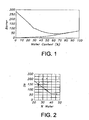
- Figure 1 is a graph of water content versus oxygen permeability that has been reported in the literature.
- the oxygen permeability increases fairly linearly with increasing water content. This is because these conventional hydrogels derive their oxygen permeability almost exclusively on water content.
- oxygen permeability of silicone hydrogels decreases with increasing water content, at least for water contents ranging from 20 to 50 weight percent.
- Figure 1 illustrates the challenge in developing new silicone hydrogel materials. Higher water content may be desired in order to make a contact lens more wettable or comfortable, but higher water content compromises oxygen permeability. In addition, contact lenses with too high tensile modulus may be less comfortable, or even damage the cornea when worn for extended periods.
- US 2003/162862 A1 describes a silicone hydrogel formed from a reaction mixture comprising a high molecular weight hydrophilic polymer and an effective amount of an hydroxyl-functionalized silicone-containing monomer.
- This invention provides hydrogel copolymers that are useful for forming biomedical devices, particularly ophthalmic devices including contact lenses, intraocular lenses and ophthalmic implants.
- the copolymers have a desirable combination of oxygen permeability, tensile modulus, and water content, especially for soft contact lens applications.
- the hydrogel copolymers have higher oxygen permeability for a given water content value, and also exhibit desirable tensile modulus.
- the present invention relates to a hydrogel copolymer that is the hydrated polymerization product of a monomeric mixture comprising a polysiloxane prepolymer comprising soft segments that are a diradical residue of the formula (PS'): wherein:
- the above hydrogel copolymer may have either a water content in the range of 40 to no greater than 45 weight percent, or a water content in the range of 45 to 50 weight percent.
- the above hydrogel copolymer may have a modulus between about 40 and 80 g/mm 2 .
- the present invention relates to a contact lens made of the above hydrogel copolymer.
- hydrogel copolymer of either: a water content in the range of at least 20 to no greater than 40 weight percent, and an oxygen permeability greater than (330-6x) barrers, more preferably (350-6x) barrers, where x has a value equal to weight percent water content; or a water content in the range of 40 to no greater than 45 weight percent, and an oxygen permeability greater than 80 barrers; or a water content in the range of 45 to 50 weight percent, and an oxygen permeability greater than 70 barrers.
- hydrogel copolymer having a water content in the range of at least 20 to no greater than 40 weight percent, and an oxygen permeability greater than (380-6x) barrers. More preferably, the hydrogel copolymer has a water content in the range of at least 20 to no greater than 40 weight percent, and an oxygen permeability greater than (410-6x) barrers. Most preferably, the hydrogel copolymer has a water content in the range of at least 20 to no greater than 40 weight percent, and an oxygen permeability greater than (440-6x) barrers.
- hydrogel copolymer which is the hydrated polymerization product of a monomeric mixture comprising a polysiloxane prepolymer and a hydrophilic comonomer, the hydrogel copolymer having either: (i) a water content in the range of at least 20 to no greater than 30 weight percent, and an oxygen permeability of at least 200 barrers; (ii) a water content in the range of at least 30 to no greater than 40 weight percent, and an oxygen permeability greater than 150 barrers; or (iii) a water content in the range of 40 to 50 weight percent, and an oxygen permeability greater than 100 barrers.
- the hydrogel copolymers have a modulus no greater than 100 g/mm 2 , especially between about 40 and 80 g/mm 2 .
- the silicon atom content of the prepolymer is at least 32% of the prepolymer, and preferably at least 33% of the prepolymer.
- the prepolymer has a molecular weight (Mn) of at least 10,000, especially at least 15,000, and more preferably, at least 20,000.
- hydrogel copolymers having a modulus no greater than 100 g/mm 2 , an oxygen permeability of at least 140 barrers, and a water content of at least 25 weight percent.
- An especially preferred class of hydrogel copolymers has a modulus between about 40 and 80 g/mm 2 , an oxygen permeability of at least 200 barrers, and a water content of at least 25 weight percent.
- hydrogel copolymer that is the hydrated polymerization product of a monomeric mixture comprising a polysiloxane prepolymer and a hydrophilic comonomer, the hydrogel copolymer having a water content of at least 40 weight percent, and an oxygen permeability greater than 70 barrers.
- Preferred silicone hydrogel copolymers are the hydrated polymerization product of a monomeric mixture comprising a polysiloxane prepolymer, a vinyl lactam, such as N-vinylpyrollidone, and a (meth)acrylated alcohol, such as 2-hydroxyethylmethacrylate or glyceryl methacrylate.
- This invention further provides a biomedical device comprised of the copolymer, especially an ophthalmic device such as a contact lens or an intraocular lens.
- Figure 2 is a graph of water content (weight percent water) versus oxygen permeability (barrer).
- the line in Figure 2 was developed empirically by applicant by measuring and correlating various prior silicone hydrogel copolymers. As seen in Figure 2 , for water contents ranging from 20 to about 35 weight percent, the line is relatively linear with a slope approximating minus 6 (-6). In the range of 35 to 40 weight percent, the line begins to plateau.
- the hydrogel copolymers of the present invention are the hydrated polymerization product of a monomeric mixture comprising a polysiloxane prepolymer, a hydrophilic comonomer, and a monofunctional silicone-containing monomer.
- the polysiloxane prepolymers include polysiloxane-containing soft segments. These segments are derived from polysiloxanes endcapped with hydroxyl or amino radicals and represented by the following formula (PS'): wherein each A is a hydroxyl or amino radical; each R is independently selected from an alkylene group having 1 to 10 carbon atoms wherein the carbon atoms may include ether, urethane or ureido linkages therebetween; each R' is independently selected from hydrogen, monovalent hydrocarbon radicals or halogen substituted monovalent hydrocarbon radicals wherein the hydrocarbon radicals have 1 to 20 carbon atoms which may include ether linkages therebetween, and a is at least 1.
- PS' formula
- Preferred R radicals are alkylene optionally substituted with ether radicals.
- Preferred R' radicals include: alkyl groups, phenyl groups, fluoro-substituted alkyl groups and alkenyl groups, optionally substituted ether groups.
- Especially preferred R' radicals include: alkyl, such as methyl; or fluoroalkyl optionally including ether linkages, such as -CH 2 -CH 2 -CH 2 -O-CH 2 -(CF 2 ) z -H where z is 1 to 6.
- a is about 10 to about 100, more preferably about 15 to about 80.
- the Mn of PS ranges from 1000 to 8000, more preferably 2000 to 6000.
- the silicon atom content of the prepolymer is at least 32 weight % of the prepolymer, and preferably at least 33 weight % of the prepolymer. Silicon atom content is defined as the total weight of silicon atoms in the prepolymer, per total weight of the prepolymer, times 100%.
- the prepolymers are endcapped at both ends with a polymerizable ethylenic unsaturated radical.
- Preferred terminal polymerizable radicals are represented by formula (M'): wherein:
- Suitable endcapping precursors, for forming the M radicals include: hydroxy-terminated (meth)acrylates, such as 2-hydroxyethylmethacrylate, 2-hydroxyethylacrylate, and 3-hydroxypropylmethacrylate; and amino-terminated (meth)acrylates, such as t-butylaminoethylmethacrylate and aminoethylmethacrylate; and (meth)acrylic acid.
- hydroxy-terminated (meth)acrylates such as 2-hydroxyethylmethacrylate, 2-hydroxyethylacrylate, and 3-hydroxypropylmethacrylate
- amino-terminated (meth)acrylates such as t-butylaminoethylmethacrylate and aminoethylmethacrylate
- (meth)acrylic acid as used herein, the term “(meth)” denotes an optional methyl substituent.
- terms such as “(meth)acrylate” denotes either methacrylate or acrylate
- the prepolymer has a molecular weight (Mn) of at least 10,000, more preferably at least 15,000, and most preferably at least 20,000.
- the copolymers of this invention are formed by copolymerizing the polysiloxane prepolymers with one or more comonomers. Since the prepolymers are endcapped with polymerizable ethylenically unsaturated radicals, they are polymerizable by free radical polymerization.
- the monomeric mixtures employed in the invention include conventional lens-forming or device-forming monomers.
- the term "monomer” or “monomeric” and like terms denote relatively low molecular weight compounds that are polymerizable by free radical polymerization, as well as higher molecular weight compounds also referred to as “prepolymers”, “macromonomers”, and related terms.)
- the subject prepolymers are included in the monomer mixture at 5 to 95 weight percent, preferably 20 to 70 weight percent.
- At least one hydrophilic comonomer is combined with the polysiloxane prepolymer in the initial monomeric mixture.
- the monomeric mixture used in the present invention comprises a hydrophilic comonomer selected from the group consisting of methacrylic acid; acrylic acid; 2-hydroxyethyl-methacrylate; N-vinyl pyrrolidone; and methacrylamide.
- hydrophilic comonomers include: unsaturated carboxylic acids, such as methacrylic and acrylic acids; (meth)acrylic substituted alcohols, such as 2-hydroxyethylmethacrylate, 2-hydroxyethylacrylate and glyceryl methacrylate; vinyl lactams, such as N-vinyl pyrrolidone; and (meth)acrylamides, such as methacrylamide and N,N-dimethylacrylamide.
- a hydrogel is a crosslinked polymeric system that can absorb and retain water in an equilibrium state. At least one hydrophilic monomer is included in the monomer mixture at 20 to 60 weight percent, preferably 25 to 50 weight percent.
- the initial monomeric mixture comprises at least one (meth)acrylic substituted alcohol, such as at least one of 2-hydroxyethylmethacrylate and glyceryl methacrylate, preferably in an amount of at least 1 weight percent of the monomeric mixture, more preferably in an amount of 2 to 10 weight percent.
- the monomeric mixture further includes at least one vinyl lactam, such as N-vinyl pyrrolidone and/or at least one (meth)acrylamides, such as N,N-dimethylacrylamide.
- Another class of lens-forming or device-forming monomers are silicone-containing monomers.
- another silicone-containing comonomer in addition to the polysiloxane prepolymer, may be included in the initial monomeric mixture, for example, if it is desired to obtain a copolymer with higher oxygen permeability.
- the monomeric mixture used in the present invention further comprises a monofunctional silicone-containing monomer.
- One suitable class of silicone containing monomers include known bulky, monofunctional polysiloxanylalkyl monomers represented by Formula (VI): X denotes -COO-, -CONR 4 -, -OCOO-, or -OCONR 4 - where each where R 4 is H or lower alkyl; R 3 denotes hydrogen or methyl; h is 1 to 10; and each R 2 independently denotes a lower alkyl or halogenated alkyl radical, a phenyl radical or a radical of the formula -Si(R 5 ) 3 wherein each R 5 is independently a lower alkyl radical or a phenyl radical.
- Formula (VI) X denotes -COO-, -CONR 4 -, -OCOO-, or -OCONR 4 - where each where R 4 is H or lower alkyl; R 3 denotes hydrogen or methyl; h is 1 to 10; and each R 2 independently denotes a lower alkyl or
- Such bulky monomers specifically include methacryloxypropyl tris(trimethylsiloxy)silane (TRIS), pentamethyldisiloxanyl methylmethacrylate, tris(trimethylsiloxy) methacryloxy propylsilane, methyldi(trimethylsiloxy)methacryloxymethyl silane, 3-[tris(trimethylsiloxy)silyl] propyl vinyl carbamate, and 3-[tris(trimethylsiloxy)silyl] propyl vinyl carbonate.
- TMS methacryloxypropyl tris(trimethylsiloxy)silane
- pentamethyldisiloxanyl methylmethacrylate tris(trimethylsiloxy) methacryloxy propylsilane
- methyldi(trimethylsiloxy)methacryloxymethyl silane 3-[tris(trimethylsiloxy)silyl] propyl vinyl carbamate
- the monomer mixtures may include the silicone comonomer, in addition to the subject prepolymer, at 0 to 50 weight percent, preferably 5 to 30 weight percent when present.
- the monomer mixture includes a crosslinking monomer (a crosslinking monomer being defined as a monomer having multiple polymerizable functionalities). Since the subject prepolymers are endcapped at both ends with a polymerizable radical, the prepolymers will function as a crosslinker.
- a supplemental crosslinking monomer may be added to the initial monomeric mixture.
- Representative crosslinking monomers include: divinylbenzene, allyl methacrylate, ethyleneglycol dimethacrylate, tetraethyleneglycol dimethacrylate, polyethyleneglycol dimethacrylate, vinyl carbonate derivatives of the glycol dimethacrylates, and methacryloxyethyl vinylcarbonate.
- this monomeric material may be included in the monomer mixture at 0.1 to 20 weight percent, more preferably at 0.2 to 10 weight percent.
- the monomer mixtures may further include a monomer for increasing the refractive index of the resultant copolymer.
- a monomer for increasing the refractive index of the resultant copolymer examples include aromatic (meth) acrylates, such as phenyl (meth)acrylate, phenylethyl (meth)acrylate and benzyl (meth)acrylate.
- organic diluent may be included in the initial monomeric mixture.
- organic diluent encompasses organic compounds that are substantially unreactive with the components in the initial mixture, and are often used to minimize incompatibility of the monomeric components in this mixture.
- Representative organic diluents include: monohydric alcohols, such as C 2 -C 10 monohydric alcohols; diols such as ethylene glycol; polyols such as glycerin; ethers such as diethylene glycol monoethyl ether; ketones such as methyl ethyl ketone; esters such as methyl heptanoate; and hydrocarbons such as toluene.
- the monomeric mixtures may be charged to a mold, and then subjected to heat and/or light radiation, such as UV radiation, to effect curing, or free radical polymerization, of the monomer mixture in the mold.
- heat and/or light radiation such as UV radiation
- Various processes are known for curing a monomeric mixture in the production of contact lenses or other biomedical devices, including spincasting and static casting.
- Spincasting methods involve charging the monomer mixture to a mold, and spinning the mold in a controlled manner while exposing the monomer mixture to light.
- Static casting methods involve charging the monomer mixture between two mold sections forming a mold cavity providing a desired article shape, and curing the monomer mixture by exposure to heat and/or light.
- one mold section is shaped to form the anterior lens surface and the other mold section is shaped to form the posterior lens surface.
- curing of the monomeric mixture in the mold may be followed by a machining operation in order to provide a contact lens or article having a desired final configuration.
- machining operation Such methods are described in US Patent Nos. 3,408,429 , 3,660,545 , 4,113,224 , 4,197,266 , 5,271,875 , and 5,260,000 .
- the monomer mixtures may be cast in the shape of rods or buttons, which are then lathe cut into a desired shape, for example, into a lens-shaped article.
- a first class of polysiloxane prepolymers comprises blocks (I) and (II) and is terminated at each end with an ethylenic unsaturated radical: * Dii * Diol * Dii * PS x * Dii * PS y wherein:
- This class of prepolymers includes those represented by the general formulae: M ⁇ * Dii * Diol * Dii * PS x ⁇ * Dii * PS y * Dii * M or M ⁇ * Dii * Diol * Dii * PS x ⁇ * Dii * PS y * Dii * Diol * Dii * M wherein Dii, Diol, PS, *, x and y are as defined above, and M is a polymerizable ethylenically unsaturated radical.
- the blocks of formula (I) may be characterized as composed of strong hard segments (represented by *Dii*Diol*Dii*) and soft segments (represented by PS).
- the blocks of formula (II) may be characterized as composed of weaker hard segments (represented by *Dii*) and soft segments (represented by PS).
- the distribution of these weaker and strong hard blocks (I) and (II) may be random or alternate, where x and y represent the total number of blocks of respective structures in the prepolymer; stated differently, it is not necessary in formulae (III) and (IV) that all blocks of formula (I) are directly linked to each other.
- the distribution of these blocks may be controlled by the sequence of addition of the polysiloxane, diisocyanate and short chain diol ingredients during the preparation of the prepolymer.
- the prepolymers include polysiloxane-containing soft segments, represented by PS in formulae (I), (II), (III) and (IV). More particularly, this polysiloxane-containing segment is derived from polysiloxanes endcapped with hydroxyl or amino radicals, such as polysiloxane segments represented by formula (PS').
- a in formula (III) and (IV) is about 10 to about 100, more preferably about 15 to about 80.
- the Mn of PS ranges from 1000 to 8000, more preferably 2000 to 6000.
- the strong hard segments of the prepolymers include the residue of a diol, represented by Diol in formulae (I), (III) and (IV).
- Diol radicals include the diradical residue of an alkyl diol, a cycloalkyl diol, an alkyl cycloalkyl diol, an aryl diol or an alkylaryl diol having 1 to 10 carbon atoms and which may contain ether, thio or amine linkages in the main chain.
- diols include 2,2-(4,4'-dihydroxydiphenyl)propane (bisphenol-A), 4,4'-iso-propylidine dicyclohexanol, ethoxylated and propoxylated bisphenol-A, 2,2-(4,4'-dihydroxydiphenyl)pentane, 1,1'-(4,4'-dihydroxydiphenyl)-p-diisopropyl benzene, 1,3-cyclohexane diol, 1,4-cyclohexane diol, 1-4-cyclohexane dimethanol, neopentyl glycol, 1,4-butanediol, 1,3-propanediol, 1,5-pentanediol, ethylene glycol, diethylene glycol and triethylene glycol.
- alkylene and etherified alkylene diols having 1 to 10 carbon atoms.
- diisocyanates that react with hydroxyl- or amino-functionality of the polysiloxane-containing segments and diols.
- any diisocyanate may be employed.
- diisocyanates may be aliphatic or aromatic, and include alkyl, alkyl cycloalkyl, cycloalkyl, alkyl aromatic and aromatic diisocyanates preferably having 6 to 30 carbon atoms in the aliphatic or aromatic moiety.
- isophorone diisocyanate hexamethylene-1,6- diisocyanate, 4,4'-dicyclohexylmethane diisocyanate, toluene diisocyanate, 4,4'-diphenyl diisocyanate, 4,4'-diphenylmethane diisocyanate, p-phenylene diisocyanate, 1,4-phenylene 4,4'-diphenyl diisocyanate, 1,3-bis-(4,4'-isocyanto methyl) cyclohexane, and cyclohexane diisocyanate.
- the ratio of x and y should be balanced. Accordingly, the ratio of x to y is preferably at least 0.6 (i.e., x:y is at least 0.6:1), more preferably at least 0.75.
- the prepolymers are endcapped at both ends with a polymerizable ethylenic unsaturated radical, represented by M in formulae (III) and (IV).
- M polymerizable ethylenic unsaturated radical
- Representative M radicals are represented by formula (M').
- a first representative reaction scheme for forming the prepolymers is as follows. First, a diisocyanate is reacted with a diol, at a molar ratio of 2:1, respectively. 2 ⁇ x OCN - Dii - NCO + x HO - Diol - OH ⁇ x OCN - Dii * Diol * Dii - NCO In this scheme, * designates a urethane radical -NH-COO- or -OCO-NH-: Generally, this reaction is conducted in the presence of a catalyst, such as dibutyl tin dilaurate and in a solvent, such as methylene chloride, and under reflux.
- a catalyst such as dibutyl tin dilaurate
- a solvent such as methylene chloride
- a diisocyanate and the polysiloxane-diol are added, with the ratio of total diisocyanates (x+y) to polysiloxane-diol being at least 1.1.
- a second representative reaction scheme for forming the prepolymers of formula (I), (II), (III) and/or (IV) is as follows. First, a diisocyanate is reacted with the polysiloxane-diol at a molar ratio shown below, where (1+1/m) preferably ranges from 1.05 to 1.9, most preferably from 1.2 to 1.5. m + 1 OCN - Dii - NCO + m HO - PS - OH ⁇ OCN - Dii * PS m * Dii - NCO
- a second class of polysiloxane prepolymers are represented by the formula: M ⁇ * Dii * PS x * Dii * M wherein:
- a representative reaction scheme for forming this class of prepolymers is as follows. First, a diisocyanate is reacted with the polysiloxane-diol. n + 1 OCN - Dii - NCO + n HO - PS - OH ⁇ OCN - Dii * PS ⁇ x * Dii - NCO
- * designates a urethane radical -NH-COO- or -OCO-NH-.
- this reaction is conducted in the presence of a catalyst, such as dibutyl tin dilaurate and in a solvent, such as methylene chloride, and under reflux.
- a catalyst such as dibutyl tin dilaurate
- a solvent such as methylene chloride
- the reaction of the polysiloxane-diol with the diisocyanate yields urethane radicals (-NH-COO- or -OCO-NH-).
- the reaction of poly-siloxane-diamines with diisocyanates would yield urea radicals (NH-CO-NH-).
- Other methods for forming urethane or urea polymers are known in the art, and representative syntheses are illustrated in the Examples.
- Additional polysiloxane-containing prepolymers are represented by the formulae: M ⁇ * Dii * PS * Dii * Diol x * Dii * PS * Dii * M M ⁇ * Dii * Diol * Dii * PS x * Dii * Diol * Dii * M where Dii, PS, Diol, * and Dii have the same meanings as above.
- x is at least one.
- these prepolymers are composed of alternating strong hard segments (represented by *Dii*Diol*Dii*) and soft segments (represented by PS).
- These prepolymers may be prepared by methods generally known in the art, including the general methods disclosed in US 5,034,461 (Lai et al. ).
- the weight ratio of soft segments to hard segments is at least 5:1 1 and no greater than 13:1, and in some cases, preferably at least 7:1 and no greater than 11:1.
- the hydrogel copolymer when fully hydrated, has a water content of at least 20 weight percent, as measured gravimetrically. Espeically preferred are hydrogel copolymers having a water content of at least 25 weight percent.
- the hydrogel copolymer has a tensile modulus no greater than 100 g/mm 2 , more preferably a modulus between about 40 and 80 g/mm 2 .
- Modulus may be measured with an Instron (Model 4502) instrument according to ASTM D-1708a, where the hydrogel copolymer film sample is immersed in borate buffered saline.
- An appropriate size of the film sample is gauge length 22 mm and width 4.75 mm, where the sample further has ends forming a dogbone shape to accommodate gripping of the sample with clamps of the Instron instrument, and a thickness of 200 ⁇ 50 microns.
- the hydrogel copolymer has an oxygen permeability of at least 100 barrers, more preferably at least 140 barrers, most preferably at least 150 barrers. Copolymers having an oxygen permeability of at least 180 barrers, and even at least 200 barrers, are provided by this invention.
- the preferred combinations of water content and oxygen permeability may also be described as either (i) a water content in the range of at least 20 to no greater than 40 weight percent, and an oxygen permeability greater than (320-6x) barrers, where x has a value equal to weight percent water content; or (ii) a water content in the range of 40 to 50 weight percent, and an oxygen permeability greater than 70 barrers.
- these properties may be expressed as either: (i) a water content in the range of at least 20 to no greater than 30 weight percent, and an oxygen permeability of at least 200 barrers; (ii) a water content in the range of at least 30 to no greater than 40 weight percent, and an oxygen permeability greater than 150 barrers; or (iii) as required in the present invention, a water content in the range of 40 to 50 weight percent, and an oxygen permeability greater than 100 barrers.
- Oxygen permeability (also referred to as Dk) is determined by the following procedure. Other methods and/or instruments may be used as long as the oxygen permeability values obtained therefrom are equivalent to the described method.
- the oxygen permeability of silicone hydrogels is measured by the polarographic method (ANSI Z80.20-1998) using an 02 Permeometer Model 201T instrument (Createch, Albany, California USA) having a probe containing a central, circular gold cathode at its end and a silver anode insulated from the cathode. Measurements are taken only on pre-inspected pinhole-free, flat silicone hydrogel film samples of three different center thicknesses ranging from 150 to 600 microns. Center thickness measurements of the film samples may be measured using a Rehder ET-1 electronic thickness gauge.
- the film samples have the shape of a circular disk. Measurements are taken with the film sample and probe immersed in a bath containing circulating phosphate buffered saline (PBS) equilibrated at 35°C+/- 0.2°. Prior to immersing the probe and film sample in the PBS bath, the film sample is placed and centered on the cathode premoistened with the equilibrated PBS, ensuring no air bubbles or excess PBS exists between the cathode and the film sample, and the film sample is then secured to the probe with a mounting cap, with the cathode portion of the probe contacting only the film sample.
- PBS circulating phosphate buffered saline
- Teflon polymer membrane e.g., having a circular disk shape
- the Teflon membrane is first placed on the pre-moistened cathode, and then the film sample is placed on the Teflon membrane, ensuring no air bubbles or excess PBS exists beneath the Teflon membrane or film sample.
- R 2 correlation coefficient value
- oxygen permeability (Dk) is calculated from the film samples having at least three different thicknesses.
- Any film samples hydrated with solutions other than PBS are first soaked in purified water and allowed to equilibrate for at least 24 hours, and then soaked in PHB and allowed to equilibrate for at least 12 hours.
- the instruments are regularly cleaned and regularly calibrated using RGP standards. Upper and lower limits are established by calculating a +/- 8.8% of the Repository values established by William J. Benjamin, et al., The Oxygen Permeability of Reference Materials, Optom Vis Sci 7 (12s): 95 (1997): Material Name Repository Values Lower Limit Upper Limit Fluoroperm 30 26.2 24 29 Menicon EX 62.4 56 66 Quantum II 92.9 85 101
- Example 1 The general procedure of Example 1 was following for making this polysiloxane, except the molar ratio of 1,3-bishydroxybutyl tetramethyldisiloxane to dimethoxydimethylsilane was changed to about 1:28.
- the molecular weight (Mn) of the product as determined by titration was 2730.
- Example 2 ⁇ , ⁇ -bis(4-hydroxybutyl)polydimethylsiloxane (45.873 g, 9.557 mmol) from Example 1 was added to the flask. The refluxing was continued overnight, and no unreacted isocyanate remained as determined by titration. Then, IPDI (1.261 g, 5.673 mmol) was added and the reflux was continued overnight. The amount of isocyanate decreased to 22.9% as determined by titration. The contents were cooled down to ambient temperature.
- 1,1'-bi-2- naphthol 0.008 g
- 2-hydroxyethyl methacrylate 0.429 g, 3.296 mmol
- the solvent was then stripped under reduced pressure and the 44.55 g of product was recovered.
- the prepolymer had 3 strong hard segments, 4 weak hard segments (x about 3, y about 4).
- a dry 3-neck, 500-mL round-bottom flask was connected to a nitrogen inlet tube and a reflux condenser. The following were added to the flask all at once: isophorone diisocyanate (7.825 g, 35.202 mmol) (IPDI); ⁇ , ⁇ -bis(4-hydroxybutyl)polydimethylsiloxane (94.31 g, 19.648 mmol) from Example 1; dibutyl tin dilaurate (0.297 g); and 250 mL methylene chloride. The contents were refluxed. After overnight, the amount of isocyanate was determined to decrease to 44.5 % by titration.
- IPDI isophorone diisocyanate
- ⁇ , ⁇ -bis(4-hydroxybutyl)polydimethylsiloxane 94.31 g, 19.648 mmol
- dibutyl tin dilaurate 0.297 g
- diethyleneglycol 1.21 g, 13.391 mmol
- DEG diethyleneglycol
- the refluxing was continued for overnight, and the amount of isocyanate was dropped down to 5.1 % of the original as determined by titration.
- 1,1'-bi-2- naphthol 0.013 g
- 2-hydroxyethyl methacrylate 0.819 g, 6.293 mmol
- the solvent was then stripped under reduced pressure and the 82 g of product was recovered.
- the prepolymer had 4 strong hard segments, 3 weak hard segments.
- a prepolymer with components of similar molar ratios as that of Example 4 was prepared. This synthesis was similar to Example 4 except a second batch of polysiloxane of about the same molecular weight was used. The amounts of components were: isophorone diisocyanate (8.716 g, 39.209 mmol); ⁇ , ⁇ -bis(4-hydroxybutyl)-polydimethylsiloxane (105.23 g, 21.923 mmol); dibutyl tin dilaurate (0.307 g); 250 mL methylene chloride; diethyleneglycol (1.496 g, 14.093 mmol); 1,1'-bi-2- naphthol (0.0146 g); and 2-hydroxyethyl methacrylate (1.033 g, 7.938 mmol).
- a dry 3-neck, 500 mL round-bottom flask was connected to a nitrogen inlet tube and a reflux condenser. The following were added to the flask all at once: IPDI (10.3311 g, 46.475 mmol); ⁇ , ⁇ -bis(4-hydroxybutyl)polydimethylsiloxane (84.68 g, 31.023 mmol) from Example 2; dibutyl tin dilaurate (0.300 g); and 200 mL of methylene chloride. The contents were refluxed. After overnight, the amount of isocyanate was determined to decrease to 33.6 % by titration.
- Monomer mixtures were made by mixing the following components, listed in Table 1 at amounts per weight: prepolymers of Examples 3 and 4; methacryloxypropyl tris(trimethylsiloxy)silane (TRIS); N,N-dimethylacrylamide (DMA); 2-hydroxy ethyl methacrylate (HEMA); N-vinyl pyrrolidone (NVP); and methacryloxyethyl vinylcarbonate (HemaVC).
- TMS methacryloxypropyl tris(trimethylsiloxy)silane
- DMA N,N-dimethylacrylamide
- HEMA 2-hydroxy ethyl methacrylate
- NDP N-vinyl pyrrolidone
- HemaVC methacryloxyethyl vinylcarbonate
- each monomer mixture included: 1,4-bis(2-methacrylamidoethylamino)anthraquinone as a tint (150 ppm); hexanol as a diluent (10 parts by weight); and Darocur-1173 TM UV initiator (Ciba Specialty Chemical, Ardsley NY) (0.5 wt%).
- the monomer mixtures were cast between silane-treated glass plates, and then cured under UV light for 1 hour. Each monomer mixture was cast between three sets of glass plates, each set of plates separated by Teflon TM polymer tapes of different thicknesses, such that three sets of film samples were obtained for each monomer mixture, with film thicknesses of about 200, 400 and 600 microns.
- the cured films were then extracted with isopropanol overnight, followed by hydration in deionized (DI) water, boiled in DI water for 4 hours and then saturated in borate buffered saline or phosphate buffered saline to give hydrogel films. The water content was measured gravimetrically.
- DI deionized
- the monomer mixtures prepared in Examples 8 and 9 were cloudy so no films were cast. However, when less HEMA was used as a hydrophilic comonomer (as in Examples 9, 10 and 11), or when DMA was replaced totally with NVP (as in Example 6), the mixes were clear and all hydrogel films were clear. (1) Three thickness data points were not obtained. (2) Four thickness data points were obtained.
- 1,1'-bi-2- naphthol 0.0144 g
- 2-hydroxyethyl methacrylate 2.915 g, 22.399 mmol
- the solvent was then stripped under reduced pressure and the product was recovered (126 g).
- the prepolymer had 3 blocks containing of PDMS (x about 3).
- Example 29 The general procedure of Example 29 is followed, except that the molar ratio of PDMS to IPDI is 4:5, respectively. 149.6 g of prepolymer was recovered. Theoretically, the prepolymer had 4 blocks containing of PDMS (x about 4).
- Example 29 The general procedure of Example 29 is followed, except that the molar ratio of PDMS to IPDI is 5:6, respectively. 159.9 g of prepolymer was recovered. Theoretically, the prepolymer had 5 blocks containing of PDMS (x about 5).
- Monomer mixtures were made by mixing the following components, listed in Tables 5 and 6 at amounts per weight: prepolymers of Examples 29, 30, or 31; methacryloxypropyl tris(trimethylsiloxy)silane (TRIS); N,N-dimethylacrylamide (DMA); 2-hydroxy ethyl methacrylate (HEMA); N-vinyl pyrrolidone (NVP); and/or methacryloxyethyl vinylcarbonate (HemaVC).
- TIS methacryloxypropyl tris(trimethylsiloxy)silane
- DMA N,N-dimethylacrylamide
- HEMA 2-hydroxy ethyl methacrylate
- NDP N-vinyl pyrrolidone
- HemaVC methacryloxyethyl vinylcarbonate
- each monomer mixture included: 1,4-bis(2-methacrylamidoethylamino)anthraquinone as a tint (150 ppm); hexanol as a diluent (10 parts by weight); and Daroctir TM UV initiator (Ciba Specialty Chemical, Ardsley NY) (0.5 wt%).
- the monomer mixtures were cast and cured into films following the general procedure of Examples 7-12.
- the claimed copolymers have Dk/water content values falling well above the line represented various prior silicone hydrogel copolymers, and the majority of these copolymers have desirable tensile modulus for soft contact lens applications.
- copolymers including a meth(acrylic) substituted alcohol tended to have higher oxygen permeability for a given water content.
- copolymers having a prepolymer with a silicon atom content of at least 30 weight percent tended to have a higher oxygen permeability for a given water content.
- a prepolymer was prepared following the general synthesis of Example 4. The amounts of components were: isophorone diisocyanate (6.650 g, 29.918 mmol); ⁇ , ⁇ -bis(4-hydroxybutyl)-polydimethylsiloxane (72.71 g, 15.148 mmol); dibutyl tin dilaurate (0.215 g); 200 mL methylene chloride; diethyleneglycol (1.186 g, 11.172 mmol); 1,1'-bi-2- naphthol (0.012 g); and 2-hydroxyethyl methacrylate (0.986 g, 7.576 mmol).
- a prepolymer was prepared following the general synthesis of Example 4. The amounts of components were: isophorone diisocyanate (12.370 g, 55.649 mmol); ⁇ , ⁇ -bis(4-hydroxybutyl)-polydimethylsiloxane (133.47 g, 27.806 mmol); dibutyl tin dilaurate (0.404 g); 300 mL methylene chloride; diethyleneglycol (2.257 g, 21.270 mmol); 1,1'-bi-2- naphthol (0.021 g); and 2-hydroxyethyl methacrylate (1.678 g, 12.894 mmol).
- Example 1 The general procedure of Example 1 was followed for making this polysiloxane, except the molar ratio of 1,3-bishydroxybutyl tetramethyldisiloxane to dimethoxydimethylsilane was changed to about 1:45.
- the molecular weight (Mn) of the product as determined by titration was 4000.
- a prepolymer was prepared following the general synthesis of Example 4 and employing the PDSM of this example.
- the amounts of components were: isophorone diisocyanate (23.149g, 104.139 mmol); ⁇ , ⁇ -bis(4-hydroxybutyl)-polydimethylsiloxane (208.54 g, 51.568 mmol); dibutyl tin dilaurate (0.690 g); 400 ml methylene chloride; diethyleneglycol (4.769 g, 44.940 mmol); 1,1'-bi-2-naphthol (0.032 g); and 2-hydroxyethyl methacrylate (1.751 g, 13.455 mmol).
- Monomer mixtures were made by mixing the following components, listed in Tables 7 and 8 at amounts per weight: prepolymers of Examples 42, 43 or 44; methacryloxypropyl tris(trimethylsiloxy)silane (TRIS); N,N-dimethylacrylamide (DMA); 2-hydroxy ethyl methacrylate (HEMA); N-vinyl pyrrolidone (NVP); and/or methacryloxyethyl vinylcarbonate (HemaVC).
- TMS methacryloxypropyl tris(trimethylsiloxy)silane
- DMA N,N-dimethylacrylamide
- HEMA 2-hydroxy ethyl methacrylate
- NDP N-vinyl pyrrolidone
- HemaVC methacryloxyethyl vinylcarbonate
- each monomer mixture included: 1,4-bis(2-methacrylamidoethylamino)anthraquinone as a tint (150 ppm); and Darocur TM UV initiator (Ciba Specialty Chemical, Ardsley NY) (0.5 wt%).
- the monomer mixtures were cast and cured into films following the general procedure of Examples 7-12.
- the Dk values in Tables 7 and 8 were derived from five data points, except for Example 51 which was derived from four data points.
Landscapes
- Chemical & Material Sciences (AREA)
- Health & Medical Sciences (AREA)
- Medicinal Chemistry (AREA)
- Chemical Kinetics & Catalysis (AREA)
- Polymers & Plastics (AREA)
- Organic Chemistry (AREA)
- General Health & Medical Sciences (AREA)
- Veterinary Medicine (AREA)
- Physics & Mathematics (AREA)
- Epidemiology (AREA)
- Life Sciences & Earth Sciences (AREA)
- Animal Behavior & Ethology (AREA)
- Oral & Maxillofacial Surgery (AREA)
- Public Health (AREA)
- Dermatology (AREA)
- Transplantation (AREA)
- Optics & Photonics (AREA)
- General Physics & Mathematics (AREA)
- Dispersion Chemistry (AREA)
- Ophthalmology & Optometry (AREA)
- Eyeglasses (AREA)
- Materials For Medical Uses (AREA)
- Silicon Polymers (AREA)
- Macromonomer-Based Addition Polymer (AREA)
- Addition Polymer Or Copolymer, Post-Treatments, Or Chemical Modifications (AREA)
- Prostheses (AREA)
- Compositions Of Macromolecular Compounds (AREA)
- Polyurethanes Or Polyureas (AREA)
Claims (13)
- Ein Hydrogel-Copolymer, welches das hydratisierte Polymerisationsprodukt von einem Monomerengemisch, umfassend
ein Polysiloxan-Vorpolymer, umfassend weiche Segmente, welche ein zweiwertiger Rest der Formel (PS') sind: jedes A ein Hydroxyl- oder ein Aminorest ist;jedes R unabhängig ausgewählt ist aus einem Alkylenrest mit 1 bis 10 Kohlenstoffatomen, wobei die Kohlenstoffatome Ether-, Urethan- oder Ureidoverknüpfungen dazwischen enthalten können;jedes R' unabhängig ausgewählt ist aus Wasserstoff, einwertigen Kohlenwasserstoffresten oder Halogen-substituierten einwertigen Kohlenwasserstoffresten, wobei die Kohlenwasserstoffreste 1 bis 20 Kohlenstoffatome aufweisen, welche Etherverknüpfungen dazwischen enthalten können; unda mindestens 1 ist,wobei der Siliziumatomgehalt des Vorpolymers mindestens 32 Gewichtsprozent des Vorpolymers beträgt;ein monofunktionelles Silikon enthaltendes Monomer; undein hydrophiles Comonomer, ausgewählt aus der Gruppe bestehend aus: Methacrylsäure, Acrylsäure, 2-Hydroxyethylmethacrylat, N-Vinylpyrrolidon und Methacrylamid; ist, wobei das Hydrogel-Copolymer einen Wassergehalt in dem Bereich von 40 bis 50 Gewichtsprozent und eine Sauerstoffpermeabilität von größer als 100 Barrer aufweist.
 - Das Hydrogel-Copolymer gemäß Anspruch 1, wobei es entweder:einen Wassergehalt in dem Bereich von 40 bis nicht größer als 45 Gewichtsprozent; odereinen Wassergehalt in dem Bereich von 45 bis 50 Gewichtsprozent aufweist.
- Das Hydrogel-Copolymer gemäß Anspruch 1 mit einem Modul zwischen 40 und 80 g/mm2.
- Das Hydrogel-Copolymer gemäß Anspruch 1, wobei der Siliziumatomgehalt des Vorpolymers mindestens 33 Gewichtsprozent des Vorpolymers beträgt.
- Das Hydrogel-Copolymer gemäß Anspruch 1, wobei das Vorpolymer ein Molekulargewicht (Mn) von mindestens 10.000 oder mindestens 15.000 aufweist.
- Das Hydrogel-Copolymer gemäß Anspruch 1, wobei das Monomerengemisch 2-Hydroxyethylmethacrylat enthält.
- Das Hydrogel-Copolymer gemäß Anspruch 6, wobei das Monomerengemisch ferner N-Vinylpyrrolidon umfasst.
- Das Hydrogel-Copolymer gemäß Anspruch 1, wobei jedes R Alkylen ist, und jedes R' unabhängig Alkyl oder Fluoralkyl, das gegebenenfalls Etherverknüpfungen enthält, ist.
- Das Hydrogel-Copolymer gemäß Anspruch 1, wobei das Vorpolymer ferner mindestens einen Bestandteil, ausgewählt aus der Gruppe bestehend aus: starken harten Segmenten, dargestellt durch *Dii*Diol*Dii*; und schwachen harten Segmenten dargestellt durch *Dii* umfasst; wobei jedes Dii unabhängig ein zweiwertiger Rest eines Diisocyanats ist, jedes Diol unabhängig ein zweiwertiger Rest eines Diols mit 1 bis 10 Kohlenstoffatomen ist, und jedes * unabhängig -NH-CO-NH-, -NH-COO- oder -OCONH- ist.
- Das Hydrogel-Copolymer gemäß Anspruch 9, wobei das Vorpolymer die weichen Segmente und die starken harten Segmente umfasst, dargestellt durch *Dii*Diol*Dii*PS*Dii*, wobei PS der zweiwertige Rest von Formel (PS') ist.
- Das Hydrogel-Copolymer gemäß Anspruch 10, wobei das Gewichtsverhältnis der weichen Segmente zu den starken harten Segmenten mindestens 5:1 und nicht größer als 13:1 ist.
- Das Hydrogel-Copolymer gemäß Anspruch 1, wobei das Vorpolymer ausgewählt ist aus einer der folgenden Formeln:M(*Dii*Diol*Dii*PS)x(*Dii*PS)y*Dii*MM(*Dii*Diol*Dii*PS)x(*Dii*PS)y*Dii*Diol*Dii*MM(*Dii*PS*Dii*Diol)x*Dii*PS*Dii*MM(*Dii*Diol*Dii*PS)x*Dii*Diol*Dii*MM(*Dii*PS)x*Dii*Mwobei:jedes M unabhängig ein polymerisierbarer ethylenisch ungesättigter Rest ist;jedes Dii unabhängig ein zweiwertiger Rest eines Diisocyanats ist;jedes Diol unabhängig ein zweiwertiger Rest eines Diols mit 1 bis 10 Kohlenstoffatomen ist;jedes PS unabhängig ein zweiwertiger Rest eines Polysiloxandiols ist;jedes * unabhängig -NH-CO-NH- oder -NH-COO- ist;x mindestens 2 ist, undy mindestens 1 ist.
- Eine Kontaktlinse, hergestellt aus dem Hydrogel-Copolymer gemäß Anspruch 1, 2 oder 3.
Priority Applications (1)
| Application Number | Priority Date | Filing Date | Title |
|---|---|---|---|
| PL10176459T PL2270062T3 (pl) | 2004-12-29 | 2005-12-08 | Hydrożelowe kopolimery do biomedycznych urządzeń |
Applications Claiming Priority (2)
| Application Number | Priority Date | Filing Date | Title |
|---|---|---|---|
| US64015304P | 2004-12-29 | 2004-12-29 | |
| EP05853251.6A EP1841806B2 (de) | 2004-12-29 | 2005-12-08 | Hydrogelcopolymere für biomedizinische vorrichtungen |
Related Parent Applications (3)
| Application Number | Title | Priority Date | Filing Date |
|---|---|---|---|
| EP05853251.6A Division-Into EP1841806B2 (de) | 2004-12-29 | 2005-12-08 | Hydrogelcopolymere für biomedizinische vorrichtungen |
| EP05853251.6A Division EP1841806B2 (de) | 2004-12-29 | 2005-12-08 | Hydrogelcopolymere für biomedizinische vorrichtungen |
| EP05853251.6 Division | 2005-12-08 |
Publications (2)
| Publication Number | Publication Date |
|---|---|
| EP2270062A1 EP2270062A1 (de) | 2011-01-05 |
| EP2270062B1 true EP2270062B1 (de) | 2014-03-05 |
Family
ID=36130175
Family Applications (3)
| Application Number | Title | Priority Date | Filing Date |
|---|---|---|---|
| EP05853251.6A Expired - Lifetime EP1841806B2 (de) | 2004-12-29 | 2005-12-08 | Hydrogelcopolymere für biomedizinische vorrichtungen |
| EP10176457A Withdrawn EP2287223A3 (de) | 2004-12-29 | 2005-12-08 | Hydrogelcopolymere für biomedizinische Vorrichtungen |
| EP10176459.5A Expired - Lifetime EP2270062B1 (de) | 2004-12-29 | 2005-12-08 | Hydrogelcopolymere für biomedizinische Vorrichtungen |
Family Applications Before (2)
| Application Number | Title | Priority Date | Filing Date |
|---|---|---|---|
| EP05853251.6A Expired - Lifetime EP1841806B2 (de) | 2004-12-29 | 2005-12-08 | Hydrogelcopolymere für biomedizinische vorrichtungen |
| EP10176457A Withdrawn EP2287223A3 (de) | 2004-12-29 | 2005-12-08 | Hydrogelcopolymere für biomedizinische Vorrichtungen |
Country Status (16)
| Country | Link |
|---|---|
| US (1) | US20060142525A1 (de) |
| EP (3) | EP1841806B2 (de) |
| JP (2) | JP2008525617A (de) |
| KR (1) | KR20070089722A (de) |
| CN (1) | CN101137691B (de) |
| AT (1) | ATE486901T1 (de) |
| AU (1) | AU2005322447A1 (de) |
| BR (1) | BRPI0519418A2 (de) |
| CA (1) | CA2592227A1 (de) |
| DE (1) | DE602005024618D1 (de) |
| ES (2) | ES2352456T5 (de) |
| MX (1) | MX2007007855A (de) |
| PL (1) | PL2270062T3 (de) |
| TW (1) | TW200635974A (de) |
| WO (1) | WO2006071479A1 (de) |
| ZA (1) | ZA200705176B (de) |
Families Citing this family (37)
| Publication number | Priority date | Publication date | Assignee | Title |
|---|---|---|---|---|
| US6001067A (en) | 1997-03-04 | 1999-12-14 | Shults; Mark C. | Device and method for determining analyte levels |
| US8527026B2 (en) | 1997-03-04 | 2013-09-03 | Dexcom, Inc. | Device and method for determining analyte levels |
| US20030032874A1 (en) | 2001-07-27 | 2003-02-13 | Dexcom, Inc. | Sensor head for use with implantable devices |
| US7828728B2 (en) | 2003-07-25 | 2010-11-09 | Dexcom, Inc. | Analyte sensor |
| JP4708342B2 (ja) | 2003-07-25 | 2011-06-22 | デックスコム・インコーポレーテッド | 埋設可能な装置に用いる酸素増大膜システム |
| US8277713B2 (en) | 2004-05-03 | 2012-10-02 | Dexcom, Inc. | Implantable analyte sensor |
| CA2593070A1 (en) * | 2004-12-29 | 2006-07-06 | Bausch & Lomb Incorporated | Polysiloxane prepolymers for biomedical devices |
| US8744546B2 (en) | 2005-05-05 | 2014-06-03 | Dexcom, Inc. | Cellulosic-based resistance domain for an analyte sensor |
| US7572841B2 (en) * | 2006-06-15 | 2009-08-11 | Coopervision International Holding Company, Lp | Wettable silicone hydrogel contact lenses and related compositions and methods |
| US7540609B2 (en) * | 2006-06-15 | 2009-06-02 | Coopervision International Holding Company, Lp | Wettable silicone hydrogel contact lenses and related compositions and methods |
| US8231218B2 (en) | 2006-06-15 | 2012-07-31 | Coopervision International Holding Company, Lp | Wettable silicone hydrogel contact lenses and related compositions and methods |
| EP1955842A1 (de) * | 2007-02-06 | 2008-08-13 | CooperVision Inc. | Benetzbare Silikonhydrogel-Kontaktlinsen und damit verbundene Zusammensetzungen und Methoden |
| US8119753B2 (en) * | 2007-10-23 | 2012-02-21 | Bausch & Lomb Incorporated | Silicone hydrogels with amino surface groups |
| US20090108479A1 (en) * | 2007-10-26 | 2009-04-30 | Bausch & Lomb Incorporated | Method for Making Biomedical Devices |
| JP2011505179A (ja) | 2007-11-23 | 2011-02-24 | テヒニーシェ ウニヴェルジテート ウィーン | ポリビニルアルコールベースの生分解性、生体適合性、架橋ポリマーの調製用重合硬化性組成物 |
| US8682408B2 (en) | 2008-03-28 | 2014-03-25 | Dexcom, Inc. | Polymer membranes for continuous analyte sensors |
| US8583204B2 (en) | 2008-03-28 | 2013-11-12 | Dexcom, Inc. | Polymer membranes for continuous analyte sensors |
| US11730407B2 (en) | 2008-03-28 | 2023-08-22 | Dexcom, Inc. | Polymer membranes for continuous analyte sensors |
| US20090247855A1 (en) * | 2008-03-28 | 2009-10-01 | Dexcom, Inc. | Polymer membranes for continuous analyte sensors |
| US8440738B2 (en) * | 2008-07-09 | 2013-05-14 | Timothy Higgs | Silicone hydrogels and methods of manufacture |
| US7939579B1 (en) * | 2008-07-09 | 2011-05-10 | Contamac Limited | Hydrogels and methods of manufacture |
| EP4227675B1 (de) | 2008-09-19 | 2024-12-11 | DexCom, Inc. | Partikelhaltige membran und partikelelektrode für analytsensoren |
| TWI506333B (zh) | 2008-12-05 | 2015-11-01 | Novartis Ag | 用以傳遞疏水性舒適劑之眼用裝置及其製造方法 |
| US8163206B2 (en) * | 2008-12-18 | 2012-04-24 | Novartis Ag | Method for making silicone hydrogel contact lenses |
| US9782542B2 (en) * | 2009-10-01 | 2017-10-10 | Momentive Performance Materials Inc. | Self-lubricating pharmaceutical syringe stoppers |
| US9156934B2 (en) | 2011-12-23 | 2015-10-13 | Johnson & Johnson Vision Care, Inc. | Silicone hydrogels comprising n-vinyl amides and hydroxyalkyl (meth)acrylates or (meth)acrylamides |
| US8937111B2 (en) * | 2011-12-23 | 2015-01-20 | Johnson & Johnson Vision Care, Inc. | Silicone hydrogels comprising desirable water content and oxygen permeability |
| US9588258B2 (en) | 2011-12-23 | 2017-03-07 | Johnson & Johnson Vision Care, Inc. | Silicone hydrogels formed from zero diluent reactive mixtures |
| US9140825B2 (en) | 2011-12-23 | 2015-09-22 | Johnson & Johnson Vision Care, Inc. | Ionic silicone hydrogels |
| US8937110B2 (en) | 2011-12-23 | 2015-01-20 | Johnson & Johnson Vision Care, Inc. | Silicone hydrogels having a structure formed via controlled reaction kinetics |
| TWI488892B (zh) | 2011-12-29 | 2015-06-21 | Pegavision Corp | 親水性矽膠預聚物之製造方法 |
| CN106032400A (zh) * | 2015-03-17 | 2016-10-19 | 专力国际开发股份有限公司 | 网状高分子、用于制作生医装置的组成物及生医装置 |
| JP7208345B2 (ja) * | 2016-03-11 | 2023-01-18 | イノベーガ,インコーポレイテッド | コンタクトレンズ |
| MY196735A (en) | 2017-06-07 | 2023-05-03 | Novartis Ag | Silicone hydrogel contact lenses |
| JP6831020B2 (ja) | 2017-06-07 | 2021-02-17 | アルコン インク. | シリコーンヒドロゲルコンタクトレンズ |
| HUE055667T2 (hu) | 2017-06-07 | 2021-12-28 | Alcon Inc | Eljárás szilikon hidrogél kontaktlencsék elõállítására |
| GB2631460A (en) * | 2023-06-30 | 2025-01-08 | Coopervision Int Ltd | Stabilized formulations for contact lenses |
Family Cites Families (27)
| Publication number | Priority date | Publication date | Assignee | Title |
|---|---|---|---|---|
| NL285986A (de) * | 1961-12-27 | |||
| NL128305C (de) * | 1963-09-11 | |||
| US4197266A (en) * | 1974-05-06 | 1980-04-08 | Bausch & Lomb Incorporated | Method for forming optical lenses |
| US4113224A (en) * | 1975-04-08 | 1978-09-12 | Bausch & Lomb Incorporated | Apparatus for forming optical lenses |
| US4136250A (en) * | 1977-07-20 | 1979-01-23 | Ciba-Geigy Corporation | Polysiloxane hydrogels |
| US4605712A (en) * | 1984-09-24 | 1986-08-12 | Ciba-Geigy Corporation | Unsaturated polysiloxanes and polymers thereof |
| US5034461A (en) * | 1989-06-07 | 1991-07-23 | Bausch & Lomb Incorporated | Novel prepolymers useful in biomedical devices |
| US5271875A (en) * | 1991-09-12 | 1993-12-21 | Bausch & Lomb Incorporated | Method for molding lenses |
| JP3354571B2 (ja) * | 1991-11-05 | 2002-12-09 | ボシュ・アンド・ロム・インコーポレイテッド | ぬれ性のシリコーンヒドロゲル組成物およびその製造方法 |
| US5352714A (en) * | 1991-11-05 | 1994-10-04 | Bausch & Lomb Incorporated | Wettable silicone hydrogel compositions and methods for their manufacture |
| US5310779A (en) * | 1991-11-05 | 1994-05-10 | Bausch & Lomb Incorporated | UV curable crosslinking agents useful in copolymerization |
| US5358995A (en) * | 1992-05-15 | 1994-10-25 | Bausch & Lomb Incorporated | Surface wettable silicone hydrogels |
| US5260000A (en) * | 1992-08-03 | 1993-11-09 | Bausch & Lomb Incorporated | Process for making silicone containing hydrogel lenses |
| US5760100B1 (en) * | 1994-09-06 | 2000-11-14 | Ciba Vision Corp | Extended wear ophthalmic lens |
| US7052131B2 (en) * | 2001-09-10 | 2006-05-30 | J&J Vision Care, Inc. | Biomedical devices containing internal wetting agents |
| US6822016B2 (en) * | 2001-09-10 | 2004-11-23 | Johnson & Johnson Vision Care, Inc. | Biomedical devices containing internal wetting agents |
| US6008317A (en) * | 1998-05-15 | 1999-12-28 | Bausch & Lomb Incorporated | Hydroxy or amino terminated hydrophilic polymers |
| US5969076A (en) † | 1998-05-15 | 1999-10-19 | Bausch & Lomb Incorporated | Thermoplastic silicone-containing hydrogels |
| EP1194273B1 (de) * | 1999-06-11 | 2003-02-19 | Bausch & Lomb Incorporated | Linsenformwerkzeuge mit schutzschicht zur herstellung von kontaktlinsen und intraokularlinsen |
| BR0013052A (pt) * | 1999-07-27 | 2002-04-09 | Bausch & Lomb | Metodo para preparar um hidrogel de pré-polimero de silicone; hidrogel contendo silicone; lente de contato e lente intraocular |
| EP2202254A1 (de) * | 1999-10-07 | 2010-06-30 | Johson & Johnson Vision Care Inc. | Weiche Kontaktlinsen |
| JP5148794B2 (ja) * | 1999-12-16 | 2013-02-20 | クーパーヴィジョン インターナショナル ホウルディング カンパニー リミテッド パートナーシップ | 長期装用できるソフトコンタクトレンズ |
| JP2001188101A (ja) * | 1999-12-27 | 2001-07-10 | Asahi Kasei Aimii Kk | 耐汚れ性ソフトコンタクトレンズ材料 |
| US20030044447A1 (en) * | 2000-12-21 | 2003-03-06 | Diana Zanini | Antimicrobial contact lenses and methods for their production |
| US20040150788A1 (en) * | 2002-11-22 | 2004-08-05 | Ann-Margret Andersson | Antimicrobial lenses, processes to prepare them and methods of their use |
| CN100408106C (zh) * | 2002-11-22 | 2008-08-06 | 庄臣及庄臣视力保护公司 | 具有延长的功效的抗微生物透镜 |
| JP5473219B2 (ja) * | 2004-08-27 | 2014-04-16 | クーパーヴィジョン インターナショナル ホウルディング カンパニー リミテッド パートナーシップ | シリコーンヒドロゲルコンタクトレンズ |
-
2005
- 2005-12-02 US US11/292,877 patent/US20060142525A1/en not_active Abandoned
- 2005-12-08 EP EP05853251.6A patent/EP1841806B2/de not_active Expired - Lifetime
- 2005-12-08 KR KR1020077014769A patent/KR20070089722A/ko not_active Withdrawn
- 2005-12-08 ES ES05853251.6T patent/ES2352456T5/es not_active Expired - Lifetime
- 2005-12-08 WO PCT/US2005/044289 patent/WO2006071479A1/en not_active Ceased
- 2005-12-08 JP JP2007549404A patent/JP2008525617A/ja active Pending
- 2005-12-08 ES ES10176459.5T patent/ES2452880T3/es not_active Expired - Lifetime
- 2005-12-08 MX MX2007007855A patent/MX2007007855A/es not_active Application Discontinuation
- 2005-12-08 CN CN2005800454588A patent/CN101137691B/zh not_active Expired - Fee Related
- 2005-12-08 BR BRPI0519418-0A patent/BRPI0519418A2/pt not_active IP Right Cessation
- 2005-12-08 EP EP10176457A patent/EP2287223A3/de not_active Withdrawn
- 2005-12-08 PL PL10176459T patent/PL2270062T3/pl unknown
- 2005-12-08 AT AT05853251T patent/ATE486901T1/de not_active IP Right Cessation
- 2005-12-08 DE DE602005024618T patent/DE602005024618D1/de not_active Expired - Lifetime
- 2005-12-08 CA CA002592227A patent/CA2592227A1/en not_active Abandoned
- 2005-12-08 EP EP10176459.5A patent/EP2270062B1/de not_active Expired - Lifetime
- 2005-12-08 AU AU2005322447A patent/AU2005322447A1/en not_active Abandoned
- 2005-12-16 TW TW094144940A patent/TW200635974A/zh unknown
-
2007
- 2007-06-26 ZA ZA200705176A patent/ZA200705176B/xx unknown
-
2012
- 2012-11-20 JP JP2012254077A patent/JP2013064143A/ja active Pending
Also Published As
| Publication number | Publication date |
|---|---|
| EP2287223A2 (de) | 2011-02-23 |
| JP2008525617A (ja) | 2008-07-17 |
| TW200635974A (en) | 2006-10-16 |
| ES2352456T5 (es) | 2015-10-21 |
| DE602005024618D1 (de) | 2010-12-16 |
| EP2287223A3 (de) | 2011-04-27 |
| JP2013064143A (ja) | 2013-04-11 |
| MX2007007855A (es) | 2007-09-12 |
| WO2006071479A1 (en) | 2006-07-06 |
| EP1841806B2 (de) | 2015-08-19 |
| ES2352456T3 (es) | 2011-02-18 |
| ZA200705176B (en) | 2008-11-26 |
| AU2005322447A1 (en) | 2006-07-06 |
| CN101137691A (zh) | 2008-03-05 |
| EP2270062A1 (de) | 2011-01-05 |
| KR20070089722A (ko) | 2007-08-31 |
| PL2270062T3 (pl) | 2014-09-30 |
| ATE486901T1 (de) | 2010-11-15 |
| ES2452880T3 (es) | 2014-04-03 |
| BRPI0519418A2 (pt) | 2009-01-20 |
| CA2592227A1 (en) | 2006-07-06 |
| US20060142525A1 (en) | 2006-06-29 |
| EP1841806A1 (de) | 2007-10-10 |
| EP1841806B1 (de) | 2010-11-03 |
| CN101137691B (zh) | 2012-06-20 |
Similar Documents
| Publication | Publication Date | Title |
|---|---|---|
| EP1841806B1 (de) | Hydrogelcopolymere für biomedizinische vorrichtungen | |
| EP1838748B1 (de) | Polysiloxanprepolymere für biomedizinische vorrichtungen | |
| EP1831278B1 (de) | Polysiloxanprepolymere für biomedizinische vorrichtungen | |
| EP0611379B1 (de) | Zusammensetzungen von benetzbaren siliconhydrogels und verfahren zu deren herstellung | |
| US20060276608A1 (en) | Method for making biomedical devices | |
| WO2006132844A1 (en) | Rigid gas permeable lens material | |
| HK1001564B (en) | Wettable silicone hydrogel compositions and methods for their manufacture | |
| US20090142508A1 (en) | Process for making biomedical devices | |
| US20080128930A1 (en) | Method of Releasing Contact Lens |
Legal Events
| Date | Code | Title | Description |
|---|---|---|---|
| PUAI | Public reference made under article 153(3) epc to a published international application that has entered the european phase |
Free format text: ORIGINAL CODE: 0009012 |
|
| AC | Divisional application: reference to earlier application |
Ref document number: 1841806 Country of ref document: EP Kind code of ref document: P |
|
| AK | Designated contracting states |
Kind code of ref document: A1 Designated state(s): AT BE BG CH CY CZ DE DK EE ES FI FR GB GR HU IE IS IT LI LT LU LV MC NL PL PT RO SE SI SK TR |
|
| 17P | Request for examination filed |
Effective date: 20110705 |
|
| 17Q | First examination report despatched |
Effective date: 20110808 |
|
| GRAP | Despatch of communication of intention to grant a patent |
Free format text: ORIGINAL CODE: EPIDOSNIGR1 |
|
| GRAP | Despatch of communication of intention to grant a patent |
Free format text: ORIGINAL CODE: EPIDOSNIGR1 |
|
| INTG | Intention to grant announced |
Effective date: 20130909 |
|
| GRAS | Grant fee paid |
Free format text: ORIGINAL CODE: EPIDOSNIGR3 |
|
| GRAA | (expected) grant |
Free format text: ORIGINAL CODE: 0009210 |
|
| AC | Divisional application: reference to earlier application |
Ref document number: 1841806 Country of ref document: EP Kind code of ref document: P |
|
| AK | Designated contracting states |
Kind code of ref document: B1 Designated state(s): AT BE BG CH CY CZ DE DK EE ES FI FR GB GR HU IE IS IT LI LT LU LV MC NL PL PT RO SE SI SK TR |
|
| REG | Reference to a national code |
Ref country code: GB Ref legal event code: FG4D |
|
| REG | Reference to a national code |
Ref country code: CH Ref legal event code: EP |
|
| REG | Reference to a national code |
Ref country code: AT Ref legal event code: REF Ref document number: 654848 Country of ref document: AT Kind code of ref document: T Effective date: 20140315 |
|
| REG | Reference to a national code |
Ref country code: ES Ref legal event code: FG2A Ref document number: 2452880 Country of ref document: ES Kind code of ref document: T3 Effective date: 20140403 |
|
| REG | Reference to a national code |
Ref country code: IE Ref legal event code: FG4D |
|
| REG | Reference to a national code |
Ref country code: DE Ref legal event code: R096 Ref document number: 602005042893 Country of ref document: DE Effective date: 20140417 |
|
| REG | Reference to a national code |
Ref country code: AT Ref legal event code: MK05 Ref document number: 654848 Country of ref document: AT Kind code of ref document: T Effective date: 20140305 |
|
| REG | Reference to a national code |
Ref country code: NL Ref legal event code: VDEP Effective date: 20140305 |
|
| PG25 | Lapsed in a contracting state [announced via postgrant information from national office to epo] |
Ref country code: LT Free format text: LAPSE BECAUSE OF FAILURE TO SUBMIT A TRANSLATION OF THE DESCRIPTION OR TO PAY THE FEE WITHIN THE PRESCRIBED TIME-LIMIT Effective date: 20140305 |
|
| REG | Reference to a national code |
Ref country code: LT Ref legal event code: MG4D |
|
| PG25 | Lapsed in a contracting state [announced via postgrant information from national office to epo] |
Ref country code: CY Free format text: LAPSE BECAUSE OF FAILURE TO SUBMIT A TRANSLATION OF THE DESCRIPTION OR TO PAY THE FEE WITHIN THE PRESCRIBED TIME-LIMIT Effective date: 20140305 Ref country code: AT Free format text: LAPSE BECAUSE OF FAILURE TO SUBMIT A TRANSLATION OF THE DESCRIPTION OR TO PAY THE FEE WITHIN THE PRESCRIBED TIME-LIMIT Effective date: 20140305 Ref country code: SE Free format text: LAPSE BECAUSE OF FAILURE TO SUBMIT A TRANSLATION OF THE DESCRIPTION OR TO PAY THE FEE WITHIN THE PRESCRIBED TIME-LIMIT Effective date: 20140305 Ref country code: FI Free format text: LAPSE BECAUSE OF FAILURE TO SUBMIT A TRANSLATION OF THE DESCRIPTION OR TO PAY THE FEE WITHIN THE PRESCRIBED TIME-LIMIT Effective date: 20140305 |
|
| PG25 | Lapsed in a contracting state [announced via postgrant information from national office to epo] |
Ref country code: LV Free format text: LAPSE BECAUSE OF FAILURE TO SUBMIT A TRANSLATION OF THE DESCRIPTION OR TO PAY THE FEE WITHIN THE PRESCRIBED TIME-LIMIT Effective date: 20140305 |
|
| REG | Reference to a national code |
Ref country code: PL Ref legal event code: T3 |
|
| PG25 | Lapsed in a contracting state [announced via postgrant information from national office to epo] |
Ref country code: CZ Free format text: LAPSE BECAUSE OF FAILURE TO SUBMIT A TRANSLATION OF THE DESCRIPTION OR TO PAY THE FEE WITHIN THE PRESCRIBED TIME-LIMIT Effective date: 20140305 Ref country code: IS Free format text: LAPSE BECAUSE OF FAILURE TO SUBMIT A TRANSLATION OF THE DESCRIPTION OR TO PAY THE FEE WITHIN THE PRESCRIBED TIME-LIMIT Effective date: 20140705 Ref country code: BE Free format text: LAPSE BECAUSE OF FAILURE TO SUBMIT A TRANSLATION OF THE DESCRIPTION OR TO PAY THE FEE WITHIN THE PRESCRIBED TIME-LIMIT Effective date: 20140305 Ref country code: NL Free format text: LAPSE BECAUSE OF FAILURE TO SUBMIT A TRANSLATION OF THE DESCRIPTION OR TO PAY THE FEE WITHIN THE PRESCRIBED TIME-LIMIT Effective date: 20140305 Ref country code: EE Free format text: LAPSE BECAUSE OF FAILURE TO SUBMIT A TRANSLATION OF THE DESCRIPTION OR TO PAY THE FEE WITHIN THE PRESCRIBED TIME-LIMIT Effective date: 20140305 Ref country code: BG Free format text: LAPSE BECAUSE OF FAILURE TO SUBMIT A TRANSLATION OF THE DESCRIPTION OR TO PAY THE FEE WITHIN THE PRESCRIBED TIME-LIMIT Effective date: 20140605 Ref country code: RO Free format text: LAPSE BECAUSE OF FAILURE TO SUBMIT A TRANSLATION OF THE DESCRIPTION OR TO PAY THE FEE WITHIN THE PRESCRIBED TIME-LIMIT Effective date: 20140305 |
|
| PG25 | Lapsed in a contracting state [announced via postgrant information from national office to epo] |
Ref country code: SK Free format text: LAPSE BECAUSE OF FAILURE TO SUBMIT A TRANSLATION OF THE DESCRIPTION OR TO PAY THE FEE WITHIN THE PRESCRIBED TIME-LIMIT Effective date: 20140305 |
|
| REG | Reference to a national code |
Ref country code: DE Ref legal event code: R097 Ref document number: 602005042893 Country of ref document: DE |
|
| PG25 | Lapsed in a contracting state [announced via postgrant information from national office to epo] |
Ref country code: PT Free format text: LAPSE BECAUSE OF FAILURE TO SUBMIT A TRANSLATION OF THE DESCRIPTION OR TO PAY THE FEE WITHIN THE PRESCRIBED TIME-LIMIT Effective date: 20140707 |
|
| PLBE | No opposition filed within time limit |
Free format text: ORIGINAL CODE: 0009261 |
|
| STAA | Information on the status of an ep patent application or granted ep patent |
Free format text: STATUS: NO OPPOSITION FILED WITHIN TIME LIMIT |
|
| PG25 | Lapsed in a contracting state [announced via postgrant information from national office to epo] |
Ref country code: DK Free format text: LAPSE BECAUSE OF FAILURE TO SUBMIT A TRANSLATION OF THE DESCRIPTION OR TO PAY THE FEE WITHIN THE PRESCRIBED TIME-LIMIT Effective date: 20140305 |
|
| 26N | No opposition filed |
Effective date: 20141208 |
|
| REG | Reference to a national code |
Ref country code: DE Ref legal event code: R097 Ref document number: 602005042893 Country of ref document: DE Effective date: 20141208 |
|
| PG25 | Lapsed in a contracting state [announced via postgrant information from national office to epo] |
Ref country code: SI Free format text: LAPSE BECAUSE OF FAILURE TO SUBMIT A TRANSLATION OF THE DESCRIPTION OR TO PAY THE FEE WITHIN THE PRESCRIBED TIME-LIMIT Effective date: 20140305 |
|
| REG | Reference to a national code |
Ref country code: DE Ref legal event code: R119 Ref document number: 602005042893 Country of ref document: DE |
|
| PG25 | Lapsed in a contracting state [announced via postgrant information from national office to epo] |
Ref country code: LU Free format text: LAPSE BECAUSE OF FAILURE TO SUBMIT A TRANSLATION OF THE DESCRIPTION OR TO PAY THE FEE WITHIN THE PRESCRIBED TIME-LIMIT Effective date: 20141208 |
|
| REG | Reference to a national code |
Ref country code: CH Ref legal event code: PL |
|
| GBPC | Gb: european patent ceased through non-payment of renewal fee |
Effective date: 20141208 |
|
| REG | Reference to a national code |
Ref country code: IE Ref legal event code: MM4A |
|
| REG | Reference to a national code |
Ref country code: FR Ref legal event code: ST Effective date: 20150831 |
|
| PG25 | Lapsed in a contracting state [announced via postgrant information from national office to epo] |
Ref country code: DE Free format text: LAPSE BECAUSE OF NON-PAYMENT OF DUE FEES Effective date: 20150701 Ref country code: GB Free format text: LAPSE BECAUSE OF NON-PAYMENT OF DUE FEES Effective date: 20141208 Ref country code: IE Free format text: LAPSE BECAUSE OF NON-PAYMENT OF DUE FEES Effective date: 20141208 Ref country code: LI Free format text: LAPSE BECAUSE OF NON-PAYMENT OF DUE FEES Effective date: 20141231 Ref country code: CH Free format text: LAPSE BECAUSE OF NON-PAYMENT OF DUE FEES Effective date: 20141231 |
|
| PG25 | Lapsed in a contracting state [announced via postgrant information from national office to epo] |
Ref country code: FR Free format text: LAPSE BECAUSE OF NON-PAYMENT OF DUE FEES Effective date: 20141231 |
|
| PG25 | Lapsed in a contracting state [announced via postgrant information from national office to epo] |
Ref country code: IT Free format text: LAPSE BECAUSE OF NON-PAYMENT OF DUE FEES Effective date: 20141208 |
|
| PG25 | Lapsed in a contracting state [announced via postgrant information from national office to epo] |
Ref country code: PL Free format text: LAPSE BECAUSE OF NON-PAYMENT OF DUE FEES Effective date: 20141208 Ref country code: MC Free format text: LAPSE BECAUSE OF FAILURE TO SUBMIT A TRANSLATION OF THE DESCRIPTION OR TO PAY THE FEE WITHIN THE PRESCRIBED TIME-LIMIT Effective date: 20140305 |
|
| REG | Reference to a national code |
Ref country code: ES Ref legal event code: FD2A Effective date: 20160603 |
|
| PG25 | Lapsed in a contracting state [announced via postgrant information from national office to epo] |
Ref country code: GR Free format text: LAPSE BECAUSE OF FAILURE TO SUBMIT A TRANSLATION OF THE DESCRIPTION OR TO PAY THE FEE WITHIN THE PRESCRIBED TIME-LIMIT Effective date: 20140606 |
|
| PG25 | Lapsed in a contracting state [announced via postgrant information from national office to epo] |
Ref country code: TR Free format text: LAPSE BECAUSE OF FAILURE TO SUBMIT A TRANSLATION OF THE DESCRIPTION OR TO PAY THE FEE WITHIN THE PRESCRIBED TIME-LIMIT Effective date: 20140305 Ref country code: ES Free format text: LAPSE BECAUSE OF NON-PAYMENT OF DUE FEES Effective date: 20141209 Ref country code: HU Free format text: LAPSE BECAUSE OF FAILURE TO SUBMIT A TRANSLATION OF THE DESCRIPTION OR TO PAY THE FEE WITHIN THE PRESCRIBED TIME-LIMIT; INVALID AB INITIO Effective date: 20051208 |