EP2270559A2 - Dispositif ophtalmiques comportant des matières photochromiques contenant des substituants réactifs - Google Patents
Dispositif ophtalmiques comportant des matières photochromiques contenant des substituants réactifs Download PDFInfo
- Publication number
- EP2270559A2 EP2270559A2 EP10177615A EP10177615A EP2270559A2 EP 2270559 A2 EP2270559 A2 EP 2270559A2 EP 10177615 A EP10177615 A EP 10177615A EP 10177615 A EP10177615 A EP 10177615A EP 2270559 A2 EP2270559 A2 EP 2270559A2
- Authority
- EP
- European Patent Office
- Prior art keywords
- alkyl
- phenyl
- mono
- alkoxy
- substituted
- Prior art date
- Legal status (The legal status is an assumption and is not a legal conclusion. Google has not performed a legal analysis and makes no representation as to the accuracy of the status listed.)
- Granted
Links
- 0 CN(C(*)C1*)c2c1cccc2 Chemical compound CN(C(*)C1*)c2c1cccc2 0.000 description 2
Images

Classifications
-
- G—PHYSICS
- G02—OPTICS
- G02B—OPTICAL ELEMENTS, SYSTEMS OR APPARATUS
- G02B1/00—Optical elements characterised by the material of which they are made; Optical coatings for optical elements
- G02B1/04—Optical elements characterised by the material of which they are made; Optical coatings for optical elements made of organic materials, e.g. plastics
-
- G—PHYSICS
- G02—OPTICS
- G02B—OPTICAL ELEMENTS, SYSTEMS OR APPARATUS
- G02B1/00—Optical elements characterised by the material of which they are made; Optical coatings for optical elements
- G02B1/04—Optical elements characterised by the material of which they are made; Optical coatings for optical elements made of organic materials, e.g. plastics
- G02B1/041—Lenses
- G02B1/043—Contact lenses
-
- G—PHYSICS
- G02—OPTICS
- G02B—OPTICAL ELEMENTS, SYSTEMS OR APPARATUS
- G02B1/00—Optical elements characterised by the material of which they are made; Optical coatings for optical elements
- G02B1/04—Optical elements characterised by the material of which they are made; Optical coatings for optical elements made of organic materials, e.g. plastics
- G02B1/041—Lenses
-
- C—CHEMISTRY; METALLURGY
- C07—ORGANIC CHEMISTRY
- C07D—HETEROCYCLIC COMPOUNDS
- C07D311/00—Heterocyclic compounds containing six-membered rings having one oxygen atom as the only hetero atom, condensed with other rings
- C07D311/02—Heterocyclic compounds containing six-membered rings having one oxygen atom as the only hetero atom, condensed with other rings ortho- or peri-condensed with carbocyclic rings or ring systems
- C07D311/94—Heterocyclic compounds containing six-membered rings having one oxygen atom as the only hetero atom, condensed with other rings ortho- or peri-condensed with carbocyclic rings or ring systems condensed with rings other than six-membered or with ring systems containing such rings
-
- G—PHYSICS
- G02—OPTICS
- G02C—SPECTACLES; SUNGLASSES OR GOGGLES INSOFAR AS THEY HAVE THE SAME FEATURES AS SPECTACLES; CONTACT LENSES
- G02C7/00—Optical parts
- G02C7/02—Lenses; Lens systems ; Methods of designing lenses
- G02C7/04—Contact lenses for the eyes
-
- G—PHYSICS
- G03—PHOTOGRAPHY; CINEMATOGRAPHY; ANALOGOUS TECHNIQUES USING WAVES OTHER THAN OPTICAL WAVES; ELECTROGRAPHY; HOLOGRAPHY
- G03C—PHOTOSENSITIVE MATERIALS FOR PHOTOGRAPHIC PURPOSES; PHOTOGRAPHIC PROCESSES, e.g. CINE, X-RAY, COLOUR, STEREO-PHOTOGRAPHIC PROCESSES; AUXILIARY PROCESSES IN PHOTOGRAPHY
- G03C1/00—Photosensitive materials
- G03C1/72—Photosensitive compositions not covered by the groups G03C1/005 - G03C1/705
- G03C1/73—Photosensitive compositions not covered by the groups G03C1/005 - G03C1/705 containing organic compounds
-
- G—PHYSICS
- G02—OPTICS
- G02B—OPTICAL ELEMENTS, SYSTEMS OR APPARATUS
- G02B5/00—Optical elements other than lenses
- G02B5/20—Filters
- G02B5/22—Absorbing filters
- G02B5/23—Photochromic filters
-
- Y—GENERAL TAGGING OF NEW TECHNOLOGICAL DEVELOPMENTS; GENERAL TAGGING OF CROSS-SECTIONAL TECHNOLOGIES SPANNING OVER SEVERAL SECTIONS OF THE IPC; TECHNICAL SUBJECTS COVERED BY FORMER USPC CROSS-REFERENCE ART COLLECTIONS [XRACs] AND DIGESTS
- Y10—TECHNICAL SUBJECTS COVERED BY FORMER USPC
- Y10T—TECHNICAL SUBJECTS COVERED BY FORMER US CLASSIFICATION
- Y10T428/00—Stock material or miscellaneous articles
- Y10T428/31504—Composite [nonstructural laminate]
- Y10T428/31855—Of addition polymer from unsaturated monomers
- Y10T428/31935—Ester, halide or nitrile of addition polymer
Definitions
- nucleophilic moiety means an atom or grouping of atoms that is electron rich.
- electrophilic moiety means an atom or grouping of atoms that is electron poor. It is appreciated by one skilled in the art that nucleophilic moieties can react with electrophilic moieties, for example to form a covalent bond therebetween.
- a reactive substituent may be bonded to the photochromic naphthopyran by replacing a hydrogen on the rings of the naphtho-portion of the photochromic naphthopyran with a reactive substituent.
- a reactive substituent may be bonded to photochromic naphthopyran 1 or 2 by replacing a hydrogen on the B and/or B' groups of the photochromic naphthopyran with a reactive substituent.
- the reactive substituent may be represented by one of the following groupings of structures:
- reactive moieties suitable for use in various non-limiting embodiments of the present disclosure include, but are not limited to, acryl, methacryl, crotyl, 2-(methacryloxy)ethylcarbamyl, 2-(methacryloxy) ethoxycarbonyl, 4-vinylphenyl, vinyl, 1-chlorovinyl, and epoxy. Structures corresponding to such reactive moieties are shown below:
- -J may be hydrogen, provided that if -J is hydrogen, -J is bonded to an oxygen, such that the linkage is terminated by a reactive hydroxyl group, wherein the hydroxyl group comprises the reactive moiety.
- the -A- group forms a bond with the photochromic naphthopyran and a bond with the -D- group.
- the A-D bond may be a covalent bond between the carbonyl or methylene carbon of the -A- group and a nitrogen or oxygen of the diamine residue or amino alcohol residue of the -D- group.
- the A-D bond may be an amide or an ester bond.
- the A-D bond when -A-comprises a methylene carbon, the A-D bond may be an amine or ether bond.
- methylene means an organic group having the structure -CH 2 -.
- the photochromic material i.e., 3-phenyl-3-(4-(4-(2-methacryloxyethyl)carbamylpiperazin-1-yl)phenyl)-6,11-dimethoxy-13,13-dimethyl-3H,13H-indeno[2',3':3,4]naphtho[1,2-b]pyran
- the photochromic material may be purified by silica gel chromatography to yield a green expanded foam solid.
- an intermediate in the synthesis of the photochromic material may be readily purified by recrystallization methods, chromatographic methods or other methods of purification know to one skilled in the art.
- the D-J bond may have many possible structures.
- the D-J bond may be an ester or amide bond, that is, an alcohol oxygen or an amine nitrogen on the amino alcohol residue or diamine residue of the -D- group bonds with the carbonyl of the -J group.
- the D-J when -J is 4-vinylphenyl, vinyl, 1-chlorovinyl or epoxy, the D-J may be an amine or ether bond between an amine nitrogen or the alcohol oxygen, respectively, of the -D-group and the carbon of the -J group.
- the -J group when - D- is an amino alcohol, the -J group may be a hydrogen bonded to the oxygen of the amino alcohol residue, such that the D-J bond is an oxygen-hydrogen bond, resulting in a reactive moiety, i.e., a hydroxyl group, on the linking group.
- -J is acryl, methacryl, 2-(methacryloxy)ethylcarbamyl or epoxy
- -J may be attached to the -D- or -G- group of the linking group by condensation of -D- or -G- with acryloyl chloride, methacryloyl chloride, 2-isocyanatoethyl methacrylate or epichlorohydrin, respectively.
- the photochromic materials may comprises one reactive substituent R or may comprise multiple reactive substituents R, each of which may be the same or different.
- the photochromic materials comprise two reactive substituents R, which may be the same or different, and which may be bonded to the photochromic naphthopyran PC at two of the numbered positions set forth above, at one of the numbered positions and on one of the B or B' groups, or both R substituents may be bonded to the photochromic naphthopyran PC at the B and/or B' group.
- an R 3 group in the 6-position and an R 3 group in the 7-position together form a group represented by graphic formulae VD or VE: wherein T and T' are each independently oxygen or the group -NR 11 -, where R 11 , R 15 , and R 16 are as set forth above.
- non-limiting examples of the structure of the groups B and B' may each independently include: a substituted phenyl; a substituted aryl; a substituted 9-julolindinyl; a substituted heteroaromatic group, such as pyridyl furanyl, benzofuran-2-yl, benzofuran-3-yl, thienyl, benzothien-2-yl, benzothien-3-yl, dibenzofuranyl, dibenzothienyl, carbazoyl, benzopyridyl, indolinyl, or fluorenyl, wherein one or more phenyl, aryl, 9-julolindinyl, or heteroaromatic substituent is the reactive substituent R; an unsubstituted, mono-, di-, or tri-substituted phenyl or aryl group; 9-julolidinyl
- Non-limiting examples of structures for -D- include diamine residues or derivatives thereof, and amino alcohol residues or derivatives thereof as set forth above.
- a first amine nitrogen of the diamine residue may form a bond with -A-, structure I, structure II, structure III, or structure IV
- a second amine nitrogen of the diamine residue may form a bond with -E-, -G-, or -J.
- -D- is a amino alcohol residue or a derivative thereof
- the amine nitrogen of the amino alcohol residue may form a bond with -A-, structure I, structure II, structure III, or structure IV
- the alcohol oxygen of the amino alcohol residue may form a bond with -E-, -G-, or -J
- the amine nitrogen of said amino alcohol residue may form a bond with -E-, -G-, or -J
- said alcohol oxygen of said amino alcohol residue may form a bond with -A-, structure I, structure II, structure III, or structure IV.
- Non-limiting examples of structures for -E- include dicarboxylic acid residues or derivatives thereof, as set forth above.
- a first carbonyl group of said dicarboxylic acid residue may form a bond with -G- or - D-
- a second carbonyl group of said dicarboxylic acid residue may form a bond with -G-.
- Non-limiting examples of structures for -G- include polyalkyleneglycol residues and polyol residues and derivatives thereof, as set forth above.
- non-limiting examples of said polyalkyleneglycol include the structure: -[(OC 2 H 4 ) x (OC 3 H 6 ) y (OC 4 H 8 ) z ]-O-, wherein x, y, and z are each a number between 0 and 50, and the sum of x, y, and z is from 1 to 50.
- -J comprises the reactive moiety or residue thereof; or alternatively, -J is hydrogen, provided that if -J is hydrogen, -J is bonded to an oxygen of group -D- or -G-, forming a reactive moiety.
- reactive moieties are discussed above.
- one of groups R 1 , R 1 ', R 2 , R 3 , R 4 , R 5 , R 6 , B, and B' on each of structures I, II, III, and IV comprises a reactive substituent R.
- two of the groups R 1 , R 1 ', R 2 , R 3 , R 4 , R 5 , R 6 , B, and B' on each of structures I, II, III, and IV may comprise a reactive substituent R, wherein the reactive substituents R may be the same or different.
- each of structures I, II, III, and IV may comprise a reactive substituent R, wherein the reactive substituents R may be the same or different.
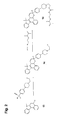
- Non-limiting methods of synthesizing the reactive substituent R on the photochromic napthopyran according to various non-limiting embodiments of the photochromic materials comprising a reactive substituent disclosed herein will now be discussed with reference to the reaction schemes presented in Figures 1 and 2 .
- Figure 1 depicts various non-limiting methods of synthesizing a reactive substituent R at the 7 position of an indeno[2',3':3,4] naphtho[1,2-b]pyran.
- Figure 2 depicts one non-limiting method of synthesizing a reactive substituent R on a B group of an indeno[2',3':3,4]naphtho[1,2-b]pyran.
- One skilled in the art will appreciate that there may be multiple ways to synthesize the reactive substituent on the photochromic naphthopyran, therefore it will be appreciated that these reaction schemes are presented for illustration purposes only and are not intended to be limiting herein.
- 3-dimethoxy-7,7-dimethyl-7H- benzo[C]fluoren-5-ol 5 may be reacted with a substituted 2-propyn-1-ol to form indeno[2',3':3,4] naphtho[1,2-b]pyran 6.
- Non-limiting methods of synthesizing 7H-benzo[C]fluoren-5-ols, suitable for use in the synthesis of various non-limiting embodiments disclosed herein, are described in U.S. Patent No. 6,296,785 at col. 11, lines 6 to col. 28, line 35, the disclosure of which is incorporated herein by reference.
- Non-limiting methods of synthesizing substituted 2-propyn-1-ols suitable for use in the synthesis of various non-limiting embodiments disclosed herein, are described in U.S. Patent Nos. 5,458,814 , col. 4, line 11 to col. 5, line 9, and at step 1 of Examples 1, 4-6, 11, 12, and 13, and 5,645,767 at col. 5, line 12 to col. 6, line 30, the disclosures of which are incorporated herein by reference.
- Indeno-fused naphthopyran 6 may then be reacted with a diamine or amino alcohol.
- 6 may be reacted with a diamine, such as piperazine to afford the 6-methoxy-7-(piperizin-1-yl)-13,13-dimethyl-3H,13H-indeno[2',3':3,4] naphtho[1,2-b]pyran 7 .
- the piperazine moiety of 7 may be condensed with 2-iscyanatoethyl methacrylate to afford photochromic naphthopyran 8 having an R substituent comprising -D-J, as defined herein above, where -D- is a diamine residue.
- indeno-fused naphthopyran 6 may be reacted with an amino alcohol, such as 3-piperidinomethanol to afford the 6-methoxy-7-(3-hydroxymethylenepiperidin-1-yl)-13,13-dimethyl-3H,13H-indeno[2',3':3,4] naphtho[1,2-b]pyran 9.
- the hydroxy moiety of 9 may be condensed with 2-iscyanatoethyl methacrylate to afford photochromic naphthopyran 10 having an R substituent comprising -D-J, as defined herein above, where -D- is an amino alcohol residue.
- the hydroxy moiety of 9 may alternatively be reacted with a cyclic anhydride, such as succinic anhydride to afford the 6-methoxy-7-(3-(2-hydroxycarbonylethylcarboxymethylenepiperidin-1-yl)-13,13-dimethyl-3H,13H-indeno[2',3':3,4] naphtho[1,2-b]pyran 11 .
- the carboxylic acid of 11 may be esterified with polyethyleneglycol methacrylate of afford photochromic naphthopyran 12 having an R substituent comprising -D-E-G-J, as defined herein above.
- 7,7-dimethyl-7H-benzo[C]fluoren-5-ol (13) may be reacted with 1-phenyl-1-(4-(4-(2-hydroxyethyl)piperizin-1-yl)phenyl-2-propyn-1-ol, to form indeno[2',3':3,4]naphtho[1,2-b]pyran 14 .
- the hydroxy moiety of 14 may be condensed with 2-iscyanatoethyl methacrylate to afford photochromic naphthopyran 15 having an R substituent on the B group, wherein the reactive substituent R comprises -D-J, as defined herein above, where -D- is an amino alcohol residue.
- photochromic materials of the present disclosure for example photochromic materials comprising a photochromic naphthopyran and a reactive substituent bonded to the photochromic naphthopyran, wherein the reactive substituent has the structure as set forth herein, may be used in ophthalmic devices.
- the photochromic materials of the present disclosure may be used in soft contact lenses, hard contact lenses, intraocular lenses, overlay lenses, ocular inserts, and optical inserts.
- the photochromic materials according to various non-limiting embodiments disclosed herein may be incorporated into an organic material, such as a polymeric, oligomeric, or monomeric material, which may be used, for example and without limitation, to form ophthalmic devices.
- an organic material such as a polymeric, oligomeric, or monomeric material
- the term "incorporated into” means physically and/or chemically combined with.
- the ophthalmic devices according to various non-limiting embodiments disclosed herein may be formed from photochromic materials physically and/or chemically combined with at least a portion of an organic material.
- polymer and “polymeric material” refers to homopolymers and copolymers (e.g., random copolymers, block copolymers, and alternating copolymers), as well as blends and other combinations thereof.
- the photochromic materials according to various non-limiting embodiments disclosed herein may each be used alone, in combination with other photochromic materials according to various non-limiting embodiments disclosed herein, or in combination with other appropriate complementary conventional photochromic materials.
- the photochromic materials according to various non-limiting embodiments disclosed herein may be used in conjunction with other complementary conventional photochromic materials having an activated absorption maxima within the range of 300 to 1000 nanometers.
- the complementary conventional photochromic materials may include other polymerizable or compatabilized photochromic materials.
- the present disclosure also contemplates ophthalmic devices formed from photochromic compositions comprising a polymeric material and a photochromic material according to the various non-limiting embodiments discussed herein.
- photochromic composition refers to a photochromic material in combination with another material, which may or may not be a photochromic material.
- the photochromic material is incorporated into at least a portion of the polymeric material.
- the photochromic materials disclosed herein may be incorporated into a portion of the polymeric material, such as by bonding to a portion of the polymeric material, for example by co-polymerizing the photochromic material with a portion of the polymeric material; or blending with the polymeric material.
- the term “blended” or “blending” mean that the photochromic material is intermixed or intermingled with at least a portion of an organic material, such as the polymeric material, but not bonded to the organic material.
- the terms "bonded” or “bonding” mean that the photochromic material is linked to a portion of an organic material, such as the polymeric material, or a precursor thereof.
- the photochromic material may be bonded to a portion of an organic material through a reactive substituent (such, but not limited to, those reactive substituents discussed above).
- the photochromic material may be incorporated into at least a portion of the polymeric material or at least a portion of the monomeric material or oligomeric material from which the ophthalmic device is formed.
- photochromic materials according to various non-limiting embodiments disclosed herein that have a reactive substituent may be bonded to an organic material such as a monomer, oligomer, or polymer having a group with which a reactive moiety may be reacted, or the reactive moiety can be reacted as a co-monomer in the polymerization reaction from which the organic material is formed, for example, in a co-polymerization process.
- the term "co-polymerized with” means that the photochromic material is linked to a portion of the polymeric material by reacting as a co-monomer in the polymerization reaction of the host monomers that result in the polymeric material.
- photochromic materials according to various non-limiting embodiments herein have a reactive substituent that comprises a polymerizable moiety that may react as a co-monomer during the polymerization of the host monomers.
- Polymeric materials suitable for the various non-limiting embodiments of the present disclosure include those suitable for the production of ophthalmic devices.
- the ophthalmic device may be formed from an optically clear polymeric material.
- the polymeric material is formed from a mixture comprising polymerizable and optionally non-polymerizable ophthalmic device forming components which are known in the art to be useful for forming ophthalmic devices, such as contact lenses. More specifically, suitable components include polymerizable monomers, prepolymers and macromers, wetting agents, UV absorbing compounds, compatibilizing components, colorants and tints, mold release agents, processing aids, mixtures thereof and the like.
- the ophthalmic device forming components preferably form a hydrogel upon polymerization and hydration.
- a hydrogel is a hydrated, crosslinked polymeric system that contains water in an equilibrium state.
- Hydrogels typically are oxygen permeable and biocompatible, making them preferred materials for producing ophthalmic devices and in particular contact and intraocular lenses.
- Ophthalmic device forming components include polymerizable monomers, prepolymers and macromers which contain polymerizable group(s) and performance groups which provide the resulting polymeric material with desirable properties.
- Suitable performance groups include but are not limited to hydrophilic groups, oxygen permeability enhancing groups, UV or visible light absorbing groups, combinations thereof and the like.
- the term "monomer” used herein refers to low molecular weight compounds (i.e. typically having number average molecular weights less than about 700).
- Prepolymers are medium to high molecular weight compounds or polymers (having repeating structural units and a number average molecular weight greater than about 700) containing functional groups capable of further polymerization.
- Macromers are uncrosslinked polymers which are capable of cross-linking or further polymerization.
- hydrophilic components which are capable of providing at least about 20% and preferably at least about 25% water content to the resulting lens when combined with the remaining components.
- the hydrophilic components that may be used to make the polymers of this invention are monomers having at least one polymerizable double bond and at least one hydrophilic functional group. Examples of polymerizable double bonds include acrylic, methacrylic, acrylamido, methacrylamido, fumaric, maleic, styryl, isopropenylphenyl, O-vinylcarbonate, O-vinylcarbamate, allylic, O-vinylacetyl and N-vinyllactam and N-vinylamido double bonds.
- Non-limiting examples of hydrophilic monomers having acrylic and methacrylic polymerizable double bonds include N,N-dimethylacrylamide (DMA), 2-hydroxyethyl acrylate, 2-hydroxyethyl methacrylate, glycerol methacrylate, 2-hydroxyethyl methacrylamide, polyethyleneglycol monomethacrylate, methacrylic acid, acrylic acid and mixtures thereof.
- DMA N,N-dimethylacrylamide
- 2-hydroxyethyl acrylate 2-hydroxyethyl methacrylate
- glycerol methacrylate 2-hydroxyethyl methacrylamide
- polyethyleneglycol monomethacrylate methacrylic acid, acrylic acid and mixtures thereof.
- Non-limiting examples of hydrophilic monomers having N-vinyl lactam and N-vinylamide polymerizable double bonds include N-vinyl pyrrolidone (NVP), N-vinyl-N-methyl acetamide, N-vinyl-N-ethyl acetamide, N-vinyl-N-ethyl formamide, N-vinyl formamide, N-2-hydroxyethyl vinyl carbamate, N-carboxy-ß-alanine N-vinyl ester, with NVP and N-vinyl-N-methyl acetamide being preferred. Polymers formed from these monomers may also be included.
- hydrophilic monomers that can be employed in the invention include polyoxyethylene polyols having one or more of the terminal hydroxyl groups replaced with a functional group containing a polymerizable double bond.
- hydrophilic vinyl carbonate or vinyl carbamate monomers disclosed in U.S. Pat. No.5,070,215
- hydrophilic oxazolone monomers disclosed in U.S. Pat. No. 4,190,277 .
- Other suitable hydrophilic monomers will be apparent to one skilled in the art.
- DMA N,N-dimethyl acrylamide
- HEMA 2-hydroxyethyl acrylate
- HEMA 2-hydroxyethyl methacrylate
- NDP N-vinylpyrrolidone
- N-vinyl-N-methyl acetamide polyethyleneglycol monomethacrylate and mixtures thereof.
- hydrophilic monomers include HEMA, DMA, NVP, N-vinyl-N-methyl acetamide and mixtures thereof.
- hydrophilic monomers are suitable for the production of conventional contact lenses such as those made from to etafilcon, polymacon, vifilcon, genfilcon A and lenefilcon A and the like.
- amount of hydrophilic monomer incorporated into the polymerizable mixture is at least about 70 weight % and preferably at least about 80 weight %, based upon the weight of all the components in the polymerizable mixture.
- suitable contact lenses may be made from polymeric materials having increased permeability to oxygen, such as galyfilcon A, senofilcon A, balafilcon, lotrafilcon A and B and the like.
- the polymerization mixtures used to form these and other materials having increased permeability to oxygen generally include one or more of the hydrophilic monomers listed above, with at least one silicone containing component.
- a silicone-containing component is one that contains at least one [-Si-O-Si] group, in a monomer, macromer or prepolymer.
- the Si and attached O are present in the silicone-containing component in an amount greater than 20 weight percent, and more preferably greater than 30 weight percent of the total molecular weight of the silicone-containing component.
- Useful silicone-containing components preferably comprise polymerizable functional groups such as acrylate, methacrylate, acrylamide, methacrylamide, N-vinyl lactam, N-vinylamide, and styryl functional groups. Examples of silicone-containing components which are useful in this invention may be found in U.S. Pat. Nos.
- suitable silicone-containing monomers are polysiloxanylalkyl(meth)acrylic monomers represented by the following formula: wherein: R 30 denotes H or lower alkyl; X denotes O or NR 34 ; each R 34 independently denotes hydrogen or methyl, each R 31 -R 33 independently denotes a lower alkyl radical or a phenyl radical, and n is 1 or 3 to 10.
- polysiloxanylalkyl (meth)acrylic monomers examples include methacryloxypropyl tris(trimethylsiloxy) silane, methacryloxymethylpentamethyldisiloxane, methacryloxypropylpentamethyldisiloxane, methyldi(trimethylsiloxy)methacryloxypropyl silane, and methyldi(trimethylsiloxy)methacryloxymethyl silane.
- Methacryloxypropyl tris(trimethylsiloxy)silane is the most preferred.
- silicone-containing components is a poly(organosiloxane) prepolymer represented by Formula VII: wherein each A independently denotes an activated unsaturated group, such as an ester or amide of an acrylic or a methacrylic acid or an alkyl or aryl group (providing that at least one A comprises an activated unsaturated group capable of undergoing radical polymerization); each of R 35 , R 36 , R 37 and R 38 are independently selected from the group consisting of a monovalent hydrocarbon radical or a halogen substituted monovalent hydrocarbon radical having 1 to 18 carbon atoms which may have ether linkages between carbon atoms; R 39 denotes a divalent hydrocarbon radical having from 1 to 22 carbon atoms, and m is 0 or an integer greater than or equal to 1, and preferably 5 to 400, and more preferably 10 to 300.
- each A independently denotes an activated unsaturated group, such as an ester or amide of an acrylic or a methacrylic acid or an alkyl
- ⁇ , ⁇ -bismethacryloxypropyl poly-dimethylsiloxane is ⁇ , ⁇ -bismethacryloxypropyl poly-dimethylsiloxane.
- mPDMS monoomethacryloxypropyl terminated mono-n-butyl terminated polydimethylsiloxane.
- silicone-containing vinyl carbonate or vinyl carbamate monomers of the following formula: wherein: Y denotes O, S, or NH; R Si denotes a silicone-containing organic radical; R 40 denotes hydrogen or methyl; d is 1, 2, 3 or 4; and q is 0 or 1.
- Suitable silicone-containing organic radicals R Si include the following: -(CH 2 ) q ,Si[(CH 2 ) s CH 3 ] 3 -(CH 2 ) q ,Si[OSi(CH 2 ) s CH 3 ] 3 wherein:
- the silicone-containing vinyl carbonate or vinyl carbamate monomers specifically include: 1,3-bis[4-(vinyloxycarbonyloxy)but-1-yl]tetramethyldisiloxane; 3-(vinyloxycarbonylthio) propyl-[tris (trimethylsiloxy)silane]; 3-[tris(trimethylsiloxy)silyl] propyl allyl carbamate; 3-[tris(trimethylsiloxy)silyl] propyl vinyl carbamate; trimethylsilylethyl vinyl carbonate; trimethylsilylmethyl vinyl carbonate, and
- silicone containing components are not an exhaustive list. Any other silicone components known in the art may be used. Further examples include, but are not limited to macromers made using group transfer polymerization, such as those disclosed in 6,367,929 , polysiloxane containing polyurethane compounds such as those disclosed in US 6,858,218 , polysiloxane containing macromers, such as those described as Materials A-D in US 5,760,100 ; macromers containing polysiloxane, polyalkylene ether, diisocyanate, polyfluorinated hydrocarbon, polyfluorinated ether and polysaccharide groups, such as those described is WO 96/31792 ; polysiloxanes with a polar fluorinated graft or side group(s) having a hydrogen atom attached to a terminal difluoro-substituted carbon atom, such as those described in U.S.
- the polymerizable mixture may contain additional components such as, but not limited to, wetting agents, such as those disclosed in US 6,822,016 , US Serial No. 11/057,363 (VTN 5045), US Serial No. 10/954,560 , US Serial No. 10/954,559 and US Serial No. 955,214 ; compatibilizing components, such as those disclosed in US 6,822,016 and WO03/022322 ; UV absorbers, medicinal agents, antimicrobial compounds, reactive tints, pigments, copolymerizable and nonpolymerizable dyes, release agents and combinations thereof.
- wetting agents such as those disclosed in US 6,822,016 , US Serial No. 11/057,363 (VTN 5045), US Serial No. 10/954,560 , US Serial No. 10/954,559 and US Serial No. 955,214 ; compatibilizing components, such as those disclosed in US 6,822,016 and WO03/022322 ; UV absorbers, medicinal agents, antimicrobial compounds, reactive tint
- copolymers of the aforementioned monomers, combinations, and blends of the aforementioned polymers and copolymers with other polymers e.g., to form interpenetrating network products.
- the polymerizable mixture may optionally further comprise a diluent.
- Suitable diluents for polymerizable mixtures are well known in the art.
- Non-limiting examples for polymerizable mixtures for hydrophilic soft contact lenses include organic solvents or water or mixtures hereof.
- Preferred organic solvents include alcohols, diols, triols, polyols and polyalkylene glycols.
- Examples include but are not limited to glycerin, diols such as ethylene glycol or diethylene glycol; boris acid esters of polyols such as those described in US Patents 4,680,336 ; 4,889,664 and 5,039,459 ; polyvinylpyrrolidone; ethoxylated alkyl glucoside; ethoxylated bisphenol A; polyethylene glycol; mixtures of propoxylated and ethoxylated alkyl glucoside; single phase mixture of ethoxylated or propoxylated alkyl glucoside and C 2-12 dihydric alcohol; adducts of ⁇ -caprolactone and C 2-6 alkanediols and triols; ethoxylated C 3-6 alkanetriol; and mixtures of these as described in US Patents 5,457,140 ; 5,490,059 , 5,490,960 ; 5,498,379 ; 5,594,043 ;
- Non-limiting examples of diluents suitable for polymerizable mixtures for silicone hydrogel soft contact lenses include alcohols such as those disclosed in US 6,020,445 and US Serial No. 10/794,399 for silicone hydrogel soft contact lenses.
- alcohols such as those disclosed in US 6,020,445 and US Serial No. 10/794,399 for silicone hydrogel soft contact lenses.
- the disclosure of these and all other references cited within this application are hereby incorporated by reference. Many other suitable examples are known to those of skill in the art and are included within the scope of this invention.
- Hard contact lenses are made from polymers that include but are not limited to polymers of poly(methyl)methacrylate, silicon acrylates, fluoroacrylates, fluoroethers, polyacetylenes, and polyimides, where the preparation of representative examples may be found in US Patents 4,540,761 ; 4,508,884 ; 4,433,125 and 4,330,383 .
- Intraocular lenses of the invention can be formed using known materials.
- the lenses may be made from a rigid material including, without limitation, polymethyl methacrylate, polystyrene, polycarbonate, or the like, and combinations thereof.
- flexible materials may be used including, without limitation, hydrogels, silicone materials, acrylic materials, fluorocarbon materials and the like, or combinations thereof.
- Typical intraocular lenses are described in WO 0026698 , WO 00224.60 , WO 9929750 , WO 9927978 , WO 0022459 .
- Other ophthalmic devices, such as punctal plugs may be made from collagen and silicone elastomers.
- Various non-limiting embodiments disclosed herein provide photochromic ophthalmic devices comprising a photochromic material according to any of the non-limiting embodiments discussed above connected to a portion of the ophthalmic device.
- the term "connected to” means associated with, either directly or indirectly through another material or structure.
- the photochromic materials disclosed herein may be connected to at least a portion of the ophthalmic device, such as by bonding the photochromic materials to at least a portion of the material from which the ophthalmic device is made, for example by co-polymerizing or otherwise bonding the photochromic materials with the ophthalmic device material; blending the photochromic materials with the ophthalmic device material; or coating the photochromic materials on at least a portion of a surface of the ophthalmic device.
- the photochromic material may be connected to at least a portion of the ophthalmic device such as through an intermediate coating, film or layer.
- the photochromic material may be connected to at least a portion of the ophthalmic device by incorporating the photochromic material into at least a portion of the polymeric material of the ophthalmic device, or at least a portion of the oligomeric or monomeric material from which the ophthalmic device is formed.
- the photochromic material may be incorporated into the polymeric material of the ophthalmic device by the cast-in-place method.
- the photochromic material may be connected with at least a portion of the polymeric material of the ophthalmic device by imbibition. Imbibition and the cast-in-place method are discussed below.
- the ophthalmic device comprises a polymeric material and a photochromic material is bonded to at least a portion of the polymeric material.
- the ophthalmic device comprises a polymeric material and a photochromic material is blended with at least a portion of the polymeric material.
- the ophthalmic device comprises a polymeric material and a photochromic material is co-polymerized with at least a portion of the polymeric material.
- the photochromic material may be connected to at least a portion of the ophthalmic device of the photochromic article as part of an at least partial coating that is connected to at least a portion of the ophthalmic device. Further, the photochromic material may be incorporated into at least a portion of the coating composition prior to application of the coating composition to the ophthalmic device, or alternatively, a coating composition may be applied to the substrate, at least partially set, and thereafter the photochromic material may be imbibed into at least a portion of the coating.
- the terms "set” and “setting” include, without limitation, curing, polymerizing, cross-linking, cooling, and drying.
- the ophthalmic device may comprise an at least partial coating of a polymeric material connected to at least a portion of a surface thereof.
- the photochromic material may be blended with at least a portion of the polymeric material of the at least partial coating, or the photochromic material may be bonded to at least a portion of the polymeric material of the at least partial coating.
- the photochromic material may be co-polymerized with at least a portion of the polymeric material of the at least partial coating.
- the at least partial coating comprising a photochromic material may be directly connected to the ophthalmic device, for example, by directly applying a coating composition comprising a photochromic material to at least a portion of a surface of the ophthalmic device, and at least partially setting the coating composition. Additionally or alternatively, the at least partial coating comprising a photochromic material may be connected to the ophthalmic device, for example, through one or more additional coatings. For example, while not limiting herein, according to various non-limiting embodiments, an additional coating composition may be applied to at least a portion of the surface of the ophthalmic device, at least partially set, and thereafter the coating composition comprising a photochromic material may be applied over the additional coating and at least partially set.
- Non-limiting examples of additional coatings and films that may be used in conjunction with the ophthalmic device disclosed herein include conventional photochromic coating and films; ophthalmically compatible coatings including clear coats, hydrophilic coatings, combinations thereof; and the like.
- Non-limiting examples of conventional photochromic coatings and films include, but are not limited to, coatings and films comprising conventional photochromic materials.
- connecting a photochromic material may comprise blending the photochromic material with at least a portion of the polymeric material used to form the ophthalmic device.
- connecting the photochromic material to at least a portion of the ophthalmic device may comprise bonding the photochromic material to at least a portion of the polymeric material of the ophthalmic device.
- connecting the photochromic material to at least a portion of the ophthalmic device may comprise co-polymerizing the photochromic material with at least a portion of the polymeric material used to form the ophthalmic device.
- Non-limiting methods of connecting photochromic materials to a polymeric material include, for example, mixing the photochromic material into a solution or melt of a polymeric, oligomeric, or monomeric material, and subsequently at least partially setting the polymeric, oligomeric, or monomeric material.
- the photochromic materials may be blended with the polymeric material (i.e., intermixed with but not bonded to) or bonded to the polymeric material.
- the photochromic material contains a polymerizable group that is compatible with the polymeric, oligomeric, or monomer material, during setting of the organic material the photochromic material can be reacted with at least a portion thereof to bond the photochromic material thereto.
- connecting the photochromic material to at least a portion of the ophthalmic device may comprise imbibing the photochromic material with at least a portion of the polymeric material of the ophthalmic device.
- the photochromic material may be caused to diffuse into the polymeric material, for example, by immersing an ophthalmic device comprising a polymeric material in a solution containing the photochromic material, with or with out heating.
- the connecting the photochromic material to at least a portion of the ophthalmic device may comprise a combination of two or more of blending, bonding (for example co-polymerizing), and imbibing the photochromic material to/with at least a portion of the polymeric material of the ophthalmic device.
- the substrate comprises a polymeric material
- incorporating the photochromic material with at least a portion of a substrate comprises a cast-in-place method.
- the photochromic material may be mixed with a polymeric solution or melt, or other oligomeric and/or monomeric solution or mixture, which is subsequently cast into a molding having a desired shape and at least partially set to form the ophthalmic device.
- a photochromic material can be bonded to the polymeric material.
- connecting the photochromic material to at least a portion of an ophthalmic device comprises in-mold casting.
- a coating composition comprising the photochromic material, which may be a liquid coating composition, is applied to the surface of a mold and at least partially set. Thereafter, a polymer solution or melt, or oligomer or monomeric solution or mixture is cast over the coating and at least partially set. After setting, the ophthalmic device with the coating is removed from the mold.
- connecting the photochromic material to at least a portion of a ophthalmic device comprises applying an at least partial coating comprising the photochromic material to at least a portion of the ophthalmic device.
- suitable coating methods include dip coating, spin coating, spray coating (e.g., using a liquid coating), curtain coating, roll coating, spin and spray coating, over-molding, and the like.
- the photochromic material may be connected to the ophthalmic device by over-molding.
- a coating composition comprising the photochromic material (which may be a liquid coating composition as previously discussed) is applied to a mold and the ophthalmic device is then placed into the mold such that the ophthalmic device contacts the coating causing it to spread over at least a portion of the surface of the ophthalmic device. Thereafter, the coating composition is at least partially set and the coated ophthalmic device is removed from the mold.
- over-molding may be done by placing the ophthalmic device into a mold such that an open region is defined between the ophthalmic device and the mold, and thereafter injecting a coating composition comprising the photochromic material into the open region. Thereafter, the coating composition can be at least partially set and the coated ophthalmic device is removed from the mold.
- photochromic compositions may further comprise other additives that aid in the processing and/or performance of the composition.
- additives may include complementary photochromic materials, photoinitiators, thermal initiators, polymerization inhibitors, solvents, light stabilizers (such as, but not limited to, ultraviolet light absorbers and light stabilizers, such as hindered amine light stabilizers (HALS)), heat stabilizers, mold release agents, rheology control agents, leveling agents (such as, but not limited to, surfactants), free radical scavengers, or adhesion promoters (such as hexanediol diacrylate and coupling agents).
- light stabilizers such as, but not limited to, ultraviolet light absorbers and light stabilizers, such as hindered amine light stabilizers (HALS)
- HALS hindered amine light stabilizers
- leveling agents such as, but not limited to, surfactants
- free radical scavengers such as hexanediol diacrylate and coupling agents.
- Each of the photochromic materials described herein may be used in amounts (or in a ratio) such that a ophthalmic device or a polymeric material to which the photochromic material is associated, i.e., blended, co-polymerized, or otherwise bonded, coated and/or imbibed, exhibits a desired resultant color, e.g., substantially clear and colorless when the photochromic material is in the closed form and substantially colored when activated by actinic radiation and the photochromic material is in the open form.
- a desired resultant color e.g., substantially clear and colorless when the photochromic material is in the closed form and substantially colored when activated by actinic radiation and the photochromic material is in the open form.
- the amount of the photochromic naphthopyrans of the present disclosure to be connected to or incorporated into a coating composition, polymeric material, ophthalmic device, and/or photochromic composition is not critical provided that a sufficient amount is used to produce the desired optical effect. Generally, such amount may be described as a "photochromic amount".
- the particular amount of photochromic material used may depend on a variety of factors such as, the absorption characteristics of the photochromic material used, the intensity of color desired upon irradiation thereof, and the method used to incorporate or apply the photochromic material.
- the relative amounts of the aforesaid photochromic materials used in the various methods of the non-limiting embodiments of the present disclosure will vary and depend, in part, upon the relative intensities of the color of the activated species of such materials, the ultimate color desired, the molar absorption coefficient (of "extinction coefficient") for actinic radiation, and the method of application to the polymeric material or substrate.
- the amount of total photochromic material incorporated into or connected to a polymeric material or ophthalmic device may range from about 0.05 to about 5.0 milligrams per square centimeter of the surface to which the photochromic material is incorporated into or connected to.
- the amount of photochromic material incorporated into or connected to a coating composition may range from 0.1 to 40 weight percent based on the weight of the liquid coating composition.
- the amount of photochromic material incorporated into, i.e., blended with, co-polymerized with, or bonded to, a host polymer photochromic composition or photochromic ophthalmic device, such as by a in cast-in-place type method, may range from 0.01 to 40 weight percent based on the weight of the polymeric composition or photochromic ophthalmic device.
- Nuclear magnetic resonance spectroscopy supports the structure of 3-phenyl-3-(4-morpholinophenyl)-6-methoxy-7-(3-(2-methacryloxyethyl)carbamyloxymethylene piperidin-1-yl)-13,13-dimethyl-3H,13H-indeno[2',3':3,4]naphtho[1,2-b]pyran.
- Step 2 of Example 1 The procedure of Step 2 of Example 1 was followed except that 4-hydroxypiperidine was used in place of 3-piperidinomethanol. The product was obtained as off-white crystals.
- Step 3 of Example 1 The procedure of Step 3 of Example 1 was followed except that 3-phenyl-3-(4-morphlinophenyl)-6-methoxy-7-(4-hydroxypiperidin-1-yl)-13,13-dimethyl-3H,13H-indeno[2',3':3,4]naphtho[1,2-b]pyran (from Step 1) was used in place of 3-phenyl-3-(4-morpholinophenyl)-6-methoxy-7-(3-hydroxymethylenepiperidin-11-yl)-13,13-dimethyl-3H,13H-indeno[2',3':3,4]naphtho[1,2-b]pyran. The product was obtained as purple-tinted crystals.
- Mass spectrometry supports the molecular weight of 3-phenyl-3-(4-morphlinophenyl)-6-methoxy-7-(4-(2-methacryloxyethyl)carbamyloxypiperidin-1-yl)-13,13-dimethyl-3H,13H-indeno[2',3':3,4]naphtho[1,2-b]pyran.
- Step 2 of Example 1 The procedure of Step 2 of Example 1 was followed except that piperazine was used in place of 3-piperidinomethanol. The product was obtained as purple-tinted crystals.
- Step1 of Example 1 The procedure of Step1 of Example 1 was followed except that 1-phenyl-1-(4-(2-hydroxyethoxy)phenyl)-2-propyn-1-ol (from Step 2) was used in place of 1-phenyl-1-(4-morpholinophenyl)-2-propyn-1-ol. After the chromatography, the product was precipitated from ethyl acetate/hexanes (v/v: 1/1) and filtered off as a yellow-tinted solid.
- Step 2 of Example 1 The procedure of Step 2 of Example 1 was followed except that 3-phenyl-3-(4-(2-hydroxyethoxy)phenyl)-6,7-dimethoxy-13,13-dimethyl-3H, 13H-indeno[2',3':3,4] naphtho[1,2-b]pyran (from Step 3) was used in place of 3-phenyl-3-(4-morpholinophenyl)-6,7-dimethoxy-13,13-dimethyl-3H,13H-indeno[2',3':3,4]naphtho[1,2-b]pyran and piperidine was used in place of 3-piperidinomethanol.
- the product was obtained as a dark-green expanded foam.
- Step 3 of Example 1 The procedure of Step 3 of Example 1 was followed except that 3-phenyl-3-(4-(2-hydroxyethoxy)phenyl)-6-methoxy-7-piperidino-13,13-dimethyl-3H,13H-indeno[2',3':3,4]naphtho[1,2-b]pyran (from Step 4) was used in place of 3-phenyl-3-(4-morpholinophenyl)-6-methoxy-7-(3-hydroxymethylenepiperidin-1-yl)-13,13-dimethyl-3H,13H-indeno[2',3':3,4]naphtho[1,2-b]pyran.
- the product was obtained as a yellow-tinted expanded foam.
- Mass spectrometry supports the molecular weight of 3-phenyl-3-(4-(2-(2-methacryloxyethyl) carbamyloxyethoxy)phenyl)-6-methoxy-7-piperidino-13,13-dimethyl-3H,13H-indeno[2',3':3,4]naphtho[1,2-b]pyran.
Landscapes
- Physics & Mathematics (AREA)
- General Physics & Mathematics (AREA)
- Optics & Photonics (AREA)
- Chemical & Material Sciences (AREA)
- Engineering & Computer Science (AREA)
- Materials Engineering (AREA)
- Organic Chemistry (AREA)
- Health & Medical Sciences (AREA)
- Ophthalmology & Optometry (AREA)
- General Health & Medical Sciences (AREA)
- Eyeglasses (AREA)
- Plural Heterocyclic Compounds (AREA)
- Prostheses (AREA)
- Materials For Medical Uses (AREA)
- Pyrane Compounds (AREA)
- Heterocyclic Carbon Compounds Containing A Hetero Ring Having Oxygen Or Sulfur (AREA)
- Optical Filters (AREA)
- Nitrogen And Oxygen Or Sulfur-Condensed Heterocyclic Ring Systems (AREA)
- Pharmaceuticals Containing Other Organic And Inorganic Compounds (AREA)
Applications Claiming Priority (2)
| Application Number | Priority Date | Filing Date | Title |
|---|---|---|---|
| US11/101,979 US9052438B2 (en) | 2005-04-08 | 2005-04-08 | Ophthalmic devices comprising photochromic materials with reactive substituents |
| EP06749497.1A EP1872159B8 (fr) | 2005-04-08 | 2006-04-03 | Dispositif ophtalmiques comportant des matieres photochromiques contenant des substituants reactifs |
Related Parent Applications (3)
| Application Number | Title | Priority Date | Filing Date |
|---|---|---|---|
| EP06749497.1 Division | 2006-04-03 | ||
| EP06749497.1A Division-Into EP1872159B8 (fr) | 2005-04-08 | 2006-04-03 | Dispositif ophtalmiques comportant des matieres photochromiques contenant des substituants reactifs |
| EP06749497.1A Division EP1872159B8 (fr) | 2005-04-08 | 2006-04-03 | Dispositif ophtalmiques comportant des matieres photochromiques contenant des substituants reactifs |
Publications (4)
| Publication Number | Publication Date |
|---|---|
| EP2270559A2 true EP2270559A2 (fr) | 2011-01-05 |
| EP2270559A3 EP2270559A3 (fr) | 2011-02-09 |
| EP2270559B1 EP2270559B1 (fr) | 2013-08-21 |
| EP2270559B9 EP2270559B9 (fr) | 2014-04-02 |
Family
ID=36699051
Family Applications (3)
| Application Number | Title | Priority Date | Filing Date |
|---|---|---|---|
| EP19194590.6A Withdrawn EP3633423A1 (fr) | 2005-04-08 | 2006-04-03 | Dispositifs ophtalmiques comprenant des matériaux photochromiques dotés d'éléments réactifs |
| EP10177615.1A Expired - Lifetime EP2270559B9 (fr) | 2005-04-08 | 2006-04-03 | Dispositifs ophthalmiques comportant des matières photochromiques contenant des substituants réactifs |
| EP06749497.1A Expired - Lifetime EP1872159B8 (fr) | 2005-04-08 | 2006-04-03 | Dispositif ophtalmiques comportant des matieres photochromiques contenant des substituants reactifs |
Family Applications Before (1)
| Application Number | Title | Priority Date | Filing Date |
|---|---|---|---|
| EP19194590.6A Withdrawn EP3633423A1 (fr) | 2005-04-08 | 2006-04-03 | Dispositifs ophtalmiques comprenant des matériaux photochromiques dotés d'éléments réactifs |
Family Applications After (1)
| Application Number | Title | Priority Date | Filing Date |
|---|---|---|---|
| EP06749497.1A Expired - Lifetime EP1872159B8 (fr) | 2005-04-08 | 2006-04-03 | Dispositif ophtalmiques comportant des matieres photochromiques contenant des substituants reactifs |
Country Status (11)
| Country | Link |
|---|---|
| US (4) | US9052438B2 (fr) |
| EP (3) | EP3633423A1 (fr) |
| JP (3) | JP4975734B2 (fr) |
| KR (1) | KR101347099B1 (fr) |
| CN (3) | CN101915946B (fr) |
| AR (1) | AR055573A1 (fr) |
| AU (1) | AU2006235152B2 (fr) |
| BR (1) | BRPI0608937B1 (fr) |
| CA (1) | CA2603549C (fr) |
| TW (1) | TWI494308B (fr) |
| WO (1) | WO2006110520A1 (fr) |
Cited By (1)
| Publication number | Priority date | Publication date | Assignee | Title |
|---|---|---|---|---|
| CN105278008A (zh) * | 2010-04-13 | 2016-01-27 | 庄臣及庄臣视力保护公司 | 用于制造热致变色的接触镜片材料的方法 |
Families Citing this family (58)
| Publication number | Priority date | Publication date | Assignee | Title |
|---|---|---|---|---|
| AU2004270746B2 (en) * | 2003-09-09 | 2010-12-02 | Insight Equity A.P.X., Lp | Photochromic polyurethane laminate |
| US8147725B2 (en) | 2005-04-08 | 2012-04-03 | Transitions Optical, Inc | Photochromic materials having extended pi-conjugated systems and compositions and articles including the same |
| US9028728B2 (en) | 2005-04-08 | 2015-05-12 | Transitions Optical, Inc. | Photochromic materials that include indeno-fused naphthopyrans |
| US20060226402A1 (en) * | 2005-04-08 | 2006-10-12 | Beon-Kyu Kim | Ophthalmic devices comprising photochromic materials having extended PI-conjugated systems |
| US7556750B2 (en) * | 2005-04-08 | 2009-07-07 | Transitions Optical, Inc. | Photochromic materials with reactive substituents |
| US20060228557A1 (en) * | 2005-04-08 | 2006-10-12 | Beon-Kyu Kim | Photochromic materials having extended pi-conjugated systems and compositions and articles including the same |
| US8647538B2 (en) | 2005-04-08 | 2014-02-11 | Transitions Optical, Inc. | Photochromic compounds having at least two photochromic moieties |
| US9139552B2 (en) * | 2005-04-08 | 2015-09-22 | Transitions Optical, Inc. | Indeno-fused naphthopyrans having ethylenically unsaturated groups |
| US9052438B2 (en) | 2005-04-08 | 2015-06-09 | Johnson & Johnson Vision Care, Inc. | Ophthalmic devices comprising photochromic materials with reactive substituents |
| US8158037B2 (en) | 2005-04-08 | 2012-04-17 | Johnson & Johnson Vision Care, Inc. | Photochromic materials having extended pi-conjugated systems and compositions and articles including the same |
| US7527754B2 (en) * | 2005-12-21 | 2009-05-05 | Transitions Optical, Inc. | Photochromic indeno-fused naphthopyrans |
| US7556751B2 (en) * | 2005-12-21 | 2009-07-07 | Transitions Optical, Inc. | Photochromic materials having electron-withdrawing substituents |
| US20070145337A1 (en) * | 2005-12-23 | 2007-06-28 | Anu Chopra | Photochromic 2H-naphthopyrans |
| US8748634B2 (en) * | 2006-10-30 | 2014-06-10 | Transitions Optical, Inc. | Photochromic materials demonstrating improved fade rates |
| US9690115B2 (en) | 2010-04-13 | 2017-06-27 | Johnson & Johnson Vision Care, Inc. | Contact lenses displaying reduced indoor glare |
| US8697770B2 (en) | 2010-04-13 | 2014-04-15 | Johnson & Johnson Vision Care, Inc. | Pupil-only photochromic contact lenses displaying desirable optics and comfort |
| CN103153278B (zh) | 2010-08-27 | 2016-01-20 | 诺沃梅尔公司 | 聚合物组合物和方法 |
| US9612363B2 (en) * | 2010-11-04 | 2017-04-04 | Johnson & Johnson Vision Care, Inc. | Silicone hydrogel reactive mixtures comprising borates |
| US8952104B2 (en) | 2011-01-06 | 2015-02-10 | Novomer, Inc. | Polymer compositions and methods |
| US9731437B2 (en) * | 2013-11-22 | 2017-08-15 | Johnson & Johnson Vision Care, Inc. | Method of manufacturing hydrogel ophthalmic devices with electronic elements |
| JP6581784B2 (ja) * | 2015-03-13 | 2019-09-25 | ホヤ レンズ タイランド リミテッドHOYA Lens Thailand Ltd | 眼鏡レンズおよび眼鏡 |
| WO2016148069A1 (fr) | 2015-03-19 | 2016-09-22 | 株式会社リコー | Copolymère, encre contenant celui-ci, et récipient d'encre |
| ES2930973T3 (es) | 2018-04-17 | 2022-12-22 | Tokuyama Corp | Compuesto fotocrómico, composición curable que contiene dicho compuesto fotocrómico y artículo óptico |
| US11724471B2 (en) | 2019-03-28 | 2023-08-15 | Johnson & Johnson Vision Care, Inc. | Methods for the manufacture of photoabsorbing contact lenses and photoabsorbing contact lenses produced thereby |
| MY204149A (en) | 2019-05-13 | 2024-08-09 | Alcon Inc | Method for producing photochromic contact lenses |
| WO2020261502A1 (fr) * | 2019-06-27 | 2020-12-30 | 株式会社メニコン | Instrument médical ophtalmique comprenant un polymère photochromique et procédé de production pour instrument médical ophtalmique |
| US20210284778A1 (en) | 2020-03-11 | 2021-09-16 | Alcon Inc. | Photochromic polydiorganosiloxane vinylic crosslinkers |
| TWI788804B (zh) | 2020-03-19 | 2023-01-01 | 瑞士商愛爾康公司 | 用於嵌入式接觸鏡片之高折射率矽氧烷插入物材料 |
| AU2021236973B2 (en) | 2020-03-19 | 2024-05-09 | Alcon Inc. | Insert materials with high oxygen permeability and high refractive index |
| WO2021186383A1 (fr) | 2020-03-19 | 2021-09-23 | Alcon Inc. | Lentilles de contact en hydrogel de silicone incorporées |
| US12116442B2 (en) | 2020-05-07 | 2024-10-15 | Alcon Inc. | Method for producing silicone hydrogel contact lenses |
| WO2021245551A1 (fr) | 2020-06-02 | 2021-12-09 | Alcon Inc. | Procédé de fabrication de lentilles de contact photochromiques |
| CN113943267A (zh) * | 2020-07-18 | 2022-01-18 | 广州盛色科技有限公司 | 一种利用微通道反应器合成萘并吡喃类光致变色染料的方法 |
| EP4237232B1 (fr) | 2020-10-28 | 2024-11-27 | Alcon Inc. | Méthode de fabrication de lentilles de contact photochromiques |
| HUE070248T2 (hu) | 2020-11-04 | 2025-05-28 | Alcon Inc | Eljárás fotokróm kontaktlencsék elõállítására |
| HUE069913T2 (hu) | 2020-11-04 | 2025-04-28 | Alcon Inc | Eljárás fotokróm kontaktlencsék elõállítására |
| EP4304842B1 (fr) | 2021-03-08 | 2026-05-06 | Alcon Inc. | Méthode de fabrication de lentilles de contact photofonctionnelles |
| EP4314118B1 (fr) | 2021-03-23 | 2025-04-30 | Alcon Inc. | Agents de réticulation vinyliques à base de polysiloxane à indice de réfraction élevé |
| US12194698B2 (en) | 2021-03-24 | 2025-01-14 | Alcon Inc. | Method for making embedded hydrogel contact lenses |
| EP4313568B1 (fr) | 2021-04-01 | 2025-04-30 | Alcon Inc. | Lentilles de contact en hydrogel comprenant un insert |
| US11833771B2 (en) | 2021-04-01 | 2023-12-05 | Alcon Inc. | Method for making photochromic contact lenses |
| EP4313569B1 (fr) | 2021-04-01 | 2026-03-04 | Alcon Inc. | Lentilles de contact en hydrogel comprenant un insert |
| MX2023015075A (es) | 2021-06-14 | 2024-01-18 | Alcon Inc | Lentes de contacto multifocales difractivas de hidrogel de silicona. |
| CN117716262A (zh) | 2021-09-01 | 2024-03-15 | 爱尔康公司 | 用于生产可润湿硅酮水凝胶接触镜片的方法 |
| US12517282B2 (en) | 2021-12-20 | 2026-01-06 | Johnson & Johnson Vision Care, Inc. | Contact lenses containing light absorbing regions and methods for their preparation |
| WO2023209570A1 (fr) | 2022-04-26 | 2023-11-02 | Alcon Inc. | Procédé de fabrication de lentilles de contact noyées dans un hydrogel |
| US12358188B2 (en) | 2022-04-26 | 2025-07-15 | Alcon Inc. | Method for making embedded hydrogel contact lenses |
| WO2023209631A1 (fr) | 2022-04-28 | 2023-11-02 | Alcon Inc. | Procédé de fabrication de lentilles ophtalmiques absorbant uv et hevl |
| WO2023218324A1 (fr) | 2022-05-09 | 2023-11-16 | Alcon Inc. | Méthode de fabrication de lentilles de contact d'hydrogel intégrées |
| TW202406713A (zh) | 2022-05-23 | 2024-02-16 | 瑞士商愛爾康公司 | 用於製造hevl過濾性接觸鏡片之方法 |
| KR20240172202A (ko) | 2022-05-25 | 2024-12-09 | 알콘 인코포레이티드 | 내장형 히드로겔 콘택트 렌즈의 제조 방법 |
| TW202441215A (zh) | 2023-02-27 | 2024-10-16 | 瑞士商愛爾康公司 | 用於生產可潤濕矽酮水凝膠接觸鏡片之方法 |
| TW202500366A (zh) | 2023-03-22 | 2025-01-01 | 瑞士商愛爾康公司 | 用於製造嵌入式水凝膠接觸鏡片之方法 |
| WO2024241239A1 (fr) | 2023-05-25 | 2024-11-28 | Alcon Inc. | Lentilles de contact en hydrogel de silicone revêtues et leur procédé de fabrication |
| TW202513285A (zh) | 2023-06-01 | 2025-04-01 | 瑞士商愛爾康公司 | 用於製造嵌入式水凝膠接觸鏡片之方法 |
| EP4750625A1 (fr) | 2023-07-27 | 2026-06-03 | Johnson & Johnson Vision Care, Inc. | Systèmes de durcissement par apprentissage automatique supervisés |
| WO2026083258A1 (fr) | 2024-10-15 | 2026-04-23 | Alcon Inc. | Lentilles de contact composites comportant des objets ultraminces |
| WO2026105013A1 (fr) | 2024-11-14 | 2026-05-21 | Alcon Inc. | Lentilles de contact à zone de filtrage de couleur |
Citations (34)
| Publication number | Priority date | Publication date | Assignee | Title |
|---|---|---|---|---|
| US3808178A (en) | 1972-06-16 | 1974-04-30 | Polycon Laboratories | Oxygen-permeable contact lens composition,methods and article of manufacture |
| US4120570A (en) | 1976-06-22 | 1978-10-17 | Syntex (U.S.A.) Inc. | Method for correcting visual defects, compositions and articles of manufacture useful therein |
| US4136250A (en) | 1977-07-20 | 1979-01-23 | Ciba-Geigy Corporation | Polysiloxane hydrogels |
| US4153641A (en) | 1977-07-25 | 1979-05-08 | Bausch & Lomb Incorporated | Polysiloxane composition and contact lens |
| US4190277A (en) | 1978-08-30 | 1980-02-26 | England Robert C | Device for insertion, manipulation and removal of soft contact lenses |
| US4330383A (en) | 1978-07-18 | 1982-05-18 | Polymer Technology Corporation | Dimensionally stable oxygen permeable hard contact lens material and method of manufacture |
| EP0080539A1 (fr) | 1981-11-27 | 1983-06-08 | Tsuetaki, George F. | Polymères pour lentilles de contact et les lentilles de contact preparées à partir de ces polymères |
| US4433125A (en) | 1982-05-08 | 1984-02-21 | Shin-Etsu Chemical Co., Ltd. | Oxygen permeable hard contact lens |
| US4508884A (en) | 1983-05-25 | 1985-04-02 | Coopervision, Inc. | Oxygen permeable hard contact lens |
| US4540761A (en) | 1982-07-27 | 1985-09-10 | Hoya Lens Corporation | Oxygen-permeable hard contact lens |
| US4680336A (en) | 1984-11-21 | 1987-07-14 | Vistakon, Inc. | Method of forming shaped hydrogel articles |
| US4740533A (en) | 1987-07-28 | 1988-04-26 | Ciba-Geigy Corporation | Wettable, flexible, oxygen permeable, substantially non-swellable contact lens containing block copolymer polysiloxane-polyoxyalkylene backbone units, and use thereof |
| US4889664A (en) | 1988-11-25 | 1989-12-26 | Vistakon, Inc. | Method of forming shaped hydrogel articles including contact lenses |
| US5034461A (en) | 1989-06-07 | 1991-07-23 | Bausch & Lomb Incorporated | Novel prepolymers useful in biomedical devices |
| US5039459A (en) | 1988-11-25 | 1991-08-13 | Johnson & Johnson Vision Products, Inc. | Method of forming shaped hydrogel articles including contact lenses |
| US5070215A (en) | 1989-05-02 | 1991-12-03 | Bausch & Lomb Incorporated | Novel vinyl carbonate and vinyl carbamate contact lens material monomers |
| US5321108A (en) | 1993-02-12 | 1994-06-14 | Bausch & Lomb Incorporated | Fluorosilicone hydrogels |
| US5457140A (en) | 1993-07-22 | 1995-10-10 | Johnson & Johnson Vision Products, Inc. | Method of forming shaped hydrogel articles including contact lenses using inert, displaceable diluents |
| US5458814A (en) | 1993-12-09 | 1995-10-17 | Transitions Optical, Inc. | Substituted naphthopyrans |
| US5490059A (en) | 1994-09-02 | 1996-02-06 | Advanced Micro Devices, Inc. | Heuristic clock speed optimizing mechanism and computer system employing the same |
| WO1996031792A1 (fr) | 1995-04-04 | 1996-10-10 | Novartis Ag | Lentilles ophtalmiques qui peuvent etre portees pendant une longue duree |
| US5736305A (en) | 1996-01-23 | 1998-04-07 | Fuji Photo Film Co., Ltd. | Processing method for silver halide photosensitive materials and processor for the same |
| US5910519A (en) | 1995-03-24 | 1999-06-08 | Johnson & Johnson Vision Products, Inc. | Method of forming shaped hydrogel articles including contact lenses using inert, displaceable diluents |
| WO1999027978A1 (fr) | 1997-12-02 | 1999-06-10 | Hoya Healthcare Corporation | Cristallin artificiel et procedes de production de cristallins artificiels de type moules |
| WO1999029750A1 (fr) | 1997-12-05 | 1999-06-17 | Essilor International Compagnie Generale D'optique | Procede de fabrication d'un materiau polymere transparent resistant au depot de proteines, materiau obtenu par ce procede, lentilles de contact et implants intraoculaires faits de ce materiau |
| US6020445A (en) | 1997-10-09 | 2000-02-01 | Johnson & Johnson Vision Products, Inc. | Silicone hydrogel polymers |
| WO2000022459A1 (fr) | 1998-10-13 | 2000-04-20 | Pharmacia Groningen Bv | Lentilles intraoculaires injectables |
| WO2000022460A1 (fr) | 1998-10-13 | 2000-04-20 | Pharmacia Groningen Bv | Polymeres de siloxane photodurcissables |
| WO2000026698A1 (fr) | 1998-10-29 | 2000-05-11 | Allergan Sales, Inc. | Cristallins artificiels fabriques a partir de compositions polymeres |
| US6296785B1 (en) | 1999-09-17 | 2001-10-02 | Ppg Industries Ohio, Inc. | Indeno-fused photochromic naphthopyrans |
| WO2003022322A2 (fr) | 2001-09-10 | 2003-03-20 | Johnson & Johnson Vision Care, Inc. | Dispositifs biomedicaux contenant des agents humidifiants internes |
| US6555028B2 (en) | 1998-09-11 | 2003-04-29 | Transitions Optical, Inc. | Polymeric matrix compatibilized naphthopyrans |
| US20040192872A1 (en) | 1999-12-16 | 2004-09-30 | Asahikasei Aime Co., Ltd | Long-wearable soft contact lens |
| US6822016B2 (en) | 2001-09-10 | 2004-11-23 | Johnson & Johnson Vision Care, Inc. | Biomedical devices containing internal wetting agents |
Family Cites Families (86)
| Publication number | Priority date | Publication date | Assignee | Title |
|---|---|---|---|---|
| US955214A (en) | 1908-08-08 | 1910-04-19 | Frederick W Schroeder | Propulsion of vessels. |
| JPS557841B2 (fr) * | 1972-08-23 | 1980-02-28 | ||
| DE2262894A1 (de) | 1972-12-22 | 1974-06-27 | Licentia Gmbh | Strahlungsempfindliches aufzeichnungsmaterial |
| GB8614680D0 (en) * | 1986-06-17 | 1986-07-23 | Plessey Co Plc | Photoreactive lenses |
| CA1340939C (fr) * | 1987-02-02 | 2000-03-28 | Ryojiro Akashi | Compose photochromique |
| US5252742A (en) * | 1989-02-28 | 1993-10-12 | Otsuka Kagaku Kabushiki Kaisha | Spiropyran compounds |
| ATE130850T1 (de) * | 1989-07-28 | 1995-12-15 | Wako Pure Chem Ind Ltd | Fulgimidderivate. |
| US5236958A (en) * | 1990-02-23 | 1993-08-17 | Otsuka Kagaku Kabushiki Kaisha | Benzoselenazolino-vinylspiropyran compound |
| US5066818A (en) * | 1990-03-07 | 1991-11-19 | Ppg Industries, Inc. | Photochromic naphthopyran compounds |
| DE4007636A1 (de) | 1990-03-10 | 1991-09-12 | Basf Ag | Photochrome monomere und hieraus hergestellte photochrome polymerisate |
| US5238981A (en) * | 1992-02-24 | 1993-08-24 | Transitions Optical, Inc. | Photochromic naphthopyrans |
| US5274132A (en) * | 1992-09-30 | 1993-12-28 | Transitions Optical, Inc. | Photochromic naphthopyran compounds |
| GB9306587D0 (en) | 1993-03-30 | 1993-05-26 | Pilkington Plc | Photochromic compounds |
| US5578252A (en) * | 1993-06-21 | 1996-11-26 | Transitions Optical, Inc. | Photochromic substituted naphthopyran compounds |
| US5645768A (en) * | 1993-06-28 | 1997-07-08 | Optische Werke G. Rodenstock | Photochromic compounds |
| US5651923A (en) * | 1993-12-09 | 1997-07-29 | Transitions Optical, Inc. | Substituted naphthopyrans |
| US5650098A (en) * | 1993-12-09 | 1997-07-22 | Transitions Optical, Inc. | Substituted naphthopyrans |
| DE59506905D1 (de) * | 1994-07-11 | 1999-10-28 | Rodenstock Optik G | Diaryl-2h-naphthopyrane |
| US5645767A (en) * | 1994-11-03 | 1997-07-08 | Transitions Optical, Inc. | Photochromic indeno-fused naphthopyrans |
| JPH08176139A (ja) | 1994-12-20 | 1996-07-09 | Tokuyama Corp | クロメン化合物 |
| AUPN443695A0 (en) | 1995-07-28 | 1995-08-17 | Sola International Holdings Ltd | Photochromic polymer |
| DE19651286A1 (de) * | 1995-12-20 | 1997-06-26 | Rodenstock Optik G | Photochrome 3H-Naphthopyrane |
| DE19613992A1 (de) | 1996-04-09 | 1997-10-16 | Agfa Gevaert Ag | Farbfotografisches Silberhalogenidmaterial |
| US5723072A (en) | 1996-06-17 | 1998-03-03 | Ppg Industries, Inc. | Photochromic heterocyclic fused indenonaphthopyrans |
| FR2751648B1 (fr) | 1996-07-25 | 1998-09-25 | Corning Inc | Naphtopyranes photochromiques, compositions et articles les contenant |
| JP4492889B2 (ja) * | 1996-07-25 | 2010-06-30 | コーニング インコーポレイテッド | ナフトピラン、それらを含有する組成物および製品 |
| US5821287A (en) * | 1996-08-08 | 1998-10-13 | National Science Council | Photochromic pigment |
| US6018059A (en) | 1996-12-23 | 2000-01-25 | Corning Incorporated | (Benzofuran) naphthopyrans, the compositions and (co)polymer matrices containing them |
| FR2761063B1 (fr) | 1997-03-21 | 1999-06-04 | Corning Sa | Derives du naphtopyrane, les compositions et matrices (co)polymeres les renfermant |
| US6399791B1 (en) * | 1997-03-21 | 2002-06-04 | Corning S.A. | Naphthopyran derivatives, compositions and (co) polymer matrices containing same |
| US6025026A (en) * | 1997-06-30 | 2000-02-15 | Transitions Optical, Inc. | Process for producing an adherent polymeric layer on polymeric substrates and articles produced thereby |
| EP0958288B1 (fr) * | 1997-09-22 | 2004-03-03 | Rodenstock GmbH | Colorants de naphtopyrane photochromiques, leur procede de production, leur utilisation, ainsi qu'objet photochromique |
| US5811034A (en) * | 1997-10-23 | 1998-09-22 | Ppg Industries, Inc. | 7-methylidene-5-oxo-furo fused naphthopyrans |
| FR2770524B1 (fr) | 1997-11-03 | 2000-03-17 | Corning Sa | [indole]naphtopyranes, preparation, compositions et matrices (co)polymeres les renfermant, intermediaires de synthese |
| US6392043B1 (en) * | 1997-11-03 | 2002-05-21 | Corning S.A. | [Indole]naphthopyrans, preparation, compositions and (co)polymer matrices containing them, synthesis intermediates |
| US6630597B1 (en) * | 1997-12-15 | 2003-10-07 | Transitions Optical, Inc. | Photochromic 6-aryl substituted 3H-naphtho(2,1-b)pyrans |
| DE19805977A1 (de) * | 1998-02-13 | 1999-08-19 | Inst Neue Mat Gemein Gmbh | Photochrome Beschichtungszusammensetzung und damit beschichtete Substrate |
| US6367929B1 (en) * | 1998-03-02 | 2002-04-09 | Johnson & Johnson Vision Care, Inc. | Hydrogel with internal wetting agent |
| US5961892A (en) | 1998-09-11 | 1999-10-05 | Ppg Industries Ohio, Inc. | Polyalkoxylated naphthopyrans |
| DE69925742T2 (de) * | 1998-09-11 | 2006-03-16 | Transitions Optical, Inc., Pinellas Park | Polymerisierbare polyalkoxylierte naphthopyrane |
| US6068797A (en) * | 1998-12-11 | 2000-05-30 | Ppg Industries Ohio, Inc. | Method of preparing a shaped article having a photochromic coating thereon |
| FR2789680B1 (fr) * | 1999-02-17 | 2002-05-17 | Corning Sa | Naphtopyranes et phenanthropyranes anneles en c5-c6 avec un groupe bicyclique et les compositions et matrices (co)polymeres les renfermant |
| HK1043196A1 (zh) * | 1999-03-16 | 2002-09-06 | Zms有限责任公司 | 精密整体制品 |
| EP1038870A1 (fr) | 1999-03-24 | 2000-09-27 | Corning S.A. | 3,3-bis(aryl)-5-((N-(non)substituées)amido)naphtopyrannes,leur préparation,compositions et matrices (co)polymères les contenant |
| US6340765B1 (en) | 1999-05-20 | 2002-01-22 | Tokuyama Corporation | Chromene compound |
| WO2000071544A1 (fr) * | 1999-05-24 | 2000-11-30 | Tokuyama Corporation | Composés de chromène |
| JP4157225B2 (ja) | 1999-05-24 | 2008-10-01 | 株式会社トクヤマ | クロメン化合物 |
| US6150430A (en) * | 1999-07-06 | 2000-11-21 | Transitions Optical, Inc. | Process for adhering a photochromic coating to a polymeric substrate |
| US6348604B1 (en) | 1999-09-17 | 2002-02-19 | Ppg Industries Ohio, Inc. | Photochromic naphthopyrans |
| FR2800739B1 (fr) | 1999-11-04 | 2002-10-11 | Corning Sa | Naphtopyranes avec un heterocycle en position 5,6, preparation et compositions et matrices (co) polymeres les renfermant |
| FR2800738B1 (fr) * | 1999-11-04 | 2002-02-08 | Corning Sa | Naphtopyranes ayant un substituant perfluoroalkyle en position 5, preparation et compositions et matrices (co)polymeres les renfermant |
| FR2801052B1 (fr) | 1999-11-17 | 2004-04-02 | Corning Sa | Naphtopyranes anneles en c5-c6 par un carbocycle de type indene ou dihydronaphtalene et les compositions et matrices (co) polymeres les renfermant |
| JP4157245B2 (ja) | 2000-02-21 | 2008-10-01 | 株式会社トクヤマ | クロメン化合物 |
| AU2001241705B2 (en) | 2000-03-22 | 2005-01-20 | Transitions Optical, Inc. | Hydroxylated/carboxylated naphthopyrans |
| WO2001094336A1 (fr) | 2000-06-07 | 2001-12-13 | Optische Werke G. Rodenstock | Derives de pyrane photochromiques |
| JP2004518165A (ja) | 2000-11-29 | 2004-06-17 | ゼットエムエス エルエルシー | フォトクロミック物質およびその製造法 |
| CA2371965C (fr) | 2001-02-23 | 2010-07-06 | Johnson & Johnson Vision Care, Inc. | Colorants pour teinter des verres de contact et methodes pour leur production |
| US6747145B2 (en) * | 2001-09-04 | 2004-06-08 | Johnson & Johnson Vision Care, Inc. | Photochromic bis-naphthopyran compounds and methods for their manufacture |
| US7008568B2 (en) | 2001-11-20 | 2006-03-07 | Vision-Ease Lens, Inc. | Photochromic naphthopyran compounds: compositions and articles containing those naphthopyran compounds |
| US7368072B2 (en) | 2001-12-10 | 2008-05-06 | Ppg Industries Ohio, Inc. | Photochromic contact lenses and methods of manufacturing |
| US20050258408A1 (en) * | 2001-12-20 | 2005-11-24 | Molock Frank F | Photochromic contact lenses and methods for their production |
| US20030141490A1 (en) * | 2001-12-21 | 2003-07-31 | Walters Robert W. | Photochromic polymer compositions and articles thereof |
| US7452611B2 (en) * | 2001-12-27 | 2008-11-18 | Transitions Optical, Inc. | Photochromic optical article |
| US6846892B2 (en) | 2002-03-11 | 2005-01-25 | Johnson & Johnson Vision Care, Inc. | Low polydispersity poly-HEMA compositions |
| US6852254B2 (en) | 2002-06-26 | 2005-02-08 | Johnson & Johnson Vision Care, Inc. | Methods for the production of tinted contact lenses |
| US8158695B2 (en) | 2002-09-06 | 2012-04-17 | Johnson & Johnson Vision Care, Inc. | Forming clear, wettable silicone hydrogel articles without surface treatments |
| WO2004047674A2 (fr) | 2002-10-28 | 2004-06-10 | Vision-Ease Lens, Inc. | Naphthopyranes fusion nees heterocycliques contenant de l'oxygene |
| WO2004041961A1 (fr) | 2002-11-04 | 2004-05-21 | Polymers Australia Pty Limited | Compositions photochromes et articles transmettant la lumiere |
| US7262295B2 (en) * | 2003-03-20 | 2007-08-28 | Transitions Optical, Inc. | Indeno-fused photochromic naphthopyrans, naphthols and photochromic articles |
| US7166357B2 (en) * | 2003-03-20 | 2007-01-23 | Transitions Optical, Inc. | Photochromic articles that activate behind ultraviolet radiation blocking transparencies and methods for preparation |
| US20040186241A1 (en) * | 2003-03-20 | 2004-09-23 | Gemert Barry Van | Photochromic ocular devices |
| US7320826B2 (en) * | 2003-03-20 | 2008-01-22 | Ppg Industries Ohio, Inc. | Photochromic articles with reduced temperature dependency and methods for preparation |
| US7256921B2 (en) * | 2003-07-01 | 2007-08-14 | Transitions Optical, Inc. | Polarizing, photochromic devices and methods of making the same |
| US7342112B2 (en) | 2003-07-01 | 2008-03-11 | Ppg Industries Ohio, Inc. | Photochromic compounds |
| US7786185B2 (en) * | 2004-03-05 | 2010-08-31 | Johnson & Johnson Vision Care, Inc. | Wettable hydrogels comprising acyclic polyamides |
| CN100498147C (zh) | 2004-07-05 | 2009-06-10 | 联邦科学与产业研究组织 | 用于操作气态环境中低温设备的方法和装置 |
| US7465415B2 (en) | 2004-07-30 | 2008-12-16 | Ppg Industries Ohio, Inc. | Photochromic materials derived from ring-opening monomers and photochromic initiators |
| US7249848B2 (en) * | 2004-09-30 | 2007-07-31 | Johnson & Johnson Vision Care, Inc. | Wettable hydrogels comprising reactive, hydrophilic, polymeric internal wetting agents |
| US7247692B2 (en) * | 2004-09-30 | 2007-07-24 | Johnson & Johnson Vision Care, Inc. | Biomedical devices containing amphiphilic block copolymers |
| US7473738B2 (en) * | 2004-09-30 | 2009-01-06 | Johnson & Johnson Vision Care, Inc. | Lactam polymer derivatives |
| US20060226402A1 (en) * | 2005-04-08 | 2006-10-12 | Beon-Kyu Kim | Ophthalmic devices comprising photochromic materials having extended PI-conjugated systems |
| US20060227287A1 (en) * | 2005-04-08 | 2006-10-12 | Frank Molock | Photochromic ophthalmic devices made with dual initiator system |
| US9052438B2 (en) * | 2005-04-08 | 2015-06-09 | Johnson & Johnson Vision Care, Inc. | Ophthalmic devices comprising photochromic materials with reactive substituents |
| US20060228557A1 (en) * | 2005-04-08 | 2006-10-12 | Beon-Kyu Kim | Photochromic materials having extended pi-conjugated systems and compositions and articles including the same |
| US7556750B2 (en) * | 2005-04-08 | 2009-07-07 | Transitions Optical, Inc. | Photochromic materials with reactive substituents |
| US7527754B2 (en) * | 2005-12-21 | 2009-05-05 | Transitions Optical, Inc. | Photochromic indeno-fused naphthopyrans |
-
2005
- 2005-04-08 US US11/101,979 patent/US9052438B2/en active Active
-
2006
- 2006-04-03 CA CA2603549A patent/CA2603549C/fr not_active Expired - Fee Related
- 2006-04-03 EP EP19194590.6A patent/EP3633423A1/fr not_active Withdrawn
- 2006-04-03 BR BRPI0608937-2A patent/BRPI0608937B1/pt not_active IP Right Cessation
- 2006-04-03 EP EP10177615.1A patent/EP2270559B9/fr not_active Expired - Lifetime
- 2006-04-03 KR KR1020077025861A patent/KR101347099B1/ko not_active Expired - Lifetime
- 2006-04-03 JP JP2008505568A patent/JP4975734B2/ja not_active Expired - Lifetime
- 2006-04-03 AU AU2006235152A patent/AU2006235152B2/en not_active Expired
- 2006-04-03 CN CN201010240771.XA patent/CN101915946B/zh not_active Expired - Lifetime
- 2006-04-03 EP EP06749497.1A patent/EP1872159B8/fr not_active Expired - Lifetime
- 2006-04-03 WO PCT/US2006/013005 patent/WO2006110520A1/fr not_active Ceased
- 2006-04-03 CN CN200680020553.7A patent/CN101208621B/zh not_active Expired - Lifetime
- 2006-04-03 CN CN201510179877.6A patent/CN104898187B/zh not_active Expired - Lifetime
- 2006-04-07 AR ARP060101397A patent/AR055573A1/es active IP Right Grant
- 2006-04-07 TW TW095112297A patent/TWI494308B/zh not_active IP Right Cessation
-
2011
- 2011-07-11 JP JP2011152692A patent/JP5670268B2/ja not_active Expired - Lifetime
-
2012
- 2012-01-26 JP JP2012013867A patent/JP5524252B2/ja not_active Expired - Lifetime
-
2015
- 2015-05-06 US US14/705,175 patent/US10197707B2/en active Active
-
2018
- 2018-12-19 US US16/224,875 patent/US11256002B2/en active Active
-
2022
- 2022-01-18 US US17/577,518 patent/US11874434B2/en not_active Expired - Lifetime
Patent Citations (44)
| Publication number | Priority date | Publication date | Assignee | Title |
|---|---|---|---|---|
| US3808178A (en) | 1972-06-16 | 1974-04-30 | Polycon Laboratories | Oxygen-permeable contact lens composition,methods and article of manufacture |
| US4120570A (en) | 1976-06-22 | 1978-10-17 | Syntex (U.S.A.) Inc. | Method for correcting visual defects, compositions and articles of manufacture useful therein |
| US4136250A (en) | 1977-07-20 | 1979-01-23 | Ciba-Geigy Corporation | Polysiloxane hydrogels |
| US4153641A (en) | 1977-07-25 | 1979-05-08 | Bausch & Lomb Incorporated | Polysiloxane composition and contact lens |
| US4330383A (en) | 1978-07-18 | 1982-05-18 | Polymer Technology Corporation | Dimensionally stable oxygen permeable hard contact lens material and method of manufacture |
| US4190277A (en) | 1978-08-30 | 1980-02-26 | England Robert C | Device for insertion, manipulation and removal of soft contact lenses |
| EP0080539A1 (fr) | 1981-11-27 | 1983-06-08 | Tsuetaki, George F. | Polymères pour lentilles de contact et les lentilles de contact preparées à partir de ces polymères |
| US4433125A (en) | 1982-05-08 | 1984-02-21 | Shin-Etsu Chemical Co., Ltd. | Oxygen permeable hard contact lens |
| US4540761A (en) | 1982-07-27 | 1985-09-10 | Hoya Lens Corporation | Oxygen-permeable hard contact lens |
| US4508884A (en) | 1983-05-25 | 1985-04-02 | Coopervision, Inc. | Oxygen permeable hard contact lens |
| US4680336A (en) | 1984-11-21 | 1987-07-14 | Vistakon, Inc. | Method of forming shaped hydrogel articles |
| US4740533A (en) | 1987-07-28 | 1988-04-26 | Ciba-Geigy Corporation | Wettable, flexible, oxygen permeable, substantially non-swellable contact lens containing block copolymer polysiloxane-polyoxyalkylene backbone units, and use thereof |
| US4889664A (en) | 1988-11-25 | 1989-12-26 | Vistakon, Inc. | Method of forming shaped hydrogel articles including contact lenses |
| US5039459A (en) | 1988-11-25 | 1991-08-13 | Johnson & Johnson Vision Products, Inc. | Method of forming shaped hydrogel articles including contact lenses |
| US5070215A (en) | 1989-05-02 | 1991-12-03 | Bausch & Lomb Incorporated | Novel vinyl carbonate and vinyl carbamate contact lens material monomers |
| US5034461A (en) | 1989-06-07 | 1991-07-23 | Bausch & Lomb Incorporated | Novel prepolymers useful in biomedical devices |
| US6858218B2 (en) | 1989-06-07 | 2005-02-22 | Bausch & Lomb Incorporated | Hydrogel from polysiloxane-containing urethane prepolymer, tris (trimethylsiloxy) silylpropyl methacrylate, and a hydrophilic comonomer |
| US5321108A (en) | 1993-02-12 | 1994-06-14 | Bausch & Lomb Incorporated | Fluorosilicone hydrogels |
| US5387662A (en) | 1993-02-12 | 1995-02-07 | Bausch & Lomb Incorporated | Fluorosilicone hydrogels |
| US5539016A (en) | 1993-02-12 | 1996-07-23 | Bausch & Lomb Incorporated | Fluorosilicone hydrogels |
| US5498379A (en) | 1993-07-22 | 1996-03-12 | Johnson & Johnson Vision Products, Inc. | Method of forming shaped hydrogel articles including contact lenses using inert, displaceable diluents |
| US5490960A (en) | 1993-07-22 | 1996-02-13 | Johnson & Johnson Vision Products, Inc. | Method of forming shaped hydrogel articles including contact lenses using inert, displaceable diluents |
| US5594043A (en) | 1993-07-22 | 1997-01-14 | Johnson & Johnson Vision Products, Inc. | Method of forming shaped hydrogel articles including contact lenses using inert, displaceable diluents |
| US5684058A (en) | 1993-07-22 | 1997-11-04 | Johnson & Johnson Vision Products, Inc. | Method of forming shaped hydrogel articles including contact lenses using inert, displaceable diluents |
| US5457140A (en) | 1993-07-22 | 1995-10-10 | Johnson & Johnson Vision Products, Inc. | Method of forming shaped hydrogel articles including contact lenses using inert, displaceable diluents |
| US5736409A (en) | 1993-07-22 | 1998-04-07 | Johnson & Johnson Vision Products, Inc. | Method of testing inert, displaceable diluents used in forming shaped hydrogel articles |
| US5458814A (en) | 1993-12-09 | 1995-10-17 | Transitions Optical, Inc. | Substituted naphthopyrans |
| US5490059A (en) | 1994-09-02 | 1996-02-06 | Advanced Micro Devices, Inc. | Heuristic clock speed optimizing mechanism and computer system employing the same |
| US5760100B1 (en) | 1994-09-06 | 2000-11-14 | Ciba Vision Corp | Extended wear ophthalmic lens |
| US5760100A (en) | 1994-09-06 | 1998-06-02 | Ciba Vision Corporation | Extended wear ophthalmic lens |
| US5910519A (en) | 1995-03-24 | 1999-06-08 | Johnson & Johnson Vision Products, Inc. | Method of forming shaped hydrogel articles including contact lenses using inert, displaceable diluents |
| WO1996031792A1 (fr) | 1995-04-04 | 1996-10-10 | Novartis Ag | Lentilles ophtalmiques qui peuvent etre portees pendant une longue duree |
| US5736305A (en) | 1996-01-23 | 1998-04-07 | Fuji Photo Film Co., Ltd. | Processing method for silver halide photosensitive materials and processor for the same |
| US6020445A (en) | 1997-10-09 | 2000-02-01 | Johnson & Johnson Vision Products, Inc. | Silicone hydrogel polymers |
| WO1999027978A1 (fr) | 1997-12-02 | 1999-06-10 | Hoya Healthcare Corporation | Cristallin artificiel et procedes de production de cristallins artificiels de type moules |
| WO1999029750A1 (fr) | 1997-12-05 | 1999-06-17 | Essilor International Compagnie Generale D'optique | Procede de fabrication d'un materiau polymere transparent resistant au depot de proteines, materiau obtenu par ce procede, lentilles de contact et implants intraoculaires faits de ce materiau |
| US6555028B2 (en) | 1998-09-11 | 2003-04-29 | Transitions Optical, Inc. | Polymeric matrix compatibilized naphthopyrans |
| WO2000022460A1 (fr) | 1998-10-13 | 2000-04-20 | Pharmacia Groningen Bv | Polymeres de siloxane photodurcissables |
| WO2000022459A1 (fr) | 1998-10-13 | 2000-04-20 | Pharmacia Groningen Bv | Lentilles intraoculaires injectables |
| WO2000026698A1 (fr) | 1998-10-29 | 2000-05-11 | Allergan Sales, Inc. | Cristallins artificiels fabriques a partir de compositions polymeres |
| US6296785B1 (en) | 1999-09-17 | 2001-10-02 | Ppg Industries Ohio, Inc. | Indeno-fused photochromic naphthopyrans |
| US20040192872A1 (en) | 1999-12-16 | 2004-09-30 | Asahikasei Aime Co., Ltd | Long-wearable soft contact lens |
| WO2003022322A2 (fr) | 2001-09-10 | 2003-03-20 | Johnson & Johnson Vision Care, Inc. | Dispositifs biomedicaux contenant des agents humidifiants internes |
| US6822016B2 (en) | 2001-09-10 | 2004-11-23 | Johnson & Johnson Vision Care, Inc. | Biomedical devices containing internal wetting agents |
Cited By (2)
| Publication number | Priority date | Publication date | Assignee | Title |
|---|---|---|---|---|
| CN105278008A (zh) * | 2010-04-13 | 2016-01-27 | 庄臣及庄臣视力保护公司 | 用于制造热致变色的接触镜片材料的方法 |
| CN105278008B (zh) * | 2010-04-13 | 2018-04-13 | 庄臣及庄臣视力保护公司 | 用于制造光致变色的接触镜片材料的方法 |
Also Published As
Similar Documents
| Publication | Publication Date | Title |
|---|---|---|
| US11874434B2 (en) | Ophthalmic devices comprising photochromic materials with reactive substituents | |
| CA2602661C (fr) | Matieres photochromiques basees sur des derivees de naphthopyranne contenant des substituants reactifs | |
| US20060226402A1 (en) | Ophthalmic devices comprising photochromic materials having extended PI-conjugated systems | |
| HK40023276A (en) | Ophthalmic devices comprising photochromic materials with reactive substituents | |
| HK1151860B (en) | Ophthalmic devices comprising photochromic materials with reactive substituents | |
| HK1114905B (en) | Ophthalmic devices comprising photochromic materials with reactive substituents | |
| HK1114905A (en) | Ophthalmic devices comprising photochromic materials with reactive substituents | |
| HK1150075B (en) | Ophthalmic devices comprising photochromic materials with reactive substituents | |
| HK1213641B (en) | Ophthalmic devices comprising photochromic materials with reactive substituents |
Legal Events
| Date | Code | Title | Description |
|---|---|---|---|
| PUAI | Public reference made under article 153(3) epc to a published international application that has entered the european phase |
Free format text: ORIGINAL CODE: 0009012 |
|
| AC | Divisional application: reference to earlier application |
Ref document number: 1872159 Country of ref document: EP Kind code of ref document: P |
|
| AK | Designated contracting states |
Kind code of ref document: A2 Designated state(s): DE FR GB IE IT |
|
| PUAL | Search report despatched |
Free format text: ORIGINAL CODE: 0009013 |
|
| AK | Designated contracting states |
Kind code of ref document: A3 Designated state(s): DE FR GB IE IT |
|
| RIC1 | Information provided on ipc code assigned before grant |
Ipc: C07D 311/94 20060101ALI20110106BHEP Ipc: G02B 5/23 20060101AFI20101129BHEP Ipc: G02B 1/04 20060101ALI20110106BHEP Ipc: G03C 1/73 20060101ALI20110106BHEP |
|
| 17P | Request for examination filed |
Effective date: 20110809 |
|
| 17Q | First examination report despatched |
Effective date: 20110906 |
|
| REG | Reference to a national code |
Ref country code: HK Ref legal event code: DE Ref document number: 1151860 Country of ref document: HK |
|
| GRAP | Despatch of communication of intention to grant a patent |
Free format text: ORIGINAL CODE: EPIDOSNIGR1 |
|
| GRAS | Grant fee paid |
Free format text: ORIGINAL CODE: EPIDOSNIGR3 |
|
| GRAA | (expected) grant |
Free format text: ORIGINAL CODE: 0009210 |
|
| AC | Divisional application: reference to earlier application |
Ref document number: 1872159 Country of ref document: EP Kind code of ref document: P |
|
| AK | Designated contracting states |
Kind code of ref document: B1 Designated state(s): DE FR GB IE IT |
|
| REG | Reference to a national code |
Ref country code: GB Ref legal event code: FG4D |
|
| REG | Reference to a national code |
Ref country code: IE Ref legal event code: FG4D |
|
| REG | Reference to a national code |
Ref country code: DE Ref legal event code: R096 Ref document number: 602006038056 Country of ref document: DE Effective date: 20131017 |
|
| REG | Reference to a national code |
Ref country code: HK Ref legal event code: GR Ref document number: 1151860 Country of ref document: HK |
|
| PLBE | No opposition filed within time limit |
Free format text: ORIGINAL CODE: 0009261 |
|
| STAA | Information on the status of an ep patent application or granted ep patent |
Free format text: STATUS: NO OPPOSITION FILED WITHIN TIME LIMIT |
|
| 26N | No opposition filed |
Effective date: 20140522 |
|
| REG | Reference to a national code |
Ref country code: DE Ref legal event code: R097 Ref document number: 602006038056 Country of ref document: DE Effective date: 20140522 |
|
| REG | Reference to a national code |
Ref country code: FR Ref legal event code: PLFP Year of fee payment: 11 |
|
| REG | Reference to a national code |
Ref country code: FR Ref legal event code: PLFP Year of fee payment: 12 |
|
| REG | Reference to a national code |
Ref country code: FR Ref legal event code: PLFP Year of fee payment: 13 |
|
| P01 | Opt-out of the competence of the unified patent court (upc) registered |
Effective date: 20230522 |
|
| PGFP | Annual fee paid to national office [announced via postgrant information from national office to epo] |
Ref country code: IE Payment date: 20250310 Year of fee payment: 20 |
|
| PGFP | Annual fee paid to national office [announced via postgrant information from national office to epo] |
Ref country code: FR Payment date: 20250310 Year of fee payment: 20 |
|
| PGFP | Annual fee paid to national office [announced via postgrant information from national office to epo] |
Ref country code: IT Payment date: 20250320 Year of fee payment: 20 Ref country code: GB Payment date: 20250306 Year of fee payment: 20 |
|
| PGFP | Annual fee paid to national office [announced via postgrant information from national office to epo] |
Ref country code: DE Payment date: 20250305 Year of fee payment: 20 |
|
| REG | Reference to a national code |
Ref country code: DE Ref legal event code: R071 Ref document number: 602006038056 Country of ref document: DE |
|
| REG | Reference to a national code |
Ref country code: GB Ref legal event code: PE20 Expiry date: 20260402 |
|
| REG | Reference to a national code |
Ref country code: IE Ref legal event code: MK9A |
|
| PG25 | Lapsed in a contracting state [announced via postgrant information from national office to epo] |
Ref country code: GB Free format text: LAPSE BECAUSE OF EXPIRATION OF PROTECTION Effective date: 20260402 |
|
| PG25 | Lapsed in a contracting state [announced via postgrant information from national office to epo] |
Ref country code: IE Free format text: LAPSE BECAUSE OF EXPIRATION OF PROTECTION Effective date: 20260403 |