EP2272025B1 - Système et procédé de production de supports utilisateur - Google Patents
Système et procédé de production de supports utilisateur Download PDFInfo
- Publication number
- EP2272025B1 EP2272025B1 EP09728146.3A EP09728146A EP2272025B1 EP 2272025 B1 EP2272025 B1 EP 2272025B1 EP 09728146 A EP09728146 A EP 09728146A EP 2272025 B1 EP2272025 B1 EP 2272025B1
- Authority
- EP
- European Patent Office
- Prior art keywords
- key
- medium
- dispenser
- source
- identification system
- Prior art date
- Legal status (The legal status is an assumption and is not a legal conclusion. Google has not performed a legal analysis and makes no representation as to the accuracy of the status listed.)
- Active
Links
Images

Classifications
-
- H—ELECTRICITY
- H04—ELECTRIC COMMUNICATION TECHNIQUE
- H04L—TRANSMISSION OF DIGITAL INFORMATION, e.g. TELEGRAPHIC COMMUNICATION
- H04L9/00—Cryptographic mechanisms or cryptographic arrangements for secret or secure communications; Network security protocols
- H04L9/08—Key distribution or management, e.g. generation, sharing or updating, of cryptographic keys or passwords
-
- G—PHYSICS
- G06—COMPUTING OR CALCULATING; COUNTING
- G06F—ELECTRIC DIGITAL DATA PROCESSING
- G06F21/00—Security arrangements for protecting computers, components thereof, programs or data against unauthorised activity
- G06F21/30—Authentication, i.e. establishing the identity or authorisation of security principals
- G06F21/31—User authentication
- G06F21/34—User authentication involving the use of external additional devices, e.g. dongles or smart cards
-
- G—PHYSICS
- G06—COMPUTING OR CALCULATING; COUNTING
- G06Q—INFORMATION AND COMMUNICATION TECHNOLOGY [ICT] SPECIALLY ADAPTED FOR ADMINISTRATIVE, COMMERCIAL, FINANCIAL, MANAGERIAL OR SUPERVISORY PURPOSES; SYSTEMS OR METHODS SPECIALLY ADAPTED FOR ADMINISTRATIVE, COMMERCIAL, FINANCIAL, MANAGERIAL OR SUPERVISORY PURPOSES, NOT OTHERWISE PROVIDED FOR
- G06Q20/00—Payment architectures, schemes or protocols
- G06Q20/02—Payment architectures, schemes or protocols involving a neutral party, e.g. certification authority, notary or trusted third party [TTP]
-
- G—PHYSICS
- G06—COMPUTING OR CALCULATING; COUNTING
- G06Q—INFORMATION AND COMMUNICATION TECHNOLOGY [ICT] SPECIALLY ADAPTED FOR ADMINISTRATIVE, COMMERCIAL, FINANCIAL, MANAGERIAL OR SUPERVISORY PURPOSES; SYSTEMS OR METHODS SPECIALLY ADAPTED FOR ADMINISTRATIVE, COMMERCIAL, FINANCIAL, MANAGERIAL OR SUPERVISORY PURPOSES, NOT OTHERWISE PROVIDED FOR
- G06Q20/00—Payment architectures, schemes or protocols
- G06Q20/30—Payment architectures, schemes or protocols characterised by the use of specific devices or networks
- G06Q20/34—Payment architectures, schemes or protocols characterised by the use of specific devices or networks using cards, e.g. integrated circuit [IC] cards or magnetic cards
- G06Q20/341—Active cards, i.e. cards including their own processing means, e.g. including an IC or chip
-
- G—PHYSICS
- G06—COMPUTING OR CALCULATING; COUNTING
- G06Q—INFORMATION AND COMMUNICATION TECHNOLOGY [ICT] SPECIALLY ADAPTED FOR ADMINISTRATIVE, COMMERCIAL, FINANCIAL, MANAGERIAL OR SUPERVISORY PURPOSES; SYSTEMS OR METHODS SPECIALLY ADAPTED FOR ADMINISTRATIVE, COMMERCIAL, FINANCIAL, MANAGERIAL OR SUPERVISORY PURPOSES, NOT OTHERWISE PROVIDED FOR
- G06Q20/00—Payment architectures, schemes or protocols
- G06Q20/30—Payment architectures, schemes or protocols characterised by the use of specific devices or networks
- G06Q20/34—Payment architectures, schemes or protocols characterised by the use of specific devices or networks using cards, e.g. integrated circuit [IC] cards or magnetic cards
- G06Q20/341—Active cards, i.e. cards including their own processing means, e.g. including an IC or chip
- G06Q20/3415—Cards acting autonomously as pay-media
-
- G—PHYSICS
- G06—COMPUTING OR CALCULATING; COUNTING
- G06Q—INFORMATION AND COMMUNICATION TECHNOLOGY [ICT] SPECIALLY ADAPTED FOR ADMINISTRATIVE, COMMERCIAL, FINANCIAL, MANAGERIAL OR SUPERVISORY PURPOSES; SYSTEMS OR METHODS SPECIALLY ADAPTED FOR ADMINISTRATIVE, COMMERCIAL, FINANCIAL, MANAGERIAL OR SUPERVISORY PURPOSES, NOT OTHERWISE PROVIDED FOR
- G06Q20/00—Payment architectures, schemes or protocols
- G06Q20/38—Payment protocols; Details thereof
- G06Q20/382—Payment protocols; Details thereof insuring higher security of transaction
- G06Q20/3829—Payment protocols; Details thereof insuring higher security of transaction involving key management
-
- G—PHYSICS
- G06—COMPUTING OR CALCULATING; COUNTING
- G06Q—INFORMATION AND COMMUNICATION TECHNOLOGY [ICT] SPECIALLY ADAPTED FOR ADMINISTRATIVE, COMMERCIAL, FINANCIAL, MANAGERIAL OR SUPERVISORY PURPOSES; SYSTEMS OR METHODS SPECIALLY ADAPTED FOR ADMINISTRATIVE, COMMERCIAL, FINANCIAL, MANAGERIAL OR SUPERVISORY PURPOSES, NOT OTHERWISE PROVIDED FOR
- G06Q20/00—Payment architectures, schemes or protocols
- G06Q20/38—Payment protocols; Details thereof
- G06Q20/40—Authorisation, e.g. identification of payer or payee, verification of customer or shop credentials; Review and approval of payers, e.g. check credit lines or negative lists
-
- G—PHYSICS
- G06—COMPUTING OR CALCULATING; COUNTING
- G06Q—INFORMATION AND COMMUNICATION TECHNOLOGY [ICT] SPECIALLY ADAPTED FOR ADMINISTRATIVE, COMMERCIAL, FINANCIAL, MANAGERIAL OR SUPERVISORY PURPOSES; SYSTEMS OR METHODS SPECIALLY ADAPTED FOR ADMINISTRATIVE, COMMERCIAL, FINANCIAL, MANAGERIAL OR SUPERVISORY PURPOSES, NOT OTHERWISE PROVIDED FOR
- G06Q20/00—Payment architectures, schemes or protocols
- G06Q20/38—Payment protocols; Details thereof
- G06Q20/40—Authorisation, e.g. identification of payer or payee, verification of customer or shop credentials; Review and approval of payers, e.g. check credit lines or negative lists
- G06Q20/401—Transaction verification
- G06Q20/4014—Identity check for transactions
- G06Q20/40145—Biometric identity checks
-
- G—PHYSICS
- G06—COMPUTING OR CALCULATING; COUNTING
- G06Q—INFORMATION AND COMMUNICATION TECHNOLOGY [ICT] SPECIALLY ADAPTED FOR ADMINISTRATIVE, COMMERCIAL, FINANCIAL, MANAGERIAL OR SUPERVISORY PURPOSES; SYSTEMS OR METHODS SPECIALLY ADAPTED FOR ADMINISTRATIVE, COMMERCIAL, FINANCIAL, MANAGERIAL OR SUPERVISORY PURPOSES, NOT OTHERWISE PROVIDED FOR
- G06Q20/00—Payment architectures, schemes or protocols
- G06Q20/38—Payment protocols; Details thereof
- G06Q20/40—Authorisation, e.g. identification of payer or payee, verification of customer or shop credentials; Review and approval of payers, e.g. check credit lines or negative lists
- G06Q20/409—Device specific authentication in transaction processing
- G06Q20/4097—Device specific authentication in transaction processing using mutual authentication between devices and transaction partners
- G06Q20/40975—Device specific authentication in transaction processing using mutual authentication between devices and transaction partners using encryption therefor
-
- G—PHYSICS
- G07—CHECKING-DEVICES
- G07F—COIN-FREED OR LIKE APPARATUS
- G07F7/00—Mechanisms actuated by objects other than coins to free or to actuate vending, hiring, coin or paper currency dispensing or refunding apparatus
- G07F7/08—Mechanisms actuated by objects other than coins to free or to actuate vending, hiring, coin or paper currency dispensing or refunding apparatus by coded identity card or credit card or other personal identification means
- G07F7/10—Mechanisms actuated by objects other than coins to free or to actuate vending, hiring, coin or paper currency dispensing or refunding apparatus by coded identity card or credit card or other personal identification means together with a coded signal, e.g. in the form of personal identification information, like personal identification number [PIN] or biometric data
- G07F7/1008—Active credit-cards provided with means to personalise their use, e.g. with PIN-introduction/comparison system
-
- G—PHYSICS
- G07—CHECKING-DEVICES
- G07F—COIN-FREED OR LIKE APPARATUS
- G07F7/00—Mechanisms actuated by objects other than coins to free or to actuate vending, hiring, coin or paper currency dispensing or refunding apparatus
- G07F7/08—Mechanisms actuated by objects other than coins to free or to actuate vending, hiring, coin or paper currency dispensing or refunding apparatus by coded identity card or credit card or other personal identification means
- G07F7/10—Mechanisms actuated by objects other than coins to free or to actuate vending, hiring, coin or paper currency dispensing or refunding apparatus by coded identity card or credit card or other personal identification means together with a coded signal, e.g. in the form of personal identification information, like personal identification number [PIN] or biometric data
- G07F7/1016—Devices or methods for securing the PIN and other transaction-data, e.g. by encryption
-
- H—ELECTRICITY
- H04—ELECTRIC COMMUNICATION TECHNIQUE
- H04L—TRANSMISSION OF DIGITAL INFORMATION, e.g. TELEGRAPHIC COMMUNICATION
- H04L9/00—Cryptographic mechanisms or cryptographic arrangements for secret or secure communications; Network security protocols
- H04L9/08—Key distribution or management, e.g. generation, sharing or updating, of cryptographic keys or passwords
- H04L9/0816—Key establishment, i.e. cryptographic processes or cryptographic protocols whereby a shared secret becomes available to two or more parties, for subsequent use
- H04L9/0819—Key transport or distribution, i.e. key establishment techniques where one party creates or otherwise obtains a secret value, and securely transfers it to the other(s)
Definitions
- the invention relates to the field of identification technology, as used for example for security and data carrier systems. More particularly, it relates to a system and method for producing user media in an identification system.
- Identification systems are used in a variety of applications, such as access control (in so-called online systems, where an object to which access is controlled contacts a user) central unit, and in 'offline' systems where this is not the case), prepaid card systems, data collection systems, etc.
- the identification systems on user media for example, "smart cards" - on which are provided with a data storage on which a suitable electronic key is stored.
- the application takes place - usually non-contact - a data exchange with a writing and / or reading device, wherein based on the electronic key an authentication process is performed and the desired action - eg the release of an object, the purchase of a good or service, writing information on the user medium, etc. - is only successfully carried out if in the writing and / or reading device or possibly in the user medium, the correctness of the electronic key is determined or the result of a calculation operation based on the key results in a desired value.
- An alternative procedure is to provide a so-called "site key” or "master key”, which serves as the basis for the calculation of the electronic keys.
- the electronic keys of the various media are different, only the 'Master Key' is common.
- the 'master key' is never used for identification and is not calculable from the keys.
- a system with central certification authority for applications in the banking sector or the like for example, in the U.S. Patents 4,811,393 and 4,910,773 described.
- 'user cards' (user media) are made available, which are also designed as security modules, in whose memory, for example, only the module-own processor has access.
- On the user media a diversified key is stored, which has been determined from a base key.
- This system also requires a central certification authority and is also expensive because all user media must be designed as hardware modules with appropriate processors and data storage.
- an identification system which includes at least one key dispenser medium with a first integrated circuit and at least one user medium.
- the first integrated circuit has memory means and processor means which are preferably monolithically integrated. It is equipped to store a source key ("Site Key") and to calculate derived keys.
- the hardware of the key dispenser medium does not permit reading of the unencrypted source key.
- the user medium may include a second integrated circuit and is equipped to store a derived key and perform an authentication process based on this derived key together with a writing and / or reading device.
- the key donor medium is capable of generating the source key itself in an initialization process, and the key donor medium can decrypt the source key only by a non-readable security key, the security key being present in each key donor medium.
- the monolithic integration of the first integrated circuit, which in addition to the memory for the source key also includes the processor means for calculating the derived key, is advantageous in that, for the calculation of the derived key, no data enabling the calculation of the source key must leave the integrated circuit.
- the writing and / or reading device has a third integrated circuit which, like the key dispenser medium, is equipped to store a source key ("site key”) and to calculate keys derived therefrom.
- site key a source key
- the hardware of the writing and / or reading device does not allow readout of the unencrypted source key and, for example, does not permit the issuance of encrypted data having the source key, and / or, for example, does not permit the issuing of derived keys.
- the latter are calculated exclusively to carry out the authentication process together with the user media, which also have this derived key.
- the third integrated circuit forwards the derived key to another element of the writing and / or reading device, which in turn performs the authentication process with the user medium.
- the third integrated circuit is designed to be physically identical to the first integrated circuit and differs therefrom only in that it is configured differently.
- the key dispenser medium and the user medium are now physically differently designed such that the user medium is not able to read out or otherwise determine the source key either directly or with auxiliary means (eg an intermediate computer) and / or that the user medium is unable to compute a derived key.
- auxiliary means eg an intermediate computer
- the first integrated circuit and the second integrated hardware may be designed differently so that the first integrated circuit operations (calculations, etc.) are possible, which can not perform the second integrated circuit.
- This procedure has the important advantage that users of user media can not turn it into a key donor through unauthorized actions.
- Key dispensers can be kept in small quantities and controlled at any time.
- the identification system has at least two different communication channels which are fundamentally different by the physics of the signal transmission and / or by the protocols used.
- the key dispenser media can only be read by contact, while the communication between user media and writing and / or Reading device without contact, for example via radio frequency (RFID) waves or other electromagnetic waves, inductive or capacitive / resistive.
- RFID radio frequency
- the use of electromagnetic waves for data exchange with both the key dispenser media and the user media, but with different frequencies and / or different protocols is conceivable.
- identification systems are configured such that user media have data exchange interfaces other than the key dispensers, i. the user media can not read data sent by key donor media on at least one available communication channel due to the different communication channels.
- the key dispenser medium is capable of decrypting and storing an encrypted source key provided by another key dispenser medium, and encrypting the source key for transmission to another key dispenser medium.
- a 'key dispenser' is here referred to as a key dispenser with a source key stored thereon). to perform on a 'blank' key dispenser medium.
- the release of the source key is carried out in the procedure according to the third property only encrypted and, for example, only after entering another security element, for example. A PIN.
- a (for example, encrypted) specific code (unique number or the like) of the key dispenser medium to be described may be required as a further security element.
- This specific code is requested, for example, at the beginning of the process by the key dispenser medium to be described.
- This additional security feature has the advantage that an abusively stored data packet with the encrypted source key can not also be used to generate further key dispensers.
- the security feature may be required for all first processor means and possibly also for the third processor means, for example if they can be written on-line, or even only for a selection of processor means.
- the key dispenser media may be provided on the production side with a security key which is unknown to the operator of the identification system (one security key per operator may be provided, or the security key may be identical for several or even for each operator) resulting in security problems).
- the security key is used for decrypting - and in the case of symmetric encryption also encrypting - the source key and is integrated in the first integrated circuit so that it can never be issued.
- asymmetric encryption may also be provided, wherein at least the key required for decryption is a security key known only to the security chip.
- the security key is not known to a single individual, but himself resulting from a combination of different sub-keys that are known to different persons / groups of people.
- the source key can be generated by the key dispenser medium itself.
- a first type of key dispenser media is capable of duplicating other key dispensers.
- a second type of key dispenser media also called "reduced key dispenser medium" in this text - may derive derived keys from the source key - and possibly initialize writers and / or readers as described below - but not generate any other key dispensers.
- this is accomplished by providing data generated by first / second type key dispenser media with different identifiers.
- the integrated circuits of both types Key dispenser media refuse to save a source key if the data contained in the source key (encrypted) comes from a reduced key dispenser medium. This can be accomplished by a corresponding configuration of the first integrated circuit.
- the second type of key dispenser media is not capable of issuing the source key (encrypted).
- first and second key dispensers allow a finer gradation of permissions by the operator.
- reduced key dispensers according to the first variant is also particularly useful if, as described below, the encrypted source key is sent via a data line or a network. Then, a person unauthorizedly listening to the data line can not generate a key dispenser from the encrypted source key even if a key dispenser medium blank is present.
- the operator is provided with a set of parts that includes at least one key dispenser medium - preferably having the ability to generate even the source key and handed over as a key dispenser medium blank - and a plurality of user media, also without keys (or with a factory-set, provisional key) includes.
- the set preferably also includes instructions in which the operator is to generate source keys, derive derived keys from them, and possibly duplicate key dispensers.
- the key dispensers contain the source key and are set up to calculate a derived key from the source key and further parameters (for example a unique number and / or an application index) and to issue this key.
- the key dispensers are only made available to a limited group of users as a 'master', for example, only one system administrator.
- the key dispensers - or the first integrated circuits present thereon - can be set up so that they make the issuing of the encrypted source key and / or the issuing of a derived key dependent on the input of an identification code (for example PIN).
- an automatic "reset" may be provided, for example, including deleting or not making the source key inaccessible.
- the first integrated circuits are monolithic in the sense that memory means and processor means are integrated in a common chip, and there are no data lines between memory and processor that are accessible without destruction of the chip.
- the first - and possibly also the third integrated circuit - can be configured, for example, as a security chip which comprises both the storage means and also has the processor means. Security chips, which output (certain) data only in encrypted form and which also make 'reverse engineering' at least difficult, are already known in principle.
- the first and possibly the third integrated circuit have, for example, additional means for calculating a derived key on the basis of the source key and with the aid of further data (for example a unique number and / or an application index). The first integrated circuit may also issue this derived key, possibly encrypted.
- the key dispenser media may be physically configured as smart cards, dongles, integrated into a data processing device or integrable (slot, etc.) chipsets, etc.
- the physical design is not essential, in which case the monolithic integration of the memory containing the source key with the processor means calculating these encrypting and derived keys in a single chip is always preferred.
- the second media are user media. They contain a derived key calculated by a key donor. They are also equipped to exchange data on a - preferably contactless - path with a read and write device and to perform an authentication process.
- the data exchange between user media and writing and / or reading device can, for example, via radio frequency (RF) signals.
- RF radio frequency
- a known per se technology can be used, at the time of writing, for example, Mifare® (a system based on ISO 14443A, which is offered in different variants, including "Mifare Classic” and "Mifare DESfire"), or FeliCa (ISO 18092), another ISO 14443A based system, an ISO14443 B based system, etc.
- an advantage of the identification system according to the invention is that a good security standard is provided which is independent of the built-in security of the data transmission technology.
- the process steps that take place during the authentication are usually defined by the technology used (for example "Mifare Classic"). They can be based on the challenge-response method or other approaches and are partly proprietary and not known; the invention works regardless of whether the authentication is performed with known or secret algorithms.
- the procedure according to the invention only the - derived - key is provided; how it is used in the authentication is not relevant to the invention.
- the physical configuration of the user media can be any form known from the prior art, for example, as a chip card (with RFID chip - also referred to in this form as RFID, tag '- or other chip), as in another medium (clock , Mobile phone, etc.) integrated RFID tag, as a key built into a key, etc. Also, new alternative forms are conceivable.
- the third integrated circuit may, for example, first of all calculate the possibly specific application key of the user medium from parameters provided by the user medium (for example the unique number and / or the application index). For this purpose, the third integrated circuit is then arranged, for example, like the first integrated circuit, to perform a calculation from the source key and these parameters with the same algorithm - for example a hash algorithm - as the first integrated circuit. Also, the third integrated circuit is preferably monolithic in the sense that memory means and processor means are integrated in a common chip, and there are no data lines between memory and processor accessible without destroying the chip. The third integrated circuit may be physically constructed like the first integrated circuit, but preferably the configuration is chosen such that the issuance of the source key is also not encrypted, or that a key issued by a third integrated circuit is not integrated by any first or third integrated circuit Circuit is accepted.
- the writing and / or reading devices may be externally formed as known writing and / or reading devices (for example, by Mifare applications), which, in contrast to the known writing and / or reading devices, the said third integrated circuit is present, the key required for authentication.
- the procedure according to the various embodiments of the invention has the following advantages:
- the 'secret' of the identification system is the source key.
- the hardware of all elements of the system is set up so that the source key is not unencrypted by any component of the system.
- the source key may only be stored by a first or possibly a third integrated circuit, and only a first or third integrated circuit may store the source key (non-system media can not decrypt the key, even if it is available to them in encrypted form ).
- the first and the third integrated circuits can be designed as chips specially produced / configured for the application, for example security chips. This in turn allows the third integrated circuits to be configured so that they never issue the source key or derived key, even encrypted. It can therefore by the design of the first and possibly third integrated circuits ensure that only the key donor media can act as a key donor and only the key donor media can generate additional key donor media by passing the encrypted source key.
- the key dispenser medium is not needed in the day-to-day operation of the identification system and can be kept safe and complete, for example in the vault (physical security).
- the source key can be generated by the operator, it does not have to be known to the manufacturer (system provider).
- the security key is known at most to the manufacturer and, for example, nobody.
- the safety chips used can only be produced by the manufacturer. The overall result is a very secure system that provides good protection against abuse.
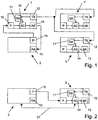
- FIGS 1 and 2 schematically components of an inventive identification system are shown. These components may be physically formed as chips or "tags" of the aforementioned type, or comprise such chips.
- data storage and data processing means there are generally further means which effect the actual data exchange, for example antennas, amplifier means (which act on an antenna with a signal), etc., or also contact surfaces, etc. Since the exact configuration of these further means is not relevant to the invention , will not be discussed further here.
- a source key 11 and a security key 12 are present.
- the security key 12 is for encrypting the source key; he is can never be read out of the key donor medium.
- the source key is stored in a writable, for example, nonvolatile memory of the key dispenser medium.
- the internal wiring of the key dispenser medium does not allow reading of the source key 11 from the outside, and the wiring and / or the firmware of the key dispenser medium does not allow issuing of the source key 11 without encryption.
- the key dispenser medium has, in addition to means for encrypting the source key 11 with the security key 12, further data processing means 14 for calculating a derived key 13 from the source key and further parameters 15 such as the unique number and / or an application number.
- the user medium 2 in addition to a (preferably writable, non-volatile) memory 15 with unique number, application number and / or other, for example, application-dependent data on a storage space for a derived key.
- the user medium can be designed and configured, for example, in the manner of user media of identification systems known per se, and also the corresponding data processing means, for example for encrypting data with the derived key, can be implemented.
- the electronic module of the writing and / or reading device 3 has, similar to the key dispenser medium, a security key 12 and storage locations for the source key 11 and data processing means 14 for calculating a derived key 13 based on the source key 11 and other parameters 15 such as the unique number and / or one Application number etc. on.
- the user Prior to the initialization of the identification system, the user will be provided with at least one key dispenser medium 1 (preferably multiple key dispenser media) and a plurality of second media 2, and writing and / or reading devices will be provided with third integrated circuits.
- the key dispenser media and the third integrated circuits are already provided with the security key; the security key is not disclosed to the user. All media and all writing and / or reading devices are in a ground state, in which they have, for example, no source or derived key, except possible pre-fabricated manufacturing, provisional keys that can not guarantee the whole security.
- a source key 11 can be determined, for example as a random number, for example with at least 64 bits, preferably at least 128 bits, more preferably at least 256 bits. This turns the medium into a key dispenser (master).
- the key dispenser (the initialized key dispenser medium) may be duplicated by describing another key dispenser medium. It is advantageous if the user has at least one duplicate of the key dispenser so that he can continue operating and maintaining the identification system in the event of a loss or defect of a key dispenser.
- the target medium 1 'to which the key dispenser is duplicated also has the security key 12 and can decrypt the source key 11 and store it in the designated memory.
- the writing and / or reading device 3 can be initialized with the third integrated circuit.
- the source key 11 is read into the memory provided for this purpose.
- the writing and / or reading device can also be programmed by means of a programming device provided for functions, access rights or access rights.
- the publication of the source key by the master can be linked to another security element, for example, the input of a PIN.
- the key dispenser medium and also the writing and / or reading device may have means for reading in such a PIN (or the like) via a suitable input means - for example.
- a computer via which the key dispenser medium is connected by means of card reader, or interface or a programming device, by means of which a writing and / or reading device can be contacted without contact - entered by the user or read in in a suitable manner; this includes the possibility to query biometric data.
- the initialization of a user medium 2 takes place by calculating the derived key 13 on the basis of, for example, previously provided by the user medium 2 parameters 15 in key dispenser medium 1. Subsequently to the calculation of the derived key 13 is stored in the space provided for the user medium.
- FIG. 2 represented a communication connection between the user medium and the electronic module 3 of the writing and / or reading device produced.
- the user-medium-specific parameters 15 are transmitted to the third integrated circuit 3, which enables it to calculate the derived key 13 from the source key 11 and these parameters 15. This does not have to be stored permanently (even if the permanent storage of the derived key is an option), but can be recalculated for every data exchange with a user medium.
- the authentication process can take place, and writing and / or reading operations can be performed on the storage means of the user medium 1 and / or take place on the storage means of the writing and / or reading device.
- the data exchange that takes place during the authentication process-it can be based on the challenge-response principle or on another principle-can be carried out as known per se from the prior art. For example, a known, proprietary, or normalized protocol may be used.
- One of the strengths of the invention is that the security features and practical advantages of the inventive method are independent of the protocols used in authentication and data exchange, and therefore any suitable protocols can be used. Under certain circumstances, the persons with the user medium 2 need not be aware that the identification system of the prior art (for example "Mifare Classic") differs by additional security features.
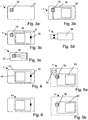
- FIGS. 3a to 6 are possible physical embodiments of and media and electronic modules of the components of inventive Identification systems drawn. However, the realization of a system according to the invention does not depend on the components used. It can also be used media / modules that are designed differently than the drawn media / modules; FIGS. 3a to 6 just show some possible examples.
- the key donor medium 1 according to FIG. 3a is designed as a "smart card” (chip card) 31 with a chip 32.
- the chip 32 is a security chip of the type mentioned, which integrates both storage means and processor means in a monolithic structure.
- the data exchange described above takes place with the aid of an example, conventional chip card reader.
- Such a smart card reader can be connected to a computer, for example, which carries out the data exchange. Due to the procedure according to various embodiments of the invention, at no time will a source key 11 be unencrypted in a data memory of the computer.
- an RFID writing and reading device can be connected to the chip card reader to the computer, whereby the in FIG. 1 drawn data exchange between key donor medium 1 and user medium 2 directly, can be performed online.
- the smart card 31 according to FIG. 3b which can also serve as a key donor medium, differs from that according to FIG. 3a in that it has a radio-frequency antenna 33 in direct communication with the chip 32. If the chip 32 is supplied with power, it can exchange data via this antenna directly with an RFID medium, for example with a designed as an RFID chip user medium 2 or with an offline write and / or Reading unit whose (for example, only) communication interface is an RFID communication interface.
- the chip card according to Figure 3c has, in addition to the chip 32, an RFID chip 34 with an RFID antenna 35.
- This RFID chip 34 may, for example, be described on-line (while the smart card is in communication with a computer) with the encrypted source key 11. From this, the encrypted source key 11 is then transmitted to an offline writing and / or reading unit whose (for example, only) communication interface is an RFID communication interface.
- the functionality of the chip card 31 according to Figure 3c is therefore very similar to that according to FIG. 3b ,
- 3d figure shows the key dispenser medium 1 as a USB dongle 36.
- the dongle, the security chip is installed, which may be physically identical to the chip 32 of the smart card.
- the functionality of the key donor medium according to 3d figure is identical to that of the key donor medium according to FIG. 3a , but no chip card reader is needed.
- a dongle can also have a different interface.
- FIG. 3e shows a security chip 32, which is applied directly to a printed circuit board 37 and contacted by this, such a circuit board may, for example, be designed as a plug-in card for a computer. Also, the application of the security chip 32 on an existing board in a computer is conceivable.
- An identification system can only have key dispenser media 1, all of which are the same or they are any combination conceivable.
- the security chip is of identical design and functionality even with different media, ie that the different media only differ in how the data exchange with the chip takes place.
- FIG. 4 shows a possible user medium 2. This is designed as a chip card 41 with an RFID chip 42 with RFID antenna 43. Instead of on a chip card, the RFID chip and the RFID antenna can also be present on another carrier, for example integrated in a device with still other functions (mobile phone, clock, etc.), on a chip card cover, etc.
- FIG. 5a schematically shows an electronic module of a writing and / or reading device 3.
- a chip 52 which is designed as a security chip as that of a key dispenser (but as mentioned with a slightly different configuration)
- an RFID antenna 53 for data exchange with a user medium
- the writing and / or reading device 3 also has an interface 54 for data exchange with a control center.
- the writing and / or reading device according to Fig. 5a is therefore an example of a writing and / or reading device that is suitable for an 'online' writing and / or reading device that can be initialized and programmed from the control center.
- the control center will have, at least for initialization and preferably also for programming, a key dispenser medium which, for example, is in communication connection with a computer of the control center.
- the encrypted source key is sent via data lines and via the interface 54 to the chip 52.
- the writing and / or reading device 3 of FIG. 5b is different from the one of Fig. 5a in that there is no interface.
- the writing and / or reading device is suitable for an 'offline' writing and / or reading device and must be initialized via RFID data exchange and possibly programmed, for example.
- a corresponding RFID programmer with smart card reader in conjunction with a key dispenser according to Fig. 3a
- a key donor medium as in Fig. 3b or 3c drawn.
- an auxiliary medium can be used for this, as described below.
- FIG. 6 shows an auxiliary medium 61, which may be physically configured as a user medium and not necessarily different from one.
- the auxiliary medium 61 is used to transmit an (encrypted) source key 11 to an 'offline' writing and / or reading device and possibly - depending on the configuration of Identifzierungssystems and security requirements for the programming of the writing and / or reading devices - also the authentication to such for programming the writing and / or reading device.
- Such an auxiliary medium 61 may, for example, be described by a computer which is in communication with a key dispenser medium.
- RFID for all of the described media, instead of or in addition to RFID technology, other communication channels can be used, for example infrared, Bluetooth or other contactless interfaces, contact-type signal transmission, capacitive-resistive coupling, etc.
- FIG. 7 elements of a possible embodiment of an identification system according to the invention are shown and some steps are explained for its operation.
- An example with at least one suitable computer 72 equipped central of the operator of Identifz istssystems receives from the manufacturer at least one key dispenser medium 1 and, for example, at least one reduced key dispenser medium 71.
- appropriate means - here with a computer connected to the smart card reader 73 - can be started in a key dispenser the initialization process and a source key generated.
- the key dispenser medium thus provided with the source key becomes the first key dispenser.
- the computer which can caching the source key provided by the first key dispenser, encrypted with the pre-installed security key, and transferred to other key dispenser media, further key dispensers are optionally generated and, for example, a reduced key dispenser medium is also provided with the source key.
- a reduced key dispenser medium is also provided with the source key.
- the key dispenser media are also set up so that they issue the encrypted source key and possibly also derived key only after entering a PIN; if a wrong PIN is input several times, a key dispenser medium is automatically returned to the default state, and the source key is deleted or made inaccessible.
- the data packet stored on the computer with the encrypted source key can also additionally have the - for example, encrypted - unique number of the key dispenser medium to be described, and the key dispenser medium can only be described in case of consistency.
- derived keys for the user media 2 are subsequently generated.
- an RFID read and write device 74 which is also connected to the computer, or the application number and / or possibly the unique number is generated by the computer and loaded only during the initialization process on the user media. It is also possible to store several application numbers on a medium, each with one derived key, so that the user medium can perform several functions.
- the derived key is read by the computer from the key dispenser and - possibly together with application number and / or possibly the unique number - loaded on the integrated circuit (eg RFID chip) of the appropriate user medium.
- the integrated circuit eg RFID chip
- FIG. 7 shows as examples of writing and / or reading devices schematically a online connected via a data line to the central security door 76, also connected online with the central data collection terminal 77, a contactable via the Internet 81, in a different building of the headquarters / building complex located second security door, a not programmable via data lines from the control panel ("offline") door 79 and a here also not contactable with data lines from the head office, connected to a computer 83 chip card reader 84th
- the write and / or read devices receive the source keys (encrypted) via data lines (for 76-78) or (for 79 and 84) via an auxiliary medium 61, an RFID-capable key dispenser, with the aid of an RFID-capable chip card reader or transmitted via a suitable other interface of the writing and / or reading device.
- the source keys Encrypted
- auxiliary medium 61 an RFID-capable key dispenser
- RFID-capable chip card reader or transmitted via a suitable other interface of the writing and / or reading device.
- Programming can be done online via the corresponding data lines (for 76-78) or (for 79 and possibly 84) via a programming device 80.
- the writing and / or reading devices can also be reprogrammed at any time at a later time, the reprogramming may require the presence of a key dispenser and / or the input of security features (programming PIN, etc.); in the former case, for example, the writing and / or reading device requires the source key before it enters a programming mode.
- a query of data stored in the writing and / or reading device can also be made.
- the PC 83 with smart card reader 84 is an example of the application of the invention for controlling access to a virtual access point to a computer or computer network.
- the security chip may be present in the chip card reader or in the computer (network) and authorize access to the computer (network) as a whole or to specific applications;
- the programmability of the control center via data lines as in the 'online' applications described above is possible.
- the key dispensers - which are preferably all registered - are stored in a safe place, for example in a safe that is accessible only to a limited group of people. If a key dispenser is lost or another vulnerability exists, the writers and / or readers and the existing (or newly delivered) key dispenser media can be reset and reinitialized without the need to replace components.
- the resetting of the writing and / or reading devices in the ground state preferably sets the Presence of at least one functioning key dispenser, that is, as long as there is still a functioning key dispenser, a re-initialization is possible at any time.
- writing and / or reading devices with, for example, other functions may also be present, for example devices for debiting or charging the user media as prepaid cards, etc.
- a special category of writing and / or reading devices are devices that do not have a third integrated circuit, therefore do not know the source key and are provided, for example, with a fixed application key. The security of transactions with such writers and / or readers is less high, since manipulation is barely controllable once the application key has been copied. Therefore, it is preferably provided that such special writing and / or reading devices are usable only in secure rooms and / or that they can only read data and the user media refusing to write to data from such writing and / or reading devices.
- One possible application of such special writing and / or reading device is time recording.
- the source key can also be asymmetrically encrypted when being output instead of symmetrically with the security key.
- at least the decrypting key should be proprietary and known only to the first and third integrated circuits.
- the encrypting key is also proprietary and known only to the appropriate circuits, so that a 'false' key dispenser would be detected in the attempted reprogramming of the writing and / or reading devices.
- the process of duplicating a master can also be carried out via a data line.
Landscapes
- Engineering & Computer Science (AREA)
- Business, Economics & Management (AREA)
- Accounting & Taxation (AREA)
- Physics & Mathematics (AREA)
- General Physics & Mathematics (AREA)
- Theoretical Computer Science (AREA)
- Computer Security & Cryptography (AREA)
- General Business, Economics & Management (AREA)
- Strategic Management (AREA)
- Finance (AREA)
- Computer Networks & Wireless Communication (AREA)
- Microelectronics & Electronic Packaging (AREA)
- Signal Processing (AREA)
- Software Systems (AREA)
- Computer Hardware Design (AREA)
- General Engineering & Computer Science (AREA)
- Storage Device Security (AREA)
Claims (15)
- Système d'indentification avec au moins un support d'information d'utilisateur (2), lequel est équipé pour mémoriser une clé dérivée (13) et pour s'authentifier avec celle-ci auprès d'un dispositif d'écriture et/ou de lecture (3), comprenant au moins un support distributeur de clés (1, 71), lequel inclut un premier circuit intégré monolithique (32) avec des moyens de mémoire et des moyens processeur, dans lequel le premier circuit intégré est équipé pour mémoriser une clé source (11) et pour dériver de celle-ci la clé dérivée (13) et pour la transmettre pour la mémorisation dans le support d'information d'utilisateur, dans lequel le support distributeur de clés, dans un processus d'initialisation, est apte à générer lui-même la clé source (11), et le support distributeur de clés peut seulement transmettre la clé source de façon décryptable par une clé de sécurité non-lisible, dans lequel la clé de sécurité (12) est prévue dans chaque support distributeur de clés (1, 71).
- Système d'indentification selon la revendication 1, comprenant au moins un dispositif d'écriture et/ou de lecture (3), dans lequel le support d'information d'utilisateur (2) et le dispositif d'écriture et/ou de lecture (3) sont aptes à performer un processus d'authentification par échange de données, et dans lequel le dispositif d'écriture et/ou de lecture comprend un troisième circuit intégré monolithique, lequel est apte à mémoriser la clé source (11) de façon encryptée mise à disposition par un support distributeur de clés et à dériver de celle-ci la clé dérivée (13).
- Système d'indentification selon la revendication 2, caractérisé en ce que le premier circuit intégré et le troisième circuit intégré sont identiques l'un à l'autre à l'exception d'une configuration.
- Système d'indentification selon la revendication 2 ou 3, caractérisé en ce que le dispositif d'écriture et/ou de lecture (3), respectivement au moins l'un desdits dispositifs d'écriture et/ou de lecture est connecté à une centrale via une ligne de données.
- Système d'indentification selon l'une des revendications 2 à 4, caractérisé en ce que le dispositif d'écriture et/ou de lecture (3), respectivement au moins l'un desdits dispositifs d'écriture et/ou de lecture est un dispositif d'écriture et/ou de lecture (3) « hors ligne » et est programmable par un appareil de programmation (80), dans lequel au moins une initialisation du dispositif d'écriture et/ou de lecture (3) pose comme pré-condition la présence d'une clé source (11) encryptée mise à disposition par le support distributeur de clés.
- Système d'indentification selon l'une des revendications précédentes, dans lequel le support d'information d'utilisateur (2) n'est apte ni directement ni avec des moyens auxiliaires à lire la clé source (11) à partir du support distributeur de clés et/ou dans lequel le support d'information d'utilisateur n'est pas apte à calculer une clé dérivée.
- Système d'indentification selon la revendication 6, caractérisé en ce que la clé dérivée est réalisée sur la base de la clé source et d'un chiffre unique et/ou d'un chiffre d'application du support d'information d'utilisateur avec un algorithme mathématique, lequel de préférence n'est pas réversible.
- Système d'indentification selon la revendication 6 ou 7, dans lequel le support distributeur de clés (1, 71), via une première interface, est apte à échanger des données avec un autre support d'information, et le support d'information d'utilisateur (2), via une deuxième interface, est apte à échanger des données avec un autre support d'information, dans lequel la première et la deuxième interface ne sont pas compatibles l'une avec l'autre, dans lequel de préférence la deuxième interface est une interface pour l'échange de données sans contact, par exemple une interface RFID.
- Système d'indentification selon l'une des revendications précédentes, caractérisé en ce que le support d'information d'utilisateur (2) comprend une puce RFID (42) laquelle est apte à mémoriser la clé dérivée (13).
- Système d'indentification selon l'une des revendications précédentes, caractérisé en ce que le premier circuit intégré (32) est une puce à contact lisible.
- Système d'indentification selon l'une des revendications précédentes, caractérisé en ce que le premier circuit intégré est équipé pour décrypter et pour mémoriser une clé source (11) encryptée mise à disposition par un autre support distributeur de clés, et pour transmettre la clé source encryptée, décryptable avec la clé de sécurité (12), à un autre support distributeur de clés (1, 71).
- Système d'indentification selon la revendication 11, caractérisé en ce que, en plus du support distributeur de clés (1) mentionné, au moins un support distributeur de clés (71) réduit est prévu, lequel est apte à dériver la clé dérivée (13) à partir de la clé source (11) et à la transmettre pour la mémorisation dans le support d'information d'utilisateur, et lequel n'est pas apte à mettre à disposition la clé source encryptée de telle façon qu'elle peut être décryptée et mémorisée par un autre support distributeur de clés (1) ou par un support distributeur de clés (71) réduit.
- Système d'indentification selon l'une des revendications 11 ou 12, dans lequel pour la transmission d'une clé source la transmission simultanée d'un code est une pré-condition à poser, lequel code est spécial pour l'autre support de mémorisation de clés à écrire.
- Méthode pour l'établissement d'un système d'identification avec au moins un support d'information d'utilisateur (2), lequel est équipé pour s'authentifier avec une clé dérivée auprès d'un dispositif d'écriture et/ou de lecture (3), et avec au moins un support distributeur de clés (1, 71), comprenant les étapes de méthode suivantes :(a) fourniture d'au moins un support distributeur de clés (1, 71) à un opérateur du système d'identification, dans lequel le support distributeur de clés est équipé pour générer, pour mémoriser une clé source (11) et pour dériver de celle-ci des clés dérivées (13),(b) fourniture à l'opérateur d'une pluralité de supports d'information d'utilisateur sans clé ou avec des clés identiques, dans lequel les supports d'information d'utilisateur sont aptes à recevoir et à mémoriser la clé dérivée et mise à disposition par le support distributeur de clés (1, 71),dans lequel ledit au moins un support distributeur de clés (1, 71) au moment de la fourniture à l'opérateur comprend une clé de sécurité (12) non-lisible et est apte à dériver la clé dérivée (13) à partir de la clé source (11) et à la transmettre pour la mémorisation dans le support d'information d'utilisateur, et dans lequel le support distributeur de clés peut transmettre la clé source (11) de façon décryptable seulement par la clé de sécurité (12) non-lisible.
- Méthode selon la revendication 14, caractérisé en ce que le support distributeur de clés est apte à décrypter et à mémoriser une clé source (11) encryptée mise à disposition par un autre support distributeur de clés.
Applications Claiming Priority (2)
| Application Number | Priority Date | Filing Date | Title |
|---|---|---|---|
| CH4892008 | 2008-04-01 | ||
| PCT/CH2009/000108 WO2009121197A1 (fr) | 2008-04-01 | 2009-03-31 | Système et procédé de production de supports utilisateur |
Publications (2)
| Publication Number | Publication Date |
|---|---|
| EP2272025A1 EP2272025A1 (fr) | 2011-01-12 |
| EP2272025B1 true EP2272025B1 (fr) | 2019-07-24 |
Family
ID=40775383
Family Applications (1)
| Application Number | Title | Priority Date | Filing Date |
|---|---|---|---|
| EP09728146.3A Active EP2272025B1 (fr) | 2008-04-01 | 2009-03-31 | Système et procédé de production de supports utilisateur |
Country Status (3)
| Country | Link |
|---|---|
| US (1) | US8681991B2 (fr) |
| EP (1) | EP2272025B1 (fr) |
| WO (1) | WO2009121197A1 (fr) |
Families Citing this family (6)
| Publication number | Priority date | Publication date | Assignee | Title |
|---|---|---|---|---|
| US9075571B2 (en) * | 2005-07-21 | 2015-07-07 | Clevx, Llc | Memory lock system with manipulatable input device and method of operation thereof |
| US20100174913A1 (en) * | 2009-01-03 | 2010-07-08 | Johnson Simon B | Multi-factor authentication system for encryption key storage and method of operation therefor |
| US9286493B2 (en) | 2009-01-07 | 2016-03-15 | Clevx, Llc | Encryption bridge system and method of operation thereof |
| EP2815535B1 (fr) * | 2012-02-13 | 2018-11-14 | Schlage Lock Company LLC | Système de gestion de justificatif d'identité |
| DE102016207441A1 (de) * | 2016-04-29 | 2017-11-02 | Siemens Aktiengesellschaft | Verfahren und Vorrichtung zur Steuerung von Sicherheitsmaßnahmen in Automatisierungs-, Steuerungs- und/oder Kontrollsystemen |
| CN110490008B (zh) * | 2018-05-14 | 2021-08-10 | 英韧科技(上海)有限公司 | 安全装置及安全芯片 |
Family Cites Families (25)
| Publication number | Priority date | Publication date | Assignee | Title |
|---|---|---|---|---|
| FR2601795B1 (fr) * | 1986-07-17 | 1988-10-07 | Bull Cp8 | Procede pour diversifier une cle de base et pour authentifier une cle ainsi diversifiee comme ayant ete elaboree a partir d'une cle de base predeterminee, et systeme pour la mise en oeuvre |
| FR2613565B1 (fr) * | 1987-04-03 | 1989-06-23 | Bull Cps | Procede pour acheminer des cles secretes vers des modules de securite et des cartes utilisateurs, dans un reseau de traitement d'informations |
| GB9213169D0 (en) * | 1992-06-22 | 1992-08-05 | Ncr Int Inc | Cryptographic key management apparatus and method |
| US5633930A (en) * | 1994-09-30 | 1997-05-27 | Electronic Payment Services, Inc. | Common cryptographic key verification in a transaction network |
| US5889941A (en) * | 1996-04-15 | 1999-03-30 | Ubiq Inc. | System and apparatus for smart card personalization |
| DE69824437T2 (de) * | 1997-10-14 | 2005-06-23 | Visa International Service Association, Foster City | Personalisieren von chipkarten |
| US6157722A (en) * | 1998-03-23 | 2000-12-05 | Interlok Technologies, Llc | Encryption key management system and method |
| CN1224909C (zh) * | 1998-10-16 | 2005-10-26 | 松下电器产业株式会社 | 数字作品保护系统 |
| US6738900B1 (en) * | 2000-01-28 | 2004-05-18 | Nortel Networks Limited | Method and apparatus for distributing public key certificates |
| US6736313B1 (en) * | 2000-05-09 | 2004-05-18 | Gilbarco Inc. | Card reader module with pin decryption |
| JP4269501B2 (ja) * | 2000-09-07 | 2009-05-27 | ソニー株式会社 | 情報記録装置、情報再生装置、情報記録方法、情報再生方法、および情報記録媒体、並びにプログラム提供媒体 |
| CN1207867C (zh) * | 2001-09-28 | 2005-06-22 | 中国科学院研究生院 | 一种安全的数字签名系统及其数字签名方法 |
| JP2003187190A (ja) * | 2001-12-19 | 2003-07-04 | Hitachi Ltd | Icカード管理システム |
| US20030145203A1 (en) * | 2002-01-30 | 2003-07-31 | Yves Audebert | System and method for performing mutual authentications between security tokens |
| EP1418750A1 (fr) * | 2002-11-11 | 2004-05-12 | STMicroelectronics Limited | Circuit intégré de sécurité |
| JP2004212828A (ja) * | 2003-01-08 | 2004-07-29 | Sony Corp | 暗号処理装置、および暗号処理方法、並びにコンピュータ・プログラム |
| EP1612990A4 (fr) * | 2003-03-11 | 2011-06-01 | Panasonic Corp | Systeme d'enregistrement/reproduction de contenu, dispositif de distribution, dispositif de reproduction, et dispositif d'enregistrement |
| JP4314950B2 (ja) * | 2003-09-26 | 2009-08-19 | 日本ビクター株式会社 | 暗号化装置及び復号化装置 |
| US7512800B2 (en) * | 2004-02-03 | 2009-03-31 | Hewlett-Packard Development Company, L.P. | Key management technique for establishing a secure channel |
| US7624269B2 (en) * | 2004-07-09 | 2009-11-24 | Voltage Security, Inc. | Secure messaging system with derived keys |
| FR2875656A1 (fr) | 2004-09-17 | 2006-03-24 | Proton World Internatinal Nv | Diversification de cle dans un circuit integre |
| US7958369B2 (en) * | 2004-10-22 | 2011-06-07 | Hewlett-Packard Development Company, L.P. | Systems and methods for multiple level control of access of privileges to protected media content |
| US20080052770A1 (en) * | 2006-03-31 | 2008-02-28 | Axalto Inc | Method and system of providing security services using a secure device |
| US7464865B2 (en) * | 2006-04-28 | 2008-12-16 | Research In Motion Limited | System and method for managing multiple smart card sessions |
| US8074271B2 (en) * | 2006-08-09 | 2011-12-06 | Assa Abloy Ab | Method and apparatus for making a decision on a card |
-
2009
- 2009-03-31 US US12/935,714 patent/US8681991B2/en active Active
- 2009-03-31 WO PCT/CH2009/000108 patent/WO2009121197A1/fr not_active Ceased
- 2009-03-31 EP EP09728146.3A patent/EP2272025B1/fr active Active
Non-Patent Citations (1)
| Title |
|---|
| None * |
Also Published As
| Publication number | Publication date |
|---|---|
| WO2009121197A1 (fr) | 2009-10-08 |
| US20110113255A1 (en) | 2011-05-12 |
| EP2272025A1 (fr) | 2011-01-12 |
| US8681991B2 (en) | 2014-03-25 |
Similar Documents
| Publication | Publication Date | Title |
|---|---|---|
| DE3780571T2 (de) | Sicherheitssystem fuer den datenbestand eines tragbaren datentraegers. | |
| DE3780002T2 (de) | System fuer einen tragbaren datentraeger. | |
| DE69814406T2 (de) | Tragbare elektronische vorrichtung für systeme zur gesicherten kommunikation und verfahren zur initialisierung der parameter | |
| DE2837201C2 (fr) | ||
| DE69807210T2 (de) | Gesichertes mehrzweckkartensystem und -verfahren | |
| EP2595083B1 (fr) | Procédé destiné à protéger une carte à puce contre les utilisations non autorisées, carte à puce et terminal de carte à puce | |
| EP2272025B1 (fr) | Système et procédé de production de supports utilisateur | |
| EP0355372A1 (fr) | Terminal commandé par support de données dans un système d'échange de données | |
| WO2005098764A1 (fr) | Support de donnees a generateur de tan et affichage | |
| EP3422243B1 (fr) | Token d'identification au microcontrôleur securisé | |
| WO1998050894A1 (fr) | Systeme permettant une lecture et un traitement proteges de donnees sur des supports de donnees intelligents | |
| EP2389644B1 (fr) | Procédé de déverrouillage d'une fonction de carte à puce, et lecteur de carte | |
| EP4068103B1 (fr) | Procédé de mise à jour des données de personnalisation | |
| EP3125464B1 (fr) | Service de révocation pour un certificat généré par un jeton d'id | |
| DE19719275C2 (de) | System mit einem tragbaren Terminal und damit verbindbaren Datenträgern | |
| EP3215977B1 (fr) | Procédé de modification d'une structure de données enregistrée dans une carte à puce, dispositif de signature et système électronique | |
| DE102016123019A1 (de) | Verfahren zum elektronischen Initiieren einer Aktion und elektronisches System zum elektronischen Initiieren einer Aktion | |
| EP3232640B1 (fr) | Vérification de la validité et blocage de certificats | |
| EP3671506B1 (fr) | Carte à puce, système informatique, procédé d'activation d'une carte à puce et procédé de personnalisation d'une carte à puce | |
| EP2823598B1 (fr) | Procédé d'établissement d'une instance dérivée | |
| EP1722336A2 (fr) | Dispositif et procédé destinés à la production de données pour initialiser des supports de données de sécurité | |
| EP3175383B1 (fr) | Procédé pour modifier les données de contrôle d'une carte à puce et système de carte à puce | |
| DE102022004009A1 (de) | Verfahren zum Erteilen oder Ablehnen eines Zugangs zu einem Skigebiet sowie Schuh | |
| DE10028821A1 (de) | Chipkarte mit Lesekennungen | |
| EP3180729B1 (fr) | Identités numériques avec attributs externes |
Legal Events
| Date | Code | Title | Description |
|---|---|---|---|
| PUAI | Public reference made under article 153(3) epc to a published international application that has entered the european phase |
Free format text: ORIGINAL CODE: 0009012 |
|
| 17P | Request for examination filed |
Effective date: 20100929 |
|
| AK | Designated contracting states |
Kind code of ref document: A1 Designated state(s): AT BE BG CH CY CZ DE DK EE ES FI FR GB GR HR HU IE IS IT LI LT LU LV MC MK MT NL NO PL PT RO SE SI SK TR |
|
| AX | Request for extension of the european patent |
Extension state: AL BA RS |
|
| DAX | Request for extension of the european patent (deleted) | ||
| RIN1 | Information on inventor provided before grant (corrected) |
Inventor name: KUSTER, CHRISTIAN Inventor name: SEGMUELLER, MIKE |
|
| RAP1 | Party data changed (applicant data changed or rights of an application transferred) |
Owner name: DORMAKABA SCHWEIZ AG |
|
| STAA | Information on the status of an ep patent application or granted ep patent |
Free format text: STATUS: EXAMINATION IS IN PROGRESS |
|
| 17Q | First examination report despatched |
Effective date: 20180305 |
|
| REG | Reference to a national code |
Ref country code: DE Ref legal event code: R079 Ref document number: 502009015887 Country of ref document: DE Free format text: PREVIOUS MAIN CLASS: G06F0021200000 Ipc: G06F0021340000 |
|
| GRAP | Despatch of communication of intention to grant a patent |
Free format text: ORIGINAL CODE: EPIDOSNIGR1 |
|
| STAA | Information on the status of an ep patent application or granted ep patent |
Free format text: STATUS: GRANT OF PATENT IS INTENDED |
|
| RIC1 | Information provided on ipc code assigned before grant |
Ipc: G06F 21/34 20130101AFI20190128BHEP Ipc: G06Q 20/40 20120101ALI20190128BHEP Ipc: G06Q 20/38 20120101ALI20190128BHEP Ipc: G06Q 20/34 20120101ALI20190128BHEP Ipc: H04L 9/08 20060101ALI20190128BHEP Ipc: G06Q 20/02 20120101ALI20190128BHEP Ipc: G07F 7/10 20060101ALI20190128BHEP |
|
| INTG | Intention to grant announced |
Effective date: 20190228 |
|
| GRAS | Grant fee paid |
Free format text: ORIGINAL CODE: EPIDOSNIGR3 |
|
| GRAA | (expected) grant |
Free format text: ORIGINAL CODE: 0009210 |
|
| STAA | Information on the status of an ep patent application or granted ep patent |
Free format text: STATUS: THE PATENT HAS BEEN GRANTED |
|
| AK | Designated contracting states |
Kind code of ref document: B1 Designated state(s): AT BE BG CH CY CZ DE DK EE ES FI FR GB GR HR HU IE IS IT LI LT LU LV MC MK MT NL NO PL PT RO SE SI SK TR |
|
| REG | Reference to a national code |
Ref country code: GB Ref legal event code: FG4D Free format text: NOT ENGLISH |
|
| REG | Reference to a national code |
Ref country code: CH Ref legal event code: EP |
|
| REG | Reference to a national code |
Ref country code: DE Ref legal event code: R096 Ref document number: 502009015887 Country of ref document: DE |
|
| REG | Reference to a national code |
Ref country code: AT Ref legal event code: REF Ref document number: 1159058 Country of ref document: AT Kind code of ref document: T Effective date: 20190815 |
|
| REG | Reference to a national code |
Ref country code: IE Ref legal event code: FG4D Free format text: LANGUAGE OF EP DOCUMENT: GERMAN |
|
| REG | Reference to a national code |
Ref country code: NL Ref legal event code: FP |
|
| REG | Reference to a national code |
Ref country code: LT Ref legal event code: MG4D |
|
| PG25 | Lapsed in a contracting state [announced via postgrant information from national office to epo] |
Ref country code: SE Free format text: LAPSE BECAUSE OF FAILURE TO SUBMIT A TRANSLATION OF THE DESCRIPTION OR TO PAY THE FEE WITHIN THE PRESCRIBED TIME-LIMIT Effective date: 20190724 Ref country code: NO Free format text: LAPSE BECAUSE OF FAILURE TO SUBMIT A TRANSLATION OF THE DESCRIPTION OR TO PAY THE FEE WITHIN THE PRESCRIBED TIME-LIMIT Effective date: 20191024 Ref country code: FI Free format text: LAPSE BECAUSE OF FAILURE TO SUBMIT A TRANSLATION OF THE DESCRIPTION OR TO PAY THE FEE WITHIN THE PRESCRIBED TIME-LIMIT Effective date: 20190724 Ref country code: PT Free format text: LAPSE BECAUSE OF FAILURE TO SUBMIT A TRANSLATION OF THE DESCRIPTION OR TO PAY THE FEE WITHIN THE PRESCRIBED TIME-LIMIT Effective date: 20191125 Ref country code: BG Free format text: LAPSE BECAUSE OF FAILURE TO SUBMIT A TRANSLATION OF THE DESCRIPTION OR TO PAY THE FEE WITHIN THE PRESCRIBED TIME-LIMIT Effective date: 20191024 Ref country code: HR Free format text: LAPSE BECAUSE OF FAILURE TO SUBMIT A TRANSLATION OF THE DESCRIPTION OR TO PAY THE FEE WITHIN THE PRESCRIBED TIME-LIMIT Effective date: 20190724 Ref country code: LT Free format text: LAPSE BECAUSE OF FAILURE TO SUBMIT A TRANSLATION OF THE DESCRIPTION OR TO PAY THE FEE WITHIN THE PRESCRIBED TIME-LIMIT Effective date: 20190724 |
|
| PG25 | Lapsed in a contracting state [announced via postgrant information from national office to epo] |
Ref country code: LV Free format text: LAPSE BECAUSE OF FAILURE TO SUBMIT A TRANSLATION OF THE DESCRIPTION OR TO PAY THE FEE WITHIN THE PRESCRIBED TIME-LIMIT Effective date: 20190724 Ref country code: GR Free format text: LAPSE BECAUSE OF FAILURE TO SUBMIT A TRANSLATION OF THE DESCRIPTION OR TO PAY THE FEE WITHIN THE PRESCRIBED TIME-LIMIT Effective date: 20191025 Ref country code: IS Free format text: LAPSE BECAUSE OF FAILURE TO SUBMIT A TRANSLATION OF THE DESCRIPTION OR TO PAY THE FEE WITHIN THE PRESCRIBED TIME-LIMIT Effective date: 20191124 Ref country code: ES Free format text: LAPSE BECAUSE OF FAILURE TO SUBMIT A TRANSLATION OF THE DESCRIPTION OR TO PAY THE FEE WITHIN THE PRESCRIBED TIME-LIMIT Effective date: 20190724 |
|
| PG25 | Lapsed in a contracting state [announced via postgrant information from national office to epo] |
Ref country code: TR Free format text: LAPSE BECAUSE OF FAILURE TO SUBMIT A TRANSLATION OF THE DESCRIPTION OR TO PAY THE FEE WITHIN THE PRESCRIBED TIME-LIMIT Effective date: 20190724 |
|
| PG25 | Lapsed in a contracting state [announced via postgrant information from national office to epo] |
Ref country code: IT Free format text: LAPSE BECAUSE OF FAILURE TO SUBMIT A TRANSLATION OF THE DESCRIPTION OR TO PAY THE FEE WITHIN THE PRESCRIBED TIME-LIMIT Effective date: 20190724 Ref country code: EE Free format text: LAPSE BECAUSE OF FAILURE TO SUBMIT A TRANSLATION OF THE DESCRIPTION OR TO PAY THE FEE WITHIN THE PRESCRIBED TIME-LIMIT Effective date: 20190724 Ref country code: PL Free format text: LAPSE BECAUSE OF FAILURE TO SUBMIT A TRANSLATION OF THE DESCRIPTION OR TO PAY THE FEE WITHIN THE PRESCRIBED TIME-LIMIT Effective date: 20190724 Ref country code: DK Free format text: LAPSE BECAUSE OF FAILURE TO SUBMIT A TRANSLATION OF THE DESCRIPTION OR TO PAY THE FEE WITHIN THE PRESCRIBED TIME-LIMIT Effective date: 20190724 Ref country code: RO Free format text: LAPSE BECAUSE OF FAILURE TO SUBMIT A TRANSLATION OF THE DESCRIPTION OR TO PAY THE FEE WITHIN THE PRESCRIBED TIME-LIMIT Effective date: 20190724 |
|
| PG25 | Lapsed in a contracting state [announced via postgrant information from national office to epo] |
Ref country code: CZ Free format text: LAPSE BECAUSE OF FAILURE TO SUBMIT A TRANSLATION OF THE DESCRIPTION OR TO PAY THE FEE WITHIN THE PRESCRIBED TIME-LIMIT Effective date: 20190724 Ref country code: SK Free format text: LAPSE BECAUSE OF FAILURE TO SUBMIT A TRANSLATION OF THE DESCRIPTION OR TO PAY THE FEE WITHIN THE PRESCRIBED TIME-LIMIT Effective date: 20190724 Ref country code: IS Free format text: LAPSE BECAUSE OF FAILURE TO SUBMIT A TRANSLATION OF THE DESCRIPTION OR TO PAY THE FEE WITHIN THE PRESCRIBED TIME-LIMIT Effective date: 20200224 |
|
| REG | Reference to a national code |
Ref country code: DE Ref legal event code: R097 Ref document number: 502009015887 Country of ref document: DE |
|
| PLBE | No opposition filed within time limit |
Free format text: ORIGINAL CODE: 0009261 |
|
| STAA | Information on the status of an ep patent application or granted ep patent |
Free format text: STATUS: NO OPPOSITION FILED WITHIN TIME LIMIT |
|
| PG2D | Information on lapse in contracting state deleted |
Ref country code: IS |
|
| 26N | No opposition filed |
Effective date: 20200603 |
|
| PG25 | Lapsed in a contracting state [announced via postgrant information from national office to epo] |
Ref country code: SI Free format text: LAPSE BECAUSE OF FAILURE TO SUBMIT A TRANSLATION OF THE DESCRIPTION OR TO PAY THE FEE WITHIN THE PRESCRIBED TIME-LIMIT Effective date: 20190724 |
|
| PG25 | Lapsed in a contracting state [announced via postgrant information from national office to epo] |
Ref country code: MC Free format text: LAPSE BECAUSE OF FAILURE TO SUBMIT A TRANSLATION OF THE DESCRIPTION OR TO PAY THE FEE WITHIN THE PRESCRIBED TIME-LIMIT Effective date: 20190724 |
|
| REG | Reference to a national code |
Ref country code: CH Ref legal event code: PL |
|
| REG | Reference to a national code |
Ref country code: BE Ref legal event code: MM Effective date: 20200331 |
|
| PG25 | Lapsed in a contracting state [announced via postgrant information from national office to epo] |
Ref country code: LU Free format text: LAPSE BECAUSE OF NON-PAYMENT OF DUE FEES Effective date: 20200331 |
|
| PG25 | Lapsed in a contracting state [announced via postgrant information from national office to epo] |
Ref country code: LI Free format text: LAPSE BECAUSE OF NON-PAYMENT OF DUE FEES Effective date: 20200331 Ref country code: CH Free format text: LAPSE BECAUSE OF NON-PAYMENT OF DUE FEES Effective date: 20200331 Ref country code: IE Free format text: LAPSE BECAUSE OF NON-PAYMENT OF DUE FEES Effective date: 20200331 |
|
| PG25 | Lapsed in a contracting state [announced via postgrant information from national office to epo] |
Ref country code: BE Free format text: LAPSE BECAUSE OF NON-PAYMENT OF DUE FEES Effective date: 20200331 |
|
| PG25 | Lapsed in a contracting state [announced via postgrant information from national office to epo] |
Ref country code: MT Free format text: LAPSE BECAUSE OF FAILURE TO SUBMIT A TRANSLATION OF THE DESCRIPTION OR TO PAY THE FEE WITHIN THE PRESCRIBED TIME-LIMIT Effective date: 20190724 Ref country code: CY Free format text: LAPSE BECAUSE OF FAILURE TO SUBMIT A TRANSLATION OF THE DESCRIPTION OR TO PAY THE FEE WITHIN THE PRESCRIBED TIME-LIMIT Effective date: 20190724 |
|
| PG25 | Lapsed in a contracting state [announced via postgrant information from national office to epo] |
Ref country code: MK Free format text: LAPSE BECAUSE OF FAILURE TO SUBMIT A TRANSLATION OF THE DESCRIPTION OR TO PAY THE FEE WITHIN THE PRESCRIBED TIME-LIMIT Effective date: 20190724 |
|
| PGFP | Annual fee paid to national office [announced via postgrant information from national office to epo] |
Ref country code: GB Payment date: 20260324 Year of fee payment: 18 |
|
| PGFP | Annual fee paid to national office [announced via postgrant information from national office to epo] |
Ref country code: DE Payment date: 20260319 Year of fee payment: 18 |
|
| PGFP | Annual fee paid to national office [announced via postgrant information from national office to epo] |
Ref country code: AT Payment date: 20260320 Year of fee payment: 18 |
|
| PGFP | Annual fee paid to national office [announced via postgrant information from national office to epo] |
Ref country code: NL Payment date: 20260319 Year of fee payment: 18 |
|
| PGFP | Annual fee paid to national office [announced via postgrant information from national office to epo] |
Ref country code: FR Payment date: 20260320 Year of fee payment: 18 |