EP2272384A1 - Procédé et dispositif destinés à la fabrication de boissons - Google Patents
Procédé et dispositif destinés à la fabrication de boissons Download PDFInfo
- Publication number
- EP2272384A1 EP2272384A1 EP09008927A EP09008927A EP2272384A1 EP 2272384 A1 EP2272384 A1 EP 2272384A1 EP 09008927 A EP09008927 A EP 09008927A EP 09008927 A EP09008927 A EP 09008927A EP 2272384 A1 EP2272384 A1 EP 2272384A1
- Authority
- EP
- European Patent Office
- Prior art keywords
- beverage
- carbon dioxide
- tank
- batch
- batch tank
- Prior art date
- Legal status (The legal status is an assumption and is not a legal conclusion. Google has not performed a legal analysis and makes no representation as to the accuracy of the status listed.)
- Withdrawn
Links
- 238000000034 method Methods 0.000 title claims abstract description 23
- CURLTUGMZLYLDI-UHFFFAOYSA-N Carbon dioxide Chemical compound O=C=O CURLTUGMZLYLDI-UHFFFAOYSA-N 0.000 claims abstract description 117
- 229910002092 carbon dioxide Inorganic materials 0.000 claims abstract description 54
- 239000001569 carbon dioxide Substances 0.000 claims abstract description 54
- 238000002156 mixing Methods 0.000 claims abstract description 43
- QVGXLLKOCUKJST-UHFFFAOYSA-N atomic oxygen Chemical compound [O] QVGXLLKOCUKJST-UHFFFAOYSA-N 0.000 claims abstract description 13
- 229910052760 oxygen Inorganic materials 0.000 claims abstract description 13
- 239000001301 oxygen Substances 0.000 claims abstract description 13
- 238000004519 manufacturing process Methods 0.000 claims abstract description 11
- XLYOFNOQVPJJNP-UHFFFAOYSA-N water Substances O XLYOFNOQVPJJNP-UHFFFAOYSA-N 0.000 claims abstract description 9
- 239000007789 gas Substances 0.000 claims abstract description 8
- 235000013361 beverage Nutrition 0.000 claims description 57
- 238000007872 degassing Methods 0.000 claims description 18
- 238000010923 batch production Methods 0.000 description 6
- 238000003763 carbonization Methods 0.000 description 6
- 238000010924 continuous production Methods 0.000 description 3
- 230000002349 favourable effect Effects 0.000 description 3
- 239000007788 liquid Substances 0.000 description 3
- 239000000203 mixture Substances 0.000 description 3
- 238000010000 carbonizing Methods 0.000 description 2
- 235000011389 fruit/vegetable juice Nutrition 0.000 description 2
- 238000003860 storage Methods 0.000 description 2
- 239000006188 syrup Substances 0.000 description 2
- 235000020357 syrup Nutrition 0.000 description 2
- 239000002253 acid Substances 0.000 description 1
- 150000007513 acids Chemical class 0.000 description 1
- 239000000654 additive Substances 0.000 description 1
- 235000013405 beer Nutrition 0.000 description 1
- 238000007664 blowing Methods 0.000 description 1
- 230000003139 buffering effect Effects 0.000 description 1
- 235000014171 carbonated beverage Nutrition 0.000 description 1
- 230000003247 decreasing effect Effects 0.000 description 1
- 238000010586 diagram Methods 0.000 description 1
- 238000007599 discharging Methods 0.000 description 1
- 239000000686 essence Substances 0.000 description 1
- 238000011010 flushing procedure Methods 0.000 description 1
- 238000009472 formulation Methods 0.000 description 1
- 238000003908 quality control method Methods 0.000 description 1
Images

Classifications
-
- A—HUMAN NECESSITIES
- A23—FOODS OR FOODSTUFFS; TREATMENT THEREOF, NOT COVERED BY OTHER CLASSES
- A23L—FOODS, FOODSTUFFS OR NON-ALCOHOLIC BEVERAGES, NOT OTHERWISE PROVIDED FOR; PREPARATION OR TREATMENT THEREOF
- A23L2/00—Non-alcoholic beverages; Dry compositions or concentrates therefor; Preparation or treatment thereof
- A23L2/52—Adding ingredients
- A23L2/54—Mixing with gases
-
- B—PERFORMING OPERATIONS; TRANSPORTING
- B01—PHYSICAL OR CHEMICAL PROCESSES OR APPARATUS IN GENERAL
- B01F—MIXING, e.g. DISSOLVING, EMULSIFYING OR DISPERSING
- B01F23/00—Mixing according to the phases to be mixed, e.g. dispersing or emulsifying
- B01F23/20—Mixing gases with liquids
- B01F23/23—Mixing gases with liquids by introducing gases into liquid media, e.g. for producing aerated liquids
- B01F23/236—Mixing gases with liquids by introducing gases into liquid media, e.g. for producing aerated liquids specially adapted for aerating or carbonating beverages
- B01F23/2362—Mixing gases with liquids by introducing gases into liquid media, e.g. for producing aerated liquids specially adapted for aerating or carbonating beverages for aerating or carbonating within receptacles or tanks, e.g. distribution machines
-
- B—PERFORMING OPERATIONS; TRANSPORTING
- B01—PHYSICAL OR CHEMICAL PROCESSES OR APPARATUS IN GENERAL
- B01F—MIXING, e.g. DISSOLVING, EMULSIFYING OR DISPERSING
- B01F23/00—Mixing according to the phases to be mixed, e.g. dispersing or emulsifying
- B01F23/20—Mixing gases with liquids
- B01F23/23—Mixing gases with liquids by introducing gases into liquid media, e.g. for producing aerated liquids
- B01F23/236—Mixing gases with liquids by introducing gases into liquid media, e.g. for producing aerated liquids specially adapted for aerating or carbonating beverages
- B01F23/2363—Mixing systems, i.e. flow charts or diagrams; Arrangements, e.g. comprising controlling means
Definitions
- the invention relates to a method and a device for beverage production according to the preamble of claim 1 and 11, respectively.
- beverages can be mixed both continuously and in the so-called batch process, for example with two batch containers per filling line.
- the dosing and mixing of the basic components of a beverage in the batch tanks and the emptying of the tanks then takes place alternately and allows a quasi-continuous production.
- Known batch processes are particularly suitable for still products such as juices and juice-like products.
- Carbonated beverages can only be premixed in known batch processes and must then be metered in a continuous process and mixed with degassed water and carbon dioxide to the finished beverage.
- the finished beverage is buffered in a pressure tank at constant pressure to compensate for performance variations during bottling. With increasing fill level in the tank, the pressure can only be kept constant by blowing off carbon dioxide. The resulting carbon dioxide losses are undesirable.
- a large number of individual containers for degassing, blending, carbonation and buffering of the drink is needed.
- the beverage is supplied to carbon dioxide during the mixing in a circulation loop. This allows the carbonation of the drink, and if necessary, the degassing, set continuously and very precisely.
- the beverage is examined during mixing in a circulation loop. This allows the product composition to be checked before bottling and corrected if necessary. This ensures a consistently high quality.
- the batch tank is biased to a saturation pressure with carbon dioxide prior to introduction of the base components.
- the carbonation can be easily adapted to different drinks and temperatures and largely independent of a possible Vorkarbonmaschine and other dissolved foreign gases, such as oxygen.
- excess carbon dioxide is introduced from the batch tank into the beverage or into at least one incoming basic component.
- the carbon dioxide can be returned to the product cycle and the carbon dioxide consumption can be reduced.
- the oxygen content of the beverage is reduced in the batch tank. This is a separate degassing of the main component of the drink, such. As water, dispensable.
- carbon dioxide is used as the stripping gas for oxygen.
- the carbon dioxide can be used both for carbonization and for degassing and the process can be simplified.
- a degassed main component of the beverage in particular water
- the method can also be used in existing systems with separate degassing.
- the process is carried out in quasi-continuous operation in which the drink is alternately mixed in a batch tank and carbonated and discharged from another batch tank. An attached filling line can then be operated continuously.
- a mixing device for beverage production which comprises a carbon dioxide feed line for introducing carbon dioxide into the batch tank. Mixing and carbonizing can thus take place in the same container. A downstream carbonization in a separate unit is therefore unnecessary.
- the mixing device further comprises a circulation line for the beverage, which is connected to the batch tank so that the beverage can be circulated.
- a circulation line for the beverage, which is connected to the batch tank so that the beverage can be circulated.
- the quality of the drink can be easily examined and continuously corrected if necessary.
- a particularly advantageous embodiment comprises a further carbon dioxide feed line for introducing carbon dioxide into the circulation line.
- the mixing device further comprises a carbon dioxide return line interconnected so that excess carbon dioxide can be introduced from the batch tank into the beverage or at least one incoming base component of the beverage. This can reduce carbon dioxide consumption.
- a favorable embodiment further comprises a degassing container for a main component to be mixed with the beverage, in particular water.
- the device can be easily integrated into existing systems.
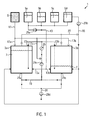
- a mixing device 1 comprises a first batch container, namely a first batch tank 3a and a second batch tank 3b, which in mutual exchange with base components 5a-d of a beverage 7 and filled with carbon dioxide 9 and after mixing, Carbonation and degassing of the beverage 7 are emptied.
- the beverage 7 is mixed in the tank 3a and passed from the tank 3b for filling.
- the two batch tanks 3a, 3b are sufficient for a quasi-continuous production for a filling line; however, further batch tanks could be provided.
- Liquid flows are in Fig. 1 and 2 indicated by black arrows, gas flows by white arrows, open pipelines by solid lines and closed pipelines by dashed lines. Suitable control elements for dosing and opening or closing the lines are well known and not shown for clarity.
- the basic components 5a-5c are for example juices, syrups, acids, essences or additives of all kinds.
- the basic component 5d is the main component of the beverage 7, usually water.
- a product or intermediate may be used, such. Beer.
- the basic components 5a-5d, the number of which may differ from the example, and the carbon dioxide 9 are fed from suitable component stations, such as storage tanks and / or supply networks, in a known manner.
- the components 5a-5d are metered in successively or jointly as needed and conveyed via a component supply line 13 into the tank 3a.
- the supply line 13 branches into the branches 13a and 13b assigned to the respective tanks 3a, 3b, which can be opened or closed alternately.
- the line 13a is shown open to make it clear that during filling and possibly also during the mixing, z. B. for post-dosing of the components 5a - 5d, at least temporarily open.
- the pipe 13b is closed during the emptying of the tank 3b.
- carbon dioxide supply lines 17a-17c are shown opened to illustrate that carbon dioxide 9 is needed for biasing the tank 3a, for carbonizing and degassing in the circulation loop 19 described below, and for Pressure stop in the tank 3b can be initiated above the sinking liquid level.
- the main component 5d can be fed alternately into the tanks 3a, 3b via the component supply line 13, for example for the purpose of flushing or metering, as well as via its own main component supply line 15.
- the carbon dioxide 9 is introduced via a carbon dioxide supply line 17 and its branch lines 17a, 17b into the tanks 3a, 3b and via a branch line 17c into a circulation loop or line 19 for the beverage 7 to be mixed as needed.
- the circulation loop 19 connects in the example the output 21 a and the input 23 a of the tank used for mixing 3 a.
- measuring devices 25 are provided for quality control of the beverage 7, for example, to determine the conductance, oxygen content and / or Brix value.
- a carbon dioxide return line 27 is provided, with which the carbon dioxide 9 at least in a base component 5a - 5d, preferably in the main component 5d, introduced and thus can be returned to the product cycle.
- the excess carbon dioxide 9 can serve as a stripping gas for reducing the oxygen content and or for carbonating the product.
- the circulation of the components 5 a - 5 d or of the beverage 7 from the tank 3 a begins through the circulation loop 19 and back in the tank 3a. Meanwhile, the product quality is checked in the circulation loop 19 and supplied via the line 17c carbon dioxide 9 for the carbonation and / or degassing of the beverage 7.
- the carbon dioxide 9 in the tank 3a serves both the carbonation and as a stripping gas for the reduction of oxygen in the beverage 7 and is introduced during the mixing as needed.
- carbon dioxide is introduced during the emptying to keep the saturation pressure in the tank 3b even with decreasing liquid level.
- carbon dioxide 9 may remain after emptying for subsequent biasing of the tank 3b during the next batch change in the tank 3b.
- Fig. 2 shows a scheme of a second embodiment of the invention, which differs from the first embodiment essentially in that the oxygen content of the main component 5d is not reduced in the tanks 3a and 3b, but in a separate degassing tank 33. Accordingly, the carbon dioxide 9 is used in the tanks 3a and 3b during mixing only for carbonating the beverage 7, but not as a stripping gas for oxygen contained. Otherwise, the method sequence or the components of the mixing device 1 correspond to the method and the arrangement of the first embodiment, if not stated otherwise. However, the described features of the embodiments can also be combined with each other.
- the Fig. 2 also shows a variant of the routing of the supply lines 13 and 15, in which the components 5a - 5d are not introduced directly but via the circulation loop 19 in the respective tank 3a and 3b.
- the in the FIGS. 1 and 2 shown Zu einssectionn are used alternatively. It is crucial that a circulation of the beverage 7 to be mixed and carbonated through the loop 19 is possible.
- the invention has the advantage that beverages 7 can be prepared in a batch process quasi-continuous, wherein the degassing, metering, mixing and carbonization in a compact system are summarized. In the first embodiment also eliminates the need for a separate degassing.
- the described batch process can dose any number of individual beverage components 5a-5d in possibly very different amounts and is therefore versatile for different beverage formulations.
- the plant is suitable both for the production of still and carbonated finished drinks as well as for the production of beverage syrups.
- the carbon dioxide consumption is minimized by alternately using the tanks 3a, 3b for mixing and by returning excess carbon dioxide 9.
- the circulation loop 19 allows a product control during the production of the beverage 7, so even before the actual filling. That is, the composition of the beverage 7 can be corrected before filling by any necessary subsequent dosing one or more components 5a - 5d. This guarantees a consistently high product quality.
- the method described or the mixing device can be flexibly and easily expanded by additional component stations or adapted to new requirements. This is associated with low investment and operating costs, especially if a component or degassing can be assigned to multiple production lines, or if existing component stations can be integrated or connected.
- the batch process described allows a central storage of the components and can be carried out with little staff. A variety of different drinks can therefore be mixed and bottled cost.
Landscapes
- Chemical & Material Sciences (AREA)
- Chemical Kinetics & Catalysis (AREA)
- Health & Medical Sciences (AREA)
- Nutrition Science (AREA)
- Life Sciences & Earth Sciences (AREA)
- Engineering & Computer Science (AREA)
- Food Science & Technology (AREA)
- Polymers & Plastics (AREA)
- Non-Alcoholic Beverages (AREA)
Priority Applications (1)
| Application Number | Priority Date | Filing Date | Title |
|---|---|---|---|
| EP09008927A EP2272384A1 (fr) | 2009-07-08 | 2009-07-08 | Procédé et dispositif destinés à la fabrication de boissons |
Applications Claiming Priority (1)
| Application Number | Priority Date | Filing Date | Title |
|---|---|---|---|
| EP09008927A EP2272384A1 (fr) | 2009-07-08 | 2009-07-08 | Procédé et dispositif destinés à la fabrication de boissons |
Publications (1)
| Publication Number | Publication Date |
|---|---|
| EP2272384A1 true EP2272384A1 (fr) | 2011-01-12 |
Family
ID=41395481
Family Applications (1)
| Application Number | Title | Priority Date | Filing Date |
|---|---|---|---|
| EP09008927A Withdrawn EP2272384A1 (fr) | 2009-07-08 | 2009-07-08 | Procédé et dispositif destinés à la fabrication de boissons |
Country Status (1)
| Country | Link |
|---|---|
| EP (1) | EP2272384A1 (fr) |
Cited By (5)
| Publication number | Priority date | Publication date | Assignee | Title |
|---|---|---|---|---|
| DE102012224163A1 (de) * | 2012-12-21 | 2014-07-10 | Krones Ag | Verfahren zum Herstellen eines Sirups |
| DE202016106864U1 (de) * | 2016-12-09 | 2018-03-12 | Krones Ag | Vorrichtung zur Herstellung sauerstoffempfindlicher Getränke |
| DE102016224562A1 (de) * | 2016-12-09 | 2018-06-14 | Krones Ag | Vorrichtung und Verfahren zur Herstellung sauerstoffempfindlicher Getränke |
| US10961488B2 (en) * | 2015-04-15 | 2021-03-30 | Board Of Trustees Of The University Of Arkansas | Method for controlling the concentration of single and multiple dissolved gases in beverages |
| DE102022123078A1 (de) * | 2022-09-12 | 2024-03-14 | Khs Gmbh | Verfahren und Vorrichtung zum Anreichern einer Flüssigkeit mit Kohlendioxid |
Citations (4)
| Publication number | Priority date | Publication date | Assignee | Title |
|---|---|---|---|---|
| DE3132706A1 (de) * | 1981-08-19 | 1983-03-31 | Ortmann & Herbst Gmbh, 2000 Hamburg | Vorrichtung zum dosieren, entlueften und karbonisieren von mehrkomponentengetraenken |
| US4886525A (en) * | 1987-06-02 | 1989-12-12 | The Coca-Cola Company | System for improving carbonation in post-mix dispenser carbonators |
| EP0512393A1 (fr) * | 1991-05-06 | 1992-11-11 | KRONES AG Hermann Kronseder Maschinenfabrik | Méthode et appareil pour mélanger les composants d'une boisson |
| WO1993000988A1 (fr) * | 1991-07-12 | 1993-01-21 | Krones Ag | Procede et dispositif pour le melange de composants de boissons |
-
2009
- 2009-07-08 EP EP09008927A patent/EP2272384A1/fr not_active Withdrawn
Patent Citations (4)
| Publication number | Priority date | Publication date | Assignee | Title |
|---|---|---|---|---|
| DE3132706A1 (de) * | 1981-08-19 | 1983-03-31 | Ortmann & Herbst Gmbh, 2000 Hamburg | Vorrichtung zum dosieren, entlueften und karbonisieren von mehrkomponentengetraenken |
| US4886525A (en) * | 1987-06-02 | 1989-12-12 | The Coca-Cola Company | System for improving carbonation in post-mix dispenser carbonators |
| EP0512393A1 (fr) * | 1991-05-06 | 1992-11-11 | KRONES AG Hermann Kronseder Maschinenfabrik | Méthode et appareil pour mélanger les composants d'une boisson |
| WO1993000988A1 (fr) * | 1991-07-12 | 1993-01-21 | Krones Ag | Procede et dispositif pour le melange de composants de boissons |
Cited By (6)
| Publication number | Priority date | Publication date | Assignee | Title |
|---|---|---|---|---|
| DE102012224163A1 (de) * | 2012-12-21 | 2014-07-10 | Krones Ag | Verfahren zum Herstellen eines Sirups |
| DE102012224163B4 (de) * | 2012-12-21 | 2017-11-16 | Krones Aktiengesellschaft | Verfahren zum Herstellen eines Sirups |
| US10961488B2 (en) * | 2015-04-15 | 2021-03-30 | Board Of Trustees Of The University Of Arkansas | Method for controlling the concentration of single and multiple dissolved gases in beverages |
| DE202016106864U1 (de) * | 2016-12-09 | 2018-03-12 | Krones Ag | Vorrichtung zur Herstellung sauerstoffempfindlicher Getränke |
| DE102016224562A1 (de) * | 2016-12-09 | 2018-06-14 | Krones Ag | Vorrichtung und Verfahren zur Herstellung sauerstoffempfindlicher Getränke |
| DE102022123078A1 (de) * | 2022-09-12 | 2024-03-14 | Khs Gmbh | Verfahren und Vorrichtung zum Anreichern einer Flüssigkeit mit Kohlendioxid |
Similar Documents
| Publication | Publication Date | Title |
|---|---|---|
| EP0098389B1 (fr) | Procédé pour la production de boissons rafraîchissantes libres d'alcool en particulier des boissons contenant de l'acide de carbone ainsi qu'un appareil pour la mise en oeuvre du procédé | |
| EP2217524B1 (fr) | Procédé et dispositif de remplissage de liquides | |
| DE2226307A1 (de) | Verfahren und Einrichtung zum Herstellen von mit Kohlensäure versetzten Getränken | |
| EP1718403A1 (fr) | Procede et dispositif de gazeification d'eau | |
| EP3834954A1 (fr) | Appareil de remplissage de contenant avec nettoyage cip | |
| EP4177213A1 (fr) | Traitement de nettoyage d'un dispositif de remplissage de récipients avec un produit de remplissage | |
| WO2009103426A1 (fr) | Procédé pour remplir des récipients d’un produit constitué d’au moins deux composants, poste de remplissage et machine de remplissage pour la mise en œuvre du procédé | |
| EP2388064B1 (fr) | Dispositif et procédé destinés au mélange de boissons | |
| EP1065948B1 (fr) | Dispositif permettant de preparer en continu au moins deux melanges constitues d'aliments liquides differents | |
| EP2623190A1 (fr) | Dispositif de carbonatation pour le vin et des boissons contenant du vin | |
| DE3132706C2 (de) | Vorrichtung zum Dosieren, Entlüften und Karbonisieren von Mehrkomponentengetränken | |
| EP3678981B1 (fr) | Dispositif et procédé por remplir un récipient avec un produit | |
| EP3678983A1 (fr) | Dispositif de remplissage d'un contenant avec un produit de remplissage | |
| DE102019118091A1 (de) | Verfahren und Vorrichtung zum Befüllen eines zu befüllenden Behälters mit einem karbonisierten Füllprodukt | |
| DE102019111929A1 (de) | Füllmaschine und Verfahren zum Füllen von Behältern mit einem flüssigen Füllgut | |
| DE102018127513B4 (de) | Verfahren sowie Füllsystem zum Befüllen von Behältern | |
| EP0977497A2 (fr) | Procede de mise en marche d'une installation de dosage de liquide a proprietes en ligne, notamment dans le cadre de la production de boissons gazeuses a base d'eau, de sirop et de gaz carbonique | |
| DE102022119477A1 (de) | Vorrichtung zum Befüllen eines Behälters mit einem Füllprodukt | |
| DE102022118571A1 (de) | Freistrahlfüllen eines Behälters mit einem mehrkomponentigen Füllprodukt | |
| DE102010040703B4 (de) | Vorrichtung und Verfahren zum Behandeln von Getränken | |
| DE102009054313A1 (de) | Verfahren sowie Vorrichtung zum Herstellen eines Mischproduktes, insbesondere Mischgetränkes | |
| DE102020110502A1 (de) | Herstellung karbonisierter Getränke | |
| DE19716447C1 (de) | Verfahren zum Anfahren einer Flüssigkeits-Dosieranlage mit In-line-Eigenschaften, insbesondere bei der Herstellung von Softdrinks aus Wasser, Sirup und Kohlendioxid | |
| DE102010025690A1 (de) | Verfahren und Anlage zur Herstellung von Fluidgemischen, z.B. Getränken | |
| DE102012219159B4 (de) | Vorrichtung zum Karbonisieren eines flüssigen Mediums und Verfahren zum Karbonisieren eines flüssigen Mediums |
Legal Events
| Date | Code | Title | Description |
|---|---|---|---|
| PUAI | Public reference made under article 153(3) epc to a published international application that has entered the european phase |
Free format text: ORIGINAL CODE: 0009012 |
|
| AK | Designated contracting states |
Kind code of ref document: A1 Designated state(s): AT BE BG CH CY CZ DE DK EE ES FI FR GB GR HR HU IE IS IT LI LT LU LV MC MK MT NL NO PL PT RO SE SI SK SM TR |
|
| AX | Request for extension of the european patent |
Extension state: AL BA RS |
|
| 17P | Request for examination filed |
Effective date: 20110712 |
|
| 17Q | First examination report despatched |
Effective date: 20110923 |
|
| STAA | Information on the status of an ep patent application or granted ep patent |
Free format text: STATUS: THE APPLICATION IS DEEMED TO BE WITHDRAWN |
|
| 18D | Application deemed to be withdrawn |
Effective date: 20120204 |