EP2272467A1 - Implant surélevé pour la reconstruction de défauts du ménisque ou de défauts partiels du ménisque - Google Patents
Implant surélevé pour la reconstruction de défauts du ménisque ou de défauts partiels du ménisque Download PDFInfo
- Publication number
- EP2272467A1 EP2272467A1 EP10006869A EP10006869A EP2272467A1 EP 2272467 A1 EP2272467 A1 EP 2272467A1 EP 10006869 A EP10006869 A EP 10006869A EP 10006869 A EP10006869 A EP 10006869A EP 2272467 A1 EP2272467 A1 EP 2272467A1
- Authority
- EP
- European Patent Office
- Prior art keywords
- implant
- additional elevation
- elevated
- contact surface
- molding
- Prior art date
- Legal status (The legal status is an assumption and is not a legal conclusion. Google has not performed a legal analysis and makes no representation as to the accuracy of the status listed.)
- Granted
Links
- 239000007943 implant Substances 0.000 title claims abstract description 157
- 230000005499 meniscus Effects 0.000 title claims abstract description 55
- 230000007547 defect Effects 0.000 title claims abstract description 25
- 238000000465 moulding Methods 0.000 claims abstract description 121
- 210000000281 joint capsule Anatomy 0.000 claims abstract description 53
- 230000002183 duodenal effect Effects 0.000 claims abstract description 10
- 238000004873 anchoring Methods 0.000 claims description 48
- 239000000463 material Substances 0.000 claims description 35
- 210000004027 cell Anatomy 0.000 claims description 25
- 239000011148 porous material Substances 0.000 claims description 14
- 210000001612 chondrocyte Anatomy 0.000 claims description 12
- 238000010521 absorption reaction Methods 0.000 claims description 9
- 210000002950 fibroblast Anatomy 0.000 claims description 8
- 239000002657 fibrous material Substances 0.000 claims description 8
- 210000000130 stem cell Anatomy 0.000 claims description 8
- 210000002437 synoviocyte Anatomy 0.000 claims description 5
- 239000002131 composite material Substances 0.000 claims description 4
- 229920001222 biopolymer Polymers 0.000 claims description 3
- 239000005014 poly(hydroxyalkanoate) Substances 0.000 claims description 3
- 229920000903 polyhydroxyalkanoate Polymers 0.000 claims description 3
- 229920001282 polysaccharide Polymers 0.000 claims description 3
- 239000005017 polysaccharide Substances 0.000 claims description 3
- 239000004814 polyurethane Substances 0.000 claims description 3
- 229920002635 polyurethane Polymers 0.000 claims description 3
- 229920001059 synthetic polymer Polymers 0.000 claims description 3
- 239000004372 Polyvinyl alcohol Substances 0.000 claims description 2
- 229920002451 polyvinyl alcohol Polymers 0.000 claims description 2
- 108090000623 proteins and genes Proteins 0.000 claims description 2
- 102000004169 proteins and genes Human genes 0.000 claims description 2
- 150000004676 glycans Chemical class 0.000 claims 1
- 229920005615 natural polymer Polymers 0.000 claims 1
- 239000011345 viscous material Substances 0.000 claims 1
- 125000006850 spacer group Chemical group 0.000 description 16
- 210000000629 knee joint Anatomy 0.000 description 15
- 210000000988 bone and bone Anatomy 0.000 description 10
- 238000000034 method Methods 0.000 description 8
- 239000004480 active ingredient Substances 0.000 description 5
- 239000000853 adhesive Substances 0.000 description 5
- 230000001070 adhesive effect Effects 0.000 description 5
- 210000000845 cartilage Anatomy 0.000 description 5
- 210000002303 tibia Anatomy 0.000 description 5
- 210000000689 upper leg Anatomy 0.000 description 5
- 239000001913 cellulose Substances 0.000 description 4
- 229920002678 cellulose Polymers 0.000 description 4
- 239000011248 coating agent Substances 0.000 description 4
- 238000000576 coating method Methods 0.000 description 4
- 238000010276 construction Methods 0.000 description 4
- 230000035876 healing Effects 0.000 description 4
- 210000001519 tissue Anatomy 0.000 description 4
- 241001465754 Metazoa Species 0.000 description 3
- 239000013543 active substance Substances 0.000 description 3
- 239000002775 capsule Substances 0.000 description 3
- 210000002808 connective tissue Anatomy 0.000 description 3
- 239000000835 fiber Substances 0.000 description 3
- 238000002513 implantation Methods 0.000 description 3
- 239000012528 membrane Substances 0.000 description 3
- 229920001692 polycarbonate urethane Polymers 0.000 description 3
- 229920000642 polymer Polymers 0.000 description 3
- 210000001179 synovial fluid Anatomy 0.000 description 3
- 210000004353 tibial menisci Anatomy 0.000 description 3
- 238000002054 transplantation Methods 0.000 description 3
- KIUKXJAPPMFGSW-DNGZLQJQSA-N (2S,3S,4S,5R,6R)-6-[(2S,3R,4R,5S,6R)-3-Acetamido-2-[(2S,3S,4R,5R,6R)-6-[(2R,3R,4R,5S,6R)-3-acetamido-2,5-dihydroxy-6-(hydroxymethyl)oxan-4-yl]oxy-2-carboxy-4,5-dihydroxyoxan-3-yl]oxy-5-hydroxy-6-(hydroxymethyl)oxan-4-yl]oxy-3,4,5-trihydroxyoxane-2-carboxylic acid Chemical compound CC(=O)N[C@H]1[C@H](O)O[C@H](CO)[C@@H](O)[C@@H]1O[C@H]1[C@H](O)[C@@H](O)[C@H](O[C@H]2[C@@H]([C@@H](O[C@H]3[C@@H]([C@@H](O)[C@H](O)[C@H](O3)C(O)=O)O)[C@H](O)[C@@H](CO)O2)NC(C)=O)[C@@H](C(O)=O)O1 KIUKXJAPPMFGSW-DNGZLQJQSA-N 0.000 description 2
- VPVXHAANQNHFSF-UHFFFAOYSA-N 1,4-dioxan-2-one Chemical compound O=C1COCCO1 VPVXHAANQNHFSF-UHFFFAOYSA-N 0.000 description 2
- AEMRFAOFKBGASW-UHFFFAOYSA-N Glycolic acid Polymers OCC(O)=O AEMRFAOFKBGASW-UHFFFAOYSA-N 0.000 description 2
- 229920000954 Polyglycolide Polymers 0.000 description 2
- 230000006978 adaptation Effects 0.000 description 2
- 239000000560 biocompatible material Substances 0.000 description 2
- 239000003795 chemical substances by application Substances 0.000 description 2
- 230000000875 corresponding effect Effects 0.000 description 2
- 230000006378 damage Effects 0.000 description 2
- 230000007423 decrease Effects 0.000 description 2
- 230000001419 dependent effect Effects 0.000 description 2
- 230000004069 differentiation Effects 0.000 description 2
- 239000003102 growth factor Substances 0.000 description 2
- 229920002674 hyaluronan Polymers 0.000 description 2
- 229960003160 hyaluronic acid Drugs 0.000 description 2
- 230000002757 inflammatory effect Effects 0.000 description 2
- 210000003041 ligament Anatomy 0.000 description 2
- 210000004417 patella Anatomy 0.000 description 2
- 229920000747 poly(lactic acid) Polymers 0.000 description 2
- 229920001610 polycaprolactone Polymers 0.000 description 2
- 150000004804 polysaccharides Chemical class 0.000 description 2
- 229920001296 polysiloxane Polymers 0.000 description 2
- -1 polytrimethylene carbonate Polymers 0.000 description 2
- 229920000166 polytrimethylene carbonate Polymers 0.000 description 2
- 230000007115 recruitment Effects 0.000 description 2
- 230000008093 supporting effect Effects 0.000 description 2
- 239000003106 tissue adhesive Substances 0.000 description 2
- OFNXOACBUMGOPC-HZYVHMACSA-N 5'-hydroxystreptomycin Chemical compound CN[C@H]1[C@H](O)[C@@H](O)[C@H](CO)O[C@H]1O[C@@H]1[C@](C=O)(O)[C@H](CO)O[C@H]1O[C@@H]1[C@@H](NC(N)=N)[C@H](O)[C@@H](NC(N)=N)[C@H](O)[C@H]1O OFNXOACBUMGOPC-HZYVHMACSA-N 0.000 description 1
- 102000009027 Albumins Human genes 0.000 description 1
- 108010088751 Albumins Proteins 0.000 description 1
- 229920002134 Carboxymethyl cellulose Polymers 0.000 description 1
- 229920001661 Chitosan Polymers 0.000 description 1
- 229920001287 Chondroitin sulfate Polymers 0.000 description 1
- 102000008186 Collagen Human genes 0.000 description 1
- 108010035532 Collagen Proteins 0.000 description 1
- 229920001651 Cyanoacrylate Polymers 0.000 description 1
- 229920000045 Dermatan sulfate Polymers 0.000 description 1
- 102000016942 Elastin Human genes 0.000 description 1
- 108010014258 Elastin Proteins 0.000 description 1
- 108010080379 Fibrin Tissue Adhesive Proteins 0.000 description 1
- 108010010803 Gelatin Proteins 0.000 description 1
- 229920002683 Glycosaminoglycan Polymers 0.000 description 1
- 229920002971 Heparan sulfate Polymers 0.000 description 1
- HTTJABKRGRZYRN-UHFFFAOYSA-N Heparin Chemical compound OC1C(NC(=O)C)C(O)OC(COS(O)(=O)=O)C1OC1C(OS(O)(=O)=O)C(O)C(OC2C(C(OS(O)(=O)=O)C(OC3C(C(O)C(O)C(O3)C(O)=O)OS(O)(=O)=O)C(CO)O2)NS(O)(=O)=O)C(C(O)=O)O1 HTTJABKRGRZYRN-UHFFFAOYSA-N 0.000 description 1
- 229920000663 Hydroxyethyl cellulose Polymers 0.000 description 1
- 239000004354 Hydroxyethyl cellulose Substances 0.000 description 1
- 229920002153 Hydroxypropyl cellulose Polymers 0.000 description 1
- 229920000288 Keratan sulfate Polymers 0.000 description 1
- MWCLLHOVUTZFKS-UHFFFAOYSA-N Methyl cyanoacrylate Chemical compound COC(=O)C(=C)C#N MWCLLHOVUTZFKS-UHFFFAOYSA-N 0.000 description 1
- 239000004721 Polyphenylene oxide Substances 0.000 description 1
- 108010081750 Reticulin Proteins 0.000 description 1
- 208000027418 Wounds and injury Diseases 0.000 description 1
- 239000000783 alginic acid Substances 0.000 description 1
- 229920000615 alginic acid Polymers 0.000 description 1
- 235000010443 alginic acid Nutrition 0.000 description 1
- 229960001126 alginic acid Drugs 0.000 description 1
- 150000004781 alginic acids Chemical class 0.000 description 1
- 125000001931 aliphatic group Chemical group 0.000 description 1
- 229920013820 alkyl cellulose Polymers 0.000 description 1
- 150000001280 alpha hydroxy acids Chemical class 0.000 description 1
- 239000002870 angiogenesis inducing agent Substances 0.000 description 1
- 239000000730 antalgic agent Substances 0.000 description 1
- 210000001264 anterior cruciate ligament Anatomy 0.000 description 1
- 239000002260 anti-inflammatory agent Substances 0.000 description 1
- 229940121363 anti-inflammatory agent Drugs 0.000 description 1
- 239000004599 antimicrobial Substances 0.000 description 1
- 238000013459 approach Methods 0.000 description 1
- 210000001188 articular cartilage Anatomy 0.000 description 1
- 125000003118 aryl group Chemical group 0.000 description 1
- 150000001277 beta hydroxy acids Chemical class 0.000 description 1
- 239000003124 biologic agent Substances 0.000 description 1
- 210000001185 bone marrow Anatomy 0.000 description 1
- 239000001768 carboxy methyl cellulose Substances 0.000 description 1
- 235000010948 carboxy methyl cellulose Nutrition 0.000 description 1
- 239000008112 carboxymethyl-cellulose Substances 0.000 description 1
- 230000024245 cell differentiation Effects 0.000 description 1
- 230000001413 cellular effect Effects 0.000 description 1
- 229940045110 chitosan Drugs 0.000 description 1
- 229940094517 chondroitin 4-sulfate Drugs 0.000 description 1
- KXKPYJOVDUMHGS-OSRGNVMNSA-N chondroitin sulfate Chemical compound CC(=O)N[C@H]1[C@H](O)O[C@H](OS(O)(=O)=O)[C@H](O)[C@@H]1O[C@H]1[C@H](O)[C@@H](O)[C@H](O)[C@@H](C(O)=O)O1 KXKPYJOVDUMHGS-OSRGNVMNSA-N 0.000 description 1
- 229920001436 collagen Polymers 0.000 description 1
- 210000004439 collateral ligament Anatomy 0.000 description 1
- 150000001875 compounds Chemical class 0.000 description 1
- 239000006258 conductive agent Substances 0.000 description 1
- 210000000522 condylus lateralis femoris Anatomy 0.000 description 1
- 210000000838 condylus lateralis tibialis Anatomy 0.000 description 1
- 229920001577 copolymer Polymers 0.000 description 1
- 230000002950 deficient Effects 0.000 description 1
- AVJBPWGFOQAPRH-FWMKGIEWSA-L dermatan sulfate Chemical compound CC(=O)N[C@H]1[C@H](O)O[C@H](CO)[C@H](OS([O-])(=O)=O)[C@@H]1O[C@H]1[C@H](O)[C@@H](O)[C@H](O)[C@H](C([O-])=O)O1 AVJBPWGFOQAPRH-FWMKGIEWSA-L 0.000 description 1
- 229940051593 dermatan sulfate Drugs 0.000 description 1
- 239000000645 desinfectant Substances 0.000 description 1
- 238000009792 diffusion process Methods 0.000 description 1
- 229920002549 elastin Polymers 0.000 description 1
- 210000000968 fibrocartilage Anatomy 0.000 description 1
- 238000004108 freeze drying Methods 0.000 description 1
- 150000001281 gamma hydroxy acids Chemical class 0.000 description 1
- 229920000159 gelatin Polymers 0.000 description 1
- 239000008273 gelatin Substances 0.000 description 1
- 235000019322 gelatine Nutrition 0.000 description 1
- 235000011852 gelatine desserts Nutrition 0.000 description 1
- 229920013821 hydroxy alkyl cellulose Polymers 0.000 description 1
- 235000019447 hydroxyethyl cellulose Nutrition 0.000 description 1
- 229940071826 hydroxyethyl cellulose Drugs 0.000 description 1
- 229920003063 hydroxymethyl cellulose Polymers 0.000 description 1
- 229940031574 hydroxymethyl cellulose Drugs 0.000 description 1
- 239000001863 hydroxypropyl cellulose Substances 0.000 description 1
- 235000010977 hydroxypropyl cellulose Nutrition 0.000 description 1
- 229940071676 hydroxypropylcellulose Drugs 0.000 description 1
- OFNXOACBUMGOPC-UHFFFAOYSA-N hydroxystreptomycin Natural products CNC1C(O)C(O)C(CO)OC1OC1C(C=O)(O)C(CO)OC1OC1C(N=C(N)N)C(O)C(N=C(N)N)C(O)C1O OFNXOACBUMGOPC-UHFFFAOYSA-N 0.000 description 1
- 230000001976 improved effect Effects 0.000 description 1
- 230000001939 inductive effect Effects 0.000 description 1
- 208000014674 injury Diseases 0.000 description 1
- 230000002427 irreversible effect Effects 0.000 description 1
- OKPOKMCPHKVCPP-UHFFFAOYSA-N isoorientaline Natural products C1=C(O)C(OC)=CC(CC2C3=CC(OC)=C(O)C=C3CCN2C)=C1 OKPOKMCPHKVCPP-UHFFFAOYSA-N 0.000 description 1
- KXCLCNHUUKTANI-RBIYJLQWSA-N keratan Chemical compound CC(=O)N[C@@H]1[C@@H](O)C[C@@H](COS(O)(=O)=O)O[C@H]1O[C@@H]1[C@@H](O)[C@H](O[C@@H]2[C@H](O[C@@H](O[C@H]3[C@H]([C@@H](COS(O)(=O)=O)O[C@@H](O)[C@@H]3O)O)[C@H](NC(C)=O)[C@H]2O)COS(O)(=O)=O)O[C@H](COS(O)(=O)=O)[C@@H]1O KXCLCNHUUKTANI-RBIYJLQWSA-N 0.000 description 1
- 229920000609 methyl cellulose Polymers 0.000 description 1
- 239000001923 methylcellulose Substances 0.000 description 1
- 229960002900 methylcellulose Drugs 0.000 description 1
- 239000000178 monomer Substances 0.000 description 1
- 235000016709 nutrition Nutrition 0.000 description 1
- 230000035764 nutrition Effects 0.000 description 1
- 230000000399 orthopedic effect Effects 0.000 description 1
- 210000000426 patellar ligament Anatomy 0.000 description 1
- 230000004962 physiological condition Effects 0.000 description 1
- 229920000070 poly-3-hydroxybutyrate Polymers 0.000 description 1
- 229920002791 poly-4-hydroxybutyrate Polymers 0.000 description 1
- 229920000570 polyether Polymers 0.000 description 1
- 210000002967 posterior cruciate ligament Anatomy 0.000 description 1
- 239000002243 precursor Substances 0.000 description 1
- 238000003825 pressing Methods 0.000 description 1
- JTQHYPFKHZLTSH-UHFFFAOYSA-N reticulin Natural products COC1CC(OC2C(CO)OC(OC3C(O)CC(OC4C(C)OC(CC4OC)OC5CCC6(C)C7CCC8(C)C(CCC8(O)C7CC=C6C5)C(C)O)OC3C)C(O)C2OC)OC(C)C1O JTQHYPFKHZLTSH-UHFFFAOYSA-N 0.000 description 1
- 239000007779 soft material Substances 0.000 description 1
- 238000005476 soldering Methods 0.000 description 1
- 230000006641 stabilisation Effects 0.000 description 1
- 238000011105 stabilization Methods 0.000 description 1
- 238000001356 surgical procedure Methods 0.000 description 1
- 150000003673 urethanes Chemical class 0.000 description 1
- 238000003466 welding Methods 0.000 description 1
Images

Classifications
-
- A—HUMAN NECESSITIES
- A61—MEDICAL OR VETERINARY SCIENCE; HYGIENE
- A61F—FILTERS IMPLANTABLE INTO BLOOD VESSELS; PROSTHESES; DEVICES PROVIDING PATENCY TO, OR PREVENTING COLLAPSING OF, TUBULAR STRUCTURES OF THE BODY, e.g. STENTS; ORTHOPAEDIC, NURSING OR CONTRACEPTIVE DEVICES; FOMENTATION; TREATMENT OR PROTECTION OF EYES OR EARS; BANDAGES, DRESSINGS OR ABSORBENT PADS; FIRST-AID KITS
- A61F2/00—Filters implantable into blood vessels; Prostheses, i.e. artificial substitutes or replacements for parts of the body; Appliances for connecting them with the body; Devices providing patency to, or preventing collapsing of, tubular structures of the body, e.g. stents
- A61F2/02—Prostheses implantable into the body
- A61F2/30—Joints
- A61F2/38—Joints for elbows or knees
-
- A—HUMAN NECESSITIES
- A61—MEDICAL OR VETERINARY SCIENCE; HYGIENE
- A61F—FILTERS IMPLANTABLE INTO BLOOD VESSELS; PROSTHESES; DEVICES PROVIDING PATENCY TO, OR PREVENTING COLLAPSING OF, TUBULAR STRUCTURES OF THE BODY, e.g. STENTS; ORTHOPAEDIC, NURSING OR CONTRACEPTIVE DEVICES; FOMENTATION; TREATMENT OR PROTECTION OF EYES OR EARS; BANDAGES, DRESSINGS OR ABSORBENT PADS; FIRST-AID KITS
- A61F2/00—Filters implantable into blood vessels; Prostheses, i.e. artificial substitutes or replacements for parts of the body; Appliances for connecting them with the body; Devices providing patency to, or preventing collapsing of, tubular structures of the body, e.g. stents
- A61F2/02—Prostheses implantable into the body
- A61F2/30—Joints
- A61F2/38—Joints for elbows or knees
- A61F2/3872—Meniscus for implantation between the natural bone surfaces
-
- A—HUMAN NECESSITIES
- A61—MEDICAL OR VETERINARY SCIENCE; HYGIENE
- A61F—FILTERS IMPLANTABLE INTO BLOOD VESSELS; PROSTHESES; DEVICES PROVIDING PATENCY TO, OR PREVENTING COLLAPSING OF, TUBULAR STRUCTURES OF THE BODY, e.g. STENTS; ORTHOPAEDIC, NURSING OR CONTRACEPTIVE DEVICES; FOMENTATION; TREATMENT OR PROTECTION OF EYES OR EARS; BANDAGES, DRESSINGS OR ABSORBENT PADS; FIRST-AID KITS
- A61F2/00—Filters implantable into blood vessels; Prostheses, i.e. artificial substitutes or replacements for parts of the body; Appliances for connecting them with the body; Devices providing patency to, or preventing collapsing of, tubular structures of the body, e.g. stents
- A61F2/02—Prostheses implantable into the body
- A61F2/30—Joints
- A61F2/3094—Designing or manufacturing processes
- A61F2/30965—Reinforcing the prosthesis by embedding particles or fibres during moulding or dipping
-
- A—HUMAN NECESSITIES
- A61—MEDICAL OR VETERINARY SCIENCE; HYGIENE
- A61F—FILTERS IMPLANTABLE INTO BLOOD VESSELS; PROSTHESES; DEVICES PROVIDING PATENCY TO, OR PREVENTING COLLAPSING OF, TUBULAR STRUCTURES OF THE BODY, e.g. STENTS; ORTHOPAEDIC, NURSING OR CONTRACEPTIVE DEVICES; FOMENTATION; TREATMENT OR PROTECTION OF EYES OR EARS; BANDAGES, DRESSINGS OR ABSORBENT PADS; FIRST-AID KITS
- A61F2/00—Filters implantable into blood vessels; Prostheses, i.e. artificial substitutes or replacements for parts of the body; Appliances for connecting them with the body; Devices providing patency to, or preventing collapsing of, tubular structures of the body, e.g. stents
- A61F2/02—Prostheses implantable into the body
- A61F2/30—Joints
- A61F2002/30001—Additional features of subject-matter classified in A61F2/28, A61F2/30 and subgroups thereof
- A61F2002/30003—Material related properties of the prosthesis or of a coating on the prosthesis
- A61F2002/30004—Material related properties of the prosthesis or of a coating on the prosthesis the prosthesis being made from materials having different values of a given property at different locations within the same prosthesis
- A61F2002/30014—Material related properties of the prosthesis or of a coating on the prosthesis the prosthesis being made from materials having different values of a given property at different locations within the same prosthesis differing in elasticity, stiffness or compressibility
-
- A—HUMAN NECESSITIES
- A61—MEDICAL OR VETERINARY SCIENCE; HYGIENE
- A61F—FILTERS IMPLANTABLE INTO BLOOD VESSELS; PROSTHESES; DEVICES PROVIDING PATENCY TO, OR PREVENTING COLLAPSING OF, TUBULAR STRUCTURES OF THE BODY, e.g. STENTS; ORTHOPAEDIC, NURSING OR CONTRACEPTIVE DEVICES; FOMENTATION; TREATMENT OR PROTECTION OF EYES OR EARS; BANDAGES, DRESSINGS OR ABSORBENT PADS; FIRST-AID KITS
- A61F2/00—Filters implantable into blood vessels; Prostheses, i.e. artificial substitutes or replacements for parts of the body; Appliances for connecting them with the body; Devices providing patency to, or preventing collapsing of, tubular structures of the body, e.g. stents
- A61F2/02—Prostheses implantable into the body
- A61F2/30—Joints
- A61F2002/30001—Additional features of subject-matter classified in A61F2/28, A61F2/30 and subgroups thereof
- A61F2002/30003—Material related properties of the prosthesis or of a coating on the prosthesis
- A61F2002/3006—Properties of materials and coating materials
- A61F2002/30062—(bio)absorbable, biodegradable, bioerodable, (bio)resorbable, resorptive
-
- A—HUMAN NECESSITIES
- A61—MEDICAL OR VETERINARY SCIENCE; HYGIENE
- A61F—FILTERS IMPLANTABLE INTO BLOOD VESSELS; PROSTHESES; DEVICES PROVIDING PATENCY TO, OR PREVENTING COLLAPSING OF, TUBULAR STRUCTURES OF THE BODY, e.g. STENTS; ORTHOPAEDIC, NURSING OR CONTRACEPTIVE DEVICES; FOMENTATION; TREATMENT OR PROTECTION OF EYES OR EARS; BANDAGES, DRESSINGS OR ABSORBENT PADS; FIRST-AID KITS
- A61F2/00—Filters implantable into blood vessels; Prostheses, i.e. artificial substitutes or replacements for parts of the body; Appliances for connecting them with the body; Devices providing patency to, or preventing collapsing of, tubular structures of the body, e.g. stents
- A61F2/02—Prostheses implantable into the body
- A61F2/30—Joints
- A61F2002/30001—Additional features of subject-matter classified in A61F2/28, A61F2/30 and subgroups thereof
- A61F2002/30108—Shapes
- A61F2002/3011—Cross-sections or two-dimensional shapes
- A61F2002/30138—Convex polygonal shapes
- A61F2002/30156—Convex polygonal shapes triangular
-
- A—HUMAN NECESSITIES
- A61—MEDICAL OR VETERINARY SCIENCE; HYGIENE
- A61F—FILTERS IMPLANTABLE INTO BLOOD VESSELS; PROSTHESES; DEVICES PROVIDING PATENCY TO, OR PREVENTING COLLAPSING OF, TUBULAR STRUCTURES OF THE BODY, e.g. STENTS; ORTHOPAEDIC, NURSING OR CONTRACEPTIVE DEVICES; FOMENTATION; TREATMENT OR PROTECTION OF EYES OR EARS; BANDAGES, DRESSINGS OR ABSORBENT PADS; FIRST-AID KITS
- A61F2/00—Filters implantable into blood vessels; Prostheses, i.e. artificial substitutes or replacements for parts of the body; Appliances for connecting them with the body; Devices providing patency to, or preventing collapsing of, tubular structures of the body, e.g. stents
- A61F2/02—Prostheses implantable into the body
- A61F2/30—Joints
- A61F2002/30001—Additional features of subject-matter classified in A61F2/28, A61F2/30 and subgroups thereof
- A61F2002/30108—Shapes
- A61F2002/30199—Three-dimensional shapes
- A61F2002/3028—Three-dimensional shapes polyhedral different from parallelepipedal and pyramidal
- A61F2002/30281—Three-dimensional shapes polyhedral different from parallelepipedal and pyramidal wedge-shaped
-
- A—HUMAN NECESSITIES
- A61—MEDICAL OR VETERINARY SCIENCE; HYGIENE
- A61F—FILTERS IMPLANTABLE INTO BLOOD VESSELS; PROSTHESES; DEVICES PROVIDING PATENCY TO, OR PREVENTING COLLAPSING OF, TUBULAR STRUCTURES OF THE BODY, e.g. STENTS; ORTHOPAEDIC, NURSING OR CONTRACEPTIVE DEVICES; FOMENTATION; TREATMENT OR PROTECTION OF EYES OR EARS; BANDAGES, DRESSINGS OR ABSORBENT PADS; FIRST-AID KITS
- A61F2/00—Filters implantable into blood vessels; Prostheses, i.e. artificial substitutes or replacements for parts of the body; Appliances for connecting them with the body; Devices providing patency to, or preventing collapsing of, tubular structures of the body, e.g. stents
- A61F2/02—Prostheses implantable into the body
- A61F2/30—Joints
- A61F2002/30001—Additional features of subject-matter classified in A61F2/28, A61F2/30 and subgroups thereof
- A61F2002/30108—Shapes
- A61F2002/30199—Three-dimensional shapes
- A61F2002/30308—Three-dimensional shapes banana-shaped
-
- A—HUMAN NECESSITIES
- A61—MEDICAL OR VETERINARY SCIENCE; HYGIENE
- A61F—FILTERS IMPLANTABLE INTO BLOOD VESSELS; PROSTHESES; DEVICES PROVIDING PATENCY TO, OR PREVENTING COLLAPSING OF, TUBULAR STRUCTURES OF THE BODY, e.g. STENTS; ORTHOPAEDIC, NURSING OR CONTRACEPTIVE DEVICES; FOMENTATION; TREATMENT OR PROTECTION OF EYES OR EARS; BANDAGES, DRESSINGS OR ABSORBENT PADS; FIRST-AID KITS
- A61F2/00—Filters implantable into blood vessels; Prostheses, i.e. artificial substitutes or replacements for parts of the body; Appliances for connecting them with the body; Devices providing patency to, or preventing collapsing of, tubular structures of the body, e.g. stents
- A61F2/02—Prostheses implantable into the body
- A61F2/30—Joints
- A61F2/30767—Special external or bone-contacting surface, e.g. coating for improving bone ingrowth
- A61F2002/3092—Special external or bone-contacting surface, e.g. coating for improving bone ingrowth having an open-celled or open-pored structure
-
- A—HUMAN NECESSITIES
- A61—MEDICAL OR VETERINARY SCIENCE; HYGIENE
- A61F—FILTERS IMPLANTABLE INTO BLOOD VESSELS; PROSTHESES; DEVICES PROVIDING PATENCY TO, OR PREVENTING COLLAPSING OF, TUBULAR STRUCTURES OF THE BODY, e.g. STENTS; ORTHOPAEDIC, NURSING OR CONTRACEPTIVE DEVICES; FOMENTATION; TREATMENT OR PROTECTION OF EYES OR EARS; BANDAGES, DRESSINGS OR ABSORBENT PADS; FIRST-AID KITS
- A61F2210/00—Particular material properties of prostheses classified in groups A61F2/00 - A61F2/26 or A61F2/82 or A61F9/00 or A61F11/00 or subgroups thereof
- A61F2210/0004—Particular material properties of prostheses classified in groups A61F2/00 - A61F2/26 or A61F2/82 or A61F9/00 or A61F11/00 or subgroups thereof bioabsorbable
-
- A—HUMAN NECESSITIES
- A61—MEDICAL OR VETERINARY SCIENCE; HYGIENE
- A61F—FILTERS IMPLANTABLE INTO BLOOD VESSELS; PROSTHESES; DEVICES PROVIDING PATENCY TO, OR PREVENTING COLLAPSING OF, TUBULAR STRUCTURES OF THE BODY, e.g. STENTS; ORTHOPAEDIC, NURSING OR CONTRACEPTIVE DEVICES; FOMENTATION; TREATMENT OR PROTECTION OF EYES OR EARS; BANDAGES, DRESSINGS OR ABSORBENT PADS; FIRST-AID KITS
- A61F2230/00—Geometry of prostheses classified in groups A61F2/00 - A61F2/26 or A61F2/82 or A61F9/00 or A61F11/00 or subgroups thereof
- A61F2230/0002—Two-dimensional shapes, e.g. cross-sections
- A61F2230/0017—Angular shapes
- A61F2230/0023—Angular shapes triangular
-
- A—HUMAN NECESSITIES
- A61—MEDICAL OR VETERINARY SCIENCE; HYGIENE
- A61F—FILTERS IMPLANTABLE INTO BLOOD VESSELS; PROSTHESES; DEVICES PROVIDING PATENCY TO, OR PREVENTING COLLAPSING OF, TUBULAR STRUCTURES OF THE BODY, e.g. STENTS; ORTHOPAEDIC, NURSING OR CONTRACEPTIVE DEVICES; FOMENTATION; TREATMENT OR PROTECTION OF EYES OR EARS; BANDAGES, DRESSINGS OR ABSORBENT PADS; FIRST-AID KITS
- A61F2230/00—Geometry of prostheses classified in groups A61F2/00 - A61F2/26 or A61F2/82 or A61F9/00 or A61F11/00 or subgroups thereof
- A61F2230/0063—Three-dimensional shapes
-
- A—HUMAN NECESSITIES
- A61—MEDICAL OR VETERINARY SCIENCE; HYGIENE
- A61F—FILTERS IMPLANTABLE INTO BLOOD VESSELS; PROSTHESES; DEVICES PROVIDING PATENCY TO, OR PREVENTING COLLAPSING OF, TUBULAR STRUCTURES OF THE BODY, e.g. STENTS; ORTHOPAEDIC, NURSING OR CONTRACEPTIVE DEVICES; FOMENTATION; TREATMENT OR PROTECTION OF EYES OR EARS; BANDAGES, DRESSINGS OR ABSORBENT PADS; FIRST-AID KITS
- A61F2230/00—Geometry of prostheses classified in groups A61F2/00 - A61F2/26 or A61F2/82 or A61F9/00 or A61F11/00 or subgroups thereof
- A61F2230/0063—Three-dimensional shapes
- A61F2230/0086—Pyramidal, tetrahedral, or wedge-shaped
-
- A—HUMAN NECESSITIES
- A61—MEDICAL OR VETERINARY SCIENCE; HYGIENE
- A61F—FILTERS IMPLANTABLE INTO BLOOD VESSELS; PROSTHESES; DEVICES PROVIDING PATENCY TO, OR PREVENTING COLLAPSING OF, TUBULAR STRUCTURES OF THE BODY, e.g. STENTS; ORTHOPAEDIC, NURSING OR CONTRACEPTIVE DEVICES; FOMENTATION; TREATMENT OR PROTECTION OF EYES OR EARS; BANDAGES, DRESSINGS OR ABSORBENT PADS; FIRST-AID KITS
- A61F2250/00—Special features of prostheses classified in groups A61F2/00 - A61F2/26 or A61F2/82 or A61F9/00 or A61F11/00 or subgroups thereof
- A61F2250/0014—Special features of prostheses classified in groups A61F2/00 - A61F2/26 or A61F2/82 or A61F9/00 or A61F11/00 or subgroups thereof having different values of a given property or geometrical feature, e.g. mechanical property or material property, at different locations within the same prosthesis
- A61F2250/0018—Special features of prostheses classified in groups A61F2/00 - A61F2/26 or A61F2/82 or A61F9/00 or A61F11/00 or subgroups thereof having different values of a given property or geometrical feature, e.g. mechanical property or material property, at different locations within the same prosthesis differing in elasticity, stiffness or compressibility
Definitions
- the present invention relates to an implant for the reconstruction of meniscal defects or meniscal duodenal defects, a corresponding surgical set and a method for the reconstruction of meniscal defects or meniscal duodenal defects.
- meniscal defects are one of the great challenges in orthopedics and traumatology.
- the paradigm was that the destruction of meniscal structures is irreversible and their "restitutio ad integrum" is no longer possible.
- meniscus transplants are also used used by donor cores.
- the disadvantage is that this is dead and therefore only partially revitalizable material.
- a key problem with meniscal reconstructions is the stable anchoring of the graft.
- base i. From the side of the meniscus facing the capsule, each implant or graft must be anchored as firmly as possible to its base on this joint capsule or skirt. If the joint capsule does not stabilize, for example, a graft can not be revitalized.
- a stable anchoring in the phase of healing in the sense of a close contact between the meniscal transplant or implant and the joint capsule must also persist during movements of the joint.
- implants or grafts used for meniscal reconstruction are fixed to the joint capsule by a similar technique, with which meniscal ruptures are also treated.
- the implants or grafts are sewn with threads or attached to the capsule with suitable anchor elements.
- the anchor elements are shot through the meniscus to be attached, the implant to be attached or the graft to be attached into the joint capsule.
- a particular problem is also the fixation of the terminals of a meniscal implant or graft.
- One of the usual fixation techniques is to reinforce the terminals with threads and anchor the threads in the tibial bone.
- the object of the present invention is therefore to provide an implant for the meniscal reconstruction, which enables the most stable possible anchoring or fixation on the joint capsule (edge strip) of a patient.
- the implant should be as simple as possible, in particular by means of arthroscopic methods, implantable.
- the implant according to the invention is an implant for the reconstruction of meniscal defects or meniscal duodenal defects, comprising an elevated mold body with a femoral condylar contact surface, a tibial condylar contact surface and a joint capsule contact surface, in particular in the manner of an art meniscus or art meniscus with a substantially a natural meniscus or part meniscus equivalent outer surface contour, wherein on the outer surface or surface of the elevated molding at least one, in particular one, additional elevation is formed. Possibly. it is also possible for two, three, four or more additional elevations to be formed.
- an oversized shaped body is to be understood as meaning a shaped body which has an elevation.
- a transverse inclination of the molding is to be understood. If, for example, the shaped body is of curved design, as will be explained in more detail below, then the bank or elevation is preferably formed in the curved area of the elevated shaped body towards the inside of the curve.
- the present invention provides an implant for the reconstruction of meniscal defects or meniscal duodenal defects on the basis of an elevated molded body, which can be designed as an art meniscus or artificial meniscus and is additionally raised on its outer surface or surface. If the implant according to the invention is inserted at the site of a previously removed, defective meniscus or partial meniscus between the knee joint surfaces of a patient, which can be carried out arthroscopically with particular advantage, the implant becomes more outward due to the additional elevation by the femoral and tibial joint condyles pressed the joint capsule (edge strip) and held there as is the case in known from the prior art Kunststoffmeniski or Kunststoffteilmeniski the case. Additional fixation steps, in particular to the joint capsule or edge strip of a human or animal knee joint, are generally no longer necessary.
- the elevated molding and the at least one additional elevation are integrally formed.
- the elevated molding and the at least be formed an additional elevation monolithic. It is preferred if the at least one additional elevation is integrally formed on the outer surface of the elevated molding.
- the elevated molding and the at least one additional elevation can be positively, positively and / or cohesively, preferably cohesively, interconnected. Suitable cohesive compounds may for example be based on adhesive, welding, soldering, pressing, coating and / or lyophilization techniques.
- the implant has a composite structure of the elevated molding and the at least one additional elevation, in particular in the manner of a composite.
- the elevated molding and the at least one additional elevation may touch each other along a common interface.
- the elevated molding and the at least one additional elevation are interconnected along a common interface.
- the at least one additional elevation is formed in a further embodiment in the form of a coating on the outer surface of the elevated molding.
- the at least one additional elevation is preferably formed on at least one part, in particular only on one part, of the outer surface of the elevated molding.
- the at least one additional elevation is formed over the whole area on the at least one part of the outer surface of the elevated molding.
- the at least one additional elevation may be formed on the femoral condylar contact surface, tibial condylar contact surface and / or the joint capsule contact surface of the elevated molding be.
- the at least one additional elevation is formed on the femoral condylar contact surface and / or tibial condylar contact surface of the elevated molding.
- the at least one additional elevation is formed on the joint capsule contact surface of the elevated molding, then it is preferred if it is additionally formed on the femoral and / or tibial condylar contact surface of the elevated molding, whereby the raised moldings are particularly advantageously exposed to the outside is pressed to the joint capsule or edge strip.
- the implant has two additional elevations.
- an additional elevation may be formed on the femoral condylar contact surface and the tibial condylar contact surface of the elevated molding.
- an additional elevation may be formed on the outer surface of end portions of the elevated molding. Additional elevations formed on end regions of the elevated shaped body are ideally designed such that they can correspond to the outer surface contour of the joint portions of the femur and tibia bone adjoining the end regions of the elevated molded body, so that in particular in the region of these end regions a firm anchoring or Clamping of the implant is possible.
- the implant according to the invention in particular the elevated molding and / or the at least one additional elevation, can be resorbable, partially absorbable or non-resorbable.
- the implant in particular the elevated molding and the at least one additional elevation, resorbable.
- the at least one additional elevation may be formed from the same material as the elevated molding. Preferably, however, the at least one additional elevation is formed of a different material than the elevated molding. Preferably, the at least one additional elevation is formed from a resorbable material, more preferably from another resorbable, particularly preferably from a more rapidly resorbable, material than the elevated molded body. If the at least one additional elevation is resorbable or faster absorbable than the elevated shaped body, this has the advantage that only during the initial healing phase does the implant become increasingly pressed against the joint capsule or edge of a patient. In the further course of the healing phase, the pressure on the implant decreases substantially continuously due to the resorbability or faster resorbability of the at least one additional elevation. Idealivenise occurs in place of at least one additional elevation after absorption of a meniscus regenerate, which is built up by body cells of the patient and / or optionally located in the elevated molding body cells.
- the at least one additional elevation has in a further embodiment a layered structure.
- individual layers of the at least one additional elevation are formed from materials having different absorption rates or absorption times.
- layers of the at least one additional elevation form a Resorptionsgradienten.
- the rate of absorption of the layers increases from that of the elevated one Shaped side facing the at least one additional elevation to an opposite, a femoral and / or tibial articular surface side facing the at least one additional elevation substantially continuously.
- the at least one additional elevation has a layered structure with regard to the absorption time or absorption rate.
- layers of the at least one additional elevation facing the articular surfaces to absorb more quickly, as a result of which the thickness of the at least one additional elevation decreases during the healing phase, so that the implant or the elevated molding is finally stressed under physiological conditions.
- the at least one additional elevation has a substantially smooth outer surface.
- the material of the at least one additional elevation has good sliding properties.
- the at least one additional elevation has a low-friction outer surface.
- the material of the at least one additional elevation has good tribological properties.
- the outer surface of the at least one additional elevation is formed smooth and low friction. This improves the articulation of the at least one additional elevation with the articular surfaces of the knee joint.
- the at least one additional elevation is covered by a low-friction and in particular smooth membrane towards the joint.
- the at least one additional elevation is made of a flexible and in particular soft material educated.
- the at least one additional elevation is formed from a more flexible and in particular softer material than the elevated molding.
- the at least one additional elevation can be formed from a stretchable, in particular elastic, material.
- the at least one additional elevation is formed from a more flexible, in particular softer, material than the elevated molding.
- the implant in particular the elevated molding and / or the at least one additional elevation, is formed porous in a further preferred embodiment.
- the implant, in particular the elevated molding and / or the at least one additional elevation preferably has an interconnecting porosity.
- the implant in particular the elevated molding and / or the at least one additional elevation, pores having a pore size between 50 and 500 .mu.m, preferably 100 and 350 .mu.m, more preferably 150 and 250 .mu.m.
- the implant, in particular the elevated molding and / or the at least one additional elevation is open-pored.
- the implant in particular the elevated molding and / or the at least one additional elevation, may be open-porous in the region of the femoral condylar contact surface, the tibial condylar contact surface and / or the joint capsule contact surface.
- the implant in particular the elevated molding and / or the at least one additional elevation, in the region of the joint capsule contact surface, in particular only in the region of the joint capsule contact surface, open-porous. This is particularly advantageous since the natural meniscus essentially only has cells in its area facing the joint capsule (so-called base).
- base the other, in particular the femoral and tibial joint surfaces facing areas of a natural Mensikus, however, are pronounced zellarm.
- the implant in particular the elevated molding and / or the at least one additional elevation, colonize and by the structure of the body's own connective tissue, especially cartilage, to a permanent anchorage of the implant , in particular of the elevated molding and / or the at least one additional elevation, contribute to the joint capsule of the patient.
- the implant in particular the elevated molding and / or the at least one additional elevation, preferably has open pores on the joint capsule contact surface, which are formed to a depth which is one third to two thirds of the width of the implant, in particular of the elevated molding and / or the at least one additional elevation corresponds.
- the implant in particular the elevated molding and / or the at least one additional elevation, is preferably only in the region of the femoral condylar Contact surface and / or tibial condylar contact surface formed open porous.
- the implant, in particular the elevated molding and / or the at least one additional elevation in the region of the femoral condylar contact surface, tibial condylar contact surface and the joint capsule contact surface is open-porous.
- synovial cells both ingrowth of body cells from the synovial fluid, so-called synovial cells, as well as ingrowth of other body cells, in particular stem cells, chondrocytes, chondroblasts and / or fibroblasts, starting from the joint capsule of the patient in the implant, in particular the elevated molding and / or the at least one additional elevation, possible.
- the implant in particular the elevated molding and / or the at least one additional elevation, has closed pores.
- the flexibility, in particular extensibility, preferably elasticity, of the implant, in particular of the elevated molding and / or the at least one additional elevation can be increased with particular advantage in the sense of easier compressibility, whereby a better adaptation to patient-specific joint contours is possible.
- the implant in particular the elevated molding and / or the at least one additional elevation, closed pores and open pores.
- the implant in particular the elevated molding and / or the at least one additional elevation, may be open-porous in the region of the joint capsule contact surface and may be formed in a closed manner in the region of the femoral condylar contact surface and / or tibial condylar contact surface. In this way, for example, ingrowth of body cells, starting from the joint capsule of a patient into the implant, in particular the elevated molding and / or the at least one additional elevation, is facilitated.
- the closed pores in the region of the femoral condylar contact surface and / or tibial condylar contact surface of the implant, in particular the elevated molding and / or the at least one additional elevation, on the other hand, provide with particular advantage for greater flexibility, in particular elasticity, preferably elasticity In turn, a better adaptation to patient-specific joint contours can be achieved.
- the implant in particular the elevated moldings and / or the at least one additional elevation, in a further embodiment has pores filled with a material.
- the pores may be at least partially or completely filled with the material.
- the material itself is preferably a resorbable and / or viscous, in particular highly viscous, material.
- the filling material is resorbable and / or viscous, in particular highly viscous, space for sprouting body cells, in particular stem cells, chondrocytes, chondroblasts, synovial cells, fibroblasts and combinations thereof, is provided as the resorption progresses or the material emerges from the pores.
- the implant in particular the elevated molding and / or the at least one additional elevation, preferably has pores filled with a material in the region of the joint capsule contact surface, preferably only in the region of the joint capsule contact surface.
- the material is resorbable or viscous, in particular highly viscous, as described above, cellular colonization based on the joint capsule of a patient in the implant, in particular the elevated molding and / or the at least one additional elevation, can be "forced" with particular advantage ,
- the articular cartilage-facing surfaces of the implant in particular the elevated molding and / or the at least one additional elevation, can be closed or covered with a membrane, which optionally has good tribological properties.
- the membrane preferably allows the diffusion of synovial fluid for the nutrition of cells.
- the implant in particular the elevated molding and / or the at least one additional elevation, disc-shaped, in particular in the form of a cylindrical disc, or substantially wedge-shaped.
- the implant in particular the elevated moldings and / or the at least one additional elevation, has a broad central region, which is flanked in relation thereto by two narrow end regions.
- the implant, in particular the elevated molding and / or the at least one additional elevation is preferably semicircular, C-shaped, sickle-shaped or crescent-shaped.
- the implant, in particular the elevated moldings and / or the at least one additional elevation can furthermore be designed in the form of a wedge widened in a circular manner, in particular a sickle-shaped or crescent-shaped wedge.
- the implant in particular the elevated molding and / or the at least one additional elevation, as a wedge, this preferably has a central region and an edge region, wherein the edge region preferably over an angle of more than 0 ° and ⁇ 360 ° to the Central region extends and the edge region may have a greater thickness than the central region of the wedge.
- the implant in particular the elevated molding and / or the at least one additional elevation, has anchoring elements for anchoring the implant, in particular the elevated molding and / or the at least one additional elevation, with the knee joint of a patient.
- the anchoring elements can in principle be provided for anchoring the implant, in particular the elevated molding and / or the at least one additional elevation, with the femoral bone, tibial bone and / or the joint capsule.
- the anchoring elements in the femoral Condyle contact surface, the tibial condylar contact surface and / or the joint capsule contact surface of the implant, in particular the excessive molding and / or the at least one additional elevation be formed.
- the anchoring elements are formed in the region of the joint capsule contact surface. Suitable anchoring elements are selected from the group consisting of anchor hooks, in particular barbs, anchor arrows, anchor pins, anchor bolts and thread-like structures, in particular threads. Combinations of the anchoring elements listed above are also conceivable.
- the anchoring elements are generally formed integrally with the implant, in particular the elevated molding and / or the at least one additional elevation.
- the anchoring elements can be attached to the implant prior to implantation, in particular to the elevated molding and / or the at least one additional elevation.
- the anchoring elements themselves are preferably made of a resorbable material.
- the anchoring elements are formed from a material which can be pressed, for example, into the joint capsule or rim of a patient, resulting in a better anchoring of the implant according to the invention, in particular due to the thereby achievable form and / or material connection the inflated molding and / or the at least one additional elevation achieve.
- Another advantage is that targeted and controllable injury and inflammatory stimuli can be caused by means of anchoring elements, whereby ingrowth of the implant, in particular of the elevated molding and / or the at least one additional elevation in the knee joint region of a patient is favored.
- the anchoring elements are threads, then these threads may be threads which are firmly incorporated into the implant, in particular the elevated molding, and which emerge from the latter.
- the implant can in particular at the joint capsule or border of a patient, if necessary with the help of a suitable instrument, sewn.
- the use of threads as anchoring elements also has the advantage that they can be integrated after a certain time in the connective tissue of a patient and in this way also the ingrowth of the implant, in particular the excessive molding and / or the at least one additional elevation at the Favor the capsule of a patient.
- the implant in particular the elevated molding and / or the at least one additional elevation, only in the region of the femoral condylar contact surface and / or tibial condylar contact surface anchoring elements, in particular as described in the previous section on.
- anchoring elements threads are mentioned in this context. These can be pulled by appropriate instruments through a human or animal bone and attached to this. Alternatively, the threads may be connected at their free end by means of one or more other anchoring elements. The threads connected to one or more other anchoring elements can be fixed in the bone with the aid of a suitable instrument and, if appropriate, the threads are tightened to achieve a desired pretension.
- said anchoring elements it is also possible for said anchoring elements to have barb-shaped structures, whereby they can be anchored, for example, in the tissue of the joint capsule of a patient and in this way the implant, in particular the elevated molding and / or the at least one additional elevation, in the region of the femoral Stabilize condylar contact surface and / or tibial condylar contact surface.
- the implant according to the invention is also suitable for the reconstruction of meniscal duodenal defects.
- the implant can be designed as a partial art meniscus.
- the anchoring elements described in the previous embodiments can be used.
- an implant designed as a partial art meniscus has anchoring elements at its ends, where it touches the natural meniscus left in the joint.
- the anchoring elements can be pressed into the natural residual meniscus and connect, for example, by means of positive locking in a fixed manner with the natural residual meniscus.
- the anchoring elements can furthermore either be firmly connected to the implant or be connected to the implant immediately before the operation and / or be anchored in the natural residual meniscus.
- the implant designed as a partial art meniscus with a natural residual meniscus, for example by means of a fibrin glue and / or a tissue adhesive based on cyanoacrylate monomers.
- the sides of the implant designed as a partial art meniscus may be roughened or provided with a coating which bonds particularly well with the adhesive used.
- threads are preferably used which, because of their material properties or due to a surface coating, can be combined particularly well with an adhesive.
- the implant has anchoring elements for anchoring between the elevated molding and the at least one additional elevation.
- the implant in particular the elevated molded body, has a spacer or spacer which is provided for a mutual spacing of the femoral and tibial joint surfaces.
- the at least one additional elevation is further designed as a spacer or spacer, in particular for the mutual spacing of the femoral and tibial articular surfaces.
- the spacer may extend as far as the notch area of the knee joint or even protrude into the notch area (roof between the femoral condyles or the intercondylar fossa) of the knee joint.
- the spacer is usually between the articular surfaces of the femur bone and tibial bone and is preferably adapted to the shape of the femoral condyles and the tibial condyles and thus can be placed stably between these articular surfaces, the spacer causes an additional stabilization of the implant according to the invention in the joint.
- the spacer has a shorter absorption time than the elevated molding (art meniscus or Kunststoffteilmeniskus).
- the spacer and the elevated molding may be formed integrally or physically separated from each other.
- the spacer and the elevated molding are not firmly joined together, the spacer can be supported, for example, against the articular surfaces of the femoral and tibial condyles and against the elevated molding, whereby the implant, in particular the elevated molding and / or the at least one additional molding Elevation, is pressed to the outside of the joint capsule or sidebar.
- the implant in particular the elevated molding and / or the at least one additional molding Elevation, is pressed to the outside of the joint capsule or sidebar.
- the implant in particular the elevated molding and / or the at least one additional elevation, can in principle comprise all biocompatible materials or be formed from all biocompatible materials.
- the materials may be resorbable, partially absorbable or non-resorbable.
- the implant in particular the elevated molding and / or the at least one additional elevation, resorbable materials or is formed from such materials.
- the materials in question are naturally occurring polymers, so-called biopolymers, and / or synthetic polymers. In general, preference is given to polymers which, with respect to their elastic properties, are comparable to a natural articular cartilage and / or meniscal tissue. Suitable polymers are preferably selected from the group consisting of proteins, polysaccharides, polyhydroxyalkanoates, and combinations thereof.
- Suitable polysaccharides are in particular selected from the group consisting of glycosaminoglycans, cellulose derivatives and combinations thereof.
- the cellulose derivatives may be, in particular, alkylcelluloses, hydroxyalkylcelluloses, carboxyalkylcelluloses or combinations thereof.
- Preferred polyhydroxyalkanoates are derived from ⁇ -, ⁇ - and / or ⁇ -hydroxy acids.
- Suitable biopolymers and / or synthetic polymers may be selected, for example, from the group consisting of albumin, gelatin, collagen, elastin, reticulin, chondroitin-4-sulfate, chondroitin-6-sulfate, keratan sulfate, dermatan sulfate, heparin sulfate, hyaluronic acid, chitosan, alginic acid, methylcellulose, Hydroxymethylcellulose, hydroxyethylcellulose, hydroxypropylcellulose, hydroxybutylcellulose, carboxymethylcellulose, polylactide, polyglycolide, poly- ⁇ -caprolactone, polytrimethylene carbonate, poly-para-dioxanone, poly-3-hydroxybutyrate, poly-4-hydroxybutyrate, polyvinyl alcohol, polyurethanes, derivatives thereof, analogs thereof, copolymers thereof and combinations thereof.
- suitable polyurethanes may be selected from the group consisting of aromatic polycarbonate urethanes, aliphatic polycarbonate urethanes, silicone polycarbonate urethanes, silicone polyether urethanes, derivatives thereof, analogs thereof, and combinations thereof.
- the implant in particular the elevated moldings and / or the at least one additional elevation, is formed from a transplantation material, in particular alloplastic and / or autologous transplantation material.
- the transplantation material is preferably a connective and / or supporting tissue, in particular cartilage tissue.
- the implant in particular the elevated molding and / or the at least one additional elevation, a proportion of a fibrous material.
- fibrous material By means of the fibrous material, the mechanical stability of the implant, in particular of the elevated molding and / or the at least one additional elevation, can be improved with particular advantage.
- Suitable fibrous materials may, for example, be selected from the group consisting of polyglycolide, polylactide, polytrimethylene carbonate, poly- ⁇ -caprolactone, poly-para-dioxanone, cellulose or cellulose derivatives, hyaluronic acid and combinations thereof.
- the implant in particular the elevated molding and / or the at least one additional elevation, has an inhomogeneous fiber orientation.
- fibers of the fibrous material may be aligned in the radial direction in the case of a semicircular, crescent or crescent-shaped implant. If the implant has a spacer or spacers, then fibers of the fibrous material can be arranged in the longitudinal and / or transverse direction of the spacer.
- the implant in particular the elevated molding and / or the at least one additional elevation, a proportion of the fibrous material between 2 and 80 wt .-%, in particular 10 and 30 wt .-%, preferably 15 and 25 wt .-%, based on the total weight of the implant.
- the implant in particular the elevated moldings and / or the at least one additional elevation, is in a further embodiment inoculated or inoculated with cells, in particular body cells, preferably autologous body cells.
- the cells are preferably selected from the group consisting of chondrocytes, chondroblasts, synovial cells, fibroblasts, progenitor cells thereof, stem cells thereof, and combinations thereof.
- the presence of body cells in the implant, in particular in the elevated molding and / or the at least one additional elevation can accelerate the construction of a Meniskusregenerats.
- the cells themselves may be derived from the bone marrow of a patient or may have been removed from a patient's body during surgery.
- the implant in particular the elevated molding and / or the at least one additional elevation, contain active substances, in particular biological agents.
- the agents may be selected from the group consisting of growth factors, recruitment factors, differentiation factors, adhesion factors, and combinations thereof.
- the active substances may be, for example, chrondroinductive, fibroblast-inducing, fibroblast-conductive and / or angiogenesis-stimulating active ingredients.
- the implant in particular the elevated molding and / or the at least one additional elevation, in the area of the joint capsule contact surface fibroblastinductive, fibroblast conductive and / or angiogenesis stimulating agents, whereas other areas, especially the femoral condylar contact surface and / or the tibial condylar contact surface of the implant, in particular of the elevated molding and / or the at least have an additional elevation, preferably chondroinductive agents.
- suitable active ingredients may also be selected from the group consisting of antimicrobial agents, disinfecting agents, anti-inflammatory agents, analgesic agents and combinations thereof.
- the active ingredients are distributed inhomogeneously in the implant, in particular in the elevated molding and / or the at least one additional elevation.
- the active ingredients in the area of the joint capsule contact area of the implant can be present in higher concentrations than in other areas of the implant.
- anchoring elements of the implant, in particular the elevated molding and / or the at least one additional elevation, active ingredients, as described above, contain or be formed from materials having a corresponding effect.
- the invention further relates to a surgical kit for the reconstruction of meniscal defects or meniscal duodenal defects, wherein the surgical kit comprises at least one implant of the present invention.
- the kit may include a component selected from the group consisting of spacers for mutual purposes Spacing a femoral condyle and a tibial condyle and / or a tissue adhesive include.
- Another aspect of the present invention relates to a method of reconstructing meniscal defects or meniscal duodenal defects wherein an implant according to the present invention is implanted after removal of a natural meniscus or partial meniscus between a tibial condyle and a tibial condyle-articulating femoral condyle of a natural knee joint.
- an implant according to the present invention is implanted after removal of a natural meniscus or partial meniscus between a tibial condyle and a tibial condyle-articulating femoral condyle of a natural knee joint.
- the tibial condyle and / or the femoral condyle are subjected to microfracturing prior to implantation of the implant.
- the implant is inoculated before implantation with cells, preferably body cells, in particular autologous body cells, preferably selected from the group consisting of chondrocytes, chondroblasts, synoviocytes, fibroblasts, precursor cells thereof, stem cells thereof and combinations thereof ,
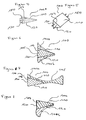
- FIG. 1 shows a natural knee joint 10.
- the femur ends knee-wise (distally) with two relatively wide, slightly outwardly curved (convex) joint knobs 18a; b (Condylus lateralis femoris 18a and condyle medialis femoris 18b).
- the upper end of the tibia 14 also terminates in two, but slightly inwardly curved (concave) Gelenkknorren 20a, b (Condylus lateralis tibiae 20a and condyle medialis tibiae 20b). Between the articular surfaces described above, the medial meniscus and the lateral meniscus are paired, crescent-shaped fibrocartilage discs to compensate for the incongruity of the articulating bones (the menisci are in the FIG. 1 not shown). From the also involved in the construction of the knee joint ligaments are in the FIG. 1 the lateral ligaments 24 (anterior cruciate ligament), the posterior cruciate ligament 26 (posterior ligament), and the patellar tendon 28 (ligamentum patellae).
- FIG. 2 shows a plan view of an art meniscus 100 'known from the prior art.
- the art meniscus has a femoral condylar contact surface 110 ', a tibial condylar contact surface 120' and an articular capsule contact surface 130 '(base).
- the art meniscus 100 ' is sickle-shaped or crescent-shaped.
- the in FIG. 2 illustrated art meniscus 100 ' is suitable for a complete meniscus reconstruction. Au ground the in FIG. 2
- the open-crescent shape illustrated by way of example is suitable for the reconstruction of the medial meniscus, in particular the art meniscus 100 '.
- FIG. 3 schematically shows a sectional oblique view of in FIG. 2 illustrated art meniscus 100 '. From the FIG. 3 It is clear that the art meniscus 100 'is already excessive in itself or has an elevation 107'.
- FIG. 4 shows the cross-sectional area of an implant 100 according to the invention.
- the implant 100 is based on a formed as an art meniscus or art meniscus inflated shaped body 105 (molded body 105 has per se an elevation 107).
- the elevated molding 105 has a femoral condylar contact surface 110, a tibial condylar contact surface 120, and a joint capsule contact surface 130 (base).
- the raised molding 105 additionally has anchoring elements 150.
- the anchoring elements 150 can, as in FIG FIG. 4 exemplified be formed arrow-shaped.
- the anchoring elements 150 are integrally connected to the elevated mold body 105 and exit from its joint capsule contact surface 130.
- the implant 100 can be fixed to the joint capsule or edge strip of a human or animal knee joint.
- the anchoring elements 150 provide anchoring in the joint capsule with particular advantage for targeted and controlled inflammatory stimuli, which anchor the implant 100, in particular the ingrowth of body cells into the implant 100 and optionally the construction of connective and / or supporting tissue, in particular cartilage tissue, can accelerate.
- FIG. 5 schematically shows a further embodiment of an inventive implant 100.
- the implant 100 has a formed as Kunststoffteilmeniskus excessive molding 105 (molding 105 has in itself an elevation 107).
- the elevated molding 105 also has a femoral condylar contact surface 110, a tibial condylar contact surface 120 and a joint capsule contact surface 130 (base).
- the elevated molding 105 is essentially wedge-shaped and has anchoring elements 150 at the ends of the wedge, which are each provided for adjoining the natural residual meniscus. With regard to further features and advantages with respect to the anchoring elements 150, reference is made to the description FIG. 5 directed.
- FIG. 6 shows the cross-sectional area of a preferred embodiment for an inventive implant 100.
- the implant is based on an elevated mold body 105 (molded body 105 has an elevation 107 per se).
- the elevated molding 105 has a femoral condylar contact surface 110, a tibial condylar contact surface 120 and a joint capsule contact surface 130 (base).
- the elevated molding 105 can be used in particular as an art meniscus or art meniscus, as it is for example in FIG. 2 is shown be educated.
- the implant 100 has two additional elevations 140a, b.
- the additional elevation 140a is concave on its side facing the articular surface, so that they can cooperate with a femoral condyle.
- the additional elevation 140b is (slightly) convex on its side facing the articular surface so that it can cooperate with a tibial condyle.
- FIG. 7 shows a further preferred embodiment of an inventive implant 100.
- the implant 100 is based, as in FIG. 6 represented implant, on an inflated molding 105, which may be formed in the manner of an art meniscus or Kunststoffteilmeniskus.
- the elevated molding 105 further includes a femoral condylar contact surface 110, a tibial condylar contact surface 120, and a joint capsule contact surface 130 (base).
- an elevation 140a is additionally formed on the femoral condylar contact surface.
- the additional elevation 140a has at the same time a spacer region 145 which projects between the femoral and tibial joint surfaces and can extend to the notch region of a knee joint.
- the additional elevation 140a is (slightly) concave on its side facing the femoral articular surface in order to be able to cooperate with a femoral condyle.
- FIG. 8 schematically shows a further preferred embodiment of an inventive implant 100.
- the implant 100 is based, as in FIG. 7 represented implant, on an inflated molding 105, which may be formed in the manner of an art meniscus or Kunststoffteilmeniskus.
- the elevated molding 105 also has a femoral condylar contact surface 110, a tibial condylar contact surface 120 and a joint capsule contact surface 130 (base).
- an elevation 140b is additionally formed on the tibial condylar contact surface.
- the elevation 140b is (slightly) convex on the side facing the tibial condylar contact surface to allow cooperation with a tibial condyle.
Landscapes
- Health & Medical Sciences (AREA)
- Orthopedic Medicine & Surgery (AREA)
- Physical Education & Sports Medicine (AREA)
- Cardiology (AREA)
- Oral & Maxillofacial Surgery (AREA)
- Transplantation (AREA)
- Engineering & Computer Science (AREA)
- Biomedical Technology (AREA)
- Heart & Thoracic Surgery (AREA)
- Vascular Medicine (AREA)
- Life Sciences & Earth Sciences (AREA)
- Animal Behavior & Ethology (AREA)
- General Health & Medical Sciences (AREA)
- Public Health (AREA)
- Veterinary Medicine (AREA)
- Prostheses (AREA)
Applications Claiming Priority (1)
| Application Number | Priority Date | Filing Date | Title |
|---|---|---|---|
| DE102009032218A DE102009032218A1 (de) | 2009-07-06 | 2009-07-06 | Überhöhtes Implantat zur Rekonstruktion von Meniskusdefekten oder Meniskusteildefekten |
Publications (2)
| Publication Number | Publication Date |
|---|---|
| EP2272467A1 true EP2272467A1 (fr) | 2011-01-12 |
| EP2272467B1 EP2272467B1 (fr) | 2017-09-06 |
Family
ID=42752987
Family Applications (1)
| Application Number | Title | Priority Date | Filing Date |
|---|---|---|---|
| EP10006869.1A Not-in-force EP2272467B1 (fr) | 2009-07-06 | 2010-07-02 | Implant surélevé pour la reconstruction de défauts du ménisque ou de défauts partiels du ménisque |
Country Status (3)
| Country | Link |
|---|---|
| US (1) | US9445908B2 (fr) |
| EP (1) | EP2272467B1 (fr) |
| DE (1) | DE102009032218A1 (fr) |
Cited By (1)
| Publication number | Priority date | Publication date | Assignee | Title |
|---|---|---|---|---|
| WO2012121853A1 (fr) * | 2011-03-08 | 2012-09-13 | Synthes Usa, Llc | Méthode et implant destiné à remplacer un tissu méniscal endommagé |
Families Citing this family (12)
| Publication number | Priority date | Publication date | Assignee | Title |
|---|---|---|---|---|
| EP1686932B1 (fr) * | 2003-06-27 | 2010-01-06 | ABS Corporation | Systeme destines a l'arthroplastie de la cheville |
| US20100131069A1 (en) * | 2007-08-01 | 2010-05-27 | Jeffrey Halbrecht | Method and system for patella tendon realignment |
| WO2009018365A1 (fr) | 2007-08-01 | 2009-02-05 | Jeffrey Halbrecht | Procédé et système pour le réalignement de ligament rotulien |
| US9278004B2 (en) | 2009-08-27 | 2016-03-08 | Cotera, Inc. | Method and apparatus for altering biomechanics of the articular joints |
| US9668868B2 (en) | 2009-08-27 | 2017-06-06 | Cotera, Inc. | Apparatus and methods for treatment of patellofemoral conditions |
| CN116570353A (zh) | 2009-08-27 | 2023-08-11 | 铸造有限责任公司 | 用于改变膝关节中髌骨与股骨之间的负载及治疗髋关节疾病的设备 |
| US10349980B2 (en) | 2009-08-27 | 2019-07-16 | The Foundry, Llc | Method and apparatus for altering biomechanics of the shoulder |
| US9861408B2 (en) | 2009-08-27 | 2018-01-09 | The Foundry, Llc | Method and apparatus for treating canine cruciate ligament disease |
| US9468466B1 (en) | 2012-08-24 | 2016-10-18 | Cotera, Inc. | Method and apparatus for altering biomechanics of the spine |
| EP4084711A4 (fr) | 2020-01-02 | 2024-01-03 | ZKR Orthopedics, Inc. | Implant de réalignement de tendon de rotule ayant une forme modifiable |
| US12303396B2 (en) | 2020-05-11 | 2025-05-20 | Zkr Orthopedics, Inc. | Adjustable patellar tendon realignment implant |
| AU2024334108A1 (en) | 2023-08-29 | 2026-02-26 | Zkr Orthopedics, Inc. | Multiplanar tendon realignment implants and related systems and methods |
Citations (4)
| Publication number | Priority date | Publication date | Assignee | Title |
|---|---|---|---|---|
| WO2003007788A2 (fr) * | 2001-07-16 | 2003-01-30 | Depuy Products, Inc. | Dispositif et procede chirurgicaux unitaires |
| US20080086210A1 (en) | 2006-10-09 | 2008-04-10 | Active Implants Corporation | Meniscus Prosthetic Device |
| US20080097606A1 (en) * | 2006-10-19 | 2008-04-24 | Cragg Andrew H | Knee joint prosthesis and hyaluronate compositions for treatment of osteoarthritis |
| DE202008013581U1 (de) * | 2008-04-09 | 2009-03-19 | Active Implants Corp. | Vorgespannte Meniskusprothesegeräte |
Family Cites Families (14)
| Publication number | Priority date | Publication date | Assignee | Title |
|---|---|---|---|---|
| US4344193A (en) * | 1980-11-28 | 1982-08-17 | Kenny Charles H | Meniscus prosthesis |
| US5007934A (en) | 1987-07-20 | 1991-04-16 | Regen Corporation | Prosthetic meniscus |
| DE3840470A1 (de) * | 1988-12-01 | 1990-06-07 | Lieke Michael | Prothesenkomponenten zum ersatz des meniskusapparates |
| US4919667A (en) * | 1988-12-02 | 1990-04-24 | Stryker Corporation | Implant |
| CA2149900C (fr) * | 1993-09-24 | 2003-06-24 | Yasuo Shikinami | Materiau pour implants |
| US5855610A (en) * | 1995-05-19 | 1999-01-05 | Children's Medical Center Corporation | Engineering of strong, pliable tissues |
| GB9704749D0 (en) * | 1997-03-07 | 1997-04-23 | Univ London | Tissue Implant |
| US20050209703A1 (en) * | 1999-04-02 | 2005-09-22 | Fell Barry M | Surgically implantable prosthetic system |
| US6629997B2 (en) * | 2000-03-27 | 2003-10-07 | Kevin A. Mansmann | Meniscus-type implant with hydrogel surface reinforced by three-dimensional mesh |
| US20020183845A1 (en) * | 2000-11-30 | 2002-12-05 | Mansmann Kevin A. | Multi-perforated non-planar device for anchoring cartilage implants and high-gradient interfaces |
| ES2405080T3 (es) * | 2003-02-26 | 2013-05-30 | Zimmer Orthobiologics, Inc. | Preparado para la reparación de un tejido cartilaginoso, en particular de defectos de cartílagos articulares |
| US7560432B2 (en) * | 2003-11-26 | 2009-07-14 | Histogenics Corporation | In situ method for treatment and repair of meniscal injuries |
| US20060173542A1 (en) * | 2004-12-28 | 2006-08-03 | Takiron Co., Ltd. | Biomaterial for artificial cartilage |
| GB0516846D0 (en) * | 2005-08-17 | 2005-09-21 | Knight David P | Meniscal repair device |
-
2009
- 2009-07-06 DE DE102009032218A patent/DE102009032218A1/de not_active Withdrawn
-
2010
- 2010-07-01 US US12/828,407 patent/US9445908B2/en active Active
- 2010-07-02 EP EP10006869.1A patent/EP2272467B1/fr not_active Not-in-force
Patent Citations (4)
| Publication number | Priority date | Publication date | Assignee | Title |
|---|---|---|---|---|
| WO2003007788A2 (fr) * | 2001-07-16 | 2003-01-30 | Depuy Products, Inc. | Dispositif et procede chirurgicaux unitaires |
| US20080086210A1 (en) | 2006-10-09 | 2008-04-10 | Active Implants Corporation | Meniscus Prosthetic Device |
| US20080097606A1 (en) * | 2006-10-19 | 2008-04-24 | Cragg Andrew H | Knee joint prosthesis and hyaluronate compositions for treatment of osteoarthritis |
| DE202008013581U1 (de) * | 2008-04-09 | 2009-03-19 | Active Implants Corp. | Vorgespannte Meniskusprothesegeräte |
Cited By (6)
| Publication number | Priority date | Publication date | Assignee | Title |
|---|---|---|---|---|
| WO2012121853A1 (fr) * | 2011-03-08 | 2012-09-13 | Synthes Usa, Llc | Méthode et implant destiné à remplacer un tissu méniscal endommagé |
| CN103415270A (zh) * | 2011-03-08 | 2013-11-27 | 新特斯有限责任公司 | 替换受损半月板组织的方法和植入物 |
| US8771353B2 (en) | 2011-03-08 | 2014-07-08 | DePuy Synthes Products, LLC | Method and implant for replacing damaged meniscal tissue |
| US9125748B2 (en) | 2011-03-08 | 2015-09-08 | DePuy Synthes Products, Inc. | Method and implant for replacing damaged meniscal tissue |
| CN103415270B (zh) * | 2011-03-08 | 2016-03-16 | 新特斯有限责任公司 | 替换受损半月板组织的方法和植入物 |
| US10130479B2 (en) | 2011-03-08 | 2018-11-20 | DePuy Synthes Products, Inc. | Method and implant for replacing damaged meniscal tissue |
Also Published As
| Publication number | Publication date |
|---|---|
| US9445908B2 (en) | 2016-09-20 |
| DE102009032218A1 (de) | 2011-01-13 |
| EP2272467B1 (fr) | 2017-09-06 |
| US20110004305A1 (en) | 2011-01-06 |
Similar Documents
| Publication | Publication Date | Title |
|---|---|---|
| EP2272467B1 (fr) | Implant surélevé pour la reconstruction de défauts du ménisque ou de défauts partiels du ménisque | |
| EP2108333B1 (fr) | Implant destiné à l'implantation dans du tissu osseux ou dans du tissu osseux remplacé par du matériau de remplacement d'os | |
| DE3879921T2 (de) | Prothese für meniscus. | |
| DE69617423T2 (de) | Gelenkprothese | |
| DE60026585T2 (de) | Prothesenvorrichtung | |
| EP1673446B1 (fr) | Prothese de cartilage et procede pour realiser une prothese de cartilage | |
| DE69923167T2 (de) | Membran mit gewellter Oberfläche zur Führung des Gewebes | |
| DE602004013383T2 (de) | Meniskus- und Tibia-Implantat | |
| DE69726896T2 (de) | Trägerstruktur für die Chondrozytentransplantation zur Reparatur von Knorpeln und Gelenken | |
| DE2502884C2 (fr) | ||
| DE202008013581U1 (de) | Vorgespannte Meniskusprothesegeräte | |
| DE102008010893B3 (de) | Implantat zum Einbringen in einen Alveolarraum | |
| DE102004041354A1 (de) | Implantat für den chirurgischen Einsatz bei Menschen oder Wirbeltieren | |
| CH702937A1 (de) | Fixationsimplantat. | |
| EP4274515A1 (fr) | Implant en plusieurs parties comprenant un élément de support et un élément fonctionnel | |
| EP1740190A1 (fr) | Utilisation d'un melange pour produire un agent servant a traiter un cartilage defectueux ou degenere in vivo et pour produire un substitut de cartilage naturel in vitro | |
| EP3541438A1 (fr) | Implant et kit de traitement d'un défaut osseux | |
| DE102009032216B4 (de) | Spacer-Implantat zur Behandlung von menschlichen oder tierischen Gelenkknorpelschäden | |
| DE102012109266B4 (de) | Implantat zur Erzeugung eines transplantierbaren Gewebestücks | |
| US20250025288A1 (en) | Graft and scaffold acl repair system | |
| EP2663260B1 (fr) | Produit médical et son procédé de fabrication, en particulier pour le traitement régénérateur de dommages au cartilage | |
| DE102006026589A1 (de) | Verwendung eines Kollagens mit osteoinduktiven Wirkstoffen zur Behandlung von Sehnen- und/oder Bänderdefekten | |
| DE102015225218A1 (de) | Banderhaltendes Implantat |
Legal Events
| Date | Code | Title | Description |
|---|---|---|---|
| PUAI | Public reference made under article 153(3) epc to a published international application that has entered the european phase |
Free format text: ORIGINAL CODE: 0009012 |
|
| AK | Designated contracting states |
Kind code of ref document: A1 Designated state(s): AL AT BE BG CH CY CZ DE DK EE ES FI FR GB GR HR HU IE IS IT LI LT LU LV MC MK MT NL NO PL PT RO SE SI SK SM TR |
|
| AX | Request for extension of the european patent |
Extension state: BA ME RS |
|
| 17P | Request for examination filed |
Effective date: 20110707 |
|
| 17Q | First examination report despatched |
Effective date: 20140613 |
|
| GRAJ | Information related to disapproval of communication of intention to grant by the applicant or resumption of examination proceedings by the epo deleted |
Free format text: ORIGINAL CODE: EPIDOSDIGR1 |
|
| GRAP | Despatch of communication of intention to grant a patent |
Free format text: ORIGINAL CODE: EPIDOSNIGR1 |
|
| RIC1 | Information provided on ipc code assigned before grant |
Ipc: A61F 2/00 20060101ALN20161221BHEP Ipc: A61F 2/30 20060101ALN20161221BHEP Ipc: A61F 2/38 20060101AFI20161221BHEP |
|
| GRAP | Despatch of communication of intention to grant a patent |
Free format text: ORIGINAL CODE: EPIDOSNIGR1 |
|
| INTG | Intention to grant announced |
Effective date: 20170127 |
|
| GRAS | Grant fee paid |
Free format text: ORIGINAL CODE: EPIDOSNIGR3 |
|
| GRAA | (expected) grant |
Free format text: ORIGINAL CODE: 0009210 |
|
| AK | Designated contracting states |
Kind code of ref document: B1 Designated state(s): AL AT BE BG CH CY CZ DE DK EE ES FI FR GB GR HR HU IE IS IT LI LT LU LV MC MK MT NL NO PL PT RO SE SI SK SM TR |
|
| REG | Reference to a national code |
Ref country code: GB Ref legal event code: FG4D Free format text: NOT ENGLISH |
|
| REG | Reference to a national code |
Ref country code: CH Ref legal event code: EP Ref country code: AT Ref legal event code: REF Ref document number: 925050 Country of ref document: AT Kind code of ref document: T Effective date: 20170915 |
|
| REG | Reference to a national code |
Ref country code: IE Ref legal event code: FG4D Free format text: LANGUAGE OF EP DOCUMENT: GERMAN |
|
| REG | Reference to a national code |
Ref country code: DE Ref legal event code: R096 Ref document number: 502010014100 Country of ref document: DE |
|
| REG | Reference to a national code |
Ref country code: NL Ref legal event code: MP Effective date: 20170906 |
|
| REG | Reference to a national code |
Ref country code: LT Ref legal event code: MG4D |
|
| PG25 | Lapsed in a contracting state [announced via postgrant information from national office to epo] |
Ref country code: HR Free format text: LAPSE BECAUSE OF FAILURE TO SUBMIT A TRANSLATION OF THE DESCRIPTION OR TO PAY THE FEE WITHIN THE PRESCRIBED TIME-LIMIT Effective date: 20170906 Ref country code: FI Free format text: LAPSE BECAUSE OF FAILURE TO SUBMIT A TRANSLATION OF THE DESCRIPTION OR TO PAY THE FEE WITHIN THE PRESCRIBED TIME-LIMIT Effective date: 20170906 Ref country code: NO Free format text: LAPSE BECAUSE OF FAILURE TO SUBMIT A TRANSLATION OF THE DESCRIPTION OR TO PAY THE FEE WITHIN THE PRESCRIBED TIME-LIMIT Effective date: 20171206 Ref country code: SE Free format text: LAPSE BECAUSE OF FAILURE TO SUBMIT A TRANSLATION OF THE DESCRIPTION OR TO PAY THE FEE WITHIN THE PRESCRIBED TIME-LIMIT Effective date: 20170906 Ref country code: LT Free format text: LAPSE BECAUSE OF FAILURE TO SUBMIT A TRANSLATION OF THE DESCRIPTION OR TO PAY THE FEE WITHIN THE PRESCRIBED TIME-LIMIT Effective date: 20170906 |
|
| PG25 | Lapsed in a contracting state [announced via postgrant information from national office to epo] |
Ref country code: GR Free format text: LAPSE BECAUSE OF FAILURE TO SUBMIT A TRANSLATION OF THE DESCRIPTION OR TO PAY THE FEE WITHIN THE PRESCRIBED TIME-LIMIT Effective date: 20171207 Ref country code: ES Free format text: LAPSE BECAUSE OF FAILURE TO SUBMIT A TRANSLATION OF THE DESCRIPTION OR TO PAY THE FEE WITHIN THE PRESCRIBED TIME-LIMIT Effective date: 20170906 Ref country code: BG Free format text: LAPSE BECAUSE OF FAILURE TO SUBMIT A TRANSLATION OF THE DESCRIPTION OR TO PAY THE FEE WITHIN THE PRESCRIBED TIME-LIMIT Effective date: 20171206 Ref country code: LV Free format text: LAPSE BECAUSE OF FAILURE TO SUBMIT A TRANSLATION OF THE DESCRIPTION OR TO PAY THE FEE WITHIN THE PRESCRIBED TIME-LIMIT Effective date: 20170906 |
|
| PG25 | Lapsed in a contracting state [announced via postgrant information from national office to epo] |
Ref country code: NL Free format text: LAPSE BECAUSE OF FAILURE TO SUBMIT A TRANSLATION OF THE DESCRIPTION OR TO PAY THE FEE WITHIN THE PRESCRIBED TIME-LIMIT Effective date: 20170906 |
|
| PG25 | Lapsed in a contracting state [announced via postgrant information from national office to epo] |
Ref country code: RO Free format text: LAPSE BECAUSE OF FAILURE TO SUBMIT A TRANSLATION OF THE DESCRIPTION OR TO PAY THE FEE WITHIN THE PRESCRIBED TIME-LIMIT Effective date: 20170906 Ref country code: CZ Free format text: LAPSE BECAUSE OF FAILURE TO SUBMIT A TRANSLATION OF THE DESCRIPTION OR TO PAY THE FEE WITHIN THE PRESCRIBED TIME-LIMIT Effective date: 20170906 Ref country code: PL Free format text: LAPSE BECAUSE OF FAILURE TO SUBMIT A TRANSLATION OF THE DESCRIPTION OR TO PAY THE FEE WITHIN THE PRESCRIBED TIME-LIMIT Effective date: 20170906 |
|
| PG25 | Lapsed in a contracting state [announced via postgrant information from national office to epo] |
Ref country code: IT Free format text: LAPSE BECAUSE OF FAILURE TO SUBMIT A TRANSLATION OF THE DESCRIPTION OR TO PAY THE FEE WITHIN THE PRESCRIBED TIME-LIMIT Effective date: 20170906 Ref country code: EE Free format text: LAPSE BECAUSE OF FAILURE TO SUBMIT A TRANSLATION OF THE DESCRIPTION OR TO PAY THE FEE WITHIN THE PRESCRIBED TIME-LIMIT Effective date: 20170906 Ref country code: IS Free format text: LAPSE BECAUSE OF FAILURE TO SUBMIT A TRANSLATION OF THE DESCRIPTION OR TO PAY THE FEE WITHIN THE PRESCRIBED TIME-LIMIT Effective date: 20180106 Ref country code: SK Free format text: LAPSE BECAUSE OF FAILURE TO SUBMIT A TRANSLATION OF THE DESCRIPTION OR TO PAY THE FEE WITHIN THE PRESCRIBED TIME-LIMIT Effective date: 20170906 Ref country code: SM Free format text: LAPSE BECAUSE OF FAILURE TO SUBMIT A TRANSLATION OF THE DESCRIPTION OR TO PAY THE FEE WITHIN THE PRESCRIBED TIME-LIMIT Effective date: 20170906 |
|
| REG | Reference to a national code |
Ref country code: DE Ref legal event code: R097 Ref document number: 502010014100 Country of ref document: DE |
|
| PLBE | No opposition filed within time limit |
Free format text: ORIGINAL CODE: 0009261 |
|
| STAA | Information on the status of an ep patent application or granted ep patent |
Free format text: STATUS: NO OPPOSITION FILED WITHIN TIME LIMIT |
|
| REG | Reference to a national code |
Ref country code: FR Ref legal event code: PLFP Year of fee payment: 9 |
|
| PG25 | Lapsed in a contracting state [announced via postgrant information from national office to epo] |
Ref country code: DK Free format text: LAPSE BECAUSE OF FAILURE TO SUBMIT A TRANSLATION OF THE DESCRIPTION OR TO PAY THE FEE WITHIN THE PRESCRIBED TIME-LIMIT Effective date: 20170906 |
|
| 26N | No opposition filed |
Effective date: 20180607 |
|
| PG25 | Lapsed in a contracting state [announced via postgrant information from national office to epo] |
Ref country code: SI Free format text: LAPSE BECAUSE OF FAILURE TO SUBMIT A TRANSLATION OF THE DESCRIPTION OR TO PAY THE FEE WITHIN THE PRESCRIBED TIME-LIMIT Effective date: 20170906 |
|
| PG25 | Lapsed in a contracting state [announced via postgrant information from national office to epo] |
Ref country code: MT Free format text: LAPSE BECAUSE OF FAILURE TO SUBMIT A TRANSLATION OF THE DESCRIPTION OR TO PAY THE FEE WITHIN THE PRESCRIBED TIME-LIMIT Effective date: 20170906 |
|
| REG | Reference to a national code |
Ref country code: CH Ref legal event code: PL |
|
| PG25 | Lapsed in a contracting state [announced via postgrant information from national office to epo] |
Ref country code: LU Free format text: LAPSE BECAUSE OF NON-PAYMENT OF DUE FEES Effective date: 20180702 Ref country code: MC Free format text: LAPSE BECAUSE OF FAILURE TO SUBMIT A TRANSLATION OF THE DESCRIPTION OR TO PAY THE FEE WITHIN THE PRESCRIBED TIME-LIMIT Effective date: 20170906 |
|
| REG | Reference to a national code |
Ref country code: BE Ref legal event code: MM Effective date: 20180731 |
|
| REG | Reference to a national code |
Ref country code: IE Ref legal event code: MM4A |
|
| PG25 | Lapsed in a contracting state [announced via postgrant information from national office to epo] |
Ref country code: LI Free format text: LAPSE BECAUSE OF NON-PAYMENT OF DUE FEES Effective date: 20180731 Ref country code: CH Free format text: LAPSE BECAUSE OF NON-PAYMENT OF DUE FEES Effective date: 20180731 Ref country code: IE Free format text: LAPSE BECAUSE OF NON-PAYMENT OF DUE FEES Effective date: 20180702 |
|
| PG25 | Lapsed in a contracting state [announced via postgrant information from national office to epo] |
Ref country code: BE Free format text: LAPSE BECAUSE OF NON-PAYMENT OF DUE FEES Effective date: 20180731 |
|
| REG | Reference to a national code |
Ref country code: AT Ref legal event code: MM01 Ref document number: 925050 Country of ref document: AT Kind code of ref document: T Effective date: 20180702 |
|
| PG25 | Lapsed in a contracting state [announced via postgrant information from national office to epo] |
Ref country code: AT Free format text: LAPSE BECAUSE OF NON-PAYMENT OF DUE FEES Effective date: 20180702 |
|
| PG25 | Lapsed in a contracting state [announced via postgrant information from national office to epo] |
Ref country code: TR Free format text: LAPSE BECAUSE OF FAILURE TO SUBMIT A TRANSLATION OF THE DESCRIPTION OR TO PAY THE FEE WITHIN THE PRESCRIBED TIME-LIMIT Effective date: 20170906 |
|
| PG25 | Lapsed in a contracting state [announced via postgrant information from national office to epo] |
Ref country code: PT Free format text: LAPSE BECAUSE OF FAILURE TO SUBMIT A TRANSLATION OF THE DESCRIPTION OR TO PAY THE FEE WITHIN THE PRESCRIBED TIME-LIMIT Effective date: 20170906 Ref country code: HU Free format text: LAPSE BECAUSE OF FAILURE TO SUBMIT A TRANSLATION OF THE DESCRIPTION OR TO PAY THE FEE WITHIN THE PRESCRIBED TIME-LIMIT; INVALID AB INITIO Effective date: 20100702 |
|
| PG25 | Lapsed in a contracting state [announced via postgrant information from national office to epo] |
Ref country code: MK Free format text: LAPSE BECAUSE OF NON-PAYMENT OF DUE FEES Effective date: 20170906 Ref country code: CY Free format text: LAPSE BECAUSE OF FAILURE TO SUBMIT A TRANSLATION OF THE DESCRIPTION OR TO PAY THE FEE WITHIN THE PRESCRIBED TIME-LIMIT Effective date: 20170906 |
|
| PG25 | Lapsed in a contracting state [announced via postgrant information from national office to epo] |
Ref country code: AL Free format text: LAPSE BECAUSE OF FAILURE TO SUBMIT A TRANSLATION OF THE DESCRIPTION OR TO PAY THE FEE WITHIN THE PRESCRIBED TIME-LIMIT Effective date: 20170906 |
|
| P01 | Opt-out of the competence of the unified patent court (upc) registered |
Effective date: 20230726 |
|
| PGFP | Annual fee paid to national office [announced via postgrant information from national office to epo] |
Ref country code: GB Payment date: 20230724 Year of fee payment: 14 |
|
| PGFP | Annual fee paid to national office [announced via postgrant information from national office to epo] |
Ref country code: FR Payment date: 20230724 Year of fee payment: 14 Ref country code: DE Payment date: 20230720 Year of fee payment: 14 |
|
| REG | Reference to a national code |
Ref country code: DE Ref legal event code: R119 Ref document number: 502010014100 Country of ref document: DE |
|
| GBPC | Gb: european patent ceased through non-payment of renewal fee |
Effective date: 20240702 |
|
| PG25 | Lapsed in a contracting state [announced via postgrant information from national office to epo] |
Ref country code: DE Free format text: LAPSE BECAUSE OF NON-PAYMENT OF DUE FEES Effective date: 20250201 |
|
| PG25 | Lapsed in a contracting state [announced via postgrant information from national office to epo] |
Ref country code: FR Free format text: LAPSE BECAUSE OF NON-PAYMENT OF DUE FEES Effective date: 20240731 |
|
| PG25 | Lapsed in a contracting state [announced via postgrant information from national office to epo] |
Ref country code: GB Free format text: LAPSE BECAUSE OF NON-PAYMENT OF DUE FEES Effective date: 20240702 |