EP2272695A1 - Appareil de climatisation d'air pour véhicule - Google Patents
Appareil de climatisation d'air pour véhicule Download PDFInfo
- Publication number
- EP2272695A1 EP2272695A1 EP10168904A EP10168904A EP2272695A1 EP 2272695 A1 EP2272695 A1 EP 2272695A1 EP 10168904 A EP10168904 A EP 10168904A EP 10168904 A EP10168904 A EP 10168904A EP 2272695 A1 EP2272695 A1 EP 2272695A1
- Authority
- EP
- European Patent Office
- Prior art keywords
- air
- defroster
- vent
- passage
- casing
- Prior art date
- Legal status (The legal status is an assumption and is not a legal conclusion. Google has not performed a legal analysis and makes no representation as to the accuracy of the status listed.)
- Granted
Links
Images














Classifications
-
- B—PERFORMING OPERATIONS; TRANSPORTING
- B60—VEHICLES IN GENERAL
- B60H—ARRANGEMENTS OF HEATING, COOLING, VENTILATING OR OTHER AIR-TREATING DEVICES SPECIALLY ADAPTED FOR PASSENGER OR GOODS SPACES OF VEHICLES
- B60H1/00—Heating, cooling or ventilating devices
- B60H1/00642—Control systems or circuits; Control members or indication devices for heating, cooling or ventilating devices
- B60H1/00814—Control systems or circuits characterised by their output, for controlling particular components of the heating, cooling or ventilating installation
- B60H1/00821—Control systems or circuits characterised by their output, for controlling particular components of the heating, cooling or ventilating installation the components being ventilating, air admitting or air distributing devices
- B60H1/00835—Damper doors, e.g. position control
- B60H1/00842—Damper doors, e.g. position control the system comprising a plurality of damper doors; Air distribution between several outlets
-
- B—PERFORMING OPERATIONS; TRANSPORTING
- B60—VEHICLES IN GENERAL
- B60H—ARRANGEMENTS OF HEATING, COOLING, VENTILATING OR OTHER AIR-TREATING DEVICES SPECIALLY ADAPTED FOR PASSENGER OR GOODS SPACES OF VEHICLES
- B60H1/00—Heating, cooling or ventilating devices
- B60H1/00507—Details, e.g. mounting arrangements, desaeration devices
- B60H1/00557—Details of ducts or cables
- B60H1/00564—Details of ducts or cables of air ducts
-
- B—PERFORMING OPERATIONS; TRANSPORTING
- B60—VEHICLES IN GENERAL
- B60H—ARRANGEMENTS OF HEATING, COOLING, VENTILATING OR OTHER AIR-TREATING DEVICES SPECIALLY ADAPTED FOR PASSENGER OR GOODS SPACES OF VEHICLES
- B60H1/00—Heating, cooling or ventilating devices
- B60H1/24—Ventilating devices where the heating or cooling is irrelevant
- B60H1/241—Ventilating devices where the heating or cooling is irrelevant characterised by the location of ventilation devices in the vehicle
- B60H1/242—Ventilating devices where the heating or cooling is irrelevant characterised by the location of ventilation devices in the vehicle located in the front area
Definitions
- the present invention relates to a vehicular air conditioning apparatus mounted in a vehicle for blowing air into a vehicle compartment that has been adjusted in temperature by a heat exchanger, for thereby adjusting temperature of the vehicle compartment.
- a vehicular air conditioning apparatus that is mounted in a vehicle, internal and external air is introduced into a casing by a blower, and after cooled air, which has been cooled by an evaporator (heat exchanger) that forms a cooling means, and heated air, which has been heated by a heater core (heat exchanger) that forms a heating means, are mixed together in the casing at a predetermined mixing ratio, the mixed air is blown out from a defroster blow-out port, a face blow-out port, or a foot blow-out port, whereby adjustment of temperature and humidity in the vehicle compartment is carried out.
- evaporator heat exchanger
- heated air which has been heated by a heater core (heat exchanger) that forms a heating means
- a defroster blow-out port is disposed in the vicinity of a front window of a vehicle, i.e., on a forward side of the vehicle. Fog on the front window is eliminated by blowing air from the defroster blow-out port.
- a vent blow-out port is disposed on a rearward side of the vehicle with respect to the defroster blow-out port, for cooling air in the vicinity of the faces of passengers by blowing air from the vent blow-out port.
- a heat-defroster mode in which in the vehicle compartment, air is blown both in the vicinity of the feet of passengers and in the vicinity of a front window for eliminating fog on the front window from a defroster blow-out port, it is desired to equalize a temperature of air blown in the vicinity of the feet of passengers with a temperature of air blown in the vicinity of the front window.
- the air heated by a heating means relatively tends to flow into a passage that blows the air in the vicinity of the feet of passengers.
- the air cooled by a cooling means without passing the heating means tends to flow into the defroster blow-out port.
- a general object of the present invention is to provide a vehicular air conditioning apparatus, which is capable of securing a large difference between the temperatures of air blown to the vicinity of the face and feet of a passenger in a bi-level mode, while reducing a difference between the temperatures of air blown to the vicinity of the feet of a passenger and a front window in a heat-defroster mode, and which is capable of efficiently mounting blowing ducts in a limited space of the apparatus for blowing air into a vehicle compartment.
- the present invention is characterized by a vehicular air conditioning apparatus including a casing having a plurality of passages through which air flows, a heat exchanger for performing heat exchange of the air, and a damper mechanism for switching a flow state of the air in the passages.
- a defroster opening for blowing the air to a defroster blow-out port that opens in the vicinity of a front window in a vehicle compartment
- a vent opening for blowing the air to a vent blow-out port that opens in the vicinity of a face of a passenger in the vehicle compartment
- a first blowing duct for connecting the defroster opening and the defroster blow-out port
- a second blowing duct for connecting the vent opening and the vent blow-out port
- the defroster opening is disposed on a rearward side of a vehicle with respect to the vent opening, a downstream side of the first blowing duct extends toward a forward side of the vehicle, and a downstream side of the second blowing duct extends toward the rearward side of the vehicle.
- the vent opening is disposed on a forward side of a vehicle with respect to the defroster opening
- the first blowing duct connects the defroster opening and the defroster blow-out port
- a downstream side of the first blowing duct extends toward the forward side of the vehicle.
- the second blowing duct connects the vent opening and the vent blow-out port, and a downstream side of the second blowing duct extends toward the rearward side of the vehicle.
- the length of a path from the heat exchanger to the vent opening can be short by disposing the vent opening on a forward side of a vehicle. Since the air cooled by the heat exchanger can be quickly supplied to the vent opening, a large temperature difference can be secured compared to the air heated by the heat exchanger.
- a length of a path can be large from part of the casing in which the warm air and cool air start mixing to the defroster opening and a heat opening, thereby securing a sufficient length for mixing the warm air and cool air.
- a temperature difference can be made small between the temperature of air blown in the vicinity of the feet of passengers and the temperature of air blown in the vicinity of the front window. As a result, the comfort of passengers in the vehicle compartment can be enhanced.
- reference numeral 400 indicates a vehicular air conditioning apparatus according to an embodiment of the present invention.
- the vehicular air conditioning apparatus 400 for example, is installed in a vehicle having three rows of seats arranged along the direction of travel of the vehicle.
- the first row of seats in the vehicle compartment of the vehicle is designated as front seats
- the second row of seats is designated as middle seats
- the third row of seats is designated as rear seats.
- the vehicular air conditioning apparatus 400 is installed so that the righthand side thereof shown in FIG. 2 (in the direction of arrow A) is oriented toward the front side of the vehicle, whereas the lefthand side (in the direction of arrow B) is oriented toward the rear side of the vehicle.
- the arrow A direction shall be described as a forward direction
- the arrow B direction shall be described as a rearward direction.
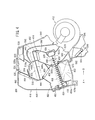
- FIG. 2 is a cross sectional view in a central portion (taken along line II-II in FIG. 1 ) along the widthwise direction of the vehicular air conditioning apparatus 400
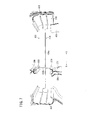
- FIG. 3 is a cross sectional view of a region (taken along line III-III in FIG. 1 ) somewhat deviated to the side of the second divided casing 418 from the aforementioned central portion.
- a plurality of rotating members made up of dampers or the like are disposed in the interior of the casing.
- Such rotating members are driven by rotary drive sources such as motors or the like.
- rotary drive sources such as motors or the like.
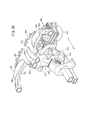
- the vehicular air conditioning apparatus 400 includes a casing 402 constituted by respective air passages, a first blower unit 406 connected through a connection duct 404 to a side portion of the casing 402 for blowing air toward the front seat side of the vehicle, an evaporator (heat exchanger) 408 arranged inside the casing 402 for cooling the air, a heater core (heat exchanger) 410 for heating the air, a second blower unit 412 connected to a lower portion of the casing 402 for blowing air toward the middle seats and rear seats of the vehicle, and a damper mechanism 414 for switching the flow of air that flows through and inside each of the respective passages.
- a casing 402 constituted by respective air passages
- a first blower unit 406 connected through a connection duct 404 to a side portion of the casing 402 for blowing air toward the front seat side of the vehicle
- an evaporator (heat exchanger) 408 arranged inside the casing 402 for cooling the air
- the casing 402 is constituted by first and second divided casings 416, 418 having substantially symmetrical shapes, wherein a center plate 420 (see FIG. 27 ) is disposed between the first divided casing 416 and the second divided casing 418.
- the connection duct 404 is connected on a lower side portion of the first divided casing 416, and a first intake port 422 is formed through which air is supplied from the first blower unit 406.
- the first intake port 422 communicates with a first front passage (first passage) 424 disposed on an upstream side of the evaporator 408. As easily understood from FIG.
- the second blower unit 412 expands outwardly and is disposed at a joined region of the substantially symmetrical first divided casing 416 and second divided casing 418 that make up the casing 402, more specifically, at a center portion of the casing 402. Further, the second blower unit 412 is positioned inside a non-illustrated center console of the vehicle.
- an evaporator holder 426 is formed for maintaining the evaporator 408, which has a rectangular shape in cross section.
- the evaporator holder 426 is provided on a lower part of the casing 402 facing the first intake port 422.
- the evaporator holder 426 includes a first retaining member 428 that holds one end of the evaporator 408 that is disposed on the forward side (in the direction of arrow A) of the casing 402, and a second retaining member 430 that holds another end of the evaporator 408 that is disposed on the rearward side (in the direction of arrow B) of the casing 402.
- the first and second retaining members 428, 430 are formed with U-shapes in cross section, which open toward one another in mutually facing directions, and extend in the widthwise direction of the casing 402, from an inner wall surface of the first divided casing 416 to an inner wall surface of the second divided casing 418.
- the evaporator 408 which is retained by the first and second retaining members 428, 430, is disposed such that one end thereof in the forward direction of the vehicle (the direction of arrow A) is inclined downward at a predetermined angle with respect to the other end thereof.
- a first rib 432 which projects a predetermined height from the inner wall surface at a position between the first retaining member 428 and the second retaining member 430, is formed on the inner wall surface of the first divided casing 416, wherein the first rib 432 abuts against one side surface of the evaporator 408.
- a second rib 434 which projects a predetermined height from the inner wall surface of the second divided casing 418 at a position between the first retaining member 428 and the second retaining member 430, is formed on the inner wall surface thereof, confronting the first rib 432, wherein the second rib 434 abuts against the other side surface of the evaporator 408.
- the first and second ribs 432, 434 are formed respectively with cross-like shapes, such that horizontal ribs 432a, 434a thereof, which extend from the first retaining member 428 to the second retaining member 430, abut roughly in the center of the evaporator 408 to divide the evaporator 408 in half in the thickness direction thereof.
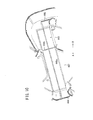
- vertical ribs 432b, 434b which are perpendicular to the horizontal ribs 432a, 434a, abut against a boundary portion in the evaporator 408 of a first cooling section 436 through which air supplied from the first blower unit 406 passes, and a second cooling section 438 through which air supplied from the second blower unit 412 passes (refer to FIG. 8 ).
- the vertical ribs 432b, 434b are disposed substantially parallel to the blowing direction of air that is supplied to the evaporator 408 from the first front passage 424 and a first rear passage 570. Stated otherwise, the horizontal ribs 432a, 434a face toward the first front passage 424 and the first rear passage 570 and are formed substantially parallel with the lower surface (supply surface) of the evaporator 408 on the upstream side thereof to which the air is supplied. Further, compared to the second rib 434, the first rib 432 is set to have a greater height from the inner wall surface of the first divided casing 416, and the horizontal rib 432a and vertical rib 432b are formed perpendicularly with respect to the inner wall surface.
- a plurality of reinforcement ribs (reinforcement members) 440 are formed substantially parallel with the vertical ribs 432b.
- the reinforcement ribs 440 are disposed with respect to upper and lower surface sides of the horizontal rib 432a, and are formed with substantially triangular shapes in cross section, which taper in a direction away from the inner wall surface (see FIGS. 6 and 9 ).
- a heater holder 442 is formed for maintaining a heater, which has a rectangular shape in cross section.
- the heater holder 442 is provided upwardly of the evaporator holder 426.
- the heater holder 442 includes a first retaining member 444 that holds one end of the heater core 410 that is disposed on the forward side (in the direction of arrow A) of the casing 402, and a second retaining member 446 that holds another end of the heater core 410 that is disposed on the rearward side (in the direction of arrow B) of the casing 402.
- the first retaining member 444 is formed to cover one end portion of the heater core 410, whereas the second retaining member 446 is formed to cover a lower half part only of the other end of the heater core 410.
- the first and second retaining members 444, 446 extend along the widthwise direction of the casing 402, from an inner wall surface of the first divided casing 416 to an inner wall surface of the second divided casing 418.
- the heater core 410 which is retained by the first and second retaining members 444, 446, is disposed such that one end thereof in the forward direction of the vehicle (the direction of arrow A) is inclined downward at a predetermined angle with respect to the other end thereof.
- a rib 448 which projects a predetermined height from the inner wall surface at a position between the first retaining member 444 and the second retaining member 446, is formed on the inner wall surface of the first divided casing 416, such that the rib 448 abuts against one side surface of the heater core 410.
- the rib 448 is formed with a substantially cross-like shape, such that a horizontal rib 448a thereof, which extends from the first retaining member 444 to the second retaining member 446, abuts roughly in the center of the heater core 410 to divide the heater core 410 in half in the thickness direction thereof.
- a vertical rib 448b which is perpendicular to the horizontal rib 448a, abuts against a boundary portion in the heater core 410 of a first heating section 450 through which air supplied from the first blower unit 406 passes, and a second heating section 452 through which air supplied from the second blower unit 412 passes (refer to FIG. 4 ). Further, in the second divided casing 418, a region thereof opens in a direction facing toward the heater core 410.
- a first guide panel 456 is formed, which faces toward the first front passage 424 on a forward side (in the direction of arrow A) adjacent to first drain ports 454a, 454b.
- the first guide panel 456 is arranged in an upstanding manner along the extending direction of the first front passage 424.
- An upper end part thereof extends to the vicinity of the lower surface of the evaporator 408, and is bent in a direction (the direction of arrow B) separating from the evaporator holder 426 that retains the evaporator 408.
- the evaporator 408 for example, although water condensation is generated when air passing through the interior of the evaporator 408 is cooled, because one end side thereof is disposed to be inclined downwardly at a predetermined angle, moisture that is generated inside the evaporator 408 can be moved to one end side, i.e., the front side of the vehicle (in the direction of arrow A), along the lower surface of the evaporator 408.
- tubes 458a, 458b are formed from thin plates of aluminum or the like, and fins 460, which are folded in a serpentine-like undulating shape, are disposed respectively between the stacked tubes 458a, 458b.
- fins 460 On the fins 460, a plurality of louvers 462 are formed, which are cut out so as to be inclined at predetermined angles with respect to the planar surface of the fins 460.
- the evaporator 408 includes the first cooling section 436, which cools air supplied from the first blower unit 406, and the second cooling section 438, which cools air supplied from the second blower unit 412. Additionally, the first cooling section 436 is arranged in the forward direction (the direction of arrow A) of the casing 402, whereas the second cooling section 438 is arranged in the rearward direction (the direction of arrow B) of the casing 402.
- first and second partitioning members 464, 466 are installed for blocking communication of air between the first cooling section 436 and the second cooling section 438.
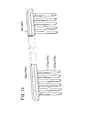
- the first and second partitioning members 464, 466 are formed from a resin material, for example, and are equipped with straightly formed base portions 468a, 468b, and a plurality of sealing portions 470a, 470b, which project at a predetermined length from the lower surface of the base portions 468a, 468b.
- projections 472a, 472b are formed thereon, which project in a direction perpendicular to the lengthwise direction, centrally along the lengthwise direction of the sealing portions 470a, 470b.
- the sealing portions 470a, 470b are formed with the same length, and are disposed so as to be separated mutually at equal intervals along the base portions 468a, 468b. Further, the projections 472a, 472b project in the same directions with respect to the sealing portions 470a, 470b.
- the first partitioning member 464 is mounted on a lower surface side of the evaporator 408 on the upstream side thereof, such that the sealing portions 470a thereof are inserted respectively between the stacked tubes 458a, 458b in the evaporator 408, and the base portion 468a abuts against the lower surface.
- the second partitioning member 466 is mounted on an upper surface side of the evaporator 408 on the downstream side thereof, such that the sealing portions 470b thereof are inserted on an opposite side from the first partitioning member 464 between the tubes 458a, 458b, and the base portion 468b abuts against the upper surface.
- the sealing portions 470a of the first partitioning member 464 and the sealing portions 470b of the second partitioning member 466 are offset from each other along the direction of extension (the direction of arrow C) of the base portions 468a, 468b, and further, overlap in the direction of extension of the tubes 458a, 458b. Owing to the two sealing portions 470a, 470b, which are mutually overlapped in this manner, intervals between adjacent tubes 458a, 458b in the same layer are sealed respectively.
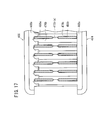
- the projections 472a of the first partitioning member 464 and the projections 472b of the second partitioning member 466 are inserted between the adjacent tubes 458a and the tubes 458b, while the first partitioning member 464 and the second partitioning member 466 are slid respectively along the direction of extension (the direction of arrow C) of the base portions 468a, 468b. Consequently, the projections 472a of the first partitioning member 464 and the projections 472b of the second partitioning member 466 overlap in the direction of extension of the tubes 458a, 458b, and gaps occurring between the tubes 458a disposed on the upper surface side and the tubes 458b disposed on the lower surface side are sealed (see FIG. 17 ).
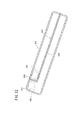
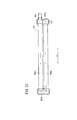
- the base portions 468a, 468b of the first and second partitioning members 464, 466 are retained respectively in base holders 578, 588, which are formed in the casing 402 (see FIG. 12 ).
- the means for blocking communication of air between the first cooling section 436 and the second cooling section 438 in the evaporator 408 is not limited to the aforementioned first and second partitioning members 464, 466.
- a plate-shaped partition plate 474 may also be disposed at the boundary region between the first cooling section 436 and the second cooling section 438.
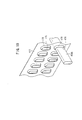
- the partition plate 474 includes a plurality of insertion holes 476 therein through which the tubes 458a, 458b are inserted.
- Pressing members 478 which are inclined at predetermined angles from the partition plate 474 about centers of the insertion holes 476, are formed in openings of the insertion holes 476.
- the pressing members 478 are substantially chevron shaped in cross section about the center of the insertion holes 476, and are tiltable with a certain resiliency in a radial direction of the insertion holes about a fulcrum point defined by an adjoining region with the partition plate 474.
- a cut line or seam is disposed in fins 460a forming a boundary between the first cooling section 436 and the second cooling section 438.
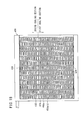
- a pressing force P is applied respectively from the right and left in a direction to approach mutually toward the plural tubes 458a, 458b, and while heat is applied thereto, welding (e.g., using solder) is carried out, whereby the tubes 458a, 458b, the fins 460a, and the partition plate 474 are mutually bonded together to manufacture the evaporator 408 (see FIG. 18 ).
- the pressing members 478 of the partition plate 474 contact the side surfaces of the tubes 458a, 458b due to the pressing force P, and further, because the tubes 458a, 458b are retained by the resilient force thereof, a state in which the partition plate 474 and the tubes 458a, 458b are mutually positioned can be realized.
- a state in which the partition plate 474 and the tubes 458a, 458b are mutually positioned can be realized.
- a second front passage 482 is formed, through which air having passed through the first cooling section 436 is supplied.
- a third front passage 484 and a fourth front passage 486 are formed in a branching or bifurcated manner.
- a first air mixing damper 488 is rotatably disposed so as to face toward the branching portion of the third front passage 484 and the fourth front passage 486.
- the third front passage 484 is arranged in the forward direction (the direction of arrow A), whereas the fourth front passage 486 is arranged in the rearward direction (the direction of arrow B), of the casing 402.
- the heater core 410 is disposed on a downstream side of the fourth front passage 486.
- a cooling vent damper 490 is disposed in a downward direction facing the second front passage 482, for switching a communication state between the second front passage 482 and the third front passage 484. More specifically, because the cooling vent damper 490 is arranged in the vicinity of the evaporator 408, the cooling vent damper 490 is disposed such that, under a switching action thereof, chilled air cooled by the evaporator 408 is supplied directly into the third front passage 484.
- the third front passage 484 extends upwardly, and a vent opening 492 opens at an upper portion on the downstream side thereof, where a vent damper 494 is rotatably disposed.
- the vent damper 494 switches a blowing state of air that flows through the third front passage 484, when the air is blown to the vent opening 492 and a later described sixth front passage 520, and also is capable of adjusting the blowing rate thereof.
- the heater core 410 is arranged to straddle between the first divided casing 416 and the second divided casing 418, and is disposed such that one end thereof in the forward direction of the vehicle (the direction of arrow A) is inclined downward at a predetermined angle with respect to the other end thereof in the rearward direction of the vehicle.
- the heater core 410 includes the first heating section 450 that heats air supplied from the first blower unit 406, and the second heating section 452 that heats air supplied from the second blower unit 412, wherein the first heating section 450 is arranged on the forward side of the casing 402.
- tubes 496a, 496b are formed from a pair of thin plates of aluminum or the like, and fins (not shown), which are folded in a serpentine-like undulating shape, are disposed respectively between the stacked tubes 496a, 496b.
- fins On the fins, a plurality of louvers are formed, which are cut out so as to be inclined at predetermined angles with respect to planar surfaces of the fins.
- a supply conduit 498 through which heated water is supplied from the exterior, and a discharge conduit 500 through which heated water having circulated through the interior of the heater core 410 is discharged, are connected respectively.
- the discharge conduit 500 is arranged in the vicinity of a corner portion in a rear upward direction of the casing 402, whereas the supply conduit 498 is arranged in parallel adjacent to the discharge conduit 500.
- a baffle plate 502 is disposed, which is substantially L-shaped in cross section.
- the baffle plate 502 extends at a predetermined width in an extending direction (the direction of arrow E) of the supply conduit 498 and the discharge conduit 500, and the baffle plate 502 is arranged between one of the tubes 496a and the other of the tubes 496b. Additionally, as shown in FIG. 23 , the pair of tubes 496a, 496b are separated inside the tank portion 503a by the baffle plate 502.
- the baffle plate 502 is made up from a planar portion 504 arranged centrally in the thickness direction of the heater core 410 and a bent portion 506, which is bent at a right angle at one end of the planar portion 504.
- the bent portion 506 is disposed between the discharge conduit 500 and the supply conduit 498.
- a plurality of caulking projections 507 are disposed respectively on both ends thereof along the longitudinal direction (the direction of arrow E) of the heater core 410.
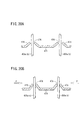
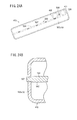
- caulking projections 507 After such caulking projections 507 have been inserted through holes formed in a side surface of the tank portions 503a, 503b to project outwardly therefrom, the projecting regions thereof are pressed and crushed by a non-illustrated jig or the like (see FIG. 24B ).
- the caulking projections 507 are formed with rectangular shapes in cross section and are disposed while being mutually separated at predetermined distances on side surfaces of the planar portion 504 and the bent portion 506. Together therewith, holes facing the planar portion 504 are disposed centrally in the thickness direction on the tank portion 503a, and holes facing the bent portion 506 are disposed at positions between the supply conduit 498 and the discharge conduit 500 (see FIG. 24A ).
- the baffle plate 502 is affixed securely with respect to the tank portion 503a disposed on the heater core 410.
- heated water supplied from the supply conduit 498 is supplied, via the one tank portion 503a, to one of the tubes 496a, which is disposed on the upper side. Then, after the heated water has flowed through the tube 496a to the other end side of the heater core 410, the heated water reverses direction inside the tank portion 503b disposed at the other end of the heater core 410, passes through the other tube 496b disposed on the lower side, and flows along the lower surface side of the baffle plate 502 back to the one end side of the heater core 410, whereupon the heated water is discharged from the discharge conduit 500.
- the discharge conduit 500 is connected at an upper corner portion 411 (in the rearward direction) of the heater core 410, which is inclined at a predetermined angle, even in the case that entrapped or retained air is generated inside the heater core 410, the air can be reliably discharged to the exterior through the discharge conduit 500, which is connected at the upper corner portion 411 where such retained air is generated. Stated otherwise, the discharge conduit 500 is connected at an uppermost position in the heater core 410, the heater core 410 being disposed at a predetermined angle of inclination inside the casing 402.
- the baffle plate 502 which is disposed inside the heater core 410, is not limited to having an L-shape in cross section, as described above.
- a baffle plate 508 having a cross-like shape in cross section in a heater core 410a may also be used.
- the baffle plate 508 includes a planar portion 510 and a vertical portion 512 that intersects at a right angle with respect to the planar portion 510.
- the planar portion 510 is arranged centrally in the thickness direction of the heater core 410a, and the vertical portion 512 is arranged between the discharge conduit 500 and the supply conduit 498.
- a through hole 512a opens through which the circulated heated water can flow.
- another through hole 510a opens through which the heated water can flow.
- heated water supplied from the supply conduit 498 is supplied to the interior of one of the tank portions 503a, and flows along an upper surface side of the baffle plate 508 and is supplied to one of the tubes (not shown).
- the heated water flows along the lower surface side of the baffle plate 508, and after flowing to the through hole 510a of the planar portion 510 from the through hole 512a of the vertical portion 512, the heated water is discharged from the discharge conduit 500 via the tank portion 503a.
- the discharge conduit 500 is connected at an upper corner portion 411a (in the rearward direction) of the heater core 410a, which is inclined at a predetermined angle, even in the case that entrapped or retained air is generated inside the heater core 410a, the air can be reliably discharged to the exterior through the discharge conduit 500, which is connected at the upper corner portion 411a where such retained air is generated.
- a fifth front passage 514 is formed on the downstream side of the heater core 410.
- the fifth front passage 514 extends in the forward direction (in the direction of arrow A), and at a location that merges with the third front passage 484, a temperature control damper 516 is provided, and together therewith, sub-defroster dampers 518a, 518b are disposed in an upward direction facing the heater core 410.
- a communication state between the fifth front passage 514 and the third front passage 484 is switched, for deflecting the blowing direction of warm air supplied from the fifth front passage 514 into the third front passage 484.
- the sub-defroster dampers 518a, 518b are disposed so as to be capable of switching a communication state between the fifth front passage 514 and the sixth front passage 520 formed thereabove.
- the sub-defroster dampers 518a, 518b By rotating the sub-defroster dampers 518a, 518b and thereby establishing communication between the fifth front passage 514 and the sixth front passage 520, i.e., by shortening the fluid passage from the fifth front passage 514 to the sixth front passage 520, warm air heated by the heater core 410 can be supplied directly to the sixth front passage 520 without flowing through the third front passage 484, in a state in which ventilation resistance of the fluid passage is reduced.
- the blowing rate can be increased to quickly heat such areas.
- the blowing rate of air during the heat mode and the defroster mode can be increased.
- the sixth front passage 520 communicates with the downstream side of the third front passage 484 through the forwardly disposed opening, and communicates with a later-described seventh front passage 522 through the rearwardly disposed opening.
- a defroster opening 524 opens upwardly of the sixth front passage 520, with a pair of defroster dampers 526a, 526b being disposed rotatably therein facing the defroster opening 524.
- the defroster dampers 526a, 526b are provided to switch the blowing state when the air supplied to the sixth front passage 520 is blown out from the defroster opening 524, and further are capable of adjusting the blowing rate thereof.
- a pair of heat dampers 528 made up from a butterfly valve are rotatably disposed (see FIG. 2 ). By rotating the heat dampers 528, the blowing state of air is switched, when air supplied from the sixth front passage 520 is blown out through later-described seventh and eighth front passages 522, 540 or through the defroster opening 524, and further, the blowing rate of such air can be adjusted.
- the sixth front passage 520 is divided into two sections by the center plate 420, which is disposed centrally in the casing 402 in the widthwise direction thereof. Also, the sixth front passage 520 is further divided respectively by a pair of dividing panels 530a, 530b, which are disposed roughly centrally in the widthwise direction, respectively, of the first and second divided casings 416, 418.
- the pair of heat dampers 528 are disposed, such that air that flows between the center plate 420 and the dividing panels 530a, 530b is directed outwardly to a first heat passage 538 (discussed later) under rotating actions of the heat dampers 528.
- the defroster dampers 526a, 526b are disposed respectively between the dividing panels 530a, 530b and inner wall surfaces of the first and second divided casings 416, 418, so that air that flows between the dividing panels 530a, 530b and inner wall surfaces of the first and second divided casings 416, 418 is directed outwardly, respectively, from side portions 534 of the defroster opening 524 under rotating actions of the defroster dampers 526a, 526b.
- the sixth front passage 520 is divided into four sections inside the casing 402 by the pair of dividing panels 530a, 530b and the center plate 420, such that the blowing state and blowing rate of air that is blown from the defroster opening 524 is switched by the defroster dampers 526a, 526b.
- the seventh front passage 522 communicates with a first heat blow-out port (not shown) through the first heat passage 538 for the purpose of blowing air in the vicinity of the feet of passengers in the front seats in the vehicle compartment.
- the eighth front passage 540 extends downwardly in a curving manner and communicates with a second heat blow-out port (not shown) upwardly of the second blower unit 412 through a second heat passage (not shown) for the purpose of blowing air in the vicinity of the feet of passengers in the middle seats in the vehicle compartment.
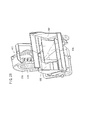
- the vent opening 492 and the defroster opening 524 open upwardly of the casing 402, and further, the vent opening 492 is arranged on a forward side (in the direction of arrow A), whereas the defroster opening 524 is arranged rearwardly, substantially centrally in the casing 402 with respect to the vent opening 492 (see FIG. 3 ).
- a vent duct 544 (second blowing duct), which extends while curving toward the rearward side of the vehicle (in the direction of arrow B), is connected to the vent opening 492 for supplying mixed air from the vent opening 492 to a vent blow-out port (not shown) facing the vicinity of faces of passengers in the front seats of the vehicle compartment.
- the vent duct 544 is provided so that the vent opening 492 formed in the casing 402 and the vent blow-out port (not shown) in the vehicle compartment are connected to each other.
- a pair of center vent ducts 546 that make up the vent duct 544 are connected to a center portion of the vent opening 492 and blow air toward the center of the front seats, whereas another pair of side vent ducts 548, which are connected to both ends of the vent opening 492, extend in lateral directions of the front seats, and blow air toward the driver's seat and passenger seat sides thereof.
- a defroster duct 550 (first blowing duct), which extends while curving toward the forward side of the vehicle (in the direction of arrow A), is connected to the defroster opening 524 for supplying mixed air from the defroster opening 524 to a defroster blow-out port (not shown) facing the vicinity of the front window in the vehicle compartment.
- the defroster duct 550 is provided so that the defroster opening 524 formed in the casing 402 and the defroster blow-out port (not shown) in the vehicle compartment are connected to each other.
- the defroster duct 550 is constituted by center defroster ducts 552, which are branched in a forked manner so as to avoid the center vent ducts 546 that extend upwardly of the defroster opening 524, and extend toward an unillustrated front window, and side defroster ducts 554, which extend perpendicularly to the center defroster ducts 552 in lateral directions together with the side vent ducts 548.
- the vehicular air conditioning apparatus 400 can be made small in size.
- the center defroster ducts 552 extend toward the forward side (in the direction of arrow A) straddling upwardly over the side vent ducts 548.
- vent duct 544 connects to the vent opening 492 disposed on the forward side and extends rearwardly (in the direction of arrow B) toward the vehicle compartment
- defroster duct 550 connects to the defroster opening 524 disposed on the rearward side and extends in a forward direction (in the direction of arrow A) on the front window side while crossing over the vent duct 544.
- the third front passage 484 that communicates between the downstream side of the evaporator 408 and the vent opening 492 can be oriented upwardly and arranged in a straight line fashion, while the defroster opening 524 can be disposed upwardly of the heater core 410.
- the center defroster ducts 552 and the side defroster ducts 554 that constitute the defroster duct 550 extend respectively from the side portions 534 of the defroster opening 524, such that the center vent ducts 546 are oriented and can extend rearwardly (in the direction of arrow B) from the vent opening 492, which is disposed forwardly (in the direction of arrow A) of the defroster opening 524.
- the first blower unit 406 includes an intake damper (not shown) in which an external air intake port 556 connected to a duct (not shown) for the purpose of introducing external air and an internal air intake port 558 for introducing internal air are arranged in an opening thereof, and which carries out switching between the external and internal air, and a first blower fan (first blower) 560 that supplies air that is taken in to the interior of the casing 402.
- a blower case 562 in which the first blower fan 560 is accommodated communicates with the interior of the casing 402 through the connection duct 404 connected to the first intake port 422. Rotation of the first blower fan 560 is controlled by a fan motor (not shown), which is driven under the control of a non-illustrated rotation control device.
- a second intake port 568 through which air is supplied from the second blower unit 412 is formed at a rearward side perpendicular to the first intake port 422.
- the second intake port 568 opens at a position on an upstream side of the evaporator 408, and communicates with the first rear passage 570 (second passage), and further, is formed alongside the first intake port 422 via the first rear passage 570 and a first dividing wall 572.
- the second blower unit 412 includes a second blower fan (second blower) 574, which supplies air that has been taken in to the interior of the casing 402.
- a blower case 576 in which the second blower fan 574 is accommodated is connected to the second intake port 568 of the casing 402 and communicates with the first rear passage 570.
- rotation of the second blower fan 574 is controlled by a fan motor (not shown) driven under the control of an unillustrated rotation control device.
- the evaporator 408 On a downstream side of the first rear passage 570, the evaporator 408 is disposed such that the second cooling section 438 thereof faces the first rear passage 570.
- the first dividing wall 572 which is formed between the first rear passage 570 and the first front passage 424, extends to the first and second partitioning members 464, 466 that are installed on the evaporator 408.
- the first partitioning member 464 is retained in the base holder 578, which is disposed at the end of the first dividing wall 572.
- first dividing wall 572 extends to the first and second partitioning members 464, 466 that are installed on the evaporator 408, air that flows to the evaporator 408 through the first rear passage 570 is prevented from mixing with air that flows to the evaporator 408 through the first front passage 424.
- a second guide panel 580 for guiding moisture ejected from the evaporator 408 to the bottom of the casing 402 is formed in the first rear passage 570 while being separated a predetermined distance from the first dividing wall 572.
- An upper end of the second guide panel 580 extends to the vicinity of the base holder 578 disposed on the first dividing wall 572, and is bent rearwardly so as to be separated a predetermined distance from the base holder 578 (see FIG. 7 ).
- the moisture generated by the second cooling section 438 of the evaporator 408 flows to the forward side (in the direction of arrow A) along the lower surface of the evaporator 408 and is retained in the first partitioning member 464 and the base holder 578, or when such moisture comes into contact with the upper end of the second guide panel 580, the moisture is guided and flows downwardly along the second guide panel 580.
- the moisture is then discharged from the casing 402 through a second drain port 582 disposed between the first dividing wall 572 and the second guide panel 580.
- the upper end of the second guide panel 580 is flexed or bent rearwardly (in the direction of arrow B), so as to be separated a predetermined distance from the base holder 578 (see FIG.
- a second rear passage 584 is formed, to which air having passed through the second cooling section 438 of the evaporator 408 is supplied.
- the second rear passage 584 is separated from the second front passage 482 by a second dividing wall 586, wherein the second partitioning member 466 is retained in the base holder 588 disposed at the end of the second dividing wall 586.
- the second dividing wall 586 extends to the second partitioning member 466 installed on the evaporator 408, on the downstream side of the evaporator 408 as well, air that flows to the second cooling section 438 of the evaporator 408 through the first rear passage 570 does not intermix with air that passes through the first front passage 424 and flows to the first cooling section 436 of the evaporator 408.
- a second air mixing damper 590 is disposed rotatably therein facing the heater core 410 for mixing cooled air and heated air at a predetermined mixing ratio to thereby produce mixed air.
- the second air mixing damper 590 switches the communication state between the second rear passage 584 and an upstream or downstream side of a third rear passage 592, which is connected to a downstream side of the heater core 410. Consequently, by rotating the second air mixing damper 590, cool air that is cooled by the evaporator 408 and supplied to the second rear passage 584 and warm air that is heated by the heater core 410 and which flows through the third rear passage 592 are mixed at a predetermined mixing ratio within the third rear passage 592 and blown out therefrom.
- the third rear passage 592 functions as a mixing section for mixing warm air and cool air, which is then blown out to the middle seats and rear seats in the vehicle.
- the third rear passage 592 after bending to circumvent the other end of the heater core 410, extends downwardly, and midway therein, an opening is formed that communicates with the second rear passage 584.
- the third rear passage 592 branches in a forked manner, branching in widthwise directions of the casing 402 about the first rear passage 570, and after extending so as to avoid the first rear passage 570 on both sides thereof, the third rear passage 592 merges again downward of the first rear passage 570. Stated otherwise, the third rear passage 592 is formed so as to cross over the first rear passage 570.
- a rotatable mode switching damper 598 is disposed at a branching location thereof, which serves to switch the blowing state of air to the fourth and fifth rear passages 594, 596, which branch respectively from the third rear passage 592, and also to adjust the blowing rate of air thereto.
- the fourth and fifth rear passages 594, 596 extend toward a rearward direction of the vehicle.
- the fourth rear passage 594 communicates with a vent blow-out port (not shown) for blowing air in the vicinity of faces of passengers in the middle seats of the vehicle.
- the fifth rear passage 596 communicates with second and third heat blow-out ports (not shown) for blowing air in the vicinity of the feet of passengers in the middle and rear seats.
- air supplied from the second blower unit 412 is directed into the casing 402 through the second intake port 568, and is selectively supplied to the vent blow-out port, and the second and third heat blow-out ports, which are arranged to face the middle seats and rear seats in the vehicle, through the first through fifth rear passages 570, 584, 592, 594, 596.
- the second to seventh front passages 482, 484, 486, 514, 520, 522 are divided in half at a substantially central portion of the casing 402 by the center plate 420, the second to seventh front passages 482, 484, 486, 514, 520, 522 are disposed respectively inside of the first and second divided casings 416, 418.
- the vehicular air conditioning apparatus 400 is basically constructed as described above. Next, operations and effects of the invention shall be explained. First, when operation of the vehicular air conditioning apparatus 400 is started, the first blower fan 560 of the first blower unit 406 is rotated under the control of a rotation control device (not shown), and air (interior or exterior air) that is taken in through a duct or the like is supplied to the first front passage 424 of the casing 402 through the connection duct 404.
- air that is taken in by rotation of the second blower fan 574 of the second blower unit 412 under the control of a non-illustrated rotation control device is supplied to the first rear passage 570 from the blower case 576 while passing through the second intake port 568.
- first air air supplied to the interior of the casing 402 by the first blower fan 560
- second air air supplied to the interior of the casing 402 by the second blower fan 574
- the first air and the second air supplied to the interior of the casing 402 are each cooled by passing respectively through the first and second cooling sections 436, 438 of the evaporator 408, and flow respectively as chilled air to the second front passage 482 and the second rear passage 584, in which the first and second air mixing dampers 488, 590 are disposed.
- the interior of the evaporator 408 is divided into the first cooling section 436 and the second cooling section 438 by a non-illustrated partitioning means, the first air and the second air do not mix with one another.
- a vent mode is selected by a passenger using a controller (not shown) inside the vehicle compartment for blowing air in the vicinity of the face of the passenger, by blocking communication between the second front passage 482 and the fourth front passage 486 by means of the first air mixing damper 488, the first air (cooled air) flows from the second front passage 482 to the third front passage 484.
- the temperature control damper 516 blocks communication between the fifth front passage 514 and the third front passage 484.
- the vent damper 494 is rotated into a position that blocks communication between the third front passage 484 and the sixth front passage 520, the first air is blown from the opened vent opening 492, through the vent duct 544, and in the vicinity of the face of a passenger who rides in the front seat in the vehicle compartment.
- the second air since flow to the second heating section 452 of the heater core 410 is interrupted by the second air mixing damper 590, the second air flows downstream from the second rear passage 584 through the third rear passage 592. Additionally, the second air (cooled air) is blown in the vicinity of the face of a passenger who rides in the middle seat in the vehicle compartment from the vent blow-out port (not shown) through the fourth rear passage 594 under a switching operation of the mode switching damper 598.
- the cooling vent damper 490 enables communication between the second front passage 482 and the third front passage 484.
- the blowing rate of the first air (cooled air) that flows to the third front passage 484 from the second front passage 482 increases, the vehicle compartment can be cooled quickly by the first air, which is blown from the vent opening 492 through the vent duct 544.
- the temperature control damper 516 is rotated to become substantially parallel with the third front passage 484 and to block communication between the fifth front passage 514 and the third front passage 484. As a result, cooled air in the third front passage 484 can be supplied to the vent opening 492 without being raised in temperature.
- the temperature control damper 516 suppresses flow passage resistance when cool air flows through the third front passage 484, low electrical power consumption of the first blower fan 560 is realized, along with reducing noise.
- the first air mixing damper 488 is rotated to an intermediate position between the third front passage 484 and the fourth front passage 486, so that the first air is caused to flow respectively to both the third front passage 484 and the fourth front passage 486. Furthermore, the temperature control damper 516 is rotated, whereupon air heated by the first heating section 450 of the heater core 410 is supplied into the third front passage 484 from the fifth front passage 514.
- the vent damper 494 is positioned at an intermediate position between the vent opening 492 and the opening of the sixth front passage 520, and together therewith, the defroster opening 524 is blocked by the defroster dampers 526a, 526b, whereupon the communication opening from the fifth front passage 514 to the sixth front passage 520 is blocked by the sub-defroster dampers 518a, 518b and communication therebetween is interrupted.
- the first air flows from the second front passage 482 to the third front passage 484.
- the temperature control damper 516 is oriented in a direction so as to be separated from the communication opening between the fifth front passage 514 and the third front passage 484, while the end portion thereof is rotated to face the upstream side of the third front passage 484.
- the first air (cooled air) is heated by the first heating section 450 of the heater core 410, and by mixing only at a small amount with the first air (heated air) that flows to the third front passage 484 through the fifth front passage 514, air is blown directly from the vent opening 492, through the vent duct 544, and in the vicinity of the face of a passenger who rides in the front seat in the vehicle compartment.
- the temperature control damper 516 is rotated so that the end portion thereof confronts the upstream side of the third front passage 484 and projects into the third front passage 484, warm air is guided to the upstream side of the third front passage 484 along the temperature control damper 516, and further mixing thereof with cooled air can be promoted.
- the heat dampers 528 in the form of a butterfly valve one end side thereof is rotated about the support axis to project toward the side of the sixth front passage 520 (in the direction of arrow A), while the other end side thereof is rotated to project toward the side of the seventh front passage (in the direction of arrow B).
- warm air that is mixed with cool air in the third front passage 484 flows from the sixth front passage 520, through the seventh front passage 522, and to the first heat passage 538, and is blown in the vicinity of the feet of passengers who ride in the front seat in the vehicle compartment, and together therewith, is blown in the vicinity of the feet of passengers who ride in the middle seats in the vehicle compartment, from the eighth front passage 540 and through the second heat passage (not shown).
- the sub-defroster dampers 518a, 518b may be rotated so as to establish communication between the fifth front passage 514 and the sixth front passage 520.
- air that passes through the first heating section 450 of the heater core 410 is added to the first air, which has been supplied to the sixth front passage 520 via the third front passage 484, whereupon warm first air can be supplied directly with respect to the sixth front passage 520.
- the second air mixing damper 590 is rotated to an intermediate position whereby the second air flows to the second heating section 452 of the heater core 410, and together therewith, flows to the third rear passage 592 connected to the second rear passage 584.
- the second air after having been cooled by the second cooling section 438 of the evaporator 408, is divided in flow by the second air mixing damper 590, such that one portion is guided to the third rear passage 592 as cooled air, whereas the other portion thereof, after being heated by the second heating section 452 of the heater core 410, is blown into the third rear passage 592.
- the second air is adjusted to a suitable temperature in the third rear passage 592.
- the angle of rotation of the second air mixing damper 590 can be freely changed in accordance with the temperature desired by passengers in the vehicle compartment, or stated otherwise, the second air mixing damper 590 can be rotated in coordination with an input from the controller in the vehicle compartment. Concerning the second air, which flows downstream through the third rear passage 592, the flow rate ratio thereof to the fourth rear passage 594 and the fifth rear passage 596 is adjusted by rotating the mode switching damper 598 to a predetermined position so that the second air flows therethrough.
- the second air is blown from the vent blow-out port (not shown) in the vicinity of the faces of passengers in the middle seats inside the vehicle compartment, or alternatively, is blown from the second heat blow-out port and the third heat blow-out port (not shown) toward the feet of passengers in the middle seats and rear seats inside the vehicle compartment.
- the predetermined position of the mode switching damper 598 is defined in accordance with the set temperature and mode, which are input by a passenger from the controller inside the vehicle compartment.
- the set temperature and/or mode, apart from being input from the front seats, may also be input from the middle seats or the rear seats.
- the first air mixing damper 488 is rotated more to the side of the third front passage 484.
- the temperature control damper 516 is rotated somewhat to establish communication between the third front passage 484 and the fifth front passage 514.
- the cooling vent damper 490 blocks communication between the second front passage 482 and the third front passage 484, and the vent damper 494 and the defroster dampers 526a, 526b are rotated respectively so that the vent opening 492 and the defroster opening 524 are closed.
- the heated first air that has passed through the first heating section 450 of the heater core 410 is supplied to the third front passage 484 from the fifth front passage 514.
- the first air (cooled air) which has flowed in from the second front passage 482
- the first air (heated air) is mixed with the first air (heated air), whereupon the mixed air passes through the sixth front passage 520 and the seventh front passage 522 and flows rearwardly.
- air is blown from a non-illustrated first heat opening in the vicinity of the feet of passengers riding in the front seat in the vehicle compartment, and from the eighth front passage 540 air is blown out via a non-illustrated second heat passage in the vicinity of the feet of passengers in the middle seats in the vehicle compartment.
- the sub-defroster dampers 518a, 518b may be rotated to establish communication between the fifth front passage 514 and the sixth front passage 520.
- air passes through the first heating section 450 of the heater core 410 and is added to the first air supplied to the sixth front passage 520 via the third front passage 484, and such heated first air can be supplied directly with respect to the sixth front passage 520.
- the air blowing rate of warm air which is blown in the vicinity of the feet of passengers in the front seat in the vehicle compartment from the first heat opening, can be increased. Stated otherwise, warm air blown in the vicinity of the feet of passengers can be supplied at a more stable temperature.
- the second air mixing damper 590 is rotated somewhat to separate away from the heater core 410, whereupon second air, which has passed through the second heating section 452 of the heater core 410, flows downstream through the third rear passage 592.
- the mode switching damper 598 By rotating the mode switching damper 598 to a position blocking the fourth rear passage 594, the second air passes through the fifth rear passage 596 and is blown in the vicinity of the feet of passengers in the middle and rear seats in the vehicle compartment from the second heat opening and the third heat opening (not shown).
- the defroster dampers 526a, 526b in the form of a butterfly valve are rotated about the support axis so as to separate from the defroster opening 524, together with blocking the vent opening 492 by the vent damper 494 (refer to the broken line in FIG. 3 ).
- a portion of the first air (mixed air) that is mixed in the third front passage 484 passes through the defroster opening 524 and is blown in the vicinity of the front window in the vehicle compartment.
- first air passes through the sixth and seventh front passages 520, 522, and is blown in the vicinity of the feet of passengers in the front seats in the vehicle compartment through the first heat passage 538, as well as being blown in the vicinity of the feet of passengers in the middle seats in the vehicle compartment from the eighth front passage 540 through a non-illustrated second heat passage.
- the defroster mode for blowing air only in the vicinity of the front widow for eliminating fog (condensation) from the front window in the vehicle shall be described.
- the first air-mixing damper 488 and the cooling vent damper 490 block communication respectively between the second front passage 482 and the third front passage 484.
- the vent damper 494 blocks the vent opening 492 and communication between the vent duct 544 and the third front passage 484, while the temperature control damper 516 establishes communication between the fifth front passage 514 and the third front passage 484.
- the heat dampers 528 in the form of a butterfly valve are rotated about the support axis, so that one end thereof blocks the eighth front passage 540 and the other end thereof blocks the seventh front passage 522, respectively.
- the sub-defroster dampers 518a, 518b and the defroster dampers 526a, 526b in the form of butterfly valves are rotated to establish communication between the fifth front passage 514, the sixth front passage 520, and the defroster opening 524.
- warm first air that has passed through the heater core 410 is supplied from the fifth front passage 514, through the sixth front passage 520, and to the opened defroster opening 524, whereby warm air is blown in the vicinity of the front window in the vehicle.
- the second blower unit 412 is not driven, and only the first air supplied from the first blower unit 406 is blown out.
- the vent opening 492 is disposed on the forward side of the vehicle (in the direction of arrow A) with respect to the defroster opening 524.
- the length between the first heat passage 538 (first heat opening) and the third front passage 484 can be large, and the length between the defroster opening 524 and the first heat passage 538 (first heat opening) can be small.
- a length of a path can be large from the third front passage 484 in which the warm air and cool air start mixing to the defroster opening 524 and the first heat passage 538 (first heat opening) in which air is blown, thereby securing a sufficient length for mixing the warm air and cool air.
- a temperature difference can be made as small as possible between the temperature of air blown in the vicinity of the feet of a passenger and the temperature of air blown in the vicinity of the front window.
- the third front passage 484 formed on the downstream side of the evaporator 408 can be oriented upwardly and disposed in a straight line fashion so that the third front passage 484 opens only at the vent opening 492. Owing thereto, in the bi-level mode, cool air that has been cooled by the evaporator 408 can be quickly supplied to the vent opening 492 through the third front passage 484, and the cooled air can be blown in the vicinity of the face of a passenger from a vent blow-out port (not shown) in the vehicle compartment through the vent duct 544 connected to the vent opening 492.
- the cooled air is prevented from mixing with heated air that is heated by the heater core 410, so that a temperature difference can be made larger between the air supplied from the vent blow-out port (not shown) into the vehicle compartment and the air supplied to the vicinity of the feet of a passenger through the first heat blow-out port (not shown) in the vehicle compartment.
- the air in the vicinity of the face of a passenger can be made cooler, while the air in the vicinity of the feet of the passenger can be made warmer, so that the comfort of passengers can be enhanced.
- center vent ducts 546 connected to the vent opening 492 are disposed in a straight line fashion, and oriented rearwardly (in the direction of arrow B) between the pair of center defroster ducts 552, 552 and the side defroster ducts 554.
- the center vent ducts 546 can open only in the vehicle compartment. Stated otherwise, in the bi-level mode, the air cooled by the evaporator 408 does not intermix with warm air, and the third front passage 484 and the center vent ducts 546, which make up a path from the downstream side of the evaporator 408 to the face of a passenger, can open only at the vent opening 492 and only in the vehicle compartment, respectively. Accordingly, the possibility that the cooled air is undesirably warmed can be reduced as much as possible.
- a vehicular air conditioning apparatus 400 includes a casing 402 constituted by respective air passages.
- the casing 402 has a vent opening 492 and a defroster opening 524 at an upper portion thereof.
- the vent opening 492 is disposed on a forward side of a vehicle with respect to the defroster opening 524.
- a pair of defroster ducts 550 extend in lateral directions respectively from side portions 534 of the defroster opening 524, and center vent ducts 546 are disposed in a straight line fashion from the vent opening 492 and oriented rearwardly of the vehicle between the pair of the defroster ducts 550.
- the center vent ducts 546 open only in the vehicle compartment.
- a third front passage 484 on the downstream side of the evaporator 408 extends upwardly in a straight line fashion.
Landscapes
- Physics & Mathematics (AREA)
- Thermal Sciences (AREA)
- Engineering & Computer Science (AREA)
- Mechanical Engineering (AREA)
- Air-Conditioning For Vehicles (AREA)
Priority Applications (1)
| Application Number | Priority Date | Filing Date | Title |
|---|---|---|---|
| PL10168904T PL2272695T3 (pl) | 2009-07-10 | 2010-07-08 | Samochodowy aparat klimatyzacyjny |
Applications Claiming Priority (1)
| Application Number | Priority Date | Filing Date | Title |
|---|---|---|---|
| US12/500,721 US8408980B2 (en) | 2009-07-10 | 2009-07-10 | Vehicular air conditioning apparatus |
Publications (2)
| Publication Number | Publication Date |
|---|---|
| EP2272695A1 true EP2272695A1 (fr) | 2011-01-12 |
| EP2272695B1 EP2272695B1 (fr) | 2012-07-04 |
Family
ID=42670328
Family Applications (1)
| Application Number | Title | Priority Date | Filing Date |
|---|---|---|---|
| EP10168904A Not-in-force EP2272695B1 (fr) | 2009-07-10 | 2010-07-08 | Appareil de climatisation d'air pour véhicule |
Country Status (5)
| Country | Link |
|---|---|
| US (1) | US8408980B2 (fr) |
| EP (1) | EP2272695B1 (fr) |
| JP (1) | JP5639802B2 (fr) |
| CN (1) | CN101947909A (fr) |
| PL (1) | PL2272695T3 (fr) |
Families Citing this family (20)
| Publication number | Priority date | Publication date | Assignee | Title |
|---|---|---|---|---|
| US20100216387A1 (en) * | 2009-02-20 | 2010-08-26 | Ford Global Technologies, Llc | Duct architecture for regulating climate zone in a vehicle |
| KR101406651B1 (ko) * | 2012-11-12 | 2014-06-13 | 현대자동차주식회사 | 차량의 공조장치 |
| JP6420531B2 (ja) * | 2013-09-11 | 2018-11-07 | 株式会社ケーヒン | 車両用空調装置 |
| DE102013219811A1 (de) * | 2013-09-30 | 2015-04-02 | Behr Gmbh & Co. Kg | Klimaanlage |
| JP6287375B2 (ja) * | 2014-03-11 | 2018-03-07 | 三菱自動車工業株式会社 | 電池パック温調装置 |
| JP6281362B2 (ja) * | 2014-03-26 | 2018-02-21 | 株式会社デンソー | 車両用空調ユニット |
| JP6339920B2 (ja) * | 2014-10-22 | 2018-06-06 | 株式会社ヴァレオジャパン | 車両用空調装置 |
| DE102015117964B4 (de) * | 2014-10-24 | 2020-07-23 | Hanon Systems | Klimatisierungssystem zur Konditionierung der Luft eines Fahrgastraumes eines Kraftfahrzeuges |
| JP2017013704A (ja) * | 2015-07-03 | 2017-01-19 | 株式会社ヴァレオジャパン | 車両用空調装置及びその車両用空調装置を搭載した車両 |
| JP6592466B2 (ja) * | 2016-01-18 | 2019-10-16 | ハンオン システムズ | 車両用空調システム |
| JP6756508B2 (ja) * | 2016-04-04 | 2020-09-16 | 株式会社ジャパンディスプレイ | 表示装置 |
| US10556480B2 (en) * | 2017-01-17 | 2020-02-11 | Nissan North America, Inc. | Vehicle HVAC system |
| US10065479B1 (en) * | 2017-02-22 | 2018-09-04 | Denso International America, Inc. | System and method for minimizing air leak in an HVAC unit |
| US10882378B2 (en) * | 2017-08-18 | 2021-01-05 | Zhejiang CFMOTO Power Co., Ltd. | ATV air heat exchanger with mounting structure and linkage |
| KR102456849B1 (ko) * | 2017-12-15 | 2022-10-21 | 한온시스템 주식회사 | 차량용 공조장치 |
| US20190351743A1 (en) * | 2018-05-15 | 2019-11-21 | Calsonic Kansei North America, Inc. | Compact rear vehicle hvac structure |
| KR102661622B1 (ko) * | 2018-11-12 | 2024-04-29 | 현대자동차주식회사 | 차량용 공조장치 |
| KR102658581B1 (ko) * | 2019-03-06 | 2024-04-18 | 한온시스템 주식회사 | 차량용 공조장치 |
| DE102019213861A1 (de) * | 2019-09-11 | 2021-03-11 | Mahle International Gmbh | Verfahren zum Betreiben einer Klimatisierungsanlage im Fahrzeuginnenraum eines Kraftfahrzeugs |
| DE102019131472A1 (de) * | 2019-11-21 | 2021-05-27 | Valeo Klimasysteme Gmbh | Heizungs-, Lüftungs- und/oder Klimaanlage für ein Kraftfahrzeug |
Citations (4)
| Publication number | Priority date | Publication date | Assignee | Title |
|---|---|---|---|---|
| EP0210548A2 (fr) * | 1985-07-20 | 1987-02-04 | Bayerische Motoren Werke Aktiengesellschaft, Patentabteilung AJ-3 | Installation de chauffage et/ou de climatisation pour l'habitacle de véhicules à moteur, en particulier pour voitures |
| EP1308326A2 (fr) * | 2001-11-05 | 2003-05-07 | Delphi Technologies, Inc. | Installation de chauffage, ventilation et climatisation pour véhicules avec chauffage et dégivrage améliorés |
| JP2003220820A (ja) | 2002-01-31 | 2003-08-05 | Denso Corp | 車両用空調装置 |
| EP1386763A1 (fr) * | 2002-07-29 | 2004-02-04 | Nissan Motor Company, Limited | Système de climatisation de véhicule |
Family Cites Families (26)
| Publication number | Priority date | Publication date | Assignee | Title |
|---|---|---|---|---|
| JPS5848506U (ja) * | 1981-09-30 | 1983-04-01 | カルソニックカンセイ株式会社 | 自動車用空気調和装置 |
| US5309731A (en) * | 1991-12-27 | 1994-05-10 | Nippondenso Co., Ltd. | Air conditioning apparatus |
| FR2775221B1 (fr) * | 1998-02-20 | 2000-05-26 | Renault | Dispositif d'aeration, de chauffage et de climatisation d'un habitacle d'un vehicule automobile |
| US6186885B1 (en) * | 1999-02-18 | 2001-02-13 | Ford Motor Company | Integrated HVAC system for an automotive vehicle |
| JP2002052919A (ja) * | 2000-08-09 | 2002-02-19 | Denso Corp | 車両用空調装置 |
| JP2002087045A (ja) * | 2000-09-19 | 2002-03-26 | Toyoda Gosei Co Ltd | 空調用ダクト |
| JP3580539B2 (ja) * | 2000-10-18 | 2004-10-27 | 本田技研工業株式会社 | 空調用ダクト及び空調用ダクトの製造・取付方法 |
| US6431976B1 (en) * | 2001-01-26 | 2002-08-13 | Visteon Global Technologies, Inc. | Rotary distribution chamber for selective distribution of a fluid |
| FR2824298B1 (fr) * | 2001-05-04 | 2003-12-12 | Valeo Climatisation | Dispositif de recyclage de l'air d'un habitacle de vehicule |
| ITTO20010619A1 (it) * | 2001-06-27 | 2002-12-27 | Fiat Ricerche | Sistema di distribuzione di aria per un autoveicolo. |
| JP2003159927A (ja) * | 2001-11-22 | 2003-06-03 | Denso Corp | 車両用空調装置 |
| KR100482594B1 (ko) * | 2003-04-14 | 2005-04-14 | 현대자동차주식회사 | 차량의 성에 제거 장치 |
| ITTO20031008A1 (it) * | 2003-12-16 | 2005-06-17 | Fiat Ricerche | Sistema di distribuzione di aria per una plancia di autoveicolo e plancia di autoveicolo comprendente tale sistema. |
| US7063612B2 (en) * | 2004-01-30 | 2006-06-20 | Behr Gmbh & Co. Kg | Air mixing unit for a ventilation system |
| DE102004020415A1 (de) * | 2004-04-23 | 2005-11-10 | Behr Gmbh & Co. Kg | Heiz- oder Klimaanlage für ein Fahrzeug |
| JP4380450B2 (ja) * | 2004-07-26 | 2009-12-09 | 株式会社デンソー | 空気通路開閉装置および車両用空調装置 |
| KR100613708B1 (ko) * | 2004-08-17 | 2006-08-21 | 현대모비스 주식회사 | 인스트루먼트 패널 일체형 디프로스터 덕트 |
| JP4665229B2 (ja) * | 2005-04-21 | 2011-04-06 | 株式会社ヴァレオサーマルシステムズ | 車両用空調装置 |
| KR100683220B1 (ko) * | 2005-07-05 | 2007-02-15 | 현대모비스 주식회사 | 차량용 제상덕트의 유로구조 |
| CA2524191A1 (fr) * | 2005-10-24 | 2007-04-24 | Progressive Moulded Products Limited | Systeme et methode de controle du debit d'air pour ventilation de vehicule |
| JP2007118753A (ja) * | 2005-10-27 | 2007-05-17 | Denso Corp | 空気通路開閉装置 |
| JP5189732B2 (ja) * | 2005-11-16 | 2013-04-24 | カルソニックカンセイ株式会社 | 自動車用空気調和装置 |
| US20070293134A1 (en) * | 2006-05-16 | 2007-12-20 | Calsonic Kansei Corporation | Defroster duct |
| US9610823B2 (en) * | 2008-09-25 | 2017-04-04 | Mahle International Gmbh | Vehicle HVAC temperature control system |
| US10029536B2 (en) * | 2009-05-29 | 2018-07-24 | Honda Motor Co., Ltd. | Integrated front and rear HVAC system |
| KR101124947B1 (ko) * | 2009-07-21 | 2012-03-27 | 현대자동차주식회사 | 차량용 공조장치 |
-
2009
- 2009-07-10 US US12/500,721 patent/US8408980B2/en not_active Expired - Fee Related
-
2010
- 2010-07-07 JP JP2010154754A patent/JP5639802B2/ja not_active Expired - Fee Related
- 2010-07-08 EP EP10168904A patent/EP2272695B1/fr not_active Not-in-force
- 2010-07-08 PL PL10168904T patent/PL2272695T3/pl unknown
- 2010-07-09 CN CN2010102268882A patent/CN101947909A/zh active Pending
Patent Citations (4)
| Publication number | Priority date | Publication date | Assignee | Title |
|---|---|---|---|---|
| EP0210548A2 (fr) * | 1985-07-20 | 1987-02-04 | Bayerische Motoren Werke Aktiengesellschaft, Patentabteilung AJ-3 | Installation de chauffage et/ou de climatisation pour l'habitacle de véhicules à moteur, en particulier pour voitures |
| EP1308326A2 (fr) * | 2001-11-05 | 2003-05-07 | Delphi Technologies, Inc. | Installation de chauffage, ventilation et climatisation pour véhicules avec chauffage et dégivrage améliorés |
| JP2003220820A (ja) | 2002-01-31 | 2003-08-05 | Denso Corp | 車両用空調装置 |
| EP1386763A1 (fr) * | 2002-07-29 | 2004-02-04 | Nissan Motor Company, Limited | Système de climatisation de véhicule |
Also Published As
| Publication number | Publication date |
|---|---|
| US8408980B2 (en) | 2013-04-02 |
| EP2272695B1 (fr) | 2012-07-04 |
| JP2011016525A (ja) | 2011-01-27 |
| JP5639802B2 (ja) | 2014-12-10 |
| US20110009043A1 (en) | 2011-01-13 |
| PL2272695T3 (pl) | 2012-12-31 |
| CN101947909A (zh) | 2011-01-19 |
Similar Documents
| Publication | Publication Date | Title |
|---|---|---|
| EP2272695B1 (fr) | Appareil de climatisation d'air pour véhicule | |
| US8544528B2 (en) | Heat exchanger equipped with partitioning members for use in a vehicular air conditioning apparatus | |
| US8376037B2 (en) | Vehicular air conditioning apparatus and temperature control method performed thereby | |
| US8267155B2 (en) | Vehicular air conditioning apparatus | |
| US8662158B2 (en) | Vehicular air conditioning apparatus | |
| US8403029B2 (en) | Vehicular air conditioning apparatus | |
| US9174511B2 (en) | Vehicular air conditioning apparatus | |
| US20110005730A1 (en) | Vehicular air conditioning apparatus | |
| US20110005707A1 (en) | Heat exchanger equipped with a partitioning member for use in a vehicular air conditioning apparatus | |
| US8662157B2 (en) | Vehicular air conditioning apparatus | |
| US20110005719A1 (en) | Heat exchanger for vehicular air conditioning apparatus | |
| US8997838B2 (en) | Vehicular air conditioning apparatus | |
| US8443873B2 (en) | Heat exchanger for vehicular air conditioning apparatus | |
| US20100167635A1 (en) | Air conditioner for vehicle | |
| US8443872B2 (en) | Heat exchanger for vehicular air conditioning apparatus | |
| JP2009286286A (ja) | 車両用空調装置 | |
| JP4078180B2 (ja) | 車両用空調装置 | |
| US20110005271A1 (en) | Vehicular air conditioning apparatus | |
| US20110005732A1 (en) | Vehicular air conditioning apparatus | |
| JP2006036032A (ja) | 自動車用空調装置 | |
| US20110005715A1 (en) | Vehicular air conditioning apparatus | |
| US20110005714A1 (en) | Vehicular air conditioning apparatus | |
| KR20170118998A (ko) | 차량용 루프형 공조장치 | |
| JP5962499B2 (ja) | 車載用空調装置 | |
| US20110005712A1 (en) | Heat exchanger for vehicular air conditioning apparatus |
Legal Events
| Date | Code | Title | Description |
|---|---|---|---|
| PUAI | Public reference made under article 153(3) epc to a published international application that has entered the european phase |
Free format text: ORIGINAL CODE: 0009012 |
|
| AK | Designated contracting states |
Kind code of ref document: A1 Designated state(s): AL AT BE BG CH CY CZ DE DK EE ES FI FR GB GR HR HU IE IS IT LI LT LU LV MC MK MT NL NO PL PT RO SE SI SK SM TR |
|
| AX | Request for extension of the european patent |
Extension state: BA ME RS |
|
| 17P | Request for examination filed |
Effective date: 20110310 |
|
| GRAP | Despatch of communication of intention to grant a patent |
Free format text: ORIGINAL CODE: EPIDOSNIGR1 |
|
| RIC1 | Information provided on ipc code assigned before grant |
Ipc: B60H 1/00 20060101AFI20111221BHEP |
|
| GRAS | Grant fee paid |
Free format text: ORIGINAL CODE: EPIDOSNIGR3 |
|
| GRAA | (expected) grant |
Free format text: ORIGINAL CODE: 0009210 |
|
| AK | Designated contracting states |
Kind code of ref document: B1 Designated state(s): AL AT BE BG CH CY CZ DE DK EE ES FI FR GB GR HR HU IE IS IT LI LT LU LV MC MK MT NL NO PL PT RO SE SI SK SM TR |
|
| REG | Reference to a national code |
Ref country code: GB Ref legal event code: FG4D |
|
| REG | Reference to a national code |
Ref country code: CH Ref legal event code: EP |
|
| REG | Reference to a national code |
Ref country code: AT Ref legal event code: REF Ref document number: 565016 Country of ref document: AT Kind code of ref document: T Effective date: 20120715 |
|
| REG | Reference to a national code |
Ref country code: IE Ref legal event code: FG4D |
|
| REG | Reference to a national code |
Ref country code: DE Ref legal event code: R096 Ref document number: 602010002084 Country of ref document: DE Effective date: 20120830 |
|
| REG | Reference to a national code |
Ref country code: AT Ref legal event code: MK05 Ref document number: 565016 Country of ref document: AT Kind code of ref document: T Effective date: 20120704 |
|
| REG | Reference to a national code |
Ref country code: NL Ref legal event code: VDEP Effective date: 20120704 |
|
| PG25 | Lapsed in a contracting state [announced via postgrant information from national office to epo] |
Ref country code: SI Free format text: LAPSE BECAUSE OF FAILURE TO SUBMIT A TRANSLATION OF THE DESCRIPTION OR TO PAY THE FEE WITHIN THE PRESCRIBED TIME-LIMIT Effective date: 20120704 |
|
| REG | Reference to a national code |
Ref country code: LT Ref legal event code: MG4D Effective date: 20120704 |
|
| REG | Reference to a national code |
Ref country code: PL Ref legal event code: T3 |
|
| PG25 | Lapsed in a contracting state [announced via postgrant information from national office to epo] |
Ref country code: IS Free format text: LAPSE BECAUSE OF FAILURE TO SUBMIT A TRANSLATION OF THE DESCRIPTION OR TO PAY THE FEE WITHIN THE PRESCRIBED TIME-LIMIT Effective date: 20121104 Ref country code: LT Free format text: LAPSE BECAUSE OF FAILURE TO SUBMIT A TRANSLATION OF THE DESCRIPTION OR TO PAY THE FEE WITHIN THE PRESCRIBED TIME-LIMIT Effective date: 20120704 Ref country code: BE Free format text: LAPSE BECAUSE OF FAILURE TO SUBMIT A TRANSLATION OF THE DESCRIPTION OR TO PAY THE FEE WITHIN THE PRESCRIBED TIME-LIMIT Effective date: 20120704 Ref country code: HR Free format text: LAPSE BECAUSE OF FAILURE TO SUBMIT A TRANSLATION OF THE DESCRIPTION OR TO PAY THE FEE WITHIN THE PRESCRIBED TIME-LIMIT Effective date: 20120704 Ref country code: FI Free format text: LAPSE BECAUSE OF FAILURE TO SUBMIT A TRANSLATION OF THE DESCRIPTION OR TO PAY THE FEE WITHIN THE PRESCRIBED TIME-LIMIT Effective date: 20120704 Ref country code: CY Free format text: LAPSE BECAUSE OF FAILURE TO SUBMIT A TRANSLATION OF THE DESCRIPTION OR TO PAY THE FEE WITHIN THE PRESCRIBED TIME-LIMIT Effective date: 20120704 Ref country code: AT Free format text: LAPSE BECAUSE OF FAILURE TO SUBMIT A TRANSLATION OF THE DESCRIPTION OR TO PAY THE FEE WITHIN THE PRESCRIBED TIME-LIMIT Effective date: 20120704 Ref country code: NO Free format text: LAPSE BECAUSE OF FAILURE TO SUBMIT A TRANSLATION OF THE DESCRIPTION OR TO PAY THE FEE WITHIN THE PRESCRIBED TIME-LIMIT Effective date: 20121004 |
|
| PG25 | Lapsed in a contracting state [announced via postgrant information from national office to epo] |
Ref country code: MK Free format text: LAPSE BECAUSE OF FAILURE TO SUBMIT A TRANSLATION OF THE DESCRIPTION OR TO PAY THE FEE WITHIN THE PRESCRIBED TIME-LIMIT Effective date: 20120704 Ref country code: PT Free format text: LAPSE BECAUSE OF FAILURE TO SUBMIT A TRANSLATION OF THE DESCRIPTION OR TO PAY THE FEE WITHIN THE PRESCRIBED TIME-LIMIT Effective date: 20121105 Ref country code: GR Free format text: LAPSE BECAUSE OF FAILURE TO SUBMIT A TRANSLATION OF THE DESCRIPTION OR TO PAY THE FEE WITHIN THE PRESCRIBED TIME-LIMIT Effective date: 20121005 Ref country code: SE Free format text: LAPSE BECAUSE OF FAILURE TO SUBMIT A TRANSLATION OF THE DESCRIPTION OR TO PAY THE FEE WITHIN THE PRESCRIBED TIME-LIMIT Effective date: 20120704 Ref country code: LV Free format text: LAPSE BECAUSE OF FAILURE TO SUBMIT A TRANSLATION OF THE DESCRIPTION OR TO PAY THE FEE WITHIN THE PRESCRIBED TIME-LIMIT Effective date: 20120704 Ref country code: MC Free format text: LAPSE BECAUSE OF NON-PAYMENT OF DUE FEES Effective date: 20120731 |
|
| PG25 | Lapsed in a contracting state [announced via postgrant information from national office to epo] |
Ref country code: NL Free format text: LAPSE BECAUSE OF FAILURE TO SUBMIT A TRANSLATION OF THE DESCRIPTION OR TO PAY THE FEE WITHIN THE PRESCRIBED TIME-LIMIT Effective date: 20120704 |
|
| PG25 | Lapsed in a contracting state [announced via postgrant information from national office to epo] |
Ref country code: ES Free format text: LAPSE BECAUSE OF FAILURE TO SUBMIT A TRANSLATION OF THE DESCRIPTION OR TO PAY THE FEE WITHIN THE PRESCRIBED TIME-LIMIT Effective date: 20121015 Ref country code: CZ Free format text: LAPSE BECAUSE OF FAILURE TO SUBMIT A TRANSLATION OF THE DESCRIPTION OR TO PAY THE FEE WITHIN THE PRESCRIBED TIME-LIMIT Effective date: 20120704 Ref country code: DK Free format text: LAPSE BECAUSE OF FAILURE TO SUBMIT A TRANSLATION OF THE DESCRIPTION OR TO PAY THE FEE WITHIN THE PRESCRIBED TIME-LIMIT Effective date: 20120704 Ref country code: RO Free format text: LAPSE BECAUSE OF FAILURE TO SUBMIT A TRANSLATION OF THE DESCRIPTION OR TO PAY THE FEE WITHIN THE PRESCRIBED TIME-LIMIT Effective date: 20120704 Ref country code: EE Free format text: LAPSE BECAUSE OF FAILURE TO SUBMIT A TRANSLATION OF THE DESCRIPTION OR TO PAY THE FEE WITHIN THE PRESCRIBED TIME-LIMIT Effective date: 20120704 |
|
| REG | Reference to a national code |
Ref country code: IE Ref legal event code: MM4A |
|
| PLBE | No opposition filed within time limit |
Free format text: ORIGINAL CODE: 0009261 |
|
| STAA | Information on the status of an ep patent application or granted ep patent |
Free format text: STATUS: NO OPPOSITION FILED WITHIN TIME LIMIT |
|
| PG25 | Lapsed in a contracting state [announced via postgrant information from national office to epo] |
Ref country code: SK Free format text: LAPSE BECAUSE OF FAILURE TO SUBMIT A TRANSLATION OF THE DESCRIPTION OR TO PAY THE FEE WITHIN THE PRESCRIBED TIME-LIMIT Effective date: 20120704 |
|
| 26N | No opposition filed |
Effective date: 20130405 |
|
| PG25 | Lapsed in a contracting state [announced via postgrant information from national office to epo] |
Ref country code: IE Free format text: LAPSE BECAUSE OF NON-PAYMENT OF DUE FEES Effective date: 20120708 Ref country code: BG Free format text: LAPSE BECAUSE OF FAILURE TO SUBMIT A TRANSLATION OF THE DESCRIPTION OR TO PAY THE FEE WITHIN THE PRESCRIBED TIME-LIMIT Effective date: 20121004 Ref country code: MT Free format text: LAPSE BECAUSE OF FAILURE TO SUBMIT A TRANSLATION OF THE DESCRIPTION OR TO PAY THE FEE WITHIN THE PRESCRIBED TIME-LIMIT Effective date: 20120704 |
|
| REG | Reference to a national code |
Ref country code: DE Ref legal event code: R097 Ref document number: 602010002084 Country of ref document: DE Effective date: 20130405 |
|
| PG25 | Lapsed in a contracting state [announced via postgrant information from national office to epo] |
Ref country code: AL Free format text: LAPSE BECAUSE OF FAILURE TO SUBMIT A TRANSLATION OF THE DESCRIPTION OR TO PAY THE FEE WITHIN THE PRESCRIBED TIME-LIMIT Effective date: 20120704 |
|
| PG25 | Lapsed in a contracting state [announced via postgrant information from national office to epo] |
Ref country code: TR Free format text: LAPSE BECAUSE OF FAILURE TO SUBMIT A TRANSLATION OF THE DESCRIPTION OR TO PAY THE FEE WITHIN THE PRESCRIBED TIME-LIMIT Effective date: 20120704 |
|
| PG25 | Lapsed in a contracting state [announced via postgrant information from national office to epo] |
Ref country code: LU Free format text: LAPSE BECAUSE OF NON-PAYMENT OF DUE FEES Effective date: 20120708 Ref country code: SM Free format text: LAPSE BECAUSE OF FAILURE TO SUBMIT A TRANSLATION OF THE DESCRIPTION OR TO PAY THE FEE WITHIN THE PRESCRIBED TIME-LIMIT Effective date: 20120704 |
|
| PG25 | Lapsed in a contracting state [announced via postgrant information from national office to epo] |
Ref country code: HU Free format text: LAPSE BECAUSE OF FAILURE TO SUBMIT A TRANSLATION OF THE DESCRIPTION OR TO PAY THE FEE WITHIN THE PRESCRIBED TIME-LIMIT Effective date: 20100708 |
|
| REG | Reference to a national code |
Ref country code: CH Ref legal event code: PL |
|
| GBPC | Gb: european patent ceased through non-payment of renewal fee |
Effective date: 20140708 |
|
| PG25 | Lapsed in a contracting state [announced via postgrant information from national office to epo] |
Ref country code: CH Free format text: LAPSE BECAUSE OF NON-PAYMENT OF DUE FEES Effective date: 20140731 Ref country code: LI Free format text: LAPSE BECAUSE OF NON-PAYMENT OF DUE FEES Effective date: 20140731 |
|
| PG25 | Lapsed in a contracting state [announced via postgrant information from national office to epo] |
Ref country code: GB Free format text: LAPSE BECAUSE OF NON-PAYMENT OF DUE FEES Effective date: 20140708 |
|
| REG | Reference to a national code |
Ref country code: FR Ref legal event code: PLFP Year of fee payment: 7 |
|
| REG | Reference to a national code |
Ref country code: FR Ref legal event code: PLFP Year of fee payment: 8 |
|
| REG | Reference to a national code |
Ref country code: FR Ref legal event code: PLFP Year of fee payment: 9 |
|
| PGFP | Annual fee paid to national office [announced via postgrant information from national office to epo] |
Ref country code: FR Payment date: 20180612 Year of fee payment: 9 Ref country code: PL Payment date: 20180530 Year of fee payment: 9 |
|
| PGFP | Annual fee paid to national office [announced via postgrant information from national office to epo] |
Ref country code: DE Payment date: 20180626 Year of fee payment: 9 Ref country code: IT Payment date: 20180713 Year of fee payment: 9 |
|
| REG | Reference to a national code |
Ref country code: DE Ref legal event code: R119 Ref document number: 602010002084 Country of ref document: DE |
|
| PG25 | Lapsed in a contracting state [announced via postgrant information from national office to epo] |
Ref country code: DE Free format text: LAPSE BECAUSE OF NON-PAYMENT OF DUE FEES Effective date: 20200201 |
|
| PG25 | Lapsed in a contracting state [announced via postgrant information from national office to epo] |
Ref country code: FR Free format text: LAPSE BECAUSE OF NON-PAYMENT OF DUE FEES Effective date: 20190731 |
|
| PG25 | Lapsed in a contracting state [announced via postgrant information from national office to epo] |
Ref country code: IT Free format text: LAPSE BECAUSE OF NON-PAYMENT OF DUE FEES Effective date: 20190708 |
|
| PG25 | Lapsed in a contracting state [announced via postgrant information from national office to epo] |
Ref country code: PL Free format text: LAPSE BECAUSE OF NON-PAYMENT OF DUE FEES Effective date: 20190708 |