EP2273039A1 - Überwachung der Wasserqualität in Swimmingpool - Google Patents
Überwachung der Wasserqualität in Swimmingpool Download PDFInfo
- Publication number
- EP2273039A1 EP2273039A1 EP10169084A EP10169084A EP2273039A1 EP 2273039 A1 EP2273039 A1 EP 2273039A1 EP 10169084 A EP10169084 A EP 10169084A EP 10169084 A EP10169084 A EP 10169084A EP 2273039 A1 EP2273039 A1 EP 2273039A1
- Authority
- EP
- European Patent Office
- Prior art keywords
- mode
- water
- treatment
- water quality
- quality
- Prior art date
- Legal status (The legal status is an assumption and is not a legal conclusion. Google has not performed a legal analysis and makes no representation as to the accuracy of the status listed.)
- Withdrawn
Links
- XLYOFNOQVPJJNP-UHFFFAOYSA-N water Substances O XLYOFNOQVPJJNP-UHFFFAOYSA-N 0.000 title claims abstract description 85
- 238000003908 quality control method Methods 0.000 title claims 7
- 238000000034 method Methods 0.000 claims abstract description 28
- 230000009182 swimming Effects 0.000 claims abstract description 12
- 230000000670 limiting effect Effects 0.000 claims abstract description 4
- 238000012545 processing Methods 0.000 claims description 19
- 230000001105 regulatory effect Effects 0.000 claims description 12
- 230000001276 controlling effect Effects 0.000 claims description 8
- 239000000126 substance Substances 0.000 claims description 4
- 230000009471 action Effects 0.000 claims description 3
- 238000004422 calculation algorithm Methods 0.000 claims description 3
- 230000002123 temporal effect Effects 0.000 claims description 2
- 238000009434 installation Methods 0.000 description 11
- 239000000523 sample Substances 0.000 description 10
- 230000008859 change Effects 0.000 description 8
- 230000008569 process Effects 0.000 description 7
- 238000007726 management method Methods 0.000 description 6
- 230000007704 transition Effects 0.000 description 6
- 238000013019 agitation Methods 0.000 description 4
- 238000005259 measurement Methods 0.000 description 4
- 230000001580 bacterial effect Effects 0.000 description 3
- 238000004891 communication Methods 0.000 description 3
- 238000000605 extraction Methods 0.000 description 3
- 238000002347 injection Methods 0.000 description 3
- 239000007924 injection Substances 0.000 description 3
- 230000003287 optical effect Effects 0.000 description 3
- 230000000721 bacterilogical effect Effects 0.000 description 2
- 230000008901 benefit Effects 0.000 description 2
- 239000002131 composite material Substances 0.000 description 2
- 238000001514 detection method Methods 0.000 description 2
- 238000012423 maintenance Methods 0.000 description 2
- 238000002156 mixing Methods 0.000 description 2
- 229920006395 saturated elastomer Polymers 0.000 description 2
- 239000000243 solution Substances 0.000 description 2
- ZAMOUSCENKQFHK-UHFFFAOYSA-N Chlorine atom Chemical compound [Cl] ZAMOUSCENKQFHK-UHFFFAOYSA-N 0.000 description 1
- 206010013647 Drowning Diseases 0.000 description 1
- 230000004913 activation Effects 0.000 description 1
- 238000013459 approach Methods 0.000 description 1
- 230000004888 barrier function Effects 0.000 description 1
- 230000009286 beneficial effect Effects 0.000 description 1
- 230000002457 bidirectional effect Effects 0.000 description 1
- 238000004364 calculation method Methods 0.000 description 1
- 229910052801 chlorine Inorganic materials 0.000 description 1
- 239000000460 chlorine Substances 0.000 description 1
- 238000009109 curative therapy Methods 0.000 description 1
- 230000009849 deactivation Effects 0.000 description 1
- 230000000694 effects Effects 0.000 description 1
- 238000005868 electrolysis reaction Methods 0.000 description 1
- 229940082150 encore Drugs 0.000 description 1
- 238000001914 filtration Methods 0.000 description 1
- 238000012544 monitoring process Methods 0.000 description 1
- 230000002265 prevention Effects 0.000 description 1
- 230000035755 proliferation Effects 0.000 description 1
- 230000001737 promoting effect Effects 0.000 description 1
- 239000004576 sand Substances 0.000 description 1
- 230000035939 shock Effects 0.000 description 1
- 238000003756 stirring Methods 0.000 description 1
- 230000035900 sweating Effects 0.000 description 1
Images
Classifications
-
- C—CHEMISTRY; METALLURGY
- C02—TREATMENT OF WATER, WASTE WATER, SEWAGE, OR SLUDGE
- C02F—TREATMENT OF WATER, WASTE WATER, SEWAGE, OR SLUDGE
- C02F1/00—Treatment of water, waste water, or sewage
- C02F1/008—Control or steering systems not provided for elsewhere in subclass C02F
-
- C—CHEMISTRY; METALLURGY
- C12—BIOCHEMISTRY; BEER; SPIRITS; WINE; VINEGAR; MICROBIOLOGY; ENZYMOLOGY; MUTATION OR GENETIC ENGINEERING
- C12Q—MEASURING OR TESTING PROCESSES INVOLVING ENZYMES, NUCLEIC ACIDS OR MICROORGANISMS; COMPOSITIONS OR TEST PAPERS THEREFOR; PROCESSES OF PREPARING SUCH COMPOSITIONS; CONDITION-RESPONSIVE CONTROL IN MICROBIOLOGICAL OR ENZYMOLOGICAL PROCESSES
- C12Q1/00—Measuring or testing processes involving enzymes, nucleic acids or microorganisms; Compositions therefor; Processes of preparing such compositions
- C12Q1/02—Measuring or testing processes involving enzymes, nucleic acids or microorganisms; Compositions therefor; Processes of preparing such compositions involving viable microorganisms
- C12Q1/04—Determining presence or kind of microorganism; Use of selective media for testing antibiotics or bacteriocides; Compositions containing a chemical indicator therefor
-
- C—CHEMISTRY; METALLURGY
- C02—TREATMENT OF WATER, WASTE WATER, SEWAGE, OR SLUDGE
- C02F—TREATMENT OF WATER, WASTE WATER, SEWAGE, OR SLUDGE
- C02F2103/00—Nature of the water, waste water, sewage or sludge to be treated
- C02F2103/42—Nature of the water, waste water, sewage or sludge to be treated from bathing facilities, e.g. swimming pools
-
- C—CHEMISTRY; METALLURGY
- C02—TREATMENT OF WATER, WASTE WATER, SEWAGE, OR SLUDGE
- C02F—TREATMENT OF WATER, WASTE WATER, SEWAGE, OR SLUDGE
- C02F2209/00—Controlling or monitoring parameters in water treatment
- C02F2209/005—Processes using a programmable logic controller [PLC]
-
- C—CHEMISTRY; METALLURGY
- C02—TREATMENT OF WATER, WASTE WATER, SEWAGE, OR SLUDGE
- C02F—TREATMENT OF WATER, WASTE WATER, SEWAGE, OR SLUDGE
- C02F2209/00—Controlling or monitoring parameters in water treatment
- C02F2209/02—Temperature
-
- C—CHEMISTRY; METALLURGY
- C02—TREATMENT OF WATER, WASTE WATER, SEWAGE, OR SLUDGE
- C02F—TREATMENT OF WATER, WASTE WATER, SEWAGE, OR SLUDGE
- C02F2209/00—Controlling or monitoring parameters in water treatment
- C02F2209/03—Pressure
-
- C—CHEMISTRY; METALLURGY
- C02—TREATMENT OF WATER, WASTE WATER, SEWAGE, OR SLUDGE
- C02F—TREATMENT OF WATER, WASTE WATER, SEWAGE, OR SLUDGE
- C02F2209/00—Controlling or monitoring parameters in water treatment
- C02F2209/06—Controlling or monitoring parameters in water treatment pH
-
- C—CHEMISTRY; METALLURGY
- C02—TREATMENT OF WATER, WASTE WATER, SEWAGE, OR SLUDGE
- C02F—TREATMENT OF WATER, WASTE WATER, SEWAGE, OR SLUDGE
- C02F2209/00—Controlling or monitoring parameters in water treatment
- C02F2209/29—Chlorine compounds
Definitions
- the invention relates to the field of managing the quality of water in an individual pool.
- a problem associated with the quality of the water in a swimming pool is the possibility of the passage of water in a modified state in which the water becomes cloudy (it is said that the water has "turned"), this state being qualified here degraded state.
- Such a degraded state requires a complete emptying and refilling of the pool or requires an intensive treatment treatment, expensive and possibly harmful to users or the environment due to the amount of chemicals to use.
- a device for regulating the quality of the water comprises several sensors and several actuators able respectively to measure physico-chemical parameters of water, including bacteriological parameters, and to act on these parameters to meet a water quality criterion.
- a simple control device measures the pH of the water and controls a dosing pump type actuator so as to obtain a pH whose optimum value, between 7.2 and 7.7, depends on the hardness and alkalinity of the pump. water and at least within a tolerance range greater than 6.9 and less than 7.9.
- the invention aims to improve the management of the water quality of an individual pool by introducing several modes of treatment with automatic passage from one treatment mode to another, when receiving a particular information.
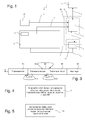
- the figure 1 represents an individual pool installation 1 using the method according to the invention.
- the installation comprises a pond 2 and water quality regulation means 3 in the basin and connected to the basin by an extraction pipe 4 and a delivery pipe 5.
- the installation also comprises supervisory means 6 communicating with the regulating means by a first connecting means 7, such as a set line, and by a second connecting means 8, such as an information line of FIG. regulation.
- the first connecting means and the second connecting means are advantageously made by bidirectional radiofrequency communication if the means The control means and the supervision means are physically distant from several meters.
- a memory not shown can contain predefined data relating to several predefined water treatment modes, as will be detailed later.
- the supervision means communicate with a remote server 10, shared between several installations, by a third connection means 9, such as an Internet network.
- the remote server 10 is dedicated to monitoring a pool of individual pools.
- the remote server 10 is a weather server.
- the installation comprises a presence sensor 11 immersed in the pool and connected to the supervision means.
- the presence sensor is provided with optical or vibratory devices, for example ultrasonic, to detect the presence of at least one swimmer in the pool and to transmit a presence information of logic type.
- the detection of presence can also be indirect, for example from the agitation of the pond water.
- the optical or vibratory devices make it possible to measure or quantitatively evaluate the number of swimmers in the pool and to transmit analog presence information.
- the presence information is transmitted on a presence information line 12, using wired, ultrasonic, infrared or radio frequency communication means.
- the installation also comprises a security sensor 13 of the perimeter type and connected to the supervision means.
- the security sensor detects the passage of a swimmer in the direction of the pool and transmits a security information of the logical type on a security information line 14.
- This sensor may be constituted by an infrared barrier arranged around the basin.
- an action sensor on a gate is used as a safety sensor.
- the security information is transmitted to the supervisory means using wired, ultrasonic, infrared or radiofrequency type communication means.
- the presence sensor also plays the role of security sensor, or conversely, to allow including the detection of drowning risk of a young child in the absence of adult supervision.
- Such a security sensor is generally required. Its existence is then advantageously used in the process according to the invention.
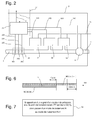
- the figure 2 represents means 3 for regulating the quality of the water in the installation 1.
- a first actuator 31 is for example a metering pump, allowing the injection of chlorinated products.
- a second actuator 32 is for example an electrolysis device.
- a third actuator 33 is for example an ozonator. Alternatively, the third actuator is an ultraviolet light device.
- the fourth actuator 34 is a motor acting on a circulation pump. The water coming from the extraction pipe is thus pushed back into the basin by the discharge pipe. Thus, these actuators allow the injection of treatment products or filtration of the pool water.
- the actuators are powered by a power supply line 15, for example from the AC mains, provided with means for voltage step-downs and / or differential protection not shown.
- the actuators are controlled by control lines, respectively referenced 310-340 for actuators 31-34.
- the control lines come from a microcontroller 35.
- a physico-chemical sensor assembly 36 comprises a first probe 361, for example a pH probe, a second probe 362, for example an optical probe or a chlorine probe, and a third probe 363, for example a water temperature probe. Other probes can also be used, for example for measuring water pressure or for measuring bacterial concentrations. These probes are connected to the microcontroller by measurement lines, respectively referenced 364 to 366.
- the microcontroller executes a regulation program, of the multi-variable servo type, able to satisfy a water quality criterion by driving the actuators using the control lines from data collected on the measurement lines.
- a regulation program of the multi-variable servo type, able to satisfy a water quality criterion by driving the actuators using the control lines from data collected on the measurement lines.
- Any technique in the automatic domain can be used in the control program, including expert system rules or fuzzy logic.
- a PID-type servocontrol is used and the quality criterion is the PID control setpoint.
- the quality criterion is satisfied if the actual value differs very little from the set value, for example to less than 5% or even less than 2%.
- the supervision means and the regulation means are represented as physically different. This is indeed the case if a first control device 61 includes only the supervision means, while a regulating device 63 comprises only the regulating means.
- a second control device 62 comprises the supervision means but also a part of the regulation means, and in particular the microcontroller 35.
- Such an arrangement makes it possible to regroup the hardware and software computer resources required for the supervision and regulation means, in a logical unit and common calculation, not shown.
- a metering pump can deliver more than a certain amount of chlorinated products per day, for a given volume of water. It can also be decided that the water circulation motor should rotate at no more than half of its rated speed or that it can only run during hours of low electric power charging.
- operating limit is meant any threshold imposed, that an operating parameter of an actuator can not exceed, which thus limits the operation of the actuator.
- Such a limit of operation can be temporal, by the definition of deactivation periods or by operation in off-peak hours only for example, can be a power, by the limitation of the operating power for example, can be a quantity of one certain resource as a processing product that must not be exceeded.
- an operating limit has the effect of limiting the consumption to a resource of energy type and / or treatment product and / or water of the water management device of the pool.
- a problem with defining strict operating limits is that reducing actuator processing can compromise the achievement of the quality objective, making it impossible to maintain operation within the tolerance range defined by these operating limits. .
- the risk is for example that a sudden pollution brought by a group of bathers, a significant mixing of the water, a storm or sand wind, untreated because of the operating limits imposed, lead the water in a cloudy state subsequently requiring a very important curative treatment.
- the management of the water quality by the device described above is done according to several distinct water treatment modes.
- Each mode is defined in particular by all the operating limits that apply to the actuators of the device.
- the modes are distinct in that at least one of these operating limits is different between two different modes.
- the figure 3 schematically represents the process according to the invention, applied to four modes of water treatment of the pool.
- the treatment modes are represented along an axis Q oriented according to increasing amounts of consumption.
- a first mode of treatment M1 is a mode of wintering, in which the parameters of operation of the actuators are very largely limited, certain actuators being able to be totally deactivated.
- a second mode of treatment M2 is a reduced mode of treatment, or mode of economic use, in which the quality of the water is maintained while setting important operating limits, but overall less restrictive than in the first mode of treatment . These limits have been determined by an installer or remotely by the server 20 if it is a manager of a pool of individual pools, considering that the pool is not used or that it is very little used.
- a very low use corresponds for example to less than one user for 40 cubic meters of basin. Lack of use or very low use can also be characterized by a state of total rest (or near-rest) of water in the basin.
- the presence of swimmers plays a large role in the need for treatment products: bacterial inputs, sweating, mixing water. It is therefore particularly advantageous to anticipate a change of mode according to information related to the presence of at least one swimmer, and preferably according to information of the number of swimmers, this number being at least estimated.
- a third mode of treatment M3 is an average mode of treatment, or mode of normal use, in which the swimming pool is normally used. Normal use corresponds, for example, to a user density that is greater than the previous case but remains less than one user per 10 cubic meters of pool.
- densities can be parameterized according to the temperature of the water, cold water being more tolerant to a large number of users, and / or depending on the agitation of the water caused by the users. They can also integrate historical data, and / or be determined by an expert system housed in the server 20.
- the operating limits are less restrictive in the third mode of treatment than in the second mode.
- a fourth M4 treatment mode is a strong mode of treatment, or "shock" mode, in which it is appropriate to allow the injection of strong treatment products.
- This method of treatment does not include any other operating limits than those imposed by the characteristics specific to each actuator and / or the normative limits on the authorized concentrations of products.
- each mode of treatment corresponds to the execution of a program for regulating the quality of the water.
- This control program is for example identical to control programs of the prior art: PID type control, control by internal model, control by fuzzy logic, etc.
- the process is represented on the figure 3 in the form of arrows symbolizing an automatic transition from a more economical treatment mode to a less economical treatment mode when the control means no longer meet a water quality criterion while remaining within the operating limits of the mode more economical treatment. (It is said that the more economical mode of treatment is saturated).
- a first arrow A11 represents an automatic passage, caused by the supervision means, from the reduced processing mode to the average processing mode, if the water quality criterion comes out of a predefined range.
- a second arrow A12 represents an automatic transition from the average treatment to the strong one if the quality criterion comes out of the predefined range.
- the figure 4 represents a first step of the method, in the case where the information of a presence sensor causes a first change of mode of treatment.
- the invention provides that it is possible to cause an advance passage from a more economical mode to a less economical mode following the receipt of information by the supervisory means, although the more economical mode is not not saturated yet.
- the regulating means do not act during the high rate tariff hours.
- the presence sensor detects a stirring of the water (or if the security sensor detects the approach of a user) the presence (or security) information received by the supervision means triggers the transition to the normal processing mode, with activation of certain control means, although it is quite possible that the presence of a swimmer, or a few swimmers, could be supported by the water basin without requiring to activate the means of regulation.
- This advance passage is represented by a third arrow A13.
- a fourth arrow A14 represents an advance passage of the average processing to the strong processing on receipt of information.
- the method is applied in the same way to a transition from winterization treatment to reduced treatment, either by anticipation or during a saturation of the control means.
- the figure 5 represents a second step of the method, in the case where the information of a meteorological server transmitted to the supervisory means causes a second mode change, namely a change from the average processing mode to the strong processing mode.
- This information is for example a significant risk of thunderstorm. Indeed, a stormy weather easily causes a change in the state of water by promoting bacterial proliferation.
- the information is transmitted by a management server of a swimming pool park.
- the information is provided by an individual mini-weather station, or simply by a water temperature sensor (for example the third probe 363 can be used for this purpose).
- the temperature of the water has a very important impact on its quality and the need for treatment products.
- the return to a more economical mode is also performed automatically, preferably following the receipt of information.
- a presence sensor operating by detecting agitation of the water can provide information that no more swimmers are in the pool.
- the method causes an automatic return from the average processing mode to the reduced processing mode, as represented by an arrow A15 on the figure 3 .
- this automatic return takes place after a fixed time delay, or linked to the number of swimmers detected by the presence sensor.
- the figure 6 schematically represents a critical zone CZ of a processing mode, for example the reduced processing mode M2, to illustrate the process step which will be described in FIG. figure 7 .
- An operating parameter PAR is shown on the abscissa and a first zone corresponding to a first more economical operating mode and designated by Mode (N) (and hatched in the figure) is limited on the right by a first operating limit applied to the parameter of PAR operation.
- a second zone corresponding to a second mode of operation less economical and designated by Mode (N + 1) (and dashed in the figure) is limited on the right by a second limit of operation of the PAR operating parameter, greater than the first limit .
- the operating parameter has a precise value, whatever the mode of operation. This value is represented by a PT operating point.
- the operating parameter is for example the time and each zone then corresponds to a permitted time slot in each mode, or for example a daily quantity of chlorinated products and each zone then corresponds to a range of daily quantities authorized in each mode.
- a critical zone CZ (N) is defined within each zone by a proximity relationship with the upper limit of the operating parameter.
- the critical zone is any value greater than 90% of the upper limit of the parameter.
- the critical zone CZ (N) assigned to the first zone and the critical zone CZ (N + 1) assigned to the second zone are represented.
- the figure 7 represents a third step of a variant of the process, in relation to the figure 6 , in the case where the information received by the supervisory means is information from a presence sensor.
- This variant avoids an automatic change of treatment mode if there is still a sufficient margin in the most economical mode.
- condition on the critical zone can be replaced by a time condition on the maintenance of the information. For example, early passage in the less efficient mode occurs only if the presence is detected for more than thirty minutes.
- the concept of the invention it is possible to know the operating state of the swimming pool water quality management device, simply by the knowledge of its operating mode, which gives relevant information. on the situation.
- a human machine interface which displays the active processing mode of the device, for example in the form of four LEDs representative of modes M1 to M4 of the description. Switching from one operating mode to another can also be done manually.
- the pool owner or his maintenance manager has complete control over the individual pool.
- the understanding of the operation of the device and the programming relative to each mode of operation, in particular by fixing or Moving operating limit values, is easy and natural.
- the control method may be slightly less efficient than other complex processes used for collective pools, but it has the great advantage of not requiring any particular expertise for its implementation.
Landscapes
- Chemical & Material Sciences (AREA)
- Life Sciences & Earth Sciences (AREA)
- Organic Chemistry (AREA)
- Engineering & Computer Science (AREA)
- Health & Medical Sciences (AREA)
- Zoology (AREA)
- Wood Science & Technology (AREA)
- Proteomics, Peptides & Aminoacids (AREA)
- Molecular Biology (AREA)
- Bioinformatics & Cheminformatics (AREA)
- Immunology (AREA)
- Microbiology (AREA)
- Biophysics (AREA)
- Analytical Chemistry (AREA)
- Physics & Mathematics (AREA)
- Toxicology (AREA)
- Biochemistry (AREA)
- Biotechnology (AREA)
- General Engineering & Computer Science (AREA)
- General Health & Medical Sciences (AREA)
- Genetics & Genomics (AREA)
- Hydrology & Water Resources (AREA)
- Environmental & Geological Engineering (AREA)
- Water Supply & Treatment (AREA)
- Treatment Of Water By Oxidation Or Reduction (AREA)
- Control Of Non-Electrical Variables (AREA)
Applications Claiming Priority (1)
| Application Number | Priority Date | Filing Date | Title |
|---|---|---|---|
| FR0954843A FR2947906B1 (fr) | 2009-07-10 | 2009-07-10 | Controle de la qualite de l'eau dans une piscine individuelle |
Publications (1)
| Publication Number | Publication Date |
|---|---|
| EP2273039A1 true EP2273039A1 (de) | 2011-01-12 |
Family
ID=41664398
Family Applications (1)
| Application Number | Title | Priority Date | Filing Date |
|---|---|---|---|
| EP10169084A Withdrawn EP2273039A1 (de) | 2009-07-10 | 2010-07-09 | Überwachung der Wasserqualität in Swimmingpool |
Country Status (2)
| Country | Link |
|---|---|
| EP (1) | EP2273039A1 (de) |
| FR (1) | FR2947906B1 (de) |
Cited By (4)
| Publication number | Priority date | Publication date | Assignee | Title |
|---|---|---|---|---|
| FR3060803A1 (fr) * | 2016-12-20 | 2018-06-22 | Ondilo | Procede pour maintenir un equilibre d'un parametre physico-chimique d'un milieu, produit programme d'ordinateur et moyen electronique associes |
| FR3069860A1 (fr) * | 2017-08-03 | 2019-02-08 | Klereo | Procede et dispositif de desinfection de l'eau d'une piscine |
| EP4484382A1 (de) * | 2023-06-29 | 2025-01-01 | ACWA Groupe | Anlage zur chlorierung von wasser in einem schwimmbecken |
| WO2026106906A1 (en) * | 2024-11-12 | 2026-05-21 | King Technology, Inc. | Automated method for inhibiting microorganism growth in a recreational body of water |
Citations (4)
| Publication number | Priority date | Publication date | Assignee | Title |
|---|---|---|---|---|
| US4676914A (en) * | 1983-03-18 | 1987-06-30 | North Coast Systems, Inc. | Microprocessor based pump controller for backwashable filter |
| US5422014A (en) * | 1993-03-18 | 1995-06-06 | Allen; Ross R. | Automatic chemical monitor and control system |
| US5628896A (en) * | 1994-10-21 | 1997-05-13 | Klingenberger Gmbh | Apparatus for operating a filter arrangement |
| DE102005035238A1 (de) * | 2005-07-25 | 2007-02-01 | Udo Dr.-Ing. Pauly | Verfahren zur Überwachung und Steuerung der Wassergüte in Schwimmbädern |
-
2009
- 2009-07-10 FR FR0954843A patent/FR2947906B1/fr active Active
-
2010
- 2010-07-09 EP EP10169084A patent/EP2273039A1/de not_active Withdrawn
Patent Citations (4)
| Publication number | Priority date | Publication date | Assignee | Title |
|---|---|---|---|---|
| US4676914A (en) * | 1983-03-18 | 1987-06-30 | North Coast Systems, Inc. | Microprocessor based pump controller for backwashable filter |
| US5422014A (en) * | 1993-03-18 | 1995-06-06 | Allen; Ross R. | Automatic chemical monitor and control system |
| US5628896A (en) * | 1994-10-21 | 1997-05-13 | Klingenberger Gmbh | Apparatus for operating a filter arrangement |
| DE102005035238A1 (de) * | 2005-07-25 | 2007-02-01 | Udo Dr.-Ing. Pauly | Verfahren zur Überwachung und Steuerung der Wassergüte in Schwimmbädern |
Cited By (7)
| Publication number | Priority date | Publication date | Assignee | Title |
|---|---|---|---|---|
| FR3060803A1 (fr) * | 2016-12-20 | 2018-06-22 | Ondilo | Procede pour maintenir un equilibre d'un parametre physico-chimique d'un milieu, produit programme d'ordinateur et moyen electronique associes |
| WO2018115751A1 (fr) * | 2016-12-20 | 2018-06-28 | Ondilo | Procede pour maintenir un equilibre d'un parametre physico-chimique d'un milieu, produit programme d'ordinateur et module electronique associes |
| US11543839B2 (en) | 2016-12-20 | 2023-01-03 | Ondilo | Method for maintaining an equilibrium of a physico-chemical parameter of a medium, associated computer program product and electronic module |
| FR3069860A1 (fr) * | 2017-08-03 | 2019-02-08 | Klereo | Procede et dispositif de desinfection de l'eau d'une piscine |
| EP4484382A1 (de) * | 2023-06-29 | 2025-01-01 | ACWA Groupe | Anlage zur chlorierung von wasser in einem schwimmbecken |
| FR3150513A1 (fr) * | 2023-06-29 | 2025-01-03 | Acwa Groupe | Installation pour la chloration de l’eau d’une piscine |
| WO2026106906A1 (en) * | 2024-11-12 | 2026-05-21 | King Technology, Inc. | Automated method for inhibiting microorganism growth in a recreational body of water |
Also Published As
| Publication number | Publication date |
|---|---|
| FR2947906B1 (fr) | 2015-01-02 |
| FR2947906A1 (fr) | 2011-01-14 |
Similar Documents
| Publication | Publication Date | Title |
|---|---|---|
| EP2452507A2 (de) | Überwachung einer poolgruppe | |
| EP3545266B1 (de) | Wassersensor und analytiksystem | |
| CN117084200B (zh) | 应用大数据分析的水产养殖投药控制系统 | |
| CA2283679A1 (fr) | Procede d'entretien de l'eau d'une piscine et dispositif pour la mise en oeuvre du procede | |
| FR2947906A1 (fr) | Controle de la qualite de l'eau dans une piscine individuelle | |
| FR3008207A1 (fr) | Unite et procede de regulation energetique d'un systeme de production et de consommation electrique | |
| KR102504241B1 (ko) | 인공지능 기반의 수질 모니터링 방법 및 시스템 | |
| FR3071260A1 (fr) | Integrateur hydraulique et procede pour la gestion centralisee du reseau hydraulique d'une installation | |
| US12618742B2 (en) | Periodic water leak detection | |
| EP3816854A1 (de) | Verfahren und vorrichtung zur verbesserten kontrolle von schwimmbädern | |
| FR3140877A1 (fr) | Procédé et dispositif de désinfection de l'eau d'une piscine. | |
| CN108870755B (zh) | 一种蓄热式开水器开水容量的自动调节方法及装置 | |
| EP1051260A1 (de) | Verfahren zur reglung von zentrifugen für die entwässerung von abfallwasserschlämmen unter benutzung von fuzzy-logic | |
| CN120428786A (zh) | 一种优化人工生境冷给水控制策略的方法及系统 | |
| WO2010052419A1 (fr) | Procede et dispositif de regulation de parametres internes physiques et chimiques d'un liquide dans un circuit hydraulique | |
| FR3035563A1 (fr) | Arrosage autonome-telegere | |
| WO2015036406A1 (fr) | Gestion de la consommation energetique d'un parc de calculateurs | |
| WO2010055236A1 (fr) | Dispositif et procede de controle d'une concentration d'un desinfectant halogene dans une piscine ou similaire. | |
| FR3094087A1 (fr) | Système et procédé pour le suivi et le contrôle centralisé de la consommation en eau de bâtiments comportant plusieurs étages | |
| WO2025088269A1 (fr) | Procédé et dispositif de contrôle de qualité d'un liquide faiblement chargé dans un système comprenant une filtration membranaire | |
| FR3147860A1 (fr) | Systeme et procede de surveillance d'installation aquatique | |
| EP3558111B1 (de) | Verfahren zur aufrechterhaltung eines gleichgewichts eines physikalisch-chemischen parameters eines mediums, zugehöriges computerprogrammprodukt und elektronisches modul | |
| FR2912939A1 (fr) | Procede de degradation de dechets et systeme correspondant | |
| FR2951446A1 (fr) | Dispositif de traitement d'une eau de bassin et notamment de piscine a partir d'un derive halogene et procede de mise en oeuvre associe | |
| EP2886701B1 (de) | System zur Wassererwärmung und -versorgung der Verbraucher |
Legal Events
| Date | Code | Title | Description |
|---|---|---|---|
| PUAI | Public reference made under article 153(3) epc to a published international application that has entered the european phase |
Free format text: ORIGINAL CODE: 0009012 |
|
| AK | Designated contracting states |
Kind code of ref document: A1 Designated state(s): AL AT BE BG CH CY CZ DE DK EE ES FI FR GB GR HR HU IE IS IT LI LT LU LV MC MK MT NL NO PL PT RO SE SI SK SM TR |
|
| AX | Request for extension of the european patent |
Extension state: BA ME RS |
|
| 17P | Request for examination filed |
Effective date: 20110712 |
|
| 17Q | First examination report despatched |
Effective date: 20111018 |
|
| STAA | Information on the status of an ep patent application or granted ep patent |
Free format text: STATUS: THE APPLICATION IS DEEMED TO BE WITHDRAWN |
|
| 18D | Application deemed to be withdrawn |
Effective date: 20140201 |