EP2273685A2 - Drahtlose RF-Vorrichtung, die eine Infrarotbake zur Anwesenheitserkennung beinhaltet - Google Patents
Drahtlose RF-Vorrichtung, die eine Infrarotbake zur Anwesenheitserkennung beinhaltet Download PDFInfo
- Publication number
- EP2273685A2 EP2273685A2 EP10003130A EP10003130A EP2273685A2 EP 2273685 A2 EP2273685 A2 EP 2273685A2 EP 10003130 A EP10003130 A EP 10003130A EP 10003130 A EP10003130 A EP 10003130A EP 2273685 A2 EP2273685 A2 EP 2273685A2
- Authority
- EP
- European Patent Office
- Prior art keywords
- access point
- code
- wireless communication
- audio
- wireless
- Prior art date
- Legal status (The legal status is an assumption and is not a legal conclusion. Google has not performed a legal analysis and makes no representation as to the accuracy of the status listed.)
- Granted
Links
Images



Classifications
-
- H—ELECTRICITY
- H04—ELECTRIC COMMUNICATION TECHNIQUE
- H04B—TRANSMISSION
- H04B1/00—Details of transmission systems, not covered by a single one of groups H04B3/00 - H04B13/00; Details of transmission systems not characterised by the medium used for transmission
- H04B1/38—Transceivers, i.e. devices in which transmitter and receiver form a structural unit and in which at least one part is used for functions of transmitting and receiving
- H04B1/40—Circuits
-
- H—ELECTRICITY
- H04—ELECTRIC COMMUNICATION TECHNIQUE
- H04W—WIRELESS COMMUNICATION NETWORKS
- H04W4/00—Services specially adapted for wireless communication networks; Facilities therefor
- H04W4/80—Services using short range communication, e.g. near-field communication [NFC], radio-frequency identification [RFID] or low energy communication
Definitions
- the present invention relates to networks of devices that can be connected using wireless links, in particular devices that use the Bluetooth technology.
- embodiments of the present invention pertain to a method and system for selecting and connecting to wireless access point within a local area network.
- Bluetooth One prevalent technology for wireless distribution of audio and data is Bluetooth, where its popularity is based on it providing a high-performance, yet low-cost, integrated radio transceiver.
- Bluetooth protocol is known in the art as a short range (10 meter) frequency-hopping radio link between devices. These devices are then termed “Bluetooth-enabled”.
- Bluetooth is a trademark owned by Bluetooth SIG, Inc. Bluetooth technology allows Bluetooth devices to "discover" other Bluetooth devices that are within range and then connect with those devices, either automatically or at a user's discretion.
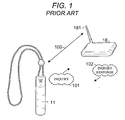
- FIG. 1 depicts a wireless microphone 11 that is sending audio, via a Bluetooth RF communication link 100, to a wireless audio access point 18 that is configured as a wireless communication access point.
- This application is suitable for a teacher, using this wireless microphone 11, to address students in a classroom setting.
- Such audio distribution using Bluetooth is well understood in the prior art and is similar to Bluetooth links between mobile telephones and microphone headsets, etc.
- Bluetooth radios operate in the ISM (Industrial, Scientific, and Medical) band at 2.4 GHz (gigahertz).
- ISM International, Scientific, and Medical
- a frequency hop transceiver is applied to combat interference and fading.
- Bluetooth uses a packet-switching protocol based on a frequency hop scheme with 1600 hops/second. Slots can be reserved for synchronous packets. A packet nominally covers a single slot, but can be extended to cover up to five slots. Each packet is transmitted in a different hop frequency. The entire available frequency spectrum is used with 79 hops of one (1) MHz (megahertz) bandwidth, defined analogous to the IEEE (Institute of Electronic and Electrical Engineers) 802.11 standard.
- a connection between devices is made by a page message if the address is already known, or by an inquiry message followed by a page message if the address is unknown.
- the inquiry message enables the Bluetooth device to discover which other Bluetooth units are in range and what their addresses are, as well as other information such as their clocks and class-of-device.
- a “discoverable device” is a Bluetooth device in range that will respond to an inquiry (normally in addition to responding to a page).
- a discoverable device scans for inquiry messages, referred to as "inquiry scan.”
- a “connectable device” is a Bluetooth device in range that will respond to a page.
- Bluetooth communication is established first by having an unconnected Bluetooth (initiator) device broadcast an 'Inquiry' command that instructs all other Bluetooth devices in the immediate vicinity that are 'discoverable', to provide their respective Bluetooth addresses and clock values. Accordingly, the wireless microphone 11 broadcasts a Bluetooth inquiry 101 and the wireless audio access point 18 responds by broadcasting a Bluetooth inquiry response 102. Although not illustrated, those skilled in the art will appreciate that all other discoverable Bluetooth devices in the immediate vicinity will also broadcast their own Bluetooth inquiry responses.
- the still unconnected wireless microphone 11 pages each of the discovered Bluetooth devices and, based on contents of their responses, determines to which other Bluetooth device it desires to connect.
- a Bluetooth 'Master page response' is then sent to the desired device and the desired device accepts the connection.
- the wireless audio access point 18 is the desired device to which the wireless microphone 11 will attempt to connect.
- the final step is for the wireless audio access point 18 to take control of the Bluetooth link by becoming the 'master' and causing the wireless microphone 11 to become the 'slave'. This transfer of control is accomplished using a Bluetooth 'LMP_switch_req' command.
- Table 1 The above described example of establishing a Bluetooth communication link is detailed further in Table 1.
- the wireless audio access point 18 must always, or least periodically, be discoverable in order to establish a new link with a previously unconnected wireless microphone 11.
- the wireless audio access point 18 issues the Bluetooth 'inquiry', either periodically to search for new devices or by a manual operator action.
- This alternative suffers from the drawback of either having to reserve Bluetooth bandwidth for the periodic search or of requiring a manual operator action at the wireless audio access point 18.
- both prior art alternatives will allow the devices to be discovered by extraneous Bluetooth devices outside of the audio system and also allow the audio system to discover these extraneous devices. Examples of such extraneous devices include, but are not limited to: cell phones and associated earpieces, desktop and laptop computers, fax machines, game controllers, keyboards and mice, personal digital assistants (PDA), and printers.
- PDA personal digital assistants
- Table 2 below lists the ranges associated with the various classes of Bluetooth radios.
- Class Maximum Permitted Power mW (dBm) Range (approximate) Class 1 100 mW (20 dBm) ⁇ 100 meters Class 2 2.5 mW (4 dBm) ⁇ 10 meters* Class 3 1 mW (0 dBm) ⁇ 1 meter *
- Class 2 devices In most cases the effective range of class 2 devices is extended if they connect to a class 1 transceiver, compared to a pure class 2 network. This is accomplished by the higher sensitivity and transmission power of Class 1 devices.
- FIG. 2 depicts a portion of a school building having several classrooms and with the wireless range of a typical Bluetooth device thereupon superimposed.
- a class 2 Bluetooth device 210 such as wireless audio access point 18, located in a first classroom 21 extends well beyond the confines of that classroom.
- the wireless audio access point 18 located in the first classroom 21 would interact, such as by trying to establish the Bluetooth RF communication link 100, with any Bluetooth devices located in a second classroom 22, a fourth classroom 24, and a fifth classroom 25.
- the Bluetooth wireless audio access point 18 also interacts with some portion of the Bluetooth devices in a third classroom 23, a sixth classroom 26, a seventh classroom 27, and an eighth classroom 28.
- a ninth classroom 29 would not interact with the Bluetooth wireless audio access point 18 in the first classroom 21, but even that is not assured, as described above in the table notes for Table 2.
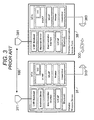
- FIG. 3 depicts a portable wireless device communicating with a wireless communication access point using Bluetooth and additionally including IrDA, an infrared digital protocol, in order to accelerate Bluetooth connection times in accordance with a known method.
- the Bluetooth Specification provides for an out of band (OoB) association to discover the devices as well as to exchange or transfer cryptographic numbers used in the pairing process.
- OoB out of band
- a portable wireless device may include both a Bluetooth radio and an Infrared Data Association (IrDA) high speed infrared protocol.
- An IrDA communication link 300 is a low power infrared (IR) signal having high-speed characteristics (i.e. baud rate of 9600 baud or greater) and short range (i.e. limited to 1 meter).
- Portable wireless device 31 includes both a Bluetooth RF antenna 311 and an IrDA infrared transceiver 313.
- wireless communication access point 38 also includes both a corresponding Bluetooth RF antenna 381 and a corresponding IrDA infrared transceiver 383.
- the prior art simply does not provide an effective means of limiting Bluetooth communications to the confines of a single classroom.
- the prior does include certain provisions for out of band (OoB) communications, including IrDA, these provisions are not suitable for a classroom audio system where communication between a wireless microphone and a wireless audio access point is based on collocation within the confines of the same classroom.
- OFB out of band
- the present invention provides a wireless communication system comprising a portable wireless device and a wireless communication access point that manages radio frequency digital communications based on a low baud rate infrared beacon signal.
- the portable wireless device includes a radio frequency digital transceiver, an infrared beacon transmitter, and a control switch.
- the infrared beacon transmitter transmits a low baud rate infrared beacon signal at a data rate greater than 400 baud (symbols per second) and less than 9600 baud.
- the wireless communication access point includes a radio frequency digital transceiver that communicates with said radio frequency digital transceiver of said portable wireless device and an infrared sensor that receives the low baud rate infrared beacon signal.
- the wireless communication access point manages radio frequency digital communications based on the low baud rate infrared beacon signal.
- the present invention provides a wireless audio distribution system suitable for use in a classroom setting.
- This audio distribution system includes a RF wireless microphone that further includes a Bluetooth transceiver, an infrared beacon transmitter, a control switch, and a microphone element.
- This audio distribution system also includes a wireless audio access point that further comprises a Bluetooth transceiver and an infrared sensor.
- the infrared beacon transmitter transmits a first IR code upon activation of the control switch and transmits a second IR code, which has a value assigned by the wireless audio access point.
- the RF wireless microphone and the wireless audio access point establish Bluetooth communication upon detection of the first IR code at the wireless audio access point.
- the RF wireless microphone and the wireless audio access point terminate Bluetooth communication upon a first predetermined condition of failing to receive the second IR code.
- the RF wireless microphone and the wireless audio access point reestablish Bluetooth communication upon a second predetermined condition of receiving said second IR code.
- the wireless audio access point mutes the audio output from the microphone element upon a third predetermined condition of failing to receive the second IR code.
- the wireless audio access point enables the audio output from the microphone element upon a fourth predetermined condition of receiving the second IR code.
- the infrared transmitter is adapted to transmit a low baud rate infrared beacon signal at a data rate greater than 400 baud and less than 9600 baud; and the first and second IR codes are transmitted via the low baud rate infrared signal.
- the present invention provides a method for selectively communicating with a portable wireless device as it moves throughout a predefined area.
- This method comprises the steps of: providing the portable wireless device, providing a plurality of a wireless communication access points, transmitting a first IR code from the portable wireless device to a first wireless communication access point, selecting a specific RF communication channel based on the contents of the first IR code, and establishing communication between the portable wireless device and said first wireless communication access point on the specific RF communication channel.
- the plurality of a wireless communication access points are located throughout the predetermined area. Each one of said wireless communication access points is located at a predetermined position, is capable of wireless reception and transmission on multiple RF communication channels, and is capable of receiving IR codes.
- the first IR code comprises an infrared signal at a data rate of between 400 and 9600 baud.
- the present invention provides a method for selectively distributing audio from a wireless microphone to an audio component.
- This method comprises the steps of: providing the wireless microphone and audio distribution component, transmitting a first IR code from the wireless microphone to the audio distribution component and simultaneously attempting to reestablish Bluetooth communication with a previously connected audio distribution component when an operator of the wireless microphone actuates a switch, establishing Bluetooth communication between wireless microphone and the audio distribution component, transmitting a recognized value from the audio distribution component to the wireless microphone via Bluetooth communication, assigning (step 703) the recognized value to the second IR code at the wireless microphone, transmitting (step 704), upon request, the second IR code from the wireless microphone to the audio distribution component, conditionally terminating and reestablishing Bluetooth communications based on the presence of the second IR code, and conditionally muting and enabling audio based on the presence of the second IR code.
- the wireless microphone transmits and receives Bluetooth messages including audio data.
- the wireless microphone also transmits an infrared beacon signal.
- the first IR code is particularly suitable to facilitate fast pairing.
- the Bluetooth communication between the wireless microphone and the audio distribution component is conditionally terminated when the second IR code is not received, at the audio distribution component, for a first predetermined time increment.
- the Bluetooth communication between the wireless microphone and the audio distribution component is conditionally reestablished the second IR code, having a recognized value, is received at the audio distribution component.
- the audio from the microphone is conditionally muted when the second IR code is not received at the audio distribution component for a second predetermined time increment.
- the audio from the microphone is conditionally enabled when the second IR code, having a recognized value, is received at the audio distribution component.
- the present invention seeks to overcome or at least ameliorate one or more of several problems, including but not limited to: using an RF wireless microphone in multiple classrooms.
- FIG. 1 depicts a wireless microphone using Bluetooth, a radio frequency digital protocol, to transmit an audio signal to a wireless audio access point.
- FIG. 2 depicts a portion of a school building having several classrooms and with the wireless range of a typical Bluetooth device thereupon superimposed.
- FIG. 3 depicts a portable wireless device communicating with a wireless communication access point using Bluetooth and additionally including IrDA, an infrared digital protocol, in order to accelerate Bluetooth connection times in accordance with a known method.
- FIG. 4 depicts a classroom audio presentation system that uses a single RF wireless microphone that further includes an infrared beacon for presence detection in accordance with one illustrative embodiment of the present invention.
- FIG. 5 illustrates further details for the wireless microphone of FIG. 4 .
- FIG. 6 illustrates further details for the wireless audio access point (i.e. wireless communication access point) of FIG. 4 .
- FIG. 7 is a flowchart of a process for intelligently connecting to a wireless access point and maintaining this connection based on the presence of an infrared signal in accordance with one embodiment of the present invention.
- Bluetooth is the code name for a technology specification for small form factor, low-cost, short-range radio links between personal computers (PCs), personal digital assistants (PDA), mobile phones, and other devices.
- a collection of devices connected in a Bluetooth system is referred to as a "piconet” or a "subnet.”
- a piconet starts with two connected devices, such as a computer system and a cellular phone, and may grow to eight connected devices. All Bluetooth devices are peer units; however, when establishing a piconet, one unit will act as a master and the other(s) as slave(s) for the duration of the piconet connection.
- the present invention can be embodied as a wireless classroom audio presentation system that includes at least one RF wireless microphone 41 that works in conjunction with a wireless audio access point 48.
- This wireless audio access point is located in such a position within a classroom, such as being ceiling-mounted, so that it is generally in a line of sight with all interior portions of the classroom and out of a line of sight from the interior portions of other classrooms.
- a wireless audio access point 48 mounted on the ceiling of a first classroom 21, as shown in FIG. 2 should not be visible to an occupant of a second classroom 22.
- the RF wireless microphone 41 is a Bluetooth microphone that additionally incorporates an infrared beacon transmitter 413.
- This infrared beacon transmitter 413 is designed to transmit a low baud rate infrared beacon signal 400 at both a low power setting and a high power setting.
- the wireless audio access point 48 detects the presence of RF wireless microphone 41 within the same classroom by verifying that the microphone is within a direct line of sight, of infrared (IR) sensor 483, by causing the RF wireless microphone to transmit an infrared beacon code at a the low power setting or alternatively within an indirect line of sight by causing transmission of this infrared beacon code at a high power setting.
- IR infrared
- a Bluetooth RF communication link 100 is established between the RF microphone 41 and the wireless audio access point 48 as follows. First, the person operating the RF microphone 41, such as a school teacher, activates a control switch 414 which causes the RF wireless microphone 41 to emit a first IR Code 401 from its infrared beacon transmitter 413. Next, the wireless audio access point 48 detects this first IR Code 401 at its infrared sensor 483 and in response thereto transmits a Bluetooth inquiry 101. Finally, the RF wireless microphone 41 responds with a Bluetooth inquiry response 102 using techniques known to those skilled in the art.
- the RF wireless microphone 41 to become discoverable for a very short time duration, namely the duration required to become recognized by the wireless audio access point 48 which is functioning as a Bluetooth 'master'.
- the first IR code 401 is a long code particularly adapted to facilitate fast Bluetooth pairing of the RF wireless microphone 41 and the wireless audio access point 48.
- this long code includes the Bluetooth address of wireless microphone 41.
- a low baud rate infrared beacon signal 400 including a first IR code 401 in order to establish a Bluetooth communication link 100 to avoid having to remain discoverable to extraneous Bluetooth devices can be extended to other wireless communication systems and various other portable wireless devices.
- a low baud rate infrared beacon signal that includes relatively simple (short bit pattern) codes provides significant advantages as compared to a high baud rate digital infrared two communication, such as IrDA. These advantages include a greater optical range, such as allowing for both direct and indirect lines of sight, and lower power consumption at the infrared transmitter. These advantages can be significantly enhanced by managing both the power level of the infrared beacon transmitter and the duty cycle of the IR code transmission, such as for example once every 2 minutes. Suitable data rates for such a low baud rate infrared beacon signal 400 are between 400 baud and 9600 baud with 1200 baud having been shown to provide satisfactory operational characteristics.
- FIG. 5 shows an exemplary block diagram of certain functional blocks within the RF wireless microphone 41.
- the primary functional blocks shown include a Bluetooth transceiver 415, an infrared beacon transmitter 413, and a control switch 414 that provide the functionality previously described above.
- the RF wireless microphone 41 includes an antenna 411 associated with Bluetooth transceiver 415, a microphone element 417 and associated audio input circuitry, and processing and memory elements typically found in modem electronic equipment.
- FIG. 6 shows an exemplary block diagram of certain functional blocks within the wireless audio access point 48.
- the primary functional blocks shown include a Bluetooth transceiver 485 and an infrared (IR) sensor 483 that provide the functionality previously described above.
- the wireless audio access point 48 includes an antenna 481 associated with Bluetooth transceiver 485, audio output circuitry 487, and processing and memory elements typically found in modern electronic equipment.
- FIG. 7 shows a process flowchart 700 for selectively communicating with a portable wireless device as it moves throughout a predefined area.
- the portable wireless device is a wireless microphone and the predefined area is a portion of a school building.
- the present invention is also suitable for use in other predefined areas, such as, but not limed to: conference centers and hotels.
- the predefined area includes a number of wireless communication access points within the area.
- Flowchart 700 includes processes of the present invention which, in one embodiment, are carried out by a processor and electrical components under the control of computer readable and computer executable instructions.
- the computer readable and computer executable instructions may reside, for example, in data storage features such as computer usable memory or in any other type of computer readable medium.
- specific steps are disclosed in flowchart 700, such steps are exemplary. That is, the present invention is well suited to performing various other steps or variations of the steps recited in FIG. 7 . Within the present embodiment, it should be appreciated that the steps of flowchart 700 can be performed by software or hardware or any combination of software and hardware.
- an RF communication link such as a Bluetooth RF communication link 100 is established (step 702) only after the portable wireless device 41 has transmitted (step 701) a first IR code 401 and this first IR code is received at the wireless communication access point 48.
- Establishing (step 702) the Bluetooth link entails the wireless communication access point 48 transmitting a Bluetooth inquiry 101 and the portable wireless device transmitting a Bluetooth inquiry response 102.
- the first IR code may be transmitted (step 701) in response to an operator action.
- the inventor has discovered that it is advantageous to use relatively high powered infrared signal at a low data rate, such as between 400 and 9600 baud because this signal has a reasonable range for use within a single room and is reasonably low-powered, especially if transmitted at a low duty cycle.
- a low data rate such as between 400 and 9600 baud
- the present invention generally selects a specific RF communication channel based on the contents of the first IR code and that a particular Bluetooth frequency hopping scheme is only one instance of a specific RF communication channel that is established in accordance with the present invention.
- the wireless access point 48 assigns (step 703) a second IR code for the portable wireless device 41 to transmit (step 704) upon request.
- this allows the wireless access point 48 to determine whether the portable wireless device is within the confines of the same room, such as a school classroom.
- the portable wireless device 41 is a wireless microphone.
- the wireless access point 48 such as a wireless audio access point, periodically requests that the wireless microphone 41 transmit (step 704) the second IR code. If the second IR code is not received (i.e. 'missing') at the wireless audio access point 48 add more specifically at IR Sensor 483, shown in FIG. 6 , then the audio from the wireless microphone is muted (step 708). Note that the associated audio data stream is still being transmitted from the wireless microphone 41 to the wireless audio access point 48, but is being muted in the audio output circuitry 487, shown in FIG. 6 .
- the wireless audio access point 48 continues to request for the wireless microphone 41 to transmit the second IR Code.
- the wireless audio access point 48 will request that the second IR Code be transmitted at a 'high power' setting so that collocation can be determined even if the infrared beacon transmitter 413 is not in a direct line-of-sight with the IR sensor 483.
- the RF communication link such as Bluetooth
- embodiments of the present invention provide a user-friendly system and method for using a wireless microphone in multiple classrooms while monitoring whether the wireless microphone is collocated in a classroom with a wireless audio access point while preventing undesired or extraneous audio.
- the present invention includes a method for intelligently selecting a Bluetooth access point from a plurality of available points.
Landscapes
- Engineering & Computer Science (AREA)
- Computer Networks & Wireless Communication (AREA)
- Signal Processing (AREA)
- Mobile Radio Communication Systems (AREA)
- Optical Communication System (AREA)
Applications Claiming Priority (1)
| Application Number | Priority Date | Filing Date | Title |
|---|---|---|---|
| US12/466,854 US8254838B2 (en) | 2009-05-15 | 2009-05-15 | RF wireless device including an infrared beacon for presence detection |
Publications (3)
| Publication Number | Publication Date |
|---|---|
| EP2273685A2 true EP2273685A2 (de) | 2011-01-12 |
| EP2273685A3 EP2273685A3 (de) | 2012-08-15 |
| EP2273685B1 EP2273685B1 (de) | 2015-10-14 |
Family
ID=43068907
Family Applications (1)
| Application Number | Title | Priority Date | Filing Date |
|---|---|---|---|
| EP10003130.1A Not-in-force EP2273685B1 (de) | 2009-05-15 | 2010-03-24 | Drahtlose RF-Vorrichtung, die eine Infrarotbake zur Anwesenheitserkennung beinhaltet |
Country Status (2)
| Country | Link |
|---|---|
| US (1) | US8254838B2 (de) |
| EP (1) | EP2273685B1 (de) |
Families Citing this family (27)
| Publication number | Priority date | Publication date | Assignee | Title |
|---|---|---|---|---|
| US8145134B2 (en) * | 2008-07-22 | 2012-03-27 | At&T Intellectual Property I, L.P. | Wireless microphone beacon |
| US8989420B1 (en) * | 2010-04-26 | 2015-03-24 | Engagement Innovations LLC | Throwable wireless microphone system for passing from one user to the next in lecture rooms and auditoriums |
| EP2633702B1 (de) * | 2010-10-29 | 2020-03-11 | Cochlear Limited | Dopplung oder verknüpfung elektronischer vorrichtungen |
| WO2013012547A1 (en) | 2011-06-30 | 2013-01-24 | Lutron Electronics Co., Inc. | Load control device having internet connectivity, and method of programming the same using a smart phone |
| US9544977B2 (en) | 2011-06-30 | 2017-01-10 | Lutron Electronics Co., Inc. | Method of programming a load control device using a smart phone |
| US9386666B2 (en) | 2011-06-30 | 2016-07-05 | Lutron Electronics Co., Inc. | Method of optically transmitting digital information from a smart phone to a control device |
| US9942093B2 (en) | 2011-08-26 | 2018-04-10 | Comcast Cable Communications, Llc | Data gathering for a node |
| US20130222122A1 (en) | 2011-08-29 | 2013-08-29 | Lutron Electronics Co., Inc. | Two-Part Load Control System Mountable To A Single Electrical Wallbox |
| JP5901231B2 (ja) * | 2011-11-04 | 2016-04-06 | オリンパス株式会社 | 無線通信端末 |
| US20140022917A1 (en) * | 2012-07-17 | 2014-01-23 | Procter And Gamble, Inc. | Home network of connected consumer devices |
| US20140022968A1 (en) * | 2012-07-17 | 2014-01-23 | Procter And Gamble, Inc. | Home network of connected consumer devices |
| US9992729B2 (en) * | 2012-10-22 | 2018-06-05 | The Nielsen Company (Us), Llc | Systems and methods for wirelessly modifying detection characteristics of portable devices |
| US10244086B2 (en) | 2012-12-21 | 2019-03-26 | Lutron Electronics Co., Inc. | Multiple network access load control devices |
| US9413171B2 (en) | 2012-12-21 | 2016-08-09 | Lutron Electronics Co., Inc. | Network access coordination of load control devices |
| US10019047B2 (en) | 2012-12-21 | 2018-07-10 | Lutron Electronics Co., Inc. | Operational coordination of load control devices for control of electrical loads |
| US10135629B2 (en) | 2013-03-15 | 2018-11-20 | Lutron Electronics Co., Inc. | Load control device user interface and database management using near field communication (NFC) |
| KR102246742B1 (ko) | 2015-04-17 | 2021-05-03 | 삼성전자주식회사 | 전자 장치 및 전자 장치에서 적어도 하나의 페어링 대상을 식별하는 방법 |
| US10917767B2 (en) | 2016-03-31 | 2021-02-09 | Intel Corporation | IOT device selection |
| US10097948B2 (en) | 2016-03-31 | 2018-10-09 | Intel Corporation | Point-and-connect bluetooth pairing |
| US9877212B1 (en) | 2016-11-08 | 2018-01-23 | International Business Machines Corporation | Crowd sourcing beacon setting adjustments |
| US10505909B2 (en) | 2016-12-21 | 2019-12-10 | Intel Corporation | Dual physical channel secure connection |
| US10867601B2 (en) * | 2018-01-17 | 2020-12-15 | Citrix Systems, Inc. | In-band voice-assistant/concierge for controlling online meetings |
| US11494514B1 (en) | 2018-02-20 | 2022-11-08 | PRIVACY4CARS, Inc. | Data privacy and security in vehicles |
| US11157648B1 (en) | 2018-02-20 | 2021-10-26 | PRIVACY4CARS, Inc. | Data privacy and security in vehicles |
| US11026277B2 (en) * | 2019-01-22 | 2021-06-01 | Galaxy Next Generation, Inc. | Assistive listening system that uses sound waves for device pairing |
| US11921886B2 (en) | 2021-06-17 | 2024-03-05 | PRIVACY4CARS, Inc. | Artificial intelligence based system and method for generating dynamically variable multi-dimensional privacy rating for vehicles |
| US12380236B2 (en) | 2021-12-30 | 2025-08-05 | PRIVACY4CARS, Inc. | Data privacy and security management system |
Family Cites Families (8)
| Publication number | Priority date | Publication date | Assignee | Title |
|---|---|---|---|---|
| CA2191592A1 (en) * | 1995-03-29 | 1996-10-03 | Ronald L. Mahany | Infrared backbone communication network having a radio frequency backup channel |
| AU2001234914A1 (en) * | 2000-02-07 | 2001-08-14 | Qualcomm Incorporated | System and method for modularizing the functionality of an electronic device |
| US7016325B2 (en) | 2001-01-18 | 2006-03-21 | Strix Systems, Inc. | Link context mobility method and system for providing such mobility, such as a system employing short range frequency hopping spread spectrum wireless protocols |
| ATE300824T1 (de) * | 2001-02-27 | 2005-08-15 | Ericsson Telefon Ab L M | Kommunikations-interface zum empfang digitaler signale |
| US6771962B2 (en) | 2001-03-30 | 2004-08-03 | Nokia Corporation | Apparatus, and an associated method, by which to provide temporary identifiers to a mobile node involved in a communication handover |
| US7151764B1 (en) | 2001-11-01 | 2006-12-19 | Nokia Corporation | Service notification on a low bluetooth layer |
| US7509417B1 (en) | 2002-02-28 | 2009-03-24 | Palm, Inc. | Method for intelligently selecting a wireless communication access point |
| US8543831B2 (en) | 2007-11-14 | 2013-09-24 | Qimonda Ag | System and method for establishing data connections between electronic devices |
-
2009
- 2009-05-15 US US12/466,854 patent/US8254838B2/en active Active
-
2010
- 2010-03-24 EP EP10003130.1A patent/EP2273685B1/de not_active Not-in-force
Non-Patent Citations (1)
| Title |
|---|
| None |
Also Published As
| Publication number | Publication date |
|---|---|
| EP2273685B1 (de) | 2015-10-14 |
| US20100291880A1 (en) | 2010-11-18 |
| EP2273685A3 (de) | 2012-08-15 |
| US8254838B2 (en) | 2012-08-28 |
Similar Documents
| Publication | Publication Date | Title |
|---|---|---|
| EP2273685B1 (de) | Drahtlose RF-Vorrichtung, die eine Infrarotbake zur Anwesenheitserkennung beinhaltet | |
| US6950645B1 (en) | Power-conserving intuitive device discovery technique in a bluetooth environment | |
| US8121546B2 (en) | Bluetooth-enabled mobile terminal and fast device connection method thereof | |
| US7242905B2 (en) | Method of information sharing between cellular and local wireless communication systems | |
| US7356347B1 (en) | Efficient discovery of devices in a bluetooth environment | |
| US6982962B1 (en) | System and method for selecting a network access provider using a portable information device | |
| KR101133311B1 (ko) | 장치들을 페어링하기 위한 방법 | |
| US7130584B2 (en) | Method and device for identifying and pairing Bluetooth devices | |
| US10051076B2 (en) | Low power digital radio range extension | |
| KR100389820B1 (ko) | 블루투스 무선 통신을 이용한 블루투스 장치간 링크 설정방법 | |
| CN104539325B (zh) | 一种基于低功耗蓝牙微微网的组网互连方法及系统 | |
| US20080031184A1 (en) | Bluetooth-based communication system and method | |
| US20040114538A1 (en) | Device roles and piconet connections | |
| US20060203083A1 (en) | Method and apparatus for videoconference interaction with bluetooth-enabled cellular telephone | |
| JP2003224622A (ja) | 接続率の向上が可能な無線通信機器及びその方法 | |
| CN113873684A (zh) | 基于局域网的连接建立方法、装置、终端设备及存储介质 | |
| KR100787224B1 (ko) | 채널 변경이 가능한 무선 통신 단말기 및 그 채널 변경방법 | |
| WO2003105355A1 (ja) | 通信装置 | |
| CN101978657B (zh) | 无线个人域网 | |
| KR100370605B1 (ko) | 블루투스 무선 통신을 이용한 정보 공유 방법 | |
| KR100895852B1 (ko) | 통합 지정 통신 서비스 방법 및 시스템 | |
| US20040085941A1 (en) | Information appliance control system | |
| KR20060071907A (ko) | 휴대용 단말기 간의 블루투스 메시지 서비스 제공 방법 | |
| Lynch Jr | Co-channel interference in bluetooth piconets | |
| EP1722526B1 (de) | Verfahren und Vorrichtung zum Durchführen eines sofortigen Nachrichtendienstes mittels eines lokalen Netzwerks |
Legal Events
| Date | Code | Title | Description |
|---|---|---|---|
| PUAI | Public reference made under article 153(3) epc to a published international application that has entered the european phase |
Free format text: ORIGINAL CODE: 0009012 |
|
| AK | Designated contracting states |
Kind code of ref document: A2 Designated state(s): AT BE BG CH CY CZ DE DK EE ES FI FR GB GR HR HU IE IS IT LI LT LU LV MC MK MT NL NO PL PT RO SE SI SK SM TR |
|
| AX | Request for extension of the european patent |
Extension state: AL BA ME RS |
|
| PUAL | Search report despatched |
Free format text: ORIGINAL CODE: 0009013 |
|
| AK | Designated contracting states |
Kind code of ref document: A3 Designated state(s): AT BE BG CH CY CZ DE DK EE ES FI FR GB GR HR HU IE IS IT LI LT LU LV MC MK MT NL NO PL PT RO SE SI SK SM TR |
|
| AX | Request for extension of the european patent |
Extension state: AL BA ME RS |
|
| RIC1 | Information provided on ipc code assigned before grant |
Ipc: H04B 1/20 20060101ALI20120710BHEP Ipc: H04B 1/40 20060101ALI20120710BHEP Ipc: H04B 1/38 20060101AFI20120710BHEP |
|
| 17P | Request for examination filed |
Effective date: 20130131 |
|
| GRAP | Despatch of communication of intention to grant a patent |
Free format text: ORIGINAL CODE: EPIDOSNIGR1 |
|
| INTG | Intention to grant announced |
Effective date: 20150623 |
|
| GRAR | Information related to intention to grant a patent recorded |
Free format text: ORIGINAL CODE: EPIDOSNIGR71 |
|
| GRAS | Grant fee paid |
Free format text: ORIGINAL CODE: EPIDOSNIGR3 |
|
| GRAA | (expected) grant |
Free format text: ORIGINAL CODE: 0009210 |
|
| AK | Designated contracting states |
Kind code of ref document: B1 Designated state(s): AT BE BG CH CY CZ DE DK EE ES FI FR GB GR HR HU IE IS IT LI LT LU LV MC MK MT NL NO PL PT RO SE SI SK SM TR |
|
| INTG | Intention to grant announced |
Effective date: 20150909 |
|
| REG | Reference to a national code |
Ref country code: GB Ref legal event code: FG4D |
|
| REG | Reference to a national code |
Ref country code: AT Ref legal event code: REF Ref document number: 755775 Country of ref document: AT Kind code of ref document: T Effective date: 20151015 Ref country code: CH Ref legal event code: EP |
|
| REG | Reference to a national code |
Ref country code: IE Ref legal event code: FG4D |
|
| REG | Reference to a national code |
Ref country code: DE Ref legal event code: R096 Ref document number: 602010028167 Country of ref document: DE |
|
| REG | Reference to a national code |
Ref country code: NL Ref legal event code: FP |
|
| REG | Reference to a national code |
Ref country code: LT Ref legal event code: MG4D |
|
| REG | Reference to a national code |
Ref country code: AT Ref legal event code: MK05 Ref document number: 755775 Country of ref document: AT Kind code of ref document: T Effective date: 20151014 |
|
| PG25 | Lapsed in a contracting state [announced via postgrant information from national office to epo] |
Ref country code: ES Free format text: LAPSE BECAUSE OF FAILURE TO SUBMIT A TRANSLATION OF THE DESCRIPTION OR TO PAY THE FEE WITHIN THE PRESCRIBED TIME-LIMIT Effective date: 20151014 Ref country code: NO Free format text: LAPSE BECAUSE OF FAILURE TO SUBMIT A TRANSLATION OF THE DESCRIPTION OR TO PAY THE FEE WITHIN THE PRESCRIBED TIME-LIMIT Effective date: 20160114 Ref country code: HR Free format text: LAPSE BECAUSE OF FAILURE TO SUBMIT A TRANSLATION OF THE DESCRIPTION OR TO PAY THE FEE WITHIN THE PRESCRIBED TIME-LIMIT Effective date: 20151014 Ref country code: IS Free format text: LAPSE BECAUSE OF FAILURE TO SUBMIT A TRANSLATION OF THE DESCRIPTION OR TO PAY THE FEE WITHIN THE PRESCRIBED TIME-LIMIT Effective date: 20160214 Ref country code: IT Free format text: LAPSE BECAUSE OF FAILURE TO SUBMIT A TRANSLATION OF THE DESCRIPTION OR TO PAY THE FEE WITHIN THE PRESCRIBED TIME-LIMIT Effective date: 20151014 Ref country code: LT Free format text: LAPSE BECAUSE OF FAILURE TO SUBMIT A TRANSLATION OF THE DESCRIPTION OR TO PAY THE FEE WITHIN THE PRESCRIBED TIME-LIMIT Effective date: 20151014 |
|
| PG25 | Lapsed in a contracting state [announced via postgrant information from national office to epo] |
Ref country code: GR Free format text: LAPSE BECAUSE OF FAILURE TO SUBMIT A TRANSLATION OF THE DESCRIPTION OR TO PAY THE FEE WITHIN THE PRESCRIBED TIME-LIMIT Effective date: 20160115 Ref country code: SE Free format text: LAPSE BECAUSE OF FAILURE TO SUBMIT A TRANSLATION OF THE DESCRIPTION OR TO PAY THE FEE WITHIN THE PRESCRIBED TIME-LIMIT Effective date: 20151014 Ref country code: PL Free format text: LAPSE BECAUSE OF FAILURE TO SUBMIT A TRANSLATION OF THE DESCRIPTION OR TO PAY THE FEE WITHIN THE PRESCRIBED TIME-LIMIT Effective date: 20151014 Ref country code: AT Free format text: LAPSE BECAUSE OF FAILURE TO SUBMIT A TRANSLATION OF THE DESCRIPTION OR TO PAY THE FEE WITHIN THE PRESCRIBED TIME-LIMIT Effective date: 20151014 Ref country code: PT Free format text: LAPSE BECAUSE OF FAILURE TO SUBMIT A TRANSLATION OF THE DESCRIPTION OR TO PAY THE FEE WITHIN THE PRESCRIBED TIME-LIMIT Effective date: 20160215 Ref country code: FI Free format text: LAPSE BECAUSE OF FAILURE TO SUBMIT A TRANSLATION OF THE DESCRIPTION OR TO PAY THE FEE WITHIN THE PRESCRIBED TIME-LIMIT Effective date: 20151014 Ref country code: LV Free format text: LAPSE BECAUSE OF FAILURE TO SUBMIT A TRANSLATION OF THE DESCRIPTION OR TO PAY THE FEE WITHIN THE PRESCRIBED TIME-LIMIT Effective date: 20151014 |
|
| REG | Reference to a national code |
Ref country code: DE Ref legal event code: R097 Ref document number: 602010028167 Country of ref document: DE |
|
| PG25 | Lapsed in a contracting state [announced via postgrant information from national office to epo] |
Ref country code: CZ Free format text: LAPSE BECAUSE OF FAILURE TO SUBMIT A TRANSLATION OF THE DESCRIPTION OR TO PAY THE FEE WITHIN THE PRESCRIBED TIME-LIMIT Effective date: 20151014 |
|
| PLBE | No opposition filed within time limit |
Free format text: ORIGINAL CODE: 0009261 |
|
| STAA | Information on the status of an ep patent application or granted ep patent |
Free format text: STATUS: NO OPPOSITION FILED WITHIN TIME LIMIT |
|
| PG25 | Lapsed in a contracting state [announced via postgrant information from national office to epo] |
Ref country code: SM Free format text: LAPSE BECAUSE OF FAILURE TO SUBMIT A TRANSLATION OF THE DESCRIPTION OR TO PAY THE FEE WITHIN THE PRESCRIBED TIME-LIMIT Effective date: 20151014 Ref country code: SK Free format text: LAPSE BECAUSE OF FAILURE TO SUBMIT A TRANSLATION OF THE DESCRIPTION OR TO PAY THE FEE WITHIN THE PRESCRIBED TIME-LIMIT Effective date: 20151014 Ref country code: RO Free format text: LAPSE BECAUSE OF FAILURE TO SUBMIT A TRANSLATION OF THE DESCRIPTION OR TO PAY THE FEE WITHIN THE PRESCRIBED TIME-LIMIT Effective date: 20151014 Ref country code: DK Free format text: LAPSE BECAUSE OF FAILURE TO SUBMIT A TRANSLATION OF THE DESCRIPTION OR TO PAY THE FEE WITHIN THE PRESCRIBED TIME-LIMIT Effective date: 20151014 Ref country code: EE Free format text: LAPSE BECAUSE OF FAILURE TO SUBMIT A TRANSLATION OF THE DESCRIPTION OR TO PAY THE FEE WITHIN THE PRESCRIBED TIME-LIMIT Effective date: 20151014 |
|
| 26N | No opposition filed |
Effective date: 20160715 |
|
| PG25 | Lapsed in a contracting state [announced via postgrant information from national office to epo] |
Ref country code: MC Free format text: LAPSE BECAUSE OF FAILURE TO SUBMIT A TRANSLATION OF THE DESCRIPTION OR TO PAY THE FEE WITHIN THE PRESCRIBED TIME-LIMIT Effective date: 20151014 |
|
| REG | Reference to a national code |
Ref country code: CH Ref legal event code: PL |
|
| PG25 | Lapsed in a contracting state [announced via postgrant information from national office to epo] |
Ref country code: SI Free format text: LAPSE BECAUSE OF FAILURE TO SUBMIT A TRANSLATION OF THE DESCRIPTION OR TO PAY THE FEE WITHIN THE PRESCRIBED TIME-LIMIT Effective date: 20151014 |
|
| REG | Reference to a national code |
Ref country code: IE Ref legal event code: MM4A |
|
| REG | Reference to a national code |
Ref country code: FR Ref legal event code: ST Effective date: 20161130 |
|
| PG25 | Lapsed in a contracting state [announced via postgrant information from national office to epo] |
Ref country code: IE Free format text: LAPSE BECAUSE OF NON-PAYMENT OF DUE FEES Effective date: 20160324 Ref country code: FR Free format text: LAPSE BECAUSE OF NON-PAYMENT OF DUE FEES Effective date: 20160331 Ref country code: CH Free format text: LAPSE BECAUSE OF NON-PAYMENT OF DUE FEES Effective date: 20160331 Ref country code: LI Free format text: LAPSE BECAUSE OF NON-PAYMENT OF DUE FEES Effective date: 20160331 |
|
| PG25 | Lapsed in a contracting state [announced via postgrant information from national office to epo] |
Ref country code: MT Free format text: LAPSE BECAUSE OF FAILURE TO SUBMIT A TRANSLATION OF THE DESCRIPTION OR TO PAY THE FEE WITHIN THE PRESCRIBED TIME-LIMIT Effective date: 20151014 |
|
| PG25 | Lapsed in a contracting state [announced via postgrant information from national office to epo] |
Ref country code: CY Free format text: LAPSE BECAUSE OF FAILURE TO SUBMIT A TRANSLATION OF THE DESCRIPTION OR TO PAY THE FEE WITHIN THE PRESCRIBED TIME-LIMIT Effective date: 20151014 Ref country code: HU Free format text: LAPSE BECAUSE OF FAILURE TO SUBMIT A TRANSLATION OF THE DESCRIPTION OR TO PAY THE FEE WITHIN THE PRESCRIBED TIME-LIMIT; INVALID AB INITIO Effective date: 20100324 |
|
| PG25 | Lapsed in a contracting state [announced via postgrant information from national office to epo] |
Ref country code: TR Free format text: LAPSE BECAUSE OF FAILURE TO SUBMIT A TRANSLATION OF THE DESCRIPTION OR TO PAY THE FEE WITHIN THE PRESCRIBED TIME-LIMIT Effective date: 20151014 Ref country code: MK Free format text: LAPSE BECAUSE OF FAILURE TO SUBMIT A TRANSLATION OF THE DESCRIPTION OR TO PAY THE FEE WITHIN THE PRESCRIBED TIME-LIMIT Effective date: 20151014 Ref country code: MT Free format text: LAPSE BECAUSE OF FAILURE TO SUBMIT A TRANSLATION OF THE DESCRIPTION OR TO PAY THE FEE WITHIN THE PRESCRIBED TIME-LIMIT Effective date: 20160331 |
|
| PG25 | Lapsed in a contracting state [announced via postgrant information from national office to epo] |
Ref country code: BG Free format text: LAPSE BECAUSE OF FAILURE TO SUBMIT A TRANSLATION OF THE DESCRIPTION OR TO PAY THE FEE WITHIN THE PRESCRIBED TIME-LIMIT Effective date: 20151014 |
|
| P01 | Opt-out of the competence of the unified patent court (upc) registered |
Effective date: 20230430 |
|
| PGFP | Annual fee paid to national office [announced via postgrant information from national office to epo] |
Ref country code: NL Payment date: 20240320 Year of fee payment: 15 Ref country code: LU Payment date: 20240321 Year of fee payment: 15 |
|
| PGFP | Annual fee paid to national office [announced via postgrant information from national office to epo] |
Ref country code: DE Payment date: 20240321 Year of fee payment: 15 Ref country code: GB Payment date: 20240322 Year of fee payment: 15 |
|
| PGFP | Annual fee paid to national office [announced via postgrant information from national office to epo] |
Ref country code: BE Payment date: 20240320 Year of fee payment: 15 |
|
| REG | Reference to a national code |
Ref country code: DE Ref legal event code: R119 Ref document number: 602010028167 Country of ref document: DE |
|
| REG | Reference to a national code |
Ref country code: NL Ref legal event code: MM Effective date: 20250401 |
|
| PG25 | Lapsed in a contracting state [announced via postgrant information from national office to epo] |
Ref country code: LU Free format text: LAPSE BECAUSE OF NON-PAYMENT OF DUE FEES Effective date: 20250324 |
|
| GBPC | Gb: european patent ceased through non-payment of renewal fee |
Effective date: 20250324 |
|
| REG | Reference to a national code |
Ref country code: BE Ref legal event code: MM Effective date: 20250331 |
|
| PG25 | Lapsed in a contracting state [announced via postgrant information from national office to epo] |
Ref country code: NL Free format text: LAPSE BECAUSE OF NON-PAYMENT OF DUE FEES Effective date: 20250401 |
|
| PG25 | Lapsed in a contracting state [announced via postgrant information from national office to epo] |
Ref country code: DE Free format text: LAPSE BECAUSE OF NON-PAYMENT OF DUE FEES Effective date: 20251001 |
|
| PG25 | Lapsed in a contracting state [announced via postgrant information from national office to epo] |
Ref country code: GB Free format text: LAPSE BECAUSE OF NON-PAYMENT OF DUE FEES Effective date: 20250324 |
|
| PG25 | Lapsed in a contracting state [announced via postgrant information from national office to epo] |
Ref country code: BE Free format text: LAPSE BECAUSE OF NON-PAYMENT OF DUE FEES Effective date: 20250331 |