EP2273760B1 - Procédé de conversion d'une première information d'identification en une seconde information d'identification, agencement d'interface pour un réseau de communication et réseau de communication doté d'une instance de conversion - Google Patents
Procédé de conversion d'une première information d'identification en une seconde information d'identification, agencement d'interface pour un réseau de communication et réseau de communication doté d'une instance de conversion Download PDFInfo
- Publication number
- EP2273760B1 EP2273760B1 EP09008737.0A EP09008737A EP2273760B1 EP 2273760 B1 EP2273760 B1 EP 2273760B1 EP 09008737 A EP09008737 A EP 09008737A EP 2273760 B1 EP2273760 B1 EP 2273760B1
- Authority
- EP
- European Patent Office
- Prior art keywords
- conversion
- identification
- entity
- type
- types
- Prior art date
- Legal status (The legal status is an assumption and is not a legal conclusion. Google has not performed a legal analysis and makes no representation as to the accuracy of the status listed.)
- Not-in-force
Links
Images

Classifications
-
- H—ELECTRICITY
- H04—ELECTRIC COMMUNICATION TECHNIQUE
- H04L—TRANSMISSION OF DIGITAL INFORMATION, e.g. TELEGRAPHIC COMMUNICATION
- H04L61/00—Network arrangements, protocols or services for addressing or naming
- H04L61/45—Network directories; Name-to-address mapping
- H04L61/4505—Network directories; Name-to-address mapping using standardised directories; using standardised directory access protocols
-
- H—ELECTRICITY
- H04—ELECTRIC COMMUNICATION TECHNIQUE
- H04L—TRANSMISSION OF DIGITAL INFORMATION, e.g. TELEGRAPHIC COMMUNICATION
- H04L61/00—Network arrangements, protocols or services for addressing or naming
- H04L61/45—Network directories; Name-to-address mapping
- H04L61/4552—Lookup mechanisms between a plurality of directories; Synchronisation of directories, e.g. metadirectories
-
- H—ELECTRICITY
- H04—ELECTRIC COMMUNICATION TECHNIQUE
- H04L—TRANSMISSION OF DIGITAL INFORMATION, e.g. TELEGRAPHIC COMMUNICATION
- H04L67/00—Network arrangements or protocols for supporting network services or applications
- H04L67/01—Protocols
- H04L67/02—Protocols based on web technology, e.g. hypertext transfer protocol [HTTP]
-
- H—ELECTRICITY
- H04—ELECTRIC COMMUNICATION TECHNIQUE
- H04Q—SELECTING
- H04Q2213/00—Indexing scheme relating to selecting arrangements in general and for multiplex systems
- H04Q2213/13095—PIN / Access code, authentication
Definitions
- the present invention relates to a method for converting a first identification information of a first identification type into a second identification information of a second identification type, an interface arrangement suitable for carrying out the method and a communication network with a conversion entity.
- Identification information - hereinafter also referred to as an identifier - as names or addresses are important resources for communication. Identifiers serve to represent the identity of network components involved in the communication.
- identifier or “identification information” is understood to mean a sequence of numbers, letters or other characters / symbols which are used to uniquely identify a subscriber, a user, a network element or a function of a network element.
- Names, numbers and addresses are identification information. People prefer names and easy-to-remember numbers (such as domain names and phone numbers) as identification information; Network components or network elements mostly use addresses (eg IP addresses, Internet Protocol addresses) for identifying parties involved in the communication.
- identification types For the realization of communication services, it is necessary to assign these different types of identification information - also referred to below as identification types - clearly to each other and to map each other (identifier mapping).
- This mapping is done according to known methods in so-called "resolution entities", which are also referred to below as resolution units.
- resolution entities which are also referred to below as resolution units.
- “mapping” or “transformation” is basically the meaningful resolution of a string (ie a sequence of characters) that makes sense in terms of the context into a result that can be used by the requesting party.
- An example of a resolution unit is the Domain Name Service (DNS), which maps domain names to IP addresses.
- DNS Domain Name Service
- the mapping from an identifier of a first identification type to an identifier of a second one is currently taking place Type of identification within specific resolution units, each for a specific mapping (for a given pair of a first identification type of a group of initial identification types and a second identification type of a group of target identification types).
- Such resolution units are each addressed by a special protocol, such as the DNS protocol, DIAMETER (RFC 3588), INAP (Intelligent Network Application Part), etc.
- the invention is based on the object, a method for converting a first identification information of a first identification type into a second identification information of a second identification type, an interface arrangement for a communication network for converting a first identification information of a first identification type into a second identification information of a second identification type and a communication network with a To provide a conversion entity for converting a first identification information of a first identification type into a second identification information of a second identification, which avoids or at least reduces the disadvantages of the prior art and leads to a simpler, cheaper and less error-prone network configuration to make communication services easier, more flexible, with greater customer benefit to provide services and with greater quality of service can.
- This object is achieved by a method for converting a first identification information of a first identification type into a second identification information of a second identification type according to claim 1, as well as an interface arrangement according to claim 6 and a communication network according to claim 10.
- NGN Next Generation Network
- FMC fixed network and mobile network
- the IDAL level or the conversion instance serves as a universal resolution unit for all different types of identity information (or for all different pairs of identification types from the initial identification types on the one hand and the target identification types on the other).
- the IDAL level is addressed as an interface according to a uniform standard protocol by the user instances (client-server architecture), the user instances having an IDAL level request interface (the client side) and the IDAL level conversion instance having control logic or control layer for processing the conversion requests of the request interfaces (IDAL clients) of the payload instances.
- the conversion entity preferably comprises a plurality of transformation interfaces, each transformation interface being assigned a resolution unit, and the control layer performing various transformation functions triggered by the conversion request received by the usage instance. It is thus possible according to the invention in an advantageous manner to continue existing resolution units use. According to the invention, it is particularly advantageous that the IDAL level is fully configurable with regard to the conversion functions and is thus very flexible. According to the invention, it is further particularly preferred that an authentication or an authorization is carried out between the conversion entity and the usage instances and an authorization check is carried out. For this purpose, the control layer has an authentication layer.
- heterogeneous protocol structure networks such as mobile networks, SIP networks (Session Initiation Protocol), POTS networks (Plain Old Telephone Service), SS7 networks (Signaling System # 7), in a simple manner is feasible.
- SIP networks Session Initiation Protocol
- POTS networks Plain Old Telephone Service
- SS7 networks Synignaling System # 7
- the conversion request and / or the conversion response according to the SOAP protocol is provided or according to the XML standard (Extended Markup Language) is provided.
- SOAP protocol Simple Object Activation Protocol
- XML standard Extended Markup Language
- the conversion entity has a control layer, wherein the control layer has a plurality of conversion interfaces for different identification types, wherein the conversion entity has a plurality of resolution units, wherein in each case a conversion interface is associated with a resolution unit such that the resolution unit from the conversion interface first identification information of the first identification type is supplied and the conversion interface of the resolution unit, the second identification information of the second identification type is fed, wherein between mutually associated conversion interfaces and resolution units for different pairs of first and second types of identification different Query protocols are provided, in particular according to the DNS standard (Domain Name System) and / or according to the RADIUS standard (Remote Authentication Dial-In User Service) and / or according to the DIAMETER standard (RFC 3588) and / or according to the SIP Standard (Session Initiation Protocol).
- DNS Domain Name System
- RADIUS Remote Authentication Dial-In User Service
- DIAMETER RRC 3588
- SIP Standard Session Initiation Protocol
- identification information is controlled between a plurality of conversion interfaces and a plurality of resolution units and a conversion between at least three different identification types is carried out for converting the first identification information of the first identification type from the group of the output identification types into the second identification information the second identification type is performed from the group of target identification types.
- Another object of the present invention relates to an interface arrangement for a communication network for converting a first identification information of a first identification type into a second identification information a second identification type, wherein the first identification type is selected from a group of initial identification types, and wherein the second identification type is selected from a group of target identification types, the interface arrangement being adapted to receive a conversion request to broadcast a conversion response, the conversion requests and / or the conversion responses is provided for any pair of the first identification type from the group of the initial identification types and the second identification type from the group of target identification types according to a uniform standard protocol.
- the interface arrangement has a conversion entity, wherein the transformation entity has a control layer, wherein the control entity has a plurality of transformation interfaces for different identification types, wherein the transformation entity is assigned a plurality of resolution units, wherein in each case one transformation unit is assigned a resolution unit in such a way in that the first identification code of the first identification type can be fed to the resolution unit by the conversion interface and the second identification code of the second identification code can be fed to the conversion interface; different query protocols are provided between mutually allocated conversion interfaces and resolution units for different pairs of first and second identification types.
- D NS Domain Name System
- RADIUS Remote Authentication Dial-In User Service
- DIAMETER RRC 3588
- SIP Session Initiation Protocol
- a further subject of the present invention relates to a communication network with a conversion entity for converting a first identification information of a first identification type into a second identification information of a second identification type, wherein the first identification type is selected from a group of initial identification types and wherein the second identification type is selected from a group of target identification types is, wherein to carry out the conversion of the conversion entity a conversion request can be supplied by a use instance and a conversion response can be supplied to the use instance by the conversion entity, wherein the conversion requests and / or the conversion responses for any pair of the first identification type from the group of the initial identification types and the second identification type from the group of target identification types according to a uniform Standard protocol is provided.
- the conversion entity has a control layer, wherein the control layer has a plurality of conversion interfaces for different identification types, wherein the conversion entity has a plurality of resolution units, wherein in each case one conversion interface is assigned a resolution unit such that the resolution unit of the Conversion interface, the first identification information of the first identification type is zuluessbar and the conversion interface of the resolution unit, the second identification information of the second identification type zuleitbar, between mutually associated conversion interfaces and resolution units for different pairs of first and second types of identification different query protocols are provided, for example according to the DNS Standard (Domain Name System) and / or according to the RADIUS Standard (Remote Authentication Dial-In User Service) and / or according to the DIAMETER standard (RFC 3588) and / or according to the SIP standard (Session Initiation Protocol).
- DNS Standard Domain Name System
- RADIUS Standard Remote Authentication Dial-In User Service
- DIAMETER RRC 3588
- SIP Session Initiation Protocol
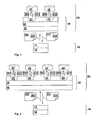
- FIG. 4 is a schematic representation of a communication network 3 with two participants 1, 2 shown.
- a service for example the connection of the first subscriber 1 to the second subscriber 2
- a conversion of an identity information must be carried out.
- the communication network 3 to a network component 4, for example, a computer, by means of which the requested service is provided.
- a usage instance 10 is operated in the communication network 3 (for example, concerning the establishment of a communication connection) which requires the conversion of an identity information.
- the usage instance 10 has an application layer 12 and a request interface 11.
- the conversion entity 20 has a control layer 30 and a plurality of resolution units 41, 42, 43, 44.
- the control layer 30 comprises an authentication layer 36, a logic layer 35, and further a plurality of conversion interfaces 31, 32, 33, 34.
- the resolution units 41, 42, 43, 44 can either (possibly with associated databases) be physically "connected” to the control layer 30 or be located together (for example, in the sense that they are located on a computer ("server")). are ", ie, executed by one and the same computer) or it is the resolution units 41, 42, 43, 44 of the control layer 30, ie the resolution units 41, 42, 43, 44 are spatially separated from the control layer 30 and communicate via a communication link (eg as part of the communication network 3 or via a dedicated (separate) communication link.) Each conversion interface 31, 32, 33 , 34 is typically associated with exactly one resolution unit 41, 42, 43, 44.
- Such a pairing of logical conversion interface and logical resolution unit is for converting first identification information 301, 302 , 303, 304 of exactly one first identification type (from a group of initial identification types) into second identification information 311, 312, 313, 314 of exactly one second identification type (from a group of target identification types) according to a specific one Interface protocol.
- Another pairing of logical conversion interface and logical resolution unit would correspond if either one of the identification types or the interface protocol were different.
- the logic layer 35 serves to drive the conversion interfaces 31, 32, 33, 34 such that the second identification information 311, 312 requested by the conversion request 101 (and corresponding to the first identification information 301, 302, 303, 304 transmitted with the conversion request 101) , 313, 314 are supplied by a resolution unit 41, 42, 43, 44 or by a plurality of resolution units 41, 42, 43, 44, so that the second identification information 311, 312, 313, 314 is then sent to the (Inquiry interface 11 of the) use instance 10 can be directed.
- the logic layer 35 forwards the conversion response 111 to the use instance 10, it is ensured by means of an authentication process controlled by the authentication layer 36 that the usage instance 10 (or its request interface 11) is authorized to query the second identification information 311, 312, 313, 314.
- the identification information denoted by reference numerals 311 and 302 are of the same identification type, and therefore, in turn, from the resolution unit indicated by reference numeral 41 in response (ie, as second identification information 311) to the conversion interface designated by reference numeral 31 and, on the other hand, be forwarded by the conversion interface designated by the reference numeral 32 as a request (ie, as first identification information 302) to the resolution unit designated by the reference numeral 42.
- the user instance 10 requests the second identification information designated by the reference numeral 314 by means of the conversion request 101, for example with the first identification information designated by the reference numeral 301, and returns it to the user instance 10 by means of the conversion response 111.
- the identification information denoted by reference numerals 311 and 302 are of the same identification type, and therefore, in turn, from the resolution unit indicated by reference numeral 41 in response (ie, as second identification information 311) to the conversion interface designated by reference numeral 31 and, on the other hand, be forwarded by the conversion interface designated by the reference numeral 32 as a request (ie, as first identification information 302) to the resolution unit designated by the reference numeral 42.
- the identification information denoted by reference numerals 312 and 303 are of the same identification type, and therefore, in response to the resolution unit indicated by the reference numeral 42 in response (ie, as second identification information 312) to that indicated by reference numeral 32
- the designated by the reference numeral 32 conversion interface as a request (ie as the first identification information 303) to the reference numeral 43th be referred to the designated resolution unit.
- the identification information denoted by reference numerals 313 and 304 are of the same identification type and, therefore, in response to the resolution unit denoted by reference numeral 43 in response (ie, as second identification information 313) to that indicated by reference numeral 33 Conversion interface to be returned and on the other hand of the designated by the reference numeral 34 conversion interface as a request (ie, as the first identification information 303) to the resolution unit designated by the reference numeral 44 are forwarded.
- the use instance 10 ie any application that has a need for conversion in the network (as opposed to the conversion according to the invention with the aid of the conversion entity 20), must use the FIG. 4 control conversion operations for converting the first identification information 301 into the second identification information 314 itself, that is, on the knowledge that identification information of the identification type of the second identification information 314 is required for the first identification information 301 (of the first identification type), performing all conversion operations ( with the corresponding authentications) for transfer to the identification type of the second identification information 314 and monitor.
- the utilization instance 10 is relieved of such conversion operations.
- the utilization instance 10 upon recognizing a conversion requirement, for example, the telephone number (as first identification type (ie known identification type) and part of the group of output identification types) of the called party to the so-called next-hop address (as the second identification (ie Identification type) and part of the group of target identification types) of the next network element, by means of the request interface 11 sends a corresponding conversion request 101 to the conversion entity 20.
- a uniform standard protocol in particular according to the SOAP protocol.
- the control layer 30 of the conversion entity 20, in particular the logic layer 35 controls one or more conversion interfaces 31, 32, 33, 34 serially or recursively (in particular by means of a so-called rule engine, ie a set of rules, within the logic layer 35) such that (by the corresponding responses of the resolution units 41, 42, 43, 44), this conversion can be carried out successfully and the searched next-hop address (as second identification information) by means of the conversion response 111 (according to the standard protocol, in particular SOAP) again returned to the user of use 10 can be.
- the conversion response 111 is the only response to the conversion request 101.
- Usage instance 10 is authenticated, ie it is checked (by the authentication layer 35 of the conversion entity 20) whether this user instance 10 or application 10 may make this request.
- the conversion entity 20 implements a server, with respect to which the request interface 11 (or the use instance 10) acts as a user (or client).
- the interface arrangement according to the invention is realized between the user entity 10 and the conversion entity 20. It is characteristic of this interface arrangement that, for all conversion processes between initial identification types on the one hand and target identification types, on the other hand, a uniform standard interface, in particular according to the SOAP protocol, is used.
- the inventive method for realizing an integrated communication service (as a user instance 10) "mobile and IP TV (Internet Protocol TeleVision)" for activation of an IP-TV feature on a Mobile terminal to be illustrated.
- the use instance 10 requires (the iP-TV application) based on the mobile number, for example, GSM mobile number, the current IP address of the broadband port of the so-called IAD (Integrated Access Device) of the IP-TV connection to a credential to the IP Address (Internet Protocol address) of the IAD for enabling an IP-TV feature - such as a movie or the like - to be able to send.
- the mobile number for example, GSM mobile number
- IAD Integrated Access Device
- IP Address Internet Protocol address
- the usage instance 10, ie in this case the IP-TV application sends the conversion request 101 to the conversion entity 20 via the request interface 11 and in accordance with the SOAP protocol.
- the conversion request 101 comprises both the known mobile radio number (MSISDN, Mobile Subscriber Integrated Services Digital Network Number) as the first identification information 301 as well as the requested IP address of the IP-TV IAD as a second identification type.
- MSISDN Mobile Subscriber Integrated Services Digital Network Number
- the conversion entity 20 or the control layer 30, in particular the authentication layer 36 identifies the usage instance 10-here the IP-TV application-and authenticates or authorizes the conversion request.
- a stored rule for the conversion (mapping function) of the identification type "MSISDN” to the identification type "IP address of the IP-TV-IAD" is called by the control layer 30, in particular the logic layer 35.
- the conversion interfaces 31, 32, 33, 34 are called, which in turn request the resolution units 41, 42, 43, 44 to submit corresponding replies.
- the customer database is requested in response to the identification type "customer number”.
- the contract database is queried in response to the identification type "Line ID".
- a DIAMETER protocol with the identification type "Line-ID”
- the response to the identification type "Session ID” is requested.
- a RADIUS protocol with the identification type "session ID” according to the identification type "IP address of the IP TV IAD” is queried as an answer.
- the conversion entity 20 then sends the relevant identification information 311, 312, 313, 314 to the usage instance 10, ie the IP-TV application.
Landscapes
- Engineering & Computer Science (AREA)
- Computer Networks & Wireless Communication (AREA)
- Signal Processing (AREA)
- Telephonic Communication Services (AREA)
- Communication Control (AREA)
- Data Exchanges In Wide-Area Networks (AREA)
Claims (13)
- Procédé de conversion d'une première information d'identification (301, 302, 303, 304) d'un premier type d'identification en une seconde information d'identification (311, 312, 313, 314) d'un second type d'identification, le premier type d'identification étant sélectionné dans un groupe de types d'identification de départ et le second type d'identification dans un groupe de types d'identifications de destination, dans lequel, pour réaliser la conversion, une demande de conversion (101) est communiquée par une instance d'utilisation (10) à une instance de conversion (20) et une réponse de conversion (111) est communiquée par l'instance de conversion (20) à l'instance d'utilisation (10), caractérisé en ce que les demandes de conversion (101) et/ou les réponses de conversion (111) pour n'importe quelle paire de premier type d'identification du groupe des types d'identifications de départ et de second type d'identification du groupe des types d'identification de destination sont prévues suivant un protocole standard uniforme, l'instance de conversion (20) présentant une couche de conversion (30), la couche de conversion (30) présentant une pluralité d'interfaces de conversion (31, 32, 33, 34) pour différents types d'identification, l'instance de conversion (20) présentant une pluralité d'instances de définition (41, 42, 43, 44), étant affectée respectivement à une interface de conversion (31, 32, 33, 34) une unité de définition (41, 42, 43, 44) de manière à ce que la première information d'identification (301, 302, 303, 304) du premier type d'identification soit communiquée à l'unité de définition (41, 42, 43, 44) par l'interface de conversion (31, 32, 33, 34) et que la seconde information d'identification (311, 312, 313, 314) du second type d'identification soit communiquée à l'interface de conversion (31, 32, 33, 34) par l'unité de définition (41, 42, 43, 44), des protocoles d'interrogation étant prévus entre les unités de conversion (31, 32, 33, 34) et les unités de définition (41, 42, 43, 44) affectées les unes aux autres pour différentes paires de premier et second types d'identification.
- Procédé selon la revendication 1, caractérisé en ce que la demande de conversion (101) et/ou la réponse de conversion (111) sont prévues suivant le protocole SOAP, Simple Object Activation Protocol (protocole d'activation d'objet unique).
- Procédé selon la revendication 1, caractérisé en ce que les différents protocoles d'interrogation sont prévus suivant la norme DNS, Domaine Name System (système du nom de domaine) et/ou suivant la norme RADIUS, Remote Authentification Dial-in Service (service de numérotation à authentification à distance) et/ou suivant la norme DIAMETER, RFC 3588, et/ou suivant la norme SIP, Session Initiation Protocol (protocole d'initiation de session).
- Procédé selon une des revendications précédentes, caractérisé en ce que, entre une pluralité d'interfaces de conversion (31, 32, 33 34) et une pluralité d'unités de définition (41, 42, 43, 44), des informations d'identification et, sous la commande de la couche de commande (30), une conversion entre au moins trois types d'identifications différents est effectuée pour réaliser la conversion de la première information d'identification (301, 302, 303, 304) du premier type d'identification du groupe des types d'identifications de départ en seconde information d'identification (311, 312, 313, 314) du second type d'identification du groupe des identifications de destination.
- Procédé selon une des revendications précédentes, caractérisé en ce que sont affectés à différentes unités de définition (41, 42, 43, 44) des types différents de banques de données, les protocoles d'interrogation étant différents en fonction du type de banque de données de la banque de données affectée.
- Dispositif d'interface pour réseau de communication (3) pour la conversion d'une première information d'identification (301, 302, 303, 304) d'un premier type d'identification en une seconde information d'identification (311, 312, 313, 314) d'un second type d'identification, le premier type d'identification étant sélectionné dans un groupe d'identifications de départ et le second type d'identification dans un groupe d'identifications de destination, le dispositif d'interface étant conçu pour recevoir une demande de conversion (101) et pour envoyer une réponse de conversion (111), caractérisé en ce que les demandes de conversion (101) et/ou les réponses de conversion (111) pour n'importe quelle paire de premier type d'identification du groupe des identifications de départ et de second type d'identification du groupe des identifications de destination sont prévues suivant un procédé standard uniforme, étant affectée au dispositif d'interface une instance de conversion (20), l'instance de conversion (20) présentant une couche de commande (30), la couche de commande (30) présentant une pluralité d'interfaces de conversion (31, 32, 33, 34) pour différents types d'identifications, l'instance de conversion (20) comprenant une pluralité d'unités de définition (41, 42, 43, 44), étant affectée respectivement à une interface de conversion (31, 32, 33, 34) une unité de définition (41, 42, 43, 44) de manière à ce que l'interface de conversion (31, 32, 33, 34) soit conçue pour communiquer à l'interface de définition (41, 42, 43, 44) la première information d'identification (301, 302, 303, 304) du premier type d'identification et l'unité de définition (41, 42, 43, 44) pour communiquer à l'interface de conversion (31, 32, 33, 34) la seconde information d'identification (311, 312, 313, 314) du second type d'identification, différents protocoles d'interrogation étant prévus entre des interfaces de conversion (31, 32, 33, 34) et unités de définition (41, 42, 43, 44) affectées les unes aux autres pour différentes paires de premier et second types d'identifications.
- Dispositif d'interface selon la revendication 6, caractérisé en ce que la demande de conversion (101) et/ou la réponse de conversion (111) sont prévues suivant le protocole SOAP, Simple Object Activation Protocol (protocole d'activation d'objet unique).
- Dispositif d'interface selon la revendication 6 ou 7, caractérisé en ce que les différents protocoles d'interrogation sont prévus suivant la norme DNS, Domaine Name System (système du nom de domaine) et/ou suivant la norme RADIUS, Remote Authentification Dial-in Service (service de numérotation à authentification à distance) et/ou suivant la norme DIAMETER, RFC 3588, et/ou suivant la norme SIP, Session Initiation Protocol (protocole d'initiation de session).
- Dispositif d'interface selon une des revendications 6 à 8, caractérisé en ce que sont affectés à différentes unités de définition (41, 42, 43, 44) différents types de banques de données, les protocoles d'interrogation étant différents en fonction du type de banque de données de la banque de données affectée.
- Réseau de communication (3) comportant une instance de conversion (20) pour convertir une première information d'identification (301, 302, 303, 304) d'un premier type d'identification en une seconde information d'identification (311, 312, 313, 314) d'un second type d'identification, le premier type d'identification étant sélectionné dans un groupe de types d'identifications de départ et le second type d'identification dans un groupe de types d'identifications de destination, dans lequel il est prévu, pour réaliser la conversion, de communiquer une demande de conversion (101) par une instance d'utilisation (10) à l'instance de conversion (20) et de communiquer une réponse de conversion (111) par l'instance de conversion (20) à l'instance d'utilisation (10), caractérisé en ce que les demandes de conversion (101) et/ou les réponses de conversion (111) pour n'importe quelle paire de premier type d'identification du groupe des types d'identifications de départ et de second type d'identification du groupe des types d'identifications de destination sont prévues suivant un protocole standard uniforme, l'instance de conversion (20) présentant une couche de commande (30), la couche de commande (30) présentant une pluralité d'interfaces de conversion (31, 32, 33, 34) pour différents types d'utilisation, l'instance de conversion (20) comprenant une pluralité d'unités de définition (41, 42, 43, 44), étant respectivement affectée à une interface de conversion (31, 32, 33, 34) une unité de définition (41, 42, 43, 44) de manière à ce que l'interface de conversion (31, 32, 33, 34) soit conçue pour communiquer à l'unité de définition (41, 42, 43, 44) la première information d'utilisation (301, 302, 303, 304) du premier type d'identification et l'unité de définition (41, 42, 43, 44) pour communiquer à l'interface de conversion (31, 32, 33, 34) la seconde information d'utilisation (311, 312, 313, 314) du second type d'identification, différents protocoles d'interrogation étant prévus entre des interfaces de conversion (31, 32, 33, 34) et des unités de définition (41, 42, 43, 44) affectées les unes aux autres pour différentes paires de premier et second types d'identifications.
- Réseau de communication (3) selon la revendication 10, caractérisé en ce que la demande de conversion (101) et/ou la réponse de conversion (111) sont prévues suivant le protocole SOAP, Simple Object Activation Protocol (protocole d'activation d'objet unique).
- Réseau de communication (3) selon la revendication 10 ou 11, caractérisé en ce que les différents protocoles d'interrogation sont prévus suivant la norme DNS, Domaine Name System (système du nom de domaine) et/ou suivant la norme RADIUS, Remote Authentification Dial-in Service (service de numérotation à authentification à distance) et/ou suivant la norme DIAMETER, RFC 3588, et/ou suivant la norme SIP, Session Initiation Protocol (protocole d'initiation de session).
- Réseau de communication (3) selon une des revendications 10 à 12, caractérisé en ce que sont affectés à différentes unités de définition (41, 42, 43, 44) différents types de banques de données, les protocoles d'interrogation étant différents en fonction du type de banque de données de la banque de données affectée.
Priority Applications (1)
| Application Number | Priority Date | Filing Date | Title |
|---|---|---|---|
| EP09008737.0A EP2273760B1 (fr) | 2009-07-03 | 2009-07-03 | Procédé de conversion d'une première information d'identification en une seconde information d'identification, agencement d'interface pour un réseau de communication et réseau de communication doté d'une instance de conversion |
Applications Claiming Priority (1)
| Application Number | Priority Date | Filing Date | Title |
|---|---|---|---|
| EP09008737.0A EP2273760B1 (fr) | 2009-07-03 | 2009-07-03 | Procédé de conversion d'une première information d'identification en une seconde information d'identification, agencement d'interface pour un réseau de communication et réseau de communication doté d'une instance de conversion |
Publications (2)
| Publication Number | Publication Date |
|---|---|
| EP2273760A1 EP2273760A1 (fr) | 2011-01-12 |
| EP2273760B1 true EP2273760B1 (fr) | 2014-06-18 |
Family
ID=41429330
Family Applications (1)
| Application Number | Title | Priority Date | Filing Date |
|---|---|---|---|
| EP09008737.0A Not-in-force EP2273760B1 (fr) | 2009-07-03 | 2009-07-03 | Procédé de conversion d'une première information d'identification en une seconde information d'identification, agencement d'interface pour un réseau de communication et réseau de communication doté d'une instance de conversion |
Country Status (1)
| Country | Link |
|---|---|
| EP (1) | EP2273760B1 (fr) |
Families Citing this family (2)
| Publication number | Priority date | Publication date | Assignee | Title |
|---|---|---|---|---|
| ES2978712T3 (es) * | 2021-08-31 | 2024-09-18 | Deutsche Telekom Ag | Técnicas para proporcionar un sistema multitrayecto genérico mediante una selección flexible de protocolos de red |
| CN119996436A (zh) * | 2023-11-13 | 2025-05-13 | 上海汽车集团股份有限公司 | 一种车辆中车控服务模块的通信方法和相关装置 |
Family Cites Families (3)
| Publication number | Priority date | Publication date | Assignee | Title |
|---|---|---|---|---|
| US6065016A (en) | 1996-08-06 | 2000-05-16 | At&T Corporation | Universal directory service |
| US7822825B2 (en) * | 2002-11-15 | 2010-10-26 | Telecom Italia S.P.A. | Device and method for centralized data management and a access control to databases |
| EP1847076B1 (fr) | 2004-12-17 | 2012-02-15 | Tekelec | Procédés, systèmes et programmes informatiques servant à assurer l'accès à une base de données dans un environnement réseau à sous-système multimédia à protocole internet (IMS) |
-
2009
- 2009-07-03 EP EP09008737.0A patent/EP2273760B1/fr not_active Not-in-force
Also Published As
| Publication number | Publication date |
|---|---|
| EP2273760A1 (fr) | 2011-01-12 |
Similar Documents
| Publication | Publication Date | Title |
|---|---|---|
| DE60207984T2 (de) | Bedienerauswählender Server, Methode und System für die Beglaubigung, Ermächtigung und Buchhaltung | |
| EP2826224B1 (fr) | Accès de clients à un service de serveur par opc-ua | |
| DE10392283T5 (de) | System, Verfahren und Vorrichtung für verbündete einzelne Dienstleistungen mit Anmeldeverfahren beziehungsweise Sign-On-Dienstleistungen | |
| EP1488611A1 (fr) | Systeme de serveurs aaa permettant un controle d'acces et une affectation d'adresses efficaces | |
| DE102009004490A1 (de) | Verfahren und System zur Authentifizierung von Netzknoten eines Peer-to-Peer Netzwerks | |
| EP3799379B1 (fr) | Procédé et système de communication à base d'ip permettant de changer les instances de commande de connexion sans nouvel enregistrement des abonnés finaux | |
| EP2273760B1 (fr) | Procédé de conversion d'une première information d'identification en une seconde information d'identification, agencement d'interface pour un réseau de communication et réseau de communication doté d'une instance de conversion | |
| EP2875626B1 (fr) | Procédé et dispositif pour établir une liaison de télécommunication | |
| DE10316236A1 (de) | Verfahren und Anordnung zur Konfiguration einer Einrichtung in einem Datennetz | |
| DE102009034285A1 (de) | Verteiltes Netzwerkregister | |
| WO2019242947A1 (fr) | Procédé de rattachement d'un appareil terminal dans une infrastructure informatique pouvant être mise en réseau | |
| EP2506177A1 (fr) | Procédé et dispositif destinés à la comparaison de données d'identification | |
| EP2198590B1 (fr) | Sélection paramétrisable d'un système de communication au moyen de mécanismes de résolution basée sur des noms | |
| DE112022005649T5 (de) | Verfahren zum übertragen und empfangen multimedialer daten | |
| EP2274902B1 (fr) | Adressage universel d'un correspondant par affectation statique transparente d'un numéro d'appel | |
| WO2008058841A2 (fr) | Procédé d'amorçage | |
| WO2021223922A1 (fr) | Procédé d'établissement d'un canal de transmission sécurisé pour la transmission de données dans un système d'automatisation industrielle | |
| EP1845689B1 (fr) | Procédé et système de communication destinés à la préparation d'un accès personnalisable à un groupe de dispositifs | |
| WO2006048317A2 (fr) | Procede et systeme pour identifier un abonne et la connexion utilisee lors de liaisons voip | |
| DE10046311B4 (de) | Verfahren für eine Zuweisung von Knotennummern zu Netzknoten eines Netzwerks | |
| DE10339051B3 (de) | Verfahren zum Zuordnen von über mehrere Subnetze verteilten Clients zu einen Server und Client zur Ankopplung an einen Server | |
| EP2056631B1 (fr) | Procédé de configuration d'un réseau personnel dans un réseau radio mobile | |
| WO2004025924A1 (fr) | Actualisation d'un logiciel mis en memoire dans un ordinateur d'un systeme de communication de donnees | |
| DE60219778T2 (de) | Vorrichtung und verfahren zur kommunikation zwischen geräten mit gemeinsamen datensätzen | |
| DE102025120521A1 (de) | Verfahren zum Einrichten eines Profils in einem sicheren Element |
Legal Events
| Date | Code | Title | Description |
|---|---|---|---|
| PUAI | Public reference made under article 153(3) epc to a published international application that has entered the european phase |
Free format text: ORIGINAL CODE: 0009012 |
|
| AK | Designated contracting states |
Kind code of ref document: A1 Designated state(s): AT BE BG CH CY CZ DE DK EE ES FI FR GB GR HR HU IE IS IT LI LT LU LV MC MK MT NL NO PL PT RO SE SI SK SM TR |
|
| AX | Request for extension of the european patent |
Extension state: AL BA RS |
|
| 17P | Request for examination filed |
Effective date: 20110712 |
|
| 17Q | First examination report despatched |
Effective date: 20110801 |
|
| GRAP | Despatch of communication of intention to grant a patent |
Free format text: ORIGINAL CODE: EPIDOSNIGR1 |
|
| GRAP | Despatch of communication of intention to grant a patent |
Free format text: ORIGINAL CODE: EPIDOSNIGR1 |
|
| INTG | Intention to grant announced |
Effective date: 20140128 |
|
| INTG | Intention to grant announced |
Effective date: 20140227 |
|
| GRAS | Grant fee paid |
Free format text: ORIGINAL CODE: EPIDOSNIGR3 |
|
| GRAA | (expected) grant |
Free format text: ORIGINAL CODE: 0009210 |
|
| AK | Designated contracting states |
Kind code of ref document: B1 Designated state(s): AT BE BG CH CY CZ DE DK EE ES FI FR GB GR HR HU IE IS IT LI LT LU LV MC MK MT NL NO PL PT RO SE SI SK SM TR |
|
| REG | Reference to a national code |
Ref country code: GB Ref legal event code: FG4D Free format text: NOT ENGLISH |
|
| REG | Reference to a national code |
Ref country code: CH Ref legal event code: EP |
|
| REG | Reference to a national code |
Ref country code: AT Ref legal event code: REF Ref document number: 673921 Country of ref document: AT Kind code of ref document: T Effective date: 20140715 |
|
| REG | Reference to a national code |
Ref country code: IE Ref legal event code: FG4D Free format text: LANGUAGE OF EP DOCUMENT: GERMAN |
|
| REG | Reference to a national code |
Ref country code: DE Ref legal event code: R096 Ref document number: 502009009520 Country of ref document: DE Effective date: 20140807 |
|
| PG25 | Lapsed in a contracting state [announced via postgrant information from national office to epo] |
Ref country code: GR Free format text: LAPSE BECAUSE OF FAILURE TO SUBMIT A TRANSLATION OF THE DESCRIPTION OR TO PAY THE FEE WITHIN THE PRESCRIBED TIME-LIMIT Effective date: 20140919 Ref country code: CY Free format text: LAPSE BECAUSE OF FAILURE TO SUBMIT A TRANSLATION OF THE DESCRIPTION OR TO PAY THE FEE WITHIN THE PRESCRIBED TIME-LIMIT Effective date: 20140618 Ref country code: FI Free format text: LAPSE BECAUSE OF FAILURE TO SUBMIT A TRANSLATION OF THE DESCRIPTION OR TO PAY THE FEE WITHIN THE PRESCRIBED TIME-LIMIT Effective date: 20140618 Ref country code: LT Free format text: LAPSE BECAUSE OF FAILURE TO SUBMIT A TRANSLATION OF THE DESCRIPTION OR TO PAY THE FEE WITHIN THE PRESCRIBED TIME-LIMIT Effective date: 20140618 Ref country code: NO Free format text: LAPSE BECAUSE OF FAILURE TO SUBMIT A TRANSLATION OF THE DESCRIPTION OR TO PAY THE FEE WITHIN THE PRESCRIBED TIME-LIMIT Effective date: 20140918 |
|
| REG | Reference to a national code |
Ref country code: NL Ref legal event code: VDEP Effective date: 20140618 |
|
| REG | Reference to a national code |
Ref country code: LT Ref legal event code: MG4D |
|
| PG25 | Lapsed in a contracting state [announced via postgrant information from national office to epo] |
Ref country code: SE Free format text: LAPSE BECAUSE OF FAILURE TO SUBMIT A TRANSLATION OF THE DESCRIPTION OR TO PAY THE FEE WITHIN THE PRESCRIBED TIME-LIMIT Effective date: 20140618 Ref country code: LV Free format text: LAPSE BECAUSE OF FAILURE TO SUBMIT A TRANSLATION OF THE DESCRIPTION OR TO PAY THE FEE WITHIN THE PRESCRIBED TIME-LIMIT Effective date: 20140618 Ref country code: HR Free format text: LAPSE BECAUSE OF FAILURE TO SUBMIT A TRANSLATION OF THE DESCRIPTION OR TO PAY THE FEE WITHIN THE PRESCRIBED TIME-LIMIT Effective date: 20140618 |
|
| PG25 | Lapsed in a contracting state [announced via postgrant information from national office to epo] |
Ref country code: ES Free format text: LAPSE BECAUSE OF FAILURE TO SUBMIT A TRANSLATION OF THE DESCRIPTION OR TO PAY THE FEE WITHIN THE PRESCRIBED TIME-LIMIT Effective date: 20140618 Ref country code: EE Free format text: LAPSE BECAUSE OF FAILURE TO SUBMIT A TRANSLATION OF THE DESCRIPTION OR TO PAY THE FEE WITHIN THE PRESCRIBED TIME-LIMIT Effective date: 20140618 Ref country code: SK Free format text: LAPSE BECAUSE OF FAILURE TO SUBMIT A TRANSLATION OF THE DESCRIPTION OR TO PAY THE FEE WITHIN THE PRESCRIBED TIME-LIMIT Effective date: 20140618 Ref country code: PT Free format text: LAPSE BECAUSE OF FAILURE TO SUBMIT A TRANSLATION OF THE DESCRIPTION OR TO PAY THE FEE WITHIN THE PRESCRIBED TIME-LIMIT Effective date: 20141020 Ref country code: RO Free format text: LAPSE BECAUSE OF FAILURE TO SUBMIT A TRANSLATION OF THE DESCRIPTION OR TO PAY THE FEE WITHIN THE PRESCRIBED TIME-LIMIT Effective date: 20140618 Ref country code: CZ Free format text: LAPSE BECAUSE OF FAILURE TO SUBMIT A TRANSLATION OF THE DESCRIPTION OR TO PAY THE FEE WITHIN THE PRESCRIBED TIME-LIMIT Effective date: 20140618 |
|
| PG25 | Lapsed in a contracting state [announced via postgrant information from national office to epo] |
Ref country code: PL Free format text: LAPSE BECAUSE OF FAILURE TO SUBMIT A TRANSLATION OF THE DESCRIPTION OR TO PAY THE FEE WITHIN THE PRESCRIBED TIME-LIMIT Effective date: 20140618 Ref country code: NL Free format text: LAPSE BECAUSE OF FAILURE TO SUBMIT A TRANSLATION OF THE DESCRIPTION OR TO PAY THE FEE WITHIN THE PRESCRIBED TIME-LIMIT Effective date: 20140618 Ref country code: IS Free format text: LAPSE BECAUSE OF FAILURE TO SUBMIT A TRANSLATION OF THE DESCRIPTION OR TO PAY THE FEE WITHIN THE PRESCRIBED TIME-LIMIT Effective date: 20141018 |
|
| REG | Reference to a national code |
Ref country code: CH Ref legal event code: PL |
|
| REG | Reference to a national code |
Ref country code: DE Ref legal event code: R097 Ref document number: 502009009520 Country of ref document: DE |
|
| PG25 | Lapsed in a contracting state [announced via postgrant information from national office to epo] |
Ref country code: MC Free format text: LAPSE BECAUSE OF FAILURE TO SUBMIT A TRANSLATION OF THE DESCRIPTION OR TO PAY THE FEE WITHIN THE PRESCRIBED TIME-LIMIT Effective date: 20140618 |
|
| REG | Reference to a national code |
Ref country code: IE Ref legal event code: MM4A |
|
| PLBE | No opposition filed within time limit |
Free format text: ORIGINAL CODE: 0009261 |
|
| STAA | Information on the status of an ep patent application or granted ep patent |
Free format text: STATUS: NO OPPOSITION FILED WITHIN TIME LIMIT |
|
| PG25 | Lapsed in a contracting state [announced via postgrant information from national office to epo] |
Ref country code: CH Free format text: LAPSE BECAUSE OF NON-PAYMENT OF DUE FEES Effective date: 20140731 Ref country code: LI Free format text: LAPSE BECAUSE OF NON-PAYMENT OF DUE FEES Effective date: 20140731 Ref country code: DK Free format text: LAPSE BECAUSE OF FAILURE TO SUBMIT A TRANSLATION OF THE DESCRIPTION OR TO PAY THE FEE WITHIN THE PRESCRIBED TIME-LIMIT Effective date: 20140618 Ref country code: IT Free format text: LAPSE BECAUSE OF FAILURE TO SUBMIT A TRANSLATION OF THE DESCRIPTION OR TO PAY THE FEE WITHIN THE PRESCRIBED TIME-LIMIT Effective date: 20140618 |
|
| 26N | No opposition filed |
Effective date: 20150319 |
|
| PG25 | Lapsed in a contracting state [announced via postgrant information from national office to epo] |
Ref country code: SI Free format text: LAPSE BECAUSE OF FAILURE TO SUBMIT A TRANSLATION OF THE DESCRIPTION OR TO PAY THE FEE WITHIN THE PRESCRIBED TIME-LIMIT Effective date: 20140618 |
|
| PG25 | Lapsed in a contracting state [announced via postgrant information from national office to epo] |
Ref country code: IE Free format text: LAPSE BECAUSE OF NON-PAYMENT OF DUE FEES Effective date: 20140703 |
|
| REG | Reference to a national code |
Ref country code: AT Ref legal event code: MM01 Ref document number: 673921 Country of ref document: AT Kind code of ref document: T Effective date: 20140703 |
|
| PG25 | Lapsed in a contracting state [announced via postgrant information from national office to epo] |
Ref country code: AT Free format text: LAPSE BECAUSE OF NON-PAYMENT OF DUE FEES Effective date: 20140703 |
|
| PG25 | Lapsed in a contracting state [announced via postgrant information from national office to epo] |
Ref country code: SM Free format text: LAPSE BECAUSE OF FAILURE TO SUBMIT A TRANSLATION OF THE DESCRIPTION OR TO PAY THE FEE WITHIN THE PRESCRIBED TIME-LIMIT Effective date: 20140618 |
|
| PG25 | Lapsed in a contracting state [announced via postgrant information from national office to epo] |
Ref country code: BG Free format text: LAPSE BECAUSE OF FAILURE TO SUBMIT A TRANSLATION OF THE DESCRIPTION OR TO PAY THE FEE WITHIN THE PRESCRIBED TIME-LIMIT Effective date: 20140618 Ref country code: MT Free format text: LAPSE BECAUSE OF FAILURE TO SUBMIT A TRANSLATION OF THE DESCRIPTION OR TO PAY THE FEE WITHIN THE PRESCRIBED TIME-LIMIT Effective date: 20140618 |
|
| REG | Reference to a national code |
Ref country code: FR Ref legal event code: PLFP Year of fee payment: 8 |
|
| PG25 | Lapsed in a contracting state [announced via postgrant information from national office to epo] |
Ref country code: LU Free format text: LAPSE BECAUSE OF NON-PAYMENT OF DUE FEES Effective date: 20140703 Ref country code: BE Free format text: LAPSE BECAUSE OF FAILURE TO SUBMIT A TRANSLATION OF THE DESCRIPTION OR TO PAY THE FEE WITHIN THE PRESCRIBED TIME-LIMIT Effective date: 20140731 Ref country code: TR Free format text: LAPSE BECAUSE OF FAILURE TO SUBMIT A TRANSLATION OF THE DESCRIPTION OR TO PAY THE FEE WITHIN THE PRESCRIBED TIME-LIMIT Effective date: 20140618 Ref country code: HU Free format text: LAPSE BECAUSE OF FAILURE TO SUBMIT A TRANSLATION OF THE DESCRIPTION OR TO PAY THE FEE WITHIN THE PRESCRIBED TIME-LIMIT; INVALID AB INITIO Effective date: 20090703 |
|
| REG | Reference to a national code |
Ref country code: FR Ref legal event code: PLFP Year of fee payment: 9 |
|
| PG25 | Lapsed in a contracting state [announced via postgrant information from national office to epo] |
Ref country code: MK Free format text: LAPSE BECAUSE OF FAILURE TO SUBMIT A TRANSLATION OF THE DESCRIPTION OR TO PAY THE FEE WITHIN THE PRESCRIBED TIME-LIMIT Effective date: 20140618 |
|
| REG | Reference to a national code |
Ref country code: FR Ref legal event code: PLFP Year of fee payment: 10 |
|
| REG | Reference to a national code |
Ref country code: DE Ref legal event code: R079 Ref document number: 502009009520 Country of ref document: DE Free format text: PREVIOUS MAIN CLASS: H04L0029120000 Ipc: H04L0067286900 |
|
| PGFP | Annual fee paid to national office [announced via postgrant information from national office to epo] |
Ref country code: DE Payment date: 20240719 Year of fee payment: 16 |
|
| PGFP | Annual fee paid to national office [announced via postgrant information from national office to epo] |
Ref country code: GB Payment date: 20240723 Year of fee payment: 16 |
|
| PGFP | Annual fee paid to national office [announced via postgrant information from national office to epo] |
Ref country code: FR Payment date: 20240724 Year of fee payment: 16 |
|
| REG | Reference to a national code |
Ref country code: DE Ref legal event code: R119 Ref document number: 502009009520 Country of ref document: DE |
|
| GBPC | Gb: european patent ceased through non-payment of renewal fee |
Effective date: 20250703 |
|
| PG25 | Lapsed in a contracting state [announced via postgrant information from national office to epo] |
Ref country code: GB Free format text: LAPSE BECAUSE OF NON-PAYMENT OF DUE FEES Effective date: 20250703 |
|
| PG25 | Lapsed in a contracting state [announced via postgrant information from national office to epo] |
Ref country code: DE Free format text: LAPSE BECAUSE OF NON-PAYMENT OF DUE FEES Effective date: 20260203 |
|
| PG25 | Lapsed in a contracting state [announced via postgrant information from national office to epo] |
Ref country code: FR Free format text: LAPSE BECAUSE OF NON-PAYMENT OF DUE FEES Effective date: 20250731 |