EP2275385B1 - Verfahren zur Herstellung von Plättchen mit einem geschichteten Material - Google Patents
Verfahren zur Herstellung von Plättchen mit einem geschichteten Material Download PDFInfo
- Publication number
- EP2275385B1 EP2275385B1 EP09165606.6A EP09165606A EP2275385B1 EP 2275385 B1 EP2275385 B1 EP 2275385B1 EP 09165606 A EP09165606 A EP 09165606A EP 2275385 B1 EP2275385 B1 EP 2275385B1
- Authority
- EP
- European Patent Office
- Prior art keywords
- platelets
- layered material
- particles
- graphite
- less
- Prior art date
- Legal status (The legal status is an assumption and is not a legal conclusion. Google has not performed a legal analysis and makes no representation as to the accuracy of the status listed.)
- Not-in-force
Links
Images

Classifications
-
- C—CHEMISTRY; METALLURGY
- C09—DYES; PAINTS; POLISHES; NATURAL RESINS; ADHESIVES; COMPOSITIONS NOT OTHERWISE PROVIDED FOR; APPLICATIONS OF MATERIALS NOT OTHERWISE PROVIDED FOR
- C09C—TREATMENT OF INORGANIC MATERIALS, OTHER THAN FIBROUS FILLERS, TO ENHANCE THEIR PIGMENTING OR FILLING PROPERTIES ; PREPARATION OF CARBON BLACK ; PREPARATION OF INORGANIC MATERIALS WHICH ARE NO SINGLE CHEMICAL COMPOUNDS AND WHICH ARE MAINLY USED AS PIGMENTS OR FILLERS
- C09C1/00—Treatment of specific inorganic materials other than fibrous fillers; Preparation of carbon black
- C09C1/0003—Compounds of molybdenum
-
- C—CHEMISTRY; METALLURGY
- C01—INORGANIC CHEMISTRY
- C01B—NON-METALLIC ELEMENTS; COMPOUNDS THEREOF; METALLOIDS OR COMPOUNDS THEREOF NOT COVERED BY SUBCLASS C01C
- C01B32/00—Carbon; Compounds thereof
- C01B32/20—Graphite
- C01B32/21—After-treatment
- C01B32/22—Intercalation
- C01B32/225—Expansion; Exfoliation
-
- C—CHEMISTRY; METALLURGY
- C09—DYES; PAINTS; POLISHES; NATURAL RESINS; ADHESIVES; COMPOSITIONS NOT OTHERWISE PROVIDED FOR; APPLICATIONS OF MATERIALS NOT OTHERWISE PROVIDED FOR
- C09C—TREATMENT OF INORGANIC MATERIALS, OTHER THAN FIBROUS FILLERS, TO ENHANCE THEIR PIGMENTING OR FILLING PROPERTIES ; PREPARATION OF CARBON BLACK ; PREPARATION OF INORGANIC MATERIALS WHICH ARE NO SINGLE CHEMICAL COMPOUNDS AND WHICH ARE MAINLY USED AS PIGMENTS OR FILLERS
- C09C1/00—Treatment of specific inorganic materials other than fibrous fillers; Preparation of carbon black
- C09C1/44—Carbon
- C09C1/46—Graphite
-
- C—CHEMISTRY; METALLURGY
- C09—DYES; PAINTS; POLISHES; NATURAL RESINS; ADHESIVES; COMPOSITIONS NOT OTHERWISE PROVIDED FOR; APPLICATIONS OF MATERIALS NOT OTHERWISE PROVIDED FOR
- C09C—TREATMENT OF INORGANIC MATERIALS, OTHER THAN FIBROUS FILLERS, TO ENHANCE THEIR PIGMENTING OR FILLING PROPERTIES ; PREPARATION OF CARBON BLACK ; PREPARATION OF INORGANIC MATERIALS WHICH ARE NO SINGLE CHEMICAL COMPOUNDS AND WHICH ARE MAINLY USED AS PIGMENTS OR FILLERS
- C09C3/00—Treatment in general of inorganic materials, other than fibrous fillers, to enhance their pigmenting or filling properties
- C09C3/04—Physical treatment, e.g. grinding or treatment with ultrasonic vibrations
- C09C3/041—Grinding
-
- C—CHEMISTRY; METALLURGY
- C01—INORGANIC CHEMISTRY
- C01P—INDEXING SCHEME RELATING TO STRUCTURAL AND PHYSICAL ASPECTS OF SOLID INORGANIC COMPOUNDS
- C01P2004/00—Particle morphology
- C01P2004/20—Particle morphology extending in two dimensions, e.g. plate-like
-
- C—CHEMISTRY; METALLURGY
- C01—INORGANIC CHEMISTRY
- C01P—INDEXING SCHEME RELATING TO STRUCTURAL AND PHYSICAL ASPECTS OF SOLID INORGANIC COMPOUNDS
- C01P2004/00—Particle morphology
- C01P2004/60—Particles characterised by their size
Definitions
- the invention relates to a method of producing from particles of a layered material, e.g. graphite, platelets comprising the layered material, wherein the particles are exposed to a mechanical grinding treatment.
- a layered material e.g. graphite
- Graphite is a well-known allotropic form of carbon. It consists of stacks of parallel two-dimensional graphene sheets. Each graphene sheet has a two-dimensional hexagonal lattice of sp 2 -hybridized carbon atoms. In a graphite crystal the individual graphene layers are held together by weak van der Waals-forces, while within each graphene layer the carbon atoms are covalently bound.
- a method for forming monocrystalline graphene layers on a silicone carbide substrate is disclosed in C. Berger et al., "Electronic Confinement and Coherence in Patterned Epitaxial Graphene", Science (Washington, DC, United States) (2006), 312(5777), 1191-1196 .
- the silicone carbide surface is heated to above 1400 °C. As silicone has a higher vapour pressure than carbon, the silicone atoms evaporate first, thus leaving behind a monocrystalline graphene layer.
- US 2002/054995 A1 discloses a method in which thin graphite platelets are manufactured in a high-pressure mill by means of fluid jets that cause fluid to enter the tips of cracks in graphite particles, thus separating the graphite into platelets. Thereby, the inventors seek to obtain platelets with a thickness in the range of 1 to 100 nm.
- the problem is solved by a method of producing from particles of a layered material platelets comprising the layered material, wherein the particles are exposed to a mechanical grinding treatment using grinding media, the stress energy SE GM of the grinding media being smaller than 10 ⁇ Nm (micro newton meters).
- methods that employ grinding media can lend themselves to being scaled-up, rendering them suitable for mass production of the platelets or platelet suspension according to the invention.
- non-expanded with reference to a particle means that before being exposed to the mechanical milling treatment, the layered material of the particle has not been expanded by means of an expandable intercalation agent intercalated between layers of the layered material.
- non-sonicated with reference to a particle means that before being exposed to the mechanical grinding treatment, the layered material of the particle has not been exposed to ultrasound waves.
- the conditions of the grinding treatment are selected such that a sonication step or an expansion step is not required.
- a platelet of the layered material in the context of the present invention may comprise one layer or several parallel layers of the layered material. Each platelet has a length and a width parallel to the plane(s) of the layer(s) and a thickness orthogonal to the plane(s).
- platelets of the layered material can be exfoliated in a single mechanical step, thereby allowing for a cost-effective production. Moreover, it is an achievable advantage of the method according to the invention that it lends itself to scale-up, which may allow for cost-effective mass production of platelets of the layered material.
- the distribution of thicknesses of the platelets generated by the method according to the invention as well as the defect density in the final product may be controlled by means of the grinding conditions. Both the thickness and the defect density are important parameters that define amongst other things the mechanical, thermal and electrical properties of the final product. Therefore, advantageously, with the method according to the invention a large selection of products with different properties can be provided for.
- the length and width of the platelets are greater than 0.1 ⁇ m (micrometers), preferably greater than 0,2 ⁇ m, preferably greater than 0,5 ⁇ m.
- the length and width are smaller than 20 ⁇ m, more preferably smaller than 5 ⁇ m.
- the stress energy SE GM of the grinding media used in the grinding treatment is smaller than 10 ⁇ Nm. More preferably, the stress energy SE GM is smaller than 3 ⁇ Nm, more preferably smaller than 1 ⁇ Nm, more preferably smaller than 0.3 ⁇ Nm, more preferably smaller than 0.1 ⁇ Nm.
- a low stress energy can contribute to a high aspect ratio of the final product. It is believed that this is at least partly due to the fact that a low stress energy can help to avoid breakage of the layers of the layered material.
- At least some of the platelets thus generated are less than 100 nm thick, more preferably less than 20 nm, more preferably less than 4 nm, more preferably less than 3.4 nm, more preferably less than 2 nm, more preferably less than 1nm. More preferably, at least 1%, more preferably at least 2%, more preferably at least 5%, more preferably at least 10%, more preferably at least 20%, more preferably at least 50% of the platelets are less than 100 nm thick, more preferably less than 20 nm, more preferably less than 4 nm, more preferably less than 3.4 nm, more preferably less than 2 nm, more preferably less than 1 nm.
- the arithmetic mean thickness of the platelets is less than 100 nm, more preferably less than 20 nm, more preferably less than 4 nm, more preferably less than 3.4 nm, more preferably less than 2 nm, more preferably less than 1 nm.
- the platelets produced by the mechanical grinding treatment comprise single layer platelets. More preferably, at least 1%, more preferably at least 2%, more preferably at least 4% of the platelets generated are single layer platelets.
- Preferred single layer platelets are single layer graphene platelets.
- the preferred grinding treatment is a wet-grinding treatment.
- the particles of the layered material are mixed in a liquid medium, and the mixed-in particles are exposed to a mechanical grinding treatment to produce platelets of the layered material.
- the preferred mixture is a dispersion, more preferably a suspension, of the particles in the liquid medium.
- the mixture may be a slurry.
- the content of the layered material in the mixture is more than 0.01 wt% (weight percent), preferably more than 0.1 wt%, preferably more than 1 wt%, preferably more than 3 wt%.
- a high content of the layered material can facilitate further processing of the product.
- a high content of layered material may increase the grinding time required to achieve the desired degree of exfoliation and thinness of the platelets. As a rule of thumb, doubling the content of the material doubles the grinding time required. Too long a grinding time may entail breakage of layers of the layered material due to overstrain, which in turn can reduce the lengths and widths of the platelets obtained.
- a content of the material may render the dispersion instable. It is believed that this at least partly is due to a too small inter-particle distance as the size of the particles is reduced in the grinding treatment.
- the content of the layered material in the mixture is less than 50 wt%, more preferably less than 30 wt%, e.g. 10 wt%.
- the preferred mixture medium is an aqueous medium, preferably deionised water.
- the invention also encompasses embodiments in which the mixture medium is e.g. an organic medium.
- the mixer medium may also be a mixture of several liquids, including mixtures of organic and inorganic liquids.
- Preferred organic liquids include alcohols such as EtOH.
- liquids whose surface energy is similar to that of graphene are preferred, e.g. n-methyl-pyrrolidone (NMP). It is an achievable advantage of such liquids that due to its interaction with the layered material it can promote the delamination process (see e.g. Y. Hernandez et al, "High-yield production of graphene by liquid-phase exfoliation of graphite", Nature Nanotechnology, vol. 3, September 2008, published online 10 August 2008 , doi 10.1038/nnano.2008.215).
- the mixture contains a surfactant.
- surfactants are ionic surfactants, e.g. anionic surfactants, such as SDS (Sodium-Dodecyl-Sulphate) or SDBS (Sodium-Dodecyl-Benzol-Sulphonate).
- the surfactant can act as a stabilizing agent. It is believed that this is due to the surfactant adsorbing to the platelets, thereby preventing, preferably by electrostatic and/or steric effects, that the platelets agglomerate or that the exfoliation process is even (partially) reversed.
- a stable suspension of platelets with a considerable long-term stability of the platelets dispersion can be achieved.
- a ⁇ potential of the dispersion is greater than 20 mV (microvolts), more preferably greater than 30 mV, more preferably greater than 50 mV.
- the appropriate amount of surfactants can be determined by means of measuring an adsorption isotherme as e.g. disclosed in Lin, Shi-Yow et al., " Determination of adsorption of an ionic surfactant on latex from surface tension measurements", Colloids and Surfaces, A: Physicochemical and Engineering Aspects (2002), 196(2-3), 189-198 .
- the milling beads preferably are 800 ⁇ m or less in diameter, more preferably 200 ⁇ m or less, more preferably 100 ⁇ m or less, more preferably 50 ⁇ m or less. It is an achievable advantage of smaller milling beads that their kinetic energy and therefore their stress energy of the beads can be reduced, which in turn can help to avoid breakage of individual layers of the layered material. It is another achievable advantage of small milling beads is that more beads can be provided in the same volume of the milling chamber, which may help to accelerate exfoliation. Preferably, the amount of milling beads is chosen such that the dry milling beads can fill up about 80% to 90% of the milling chamber.
- the milling beads preferably have weight densities lower than 6100 kg/m 3 (kilogram per cubic meter), preferably lower than 1100 kg/m 3 . It is an achievable advantage of milling beads with lower weight density that the kinetic energy of the beads can be reduced, which intern can help to avoid breakage of individual layers of the layered material.
- Preferred milling bead materials are yttrium stabilized zirconia, aluminia, or plastics such as polystyrol and polymethyl methacrylate (PMMA) or mixtures of these.
- PMMA polymethyl methacrylate
- at least some, more preferably essentially all, of the milling beads are of the same layered material as the particles, thereby providing for at least partially autogenous grinding. This way, advantageously, contamination of the milling product by wear debris from the milling beads can be avoided. Moreover, costs can be reduced as e.g. graphite is more affordable than yttrium stabilized zirconia.
- the mechanical grinding treatment is applied to the particles by means of a stirred media mill.
- a stirred media mill e.g. a tumbling ball mill, a rocker mill or a planetary ball mill may be applied.
- the maximum circumferential velocity of the stirrer of the stirred media mill is smaller than 60 m/s. More preferably, the maximum circumferential velocity is smaller than 40 m/s, more preferably less than 10 m/s, more preferably less than 5 m/s. The maximum circumferential velocity preferably is more than 0.1 m/s, preferably more than 0.3 m/s, preferably more than 1 m/s.
- the revolution speed of the stirrer is 3000 rpm or less, preferably 1500 rpm or less. Preferred revolution speeds of the stirrer are 30 rpm or above, more preferably 100 rpm or above, more preferably 300 rpm or above.
- the particles comprise graphite or a graphite derivative as the layered material.
- the particles may e.g. consist of natural graphite, synthetic graphite, highly oriented pyrolytic graphite, graphite oxide, graphite fluoride, graphite fibres, graphite nano-fibres or a combination thereof.
- Preferred particles are polycrystalline. Typically, they contain micron- and/or nanometer scaled graphite crystallites, with each crystallite being composed of one sheet or several sheets of graphene.
- the invention also encompasses methods in which monocrystalline particles are applied.
- the particles preferably are provided as a powder containing fine graphite granules or flakes, short segments of carbon fibre or graphite fibre, carbon or graphite whiskers, carbon or graphitic nano-fibres or their mixture.
- the powder can be prepared e.g. by chopping or grinding, preferably dry-grinding, of larger particles or fibres.
- the method according to the invention may also be applied to other layered materials such as anthracene, molybdenum disulfide, niobium selenide, or phyllosilicates.
- the method according to the invention is also applicable to expanded or partially exfoliated layered materials, e.g. materials pre-treated by sonication.
- Preferred particles of the layered materials are 300 ⁇ m or less in diameter, preferably 100 ⁇ m or less, more preferably 30 ⁇ m or less, more preferably 10 ⁇ m or less.
- Preferred particles are more than 0.1 ⁇ m, more preferably more than 0.3 ⁇ m, more preferably 1 ⁇ m or more in diameter.
- the layers of the layered material are graphene layers.
- the graphene layers may or may not be oxidised, fluoridised or otherwise derivatised or functionalised.
- the length and the width of at least some of the platelets preferably are greater than 0.1 ⁇ m, more preferably greater than 0.2 ⁇ m, more preferably greater than 0.5 ⁇ m, more preferably greater than 1 ⁇ m, more preferably greater than 2 ⁇ m.
- At least 1%, more preferably at least 2%, more preferably at least 5%, more preferably at least 10%, more preferably at least 20%, more preferably at least 50% of the platelets have length and the width greater than 0.1 ⁇ m, more preferably greater than 0.2 ⁇ m, more preferably greater than 0.5 ⁇ m, more preferably greater than 1 ⁇ m, more preferably greater than 2 ⁇ m.
- the grinding treatment according to the invention preferably is performed at a temperature below 150°C, preferably below 100°C, preferably below 50°C, preferably around 20°C, preferably at even lower temperatures depending on the chosen fluid. It is an achievable advantage of lower temperatures that they can increase shear forces, thereby furthering exfoliation.
- the particles are exposed to a mechanical grinding treatment, the grinding conditions being selected such that from a non-sonicated and non-expanded form of the particles of the layered material by means of the mechanical grinding treatment platelets of the layered material are formed, at least some of the platelets generated from the non-sonicated and non-expanded form of the particles being less than 4 nm thick.
- 1%, more preferably 2%, more preferably 5%, more preferably 10%, more preferably 20%, more preferably 50% of the platelets generated from the non-sonicated and non-expanded form of the particles are less than 3.5 nm, more preferably less than 2 nm thick.
- the particles are exposed to a mechanical grinding treatment, the grinding conditions being selected such that from a non-sonicated and non-expanded form of the particles of the layered material by means of the mechanical grinding treatment platelets of the layered material are produced, at least some of the platelets produced from the non-sonicated and non-expanded form of the particles being single layer platelets, preferable single layer graphene platelets. More preferably, at least 1%, more preferably at least 2%, more preferably at least 4% of the platelets generated are single layer platelets, more preferably single layer graphene platelets.
- the thickness profile of 300 platelets was measured by atomic force microscopy, using a Veeco-Multimode AFM (Atomic Force Microscope), available from Veeco, Digital Instruments, Santa Barbara, CA, USA. Most specifically, the topography of the platelets on the wafer surface was measured in tapping mode and the height profile of the platelets was extracted from the measured AFM data. In all the results presented here, the stabilizing agent SDS was still present on the particle surface and increases the measured thickness of the graphite platelets.
- Veeco-Multimode AFM Anamic Force Microscope
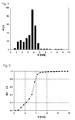
- Fig. 1 The distribution of the number density n of the thicknesses d of the graphite platelets is shown in Fig. 1, and Fig. 2 shows the corresponding cumulative distribution Q 0 of thicknesses. Even though the exact heights of the SDS layer on the graphite plates is not known exactly, it can be assumed that those platelets with heights of less than one nanometer are single layer graphene platelets.
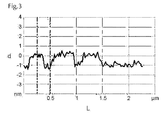
- Fig. 3 shows the height d profile across three such single layer graphene platelets. The value of L indicates the position along a line in the plane of the platelet.
- the cumulative thickness distribution of that mean value d 50 was determined to be 2.7 nm. In other words, 50% of the platelets are equal to or less than 2.7 nm in thick. About 5% of the platelets are single layer graphene platelets.
- the second example differs from example 1 in that this time yttrium stabilized zirconia milling beads with a diameter of only 50 ⁇ m were used as milling beads.
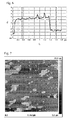
- Fig. 4 shows the thickness profile of 300 platelets.
- Fig. 5 shows the corresponding cumulative distribution Q 0 of thicknesses.
- Fig. 6 shows the height profile across an exemplary graphene platelet.
- the value of L indicates the position along a line in the plane of the platelet.
- the cumulative thickness distribution of that mean value d 50 was determined to be 3.4 nm. In other words, 50% of the platelets are equal to or less than 3.4 nm in thick.
- Fig. 7 shows an atomic force micrograph of the platelets on the silicon dioxide substrate.
Landscapes
- Chemical & Material Sciences (AREA)
- Organic Chemistry (AREA)
- Life Sciences & Earth Sciences (AREA)
- General Life Sciences & Earth Sciences (AREA)
- Geology (AREA)
- Inorganic Chemistry (AREA)
- Battery Electrode And Active Subsutance (AREA)
- Carbon And Carbon Compounds (AREA)
Claims (12)
- Verfahren zur Herstellung von Plättchen, die ein geschichtetes Material aufweisen, aus Partikeln aus dem geschichteten Material, wobei die Partikel einer mechanischen Mahlbehandlung unter Verwendung von Mahlmittel ausgesetzt werden, dadurch gekennzeichnet, dass die Beanspruchungsenergie des Mahlmittels SEGM kleiner als 10 µNm ist.
- Das Verfahren entsprechend Anspruch 1, dadurch gekennzeichnet, dass die Partikel aus dem geschichtetem Material in ein flüssiges Medium gemischt werden; und die hineingemischten Partikel der mechanischen Mahlbehandlung ausgesetzt werden, wodurch zumindest einige der Partikel aus dem geschichteten Material abblättern zur Herstellung von Plättchen aus dem geschichteten Material.
- Das Verfahren entsprechend Anspruch 2, dadurch gekennzeichnet, dass der Gehalt des geschichteten Materials in der Mischung mehr als 0,01 Gewichtsprozent beträgt.
- Das Verfahren entsprechend Anspruch 2 oder Anspruch 3, dadurch gekennzeichnet, dass das Mischungsmedium ein wässriges Medium ist.
- Das Verfahren entsprechend einem der Ansprüche 2 bis 4, dadurch gekennzeichnet, dass die Mischung ein Tensid enthält.
- Das Verfahren entsprechend einem der vorhergehenden Ansprüche, dadurch gekennzeichnet, dass die Mahlkörper einen Durchmesser von 800 µm oder weniger aufweisen.
- Das Verfahren entsprechend einer der vorhergehenden Ansprüche, dadurch gekennzeichnet, dass die mechanische Mahlbehandlung mittels einer Rührwerksmühle auf die Dispersion angewendet wird.
- Das Verfahren entsprechend einem der vorhergehenden Ansprüche, dadurch gekennzeichnet, dass die maximale Umfangsgeschwindigkeit vt des Rührers der Rührwerksmühle kleiner als 60 Meter pro Sekunde ist.
- Das Verfahren entsprechend einem der vorhergehenden Ansprüche, dadurch gekennzeichnet, dass die Partikel Graphit als geschichtetes Material enthalten.
- Das Verfahren entsprechend einem der vorhergehenden Ansprüche, dadurch gekennzeichnet, dass die Schichten Graphenschichten sind.
- Das Verfahren entsprechend einem der vorhergehenden Ansprüche, dadurch gekennzeichnet, dass die Partikel aus dem geschichteten Material einen Durchmesser von 300 Mikrometer oder weniger aufweisen.
- Das Verfahren entsprechend einem der vorhergehenden Ansprüche, dadurch gekennzeichnet, dass die Mahlbehandlung bei einer Temperatur unter 150°C durchgeführt wird.
Priority Applications (3)
| Application Number | Priority Date | Filing Date | Title |
|---|---|---|---|
| EP09165606.6A EP2275385B1 (de) | 2009-07-15 | 2009-07-15 | Verfahren zur Herstellung von Plättchen mit einem geschichteten Material |
| PCT/EP2010/059752 WO2011006814A1 (en) | 2009-07-15 | 2010-07-07 | Method of producing platelets comprising a layered material |
| US13/383,509 US20120220198A1 (en) | 2009-07-15 | 2010-07-07 | Method of producing platelets comprising a layered material |
Applications Claiming Priority (1)
| Application Number | Priority Date | Filing Date | Title |
|---|---|---|---|
| EP09165606.6A EP2275385B1 (de) | 2009-07-15 | 2009-07-15 | Verfahren zur Herstellung von Plättchen mit einem geschichteten Material |
Publications (2)
| Publication Number | Publication Date |
|---|---|
| EP2275385A1 EP2275385A1 (de) | 2011-01-19 |
| EP2275385B1 true EP2275385B1 (de) | 2015-11-04 |
Family
ID=41279322
Family Applications (1)
| Application Number | Title | Priority Date | Filing Date |
|---|---|---|---|
| EP09165606.6A Not-in-force EP2275385B1 (de) | 2009-07-15 | 2009-07-15 | Verfahren zur Herstellung von Plättchen mit einem geschichteten Material |
Country Status (3)
| Country | Link |
|---|---|
| US (1) | US20120220198A1 (de) |
| EP (1) | EP2275385B1 (de) |
| WO (1) | WO2011006814A1 (de) |
Families Citing this family (22)
| Publication number | Priority date | Publication date | Assignee | Title |
|---|---|---|---|---|
| FR2962121B1 (fr) * | 2009-11-03 | 2012-07-13 | Centre Nat Rech Scient | Preparation de graphene par amincissement mecanique de materiaux graphitiques |
| CA2853670C (en) | 2011-10-27 | 2017-06-13 | Garmor, Inc. | Composite graphene structures |
| US8734683B2 (en) * | 2011-11-29 | 2014-05-27 | Xerox Corporation | Graphene nano-sheets and methods for making the same |
| JP5723058B2 (ja) * | 2012-03-09 | 2015-05-27 | リサーチ アンド ビジネス ファンデーション ソンギュングァン ユニバーシティResearch & Business Foundation Sungkyunkwan University | 板型炭素ナノ粒子製造方法及びそれを用いたアルミニウム‐炭素の複合材料の製造方法 |
| EP2639201B1 (de) | 2012-03-14 | 2016-02-10 | Friedrich-Alexander-Universität Erlangen-Nürnberg | Verfahren zur herstellung von graphenoxid zur graphenherstellung |
| US9206051B2 (en) * | 2012-03-30 | 2015-12-08 | Scott Murray | Apparatus for mechanical exfoliation of particulate materials |
| US20130309495A1 (en) | 2012-05-18 | 2013-11-21 | InHwan Do | Process of dry milling particulate materials |
| CA2903987C (en) | 2013-03-08 | 2018-05-01 | University Of Central Florida Research Foundation, Inc. | Large scale oxidized graphene production for industrial applications |
| EP2964573A4 (de) | 2013-03-08 | 2016-11-02 | Garmor Inc | Grapheneinschluss in einem wirt |
| KR101526412B1 (ko) * | 2013-10-22 | 2015-06-05 | 현대자동차 주식회사 | 그래핀 나노플레이트의 제조 방법, 이에 따라 제조된 그래핀, 및 이를 포함하는 그래핀 나노플레이트 페이스트와 전도성 막 |
| WO2015065893A1 (en) * | 2013-10-28 | 2015-05-07 | Garmor, Inc. | Ultra-low oxidized thin graphite flakes |
| CN104070615A (zh) * | 2014-07-10 | 2014-10-01 | 湖南元素密码石墨烯研究院(有限合伙) | 一种太阳能硅片线切割钢线及其制作方法 |
| US9828290B2 (en) | 2014-08-18 | 2017-11-28 | Garmor Inc. | Graphite oxide entrainment in cement and asphalt composite |
| JP6484348B2 (ja) | 2015-03-13 | 2019-03-13 | ユニバーシティ オブ セントラル フロリダ リサーチ ファウンデーション,インコーポレイテッド | ホスト中でのグラフェンナノ粒子の均一な分散 |
| WO2016154057A1 (en) | 2015-03-23 | 2016-09-29 | Garmor Inc. | Engineered composite structure using graphene oxide |
| JP6563029B2 (ja) | 2015-04-13 | 2019-08-21 | ガーマー インク.Garmor, Inc. | コンクリート又はアスファルトなどのホスト中の酸化グラファイト強化繊維 |
| US11482348B2 (en) | 2015-06-09 | 2022-10-25 | Asbury Graphite Of North Carolina, Inc. | Graphite oxide and polyacrylonitrile based composite |
| WO2017053204A1 (en) | 2015-09-21 | 2017-03-30 | Garmor Inc. | Low-cost, high-performance composite bipolar plate |
| WO2018081413A1 (en) | 2016-10-26 | 2018-05-03 | Garmor Inc. | Additive coated particles for low high performance materials |
| CN109294283B (zh) * | 2018-09-29 | 2020-11-17 | 青岛黑猫炭黑科技有限责任公司 | 一种多相纳米级复合碳材料的制备方法 |
| US11791061B2 (en) | 2019-09-12 | 2023-10-17 | Asbury Graphite North Carolina, Inc. | Conductive high strength extrudable ultra high molecular weight polymer graphene oxide composite |
| WO2025037108A2 (en) | 2023-08-15 | 2025-02-20 | Board Of Trustees Of The Leland Stanford Junior University | Modified thrombopoietin |
Family Cites Families (6)
| Publication number | Priority date | Publication date | Assignee | Title |
|---|---|---|---|---|
| US20020054995A1 (en) * | 1999-10-06 | 2002-05-09 | Marian Mazurkiewicz | Graphite platelet nanostructures |
| KR20130106440A (ko) * | 2006-02-28 | 2013-09-27 | 프리메트 프리시젼 머테리알스, 인크. | 리튬계 화합물 나노입자 조성물 및 이의 제조 방법 |
| US7785492B1 (en) * | 2006-09-26 | 2010-08-31 | Nanotek Instruments, Inc. | Mass production of nano-scaled platelets and products |
| WO2008143692A1 (en) * | 2006-10-31 | 2008-11-27 | The Regents Of The University Of California | Graphite nano platelets for thermal and electrical applications |
| US8132746B2 (en) | 2007-04-17 | 2012-03-13 | Nanotek Instruments, Inc. | Low-temperature method of producing nano-scaled graphene platelets and their nanocomposites |
| US7824651B2 (en) | 2007-05-08 | 2010-11-02 | Nanotek Instruments, Inc. | Method of producing exfoliated graphite, flexible graphite, and nano-scaled graphene platelets |
-
2009
- 2009-07-15 EP EP09165606.6A patent/EP2275385B1/de not_active Not-in-force
-
2010
- 2010-07-07 US US13/383,509 patent/US20120220198A1/en not_active Abandoned
- 2010-07-07 WO PCT/EP2010/059752 patent/WO2011006814A1/en not_active Ceased
Also Published As
| Publication number | Publication date |
|---|---|
| US20120220198A1 (en) | 2012-08-30 |
| WO2011006814A1 (en) | 2011-01-20 |
| EP2275385A1 (de) | 2011-01-19 |
Similar Documents
| Publication | Publication Date | Title |
|---|---|---|
| EP2275385B1 (de) | Verfahren zur Herstellung von Plättchen mit einem geschichteten Material | |
| Dideikin et al. | Rehybridization of carbon on facets of detonation diamond nanocrystals and forming hydrosols of individual particles | |
| US10995002B2 (en) | Large scale oxidized graphene production for industrial applications | |
| US10351473B2 (en) | Graphite oxide entrainment in cement and asphalt composite | |
| KR102494146B1 (ko) | 코크스 또는 석탄으로부터의 그래핀 시트의 초음파 처리에 의한 직접 생산 | |
| Zhu et al. | Decorating graphene oxide with CuO nanoparticles in a water–isopropanol system | |
| JP6618800B2 (ja) | 粒子材料を乾式粉砕するプロセス | |
| Knieke et al. | Scalable production of graphene sheets by mechanical delamination | |
| CN102725226B (zh) | 通过机械方式使石墨材料变薄来制备石墨烯 | |
| Spyrou et al. | An introduction to graphene | |
| JP2005001983A (ja) | 超分散状態ナノ炭素およびその製造方法 | |
| Nacken et al. | Determination of quantitative structure-property and structure-process relationships for graphene production in water | |
| Padya et al. | A facile co-solvent strategy for preparation of graphene nanoplatelet powder: An industrially viable innovative approach | |
| Damm et al. | Delamination of hexagonal boron nitride in a stirred media mill | |
| Mączka et al. | Phonon properties of nanosized MnWO4 with different size and morphology | |
| Venkanna et al. | Synthesis and characterizations of graphene oxide and reduced graphene oxide nanosheets | |
| Baidakova et al. | Methods of characterization and models of nanodiamond particles | |
| Xiao | Hexagonal boron nitride nanosheets synthesis and applications | |
| S Makadia et al. | The freeze-thaw technique for exfoliation of graphite: A novel approach for bulk production of scroll-free graphene oxide sheets | |
| Knieke et al. | Delamination of Graphite Sheets in Stirred Media Mills | |
| Rosoff-Verbit | Liberation of Graphene-like Nanoplatelets and Sub-micron Particles from Anthracite Coal through Chemically Aided Attrition Milling | |
| Liu et al. | Preparation of graphene nanosheet/alumina composites | |
| Alzahrani | Production of High-Quality Few-Layer Graphene Flakes by Intercalation and Exfoliation | |
| Bhagat et al. | Strain-induced tuning of optical properties of layered Mo $ S_2$ | |
| Tkalya | Graphene-based polymer nanocomposites |
Legal Events
| Date | Code | Title | Description |
|---|---|---|---|
| PUAI | Public reference made under article 153(3) epc to a published international application that has entered the european phase |
Free format text: ORIGINAL CODE: 0009012 |
|
| 17P | Request for examination filed |
Effective date: 20101119 |
|
| AK | Designated contracting states |
Kind code of ref document: A1 Designated state(s): AT BE BG CH CY CZ DE DK EE ES FI FR GB GR HR HU IE IS IT LI LT LU LV MC MK MT NL NO PL PT RO SE SI SK SM TR |
|
| AX | Request for extension of the european patent |
Extension state: AL BA RS |
|
| 17Q | First examination report despatched |
Effective date: 20120710 |
|
| GRAP | Despatch of communication of intention to grant a patent |
Free format text: ORIGINAL CODE: EPIDOSNIGR1 |
|
| RIC1 | Information provided on ipc code assigned before grant |
Ipc: C01B 31/04 20060101AFI20150202BHEP Ipc: C09C 1/00 20060101ALI20150202BHEP Ipc: C09C 1/46 20060101ALI20150202BHEP Ipc: C09C 3/04 20060101ALI20150202BHEP |
|
| INTG | Intention to grant announced |
Effective date: 20150226 |
|
| GRAP | Despatch of communication of intention to grant a patent |
Free format text: ORIGINAL CODE: EPIDOSNIGR1 |
|
| INTG | Intention to grant announced |
Effective date: 20150511 |
|
| GRAS | Grant fee paid |
Free format text: ORIGINAL CODE: EPIDOSNIGR3 |
|
| GRAA | (expected) grant |
Free format text: ORIGINAL CODE: 0009210 |
|
| AK | Designated contracting states |
Kind code of ref document: B1 Designated state(s): AT BE BG CH CY CZ DE DK EE ES FI FR GB GR HR HU IE IS IT LI LT LU LV MC MK MT NL NO PL PT RO SE SI SK SM TR |
|
| REG | Reference to a national code |
Ref country code: GB Ref legal event code: FG4D |
|
| REG | Reference to a national code |
Ref country code: CH Ref legal event code: EP |
|
| REG | Reference to a national code |
Ref country code: AT Ref legal event code: REF Ref document number: 759045 Country of ref document: AT Kind code of ref document: T Effective date: 20151115 |
|
| REG | Reference to a national code |
Ref country code: IE Ref legal event code: FG4D |
|
| REG | Reference to a national code |
Ref country code: DE Ref legal event code: R096 Ref document number: 602009034587 Country of ref document: DE |
|
| REG | Reference to a national code |
Ref country code: NL Ref legal event code: MP Effective date: 20151104 |
|
| REG | Reference to a national code |
Ref country code: LT Ref legal event code: MG4D |
|
| REG | Reference to a national code |
Ref country code: AT Ref legal event code: MK05 Ref document number: 759045 Country of ref document: AT Kind code of ref document: T Effective date: 20151104 |
|
| PG25 | Lapsed in a contracting state [announced via postgrant information from national office to epo] |
Ref country code: LT Free format text: LAPSE BECAUSE OF FAILURE TO SUBMIT A TRANSLATION OF THE DESCRIPTION OR TO PAY THE FEE WITHIN THE PRESCRIBED TIME-LIMIT Effective date: 20151104 Ref country code: ES Free format text: LAPSE BECAUSE OF FAILURE TO SUBMIT A TRANSLATION OF THE DESCRIPTION OR TO PAY THE FEE WITHIN THE PRESCRIBED TIME-LIMIT Effective date: 20151104 Ref country code: NO Free format text: LAPSE BECAUSE OF FAILURE TO SUBMIT A TRANSLATION OF THE DESCRIPTION OR TO PAY THE FEE WITHIN THE PRESCRIBED TIME-LIMIT Effective date: 20160204 Ref country code: NL Free format text: LAPSE BECAUSE OF FAILURE TO SUBMIT A TRANSLATION OF THE DESCRIPTION OR TO PAY THE FEE WITHIN THE PRESCRIBED TIME-LIMIT Effective date: 20151104 Ref country code: HR Free format text: LAPSE BECAUSE OF FAILURE TO SUBMIT A TRANSLATION OF THE DESCRIPTION OR TO PAY THE FEE WITHIN THE PRESCRIBED TIME-LIMIT Effective date: 20151104 Ref country code: IT Free format text: LAPSE BECAUSE OF FAILURE TO SUBMIT A TRANSLATION OF THE DESCRIPTION OR TO PAY THE FEE WITHIN THE PRESCRIBED TIME-LIMIT Effective date: 20151104 Ref country code: IS Free format text: LAPSE BECAUSE OF FAILURE TO SUBMIT A TRANSLATION OF THE DESCRIPTION OR TO PAY THE FEE WITHIN THE PRESCRIBED TIME-LIMIT Effective date: 20160304 |
|
| PG25 | Lapsed in a contracting state [announced via postgrant information from national office to epo] |
Ref country code: PT Free format text: LAPSE BECAUSE OF FAILURE TO SUBMIT A TRANSLATION OF THE DESCRIPTION OR TO PAY THE FEE WITHIN THE PRESCRIBED TIME-LIMIT Effective date: 20160304 Ref country code: FI Free format text: LAPSE BECAUSE OF FAILURE TO SUBMIT A TRANSLATION OF THE DESCRIPTION OR TO PAY THE FEE WITHIN THE PRESCRIBED TIME-LIMIT Effective date: 20151104 Ref country code: GR Free format text: LAPSE BECAUSE OF FAILURE TO SUBMIT A TRANSLATION OF THE DESCRIPTION OR TO PAY THE FEE WITHIN THE PRESCRIBED TIME-LIMIT Effective date: 20160205 Ref country code: SE Free format text: LAPSE BECAUSE OF FAILURE TO SUBMIT A TRANSLATION OF THE DESCRIPTION OR TO PAY THE FEE WITHIN THE PRESCRIBED TIME-LIMIT Effective date: 20151104 Ref country code: PL Free format text: LAPSE BECAUSE OF FAILURE TO SUBMIT A TRANSLATION OF THE DESCRIPTION OR TO PAY THE FEE WITHIN THE PRESCRIBED TIME-LIMIT Effective date: 20151104 Ref country code: AT Free format text: LAPSE BECAUSE OF FAILURE TO SUBMIT A TRANSLATION OF THE DESCRIPTION OR TO PAY THE FEE WITHIN THE PRESCRIBED TIME-LIMIT Effective date: 20151104 Ref country code: LV Free format text: LAPSE BECAUSE OF FAILURE TO SUBMIT A TRANSLATION OF THE DESCRIPTION OR TO PAY THE FEE WITHIN THE PRESCRIBED TIME-LIMIT Effective date: 20151104 |
|
| REG | Reference to a national code |
Ref country code: FR Ref legal event code: PLFP Year of fee payment: 8 |
|
| PG25 | Lapsed in a contracting state [announced via postgrant information from national office to epo] |
Ref country code: CZ Free format text: LAPSE BECAUSE OF FAILURE TO SUBMIT A TRANSLATION OF THE DESCRIPTION OR TO PAY THE FEE WITHIN THE PRESCRIBED TIME-LIMIT Effective date: 20151104 |
|
| REG | Reference to a national code |
Ref country code: DE Ref legal event code: R097 Ref document number: 602009034587 Country of ref document: DE |
|
| PG25 | Lapsed in a contracting state [announced via postgrant information from national office to epo] |
Ref country code: RO Free format text: LAPSE BECAUSE OF FAILURE TO SUBMIT A TRANSLATION OF THE DESCRIPTION OR TO PAY THE FEE WITHIN THE PRESCRIBED TIME-LIMIT Effective date: 20151104 Ref country code: SM Free format text: LAPSE BECAUSE OF FAILURE TO SUBMIT A TRANSLATION OF THE DESCRIPTION OR TO PAY THE FEE WITHIN THE PRESCRIBED TIME-LIMIT Effective date: 20151104 Ref country code: DK Free format text: LAPSE BECAUSE OF FAILURE TO SUBMIT A TRANSLATION OF THE DESCRIPTION OR TO PAY THE FEE WITHIN THE PRESCRIBED TIME-LIMIT Effective date: 20151104 Ref country code: SK Free format text: LAPSE BECAUSE OF FAILURE TO SUBMIT A TRANSLATION OF THE DESCRIPTION OR TO PAY THE FEE WITHIN THE PRESCRIBED TIME-LIMIT Effective date: 20151104 Ref country code: EE Free format text: LAPSE BECAUSE OF FAILURE TO SUBMIT A TRANSLATION OF THE DESCRIPTION OR TO PAY THE FEE WITHIN THE PRESCRIBED TIME-LIMIT Effective date: 20151104 |
|
| PLBE | No opposition filed within time limit |
Free format text: ORIGINAL CODE: 0009261 |
|
| STAA | Information on the status of an ep patent application or granted ep patent |
Free format text: STATUS: NO OPPOSITION FILED WITHIN TIME LIMIT |
|
| 26N | No opposition filed |
Effective date: 20160805 |
|
| REG | Reference to a national code |
Ref country code: DE Ref legal event code: R079 Ref document number: 602009034587 Country of ref document: DE Free format text: PREVIOUS MAIN CLASS: C01B0031040000 Ipc: C01B0032200000 |
|
| PG25 | Lapsed in a contracting state [announced via postgrant information from national office to epo] |
Ref country code: SI Free format text: LAPSE BECAUSE OF FAILURE TO SUBMIT A TRANSLATION OF THE DESCRIPTION OR TO PAY THE FEE WITHIN THE PRESCRIBED TIME-LIMIT Effective date: 20151104 |
|
| PG25 | Lapsed in a contracting state [announced via postgrant information from national office to epo] |
Ref country code: BE Free format text: LAPSE BECAUSE OF FAILURE TO SUBMIT A TRANSLATION OF THE DESCRIPTION OR TO PAY THE FEE WITHIN THE PRESCRIBED TIME-LIMIT Effective date: 20151104 |
|
| REG | Reference to a national code |
Ref country code: CH Ref legal event code: PL |
|
| PG25 | Lapsed in a contracting state [announced via postgrant information from national office to epo] |
Ref country code: MC Free format text: LAPSE BECAUSE OF FAILURE TO SUBMIT A TRANSLATION OF THE DESCRIPTION OR TO PAY THE FEE WITHIN THE PRESCRIBED TIME-LIMIT Effective date: 20151104 |
|
| PG25 | Lapsed in a contracting state [announced via postgrant information from national office to epo] |
Ref country code: CH Free format text: LAPSE BECAUSE OF NON-PAYMENT OF DUE FEES Effective date: 20160731 Ref country code: LI Free format text: LAPSE BECAUSE OF NON-PAYMENT OF DUE FEES Effective date: 20160731 |
|
| REG | Reference to a national code |
Ref country code: IE Ref legal event code: MM4A |
|
| REG | Reference to a national code |
Ref country code: FR Ref legal event code: PLFP Year of fee payment: 9 |
|
| PG25 | Lapsed in a contracting state [announced via postgrant information from national office to epo] |
Ref country code: IE Free format text: LAPSE BECAUSE OF NON-PAYMENT OF DUE FEES Effective date: 20160715 |
|
| PG25 | Lapsed in a contracting state [announced via postgrant information from national office to epo] |
Ref country code: LU Free format text: LAPSE BECAUSE OF NON-PAYMENT OF DUE FEES Effective date: 20160715 |
|
| PGFP | Annual fee paid to national office [announced via postgrant information from national office to epo] |
Ref country code: GB Payment date: 20170724 Year of fee payment: 9 Ref country code: FR Payment date: 20170720 Year of fee payment: 9 Ref country code: DE Payment date: 20170724 Year of fee payment: 9 |
|
| PG25 | Lapsed in a contracting state [announced via postgrant information from national office to epo] |
Ref country code: HU Free format text: LAPSE BECAUSE OF FAILURE TO SUBMIT A TRANSLATION OF THE DESCRIPTION OR TO PAY THE FEE WITHIN THE PRESCRIBED TIME-LIMIT; INVALID AB INITIO Effective date: 20090715 Ref country code: CY Free format text: LAPSE BECAUSE OF FAILURE TO SUBMIT A TRANSLATION OF THE DESCRIPTION OR TO PAY THE FEE WITHIN THE PRESCRIBED TIME-LIMIT Effective date: 20151104 |
|
| PG25 | Lapsed in a contracting state [announced via postgrant information from national office to epo] |
Ref country code: TR Free format text: LAPSE BECAUSE OF FAILURE TO SUBMIT A TRANSLATION OF THE DESCRIPTION OR TO PAY THE FEE WITHIN THE PRESCRIBED TIME-LIMIT Effective date: 20151104 Ref country code: MT Free format text: LAPSE BECAUSE OF NON-PAYMENT OF DUE FEES Effective date: 20160731 Ref country code: MK Free format text: LAPSE BECAUSE OF FAILURE TO SUBMIT A TRANSLATION OF THE DESCRIPTION OR TO PAY THE FEE WITHIN THE PRESCRIBED TIME-LIMIT Effective date: 20151104 |
|
| PG25 | Lapsed in a contracting state [announced via postgrant information from national office to epo] |
Ref country code: BG Free format text: LAPSE BECAUSE OF FAILURE TO SUBMIT A TRANSLATION OF THE DESCRIPTION OR TO PAY THE FEE WITHIN THE PRESCRIBED TIME-LIMIT Effective date: 20151104 |
|
| REG | Reference to a national code |
Ref country code: DE Ref legal event code: R119 Ref document number: 602009034587 Country of ref document: DE |
|
| GBPC | Gb: european patent ceased through non-payment of renewal fee |
Effective date: 20180715 |
|
| PG25 | Lapsed in a contracting state [announced via postgrant information from national office to epo] |
Ref country code: DE Free format text: LAPSE BECAUSE OF NON-PAYMENT OF DUE FEES Effective date: 20190201 Ref country code: GB Free format text: LAPSE BECAUSE OF NON-PAYMENT OF DUE FEES Effective date: 20180715 Ref country code: FR Free format text: LAPSE BECAUSE OF NON-PAYMENT OF DUE FEES Effective date: 20180731 |