EP2275704A1 - Surveillance d'une machine produisant des oscillations - Google Patents
Surveillance d'une machine produisant des oscillations Download PDFInfo
- Publication number
- EP2275704A1 EP2275704A1 EP09165471A EP09165471A EP2275704A1 EP 2275704 A1 EP2275704 A1 EP 2275704A1 EP 09165471 A EP09165471 A EP 09165471A EP 09165471 A EP09165471 A EP 09165471A EP 2275704 A1 EP2275704 A1 EP 2275704A1
- Authority
- EP
- European Patent Office
- Prior art keywords
- machine
- vibration
- operating
- parameter
- information
- Prior art date
- Legal status (The legal status is an assumption and is not a legal conclusion. Google has not performed a legal analysis and makes no representation as to the accuracy of the status listed.)
- Withdrawn
Links
Images


Classifications
-
- B—PERFORMING OPERATIONS; TRANSPORTING
- B41—PRINTING; LINING MACHINES; TYPEWRITERS; STAMPS
- B41F—PRINTING MACHINES OR PRESSES
- B41F13/00—Common details of rotary presses or machines
- B41F13/004—Electric or hydraulic features of drives
- B41F13/0045—Electric driving devices
-
- B—PERFORMING OPERATIONS; TRANSPORTING
- B41—PRINTING; LINING MACHINES; TYPEWRITERS; STAMPS
- B41F—PRINTING MACHINES OR PRESSES
- B41F33/00—Indicating, counting, warning, control or safety devices
Definitions
- the invention relates to a method and a system for monitoring a machine, preferably a printing press, such as a rotary printing machine, which generates vibrations, as well as a method for generating and / or maintaining an information system for the operation of the machine.
- measures which may be substantially passive or active.
- Passive measures are characterized by the use of a sound absorber, which attenuates the sound across its propagation direction.
- active measures are based on the simple physical principle, whereby an oscillation to be extinguished is extinguished by superposing an antiphase oscillation.
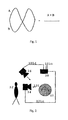
- FIG. 1 the principle of an active method is shown, wherein an oscillation A is superimposed with an antiphase oscillation B, so that for the superposition (A + B) a vanishing amplitude results.
- An ANC (Adaptive Noise Control) method is essentially that in the FIG.
- Noise in the vicinity of a machine can also be used to make conclusions about a state of the machine.
- a system for detecting a printer malfunction is known wherein the detection is performed based on measurements of vibration, temperature, and sound.
- From the JP 51555002 is related to judging properties such as flaking known with a printing process of a printing press, wherein the assessment based on measured sound takes place.
- the object of the invention is to suppress vibrations in the environment of a machine and at the same time to use for monitoring the machine.
- One aspect of the invention relates to a method for monitoring a machine producing at least one vibration, in particular a printing press.
- the method comprises the steps of measuring the at least one vibration generated by the engine, evaluating the at least one vibration generated by the engine to calculate at least one of at least one or a portion of the vibration generated by the engine, generating the at least one countervibration for mitigating the vibration generated by the machine.
- an operating condition of the engine and / or at least one characteristic vibration parameter for monitoring the engine from a superposition vibration or from the vibration generated by the engine are determined.
- the superposition vibration results from a superposition of vibration and counter vibration.
- the mitigation of the vibration generated by the machine is at least partially mitigating.
- the operating condition may describe a condition of the machine, a situation in which the machine is located, a lack or presence of a quality or characteristic of the machine, a lack or presence of consumables or resources for the machine, as well as a deviation from normality .
- Operating states of the machine can be, for example: pre-moistening, operating point in the linear characteristic range, operating point in the non-linear characteristic range, full load, partial load, idling, breakdown, partial lack of a path, temperature too high.
- the machine which may also be a machine component or a machine element, has one or more rotating machine elements, such as a roller, a roller, a cylinder, a gear, or a ball bearing, wherein the rotating machine elements substantially produce the vibration.
- the oscillation can thus have a periodic or quasi-periodic character.
- the vibration can also be generated by machine elements that touch each other and perform a translational movement relative to each other.
- the parameters of the countervibration for example amplitude, frequency or frequency response, phase or phase response, can be adjusted in the evaluation of the vibration generated by the machine depending on the corresponding parameters of the vibration so that predetermined or predetermined criteria are met.
- the criteria can be set in view of the fact that, for example, the overlay vibration in a given space and / or frequency range are reduced so that the outgoing of the overlay vibration, the operator of the machine perceived as disturbing effect is reduced and at the same time the overlay vibration remains unaffected in that it can be used for further technical applications, for example determining an operating state of the machine.
- the vibration generated by the machine and / or the superposition vibration can also only partially or completely attenuated.
- a sound pressure in the vicinity of the machine or in a hall in which the machine is operated can be suppressed to the extent that the people working on the machine or in the hall are less disturbed by the sound generated by the machine.
- the overlapping vibration comprising the sound and the vibrations of the machine is not changed or reduced in such a way that a detection of the vibration parameters by means of Measuring the overlay vibration is no longer possible.
- the self-contradictory goals to mitigate the sound in the environment of the machine and at the same time to use to monitor the machine can be achieved simultaneously.
- the vibration generated by the machine and / or the superimposition oscillation can be completely optimally attenuated, that is to say maximum or as far as is technically feasible.
- the overlay vibration may be measured and the countervibration may be generated to attenuate the vibration generated by the engine or the overlay vibration in response to the measured overlay vibration.
- the countervibration may be generated to attenuate the vibration generated by the engine or the overlay vibration in response to the measured overlay vibration.
- the countervibration can be determined either as a function of the vibration generated by the machine, for example by means of a microphone positioned close to the vibration source, or depending on the superposition vibration, or in response to both the vibration generated by the machine and the superimposed vibration become.
- the countervibration can be generated in such a way that predetermined spatial regions become stronger and the remaining spatial regions are less strongly attenuated.
- the specification of the room areas with a greater attenuation may be based on where operators of the machines essentially reside. Those in the room areas with less attenuation Measured local oscillation can be used to determine information about the operation of the machine to monitor the machine.
- At least one vibration parameter characterizing the vibration generated by the engine may be detected for monitoring the engine.
- Monitoring may consist in that one of the measured or determined operating parameters of the printing press is regulated or controlled or displayed to an operator. Monitoring can also consist in that, based on an evaluation of the status information, a malfunction of the printing press is forecast or a maintenance of the printing press is planned.
- Monitoring may be a continuous, continuous control of the machine with regard to an operational and / or process and / or hardware and / or software fault, an anomaly of the operation or deviation from normal states or operations. If the monitoring is a control or control of the machine, the control may be an adaptive and / or fuzzy and / or database based control.
- the vibration parameter may be a fundamental frequency, an amplitude of the fundamental frequency, a first harmonic, a first harmonic amplitude, a frequency response, or a phase response.
- the vibration parameter may relate to discrete values of frequency and / or phase of the vibration and associated amplitude values. For example, a significant increase in a selected harmonic of a fundamental vibration of a predetermined engine component may be considered indicative of a malfunction of the particular engine component.
- the amount of increase may be related to a physical size of the machine or machine component, such as a speed, rotational speed, or spin.
- the vibration parameter may be a time-dependent and / or location-dependent profile of at least one spectral component and / or an amplitude and / or a phase of the vibration.
- historical patterns that is, history recorded during previous operating phases of the machine, may be related to malfunctions or operating characteristics of the machine.
- the currently measured time- and / or location-dependent course of the spectral components and / or amplitude and / or phase can be checked for agreement with historical or recorded history patterns, from which can be deduced is whether the current operation of the machine has a certain malfunction or operating characteristic.
- the test can be carried out using standard pattern recognition methods.
- the vibration parameter may include combinations of amplitude, frequency or phase information. Combinations can also be understood as a pattern, wherein an occurrence of a pattern can characterize an operating state.
- the methods known from artificial intelligence can be used.
- the advantage of evaluating operating conditions by evaluating patterns of the vibration parameters over a direct measurement of the operating parameters is that different operating conditions may result for the same combination of operating parameters, the operating conditions differing due to the presence of a malfunction that can not be detected by an operating parameter is.
- the operating state may be normal, and once defective or problematic, depending on the respective vibration parameters. In this way, not only the classic control variables such as amount of water, amount of color or color water mixture can be controlled, but also operating states, which are described by linguistic variables, such as normal operating state.
- the operating state can be characterized by operating information.
- operating information By means of this operating information, the machine can be monitored.
- the operating information which can be represented in terms of information technology as a set of data records by means of a plurality of data fields, relates to at least one, preferably two, three, four or more operating parameters, and / or the at least one vibration parameter, and / or status information relating to a fault or normal function of the machine ,
- the operating parameter may relate to a quantitative quantity, for example a physical quantity such as speed, speed or temperature.
- the operating parameter may assume discrete or binary values, for example an on / off state, or a first roll is applied to a second roll and to a third roll: yes / no, or warm-up phase, or represent a countable size, for example a number of printed pages.
- the operating parameter may also be digital information of a print motif.
- the status information may relate to the failure of one or more machine components, which failure may be imminent or already occurred.
- the status information may include a linguistic variable, such as "good”, “bad”, “defective”, “failed” or “failing", to which a continuous numerical value on a scale between a minimum and a maximum value may be assigned.
- Typical status information is, for example, "color OK”, or “color too thick", or "transmission between a first roller and a second roller faulty".
- the at least one operating parameter of the machine can be determined and / or changed, and the status information of the machine can be evaluated with regard to a faulty or normal function of the machine.
- the aim of the evaluation may be to monitor at least one of the following quantities: a quantity of water, a quantity of paint, a color water mixture, a speed, a web tension, a nip of two rolls, a color split, a Schmitz.
- nip is generally referred to the contact surface, which forms in juxtaposed, in particular approximately cylindrical bodies of revolution.
- the rotational bodies may, for example, be ink rollers or dampening rollers, in particular a dyeing or dampening unit, or a forme cylinder or transfer cylinder, in particular a printing unit.
- Monitoring the machine may mean that an error message or an alarm is issued and / or the operation of the machine is changed, for example, by the workload the machine is throttled or the machine is stopped if the operating information or parts thereof, such as the status information and / or the operating parameters, have values according to an error pattern or outside an approved range.
- Monitoring of the machine can also mean that the machine is controlled or controlled by means of the operating information, for example by using one of the measured or determined operating parameters of the printing press for controlling or displaying the machine or to an operator, or by evaluating the status information Malfunction of the printing press predicts or maintenance of the printing press is planned.
- the following steps may be performed: providing an information system with operating information, accessing operating information stored in the information system by executing an interrogation of the vibration parameter, and determining quantities indicative of an operating state of the machine, such as operating parameters and / or status information from the operating information.
- the information system may be a database, such as a relational or a fuzzy database, a table, or a neural network.
- the operating information is stored or stored in the form of data records.
- the use of the information system is based on the idea of using the information system in two phases.
- a first phase or build phase or learning phase the information system can be filled with as many operating states of the machine operating information.
- operating information can be retrieved from the information system.
- a first, known or available part of the operating information for example one or more characteristic vibration parameters, can be input as input to the information system.
- a second, sought-after part of the operating information can be obtained, for example at least one operating parameter or status information which characterizes the operation of the machine.
- At least one operating parameter can be determined by measuring the operating parameter. It can sensors for each physical occurring on the machine or technical size, such as temperature sensors, pressure sensors or humidity sensors, are arranged on one or more machine components, whereby the corresponding physical size measured and associated signals are provided. Preferably, electrical or electronic signals can also be tapped directly and stored as operating parameters.
- a cross-check of the determined values can be carried out. If the cross-check detects a difference between the determined values, appropriate measures can be initiated, for example, maintenance or replacement of measuring sensors.
- the monitoring of the machine may include altering the operating parameters, with the aim of bringing the operating state of the machine representable by a multi-dimensional vector into a desired value range, or outputting the operating information or taking an emergency measure, for example shutting down the machine.
- the vibration generated by the machine and / or the superposition vibration is attenuated only partially or partially or incompletely in the time domain and / or in the frequency domain and / or in the local area.
- the weakening can be, for example, 100 percent, or 50 percent, or 10 percent. That is, in a first range of the time, frequency or location range, the vibration generated by the machine and / or the beat vibration is attenuated, and in a second range complementary to the first range, no or only a reduced attenuation is performed. In the areas with no or reduced attenuation, the overlay oscillation can be evaluated to determine the oscillation parameters.
- a periodic time window or a periodic time slot may be determined in which the vibration generated by the machine and / or the superposition vibration are not or only partially attenuated.
- Time windows may be understood to be a fixed length period of time within which a resource may be used or an action or process may be performed, for example a weakening of a vibration, wherein the period is periodically available.
- the vibration generated by the engine and / or the overlay vibration are attenuated more than within the time window, preferably as best as possible or optimal.
- the periodic time window can be defined by means of synchronization signals, wherein at the beginning of the time window a start synchronization signal and at the end of the time window an end synchronization signal is transmitted.
- the size of the time window can be chosen to be very small, so that the people in the vicinity of the machine or in the hall in which the machine is installed do not perceive the time window and only the suppression or perceive the attenuation of the sound during the time outside the time window.
- the length of the time window can be, for example, between 0.1 percent and 10 percent of the synchronization period.
- the length of the time window may be a dynamic quantity that changes during operation of the machine, that is, can be increased or decreased, depending on the operating information.
- the vibration generated by the machine and / or overlay vibration can be attenuated according to one or more user specifications.
- One of these specifications concerns a magnitude of the mitigation.
- the vibration generated by the machine and / or superposition oscillation can be reduced by a predetermined amount, for example by a factor of 0.8 or 0.2 or 0.02 or by 10 dB or by 20 dB.
- the maximum value of 100% for example, the size of the maximum possible or optimal attenuation can be understood, with a desired attenuation may have a value less than or equal to 100%.
- the user can select one or more location areas in which a stronger attenuation is desired, for example, because in these areas the operators of the machine want to work undisturbed by the disturbing sound of the machine. In the other local areas, a smaller attenuation is carried out, so that a better recognition of the vibration parameters from the superimposed oscillation measured there is possible.
- Another requirement relates to a frequency dependence of the attenuation or at least one frequency range for the attenuation.
- discrete frequencies can be specified at which the oscillation is to be suppressed.
- a range of frequencies to be excluded from the attenuation may be determined or determined because there are lines or gradients in this area with particular patterns indicative of machine malfunction.
- a specification concerns at least one vibration source whose vibration is to be mitigated.
- one or more machine components can be selected, which generate particularly much disturbing sound, wherein the vibrations of these machine components are selectively suppressed, for example by the sound-generating vibrations by means of electro-mechanical transducers, such as piezo elements, countervibrations are superimposed.
- machine components that are of particular importance to the operation of the machine, but produce less vibration or noise than other machine components, may be wholly or partially excluded from attenuation of the overlay vibration.
- the user preferences may also be combined, for example, by suppressing the vibration of a selected vibration source to be strong in a periodic time window and little suppressed outside that time window.
- the attenuation can also be chosen so that a good audible residual sound remains, which can be used by the people around the machine for a personal assessment of the operating condition of the machine.
- the operating parameter of the machine may be one or more of: a continuous or discrete control signal, information to be printed, a material property of a machine component, such as a rubber roller or plate, or a material used for printing For example, paper, paint, blanket, mechanical pressure on a roll surface, a kinematic quantity such as rotation angle, rotational speed, spin, one or more rotating machine components, a temperature, an ON / OFF state.
- a material property of a machine component such as a rubber roller or plate, or a material used for printing
- a kinematic quantity such as rotation angle, rotational speed, spin, one or more rotating machine components
- a temperature an ON / OFF state
- the Operational parameters may also be a linguistic quantity of a certain severity, for example, high temperature, or normal speed.
- the vibration is a vibration or mechanical vibration and / or a sound of at least one machine component.
- the oscillation may have any desired time sequence, for example a sinusoidal, a rectangular or a sawtooth-shaped drain, or even combinations thereof.
- sound occurs together with a vibration, where the vibration of the mechanical vibration of a solid or liquid element and sound as the air vibration are called.
- the sound may have a spectrum inside and / or outside of the human audible spectral range.
- a malfunction / malfunction can be detected by the fact that the operating information, for example an operating parameter or a vibration parameter, has values within a fault range, the fault range being a predetermined value range of the operating information.
- a disturbance may be characterized in that a temperature has a value higher than a predetermined maximum value or a lower value than its predetermined minimum value.
- a disturbance range may be defined, the disturbance range being a range complementary to a normal range.
- a fault area may have variable limits or dependencies on certain operating parameters.
- a disturbance may be defined so that a sound amplitude exceeds a predetermined value, the sound being assigned to a particular machine component, and having a specific value constellation of other operating parameters of that machine component, such as temperature, rotational speed, or pressure.
- a disturbance can also be defined by the fact that, for example, certain components of the oscillation have predetermined values or the frequency spectrum has a predetermined course.
- a disturbance can be detected by being predetermined Elements of the operating information, for example predetermined operating parameters and / or vibration parameters, have values which correspond exactly or approximately to a predetermined value pattern.
- predetermined operating parameters and / or vibration parameters have values which correspond exactly or approximately to a predetermined value pattern.
- common pattern recognition methods can be used.
- a malfunction can be predicted on the basis of the operating information. For example, a temporal course of predetermined operating parameters or vibration parameters can be analyzed for the prognosis, it being possible for the time profile to be continued or predicted beyond the respective current time. If the predicted values of the operating parameters, the vibration parameter or other elements of the operating information have values within the interference range or outside the normal range, then it can be assumed that a fault will occur. In this way, it is possible to predict both the type of disturbance and the time of occurrence of the disturbance.
- a fault also affects a wear of the machine.
- the wear of the machine can be characterized by a value of a vibration parameter or a value combination of several vibration parameters and / or operating parameters.
- the degree of wear can be characterized by a numerical value.
- a maintenance of the machine can be planned or executed. If, for example, it is determined that there is a high degree of wear as a result of operating the machine under extreme conditions, the maintenance intervals can be shortened or the next maintenance date can be brought forward.
- variables relevant to the operation of the machine may be monitored, wherein monitoring includes controlling, controlling and / or controlling the machine or machine component and / or the relevant quantities. These quantities include consumables such as a quantity of water, an amount of paint or a mixing ratio of a color water mixture.
- the variables relevant to the machine relate, for example, to a speed or rotational speed, at least a machine element or a machine component, and / or a web tension, and / or a color split, and / or a Schmitz, and / or a NIP of two rolls.
- the monitoring may also be performed, for example, for a bearing and / or a Schmitzringschmierung / Schmitzring mecanic and / or a folder, in particular a wear underlying components of the folder such as brushes, springs or cutting device.
- the variables or controlled variables that are relevant for the operation of the machine and / or one or more elements of the operating information can be output visually and / or acoustically by means of an output unit.
- the output unit may include one or more computer displays, gauges, warning lights and / or speakers.
- the outputting of information can also relate to sending at least one SMS message to at least one mobile phone.
- the outputting of the information may further relate to a targeted amplification or attenuation of the sound from one or more sound sources, which are determined or determined during the operation of the machine.
- the visually or acoustically output information preferably relates to a vibration or acoustic map, which is determined to represent the measured and / or calculated superposition vibration.
- the measurements can be carried out, for example, by means of microphone arrays and / or arrays of piezo elements.
- the microphone array and at least one optical camera can be arranged in a predeterminable position relative to one another in order to document at least part of the measurements from the optical camera.
- the acoustic map can detect acoustic vibrations and / or vibrations, as well as represent a spatial amplitude and / or frequency distribution of the superimposed oscillation. Based on the map, an operator may derive information relevant to the operation of the machine or an assessment of the condition of the machine. Based on the map, the sources of vibration can also be determined or determined.
- Another aspect of the invention relates to a method for providing an information system for monitoring a machine, preferably a printing press.
- the monitoring is performed by measuring or determining at least one operating parameter of Machine and / or a status information of the machine based on at least one of a measured, generated by the machine vibration or from a measured overlay vibration determined characteristic vibration parameters of the machine executed.
- the monitoring is further by means of evaluating and / or changing the at least one operating parameter of the machine and / or the status information of the machine, wherein in the information system at least one operating information is stored, comprising the at least one operating parameter and / or the at least one characteristic vibration parameter of the machine ,
- the information system provides records by means of which relationships between one or more operating states of the machine on the one hand and one or more operating information on the other hand can be established.
- the information system is designed to identify, find and / or provide the remaining components of the operating information as well as a related operating state of the machine when specifying one or more components of the operating information.
- the method for providing the information system including generating and / or maintaining the information system comprises several steps.
- the first step involves operating the machine in a typical operating condition of the machine.
- the typical operating state is characterized by at least one typical operating parameter of the machine, for example a certain rotational speed and / or a web tension and / or a moisture.
- an operating parameter of the machine may have values outside a normal operating point or normal working range.
- the next step involves determining the at least one characteristic vibration parameter of the engine identifying at least one vibration generated by the engine operating in the at least one typical operating condition. This is followed by a step of receiving operating information including the characteristic vibration parameter of the machine and the operating parameter of the machine in the information system. The steps are repeated for other typical operating conditions of the machine.
- the printing press can be operated either in the normal range or in certain characteristic error states.
- This can be a characteristic fault condition is that one or more operating parameters of the machine have values outside of a normal operating point or working range and / or characteristics deviating from normal characteristic curves.
- a characteristic failure condition may be that the press component is operated at 10 percent overspeed, or at high web tension, or too large NIP.
- the value of a specific operating parameter may thus be determined outside the operating point or the normal range, wherein the values of the remaining operating parameters may be at the operating point or in the normal range.
- the spectrum of the measured characteristic vibration of such a malfunctioning printing press component may have typical peaks or other typical patterning.
- each operating state is clearly characterized or characterized by the respective operating information.
- the operating states of the machine recorded overall in the information system characterize as completely as possible the operation of the machine. In other words, the number of operating states, which are possible while operating the machine but are not detected in the information system, is minimized.
- Missing values that can not be generated when generating the information system because they are associated with, for example, serious machine malfunctions can be provided while the machine is in operation. Missing values (so-called "missing values”) can also be generated by appropriate statistical methods or by interpolation from the existing values. Missing values can also be determined by means of extrapolation using methods of artificial intelligence from the existing values.
- the information system may be a relational or fuzzy database, an artificial neural network, or other system that can receive the operating information and operating conditions of the machine, with access to the information concerning the operating conditions by means of a query or access to at least a part of the operating information is possible.
- the at least one typical operating state of the machine may be a startup or a shutdown of the machine.
- the operational information included in the information system includes the characteristic vibration parameter of the engine and the characteristic of the operating parameter of the engine.
- the system includes at least one sensor for measuring vibrations, wherein the sensor can convert the vibration into an analog or digital sensor signal.
- the sensor can be designed as a microphone, acceleration sensor, optical distance meter or deformation sensor.
- the vibration may be a sound or vibration generated by the engine or by one or more engine components.
- the system further comprises at least one actuator for generating at least one countervibration.
- the countervibration is suitable for attenuating the vibration generated by the machine, wherein the attenuation can be converted by superimposing vibration and countervibration to a superposition vibration measurable with the sensor.
- an actuator signal is converted by the actuator into the opposite oscillation.
- the actuator may be formed as a speaker or piezoelectric element, depending on whether sound or vibrations are generated.
- Actuator may also be understood to mean a multiplicity or a plurality of actuators, for example an actuator array. An orientation or orientation of each of an actuator and / or the directional characteristic of the actuator for radiating the vibration in a desired direction may be fixed or adaptive.
- system includes a processing unit coupled to the sensor and to the actuator that can evaluate the vibration generated by the engine and the overlay vibration to calculate the countervibration and determine an operating condition of the machine by processing the sensor and actuator signals.
- the processing unit preferably comprises a digital data processing unit which comprises at least one A / D converter and at least one D / A converter as interface to the sensor and / or actuator or to the sensor / actuator arrays.
- a digital data processing unit which comprises at least one A / D converter and at least one D / A converter as interface to the sensor and / or actuator or to the sensor / actuator arrays.
- the A / D and / or D / A conversion in the sensor or in the actuator is feasible, whereby the actuator and / or sensor signal is a digital signal.
- Noise barriers can be installed, which are not flexible displaced. Noise barriers are not very suitable for flexible production. Noise barriers or partitions are known as passive noise reduction systems.
- Active noise reduction systems are known, for example, from aviation. Battery-operated "sound-absorbing" headphones or actively insulated air ducts can be used here.
- An active, also known as Active Noise Control (ANC), noise reduction system uses the in Fig. 1 principle shown: An oscillation A is superimposed on an antiphase oscillation or countervibration B so that for the superposition oscillation (A + B) a vanishing amplitude results.
- ANC Active Noise Control
- the FIG. 2 shows the structure of an ANC system.
- This comprises at least one sensor or a microphone 14 for detecting the sound, at least one processing unit 28 for processing or analyzing the vibration A detected by the microphone 14 or superposition vibration (A + B) according to FIG FIG. 1 and at least one speaker 16.
- the output counter-vibration B has the same frequency as the detected vibration A but with a phase angle shifted by 180 degrees. Vibration and counter vibration cancel each other out.
- An active noise reduction system is particularly suitable for a closed room.
- a human 12 may hear a sound 121 present in the vicinity of the machine component 10a.
- the sound signal 121c generated by the sensor or microphone 14 may be an analog or digital signal.
- the sound signal 121c is input to the processing unit 128.
- the aim of the present invention is to minimize or reduce the human disturbing or harmful sound.
- the information contained in the sound produced by the machine should not be lost.
- information such as machine speed, pressure ON / DOWN operations, etc. should also be acoustically or audibly perceptible.
- Such information should, for safety reasons, albeit modified or attenuated Form, be acoustically available to a human around the machine.
- measurements are carried out which serve to better control the printing process and simplify maintenance.
- FIG. 3a illustrates a signal flow diagram of active suppression of a sound 121 and a vibration 122 in the vicinity of a machine component 10a, while simultaneously monitoring the machine component 10a by evaluating the sound 121 and / or the vibration 122.
- the monitoring of the engine component 10a includes a regulation of an N1P ratio.
- the machine component 10a which includes rotating parts or elements, generates a sound vibration 121a and a vibration vibration 122a.
- an entire overlay vibration 120 may be measured, which includes a sound overlay vibration - in short: sound 121 - and a vibration overlay vibration - in short: vibration 122.
- the sound 121 represents a superposition of a sound vibration 121a generated by the engine component 10a, and a sound opposite vibration 121b generated by one or more speakers 18.
- the sound vibration 121a and / or the sound 121 perceived as superposition vibration can be detected with a microphone 14, whereby a sound signal 121c is generated.
- a vibration 122 including a vibration vibration 122a and a vibration counter vibration 122b.
- the vibration vibration 122a and / or the vibration 122 are measured with a strain sensor 18 and converted into a vibration signal 122c.
- the vibration counter vibration 122b is generated from a counter vibration signal 122 by means of a piezoelectric element 120.
- the components of the sound 121 that is, the sound vibration 121a and the sound counter vibration 121b, are mapped to a sound signal 121c and an antinoise signal 122d. Accordingly, the components of the vibration 122, that is, the vibration vibration 122a and the vibration counter vibration 122b are mapped to a vibration signal 122c and a counter vibration signal 122d.
- a processing unit 28 is configured to process the signals 121c, 122c for generating a counter sound signal 121d and a counter vibration signal 122d, which are converted to a sound counter vibration 121b and a vibration counter vibration 122b by means of the speaker 16 and the piezoelectric element 20, respectively.
- the counter vibrations 121b, 122b are adapted to attenuate the sound 121 and the vibration 122 in the vicinity of the engine.
- the processing unit 28 is designed to determine from the sound signal 121c and the vibration signal 122c one or more vibration parameters 34b, for example a location-dependent profile of the spectral components, the phase and / or the amplitude of the vibration.
- the vibration parameter 34b is part of operating information that identifies the operation or operating state of the engine.
- the operating information further comprises at least one status information 34c, which provides information about a malfunctioning or normal function of the machine via a machine operated in a specific operating state.
- the operating information also includes an operating parameter 34a, such as a temperature, pressure, or rotational speed of the machine component 10a.
- the processing unit 28 executes a query in the information system 22, thereby providing the entire operation information including the vibration parameter 34b.
- a specific operating state such as an NIP ratio
- the vibration generated by the machine 121a, 122a and / or the superposition vibration 121, 122 are attenuated only partially or incompletely to correct determination of the vibration parameter 34b from the measured superposition vibration 121, 122 to allow. Accordingly, a periodic time window is determined, for example, in which no attenuation of the superposition oscillation 121, 122 is supplied, so that undisturbed or correct determination of the oscillation parameter 34b is possible in this time window.
- the time window has a typical size of, for example, 0.1 percent or 1 percent to a maximum of 10 percent of the time between two consecutive synchronization signals marking the beginning of two consecutive time slots.
- Some operating parameters 34a are measured by sensors.
- a temperature of the machine component 10a measured via a temperature sensor 24 is representative of any measurable operating parameter 34a.
- the operating parameter 34a can also be determined from the information system 22 by means of a query for the vibration parameter 34b.
- the sensors can be validated by means of cross-check or, if appropriate, the measurement results of one or more defective sensors can be replaced by values from the information system 22.
- FIG. 3a is the regulation of a NIP ratio shown.
- a target NIP ratio 30 is predetermined and supplied to the processing unit 28. This determines from the vibration parameter 34b, via a query in the information system 22, the actual NIP ratio 32. According to the difference between the target and actual NIP ratio 30, 32, those operating parameters 34b which affect the NIP ratio are recalculated , and supplied to the engine component 10a for adjusting the actual NIP ratio 32 to the target NIP ratio 30.
- the values relevant for the regulation or the operation of the machine such as, for example, oscillation parameter 34b or actual / nominal NIP ratio 32, 30 are output via the user interface.
- the machine of the in the FIG. 2 shown ANC system has rotating machine components 10a. If the noise source has rotating parts, the rotational speeds and angles of rotation can be included in the evaluation.
- control signals can be evaluated that indicate certain processes in the machine. With additional signals, for example, control signals, the evaluation can be influenced or a certain behavior of the processing unit 28 and / or output unit can be achieved. Systems without additional information are also conceivable, for example when, as in the case of rotating bodies, the noise and noise levels occur periodically.
- Noise suppression systems according to FIG. 2 may include two microphones 14 and a speaker 16.
- a first microphone 14 is used to detect the noise source as accurately as possible and a second used to detect the residual noise, for example, the operating personnel.
- the speaker 16 is controlled so that the residual noise is changed so that an optimal working environment arises. Any configurations with X sensors, Y evaluation units and Z output units are possible ( FIG. 3b ).
- the transmitter 16 is not absolutely necessary, can be determined by the normal case deviating noise and / or immissions. Such deviations can be used, for example, for the early detection of malfunctions or wear and / or changed process variables.
- noise analysis can be used to prevent material damage. It can be used to replace the periodic maintenance case with the identified or measured and required maintenance case. This material and time can be minimized.
- the noise analysis may be used to control or provide the ideal color water mixture or water and / or color, or to issue specific messages.
- the messages may indicate, for example, the exceeding or falling below of certain limit values and their cause. Particular attention is paid, for example, to the development of noise during color separation or water transfer or combined transfer between two rotating bodies.
- digital signal processing is used.
- the signal output can be acoustic and / or other type.
- the acoustic control system can be adaptive and / or fuzzy-fied and / or build on databases.
- Noises are often associated with vibrations. For this reason, it is conceivable to combine the signal recording in the form of acoustic signals with the recording of vibrations.
- the noise level can be reduced by the output of acoustic and / or vibration signals.
- the reduction of noise by targeted delivery of vibrations to mechanical parts can also be used, for example, to reduce mechanical wear.
- the noise and / or vibration can be reduced. Vibrations can be detected by other non-acoustic measurement methods such as accelerometers or fast optical distance measurements.
- the availability of printing equipment is increased by the reduction of vibrations.
- the parts wear can be reduced. Material web breaks can be minimized.
- a practical problem with using ANC systems in printing machines is that dirt, paint and water mist clog common microphones, which could lead to system failure.
- microphones and / or speakers are used, which are made for example of one-crystal-metal alloys and are widely used in clean room technology.
- Such microphones and loudspeakers for example, are able to emit sound or to receive vibrations by contact with larger objects such as sheets or glass panes. They are easy to clean and dispose of no or very small openings.
- the problem can also be alleviated by suitable arrangement and protection of loudspeakers and microphones.
- Reducing noise can be implemented in an entire production hall including ancillary operations.
- the noise reduction installation can be fixed or movable.
- At least one sensor for airborne sound and / or body vibrations is provided and at least one processing unit which can have additional signal inputs and at least one output unit for airborne sound or body vibrations.
- all or parts thereof may be assigned to one or the other sub-function noise suppression or sound evaluation or be switched off. The assignment is made dynamically based on algorithms and methods or external signals in the processing unit and / or between the processing units of the device.
- the subfunctions are preferably synchronized.
- FIG. 3b is a possible configuration with a maximum of N sensors (S), processing units or methods or procedures (V) and a maximum of M actuators (A) shown.
- S sensors
- V processing units or methods or procedures
- A maximum of M actuators
- the mentioned assignment or the synchronization between the subfunctions can be done by way of example in time multiplex, see FIG. 4 ,
- the time division multiplex can be fixed or variable or adaptive. As the process and condition detection by sound evaluation does not necessarily have to be carried out continuously preferably the noise suppression will have a longer duty cycle.
- Time division multiplexing means that suppression of sound and / or vibrations is performed within a periodic time window, and no suppression is performed outside the periodic time window.
- Another method provides to influence the noise suppression so that at the same time and at least partially or temporarily a noise detection with subsequent analysis is possible.
- individual frequencies or frequency ranges are not or not attenuated for a short duration, output for the noise suppression. This allows the detection of said frequencies or frequency ranges for noise analysis. Since the information content of individual frequencies or frequency ranges is not sufficient for all applications, a frequency sweep or sequence of frequencies or frequency ranges is successively removed from the noise suppression.
- Frequency sweep is understood to mean that the frequency spectrum of the oscillation is traversed, wherein attenuation of the oscillation is performed for predetermined frequency ranges or discrete frequencies.
- the process is repeated until the information content of the detected and measured frequencies is sufficient for the intended functions. In this way, the noise suppression is only partially and to a limited extent suspended or suppressed.
- FIG. 5a exemplified is the spectrum of a noise signal.
- FIG. 5b it is shown how the spectrum is divided into three areas ABA.
- the FIG. 5c shows the noise suppression of the frequency range B.
- Certain frequencies or frequency ranges are permanently output for the noise suppression not or weakened.
- the detection of noise in said frequencies is permanently possible, see FIG. 5b , c.
- synchronization is performed.
- synchronization is meant that the beginning and end of the periodic time window are determined by means of synchronization signals.
- the synchronization is based on a multiple or fraction of the rotational frequency of a rotating body.
- the rotation frequency can be provided only to determine a repetition frequency of a sequence of a time division multiplex or sequence of a frequency domain sampling or frequency sweep.
- the rotation frequency also gives indications of the expected signal power spectrum.
- a synchronization in relation to the angular position of a rotary body is also conceivable.
- Different remote devices are synchronized so that at any time, for example, the production hall has a minimum and non-interfering noise level in the frequencies.
- only a noise recording and analysis can be performed, for example, during setup and maintenance.
- the apparatus can be used to determine the NIP of water and inking rollers.
- the noise of the plate cylinder rotating at a known speed is detected with the roller engaged. In this case, the noise is preferably evaluated when driving over the plate channel.
- Adhesive tape, glue or other materials can be applied to the rubber rollers or back pressure adjustment.
- the noise generated when the adhesive rolls over are used to determine the NIP or NIP range.
- the rollers are wholly or partially provided with paint or water.
- the information obtained about the NIP can be used to automatically put the NIP in closed loop.
- the obtained signals and information can also be used to determine the properties of the rubber rollers to be calibrated.
- print motifs can be used.
- the focus is mainly on the area coverage per color and line of a newspaper page or plate.
- the line is therefore authoritative because, for example, the color separation (in roll rotations) takes place in lines or strips transversely to the direction of paper travel. It thus allows to calculate and estimate the expected noise level.
- a common file format for print motifs are TIFF-G4 files, which are used for the production of plates.
- vibration sources By using a plurality of microphones and / or vibration sensors, the location of noise sources and noises can be realized. Under certain conditions, vibration sources can also be located.
- Elements of the noise suppression devices, methods or methods and elements of the noise evaluation device, method or methods are at least partially identical and / or can be synchronized.
- the noise suppression device has airborne and / or structure-borne sound sensors and actuators and / or vibration sensors and actuators.
- the vibration sensors are in particular acceleration sensors and / or deformation sensors and / or optical sensors.
- the printing press or parts thereof are supplied with a signal for air and / or structure-borne sound and / or vibrations and / or process variables so that the entire sound or certain frequencies or certain frequency ranges thereof are minimized.
- the sound minimization takes place permanently or temporarily.
- the sound emissions are not or only partially minimized.
- the printing press comprises at least one signal recording unit, a processing unit without transmitters with no or at least one signal input and a signal output unit, for minimizing the sound and / or vibrations.
- the printing machine comprises at least one processing unit having at least one signal input and a signal output unit for minimizing the sound.
- Noise is minimized and additional sonic components are added, giving the operator the full auditory information content of the machine assembly or machine or aggregate or production hall.
- the printing press or parts thereof are subjected to a sound signal so that the total sound is minimized while information-containing acoustic signals are not attenuated to the same extent as the noise signals without information content.
- the sound and the informational content of the sound are also suitably influenced in locations remote from the machine, for example in a hall or a secondary operation of the printing press, optionally using additional systems for this purpose.
- digital image information of the print motifs is used to evaluate the sound and, in addition, material properties as well as paper, color, plate material, blanket material and rubber roll material properties and / or dimensions are taken into account. Furthermore, mechanical, optical or electrical devices for detecting the material properties and / or dimensions are provided.
- Measurement and manual or automatic adjustment of the NIP is accomplished by using the channel roll channel and / or blanket channel channel overrides to determine the NIP between applicator rolls or blankets.
- the method and / or device evaluates noises and / or vibrations.
- the roll or rubber blanket or counter-pressure element to be adjusted is dyed or commissioned by other means.
- the channel overruns of the plate cylinder channel and / or blanket channel are used to determine the NIP and the noise of the material tear is measured and evaluated as it leaves the contact surface.
- the mechanical properties of the rollers are determined and / or used.
- Rollers and blankets have additional built-in sensors and / or transmitters and the sensors can preferably be read wirelessly.
- the sensors and / or transmitters are designed as pressure-sensitive elements in the roll shell.
- Digital image content is used to detect and / or monitor process variables during the printing process.
- Water quantity and / or color amount and / or color water balance and / or web tension and / or NIP are determined and / or monitored and / or regulated.
- a periodic maintenance case can be replaced by the identified or measured and / or required maintenance case.
- the monitoring of the machine relates to monitoring of bearings and / or a Schmitzringschmtechnik or a Schmitzringschreibs or a folder.
- the monitoring of the folder relates to monitoring components that are subject to wear such as brushes, springs or cutting device.
- a device for issuing warnings and error and status messages is provided.
- Non-acoustic measurement methods are used to detect vibrations, such as laser distance sensors and / or acceleration sensors.
- the measurements and evaluations are used to influence a process, preferably via the speed and / or web tension.
Landscapes
- Engineering & Computer Science (AREA)
- Mechanical Engineering (AREA)
- Testing Of Devices, Machine Parts, Or Other Structures Thereof (AREA)
Priority Applications (1)
| Application Number | Priority Date | Filing Date | Title |
|---|---|---|---|
| EP09165471A EP2275704A1 (fr) | 2009-07-15 | 2009-07-15 | Surveillance d'une machine produisant des oscillations |
Applications Claiming Priority (1)
| Application Number | Priority Date | Filing Date | Title |
|---|---|---|---|
| EP09165471A EP2275704A1 (fr) | 2009-07-15 | 2009-07-15 | Surveillance d'une machine produisant des oscillations |
Publications (1)
| Publication Number | Publication Date |
|---|---|
| EP2275704A1 true EP2275704A1 (fr) | 2011-01-19 |
Family
ID=41353920
Family Applications (1)
| Application Number | Title | Priority Date | Filing Date |
|---|---|---|---|
| EP09165471A Withdrawn EP2275704A1 (fr) | 2009-07-15 | 2009-07-15 | Surveillance d'une machine produisant des oscillations |
Country Status (1)
| Country | Link |
|---|---|
| EP (1) | EP2275704A1 (fr) |
Cited By (6)
| Publication number | Priority date | Publication date | Assignee | Title |
|---|---|---|---|---|
| EP2481586A1 (fr) * | 2011-02-01 | 2012-08-01 | Manroland AG | Poste de conduite d'une presse |
| WO2018178291A1 (fr) * | 2017-03-31 | 2018-10-04 | Koenig & Bauer Ag | Système de machine de traitement et procédé pour faire fonctionner un système de machine de traitement |
| WO2021099252A1 (fr) * | 2019-11-19 | 2021-05-27 | Auto-Kabel Management Gmbh | Procédé d'amortissement actif d'oscillations pendant un processus et dispositif d'amortissement actif d'oscillations |
| CN115524968A (zh) * | 2022-09-09 | 2022-12-27 | 苏州热工研究院有限公司 | 一种核电汽轮机振动参数模拟方法 |
| CN117168865A (zh) * | 2023-11-03 | 2023-12-05 | 南通宝佳精密机械有限公司 | 一种用于机电设备保护系统 |
| CN120588631A (zh) * | 2025-08-08 | 2025-09-05 | 福州垚鑫新型材料有限公司 | 一种不干胶标签印刷工艺及设备 |
Citations (11)
| Publication number | Priority date | Publication date | Assignee | Title |
|---|---|---|---|---|
| JPS6273949A (ja) | 1985-09-27 | 1987-04-04 | Tokyo Kikai Seisakusho:Kk | 印刷機保守管理システム |
| EP0259636A2 (fr) | 1986-09-05 | 1988-03-16 | M.A.N.-ROLAND Druckmaschinen Aktiengesellschaft | Dispositif de détection de défauts |
| JPH06282275A (ja) | 1993-03-26 | 1994-10-07 | Canon Inc | プリンタ装置 |
| JPH07160272A (ja) | 1993-12-03 | 1995-06-23 | Ricoh Co Ltd | 騒音制御装置 |
| JPH09281976A (ja) | 1996-04-12 | 1997-10-31 | Ricoh Co Ltd | 画像形成装置の消音装置 |
| JP2000155588A (ja) | 1998-11-19 | 2000-06-06 | Oki Electric Ind Co Ltd | 騒音低減装置 |
| US20020158180A1 (en) * | 2000-10-26 | 2002-10-31 | Matthias Noell | Method for compensating for mechanical oscillations in machines |
| EP1584744A2 (fr) * | 2002-02-01 | 2005-10-12 | Koenig & Bauer Aktiengesellschaft | Procédé et dispositif pour réduire des vibrations sur des composants en rotation |
| EP1767364A1 (fr) | 2005-09-22 | 2007-03-28 | Oy Keskuslaboratorio - Centrallaboratorium Ab | Procédé et système en ligne pour surveiller et régler les conditions d'impression et les matériaux d'une presse |
| US20070120514A1 (en) * | 2005-02-01 | 2007-05-31 | Heidelberger Druckmaschinen Ag | Method for active compensation of oscillations in a machine which processes printing material, and a machine which processes printing material |
| DE102007035476A1 (de) * | 2007-07-26 | 2009-01-29 | Windmöller & Hölscher Kg | Verfahren zum Betreiben einer Druckmaschine |
-
2009
- 2009-07-15 EP EP09165471A patent/EP2275704A1/fr not_active Withdrawn
Patent Citations (11)
| Publication number | Priority date | Publication date | Assignee | Title |
|---|---|---|---|---|
| JPS6273949A (ja) | 1985-09-27 | 1987-04-04 | Tokyo Kikai Seisakusho:Kk | 印刷機保守管理システム |
| EP0259636A2 (fr) | 1986-09-05 | 1988-03-16 | M.A.N.-ROLAND Druckmaschinen Aktiengesellschaft | Dispositif de détection de défauts |
| JPH06282275A (ja) | 1993-03-26 | 1994-10-07 | Canon Inc | プリンタ装置 |
| JPH07160272A (ja) | 1993-12-03 | 1995-06-23 | Ricoh Co Ltd | 騒音制御装置 |
| JPH09281976A (ja) | 1996-04-12 | 1997-10-31 | Ricoh Co Ltd | 画像形成装置の消音装置 |
| JP2000155588A (ja) | 1998-11-19 | 2000-06-06 | Oki Electric Ind Co Ltd | 騒音低減装置 |
| US20020158180A1 (en) * | 2000-10-26 | 2002-10-31 | Matthias Noell | Method for compensating for mechanical oscillations in machines |
| EP1584744A2 (fr) * | 2002-02-01 | 2005-10-12 | Koenig & Bauer Aktiengesellschaft | Procédé et dispositif pour réduire des vibrations sur des composants en rotation |
| US20070120514A1 (en) * | 2005-02-01 | 2007-05-31 | Heidelberger Druckmaschinen Ag | Method for active compensation of oscillations in a machine which processes printing material, and a machine which processes printing material |
| EP1767364A1 (fr) | 2005-09-22 | 2007-03-28 | Oy Keskuslaboratorio - Centrallaboratorium Ab | Procédé et système en ligne pour surveiller et régler les conditions d'impression et les matériaux d'une presse |
| DE102007035476A1 (de) * | 2007-07-26 | 2009-01-29 | Windmöller & Hölscher Kg | Verfahren zum Betreiben einer Druckmaschine |
Cited By (11)
| Publication number | Priority date | Publication date | Assignee | Title |
|---|---|---|---|---|
| EP2481586A1 (fr) * | 2011-02-01 | 2012-08-01 | Manroland AG | Poste de conduite d'une presse |
| CN102627024A (zh) * | 2011-02-01 | 2012-08-08 | 曼罗兰公司 | 印刷机控制台 |
| WO2018178291A1 (fr) * | 2017-03-31 | 2018-10-04 | Koenig & Bauer Ag | Système de machine de traitement et procédé pour faire fonctionner un système de machine de traitement |
| CN110431015A (zh) * | 2017-03-31 | 2019-11-08 | 柯尼格及包尔公开股份有限公司 | 加工机系统和用于运行加工机系统的方法 |
| CN110431015B (zh) * | 2017-03-31 | 2021-08-17 | 柯尼格及包尔公开股份有限公司 | 加工机系统和用于运行加工机系统的方法 |
| WO2021099252A1 (fr) * | 2019-11-19 | 2021-05-27 | Auto-Kabel Management Gmbh | Procédé d'amortissement actif d'oscillations pendant un processus et dispositif d'amortissement actif d'oscillations |
| CN115524968A (zh) * | 2022-09-09 | 2022-12-27 | 苏州热工研究院有限公司 | 一种核电汽轮机振动参数模拟方法 |
| CN117168865A (zh) * | 2023-11-03 | 2023-12-05 | 南通宝佳精密机械有限公司 | 一种用于机电设备保护系统 |
| CN117168865B (zh) * | 2023-11-03 | 2024-04-12 | 南通宝佳精密机械有限公司 | 一种机电设备保护系统 |
| CN120588631A (zh) * | 2025-08-08 | 2025-09-05 | 福州垚鑫新型材料有限公司 | 一种不干胶标签印刷工艺及设备 |
| CN120588631B (zh) * | 2025-08-08 | 2025-09-30 | 福州垚鑫新型材料有限公司 | 一种不干胶标签印刷工艺及设备 |
Similar Documents
| Publication | Publication Date | Title |
|---|---|---|
| DE102016105877B4 (de) | Verfahren und Vorrichtung zur Überwachung einer Maschine | |
| EP4000018B1 (fr) | Maintenance prévisionnelle pour un dispositif de l'industrie des denrées alimentaires à l'aide d'un jumeau numérique et planification de production optimisée | |
| EP1423827B1 (fr) | Dispositif et procede de detection precoce et de prediction de deteriorations d'unites | |
| DE102018105087B3 (de) | System, Verfahren und Computerprogrammprodukt zur Erfassung physikalischer Größen von mindestens einer Komponente eines Stufentransformators und zum Monitoring der Komponenten eines Stufentransformators | |
| WO2003095956A2 (fr) | Detecteur de vibrations et procede de surveillance d'etat de pieces et de paliers tournants | |
| EP1202147B1 (fr) | Procédé pour compenser des vibrations mécaniques dans des machines | |
| DE112020005149T5 (de) | Verfahren und System zur Überwachung des Bearbeitungszustands einer Arbeitsmaschine | |
| EP1815979A2 (fr) | Procédé de compensation active d'oscillations dans une machine de traitement de matière d'impression et machine de traitement de matière d'impression | |
| EP0829352A2 (fr) | Système de diagnose | |
| DE102021203806A1 (de) | Verfahren zur Überwachung des Betriebs eines Ventilators, Vorrichtung und Ventilator | |
| EP4437251A1 (fr) | Procédé pour faire fonctionner une chaîne cinématique dotée d'un entraînement à moteur électrique | |
| EP1837178B1 (fr) | Procédé de compensation d'une vibration dans une imprimante | |
| EP2072257A2 (fr) | Procédé de fabrication d'un produit d'impression | |
| EP1457274A2 (fr) | Procédé et dispositif pour éviter des vibrations | |
| DE102007035476A1 (de) | Verfahren zum Betreiben einer Druckmaschine | |
| DE102004040093B4 (de) | Druckmaschinensteuerungssystem | |
| EP3959498B1 (fr) | Analyse acoustique d'un état d'une machine | |
| EP2195485A1 (fr) | Calandre et cylindre intermediaire de calandre | |
| EP3838595B1 (fr) | Procédé de fonctionnement d'une machine d'impression rotative | |
| DE102007003695B4 (de) | Verfahren und Vorrichtung zum Steuern von Antrieben | |
| EP1987951A2 (fr) | Presse d'impression et procédé d'opération d'une presse | |
| DE102005022874A1 (de) | Verfahren zur Schwingungsreduzierung in Papiermaschinen | |
| EP4450284A1 (fr) | Procédé de détermination de paramètres d'impression optimisés pour au moins un groupe d'impression d'une presse rotative et produit programme informatique | |
| DE102023117714A1 (de) | Verfahren zum Bestimmen von optimierten Druckparametern für mindestens ein Druckwerk einer Rotationsdruckmaschine und Computerprogrammprodukt | |
| DE102023117718A1 (de) | Anordnung für eine Rotationsdruckmaschine, Rotationsdruckmaschine und Verfahren zum Steuern eines Druckwerkes im Druckbetrieb einer Rotationsdruckmaschine |
Legal Events
| Date | Code | Title | Description |
|---|---|---|---|
| PUAI | Public reference made under article 153(3) epc to a published international application that has entered the european phase |
Free format text: ORIGINAL CODE: 0009012 |
|
| AK | Designated contracting states |
Kind code of ref document: A1 Designated state(s): AT BE BG CH CY CZ DE DK EE ES FI FR GB GR HR HU IE IS IT LI LT LU LV MC MK MT NL NO PL PT RO SE SI SK SM TR |
|
| STAA | Information on the status of an ep patent application or granted ep patent |
Free format text: STATUS: THE APPLICATION IS DEEMED TO BE WITHDRAWN |
|
| 18D | Application deemed to be withdrawn |
Effective date: 20110720 |