EP2276009A1 - Digitale Verbindung von Geräten der Unterhaltungselektronik - Google Patents
Digitale Verbindung von Geräten der Unterhaltungselektronik Download PDFInfo
- Publication number
- EP2276009A1 EP2276009A1 EP10176571A EP10176571A EP2276009A1 EP 2276009 A1 EP2276009 A1 EP 2276009A1 EP 10176571 A EP10176571 A EP 10176571A EP 10176571 A EP10176571 A EP 10176571A EP 2276009 A1 EP2276009 A1 EP 2276009A1
- Authority
- EP
- European Patent Office
- Prior art keywords
- bus
- devices
- remote control
- adaptor
- interface
- Prior art date
- Legal status (The legal status is an assumption and is not a legal conclusion. Google has not performed a legal analysis and makes no representation as to the accuracy of the status listed.)
- Granted
Links
- 238000000034 method Methods 0.000 claims abstract description 62
- 238000004891 communication Methods 0.000 claims description 53
- 230000004044 response Effects 0.000 claims description 5
- 230000004913 activation Effects 0.000 claims 1
- 238000013507 mapping Methods 0.000 abstract description 4
- 238000012545 processing Methods 0.000 abstract description 4
- 230000006870 function Effects 0.000 description 97
- 230000008569 process Effects 0.000 description 11
- 230000005540 biological transmission Effects 0.000 description 10
- 230000003993 interaction Effects 0.000 description 4
- 238000012546 transfer Methods 0.000 description 4
- 230000000694 effects Effects 0.000 description 3
- 230000006872 improvement Effects 0.000 description 3
- 230000008901 benefit Effects 0.000 description 2
- 230000008859 change Effects 0.000 description 2
- 238000010586 diagram Methods 0.000 description 2
- 238000013459 approach Methods 0.000 description 1
- 230000001419 dependent effect Effects 0.000 description 1
- 230000009977 dual effect Effects 0.000 description 1
- 238000009434 installation Methods 0.000 description 1
- 230000002452 interceptive effect Effects 0.000 description 1
- 239000004973 liquid crystal related substance Substances 0.000 description 1
- 239000000463 material Substances 0.000 description 1
- 230000002093 peripheral effect Effects 0.000 description 1
- 238000007781 pre-processing Methods 0.000 description 1
- 230000009467 reduction Effects 0.000 description 1
Images







Classifications
-
- H—ELECTRICITY
- H04—ELECTRIC COMMUNICATION TECHNIQUE
- H04L—TRANSMISSION OF DIGITAL INFORMATION, e.g. TELEGRAPHIC COMMUNICATION
- H04L12/00—Data switching networks
- H04L12/28—Data switching networks characterised by path configuration, e.g. LAN [Local Area Networks] or WAN [Wide Area Networks]
- H04L12/40—Bus networks
- H04L12/40052—High-speed IEEE 1394 serial bus
- H04L12/40117—Interconnection of audio or video/imaging devices
-
- G—PHYSICS
- G08—SIGNALLING
- G08C—TRANSMISSION SYSTEMS FOR MEASURED VALUES, CONTROL OR SIMILAR SIGNALS
- G08C19/00—Electric signal transmission systems
- G08C19/16—Electric signal transmission systems in which transmission is by pulses
- G08C19/28—Electric signal transmission systems in which transmission is by pulses using pulse code
-
- H—ELECTRICITY
- H04—ELECTRIC COMMUNICATION TECHNIQUE
- H04B—TRANSMISSION
- H04B1/00—Details of transmission systems, not covered by a single one of groups H04B3/00 - H04B13/00; Details of transmission systems not characterised by the medium used for transmission
- H04B1/06—Receivers
- H04B1/16—Circuits
- H04B1/20—Circuits for coupling gramophone pick-up, recorder output, or microphone to receiver
- H04B1/202—Circuits for coupling gramophone pick-up, recorder output, or microphone to receiver by remote control
-
- H—ELECTRICITY
- H04—ELECTRIC COMMUNICATION TECHNIQUE
- H04B—TRANSMISSION
- H04B1/00—Details of transmission systems, not covered by a single one of groups H04B3/00 - H04B13/00; Details of transmission systems not characterised by the medium used for transmission
- H04B1/06—Receivers
- H04B1/16—Circuits
- H04B1/20—Circuits for coupling gramophone pick-up, recorder output, or microphone to receiver
- H04B1/205—Circuits for coupling gramophone pick-up, recorder output, or microphone to receiver with control bus for exchanging commands between units
-
- H—ELECTRICITY
- H04—ELECTRIC COMMUNICATION TECHNIQUE
- H04L—TRANSMISSION OF DIGITAL INFORMATION, e.g. TELEGRAPHIC COMMUNICATION
- H04L12/00—Data switching networks
- H04L12/28—Data switching networks characterised by path configuration, e.g. LAN [Local Area Networks] or WAN [Wide Area Networks]
- H04L12/2803—Home automation networks
- H04L12/2805—Home Audio Video Interoperability [HAVI] networks
-
- H—ELECTRICITY
- H04—ELECTRIC COMMUNICATION TECHNIQUE
- H04L—TRANSMISSION OF DIGITAL INFORMATION, e.g. TELEGRAPHIC COMMUNICATION
- H04L12/00—Data switching networks
- H04L12/28—Data switching networks characterised by path configuration, e.g. LAN [Local Area Networks] or WAN [Wide Area Networks]
- H04L12/2803—Home automation networks
- H04L12/2807—Exchanging configuration information on appliance services in a home automation network
- H04L12/2814—Exchanging control software or macros for controlling appliance services in a home automation network
-
- G—PHYSICS
- G08—SIGNALLING
- G08C—TRANSMISSION SYSTEMS FOR MEASURED VALUES, CONTROL OR SIMILAR SIGNALS
- G08C2201/00—Transmission systems of control signals via wireless link
- G08C2201/20—Binding and programming of remote control devices
-
- G—PHYSICS
- G08—SIGNALLING
- G08C—TRANSMISSION SYSTEMS FOR MEASURED VALUES, CONTROL OR SIMILAR SIGNALS
- G08C2201/00—Transmission systems of control signals via wireless link
- G08C2201/20—Binding and programming of remote control devices
- G08C2201/21—Programming remote control devices via third means
-
- G—PHYSICS
- G08—SIGNALLING
- G08C—TRANSMISSION SYSTEMS FOR MEASURED VALUES, CONTROL OR SIMILAR SIGNALS
- G08C2201/00—Transmission systems of control signals via wireless link
- G08C2201/30—User interface
-
- G—PHYSICS
- G08—SIGNALLING
- G08C—TRANSMISSION SYSTEMS FOR MEASURED VALUES, CONTROL OR SIMILAR SIGNALS
- G08C2201/00—Transmission systems of control signals via wireless link
- G08C2201/40—Remote control systems using repeaters, converters, gateways
- G08C2201/41—Remote control of gateways
-
- G—PHYSICS
- G08—SIGNALLING
- G08C—TRANSMISSION SYSTEMS FOR MEASURED VALUES, CONTROL OR SIMILAR SIGNALS
- G08C2201/00—Transmission systems of control signals via wireless link
- G08C2201/50—Receiving or transmitting feedback, e.g. replies, status updates, acknowledgements, from the controlled devices
-
- G—PHYSICS
- G08—SIGNALLING
- G08C—TRANSMISSION SYSTEMS FOR MEASURED VALUES, CONTROL OR SIMILAR SIGNALS
- G08C2201/00—Transmission systems of control signals via wireless link
- G08C2201/90—Additional features
- G08C2201/92—Universal remote control
-
- H—ELECTRICITY
- H04—ELECTRIC COMMUNICATION TECHNIQUE
- H04L—TRANSMISSION OF DIGITAL INFORMATION, e.g. TELEGRAPHIC COMMUNICATION
- H04L12/00—Data switching networks
- H04L12/28—Data switching networks characterised by path configuration, e.g. LAN [Local Area Networks] or WAN [Wide Area Networks]
- H04L12/2803—Home automation networks
- H04L12/2807—Exchanging configuration information on appliance services in a home automation network
- H04L12/281—Exchanging configuration information on appliance services in a home automation network indicating a format for calling an appliance service function in a home automation network
-
- H—ELECTRICITY
- H04—ELECTRIC COMMUNICATION TECHNIQUE
- H04L—TRANSMISSION OF DIGITAL INFORMATION, e.g. TELEGRAPHIC COMMUNICATION
- H04L12/00—Data switching networks
- H04L12/28—Data switching networks characterised by path configuration, e.g. LAN [Local Area Networks] or WAN [Wide Area Networks]
- H04L12/2803—Home automation networks
- H04L2012/2847—Home automation networks characterised by the type of home appliance used
- H04L2012/2849—Audio/video appliances
-
- H—ELECTRICITY
- H04—ELECTRIC COMMUNICATION TECHNIQUE
- H04L—TRANSMISSION OF DIGITAL INFORMATION, e.g. TELEGRAPHIC COMMUNICATION
- H04L12/00—Data switching networks
- H04L12/28—Data switching networks characterised by path configuration, e.g. LAN [Local Area Networks] or WAN [Wide Area Networks]
- H04L12/2803—Home automation networks
- H04L2012/2847—Home automation networks characterised by the type of home appliance used
- H04L2012/285—Generic home appliances, e.g. refrigerators
Definitions
- a remote control In an electronic system, such as an entertainment system, to be remotely operated, it is advantageous for a remote control to be able to configure itself to match the capabilities of the particular appliance to be controlled at that particular time by the remote control. In those devices known as universal remote controls, this capability is particularly useful since such remote controls have a generally generic keypad layout that can be used to control different remotely operable devices.
- U.S. Patent Application Serial No. 09/121,229 filed on July 23, 1998 in the name of Universal Electronics Inc.
- Various methods and systems in which the invention is embodied are provided for setting up a universal remote control for operation with a system having devices to be controlled such as a TV, VCR and/or electronics appliances, wherein the devices are preferably interconnected.
- One method includes the steps of having the devices to be controlled provide a listing of the capabilities of each device, recognizing a single set of standard abstract features indicators; processing said indicators; and, mapping said indicators into specific IR codes and keys according to said list of capabilities of said controlled device.
- One embodiment is optimized for use with a virtual remote control, wherein only icons corresponding to related capabilities are displayed on a touch screen of the virtual remote control.
- Such an embodiment is particularly well suited for controlling different families of function capability associated with correspondingly different entertainment devices to achieve an integrated entertainment, or task, grouping. Reduction of the icons displayed to the user reduces the apparent complexity of the remote with which the devices are controlled. This is advantageous.
- FCD functional capability definition
- the device to be controlled conveys, or is caused to convey, a summary of its capabilities to the remote control
- the remote control need only recognize and process a single set of standard abstract feature indicators, and map these indicators on specific IR codes and keys according to a list of capabilities provided by the controlled device.
- the remote control includes an LCD display panel and touch screen input capability, allowing it to display only those key functions applicable to the specific device being controlled. This reduces the likelihood that a user will be confused by the presence of extraneous keys.
- This invention further describes encoding schemes and methods and communication protocols for conveying this information to the remote control from a specific device. This may be an extension, or an additional capability, of the device activated setup described in the aforementioned application.
- the invention discloses a method and system for setting up a universal remote control for operation with a device to be controlled (TV, VCR, etc.), including the steps of providing a listing of standard feature indicators as to the capabilities of each device to be controlled.
- the indicators are provided from the device to be controlled to the remote control.
- the indicators are processed by the remote control which maps said indicators into specific IR codes and keys according to the list of capabilities of the device to be controlled.
- the invention includes a method for setting up a control unit for operation with a device to be controlled.
- the method comprises the steps of: transmitting from the control unit to the device to be controlled a request for configuration information; transmitting a listing of controllable functions of the device to be controlled from the device to be controlled; recognizing a set of function indicators, each of the indicators corresponding to a respective function to be controlled from the listing of controllable functions; mapping the functions into specific codes and keys according to the listing of controllable functions of the device: and storing the resulting configuration information.
- Another embodiment of the invention includes a control system for electronically controlled devices wherein the system comprises: a standard high performance bus connecting the electronically controlled devices; a signal responsive universal remote control providing a user interface; and an interface adaptor communicating with the bus.
- the adaptor preferably includes a signal transceiver, a bus interface unit, and a micro controller connected to control two-way communications between the signal transceiver and the bus interface unit to selectively obtain capability information from one of the electronically controlled devices connected to the bus.
- Another method of the invention includes controlling electronically controlled devices via a universal remote control.
- the method includes the steps of: interconnecting the devices using a standard high performance bus to enable communication between devices at a digital level; connecting an interface adaptor to the bus; providing the interface adaptor with the capability of communicating via IR to a universal remote control; soliciting information from the devices on the bus; and communicating the solicited information via a two-way communication link between the remote control and at least one of the devices to control the device, or devices, via the universal remote control.
- the invention also envisions a control system providing: a plurality of devices connected via a bus conforming to a first standard, wherein the devices communicate according to a second standard; a plurality of devices, including a target device having context determined data defining a plurality of functions supported by the target device and a plurality of associated icons; an adaptor in operable communication with the bus to receive context determined data from the target device and send context determined data to the target devices; and a remote control in operable communication with the adaptor to send and receive context determined data.
- the invention also includes a control system for controlling devices connected through a bus conforming to an IEEE 1394 standard and communicating according to a HAVi standard.
- the system includes: an adaptor communicating with one of the devices: and a remote control in communication with one of the devices via the adaptor.
- the remote control is configured by one of the devices by communicating context determined data to the remote control.
- Fig. 1a is a pictorial sketch of an interconnected entertainment system.
- a remote control is shown controlling various components of the system, including a TV set and a VCR.
- Fig. 1b depicts two-way communication between a remote control and a TV, whereby the TV may provide capability data, for example, to the remote control.
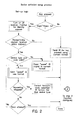
- Fig. 2 is a flow chart depicting a device activated setup process for setting up the remote control.
- Fig. 3 is a flow chart depicting the continuation of the processing of the data to configure the key layout of the remote control to match the data from the controlled device.
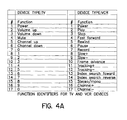
- Fig. 4a is a partial table, or listing, of a TV and a VCR and respective type functions of those devices.
- Fig. 4b is a continuation of the partial table shown in Fig. 4a .
- Fig. 5 is a table or listing of TV and VCR functions, wherein the functions are grouped to provide a compact or compressed version of the respective functions.
- Fig. 6 is a table or listing showing reserved numbering or lettering for indicating a new function.
- Figs. 7a-7c depict the frame format, the bit format and the sub-carrier format, respectively, for the data.
- Fig. 7d depicts the byte and data format corresponding to Figs. 7a-7c .
- Figs. 8a- 8d show, in pictorial sketches, the touch screen displays for four example device codes. Different function capability for a VCR is shown in the different figures. The graphical-dynamically-alterable display present the user with a less cluttered "keyboard.”
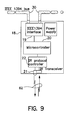
- Fig. 9 is a block diagram indicating an interconnection to a standard serial bus.
- the present invention relates to devices for controlling other devices remotely; other uses will be apparent from the teachings disclosed herein.
- Particular embodiments of this invention relate to remotely controlling devices capable of communicating with the remote control.
- the present invention will be best understood from the following description of preferred and exemplary embodiments with reference to the attached drawings, wherein like reference numerals and characters refer to like parts and with reference to the following claims. It will be understood that, generally, only enough of an exemplary embodiment has been shown in the drawings in order to enable those skilled in the art to understand the underlying principles and concepts of the invention while simplifying the illustration of the drawings.
- Fig. 1a shows a pictorial view of a remote control 10 for controlling an associated home entertainment system 11 including a TV set 12 and a VCR 14.
- the system components Preferably have two-way communication capability, in accordance with a preferred embodiment of the invention.
- Fig. 1b shows a simplified system wherein a single system component, the TV set 12, is controlled by the remote control 10.
- the "Device Activated Setup" (DAS) method described in the aforementioned U.S. Patent Application Serial No. 09/121,229 is utilized for the initial set up for remote control operation. After the initial set up, the function identity and operating parameters are established in accordance with the present invention.
- DAS Device Activated Setup
- Fig. 2 is a flowchart, similar to that shown in the patent application discussed in the background section, depicting how such data is processed by the remote control for the initial set up process. This flowchart, however, depicts an improvement according to the present invention.
- the link "step 2-function configuration" represents an improvement and an extension of the basic DAS process to encompass acquisition of FCD data for the device to be controlled.
- FIG. 4a and 4b An example of two such function sets are shown in Figs. 4a and 4b for a TV and a VCR. Similar tables are constructed for each additional device type to be supported (controlled). The number identifiers in the table of Figs. 4a and 4b do not themselves define what IR signal is to be sent to the controlled (target) device to effect the function; the numbers simply indicate to the remote control which functions a particular device supports. The exact format of the IR signal to be sent is already known to the remote control, as is the key data. Alternatively, this data could be provided subsequently.
- the table of Figs. 4a and 4b includes several groups of functions which could reasonably be expected to appear. Additionally, the groups often comprise families of related functions. For example, the family comprising "Volume Up” and “Volume Down,” and the family comprising "Play” and “Stop,” could both be included, as a “group”. From the teachings herein it will be understood that the family relationship may be defined in terms of a functional relationship, such as audio control; an entertainment relationship, such as audio control of source “a” and image control of source “b” and signal selection control of source “c”; a device relationship, such as VCR or Digital Satellite; as well as a task optimized or a user defined relationship. Other families and groupings will be apparent to those of skill in the art.
- Fig. 5 shows that grouping such functions under a single designator results in a more compact representation, or table. While both representations can be used effectively, the compact version of Fig. 5 is used herein.
- a simple "playback only" VCR could completely identify its functionality to a remote control by sending to the remote control two bytes of data: "01” followed by "02" (see Fig. 8a ). If another model in that range featured recording capability and a channel tuner in addition to the basic capabilities, that model would identify its capabilities by sending a string, "01,02,03,10,11,” to the remote control (see Fig. 8b ). Another model having additional features of slow motion capability would send the string "01,02,03,04,05,10,11" (see Fig. 8c ).
- the remote control is then able to tailor its presentation of functions to the user to match the exact device being controlled. There is no ambiguity in assigning the same function number to different functions across devices, since the device type is already known to the remote control as a result of the initial DAS.
- Fig. 6 shows an assignment of a number to allow for future expansion and/or addition of new functions not included in the initial function number assignments.
- "00" is reserved to indicate that the data following "00" is a definition of a new IR code and function. So, for example, if the VCR above were a dual format deck which allowed the user to switch between playing tapes recorded in NTSC and PAL formats, it might define a "format switching" function key to the remote control by sending the following data to the remote (see Fig.
- Figs. 8a, 8b, 8c and 8d thus illustrate how a remote control equipped with an LCD touch screen input means might configure its display in response to each of the four different VCR capability data strings used in the above example.
- FCD functional capability definition
- the 8-bit system identification value from the DAS data is examined. If this value indicates that the transmitting device does not support the extensions described here, the remote control setup is complete and it resumes normal operation. If, on the other hand, the system identification value indicates that the device supports capability reporting then the remote control continues by requesting from the device its FCD data string. This request will usually take the form of a single specific remote control IR command (i.e., the equivalent of a key press) sent to the target CE device in its standard format (i.e., the format established during the DAS process). By agreement with the manufacturer of that device, that particular command will be recognized by the CE device as a request to transmit to the remote control an FCD of the form described above.
- a single specific remote control IR command i.e., the equivalent of a key press
- the data is transmitted from the CE device to the remote control using a variant of the DAS link level protocol.
- the FCD data is divided into eight-byte blocks.
- the final block is padded as necessary with FF ("255") values to bring it to exactly eight bytes.
- An eight byte header block is then constructed as follows: 1 byte Length (represents the number of 8-byte blocks present of header (to allow for future expansion, currently fixed at 1)) 1 byte Length of data to follow (excluding header block) 2 byte Data checksum (calculated across all bytes of data, including pad bytes but excluding header) 3 bytes Reserved for future expansion 1 byte Header checksum (calculated across the seven preceding bytes)
- the above data is transmitted to the remote control using a variant of the DAS link level protocol as will be described below. It has been found preferable that this data and the DAS use the same transmit and receive hardware, i.e., carrier frequency and pulse timing. However, for some applications it is preferable to utilize separate transmit and receive hardware.
- the encoded data stream consists of alternating intervals of carrier and no carrier.
- the duration of each interval signals the value of the bit corresponding to that location.
- Ones are represented by short intervals, zeros by long intervals.
- Figs. 7a-7d shows the format in detail.
- the remote control if the remote control receives the FCD data successfully, it configures itself as appropriate for operation of that device and resumes normal operation. If for any reason the data is not received successfully (truncated number of packets, bad checksum(s), etc.) the remote control will wait an appropriate period of time and then repeat the request. If after three such attempts the data has still not been obtained, the remote control will abort the process and revert to default operation -- usually, supporting the maximum set of possible functions for that device family.
- the next generation of consumer entertainment appliances uses digitally encoded audio and video signals. Transfer of program material between these devices in the original digital format, such as for example, between a digital cable box and a high definition TV set is highly desirable in order to take full advantage of the superior picture and sound quality which is obtainable therefrom.
- HAVi Home Audio Video interoperability
- present suggested standards are directed primarily to home entertainment appliances, however the methods disclosed are applicable to other appliances in the home such as the control of lighting, personal computers, security, communications, sprinklers and other convenience items.
- the HAVi allows control information to be transferred between devices at two levels; the first, referred to as the functional control module (FCM) interface defines a set of standardized commands for each device type (such as play/stop/pause for a VCR device, channel change for a TV tuner, etc.). Not all devices necessarily support all possible commands (e.g. a VCR may not support "indexed skip") so provision is made for a device to enumerate its capabilities in response to a query from another device on the bus. In the FCM interface method, this enumeration consists of a simple list of which standard functions are or are not supported by the device (say VCR); and, the controlling device (say remote) determines the look and feel of the user interface. The controlled device simply accepts commands from the controlling device.
- FCM functional control module
- the second method referred to as the data driven interaction (DDI) interface
- DAI data driven interaction
- the controlling device simply presents these to the user and reports back to the controlled device which icon was selected.
- the controlled device determines the look and feel of the user interface, the controlling device simply acts as intermediary between it and the user.
- a remote control of the type described herein can be utilized by providing an adaptor device which attaches to the IEEE 1394 bus.
- the adaptor solicits capability information from other appliances on the bus and communicates these to the remote control via a two-way communication link.
- a single HAVi compatible adaptor device can provide remote configuration services for all consumer appliances connected to the bus, instead of each one individually supplying its DAS data directly to the remote control.
- the remote control can issue user commands to an appliance either by relaying them back through this same adaptor device or by communicating directly with the appliance, whichever is best supported by the appliance in question.
- the adaptor device can be either a "stand alone” unit or incorporated within some other appliance (e.g. cable set top box "STB").
- a remote control which includes a graphic LCD display and touch screen input capability would be capable of supporting both DDT and FCM command structures. Such a remote control would represent an extremely powerful user interface device, essentially becoming an extension of the controlled appliance in the user's hand. Also, since the HAVi standard allows an ongoing two-way dialog between the controlled and controlling devices, the remote control display and configuration can be updated dynamically during use of the system; not just at setup time as is the case with the basic "extended DAS" transaction described earlier.
- Fig. 1a depicts a HAVi compliant entertainment equipment system equipped with such a remote control 10.
- the user has just completed entering a new channel number into a DDI capable digital cable set top box (STB) 16.
- STB digital cable set top box
- the remote control's 10 touch screen display is showing only those key functions needed to enter a new channel number.
- the STB 16 has caused the remote control 10 to display to the user the station (ESPN) corresponding to the channel number just entered (e.g. 17).
- Fig. 9 shows a block diagram of the remote control interface unit 18.
- Interface unit 18 transfers data between HAVi compliant devices on the IEEE 1394 bus 30 and the remote control 10. Accordingly, interface unit 18 has both an IEEE 1394 bus interface module 19 for communication with the HAVi devices of Fig. 1a , and an infrared transceiver 21 for communication with the remote control 10.
- the IEEE 1394 interface 19 is connected through a microcontroller 20 through IR protocol controller 22 to IR transceiver 21.
- Microcontroller 20 controls both the interface 19 and the IR transceiver 21. More specifically, microcontroller 20 is a general purpose microcontroller programmed to effect the orderly transfer of data between the IEEE 1394 interface 19 and the IR transceiver 21.
- the IEEE 1394 interface 18 can be implemented using one of several specialized integrated circuit chip sets available for this purpose, for example a Texas Instrument TSBI2LV31 Link layer Controller together with a TSB21 LV03 Transceiver/Arbiter. Other equivalent parts are available and are well known in the art.
- the communication system linking to the remote control may be IR or RF (of the type previously described) or, if a greater data throughput is desired in order to handle large icon definition bitmaps, a high speed link level protocol such as IRDA Control IR, a standard protocol defined by the Infrared Data Association may be used.
- Integrated IR transceivers are available for this standard, for example, the Sharp GP2W200IYK, the link layer control protocol can be implemented either in the micro controller or via a separate protocol chip such as the IRDA Control Peripheral Engine of the Sharp Co.
- Another possible choice is the TWIRP (Two Way IR Protocol) from SolutioNet Ltd., using, for example, the AT435TS00 TWIRP station transceiver available from SolutioNet.
- the microcontroller 20 can be any suitable general purpose processor.
- a function of the firmware program in this device is to monitor the two interfaces for messages and to relay any data received from one onto the other.
- HAVi data can be performed by the remote control, since in this particular embodiment the remote control has considerably more processing power than is available in the RCI unit. However, in other implementations it may be more efficient to pre-process some or all of the HAVi data within the RCI unit. For example, if the remote control has a low resolution display with a limited number of pixels available for each icon displayed, preprocessing HAVi icon bitmaps into compressed representations prior to transmission to the remote would more efficiently utilize transmission channel bandwidth as well as conserve memory in the remote control.
- the present invention includes a method for setting up a control unit for operation with a device to be controlled.
- the method comprises the steps of transmitting from the control unit to the device to be controlled a request for configuration information; and transmitting a list of controllable functions of the device to be controlled from the device to be controlled.
- the remote control 10 is shown sending a request for information 32, and the TV 12 is shown transmitting information 34 to the remote control 10.
- the method also comprises recognizing a set of function indicators 36 (See Fig. 1a ) each of said indicators 36 corresponds to a respective function to be controlled from the listing of controllable functions (See Figs. 4a , 4b , and 5 ); mapping said functions into specific codes and keys according to said listing of controllable functions of said device; and storing the resultant configuration information for use.
- the step of storing the resultant configuration information include the step of storing the information in the control unit.
- the set of function indicators is a single set of respective standard feature indicators, each standard feature indicator comprising a respective icon corresponding to the respective function to be controlled.
- each respective icon is a unique icon within the single set of respective standard features indicators. This reduces ambiguity and provides the user with quick selection capability.
- Another method of reducing the complexity of the controlling unit includes the step of displaying on the control unit only function indicators corresponding to respective functions to be controlled from the listing of controllable functions of the device to be controlled. Referring to Fig.
- the remote control 10 shows function indicators comprising a rewind icon 38, a stop icon 40, a pause icon 42, a play icon 44, and a fast forward icon 46. Since these are the only functions desired to be controlled, for example, with this particular VCR the user is presented with a control unit having substantially reduced apparent complexity. This eases the users' selectivity by reducing extraneous information. Referring to Fig. 8d ., a protocol icon 48 is also displayed.
- the listing of controllable functions may be divided into a plurality of families and the single set of function indicators may be divided into a corresponding plurality of families. Accordingly, the step of displaying may include displaying only the family of indicators corresponding to the family of functions to be controlled.
- the indicators 36 of Fig. 8b have been divided into a TV family 50 and a VCR family 52.
- the step of transmitting comprises the step of conveying configuration information between the control unit and the device to be controlled (also referred to herein as a target device) via an encoding scheme in a communications protocol. It will often be desirable to utilize an industry standard protocol and it will often be desirable to provide compatibility by utilizing a consumer electronics standard for the control unit and for the interface device communication. As discussed earlier, one consumer electronics standard is a HAVi standard.
- the set of variable functions is defined for each device to be controlled and the unique numeric identifier is assigned to each function. It may be desirable to group the related variable functions under a single designator. It is often desirable to reserve at least one code for indicating that data following the code is a definition of a new IR code and corresponding key annotation.
- the invention also includes a control system 60 of electronically controlled devices, see Fig. 1a .
- the inventive system comprises a standard high performance bus 30 connecting the electronically controlled devices (See Fig. 1a).
- Fig. 1a shows an embodiment wherein the electronically controlled devices constitute a home entertainment system 11 including a VCR 14, a TV 12, an audio source 54, a DVD 56, and a CD player 58.
- the remote control 10 communicates with the electronically controlled devices via the remote control interface unit 18.
- Fig. 1b shows an embodiment wherein the remote control 10 communicates with the electronically controlled device directly.
- the control system designated with reference number 60, in Fig. 1a includes a signal responsive of universal remote control 10 providing a user interface; and an interface adaptor 18 communicating with the bus 30.
- the interface adaptor 18 is a remote control interface 18.
- Fig. 9 depicting an exemplary interface adaptor 18.
- the interface adaptor 18 shown in Fig. 9 includes a signal transceiver 21, a bus interface unit 19, and a microcontroller 20.
- the components in Fig. 9 have been connected to control two-way communications between the signal transceiver 21 and the bus interface unit 19 to selectively obtain capability information from one of the electronically controlled devices, e.g., the VCR 14, connected to the bus 30.
- Fig. 9 also depicts two-way communications 62 between the remote control interface unit 18 and the remote (Not shown in Fig. 9 ). It is often desirable for the capability information obtained from the control devices to include function capability information.
- the interface adaptor 18 is mechanically and electrically connected to the bus 30.
- the bus 30 is a high speed digital serial bus which utilizes a communications standard consistent with the home audio-video interoperability (HAVi) standard. Accordingly, it is generally desirable for the remote control to be adapted to issue user commands to one of the electrically controlled devices through the interface adaptor.
- HAVi home audio-video interoperability
- the invention also includes a method for controlling electronically controlled devices by a universal remote control.
- This method includes the steps of interconnecting the devices using a standard high performance bus to enable communication between the devices at a digital level.
- An interface adaptor is connected to the bus and provided with the capability of communicating by IR to a universal remote control.
- the method includes soliciting information from the devices on the bus and communicating the solicited information via a two-way communication link between the universal remote control and the devices to control at least one of the devices via the universal remote control.
- the interface adaptor provides a go between for the communication.
- the present invention also envisions a control system comprising a plurality of devices connected via a bus conforming to a first standard, wherein the devices communicate according to a second standard.
- the plurality of the devices include a target device having data driven interaction data (DDI Data), that is context determined data, defining a plurality of functions supported by the target device and a plurality of associated icons.
- DCI Data data driven interaction data
- An adaptor is placed in operable communication with the bus to receive the DDI Data from the target device and send the DDI Data to the target device.
- a remote control is placed in operable communication with the adaptor to send and receive the DDI Data.
- the bus is a serial bus
- the first standard is an IEEE1394 standard.
- the target device configure the remote control. It is also often desirable for the remote control to comprise a display wherein the target device displays at least one of the plurality of associated icons on the display of the remote control.
- the remote control often comprises at least one configured function defined by the target device and a display displaying an icon standard with at least one configured function.
- the adaptor will often be desirable for the adaptor to comprise means to identify itself to the target device as a unit having display and control input capabilities, even though the adaptor does not provide display and control input capabilities. This allows the adaptor to act as a conduit between the target device and the remote control, wherein the remote control does have display and controlling capabilities.
- the system comprises a two-way wireless link connecting the adaptor and the remote.
- the wireless link it is desirable for the wireless link to include a radio frequency link or an infrared (IR) link.
- IR infrared
- Such a two-way link is depicted in Fig. 9 and also referred to a two-way communication 62.
- the adaptor 18 has been shown separate from the plurality of devices connected via the bus 30 for ease of illustration, it will be understood that the adaptor 18 may be housed in one of the plurality of devices.
- the second standard may be a HAVi standard and the first standard may be an IEEE1394 standard. It is often desirable to provide the remote control with a dynamical-graphical-user interface connected to change display graphics according to a status of the target device.
- the remote control comprises means for receiving the status of a target device from the target device through the adaptor.
- the remote control may also comprise means for directly controlling the target device.
- the icon may be dynamically altered in response to communications with one of the devices.
Landscapes
- Engineering & Computer Science (AREA)
- Computer Networks & Wireless Communication (AREA)
- Signal Processing (AREA)
- Automation & Control Theory (AREA)
- Multimedia (AREA)
- Physics & Mathematics (AREA)
- General Physics & Mathematics (AREA)
- Selective Calling Equipment (AREA)
- Details Of Television Systems (AREA)
Applications Claiming Priority (2)
| Application Number | Priority Date | Filing Date | Title |
|---|---|---|---|
| US09/334,584 US6781518B1 (en) | 1998-07-23 | 1999-06-16 | Digital interconnect of entertainment equipment |
| EP00305105A EP1061490B1 (de) | 1999-06-16 | 2000-06-16 | Digitale Verbindung von Geräten der Unterhaltungselektronik |
Related Parent Applications (2)
| Application Number | Title | Priority Date | Filing Date |
|---|---|---|---|
| EP00305105.9 Division | 2000-06-16 | ||
| EP00305105A Division EP1061490B1 (de) | 1999-06-16 | 2000-06-16 | Digitale Verbindung von Geräten der Unterhaltungselektronik |
Publications (2)
| Publication Number | Publication Date |
|---|---|
| EP2276009A1 true EP2276009A1 (de) | 2011-01-19 |
| EP2276009B1 EP2276009B1 (de) | 2020-04-01 |
Family
ID=23307880
Family Applications (2)
| Application Number | Title | Priority Date | Filing Date |
|---|---|---|---|
| EP00305105A Expired - Lifetime EP1061490B1 (de) | 1999-06-16 | 2000-06-16 | Digitale Verbindung von Geräten der Unterhaltungselektronik |
| EP10176571.7A Expired - Lifetime EP2276009B1 (de) | 1999-06-16 | 2000-06-16 | Digitale verbindung von geräten der unterhaltungselektronik |
Family Applications Before (1)
| Application Number | Title | Priority Date | Filing Date |
|---|---|---|---|
| EP00305105A Expired - Lifetime EP1061490B1 (de) | 1999-06-16 | 2000-06-16 | Digitale Verbindung von Geräten der Unterhaltungselektronik |
Country Status (6)
| Country | Link |
|---|---|
| EP (2) | EP1061490B1 (de) |
| AU (1) | AU771204B2 (de) |
| BR (1) | BR0011661A (de) |
| CA (1) | CA2311794A1 (de) |
| MX (1) | MXPA01012986A (de) |
| WO (1) | WO2000077759A1 (de) |
Cited By (3)
| Publication number | Priority date | Publication date | Assignee | Title |
|---|---|---|---|---|
| CN103745590A (zh) * | 2014-01-08 | 2014-04-23 | 无锡讯泰科技有限公司 | 一种红外遥控编码方法 |
| CN110505507A (zh) * | 2019-08-06 | 2019-11-26 | 深圳创维-Rgb电子有限公司 | 一种电视机、智能红外控制系统及其控制方法 |
| CN112073666A (zh) * | 2019-06-10 | 2020-12-11 | 海信视像科技股份有限公司 | 一种显示设备的电源控制方法及显示设备 |
Families Citing this family (25)
| Publication number | Priority date | Publication date | Assignee | Title |
|---|---|---|---|---|
| US7831930B2 (en) | 2001-11-20 | 2010-11-09 | Universal Electronics Inc. | System and method for displaying a user interface for a remote control application |
| JPWO2002054404A1 (ja) | 2000-12-28 | 2004-05-13 | ソニー株式会社 | データ伝送システム及びデータ伝送方法、並びに、電子機器 |
| FI114949B (fi) | 2001-03-28 | 2005-01-31 | Valtion Teknillinen | Menetelmä elektronisen laitteen ohjaamiseksi ja elektroninen järjestelmä |
| GB2403385A (en) * | 2001-06-14 | 2004-12-29 | Peter D Hallenbeck | Transmitting infra-red command codes over a network |
| US7224404B2 (en) * | 2001-07-30 | 2007-05-29 | Samsung Electronics Co., Ltd. | Remote display control of video/graphics data |
| US6947101B2 (en) * | 2001-08-03 | 2005-09-20 | Universal Electronics Inc. | Control device with easy lock feature |
| US7095456B2 (en) * | 2001-11-21 | 2006-08-22 | Ui Evolution, Inc. | Field extensible controllee sourced universal remote control method and apparatus |
| US7987491B2 (en) | 2002-05-10 | 2011-07-26 | Richard Reisman | Method and apparatus for browsing using alternative linkbases |
| JP2004120442A (ja) * | 2002-09-26 | 2004-04-15 | Pioneer Electronic Corp | 遠隔制御システム、遠隔操作装置、遠隔制御方法 |
| FR2849977B1 (fr) * | 2003-01-10 | 2005-06-03 | Thomson Licensing Sa | Procede de controle d'appareils au sein d'un reseau par une telecommande dediee et appareils mettant en oeuvre le procede |
| WO2004077788A1 (en) * | 2003-02-25 | 2004-09-10 | Philips Intellectual Property & Standards Gmbh | Electronic operating system |
| KR100520118B1 (ko) | 2003-08-21 | 2005-10-10 | 삼성전자주식회사 | 다수개의 피제어 기기 제어를 위한 통합 제어 장치 및 방법 |
| CN1853353A (zh) * | 2003-09-17 | 2006-10-25 | 皇家飞利浦电子股份有限公司 | 发送xml文档的遥控装置 |
| JP2007506343A (ja) * | 2003-09-17 | 2007-03-15 | コニンクリユケ フィリップス エレクトロニクス エヌ.ブイ. | Xmlドキュメントを伝送するリモートコントロール装置 |
| WO2005055167A1 (en) * | 2003-12-03 | 2005-06-16 | Koninklijke Philips Electronics N.V. | Method of enabling the programming of a universal remote control system |
| US20190278560A1 (en) | 2004-10-27 | 2019-09-12 | Chestnut Hill Sound, Inc. | Media appliance with auxiliary source module docking and fail-safe alarm modes |
| US7885622B2 (en) | 2004-10-27 | 2011-02-08 | Chestnut Hill Sound Inc. | Entertainment system with bandless tuning |
| US8090309B2 (en) | 2004-10-27 | 2012-01-03 | Chestnut Hill Sound, Inc. | Entertainment system with unified content selection |
| US8031056B2 (en) | 2005-05-30 | 2011-10-04 | Sony Corporation | Remote controller and remote control method |
| JPWO2007037077A1 (ja) * | 2005-09-28 | 2009-04-02 | パナソニック株式会社 | 操作画面を用いた機器制御方法並びにその方法を用いた電子機器及びシステム |
| JP4539529B2 (ja) | 2005-10-24 | 2010-09-08 | ソニー株式会社 | リモートコントロールシステム及びリモートコマンダのプリセット方法 |
| KR101263680B1 (ko) * | 2006-05-04 | 2013-05-22 | 삼성전자주식회사 | 접속장치, 전자장치 및 그 제어방법 |
| ITTO20060799A1 (it) * | 2006-11-09 | 2008-05-10 | Enzo Tarizzo | Sistema di controllo di apparecchiature e dispositivi elettrici e/o elettronici dislocati in un ambiente, in particolare in un ambiente domestico |
| KR101366316B1 (ko) * | 2007-01-09 | 2014-02-21 | 엘지전자 주식회사 | 신호 싱크 및 그의 동작 방법과 이를 제어하는 컴퓨터프로그램을 저장하는 컴퓨터로 읽을 수 있는 기록 매체 |
| US8189120B2 (en) * | 2009-02-04 | 2012-05-29 | Sony Corporation | Non-programmable universal remote system and method |
Citations (5)
| Publication number | Priority date | Publication date | Assignee | Title |
|---|---|---|---|---|
| EP0513443A1 (de) * | 1991-05-06 | 1992-11-19 | Koninklijke Philips Electronics N.V. | Gebäudeleitsystem |
| JPH0583765A (ja) * | 1991-09-18 | 1993-04-02 | Fujitsu Ten Ltd | 遠隔制御システム |
| US5438325A (en) * | 1993-07-09 | 1995-08-01 | Sony Corporation | Remote controller apparatus and an audio-video combination system using the same |
| DE19709800A1 (de) * | 1997-03-10 | 1998-09-17 | Bosch Gmbh Robert | Einrichtung zur Ankopplung eines fernsteuerbaren Gerätes an ein Netz |
| US12122998B2 (en) | 2017-12-21 | 2024-10-22 | Crispr Therapeutics Ag | Materials and methods for treatment of usher syndrome type 2A and/or non-syndromic autosomal recessive retinitis pigmentosa (ARRP) |
Family Cites Families (4)
| Publication number | Priority date | Publication date | Assignee | Title |
|---|---|---|---|---|
| DE3413286C1 (de) | 1984-04-07 | 1986-01-09 | Hoesch Ag, 4600 Dortmund | Mittenfreies Grosswaelzlager |
| US5515052A (en) | 1987-10-14 | 1996-05-07 | Universal Electronics Inc. | Universal remote control with function synthesis |
| US6157319A (en) | 1998-07-23 | 2000-12-05 | Universal Electronics Inc. | Universal remote control system with device activated setup |
| US6111677A (en) * | 1998-08-31 | 2000-08-29 | Sony Corporation | Optical remote control interface system and method |
-
2000
- 2000-06-01 AU AU54611/00A patent/AU771204B2/en not_active Ceased
- 2000-06-01 WO PCT/US2000/015305 patent/WO2000077759A1/en not_active Ceased
- 2000-06-01 BR BR0011661-0A patent/BR0011661A/pt not_active IP Right Cessation
- 2000-06-01 MX MXPA01012986A patent/MXPA01012986A/es unknown
- 2000-06-15 CA CA002311794A patent/CA2311794A1/en not_active Abandoned
- 2000-06-16 EP EP00305105A patent/EP1061490B1/de not_active Expired - Lifetime
- 2000-06-16 EP EP10176571.7A patent/EP2276009B1/de not_active Expired - Lifetime
Patent Citations (5)
| Publication number | Priority date | Publication date | Assignee | Title |
|---|---|---|---|---|
| EP0513443A1 (de) * | 1991-05-06 | 1992-11-19 | Koninklijke Philips Electronics N.V. | Gebäudeleitsystem |
| JPH0583765A (ja) * | 1991-09-18 | 1993-04-02 | Fujitsu Ten Ltd | 遠隔制御システム |
| US5438325A (en) * | 1993-07-09 | 1995-08-01 | Sony Corporation | Remote controller apparatus and an audio-video combination system using the same |
| DE19709800A1 (de) * | 1997-03-10 | 1998-09-17 | Bosch Gmbh Robert | Einrichtung zur Ankopplung eines fernsteuerbaren Gerätes an ein Netz |
| US12122998B2 (en) | 2017-12-21 | 2024-10-22 | Crispr Therapeutics Ag | Materials and methods for treatment of usher syndrome type 2A and/or non-syndromic autosomal recessive retinitis pigmentosa (ARRP) |
Cited By (5)
| Publication number | Priority date | Publication date | Assignee | Title |
|---|---|---|---|---|
| CN103745590A (zh) * | 2014-01-08 | 2014-04-23 | 无锡讯泰科技有限公司 | 一种红外遥控编码方法 |
| CN103745590B (zh) * | 2014-01-08 | 2016-08-17 | 无锡讯泰科技有限公司 | 一种红外遥控编码方法 |
| CN112073666A (zh) * | 2019-06-10 | 2020-12-11 | 海信视像科技股份有限公司 | 一种显示设备的电源控制方法及显示设备 |
| CN112073666B (zh) * | 2019-06-10 | 2023-03-24 | 海信视像科技股份有限公司 | 一种显示设备的电源控制方法及显示设备 |
| CN110505507A (zh) * | 2019-08-06 | 2019-11-26 | 深圳创维-Rgb电子有限公司 | 一种电视机、智能红外控制系统及其控制方法 |
Also Published As
| Publication number | Publication date |
|---|---|
| EP1061490B1 (de) | 2013-01-23 |
| AU5461100A (en) | 2001-01-02 |
| AU771204B2 (en) | 2004-03-18 |
| BR0011661A (pt) | 2002-03-26 |
| EP1061490A2 (de) | 2000-12-20 |
| EP1061490A3 (de) | 2001-04-25 |
| EP2276009B1 (de) | 2020-04-01 |
| MXPA01012986A (es) | 2003-06-24 |
| WO2000077759A1 (en) | 2000-12-21 |
| CA2311794A1 (en) | 2000-12-16 |
Similar Documents
| Publication | Publication Date | Title |
|---|---|---|
| US8558676B2 (en) | Digital interconnect of entertainment equipment in the home | |
| US6781518B1 (en) | Digital interconnect of entertainment equipment | |
| US6784804B1 (en) | Digital interconnect of entertainment equipment | |
| EP2276009B1 (de) | Digitale verbindung von geräten der unterhaltungselektronik | |
| EP1506459B1 (de) | System und verfahren zum automatischen einrichten einer universellen fernbedienung | |
| EP2339560B1 (de) | System und verfahren zur automatischen einrichtung einer universellen fernbedienung | |
| US8286204B2 (en) | Data communication system, apparatus and control method therefor | |
| US6400280B1 (en) | Remote control signal receiver and method, and remote control system | |
| US6684110B1 (en) | Control system, apparatus, and method in which display characteristics of an operation panel are changeable | |
| EP2259243A2 (de) | Fernbedienungssystem, Fernsteuerverfahren, Fernsteuergerät und elektronisches Gerät | |
| US9257037B2 (en) | System and method for automatically setting up a universal remote control | |
| US9311814B2 (en) | System and method for automatically setting up a universal remote control | |
| US20180089990A1 (en) | System and method for automatically setting up a universal remote control | |
| AU2004202539A1 (en) | Digital Interconnection of Electronics Entertainment Equipment | |
| JPH06187771A (ja) | 映像機器制御装置および方法 | |
| JPH10178684A (ja) | 集中制御システム,集中制御ユニット及びその制御対象機器 | |
| JPH09282031A (ja) | 制御信号通信方式 | |
| KR20060116450A (ko) | 텔레비전을 기반으로 하는 디바이스 링크 시스템에서의복합 제품 제어방법 | |
| KR20060117386A (ko) | 텔레비전을 기반으로 하는 디바이스 링크 시스템에서의동종 슬레이브 디바이스 처리방법 | |
| JP2007202042A (ja) | 電子機器 | |
| JPS62256600A (ja) | 汎用リモ−トコントロ−ラ |
Legal Events
| Date | Code | Title | Description |
|---|---|---|---|
| PUAI | Public reference made under article 153(3) epc to a published international application that has entered the european phase |
Free format text: ORIGINAL CODE: 0009012 |
|
| AC | Divisional application: reference to earlier application |
Ref document number: 1061490 Country of ref document: EP Kind code of ref document: P |
|
| AK | Designated contracting states |
Kind code of ref document: A1 Designated state(s): AT BE CH CY DE DK ES FI FR GB GR IE IT LI LU MC NL PT SE |
|
| RIN1 | Information on inventor provided before grant (corrected) |
Inventor name: JOHNS, GREGORY Inventor name: HAYES, PATRICK H Inventor name: CONWAY, JAMES N |
|
| 17P | Request for examination filed |
Effective date: 20110715 |
|
| RAP1 | Party data changed (applicant data changed or rights of an application transferred) |
Owner name: UNIVERSAL ELECTRONICS, INC. |
|
| STAA | Information on the status of an ep patent application or granted ep patent |
Free format text: STATUS: EXAMINATION IS IN PROGRESS |
|
| 17Q | First examination report despatched |
Effective date: 20180302 |
|
| GRAP | Despatch of communication of intention to grant a patent |
Free format text: ORIGINAL CODE: EPIDOSNIGR1 |
|
| STAA | Information on the status of an ep patent application or granted ep patent |
Free format text: STATUS: GRANT OF PATENT IS INTENDED |
|
| RIC1 | Information provided on ipc code assigned before grant |
Ipc: H04L 12/28 20060101ALI20191114BHEP Ipc: H04B 1/20 20060101ALI20191114BHEP Ipc: H04L 12/40 20060101ALI20191114BHEP Ipc: G08C 19/28 20060101AFI20191114BHEP |
|
| INTG | Intention to grant announced |
Effective date: 20191216 |
|
| GRAS | Grant fee paid |
Free format text: ORIGINAL CODE: EPIDOSNIGR3 |
|
| GRAA | (expected) grant |
Free format text: ORIGINAL CODE: 0009210 |
|
| STAA | Information on the status of an ep patent application or granted ep patent |
Free format text: STATUS: THE PATENT HAS BEEN GRANTED |
|
| AC | Divisional application: reference to earlier application |
Ref document number: 1061490 Country of ref document: EP Kind code of ref document: P |
|
| AK | Designated contracting states |
Kind code of ref document: B1 Designated state(s): AT BE CH CY DE DK ES FI FR GB GR IE IT LI LU MC NL PT SE |
|
| REG | Reference to a national code |
Ref country code: GB Ref legal event code: FG4D |
|
| REG | Reference to a national code |
Ref country code: CH Ref legal event code: EP Ref country code: AT Ref legal event code: REF Ref document number: 1252383 Country of ref document: AT Kind code of ref document: T Effective date: 20200415 |
|
| REG | Reference to a national code |
Ref country code: DE Ref legal event code: R096 Ref document number: 60049970 Country of ref document: DE |
|
| REG | Reference to a national code |
Ref country code: IE Ref legal event code: FG4D |
|
| REG | Reference to a national code |
Ref country code: DE Ref legal event code: R071 Ref document number: 60049970 Country of ref document: DE |
|
| REG | Reference to a national code |
Ref country code: NL Ref legal event code: MK Effective date: 20200615 |
|
| REG | Reference to a national code |
Ref country code: CH Ref legal event code: PL |
|
| REG | Reference to a national code |
Ref country code: IE Ref legal event code: MK9A |
|
| REG | Reference to a national code |
Ref country code: BE Ref legal event code: MK Effective date: 20200616 |
|
| REG | Reference to a national code |
Ref country code: GB Ref legal event code: PE20 Expiry date: 20200615 |
|
| PG25 | Lapsed in a contracting state [announced via postgrant information from national office to epo] |
Ref country code: SE Free format text: LAPSE BECAUSE OF FAILURE TO SUBMIT A TRANSLATION OF THE DESCRIPTION OR TO PAY THE FEE WITHIN THE PRESCRIBED TIME-LIMIT Effective date: 20200401 Ref country code: GR Free format text: LAPSE BECAUSE OF FAILURE TO SUBMIT A TRANSLATION OF THE DESCRIPTION OR TO PAY THE FEE WITHIN THE PRESCRIBED TIME-LIMIT Effective date: 20200702 Ref country code: FI Free format text: LAPSE BECAUSE OF FAILURE TO SUBMIT A TRANSLATION OF THE DESCRIPTION OR TO PAY THE FEE WITHIN THE PRESCRIBED TIME-LIMIT Effective date: 20200401 Ref country code: PT Free format text: LAPSE BECAUSE OF FAILURE TO SUBMIT A TRANSLATION OF THE DESCRIPTION OR TO PAY THE FEE WITHIN THE PRESCRIBED TIME-LIMIT Effective date: 20200817 Ref country code: IE Free format text: LAPSE BECAUSE OF EXPIRATION OF PROTECTION Effective date: 20200616 Ref country code: GB Free format text: LAPSE BECAUSE OF EXPIRATION OF PROTECTION Effective date: 20200615 |
|
| REG | Reference to a national code |
Ref country code: AT Ref legal event code: MK05 Ref document number: 1252383 Country of ref document: AT Kind code of ref document: T Effective date: 20200401 |
|
| REG | Reference to a national code |
Ref country code: DE Ref legal event code: R097 Ref document number: 60049970 Country of ref document: DE |
|
| PG25 | Lapsed in a contracting state [announced via postgrant information from national office to epo] |
Ref country code: ES Free format text: LAPSE BECAUSE OF FAILURE TO SUBMIT A TRANSLATION OF THE DESCRIPTION OR TO PAY THE FEE WITHIN THE PRESCRIBED TIME-LIMIT Effective date: 20200401 Ref country code: DK Free format text: LAPSE BECAUSE OF FAILURE TO SUBMIT A TRANSLATION OF THE DESCRIPTION OR TO PAY THE FEE WITHIN THE PRESCRIBED TIME-LIMIT Effective date: 20200401 Ref country code: AT Free format text: LAPSE BECAUSE OF FAILURE TO SUBMIT A TRANSLATION OF THE DESCRIPTION OR TO PAY THE FEE WITHIN THE PRESCRIBED TIME-LIMIT Effective date: 20200401 |
|
| PLBE | No opposition filed within time limit |
Free format text: ORIGINAL CODE: 0009261 |
|
| STAA | Information on the status of an ep patent application or granted ep patent |
Free format text: STATUS: NO OPPOSITION FILED WITHIN TIME LIMIT |
|
| 26N | No opposition filed |
Effective date: 20210112 |
|
| PG25 | Lapsed in a contracting state [announced via postgrant information from national office to epo] |
Ref country code: IT Free format text: LAPSE BECAUSE OF FAILURE TO SUBMIT A TRANSLATION OF THE DESCRIPTION OR TO PAY THE FEE WITHIN THE PRESCRIBED TIME-LIMIT Effective date: 20200401 |
|
| P01 | Opt-out of the competence of the unified patent court (upc) registered |
Effective date: 20230530 |