EP2277110B1 - Architecture de service distribuée - Google Patents
Architecture de service distribuée Download PDFInfo
- Publication number
- EP2277110B1 EP2277110B1 EP08735215.9A EP08735215A EP2277110B1 EP 2277110 B1 EP2277110 B1 EP 2277110B1 EP 08735215 A EP08735215 A EP 08735215A EP 2277110 B1 EP2277110 B1 EP 2277110B1
- Authority
- EP
- European Patent Office
- Prior art keywords
- tuple
- peer entity
- peer
- type
- tuples
- Prior art date
- Legal status (The legal status is an assumption and is not a legal conclusion. Google has not performed a legal analysis and makes no representation as to the accuracy of the status listed.)
- Active
Links
Images


Classifications
-
- G—PHYSICS
- G06—COMPUTING OR CALCULATING; COUNTING
- G06F—ELECTRIC DIGITAL DATA PROCESSING
- G06F9/00—Arrangements for program control, e.g. control units
- G06F9/06—Arrangements for program control, e.g. control units using stored programs, i.e. using an internal store of processing equipment to receive or retain programs
- G06F9/46—Multiprogramming arrangements
- G06F9/50—Allocation of resources, e.g. of the central processing unit [CPU]
- G06F9/5005—Allocation of resources, e.g. of the central processing unit [CPU] to service a request
- G06F9/5027—Allocation of resources, e.g. of the central processing unit [CPU] to service a request the resource being a machine, e.g. CPUs, Servers, Terminals
- G06F9/505—Allocation of resources, e.g. of the central processing unit [CPU] to service a request the resource being a machine, e.g. CPUs, Servers, Terminals considering the load
-
- G—PHYSICS
- G06—COMPUTING OR CALCULATING; COUNTING
- G06F—ELECTRIC DIGITAL DATA PROCESSING
- G06F9/00—Arrangements for program control, e.g. control units
- G06F9/06—Arrangements for program control, e.g. control units using stored programs, i.e. using an internal store of processing equipment to receive or retain programs
- G06F9/46—Multiprogramming arrangements
- G06F9/50—Allocation of resources, e.g. of the central processing unit [CPU]
- G06F9/5005—Allocation of resources, e.g. of the central processing unit [CPU] to service a request
- G06F9/5027—Allocation of resources, e.g. of the central processing unit [CPU] to service a request the resource being a machine, e.g. CPUs, Servers, Terminals
- G06F9/5055—Allocation of resources, e.g. of the central processing unit [CPU] to service a request the resource being a machine, e.g. CPUs, Servers, Terminals considering software capabilities, i.e. software resources associated or available to the machine
-
- G—PHYSICS
- G06—COMPUTING OR CALCULATING; COUNTING
- G06F—ELECTRIC DIGITAL DATA PROCESSING
- G06F9/00—Arrangements for program control, e.g. control units
- G06F9/06—Arrangements for program control, e.g. control units using stored programs, i.e. using an internal store of processing equipment to receive or retain programs
- G06F9/46—Multiprogramming arrangements
- G06F9/50—Allocation of resources, e.g. of the central processing unit [CPU]
- G06F9/5061—Partitioning or combining of resources
- G06F9/5072—Grid computing
-
- G—PHYSICS
- G06—COMPUTING OR CALCULATING; COUNTING
- G06Q—INFORMATION AND COMMUNICATION TECHNOLOGY [ICT] SPECIALLY ADAPTED FOR ADMINISTRATIVE, COMMERCIAL, FINANCIAL, MANAGERIAL OR SUPERVISORY PURPOSES; SYSTEMS OR METHODS SPECIALLY ADAPTED FOR ADMINISTRATIVE, COMMERCIAL, FINANCIAL, MANAGERIAL OR SUPERVISORY PURPOSES, NOT OTHERWISE PROVIDED FOR
- G06Q10/00—Administration; Management
- G06Q10/10—Office automation; Time management
- G06Q10/103—Workflow collaboration or project management
-
- G—PHYSICS
- G06—COMPUTING OR CALCULATING; COUNTING
- G06F—ELECTRIC DIGITAL DATA PROCESSING
- G06F2209/00—Indexing scheme relating to G06F9/00
- G06F2209/50—Indexing scheme relating to G06F9/50
- G06F2209/5022—Workload threshold
Definitions
- the present invention relates to a distributed service framework for executing services in a distributed way.
- a service Middleware that scales in System Size and Applications 10th IFIP/IEEE International Symposium on Integrated Network Management (IM-2007), Kunststoff, Germany, May 21-25, 2007, pages 70-79 ) disclose a peer-to-peer service management middleware that dynamically allocates system resources to a large set of application services.
- a possible deployment scenario described by the Authors includes a cluster, comprising several data centres, and many entry points. Each data centre includes a plurality of nodes. Each node can run concurrently instances of several applications. Service requests enter the cluster through the entry points that direct incoming requests to the nodes using a round-robin forwarding policy. Upon receiving a request from an entry point, a node determines the application type thereof.
- the node processes the request if it runs the corresponding application and if the CPU utilization is below a configurable threshold. Otherwise the node consults its forwarding table and routes the request to a peer that offers the required application.
- the forwarding table contains, for each application offered in the system, a configurable number of nodes that run that particular application. The entries of the forwarding table are soft state, and each entry expires after a preconfigured timeout. Therefore, each node advertises its complete configuration after each placement cycle.
- Rosario Alfano and Gaetano di Caprio introduce a Collector entity in the Linda model.
- the Authors state that a collector can be seen as a blackboard that incorporates a number of workers, i.e. a blackboard with execution capabilities.
- a collector acts towards other Collector as a worker: it executes take operations in order to transfer tuples on its blackboard from overloaded collectors.
- load balancing is achieved by having each collector calculating its own residual power (RP) which represent its ability to help others.
- a collector When a collector realizes that it has some RP available (a few tuples in its blackboard) it offers its computational power to other collector, just sending them a notification of availability. Overloaded collectors accept one of the possible computational power offers. When a collector receives acknowledge to its computational power offers, it begin to take tuples from the collector in trouble. Therefore, according to TURBO system, when a collector is overloaded it must only check if it has received some help offers from other collectors and accept them.
- TURBO provides a load balancing system to distribute load among collectors evenly.
- the Applicant faced the problem of providing a distributed service framework for the execution of services in a distributed way, which guarantees high performances, scalability and robustness.
- the present invention relates to a system for executing services in a distributed way, the execution of each service involving the processing of a plurality of tasks of predetermined types, each task type to be processed being represented by a corresponding type of tuples of data relating to the task type, wherein:
- system further comprises a plurality of client entities, each client entity being adapted to send service requests to at least one of the plurality of peer entities.
- each peer entity is adapted to generate a tuple of data representing one of the plurality of tasks involved in the execution of the requested service.
- the tuple of data generated by the peer entity represents the first task to be processed for the execution of the requested service.
- a), b) and c) are performed on the tuple generated by the peer entity.
- each worker module is adapted to execute a task involved in the execution of a service by consuming the tuple representing such task and by producing a tuple representing another task of the plurality of tasks involved in the execution of the service.
- a), b) and c) are performed on a tuple produced by a worker module of the peer entity.
- a), b) and c) are performed on a tuple received by another peer entity of the plurality of peer entities.
- each peer entity comprises worker execution environment modules adapted to retrieve tuples from the first tuple group and to activate corresponding worker modules of the peer entity, which are able to process the corresponding task types represented by the retrieved tuples.
- said worker execution environment modules are adapted to retrieve the tuples from the first tuple group according to predetermined scheduling policies.
- b) is carried out by storing the tuple in the first tuple group of the peer entity.
- the tuple handling modules of each peer entity are adapted to handle a linked-peer-table stored in the peer entity for associating, with each tuple type of a predetermined number of tuple types, a list of linked peer entities of the system that comprise worker modules adapted to process tuples of said tuple type.
- the tuple handling modules are adapted to access the linked-peer-table to retrieve (if any), according to predetermined forwarding policies, one of the linked peer entities that in the linked-peer-table is associated with the tuple type T.
- the tuple handling modules are adapted to forward the tuple to the peer entity so retrieved.
- the tuple space modules of the peer entity are adapted to store the tuple of type T in the second tuple group.
- the tuple handling modules are advantageously adapted to send to a number of peer entities of the system, selected according to predetermined policies from those listed in the linked-peer-table stored in the peer entity, a request for a peer entity of the system that comprises at least one worker module adapted to execute tuples of the type T.
- the peer entity At the receipt of a response to said request, the peer entity is adapted to update the linked-peer-table stored therein with the information received in said response.
- the tuple handling modules are adapted to activate again the forwarding procedure of c).
- each client entity is adapted to register with at least one of the plurality of peer entities so as to be enabled to send service requests to it.
- each client entity is adapted to send service requests to the at least one of the plurality of peer entities it is registered with.
- each peer entity comprises load handling modules adapted to periodically check the workload (with respect to tuples processing) of the peer entity. If the workload is lower than a predetermined threshold, the peer entity is advantageously adapted to notify it to a number of peer entities of the system.
- the peer entity is adapted to notify it to the linked peer entities of the linked-peer-table thereof, which are associated with the same tuple types that can be processed by it.
- the load handling modules of each peer entity are also adapted to check if in the second tuple group stored in the peer entity there is at least one tuple type having an average permanence time higher than a given threshold.
- the load handling modules are advantageously adapted to nominate a worker module, which is able to process tuples of said at least one tuple type, as candidate for being allocated within the peer entity.
- the load handling modules of each peer entity are also adapted to check if in the second tuple group stored in the peer entity there is at least one tuple type having a life-time almost to expire.
- the load handling modules are adapted to nominate a worker module, which is able to process tuples of said at least one tuple type, as candidate for being allocated within the peer entity.
- the load handling modules are adapted to nominate a worker module, which is able to process tuples of type T, as candidate for being allocated within the peer entity.
- a peer entity is adapted to actually de-allocate a worker module, nominated as candidate for worker module de-allocation, when in the peer entity there is at least one other worker module nominated as candidate for worker allocation.
- a peer entity is adapted to actually allocate a worker module candidate for worker allocation when the workload of the peer entity is lower than a predetermined threshold.
- a peer entity is adapted to actually allocate a worker module candidate for worker allocation when the peer entity has computing resources available for it.
- a peer entity when a peer entity de-allocates all the worker modules thereof that are able to execute tuples of a type T, it is adapted to notify it to at least part of the linked peer entities listed in the linked-peer-table thereof.
- a peer entity when a peer entity allocates a worker module able to execute tuples of a type T, it is adapted to notify it to at least part of the linked peer entities listed in the linked-peer-table thereof.
- the peer entities of the system are deployed on a plurality of computing nodes, servers, cluster of servers and/or end-user terminals/devices, interconnected through a communication network (e.g., the Internet).
- a communication network e.g., the Internet
- the client entities are deployed on a plurality of end-user terminals/devices.
- Typical example of end-user terminals/devices are mobile phones, personal digital assistants (PDAs), Personal Computers, laptops and similar.
- PDAs personal digital assistants
- laptops and similar.
- Typical example of services that can be executed by the system are communication-session-based services, communication session set-up services, web services, application services, content-access services, access to IT application features, and similar.
- the present invention relates to a peer entity of a system for executing services in a distributed way, the execution of each service involving the processing of a plurality of tasks of predetermined types, each task type to be processed being represented by a corresponding type of tuples of data relating to the task type, wherein the peer entity is adapted to store and execute a plurality of worker modules, each worker module being adapted to process at least one task type, and the peer entity comprises tuple handling modules that, for a tuple of a type T, are adapted:
- the present invention relates to a method for handling tuples in a peer entity of a plurality of peer entities of a system for executing services in a distributed way, wherein the execution of each service involves the processing of a plurality of tasks of predetermined types, each task type to be processed is represented by a corresponding type of tuples of data relating to the task type and each peer entity of the system is adapted to store and execute a plurality of worker modules, each worker module being adapted to process at least one task type, for a tuple of a type T stored in the peer entity, the method comprising:
- Figure 1 shows a system 1000 for executing services in a distributed way comprising a plurality of peer entities 100 and a plurality of client entities 1.
- Each peer entity 100 comprises at least one worker module 10.
- peer entities 100 can be deployed on a potentially huge amount of computing nodes/servers/cluster of servers 1030 and, optionally, on end-user terminals/devices 1020, interconnected through a communication network 1010 (e.g., the Internet or a network platform provided by a telecommunication network provider).
- a communication network 1010 e.g., the Internet or a network platform provided by a telecommunication network provider.
- Client entities 1 can be deployed on a potentially huge amount of end-user terminals/devices 1020.
- the computing nodes/servers/cluster of servers 1030 may be heterogeneous, in terms of hardware, software, operating system, and similar.
- End-User terminals/devices 1020 typically are computing nodes owned and managed by end-users, adapted to perform computations on their behalf (e.g., service requests, execution of services provided to the end-user). They could be interconnected to the communication network 1010 through a telecommunication access network 1012 (such as ADSL, dial-up, GPRS, 3G UMTS, WiFi, WiMax, and similar). Moreover their addresses could be dynamically assigned and could be based, for example, on private addressing or translated to the public addresses through, e.g., Network Address Translation systems (NAT).
- NAT Network Address Translation systems
- each service is decomposed in a plurality of discrete task types (a specific portion of the service logic implementing the service) and each worker module 10 is in charge of the execution of a task type.
- Worker modules 10 are adapted to interact by means of tuples of data.
- Tuples of data are characterized by a type that represents a corresponding type of task to be executed.
- Tuples can be data structure of the following form: ⁇ tuple-type, session-id, data1,..., datan>, where tuple-type represents a task type to be executed, session-id is either an identifier of a service session descriptor, or an empty value, and data1,...,datan are data required by a worker module to execute the task type.
- a worker module 10 When a worker module 10 is ready to process a task it consumes a tuple representing such task. During the processing of a task, a worker module 10 may produce one or more tuples.
- a worker module 10 does not store information of a specific task processing after the end of the processing. It can simply have a global state related to its internal behavior (e.g., for management, configuration).
- the same worker module 10 co-exist in the same system 1000. This allows, for example, a parallel execution of tasks of the same type and the processing power of the system to be incremented.
- Worker modules 10 consuming the same type of tuples could behave in different ways (e.g., as they implement different algorithms) and could be producers of tuples of different types.
- Worker modules 10 advantageously have an autonomic behaviour, with a self-model (for self-management), and with tasks representing goals.
- Client entities 1 are software modules adapted to send service requests to at least one of the plurality of peer entities.
- the distributed service system 1000 of the invention is adapted to meet each service request by a client entity 1 by distributing the tuples, representing the tasks involved in the execution of the service, from worker modules (producers) producing tuples to worker modules (consumers) consuming tuples and by returning the result of the execution of the request to the client entity 1.
- Examples of services can be:
- the distributed service system 1000 of the invention could be used also to implement orchestration of web services, whose implementations are deployed on computing nodes.
- an orchestrator will produce a tuple whose type will correspond to a web service declaration and containing as arguments information about the invocation, and its address (i.e., the orchestrator's address).
- the orchestrator may wait for the direct answer of the web service.
- a compiler split the orchestrator in several worker modules (each of them being able to execute or invoke a web service and, optionally, to generate a tuple to invoke a subsequent web service)
- the answer could be returned as a tuple.
- each peer entity 100 advantageously comprises:
- the system 1000 may also comprise "passive" peer entities (for example, those deployed on end-user terminals 1020) that do not execute tasks but only have the function of routing tuples (e.g., from client entities to "active" peer entities).
- "Passive" peer entities will advantageously comprise the overlay management modules 101; the local tuple space modules 102; the tuple handling modules 104; the client handling modules 106; and the DHT modules 107.
- the overlay management modules 101 are adapted to handle the introduction of a new peer entity 100 in the system 1000.
- the overlay management modules 101 perform a discovery phase, in order to find an initial set of neighbor peer entities of the system 1000.
- the dimension of the initial set (ISD) could be a parameter of the system 1000.
- the discovery phase may be performed according to known mechanisms in the field of ad-hoc networks (e.g., the one disclosed by JiniTM Architectural Overview, Technical White Paper, 1999 Sun Microsystems, Inc., 901 San Antonio Road, Palo alto, California 94303 U.S.A., pages 1-22 ).
- the overlay management modules 101 can perform a selection, possibly according to some policies (e.g., random, nearest physical addresses), in order to form the initial set of neighbor peers. Otherwise, if the dimension is lower than ISD, the overlay management modules 101 can, for example, select one of the discovered peer entity and send a request to it in order to get the missing initial neighbor peers. This procedure is advantageously repeated until the number of discovered peers gets to ISD, or the performed requests failed to return new peer entities.
- some policies e.g., random, nearest physical addresses
- a peer entity receiving the above mentioned request will be adapted to select from its linked-peer-table (described below) a number of addresses of peer entities, according to predetermined policies (e.g., according to techniques well known in the art as round-robin, lowest distance, and similar).
- the local tuple space (or backboard) modules 102 are adapted to handle storing of tuples in a storage area of the peer entity 100.
- Tuples are advantageously stored in the storage area according to their types.
- Tuples are advantageously stored in the storage area with a timestamp, which indicates the time they were queued in storage area.
- the peer entity 100 can remove the tuples queued before a given time-interval and/or the older ones when the queues is full.
- the local tuple space modules 102 are advantageously adapted to classify the tuples stored in the storage area of a peer entity P according to two groups (or queues):
- the worker execution environment modules 103 are in charge of executing the worker modules 10 of the peer entity 100.
- Each worker module 10 consumes tuples of at least one type Tc and produces one or more tuples, possibly of different types, according to a behaviour programmed in a service logic.
- the worker execution environment modules 103 are adapted to retrieve tuples from the waiting queue of the peer entity 100, according to some scheduling policies (e.g., auto-adaptative, by considering priorities depending on the lengths of the waiting-queues, and similar), and to activate the corresponding worker modules 10 able to consume them. If there are not tuples in the waiting queue, the workers execution environment modules 103 suspend, waiting for new tuples being queued in the waiting queue.
- some scheduling policies e.g., auto-adaptative, by considering priorities depending on the lengths of the waiting-queues, and similar
- the workers execution environment modules 103 may request the service session descriptor handling modules 108 to create, read, update, delete service session descriptors (identified though some unique identifiers, handled by means of a DHT algorithm), before and/or after the execution of a tuple by a worker module, depending on the tuple and/or on the instructions returned by the worker module 10.
- the workers execution environment modules 103 will be adapted to read the service session descriptor identified by the field "session-id" (if not empty value), and pass the session-id and the corresponding retrieved value to the worker module 10.
- the workers execution environment modules 103 will be adapted to receive instructions concerning the service session descriptor from the worker module 10. Typical examples of instructions may be the following:
- each worker module 10 is advantageously adapted to perform the following actions:
- each worker module 10 could:
- the service session descriptor handling modules 108 are adapted to handle data concerning a service session.
- Service session descriptors are advantageously identified by a unique identifier, and are stored in repositories 1040 (preferably not handled by the peer entities) with persistency characteristics. The lifetime of the service session descriptors could be limited (the limits could be different according to the service typology).
- workers execution environments modules 103 may request service session descriptor handling modules 108 to create, read, update, delete service session descriptors (identified though unique identifiers), depending on the tuple type and/or instructions/data returned by the worker modules 10.
- the service session descriptor handling modules 108 are adapted to perform the following operations:
- Client handling modules 106 in peer entities 100 are adapted to interact with client entities 1, which are usually deployed on end-users terminals 1020.
- the client entities 1 are advantageously adapted to discover one or more peer entities 100 of the system 1000, for example by using conventional mechanisms known in the field of ad-hoc networks (e.g., the one disclosed by the above mentioned paper "JiniTM Architectural Overview").
- the client entity 1 when a client entity 1 discovers a peer entity 100 of the system 1000, the client entity 1 is adapted to send to the discovered peer entity 100 a registration message, by providing its logical name and physical address. A periodical refresh of the registration could be required in order to extend time-validity of the association.
- Registration messages are received and processed by the client handling modules 106.
- an end-user terminal 1020 run both a client entity 1 and a peer entity 100 (e.g., a passive peer entity), then the client entity 1 deployed on the end-user terminal will be advantageously adapted to perform the registration at least before the peer entity 100 deployed on the end-user terminal 1020.
- a peer entity 100 e.g., a passive peer entity
- Client entities 1 are adapted to request services by sending service-request messages to the peer entities they are registered with.
- the client handling modules 106 of peer entities 100 are adapted to receive and process said service-request messages to create a corresponding tuple representing the service request.
- service-request message could be the following: ⁇ service-request, client-entity-address, service-name, session-id, arg1,...,argn>, wherein "service-name” may represent a tuple type and "session-id” (optional) may be the identifier of the service session descriptor used to correlate multiple service requests.
- the tuple created by the client handling modules 106 starting from such service request message could be the following: ⁇ service-name, session-id, arg1,...,argn, client-entity-address>> (wherein "service-name” represent the tuple type, and "client-entity-address” is one of the arguments of the tuple).
- Client handling modules 106 are also advantageously adapted, by request of a worker module 10, to send service-return messages to client entities 1.
- the DHT modules 107 are adapted to handle a DHT (Distributed Hash Table) node associated with a peer entity 100 according to techniques well-known in the art (see, for example, Eng Keong Lua et al., "A survey and comparison of peer-to-peer overlay network schemes", IEEE Communications Surveys & tutorials, March 2004, pages 1-22 ).
- DHT Distributed Hash Table
- the DHT node of a peer entity 100 is advantageously used to map:
- the DHT modules 107 have two main functions:
- Some peer entities may implement only a DHT client function.
- the DHT client function will have to register to a DHT node function deployed in another peer entity of the system 1000.
- a client entity 1 When a client entity 1 performs its registration with a peer entity 100, it advantageously provides its logical name, in order to be identified during the execution of services involving it (e.g., to receive messages addressed to its logical name), and its physical address.
- the client handling modules 106 of a peer entity 100 When the client handling modules 106 of a peer entity 100 receives a client entity registration request, they will require the DHT modules 107 of the peer entity to create, in the DHT node, an association of the logical name of the client entity with the physical address thereof.
- client handling modules 106 of a peer entity 100 When the client handling modules 106 of a peer entity 100 have to send a message to a client entity 1 identified through its logical name, they will interact with the DHT modules 107 of the peer entity 100 in order to retrieve the physical name of the client entity 1 (optionally, a possible time-limit of validity could be introduced).
- the service session descriptor handling modules 108 When the service session descriptor handling modules 108 have to retrieve/modify a service session descriptor, they will interact with the DHT modules 107 of the peer entity, by providing the descriptor identifier and, in case of creation of a new descriptor, also the physical-address at which the descriptor is stored in the repository 1040. Depending on the required operation, the DHT modules 107 will either create an association between the descriptor identifier and the physical-address in the repository 1040, return the physical-address corresponding to the descriptor identifier, or delete the association in the DHT node.
- the tuple handling modules 104 are adapted to distribute tuples from producing worker modules to consuming worker modules deployed in the peer entities 100 of the system 1000.
- Tuple distribution is advantageously performed by using a linked-peer-table 109 structured in the following way: Tuple Type LinkedPeer 1 LinkedPeer 2 ... LinkedPeer n T-Type_m1 peer-info m1 1 peer-info m1 2 ... peer-info m1 n T-Type_m2 peer-info m2 1 peer-info m2 2 ... peer-info m2 n ... ... ... ... ... ... T-Type_mN peer-info mN 1 peer-info mN 2. ... peer-info mN n where
- the linked-peer-table 109 is advantageously used by a peer entity P in order to:
- Each peer entity P is adapted to create and maintain its linked-peer-table 109.
- the linked-peer-table 109 of a peer entity P is advantageously created when the peer entity P joins the system 1000.
- it can be initialized using the information of the initial neighbor peers by merging and selecting the available addresses.
- the initial linked-peer-table 109 may be created by selecting the following peer-info entries:
- the selected peer-info entries should be at most "n".
- the initialization phase can be repeated, with the selection of a new set of initial neighbour peer entities.
- Linked-peer-tables 109 are advantageously updated in order to take into account the communication attempts towards the "linked" peer entities.
- a linked peer entity e.g., when routing a tuple
- all its addresses stored in the linked-peer-table 109 are removed.
- linked-peer-tables 109 are advantageously reconfigured by means of two mechanisms: passive mechanism and proactive mechanism.
- a peer entity 100 When a peer entity 100 allocates new worker modules 10, it advantageously send to its linked peers (or to a subset of them selected according to some policies) a message, herein after called "New-workers-Update" message, with the information concerning the worker modules 10 allocated during a predetermined previous period.
- the same message is also advantageously sent when a peer entity 100 joins (or re-joins) the system 1000.
- the New-workers-Update message advantageously contain the following information ⁇ New-workers-Update, sender-id, distance, La>, wherein
- a peer entity P When a peer entity P receives a New-workers-Update message, it processes the contained information and modifies its linked-peer-table 109, if necessary. In particular,
- the peer entity P forwards the New-workers-Update message to all the linked peers thereof (or to a subset of them selected according to some policies) except the one from which it received the message and except the original peer entity (i.e, sender-id) that originally sent the New-workers-Update message.
- the peer entity P forwards the New-workers-Update message by making the following changes:
- a peer entity P deallocates all the worker modules 10 that are able to consume a tuple type T, it advantageously informs the potentially interested peer entities through a message, herein after called "Old-workers-Update" message.
- the peer entities that are potentially interested to know that P deallocated worker modules able to consume a tuple type T can be, for example:
- a peer entity is advantageously adapted to store, e.g., attached to the linked-peer-table 109, information about peer entities that: previously routed tuples of type T to it, are involved in a load handling procedure, previously sent messages notifying their availability to process tuples of type T, and previously sent requests for peer entities able to process tuples of type T.
- the peer entity can adopt a timestamp mechanisms, to replace, when the storage is full, the older peer entities with the new ones.
- the Old-workers-Update message advantageously contain the following information ⁇ Old-workers-Update, sender-id, T>, wherein
- a peer entity P When a peer entity P receives the message ⁇ Old-workers-Update, sender-id, T>, it eliminates from the entry_list(T,P) the peer-info entry, if present, concerning the original peer entity (sender-id). According to the above disclosed passive mechanism, any new worker module allocation or de-allocation in a peer entity is communicated to other peer entities of the system 1000. Information contained in the peer entity linked-peer-table 109 is thus updated by a peer entity any time a New-workers-Update or an Old-workers-Update message is received from another peer entity of the system 1000.
- Linked-peer-tables reconfiguration is thus performed requiring neither a periodically refreshing of the information contained therein nor the use of timestamps.
- the proactive mechanism can be used by a peer entity P to identify other peer entities of the system 1000 that have worker modules 10 able to process tuples of type T.
- This mechanism can be activated by a peer entity P by sending a message, herein after called Request-for-Peers (or RfP) message.
- RfP Request-for-Peers
- the proactive mechanism may be activated by the peer entity P either during a tuple routing procedure (as disclosed in more detail below) when the peer entity P is not able to distribute a tuple of type T, or randomly, in order to verify whether it is possible to perform a local optimization of the system configuration, according to self-organization mechanisms well known in the art.
- the peer entity P activating the proactive mechanism can select the "linked peers" to which sending the Request-for-Peer message according to the following criteria:
- peer entity P1 When a peer entity P1 receive from a requesting peer entity P2 a message ⁇ Request-for-Peers, address-P2, Tx, Ty, j>, peer entity P1 retrieves from its linked-peer-table the entry_list(Ty,P1), and returns it to the peer entity P2 through a message ⁇ Request-for-Peers-Result, Ty, list-of-peer-info-entries>. If the entry_list(Ty,P1) is empty, and j>0, peer entity P1 forwards the message ⁇ Request-for-Peers, address-P2, Tx, Ty, j-1> to all the peer entities in entry_list(Tx,P1).
- the peer entity P2 that originally activated the Request-for-Peers procedure receives a message ⁇ Request-for-Peers-Result, Ty, list-of-peer-info entries>, it updates the entry_list (Ty, P), by merging it with the received list-of-peer-info-entries.
- a Request-for-Peers message can result in one or more Request-for-Peers-Result messages (but also in zero messages) .
- the peer entity P2 After the processing of a ⁇ Request-for-Peers-Result, Ty, list-of-peer-info-entries> message, the peer entity P2 is advantageously adapted to check if there is any tuples of type Ty queued in the pending-queue stored therein. In the positive case, it activates the tuple routing procedure (as described in more detail in the following) to attempt to distribute them to the peer entities newly entered in the linked-peer-table.
- the proactive mechanism can be used by a peer entity P to reconfigure some entries of its linked-peer-table, by using the information contained in the linked-peer-table of some of its "linked" peer entities.
- the tuple routing procedure may be used by a peer entity P when:
- the distribution of a tuple t of type T (block 200) is advantageously performed in the following way:
- Load handling modules 105 are adapted to periodically check the load of a peer entity 100 with respect to tuples processing and to execute a load balancing procedure, if necessary.
- the load may be estimated as follows:
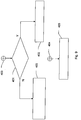
- each peer entity P is adapted to compute its total load value EL (block 300, figure 8 ) and to check if the computed value is lower than a first given m_threshold(P) value (block 301, figure 8 ).
- the peer entity P is adapted to check if the computed value is higher than a second given M_threshold(P) value (block 302, figure 8 ).
- the two thresholds m_threshold(P) and M_threshold(P) typically depend on the characteristics of the computing nodes on which the peer entity P is deployed.
- the peer load state is set to high (block 303, figure 8 ). Otherwise, the peer load state is set to normal (block 304, figure 8 ).
- the peer load state is set to low and the peer entity P notifies (block 305, figure 8 ) the low load state thereof to the "linked" peer entities that are able to consume the same types of tuples consumable by it (i.e., the peers in entry_list(T,P), for each of the tuple types T in tuple_types(P)).
- the peer entity P may notify said "linked” peer entities by sending a message, herein after called “processing-available” message, of the type ⁇ processing-available, tuple_types(P)>, wherein “processing-available” is the message identifier and "tuple_types(P)" indicates the tuple types that peer entity P is able to process.
- processing-available is the message identifier
- tuple_types(P) indicates the tuple types that peer entity P is able to process.
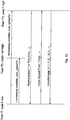
- a peer entity P1 that receives a processing-available message (block 400, figure 9 ) is adapted to check if its estimated total load value EL is high (block 401, figure 9 ).
- the peer entity P1 is adapted to identify the number of tuples that it could transfer to the notifying peer entity P (block 402, figure 9 ).
- such number can correspond to the number of tuples that guarantees the load state of the peer entity P1 to return normal.
- load available is the message identifier
- the peer entity P1 is adapted to respond with a message indicating that it has no tuples available (block 403, figure 9 ).
- the peer entity P After sending a processing-available message, the peer entity P waits for load-available messages (block 306, figure 8 ). Zero or more messages could be received, depending on the load state of the contacted "linked" peer entities.
- the peer entity P evaluates (block 306) how many tuples it can accept by considering its current estimated total load value EL, updated in order to consider also the tuples already requested (by means of a tuple-request message) from the other overload "linked" peers. Indeed, the peer entity P can accept a number of tuples guaranteeing that its load state does not become "high".
- peer entity P1 When peer entity P1 receives the tuple-request message (block 404, figure 9 ), it returns (block 405, figure 9 ) to peer entity P a message (hereinafter called "transfer-tuple" message) of the type ⁇ transfer-tuple: t1, t2, t3,...> containing (at most) the required amount of tuples for each type, de-queued from the corresponding waiting-queues.
- transfer-tuple a message (hereinafter called "transfer-tuple” message) of the type ⁇ transfer-tuple: t1, t2, t3,...> containing (at most) the required amount of tuples for each type, de-queued from the corresponding waiting-queues.
- peer entity P When peer entity P receives a transfer-tuple message, it queues the received tuples in the corresponding waiting-queues (block 308).
- Load handling modules 105 in a peer entity P are advantageously adapted to perform also a load handling procedure to handle worker module allocation/deallocation in the peer entity.
- load handling modules 105 are adapted to periodically check if in the waiting-queue of peer-entity P there is at least one tuple type T having an average permanence time in such waiting-queue lower than a given threshold.
- the load handling modules 105 are also adapted to check, for the linked peers in entry_list(T,P), the average permanence time of said at least one tuple type T in the waiting-queue of said linked peers.
- the average number of tuples of type T queued in the waiting-queue (or average queue-length) of a peer entity can be used as information indicative of the average permanence time of the tuples of type T in the waiting-queue of such peer-entity.
- the check with the linked peer entities in entry_list(T,P) can be performed by sending them a message (hereinafter called "request-queue-length" message, of the type ⁇ request-queue-length, T, my-queue-length>) to request such linked peer entities for the average permanence time of the tuples of type T in the waiting-queue thereof.
- the contacted peer entities can answer with a message (hereinafter called "response-queue-length" message) of the type ⁇ response-queue-length, T, my-queue-length> where, my-queue-length will indicate the current average permanence time of the tuples of type T in the waiting-queue thereof.
- response-queue-length a message of the type ⁇ response-queue-length, T, my-queue-length> where, my-queue-length will indicate the current average permanence time of the tuples of type T in the waiting-queue thereof.
- load handling modules 105 When the average permanence time is below a given threshold for all the linked entities in entry_list(T,P), load handling modules 105 nominate at least one worker module Wc_T able to consume tuple of type T as candidate for worker de-allocation in peer entity P. Worker module(s) Wc_T remain candidate until said average permanence time increases above the threshold or the peer entity P receives a old-workers-update message indicating that worker modules Wc_T have been de-allocated by another peer entity of the system 1000. In this latter case, the load handling modules 105 of peer entity P advantageously wait for a given number of computing periods before computing the average permanence time for type T again, for taking into account a stable situation after the de-allocation of a Wc_T.
- load handling modules 105 of a peer entity P actually de-allocate worker modules Wc_T, candidate for worker deallocation, only when for peer entity P there are worker modules, adapted to consume tuple types other than T, candidate for worker allocation.
- Worker modules adapted to consume tuples of type T' can be nominated as candidate for worker allocation by the load handling modules 105 when:
- Load handling modules 105 can decide to allocate worker modules without de-allocating other worker modules if the peer entity has some available resources (that is, if its load is not high, it has some memory available to allocate the new worker module and the related supporting data structure).
- load handling modules 105 can verify if the resources released by some de-allocation candidate Wc_T are suitable to support the allocation of candidate Wc_T'. In that case, the load handling modules 105 perform the de-allocation of worker modules Wc_T, and the allocation of worker modules Wc_T'.
- a peer entity P having some allocation candidate Wc_Ta but not de-allocation candidates, receives from a peer entity P1 a load-available message, it could answer with a message (herein after called "candidate-available" message of the type ⁇ candidate-available, Ta>), in order to propose the peer entity P1 to allocate worker modules Wc_Ta able to consume tuples of type Ta.
- Peer entity P1 can evaluate the feasibility of the allocation (e.g., by possibly de-allocating some of its de-allocation candidates).
- peer entity P1 If the evaluation gives a positive answer, peer entity P1 returns a message (hereinafter called "candidate-available-accepted" message of the type ⁇ candidate-available-accepted, Ta>) and performs the allocation/de-allocation procedure.
- load handling modules 105 of a peer entity decide to de-allocate worker modules Wc_T, they will perform the following main actions:
- the load handling modules 105 are adapted to dynamically allocate/deallocate worker modules with a mechanism that limits the number of reconfiguration/updating operations on the linked-peer-table 109 of the peer entities of the system 1000.
- the present invention in the various aspects thereof, provides a distributed service system for the execution of services requested by users in a distributed way.
- a user desiring a location-depending fee-payment information service can send a request for the service to the distributed service system by using a client entity deployed on its end-user terminal (e.g., a mobile phone).
- a client entity deployed on its end-user terminal e.g., a mobile phone.
- the client entity will send the service request to a peer entity it is registered with.
- the client handling modules of the peer entity will generate a tuple t1 of type T1 representing the first task to be executed to execute the requested service (e.g., user authentication and authorization).
- the tuple t1 will comprise, for example, information about the user identity, the type of end-user terminal, and the type of service requested by the user, and will be processed by a worker module Wc_T1 of the system.
- the worker module Wc_T1 will perform the authentication and authorization procedures and will produce a tuple t2 of type T2 representing the further tasks to be executed to continue the execution of the service.
- the tuple t2 will be will be processed by a worker module Wc_T2 of the system that, by using the data comprised in the tuple t2, will be able - for example - to handle the charging of the service and to produce a tuple t3 of type T3 representing the further task to be executed to continue the execution of the service.
- the tuple t3 will be will be processed by a worker module Wc_T3 of the system that, by using the data comprised in the tuple t3, will be able - for example - to determine the geographical position of the user and to produce a tuple t4 of type T4 representing the further task to be executed to continue the execution of the service.
- the tuple t4 will be will be processed by a worker module Wc_T4 of the system that, by using the data comprised in the tuple t4, will be able - for example - to retrieve the content requested by the user and to produce a tuple t5 of type T5 representing the further task to be executed to continue the execution of the service.
- the tuple t5 will be will be processed by a worker module Wc_T5 of the system that, by using the data comprised in the tuple t5, will be able - for example - to translate the retrieved content according to the type of the end-user terminal and to produce a tuple t6 of type T6 representing the further task to be executed to continue the execution of the service.
- the tuple t6 will be will be processed by a worker module Wc_T6 of the system that, by using the data comprised in the tuple t6, will be able - for example - to send a service-return message to the client entity of the user.
- Tuples t1 to t6 will be distributed in the system from worker modules producing them to worker modules adapted to consume them thanks to the procedures disclosed above.
- a user A desiring to establish a multi-media session with a user B can send a request to the distributed service system by using a client entity deployed on its end-user terminal (e.g., a mobile phone).
- a client entity deployed on its end-user terminal e.g., a mobile phone.
- the client entity of user A will send the service request to a peer entity it is registered with.
- the client handling modules of the peer entity receiving the request will generate a tuple t1 of type T1 representing the first task to be executed to execute the requested service (e.g., user authentication and authorization).
- the tuple t1 will comprise, for example, information about the user identity, the type of end-user terminal, the type of session requested by the user A and a logical address of user B.
- the tuple t1 will be processed by a worker module Wc_T1 of the system.
- the worker module Wc_T1 will perform the authentication and authorization procedures and will produce a tuple t2 of type T2 representing the further tasks to be executed to continue the execution of the service.
- the tuple t2 will be processed by a worker module Wc_T2 of the system that, by using the data comprised in the tuple t2, will be able - for example - to handle the charging of the request and to produce a tuple t3 of type T3 representing the further task to be executed to continue the execution of the service.
- the tuple t3 will be will be processed by a worker module Wc_T3 of the system that, by using the data comprised in the tuple t3, will be able - for example - to retrieve the physical address associated with the logical address of user B; to create a multimedia service session by requesting the service session descriptor handling modules to create a new service session descriptor for such session and memorizing the logical address of user A in the service session descriptor thus created; and to send an invite message (comprising data concerning the service session and the session identifier) to the client entity deployed on the end-user terminal of user B.
- a worker module Wc_T3 of the system that, by using the data comprised in the tuple t3, will be able - for example - to retrieve the physical address associated with the logical address of user B; to create a multimedia service session by requesting the service session descriptor handling modules to create a new service session descriptor for such session and memorizing the logical address of user A
- user B If user B wishes to accept the invite message, he/she can send an acknowledge message to user A by using the client entity deployed on its end-user terminal.
- the client entity will send the service request of user B to a peer entity it is registered with.
- the client handling modules of the peer entity will generate a tuple t1' of type T1' representing the first task to be executed to execute the requested service (e.g., user authentication and authorization).
- the tuple t1' will comprise, for example, information about the user identity, the type of end-user terminal, the identifier of the session, etc etc.
- the tuple t1' will be processed by a worker module Wc_T1' of the system.
- the worker module Wc_T1' will perform the authentication and authorization procedures and will produce a tuple t2' of type T2' representing the further tasks to be executed to continue the execution of the service.
- the tuple t2' will be processed by a worker module Wc_T2' of the system that, by using the data comprised in the tuple t2', will be able - for example - to execute the charging of the request and to produce a tuple t3' of type T3' representing the further task to be executed to continue the execution of the service.
- the tuple t3' will be processed by a worker module Wc_T3' of the system that, by using the data comprised in the tuple t3', will be able - for example - to retrieve the physical address associated with the logical address of user A by requesting the service session descriptor handling modules to read the session descriptor associated with the session; and to send an acknowledge message (comprising data concerning the service session and the session identifier) to the client entity deployed on the end-user terminal of user A.
- a worker module Wc_T3' of the system that, by using the data comprised in the tuple t3', will be able - for example - to retrieve the physical address associated with the logical address of user A by requesting the service session descriptor handling modules to read the session descriptor associated with the session; and to send an acknowledge message (comprising data concerning the service session and the session identifier) to the client entity deployed on the end-user terminal of user A.
Landscapes
- Engineering & Computer Science (AREA)
- Theoretical Computer Science (AREA)
- Software Systems (AREA)
- Physics & Mathematics (AREA)
- Business, Economics & Management (AREA)
- General Physics & Mathematics (AREA)
- Strategic Management (AREA)
- Human Resources & Organizations (AREA)
- General Engineering & Computer Science (AREA)
- Entrepreneurship & Innovation (AREA)
- Data Mining & Analysis (AREA)
- Economics (AREA)
- Marketing (AREA)
- Operations Research (AREA)
- Quality & Reliability (AREA)
- Tourism & Hospitality (AREA)
- General Business, Economics & Management (AREA)
- Mathematical Physics (AREA)
- Computer And Data Communications (AREA)
Claims (14)
- Système informatique distribué pour exécuter des services de manière distribuée, l'exécution de chaque service comportant le traitement d'une pluralité de tâches de types prédéterminés, chaque type de tâche à traiter étant représenté par un type correspondant de tuples de données, relatifs au type de tâches, dans lequel :- le système comprend une pluralité d'entités homologues ;- chaque entité homologue est conçue pour stocker et exécuter une pluralité de modules de travail, chaque module de travail étant conçu pour traiter au moins un type de tâches ; chaque entité homologue comprend des modules d'espaces de tuples conçus pour gérer le stockage d'un nombre prédéterminé de tuples dans une zone de stockage de l'entité homologue, et pour classer le nombre prédéterminé de tuples stockés dans l'entité homologue, selon un premier et un second groupes de tuples, le premier groupe comprenant des types de tuples représentant des types de tâches qui peuvent être traités par les modules de travail de l'entité homologue, le second groupe comprenant des types de tuples représentant des types de tâches qui ne peuvent être traitées par les modules de travail de l'entité homologue ;- chaque entité homologue comprend des modules de gestion de tuples qui, pour un tuple de type T, sont conçus :et en ce que :a) pour contrôler si au moins un de la pluralité de modules de travail compris dans l'entité homologue, est conçu pour traiter la tâche représentée par ledit tuple,b) dans le cas positif de a), pour prendre en charge le traitement de la tâche représentée par ledit tuple,caractérisé en ce que les modules de gestion de tuples, pour un tuple de type T, sont conçus :c) dans le cas négatif de a), pour exécuter une procédure d'envoi pour envoyer ledit tuple à une autre entité homologue de la pluralité d'entités homologues du système,- chaque entité homologue comprend des modules de gestion de charge conçus pour contrôler périodiquement si, dans le premier groupe de tuples stockés à l'intérieur, il existe au moins un type de tuples ayant un temps de permanence moyen dans le premier groupe inférieur à un seuil donné ;- dans le cas positif, pour contrôler, pour au moins une autre entité homologue du système, le temps de permanence moyen dudit au moins un type de tuples dans le premier groupe de tuples de ladite au moins autre entité homologue ;- lorsque le temps de permanence moyen dudit au moins un type de tuples est inférieur à un seuil donné également pour ladite au moins autre entité homologue du système, les modules de gestion de charge sont conçus pour nommer au moins un des modules de travail de l'entité homologue, qui est capable de traiter des tuples dudit au moins un type de tuples, comme candidat à la désallocation.
- Système selon la revendication 1, dans lequel les modules de gestion de tuples de chaque entité homologue sont conçus pour gérer une table d'homologues liés, stockée dans l'entité homologue pour associer, avec chaque type de tuples d'un nombre prédéterminé de types de tuples, une liste d'entités homologues liées du système qui comprend des modules de travail conçus pour traiter des tuples dudit type de tuples.
- Système selon la revendication 2, dans lequel, dans la procédure d'envoi de c), les modules de gestion de tuples sont conçus pour accéder à la table d'homologues liés pour récupérer, selon des politiques d'envoi prédéterminées, une des entités homologues liées qui est associée au type de tuples T dans la table d'homologues liés.
- Système selon la revendication 3, dans lequel, lorsque la table d'homologues liés ne contient pas d'entités homologues liées associées au type de tuples T, les modules de gestion de tuples de chaque entité homologue sont conçus pour envoyer à plusieurs entités homologues du système, sélectionnées selon des politiques prédéterminées d'après celles listées dans la table d'homologues liés, stockée dans l'entité homologue, une requête pour une entité homologue du système qui comprend au moins un module de travail conçu pour exécuter des tuples du type T.
- Système selon l'une quelconque des revendications 1 à 4, dans lequel, les modules de gestion de charge de chaque entité homologue sont conçus pour nommer un module de travail, qui est capable de traiter un type de tuples compris dans le second groupe de tuples, comme candidat à l'allocation à l'intérieur de l'entité homologue, lorsqu'au moins une des conditions suivantes est remplie : ledit type de tuples a un temps de permanence moyen dans le second groupe de tuples supérieur à un seuil donné ; ledit type de tuples a, dans le second groupe, une durée de vie qui est prête à expirer ; une requête faite par l'entité homologue pour une autre entité homologue du système, qui comprend au moins un module de travail conçu pour exécuter ledit type de tuples, a échoué.
- Système selon la revendication 5, dans lequel les modules de gestion de charge sont conçus pour désallouer un module de travail de l'entité homologue, nommé comme candidat à la désallocation de modules de travail, lorsque, dans l'entité homologue, il existe au moins un module de travail nommé comme candidat à l'allocation de modules de travail.
- Système selon la revendication 6, dans lequel les modules de gestion de charge sont conçus pour allouer dans l'entité homologue un module de travail, nommé comme candidat à l'allocation de modules de travail, lorsque l'entité homologue a une charge de travail par rapport au traitement des tuples, inférieure à un seuil prédéterminé.
- Système selon la revendication 1, dans lequel les modules de gestion de tuples de chaque entité homologue sont conçus pour réaliser a), b) et c) sur un tuple produit par un module de travail de l'entité homologue ou reçu par une autre entité homologue du système.
- Système selon l'une quelconque des revendications 1 à 8, dans lequel la pluralité d'entités homologues est déployée sur une pluralité de noeuds de calcul, de serveurs, de groupe de serveurs et / ou d'équipements d'utilisateurs finaux, interconnectés par un réseau de communication.
- Entité homologue pour un système pour exécuter des services de manière distribuée, selon l'une quelconque des revendications 1 à 9, l'exécution de chaque service comportant le traitement d'une pluralité de tâches de types prédéterminés, chaque type de tâche à traiter étant représenté par un type correspondant de tuples de données, relatifs au type de tâches, dans laquelle, l'entité homologue est conçue pour stocker et exécuter une pluralité de modules de travail, chaque module de travail étant conçu pour traiter au moins un type de tâches, et l'entité homologue comprend des modules d'espaces de tuples conçus pour gérer le stockage d'un nombre prédéterminé de tuples dans une zone de stockage de l'entité homologue, et pour classer le nombre prédéterminé de tuples stockés dans l'entité homologue, selon un premier et un second groupes de tuples, le premier groupe comprenant des types de tuples représentant des types de tâches qui peuvent être traités par les modules de travail de l'entité homologue, le second groupe comprenant des types de tuples représentant des types de tâches qui ne peuvent être traités par les modules de travail de l'entité homologue ;- des modules de gestion de tuples qui, pour un tuple de type T, sont conçus :et en ce que l'entité homologue comprend :a) pour contrôler si au moins un de la pluralité de modules de travail compris dans l'entité homologue, est conçu pour traiter la tâche représentée par ledit tuple,b) dans le cas positif de a), pour prendre en charge le traitement de la tâche représentée par ledit tuple,caractérisé en ce que les modules de gestion de tuples, pour un tuple de type T, sont conçus :c) dans le cas négatif de a), pour exécuter une procédure d'envoi pour envoyer ledit tuple à une autre entité homologue de la pluralité d'entités homologues du système,- des modules de gestion de charge conçus pour :- contrôler périodiquement si, dans le premier groupe de tuples stockés à l'intérieur, il existe au moins un type de tuples ayant un temps de permanence moyen dans le premier groupe inférieur à un seuil donné ;- dans le cas positif, pour contrôler, pour au moins une autre entité homologue du système, le temps de permanence moyen dudit au moins un type de tuples dans le premier groupe de tuples de ladite au moins autre entité homologue ;- lorsque le temps de permanence moyen dudit au moins un type de tuples est inférieur à un seuil donné également pour ladite au moins autre entité homologue du système, les modules de gestion de charge sont conçus pour nommer au moins un des modules de travail de l'entité homologue, qui est capable de traiter des tuples dudit au moins un type de tuples, comme candidat à la désallocation.
- Procédé pour gérer des tuples dans une entité homologue d'une pluralité d'entités homologues d'un système informatique distribué pour exécuter des services de manière distribuée, dans lequel l'exécution de chaque service comporte le traitement d'une pluralité de tâches de types prédéterminés, chaque type de tâche à traiter est représenté par un type correspondant de tuples de données, relatifs au type de tâches, et chaque entité homologue du système est conçue pour stocker et exécuter une pluralité de modules de travail, chaque module de travail étant conçu pour traiter au moins un type de tâches ; pour un tuple de type T stocké dans l'entité homologue, le procédé comprenant :a) le contrôle de si au moins un de la pluralité de modules de travail compris dans l'entité homologue, est conçu pour traiter la tâche représentée par ledit tuple,b) dans le cas positif de a), le traitement de la tâche représentée par ledit tuple, par ledit au moins un de la pluralité de modules de travail de l'entité homologue qui est conçu pour le traitercaractérisé en ce que le procédé comprend :c) dans le cas négatif de a), l'exécution d'une procédure d'envoi pour envoyer ledit tuple à une autre entité homologue de la pluralité d'entités homologues du système,le procédé comprenant, en outre :- le classement de tuples stockés dans l'entité homologue selon un premier et un second groupes de tuples, le premier groupe comprenant des types de tuples représentant des types de tâches qui peuvent être traités par les modules de travail de l'entité homologue, le second groupe comprenant des types de tuples représentant des types de tâches qui ne peuvent pas être traités par les modules de travail de l'entité homologue ;- le contrôle périodique de l'existence éventuelle, dans le premier groupe de tuples stockés à l'intérieur, d'au moins un type de tuples ayant un temps de permanence moyen dans le premier groupe inférieur à un seuil donné ;- dans le cas positif, le contrôle, pour au moins une autre entité homologue du système, du temps de permanence moyen dudit au moins un type de tuples dans le premier groupe de tuples de ladite au moins autre entité homologue, et- lorsque le temps de permanence moyen dudit au moins un type de tuples est inférieur à un seuil donné également pour ladite au moins autre entité homologue du système, en nommant au moins un des modules de travail de l'entité homologue, qui est capable de traiter des tuples dudit au moins un type de tuples, comme candidat à la désallocation par l'entité homologue.
- Procédé selon la revendication 11, comprenant, en outre, la nomination d'un module de travail, qui est capable de traiter un type de tuples compris dans le second groupe de tuples stockés dans l'entité homologue, comme candidat à l'allocation à l'intérieur de l'entité homologue, lorsqu'au moins une des conditions suivantes est remplie : ledit type de tuples a un temps de permanence moyen dans ledit second groupe supérieur à un seuil donné ; ledit type de tuples a, dans le second groupe, une durée de vie qui est prête à expirer ; une requête faite par l'entité homologue pour une autre entité homologue du système, qui comprend au moins un module de travail conçu pour exécuter ledit type de tuples, a échoué.
- Procédé selon la revendication 12, comprenant, en outre, la désallocation d'un module de travail de l'entité homologue, nommé comme candidat à la désallocation de modules de travail, lorsqu'il y a au moins un module de travail nommé comme candidat à l'allocation de modules de travail dans l'entité homologue.
- Procédé selon la revendication 13, comprenant, en outre, l'allocation dans l'entité homologue d'un module de travail, nommé comme candidat à l'allocation de modules de travail, lorsque l'entité homologue a une charge de travail par rapport au traitement des tuples inférieure à un seuil prédéterminé.
Applications Claiming Priority (1)
| Application Number | Priority Date | Filing Date | Title |
|---|---|---|---|
| PCT/EP2008/002935 WO2009127219A1 (fr) | 2008-04-14 | 2008-04-14 | Architecture de service distribuée |
Publications (2)
| Publication Number | Publication Date |
|---|---|
| EP2277110A1 EP2277110A1 (fr) | 2011-01-26 |
| EP2277110B1 true EP2277110B1 (fr) | 2018-10-31 |
Family
ID=39717704
Family Applications (1)
| Application Number | Title | Priority Date | Filing Date |
|---|---|---|---|
| EP08735215.9A Active EP2277110B1 (fr) | 2008-04-14 | 2008-04-14 | Architecture de service distribuée |
Country Status (4)
| Country | Link |
|---|---|
| US (1) | US9009211B2 (fr) |
| EP (1) | EP2277110B1 (fr) |
| CN (1) | CN102047226B (fr) |
| WO (1) | WO2009127219A1 (fr) |
Families Citing this family (25)
| Publication number | Priority date | Publication date | Assignee | Title |
|---|---|---|---|---|
| US10430338B2 (en) * | 2008-09-19 | 2019-10-01 | Oracle International Corporation | Selectively reading data from cache and primary storage based on whether cache is overloaded |
| US8868831B2 (en) * | 2009-09-14 | 2014-10-21 | Oracle International Corporation | Caching data between a database server and a storage system |
| US9325787B2 (en) * | 2009-05-18 | 2016-04-26 | Cisco Technology, Inc. | Limited broadcast, peering among DHTs, broadcast put of limited content only |
| US8479216B2 (en) * | 2009-08-18 | 2013-07-02 | International Business Machines Corporation | Method for decentralized load distribution in an event-driven system using localized migration between physically connected nodes and load exchange protocol preventing simultaneous migration of plurality of tasks to or from a same node |
| US8479215B2 (en) * | 2009-08-18 | 2013-07-02 | International Business Machines Corporation | Decentralized load distribution to reduce power and/or cooling costs in an event-driven system |
| US8875152B2 (en) * | 2010-04-22 | 2014-10-28 | Salesforce.Com, Inc. | System, method and computer program product for dynamically increasing resources utilized for processing tasks |
| KR20120122136A (ko) * | 2011-04-28 | 2012-11-07 | 삼성전자주식회사 | 데이터 스트림 관리 시스템에서의 부하 경감을 조절하는 방법 및 장치 |
| US8935227B2 (en) * | 2012-04-17 | 2015-01-13 | Oracle International Corporation | Redistributing computation work between data producers and data consumers |
| CN103685416B (zh) * | 2012-09-20 | 2019-04-26 | 联想(北京)有限公司 | 分布式任务分配与认领方法以及电子设备 |
| US10430332B2 (en) * | 2013-03-25 | 2019-10-01 | Salesforce.Com, Inc. | System and method for performance tuning of garbage collection algorithms |
| US10229161B2 (en) | 2013-09-20 | 2019-03-12 | Oracle International Corporation | Automatic caching of scan and random access data in computing systems |
| US9798655B2 (en) | 2013-09-20 | 2017-10-24 | Oracle International Corporation | Managing a cache on storage devices supporting compression |
| IN2013MU04013A (fr) * | 2013-12-23 | 2015-08-07 | Tata Consultancy Services Ltd | |
| CN104794095B (zh) * | 2014-01-16 | 2018-09-07 | 华为技术有限公司 | 分布式计算处理方法及装置 |
| CN103995748B (zh) * | 2014-05-15 | 2018-03-09 | 乐视致新电子科技(天津)有限公司 | 智能终端的任务处理方法及系统 |
| CN104050042B (zh) * | 2014-05-30 | 2017-06-13 | 北京先进数通信息技术股份公司 | Etl作业的资源分配方法及装置 |
| US10834149B2 (en) | 2014-12-15 | 2020-11-10 | At&T Intellectual Property I, L.P. | Method and system for routing of session-based services |
| US10148514B2 (en) * | 2014-12-23 | 2018-12-04 | Intel Corporation | Device discovery using discovery nodes |
| US9864779B2 (en) | 2015-06-15 | 2018-01-09 | International Business Machines Corporation | Suppressing stream functionality to expedite preferred data |
| US10331573B2 (en) | 2016-11-04 | 2019-06-25 | Oracle International Corporation | Detection of avoidable cache thrashing for OLTP and DW workloads |
| US10084805B2 (en) * | 2017-02-20 | 2018-09-25 | Sas Institute Inc. | Computer system to identify anomalies based on computer-generated results |
| US11153173B1 (en) * | 2019-09-10 | 2021-10-19 | Juniper Networks, Inc. | Dynamically updating compute node location information in a distributed computing environment |
| CN113068216B (zh) * | 2021-03-17 | 2023-06-27 | 牙木科技股份有限公司 | 网络拨测方法、网络拨测系统及计算机可读存储介质 |
| US11303712B1 (en) * | 2021-04-09 | 2022-04-12 | International Business Machines Corporation | Service management in distributed system |
| CN115037617B (zh) * | 2022-05-16 | 2024-07-09 | 中国农业银行股份有限公司 | 一种dubbo服务治理的优化方法及装置 |
Citations (1)
| Publication number | Priority date | Publication date | Assignee | Title |
|---|---|---|---|---|
| US6128642A (en) * | 1997-07-22 | 2000-10-03 | At&T Corporation | Load balancing based on queue length, in a network of processor stations |
Family Cites Families (6)
| Publication number | Priority date | Publication date | Assignee | Title |
|---|---|---|---|---|
| US5938732A (en) * | 1996-12-09 | 1999-08-17 | Sun Microsystems, Inc. | Load balancing and failover of network services |
| US7228550B1 (en) * | 2002-01-07 | 2007-06-05 | Slt Logic, Llc | System and method for making communication streams available to processes executing under control of an operating system but without the intervention of the operating system |
| US7519577B2 (en) * | 2003-06-23 | 2009-04-14 | Microsoft Corporation | Query intermediate language method and system |
| CA2545272A1 (fr) * | 2003-11-04 | 2005-05-19 | Nexthop Technologies, Inc. | Communications standards securises par reseau longue portee |
| CA2554938A1 (fr) * | 2004-06-29 | 2006-01-12 | Siemens Aktiengesellschaft | Procede de fourniture de fonction de serveur fiable comme support de service ou de serie de services |
| US7610330B1 (en) * | 2006-03-30 | 2009-10-27 | Packeteer, Inc. | Multi-dimensional computation distribution in a packet processing device having multiple processing architecture |
-
2008
- 2008-04-14 EP EP08735215.9A patent/EP2277110B1/fr active Active
- 2008-04-14 US US12/937,620 patent/US9009211B2/en active Active
- 2008-04-14 WO PCT/EP2008/002935 patent/WO2009127219A1/fr not_active Ceased
- 2008-04-14 CN CN200880129592.XA patent/CN102047226B/zh active Active
Patent Citations (1)
| Publication number | Priority date | Publication date | Assignee | Title |
|---|---|---|---|---|
| US6128642A (en) * | 1997-07-22 | 2000-10-03 | At&T Corporation | Load balancing based on queue length, in a network of processor stations |
Also Published As
| Publication number | Publication date |
|---|---|
| CN102047226B (zh) | 2014-08-20 |
| CN102047226A (zh) | 2011-05-04 |
| EP2277110A1 (fr) | 2011-01-26 |
| WO2009127219A1 (fr) | 2009-10-22 |
| US9009211B2 (en) | 2015-04-14 |
| US20110047084A1 (en) | 2011-02-24 |
Similar Documents
| Publication | Publication Date | Title |
|---|---|---|
| EP2277110B1 (fr) | Architecture de service distribuée | |
| US10567303B2 (en) | System and method for routing service requests | |
| Wuhib et al. | A gossip protocol for dynamic resource management in large cloud environments | |
| WO2012122812A1 (fr) | Procédé et système de gestion de ressources, et gestionnaire de ressources | |
| US11616725B1 (en) | Hierarchical token buckets | |
| US9760370B2 (en) | Load balancing using predictable state partitioning | |
| WO2002065230A2 (fr) | Plate-forme informatique de collaboration non hierarchique | |
| Keerthika et al. | A multiconstrained grid scheduling algorithm with load balancing and fault tolerance | |
| Haris et al. | A systematic review on load balancing issues in cloud computing | |
| Steffenel et al. | Assessing the impact of unbalanced resources and communications in edge computing | |
| Akawee et al. | Using resource allocation for seamless service provisioning in cloud computing | |
| Alam et al. | An adaptive threshold based hybrid load balancing scheme with sender and receiver initiated approach using random information exchange | |
| Tasneem et al. | An insight into load balancing in cloud computing | |
| Krauter et al. | Architecture for a grid operating system | |
| El-Darieby et al. | A scalable wide-area grid resource management framework | |
| Abouelela et al. | Multidomain hierarchical resource allocation for grid applications | |
| Choi et al. | Fast Software Component Migration for Applications Survivability in Distributed Real-Time Systems. | |
| Gonçalves et al. | FaaS@ Edge: Bringing Function-as-a-Service to Voluntary Computing at the Edge | |
| Song et al. | QSON: QoS-aware service overlay network | |
| Choi et al. | Dynamic resource discovery for applications survivability in distributed real-time systems | |
| Kimmatkar et al. | Applications sharing using binding server for distributed environment | |
| Gyires | A resource allocation protocol for providing quality of service in grid computing | |
| Derbal | Confidence-based grid service discovery | |
| Tree | Adjacency Cloud-Oriented Storage Overlay Topology Using Self-organizing | |
| Derbal | A service discovery model for computational grids |
Legal Events
| Date | Code | Title | Description |
|---|---|---|---|
| PUAI | Public reference made under article 153(3) epc to a published international application that has entered the european phase |
Free format text: ORIGINAL CODE: 0009012 |
|
| 17P | Request for examination filed |
Effective date: 20101110 |
|
| AK | Designated contracting states |
Kind code of ref document: A1 Designated state(s): AT BE BG CH CY CZ DE DK EE ES FI FR GB GR HR HU IE IS IT LI LT LU LV MC MT NL NO PL PT RO SE SI SK TR |
|
| AX | Request for extension of the european patent |
Extension state: AL BA MK RS |
|
| 17Q | First examination report despatched |
Effective date: 20110614 |
|
| DAX | Request for extension of the european patent (deleted) | ||
| RAP1 | Party data changed (applicant data changed or rights of an application transferred) |
Owner name: TELECOM ITALIA S.P.A. |
|
| REG | Reference to a national code |
Ref country code: DE Ref legal event code: R079 Ref document number: 602008057675 Country of ref document: DE Free format text: PREVIOUS MAIN CLASS: G06F0009500000 Ipc: G06Q0010100000 |
|
| GRAP | Despatch of communication of intention to grant a patent |
Free format text: ORIGINAL CODE: EPIDOSNIGR1 |
|
| STAA | Information on the status of an ep patent application or granted ep patent |
Free format text: STATUS: GRANT OF PATENT IS INTENDED |
|
| RIC1 | Information provided on ipc code assigned before grant |
Ipc: G06F 9/50 20060101ALI20180604BHEP Ipc: G06Q 10/10 20120101AFI20180604BHEP |
|
| INTG | Intention to grant announced |
Effective date: 20180628 |
|
| GRAS | Grant fee paid |
Free format text: ORIGINAL CODE: EPIDOSNIGR3 |
|
| GRAA | (expected) grant |
Free format text: ORIGINAL CODE: 0009210 |
|
| STAA | Information on the status of an ep patent application or granted ep patent |
Free format text: STATUS: THE PATENT HAS BEEN GRANTED |
|
| AK | Designated contracting states |
Kind code of ref document: B1 Designated state(s): AT BE BG CH CY CZ DE DK EE ES FI FR GB GR HR HU IE IS IT LI LT LU LV MC MT NL NO PL PT RO SE SI SK TR |
|
| REG | Reference to a national code |
Ref country code: CH Ref legal event code: EP Ref country code: GB Ref legal event code: FG4D |
|
| REG | Reference to a national code |
Ref country code: AT Ref legal event code: REF Ref document number: 1060287 Country of ref document: AT Kind code of ref document: T Effective date: 20181115 |
|
| REG | Reference to a national code |
Ref country code: DE Ref legal event code: R096 Ref document number: 602008057675 Country of ref document: DE |
|
| REG | Reference to a national code |
Ref country code: IE Ref legal event code: FG4D |
|
| REG | Reference to a national code |
Ref country code: NL Ref legal event code: MP Effective date: 20181031 |
|
| REG | Reference to a national code |
Ref country code: LT Ref legal event code: MG4D |
|
| REG | Reference to a national code |
Ref country code: AT Ref legal event code: MK05 Ref document number: 1060287 Country of ref document: AT Kind code of ref document: T Effective date: 20181031 |
|
| PG25 | Lapsed in a contracting state [announced via postgrant information from national office to epo] |
Ref country code: AT Free format text: LAPSE BECAUSE OF FAILURE TO SUBMIT A TRANSLATION OF THE DESCRIPTION OR TO PAY THE FEE WITHIN THE PRESCRIBED TIME-LIMIT Effective date: 20181031 Ref country code: IS Free format text: LAPSE BECAUSE OF FAILURE TO SUBMIT A TRANSLATION OF THE DESCRIPTION OR TO PAY THE FEE WITHIN THE PRESCRIBED TIME-LIMIT Effective date: 20190228 Ref country code: PL Free format text: LAPSE BECAUSE OF FAILURE TO SUBMIT A TRANSLATION OF THE DESCRIPTION OR TO PAY THE FEE WITHIN THE PRESCRIBED TIME-LIMIT Effective date: 20181031 Ref country code: LT Free format text: LAPSE BECAUSE OF FAILURE TO SUBMIT A TRANSLATION OF THE DESCRIPTION OR TO PAY THE FEE WITHIN THE PRESCRIBED TIME-LIMIT Effective date: 20181031 Ref country code: ES Free format text: LAPSE BECAUSE OF FAILURE TO SUBMIT A TRANSLATION OF THE DESCRIPTION OR TO PAY THE FEE WITHIN THE PRESCRIBED TIME-LIMIT Effective date: 20181031 Ref country code: NO Free format text: LAPSE BECAUSE OF FAILURE TO SUBMIT A TRANSLATION OF THE DESCRIPTION OR TO PAY THE FEE WITHIN THE PRESCRIBED TIME-LIMIT Effective date: 20190131 Ref country code: FI Free format text: LAPSE BECAUSE OF FAILURE TO SUBMIT A TRANSLATION OF THE DESCRIPTION OR TO PAY THE FEE WITHIN THE PRESCRIBED TIME-LIMIT Effective date: 20181031 Ref country code: BG Free format text: LAPSE BECAUSE OF FAILURE TO SUBMIT A TRANSLATION OF THE DESCRIPTION OR TO PAY THE FEE WITHIN THE PRESCRIBED TIME-LIMIT Effective date: 20190131 Ref country code: HR Free format text: LAPSE BECAUSE OF FAILURE TO SUBMIT A TRANSLATION OF THE DESCRIPTION OR TO PAY THE FEE WITHIN THE PRESCRIBED TIME-LIMIT Effective date: 20181031 Ref country code: LV Free format text: LAPSE BECAUSE OF FAILURE TO SUBMIT A TRANSLATION OF THE DESCRIPTION OR TO PAY THE FEE WITHIN THE PRESCRIBED TIME-LIMIT Effective date: 20181031 |
|
| PG25 | Lapsed in a contracting state [announced via postgrant information from national office to epo] |
Ref country code: PT Free format text: LAPSE BECAUSE OF FAILURE TO SUBMIT A TRANSLATION OF THE DESCRIPTION OR TO PAY THE FEE WITHIN THE PRESCRIBED TIME-LIMIT Effective date: 20190301 Ref country code: SE Free format text: LAPSE BECAUSE OF FAILURE TO SUBMIT A TRANSLATION OF THE DESCRIPTION OR TO PAY THE FEE WITHIN THE PRESCRIBED TIME-LIMIT Effective date: 20181031 Ref country code: GR Free format text: LAPSE BECAUSE OF FAILURE TO SUBMIT A TRANSLATION OF THE DESCRIPTION OR TO PAY THE FEE WITHIN THE PRESCRIBED TIME-LIMIT Effective date: 20190201 Ref country code: NL Free format text: LAPSE BECAUSE OF FAILURE TO SUBMIT A TRANSLATION OF THE DESCRIPTION OR TO PAY THE FEE WITHIN THE PRESCRIBED TIME-LIMIT Effective date: 20181031 |
|
| PG25 | Lapsed in a contracting state [announced via postgrant information from national office to epo] |
Ref country code: DK Free format text: LAPSE BECAUSE OF FAILURE TO SUBMIT A TRANSLATION OF THE DESCRIPTION OR TO PAY THE FEE WITHIN THE PRESCRIBED TIME-LIMIT Effective date: 20181031 Ref country code: CZ Free format text: LAPSE BECAUSE OF FAILURE TO SUBMIT A TRANSLATION OF THE DESCRIPTION OR TO PAY THE FEE WITHIN THE PRESCRIBED TIME-LIMIT Effective date: 20181031 |
|
| REG | Reference to a national code |
Ref country code: DE Ref legal event code: R097 Ref document number: 602008057675 Country of ref document: DE |
|
| PG25 | Lapsed in a contracting state [announced via postgrant information from national office to epo] |
Ref country code: RO Free format text: LAPSE BECAUSE OF FAILURE TO SUBMIT A TRANSLATION OF THE DESCRIPTION OR TO PAY THE FEE WITHIN THE PRESCRIBED TIME-LIMIT Effective date: 20181031 Ref country code: EE Free format text: LAPSE BECAUSE OF FAILURE TO SUBMIT A TRANSLATION OF THE DESCRIPTION OR TO PAY THE FEE WITHIN THE PRESCRIBED TIME-LIMIT Effective date: 20181031 Ref country code: SK Free format text: LAPSE BECAUSE OF FAILURE TO SUBMIT A TRANSLATION OF THE DESCRIPTION OR TO PAY THE FEE WITHIN THE PRESCRIBED TIME-LIMIT Effective date: 20181031 |
|
| PLBE | No opposition filed within time limit |
Free format text: ORIGINAL CODE: 0009261 |
|
| STAA | Information on the status of an ep patent application or granted ep patent |
Free format text: STATUS: NO OPPOSITION FILED WITHIN TIME LIMIT |
|
| 26N | No opposition filed |
Effective date: 20190801 |
|
| PG25 | Lapsed in a contracting state [announced via postgrant information from national office to epo] |
Ref country code: SI Free format text: LAPSE BECAUSE OF FAILURE TO SUBMIT A TRANSLATION OF THE DESCRIPTION OR TO PAY THE FEE WITHIN THE PRESCRIBED TIME-LIMIT Effective date: 20181031 |
|
| REG | Reference to a national code |
Ref country code: CH Ref legal event code: PL |
|
| REG | Reference to a national code |
Ref country code: BE Ref legal event code: MM Effective date: 20190430 |
|
| PG25 | Lapsed in a contracting state [announced via postgrant information from national office to epo] |
Ref country code: LU Free format text: LAPSE BECAUSE OF NON-PAYMENT OF DUE FEES Effective date: 20190414 Ref country code: MC Free format text: LAPSE BECAUSE OF FAILURE TO SUBMIT A TRANSLATION OF THE DESCRIPTION OR TO PAY THE FEE WITHIN THE PRESCRIBED TIME-LIMIT Effective date: 20181031 |
|
| PG25 | Lapsed in a contracting state [announced via postgrant information from national office to epo] |
Ref country code: CH Free format text: LAPSE BECAUSE OF NON-PAYMENT OF DUE FEES Effective date: 20190430 Ref country code: LI Free format text: LAPSE BECAUSE OF NON-PAYMENT OF DUE FEES Effective date: 20190430 |
|
| PG25 | Lapsed in a contracting state [announced via postgrant information from national office to epo] |
Ref country code: BE Free format text: LAPSE BECAUSE OF NON-PAYMENT OF DUE FEES Effective date: 20190430 |
|
| PG25 | Lapsed in a contracting state [announced via postgrant information from national office to epo] |
Ref country code: TR Free format text: LAPSE BECAUSE OF FAILURE TO SUBMIT A TRANSLATION OF THE DESCRIPTION OR TO PAY THE FEE WITHIN THE PRESCRIBED TIME-LIMIT Effective date: 20181031 |
|
| PG25 | Lapsed in a contracting state [announced via postgrant information from national office to epo] |
Ref country code: IE Free format text: LAPSE BECAUSE OF NON-PAYMENT OF DUE FEES Effective date: 20190414 |
|
| PG25 | Lapsed in a contracting state [announced via postgrant information from national office to epo] |
Ref country code: CY Free format text: LAPSE BECAUSE OF FAILURE TO SUBMIT A TRANSLATION OF THE DESCRIPTION OR TO PAY THE FEE WITHIN THE PRESCRIBED TIME-LIMIT Effective date: 20181031 |
|
| PG25 | Lapsed in a contracting state [announced via postgrant information from national office to epo] |
Ref country code: HU Free format text: LAPSE BECAUSE OF FAILURE TO SUBMIT A TRANSLATION OF THE DESCRIPTION OR TO PAY THE FEE WITHIN THE PRESCRIBED TIME-LIMIT; INVALID AB INITIO Effective date: 20080414 Ref country code: MT Free format text: LAPSE BECAUSE OF FAILURE TO SUBMIT A TRANSLATION OF THE DESCRIPTION OR TO PAY THE FEE WITHIN THE PRESCRIBED TIME-LIMIT Effective date: 20181031 |
|
| P01 | Opt-out of the competence of the unified patent court (upc) registered |
Effective date: 20230529 |
|
| P02 | Opt-out of the competence of the unified patent court (upc) changed |
Effective date: 20230604 |
|
| PGFP | Annual fee paid to national office [announced via postgrant information from national office to epo] |
Ref country code: DE Payment date: 20250417 Year of fee payment: 18 |
|
| PGFP | Annual fee paid to national office [announced via postgrant information from national office to epo] |
Ref country code: GB Payment date: 20250424 Year of fee payment: 18 |
|
| PGFP | Annual fee paid to national office [announced via postgrant information from national office to epo] |
Ref country code: IT Payment date: 20250430 Year of fee payment: 18 |
|
| PGFP | Annual fee paid to national office [announced via postgrant information from national office to epo] |
Ref country code: FR Payment date: 20250422 Year of fee payment: 18 |