EP2277828B1 - Procédé de préparation d une poudre de phosphate de lithium-fer, poudre de phosphate de lithium-fer à structure olivine, feuille de cathode utilisant ladite poudre de phosphate de lithium-fer et batterie secondaire à solvant non aqueux - Google Patents
Procédé de préparation d une poudre de phosphate de lithium-fer, poudre de phosphate de lithium-fer à structure olivine, feuille de cathode utilisant ladite poudre de phosphate de lithium-fer et batterie secondaire à solvant non aqueux Download PDFInfo
- Publication number
- EP2277828B1 EP2277828B1 EP09727078.9A EP09727078A EP2277828B1 EP 2277828 B1 EP2277828 B1 EP 2277828B1 EP 09727078 A EP09727078 A EP 09727078A EP 2277828 B1 EP2277828 B1 EP 2277828B1
- Authority
- EP
- European Patent Office
- Prior art keywords
- iron phosphate
- particles
- lithium iron
- olivine type
- raw material
- Prior art date
- Legal status (The legal status is an assumption and is not a legal conclusion. Google has not performed a legal analysis and makes no representation as to the accuracy of the status listed.)
- Active
Links
Images



Classifications
-
- H—ELECTRICITY
- H01—ELECTRIC ELEMENTS
- H01M—PROCESSES OR MEANS, e.g. BATTERIES, FOR THE DIRECT CONVERSION OF CHEMICAL ENERGY INTO ELECTRICAL ENERGY
- H01M4/00—Electrodes
- H01M4/02—Electrodes composed of, or comprising, active material
- H01M4/36—Selection of substances as active materials, active masses, active liquids
- H01M4/58—Selection of substances as active materials, active masses, active liquids of inorganic compounds other than oxides or hydroxides, e.g. sulfides, selenides, tellurides, halogenides or LiCoFy; of polyanionic structures, e.g. phosphates, silicates or borates
- H01M4/5825—Oxygenated metallic salts or polyanionic structures, e.g. borates, phosphates, silicates, olivines
-
- C—CHEMISTRY; METALLURGY
- C01—INORGANIC CHEMISTRY
- C01B—NON-METALLIC ELEMENTS; COMPOUNDS THEREOF; METALLOIDS OR COMPOUNDS THEREOF NOT COVERED BY SUBCLASS C01C
- C01B25/00—Phosphorus; Compounds thereof
- C01B25/16—Oxyacids of phosphorus; Salts thereof
- C01B25/26—Phosphates
- C01B25/45—Phosphates containing plural metal, or metal and ammonium
-
- Y—GENERAL TAGGING OF NEW TECHNOLOGICAL DEVELOPMENTS; GENERAL TAGGING OF CROSS-SECTIONAL TECHNOLOGIES SPANNING OVER SEVERAL SECTIONS OF THE IPC; TECHNICAL SUBJECTS COVERED BY FORMER USPC CROSS-REFERENCE ART COLLECTIONS [XRACs] AND DIGESTS
- Y02—TECHNOLOGIES OR APPLICATIONS FOR MITIGATION OR ADAPTATION AGAINST CLIMATE CHANGE
- Y02E—REDUCTION OF GREENHOUSE GAS [GHG] EMISSIONS, RELATED TO ENERGY GENERATION, TRANSMISSION OR DISTRIBUTION
- Y02E60/00—Enabling technologies; Technologies with a potential or indirect contribution to GHG emissions mitigation
- Y02E60/10—Energy storage using batteries
Definitions
- the present invention relates to lithium iron phosphate particles having an olivine type structure which are capable of being readily produced at low costs and providing a secondary battery having large charge and discharge capacities, and are excellent in packing properties and charge and discharge cycle characteristics, and a positive electrode sheet and a secondary battery using the lithium iron phosphate particles.
- olivine-type LiFePO 4 has been noticed because this material can provides a cell or battery having high charge and discharge capacities.
- the olivine-type LiFePO 4 tends to inherently exhibit an electric resistance as high as 10 9 ⁇ •cm and a poor packing property when used as an electrode. Therefore, it has been required to improve their properties.
- LiFePO 4 having an olivine type structure comprises rigid PO 4 3- tetrahedral polyanions, an oxygen octahedral structure having an iron ion with a redox reaction thereof, and a lithium ion as an electrical carrier.
- the LiFePO 4 having such a crystal structure can stably retain its crystal structure even when subjected to repeated charge and discharge reactions, and has such an advantage that characteristics of the LiFePO 4 tend to be hardly deteriorated as compared other lithium ion positive electrode materials even when exposed to repeated charge and discharge cycles.
- the LiFePO 4 has disadvantages such as one-dimensional diffusion path of the lithium ion and a high electric resistance owing to a less number of free electrons therein.
- Non-Patent Documents 1 to 5 studies have been conducted to provide fine particles of olivine type LiFePO 4 having a primary particle diameter of 200 to 300 or less and various materials obtained by substituting a part of the olivine type LiFePO 4 with different kinds of elements, although no productivity of the olivine type LiFePO 4 are taken into consideration.
- the above LiFePO 4 tends to have higher charge and discharge characteristics under a high electric current load as a primary particle diameter of LiFePO 4 particles becomes smaller. Therefore, in order to obtain an excellent positive electrode formed of the olivine type LiFePO 4 composite oxide, it is required to control an aggregating condition of the olivine type LiFePO 4 particles such that the olivine type LiFePO 4 composite oxide is present in the form of an adequately aggregated particles and forms a suitable network with a conductive assistant such as graphitized carbon.
- the positive electrode formed of a composite material comprising a large amount of carbon, etc. is very bulky, and has such a problem that a packing density of lithium ions per unit volume of the positive electrode material is substantially lowered.
- the process for producing the olivine type LiFePO 4 in order to obtain the small primary particles having a high packing property and a less content of amorphous moieties therein, it has been required that iron oxide fine particles or iron oxide-hydroxide fine particles are used as raw materials and sintered at low temperature for a short period of time in inert or reducing atmospheres.
- the raw materials have high solid state reactivity, are well-controlled in content of impurities therein, and are obtained, in particular, by a wet synthesis method.
- Patent Document 1 techniques of reducing an electric resistance of the olivine type LiFePO 4 by adding different kinds of metal elements thereto
- Patent Document 2 techniques of forming a composite material of the olivine type LiFePO 4 and carbon by enhancing the tap density upon production thereof
- Patent Document 3 techniques of obtaining a positive electrode active material by adding different kinds of metal elements and by using trivalent iron-containing raw materials
- Patent Document 4 techniques of using a trivalent iron-containing compound as a raw material
- Non-Patent Documents 1 to 5 have failed to produce the olivine type LiFePO 4 having a high packing property and a less content of amorphous moieties and comprising small primary particles in an industrially manner.
- the iron oxide used as a raw material tends to be insufficient in solid state reactivity, so that it may be difficult to synthesize fine primary particles.
- the general inexpensive trivalent iron-containing compound is used as a raw material, and the synthesis reaction is allowed to proceed while maintaining a shape of the particles.
- the iron oxide particles used therein have a large particle diameter, so that the ion diffusion efficiency upon the solid state reaction tends to be lowered.
- an object of the present invention is to provide and establish a process for producing the olivine type LiFePO 4 having a high packing property and a less content of impurity phases, in an industrially efficient manner with a less environmental burden, and to provide a secondary battery comprising a positive electrode material having a high packing property which exhibits a high capacity even at high rate and can be used repeatedly at charge and discharge cycles.
- the process for producing lithium iron phosphate particles having an olivine type structure wherein the iron raw material comprises at least one element selected from the group consisting of Na, Mg, Al, Si, Cr, Mn and Ni in an amount of 0.1 to 2 mol% for each element based on Fe with the proviso that a total amount of the seven elements is 1.5 to 4 mol% based on Fe, and a carbon element C in an amount of 5 to 10 mol% based on Fe, and includes at least one compound selected from the group consisting of Fe 3 O 4 , ⁇ -FeOOH, ⁇ -FeOOH and ⁇ -FeOOH which has an average primary particle diameter of 5 to 300 nm.
- the iron raw material comprises at least one element selected from the group consisting of Na, Mg, Al, Si, Cr, Mn and Ni in an amount of 0.1 to 2 mol% for each element based on Fe with the proviso that a total amount of the seven elements is 1.5 to 4 mol% based on Fe, and a carbon element
- the process for producing lithium iron phosphate particles having an olivine type structure as described above, wherein the iron raw material comprises at least one element selected from the group consisting of Na, Mg, Al, Si, Cr, Mn and Ni in an amount of 0.1 to 2 mol% for each element based on Fe with the proviso that a total amount of the seven elements is 1.5 to 4 mol% based on Fe, and a carbon element C in an amount of 5 to 10 mol% based on Fe, and the iron raw material is in the form of an acicular iron raw material having an average primary particle diameter of 5 to 300 nm and an aspect ratio of a major axis diameter to a minor axis diameter of not less than 2.
- the additive element C in the iron raw material is present in the form of an organic substance capable of reducing Fe 3+ to Fe 2+ in an inert gas atmosphere having an oxygen concentration of not more than 0.1%.
- the process for producing lithium iron phosphate particles having an olivine type structure further comprises a step A of mixing at least one material selected from the group consisting of a conductive carbon, an organic substance having a capability of reducing Fe 3+ to Fe 2+ and an organic binder which serve as an electronic conduction assistant for the lithium iron phosphate particles produced, a reducing agent for reducing Fe 3+ in the iron raw material to Fe 2+ , and a controlling agent for adjusting agglomerates diameter of a precursor of the particles to 0.3 to 30 ⁇ m, respectively, the step A being carried out either during the second step or immediately before initiation of the third step.
- the resulting reaction product comprising lithium, iron and phosphorus as main components is subjected to re-pulverization and then re-precision mixing, and the resulting mixture obtained by the re-precision mixing is re-mixed with the at least one material selected from the group consisting of the conductive carbon, the organic substance having a capability of reducing Fe 3+ to Fe 2+ and the organic binder, and then re-sintered in an inert gas or reducing gas atmosphere having an oxygen concentration of not more than 0.1% at a temperature of 250 to 750°C.
- a slurry of the raw materials is controlled such that a concentration of solid components of the raw materials therein is not less than 30% by weight; ascorbic acid or sucrose is added to the slurry in an amount of 1 to 25% by weight based on LiFePO 4 as finally produced; and the resulting slurry is mixed at a temperature of not higher than 50°C to adjust a pH value of the slurry ranging from 4 to 8.
- lithium iron phosphate particles having an olivine type structure comprising lithium and phosphorus in such an amount that a molar ratio of each of the lithium and phosphorus to iron is 0.95 to 1.05; and having a content of Fe 3+ of less than 5 mol% based on an amount of Fe, a BET specific surface area of 6 to 30 m 2 /g, a residual carbon content of 0.5 to 8% by weight, a residual sulfur content of not more than 0.08% by weight, a content of Li 3 PO 4 as a crystal phase (impurity phase) other than the olivine type structure, of not more than 5% by weight, a crystallite size of 25 to 300 nm, agglomerates diameter of 0.3 to 20 ⁇ m, a density of 2.0 to 2.8 g/cc when formed into a compression-molded product, and a powder electric resistance of 1 to 1.0 x 10 5 ⁇ •cm, said particles being obtainable by a process of the invention.
- a positive electrode material sheet for secondary batteries having a density of not less than 1.8 g/cc, which comprises a composite material comprising the lithium iron phosphate particles of the invention, 0.1 to 10% by weight of carbon as a conductive assistant, and 1 to 10% by weight of a binder.
- lithium iron phosphate particles of the invention as a positive electrode active material for a non-aqueous solvent-based secondary battery.
- the additive elements can be present in the form of a uniform solid solution therein, or surface modification. That's why electrons and Li ions can be readily moved therein owing to the defective structure. And, the particles have a high packing property because they are well-controlled to suppress formation of aggregated particles thereof.
- a secondary battery produced by using the lithium iron phosphate particles as a positive electrode material can exhibit a high capacity even in current load characteristics and can be sufficiently used in charge and discharge repeating cycles.
- the olivine type LiFePO 4 composite oxide particles according to the present invention have a density of not less than 2.0 g/cc when formed into a compression-molded product under a pressure of not less than 0.5 t/cm 2 , and can be therefore enhanced in a packing property as well as an energy density per a unit volume.
- the olivine LiFePO 4 particles according to the present invention comprise lithium and phosphorus in such an amount that a molar ratio of each of the lithium and phosphorus to iron is 0.95 to 1.05, and have a content of Fe 3+ of less than 5 mol% based on an amount of Fe, a BET specific surface area of 6 to 30 m 2 /g, a residual carbon content of 0.5 to 8% by weight, a residual sulfur content of not more than 0.08% by weight, a content of Li 3 PO 4 as an crystal phase (impurity phase) other than the olivine type structure, of not more than 5% by weight, a crystallite size of 25 to 300 nm, agglomerates diameter of 0.3 to 20 ⁇ m, a density of 2.0 to 2.8 g/cc when formed into a compression-molded product, and a powder electric resistance of 1 to 1.0 x 10 5 ⁇ •cm, and are capable of enhancing capacities at high rate and charge and discharge cycle characteristics when subjecting the secondary battery comprising
- the olivine type LiFePO 4 particles according to the present invention are suitable as a positive electrode active material for a non-aqueous solvent-based secondary battery.
- the lithium iron phosphate particles having an olivine type structure according to the present invention can be produced by subjecting an iron raw material in which additive elements such as Na, Mg, Al, Si, Cr, Mn and Ni (hereinafter referred to as "different kinds of metal elements") are incorporated in the form of a solid solution or absorbed, together with a lithium raw material and a phosphorus raw material, to uniform precision mixing and then adequate heat treatment.
- additive elements such as Na, Mg, Al, Si, Cr, Mn and Ni
- the iron raw material in which the different kinds of metal elements (such as Na, Mg, Al, Si, Cr, Mn and Ni) are incorporated in the form of a solid solution, may be produced as follows. That is, 0.1 to 1.8 mol/L of ferrous sulfate or ferric sulfate is mixed with a sulfate, a nitrate, a chloride or an organic material comprising the different kinds of metal elements to form a mixed solution thereof in which the respective elements are present in predetermined molar ratios.
- metal elements such as Na, Mg, Al, Si, Cr, Mn and Ni
- the thus obtained mixed solution is filled in a reaction vessel, and a 0.1 to 18.5 mol/L alkali aqueous solution is slowly added thereto while stirring to thereby conduct the reaction between the respective components while maintaining an inside of the reaction vessel in a temperature range of from room temperature to 105°C at a pH of not less than 8, followed by subjecting the resulting reaction mixture to air oxidation reaction, if required, thereby obtaining the iron raw material.
- a sulfate, a nitrate, a chloride or an organic material comprising the different kinds of metal elements may be absorbed in the thus produced iron oxide or iron oxide hydroxide such that the respective elements are present at predetermined molar ratios.
- organic material there may be used carboxylic acid salts, alcohols and saccharides which are likely to be incorporated or absorbed in the produced iron oxide or iron oxide hydroxide.
- the alkali source there may be used NaOH, Na 2 CO 3 , NH 4 OH, ethanol, amines, etc.
- the iron raw material may be subjected to washing by filtration or washing by decantation in order to remove sulfate ions as impurities and well control the compositional ratios of the additives to Fe.
- Examples of the apparatus used for these washing procedures include a press filter, a filter thickener, etc.
- the concentration, temperature, and pH value of the solution, the chemical reaction time, and the degree of air oxidation, etc. may be appropriately adjusted.
- the materials comprising at least one compound selected from the group consisting of Fe 3 O 4 , ⁇ -FeOOH, ⁇ -FeOOH and ⁇ -FeOOH which has an average primary particle diameter of 5 to 300 nm is used as iron sources.
- (NH 4 )H 2 PO 4 and (NH 4 ) 2 HPO 4 may be produced by a co-precipitation method using H 3 PO 4 and NH 4 OH;
- LiH 2 PO 4 may be produced by a method of subjecting a mixed solution comprising a H 3 PO 4 solution and a LiOH or LiOH•nH 2 O aqueous solution to evaporation to dryness;
- Li 3 PO 4 may be produced by a co-precipitation method using H 3 PO 4 and a LiOH or LiOH•nH 2 O.
- the average particle diameter of each of the lithium raw material and the phosphorus raw material is preferably not more than 10 ⁇ m.
- the lithium raw material and the phosphorus raw material are mixed with the above iron raw material at a predetermined mixing ratio so as to obtain the aimed lithium iron phosphate particles having an olivine type structure (first step).
- Examples of the apparatus used for the above mixing procedure include a Henschel mixer, an attritor and a highspeed mixer.
- the mixture obtained in the first step is controlled such that the agglomerates diameter therein is 0.3 to 5.0 ⁇ m (second step).
- the Fe element is present at a proportion of not less than 19/20 in a visual field of 2 ⁇ m x 2 ⁇ m except for voids.
- the controlling method used in the second step includes precision mixing of the lithium raw material and the phosphorus raw material with the iron raw material which is mainly accompanied with pulverization of the lithium raw material and the phosphorus raw material.
- precision mixing there may be used a ball mill, a vibration mill or a media-stirring type mill.
- a preferred precursor tends to be readily produced by a wet process as compared to a dry process.
- wet method it is required to carefully select the main raw materials and additives so as not to dissolve them in a solvent.
- the LiFePO 4 obtained after the third step tends to undergo grain growth, thereby failing to obtain good cell characteristics.
- the precision mixing is not carried out such that when observing the mixture using an electron microscope, the Fe element is present at a proportion of not less than 19/20 in a visual field of 2 ⁇ m x 2 ⁇ m except for voids, the LiFePO 4 obtained after the third step tends to undergo grain growth, thereby failing to obtain good cell characteristics. Also, when the Fe element is present at a proportion of not less than 19/20 by the observation, it has been recognized from experiential knowledge that the preferred LiFePO 4 is obtainable.
- the agglomerates diameter is suitably controlled by compacting the aggregated particles together with the organic material added in the first step by an adequate dry method.
- the structure of the Fe raw material is confirmed, for example, by observing a secondary electron image or a back-scattered electron image obtained using a scanning electron microscope.
- the configuration of the Fe raw material undergoes substantially no change between before and after the second step, and the presence of the Fe element was confirmed by the shape of the iron raw material in the second electron image and a high brightness portion in the back-scattered electron image.
- the agglomerates diameter of the olivine type LiFePO 4 according to the present invention undergoes substantially no change between before and after the sintering step, i.e., the aggregated particles of the lithium iron phosphate particles having an olivine type structure which are obtained through and after the second and third steps are substantially free from change in the particle diameter thereof. Therefore, it is required to control the agglomerates diameter in the second step.
- the precursor obtained in the second step is subjected to sintering at a temperature ranging from 250 to 750°C in an inert gas or reducing gas atmosphere having an oxygen concentration of not more than 0.1% (third step).
- Examples of the apparatus used in the sintering step include a gas flowing box-type muffle furnace, a gas flowing rotary furnace, a fluidized heat-treating furnace, etc.
- Examples of the inert gas used in the sintering step include N 2 , Ar, H 2 O, CO 2 and a mixed gas thereof.
- Examples of the reducing gas used in the sintering step include H 2 , CO and a mixed gas of these gases with the above inert gas.
- the Fe 3+ in the Fe raw material is converted into Fe 2+ by the reaction of the additive element C or the reducing gas to thereby produce LiFePO 4 .
- the sintering step is carried out in an atmosphere having an oxygen concentration of not more than 0.1%.
- the LiFePO 4 is sufficiently produced at a temperature of not lower than 350°C.
- the heat treatment of the precursor is preferably carried out at a temperature ranging from 400 to 700°C for several hours.
- the average primary particle diameter of the Fe raw material is preferably 30 to 250 nm.
- the chemical compositional ratios of the Li, Fe and P raw materials and the chemical compositional ratios of the respective additive elements to Fe except for the additive element C undergo substantially no change between before and after the heat treatment, and are substantially identical to those obtained in the first step.
- the content of the additive element C may be sometimes reduced to less than 50% depending upon the degree of the heat treatment for reducing Fe 3+ into Fe 2+ . Therefore, it is required to previously measure the amount of residual C under the respective sintering conditions and control the amount of residual C in the first step.
- the raw materials are preferably mixed in an aqueous solvent.
- the concentration of the raw materials in the resulting slurry is preferably adjusted to not less than 30% by weight.
- ascorbic acid or sucrose is added to the slurry in an amount of 1 to 25% by weight based on the weight of the LiFePO 4 produced.
- ascorbic acid or sucrose is added to the slurry, the chemical reaction of Li, Fe and P can be promoted, so that segregation of the composition when dried as well as formation of different phases after sintering tend to be hardly caused.
- the amount of ascorbic acid or sucrose added is less than 1% by weight, the effect of addition of ascorbic acid or sucrose tends to be hardly produced.
- the amount of ascorbic acid or sucrose added is more than 25% by weight, the different phases of products tends to be hardly suppressed in an efficient manner.
- the amount of ascorbic acid or sucrose added is more preferably is 2 to 10% by weight.
- the chemical reaction temperature used in the first step is preferably not higher than 50°C.
- the reaction temperature used in the mixing step is higher than 50°C, it may be difficult to obtain an olivine single phase.
- the reaction temperature used in the first step is more preferably in the range of from room temperature to 45°C and still more preferably 25 to 43°C.
- the pH of the slurry in the above first step is preferably controlled to 4 to 8.
- the pH of the slurry is less than 4, P ions tend to be present in the solution, so that undesirable segregation of the composition tends to be caused during drying, and formation of different phases tends to be caused after sintering.
- the pH of the slurry in the first step is more preferably 4.5 to 6.5.
- the iron raw material comprising an organic material having a high reducing capability in order to positively promote organic reduction of Fe 3+ to Fe 2+ .
- the amount of the organic material in the iron raw material is controlled such that the amount of residual carbon in the lithium iron phosphate particles produced is 0.5 to 8.0% by weight based on the weight of the lithium iron phosphate particles produced.
- the organic material having a high reducing capability there are preferably used carboxylic acid salts, alcohols and sugars which are readily incorporated or absorbed in the iron oxide or iron oxide hydroxide.
- the organic material having a high reducing capability must be carefully handled so as not to reduce the iron raw material by itself but so as to reduce the iron raw material upon sintering.
- carbon black having a high electric conductivity may be added as the additive element C during the second step or before the third step.
- the carbon black usable for the above purpose include acetylene black (produced by Denki Kagaku Kogyo K.K.) and Ketjen black (produced by Lion corp.).
- the compression-molded product obtained from the resulting olivine type LiFePO 4 can satisfy an electric resistivity of 1 to 10 5 ⁇ •cm even upon the low-temperature sintering conducted at a temperature as low as 400 to 500°C, so that a secondary battery obtained using the compression-molded product can exhibit a high performance, i.e., high secondary battery characteristics.
- the inert gas having an oxygen concentration of no more than 0.1% is used in the heat treatment of the third step, it is possible to add the above organic material having a high reducing capability during the second step or before the third step in order to positively promote organic reduction of Fe 3+ to Fe 2+ .
- the amount of the organic material added is controlled such that the amount of residual carbon in the lithium iron phosphate particles produced is 0.5 to 8% by weight based on the weight of the lithium iron phosphate particles produced.
- the organic material used is not particularly limited by easiness of incorporation or absorption in the iron raw material during the solution reaction thereof, but it is required that the organic material is present in a finely and uniformly dispersed state in the precursor comprising Li, Fe and P.
- the organic material there may be used, for example, a resin powder of polyethylene, etc.
- the particle diameter of the aggregated particles of the LiFePO 4 composite oxide particles having an olivine type structure which are obtained according to the present invention undergoes substantially no change between before and after the third step, i.e., between before and after the sintering step.
- an organic binder may be added during the second step or before the third step to control the particle diameter of the aggregated particles of the precursor to 0.3 to 30 ⁇ m, so that LiFePO 4 whose aggregated particles have a particle diameter of 0.3 to 30 ⁇ m can be produced after the sintering step.
- Examples of a controlling agent for controlling the particle diameter of the aggregated particles of the precursor to 0.3 to 30 ⁇ m which may be used in the present invention include organic binders such as polyvinyl alcohol and sucrose.
- At least one material selected from the group consisting of the above conductive carbon, the above reducing agent acting during the sintering step and the above controlling agent for controlling the particle diameter of the aggregated particles of the precursor may be added during the second step or before the third step.
- the amount of these materials added may be controlled such that the amount of residual carbon in the lithium iron phosphate particles is 0.5 to 8% by weight based on the weight of the lithium iron phosphate particles produced (step A of Invention 5).
- the resulting particles may be subjected to so-called calcination and then again to mixing with the above carbon-containing additive and pulverization, and then again to heat treatment (substantial sintering step).
- the calcination temperature be a low temperature ranging from about 250 to about 500°C
- the substantial sintering temperature be a high temperature ranging from 400 to 750°C.
- the order of the calcination and the substantial sintering to be conducted is not particularly limited.
- the carbon-containing additive added before the second heat treatment may also be the conductive carbon, the organic reducing agent, or the binder for controlling the agglomerates diameter of the precursor.
- at least one of these additives may be mixed with the particles to be treated (step A of Invention 6).
- FIG. 1 The flowchart of the process for producing the lithium iron phosphate particles having an olivine type structure according to the present invention is shown in FIG. 1 .
- olivine type LiFePO 4 which can be suitably used for non-aqueous electrolyte secondary batteries are described.
- the olivine type LiFePO 4 according to the present invention have a composition represented by the formula: Li x FeP y O 4 (wherein x and y each satisfy 0.95 ⁇ x, y ⁇ 1.05).
- x or y is out of the above-specified range, the different phases tend to be formed in the particles, and in some cases, grain growth tends to be promoted, so that it may be difficult to obtain LiFePO 4 capable of providing a cell having a high performance, i.e., exhibiting high cell characteristics.
- x and y each satisfies the condition of 0.98 ⁇ x, y ⁇ 1.02.
- the content of each of the different kinds of metal elements is preferably 0.1 to 2 mol% based on Fe.
- the ratio of Fe 3+ to Fe (Fe 3+ /Fe) in the olivine type LiFePO 4 composite oxide particles is less than 5 mol%. It is known that the LiFePO 4 produced after sintering is oxidized by exposure to air to form an amorphous phase of Fe 3+ . The thus formed Fe 3+ compound does not contribute to charge and discharge characteristics of the resulting secondary battery and generates dendrite in a negative electrode of the cell, thereby causing a large possibility that a short circuit inside of the electrode tends to be promoted. Therefore, the formation of the Fe 3+ amorphous phase in the particles should be avoided as carefully as possible.
- the olivine type LiFePO 4 according to the present invention have a BET specific surface area of 6 to 30 m 2 /g.
- the BET specific surface area of the LiFePO 4 particles is less than 6 m 2 /g, the movement of Li ions in the LiFePO 4 tends to be very slow, so that it may be difficult to retrieve a suitable amount of electric current from the resulting cell.
- the BET specific surface area of the LiFePO 4 particles is more than 30 m 2 /g, the packing density of a positive electrode of the cell tends to be lowered or the reactivity with an electrolyte solution tends to be increased.
- the BET specific surface area of the LiFePO 4 particles is preferably 8 to 28 m 2 /g and more preferably 9 to 25 m 2 /g.
- the olivine type LiFePO 4 composite oxide particles according to the present invention comprise residual carbon in an amount of 0.5 to 8.0% by weight.
- the residual carbon content is less than 0.5% by weight, it may be difficult to suppress grain growth in the particles upon the heat treatment, and the resulting particles tend to have a high electric resistance so that the secondary battery obtained using the particles tends to be deteriorated in charge and discharge characteristics.
- the residual carbon content is more than 8.0% by weight, the packing density of the positive electrode tends to be lowered, so that the resulting secondary battery tends to have a small energy density per unit volume thereof.
- the residual carbon content in the olivine type LiFePO 4 composite oxide particles is preferably 0.6 to 6.0% by weight.
- the LiFePO 4 composite oxide particles having an olivine type structure according to the present invention comprise residual sulfur as an impurity in an amount of not more than 0.08% by weight to obtain a non-aqueous electrolyte secondary battery having a good storage property.
- the residual sulfur content is more than 0.08% by weight, impurities such as lithium sulfate tend to be formed in the particles and undergo decomposition reaction during charge and discharge cycles so that the reaction thereof with an electrolyte solution when stored under high temperature condition tends to be promoted, resulting in significant rise of electric resistance in the resulting cell after storage.
- the residual sulfur content in the LiFePO 4 composite oxide particles is preferably not more than 0.05% by weight.
- the olivine type LiFePO 4 according to the present invention may also comprise, in addition to the olivine type structure, a crystal phase of Li 3 PO 4 as long as the amount of the other crystal phase detected is not more than 5% by weight.
- the LiFePO 4 particles obtained by the solid state reaction tend to be fine particles in some cases, so that the discharge capacity of the resulting cell tends to be increased.
- the content of the Li 3 PO 4 in the LiFePO 4 particles is desirably not more than 5% by weight.
- the olivine type LiFePO 4 according to the present invention have a crystallite size of 25 to 300 nm. It may be extremely difficult to mass-produce the LiFePO 4 particles having a crystallite size of less than 25 nm while satisfying the other powder properties by using the above production process. On the other hand, in the LiFePO 4 particles having a crystallite size of more than 300 nm, the movement of Li tends to require a prolonged time, so that the resulting secondary battery tends to be deteriorated in current load characteristics.
- the crystallite size of the LiFePO 4 particles is preferably 30 to 200 nm and more preferably 40 to 150 nm.
- the olivine type LiFePO 4 according to the present invention have agglomerates diameter of 0.3 to 30 ⁇ m.
- the agglomerates diameter of the LiFePO 4 particles is less than 0.3 ⁇ m, the packing density of the positive electrode in the resulting cell tends to be lowered, or the reactivity thereof with an electrolyte solution tends to be increased.
- the agglomerates diameter of the LiFePO 4 particles is preferably 0.5 to 15 ⁇ m.
- the density of a compression-molded product of the olivine type LiFePO 4 according to the present invention is preferably not less than 2.0 g/cc.
- the true density of LiCoO 2 used lamellar compound is 5.1 g/cc, whereas the true density of LiFePO 4 is as low as 3.6 g/cc. Therefore, the density of a compression-molded product of the LiFePO 4 particles is preferably not less than 2.0 g/cc which is not less than 50% of the true density thereof. The closer to the true density, the more excellent the packing property of the LiFePO 4 particles becomes.
- the olivine type LiFePO 4 according to the present invention have a small residual carbon content, primary particles thereof are aggregated together, and the density of a compression-molded product of the particles is high.
- the olivine type LiFePO 4 according to the present invention have a powder electric resistivity of 1 to 10 5 ⁇ •cm and preferably 10 to 5 x 10 4 ⁇ •cm.
- the positive electrode sheet and the non-aqueous electrolyte secondary battery obtained by using the LiFePO 4 having an olivine type structure according to the present invention as a positive electrode active material are described.
- a conducting agent and a binder are added to the positive electrode active material by an ordinary method.
- the preferred conducting agent include acetylene black, carbon black and graphite.
- the preferred binder include polytetrafluoroethylene and polyvinylidene fluoride.
- the resulting kneaded slurry is applied onto a current collector using a doctor blade having a grooved gap of 25 to 500 ⁇ m.
- the coating speed of the slurry is about 60 cm/sec, and an Al foil usually having a thickness of about 20 ⁇ m is used as the current collector.
- the drying of the slurry applied is carried out at a temperature of 80 to 180°C in a non-oxidative atmosphere for Fe 2+ .
- the sheet is subjected to calendar roll treatment while applying a pressure of 1 to 3 t/cm 2 thereto.
- the oxidation reaction of Fe 2+ to Fe 3+ tends to be caused even at room temperature. Therefore, the sheet-forming step is desirably carried out in the non-oxidative atmosphere.
- the density of the positive electrode comprising the positive electrode active material, the carbon and the binder which is formed on the current collector of the resulting positive electrode sheet is not less than 1.8 g/cc.
- the density of the compression-molded product of the positive electrode active material is as high as not less than 2.0 g/cc and the electric resistivity of the compression-molded product of the positive electrode active material is as low as 1 to 10 5 ⁇ •cm, the amount of the carbon added upon the sheet-forming step can be suppressed.
- the BET specific surface area of the positive electrode active material is as low as 6 to 30 m 2 /g, the amount of the binder added can also be suppressed. As a result, the obtained positive electrode sheet can exhibit a high density.
- Examples of a negative electrode active material which may be used for a negative electrode in the resulting cell include metallic lithium, lithium/aluminum alloy, lithium/tin alloy and graphite.
- a negative electrode sheet may be produced by the same doctor blade method as used for production of the above positive electrode sheet.
- a solvent for the electrolyte solution there may be used combination of ethylene carbonate and diethyl carbonate, as well as an organic solvent comprising at least one compound selected from the group consisting of carbonates such as propylene carbonate and dimethyl carbonate, and ethers such as dimethoxyethane.
- the electrolyte there may be used a solution prepared by dissolving lithium phosphate hexafluoride as well as at least one lithium salt selected from the group consisting of lithium perchlorate and lithium borate tetrafluoride in the above solvent.
- a discharge capacity thereof is not less than 150 mAh/g, and a capacity deterioration rate thereof in 50 cycle repeated charge and discharge characteristics is less than 10%.
- a discharge capacity thereof is not less than 120 mAh/g, and a capacity deterioration rate thereof in 50 cycle repeated charge and discharge characteristics is less than 5%.
- a discharge capacity thereof is not less than 80 mAh/g.
- the capacity deterioration rate as used herein means the value represented by the formula: (C 50 - C 1 )/C 1 x 100 wherein C 1 is a discharge capacity obtained at the first charge and discharge cycle; and C 50 is a discharge capacity obtained at the 50th charge and discharge cycle.
- C 1 is a discharge capacity obtained at the first charge and discharge cycle
- C 50 is a discharge capacity obtained at the 50th charge and discharge cycle.
- the discharge capacities vary from C n to C n+1 (n is an integer) in a continuous manner, and therefore a reasonable evaluation can be attained.
- the "C/20” means a current value fixed such that an electric current corresponding to 170 mAh/g as a theoretical capacity of LiFePO 4 is flowed over 20 hr
- the "5C” means a current value fixed such that an electric current corresponding to 170 mAh/g as a theoretical capacity of LiFePO 4 is flowed over 1/5 hr.
- the higher coefficient of C means a higher current load characteristic.
- the current value upon charging is not particularly limited. In the present invention, it has been confirmed that substantially the same capacity as the theoretical capacity is obtained using a constant current of C/20.
- the voltage range upon charging and discharging is not particularly limited. In the present invention, the charging and discharging are carried out in the voltage range between 2.0 to 4.5 V.
- the olivine type LiFePO 4 according to the present invention can be produced at low costs with a less environmental burden because the inexpensive and stable Fe 3+ -containing iron raw material is used for production thereof.
- the reason why the secondary battery of the present invention can fulfill the above cell characteristics is considered a follows. That is, it is suggested by the present inventors that since the particles of the present invention can satisfy the powder characteristics described in Invention 7, in particular, since the modifying additive elements are controlled so as to form a solid solution in the particles, a high capacity can be attained even in current load characteristics, and the resulting cell can be sufficiently used for repeated charge and discharge cycles.
- the quantitative determination of the Fe concentration of the iron raw material used in the first step of the present invention was carried out by titration (according to JIS K5109).
- the identification of a crystal phase was carried out using an X-ray diffraction analyzer "RINT-2500" (manufactured by Rigaku Corp.) under the conditions of Cu-K ⁇ , 40 kV and 300 mA to thereby confirm that no crystallized additive elements in the Fe raw materials were present.
- the quantitative determination of the element C added to the iron raw material was carried out using "EMIA-820" (manufactured by Horiba Ltd.) by burning the iron raw material in a combustion furnace under an oxygen gas flow.
- Li, Fe and P main elements as well as the contents of the additive elements except for C including Na, Mg, Al, Si, Ca, Ti, Cr, Mn, Co, Ni and Zn were measured using an inductively coupled plasma emission spectrometric analyzer "ICAP-6500" (manufactured by Thermo Fisher Scientific K.K.).
- an average primary particle diameter of the iron raw material was performed as follows. That is, using a scanning electron microscope (SEM; "S-4800") manufactured by Hitachi Ltd., minor axis diameters and major axis diameters of about 200 particles recognized from the obtained micrographic image were actually measured to calculate the average primary particle diameter. As to ⁇ -FeOOH only, an aspect ratio thereof was calculated instead of the average primary particle diameter because it had a very large difference in ratio between major axis and minor axis diameters.
- the properties of the iron raw material used in the present invention are shown in Table 1.
- the aspect ratio (major axis diameter/minor axis diameter) of ⁇ -FeOOH as the iron raw material No. 4 was 5, and the aspect ratio (major axis diameter/minor axis diameter) of ⁇ -FeOOH as the iron raw material No. 5 was 2.5.
- the Li and P concentrations in the lithium and phosphorus-containing main raw materials were measured by neutralization titration using a pH meter and hydrochloric acid or NaOH as a reagent.
- concentrations of impurity elements in the lithium and phosphorus-containing main raw materials were measured using the above inductively coupled plasma emission spectrometric analyzer. As a result, it was confirmed that the concentrations of impurity elements were those having adverse influences on the effects of the present invention or those correctable by controlling the amounts added.
- the agglomerates diameter of the precursor or the lithium iron phosphate particles having an olivine type structure was measured using a dry-type laser diffraction scattering particle size distribution meter "HELOS" (manufactured by Japan Laser Corp.), and quantitatively determined by median diameter D 50 thereof.
- HELOS dry-type laser diffraction scattering particle size distribution meter
- the lithium iron phosphate particles having an olivine type structure obtained according to the present invention were dissolved in an acid at 200°C using an autoclave for dissolution of the sample.
- the contents of lithium and phosphorus based on iron were measured using the above inductively coupled plasma emission spectrometric analyzer.
- the surface modification of the additive elements and uniform solid solution thereof were distinguished from each other by Rietveld analysis of X-ray diffraction pattern using the above apparatus and local elemental analysis using a high-resolution TEM "JEM-2010F” and its accessory “EDS” manufactured by JOEL Ltd.
- the X-ray pattern was measured at the intervals of 0.02° at a rate of 2.5°/min in the range 2 ⁇ of 15 to 120° such that the number of maximum peak intensity values counted was in the range of 5000 to 8000.
- the Rietveld analysis was conducted using a program "RIETAN2000". In the analysis, it was assumed that crystallites had no anisotropic spread, and TCH quasi void function was used as a profile function. Using a method such as Finger method for non-symmetrizing these functions, the analysis was carried out such that the reliability factor S value was less than 1.5.
- the program was applied to identification of impurity crystal phases other than the olivine type structure, quantitative determination of the impurity crystal phase of Li 3 PO 4 other than the olivine type structure, and quantitative determination of a crystallite size of the LiFePO 4 particles having a particle size of not less than 80 nm.
- the crystallite size was calculated from a half value width of the X-ray pattern of the plane (101). The spectral analysis by EDS was terminated when the maximum peak intensity exceeded 60.
- the amount of Fe 3+ based on an amount of Fe was quantitatively determined by the calculation from the amount of Fe and the result of titration of Fe 2+ (according to JIS K1462) as described above.
- the specific surface area was obtained by subjecting a sample to drying and deaeration at 120°C for 45 min under a nitrogen gas atmosphere and then measuring the specific surface area of the dried and deaerated sample by a BET one-point continuous method using "MONOSORB" manufactured by Uasa Ionics Inc.
- the residual sulfur content in the particles was quantitatively determined using the above carbon and sulfur measuring apparatus "EMIA-820" (manufactured by Horiba Ltd.), and this method was also applied to measurement of the residual carbon content in the particles.
- the density of the compression-molded product was calculated from a weight and a volume of the molded product obtained by compacting the particles under 1.5 t/cm 2 using a 13 mm ⁇ jig.
- the compression-molded product was simultaneously subjected to measurement of a powder electric resistivity thereof by a two-terminal method.
- the coin cell of a CR2032 type produced by using the olivine type LiFePO 4 composite oxide particles was evaluated for secondary battery characteristics thereof.
- acetylene black As the carbon for the conductive assistant, there were used acetylene black, ketjen black and graphite "KS-6".
- binder As the binder, there was used a solution prepared by dissolving polyvinylidene fluoride having a polymerization degree of 540000 (produced by Aldrich Corp.) in N-methyl pyrrolidone (produced by Kanto Kagaku K.K.).
- the coin cell of a CR2032 type (manufactured by Hosen Corp.) was produced by using a positive electrode sheet obtained by blanking a sheet material into 2 cm 2 , a 0.15 mm-thick Li negative electrode obtained by blanking a sheet material into 17 mm ⁇ , a separator (cell guard #2400) obtained by blanking a sheet material into 19 mm ⁇ , and an electrolyte solution (produced by Kishida Chemical Co., Ltd.) prepared by mixing EC and DEC in which 1 mol/L of LiPF 6 was dissolved, with each other at a volume ratio of 3:7.
- the mixed particles obtained in the first step and a given amount of acetylene black were charged into a ZrO 2 ball mill container, and ethanol was added thereto to adjust a concentration of the resulting slurry to 30% by weight.
- the slurry was subjected to pulverization and then precision mixing for 24 hr, and then dried at room temperature (removal of the solvent), thereby obtaining a precursor.
- the secondary electron image of the iron raw material used above is shown in FIG. 2
- the back-scattered electron image of the resulting precursor is shown in FIG. 3 .
- the average primary particle diameter of the iron raw material used was 200 nm. Twenty four squares each having a size of 2 ⁇ m x 2 ⁇ m were drawn and added on the back-scattered image shown in FIG. 2 . As a result, it was confirmed that the Fe element was present in a visual field except for voids in the respective squares.
- the resulting precursor had a particle diameter D 50 of aggregated particles of 1.4 ⁇ m (step A, second step).
- the thus obtained precursor was charged into an alumina crucible and subjected to heat treatment as described in Table 2. More specifically, the heat treatment was carried out under the conditions including a temperature rise rate of 200°C/hr, an ultimate temperature of 500°C and a retention time at the ultimate temperature of 2 hr, using a gas comprising 95% of N 2 and 5% of H 2 at a gas flow rate of 1 L/min (third step).
- the properties of the obtained particles are shown in Table 3.
- the thus obtained particles were fine particles having an olivine type structure, were substantially the same in compositional ratios between Li, Fe and P as those of the particles obtained in the first step, and further the compositional ratios between all of the additive elements except for the additive element C, and Fe were consistent with those of the first step within a measuring error range of 3%.
- the SEM microphotograph of the thus obtained lithium iron phosphate particles having an olivine type structure is shown in FIG. 4 (secondary electron image).
- Example 2 The respective experiments were carried out under the conditions shown in Table 2. The conditions not shown in Table 2 were the same as those used in Example 1. However, a given amount of the carbon-containing additive was compounded after the second step using a dry-type ball mill. The properties of the obtained lithium iron phosphate particles having an olivine type structure are shown in Table 3. As a result, similarly to Example 1, the obtained particles were fine particles having an olivine type structure, and the compositional ratios between Li, Fe and P as well as the compositional ratios between all of the additive elements except for the additive element C, and Fe were consistent with those of the first step within a measuring error range of 3%.
- the main raw materials were mixed with each other at a given mixing ratio by a wet method (aqueous solvent) using a ball mill so as to produce 150 g of lithium iron phosphate particles, and the resulting mixture was dried at 70°C for 12 hr.
- a wet method aqueous solvent
- the lithium and phosphorus-containing main raw materials Li 3 PO 4 and H 3 PO 4 were used (first step).
- step A The dried product obtained above and a given amount of the carbon-containing additive were pulverized for 24 hr using a 5 mm ⁇ ZrO 2 dry-type ball mill (step A, second step), and then subjected to calcination at 400°C for 2 hr in a nitrogen atmosphere (third step). After conducting the pulverization and mixing in the dry-type ball mill, the resulting particles were subjected again to heat treatment at 650°C for 2 hr in a nitrogen atmosphere (Procedure A).
- the properties of the thus obtained lithium iron phosphate particles having an olivine type structure are shown in Table 3.
- the obtained particles were fine particles having an olivine type structure, and the compositional ratios between Li, Fe and P as well as the compositional ratios between all of the additive elements except for the additive element C, and Fe were consistent with those of the first step within a measuring error range of 3%.
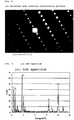
- FIGS. 5 to 7 there are shown the high-resolution TEM bright field micrographic image of the particles obtained in Examples 5 ( FIG. 5 ), the selected area electron diffraction pattern of the particles ( FIG. 6 ), and the local elemental analysis EDS spectrum of the particles ( FIG. 7 ).
- FIG. 8 shows the results of Rietveld analysis of an X-ray diffraction pattern of the particles obtained in Example 7.
- the dotted line in FIG. 8 represents a diffraction pattern of the actually measured value
- the curved line therein represents a diffraction pattern of the calculated value.
- the laterally extending linear waveform shown in a lowermost portion of FIG. 8 represents a difference between the actually measured value and the calculated value of the diffraction patterns. As the curve showing the difference between the actually measured value and the calculated value becomes closer to a straight line, these values are more consistent with each other.
- the bar-like plots between the diffraction patterns and the linear waveform represent peak positions of Li 3 PO 4 on an upper side row thereof, and peak positions of LiFePO 4 on a lower side row thereof.
- the other diffraction peaks were not observed.
- the samples of the particles obtained in Examples 1 to 8 all were subjected to the same analysis as described above. As a result, it was confirmed that no impurity crystal phases other than Li 3 PO 4 were observed, and no segregation of crystalline compounds owing to the additive elements were detected.
- the obtained particles were fine particles having an olivine type structure, and the compositional ratios between Li, Fe and P as well as the compositional ratios between all of the additive elements except for the additive element C, and Fe were consistent with those of the first step within a measuring error range of 3%.
- the first step and the second step were carried out under the conditions shown in Table 2 in the same manner as defined in Example 1, and the resulting particles were subjected to calcination, pulverization, mixing, addition of carbon source and re-sintering. Although the lithium phosphate having a fine particle diameter was obtained, the density of a molded product obtained therefrom was low.
- the first step was carried out in the same manner as defined in Example 4, but without via the second step, the resulting particles were mixed with a given amount of the carbon-containing additive using an attritor (step A) and then subjected to heat treatment in the third step.
- step A the obtained particles had an olivine type structure, the particles comprised a large amount of Fe 3+ as an impurity, were not fine particles, and had a high electric resistivity.
- the first step was carried out in the same manner as defined in Example 1, and the resulting particles were mixed with a given amount of the carbon-containing additive using an attritor (step A) and then subjected to the second and third steps to conduct the pulverization, mixing and then re-sintering thereof (procedure A). Since the compositional ratios between Li, Fe and P in the first step were out of the range defined by the present invention, the obtained particles had a small specific surface area, a small residual carbon content, a large amount of impurity crystal phase of Li 3 PO 4 , and a large crystallite size.
- the first step was carried out in the same manner as defined in Example 1, and the resulting particles were mixed with a given amount of the carbon-containing additive using an attritor and then subjected, without via the second step, to the third steps to obtain lithium iron phosphate particles.
- the resulting particles had a high residual sulfur content and were coarse particles.
- Example 1 Density of positive electrode (g/cc) Discharge capacity at 25° C (mAh/g) 0.1C 1C 5C
- Example 1 1.8 155 131 91
- Example 2 1.9 155 125 90
- Example 3 2.0 150 121 80
- Example 4 1.8 158 120 81
- Example 5 2.3 151 121 88
- Example 6 1.8 152 122 98
- Example 7 1.9 168 152 123
- Example 8 1.8 153 130 1-01 Comp.
- Example 1 1.7 152 132 41 Comp.
- Example 2 2.3 87 40.8 2 Comp.
- Example 3 2.1 117 85 0 Comp.
- Example 4 1.9 136.3 113.7 88
- the lithium iron phosphate particles having an olivine type structure according to the present invention can satisfy a high positive electrode density and high secondary battery characteristics.
- the positive electrode active material particles having a low compression molded product density as obtained in Comparative Example 1 also had a low positive electrode density. It is considered that the low discharge capacity as measured under 5C was caused owing to no effective influence attained by addition of the additives. Almost all of the particles obtained in Comparative Examples 2 to 4 which had a large crystallite size exhibited a low discharge capacity. In Comparative Example 4, the capacity deterioration rate of the particles obtained therein was also high. It is considered that the high capacity deterioration rate was caused by insufficient surface modification of the additives and insufficient uniformity of the solid solution formed.
- the cell using the particles obtained in Example 1 had a capacity deterioration rate (%) of 3% as measured under 0.1 C and a capacity deterioration rate (%) of 1% as measured under 1 C.
- the cell using the particles obtained in Comparative Example 4 had a capacity deterioration rate (%) of 12% as measured under 0.1 C and a capacity deterioration rate (%) of 6% as measured under 1 C. Therefore, it was confirmed that the secondary battery according to the present invention had an excellent capacity retention rate.
- the film thickness of the positive electrode used herein means the value obtained by subtracting the thickness of the Al foil current collector included in the positive electrode sheet from the whole thickness of the positive electrode sheet, and the film thickness was controlled by adjusting an amount of the solvent added upon formation of the coating solution and a depth of the grooved gap of the doctor blade.
- the carbon added there was used a mixture prepared by mixing acetylene black and graphite "KS-6" at a weight ratio of 1:1. As the amounts of PVDF and carbon added were increased, the density of the positive electrode was lowered. However, all of these electrode compositions exhibited high secondary battery characteristics.
- the discharge characteristic of the sheet No. 2 shown in Table 4 is shown in FIG. 9 .
- the discharge characteristic was measured by sequentially subjecting the sheet to discharging under the current condition in the order of C/20, C/10, ...., and 10C, and finally to the second discharging under C/20. As a result, it was confirmed that the obtained discharge curve was relatively excellent, and the other sheets also had a similar discharge curve to that of the sheet No. 2.
- Ascorbic acid was added to the same slurry of the Li, P and Fe raw materials as used in Example 6 (the concentration of solid components therein was adjusted to 35% by weight) such that the amount of ascorbic acid added was 5% by weight based on the weight of LiFePO 4 produced, and the resulting mixture was reacted at 40°C for 3 hr to obtain a slurry having a pH of 5.
- the resulting slurry was dried at 70°C, and then the dried product was subjected to the second and third steps in the same manner as defined in Example 6.
- Ascorbic acid and sucrose were added to the same slurry of the Li, P and Fe raw materials as used in Example 6 (the concentration of solid components therein was adjusted to 50% by weight) such that the amount of each of ascorbic acid and sucrose added was 5% by weight on the weight of LiFePO 4 produced, and the resulting mixture was reacted at room temperature (25°C) for one day to obtain a paste comprising Li, P and Fe.
- the resulting paste was dried at 70°C and then subjected to the second and third steps in the same manner as defined in Example 6.
- the process for producing the lithium iron phosphate particles having an olivine type structure according to the present invention is a production process having low production costs and a less environmental burden.
- the lithium iron phosphate particles having an olivine type structure according to the present invention are capable of producing a positive electrode sheet having a high packing property, and the secondary battery obtained by using the positive electrode sheet exhibits a high capacity even in current load characteristics, and can be used in repeated charge and discharge cycles to a sufficient extent.
- the lithium iron phosphate particles having an olivine type structure according to the present invention which are produced at low costs by the method having a less environmental burden, as a positive electrode active material for secondary batteries, it is possible to obtain a non-aqueous solvent-based secondary battery which can exhibit a high energy density per unit volume and a high capacity even in high current load characteristics, and can be used in repeated charge and discharge cycles to a sufficient extent.
Landscapes
- Chemical & Material Sciences (AREA)
- Inorganic Chemistry (AREA)
- Organic Chemistry (AREA)
- Crystallography & Structural Chemistry (AREA)
- Chemical Kinetics & Catalysis (AREA)
- Electrochemistry (AREA)
- General Chemical & Material Sciences (AREA)
- Battery Electrode And Active Subsutance (AREA)
Claims (11)
- Procédé de production de particules de phosphate de lithium-fer ayant une structure de type olivine, comprenant :une première étape de mélange d'un oxyde de fer ou d'un oxyde-hydroxyde de fer en tant que matière première fer qui comprend au moins un élément choisi dans le groupe constitué par Na, Mg, Al, Si, Cr, Mn et Ni en une quantité de 0,1 à 2 % en moles pour chaque élément par rapport à Fe, et un élément carbone C en une quantité de 5 à 10 % en moles par rapport à Fe, et a une teneur en Fe2+ inférieure ou égale à 40 % en moles par rapport une quantité de Fe, la matière première fer ayant un diamètre de particule primaire moyen de 5 à 300 nm, avec une matière première lithium et une matière première phosphore ;une deuxième étape de régulation d'un diamètre de particule des particules agrégées dans le mélange résultant à 0,3 à 5,0 µm ; etune troisième étape de frittage du mélange obtenu lors de la deuxième étape dans une atmosphère de gaz inerte ou de gaz réducteur ayant une concentration en oxygène inférieure ou égale à 0,1 % à une température de 250 à 750 °C.
- Procédé de production de particules de phosphate de lithium-fer ayant une structure de type olivine selon la revendication 1, dans lequel la matière première fer comprend au moins un élément choisi dans le groupe constitué par Na, Mg, Al, Si, Cr, Mn et Ni en une quantité de 0,1 à 2 % en moles pour chaque élément par rapport à Fe, à condition qu'une quantité totale des sept éléments soit de 1,5 à 4 % en moles par rapport à Fe, et un élément carbone C en une quantité de 5 à 10 % en moles par rapport à Fe, et comprend au moins un composé choisi dans le groupe constitué par Fe3O4, α-FeOOH, γ-FeOOH et δ-FeOOH qui a un diamètre de particule primaire moyen de 5 à 300 nm.
- Procédé de production de particules de phosphate de lithium-fer ayant une structure de type olivine selon la revendication 2, dans lequel la matière première fer comprend au moins un élément choisi dans le groupe constitué par Na, Mg, Al, Si, Cr, Mn et Ni en une quantité de 0,1 à 2 % en moles pour chaque élément par rapport à Fe, à condition qu'une quantité totale des sept éléments soit de 1,5 à 4 % en moles, par rapport à Fe, et un élément carbone C en une quantité de 5 à 10 % en moles par rapport à Fe, et la matière première fer est sous la forme d'une matière première fer aciculaire ayant un diamètre de particule primaire moyen de 5 à 300 nm et un rapport de longueur entre un diamètre d'axe majeur et un diamètre d'axe mineur supérieur ou égal à 2.
- Procédé de production de particules de phosphate de lithium-fer ayant une structure de type olivine selon l'une quelconque des revendications 1 à 3, dans lequel l'élément additif C dans la matière première fer est présent sous la forme d'une substance organique capable de réduire Fe3+ en Fe2+ dans une atmosphère de gaz inerte ayant une concentration en oxygène inférieure ou égale à 0,1 %.
- Procédé de production de particules de phosphate de lithium-fer ayant une structure de type olivine selon l'une quelconque des revendications 1 à 4, comprenant en outre une étape A de mélange d'au moins un matériau choisi dans le groupe constitué par un carbone conducteur, une substance organique ayant une capacité de réduction de Fe3+ en Fe2+ et un liant organique, qui sert d'assistant de conduction électronique pour les particules de phosphate de lithium-fer produites, un agent réducteur pour la réduction de Fe3+ dans la matière première fer en Fe2+, et un agent de régulation pour ajuster un diamètre des agglomérats d'un précurseur des particules à 0,3 à 30 µm, respectivement, l'étape A étant réalisée soit pendant la deuxième étape ou immédiatement avant l'initiation de la troisième étape.
- Procédé de production de particules de phosphate de lithium-ion ayant une structure de type olivine selon l'une quelconque des revendications 1 à 5, dans lequel, après la complétion de la troisième étape, le produit de réaction résultant comprenant du lithium, du fer et du phosphore en tant que composants principaux est soumis à une nouvelle pulvérisation, puis à un nouveau mélange de précision, et le mélange résultant obtenu par le nouveau mélange de précision est de nouveau mélangé avec ledit au moins un matériau choisi dans le groupe constitué par le carbone conducteur, la substance organique ayant une capacité de réduction de Fe3+ en Fe2+, et le liant organique, puis de nouveau fritté dans une atmosphère de gaz inerte ou de gaz réducteur ayant une concentration en oxygène inférieure ou égale à 0,1 % à une température de 250 à 750 °C.
- Procédé de production de particules de phosphate de lithium-fer ayant une structure de type olivine selon l'une quelconque des revendications 1 à 6, dans lequel, dans la première étape de mélange des matières premières respectives, une suspension des matières premières est régulée de telle sorte qu'une concentration de composants solides des matières premières dans celle-ci soit supérieure ou égale à 30 % en poids ; de l'acide ascorbique ou du sucrose est ajouté à la suspension en une quantité de 1 à 25 % en poids par rapport à LiFePO4 tel que produit; et la suspension résultante est mélangée à une température inférieure ou égale à 50 °C pour ajuster une valeur de pH de la suspension de 4 à 8.
- Particules de phosphate de lithium-fer ayant une structure de type olivine, comprenant du lithium et du phosphore en une quantité telle qu'un rapport molaire respectivement entre le lithium et le phosphore et le fer est de 0,95 à 1,05 ; et ayant une teneur en Fe3+ inférieure à 5 % en moles par rapport à une quantité de Fe, une aire de surface spécifique BET de 6 à 30 m2/g, une teneur en carbone résiduelle de 0,5 à 8 % en poids, une teneur en soufre résiduelle inférieure ou égale à 0,08 % en poids, une teneur en Li3PO4 en tant que phase cristalline (phase d'impuretés) autre que la structure de type olivine inférieure ou égale à 5 % en poids, une taille de cristallites de 25 à 300 nm, un diamètre d'agglomérats de 0,3 à 20 µm, une densité de 2,0 à 2,8 g/cc lorsqu'elles sont mises sous la forme d'un produit moulé par compression, et une résistance électrique en poudre de 1 à 1,0 x 10⁵ Ωocm, lesdites particules pouvant être obtenues par un procédé tel que défini dans l'une quelconque des revendications 1 à 7.
- Feuille de matériau d'électrode positive pour batteries secondaires ayant une densité supérieure ou égale à 1,8 g/cc, qui comprend un matériau composite comprenant les particules de phosphate de lithium-fer ayant une structure de type olivine telles que définies dans la revendication 8, 0,1 à 10 % en poids de carbone en tant qu'assistant conducteur, et 1 à 10 % en poids d'un liant.
- Batterie secondaire produite en utilisant la feuille de matériau d'électrode positive pour batteries secondaires telle que définie dans la revendication 9.
- Utilisation des particules de phosphate de lithium-fer selon la revendication 8 en tant que matériau actif d'électrode positive pour une batterie secondaire à base d'un solvant non aqueux.
Applications Claiming Priority (2)
| Application Number | Priority Date | Filing Date | Title |
|---|---|---|---|
| JP2008094056 | 2008-03-31 | ||
| PCT/JP2009/001374 WO2009122686A1 (fr) | 2008-03-31 | 2009-03-26 | Procédé de préparation d’une poudre de phosphate de lithium-fer, poudre de phosphate de lithium-fer à structure olivine, feuille de cathode utilisant ladite poudre de phosphate de lithium-fer et batterie secondaire à solvant non aqueux |
Publications (3)
| Publication Number | Publication Date |
|---|---|
| EP2277828A1 EP2277828A1 (fr) | 2011-01-26 |
| EP2277828A4 EP2277828A4 (fr) | 2014-12-31 |
| EP2277828B1 true EP2277828B1 (fr) | 2018-08-08 |
Family
ID=41135094
Family Applications (1)
| Application Number | Title | Priority Date | Filing Date |
|---|---|---|---|
| EP09727078.9A Active EP2277828B1 (fr) | 2008-03-31 | 2009-03-26 | Procédé de préparation d une poudre de phosphate de lithium-fer, poudre de phosphate de lithium-fer à structure olivine, feuille de cathode utilisant ladite poudre de phosphate de lithium-fer et batterie secondaire à solvant non aqueux |
Country Status (6)
| Country | Link |
|---|---|
| US (1) | US20110091772A1 (fr) |
| EP (1) | EP2277828B1 (fr) |
| JP (1) | JP5464322B2 (fr) |
| KR (1) | KR101587671B1 (fr) |
| CN (2) | CN105355920A (fr) |
| WO (1) | WO2009122686A1 (fr) |
Families Citing this family (71)
| Publication number | Priority date | Publication date | Assignee | Title |
|---|---|---|---|---|
| TW201010944A (en) * | 2008-04-17 | 2010-03-16 | Basf Se | Process for the preparation of crystalline lithium-, iron-and phosphate-comprising materials |
| TW200951066A (en) * | 2008-04-17 | 2009-12-16 | Basf Se | Process for the preparation of crystalline lithium-, iron-and phosphate-comprising materials |
| RU2454755C1 (ru) * | 2008-10-22 | 2012-06-27 | ЭлДжи КЕМ, ЛТД. | Катодная смесь с улучшенной эффективностью и удельной энергией электрода |
| CN102187502B (zh) * | 2008-10-22 | 2014-07-09 | 株式会社Lg化学 | 具有改善的电极效率和能量密度的正极活性材料 |
| CN102186769A (zh) * | 2008-10-22 | 2011-09-14 | 株式会社Lg化学 | 具有橄榄石结构的锂铁磷酸盐及其分析方法 |
| US9484574B2 (en) * | 2009-11-10 | 2016-11-01 | Silvia Bodoardo | Hydrothermal process for the production of LiFePO4 powder |
| CN102668198B (zh) * | 2009-11-18 | 2016-09-07 | 三井化学株式会社 | 电化学电池用水性糊剂、涂布该水性糊剂而形成的电化学电池用极板、及包括该极板的电池 |
| KR101186686B1 (ko) | 2009-12-29 | 2012-09-27 | 주식회사 에너세라믹 | 리튬 이차 전지용 양극 활물질의 제조 방법 |
| JP5502518B2 (ja) * | 2010-02-15 | 2014-05-28 | 旭化成イーマテリアルズ株式会社 | リチウムイオン二次電池 |
| KR101810259B1 (ko) * | 2010-03-19 | 2017-12-18 | 도다 고교 가부시끼가이샤 | 인산망간철리튬 입자 분말의 제조 방법, 인산망간철리튬 입자 분말, 및 상기 입자 분말을 이용한 비수전해질 이차 전지 |
| WO2011114918A1 (fr) * | 2010-03-19 | 2011-09-22 | Semiconductor Energy Laboratory Co., Ltd. | Dispositif de stockage d'énergie et procédé de fabrication associé |
| JP5765798B2 (ja) * | 2010-03-28 | 2015-08-19 | 国立大学法人 新潟大学 | Liイオン電池用正極活物質およびその製造方法 |
| CN102844916B (zh) * | 2010-04-21 | 2018-12-04 | 株式会社Lg 化学 | 橄榄石晶体结构的锂铁磷酸盐和使用所述锂铁磷酸盐的锂二次电池 |
| JP6030545B2 (ja) * | 2010-04-21 | 2016-11-24 | エルジー・ケム・リミテッド | スルフィド結合を有する硫黄化合物を含むリン酸鉄リチウム、およびそれを使用するリチウム二次電池 |
| KR101240176B1 (ko) * | 2010-04-21 | 2013-03-07 | 주식회사 엘지화학 | 탄소가 코팅된 올리빈 결정구조의 리튬 철인산화물 및 이를 이용한 리튬 이차전지 |
| CN102893432B (zh) * | 2010-04-21 | 2016-01-13 | 株式会社Lg化学 | 碳包覆的具有橄榄石晶体结构的锂铁磷酸盐和使用所述锂铁磷酸盐的锂二次电池 |
| US9318741B2 (en) * | 2010-04-28 | 2016-04-19 | Semiconductor Energy Laboratory Co., Ltd. | Positive electrode active material of power storage device, power storage device, electrically propelled vehicle, and method for manufacturing power storage device |
| DE102010021804A1 (de) | 2010-05-27 | 2011-12-01 | Süd-Chemie AG | Verbundmaterial enthaltend ein gemischtes Lithium-Metallphosphat |
| JP5784292B2 (ja) * | 2010-09-13 | 2015-09-24 | 三井金属鉱業株式会社 | マグネタイト粒子 |
| US8980126B2 (en) | 2010-10-08 | 2015-03-17 | Semiconductor Energy Laboratory Co., Ltd. | Electrode material and method for manufacturing power storage device |
| WO2012124990A2 (fr) * | 2011-03-16 | 2012-09-20 | 한화케미칼 주식회사 | Procédé pour calciner des matériaux d'électrode à l'aide d'un four rotatif |
| US8945498B2 (en) * | 2011-03-18 | 2015-02-03 | Semiconductor Energy Laboratory Co., Ltd. | Method for manufacturing lithium-containing composite oxide |
| JP2012204322A (ja) * | 2011-03-28 | 2012-10-22 | Gs Yuasa Corp | 非水電解質二次電池用活物質の製造方法 |
| JP2012229147A (ja) * | 2011-04-27 | 2012-11-22 | Nichia Corp | オリビン型リチウム遷移金属酸化物及びその製造方法 |
| JP5772197B2 (ja) | 2011-05-09 | 2015-09-02 | ソニー株式会社 | リチウムイオン二次電池用活物質、リチウムイオン二次電池用電極、リチウムイオン二次電池、電子機器、電動工具、電動車両および電力貯蔵システム |
| US11476462B2 (en) | 2011-06-22 | 2022-10-18 | National Tsing Hua University | LiFePO4 precursor for manufacturing electrode material of Li-ion battery and method for manufacturing the same |
| JP2013032257A (ja) * | 2011-06-28 | 2013-02-14 | Nichia Corp | オリビン型リチウム遷移金属酸化物及びその製造方法 |
| CN103066293B (zh) * | 2011-10-20 | 2016-11-09 | 何金祥 | 锂离子电池正极材料的制备方法 |
| JP5835612B2 (ja) * | 2011-12-06 | 2015-12-24 | トヨタ自動車株式会社 | 非水系二次電池 |
| US9112222B2 (en) | 2012-07-13 | 2015-08-18 | Sony Corporation | Lithium ion secondary battery active material, lithium ion secondary battery electrode, lithium ion secondary battery, electronic device, electronic power tool, electric vehicle, and power storage system |
| CN102867953B (zh) * | 2012-07-24 | 2015-01-21 | 龙能科技(苏州)有限公司 | 用氢氧化物或羟基氧化物生产锂离子电池正极材料的方法 |
| JP6207923B2 (ja) | 2012-08-27 | 2017-10-04 | 株式会社半導体エネルギー研究所 | 二次電池用正極の製造方法 |
| KR101733743B1 (ko) | 2012-10-05 | 2017-05-08 | 삼성에스디아이 주식회사 | 리튬 이차 전지용 양극 활물질의 제조 방법, 상기 제조 방법에 따라 제조된 리튬 이차 전지용 양극 활물질, 및 이를 포함하는 리튬 이차 전지 |
| JP6032410B2 (ja) * | 2012-10-30 | 2016-11-30 | 燐化学工業株式会社 | リン酸第二鉄含水和物粒子粉末の製造方法 |
| WO2014069207A1 (fr) * | 2012-10-31 | 2014-05-08 | シャープ株式会社 | Substance active pour électrode positive, électrode positive et élément rechargeable à électrolyte non aqueux |
| JP5928302B2 (ja) * | 2012-11-02 | 2016-06-01 | 日立金属株式会社 | リチウム二次電池用正極活物質の製造方法 |
| KR101586556B1 (ko) | 2013-01-10 | 2016-01-20 | 주식회사 엘지화학 | 탄소 코팅 리튬 인산철 나노분말 제조방법 |
| KR101561377B1 (ko) | 2013-01-10 | 2015-10-20 | 주식회사 엘지화학 | 리튬 인산철 나노분말 제조방법 |
| KR101561373B1 (ko) | 2013-01-10 | 2015-10-19 | 주식회사 엘지화학 | 리튬 인산철 나노분말 제조방법 |
| JP6028630B2 (ja) | 2013-03-12 | 2016-11-16 | ソニー株式会社 | 二次電池用活物質、二次電池用電極、二次電池、電池パック、電動車両、電力貯蔵システム、電動工具および電子機器 |
| WO2014174952A1 (fr) | 2013-04-24 | 2014-10-30 | 住友大阪セメント株式会社 | Matière d'électrode, électrode et batterie au lithium-ion |
| JP2014216240A (ja) * | 2013-04-26 | 2014-11-17 | 住友大阪セメント株式会社 | 電極活物質と電極材料及び電極、リチウムイオン電池並びに電極材料の製造方法 |
| US9431651B2 (en) | 2013-08-30 | 2016-08-30 | Hong Kong Applied Science and Technology Research Institute Company Limited | Composite material for a lithium ion battery anode and a method of producing the same |
| CN105556712A (zh) * | 2013-09-20 | 2016-05-04 | 巴斯夫欧洲公司 | 用于锂离子电池组的电极材料 |
| JP5769140B2 (ja) * | 2014-01-30 | 2015-08-26 | 住友金属鉱山株式会社 | リチウム二次電池用正極活物質の製造方法 |
| JP5835446B1 (ja) * | 2014-10-28 | 2015-12-24 | 住友大阪セメント株式会社 | 正極材料、正極材料の製造方法、正極およびリチウムイオン電池 |
| DE102015214577A1 (de) * | 2015-07-31 | 2017-02-02 | Robert Bosch Gmbh | Verfahren zur Herstellung einer Elektrode eines Lithiumionenakkumulators |
| EP3184170B1 (fr) * | 2015-12-25 | 2020-04-01 | Kabushiki Kaisha Toyota Chuo Kenkyusho | Particules d'oxyhydroxyde de fer, procédé de production et catalyseur d'oxydation utilisant ces particules |
| CN105680020A (zh) * | 2016-03-17 | 2016-06-15 | 贵州安达科技能源股份有限公司 | 一种制备磷酸铁锂和正极材料的方法 |
| CN107565132B (zh) * | 2017-08-24 | 2018-06-19 | 高延敏 | 磷酸铁的制备方法及其制备的磷酸铁、磷酸铁锂的制备方法及其制备的磷酸铁锂以及锂电池 |
| JP6497462B1 (ja) * | 2018-03-30 | 2019-04-10 | 住友大阪セメント株式会社 | リチウムイオン電池用電極材料及びリチウムイオン電池 |
| GB201905177D0 (en) * | 2019-04-11 | 2019-05-29 | Johnson Matthey Plc | Lithium metal phosphate, its preparation and use |
| CN111081319B (zh) * | 2019-11-01 | 2023-07-25 | 力神(青岛)新能源有限公司 | 一种正极材料碳含量的建模方法 |
| CN111072003A (zh) * | 2019-12-20 | 2020-04-28 | 合肥师范学院 | 一种刺球状磷酸盐电极材料及其制备方法和锂离子电池 |
| CN113023703A (zh) * | 2021-03-24 | 2021-06-25 | 郑州中科新兴产业技术研究院 | 一种回收废旧磷酸铁锂粉的方法 |
| CN113120876B (zh) * | 2021-03-30 | 2022-06-10 | 中国石油大学(北京) | 一种磷酸铁锂废极片再生回收制备磷酸铁锂材料的方法 |
| CN114261952B (zh) * | 2021-12-21 | 2024-03-29 | 蜂巢能源科技股份有限公司 | 一种磷酸铁锂正极材料、其制备方法及用途 |
| CN114497479B (zh) * | 2021-12-30 | 2023-10-31 | 乳源东阳光新能源材料有限公司 | 一种高压实高性能磷酸铁锂正极材料及其制备方法 |
| JP2024537089A (ja) | 2022-04-01 | 2024-10-10 | アスペン エアロゲルズ,インコーポレイティド | リン酸遷移金属リチウムカソード材料を調製するためのプロセス |
| CN114988386B (zh) * | 2022-06-16 | 2024-02-02 | 蜂巢能源科技股份有限公司 | 一种磷酸锰铁锂正极材料及其制备方法和应用 |
| CN115465849B (zh) * | 2022-09-26 | 2024-05-10 | 佛山市德方纳米科技有限公司 | 一种磷酸盐系正极材料及其制备方法与应用 |
| CN116374982A (zh) * | 2023-02-22 | 2023-07-04 | 深圳市依卓尔能源有限公司 | 一种橄榄石型磷酸锰铁锂及其制备方法与应用 |
| JP2025541404A (ja) * | 2023-03-29 | 2025-12-18 | リサーチ インスティチュート オブ インダストリアル サイエンス アンド テクノロジー | リチウム二次電池用オリビン系正極活物質およびその製造方法 |
| JP7812000B2 (ja) * | 2023-06-25 | 2026-02-06 | 鞍鋼集団北京研究院有限公司 | リン酸鉄ナトリウム材料の製造方法およびリン酸鉄ナトリウム材料 |
| CN117446775A (zh) * | 2023-10-25 | 2024-01-26 | 深圳珈钠能源科技有限公司 | 一种氮循环工艺制备聚阴离子型正极材料的方法 |
| CN118062819B (zh) * | 2023-12-28 | 2026-01-02 | 北京当升材料科技股份有限公司 | 磷酸铁锂材料及其制备方法和锂离子电池 |
| CN118043283A (zh) * | 2024-01-05 | 2024-05-14 | 广东邦普循环科技有限公司 | 一种复合磷酸铁锂正极材料及其制备方法和应用 |
| CN118712378B (zh) * | 2024-05-30 | 2025-06-17 | 北京当升材料科技股份有限公司 | 磷酸锰铁锂正极材料及其制备方法、电池和用电设备 |
| KR20260044141A (ko) * | 2024-09-25 | 2026-04-01 | 주식회사 엘지화학 | 양극 활물질, 이를 포함하는 양극 및 리튬 이차전지 |
| CN119191252B (zh) * | 2024-09-25 | 2025-12-09 | 南通瑞翔新材料有限公司 | 磷酸铁锂正极材料及其制备方法、电化学装置 |
| CN120736500A (zh) * | 2025-08-25 | 2025-10-03 | 安徽得壹能源科技有限公司 | 一种磷酸铁锂正极材料、其制备方法及电池 |
Family Cites Families (25)
| Publication number | Priority date | Publication date | Assignee | Title |
|---|---|---|---|---|
| US6350539B1 (en) * | 1999-10-25 | 2002-02-26 | General Motors Corporation | Composite gas distribution structure for fuel cell |
| US6528033B1 (en) | 2000-01-18 | 2003-03-04 | Valence Technology, Inc. | Method of making lithium-containing materials |
| CA2320661A1 (fr) * | 2000-09-26 | 2002-03-26 | Hydro-Quebec | Nouveau procede de synthese de materiaux limpo4 a structure olivine |
| US7510803B2 (en) * | 2001-08-24 | 2009-03-31 | Sony Corporation | Battery |
| KR101209358B1 (ko) | 2001-12-21 | 2012-12-07 | 메사추세츠 인스티튜트 오브 테크놀로지 | 전도성 리튬 저장 전극 |
| US6960402B2 (en) * | 2002-06-28 | 2005-11-01 | Advanced Energy Technology Inc. | Perforated cylindrical fuel cells |
| JP4058680B2 (ja) * | 2002-08-13 | 2008-03-12 | ソニー株式会社 | 正極活物質の製造方法及び非水電解質二次電池の製造方法 |
| US7390472B1 (en) * | 2002-10-29 | 2008-06-24 | Nei Corp. | Method of making nanostructured lithium iron phosphate—based powders with an olivine type structure |
| JP2007230784A (ja) * | 2004-03-30 | 2007-09-13 | Agc Seimi Chemical Co Ltd | リチウム鉄複合酸化物の製造方法 |
| JP4794833B2 (ja) | 2004-07-21 | 2011-10-19 | 日本コークス工業株式会社 | リチウムイオン二次電池用正極材料、その製造方法、及びリチウムイオン二次電池 |
| CN1305147C (zh) * | 2004-12-30 | 2007-03-14 | 清华大学 | 锂离子电池正极材料高密度球形磷酸铁锂的制备方法 |
| JP4804045B2 (ja) | 2005-06-15 | 2011-10-26 | Agcセイミケミカル株式会社 | リチウム鉄複合酸化物の製造方法 |
| CA2613926C (fr) * | 2005-06-29 | 2013-10-29 | Umicore | Lifepo4 nanometrique cristallin |
| JP4829557B2 (ja) * | 2005-07-21 | 2011-12-07 | Agcセイミケミカル株式会社 | リチウム鉄複合酸化物の製造方法 |
| US8323832B2 (en) * | 2005-08-08 | 2012-12-04 | A123 Systems, Inc. | Nanoscale ion storage materials |
| CN100385713C (zh) * | 2005-11-30 | 2008-04-30 | 重庆大学 | 一种制备磷酸亚铁锂的方法 |
| TWI346406B (en) * | 2006-02-16 | 2011-08-01 | Lg Chemical Ltd | Lithium secondary battery with enhanced heat-resistance |
| CN101473469A (zh) * | 2006-06-16 | 2009-07-01 | 夏普株式会社 | 正极、其制备方法以及使用该正极的锂二次电池 |
| TWI319920B (en) * | 2006-07-06 | 2010-01-21 | The preparation and application of the lifepo4/li3v2(po4)3 composite cathode materials for lithium ion batteries | |
| JP5479096B2 (ja) * | 2006-08-21 | 2014-04-23 | エルジー・ケム・リミテッド | リチウム金属リン酸化物の製造方法 |
| KR100821832B1 (ko) * | 2007-04-20 | 2008-04-14 | 정성윤 | 리튬전이금속 인산화물의 나노입자 분말의 제조방법 |
| US20090155689A1 (en) * | 2007-12-14 | 2009-06-18 | Karim Zaghib | Lithium iron phosphate cathode materials with enhanced energy density and power performance |
| TWI466370B (zh) * | 2008-01-17 | 2014-12-21 | A123 Systems Inc | 鋰離子電池的混合式金屬橄欖石電極材料 |
| US8088305B2 (en) * | 2008-02-22 | 2012-01-03 | Byd Company Limited | Lithium iron phosphate cathode material |
| KR100939647B1 (ko) * | 2009-01-22 | 2010-02-03 | 한화석유화학 주식회사 | 전극 활물질인 음이온 부족형 비화학양론 리튬 전이금속 다중산 화합물, 그 제조 방법 및 그를 이용한 전기화학 소자 |
-
2009
- 2009-03-26 EP EP09727078.9A patent/EP2277828B1/fr active Active
- 2009-03-26 US US12/935,456 patent/US20110091772A1/en not_active Abandoned
- 2009-03-26 KR KR1020107021513A patent/KR101587671B1/ko active Active
- 2009-03-26 CN CN201510896278.6A patent/CN105355920A/zh active Pending
- 2009-03-26 WO PCT/JP2009/001374 patent/WO2009122686A1/fr not_active Ceased
- 2009-03-26 CN CN2009801111827A patent/CN101980956A/zh active Pending
- 2009-03-31 JP JP2009087967A patent/JP5464322B2/ja active Active
Non-Patent Citations (1)
| Title |
|---|
| None * |
Also Published As
| Publication number | Publication date |
|---|---|
| KR20110007112A (ko) | 2011-01-21 |
| US20110091772A1 (en) | 2011-04-21 |
| EP2277828A4 (fr) | 2014-12-31 |
| CN105355920A (zh) | 2016-02-24 |
| CN101980956A (zh) | 2011-02-23 |
| KR101587671B1 (ko) | 2016-01-21 |
| JP5464322B2 (ja) | 2014-04-09 |
| JP2009263222A (ja) | 2009-11-12 |
| EP2277828A1 (fr) | 2011-01-26 |
| WO2009122686A1 (fr) | 2009-10-08 |
Similar Documents
| Publication | Publication Date | Title |
|---|---|---|
| EP2277828B1 (fr) | Procédé de préparation d une poudre de phosphate de lithium-fer, poudre de phosphate de lithium-fer à structure olivine, feuille de cathode utilisant ladite poudre de phosphate de lithium-fer et batterie secondaire à solvant non aqueux | |
| US10910640B2 (en) | Cathode active material for lithium ion secondary battery, and process for its production | |
| US9847526B2 (en) | Lithium titanate particles and process for producing the lithium titanate particles, Mg-containing lithium titanate particles and process for producing the Mg-containing lithium titanate particles, negative electrode active substance particles for non-aqueous electrolyte secondary batteries, and non-aqueous electrolyte secondary battery | |
| EP2741354B1 (fr) | Matière active de cathode pour un accumulateur lithium-ion | |
| JP4211865B2 (ja) | 非水電解質二次電池用Li−Ni複合酸化物粒子粉末及びその製造方法、並びに非水電解質二次電池 | |
| EP3723171A1 (fr) | Matériau actif d'électrode négative pour batterie secondaire à électrolyte non aqueux et procédé de production correspondant | |
| EP1281673B1 (fr) | Materiau actif cathodique fait de particules d'oxyde de cobalt pour cellule secondaire à electrolyte non aqueux et son procédé de fabrication, et cellule secondaire à electrolyte non aqueux | |
| EP3208872A1 (fr) | Matière active d'électrode positive pour batterie secondaire au lithium, électrode positive pour batterie secondaire au lithium, et batterie secondaire au lithium | |
| KR102833364B1 (ko) | 리튬 이온 이차 전지용 정극 재료, 리튬 이온 이차 전지용 정극, 및 리튬 이온 이차 전지 | |
| EP2407426A1 (fr) | Procédé de production d'un composé borate de lithium | |
| EP2595221A1 (fr) | Cathode pour batterie secondaire au lithium et batterie secondaire au lithium utilisant cette dernière | |
| Reed et al. | Scalable, low-cost synthesis of high volumetric capacity LiMn 0.5 Fe 0.5 PO 4 cathode for lithium-ion batteries | |
| JPWO2014061654A1 (ja) | Li−Ni複合酸化物粒子粉末並びに非水電解質二次電池 | |
| Angelopoulou et al. | Combustion-synthesized LixMn2O4-based spinel nanorods as cathode materials for lithium-ion batteries | |
| Madram et al. | Effect of Na+ and K+ co-doping on the structure and electrochemical behaviors of LiFePO 4/C cathode material for lithium-ion batteries | |
| US9224512B2 (en) | Positive electrode active material for non-aqueous secondary battery and manufacturing method thereof, as well as non-aqueous secondary battery using positive electrode active material | |
| WO2024095977A1 (fr) | Matière active d'électrode positive pour batterie secondaire au lithium-ion, et batterie secondaire au lithium-ion | |
| US9039926B2 (en) | Production process for composite oxide, positive-electrode active material for lithium-ion secondary battery and lithium-ion secondary battery | |
| KR102558764B1 (ko) | 전극활물질의 제조방법, 전극활물질 및 이를 포함하는 리튬 이온 전지 | |
| JP7122612B2 (ja) | 非水電解質二次電池 | |
| Yamashita et al. | Hydrothermal synthesis and electrochemical properties of Li2FexMnxCo1− 2xSiO4/C cathode materials for lithium-ion batteries | |
| US20210098780A1 (en) | Positive electrode material for lithium ion secondary battery, positive electrode for lithium ion secondary battery, and lithium ion secondary battery | |
| Minakshi et al. | Influence of sol–gel derived lithium cobalt phosphate in alkaline rechargeable battery | |
| US20260024753A1 (en) | Segregating primary nanoparticles with surface coating-networking architecture for high voltage cathode life at high rate |
Legal Events
| Date | Code | Title | Description |
|---|---|---|---|
| PUAI | Public reference made under article 153(3) epc to a published international application that has entered the european phase |
Free format text: ORIGINAL CODE: 0009012 |
|
| 17P | Request for examination filed |
Effective date: 20100929 |
|
| AK | Designated contracting states |
Kind code of ref document: A1 Designated state(s): AT BE BG CH CY CZ DE DK EE ES FI FR GB GR HR HU IE IS IT LI LT LU LV MC MK MT NL NO PL PT RO SE SI SK TR |
|
| AX | Request for extension of the european patent |
Extension state: AL BA RS |
|
| DAX | Request for extension of the european patent (deleted) | ||
| A4 | Supplementary search report drawn up and despatched |
Effective date: 20141203 |
|
| RIC1 | Information provided on ipc code assigned before grant |
Ipc: C01B 25/45 20060101AFI20141127BHEP Ipc: H01M 4/02 20060101ALI20141127BHEP Ipc: H01M 4/58 20100101ALI20141127BHEP |
|
| GRAP | Despatch of communication of intention to grant a patent |
Free format text: ORIGINAL CODE: EPIDOSNIGR1 |
|
| STAA | Information on the status of an ep patent application or granted ep patent |
Free format text: STATUS: GRANT OF PATENT IS INTENDED |
|
| INTG | Intention to grant announced |
Effective date: 20180122 |
|
| GRAS | Grant fee paid |
Free format text: ORIGINAL CODE: EPIDOSNIGR3 |
|
| RAP1 | Party data changed (applicant data changed or rights of an application transferred) |
Owner name: TODA KOGYO CORP. |
|
| GRAA | (expected) grant |
Free format text: ORIGINAL CODE: 0009210 |
|
| STAA | Information on the status of an ep patent application or granted ep patent |
Free format text: STATUS: THE PATENT HAS BEEN GRANTED |
|
| AK | Designated contracting states |
Kind code of ref document: B1 Designated state(s): AT BE BG CH CY CZ DE DK EE ES FI FR GB GR HR HU IE IS IT LI LT LU LV MC MK MT NL NO PL PT RO SE SI SK TR |
|
| REG | Reference to a national code |
Ref country code: GB Ref legal event code: FG4D |
|
| REG | Reference to a national code |
Ref country code: CH Ref legal event code: EP Ref country code: AT Ref legal event code: REF Ref document number: 1026742 Country of ref document: AT Kind code of ref document: T Effective date: 20180815 |
|
| REG | Reference to a national code |
Ref country code: IE Ref legal event code: FG4D |
|
| REG | Reference to a national code |
Ref country code: DE Ref legal event code: R096 Ref document number: 602009053706 Country of ref document: DE |
|
| REG | Reference to a national code |
Ref country code: NL Ref legal event code: MP Effective date: 20180808 |
|
| REG | Reference to a national code |
Ref country code: LT Ref legal event code: MG4D |
|
| REG | Reference to a national code |
Ref country code: AT Ref legal event code: MK05 Ref document number: 1026742 Country of ref document: AT Kind code of ref document: T Effective date: 20180808 |
|
| PG25 | Lapsed in a contracting state [announced via postgrant information from national office to epo] |
Ref country code: AT Free format text: LAPSE BECAUSE OF FAILURE TO SUBMIT A TRANSLATION OF THE DESCRIPTION OR TO PAY THE FEE WITHIN THE PRESCRIBED TIME-LIMIT Effective date: 20180808 Ref country code: NL Free format text: LAPSE BECAUSE OF FAILURE TO SUBMIT A TRANSLATION OF THE DESCRIPTION OR TO PAY THE FEE WITHIN THE PRESCRIBED TIME-LIMIT Effective date: 20180808 Ref country code: BG Free format text: LAPSE BECAUSE OF FAILURE TO SUBMIT A TRANSLATION OF THE DESCRIPTION OR TO PAY THE FEE WITHIN THE PRESCRIBED TIME-LIMIT Effective date: 20181108 Ref country code: SE Free format text: LAPSE BECAUSE OF FAILURE TO SUBMIT A TRANSLATION OF THE DESCRIPTION OR TO PAY THE FEE WITHIN THE PRESCRIBED TIME-LIMIT Effective date: 20180808 Ref country code: LT Free format text: LAPSE BECAUSE OF FAILURE TO SUBMIT A TRANSLATION OF THE DESCRIPTION OR TO PAY THE FEE WITHIN THE PRESCRIBED TIME-LIMIT Effective date: 20180808 Ref country code: GR Free format text: LAPSE BECAUSE OF FAILURE TO SUBMIT A TRANSLATION OF THE DESCRIPTION OR TO PAY THE FEE WITHIN THE PRESCRIBED TIME-LIMIT Effective date: 20181109 Ref country code: NO Free format text: LAPSE BECAUSE OF FAILURE TO SUBMIT A TRANSLATION OF THE DESCRIPTION OR TO PAY THE FEE WITHIN THE PRESCRIBED TIME-LIMIT Effective date: 20181108 Ref country code: IS Free format text: LAPSE BECAUSE OF FAILURE TO SUBMIT A TRANSLATION OF THE DESCRIPTION OR TO PAY THE FEE WITHIN THE PRESCRIBED TIME-LIMIT Effective date: 20181208 Ref country code: FI Free format text: LAPSE BECAUSE OF FAILURE TO SUBMIT A TRANSLATION OF THE DESCRIPTION OR TO PAY THE FEE WITHIN THE PRESCRIBED TIME-LIMIT Effective date: 20180808 Ref country code: PL Free format text: LAPSE BECAUSE OF FAILURE TO SUBMIT A TRANSLATION OF THE DESCRIPTION OR TO PAY THE FEE WITHIN THE PRESCRIBED TIME-LIMIT Effective date: 20180808 |
|
| PG25 | Lapsed in a contracting state [announced via postgrant information from national office to epo] |
Ref country code: LV Free format text: LAPSE BECAUSE OF FAILURE TO SUBMIT A TRANSLATION OF THE DESCRIPTION OR TO PAY THE FEE WITHIN THE PRESCRIBED TIME-LIMIT Effective date: 20180808 Ref country code: HR Free format text: LAPSE BECAUSE OF FAILURE TO SUBMIT A TRANSLATION OF THE DESCRIPTION OR TO PAY THE FEE WITHIN THE PRESCRIBED TIME-LIMIT Effective date: 20180808 Ref country code: ES Free format text: LAPSE BECAUSE OF FAILURE TO SUBMIT A TRANSLATION OF THE DESCRIPTION OR TO PAY THE FEE WITHIN THE PRESCRIBED TIME-LIMIT Effective date: 20180808 |
|
| PG25 | Lapsed in a contracting state [announced via postgrant information from national office to epo] |
Ref country code: RO Free format text: LAPSE BECAUSE OF FAILURE TO SUBMIT A TRANSLATION OF THE DESCRIPTION OR TO PAY THE FEE WITHIN THE PRESCRIBED TIME-LIMIT Effective date: 20180808 Ref country code: IT Free format text: LAPSE BECAUSE OF FAILURE TO SUBMIT A TRANSLATION OF THE DESCRIPTION OR TO PAY THE FEE WITHIN THE PRESCRIBED TIME-LIMIT Effective date: 20180808 Ref country code: EE Free format text: LAPSE BECAUSE OF FAILURE TO SUBMIT A TRANSLATION OF THE DESCRIPTION OR TO PAY THE FEE WITHIN THE PRESCRIBED TIME-LIMIT Effective date: 20180808 Ref country code: CZ Free format text: LAPSE BECAUSE OF FAILURE TO SUBMIT A TRANSLATION OF THE DESCRIPTION OR TO PAY THE FEE WITHIN THE PRESCRIBED TIME-LIMIT Effective date: 20180808 |
|
| REG | Reference to a national code |
Ref country code: DE Ref legal event code: R097 Ref document number: 602009053706 Country of ref document: DE |
|
| PG25 | Lapsed in a contracting state [announced via postgrant information from national office to epo] |
Ref country code: DK Free format text: LAPSE BECAUSE OF FAILURE TO SUBMIT A TRANSLATION OF THE DESCRIPTION OR TO PAY THE FEE WITHIN THE PRESCRIBED TIME-LIMIT Effective date: 20180808 Ref country code: SK Free format text: LAPSE BECAUSE OF FAILURE TO SUBMIT A TRANSLATION OF THE DESCRIPTION OR TO PAY THE FEE WITHIN THE PRESCRIBED TIME-LIMIT Effective date: 20180808 |
|
| PLBE | No opposition filed within time limit |
Free format text: ORIGINAL CODE: 0009261 |
|
| STAA | Information on the status of an ep patent application or granted ep patent |
Free format text: STATUS: NO OPPOSITION FILED WITHIN TIME LIMIT |
|
| 26N | No opposition filed |
Effective date: 20190509 |
|
| PG25 | Lapsed in a contracting state [announced via postgrant information from national office to epo] |
Ref country code: SI Free format text: LAPSE BECAUSE OF FAILURE TO SUBMIT A TRANSLATION OF THE DESCRIPTION OR TO PAY THE FEE WITHIN THE PRESCRIBED TIME-LIMIT Effective date: 20180808 |
|
| PG25 | Lapsed in a contracting state [announced via postgrant information from national office to epo] |
Ref country code: MC Free format text: LAPSE BECAUSE OF FAILURE TO SUBMIT A TRANSLATION OF THE DESCRIPTION OR TO PAY THE FEE WITHIN THE PRESCRIBED TIME-LIMIT Effective date: 20180808 |
|
| REG | Reference to a national code |
Ref country code: CH Ref legal event code: PL |
|
| GBPC | Gb: european patent ceased through non-payment of renewal fee |
Effective date: 20190326 |
|
| PG25 | Lapsed in a contracting state [announced via postgrant information from national office to epo] |
Ref country code: LU Free format text: LAPSE BECAUSE OF NON-PAYMENT OF DUE FEES Effective date: 20190326 |
|
| REG | Reference to a national code |
Ref country code: BE Ref legal event code: MM Effective date: 20190331 |
|
| PG25 | Lapsed in a contracting state [announced via postgrant information from national office to epo] |
Ref country code: CH Free format text: LAPSE BECAUSE OF NON-PAYMENT OF DUE FEES Effective date: 20190331 Ref country code: IE Free format text: LAPSE BECAUSE OF NON-PAYMENT OF DUE FEES Effective date: 20190326 Ref country code: GB Free format text: LAPSE BECAUSE OF NON-PAYMENT OF DUE FEES Effective date: 20190326 Ref country code: LI Free format text: LAPSE BECAUSE OF NON-PAYMENT OF DUE FEES Effective date: 20190331 |
|
| PG25 | Lapsed in a contracting state [announced via postgrant information from national office to epo] |
Ref country code: FR Free format text: LAPSE BECAUSE OF NON-PAYMENT OF DUE FEES Effective date: 20190331 Ref country code: BE Free format text: LAPSE BECAUSE OF NON-PAYMENT OF DUE FEES Effective date: 20190331 |
|
| PG25 | Lapsed in a contracting state [announced via postgrant information from national office to epo] |
Ref country code: TR Free format text: LAPSE BECAUSE OF FAILURE TO SUBMIT A TRANSLATION OF THE DESCRIPTION OR TO PAY THE FEE WITHIN THE PRESCRIBED TIME-LIMIT Effective date: 20180808 |
|
| PG25 | Lapsed in a contracting state [announced via postgrant information from national office to epo] |
Ref country code: PT Free format text: LAPSE BECAUSE OF FAILURE TO SUBMIT A TRANSLATION OF THE DESCRIPTION OR TO PAY THE FEE WITHIN THE PRESCRIBED TIME-LIMIT Effective date: 20181208 Ref country code: MT Free format text: LAPSE BECAUSE OF NON-PAYMENT OF DUE FEES Effective date: 20190326 |
|
| PG25 | Lapsed in a contracting state [announced via postgrant information from national office to epo] |
Ref country code: CY Free format text: LAPSE BECAUSE OF FAILURE TO SUBMIT A TRANSLATION OF THE DESCRIPTION OR TO PAY THE FEE WITHIN THE PRESCRIBED TIME-LIMIT Effective date: 20180808 |
|
| PG25 | Lapsed in a contracting state [announced via postgrant information from national office to epo] |
Ref country code: HU Free format text: LAPSE BECAUSE OF FAILURE TO SUBMIT A TRANSLATION OF THE DESCRIPTION OR TO PAY THE FEE WITHIN THE PRESCRIBED TIME-LIMIT; INVALID AB INITIO Effective date: 20090326 |
|
| PG25 | Lapsed in a contracting state [announced via postgrant information from national office to epo] |
Ref country code: MK Free format text: LAPSE BECAUSE OF FAILURE TO SUBMIT A TRANSLATION OF THE DESCRIPTION OR TO PAY THE FEE WITHIN THE PRESCRIBED TIME-LIMIT Effective date: 20180808 |
|
| PGFP | Annual fee paid to national office [announced via postgrant information from national office to epo] |
Ref country code: DE Payment date: 20260319 Year of fee payment: 18 |