EP2279989A2 - Engrais longue durée à base de matières essentiellement végétales dotées d'urée - Google Patents
Engrais longue durée à base de matières essentiellement végétales dotées d'urée Download PDFInfo
- Publication number
- EP2279989A2 EP2279989A2 EP20100170641 EP10170641A EP2279989A2 EP 2279989 A2 EP2279989 A2 EP 2279989A2 EP 20100170641 EP20100170641 EP 20100170641 EP 10170641 A EP10170641 A EP 10170641A EP 2279989 A2 EP2279989 A2 EP 2279989A2
- Authority
- EP
- European Patent Office
- Prior art keywords
- urea
- mass
- acid
- fertilizer
- predominantly
- Prior art date
- Legal status (The legal status is an assumption and is not a legal conclusion. Google has not performed a legal analysis and makes no representation as to the accuracy of the status listed.)
- Withdrawn
Links
Images
Classifications
-
- C—CHEMISTRY; METALLURGY
- C05—FERTILISERS; MANUFACTURE THEREOF
- C05B—PHOSPHATIC FERTILISERS
- C05B7/00—Fertilisers based essentially on alkali or ammonium orthophosphates
-
- C—CHEMISTRY; METALLURGY
- C05—FERTILISERS; MANUFACTURE THEREOF
- C05C—NITROGENOUS FERTILISERS
- C05C1/00—Ammonium nitrate fertilisers
- C05C1/02—Granulation; Pelletisation; Stabilisation; Colouring
-
- C—CHEMISTRY; METALLURGY
- C05—FERTILISERS; MANUFACTURE THEREOF
- C05C—NITROGENOUS FERTILISERS
- C05C9/00—Fertilisers containing urea or urea compounds
- C05C9/005—Post-treatment
-
- C—CHEMISTRY; METALLURGY
- C05—FERTILISERS; MANUFACTURE THEREOF
- C05F—ORGANIC FERTILISERS NOT COVERED BY SUBCLASSES C05B, C05C, e.g. FERTILISERS FROM WASTE OR REFUSE
- C05F3/00—Fertilisers from human or animal excrements, e.g. manure
- C05F3/02—Guano
-
- C—CHEMISTRY; METALLURGY
- C05—FERTILISERS; MANUFACTURE THEREOF
- C05G—MIXTURES OF FERTILISERS COVERED INDIVIDUALLY BY DIFFERENT SUBCLASSES OF CLASS C05; MIXTURES OF ONE OR MORE FERTILISERS WITH MATERIALS NOT HAVING A SPECIFIC FERTILISING ACTIVITY, e.g. PESTICIDES, SOIL-CONDITIONERS, WETTING AGENTS; FERTILISERS CHARACTERISED BY THEIR FORM
- C05G5/00—Fertilisers characterised by their form
- C05G5/30—Layered or coated, e.g. dust-preventing coatings
-
- Y—GENERAL TAGGING OF NEW TECHNOLOGICAL DEVELOPMENTS; GENERAL TAGGING OF CROSS-SECTIONAL TECHNOLOGIES SPANNING OVER SEVERAL SECTIONS OF THE IPC; TECHNICAL SUBJECTS COVERED BY FORMER USPC CROSS-REFERENCE ART COLLECTIONS [XRACs] AND DIGESTS
- Y02—TECHNOLOGIES OR APPLICATIONS FOR MITIGATION OR ADAPTATION AGAINST CLIMATE CHANGE
- Y02A—TECHNOLOGIES FOR ADAPTATION TO CLIMATE CHANGE
- Y02A40/00—Adaptation technologies in agriculture, forestry, livestock or agroalimentary production
- Y02A40/10—Adaptation technologies in agriculture, forestry, livestock or agroalimentary production in agriculture
- Y02A40/20—Fertilizers of biological origin, e.g. guano or fertilizers made from animal corpses
-
- Y—GENERAL TAGGING OF NEW TECHNOLOGICAL DEVELOPMENTS; GENERAL TAGGING OF CROSS-SECTIONAL TECHNOLOGIES SPANNING OVER SEVERAL SECTIONS OF THE IPC; TECHNICAL SUBJECTS COVERED BY FORMER USPC CROSS-REFERENCE ART COLLECTIONS [XRACs] AND DIGESTS
- Y02—TECHNOLOGIES OR APPLICATIONS FOR MITIGATION OR ADAPTATION AGAINST CLIMATE CHANGE
- Y02P—CLIMATE CHANGE MITIGATION TECHNOLOGIES IN THE PRODUCTION OR PROCESSING OF GOODS
- Y02P20/00—Technologies relating to chemical industry
- Y02P20/141—Feedstock
- Y02P20/145—Feedstock the feedstock being materials of biological origin
-
- Y—GENERAL TAGGING OF NEW TECHNOLOGICAL DEVELOPMENTS; GENERAL TAGGING OF CROSS-SECTIONAL TECHNOLOGIES SPANNING OVER SEVERAL SECTIONS OF THE IPC; TECHNICAL SUBJECTS COVERED BY FORMER USPC CROSS-REFERENCE ART COLLECTIONS [XRACs] AND DIGESTS
- Y02—TECHNOLOGIES OR APPLICATIONS FOR MITIGATION OR ADAPTATION AGAINST CLIMATE CHANGE
- Y02W—CLIMATE CHANGE MITIGATION TECHNOLOGIES RELATED TO WASTEWATER TREATMENT OR WASTE MANAGEMENT
- Y02W30/00—Technologies for solid waste management
- Y02W30/40—Bio-organic fraction processing; Production of fertilisers from the organic fraction of waste or refuse
Definitions
- the present invention relates to a process for the preparation of a urea-containing long-term fertilizer based on predominantly vegetable material according to claim 1, a long-term fertilizer composition according to claim 18 and a use of the mass for sustained release of urea.
- bio-mass based on vegetable material is described, which can be processed into biodegradable articles, such as packaging materials, brake pads, dashboards, etc.
- urea has been known as an N-containing fertilizer for many years.
- CN1900025A and CN1900024A describe a method of preparing a urea-containing fertilizer comprising the steps of: anaerobic fermentation of the vegetable and animal waste products; and adding urea to the solid part resulting from the fermentation.
- KR20020087653 describes a method of preparing a urea-containing fertilizer comprising the steps of: anaerobic fermentation of the vegetable and animal waste products; Adding urea to the solid part resulting from the fermentation; and pelleting the mixture.
- AU 10 401/70 describes a method of preparing a fertilizer comprising the steps of: drying and crushing the organic waste material; and adding the urea-formaldehyde resin to the shredded organic waste material.
- urea is problematic with its extremely good water solubility at neutral pH of 1080 g / l at 20 ° C and even 7000 g / l at 100 ° C.
- This considerable solubility in water has the advantage that urea-containing fertilizers make available to the plants to be fertilized urea directly in dissolved form as an effective N-source and allow the plants easy absorption.
- a disadvantage of solid urea preparations of all kinds is that this rapid availability occurs by rapidly releasing the urea from the preparations within hours to days.
- urea-containing granulate If, for example, a urea-containing granulate is applied to the soil, the urea will, after the first rain, within a very short time, usually between 24 and 48 hours, become the largest proportion, i.e., between two and four hours. released over 80%, the plants are then briefly available and infiltrated due to the high solubility of urea with the rainwater in the soil, to finally arrive in the groundwater. Furthermore urea penetrates thereby also into the drinking water reservoirs and must be removed expensive and consuming again by drinking water treatment.
- urea is entered into water systems such as streams, rivers and lakes, which leads to aquatic overfertilization, in which initially explodes an explosion of unicellular and multicellular algae which ultimately deprive the waters virtually all oxygen by absorbing oxygen in the dark phase.
- lower and higher organisms such as fish die, which additionally pollute the waters, and anaerobic processes occur, so that the waters completely fall over and are usually only to be rescued by drastic, complex and expensive measures such as deep aeration.
- the fermentation product from steps b and f still contains all trace elements that were already contained in the plant constituents.
- only small amounts of nitrogen are lost by ammonia and molecular nitrogen in the biogas.
- Most of the nitrogen remains in the fermentation product in the form of organically bound nitrogen in the dead methane bacteria. This is slowly mineralized in the soil, so that an advantageous long-term fertilizer effect is achieved.
- step h an effective nitrogen carrier with a plant product, which also according to DE 44 24 403 B4 with "Bioplast" is combined.
- the urea is not - as expected - released within 48 h to virtually 80%, but that the release period are determined production-specific, and thus may be the delay of the successive urea release over 12 months, in individual trials with lettuce plants this period is even up to 36 months.
- a bioplast matrix appears to be formed, which strongly retains the urea and the other nitrogen-containing chemical materials, so that they are released only to a small extent - just like a pharmaceutical sustained-release formulation - and directly from the plants to be fertilized and be included as needed.
- the vegetable starting material is preferably selected from the group consisting of: vegetable materials, especially fiber-containing materials, preferably branches, leaves, needles, roots; Fruit; Stem; Peel; peppers; tubers; Blossoms; Bark; Wood; Mark; grasses; Grain; Weed; Fibers, and animal materials, in particular animal material, which is still on / in the plant material, and animal epithelia, in particular hair, feathers; Horn; as well as mixtures of these.
- the vegetable starting material may additionally contain mineral constituents, in particular earth, clay, loam, sand, trace elements.
- the plant materials are preferably selected from the group consisting of: grasses, in particular cereals, wheat, barley, rye, millet, oats, corn, rice; evergreen hard-flowering plants, in particular acacia, eucalyptus, pine; aloes; Euphorbia; Sugar bushes ( Protea ), in particular silver tree plants (Proteaceae), in particular Königsprotea ( Protea cynaroides ); Baobabs; Hardwood plants; Sugarcane.
- the crushing is carried out by chopping, grinding and / or grinding.
- the fermentation of the vegetable material is suitably carried out by an at least predominantly anaerobic fermentation, by fermentation, in particular lactic acid fermentation, ensiling, composting or other biological reactions involving mixed biocoenoses.
- the at least predominantly performed anaerobic fermentation may be e.g. by reducing the oxygen partial pressure and / or oxygen removal and / or charging with a non-oxygen-containing gas or gas mixture, in particular inert gas, preferably nitrogen, are carried out, wherein elevated pressure and / or elevated temperature are preferred.
- a non-oxygen-containing gas or gas mixture in particular inert gas, preferably nitrogen
- the anaerobic fermentation step is usually carried out for about 14 days, but it can - depending on the material used - but also be carried out longer.
- a preferred embodiment of the present invention is, after the at least predominantly anaerobic fermentation, to carry out a predominantly aerobic aftertreatment, which is generally carried out for at least about 3 months.
- the homogenization step can be repeated up to about 10 times to obtain a shapable and / or portionable mass, the mass being thickened if necessary.
- the thickening can be carried out either by the addition of additives mentioned in the present description or by dehydration.
- the portioning of the nitrogen-containing chemical material can also be done by pelleting or granulation.
- the urea-containing long-term fertilizer produced from the thickened fermentation product is adjusted to a residual moisture content of about 8-15%.
- the homogenized mass can before its further processing additives are added, which are selected from the group consisting of: mineral fillers, especially stone dust, Thomas flour, clay flours; sulphurous minerals, in particular gypsum; phosphorus-containing minerals; Guano; Sheep wool dust, vegetable fillers, such as sawdust, wood wool, wood shavings, wood dust, nettles, renewable raw materials, silage, compost, old bread, wood ash, fibers, in particular flax, banana fiber, coconut, sisal, tree fibers, peat; To grow; Strength; Oil; resins; Sugar; Latex materials; as well as their mixtures.
- mineral fillers especially stone dust, Thomas flour, clay flours
- sulphurous minerals in particular gypsum
- phosphorus-containing minerals Guano
- Sheep wool dust vegetable fillers, such as sawdust, wood wool, wood shavings, wood dust, nettles, renewable raw materials, silage, compost, old bread, wood ash, fibers, in particular flax
- the thickening of the fermentation product may preferably be effected by adding at least one such additive.
- bioadhesive which is produced on the basis of cereal flour, protein, in particular quark or resin or a mixture thereof.
- the slow-release fertilizer is preferably used in the form of solid, spreadable pellets or as granules.
- a bioadhesive may also be added to give the pellets sufficient strength.
- Such bioadhesive for example, by the inventor of the present invention in the German patent DE 42 11 013 described.
- the bioadhesive is preferably prepared based on cereal flour, quark or resin or a mixture thereof.
- the amount of bioadhesive added influences the long-term effect of the fertilizer.
- the bioadhesive is added in an amount of 1-10% by weight of the fermentation product, depending on the desired period of urea release.
- any suitable device may be used.
- a pelleting press it is possible to use a pelleting press.
- a suitable extruder e.g. one with a perforated plate to use.
- the pasty mass was adjusted with water to such a viscosity that gave a consistency that corresponds approximately to a well pourable pancake batter.
- the sieve with the urea pellets was carefully dipped completely in the one container with the fermented mass and then taken out again and air-dried on the sieve for two days and then bagged and stored.
- Example 1 A For other nitrogen-containing chemical materials such as ammonium nitrate, ammonium phosphate and guano, the procedure was as in Example 1 A, but with the difference that in this case granules instead of press pellets were used from these materials. If ammonium nitrate was used, this was due to its explosive properties to a maximum of 65% by mass in a mixture with inert materials, in the example ammonium sulfate, before, so that no explosive disintegration in the preparation of the long-term fertilizer according to the invention was to get.
- ammonium nitrate was used, this was due to its explosive properties to a maximum of 65% by mass in a mixture with inert materials, in the example ammonium sulfate, before, so that no explosive disintegration in the preparation of the long-term fertilizer according to the invention was to get.
- the remaining after the aerobic port fermentation fermentation product is thickened by the addition of 1 wt .-% rock powder and 1 wt .-% of a biopolymer based on wheat starch and mixed with 10 wt .-% crystalline urea, by means of an extruder as in Example 1 processed into pellets and dried to a residual moisture content of about 10-25%.
- the long-term fertilizer pellets produced in this way can be brought directly into the trade after packaging and can be in this form both long camps and good dosing.
- a 10m X 10m large barley field was marked by a 100m X 200m large barley field by color markings.
- a feed barley of the variety Merylin was applied, harvested and threshed in July.
- the barley field was first fertilized with ASA (ammonium sulfate nitrate, 26% N + 13% S) nitrogen fertilizer, 40 kg / ha N at sowing time.
- SSA sulfuric acid ammonia, 21% N + 24% S
- 80 kg / ha N was carried out according to the recommendations of the European Chambers of Agriculture.
- the barley test field was fertilized once at sowing with pelleted urea-containing long-term fertilizer according to Embodiment 2, wherein about 300 kg / ha Langzeit Plantgerpellets were used. This corresponds to an amount of approx. 6 to 7 kg / ha N.
- this nitrogen is actually available to the plants in doses and activates the mixed biocoenosis in the soil (the so-called "soil life"), whereas the conventional fertilizers have huge loss rates that are found in the soil Collect groundwater and thus the plants are deprived of nutrients and disturb the soil life by high salt inputs into the soil sensitive.
- a 10m X 10m wheat trial field was marked by a 100m X 200m wheat field by color markings. At the time of sowing wheat of the variety "Impression" was applied and in July 2009 samples were taken and the fields visually compared.
- the wheat field was once fertilized on sowing with pelleted urea-containing long-term fertilizer according to Embodiment 2, with about 300 kg / ha Langzeit Plantgerpellets were used. This corresponds to an amount of about 6 to 7 kg / ha N.
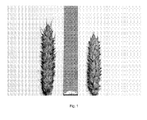
- inventively fertilized wheat plants according to the invention were striking, which is well above the ears and stalk size of the conventionally fertilized wheat plants.
- conventionally fertilized wheat plants had significantly more stunted wheat stems and wheat ears than the wheat plants of the invention.
- samples of the compared weights of ears of corn tend to tend: In each case, 100 arbitrarily selected ears of the trial field weighed on average 4.2 ⁇ 0.6 g on July 9, 2009, while the conventionally fertilized wheat ears averaged only 3.5 ⁇ 0 on the same day , 5 g.
- an excellently environmentally compatible fertilizer is available which combines the advantages of the biological fertilizer and that of urea without being associated with the disadvantages of previous urea fertilization or nitrogen fertilization and its practical suitability both in field trials demonstrated with barley and wheat as well as small experiments in horticulture with lettuce, carrots and kohlrabi.
Landscapes
- Chemical & Material Sciences (AREA)
- Organic Chemistry (AREA)
- Life Sciences & Earth Sciences (AREA)
- Pest Control & Pesticides (AREA)
- Fertilizers (AREA)
Applications Claiming Priority (1)
| Application Number | Priority Date | Filing Date | Title |
|---|---|---|---|
| DE102009035616.9A DE102009035616B4 (de) | 2009-07-31 | 2009-07-31 | Langzeitdüngermasse auf Basis von vorwiegend pflanzlichem Material mit Harnstoff, Verfahren zu ihrer Herstellung und ihre Verwendung |
Publications (2)
| Publication Number | Publication Date |
|---|---|
| EP2279989A2 true EP2279989A2 (fr) | 2011-02-02 |
| EP2279989A3 EP2279989A3 (fr) | 2013-04-10 |
Family
ID=42556785
Family Applications (1)
| Application Number | Title | Priority Date | Filing Date |
|---|---|---|---|
| EP20100170641 Withdrawn EP2279989A3 (fr) | 2009-07-31 | 2010-07-23 | Engrais longue durée à base de matières essentiellement végétales dotées d'urée |
Country Status (3)
| Country | Link |
|---|---|
| EP (1) | EP2279989A3 (fr) |
| DE (1) | DE102009035616B4 (fr) |
| ZA (1) | ZA200906326B (fr) |
Cited By (7)
| Publication number | Priority date | Publication date | Assignee | Title |
|---|---|---|---|---|
| CN103548698A (zh) * | 2013-11-08 | 2014-02-05 | 上海孙桥农业科技股份有限公司 | 帝王花快速繁殖的方法 |
| CN103755497A (zh) * | 2013-12-25 | 2014-04-30 | 合肥华创现代农业科技有限公司 | 一种添加土壤活化剂的复合肥及其制备方法 |
| CN104098385A (zh) * | 2014-06-12 | 2014-10-15 | 阜阳市颍泉区涌泉种植专业合作社 | 一种含有多种植物秧发酵物的复混肥料及其制备方法 |
| CN104140306A (zh) * | 2014-07-04 | 2014-11-12 | 马鞍山市四季果业有限公司 | 一种肥效全面的有机肥料及其制备方法 |
| CN108218592A (zh) * | 2018-04-11 | 2018-06-29 | 华中农业大学 | 一种适用于黄棕壤新型磷铵肥及其制备方法 |
| DE202017104986U1 (de) * | 2017-08-18 | 2018-11-21 | Lmengineering Gmbh | Langzeitdüngemittel sowie eine Vorrichtung zu dessen Herstellung |
| CN110981603A (zh) * | 2019-12-17 | 2020-04-10 | 中盐安徽红四方肥业股份有限公司 | 一种小麦用包膜缓释肥料及其制备方法和应用 |
Families Citing this family (1)
| Publication number | Priority date | Publication date | Assignee | Title |
|---|---|---|---|---|
| CN108409410A (zh) * | 2018-03-23 | 2018-08-17 | 山西省农业科学院农业环境与资源研究所 | 一种用于果树复壮变绿的抑菌液及其制备方法 |
Citations (6)
| Publication number | Priority date | Publication date | Assignee | Title |
|---|---|---|---|---|
| AU1040170A (en) | 1970-01-19 | 1971-07-22 | Nathanial Karnemaat John | Organic based fertilizer |
| DE4211013A1 (de) | 1992-04-02 | 1993-10-07 | Natur Technik Verwertung Gmbh | Reststoffgranulat und Verfahren zu seiner Herstellung |
| KR20020087653A (ko) | 2001-05-15 | 2002-11-23 | 심연숙 | 유기질 비료의 제조방법 |
| DE4424403B4 (de) | 1994-07-11 | 2005-07-28 | Josef Moser | Verarbeitbare Masse aus vorwiegend pflanzlichem Material sowie Verfahren zu ihrer Herstellung |
| CN1900024A (zh) | 2005-07-19 | 2007-01-24 | 孙逸龙 | 用城市生活垃圾厌氧发酵生产有机复合药肥的方法 |
| CN1900025A (zh) | 2005-07-20 | 2007-01-24 | 孙逸龙 | 一种用农作物秸秆厌氧发酵生产有机复合药肥的方法 |
Family Cites Families (6)
| Publication number | Priority date | Publication date | Assignee | Title |
|---|---|---|---|---|
| US3713800A (en) * | 1971-05-24 | 1973-01-30 | J Karnemaat | Process for producing garbage based fertilizer |
| JPH10212185A (ja) * | 1997-01-29 | 1998-08-11 | Kyowa Hakko Kogyo Co Ltd | 粒状有機質の製造法 |
| GB2335188B (en) * | 1998-06-09 | 2000-01-26 | Brycliff Ltd | Slow release matrix bound fertilisers |
| DE102005048116A1 (de) * | 2005-10-06 | 2007-04-12 | Nawaro Bioenergie Ag | Verfahren und Vorrichtung zur Herstellung von Düngemittelformkörpern aus durch die Energieerzeugung mittels Fermentation in einer Biogasanlage erhaltenen Gärresten |
| EA013156B1 (ru) * | 2006-06-30 | 2010-02-26 | ДСМ АйПи АССЕТС Б.В. | Покрытое оболочкой удобрение |
| GB2460889B (en) * | 2008-06-16 | 2010-10-20 | John William Carson | A process for the manufacture of a horticultural growing medium |
-
2009
- 2009-07-31 DE DE102009035616.9A patent/DE102009035616B4/de not_active Expired - Fee Related
- 2009-09-11 ZA ZA200906326A patent/ZA200906326B/xx unknown
-
2010
- 2010-07-23 EP EP20100170641 patent/EP2279989A3/fr not_active Withdrawn
Patent Citations (6)
| Publication number | Priority date | Publication date | Assignee | Title |
|---|---|---|---|---|
| AU1040170A (en) | 1970-01-19 | 1971-07-22 | Nathanial Karnemaat John | Organic based fertilizer |
| DE4211013A1 (de) | 1992-04-02 | 1993-10-07 | Natur Technik Verwertung Gmbh | Reststoffgranulat und Verfahren zu seiner Herstellung |
| DE4424403B4 (de) | 1994-07-11 | 2005-07-28 | Josef Moser | Verarbeitbare Masse aus vorwiegend pflanzlichem Material sowie Verfahren zu ihrer Herstellung |
| KR20020087653A (ko) | 2001-05-15 | 2002-11-23 | 심연숙 | 유기질 비료의 제조방법 |
| CN1900024A (zh) | 2005-07-19 | 2007-01-24 | 孙逸龙 | 用城市生活垃圾厌氧发酵生产有机复合药肥的方法 |
| CN1900025A (zh) | 2005-07-20 | 2007-01-24 | 孙逸龙 | 一种用农作物秸秆厌氧发酵生产有机复合药肥的方法 |
Cited By (8)
| Publication number | Priority date | Publication date | Assignee | Title |
|---|---|---|---|---|
| CN103548698A (zh) * | 2013-11-08 | 2014-02-05 | 上海孙桥农业科技股份有限公司 | 帝王花快速繁殖的方法 |
| CN103755497A (zh) * | 2013-12-25 | 2014-04-30 | 合肥华创现代农业科技有限公司 | 一种添加土壤活化剂的复合肥及其制备方法 |
| CN104098385A (zh) * | 2014-06-12 | 2014-10-15 | 阜阳市颍泉区涌泉种植专业合作社 | 一种含有多种植物秧发酵物的复混肥料及其制备方法 |
| CN104140306A (zh) * | 2014-07-04 | 2014-11-12 | 马鞍山市四季果业有限公司 | 一种肥效全面的有机肥料及其制备方法 |
| DE202017104986U1 (de) * | 2017-08-18 | 2018-11-21 | Lmengineering Gmbh | Langzeitdüngemittel sowie eine Vorrichtung zu dessen Herstellung |
| CN108218592A (zh) * | 2018-04-11 | 2018-06-29 | 华中农业大学 | 一种适用于黄棕壤新型磷铵肥及其制备方法 |
| CN110981603A (zh) * | 2019-12-17 | 2020-04-10 | 中盐安徽红四方肥业股份有限公司 | 一种小麦用包膜缓释肥料及其制备方法和应用 |
| CN110981603B (zh) * | 2019-12-17 | 2022-04-29 | 中盐安徽红四方肥业股份有限公司 | 一种小麦用包膜缓释肥料及其制备方法和应用 |
Also Published As
| Publication number | Publication date |
|---|---|
| ZA200906326B (en) | 2010-05-26 |
| DE102009035616A1 (de) | 2011-02-03 |
| EP2279989A3 (fr) | 2013-04-10 |
| DE102009035616B4 (de) | 2016-01-21 |
Similar Documents
| Publication | Publication Date | Title |
|---|---|---|
| DE102009035616B4 (de) | Langzeitdüngermasse auf Basis von vorwiegend pflanzlichem Material mit Harnstoff, Verfahren zu ihrer Herstellung und ihre Verwendung | |
| DE102008011760B4 (de) | Mittel und Langzeitdünger mit Abschreckwirkung gegen Schnecken | |
| DE60309938T2 (de) | Verfahren zur herstellung eines düngemittels und das düngemittel | |
| DE102011010329A1 (de) | Wasser speicherndes und abgebendes organisch basiertes Kompositmaterial sowie dessen Herstellung und Anwendung | |
| EP3587381A1 (fr) | Procédé de fabrication de biomasse engrais à partir de lisier des animaux du secteur agricole, tels que bovin, porc, mouton et poule pondeuse | |
| EP3247690A2 (fr) | Agents d'amélioration du sol et procédé pour leur fabrication et leur utilisation | |
| Starke et al. | Dry matter and sugar content as parameters to assess the quality of sugar beet varieties for anaerobic digestion. | |
| EP1740517A1 (fr) | Element moule servant de fertilisant et procede de production associe | |
| DE4137171C2 (fr) | ||
| DE60009563T2 (de) | Mischung zur beschleunigung der kompostierung | |
| DE102004057841A1 (de) | Formkörper zum Düngen und Verfahren zu seiner Herstellung | |
| DE4424403B4 (de) | Verarbeitbare Masse aus vorwiegend pflanzlichem Material sowie Verfahren zu ihrer Herstellung | |
| EP0923854A2 (fr) | Méthode et dispositif pour fabriquer un succédané de tourbe de haute qualité | |
| DE2739618C3 (de) | Organisches Düngemittel aus Kaffeebohnenhautchen und/oder Erdnußhäutchen | |
| EP3598891B1 (fr) | Moyen destiné à être utilisé comme tourbe de substitution, ajout à un terreau pour plantes ou destiné à l'amélioration de la terre | |
| EP0751705A1 (fr) | Desherbant, son procede de preparation et son utilisation dans la lutte contre les mauvaises herbes | |
| DE2831583B1 (de) | Verfahren zur Herstellung eines Duengemittels und Verwendung desselben | |
| DE102008019299A1 (de) | Verfahren zur Herstellung von Bodensubstrat | |
| EP0581992A1 (fr) | Procédé de transformation des matériaux organiques structurés et non structurés en humus | |
| DE202019103796U1 (de) | Organisch natives Substrat | |
| DE102004052726B3 (de) | Verfahren zur Herstellung eines organischen N/P/K-Düngers | |
| DE19507204C1 (de) | Verfahren zur Herstellung eines Komposts unter Verwendung keratinhaltiger Abfälle | |
| DE102007008188A1 (de) | Bodensubstrat aus kompostierten Fäkalien und Verfahren zu dessen Herstellung | |
| DE9114087U1 (de) | Biologisch reines Drei-Phasen-Naturstoff-Düngemittel | |
| EP4732664A2 (fr) | Substrat de culture de plantes et son procédé de fabrication |
Legal Events
| Date | Code | Title | Description |
|---|---|---|---|
| PUAI | Public reference made under article 153(3) epc to a published international application that has entered the european phase |
Free format text: ORIGINAL CODE: 0009012 |
|
| AK | Designated contracting states |
Kind code of ref document: A2 Designated state(s): AL AT BE BG CH CY CZ DE DK EE ES FI FR GB GR HR HU IE IS IT LI LT LU LV MC MK MT NL NO PL PT RO SE SI SK SM TR |
|
| AX | Request for extension of the european patent |
Extension state: BA ME RS |
|
| PUAL | Search report despatched |
Free format text: ORIGINAL CODE: 0009013 |
|
| AK | Designated contracting states |
Kind code of ref document: A3 Designated state(s): AL AT BE BG CH CY CZ DE DK EE ES FI FR GB GR HR HU IE IS IT LI LT LU LV MC MK MT NL NO PL PT RO SE SI SK SM TR |
|
| AX | Request for extension of the european patent |
Extension state: BA ME RS |
|
| RIC1 | Information provided on ipc code assigned before grant |
Ipc: C05G 5/00 20060101ALI20130304BHEP Ipc: C05C 1/02 20060101AFI20130304BHEP Ipc: C05F 3/02 20060101ALI20130304BHEP Ipc: C05G 3/00 20060101ALI20130304BHEP Ipc: C05C 9/00 20060101ALI20130304BHEP Ipc: C05B 7/00 20060101ALI20130304BHEP |
|
| 17P | Request for examination filed |
Effective date: 20131008 |
|
| RBV | Designated contracting states (corrected) |
Designated state(s): AL AT BE BG CH CY CZ DE DK EE ES FI FR GB GR HR HU IE IS IT LI LT LU LV MC MK MT NL NO PL PT RO SE SI SK SM TR |
|
| 17Q | First examination report despatched |
Effective date: 20141119 |
|
| STAA | Information on the status of an ep patent application or granted ep patent |
Free format text: STATUS: THE APPLICATION IS DEEMED TO BE WITHDRAWN |
|
| 18D | Application deemed to be withdrawn |
Effective date: 20170201 |