EP2279990B1 - Composé tétracyclique cristal liquide ayant un atome de fluor, composition de cristaux liquides et élément d'affichage à cristaux liquides - Google Patents
Composé tétracyclique cristal liquide ayant un atome de fluor, composition de cristaux liquides et élément d'affichage à cristaux liquides Download PDFInfo
- Publication number
- EP2279990B1 EP2279990B1 EP09754609.7A EP09754609A EP2279990B1 EP 2279990 B1 EP2279990 B1 EP 2279990B1 EP 09754609 A EP09754609 A EP 09754609A EP 2279990 B1 EP2279990 B1 EP 2279990B1
- Authority
- EP
- European Patent Office
- Prior art keywords
- compound
- liquid crystal
- carbons
- independently
- alkenyl
- Prior art date
- Legal status (The legal status is an assumption and is not a legal conclusion. Google has not performed a legal analysis and makes no representation as to the accuracy of the status listed.)
- Not-in-force
Links
- 150000001875 compounds Chemical class 0.000 title claims description 396
- 239000000203 mixture Substances 0.000 title claims description 223
- 239000004973 liquid crystal related substance Substances 0.000 title claims description 213
- 229910052731 fluorine Inorganic materials 0.000 title claims description 96
- 125000001153 fluoro group Chemical group F* 0.000 title claims description 4
- 239000007788 liquid Substances 0.000 title description 5
- 125000003342 alkenyl group Chemical group 0.000 claims description 67
- UFHFLCQGNIYNRP-UHFFFAOYSA-N Hydrogen Chemical compound [H][H] UFHFLCQGNIYNRP-UHFFFAOYSA-N 0.000 claims description 40
- 239000001257 hydrogen Substances 0.000 claims description 38
- 229910052739 hydrogen Inorganic materials 0.000 claims description 38
- 125000000217 alkyl group Chemical group 0.000 claims description 32
- -1 -OCHF2 Chemical group 0.000 claims description 26
- 125000003545 alkoxy group Chemical group 0.000 claims description 25
- 239000011737 fluorine Substances 0.000 claims description 23
- PXGOKWXKJXAPGV-UHFFFAOYSA-N Fluorine Chemical compound FF PXGOKWXKJXAPGV-UHFFFAOYSA-N 0.000 claims description 21
- 125000000876 trifluoromethoxy group Chemical group FC(F)(F)O* 0.000 claims description 12
- 125000004955 1,4-cyclohexylene group Chemical group [H]C1([H])C([H])([H])C([H])([*:1])C([H])([H])C([H])([H])C1([H])[*:2] 0.000 claims description 11
- 125000001140 1,4-phenylene group Chemical group [H]C1=C([H])C([*:2])=C([H])C([H])=C1[*:1] 0.000 claims description 6
- 125000005714 2,5- (1,3-dioxanylene) group Chemical group [H]C1([H])OC([H])([*:1])OC([H])([H])C1([H])[*:2] 0.000 claims description 4
- ZAMOUSCENKQFHK-UHFFFAOYSA-N Chlorine atom Chemical group [Cl] ZAMOUSCENKQFHK-UHFFFAOYSA-N 0.000 claims description 4
- 239000000460 chlorine Chemical group 0.000 claims description 4
- 229910052801 chlorine Inorganic materials 0.000 claims description 4
- 125000005453 2,5-difluoro-1,4-phenylene group Chemical group [H]C1=C([*:1])C(F)=C([H])C([*:2])=C1F 0.000 claims description 2
- YXFVVABEGXRONW-UHFFFAOYSA-N Toluene Chemical compound CC1=CC=CC=C1 YXFVVABEGXRONW-UHFFFAOYSA-N 0.000 description 366
- XEKOWRVHYACXOJ-UHFFFAOYSA-N Ethyl acetate Chemical compound CCOC(C)=O XEKOWRVHYACXOJ-UHFFFAOYSA-N 0.000 description 150
- 239000012074 organic phase Substances 0.000 description 96
- 239000012071 phase Substances 0.000 description 96
- IMNFDUFMRHMDMM-UHFFFAOYSA-N N-Heptane Chemical compound CCCCCCC IMNFDUFMRHMDMM-UHFFFAOYSA-N 0.000 description 88
- UIIMBOGNXHQVGW-UHFFFAOYSA-M Sodium bicarbonate Chemical compound [Na+].OC([O-])=O UIIMBOGNXHQVGW-UHFFFAOYSA-M 0.000 description 68
- XLYOFNOQVPJJNP-UHFFFAOYSA-N water Substances O XLYOFNOQVPJJNP-UHFFFAOYSA-N 0.000 description 68
- 239000000243 solution Substances 0.000 description 48
- KDLHZDBZIXYQEI-UHFFFAOYSA-N Palladium Chemical compound [Pd] KDLHZDBZIXYQEI-UHFFFAOYSA-N 0.000 description 46
- 239000012046 mixed solvent Substances 0.000 description 46
- 239000002904 solvent Substances 0.000 description 46
- 230000000704 physical effect Effects 0.000 description 43
- 230000005526 G1 to G0 transition Effects 0.000 description 38
- VYPSYNLAJGMNEJ-UHFFFAOYSA-N Silicium dioxide Chemical compound O=[Si]=O VYPSYNLAJGMNEJ-UHFFFAOYSA-N 0.000 description 38
- 238000006243 chemical reaction Methods 0.000 description 38
- 238000004440 column chromatography Methods 0.000 description 38
- 239000003480 eluent Substances 0.000 description 38
- 239000000843 powder Substances 0.000 description 38
- 239000000741 silica gel Substances 0.000 description 38
- 229910002027 silica gel Inorganic materials 0.000 description 38
- CSNNHWWHGAXBCP-UHFFFAOYSA-L Magnesium sulfate Chemical compound [Mg+2].[O-][S+2]([O-])([O-])[O-] CSNNHWWHGAXBCP-UHFFFAOYSA-L 0.000 description 37
- 239000007864 aqueous solution Substances 0.000 description 37
- 229920006395 saturated elastomer Polymers 0.000 description 37
- 239000008346 aqueous phase Substances 0.000 description 36
- 229910000030 sodium bicarbonate Inorganic materials 0.000 description 34
- 235000017557 sodium bicarbonate Nutrition 0.000 description 34
- 238000000034 method Methods 0.000 description 30
- 239000012299 nitrogen atmosphere Substances 0.000 description 30
- 239000000523 sample Substances 0.000 description 26
- 238000003756 stirring Methods 0.000 description 25
- 0 C*1*CCC1 Chemical compound C*1*CCC1 0.000 description 24
- 230000007704 transition Effects 0.000 description 23
- ZMXDDKWLCZADIW-UHFFFAOYSA-N N,N-Dimethylformamide Chemical compound CN(C)C=O ZMXDDKWLCZADIW-UHFFFAOYSA-N 0.000 description 21
- 230000015572 biosynthetic process Effects 0.000 description 21
- 239000012267 brine Substances 0.000 description 21
- 239000011541 reaction mixture Substances 0.000 description 21
- 238000001953 recrystallisation Methods 0.000 description 21
- HPALAKNZSZLMCH-UHFFFAOYSA-M sodium;chloride;hydrate Chemical compound O.[Na+].[Cl-] HPALAKNZSZLMCH-UHFFFAOYSA-M 0.000 description 21
- HEDRZPFGACZZDS-MICDWDOJSA-N Trichloro(2H)methane Chemical compound [2H]C(Cl)(Cl)Cl HEDRZPFGACZZDS-MICDWDOJSA-N 0.000 description 20
- 239000000126 substance Substances 0.000 description 20
- JOXIMZWYDAKGHI-UHFFFAOYSA-N toluene-4-sulfonic acid Chemical compound CC1=CC=C(S(O)(=O)=O)C=C1 JOXIMZWYDAKGHI-UHFFFAOYSA-N 0.000 description 20
- NLXLAEXVIDQMFP-UHFFFAOYSA-N Ammonia chloride Chemical compound [NH4+].[Cl-] NLXLAEXVIDQMFP-UHFFFAOYSA-N 0.000 description 18
- 238000005259 measurement Methods 0.000 description 18
- 230000003287 optical effect Effects 0.000 description 16
- KFZMGEQAYNKOFK-UHFFFAOYSA-N Isopropanol Chemical compound CC(C)O KFZMGEQAYNKOFK-UHFFFAOYSA-N 0.000 description 15
- VLKZOEOYAKHREP-UHFFFAOYSA-N n-Hexane Chemical compound CCCCCC VLKZOEOYAKHREP-UHFFFAOYSA-N 0.000 description 15
- IJGRMHOSHXDMSA-UHFFFAOYSA-N Atomic nitrogen Chemical compound N#N IJGRMHOSHXDMSA-UHFFFAOYSA-N 0.000 description 14
- JHYNXXDQQHTCHJ-UHFFFAOYSA-M ethyl(triphenyl)phosphanium;bromide Chemical compound [Br-].C=1C=CC=CC=1[P+](C=1C=CC=CC=1)(CC)C1=CC=CC=C1 JHYNXXDQQHTCHJ-UHFFFAOYSA-M 0.000 description 13
- 235000019000 fluorine Nutrition 0.000 description 13
- 230000001965 increasing effect Effects 0.000 description 13
- 238000010992 reflux Methods 0.000 description 13
- 239000004990 Smectic liquid crystal Substances 0.000 description 12
- 238000004458 analytical method Methods 0.000 description 12
- 230000000052 comparative effect Effects 0.000 description 12
- BDAGIHXWWSANSR-UHFFFAOYSA-N methanoic acid Natural products OC=O BDAGIHXWWSANSR-UHFFFAOYSA-N 0.000 description 12
- LPNYRYFBWFDTMA-UHFFFAOYSA-N potassium tert-butoxide Chemical compound [K+].CC(C)(C)[O-] LPNYRYFBWFDTMA-UHFFFAOYSA-N 0.000 description 12
- KRETVAYKRYVDGL-UHFFFAOYSA-N 8-(4-oxocyclohexyl)spiro[4.5]decane-1,4-dione Chemical compound O=C1CCC(=O)C11CCC(C2CCC(=O)CC2)CC1 KRETVAYKRYVDGL-UHFFFAOYSA-N 0.000 description 11
- 125000000219 ethylidene group Chemical group [H]C(=[*])C([H])([H])[H] 0.000 description 11
- 150000004714 phosphonium salts Chemical class 0.000 description 11
- 238000003786 synthesis reaction Methods 0.000 description 11
- 238000005160 1H NMR spectroscopy Methods 0.000 description 10
- 239000011521 glass Substances 0.000 description 10
- CUUYGSBOZFZTQY-UHFFFAOYSA-M methoxy(triphenyl)phosphanium;chloride Chemical compound [Cl-].C=1C=CC=CC=1[P+](C=1C=CC=CC=1)(OC)C1=CC=CC=C1 CUUYGSBOZFZTQY-UHFFFAOYSA-M 0.000 description 10
- BWHMMNNQKKPAPP-UHFFFAOYSA-L potassium carbonate Chemical compound [K+].[K+].[O-]C([O-])=O BWHMMNNQKKPAPP-UHFFFAOYSA-L 0.000 description 10
- 235000019270 ammonium chloride Nutrition 0.000 description 9
- GOYDNIKZWGIXJT-UHFFFAOYSA-N 1,2-difluorobenzene Chemical compound FC1=CC=CC=C1F GOYDNIKZWGIXJT-UHFFFAOYSA-N 0.000 description 8
- JRTIFGNIVWBNHW-UHFFFAOYSA-N 1-fluoro-3-(4-pentylcyclohexyl)benzene Chemical compound C1CC(CCCCC)CCC1C1=CC=CC(F)=C1 JRTIFGNIVWBNHW-UHFFFAOYSA-N 0.000 description 8
- DXFHMMVZUZLQFU-UHFFFAOYSA-N 5-[4-(4-ethylcyclohexyl)cyclohexyl]-1,2,3-trifluorobenzene Chemical compound C1CC(CC)CCC1C1CCC(C=2C=C(F)C(F)=C(F)C=2)CC1 DXFHMMVZUZLQFU-UHFFFAOYSA-N 0.000 description 8
- XDTMQSROBMDMFD-UHFFFAOYSA-N Cyclohexane Chemical compound C1CCCCC1 XDTMQSROBMDMFD-UHFFFAOYSA-N 0.000 description 8
- 238000010521 absorption reaction Methods 0.000 description 8
- 150000001298 alcohols Chemical class 0.000 description 8
- 239000012298 atmosphere Substances 0.000 description 8
- 210000004027 cell Anatomy 0.000 description 8
- 239000013078 crystal Substances 0.000 description 8
- 125000005647 linker group Chemical group 0.000 description 8
- 229910003002 lithium salt Inorganic materials 0.000 description 8
- 159000000002 lithium salts Chemical class 0.000 description 8
- 229910052757 nitrogen Inorganic materials 0.000 description 8
- 230000004044 response Effects 0.000 description 8
- 239000000758 substrate Substances 0.000 description 8
- 230000003247 decreasing effect Effects 0.000 description 7
- WGOPGODQLGJZGL-UHFFFAOYSA-N lithium;butane Chemical compound [Li+].CC[CH-]C WGOPGODQLGJZGL-UHFFFAOYSA-N 0.000 description 7
- LSEFCHWGJNHZNT-UHFFFAOYSA-M methyl(triphenyl)phosphanium;bromide Chemical compound [Br-].C=1C=CC=CC=1[P+](C=1C=CC=CC=1)(C)C1=CC=CC=C1 LSEFCHWGJNHZNT-UHFFFAOYSA-M 0.000 description 7
- IBFXEBSLQMKDBU-UHFFFAOYSA-N 1-[4-(4-ethenylcyclohexyl)cyclohexyl]-2-fluoro-4-(4-pentylcyclohexyl)benzene Chemical group C1CC(CCCCC)CCC1C(C=C1F)=CC=C1C1CCC(C2CCC(CC2)C=C)CC1 IBFXEBSLQMKDBU-UHFFFAOYSA-N 0.000 description 6
- OSWFIVFLDKOXQC-UHFFFAOYSA-N 4-(3-methoxyphenyl)aniline Chemical compound COC1=CC=CC(C=2C=CC(N)=CC=2)=C1 OSWFIVFLDKOXQC-UHFFFAOYSA-N 0.000 description 6
- CSCPPACGZOOCGX-UHFFFAOYSA-N Acetone Chemical compound CC(C)=O CSCPPACGZOOCGX-UHFFFAOYSA-N 0.000 description 6
- UHOVQNZJYSORNB-UHFFFAOYSA-N Benzene Chemical compound C1=CC=CC=C1 UHOVQNZJYSORNB-UHFFFAOYSA-N 0.000 description 6
- IAZDPXIOMUYVGZ-UHFFFAOYSA-N Dimethylsulphoxide Chemical compound CS(C)=O IAZDPXIOMUYVGZ-UHFFFAOYSA-N 0.000 description 6
- MZRVEZGGRBJDDB-UHFFFAOYSA-N N-Butyllithium Chemical compound [Li]CCCC MZRVEZGGRBJDDB-UHFFFAOYSA-N 0.000 description 6
- 150000001299 aldehydes Chemical class 0.000 description 6
- 235000019253 formic acid Nutrition 0.000 description 6
- 239000005457 ice water Substances 0.000 description 6
- SRJQTHAZUNRMPR-UYQKXTDMSA-N spinosyn A Chemical compound O([C@H]1CCC[C@@H](OC(=O)C[C@H]2[C@@H]3C=C[C@@H]4C[C@H](C[C@H]4[C@@H]3C=C2C(=O)[C@@H]1C)O[C@H]1[C@@H]([C@H](OC)[C@@H](OC)[C@H](C)O1)OC)CC)[C@H]1CC[C@H](N(C)C)[C@@H](C)O1 SRJQTHAZUNRMPR-UYQKXTDMSA-N 0.000 description 6
- KUQSXTAOZOKCQF-UHFFFAOYSA-N 4-[4-[2-fluoro-4-(4-pentylcyclohexyl)phenyl]cyclohexyl]cyclohexan-1-one Chemical compound C1CC(CCCCC)CCC1C(C=C1F)=CC=C1C1CCC(C2CCC(=O)CC2)CC1 KUQSXTAOZOKCQF-UHFFFAOYSA-N 0.000 description 5
- VEXZGXHMUGYJMC-UHFFFAOYSA-N Hydrochloric acid Chemical compound Cl VEXZGXHMUGYJMC-UHFFFAOYSA-N 0.000 description 5
- OAICVXFJPJFONN-UHFFFAOYSA-N Phosphorus Chemical compound [P] OAICVXFJPJFONN-UHFFFAOYSA-N 0.000 description 5
- 238000007239 Wittig reaction Methods 0.000 description 5
- 125000002915 carbonyl group Chemical group [*:2]C([*:1])=O 0.000 description 5
- 239000003054 catalyst Substances 0.000 description 5
- 239000007789 gas Substances 0.000 description 5
- 125000000956 methoxy group Chemical group [H]C([H])([H])O* 0.000 description 5
- 238000002156 mixing Methods 0.000 description 5
- 229910052698 phosphorus Inorganic materials 0.000 description 5
- 239000011574 phosphorus Substances 0.000 description 5
- 229910000027 potassium carbonate Inorganic materials 0.000 description 5
- 238000012360 testing method Methods 0.000 description 5
- 125000000391 vinyl group Chemical group [H]C([*])=C([H])[H] 0.000 description 5
- MLINMBWPXJKTCS-UHFFFAOYSA-N 1-[4-(4-ethenylcyclohexyl)cyclohexyl]-2,3-difluoro-4-(1-propylcyclohexyl)benzene Chemical compound C=1C=C(C2CCC(CC2)C2CCC(CC2)C=C)C(F)=C(F)C=1C1(CCC)CCCCC1 MLINMBWPXJKTCS-UHFFFAOYSA-N 0.000 description 4
- CXYOBIPVEIXKEP-UHFFFAOYSA-N 1-[4-(4-ethenylcyclohexyl)cyclohexyl]-4-(4-ethoxycyclohexyl)-2-fluorobenzene Chemical compound C1CC(OCC)CCC1C(C=C1F)=CC=C1C1CCC(C2CCC(CC2)C=C)CC1 CXYOBIPVEIXKEP-UHFFFAOYSA-N 0.000 description 4
- PXPBIZDLYJZOAH-UHFFFAOYSA-N 1-[4-(4-ethylcyclohexyl)cyclohexyl]-2-fluoro-4-(4-pentylcyclohexyl)benzene Chemical compound C1CC(CCCCC)CCC1C(C=C1F)=CC=C1C1CCC(C2CCC(CC)CC2)CC1 PXPBIZDLYJZOAH-UHFFFAOYSA-N 0.000 description 4
- CYNYIHKIEHGYOZ-UHFFFAOYSA-N 1-bromopropane Chemical compound CCCBr CYNYIHKIEHGYOZ-UHFFFAOYSA-N 0.000 description 4
- MEKOFIRRDATTAG-UHFFFAOYSA-N 2,2,5,8-tetramethyl-3,4-dihydrochromen-6-ol Chemical compound C1CC(C)(C)OC2=C1C(C)=C(O)C=C2C MEKOFIRRDATTAG-UHFFFAOYSA-N 0.000 description 4
- DFYLZDHIPHCADY-UHFFFAOYSA-N 2-fluoro-4-(4-pentylcyclohexyl)-1-[4-(4-propoxycyclohexyl)cyclohexyl]benzene Chemical compound C1CC(CCCCC)CCC1C(C=C1F)=CC=C1C1CCC(C2CCC(CC2)OCCC)CC1 DFYLZDHIPHCADY-UHFFFAOYSA-N 0.000 description 4
- KEAYESYHFKHZAL-UHFFFAOYSA-N Sodium Chemical compound [Na] KEAYESYHFKHZAL-UHFFFAOYSA-N 0.000 description 4
- 239000000538 analytical sample Substances 0.000 description 4
- ZADPBFCGQRWHPN-UHFFFAOYSA-N boronic acid Chemical class OBO ZADPBFCGQRWHPN-UHFFFAOYSA-N 0.000 description 4
- WVIIMZNLDWSIRH-UHFFFAOYSA-N cyclohexylcyclohexane Chemical compound C1CCCCC1C1CCCCC1 WVIIMZNLDWSIRH-UHFFFAOYSA-N 0.000 description 4
- 230000007423 decrease Effects 0.000 description 4
- 238000004817 gas chromatography Methods 0.000 description 4
- 238000002844 melting Methods 0.000 description 4
- 230000008018 melting Effects 0.000 description 4
- 239000012925 reference material Substances 0.000 description 4
- 239000012279 sodium borohydride Substances 0.000 description 4
- 229910000033 sodium borohydride Inorganic materials 0.000 description 4
- 239000012312 sodium hydride Substances 0.000 description 4
- 229910000104 sodium hydride Inorganic materials 0.000 description 4
- 238000010189 synthetic method Methods 0.000 description 4
- UCPPGQWSQUGPEY-UHFFFAOYSA-N 1-fluoro-3-(4-propylcyclohexyl)benzene Chemical compound C1CC(CCC)CCC1C1=CC=CC(F)=C1 UCPPGQWSQUGPEY-UHFFFAOYSA-N 0.000 description 3
- RKSVMUXGQVKQSH-QPJJXVBHSA-N 2-fluoro-4-(4-pentylcyclohexyl)-1-[4-[4-[(e)-prop-1-enyl]cyclohexyl]cyclohexyl]benzene Chemical compound C1CC(CCCCC)CCC1C(C=C1F)=CC=C1C1CCC(C2CCC(CC2)\C=C\C)CC1 RKSVMUXGQVKQSH-QPJJXVBHSA-N 0.000 description 3
- 239000003377 acid catalyst Substances 0.000 description 3
- 230000008859 change Effects 0.000 description 3
- 238000012937 correction Methods 0.000 description 3
- 125000000596 cyclohexenyl group Chemical class C1(=CCCCC1)* 0.000 description 3
- 239000002019 doping agent Substances 0.000 description 3
- 238000013213 extrapolation Methods 0.000 description 3
- 125000001997 phenyl group Chemical group [H]C1=C([H])C([H])=C(*)C([H])=C1[H] 0.000 description 3
- NAWXUBYGYWOOIX-SFHVURJKSA-N (2s)-2-[[4-[2-(2,4-diaminoquinazolin-6-yl)ethyl]benzoyl]amino]-4-methylidenepentanedioic acid Chemical compound C1=CC2=NC(N)=NC(N)=C2C=C1CCC1=CC=C(C(=O)N[C@@H](CC(=C)C(O)=O)C(O)=O)C=C1 NAWXUBYGYWOOIX-SFHVURJKSA-N 0.000 description 2
- UKLNPJDLSPMJMQ-UHFFFAOYSA-N 4-pentylcyclohexan-1-one Chemical compound CCCCCC1CCC(=O)CC1 UKLNPJDLSPMJMQ-UHFFFAOYSA-N 0.000 description 2
- NQEDLIZOPMNZMC-UHFFFAOYSA-N 4-propylcyclohexan-1-one Chemical compound CCCC1CCC(=O)CC1 NQEDLIZOPMNZMC-UHFFFAOYSA-N 0.000 description 2
- QUJIDNSQCMTYNG-UHFFFAOYSA-N 5-[4-(4-butylphenyl)-2-fluorophenyl]-2-[difluoro-(3,4,5-trifluorophenoxy)methyl]-1,3-difluorobenzene Chemical compound C1=CC(CCCC)=CC=C1C1=CC=C(C=2C=C(F)C(=C(F)C=2)C(F)(F)OC=2C=C(F)C(F)=C(F)C=2)C(F)=C1 QUJIDNSQCMTYNG-UHFFFAOYSA-N 0.000 description 2
- HEDRZPFGACZZDS-UHFFFAOYSA-N Chloroform Chemical compound ClC(Cl)Cl HEDRZPFGACZZDS-UHFFFAOYSA-N 0.000 description 2
- LFQSCWFLJHTTHZ-UHFFFAOYSA-N Ethanol Chemical compound CCO LFQSCWFLJHTTHZ-UHFFFAOYSA-N 0.000 description 2
- MHAJPDPJQMAIIY-UHFFFAOYSA-N Hydrogen peroxide Chemical compound OO MHAJPDPJQMAIIY-UHFFFAOYSA-N 0.000 description 2
- FYYHWMGAXLPEAU-UHFFFAOYSA-N Magnesium Chemical compound [Mg] FYYHWMGAXLPEAU-UHFFFAOYSA-N 0.000 description 2
- 239000004642 Polyimide Substances 0.000 description 2
- 239000000654 additive Substances 0.000 description 2
- 230000000996 additive effect Effects 0.000 description 2
- 125000004183 alkoxy alkyl group Chemical group 0.000 description 2
- 125000005742 alkyl ethenyl group Chemical group 0.000 description 2
- RDHPKYGYEGBMSE-UHFFFAOYSA-N bromoethane Chemical compound CCBr RDHPKYGYEGBMSE-UHFFFAOYSA-N 0.000 description 2
- 239000000975 dye Substances 0.000 description 2
- 238000005516 engineering process Methods 0.000 description 2
- 238000010438 heat treatment Methods 0.000 description 2
- 230000006872 improvement Effects 0.000 description 2
- INQOMBQAUSQDDS-UHFFFAOYSA-N iodomethane Chemical compound IC INQOMBQAUSQDDS-UHFFFAOYSA-N 0.000 description 2
- 239000011777 magnesium Substances 0.000 description 2
- 229910052749 magnesium Inorganic materials 0.000 description 2
- 238000000691 measurement method Methods 0.000 description 2
- 238000012986 modification Methods 0.000 description 2
- 230000004048 modification Effects 0.000 description 2
- 238000000655 nuclear magnetic resonance spectrum Methods 0.000 description 2
- HVRUGFJYCAFAAN-UHFFFAOYSA-N o-C2H5C6H4Br Natural products CCC1=CC=CC=C1Br HVRUGFJYCAFAAN-UHFFFAOYSA-N 0.000 description 2
- 150000002989 phenols Chemical class 0.000 description 2
- 230000010287 polarization Effects 0.000 description 2
- 229920001721 polyimide Polymers 0.000 description 2
- 229920000642 polymer Polymers 0.000 description 2
- CLQUSRBWROFWKH-UHFFFAOYSA-N 1,2-difluoro-3-(4-pentylcyclohexyl)benzene Chemical compound C1CC(CCCCC)CCC1C1=CC=CC(F)=C1F CLQUSRBWROFWKH-UHFFFAOYSA-N 0.000 description 1
- BKLQIKNQJIJYQX-UHFFFAOYSA-N 1,2-difluoro-3-(4-propylcyclohexyl)benzene Chemical compound C1CC(CCC)CCC1C1=CC=CC(F)=C1F BKLQIKNQJIJYQX-UHFFFAOYSA-N 0.000 description 1
- VKRKCBWIVLSRBJ-UHFFFAOYSA-N 1,4-dioxaspiro[4.5]decan-8-one Chemical compound C1CC(=O)CCC21OCCO2 VKRKCBWIVLSRBJ-UHFFFAOYSA-N 0.000 description 1
- CTWBZFADWVJRJH-UHFFFAOYSA-N 1-(2,3-difluorophenyl)-4-pentylcyclohexan-1-ol Chemical compound C1CC(CCCCC)CCC1(O)C1=CC=CC(F)=C1F CTWBZFADWVJRJH-UHFFFAOYSA-N 0.000 description 1
- NPPZDLNGYJVMRX-UHFFFAOYSA-N 1-(2,3-difluorophenyl)-4-propylcyclohexan-1-ol Chemical compound C1CC(CCC)CCC1(O)C1=CC=CC(F)=C1F NPPZDLNGYJVMRX-UHFFFAOYSA-N 0.000 description 1
- VXJRFYRBQICUQM-UHFFFAOYSA-N 1-(4-ethoxycyclohexyl)-3-fluorobenzene Chemical compound C1CC(OCC)CCC1C1=CC=CC(F)=C1 VXJRFYRBQICUQM-UHFFFAOYSA-N 0.000 description 1
- QDFKKJYEIFBEFC-UHFFFAOYSA-N 1-bromo-3-fluorobenzene Chemical compound FC1=CC=CC(Br)=C1 QDFKKJYEIFBEFC-UHFFFAOYSA-N 0.000 description 1
- VPXFITZMJUXXSM-UHFFFAOYSA-N 2,3-difluoro-1-[4-(4-methoxycyclohexyl)cyclohexyl]-4-(4-pentylcyclohexyl)benzene Chemical compound C1CC(CCCCC)CCC1C(C(=C1F)F)=CC=C1C1CCC(C2CCC(CC2)OC)CC1 VPXFITZMJUXXSM-UHFFFAOYSA-N 0.000 description 1
- BMYNFMYTOJXKLE-UHFFFAOYSA-N 3-azaniumyl-2-hydroxypropanoate Chemical compound NCC(O)C(O)=O BMYNFMYTOJXKLE-UHFFFAOYSA-N 0.000 description 1
- RXXCIBALSKQCAE-UHFFFAOYSA-N 3-methylbutoxymethylbenzene Chemical compound CC(C)CCOCC1=CC=CC=C1 RXXCIBALSKQCAE-UHFFFAOYSA-N 0.000 description 1
- RUOBZBVHHLFEFU-UHFFFAOYSA-N 4-(1,4-dioxaspiro[4.5]decan-8-yl)-1-[2-fluoro-4-(1-pentylcyclohexyl)phenyl]cyclohexan-1-ol Chemical compound C=1C=C(C2(O)CCC(CC2)C2CCC3(CC2)OCCO3)C(F)=CC=1C1(CCCCC)CCCCC1 RUOBZBVHHLFEFU-UHFFFAOYSA-N 0.000 description 1
- YXHYGUWHKHOKMM-UHFFFAOYSA-N 4-(1,4-dioxaspiro[4.5]decan-8-yl)-1-[4-(4-ethoxycyclohexyl)-2-fluorophenyl]cyclohexan-1-ol Chemical compound C1CC(OCC)CCC1C1=CC=C(C2(O)CCC(CC2)C2CCC3(CC2)OCCO3)C(F)=C1 YXHYGUWHKHOKMM-UHFFFAOYSA-N 0.000 description 1
- BMWAAXFNVGBCDC-UHFFFAOYSA-N 4-(3-fluorophenyl)cyclohexan-1-ol Chemical compound C1CC(O)CCC1C1=CC=CC(F)=C1 BMWAAXFNVGBCDC-UHFFFAOYSA-N 0.000 description 1
- LIAPPURFKRACQO-UHFFFAOYSA-N 4-(3-fluorophenyl)cyclohexan-1-one Chemical compound FC1=CC=CC(C2CCC(=O)CC2)=C1 LIAPPURFKRACQO-UHFFFAOYSA-N 0.000 description 1
- VICPNWBQMJJAQU-UHFFFAOYSA-N 4-[4-[2,3-difluoro-4-(4-pentylcyclohexyl)phenyl]cyclohexyl]cyclohexan-1-ol Chemical compound C1CC(CCCCC)CCC1C(C(=C1F)F)=CC=C1C1CCC(C2CCC(O)CC2)CC1 VICPNWBQMJJAQU-UHFFFAOYSA-N 0.000 description 1
- FGWJIMIVRQRVGL-UHFFFAOYSA-N 4-[4-[2,3-difluoro-4-(4-pentylcyclohexyl)phenyl]cyclohexyl]cyclohexan-1-one Chemical compound C1CC(CCCCC)CCC1C(C(=C1F)F)=CC=C1C1CCC(C2CCC(=O)CC2)CC1 FGWJIMIVRQRVGL-UHFFFAOYSA-N 0.000 description 1
- NZCRKUAQVBPLND-UHFFFAOYSA-N 4-[4-[2,3-difluoro-4-(4-propylcyclohexyl)phenyl]cyclohexyl]cyclohexan-1-one Chemical compound C1CC(CCC)CCC1C(C(=C1F)F)=CC=C1C1CCC(C2CCC(=O)CC2)CC1 NZCRKUAQVBPLND-UHFFFAOYSA-N 0.000 description 1
- XQZQQLDLSHBCIW-UHFFFAOYSA-N 4-[4-[2-fluoro-4-(4-pentylcyclohexyl)phenyl]cyclohexyl]cyclohexan-1-ol Chemical compound C1CC(CCCCC)CCC1C(C=C1F)=CC=C1C1CCC(C2CCC(O)CC2)CC1 XQZQQLDLSHBCIW-UHFFFAOYSA-N 0.000 description 1
- VTOZJBZGPINPKO-UHFFFAOYSA-N 4-[4-[2-fluoro-4-(4-pentylcyclohexyl)phenyl]cyclohexyl]cyclohexane-1-carbaldehyde Chemical compound C1CC(CCCCC)CCC1C(C=C1F)=CC=C1C1CCC(C2CCC(CC2)C=O)CC1 VTOZJBZGPINPKO-UHFFFAOYSA-N 0.000 description 1
- CWXVEJFMWSDCLQ-UHFFFAOYSA-N 4-[4-[4-(4-ethoxycyclohexyl)-2-fluorophenyl]cyclohexyl]cyclohexan-1-one Chemical compound C1CC(OCC)CCC1C(C=C1F)=CC=C1C1CCC(C2CCC(=O)CC2)CC1 CWXVEJFMWSDCLQ-UHFFFAOYSA-N 0.000 description 1
- QVSWAORSFNRRFT-UHFFFAOYSA-N 4-[4-[4-(4-ethoxycyclohexyl)-2-fluorophenyl]cyclohexyl]cyclohexane-1-carbaldehyde Chemical compound C1CC(OCC)CCC1C(C=C1F)=CC=C1C1CCC(C2CCC(CC2)C=O)CC1 QVSWAORSFNRRFT-UHFFFAOYSA-N 0.000 description 1
- SYRZCCGADVNDSX-UHFFFAOYSA-N 8-(3-fluorophenyl)-1,4-dioxaspiro[4.5]dec-7-ene Chemical compound FC1=CC=CC(C=2CCC3(CC=2)OCCO3)=C1 SYRZCCGADVNDSX-UHFFFAOYSA-N 0.000 description 1
- LOAQYUKYUAVPRD-UHFFFAOYSA-N 8-(3-fluorophenyl)-1,4-dioxaspiro[4.5]decan-8-ol Chemical compound C1CC(O)(C=2C=C(F)C=CC=2)CCC21OCCO2 LOAQYUKYUAVPRD-UHFFFAOYSA-N 0.000 description 1
- VRUQHQZGKWOAPF-UHFFFAOYSA-N 8-(3-fluorophenyl)-1,4-dioxaspiro[4.5]decane Chemical compound FC1=CC=CC(C2CCC3(CC2)OCCO3)=C1 VRUQHQZGKWOAPF-UHFFFAOYSA-N 0.000 description 1
- NWILDVKKCFTBIA-UHFFFAOYSA-N 8-[4-[2,3-difluoro-4-(4-propylcyclohexyl)phenyl]cyclohexyl]-1,4-dioxaspiro[4.5]decane Chemical compound C1CC(CCC)CCC1C(C(=C1F)F)=CC=C1C1CCC(C2CCC3(CC2)OCCO3)CC1 NWILDVKKCFTBIA-UHFFFAOYSA-N 0.000 description 1
- BGCZJJYHDXYHQD-UHFFFAOYSA-N 8-[4-[2-fluoro-4-(4-pentylcyclohexyl)phenyl]cyclohex-3-en-1-yl]-1,4-dioxaspiro[4.5]decane Chemical compound C1CC(CCCCC)CCC1C(C=C1F)=CC=C1C1=CCC(C2CCC3(CC2)OCCO3)CC1 BGCZJJYHDXYHQD-UHFFFAOYSA-N 0.000 description 1
- LXTWOPZKFLPDAT-UHFFFAOYSA-N 8-[4-[2-fluoro-4-(4-pentylcyclohexyl)phenyl]cyclohexyl]-1,4-dioxaspiro[4.5]decane Chemical compound C1CC(CCCCC)CCC1C(C=C1F)=CC=C1C1CCC(C2CCC3(CC2)OCCO3)CC1 LXTWOPZKFLPDAT-UHFFFAOYSA-N 0.000 description 1
- YBELPJCSOKPMGS-UHFFFAOYSA-N 8-[4-[4-(4-ethoxycyclohexyl)-2-fluorophenyl]cyclohex-3-en-1-yl]-1,4-dioxaspiro[4.5]decane Chemical compound C1CC(OCC)CCC1C(C=C1F)=CC=C1C1=CCC(C2CCC3(CC2)OCCO3)CC1 YBELPJCSOKPMGS-UHFFFAOYSA-N 0.000 description 1
- OPPHXEYBDMYPBV-UHFFFAOYSA-N 8-[4-[4-(4-ethoxycyclohexyl)-2-fluorophenyl]cyclohexyl]-1,4-dioxaspiro[4.5]decane Chemical compound C1CC(OCC)CCC1C(C=C1F)=CC=C1C1CCC(C2CCC3(CC2)OCCO3)CC1 OPPHXEYBDMYPBV-UHFFFAOYSA-N 0.000 description 1
- NRBXFWOTUMVHLC-UHFFFAOYSA-N 8-cyclohexylspiro[4.5]decane-1,4-dione Chemical compound O=C1CCC(=O)C11CCC(C2CCCCC2)CC1 NRBXFWOTUMVHLC-UHFFFAOYSA-N 0.000 description 1
- OPFTUNCRGUEPRZ-QLFBSQMISA-N Cyclohexane Natural products CC(=C)[C@@H]1CC[C@@](C)(C=C)[C@H](C(C)=C)C1 OPFTUNCRGUEPRZ-QLFBSQMISA-N 0.000 description 1
- YZCKVEUIGOORGS-OUBTZVSYSA-N Deuterium Chemical compound [2H] YZCKVEUIGOORGS-OUBTZVSYSA-N 0.000 description 1
- 238000005481 NMR spectroscopy Methods 0.000 description 1
- 239000004988 Nematic liquid crystal Substances 0.000 description 1
- DPOPAJRDYZGTIR-UHFFFAOYSA-N Tetrazine Chemical compound C1=CN=NN=N1 DPOPAJRDYZGTIR-UHFFFAOYSA-N 0.000 description 1
- OKJPEAGHQZHRQV-UHFFFAOYSA-N Triiodomethane Natural products IC(I)I OKJPEAGHQZHRQV-UHFFFAOYSA-N 0.000 description 1
- 230000001133 acceleration Effects 0.000 description 1
- 238000009825 accumulation Methods 0.000 description 1
- 238000010306 acid treatment Methods 0.000 description 1
- 230000002378 acidificating effect Effects 0.000 description 1
- 239000008186 active pharmaceutical agent Substances 0.000 description 1
- PYKYMHQGRFAEBM-UHFFFAOYSA-N anthraquinone Natural products CCC(=O)c1c(O)c2C(=O)C3C(C=CC=C3O)C(=O)c2cc1CC(=O)OC PYKYMHQGRFAEBM-UHFFFAOYSA-N 0.000 description 1
- 150000004056 anthraquinones Chemical class 0.000 description 1
- 125000005337 azoxy group Chemical group [N+]([O-])(=N*)* 0.000 description 1
- 239000004327 boric acid Substances 0.000 description 1
- 229910052799 carbon Inorganic materials 0.000 description 1
- 239000012159 carrier gas Substances 0.000 description 1
- 239000007795 chemical reaction product Substances 0.000 description 1
- 150000005288 chlorofluorobenzenes Chemical class 0.000 description 1
- 238000004587 chromatography analysis Methods 0.000 description 1
- 210000002858 crystal cell Anatomy 0.000 description 1
- 125000000113 cyclohexyl group Chemical group [H]C1([H])C([H])([H])C([H])([H])C([H])(*)C([H])([H])C1([H])[H] 0.000 description 1
- 238000013461 design Methods 0.000 description 1
- 229910052805 deuterium Inorganic materials 0.000 description 1
- 239000010432 diamond Substances 0.000 description 1
- 125000005675 difluoroethenyl group Chemical group [H]C(*)=C(F)F 0.000 description 1
- 125000004786 difluoromethoxy group Chemical group [H]C(F)(F)O* 0.000 description 1
- 238000007865 diluting Methods 0.000 description 1
- 239000004205 dimethyl polysiloxane Substances 0.000 description 1
- 235000013870 dimethyl polysiloxane Nutrition 0.000 description 1
- 238000004090 dissolution Methods 0.000 description 1
- 230000000694 effects Effects 0.000 description 1
- 125000005670 ethenylalkyl group Chemical group 0.000 description 1
- 230000001747 exhibiting effect Effects 0.000 description 1
- 230000008014 freezing Effects 0.000 description 1
- 238000007710 freezing Methods 0.000 description 1
- 125000005843 halogen group Chemical group 0.000 description 1
- 239000001307 helium Substances 0.000 description 1
- 229910052734 helium Inorganic materials 0.000 description 1
- SWQJXJOGLNCZEY-UHFFFAOYSA-N helium atom Chemical compound [He] SWQJXJOGLNCZEY-UHFFFAOYSA-N 0.000 description 1
- 230000003301 hydrolyzing effect Effects 0.000 description 1
- 230000001939 inductive effect Effects 0.000 description 1
- 238000010813 internal standard method Methods 0.000 description 1
- 239000007791 liquid phase Substances 0.000 description 1
- 239000012280 lithium aluminium hydride Substances 0.000 description 1
- 230000007774 longterm Effects 0.000 description 1
- 159000000003 magnesium salts Chemical class 0.000 description 1
- 230000014759 maintenance of location Effects 0.000 description 1
- 239000000463 material Substances 0.000 description 1
- DZVCFNFOPIZQKX-LTHRDKTGSA-M merocyanine Chemical compound [Na+].O=C1N(CCCC)C(=O)N(CCCC)C(=O)C1=C\C=C\C=C/1N(CCCS([O-])(=O)=O)C2=CC=CC=C2O\1 DZVCFNFOPIZQKX-LTHRDKTGSA-M 0.000 description 1
- 125000001160 methoxycarbonyl group Chemical group [H]C([H])([H])OC(*)=O 0.000 description 1
- 230000007935 neutral effect Effects 0.000 description 1
- 238000006053 organic reaction Methods 0.000 description 1
- 239000007800 oxidant agent Substances 0.000 description 1
- 230000001590 oxidative effect Effects 0.000 description 1
- 229920000435 poly(dimethylsiloxane) Polymers 0.000 description 1
- 239000000047 product Substances 0.000 description 1
- IZMJMCDDWKSTTK-UHFFFAOYSA-N quinoline yellow Chemical compound C1=CC=CC2=NC(C3C(C4=CC=CC=C4C3=O)=O)=CC=C21 IZMJMCDDWKSTTK-UHFFFAOYSA-N 0.000 description 1
- 230000002441 reversible effect Effects 0.000 description 1
- 239000007787 solid Substances 0.000 description 1
- 239000007858 starting material Substances 0.000 description 1
- 229910052717 sulfur Inorganic materials 0.000 description 1
- 230000002459 sustained effect Effects 0.000 description 1
- CZDYPVPMEAXLPK-UHFFFAOYSA-N tetramethylsilane Chemical compound C[Si](C)(C)C CZDYPVPMEAXLPK-UHFFFAOYSA-N 0.000 description 1
- 229920001187 thermosetting polymer Polymers 0.000 description 1
- 238000002834 transmittance Methods 0.000 description 1
- FZMJEGJVKFTGMU-UHFFFAOYSA-N triethoxy(octadecyl)silane Chemical compound CCCCCCCCCCCCCCCCCC[Si](OCC)(OCC)OCC FZMJEGJVKFTGMU-UHFFFAOYSA-N 0.000 description 1
Classifications
-
- C—CHEMISTRY; METALLURGY
- C09—DYES; PAINTS; POLISHES; NATURAL RESINS; ADHESIVES; COMPOSITIONS NOT OTHERWISE PROVIDED FOR; APPLICATIONS OF MATERIALS NOT OTHERWISE PROVIDED FOR
- C09K—MATERIALS FOR MISCELLANEOUS APPLICATIONS, NOT PROVIDED FOR ELSEWHERE
- C09K19/00—Liquid crystal materials
- C09K19/04—Liquid crystal materials characterised by the chemical structure of the liquid crystal components, e.g. by a specific unit
- C09K19/42—Mixtures of liquid crystal compounds covered by two or more of the preceding groups C09K19/06 - C09K19/40
- C09K19/44—Mixtures of liquid crystal compounds covered by two or more of the preceding groups C09K19/06 - C09K19/40 containing compounds with benzene rings directly linked
-
- C—CHEMISTRY; METALLURGY
- C09—DYES; PAINTS; POLISHES; NATURAL RESINS; ADHESIVES; COMPOSITIONS NOT OTHERWISE PROVIDED FOR; APPLICATIONS OF MATERIALS NOT OTHERWISE PROVIDED FOR
- C09K—MATERIALS FOR MISCELLANEOUS APPLICATIONS, NOT PROVIDED FOR ELSEWHERE
- C09K19/00—Liquid crystal materials
- C09K19/04—Liquid crystal materials characterised by the chemical structure of the liquid crystal components, e.g. by a specific unit
- C09K19/06—Non-steroidal liquid crystal compounds
- C09K19/08—Non-steroidal liquid crystal compounds containing at least two non-condensed rings
- C09K19/30—Non-steroidal liquid crystal compounds containing at least two non-condensed rings containing saturated or unsaturated non-aromatic rings, e.g. cyclohexane rings
- C09K19/3001—Cyclohexane rings
- C09K19/3003—Compounds containing at least two rings in which the different rings are directly linked (covalent bond)
-
- C—CHEMISTRY; METALLURGY
- C09—DYES; PAINTS; POLISHES; NATURAL RESINS; ADHESIVES; COMPOSITIONS NOT OTHERWISE PROVIDED FOR; APPLICATIONS OF MATERIALS NOT OTHERWISE PROVIDED FOR
- C09K—MATERIALS FOR MISCELLANEOUS APPLICATIONS, NOT PROVIDED FOR ELSEWHERE
- C09K19/00—Liquid crystal materials
- C09K19/04—Liquid crystal materials characterised by the chemical structure of the liquid crystal components, e.g. by a specific unit
- C09K19/06—Non-steroidal liquid crystal compounds
- C09K19/08—Non-steroidal liquid crystal compounds containing at least two non-condensed rings
- C09K19/30—Non-steroidal liquid crystal compounds containing at least two non-condensed rings containing saturated or unsaturated non-aromatic rings, e.g. cyclohexane rings
- C09K19/3001—Cyclohexane rings
- C09K19/3066—Cyclohexane rings in which the rings are linked by a chain containing carbon and oxygen atoms, e.g. esters or ethers
-
- C—CHEMISTRY; METALLURGY
- C09—DYES; PAINTS; POLISHES; NATURAL RESINS; ADHESIVES; COMPOSITIONS NOT OTHERWISE PROVIDED FOR; APPLICATIONS OF MATERIALS NOT OTHERWISE PROVIDED FOR
- C09K—MATERIALS FOR MISCELLANEOUS APPLICATIONS, NOT PROVIDED FOR ELSEWHERE
- C09K19/00—Liquid crystal materials
- C09K19/04—Liquid crystal materials characterised by the chemical structure of the liquid crystal components, e.g. by a specific unit
- C09K19/0403—Liquid crystal materials characterised by the chemical structure of the liquid crystal components, e.g. by a specific unit the structure containing one or more specific, optionally substituted ring or ring systems
- C09K2019/0407—Liquid crystal materials characterised by the chemical structure of the liquid crystal components, e.g. by a specific unit the structure containing one or more specific, optionally substituted ring or ring systems containing a carbocyclic ring, e.g. dicyano-benzene, chlorofluoro-benzene or cyclohexanone
-
- C—CHEMISTRY; METALLURGY
- C09—DYES; PAINTS; POLISHES; NATURAL RESINS; ADHESIVES; COMPOSITIONS NOT OTHERWISE PROVIDED FOR; APPLICATIONS OF MATERIALS NOT OTHERWISE PROVIDED FOR
- C09K—MATERIALS FOR MISCELLANEOUS APPLICATIONS, NOT PROVIDED FOR ELSEWHERE
- C09K19/00—Liquid crystal materials
- C09K19/04—Liquid crystal materials characterised by the chemical structure of the liquid crystal components, e.g. by a specific unit
- C09K19/06—Non-steroidal liquid crystal compounds
- C09K19/08—Non-steroidal liquid crystal compounds containing at least two non-condensed rings
- C09K19/30—Non-steroidal liquid crystal compounds containing at least two non-condensed rings containing saturated or unsaturated non-aromatic rings, e.g. cyclohexane rings
- C09K19/3001—Cyclohexane rings
- C09K19/3003—Compounds containing at least two rings in which the different rings are directly linked (covalent bond)
- C09K2019/3015—Cy-Cy-Ph-Cy
-
- C—CHEMISTRY; METALLURGY
- C09—DYES; PAINTS; POLISHES; NATURAL RESINS; ADHESIVES; COMPOSITIONS NOT OTHERWISE PROVIDED FOR; APPLICATIONS OF MATERIALS NOT OTHERWISE PROVIDED FOR
- C09K—MATERIALS FOR MISCELLANEOUS APPLICATIONS, NOT PROVIDED FOR ELSEWHERE
- C09K2323/00—Functional layers of liquid crystal optical display excluding electroactive liquid crystal layer characterised by chemical composition
Definitions
- the invention relates to a liquid crystal compound, a liquid crystal composition and a liquid crystal display device. More specifically, the invention relates to a liquid crystal compound having a backbone of cyclohexane-, benzene-, cyclohexane- and cyclohexane-rings and so forth, and a liquid crystal composition having the nematic phase and comprising this compound, and a liquid crystal display device comprising this composition.
- a display device using a liquid crystal compound (in this application a liquid crystal compound is used as a generic term for a compound having the nematic phase, and a compound having no liquid crystal phase but useful as a component of a liquid crystal composition) is widely used for displays of watches, calculators, word processors and so forth.
- This display device utilizes the refractive index anisotropy and the dielectric anisotropy of the liquid crystal compound.
- a liquid crystal display device typified by a liquid crystal display panel, a liquid crystal display module and so forth, utilizes optical anisotropy, dielectric anisotropy and so forth, which are possessed by a liquid crystal compound.
- operating modes of this liquid crystal display device a variety of modes are known, such as PC (phase change), TN (twisted nematic), STN (super twisted nematic), BTN (bistable twisted nematic), ECB (electrically controlled birefringence), OCB (optically compensated bend), IPS (in-plane switching), VA (vertical alignment) and PSA (Polymer sustained alignment) modes.
- the liquid crystal display device comprises a liquid crystal composition having suitable physical properties.
- the liquid crystal composition has suitable physical properties. It is required for liquid crystal compounds, which are components of the liquid crystal composition, to have characteristics shown in items (1) to (7) below. That is to say:
- a voltage holding ratio can be increased by using a composition containing a chemically and physically stable liquid crystal compound as described in item (1), for a display device.
- the temperature range of a nematic phase is wide in a composition that contains a liquid crystal compound having a high clearing point or a low minimum temperature of a liquid crystal phase as described in items (2) and (3), and thus the device is usable in a wide temperature range.
- the response speed can be improved.
- a display device using a composition that contains a compound having a suitable optical anisotropy as described in item (5) an improvement of the contrast in a display device can be expected. From a small to a large optical anisotropy is required according to the design of a device. Recently, a method for improving the response speed by means of a smaller cell thickness has been investigated, whereby a liquid crystal composition having a large optical anisotropy has also been required.
- the threshold voltage of the liquid crystal composition containing this compound can be decreased.
- the driving voltage of a display device can be decreased and the electric power consumption can also be decreased in the case of a display device using a composition containing a compound that has a suitable dielectric anisotropy as described in item (6).
- the liquid crystal compound is generally used as a composition prepared by mixing it with many other liquid crystal compounds in order to exhibit characteristics that cannot be attained with a single compound. Accordingly, it is desirable that a liquid crystal compound used for a display device has an excellent compatibility with other liquid crystal compounds and so forth, as described in item (7). Because the display device may also be used in a wide temperature range including a lower temperature than the freezing point, the compound that exhibits an excellent compatibility even in a low temperature range may be desirable.
- the first aim of the invention is to provide a liquid crystal compound having stability to heat, light and so forth, a wide temperature range of the nematic phase, a small viscosity and a suitable optical anisotropy, and further having a suitable dielectric anisotropy and an excellent compatibility with other liquid crystal compounds, especially a small viscosity and an excellent compatibility with other liquid crystal compounds.
- the second aim of the invention is to provide a liquid crystal composition that comprises the compound, satisfying at least one of characteristics such as stability to heat, light and so forth, a small viscosity, a suitable optical anisotropy, a suitable dielectric anisotropy, and a low threshold voltage, and then a high maximum temperature of the nematic phase (phase-transition temperature on the nematic phase-a isotropic phase) and a low minimum temperature of the nematic phase. It is also the aim to provide a liquid crystal composition that is suitably balanced regarding at least two of the characteristics.
- the third aim of the invention is to provide a liquid crystal display device that comprises the composition, having a short response time, a low power consumption, a low driving voltage, a large contrast and a wide temperature range in which the device can be used.
- the invention provides a liquid crystal compound, a liquid crystal composition, a liquid crystal display device comprising the liquid crystal composition and so forth describes below. Desirable examples of the terminal group, the ring, the bonding group and so forth of a compound represented by formula (a) will be also described below.
- the compound of the invention has general physical properties required for the compound, stability to heat, light and so forth, a wide temperature range of the liquid crystal phase, a small viscosity, an excellent compatibility with other compounds, a suitable dielectric anisotropy and a suitable refractive index anisotropy.
- the liquid crystal composition of the invention comprises at least one of these compounds, and has a high maximum temperature of the nematic phase, a low minimum temperature of the nematic phase, a small viscosity and an excellent compatibility even in a low temperature range.
- the liquid crystal display device of the invention comprises this composition, and has a wide temperature range in which the device can be used, a short response time, a low electric power consumption, a large contrast ratio and a low driving voltage.
- the amount of a compound that is expressed in a percentage means the weight percentage (% by weight) based on the total weight of the composition unless otherwise noted.
- the liquid crystal compound of the invention has a structure represented by formula (a) (hereinafter the compound is also referred to as “the compound (a)").
- R a and R b are each independently alkyl having 1 to 10 carbons, alkenyl having 2 to 10 carbons or alkoxy having 1 to 10 carbons, and in these groups, at least one of R a and R b is alkenyl or alkoxy;
- L a is hydrogen;
- Z 1 , Z 2 and Z 3 are each independently a single bond, - (CH 2 ) 2 -, -CH 2 O- or -OCH 2 .
- R a and R b are alkenyl or alkoxy, the temperature range of the liquid crystal phase in the liquid crystal compounds can be increased.
- a straight-chain is preferable to a branched-chain in the R a and R b .
- R a that is optically active is desirable, even if it is a branched group.
- An alkenyl compound bearing the desirable configuration has a high maximum temperature or a wide temperature range of the liquid crystal phase. The details are described in Mol. Cryst. Liq. Cryst., 1985, 131, 109 and Mol. Cryst. Liq. Cryst., 1985, 131, 327 .
- Alkyl may be a straight- or a branched chain. Specific examples of the alkyl include -CH 3 , -C 2 H 5 , -C 3 H 7 , -C 4 H 9 , -C 5 Hn, -C 6 Hi 3 , -C 7 H 15 , -C 8 H 17 , -C 9 H 19 and -C 10 H 21 .
- Alkoxy may be a straight- or a branched chain. Specific examples of the alkoxy include -OCH 3 , -OC 2 H 5 , -OC 3 H 7 , -OC 4 H 9 , -OC 5 H 11 , -OC s H 13 and-OC 7 H 15 , -OC 8 H 17 , -OC 9 H 19 and -OC 10 H.
- Alkoxyalkyl may be a straight- or a branched chain. Specific examples of the alkoxyalkyl include -CH 2 OCH 3 , -CH 2 OC 2 H 5 , -CH 2 OC 3 H 7 , - (CH 2 ) 2 -OCH 3 ,- (CH 2 ) 2 -OC 2 H 5 ,-(CH 2 ) 2 -OC 3 H 7 ,- (CH 2 ) 3 -OCH 3 ,-(CH 2 ) 4 -OCH 3 and -(CH 2 ) 5 OCH 3 .
- L a is hydrogen in view of a decrease of the melting point of the compound.
- Z 1 , Z 2 and Z 3 are each independently a single bond, -(CH 2 ) 2 -, -CH 2 O- or-OCH 2 -;
- R b is alkenyl having 2 to 10 carbons or alkoxy having 1 to 10 carbons: and Z 1 and Z 2 are each independently a single bond or -(CH 2 ) 2 - when L a is fluorine.
- Z 1 , Z 2 and Z 3 are preferably a single bond or - -(CH 2 ) 2 - in view of a decrease of the viscosity of the compound, and also in view of the stability of the compound.
- the compound (a) may also contain isotopes such as 2 H (deuterium) and 13 C in a larger amount than the amount of the natural abundance, because such isotopes do not make a large difference in physical properties of the compound.
- isotopes such as 2 H (deuterium) and 13 C in a larger amount than the amount of the natural abundance, because such isotopes do not make a large difference in physical properties of the compound.
- liquid crystal compound (a) it is possible to adjust physical properties such as dielectric anisotropy, to desired physical properties by suitably selecting R a , R b , L a , Z 1 , Z 2 and Z 3 .
- Examples of desirable compounds not of the invention include the compounds (a-1) to (a-4).
- R c is alkyl having 1 to 10 carbons
- R d is alkenyl having 2 to 10 carbons
- R e is alkoxy having 1 to 10 carbons
- Z 11 , Z 12 and Z 13 are each independently a single bond or-(CH 2 ) 2 -, and in these groups, at least any one of Z 11 , Z 12 and Z 13 is-(CH 2 ) 2 -.
- the compounds (a-1) to (a-4) have two fluorines, they have a large negative dielectric anisotropy. Further, because these compounds have alkenyl, they have an especially high maximum temperature or a wide temperature range of the liquid crystal phase, and an excellent compatibility with other compounds and a smaller viscosity.
- Desirable examples of the compound (a) include the compounds (a-5) to (a-12).
- the compounds (a-5) to (a-12) have alkenyl, they are desirable in view of an especially high maximum temperature or a wide temperature range of the liquid crystal phase, and an excellent compatibility with other compounds and a small viscosity.
- Examples of desirable compound (a) include the compounds (a-13) to (a-20).
- the compounds (a-13) to (a-20) have alkenyl or alkoxy, they are more desirable in view of a high maximum temperature or a wide temperature range of the liquid crystal phase, and an excellent compatibility with other compounds and a low viscosity.
- Examples of desirable compound (a) include the compounds (a-21) to (a-24).
- the compounds (a-13) to (a-20) have alkenyl at each end, they are more desirable in view of an especially high maximum temperature or a wide temperature range of the liquid crystal phase, and an excellent compatibility with other compounds and a small viscosity.
- liquid crystal compounds When liquid crystal compounds have a structure represented by these compounds (a-1) to (a-24), they have a suitable dielectric anisotropy and an excellent compatibility with other liquid crystal compounds. They have also stability to heat, light and so forth, a wide temperature range of the nematic phases, a small viscosity and a suitable optical anisotropy.
- a liquid crystal composition comprising this compound (a) is stable under conditions in which a liquid crystal display device is usually used, and this compound does not deposit its crystals (or its smectic phase) even when the composition is kept at a low temperature.
- the compound (a) is suitably applied to a liquid crystal composition used for liquid crystal display devices with display modes such as PC, TN, STN, ECB, OCB, IPS, VA and PSA, and is quite suitably applied to a liquid crystal composition used for liquid crystal display devices with display modes such as IPS and VA.
- the compound (a) can be synthesized by suitably combining techniques in synthetic organic chemistry. Methods of introducing objective terminal groups, rings and bonding groups into the starting materials are described, for example, in ORGANIC SYNTHESES (John Wiley & Sons, Inc ), ORGANIC REACTIONS (John Wiley & Sons, Inc ), COMPREHENSIVE ORGANIC SYNTHESIS (Pergamon Press ), NEW EXPERIMENTAL CHEMISTRY COURSE (Shin Jikken Kagaku Kouza, in Japanese title) (Maruzen ) and so forth.
- a method for forming the bonding groups Z 1 to Z 3 of the compound (a) will be explained in the following (I) to (III) in greater detail.
- the formation of Z 1 is shown here as a representative example and the same applies to the formation of Z 2 and Z 3 .
- the compounds (b9), (b17) and (b23) correspond to the compound (a).
- R a , R b , Z 2 , Z 3 and L a have the meanings identical to those described above.
- the compound (b2) is reacted with magnesium, giving a magnesium salt, and after the compound (b1) has been added thereto, the alcohol derivative (b3) is obtained by an acid-treatment.
- the cyclohexene derivative (b4) is obtained by dehydrating the alcohol derivative (b3) in the presence of an acid catalyst such as p-toluenesulfonic acid.
- the compound (b5) is obtained by hydrogenating this compound (b4) in the presence of a catalyst such as Pd/C (palladium on carbon).
- a lithium salt is prepared by reacting the compound (b5) with s-butyllithium.
- the alcohol derivative (b7) is obtained by reacting this lithium salt with the carbonyl derivative (b6).
- the cyclohexene derivative (b8) is obtained by dehydrating the alcohol derivative (b7) in the presence of an acid catalyst such as p-toluenesulfonic acid.
- the compound (b9) which is one example of the compound (a) of the invention, can be synthesized by hydrogenating this compound (b8) in the presence of a catalyst such as Pd/C.
- R a , R b , Z 2 , Z 3 and L a have the meanings identical to those described above.
- a lithium salt is prepared by reacting the compound (b10) with n-butyllithium.
- the alcohol derivative (b11) is obtained by reacting this lithium salt with the carbonyl derivative (b6).
- the cyclohexene derivative (b12) is obtained by dehydrating the alcohol derivative (b11) in the presence of an acid catalyst such as p-toluenesulfonic acid.
- the compound (b13) is obtained by hydrogenating this compound (b12) in the presence of a catalyst such as Pd/C.
- a lithium salt is prepared by reacting the compound (b13) with n-butyllithium.
- the aldehyde derivative (b14) is obtained by reacting this lithium salt with N, N-dimethylformamide.
- the compound (b16) is obtained by the Wittig reaction, in which the aldehyde derivative (b14) reacts with phosphorus ylide generated by the treatment of the phosphonium salt (b15) with potassium t-butoxide.
- the compound (bl7) which is one example of the compound (a) of the invention, can be synthesized by hydrogenating this compound (b16) in the presence of a catalyst such as Pd/C.
- R a , R b , Z 2 , Z 3 and L a have the meanings identical to those described above.
- a lithium salt is prepared by reacting the compound (b13) synthesized according to the procedure described above with n-butyllithium.
- the dihydroxyborane derivative (b18) is obtained by reacting this lithium salt with a boric acid ester, and then hydrolyzing the reaction product under acidic conditions.
- the phenol derivative (b19) is obtained by oxidizing this dihydroxyborane derivative (b18) with an oxidizing agent such as hydrogen peroxide.
- the compound (b21) is obtained by reducing the compound (b20) with lithium aluminum hydride or the like.
- the compound (b22) is obtained by brominating the compound (b21) with hydrobromic acid or the like.
- the compound (b23), which is one example of the compound (a) of the invention, can be synthesized by etherifying the compound (b22) by the procedure described just above, with the phenol derivative (b19) in the presence of a base such as potassium carbonate.
- any of the terminal groups R a and R b of the compound (a) is alkenyl will be explained in the following (I) and (II).
- the compounds (b31) and (b33) correspond to the compound (a).
- R b , Z 1 , Z 2 , Z 3 and L a have the meanings identical to those described above.
- the compound (b25) is derived by using the compound (b24) instead of the compound (b1) in the above example of the synthetic method in which Z 1 a single bond.
- the carbonyl derivative (b26) is obtained by deprotecting this compound (b25) using formic acid.
- the compound (b28) is obtained by the Wittig reaction, in which the carbonyl derivative (b26) reacts with the phosphorus ylide generated by the treatment of the phosphonium salt (b27) with potassium t-butoxide.
- the compound (b31), which is one example of the compound (a) of the invention, can be synthesized by the Wittig reaction, in which the aldehyde derivative (b29) reacts with the phosphorus ylide generated by the treatment of the phosphonium salt (b30) with potassium t-butoxide.
- R b , Z 1 , Z 2 , Z 3 and L a have the meanings identical to those described above, and n is an integer of 1 to 8.
- the aldehyde derivative (b32) having two or more carbons is obtained by the Wittig reaction, in which the aldehyde derivative (b29) obtained according to the procedure described above reacts with the phosphorus ylide obtained by the treatment of the phosphonium salt (b27) with potassium t-butoxide, and by the treatment with hydrochloric acid, and then by repetitions of this procedure several times (n times).
- the compound (b33) having alkenyl with three or more carbons which is one example of the compound (a) of the invention, is synthesized by the Wittig reaction, in which the aldehyde derivative (b32) reacts with the phosphorus ylide generated by the treatment of the phosphonium salt (b30) with potassium t-butoxide.
- the compound (a) of the invention in which the terminal group is alkenyl, can be synthesized by the procedure described above using the compounds (b34) and (b35) instead of the compounds (b15) and (b20), respectively, for the formation of the bonding group Z 1 that is - (CH 2 ) 2 -, -CH 2 O- or -OCH 2 -.
- the compound (a) of the invention in which the terminal group is alkenyl, is synthesized according to the procedure described above by using the compound (b36) instead of the compound (b6), for the formation of the terminal group R b that is alkenyl, which is at the opposite side to R a .
- R b , Z 1 , Z 2 , Z 3 and L a have the meanings identical to those described above, and R c is alkyl having 1 to 9 carbons, alkenyl having 2 to 9 carbons or alkoxy having 1 to 9 carbons.
- the carbonyl derivative (b25) is obtained according to the procedure described above.
- the alcohol derivative (b37) is obtained by reducing the derivative (b25) with NaBH 4 .
- the compound (b39), which is one example of the compound (a) of the invention, can be synthesized by etherifying the alcohol derivative (b37) with the compound (b38) in the presence of a base.
- the compound (a) of the invention in which the terminal group is alkenyl, is synthesized according to the procedure described above by using the compound (b36) instead of the compound (b6), for the formation of the terminal group R b that is alkoxy, which is at the opposite side to R a .
- the second aspect of the invention is a composition that contains a compound represented by formula (a), preferably a liquid crystal composition that can be used for liquid crystal materials.
- the liquid crystal composition of the invention is required to contain a compound represented by formula (a) of the invention as the component A.
- the composition may be a mixture of the component A with other components in which their names are not especially described in the specification.
- the liquid crystal compositions (a), (b), (c), (d), (e) and so forth having various characteristics, of the invention can be provided by adding a component selected from the components B, C, D and E shown below to the component A.
- a desirable component added to the component A is the component B consisting of at least one compound selected from the group of compounds represented by formulas (2), (3) and (4), or the component C consisting of at least one compound selected from the group of compounds represented by formula (5), or the component D consisting of at least one compound selected from the group of compounds represented by formulas (6), (7), (8), (9) and (10) [These are the liquid crystal compositions (b), (c) and (d), respectively].
- the threshold voltage, the temperature range of the liquid crystal phase, the refractive index anisotropy, the dielectric anisotropy, the viscosity and so forth can be adjusted by mixing the component E consisting of at least one compound selected from the group of compounds represented by formulas (11), (12) and (13) [This is the liquid crystal composition (e)].
- suitable examples of compounds represented by formula (2) include the compounds (2-1) to (2-16), suitable examples of compounds represented by formula (3) include the compounds (3-1) to (3-112), and suitable examples of compounds represented by formula (4) include the compounds (4-1) to (4-52).
- R 2 and X 2 have the meanings identical to those described above.
- compounds represented by these formulas (2) to (4) namely the component B, have positive dielectric anisotropy, and are quite excellent in heat stability and chemical stability, they are used for preparing a liquid crystal composition for TFT.
- the content of the component B in the liquid crystal composition of the invention is suitably in the range of 1% to 99% by weight, preferably in the range of 10% to 97% by weight, and more preferably in the range of 40% to 95% by weight based on the total weight of the liquid crystal composition.
- the viscosity can be adjusted by further adding a compound represented by these formulas (11) to (13) (the component E).
- Suitable examples of compounds represented by formula (5), namely the component C, include formulas (5-1) to (5-62).
- R 3 and X 3 have the meanings identical to those described above.
- these compounds represented by formulas (5) namely the component C
- the threshold voltage of the composition can be decreased by adding the component C to the composition.
- the viscosity can be adjusted, the refractive index anisotropy can be adjusted, and the temperature ranges of the liquid crystal phase can be increased by the component C.
- the component C can be further utilized for an improvement of steepness.
- the content of the component C is preferably in the range of 0.1% to 99.9% by weight, more preferably in the range of 10% to 97%, and most preferably 40% to 95% by weight based on the total weight of the composition, when the liquid crystal composition is prepared for a STN or TN mode.
- the threshold voltage, the temperature ranges of the liquid crystal phase, the refractive index anisotropy, the dielectric anisotropy, the viscosity and so forth can be adjusted by the addition of components described below.
- the component D consisting at least one compound selected from the group of compounds represented by formulas (6) to (8) and formula (10) is desirable when the liquid crystal composition having negative dielectric anisotropy, of the invention is prepared for a vertical alignment (VA) mode or the like.
- Suitable examples of compounds represented by these formulas (6) to (8) and formula (10) (component D) include compounds represented by formulas (6-1) to (6-5), formulas (7-1) to (7-11), formula (8-1) and formulas (10-1) to (10-11).
- R 4 and R 5 have the meanings identical to those described above.
- the compounds in the component D are mainly used in a liquid crystal composition for a VA mode having negative dielectric anisotropy.
- the threshold voltage of the composition is decreased but the viscosity is increased, and thus it is desirable to decrease the content as long as a desired value of threshold voltage is satisfied.
- the absolute value of the dielectric anisotropy is around 5, the voltage-driving may not occasionally be performed when the content becomes 40% by weight or less.
- compounds represented by formula (6) have two rings, they are effective mainly in adjusting the threshold voltage, the viscosity or the refractive index anisotropy. Because compounds represented by formulas (7) and (8) have three rings, they are effective in increasing the clearing point, increasing the range of the nematic phase, decreasing the threshold voltage, increasing the refractive index anisotropy, or something.
- the content of the component D is preferably 40% by weight or more, more preferably in the range of 50% to 95% by weight based on the total weight of the composition.
- the elastic constant and the voltage transmittance curve of the composition can be adjusted by mixing the component D.
- the component D is mixed in a composition having positive dielectric anisotropy, its content is preferably 30% by weight or less based on the total amount of the composition.
- Suitable examples of compounds represented by these formulas (11), (12) and (13) include compounds represented by formulas (11-1) to (11-11), formulas (12-1) to (12-18) and formulas (13-1) to (13-6), respectively.
- R 6 and R 7 have the meanings identical to those described above.
- Compounds represented by formulas (11) to (13) are close to neutral because the absolute value of the dielectric anisotropy value is small.
- Compounds represented by formula (11) are effective mainly in adjusting the viscosity or the refractive index anisotropy, and compounds represented by formulas (12) and (13) are effective in increasing the range of the nematic phase, such as increasing the clearing point, or effective in adjusting the refractive index anisotropy.
- the threshold voltage of a liquid crystal composition is increased and the viscosity is decreased, and thus a larger content is desirable as long as a desired value of threshold voltage of the liquid crystal composition is satisfied.
- the content of component E is preferably 30% by weight or more, more preferably 50% by weight or more based on the total amount of the composition.
- the content of component E is preferably 30% by weight or more, more preferably 40% by weight or more based on the total amount of the composition.
- liquid crystal composition of the invention comprises at least one of compounds represented by formula (1) of the invention in the range of 0.1% to 99% by weight.
- the liquid crystal composition of the invention is generally prepared according to any known method such as dissolution of components required at a high temperature.
- the liquid crystal composition (e) of the invention containing an optically active compound which will be described below, or a liquid crystal composition for a GH (Guest host) mode to which a dye is added can be prepared by adding an additive well-known to a person skilled in the art, depending on its intended use.
- the additive is generally well known to a person skilled in the art, and is described in the literature and so forth in detail.
- the liquid crystal composition (e) of the invention further comprises one or more optically active compounds in addition to the liquid crystal composition of the invention described above.
- a known chiral doping agent is added as an optically active compound.
- This chiral doping agent is effective in inducing a helical structure of liquid crystals, adjusting the twist angle required and then preventing a reverse twist.
- Examples of the chiral doping agent include the optically active compounds (Op-1) to (Op-13).
- the pitch of twist is adjusted by adding this optically active compound to the liquid crystal composition (e) of the invention. It is desirable to adjust the pitch to the range of 40 ⁇ m to 200 ⁇ m in a liquid crystal composition for TFT and TN modes. It is desirable to adjust the pitch to the range of 6 ⁇ m to 20 ⁇ m in a liquid crystal composition for a STN mode. It is desirable to adjust the pitch to the range of 1.5 ⁇ m to 4 ⁇ m for a bistable TN mode. Further, two or more optically active compounds may be added for the purpose of adjusting the temperature dependence of the pitch.
- the liquid crystal composition of the invention can be used for a GH mode by adding dichroic dyes such as merocyanine, stylyl, azo, azomethine, azoxy, quinophthalone, anthraquinone and tetrazine.
- dichroic dyes such as merocyanine, stylyl, azo, azomethine, azoxy, quinophthalone, anthraquinone and tetrazine.
- liquid crystal composition of the invention can be used for NCAP prepared by micro-encapsulating nematic liquid crystals, and for a polymer-distributed liquid crystal display device (PDLCD) prepared by forming a three-dimensional network polymer in liquid crystals, such as a polymer network liquid crystal display device (PNLCD), and also for a double refraction control (ECB) mode or a DS mode.
- PDLCD polymer-distributed liquid crystal display device
- PLCD polymer network liquid crystal display device
- ECB double refraction control
- a model DRX-500 apparatus (made by Bruker BioSpin Corporation) was used for measurement. Samples prepared in the examples and so forth were dissolved in deuterated solvents such as CDCl 3 in which the samples were soluble, and the measurement was carried out under the conditions of room temperature, twenty-four times of accumulation and 500 MHz.
- deuterated solvents such as CDCl 3 in which the samples were soluble
- the measurement was carried out under the conditions of room temperature, twenty-four times of accumulation and 500 MHz.
- the symbols s, d, t, q and m stand for singlet, doublet, triplet, quartet and multiplet, respectively.
- Tetramethylsilane was used as the standard reference material for a zero-point on the chemical shift 5 values.
- a Gas Chromatograph Model GC-14B made by Shimadzu Corporation was used for measurement.
- a capillary column CBP1-M25-025 (length 25 m, bore 0.22 mm, film thickness 0.25 ⁇ m; dimethylpolysiloxane as a stationary liquid phase; non-polar) made by Shimadzu Corporation was used.
- Helium was used as a carrier gas, and its flow rate was adjusted to 1 ml per minute.
- the temperature of the sample injector was set at 300 °C and the temperature of the detector (FID) was set at 300 ° C.
- a sample was dissolved in toluene giving a 1% by weight solution, and then 1 ⁇ l of the solution obtained was injected into the sample injector.
- Chloroform or hexane may also be used as a solvent for diluting the sample.
- the following capillary columns may also be used: DB-1 (length 30 m, bore 0.32 mm, film thickness 0.25 ⁇ m) made by Agilent Technologies Inc., HP-1 (length 30 m, bore 0.32 mm, film thickness 0.25 ⁇ m) made by Agilent Technologies Inc., Rtx-1 (length 30 m, bore 0.32 mm, film thickness 0.25 ⁇ m) made by Restek Corporation, BP-1 (length 30 m, bore 0.32 mm, film thickness 0.25 ⁇ m) made by SGE International Pty. Ltd, and so forth.
- the ratio of the peak areas in the gas chromatogram corresponds to the ratio of component compounds.
- the percentage by weight of each component compound in an analytical sample is not completely the same as the percentage of each peak area in the analytical sample. In the invention, however, the percentage by weight of the component compound in the analytical sample corresponds substantially to the percentage of the peak area in the analytical sample, because the correction coefficient is essentially 1 (one) when the columns described above are used. This is because there is no significant difference among the correction coefficients of the liquid crystal compounds as components.
- An internal standard method using gas chromatograms is used in order to determine the composition ratio of the liquid crystal compounds in the liquid crystal composition more accurately by means of the gas chromatograms.
- Each liquid crystal compound (test-component) weighed accurately in a fixed amount and a liquid crystal compound serving as a standard (standard reference material) are analyzed simultaneously by means of gas chromatography, and the relative intensity is calculated in advance from the ratio of the peak area of the test-component to that of the standard reference material. Then, the composition ratio of the liquid crystal compounds in the liquid crystal composition can be determined more accurately by means of the gas-chromatographic analysis using the correction based on the relative intensity of the peak area of each component to that of the standard reference material.
- Two kinds of samples are used for measuring the physical properties: one is the compound itself, and the other is a mixture of the compound and mother liquid crystals.
- the measurement is carried out according to the following method.
- the sample is prepared by mixing 15% by weight of the liquid crystal compound obtained and 85% by weight of the mother liquid crystals.
- extrapolated values are calculated from the measured values of the resulting sample by means of an extrapolation method based on the following formula.
- the extrapolated values are regarded as physical properties of the compound.
- the ratio of the liquid crystal compound to the mother liquid crystals was changed in the order of (10% by weight: 90% by weight), (5% by weight: 95% by weight) and (1% by weight: 99% by weight).
- the physical properties of the sample were measured at the ratio in which the smectic phase or the crystals did not deposit at 25 °C. Extrapolated values were determined according to the above equation, and regarded as physical properties of the liquid crystal compound.
- mother liquid crystals used for measurement and, for example, the composition ratio (% by weight) of the mother liquid crystals (A) is as shown below.
- the symbol C stood for crystals, which were expressed by C 1 or C 2 when the kinds of crystals were distinguishable.
- Phase-transition temperatures were expressed as, for example, "C 50.
- phase-transition temperature from crystals to a nematic phase is 50.0 °C
- phase-transition temperature from the nematic phase to a liquid is 100.0 °C. The same applied to the other transition temperatures.
- a sample (a mixture of a liquid crystal compound and mother liquid crystals) was placed on a hot plate of a melting point apparatus (Hot Stage Model FP-52 made by Mettler Toledo International Inc.) equipped with a polarizing microscope, and was observed with the polarizing microscope while being heated at the rate of 1 °C per minute.
- a maximum temperature meant a temperature measured when part of the sample began to change from a nematic phase to an isotropic liquid.
- the maximum temperature of the nematic phase may simply be abbreviated to "maximum temperature.”
- Samples were prepared by mixing a liquid crystal compound with mother liquid crystals so that the amount of the liquid crystal compound became 20% by weight, 15% by weight, 10% by weight, 5% by weight, 3% by weight and 1% by weight, and placed in glass vials. After these glass vials had been kept in a freezer at -10 °C or -20 °C for a certain period, they were observed as to whether or not crystals or a smectic phase had been deposited.
- Viscosity ( ⁇ ; measured at 20 °C; mPa ⁇ s):
- a mixture of a liquid crystal compound and mother liquid crystals was measured using an E-type viscometer.
- Measurement was carried out using an Abbe refractometer with a polarizing plate attached to the ocular, on irradiation with light at a wavelength of 589 nm at 25 °C.
- the surface of the main prism was rubbed in one direction, and then a sample (a mixture of a liquid crystal compound and mother liquid crystals) was dropped onto the main prism.
- a refractive index (n ⁇ ) was measured when the direction of the polarized light was parallel to that of the rubbing.
- a refractive index (n ⁇ ) was measured when the direction of polarized light was perpendicular to that of the rubbing.
- a sample (a mixture of a liquid crystal compound and mother liquid crystals) was put in a liquid crystal cell in which the distance (gap) between the two glass substrates was about 9 ⁇ m and the twist angle was 80 degrees was assembled.
- a voltage of 20 V was applied to the cell, and then a dielectric constant ( ⁇ ) in a major axis direction of the liquid crystal molecules was measured.
- a voltage of 0.5 V was applied to the cell, and then the dielectric constant ( ⁇ ) in the minor axis direction of the liquid crystal molecules was measured.
- the transition temperature of the compound (No. 5) was as follows.
- the liquid crystal composition B consisting of 85% by weight of the mother liquid crystals A and 15% by weight of 4- ⁇ 2-fluoro-4-(4-pentyl-cyclohexyl)-phenyl-4'-vinyl-bicyclohexyl (No. 5) obtained in Example 1 was prepared.
- the physical properties of the liquid crystal composition B were measured.
- the extrapolated values of the physical properties of the compound (No. 5) were calculated by extrapolating the measured values. The values were as follows.
- T NI Maximum temperature
- ⁇ dielectric anisotropy
- ⁇ n refractive index anisotropy
- the compound (No. 5) had an excellent compatibility with other liquid crystal compounds, a wide temperature range of the nematic phase and a high maximum temperature (T NI ).
- the transition temperature of the compound (No. 3) was as follows.
- the liquid crystal composition C consisting of 85% by weight of the mother liquid crystals A and 15% by weight of 4-(2-fluoro-4-(4-pentylcyclohexyl)phenyl)-4'-vinylbi (cyclohexane) (No. 3) obtained in Example 2 was prepared.
- the physical properties of the liquid crystal composition C were measured.
- the extrapolated values of the property values of the compound (No. 3) were calculated by extrapolating the measured values. The values were as follows.
- T NI Maximum temperature
- ⁇ dielectric anisotropy
- ⁇ n refractive index anisotropy
- the compound (No. 3) had an excellent compatibility with other liquid crystal compounds, a wide temperature range of the nematic phase and a high maximum temperature (T NI ).
- the transition temperature of the compound (No. 12) was as follows.
- the liquid crystal composition D consisting of 85% by weight of the mother liquid crystals A and 15% by weight of (E)-4- ⁇ 2-fluoro-4-(4-pentylcyclohexyl)phenyl ⁇ -4'-(prop-1-enyl)bicyclohexane (No. 12) obtained in Example 3 was prepared.
- the physical properties of the liquid crystal composition D were measured.
- the extrapolated values of physical properties of the compound (No. 12) were calculated by extrapolating the measured value. The values were as follows.
- the compound (No. 12) had an excellent compatibility with other liquid crystal compounds, a wide temperature range of the nematic phase and a high maximum temperature (T NI ).
- the transition temperature of the compound (No. 54) was as follows.
- the liquid crystal composition E consisting of 85% by weight of the mother liquid crystals A and 15% by weight of 4-[2-fluoro-4-(4-pentyl-cyclohexyl)-phenyl ⁇ -4'-propoxybicyclohexane (No. 54) obtained in Example 4 was prepared.
- the physical properties of the liquid crystal composition E were measured.
- the extrapolated values of physical properties of the compound (No. 54) were calculated by extrapolating the measured value. The values were as follows.
- the compound (No. 54) had an excellent compatibility with other liquid crystal compounds, a wide temperature range of the nematic phase and a high maximum temperature (T NI ).
- the transition temperature of the compound (No. 109) was as follows.
- the liquid crystal composition F consisting of 85% by weight of the mother liquid crystals A and 15% by weight of 4-(4-(4-ethoxycyclohexyl)-2-fluorophenyl)-4'-vinylbi(cyclohexane) (No. 109) obtained in Example 1 was prepared.
- the physical properties of the liquid crystal composition F were measured.
- the extrapolated values of the physical properties of the compound (No. 109) were calculated by extrapolating the measured values. The values were as follows.
- the compound (No. 109) had an excellent compatibility with other liquid crystal compounds, a wide temperature range of the nematic phase and a high maximum temperature (T NI ).
- the transition temperature of the compound (No. 141) was as follows.
- the liquid crystal composition G consisting of 85% by weight of the mother liquid crystals A and 15% by weight of 4-(2,3-difluoro-4-(-propylcyclohexyl)phenyl)-4'-vinylbi(cyclohexane) (No. 141) obtained in Example 6 was prepared.
- the physical properties of the liquid crystal composition G were measured.
- the extrapolated values of the physical properties of the compound (No. 141) were calculated by extrapolating the measured values. The values were as follows.
- the compound (No. 141) had an excellent compatibility with other liquid crystal compounds, a wide temperature range of the nematic phase and a high maximum temperature (T NI ).
- the transition temperature of the compound (No. 163) was as follows.
- the liquid crystal composition H consisting of 85% by weight of the mother liquid crystals A and 15% by weight of 4-(2,3-difluoro-4-(4-pentylcyclohexyl)phenyl-4'-methoxybi (cyclohexane) (No. 163) obtained in Example 7 was prepared.
- the physical properties of the liquid crystal composition H were measured.
- the extrapolated values of the physical properties of the compound (No. 163) were calculated by extrapolating the measured values. The values were as follows.
- the transition temperature of the compound (No. 168) was as follows.
- the liquid crystal composition I consisting of 85% by weight of the mother liquid crystals A and 15% by weight of 4-(2,3-difluoro-4-(4-pentylcyclohexyl)phenyl-4'-ethoxybi(cyclohexane) (No. 168) was prepared.
- the physical properties of the liquid crystal composition I were measured.
- the extrapolated values of physical properties of the compound (No. 168) were calculated by extrapolating the measured values. The values were as follows.
- T NI Maximum temperature
- ⁇ dielectric anisotropy
- ⁇ n refractive index anisotropy
- the compound (No. 168) had an excellent compatibility with other liquid crystal compounds, a wide temperature range of the nematic phase and a high maximum temperature (T NI ).
- the Compounds (No. 1) to (No. 496) shown below can be synthesized by a method similar to that described in Examples 1 to 8. Appendixed data was values measured by means of the methods described above. The transition temperature is shown by the measured value of the compound itself, and the maximum temperature (T NI ), dielectric anisotropy ( ⁇ ) and optical anisotropy ( ⁇ n) are shown by physical properties calculated from the measured values of the sample, in which the compound was mixed in the mother liquid crystals (i), by means of the extrapolation method described above.
- liquid crystal compositions obtained by means of the invention will be explained in detail on the basis of examples.
- Liquid crystal compounds used in the examples are expressed as symbols according to the notations in the Table below.
- 1,4-cyclohexylene has a trans-configuration.
- the ratio (percentage) of each compound means a weight percentage (% by weight) based on the total weight of the composition, unless otherwise indicated. Characteristics of the composition obtained are shown in the last part of each example.
- a number described next to the name of a liquid crystal compound in each example corresponds to that of the formula of the liquid crystal compound used for the first to third components of the invention described above.
- a "-" symbol is given instead of the number of a formula, it means another compound, which is different from that of the components.
- a sample was put on a hot plate in a melting point apparatus equipped with a polarizing microscope, and heated at a rate of 1 °C per minute.
- a temperature was measured when part of the sample changed from a nematic phase to an isotropic liquid.
- the maximum temperature of a nematic phase may be abbreviated to the "maximum temperature.”
- the optical anisotropy was measured using an Abbe refractometer with a polarizing plate attached to the ocular, on irradiation with light at a wavelength of 589 nm.
- the surface of the main prism was rubbed in one direction, and then a sample was dropped onto the main prism.
- ) was measured when the direction of polarization was parallel to that of rubbing.
- a refractive index (r ⁇ ) was measured when the direction of polarization was perpendicular to that of rubbing.
- Viscosity ( ⁇ ; measured at 20 °C; mPa ⁇ s)
- a polyimide alignment film was prepared on glass substrates in a similar manner. After a rubbing-treatment to the alignment film obtained on the glass substrates, a TN device in which the distance between the two glass substrates was 9 ⁇ m and the twist angle was 80 degrees was assembled.
- a sample (a liquid crystal composition, or a mixture of a liquid crystal compound and mother liquid crystals) was put in the VA device obtained, a voltage of 0.5 V (1 kHz, sine waves) was applied to the sample, and then the dielectric constant ( ⁇
- the sample (the liquid crystal composition, or the mixture of the liquid crystal compound and the mother liquid crystals) was put in the TN device obtained, a voltage of 0.5 V (1 kHz, sine waves) was applied to the sample, and then the dielectric constant ( ⁇ ) in the minor axis direction of the liquid crystal molecules was measured.
- VHR Voltage Holding Ratio
- a TN device was prepared by putting a sample in a cell that has a polyimide alignment film and the distance between two glass substrates (cell gap) being 6 ⁇ m.
- the TN device was charged at 25 °C by applying pulse voltage (60 microseconds at 5V).
- the waveforms of the voltage applied to the TN device were observed with a cathode ray oscilloscope and the area between the voltage curve and the axis of abscissa in a unit period (16.7 milliseconds) was measured.
- An area was similarly measured based on the waveform of the applied voltage after the TN device had been removed.
- VHR-1 The voltage holding ratio thus obtained was referred to as "VHR-1. " Then, the TN device was heated at 100 °C for 250 hours. After the TN device had been allowed to return to 25 °C, the voltage holding ratio was measured by a method similar to that described above. The voltage holding ratio obtained after the heating test was referred to as "VHR-2.”
- the heating test means an acceleration test and was used as a test corresponding to a long-term durability test for the TN device.
- Example 5 4-[2-Fluoro-4-(4-pentylcylohexyl)-phenyl]-4'-vinyl-bicyclohexyl (No. 5) (1. 5 g) obtained in Example 1 was dissolved in a mixed solvent of toluene (15 ml) and Solmix (15 ml), and Pd/C (0.20 g) was added thereto. The mixture was stirred at room temperature under a hydrogen atmosphere until hydrogen absorption had ceased. After the reaction had been completed, Pd/C was removed and then the solvent was distilled off.
- the transition temperature of the compound (E) was as follows. Transition temperature: C 42.4 SB 206.2 N 273.8 I.
- the liquid crystal composition J consisting of 85% by weight of the mother liquid crystals A and 15% by weight the comparative compound 4-ethyl-4'-(2-fluoro-4-(4-pentylcyclohexyl)phenyl)bi(cyclohexane) (E) was prepared.
- the physical properties of the liquid crystal composition J were measured.
- the extrapolated values of physical properties of the comparative compound (E) were calculated by extrapolating the measured values. The values were as follows.
- Example 5 the comparative compound (E) contained in Comparative Example 1 was replaced by the compound (No. 5). Comparison of Comparative Example 1 with Example 5 revealed that the presence of the compound (No. 5) increased the maximum temperature of the nematic phase (NI) by 2.3% and the optical anisotropy ( ⁇ n) by 3.0%. Display in a wide temperature range was realized by an increase of NI and thus by an increase of the temperature range of the nematic phase. It was found that the compound was useful for a liquid crystal device that is used for a display for a high-speed response, because a method in which the cell thickness decreases with an increase of ⁇ n, thus improving the response speed was established.
- NI maximum temperature of the nematic phase
- ⁇ n optical anisotropy
- V-HB(F)HH-3 No. 26
- 3% 5-HB(F)HH-Vl No. 12
- 3% 5-BEB(F)-C 5-14
- V-HB-C 5-1) 11% 5-PyB-C (5-9)
- 4-BB-3 11-8)
- 3-HH-2V 11-1) 10% 5-HH-V (11-1) 11% V-HHB-1 (12-1) 7% V2-HHB-1 (12-1) 12% 3-HHB-l (12-1) 9% 1V2-HBB-2 (12-4) 10% 3-HHEBH-3 (13-6) 5%
- the compound of the invention has general physical properties suitable for the compound, stability to heat, light and so forth, a wide temperature range of a liquid crystal phase, a small viscosity, an excellent compatibility with other compounds, a suitable dielectric anisotropy and a suitable refractive index anisotropy.
- the liquid crystal composition of the invention comprises at least one of these compounds, and has a high maximum temperature of the nematic phase and a low minimum temperature of the nematic phase, a small viscosity and an excellent compatibility even in a low temperature range.
- the liquid crystal display device of the invention comprises this composition, and has a wide temperature range in which the device can be used, a short response time, a low electric power consumption, a large contrast ratio and a low driving voltage, thus can be widely used for displays of a watch, a calculator, a word processor and so forth
Landscapes
- Chemical & Material Sciences (AREA)
- Crystallography & Structural Chemistry (AREA)
- Engineering & Computer Science (AREA)
- Materials Engineering (AREA)
- Organic Chemistry (AREA)
- Liquid Crystal Substances (AREA)
- Organic Low-Molecular-Weight Compounds And Preparation Thereof (AREA)
Claims (15)
- Composé représenté par la formule (a) :
 Ra et Rb sont chacun de façon indépendante un alkyle ayant de 1 à 10 carbones, un alkényle ayant de 2 à 10 carbones ou un alkoxy ayant de 1 à 10 carbones, et au moins l'un de Ra et Rb est un alkényle ou un alkoxy ;La est l'hydrogène ;Z1, Z2 et Z3 sont chacun de façon indépendante une liaison unique, -(CH2)2-, -CH2O- ou -OCH2-.
 - Composé selon la revendication 1, dans lequel, dans la formule (a), Ra est un alkényle ayant de 2 à 10 carbones, Rb est un alkyle ayant de 1 à 10 carbones.
- Composé selon la revendication 1, dans lequel, dans la formule (a), Ra est un alkyle ayant de 1 à 10 carbones, Rb est un alkényle ayant de 2 à 10 carbones.
- Composé selon la revendication 1, dans lequel, dans la formule (a), Ra et Rb sont chacun de façon indépendante un alkényle ayant de 2 à 10 carbones.
- Composé selon la revendication 1, dans lequel, dans la formule (a), Ra est un alkoxy ayant de 1 à 10 carbones, Rb est un alkényle ayant de 2 à 10 carbones.
- Composé selon la revendication 1, dans lequel, dans la formule (a), Ra est un alkényle ayant de 2 à 10 carbones, Rb est un alkoxy ayant de 1 à 10 carbones.
- Composé selon la revendication 1, qui est représenté par l'une quelconque des formules (a-5) à (a-12) :


 Rf est un alkyle ayant de 1 à 10 carbones et Rg est un alkényle ayant de 2 à 10 carbones ;Z21, Z22 et Z23 sont chacun de façon indépendante une liaison unique ou -(CH2)2-, et dans ces groupes, au moins l'un de Z21, Z22 et Z23 est -(CH2)2- ;Z24, Z25 et Z26 sont chacun de façon indépendante une liaison unique ou -CH2O-, et dans ces groupes, au moins l'un de Z24, Z25 et Z26 est -CH2O- ; etZ27, Z28 et Z29 sont chacun de façon indépendante une liaison unique ou -OCH2-, et dans ces groupes, au moins l'un de Z27, Z28 et Z29 est -OCH2-.
 - Composé selon la revendication 1, qui est représenté par l'une quelconque des formules (a-13) à (a-20) :





 Rh est un alkényle ayant de 2 à 10 carbones et Ri est un alkoxy ayant de 1 à 10 carbones ;Z31, Z32 et Z33 sont chacun de façon indépendante une liaison unique ou -(CH2)2-, et dans ces groupes, au moins l'un de Z31, Z32 et Z33 est -(CH2)2- ;Z34, Z35 et Z36 sont chacun de façon indépendante une liaison unique ou -CH2O-, et dans ces groupes, au moins l'un de Z34, Z35 et Z36 est -CH2O- ; etZ37, Z38 et Z39 sont chacun de façon indépendante une liaison unique ou -OCH2-, et dans ces groupes, au moins l'un de Z37, Z38 et Z39 est -OCH2-.
 - Composé selon la revendication 1, qui est représenté par l'une quelconque des formules (a-21) à (a-24) :



 Rj est un alkényle ayant de 2 à 10 carbones et Rk est un alkényle ayant de 2 à 10 carbones ;Z41, Z42 et Z43 sont chacun de façon indépendante une liaison unique ou -(CH2)2-, et dans ces groupes, au moins l'un de Z41, Z42 et Z43 est - (CH2)2- ;Z44, Z45 et Z46 sont chacun de façon indépendante une liaison unique ou -CH2O-, et dans ces groupes, au moins l'un de Z44, Z45 et Z46 est -CH2O- ; etZ47, Z48 et Z49 sont chacun de façon indépendante une liaison unique ou -OCH2-, et dans ces groupes, au moins l'un de Z47, Z48 et Z49 est -OCH2-.
 - Composition de cristaux liquides consistant en deux composants ou plus et comprenant comme composant au moins un composé selon l'une quelconque des revendications 1 à 9.
- Composition de cristaux liquides selon la revendication 10, comprenant comme composant au moins un composé sélectionné parmi le groupe de composés représentés par chacune des formules (2), (3) et (4) :

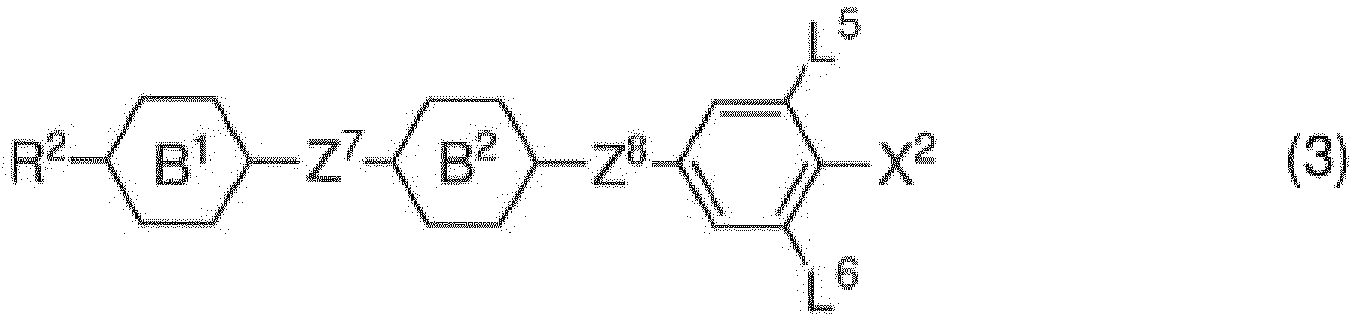
 R2 est un alkyle ayant de 1 à 10 carbones ou un alkényle ayant de 2 à 10 carbones, et dans l'alkyle et l'alkényle, l'hydrogène arbitraire peut être remplacé par le fluor et le -CH2- arbitraire peut être remplacé par -0- ;X2 est le fluor, le chlore, -OCF3, -OCHF2, -CF3, -CHF2, -CH2F, -OCF2CHF2 ou -OCF2CHFCF3 ;L'anneau B1, l'anneau B2 et l'anneau B3 sont chacun de façon indépendante le 1,4-cyclohexylène, la 1,3-dioxane-2,5-diyl, la pyrimidine-2,5-diyl, la tétrahydropyrane-2,5-diyl, le 1,4-phénylène ou le 1,4-phénylène dans lequel l'hydrogène arbitraire est remplacé par le fluor ;Z7 et Z8 sont chacun de façon indépendante -(CH2)2-, -(CH2)4-, -COO-, -CF2O-, -OCF2-, -CH=CH-, -C≡C-, -CH2O- ou une liaison unique ; etL5 et L6 sont chacun de façon indépendante l'hydrogène ou le fluor.
 - Composition de cristaux liquides selon la revendication 10, comprenant comme composant au moins un composé sélectionné parmi le groupe de composés représentés par la formule (5) :
 R3 est un alkyle ayant de 1 à 10 carbones ou un alkényle ayant de 2 à 10 carbones, et dans l'alkyle et l'alkényle, l'hydrogène arbitraire peut être remplacé par le fluor et le -CH2- arbitraire peut être remplacé par -0- ;X3 est -C=N ou -C=C-C=N ;L'anneau C1, l'anneau C2 et l'anneau C3 sont chacun de façon indépendante le 1,4-cyclohexylène, le 1,4-phénylène, le 1,4-phénylène dans lequel l'hydrogène arbitraire est remplacé par le fluor, la 1,3-dioxane-2,5-diyl, la tétrahydropyrane-2,5-diyl ou la pyrimidine-2,5-diyl ;Z9 est -(CH2)2-, -COO-, -CF2O-, -OCF2-, -C=C-, -CH2O- ou une liaison unique ;L7 et L8 sont chacun de façon indépendante l'hydrogène ou le fluor ; et r est 0 ou 1, s est 0 ou 1 et r+s est 0, 1 ou 2.
 - Composition de cristaux liquides selon la revendication 10, comprenant comme composant au moins un composé sélectionné parmi le groupe de composés représentés par chacune des formules (6), (7), (8), (9) et (10) :


 R4 et R5 sont chacun de façon indépendante un alkyle ayant de 1 à 10 carbones ou un alkényle ayant de 2 à 10 carbones, et dans l'alkyle et l'alkényle, l'hydrogène arbitraire peut être remplacé par le fluor et le -CH2- arbitraire peut être remplacé par -0- ;l'anneau D1, l'anneau D2, l'anneau D3 et l'anneau D4 sont chacun de façon indépendante le 1,4-cyclohexylène, le 1,4-cyclohexenylène, le 1,4-phénylène, le 1,4-phénylène dans lequel l'hydrogène arbitraire est remplacé par le fluor, la tétrahydropyrane-2,5-diyl ou le décahydronaphtalène-2,6-diyl ;Z10, Z11, Z12 et Z13 sont chacun de façon indépendante -(CH2)2-, -COO-, -CH2O-, -OCF2-, -OCF2(CH2)2- ou une liaison unique ;L9 et L10 sont chacun de façon indépendante le fluor ou le chlore ; et t, u, x, y et z sont chacun de façon indépendante 0 ou 1, et u+x+y+z est 1 ou 2.
 - Composition de cristaux liquides selon la revendication 10, comprenant comme composant au moins un composé sélectionné parmi le groupe de composés représentés par chacune des formules (11), (12) et (13) :


 R6 et R7 sont chacun de façon indépendante un alkyle ayant de 1 à 10 carbones ou un alkényle ayant de 2 à 10 carbones, et dans l'alkyle et l'alkényle, l'hydrogène arbitraire peut être remplacé par le fluor et le -CH2- arbitraire peut être remplacé par -0- ;l'anneau E1, l'anneau E2, l'anneau E3 et l'anneau E6 sont chacun de façon indépendante le 1,4-cyclohexylène, la pyrimidine-2,5-diyl, le 1,4-phénylène, le 2-fluoro-1,4-phénylène, le 3-fluoro-1,4-phénylène ou le 2,5-difluoro-1,4-phénylène ;l'anneau E4 et l'anneau E5 sont chacun de façon indépendante le 1,4-cyclohexylène, la pyrimidine-2,5-diyl ou le 1,4-phénylène ; etZ14, Z15 et Z16 sont chacun de façon indépendante -C=C-, -COO-, -(CH2)2-, -CH=CH- ou une liaison unique.
 - Dispositif d'affichage à cristaux liquides comprenant la composition de cristaux liquides selon l'une quelconque des revendications 10 à 14.
Applications Claiming Priority (2)
| Application Number | Priority Date | Filing Date | Title |
|---|---|---|---|
| JP2008140469 | 2008-05-29 | ||
| PCT/JP2009/059319 WO2009145101A1 (fr) | 2008-05-29 | 2009-05-21 | Composé tétracyclique cristal liquide ayant un atome de fluor, composition de cristaux liquides et élément d'affichage à cristaux liquides |
Publications (3)
| Publication Number | Publication Date |
|---|---|
| EP2279990A1 EP2279990A1 (fr) | 2011-02-02 |
| EP2279990A4 EP2279990A4 (fr) | 2013-07-03 |
| EP2279990B1 true EP2279990B1 (fr) | 2016-10-26 |
Family
ID=41376979
Family Applications (1)
| Application Number | Title | Priority Date | Filing Date |
|---|---|---|---|
| EP09754609.7A Not-in-force EP2279990B1 (fr) | 2008-05-29 | 2009-05-21 | Composé tétracyclique cristal liquide ayant un atome de fluor, composition de cristaux liquides et élément d'affichage à cristaux liquides |
Country Status (7)
| Country | Link |
|---|---|
| US (1) | US8137583B2 (fr) |
| EP (1) | EP2279990B1 (fr) |
| JP (1) | JP5531954B2 (fr) |
| KR (1) | KR101625240B1 (fr) |
| CN (1) | CN102046570B (fr) |
| TW (1) | TWI444359B (fr) |
| WO (1) | WO2009145101A1 (fr) |
Families Citing this family (10)
| Publication number | Priority date | Publication date | Assignee | Title |
|---|---|---|---|---|
| CN102186946B (zh) * | 2008-10-15 | 2014-02-12 | Jnc株式会社 | 液晶组成物以及液晶显示元件 |
| WO2011040373A1 (fr) * | 2009-10-01 | 2011-04-07 | チッソ株式会社 | Composé cristallin liquide avec anisotropie diélectrique négative, composition de cristaux liquides utilisant celui-ci, et élément d'affichage à cristaux liquides |
| CN102924243B (zh) * | 2012-03-27 | 2013-11-06 | 石家庄诚志永华显示材料有限公司 | 含有环戊基及二氟亚甲氧基连接基团的液晶化合物及其制备方法与应用 |
| DE102014010908A1 (de) * | 2013-08-16 | 2015-03-12 | Merck Patent Gmbh | Flüssigkristallines Medium |
| US10435627B2 (en) * | 2014-04-15 | 2019-10-08 | Jnc Corporation | Liquid crystal display device |
| CN109689603A (zh) * | 2016-10-04 | 2019-04-26 | Dic株式会社 | E-烯烃化合物的制造方法 |
| JP6805698B2 (ja) * | 2016-10-04 | 2020-12-23 | Dic株式会社 | E−オレフィン化合物の製造方法 |
| CN109207163B (zh) * | 2017-06-30 | 2021-09-17 | 江苏和成显示科技有限公司 | 一种液晶组合物及其应用 |
| CN114315543B (zh) * | 2020-09-30 | 2024-03-08 | 河北迈尔斯通电子材料有限公司 | 一种反式-含取代基苯基双环己基甲醛的制备方法 |
| CN116004251A (zh) * | 2023-02-15 | 2023-04-25 | 重庆汉朗精工科技有限公司 | 一种含有四环端烯的液晶组合物及其应用 |
Family Cites Families (8)
| Publication number | Priority date | Publication date | Assignee | Title |
|---|---|---|---|---|
| US5227484A (en) | 1982-01-14 | 1993-07-13 | Merck Patent Gmbh | Anisotropic compounds having nematic phase and liquid crystal mixtures |
| GB2134110B (en) * | 1983-01-26 | 1987-01-14 | Secr Defence | Liquid crystal 1-fluorophenyl-2-cyclohexyl-ethanes |
| GB8302119D0 (en) * | 1983-01-26 | 1983-03-02 | Secr Defence | Disubstituted ethanes |
| DE59008310D1 (de) * | 1989-08-26 | 1995-03-02 | Merck Patent Gmbh | Flüssigkristallines medium. |
| JP2932101B2 (ja) * | 1991-03-26 | 1999-08-09 | 株式会社大塚製薬工場 | 血漿濾過法及びその装置 |
| DE69208351T2 (de) * | 1991-09-30 | 1996-06-13 | Hoffmann La Roche | Halovinylderivate |
| JP5225531B2 (ja) | 2000-12-19 | 2013-07-03 | メルク パテント ゲゼルシャフト ミット ベシュレンクテル ハフツング | 負のdc異方性の四環式化合物および液晶媒体 |
| JP4941290B2 (ja) * | 2005-03-03 | 2012-05-30 | Jnc株式会社 | クロロフルオロベンゼン系液晶性化合物、液晶組成物および液晶表示素子 |
-
2009
- 2009-05-21 CN CN200980119399.2A patent/CN102046570B/zh not_active Expired - Fee Related
- 2009-05-21 WO PCT/JP2009/059319 patent/WO2009145101A1/fr not_active Ceased
- 2009-05-21 KR KR1020107026313A patent/KR101625240B1/ko not_active Expired - Fee Related
- 2009-05-21 US US12/995,124 patent/US8137583B2/en not_active Expired - Fee Related
- 2009-05-21 JP JP2010514450A patent/JP5531954B2/ja not_active Expired - Fee Related
- 2009-05-21 EP EP09754609.7A patent/EP2279990B1/fr not_active Not-in-force
- 2009-05-26 TW TW098117445A patent/TWI444359B/zh not_active IP Right Cessation
Also Published As
| Publication number | Publication date |
|---|---|
| US8137583B2 (en) | 2012-03-20 |
| CN102046570A (zh) | 2011-05-04 |
| EP2279990A1 (fr) | 2011-02-02 |
| JP5531954B2 (ja) | 2014-06-25 |
| JPWO2009145101A1 (ja) | 2011-10-13 |
| EP2279990A4 (fr) | 2013-07-03 |
| US20110079753A1 (en) | 2011-04-07 |
| TW201004905A (en) | 2010-02-01 |
| CN102046570B (zh) | 2014-03-19 |
| KR20110021805A (ko) | 2011-03-04 |
| TWI444359B (zh) | 2014-07-11 |
| WO2009145101A1 (fr) | 2009-12-03 |
| KR101625240B1 (ko) | 2016-05-27 |
Similar Documents
| Publication | Publication Date | Title |
|---|---|---|
| EP2284148B1 (fr) | Composé pentacyclique cristal liquide contenant un cycle cyclohexane, composition de cristaux liquides et élément d écran à cristaux liquides | |
| EP2351741B1 (fr) | Composé de cristal liquide pentacyclique présentant un hétérocycle contenant de l'azote, composition à base de cristaux liquides, et dispositif d'affichage à base de cristaux liquides | |
| EP2279990B1 (fr) | Composé tétracyclique cristal liquide ayant un atome de fluor, composition de cristaux liquides et élément d'affichage à cristaux liquides | |
| EP2123623B1 (fr) | Compose cristallin liquide, composition cristalline liquide, element d'affichage a base de cristaux liquides | |
| EP2669354B1 (fr) | Composé de cyclohéxène-3,6-diyl, composition de cristaux liquides et dispositif d'affichage à cristaux liquides | |
| EP2199270B1 (fr) | Composé cristal liquide, composition à base de cristaux liquides et dispositif d'affichage à base de cristaux liquides | |
| US8389073B2 (en) | Four-ring liquid crystal compound having tetrahydropyran and 2,2′,3,3′-tetrafluorobiphenyl, liquid crystal composition and liquid crystal display device | |
| EP1043299B1 (fr) | Composés cristaux liquides, compositions de cristaux liquides contenant ces composés et dispositifs d affichage à cristaux liquides fabriqués au moyen de ces compositions | |
| EP2690103B1 (fr) | Dérivé d'ortho ester, composition à base de cristaux liquides, et dispositif d'affichage à base de cristaux liquides | |
| EP2479162B1 (fr) | Composé cristal liquide, composition de cristaux liquides et élément d'affichage à cristaux liquides | |
| EP3260451A1 (fr) | Composé cristallin liquide comprenant du benzothiophène, composition de cristaux liquides et élément d'affichage à cristaux liquides | |
| EP2522649A1 (fr) | Composé à cristaux liquides, composition de cristaux liquides et élément d'affichage à cristaux liquides | |
| EP2468740B1 (fr) | Composés de tétrahydropyrane, compositions de cristaux liquides et dispositifs d'affichage à base de cristaux liquides | |
| EP1477546B1 (fr) | Composé contenant le groupe perfluoropropényle, compositions liquides cristallines et dispositif à cristaux liquides | |
| JP2001114722A (ja) | 分岐メチル基を有する液晶性化合物、液晶組成物及び液晶表示素子 | |
| EP1970362B1 (fr) | Compose terphenyle monofluore ayant un groupe alcenyle, composition de cristaux liquides et ecran a cristaux liquides | |
| TWI464137B (zh) | 5環液晶性化合物、液晶組成物及液晶顯示元件 | |
| KR100982763B1 (ko) | 말단기의 하나가 수소인 액정성 화합물, 그 조성물 및 이것을 함유하는 액정 표시 소자 | |
| JP2004002341A (ja) | 末端基の一つが水素である液晶性化合物、その組成物およびこれを含有する液晶表示素子 | |
| EP1731493B1 (fr) | Dérivé de benzène, composition de cristaux liquides et affichage à cristaux liquides |
Legal Events
| Date | Code | Title | Description |
|---|---|---|---|
| PUAI | Public reference made under article 153(3) epc to a published international application that has entered the european phase |
Free format text: ORIGINAL CODE: 0009012 |
|
| 17P | Request for examination filed |
Effective date: 20101108 |
|
| AK | Designated contracting states |
Kind code of ref document: A1 Designated state(s): AT BE BG CH CY CZ DE DK EE ES FI FR GB GR HR HU IE IS IT LI LT LU LV MC MK MT NL NO PL PT RO SE SI SK TR |
|
| AX | Request for extension of the european patent |
Extension state: AL BA RS |
|
| RIN1 | Information on inventor provided before grant (corrected) |
Inventor name: KUBO, TAKAHIRO Inventor name: SHIMADA, TERU |
|
| RAP1 | Party data changed (applicant data changed or rights of an application transferred) |
Owner name: CHISSO PETROCHEMICAL CORPORATION Owner name: CHISSO CORPORATION |
|
| RAP1 | Party data changed (applicant data changed or rights of an application transferred) |
Owner name: CHISSO PETROCHEMICAL CORPORATION Owner name: JNC CORPORATION |
|
| DAX | Request for extension of the european patent (deleted) | ||
| RAP1 | Party data changed (applicant data changed or rights of an application transferred) |
Owner name: JNC PETROCHEMICAL CORPORATION Owner name: JNC CORPORATION |
|
| A4 | Supplementary search report drawn up and despatched |
Effective date: 20130531 |
|
| RIC1 | Information provided on ipc code assigned before grant |
Ipc: C09K 19/12 20060101ALI20130524BHEP Ipc: C09K 19/32 20060101ALI20130524BHEP Ipc: C09K 19/44 20060101ALI20130524BHEP Ipc: C07C 25/18 20060101ALI20130524BHEP Ipc: C09K 19/16 20060101ALI20130524BHEP Ipc: C09K 19/30 20060101ALI20130524BHEP Ipc: C07C 25/24 20060101AFI20130524BHEP Ipc: C09K 19/04 20060101ALI20130524BHEP Ipc: C09K 19/18 20060101ALI20130524BHEP Ipc: C07C 43/192 20060101ALI20130524BHEP Ipc: C09K 19/34 20060101ALI20130524BHEP Ipc: C09K 19/54 20060101ALI20130524BHEP Ipc: C09K 19/14 20060101ALI20130524BHEP Ipc: G02F 1/13 20060101ALI20130524BHEP Ipc: C09K 19/20 20060101ALI20130524BHEP |
|
| 17Q | First examination report despatched |
Effective date: 20140403 |
|
| GRAP | Despatch of communication of intention to grant a patent |
Free format text: ORIGINAL CODE: EPIDOSNIGR1 |
|
| INTG | Intention to grant announced |
Effective date: 20160613 |
|
| GRAS | Grant fee paid |
Free format text: ORIGINAL CODE: EPIDOSNIGR3 |
|
| GRAA | (expected) grant |
Free format text: ORIGINAL CODE: 0009210 |
|
| AK | Designated contracting states |
Kind code of ref document: B1 Designated state(s): AT BE BG CH CY CZ DE DK EE ES FI FR GB GR HR HU IE IS IT LI LT LU LV MC MK MT NL NO PL PT RO SE SI SK TR |
|
| REG | Reference to a national code |
Ref country code: GB Ref legal event code: FG4D |
|
| REG | Reference to a national code |
Ref country code: CH Ref legal event code: EP |
|
| REG | Reference to a national code |
Ref country code: AT Ref legal event code: REF Ref document number: 839884 Country of ref document: AT Kind code of ref document: T Effective date: 20161115 |
|
| REG | Reference to a national code |
Ref country code: IE Ref legal event code: FG4D |
|
| REG | Reference to a national code |
Ref country code: DE Ref legal event code: R096 Ref document number: 602009041947 Country of ref document: DE |
|
| REG | Reference to a national code |
Ref country code: LT Ref legal event code: MG4D |
|
| PG25 | Lapsed in a contracting state [announced via postgrant information from national office to epo] |
Ref country code: LV Free format text: LAPSE BECAUSE OF FAILURE TO SUBMIT A TRANSLATION OF THE DESCRIPTION OR TO PAY THE FEE WITHIN THE PRESCRIBED TIME-LIMIT Effective date: 20161026 |
|
| REG | Reference to a national code |
Ref country code: NL Ref legal event code: MP Effective date: 20161026 |
|
| REG | Reference to a national code |
Ref country code: AT Ref legal event code: MK05 Ref document number: 839884 Country of ref document: AT Kind code of ref document: T Effective date: 20161026 |
|
| PG25 | Lapsed in a contracting state [announced via postgrant information from national office to epo] |
Ref country code: GR Free format text: LAPSE BECAUSE OF FAILURE TO SUBMIT A TRANSLATION OF THE DESCRIPTION OR TO PAY THE FEE WITHIN THE PRESCRIBED TIME-LIMIT Effective date: 20170127 Ref country code: LT Free format text: LAPSE BECAUSE OF FAILURE TO SUBMIT A TRANSLATION OF THE DESCRIPTION OR TO PAY THE FEE WITHIN THE PRESCRIBED TIME-LIMIT Effective date: 20161026 Ref country code: SE Free format text: LAPSE BECAUSE OF FAILURE TO SUBMIT A TRANSLATION OF THE DESCRIPTION OR TO PAY THE FEE WITHIN THE PRESCRIBED TIME-LIMIT Effective date: 20161026 Ref country code: NO Free format text: LAPSE BECAUSE OF FAILURE TO SUBMIT A TRANSLATION OF THE DESCRIPTION OR TO PAY THE FEE WITHIN THE PRESCRIBED TIME-LIMIT Effective date: 20170126 |
|
| PG25 | Lapsed in a contracting state [announced via postgrant information from national office to epo] |
Ref country code: HR Free format text: LAPSE BECAUSE OF FAILURE TO SUBMIT A TRANSLATION OF THE DESCRIPTION OR TO PAY THE FEE WITHIN THE PRESCRIBED TIME-LIMIT Effective date: 20161026 Ref country code: PT Free format text: LAPSE BECAUSE OF FAILURE TO SUBMIT A TRANSLATION OF THE DESCRIPTION OR TO PAY THE FEE WITHIN THE PRESCRIBED TIME-LIMIT Effective date: 20170227 Ref country code: PL Free format text: LAPSE BECAUSE OF FAILURE TO SUBMIT A TRANSLATION OF THE DESCRIPTION OR TO PAY THE FEE WITHIN THE PRESCRIBED TIME-LIMIT Effective date: 20161026 Ref country code: ES Free format text: LAPSE BECAUSE OF FAILURE TO SUBMIT A TRANSLATION OF THE DESCRIPTION OR TO PAY THE FEE WITHIN THE PRESCRIBED TIME-LIMIT Effective date: 20161026 Ref country code: BE Free format text: LAPSE BECAUSE OF FAILURE TO SUBMIT A TRANSLATION OF THE DESCRIPTION OR TO PAY THE FEE WITHIN THE PRESCRIBED TIME-LIMIT Effective date: 20161026 Ref country code: FI Free format text: LAPSE BECAUSE OF FAILURE TO SUBMIT A TRANSLATION OF THE DESCRIPTION OR TO PAY THE FEE WITHIN THE PRESCRIBED TIME-LIMIT Effective date: 20161026 Ref country code: AT Free format text: LAPSE BECAUSE OF FAILURE TO SUBMIT A TRANSLATION OF THE DESCRIPTION OR TO PAY THE FEE WITHIN THE PRESCRIBED TIME-LIMIT Effective date: 20161026 Ref country code: NL Free format text: LAPSE BECAUSE OF FAILURE TO SUBMIT A TRANSLATION OF THE DESCRIPTION OR TO PAY THE FEE WITHIN THE PRESCRIBED TIME-LIMIT Effective date: 20161026 Ref country code: IS Free format text: LAPSE BECAUSE OF FAILURE TO SUBMIT A TRANSLATION OF THE DESCRIPTION OR TO PAY THE FEE WITHIN THE PRESCRIBED TIME-LIMIT Effective date: 20170226 |
|
| REG | Reference to a national code |
Ref country code: DE Ref legal event code: R097 Ref document number: 602009041947 Country of ref document: DE |
|
| PG25 | Lapsed in a contracting state [announced via postgrant information from national office to epo] |
Ref country code: DK Free format text: LAPSE BECAUSE OF FAILURE TO SUBMIT A TRANSLATION OF THE DESCRIPTION OR TO PAY THE FEE WITHIN THE PRESCRIBED TIME-LIMIT Effective date: 20161026 Ref country code: EE Free format text: LAPSE BECAUSE OF FAILURE TO SUBMIT A TRANSLATION OF THE DESCRIPTION OR TO PAY THE FEE WITHIN THE PRESCRIBED TIME-LIMIT Effective date: 20161026 Ref country code: RO Free format text: LAPSE BECAUSE OF FAILURE TO SUBMIT A TRANSLATION OF THE DESCRIPTION OR TO PAY THE FEE WITHIN THE PRESCRIBED TIME-LIMIT Effective date: 20161026 Ref country code: SK Free format text: LAPSE BECAUSE OF FAILURE TO SUBMIT A TRANSLATION OF THE DESCRIPTION OR TO PAY THE FEE WITHIN THE PRESCRIBED TIME-LIMIT Effective date: 20161026 Ref country code: CZ Free format text: LAPSE BECAUSE OF FAILURE TO SUBMIT A TRANSLATION OF THE DESCRIPTION OR TO PAY THE FEE WITHIN THE PRESCRIBED TIME-LIMIT Effective date: 20161026 |
|
| PG25 | Lapsed in a contracting state [announced via postgrant information from national office to epo] |
Ref country code: BG Free format text: LAPSE BECAUSE OF FAILURE TO SUBMIT A TRANSLATION OF THE DESCRIPTION OR TO PAY THE FEE WITHIN THE PRESCRIBED TIME-LIMIT Effective date: 20170126 Ref country code: LU Free format text: LAPSE BECAUSE OF NON-PAYMENT OF DUE FEES Effective date: 20170531 Ref country code: IT Free format text: LAPSE BECAUSE OF FAILURE TO SUBMIT A TRANSLATION OF THE DESCRIPTION OR TO PAY THE FEE WITHIN THE PRESCRIBED TIME-LIMIT Effective date: 20161026 |
|
| PLBE | No opposition filed within time limit |
Free format text: ORIGINAL CODE: 0009261 |
|
| STAA | Information on the status of an ep patent application or granted ep patent |
Free format text: STATUS: NO OPPOSITION FILED WITHIN TIME LIMIT |
|
| 26N | No opposition filed |
Effective date: 20170727 |
|
| PG25 | Lapsed in a contracting state [announced via postgrant information from national office to epo] |
Ref country code: SI Free format text: LAPSE BECAUSE OF FAILURE TO SUBMIT A TRANSLATION OF THE DESCRIPTION OR TO PAY THE FEE WITHIN THE PRESCRIBED TIME-LIMIT Effective date: 20161026 |
|
| REG | Reference to a national code |
Ref country code: DE Ref legal event code: R119 Ref document number: 602009041947 Country of ref document: DE |
|
| REG | Reference to a national code |
Ref country code: CH Ref legal event code: PL |
|
| PG25 | Lapsed in a contracting state [announced via postgrant information from national office to epo] |
Ref country code: MC Free format text: LAPSE BECAUSE OF FAILURE TO SUBMIT A TRANSLATION OF THE DESCRIPTION OR TO PAY THE FEE WITHIN THE PRESCRIBED TIME-LIMIT Effective date: 20161026 |
|
| REG | Reference to a national code |
Ref country code: IE Ref legal event code: MM4A |
|
| PG25 | Lapsed in a contracting state [announced via postgrant information from national office to epo] |
Ref country code: LI Free format text: LAPSE BECAUSE OF NON-PAYMENT OF DUE FEES Effective date: 20170531 Ref country code: CH Free format text: LAPSE BECAUSE OF NON-PAYMENT OF DUE FEES Effective date: 20170531 |
|
| REG | Reference to a national code |
Ref country code: FR Ref legal event code: ST Effective date: 20180131 |
|
| PG25 | Lapsed in a contracting state [announced via postgrant information from national office to epo] |
Ref country code: LU Free format text: LAPSE BECAUSE OF NON-PAYMENT OF DUE FEES Effective date: 20170521 |
|
| PG25 | Lapsed in a contracting state [announced via postgrant information from national office to epo] |
Ref country code: DE Free format text: LAPSE BECAUSE OF NON-PAYMENT OF DUE FEES Effective date: 20171201 Ref country code: IE Free format text: LAPSE BECAUSE OF NON-PAYMENT OF DUE FEES Effective date: 20170521 |
|
| PG25 | Lapsed in a contracting state [announced via postgrant information from national office to epo] |
Ref country code: FR Free format text: LAPSE BECAUSE OF NON-PAYMENT OF DUE FEES Effective date: 20170531 |
|
| PG25 | Lapsed in a contracting state [announced via postgrant information from national office to epo] |
Ref country code: MT Free format text: LAPSE BECAUSE OF NON-PAYMENT OF DUE FEES Effective date: 20170521 |
|
| PG25 | Lapsed in a contracting state [announced via postgrant information from national office to epo] |
Ref country code: HU Free format text: LAPSE BECAUSE OF FAILURE TO SUBMIT A TRANSLATION OF THE DESCRIPTION OR TO PAY THE FEE WITHIN THE PRESCRIBED TIME-LIMIT; INVALID AB INITIO Effective date: 20090521 |
|
| PG25 | Lapsed in a contracting state [announced via postgrant information from national office to epo] |
Ref country code: CY Free format text: LAPSE BECAUSE OF NON-PAYMENT OF DUE FEES Effective date: 20161026 |
|
| PG25 | Lapsed in a contracting state [announced via postgrant information from national office to epo] |
Ref country code: MK Free format text: LAPSE BECAUSE OF FAILURE TO SUBMIT A TRANSLATION OF THE DESCRIPTION OR TO PAY THE FEE WITHIN THE PRESCRIBED TIME-LIMIT Effective date: 20161026 |
|
| PG25 | Lapsed in a contracting state [announced via postgrant information from national office to epo] |
Ref country code: TR Free format text: LAPSE BECAUSE OF FAILURE TO SUBMIT A TRANSLATION OF THE DESCRIPTION OR TO PAY THE FEE WITHIN THE PRESCRIBED TIME-LIMIT Effective date: 20161026 |
|
| PGFP | Annual fee paid to national office [announced via postgrant information from national office to epo] |
Ref country code: GB Payment date: 20210429 Year of fee payment: 13 |
|
| GBPC | Gb: european patent ceased through non-payment of renewal fee |
Effective date: 20220521 |
|
| PG25 | Lapsed in a contracting state [announced via postgrant information from national office to epo] |
Ref country code: GB Free format text: LAPSE BECAUSE OF NON-PAYMENT OF DUE FEES Effective date: 20220521 |