EP2281467A2 - Procédé et dispositif de chauffage, notamment de produits hautement visqueux - Google Patents
Procédé et dispositif de chauffage, notamment de produits hautement visqueux Download PDFInfo
- Publication number
- EP2281467A2 EP2281467A2 EP10168851A EP10168851A EP2281467A2 EP 2281467 A2 EP2281467 A2 EP 2281467A2 EP 10168851 A EP10168851 A EP 10168851A EP 10168851 A EP10168851 A EP 10168851A EP 2281467 A2 EP2281467 A2 EP 2281467A2
- Authority
- EP
- European Patent Office
- Prior art keywords
- product
- water
- heat exchanger
- temperature
- heating medium
- Prior art date
- Legal status (The legal status is an assumption and is not a legal conclusion. Google has not performed a legal analysis and makes no representation as to the accuracy of the status listed.)
- Granted
Links
Images


Classifications
-
- A—HUMAN NECESSITIES
- A23—FOODS OR FOODSTUFFS; TREATMENT THEREOF, NOT COVERED BY OTHER CLASSES
- A23B—PRESERVATION OF FOODS, FOODSTUFFS OR NON-ALCOHOLIC BEVERAGES; CHEMICAL RIPENING OF FRUIT OR VEGETABLES
- A23B70/00—Preservation of non-alcoholic beverages
- A23B70/30—Preservation of non-alcoholic beverages by heating
-
- A—HUMAN NECESSITIES
- A23—FOODS OR FOODSTUFFS; TREATMENT THEREOF, NOT COVERED BY OTHER CLASSES
- A23B—PRESERVATION OF FOODS, FOODSTUFFS OR NON-ALCOHOLIC BEVERAGES; CHEMICAL RIPENING OF FRUIT OR VEGETABLES
- A23B2/00—Preservation of foods or foodstuffs, in general
- A23B2/40—Preservation of foods or foodstuffs, in general by heating loose unpacked materials
- A23B2/42—Preservation of foods or foodstuffs, in general by heating loose unpacked materials while they are progressively transported through the apparatus
- A23B2/46—Preservation of foods or foodstuffs, in general by heating loose unpacked materials while they are progressively transported through the apparatus with transport through tubes
-
- A—HUMAN NECESSITIES
- A23—FOODS OR FOODSTUFFS; TREATMENT THEREOF, NOT COVERED BY OTHER CLASSES
- A23L—FOODS, FOODSTUFFS OR NON-ALCOHOLIC BEVERAGES, NOT OTHERWISE PROVIDED FOR; PREPARATION OR TREATMENT THEREOF
- A23L2/00—Non-alcoholic beverages; Dry compositions or concentrates therefor; Preparation or treatment thereof
- A23L2/02—Non-alcoholic beverages; Dry compositions or concentrates therefor; Preparation or treatment thereof containing fruit or vegetable juices
Definitions
- the invention relates to a method for heating, in particular of highly viscous products and to an apparatus for carrying out this method.
- heat exchangers are used in which the incoming product is heated by a product which has been previously heated to a higher temperature.
- heat exchangers are used in which the incoming product is heated by a product which has been previously heated to a higher temperature.
- plate heat exchanger but in accordance with hygienic design of the secondary side and tube bundle heat exchangers are.
- Such a process allows a high heat recovery of 90 to 95% and allows the reduction of heat exchange surface necessary for heating.
- investment costs and footprint can be reduced.
- a disadvantage of this technique is that this process is economically suitable for common heat exchangers with smooth heat exchanger surfaces only for low-viscosity products (up to a maximum of 5 to 15 mPas). Meanwhile, there are also heat exchangers that have an uneven, textured surface to enhance heat transfer.
- a product is used against water process.
- This process is suitable for all products, including those with a high viscosity, ie products with viscosities> 15 mPas. It has a high flexibility with regard to temperature and product spreads (ie products of different viscosity, which are run on a system).
- a disadvantage of this process is the lower heat recovery (80 to 87%). This results in higher investment costs due to larger required heat exchanger surfaces and thus to be installed heat exchanger modules.
- the present invention has the object to provide a method and an apparatus for heating products that are also suitable for heating high-viscosity products, and allows a high heat recovery at low investment costs.
- the method according to the invention and the device according to the invention allow a product / product heat exchanger process to also be possible for highly viscous products, with high heat recovery rates being possible at low investment costs and compact systems.
- the product in a first step with at least one product / water heat exchanger section, the product is preheated to a first temperature T1 with water as recuperative heating medium, the water cooling. Only then, in a second step, is the preheated product in a product / product heat exchanger section further heated to a second temperature T2.
- Preheating the product in the first step decreases the viscosity of the product, allowing for better heat transfer in the product / product heat exchanger section - i. in the second step - results.
- the third step can then be carried out a high temperature to the desired product treatment temperature with heating water.
- the product heated in the third step can then be recycled and used as a heating medium to heat the product in step two.
- this method or device allows a smaller plant periphery, lower number of pumps and equalizing heat exchanger. There are fewer heat exchanger sections or modules than the classic water swing with better heat recovery (90 to 95%) needed. The efficiency is only minimally lower than with classic product / product applications.
- the inventive method and the device according to the invention allow a higher flexibility with respect to fluctuation of the inlet temperatures and the directly resulting outlet temperatures, because with the vorgschalteten product / water section on the secondary side in terms of temperature and flow of heat transfer can be adjusted.
- the degassing or the homogenization temperature is independent of the constricted product / product process in the first section, because with the vorgschalteten product / water section on the secondary side in terms of temperature and flow of heat transfer can be adjusted.
- the cryogenic sections are not driven recuperatively with product as the cooling medium.
- the product that has been cooled in step two is in a fourth step with at least one product / water heat exchanger section 4a is cooled to a temperature T5, wherein as the cooling medium, water which has been cooled in the first step, is used.
- the heating medium of step 1, which cools in step 1 can be used to cool the returning product, which significantly improves the efficiency of the process or device. It is advantageous if the heated water from the fourth step is recirculated and used in step 1 as a heating medium for preheating the product, in which case the water cooled in step 1 can again serve as the cooling medium in step 4. The water cycle between the product to be heated and the return product to be cooled in turn improves the heat recovery.
- the product is heated to a temperature T1 in step one such that the viscosity of the product is then less than 15 mPa.s, preferably less than 5 mPa.s.
- the viscosity range can shift upwards. This means that for this application case, the viscosity at the outlet of the first heat exchanger area should be less than 25 mPa ⁇ s, preferably less than 10 mPa ⁇ s.
- the viscosity range may shift further upwards. Thus, a good heat transfer can be ensured.
- the product must therefore be heated in the warming range one in step 1 so high that the exit viscosity as an indicator falls below a critical value.
- the exact temperature and viscosity values are dependent on the respective product.
- the density decreases with increasing temperature and the heat capacity and the thermal conductivity increase with increasing temperature, which also increases the heat transfer and the effectiveness of a product / product application.
- T1 ⁇ T2 ⁇ T3 that is to say that in the warming up ranges the temperature of the product is increased, the temperature T3 then corresponding to the desired product treatment temperature necessary, for example, for the thermal treatment of the product in order to ensure its microbiological stability.
- the invention makes it possible to heat products whose initial viscosity at 20 ° C. and corresponding shear rate (for example 300 to 800 1 / s), in a range> 5 mPa ⁇ s, preferably in a range from 5 mPa ⁇ s to 100 mPa ⁇ s lies.
- the product can be passed over a product bypass past the first heat exchanger area, ie past the at least one product / water heat exchanger section.
- the device according to the invention for carrying out the method has, for carrying out the steps 1, 2, 3, a corresponding first, second and third warm-up region, which in each case comprises at least one heat exchanger section.
- a heat exchanger section in this case comprises at least one heat exchanger, in particular at least one tube bundle heat exchanger or plate heat exchanger. If there are several heat exchanger sections in a warm-up area, these are connected in series on the product side.
- the warming-up areas or their heat exchanger sections are interconnected in such a way that water can be supplied as heating medium for preheating in the first warming-up area and product which returns in the second warming-up area and which has been heated with water in a third warming-up area.
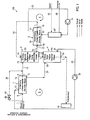
- Fig. 1 shows a device for heating a product, in particular for the thermal heating of a product.
- a device finds particular application in the beverage industry for sterilizing beverages or other liquid foods.
- the device is also suitable for all recuperative applications, in particular for heating highly viscous products.
- the device has a product inlet 7 through which the product enters the device.
- the course of the product to be heated is represented by the dashed line, the course of the water by the solid line, and the course of steam by the dashed lines.
- the device has a first warm-up area 1, which comprises at least one product / water heat exchanger section 1a includes, with which the product is preheated to a preheating T1 with water as the heating medium.
- Fig. 1 only one heat exchanger section 1a is shown. However, it is also possible to connect several first product / heat exchanger sections 1a in series one behind the other.
- FIG. 4 shows in a general manner a series connection of heat exchanger sections, wherein the outlet of a first section a is connected to the inlet of a subsequent section b for heating or cooling a product. Likewise, the outlet of a section c for a heating-cooling medium is connected to the inlet of a subsequent section b in the flow direction of the medium.
- the product / water heat exchanger section 1a here has an inlet 8 for the product and a spout 9 for the heated product.
- the heat exchanger section 1a an inlet 11 for heating medium (here: water) and an outlet 10 for the cooled heating medium.
- the first warm-up area is connected to a second warm-up area 2.
- the second warming-up area 2 also has at least one product / product heat exchanger section 2 a, with which the preheated product from the warming-up area 1 can be heated further to a temperature T 2 with heated returning product as the heating medium.
- the product / product heat exchanger section 2a an inlet 13 for product to be heated, and a spout 14 for heated product.
- the heat exchanger section 2a has a feed 15 for a heating medium, here returning product, and a discharge 16 for cooled returning product.
- the two streams are conducted countercurrently in all the sections described.
- the outlet 14 of the heat exchanger section 2a is connected via a line 17 to the inlet 18 of the product / water heat exchanger section 3a of a third heating zone 3, wherein the third heating zone 3 comprises at least one product / water heat exchanger section 3a.
- the product / water heat exchanger section 3a further heats the product from the second warming-up area 2 with water as the heating medium to a temperature T3.
- the pharmacisttäuschersetation 3a has a spout 19 for heated, returning product and further a feed 20 for the heating medium, here: water or steam, and an outlet 21 for the cooled heating medium.
- the product heated to a product treatment temperature T3 is returned via line 22 back to the second heating zone 2 as heating medium.
- the returning product enters the inlet 15 of the heat exchanger section 2 a and can thus heat the product which is supplied via the inlet 13. Thereby cools the returning product, the heating medium for the third warm-up area 3, preferably in countercurrent.
- a supply line for steam 25 is provided which supplies steam to a hot water heater 27, so that then hot water via the inlet 20 to the third warm-up area 3, i. the heat exchanger section 3a, is supplied.
- the outlet 21 is connected via the hot water heater 27 to the inlet 20, so that the circuit 6 is formed.
- the condensate is discharged via the condensate line 26 from the hot water heater 27, while new steam can be supplied via the line 25.
- the pump 24 the hot water is pumped in a circle.
- a cooling area 4 which comprises at least one product / water heat exchanger section 4 a
- the heat exchanger section 4a has a feed 28 for returning product to be cooled and an outlet 29 for the cooled product.
- the section 4a has an outlet 30 for the then heated water.
- the outlet 30 is connected via the line 51 to the inlet 11 of the heat exchanger section 1a.
- the preheating area can be supplied as the heating medium, the heated water in the section 4a.
- the water 31 can then be fed again to the inlet 31 via the circulation line 32.
- the product / water heat exchanger section 4a further includes a recirculating cooled product outlet 29.
- another non-recuperative freezer 41 is provided.
- a bypass line 39 can be provided, which can bridge the first warm-up area 1 in the partial flow.
- a corresponding control valves 40 is provided in the line 39.
- Fig. 1 in each case only one heat exchanger section is shown for the individual warming up areas or the cooling area.
- these warm-up areas can contain any number of sections which are then connected in series on the product side and as a unit then as in FIG. 1 sections are interconnected. This means that the respective inflow for several sections takes place, for example, via the inlet of the first section and the outlet via the outlet of the last of the sections arranged in series.
- a heat exchanger section comprises at least one heat exchanger module.
- Fig. 2 an example of a tube heat exchanger module is shown, for example, in the in Fig. 1 , gevid having. Smooth surfaces are advantageous for hygienic reasons.
- the module shows a secondary-side inlet 36 and a secondary-side outlet 37, which are arranged in this embodiment in the jacket 38 or outer tube of the heat exchanger.
- the tube bundle heat exchanger has a plurality of tube bundles with a corresponding primary-side inlet 34 and outlet 35. As the primary side, the flow through the inner tubes 55 of the module is called.
- the product to be heated flows in a product / water tube heat exchanger in tubes 55, ie primarily.
- the product to be heated which is not yet sterile, flows outside the tubes 55, ie, secondarily, and the sterile heated product primarily, ie, in the tubes 55. This is because the inner tubes are given a higher hygienic Security awards.
- a plurality of heat exchanger modules are arranged in a section, these are arranged in series, that is, the outlet 35 of a first module is connected to the inlet 34 of a subsequent module and the outlet 37 is connected to the inlet 36 of a subsequent module.
- the inventive method is particularly suitable for highly viscous products having a viscosity> 5 - 100 mPas
- the viscosity of a product is dependent on the product temperature.
- Fig. 3 shows a product that at a temperature of 20 ° C, a high initial viscosity, eg. B. of 20 mPas, has. How out Fig. 3 shows that at temperatures ⁇ 60 ° C, the viscosity is so high that a product / product heat exchanger process is uneconomical due to the poor heat transfer.
- the viscosity drops so much that a product / product heat exchanger process is economically possible.
- the density decreases with increasing temperature and the heat capacity and the thermal conductivity increase.
- the product which for example enters the device at a temperature of 5 ° to 35 ° C., in this case for example 15 ° C., in a first step with at least one product / water heat exchanger section 1 a to a first temperature T 1 Preheated water as a heating medium, the heating medium cools.
- the product is heated in step 1 so high that the exit viscosity as an indicator, but also the density, the thermal conductivity and the heat capacity falls below a critical value.
- the viscosity at the outlet 9 with smooth tube surfaces should be less than 15 mPa ⁇ s, preferably less than 5 mPa ⁇ s.
- the viscosity can move strongly upwards. That is, for this application, then the viscosity at the outlet 9 should be less than 25 mPa ⁇ s, preferably less than 10 mPa ⁇ s.
- the viscosity range may shift further upwards.
- the temperature T1 to which the product is heated is for example in a range between 30 ° C and 80 ° C, preferably 50 ° C to 70 ° C, depending on the initial viscosity of the product.
- the product is supplied on the primary side and the heating medium water on the secondary side.
- the preheated product which is now no longer highly viscous, can now be further heated in a second step with at least one product / product heat exchanger section 2a to a second temperature T2 with returning product as the heating medium, wherein the returning product serving as the heating medium cools.
- the product can thus be heated to a temperature T2, for example in a range of 72 ° C to 135 ° C.
- the product to be heated is supplied on the secondary side and the returning cooling product is supplied on the primary side.
- the product is then further heated with at least one product / water heat exchanger section 3a to a third temperature T3 with water as the heating medium, wherein the water preferably cools in countercurrent.
- the product may here be brought to the desired product treatment temperature, e.g. to be sterilized, to be heated up.
- the temperature may be, for example, in a range of 90 ° C to 140 ° C.
- the heating medium, i. here the water is circulated in the circuit 6, wherein via a line 25 the hot water heater steam is supplied and via a line 26 condensate is discharged.
- the highly heated product is then returned to the second warming-up area 2 via the line 22 and serves as a heating medium while being cooled down to a temperature T4 which is lower than the temperature T3.
- the temperature T4 may be in a range of 55 ° C to 65 ° C, for example.
- the product in the cooling region 4 is cooled to a temperature T5 via the at least one product / water heat exchanger section 4a.
- the temperature T5 is for example in a range between 17 ° C and 25 ° C.
- the supply of the product to be cooled takes place on the primary side, the supply of the cooling medium, here the water, takes place on the secondary side.
- the cooled returning product may optionally be to another cooler 41 to a buffer tank or directly to a filling device.
- the cooling medium used for the cooling section 4 is The cooling medium has, when entering the cooling region, here depending on the product inlet temperature: for example, a temperature of 10 ° C to 15 ° C.
- the water which is passed through the cooling area, is circulated to the preheating area 1 and in turn serves as a heating medium for preheating the product.
- This heating medium has, for example, a temperature in the range of 55 ° C to 75 ° C when entering the first warming area 1.
- the cooling medium of the cooling section 4 can be used to preheat the product so that the viscosity of the product can be lowered.
- water was given as the heating medium.
- the water In circuit 5 and 6, the water is in its liquid phase.
- the circuit water is supplied via the hot water heater 27 continuously with steam, the energy that goes into the product during heating in stage 3.
- the present invention also enables a product / product heat exchange process for high viscosity products such as fruit juices, syrups, smoothies.
Landscapes
- Life Sciences & Earth Sciences (AREA)
- Engineering & Computer Science (AREA)
- Chemical & Material Sciences (AREA)
- Food Science & Technology (AREA)
- Polymers & Plastics (AREA)
- Wood Science & Technology (AREA)
- Zoology (AREA)
- Health & Medical Sciences (AREA)
- Nutrition Science (AREA)
- Heat-Exchange Devices With Radiators And Conduit Assemblies (AREA)
- Heating, Cooling, Or Curing Plastics Or The Like In General (AREA)
Applications Claiming Priority (1)
| Application Number | Priority Date | Filing Date | Title |
|---|---|---|---|
| DE102009036019A DE102009036019A1 (de) | 2009-08-04 | 2009-08-04 | Verfahren und Vorrichtung zur Erhitzung, insbesondere von hochviskosen Produkten |
Publications (3)
| Publication Number | Publication Date |
|---|---|
| EP2281467A2 true EP2281467A2 (fr) | 2011-02-09 |
| EP2281467A3 EP2281467A3 (fr) | 2012-03-21 |
| EP2281467B1 EP2281467B1 (fr) | 2015-01-28 |
Family
ID=43216333
Family Applications (1)
| Application Number | Title | Priority Date | Filing Date |
|---|---|---|---|
| EP10168851.3A Active EP2281467B1 (fr) | 2009-08-04 | 2010-07-08 | Procédé et dispositif de chauffage, notamment de produits hautement visqueux |
Country Status (5)
| Country | Link |
|---|---|
| US (1) | US20110030918A1 (fr) |
| EP (1) | EP2281467B1 (fr) |
| CN (1) | CN101991172B (fr) |
| BR (1) | BRPI1002766A2 (fr) |
| DE (1) | DE102009036019A1 (fr) |
Cited By (2)
| Publication number | Priority date | Publication date | Assignee | Title |
|---|---|---|---|---|
| EP2687108A4 (fr) * | 2011-03-13 | 2015-03-25 | Tetra Laval Holdings & Finance | Dispositif et procédé pour chauffer et stériliser un aliment liquide |
| WO2016055548A1 (fr) * | 2014-10-07 | 2016-04-14 | Krones Ag | Installation de traitement dans le domaine alimentaire, notamment une installation de brasserie équipée d'une mini centrale de cogénération |
Families Citing this family (2)
| Publication number | Priority date | Publication date | Assignee | Title |
|---|---|---|---|---|
| CN102326621B (zh) * | 2011-05-31 | 2016-06-08 | 大连九羊食品有限公司 | 一种羊奶杀菌装置 |
| CN103815518A (zh) * | 2012-11-16 | 2014-05-28 | 缪晓青 | 一种叠压式蜂蜜保鲜灭菌杀酵机 |
Family Cites Families (12)
| Publication number | Priority date | Publication date | Assignee | Title |
|---|---|---|---|---|
| DE1492360B2 (de) * | 1965-07-03 | 1971-12-16 | Verfahren zur kontinuierlichen thermischen entkeimung von stroemenden fluessigkeiten | |
| NL8802714A (nl) * | 1987-11-24 | 1989-06-16 | Stork Amsterdam | Werkwijze voor het in continue doorstroming thermisch behandelen van een produktmengsel bestaande uit een vloeistof met daarin opgenomen vaste delen. |
| US4850270A (en) * | 1988-03-31 | 1989-07-25 | Bronnert Herve X | Liquid solid continuous aseptic processing system |
| NL9200235A (nl) * | 1992-02-07 | 1993-09-01 | Friesland Frico Domo Coop | Werkwijze en inrichting voor het aan een warmtebehandeling onderwerpen van een vloeibaar produkt. |
| US5494691A (en) * | 1993-05-10 | 1996-02-27 | Tetra Laval Holdings & Finance Sa | Process for packaging liquid food products |
| US20030049356A1 (en) * | 1998-06-03 | 2003-03-13 | Nielsen Jorgen Tage | Method of pasteurizing, monitoring PU-uptake, controlling PU-up-take and apparatus for pasteurizing |
| US7435440B2 (en) * | 2003-11-20 | 2008-10-14 | Feldmeier Equipment, Inc. | UHT pasteurizer with regeneration and ultra high temperature homogenization |
| US7186430B2 (en) * | 2003-11-20 | 2007-03-06 | Feldmeier Equipment, Inc. | UHT pasteurizer with regeneration |
| SE529692C2 (sv) * | 2005-04-19 | 2007-10-23 | Tetra Laval Holdings & Finance | Metod vid varmfyllning av livsmedel i en förpackningsbehållare |
| ITVI20050282A1 (it) * | 2005-10-18 | 2007-04-19 | Manzini Spa | Impianto per il trattamento termicamente controllato di prodotti alimentari, in particolare latte o similari |
| DE102005055016B4 (de) * | 2005-11-18 | 2008-04-03 | Tuchenhagen Dairy Systems Gmbh | Verfahren und Röhren-Wärmeaustauscher zur thermischen Behandlung hochviskoser Produkte der Nahrungsmittel- und Getränkeindustrie |
| JP6129071B2 (ja) * | 2010-05-20 | 2017-05-24 | ミテコ アクチエンゲゼルシャフトMiteco AG | 少なくとも1つの液体をパスチャライズする設備及び方法 |
-
2009
- 2009-08-04 DE DE102009036019A patent/DE102009036019A1/de not_active Withdrawn
-
2010
- 2010-07-08 EP EP10168851.3A patent/EP2281467B1/fr active Active
- 2010-08-03 BR BRPI1002766-1A patent/BRPI1002766A2/pt not_active IP Right Cessation
- 2010-08-04 CN CN2010102501660A patent/CN101991172B/zh not_active Expired - Fee Related
- 2010-08-04 US US12/850,022 patent/US20110030918A1/en not_active Abandoned
Non-Patent Citations (1)
| Title |
|---|
| None |
Cited By (3)
| Publication number | Priority date | Publication date | Assignee | Title |
|---|---|---|---|---|
| EP2687108A4 (fr) * | 2011-03-13 | 2015-03-25 | Tetra Laval Holdings & Finance | Dispositif et procédé pour chauffer et stériliser un aliment liquide |
| US9198456B2 (en) | 2011-03-13 | 2015-12-01 | Tetra Laval Holdings & Finance S.A. | Apparatus and method for heating and sterilizing liquid food |
| WO2016055548A1 (fr) * | 2014-10-07 | 2016-04-14 | Krones Ag | Installation de traitement dans le domaine alimentaire, notamment une installation de brasserie équipée d'une mini centrale de cogénération |
Also Published As
| Publication number | Publication date |
|---|---|
| CN101991172B (zh) | 2012-11-21 |
| DE102009036019A1 (de) | 2011-02-10 |
| EP2281467B1 (fr) | 2015-01-28 |
| BRPI1002766A2 (pt) | 2012-04-03 |
| US20110030918A1 (en) | 2011-02-10 |
| CN101991172A (zh) | 2011-03-30 |
| EP2281467A3 (fr) | 2012-03-21 |
Similar Documents
| Publication | Publication Date | Title |
|---|---|---|
| EP2114465B1 (fr) | Dispositif de pasteurisation avec pompe à chaleur intégrée, et procédé correspondant | |
| EP3068237B1 (fr) | Procédé et installation de pasteurisation de produits dans des récipients | |
| WO2008017571A1 (fr) | Appareil pour l'exécution combinée d'un transfert de chaleur et d'un mélangeage statique avec un liquide | |
| EP2281467B1 (fr) | Procédé et dispositif de chauffage, notamment de produits hautement visqueux | |
| EP4068984B1 (fr) | Installation de pasteurisation d'aliments ou de boissons introduits dans des récipients fermés au moyen d'un liquide de traitement | |
| EP3509980A1 (fr) | Installation de remplissage permettant le traitement thermique et le remplissage d'un liquide | |
| DE2723088C2 (de) | Vorrichtung zum zyklischen Erwärmen und Abkühlen eines Werkzeugs und Verfahren um Betreiben dieser Vorrichtung | |
| EP3431889A1 (fr) | Circuit d'alimentation pour un agent caloporteur pour un consommateur, installation industrielle et procédé de fonctionnement un tel circuit d'alimentation | |
| EP2772305B1 (fr) | Dispositif de polymérisation et procédé de fabrication de polymères thermoplastiques | |
| EP3980695B1 (fr) | Procédé pour faire fonctionner une installation de chauffage comprenant une pompe de chaleur et installation de chauffage | |
| EP3057442A1 (fr) | Procédé et dispositif de préchauffage d'un produit alimentaire pouvant être pompé dans une installation de remplissage à chaud comportant une pompe à chaleur | |
| EP2505069A2 (fr) | Système de réchauffage de boissons doté d'une installation de combustion intégrée et procédé de réchauffage de boissons | |
| DE102019126946A1 (de) | Verfahren und Vorrichtung zur Heißabfüllung von flüssigem Produkt | |
| EP4151910B1 (fr) | Circuit secondaire avec distributeur de circuit de chauffage | |
| EP4335298A1 (fr) | Procédé et dispositif de chauffage direct de produits alimentaires liquides | |
| AT506564B1 (de) | Vorrichtung zur erzeugung von kalt- und warmwasser | |
| DE69205127T2 (de) | Gefriertrocknungsanlage. | |
| EP3988498A1 (fr) | Usine de remplissage et procédé de remplissage à chaud d'un récipient d'un produit liquide | |
| EP0346282B1 (fr) | Procédé discontinu pour la désinfection de boue d'épuration | |
| EP4249138B1 (fr) | Procédé et dispositif de nettoyage d'un composant d'installation dans une installation de traitement de boissons | |
| DE10301376A1 (de) | Vorrichtung zur thermischen Entkeimung von Flüssigkeiten | |
| EP3166420A1 (fr) | Dispositif de traitement thermique et procédé de traitement thermique | |
| DE19616459C1 (de) | Vorrichtung zum Erhitzen und Rückkühlen von Milch | |
| DE102008038351A1 (de) | Kraftwerk mit Wärmepumpe | |
| EP4509763A1 (fr) | Système de chauffage et de chauffage d'eau chaude et procédé associé |
Legal Events
| Date | Code | Title | Description |
|---|---|---|---|
| PUAI | Public reference made under article 153(3) epc to a published international application that has entered the european phase |
Free format text: ORIGINAL CODE: 0009012 |
|
| AK | Designated contracting states |
Kind code of ref document: A2 Designated state(s): AL AT BE BG CH CY CZ DE DK EE ES FI FR GB GR HR HU IE IS IT LI LT LU LV MC MK MT NL NO PL PT RO SE SI SK SM TR |
|
| AX | Request for extension of the european patent |
Extension state: BA ME RS |
|
| PUAL | Search report despatched |
Free format text: ORIGINAL CODE: 0009013 |
|
| AK | Designated contracting states |
Kind code of ref document: A3 Designated state(s): AL AT BE BG CH CY CZ DE DK EE ES FI FR GB GR HR HU IE IS IT LI LT LU LV MC MK MT NL NO PL PT RO SE SI SK SM TR |
|
| AX | Request for extension of the european patent |
Extension state: BA ME RS |
|
| RIC1 | Information provided on ipc code assigned before grant |
Ipc: A23L 2/02 20060101ALI20120210BHEP Ipc: A23L 2/46 20060101ALI20120210BHEP Ipc: A23L 3/22 20060101AFI20120210BHEP |
|
| RIN1 | Information on inventor provided before grant (corrected) |
Inventor name: FEILNER, ROLAND |
|
| 17P | Request for examination filed |
Effective date: 20120920 |
|
| 17Q | First examination report despatched |
Effective date: 20130612 |
|
| GRAP | Despatch of communication of intention to grant a patent |
Free format text: ORIGINAL CODE: EPIDOSNIGR1 |
|
| INTG | Intention to grant announced |
Effective date: 20140904 |
|
| GRAS | Grant fee paid |
Free format text: ORIGINAL CODE: EPIDOSNIGR3 |
|
| GRAA | (expected) grant |
Free format text: ORIGINAL CODE: 0009210 |
|
| AK | Designated contracting states |
Kind code of ref document: B1 Designated state(s): AL AT BE BG CH CY CZ DE DK EE ES FI FR GB GR HR HU IE IS IT LI LT LU LV MC MK MT NL NO PL PT RO SE SI SK SM TR |
|
| REG | Reference to a national code |
Ref country code: GB Ref legal event code: FG4D Free format text: NOT ENGLISH |
|
| REG | Reference to a national code |
Ref country code: CH Ref legal event code: EP |
|
| REG | Reference to a national code |
Ref country code: IE Ref legal event code: FG4D Free format text: LANGUAGE OF EP DOCUMENT: GERMAN |
|
| REG | Reference to a national code |
Ref country code: DE Ref legal event code: R096 Ref document number: 502010008809 Country of ref document: DE Effective date: 20150312 |
|
| REG | Reference to a national code |
Ref country code: AT Ref legal event code: REF Ref document number: 707839 Country of ref document: AT Kind code of ref document: T Effective date: 20150315 |
|
| REG | Reference to a national code |
Ref country code: SE Ref legal event code: TRGR |
|
| REG | Reference to a national code |
Ref country code: NL Ref legal event code: VDEP Effective date: 20150128 |
|
| REG | Reference to a national code |
Ref country code: LT Ref legal event code: MG4D |
|
| PG25 | Lapsed in a contracting state [announced via postgrant information from national office to epo] |
Ref country code: FI Free format text: LAPSE BECAUSE OF FAILURE TO SUBMIT A TRANSLATION OF THE DESCRIPTION OR TO PAY THE FEE WITHIN THE PRESCRIBED TIME-LIMIT Effective date: 20150128 Ref country code: ES Free format text: LAPSE BECAUSE OF FAILURE TO SUBMIT A TRANSLATION OF THE DESCRIPTION OR TO PAY THE FEE WITHIN THE PRESCRIBED TIME-LIMIT Effective date: 20150128 Ref country code: LT Free format text: LAPSE BECAUSE OF FAILURE TO SUBMIT A TRANSLATION OF THE DESCRIPTION OR TO PAY THE FEE WITHIN THE PRESCRIBED TIME-LIMIT Effective date: 20150128 Ref country code: HR Free format text: LAPSE BECAUSE OF FAILURE TO SUBMIT A TRANSLATION OF THE DESCRIPTION OR TO PAY THE FEE WITHIN THE PRESCRIBED TIME-LIMIT Effective date: 20150128 Ref country code: NO Free format text: LAPSE BECAUSE OF FAILURE TO SUBMIT A TRANSLATION OF THE DESCRIPTION OR TO PAY THE FEE WITHIN THE PRESCRIBED TIME-LIMIT Effective date: 20150428 Ref country code: BG Free format text: LAPSE BECAUSE OF FAILURE TO SUBMIT A TRANSLATION OF THE DESCRIPTION OR TO PAY THE FEE WITHIN THE PRESCRIBED TIME-LIMIT Effective date: 20150428 |
|
| PG25 | Lapsed in a contracting state [announced via postgrant information from national office to epo] |
Ref country code: LV Free format text: LAPSE BECAUSE OF FAILURE TO SUBMIT A TRANSLATION OF THE DESCRIPTION OR TO PAY THE FEE WITHIN THE PRESCRIBED TIME-LIMIT Effective date: 20150128 Ref country code: PL Free format text: LAPSE BECAUSE OF FAILURE TO SUBMIT A TRANSLATION OF THE DESCRIPTION OR TO PAY THE FEE WITHIN THE PRESCRIBED TIME-LIMIT Effective date: 20150128 Ref country code: GR Free format text: LAPSE BECAUSE OF FAILURE TO SUBMIT A TRANSLATION OF THE DESCRIPTION OR TO PAY THE FEE WITHIN THE PRESCRIBED TIME-LIMIT Effective date: 20150429 Ref country code: NL Free format text: LAPSE BECAUSE OF FAILURE TO SUBMIT A TRANSLATION OF THE DESCRIPTION OR TO PAY THE FEE WITHIN THE PRESCRIBED TIME-LIMIT Effective date: 20150128 Ref country code: IS Free format text: LAPSE BECAUSE OF FAILURE TO SUBMIT A TRANSLATION OF THE DESCRIPTION OR TO PAY THE FEE WITHIN THE PRESCRIBED TIME-LIMIT Effective date: 20150528 |
|
| REG | Reference to a national code |
Ref country code: DE Ref legal event code: R097 Ref document number: 502010008809 Country of ref document: DE |
|
| PG25 | Lapsed in a contracting state [announced via postgrant information from national office to epo] |
Ref country code: EE Free format text: LAPSE BECAUSE OF FAILURE TO SUBMIT A TRANSLATION OF THE DESCRIPTION OR TO PAY THE FEE WITHIN THE PRESCRIBED TIME-LIMIT Effective date: 20150128 Ref country code: DK Free format text: LAPSE BECAUSE OF FAILURE TO SUBMIT A TRANSLATION OF THE DESCRIPTION OR TO PAY THE FEE WITHIN THE PRESCRIBED TIME-LIMIT Effective date: 20150128 Ref country code: RO Free format text: LAPSE BECAUSE OF FAILURE TO SUBMIT A TRANSLATION OF THE DESCRIPTION OR TO PAY THE FEE WITHIN THE PRESCRIBED TIME-LIMIT Effective date: 20150128 Ref country code: CZ Free format text: LAPSE BECAUSE OF FAILURE TO SUBMIT A TRANSLATION OF THE DESCRIPTION OR TO PAY THE FEE WITHIN THE PRESCRIBED TIME-LIMIT Effective date: 20150128 Ref country code: SK Free format text: LAPSE BECAUSE OF FAILURE TO SUBMIT A TRANSLATION OF THE DESCRIPTION OR TO PAY THE FEE WITHIN THE PRESCRIBED TIME-LIMIT Effective date: 20150128 |
|
| PLBE | No opposition filed within time limit |
Free format text: ORIGINAL CODE: 0009261 |
|
| STAA | Information on the status of an ep patent application or granted ep patent |
Free format text: STATUS: NO OPPOSITION FILED WITHIN TIME LIMIT |
|
| 26N | No opposition filed |
Effective date: 20151029 |
|
| PG25 | Lapsed in a contracting state [announced via postgrant information from national office to epo] |
Ref country code: MC Free format text: LAPSE BECAUSE OF FAILURE TO SUBMIT A TRANSLATION OF THE DESCRIPTION OR TO PAY THE FEE WITHIN THE PRESCRIBED TIME-LIMIT Effective date: 20150128 Ref country code: SI Free format text: LAPSE BECAUSE OF FAILURE TO SUBMIT A TRANSLATION OF THE DESCRIPTION OR TO PAY THE FEE WITHIN THE PRESCRIBED TIME-LIMIT Effective date: 20150128 |
|
| REG | Reference to a national code |
Ref country code: CH Ref legal event code: PL |
|
| GBPC | Gb: european patent ceased through non-payment of renewal fee |
Effective date: 20150708 |
|
| PG25 | Lapsed in a contracting state [announced via postgrant information from national office to epo] |
Ref country code: LU Free format text: LAPSE BECAUSE OF FAILURE TO SUBMIT A TRANSLATION OF THE DESCRIPTION OR TO PAY THE FEE WITHIN THE PRESCRIBED TIME-LIMIT Effective date: 20150708 |
|
| REG | Reference to a national code |
Ref country code: IE Ref legal event code: MM4A |
|
| PG25 | Lapsed in a contracting state [announced via postgrant information from national office to epo] |
Ref country code: LI Free format text: LAPSE BECAUSE OF NON-PAYMENT OF DUE FEES Effective date: 20150731 Ref country code: CH Free format text: LAPSE BECAUSE OF NON-PAYMENT OF DUE FEES Effective date: 20150731 Ref country code: GB Free format text: LAPSE BECAUSE OF NON-PAYMENT OF DUE FEES Effective date: 20150708 |
|
| REG | Reference to a national code |
Ref country code: FR Ref legal event code: ST Effective date: 20160331 |
|
| PG25 | Lapsed in a contracting state [announced via postgrant information from national office to epo] |
Ref country code: FR Free format text: LAPSE BECAUSE OF NON-PAYMENT OF DUE FEES Effective date: 20150731 |
|
| PG25 | Lapsed in a contracting state [announced via postgrant information from national office to epo] |
Ref country code: IE Free format text: LAPSE BECAUSE OF NON-PAYMENT OF DUE FEES Effective date: 20150708 |
|
| REG | Reference to a national code |
Ref country code: AT Ref legal event code: MM01 Ref document number: 707839 Country of ref document: AT Kind code of ref document: T Effective date: 20150708 |
|
| PG25 | Lapsed in a contracting state [announced via postgrant information from national office to epo] |
Ref country code: AT Free format text: LAPSE BECAUSE OF NON-PAYMENT OF DUE FEES Effective date: 20150708 |
|
| PG25 | Lapsed in a contracting state [announced via postgrant information from national office to epo] |
Ref country code: MT Free format text: LAPSE BECAUSE OF FAILURE TO SUBMIT A TRANSLATION OF THE DESCRIPTION OR TO PAY THE FEE WITHIN THE PRESCRIBED TIME-LIMIT Effective date: 20150128 |
|
| PG25 | Lapsed in a contracting state [announced via postgrant information from national office to epo] |
Ref country code: SM Free format text: LAPSE BECAUSE OF FAILURE TO SUBMIT A TRANSLATION OF THE DESCRIPTION OR TO PAY THE FEE WITHIN THE PRESCRIBED TIME-LIMIT Effective date: 20150128 Ref country code: HU Free format text: LAPSE BECAUSE OF FAILURE TO SUBMIT A TRANSLATION OF THE DESCRIPTION OR TO PAY THE FEE WITHIN THE PRESCRIBED TIME-LIMIT; INVALID AB INITIO Effective date: 20100708 |
|
| PG25 | Lapsed in a contracting state [announced via postgrant information from national office to epo] |
Ref country code: CY Free format text: LAPSE BECAUSE OF FAILURE TO SUBMIT A TRANSLATION OF THE DESCRIPTION OR TO PAY THE FEE WITHIN THE PRESCRIBED TIME-LIMIT Effective date: 20150128 |
|
| PG25 | Lapsed in a contracting state [announced via postgrant information from national office to epo] |
Ref country code: BE Free format text: LAPSE BECAUSE OF NON-PAYMENT OF DUE FEES Effective date: 20150731 |
|
| PG25 | Lapsed in a contracting state [announced via postgrant information from national office to epo] |
Ref country code: TR Free format text: LAPSE BECAUSE OF FAILURE TO SUBMIT A TRANSLATION OF THE DESCRIPTION OR TO PAY THE FEE WITHIN THE PRESCRIBED TIME-LIMIT Effective date: 20150128 |
|
| PG25 | Lapsed in a contracting state [announced via postgrant information from national office to epo] |
Ref country code: MK Free format text: LAPSE BECAUSE OF FAILURE TO SUBMIT A TRANSLATION OF THE DESCRIPTION OR TO PAY THE FEE WITHIN THE PRESCRIBED TIME-LIMIT Effective date: 20150128 Ref country code: PT Free format text: LAPSE BECAUSE OF FAILURE TO SUBMIT A TRANSLATION OF THE DESCRIPTION OR TO PAY THE FEE WITHIN THE PRESCRIBED TIME-LIMIT Effective date: 20150128 |
|
| PG25 | Lapsed in a contracting state [announced via postgrant information from national office to epo] |
Ref country code: AL Free format text: LAPSE BECAUSE OF FAILURE TO SUBMIT A TRANSLATION OF THE DESCRIPTION OR TO PAY THE FEE WITHIN THE PRESCRIBED TIME-LIMIT Effective date: 20150128 |
|
| PGFP | Annual fee paid to national office [announced via postgrant information from national office to epo] |
Ref country code: IT Payment date: 20200610 Year of fee payment: 11 |
|
| PG25 | Lapsed in a contracting state [announced via postgrant information from national office to epo] |
Ref country code: IT Free format text: LAPSE BECAUSE OF NON-PAYMENT OF DUE FEES Effective date: 20210708 |
|
| P01 | Opt-out of the competence of the unified patent court (upc) registered |
Effective date: 20230523 |
|
| PGFP | Annual fee paid to national office [announced via postgrant information from national office to epo] |
Ref country code: SE Payment date: 20240611 Year of fee payment: 15 |
|
| PGFP | Annual fee paid to national office [announced via postgrant information from national office to epo] |
Ref country code: DE Payment date: 20240604 Year of fee payment: 15 |
|
| REG | Reference to a national code |
Ref country code: DE Ref legal event code: R079 Ref document number: 502010008809 Country of ref document: DE Free format text: PREVIOUS MAIN CLASS: A23L0003220000 Ipc: A23B0002460000 |
|
| REG | Reference to a national code |
Ref country code: DE Ref legal event code: R119 Ref document number: 502010008809 Country of ref document: DE |
|
| PG25 | Lapsed in a contracting state [announced via postgrant information from national office to epo] |
Ref country code: DE Free format text: LAPSE BECAUSE OF NON-PAYMENT OF DUE FEES Effective date: 20260203 |