EP2281468B1 - Verfahren zur Verarbeitung von Nahrungsmittelmaterial mit einem Impulslaserstrahl - Google Patents
Verfahren zur Verarbeitung von Nahrungsmittelmaterial mit einem Impulslaserstrahl Download PDFInfo
- Publication number
- EP2281468B1 EP2281468B1 EP09167065A EP09167065A EP2281468B1 EP 2281468 B1 EP2281468 B1 EP 2281468B1 EP 09167065 A EP09167065 A EP 09167065A EP 09167065 A EP09167065 A EP 09167065A EP 2281468 B1 EP2281468 B1 EP 2281468B1
- Authority
- EP
- European Patent Office
- Prior art keywords
- food material
- laser
- cutting
- range
- laser beam
- Prior art date
- Legal status (The legal status is an assumption and is not a legal conclusion. Google has not performed a legal analysis and makes no representation as to the accuracy of the status listed.)
- Not-in-force
Links
Images



Classifications
-
- A—HUMAN NECESSITIES
- A23—FOODS OR FOODSTUFFS; TREATMENT THEREOF, NOT COVERED BY OTHER CLASSES
- A23N—MACHINES OR APPARATUS FOR TREATING HARVESTED FRUIT, VEGETABLES OR FLOWER BULBS IN BULK, NOT OTHERWISE PROVIDED FOR; PEELING VEGETABLES OR FRUIT IN BULK; APPARATUS FOR PREPARING ANIMAL FEEDING- STUFFS
- A23N15/00—Machines or apparatus for other treatment of fruits or vegetables for human purposes; Machines or apparatus for topping or skinning flower bulbs
-
- A—HUMAN NECESSITIES
- A23—FOODS OR FOODSTUFFS; TREATMENT THEREOF, NOT COVERED BY OTHER CLASSES
- A23N—MACHINES OR APPARATUS FOR TREATING HARVESTED FRUIT, VEGETABLES OR FLOWER BULBS IN BULK, NOT OTHERWISE PROVIDED FOR; PEELING VEGETABLES OR FRUIT IN BULK; APPARATUS FOR PREPARING ANIMAL FEEDING- STUFFS
- A23N7/00—Peeling vegetables or fruit
-
- A—HUMAN NECESSITIES
- A23—FOODS OR FOODSTUFFS; TREATMENT THEREOF, NOT COVERED BY OTHER CLASSES
- A23P—SHAPING OR WORKING OF FOODSTUFFS, NOT FULLY COVERED BY A SINGLE OTHER SUBCLASS
- A23P30/00—Shaping or working of foodstuffs characterised by the process or apparatus
-
- B—PERFORMING OPERATIONS; TRANSPORTING
- B41—PRINTING; LINING MACHINES; TYPEWRITERS; STAMPS
- B41M—PRINTING, DUPLICATING, MARKING, OR COPYING PROCESSES; COLOUR PRINTING
- B41M5/00—Duplicating or marking methods; Sheet materials for use therein
- B41M5/24—Ablative recording, e.g. by burning marks; Spark recording
Definitions
- the invention relates to a method of processing food material using a pulsed laser beam with a focussed laser spot.
- the objective of the invention is to provide a reliable, precise and non-damaging method of processing food material. This goal is achieved by a method with the technical features of claim 1. Preferred embodiments of the invention follow from the dependent claims.
- the invention provides a method of processing food material using a pulsed laser beam, wherein the wavelength of the laser beam is in the near-infrared (IR) range and the laser beam has a focussed laser spot.
- the method comprises the step of applying a laser pulse with a pulse duration in the range of 1 to 1000 fs to the food material, wherein the focused laser spot lies on the surface of the food material or in the body of the food material and the laser pulse creates a cavity in the food material at the position of the focussed laser spot.
- IR near-infrared
- cavity refers to a hollow space or recess that is formed in the surface or inside the body of the food material, depending on the position of the focussed laser spot. Since the area where the cavity is formed is essentially restricted to the position of the focussed laser spot, the size of the cavity created by the laser pulse is substantially determined by the size of the laser spot. In conventional optical techniques laser spot sizes of a few ⁇ ms or even below 1 ⁇ m can be readily achieved, so that the cavity formation can be restricted to a very small area or volume.
- the cavity can be created in the food material with a high degree of precision and without causing any thermal damage to the material surrounding the cavity.
- the method of the invention can therefore also be applied to thermally sensitive food material, such as chocolate, confectionery or ice cream.
- the method of the invention comprises the step of applying a sequence of laser pulses with a pulse duration in the range of 1 to 1000 fs to the food material, wherein the focussed laser spot lies on the surface of the food material or in the body of the food material and each laser pulse creates a cavity in the food material at the position of the focussed laser spot.
- the method according to this embodiment further comprises the step of moving the position of the focussed laser spot over the surface of the food material and/or through the body of the food material while applying the sequence of laser pulses, thereby creating a sequence of cavities in the food material.
- the movement of the laser spot can be effected, for example, by scanning the laser beam over the stationary food material or, alternatively, by keeping the laser beam stationary and moving the food material relative to the laser spot position by use of a positioning unit.
- the method of this embodiment may for example be used to alter the texture and/or consistency (mouth feel) of food material by creating a plurality of cavities on its surface and/or inside its body without causing any damage to the material, e.g., by burning it. Furthermore, providing the surfaces of a food material with a number of cavities may be used to change the appearance and/or the grip feel of food material.
- the sequence of cavities in the food material defines a cutting line or a cutting plane along which the food material is cut.
- no additional preparation of the food material prior to cutting such as freezing, dehydration, embedding in resin or paraffin or decalcification, is required, unlike with conventional cutting or slicing techniques.
- the volume of the cavities is essentially limited by the size of the laser spot, which can be made very small, as detailed above, and since no thermal damage is caused in the material surrounding the cavities, well-defined and precise cutting lines and/or cutting planes can be achieved.
- the method of the invention may be used to drill holes or grooves with accurately defined shapes and dimensions into any given food material.
- the method of the invention further comprises the step of separating the cut food material at the cutting line or cutting plane.
- an additional external force acting on the cut food material is required for its complete separation. Due to its high level of precision, the present method allows for a controlled separation (cutting, slicing etc.) of food material with accuracies in the ⁇ m range. Moreover, problems associated with conventional cutting, slicing or milling techniques, such as the generation of a large amount of frictional heat, causing thermal damage to the food material, are avoided since with the present method no thermal damage is induced outside the area of the cavity (or cutting line/plane).
- the present method may be used to controllably cut or mill sugar particles (or sugar alternatives, such as artificial sweeteners) without inducing the formation of amorphous layers in the sugar since substantially no heat is generated outside the cutting area.
- Cutting or milling sugar particles in this way offers various advantages.
- Second, sugar with well-defined particle shapes and sizes can for example, be used in high concentrated suspensions, e.g., in confectionery products, to reduce the caloric value of the material because less fat phase is required to get at least similar flow properties and sensorial perception, such as mouth feel and taste release during chewing.
- the overall creaminess of a food product can be controlled while at the same time fat add-on levels are kept very low.
- the present method may be used to produce single particles with textured surfaces so as to manipulate the interfacial surface tension in order to reduce the amount of fat required to form particle surfaces that are completely covered with a monolayer.
- the overall sweetness perception of a product can be manipulated by texture design features.
- hydroscopic sugar particles are cut or milled in a precisely controlled manner, their material properties, such as their melting temperature etc., can be controllably altered.
- sugar or salt crystals could be cut or milled so as to exhibit a desired geometrical shape, such as a cube. Such precisely cut or milled crystals may then be used as seed crystals for growing larger crystals with a crystalline structure that is significantly improved in terms of defects, imperfections, contaminants etc.
- the present method can also be advantageously applied to larger sized food materials, such as nuts, cocoa beans, fruits or vegetables.
- the method may be used to make the surface of skinned nuts desolate, so as to inhibit the migration of nut oils from the inside of the nuts to their surfaces. In this way, the formation of fat bloom can be avoided and the nuts can be prevented from drying cut, thus extending their storage life.
- the method can be employed for peeling or cutting fruits or vegetables, such as salad. If, for example, a leaf of salad is cut using the method of the invention, the salad tissue in the vicinity of the cutting area remains undamaged after the cutting process, thereby avoiding the formation of brown edges.
- At least a portion to be processed of the food material is optically transparent at the wavelength of the laser beam.
- the focussed laser spot may be positioned such that it lies in the body of the food material, i.e., inside the food material, underneath its surface.
- the food material to be processed may be purely cut inside its body without the need to cut its surface.
- a plurality of cavities may be formed inside the food material in order to alter its texture and/or consistency (e.g., mouth feel), leaving its surface unchanged.
- an "invisible" (i.e., not visible from the outside) breaking line or plane can be created within a food material, such as a chocolate tablet, acting as a predetermined breaking area. Such lines may be used to guide the consumer, for example, to use a portion associated with a certain caloric value.
- the pulse duration is in the range of 1 to 800 fs, more preferably in the range of 1 to 400 fs.
- a decrease in pulse duration yields a further increase in the precision with which a cavity can be formed in the food material. This is particularly beneficial for the case that food material which is extremely susceptible to thermal damage is processed.
- the repetition rate of the sequence of laser pulses is preferably in the range of 1 to 1000 MHz. A repetition rate of this order allows for the fast processing of food materials, in particular when used in combination with a fast laser scanner and/or positioning unit.
- the cavity (cavities) in the food material is (are) created by photodisruption.
- photodisruption designates the process of creating a cavity (hollow space) in a material by inducing an optical breakdown in the area of the material where the cavity is to be formed.
- the high light intensity within the focussed laser spot causes ionisation of the atoms of the material within the spot region through non-linear effects, such as multiphoton or cascade ionisation, thus creating a plasma at the spot position. If the density of the thus generated free electrons exceeds a given threshold value, an optical breakdown occurs.
- the locally created plasma gives the energy stored therein off to the material in the region of the laser spot, whereby said material is disrupted and a cavity is formed.
- the photodisruption process is a very localised process that is essentially limited to the region of the focussed laser spot. Therefore, the cavity (or cutting line/plane, drill hole) formation by photodisruption allows for a high degree of positional precision without causing any thermal damage to the material surrounding the cavity (or cutting line/plane, drill hole).
- the therm "even” designates a plane surface with a low surface roughness, such as a peak to valley value (distance between the highest and the deepest surface irregularity) of no more than 4 ⁇ m and an RMS value (Root Mean Square; mean square deviation related to the surface) of no more than 2 ⁇ m (e.g., for a sugar cube with an edge length of 20 ⁇ 2 ⁇ m).
- a peak to valley value distance between the highest and the deepest surface irregularity
- RMS value Root Mean Square; mean square deviation related to the surface
- a liquid such as an immersion oil, may be applied to the surface of the food material portion to be processed, in order to fill surface valleys or troughs and thereby further smoothen the surface.
- a liquid may further have good index matching properties so as to match the refractive index of the food material to be processed, thus minimising losses due to light scattering and reflection.
- At least a portion to be processed of the food material exhibits substantially no pin holes in the material and/or has a surface that is substantially free of defects and/or imperfections.
- Such a configuration of the food material allows for a further improvement of the controllability and precision of the processing step.
- the food material to be processed by the method of the invention is sugar or salt or a nut or a cocoa bean or a fruit or chocolate or milk powder or salad or ice cream.
- the method of the invention is not restricted to these materials but may in general be advantageously applied to any kind of food material, such as cocoa husks, meat, cheese, fish or frozen foods.
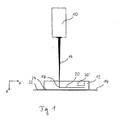
- FIG. 1 shows a schematical cress sectional representation of the set-up used for applying the method according to a currently preferred embodiment.
- the set-up includes a commercially available laser microtome 10 (Laser Microtome LMT F14 by Rowiak GmbH) and a sample holder 14.
- a food material sample 12 which, in this embodiment, is a piece of rock sugar, is placed on the sample holder 14 with a layer of immersion oil applied between sample 12 and holder 14 for optical adaptation.
- a conventional OCT (Optical Coherence Tomography) device (“Spectral Coherence Tomography) device ("Spectral Radar" by Thorlabs HL), which is not shown in Fig.
- a conventional scanning electron microscope (not shown in Fig. 1 ) is employed to image the rock sugar sample surface parallel to the plane of the sample holder 14.
- the laser microtome 10 produces a pulsed laser beam 16 with a wavelength of about 1030 nm and a focussed laser spot 18.
- the rock sugar sample 12 is optically transparent at this wavelength of the laser. Prior to cutting, the rock sugar sample 12 may be aground, e.g., by using a fine abrasive paper, so as to create a plane and even sample surface, allowing for a precise positioning of the focussed laser spot and an accurate control of its size during the cutting step.
- the rock sugar samples shown in Figs. 3 and 4 are continuously cut along the x-direction with the focussed laser spot 18 positioned in the body of the sample 12 (see Fig. 1 ).
- the laser spot 18 is moved across the sample 12 by use of a laser scanner that is part of the laser microtome 10 and not explicitly shown in Fig. 1 , resulting in a "planar" cutting line 20 that lies entirely in a sample plane parallel to the plane of the sample holder 14 ( Fig. 1 ).
- the method of the present invention can be used to create all kinds of different cutting line or plane geometries with a high degree of precision.
- a "tunnel" cutting line or plane (20', see Fig. 1 ) will be explained below with reference to Figs. 5 to 8 .
- the cavity formation and hence also the formation of the cutting lines (planes) 20, 20' in the rock sugar samples 12 is based on the physical process of photodisruption which is explained in detail above.
- the laser pulse duration was about 350 fs and the repetition rate was 10 MHz.
- the beam power during cutting was about 1 W and the cutting speed was about 1.5 mm/s.
- the thickness of the cut line 20 in the z-direction was chosen to be 75 ⁇ m ( Fig.
- the OCT images shown in Figs. 2 to 4 are turned upside down as compared to the representation of the set-up geometry shown in Fig. 1 , so that the bottom side of Figs. 2 to 4 is the side where the pulsed laser beam 16 enters the sample 12.
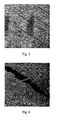
- FIG. 2 An OCT image of the rock sugar sample 12 prior to cutting is shown in Fig. 2 .
- the surface 22 of the sample holder 14 and the surface 24 of the rock sugar sample 12 can be clearly identified.
- Figure 3 shows an OCT image of the rock sugar sample 12 of Fig. 2 after the cutting was performed with the set-up geometry depicted in Fig. 1 , using the method and parameters detailed above.
- a cutting line 20 (thickness 75 ⁇ m) is formed within the body of the rock sugar sample 12 just underneath its surface 24, as evidenced by a bright line 20 in the OCT image that is substantially parallel to the surface 22 of the sample holder 14.
- a comparison of Fig. 3 with Fig. 2 shows that the sugar material underneath the cutting line 20, i.e., the material through which the pulsed laser beam 16 had to pass for cutting the line 20, is substantially unchanged, that is, no damage was done to this material during the cutting process.
- Figure 4 shows an OCT image of another rock sugar sample after the cutting was performed using the same geometry, method and parameters as these of Fig. 3 , apart from the thickness of the cutting line (here 50 ⁇ m).
- a cutting line 20 that is formed within the body of the rock sugar sample just underneath its surface 24 can be clearly identified (bright line 20 in Fig. 4 ).
- Figures 5 to 8 show SEM (Scanning Electron Microscopy) images of two further rock sugar samples after being cut using the method according to the embodiment of Fig. 1 with a laser pulse duration of about 400 fs and a pulse repetition rate of 10 MHz.
- the set-up geometry used was substantially that of Fig. 1 with the only difference that the laser beam 16 was shone onto the sample from underneath, through the sample holder 14.
- a glass slide was employed that is transparent to laser light at the wavelength used for the cutting process (1030 nm).
- a tunnel cutting plane 20' comprises a horizontal portion substantially parallel to the plane of the sample holder 14 and two vertical portions substantially perpendicular to the horizontal portion and connected thereto.
- Figures 5 to 8 show arrays of the vertical portions of such cutting planes 20', wherein these portions have a depth (along the z-direction, see Fig. 1 ) of 30 ⁇ m extending from the sample surface into the body of the sample and are arranged in parallel to one another.
- Figures 6 and 8 which have a larger magnification than Figs. 5 and 7 , show the presence of protruding or "overhanging" sample portions 26 adjacent to the vertical cut portions, demonstrating that, in these areas, material was removed from underneath the sample surface during the cutting process without damaging the overlying sample layers and thus indicating the presence of a horizontal tunnel cut portion.
- the method of the present invention can be used for cutting a transparent food material sample 12 inside its body with a high degree of precision and without damaging the material surrounding the cutting line (plane) 20, 20' or the surface 24 of the sample 12.
- Figures 5 to 8 further demonstrate that the present method is capable of creating, in a sample, arrays of cutting lines and/or planes 20' having a well-defined geometry with a high degree of precision. The method may thus, for example, be advantageously employed to produce, in an efficient and quick manner, a plurality of evenly shaped food particles with identical particle sizes and/or shapes.
Landscapes
- Life Sciences & Earth Sciences (AREA)
- Chemical & Material Sciences (AREA)
- Engineering & Computer Science (AREA)
- Food Science & Technology (AREA)
- Polymers & Plastics (AREA)
- General Preparation And Processing Of Foods (AREA)
- Laser Beam Processing (AREA)
Claims (15)
- Verfahren zum Bearbeiten von Lebensmitteln (12) unter Verwendung eines gepulsten Laserstrahls (16), wobei
die Wellenlänge des Laserstrahls in dem nah-infraroten Bereich liegt und
der Laserstrahl einen fokussierten Laserleuchtfleck (18) aufweist, wobei das Verfahren die folgenden Schritte aufweist:Aufbringen eines Laserpulses mit einer Pulsdauer in dem Bereich von 1 bis 1000 fs auf das Lebensmittel, wobei der fokussierte Laserleuchtfleck auf der Oberfläche des Lebensmittels oder in dem Körper des Lebensmittels liegt und der Laserpuls einen Hohlraum in dem Lebensmittel an der Stelle des fokussierten Laserleuchtflecks erzeugt. - Verfahren nach Anspruch 1, mit dem Schritt von Aufbringen einer Sequenz von Laserpulsen mit einer Pulslänge in dem Bereich von 1 bis 1000 fs auf das Lebensmittel, wobei jeder Laserpuls einen Hohlraum in dem Lebensmittel an der Stelle des fokussierten Laserleuchtflecks erzeugt.
- Verfahren nach Anspruch 2, ferner mit dem Schritt von Bewegen der Stelle des fokussierten Laserleuchtflecks über die Oberfläche des Lebensmittels und/oder durch den Körper des Lebensmittels, während die Sequenz von Laserpulsen aufgebracht wird, wodurch eine Sequenz von Hohlräumen in dem Lebensmittel erzeugt wird.
- Verfahren nach Anspruch 3, bei dem die Sequenz von Hohlräumen in dem Lebensmittel eine Schnittlinie (20) oder eine Schnittebene (20') definiert, entlang der das Lebensmittel geschnitten wird.
- Verfahren nach Anspruch 4, ferner mit dem Schritt von Trennen des geschnittenen Lebensmittels an der Schnittlinie oder der Schnittebene.
- Verfahren nach einem der vorhergehenden Ansprüche, bei dem zumindest ein zu bearbeitender Abschnitt des Lebensmittels bei der Wellenlänge des Laserstrahls optisch transparent ist.
- Verfahren nach Anspruch 6, bei dem der fokussierte Laserleuchtfleck in dem Körper des Lebensmittels liegt.
- Verfahren nach Anspruch 7, bei dem eine Bruchlinie oder eine Bruchebene in dem Körper des Lebensmittels erzeugt wird.
- Verfahren nach einem der vorhergehenden Ansprüche, bei dem die Pulslänge in dem Bereich von 1 bis 800 fs liegt.
- Verfahren nach Anspruch 9, bei dem die Pulslänge in dem Bereich von 1 bis 400 fs liegt.
- Verfahren nach Anspruch 2 oder einem der Ansprüche 3 bis 10 abhängig von Anspruch 2, bei dem die Wiederholungsrate der Sequenz von Laserpulsen in dem Bereich von 1 bis 1000 MHz liegt.
- Verfahren nach einem der vorhergehenden Ansprüche, bei dem der Hohlraum in dem Lebensmittel durch Photodisruption erzeugt wird.
- Verfahren nach einem der vorhergehenden Ansprüche, bei dem zumindest ein zu bearbeiteter Abschnitt des Lebensmittels eine ebene und gleichmäßige Oberfläche aufweist.
- Verfahren nach einem der vorhergehenden Ansprüche, bei dem das Lebensmittel Pfeffer oder Salz oder eine Nuss oder eine Kakaobohne oder eine Frucht oder Schokolade oder Milchpulver oder Salat oder Eiscreme ist.
- Verfahren nach einem der vorhergehenden Ansprüche, bei dem mehrere gleichmäßig geformte Lebensmittel-Teilchen mit identischen Teilchenformen und/oder -größen hergestellt werden.
Priority Applications (11)
| Application Number | Priority Date | Filing Date | Title |
|---|---|---|---|
| EP09167065A EP2281468B1 (de) | 2009-08-03 | 2009-08-03 | Verfahren zur Verarbeitung von Nahrungsmittelmaterial mit einem Impulslaserstrahl |
| AT09167065T ATE549946T1 (de) | 2009-08-03 | 2009-08-03 | Verfahren zur verarbeitung von nahrungsmittelmaterial mit einem impulslaserstrahl |
| PL09167065T PL2281468T3 (pl) | 2009-08-03 | 2009-08-03 | Sposób przetwarzania materiału spożywczego z zastosowaniem impulsowej wiązki laserowej |
| CA2711067A CA2711067A1 (en) | 2009-08-03 | 2010-07-27 | Method of processing food material using a pulsed laser beam |
| NZ587074A NZ587074A (en) | 2009-08-03 | 2010-07-29 | Method of processing food material using a pulsed laser beam with an infrared wavelength |
| IL207282A IL207282A0 (en) | 2009-08-03 | 2010-07-29 | Method of processing food material using a pulsed laser beam |
| AU2010206055A AU2010206055B2 (en) | 2009-08-03 | 2010-07-29 | Method of processing food material using a pulsed laser beam |
| JP2010170482A JP5629522B2 (ja) | 2009-08-03 | 2010-07-29 | パルス状レーザービームを用い食品材料を加工する方法 |
| ZA2010/05511A ZA201005511B (en) | 2009-08-03 | 2010-08-02 | Method of processing food material using a pulsed laser beam |
| RU2010132380/13A RU2536136C2 (ru) | 2009-08-03 | 2010-08-02 | Способ обработки пищевого материала с использованием импульсного лазерного луча |
| US12/848,789 US20110027432A1 (en) | 2009-08-03 | 2010-08-02 | Method of Processing Food Material Using A Pulsed Laser Beam |
Applications Claiming Priority (1)
| Application Number | Priority Date | Filing Date | Title |
|---|---|---|---|
| EP09167065A EP2281468B1 (de) | 2009-08-03 | 2009-08-03 | Verfahren zur Verarbeitung von Nahrungsmittelmaterial mit einem Impulslaserstrahl |
Publications (2)
| Publication Number | Publication Date |
|---|---|
| EP2281468A1 EP2281468A1 (de) | 2011-02-09 |
| EP2281468B1 true EP2281468B1 (de) | 2012-03-21 |
Family
ID=42041532
Family Applications (1)
| Application Number | Title | Priority Date | Filing Date |
|---|---|---|---|
| EP09167065A Not-in-force EP2281468B1 (de) | 2009-08-03 | 2009-08-03 | Verfahren zur Verarbeitung von Nahrungsmittelmaterial mit einem Impulslaserstrahl |
Country Status (11)
| Country | Link |
|---|---|
| US (1) | US20110027432A1 (de) |
| EP (1) | EP2281468B1 (de) |
| JP (1) | JP5629522B2 (de) |
| AT (1) | ATE549946T1 (de) |
| AU (1) | AU2010206055B2 (de) |
| CA (1) | CA2711067A1 (de) |
| IL (1) | IL207282A0 (de) |
| NZ (1) | NZ587074A (de) |
| PL (1) | PL2281468T3 (de) |
| RU (1) | RU2536136C2 (de) |
| ZA (1) | ZA201005511B (de) |
Families Citing this family (23)
| Publication number | Priority date | Publication date | Assignee | Title |
|---|---|---|---|---|
| US9107434B2 (en) * | 2011-03-11 | 2015-08-18 | Inderjit Singh | Method and apparatus for plasma assisted laser cooking of food products |
| US9997006B2 (en) | 2011-08-26 | 2018-06-12 | Elwha Llc | Treatment system and method for ingestible product dispensing system and method |
| US20130054255A1 (en) | 2011-08-26 | 2013-02-28 | Elwha LLC, a limited liability company of the State of Delaware | Controlled substance authorization and method for ingestible product preparation system and method |
| US10192037B2 (en) | 2011-08-26 | 2019-01-29 | Elwah LLC | Reporting system and method for ingestible product preparation system and method |
| US20130331966A1 (en) * | 2012-06-12 | 2013-12-12 | Elwha LLC, a limited liability company of the State of Delaware | Substrate Structure Directed Energy Treatment System And Method For Ingestible Product System And Method |
| US8989895B2 (en) | 2011-08-26 | 2015-03-24 | Elwha, Llc | Substance control system and method for dispensing systems |
| US9922576B2 (en) | 2011-08-26 | 2018-03-20 | Elwha Llc | Ingestion intelligence acquisition system and method for ingestible material preparation system and method |
| US9240028B2 (en) | 2011-08-26 | 2016-01-19 | Elwha Llc | Reporting system and method for ingestible product preparation system and method |
| US10121218B2 (en) | 2012-06-12 | 2018-11-06 | Elwha Llc | Substrate structure injection treatment system and method for ingestible product system and method |
| US20130330447A1 (en) | 2012-06-12 | 2013-12-12 | Elwha LLC, a limited liability company of the State of Delaware | Substrate Structure Deposition Treatment System And Method For Ingestible Product System and Method |
| US9111256B2 (en) | 2011-08-26 | 2015-08-18 | Elwha Llc | Selection information system and method for ingestible product preparation system and method |
| US9947167B2 (en) | 2011-08-26 | 2018-04-17 | Elwha Llc | Treatment system and method for ingestible product dispensing system and method |
| US9785985B2 (en) | 2011-08-26 | 2017-10-10 | Elwha Llc | Selection information system and method for ingestible product preparation system and method |
| US10026336B2 (en) | 2011-08-26 | 2018-07-17 | Elwha Llc | Refuse intelligence acquisition system and method for ingestible product preparation system and method |
| US20130330451A1 (en) | 2012-06-12 | 2013-12-12 | Elwha LLC, a limited liability company of the State of Delaware | Substrate Structure Duct Treatment System and Method for Ingestible Product System and Method |
| US9037478B2 (en) | 2011-08-26 | 2015-05-19 | Elwha Llc | Substance allocation system and method for ingestible product preparation system and method |
| US20150099043A1 (en) * | 2013-10-04 | 2015-04-09 | The Lucks Company | Laser cut edible decorating sheet and methods of manufacture |
| US10470486B2 (en) | 2013-10-04 | 2019-11-12 | Culpitt Ii, Llc | Laser cut edible decorating sheet and methods of manufacture |
| JP7235527B2 (ja) * | 2019-02-19 | 2023-03-08 | 雪印メグミルク株式会社 | クリーム類の製造方法 |
| CN110596157A (zh) * | 2019-09-20 | 2019-12-20 | 长江存储科技有限责任公司 | 半导体结构中氮含量的测量方法及装置 |
| CA3243041A1 (en) | 2021-12-22 | 2025-02-26 | Bayer Aktiengesellschaft | READING OPTICALLY READABLE CODES |
| JP7300232B1 (ja) | 2022-08-16 | 2023-06-29 | 大星電機株式会社 | 玉ねぎの表皮除去方法及び玉ねぎの表皮除去装置 |
| EP4467000A1 (de) | 2023-05-23 | 2024-11-27 | Astra Sweets | Verfahren zur bereitstellung mindestens einer markierung für einen gefüllten wafer mit einem ungesäuerten lebensmittelfoliengehäuse |
Family Cites Families (17)
| Publication number | Priority date | Publication date | Assignee | Title |
|---|---|---|---|---|
| US3955921A (en) * | 1972-09-19 | 1976-05-11 | Eli Lilly And Company | Method of killing microorganisms in the inside of a container utilizing a laser beam induced plasma |
| US4486645A (en) * | 1980-07-03 | 1984-12-04 | Armour Food Company | Process for removing packaging materials from packaged products |
| US4875254A (en) * | 1988-03-22 | 1989-10-24 | Design Systems, Inc. | Method and apparatus for automatically cutting food products to predetermined weight or shape |
| CH679970A5 (de) * | 1988-10-28 | 1992-05-29 | Bongrain Sa | |
| RU2018244C1 (ru) * | 1992-09-24 | 1994-08-30 | Сагаков Станислав Святославович | Способ копчения пищевых продуктов |
| US5897797A (en) * | 1994-11-04 | 1999-04-27 | Atrion Medical Product. Inc. | Produce marking system |
| JP3352934B2 (ja) * | 1998-01-21 | 2002-12-03 | 理化学研究所 | 高強度超短パルスレーザー加工方法およびその装置 |
| US6451152B1 (en) * | 2000-05-24 | 2002-09-17 | The Boeing Company | Method for heating and controlling temperature of composite material during automated placement |
| FR2813502B1 (fr) * | 2000-09-07 | 2004-04-23 | Domaine Des Genets | Procede et installation pour ouvrir des oeufs |
| DE10158115A1 (de) * | 2001-11-27 | 2003-06-05 | P A T Ges Zur Foerderung Innov | Verfahren zur Einprägung dreidimensionaler Strukturen in Lebensmittel |
| DE10202036A1 (de) * | 2002-01-18 | 2003-07-31 | Zeiss Carl Meditec Ag | Femtosekunden Lasersystem zur präzisen Bearbeitung von Material und Gewebe |
| US20040126272A1 (en) * | 2002-08-28 | 2004-07-01 | Eric Bornstein | Near infrared microbial elimination laser system |
| JP4147304B2 (ja) * | 2004-01-22 | 2008-09-10 | 防衛省技術研究本部長 | 多波長超短パルスレーザー光による材料加工法 |
| ITBZ20050038A1 (it) * | 2005-07-28 | 2007-01-29 | B Longobardi Gmbh | Procedimento e dispositivo per la marcatura di mele tramite laser |
| RU2328364C2 (ru) * | 2006-08-21 | 2008-07-10 | Общество с ограниченной ответственностью "АГРОЭЛ" | Устройство для лазерной обработки поверхностей |
| FR2915348B1 (fr) * | 2007-04-27 | 2009-07-10 | Nijal Soc Par Actions Simplifi | Dispositif de fabrication de portions de produits alimentaires texturees |
| US20080311260A1 (en) * | 2007-06-14 | 2008-12-18 | Oregon Freeze Dry, Inc. | Freeze-drying articles |
-
2009
- 2009-08-03 AT AT09167065T patent/ATE549946T1/de active
- 2009-08-03 PL PL09167065T patent/PL2281468T3/pl unknown
- 2009-08-03 EP EP09167065A patent/EP2281468B1/de not_active Not-in-force
-
2010
- 2010-07-27 CA CA2711067A patent/CA2711067A1/en not_active Abandoned
- 2010-07-29 NZ NZ587074A patent/NZ587074A/en not_active IP Right Cessation
- 2010-07-29 JP JP2010170482A patent/JP5629522B2/ja not_active Expired - Fee Related
- 2010-07-29 AU AU2010206055A patent/AU2010206055B2/en not_active Expired - Fee Related
- 2010-07-29 IL IL207282A patent/IL207282A0/en unknown
- 2010-08-02 RU RU2010132380/13A patent/RU2536136C2/ru not_active IP Right Cessation
- 2010-08-02 ZA ZA2010/05511A patent/ZA201005511B/en unknown
- 2010-08-02 US US12/848,789 patent/US20110027432A1/en not_active Abandoned
Also Published As
| Publication number | Publication date |
|---|---|
| EP2281468A1 (de) | 2011-02-09 |
| PL2281468T3 (pl) | 2012-06-29 |
| IL207282A0 (en) | 2010-12-30 |
| AU2010206055A1 (en) | 2011-02-17 |
| RU2536136C2 (ru) | 2014-12-20 |
| CA2711067A1 (en) | 2011-02-03 |
| JP2011030568A (ja) | 2011-02-17 |
| AU2010206055B2 (en) | 2015-07-09 |
| ATE549946T1 (de) | 2012-04-15 |
| NZ587074A (en) | 2012-01-12 |
| RU2010132380A (ru) | 2012-02-10 |
| US20110027432A1 (en) | 2011-02-03 |
| JP5629522B2 (ja) | 2014-11-19 |
| ZA201005511B (en) | 2011-05-25 |
Similar Documents
| Publication | Publication Date | Title |
|---|---|---|
| AU2010206055B2 (en) | Method of processing food material using a pulsed laser beam | |
| EP2781296B1 (de) | Vorrichtung und verfahren zum ausschneiden von konturen aus flächigen substraten mittels laser | |
| DE102015120950B4 (de) | Verfahren zum lasergestützten Ablösen eines Teilstücks von einem flächigen Glas- oder Glaskeramikelement, flächiges zumindest teilweise keramisiertes Glaselement oder Glaskeramikelement und Kochfläche umfassend ein flächiges Glas- oder Glaskeramikelement | |
| Echlin et al. | Materials response to glancing incidence femtosecond laser ablation | |
| JP2009202234A (ja) | レーザ加工における材料除去レートを増大する方法および装置 | |
| Lombardo et al. | Surface quality of femtosecond dissected posterior human corneal stroma investigated with atomic force microscopy | |
| US10470486B2 (en) | Laser cut edible decorating sheet and methods of manufacture | |
| US20140076299A1 (en) | Multi-step cutting process | |
| Wang et al. | Material removal and surface formation mechanism of C-plane sapphire in multipass ablation by a nanosecond UV laser | |
| EP2958472A1 (de) | Leicht zu öffnende geröstete oder gekochte aromatische kokosnuss und verfahren zur herstellung | |
| Jang et al. | Influence of laser spot scanning speed on micro-polishing of metallic surface using UV nanosecond pulse laser | |
| Wuttisarn et al. | Laser micromachining of titanium alloy in water and ice at different temperatures | |
| BR112016028133B1 (pt) | Aparelho de decoração de produto e processo para decorar um produto | |
| EP3672756B1 (de) | System und verfahren zur erzeugung einer vorbestimmten struktur aus einer diamantmasse | |
| Zhang et al. | Effects of plasma confinement on the femtosecond laser ablation of silicon | |
| Hicklin et al. | Combining microscopy and physical techniques in the study of cocoa butter polymorphs and vegetable fat blends | |
| Jagdheesh et al. | The Effects of Pulse Period on Nanosecond Laser Microfabrication. | |
| Rubenchik et al. | Dental tissue processing with ultrashort-pulse laser | |
| Lewis et al. | Theory and simulation of laser ablation–from basic mechanisms to applications | |
| Kononenko et al. | Shadowgraphic imaging of laser transfer driven by metal film blistering | |
| Shin et al. | Effect of pulse interval on TSV process using a picosecond laser | |
| Odachi et al. | Pre-ablation features formed by focusing a femtosecond laser beam with dual axicons to c-Si in vacuum | |
| Banishev et al. | Surface damage of silicon and copper by pulsed and pulse-periodic action of an Nd: YAG laser | |
| Groenendijk et al. | Influence of the repetition rate on self organized surface structuring during femtosecond pulsed laser ablation | |
| Campbell et al. | High quality machining of non-metals with a picosecond laser |
Legal Events
| Date | Code | Title | Description |
|---|---|---|---|
| PUAI | Public reference made under article 153(3) epc to a published international application that has entered the european phase |
Free format text: ORIGINAL CODE: 0009012 |
|
| AK | Designated contracting states |
Kind code of ref document: A1 Designated state(s): AT BE BG CH CY CZ DE DK EE ES FI FR GB GR HR HU IE IS IT LI LT LU LV MC MK MT NL NO PL PT RO SE SI SK SM TR |
|
| AX | Request for extension of the european patent |
Extension state: AL BA RS |
|
| 17P | Request for examination filed |
Effective date: 20110802 |
|
| GRAP | Despatch of communication of intention to grant a patent |
Free format text: ORIGINAL CODE: EPIDOSNIGR1 |
|
| RIC1 | Information provided on ipc code assigned before grant |
Ipc: B23K 26/00 20060101ALI20110916BHEP Ipc: A23N 7/00 20060101AFI20110916BHEP Ipc: B23K 26/40 20060101ALI20110916BHEP Ipc: A23N 15/00 20060101ALI20110916BHEP Ipc: A23P 1/10 20060101ALI20110916BHEP |
|
| GRAS | Grant fee paid |
Free format text: ORIGINAL CODE: EPIDOSNIGR3 |
|
| GRAA | (expected) grant |
Free format text: ORIGINAL CODE: 0009210 |
|
| AK | Designated contracting states |
Kind code of ref document: B1 Designated state(s): AT BE BG CH CY CZ DE DK EE ES FI FR GB GR HR HU IE IS IT LI LT LU LV MC MK MT NL NO PL PT RO SE SI SK SM TR |
|
| REG | Reference to a national code |
Ref country code: GB Ref legal event code: FG4D |
|
| REG | Reference to a national code |
Ref country code: CH Ref legal event code: EP |
|
| REG | Reference to a national code |
Ref country code: IE Ref legal event code: FG4D |
|
| REG | Reference to a national code |
Ref country code: AT Ref legal event code: REF Ref document number: 549946 Country of ref document: AT Kind code of ref document: T Effective date: 20120415 |
|
| REG | Reference to a national code |
Ref country code: NL Ref legal event code: T3 |
|
| REG | Reference to a national code |
Ref country code: SE Ref legal event code: TRGR |
|
| REG | Reference to a national code |
Ref country code: DE Ref legal event code: R096 Ref document number: 602009005976 Country of ref document: DE Effective date: 20120516 |
|
| REG | Reference to a national code |
Ref country code: PL Ref legal event code: T3 |
|
| PG25 | Lapsed in a contracting state [announced via postgrant information from national office to epo] |
Ref country code: NO Free format text: LAPSE BECAUSE OF FAILURE TO SUBMIT A TRANSLATION OF THE DESCRIPTION OR TO PAY THE FEE WITHIN THE PRESCRIBED TIME-LIMIT Effective date: 20120621 Ref country code: LT Free format text: LAPSE BECAUSE OF FAILURE TO SUBMIT A TRANSLATION OF THE DESCRIPTION OR TO PAY THE FEE WITHIN THE PRESCRIBED TIME-LIMIT Effective date: 20120321 Ref country code: HR Free format text: LAPSE BECAUSE OF FAILURE TO SUBMIT A TRANSLATION OF THE DESCRIPTION OR TO PAY THE FEE WITHIN THE PRESCRIBED TIME-LIMIT Effective date: 20120321 |
|
| REG | Reference to a national code |
Ref country code: SK Ref legal event code: T3 Ref document number: E 11722 Country of ref document: SK |
|
| LTIE | Lt: invalidation of european patent or patent extension |
Effective date: 20120321 |
|
| PG25 | Lapsed in a contracting state [announced via postgrant information from national office to epo] |
Ref country code: LV Free format text: LAPSE BECAUSE OF FAILURE TO SUBMIT A TRANSLATION OF THE DESCRIPTION OR TO PAY THE FEE WITHIN THE PRESCRIBED TIME-LIMIT Effective date: 20120321 Ref country code: GR Free format text: LAPSE BECAUSE OF FAILURE TO SUBMIT A TRANSLATION OF THE DESCRIPTION OR TO PAY THE FEE WITHIN THE PRESCRIBED TIME-LIMIT Effective date: 20120622 Ref country code: FI Free format text: LAPSE BECAUSE OF FAILURE TO SUBMIT A TRANSLATION OF THE DESCRIPTION OR TO PAY THE FEE WITHIN THE PRESCRIBED TIME-LIMIT Effective date: 20120321 |
|
| REG | Reference to a national code |
Ref country code: AT Ref legal event code: MK05 Ref document number: 549946 Country of ref document: AT Kind code of ref document: T Effective date: 20120321 |
|
| PG25 | Lapsed in a contracting state [announced via postgrant information from national office to epo] |
Ref country code: CY Free format text: LAPSE BECAUSE OF FAILURE TO SUBMIT A TRANSLATION OF THE DESCRIPTION OR TO PAY THE FEE WITHIN THE PRESCRIBED TIME-LIMIT Effective date: 20120321 |
|
| PG25 | Lapsed in a contracting state [announced via postgrant information from national office to epo] |
Ref country code: SI Free format text: LAPSE BECAUSE OF FAILURE TO SUBMIT A TRANSLATION OF THE DESCRIPTION OR TO PAY THE FEE WITHIN THE PRESCRIBED TIME-LIMIT Effective date: 20120321 Ref country code: EE Free format text: LAPSE BECAUSE OF FAILURE TO SUBMIT A TRANSLATION OF THE DESCRIPTION OR TO PAY THE FEE WITHIN THE PRESCRIBED TIME-LIMIT Effective date: 20120321 Ref country code: IS Free format text: LAPSE BECAUSE OF FAILURE TO SUBMIT A TRANSLATION OF THE DESCRIPTION OR TO PAY THE FEE WITHIN THE PRESCRIBED TIME-LIMIT Effective date: 20120721 Ref country code: RO Free format text: LAPSE BECAUSE OF FAILURE TO SUBMIT A TRANSLATION OF THE DESCRIPTION OR TO PAY THE FEE WITHIN THE PRESCRIBED TIME-LIMIT Effective date: 20120321 |
|
| PG25 | Lapsed in a contracting state [announced via postgrant information from national office to epo] |
Ref country code: PT Free format text: LAPSE BECAUSE OF FAILURE TO SUBMIT A TRANSLATION OF THE DESCRIPTION OR TO PAY THE FEE WITHIN THE PRESCRIBED TIME-LIMIT Effective date: 20120723 |
|
| PLBE | No opposition filed within time limit |
Free format text: ORIGINAL CODE: 0009261 |
|
| STAA | Information on the status of an ep patent application or granted ep patent |
Free format text: STATUS: NO OPPOSITION FILED WITHIN TIME LIMIT |
|
| PG25 | Lapsed in a contracting state [announced via postgrant information from national office to epo] |
Ref country code: DK Free format text: LAPSE BECAUSE OF FAILURE TO SUBMIT A TRANSLATION OF THE DESCRIPTION OR TO PAY THE FEE WITHIN THE PRESCRIBED TIME-LIMIT Effective date: 20120321 Ref country code: AT Free format text: LAPSE BECAUSE OF FAILURE TO SUBMIT A TRANSLATION OF THE DESCRIPTION OR TO PAY THE FEE WITHIN THE PRESCRIBED TIME-LIMIT Effective date: 20120321 |
|
| 26N | No opposition filed |
Effective date: 20130102 |
|
| PG25 | Lapsed in a contracting state [announced via postgrant information from national office to epo] |
Ref country code: MC Free format text: LAPSE BECAUSE OF NON-PAYMENT OF DUE FEES Effective date: 20120831 |
|
| REG | Reference to a national code |
Ref country code: DE Ref legal event code: R097 Ref document number: 602009005976 Country of ref document: DE Effective date: 20130102 |
|
| PG25 | Lapsed in a contracting state [announced via postgrant information from national office to epo] |
Ref country code: ES Free format text: LAPSE BECAUSE OF FAILURE TO SUBMIT A TRANSLATION OF THE DESCRIPTION OR TO PAY THE FEE WITHIN THE PRESCRIBED TIME-LIMIT Effective date: 20120702 |
|
| PG25 | Lapsed in a contracting state [announced via postgrant information from national office to epo] |
Ref country code: BG Free format text: LAPSE BECAUSE OF FAILURE TO SUBMIT A TRANSLATION OF THE DESCRIPTION OR TO PAY THE FEE WITHIN THE PRESCRIBED TIME-LIMIT Effective date: 20120621 |
|
| PG25 | Lapsed in a contracting state [announced via postgrant information from national office to epo] |
Ref country code: MT Free format text: LAPSE BECAUSE OF FAILURE TO SUBMIT A TRANSLATION OF THE DESCRIPTION OR TO PAY THE FEE WITHIN THE PRESCRIBED TIME-LIMIT Effective date: 20120321 |
|
| PG25 | Lapsed in a contracting state [announced via postgrant information from national office to epo] |
Ref country code: TR Free format text: LAPSE BECAUSE OF FAILURE TO SUBMIT A TRANSLATION OF THE DESCRIPTION OR TO PAY THE FEE WITHIN THE PRESCRIBED TIME-LIMIT Effective date: 20120321 |
|
| PG25 | Lapsed in a contracting state [announced via postgrant information from national office to epo] |
Ref country code: SM Free format text: LAPSE BECAUSE OF FAILURE TO SUBMIT A TRANSLATION OF THE DESCRIPTION OR TO PAY THE FEE WITHIN THE PRESCRIBED TIME-LIMIT Effective date: 20120321 Ref country code: LU Free format text: LAPSE BECAUSE OF NON-PAYMENT OF DUE FEES Effective date: 20120803 |
|
| PG25 | Lapsed in a contracting state [announced via postgrant information from national office to epo] |
Ref country code: HU Free format text: LAPSE BECAUSE OF FAILURE TO SUBMIT A TRANSLATION OF THE DESCRIPTION OR TO PAY THE FEE WITHIN THE PRESCRIBED TIME-LIMIT Effective date: 20090803 |
|
| PGFP | Annual fee paid to national office [announced via postgrant information from national office to epo] |
Ref country code: CH Payment date: 20140827 Year of fee payment: 6 Ref country code: NL Payment date: 20140826 Year of fee payment: 6 Ref country code: CZ Payment date: 20140723 Year of fee payment: 6 Ref country code: DE Payment date: 20140827 Year of fee payment: 6 Ref country code: IE Payment date: 20140827 Year of fee payment: 6 |
|
| PGFP | Annual fee paid to national office [announced via postgrant information from national office to epo] |
Ref country code: SE Payment date: 20140827 Year of fee payment: 6 Ref country code: GB Payment date: 20140827 Year of fee payment: 6 Ref country code: FR Payment date: 20140818 Year of fee payment: 6 Ref country code: SK Payment date: 20140718 Year of fee payment: 6 Ref country code: PL Payment date: 20140721 Year of fee payment: 6 |
|
| PGFP | Annual fee paid to national office [announced via postgrant information from national office to epo] |
Ref country code: IT Payment date: 20140822 Year of fee payment: 6 |
|
| PGFP | Annual fee paid to national office [announced via postgrant information from national office to epo] |
Ref country code: BE Payment date: 20140829 Year of fee payment: 6 |
|
| PG25 | Lapsed in a contracting state [announced via postgrant information from national office to epo] |
Ref country code: MK Free format text: LAPSE BECAUSE OF FAILURE TO SUBMIT A TRANSLATION OF THE DESCRIPTION OR TO PAY THE FEE WITHIN THE PRESCRIBED TIME-LIMIT Effective date: 20120321 |
|
| REG | Reference to a national code |
Ref country code: DE Ref legal event code: R119 Ref document number: 602009005976 Country of ref document: DE |
|
| REG | Reference to a national code |
Ref country code: SE Ref legal event code: EUG |
|
| REG | Reference to a national code |
Ref country code: CH Ref legal event code: PL |
|
| GBPC | Gb: european patent ceased through non-payment of renewal fee |
Effective date: 20150803 |
|
| PG25 | Lapsed in a contracting state [announced via postgrant information from national office to epo] |
Ref country code: LI Free format text: LAPSE BECAUSE OF NON-PAYMENT OF DUE FEES Effective date: 20150831 Ref country code: CZ Free format text: LAPSE BECAUSE OF NON-PAYMENT OF DUE FEES Effective date: 20150803 Ref country code: IT Free format text: LAPSE BECAUSE OF NON-PAYMENT OF DUE FEES Effective date: 20150803 Ref country code: CH Free format text: LAPSE BECAUSE OF NON-PAYMENT OF DUE FEES Effective date: 20150831 Ref country code: SK Free format text: LAPSE BECAUSE OF NON-PAYMENT OF DUE FEES Effective date: 20150803 |
|
| REG | Reference to a national code |
Ref country code: SK Ref legal event code: MM4A Ref document number: E 11722 Country of ref document: SK Effective date: 20150803 |
|
| REG | Reference to a national code |
Ref country code: NL Ref legal event code: MM Effective date: 20150901 |
|
| PG25 | Lapsed in a contracting state [announced via postgrant information from national office to epo] |
Ref country code: SE Free format text: LAPSE BECAUSE OF NON-PAYMENT OF DUE FEES Effective date: 20150804 |
|
| REG | Reference to a national code |
Ref country code: IE Ref legal event code: MM4A |
|
| REG | Reference to a national code |
Ref country code: FR Ref legal event code: ST Effective date: 20160429 |
|
| PG25 | Lapsed in a contracting state [announced via postgrant information from national office to epo] |
Ref country code: NL Free format text: LAPSE BECAUSE OF NON-PAYMENT OF DUE FEES Effective date: 20150901 |
|
| PG25 | Lapsed in a contracting state [announced via postgrant information from national office to epo] |
Ref country code: DE Free format text: LAPSE BECAUSE OF NON-PAYMENT OF DUE FEES Effective date: 20160301 Ref country code: IE Free format text: LAPSE BECAUSE OF NON-PAYMENT OF DUE FEES Effective date: 20150803 Ref country code: GB Free format text: LAPSE BECAUSE OF NON-PAYMENT OF DUE FEES Effective date: 20150803 |
|
| PG25 | Lapsed in a contracting state [announced via postgrant information from national office to epo] |
Ref country code: FR Free format text: LAPSE BECAUSE OF NON-PAYMENT OF DUE FEES Effective date: 20150831 |
|
| PG25 | Lapsed in a contracting state [announced via postgrant information from national office to epo] |
Ref country code: PL Free format text: LAPSE BECAUSE OF NON-PAYMENT OF DUE FEES Effective date: 20150803 |
|
| PG25 | Lapsed in a contracting state [announced via postgrant information from national office to epo] |
Ref country code: BE Free format text: LAPSE BECAUSE OF NON-PAYMENT OF DUE FEES Effective date: 20150831 |