EP2281502A1 - Capteur fluidique ayant un corps formé en plastique et un réactif, ainsi qu'un emballage comprenant une multiplicité desdits capteurs - Google Patents
Capteur fluidique ayant un corps formé en plastique et un réactif, ainsi qu'un emballage comprenant une multiplicité desdits capteurs Download PDFInfo
- Publication number
- EP2281502A1 EP2281502A1 EP20100175005 EP10175005A EP2281502A1 EP 2281502 A1 EP2281502 A1 EP 2281502A1 EP 20100175005 EP20100175005 EP 20100175005 EP 10175005 A EP10175005 A EP 10175005A EP 2281502 A1 EP2281502 A1 EP 2281502A1
- Authority
- EP
- European Patent Office
- Prior art keywords
- sensor
- reagent
- alternative embodiment
- sensor package
- package
- Prior art date
- Legal status (The legal status is an assumption and is not a legal conclusion. Google has not performed a legal analysis and makes no representation as to the accuracy of the status listed.)
- Granted
Links
- 239000003153 chemical reaction reagent Substances 0.000 title claims abstract description 81
- 239000012530 fluid Substances 0.000 title claims abstract description 46
- 239000004033 plastic Substances 0.000 title claims abstract description 37
- 229920003023 plastic Polymers 0.000 title claims abstract description 37
- 230000008859 change Effects 0.000 claims abstract description 21
- 239000012491 analyte Substances 0.000 claims abstract description 14
- 238000012360 testing method Methods 0.000 claims description 26
- 230000001681 protective effect Effects 0.000 claims description 21
- 239000011888 foil Substances 0.000 claims description 10
- 239000002985 plastic film Substances 0.000 claims description 2
- 229920006255 plastic film Polymers 0.000 claims description 2
- 239000008280 blood Substances 0.000 description 110
- 210000004369 blood Anatomy 0.000 description 110
- WQZGKKKJIJFFOK-GASJEMHNSA-N Glucose Natural products OC[C@H]1OC(O)[C@H](O)[C@@H](O)[C@@H]1O WQZGKKKJIJFFOK-GASJEMHNSA-N 0.000 description 87
- 239000008103 glucose Substances 0.000 description 87
- 239000002274 desiccant Substances 0.000 description 31
- 238000000034 method Methods 0.000 description 17
- 125000006850 spacer group Chemical group 0.000 description 16
- 239000000463 material Substances 0.000 description 15
- 239000004094 surface-active agent Substances 0.000 description 13
- GWEVSGVZZGPLCZ-UHFFFAOYSA-N Titan oxide Chemical compound O=[Ti]=O GWEVSGVZZGPLCZ-UHFFFAOYSA-N 0.000 description 10
- 238000004519 manufacturing process Methods 0.000 description 10
- 238000011109 contamination Methods 0.000 description 9
- 239000012528 membrane Substances 0.000 description 9
- 108010050375 Glucose 1-Dehydrogenase Proteins 0.000 description 7
- VMGAPWLDMVPYIA-HIDZBRGKSA-N n'-amino-n-iminomethanimidamide Chemical compound N\N=C\N=N VMGAPWLDMVPYIA-HIDZBRGKSA-N 0.000 description 7
- -1 polypropylene Polymers 0.000 description 7
- BOLDJAUMGUJJKM-LSDHHAIUSA-N renifolin D Natural products CC(=C)[C@@H]1Cc2c(O)c(O)ccc2[C@H]1CC(=O)c3ccc(O)cc3O BOLDJAUMGUJJKM-LSDHHAIUSA-N 0.000 description 7
- 239000000853 adhesive Substances 0.000 description 6
- 230000001070 adhesive effect Effects 0.000 description 6
- 206010012601 diabetes mellitus Diseases 0.000 description 6
- 239000011159 matrix material Substances 0.000 description 6
- 230000007246 mechanism Effects 0.000 description 6
- 239000000203 mixture Substances 0.000 description 6
- 229920000642 polymer Polymers 0.000 description 6
- 238000004806 packaging method and process Methods 0.000 description 5
- 238000007639 printing Methods 0.000 description 5
- 125000003831 tetrazolyl group Chemical group 0.000 description 5
- 239000004408 titanium dioxide Substances 0.000 description 5
- 239000004743 Polypropylene Substances 0.000 description 4
- 230000009471 action Effects 0.000 description 4
- XAGFODPZIPBFFR-UHFFFAOYSA-N aluminium Chemical compound [Al] XAGFODPZIPBFFR-UHFFFAOYSA-N 0.000 description 4
- 229910052782 aluminium Inorganic materials 0.000 description 4
- 230000004888 barrier function Effects 0.000 description 4
- 238000004891 communication Methods 0.000 description 4
- 238000010276 construction Methods 0.000 description 4
- 238000005259 measurement Methods 0.000 description 4
- MMXZSJMASHPLLR-UHFFFAOYSA-N pyrroloquinoline quinone Chemical compound C12=C(C(O)=O)C=C(C(O)=O)N=C2C(=O)C(=O)C2=C1NC(C(=O)O)=C2 MMXZSJMASHPLLR-UHFFFAOYSA-N 0.000 description 4
- 238000007789 sealing Methods 0.000 description 4
- 230000008021 deposition Effects 0.000 description 3
- 238000013461 design Methods 0.000 description 3
- 238000007373 indentation Methods 0.000 description 3
- 238000012544 monitoring process Methods 0.000 description 3
- 230000003287 optical effect Effects 0.000 description 3
- 229920001155 polypropylene Polymers 0.000 description 3
- 239000011148 porous material Substances 0.000 description 3
- 230000008569 process Effects 0.000 description 3
- 241000894007 species Species 0.000 description 3
- 238000003860 storage Methods 0.000 description 3
- 238000003466 welding Methods 0.000 description 3
- 208000013016 Hypoglycemia Diseases 0.000 description 2
- BAWFJGJZGIEFAR-NNYOXOHSSA-N NAD zwitterion Chemical compound NC(=O)C1=CC=C[N+]([C@H]2[C@@H]([C@H](O)[C@@H](COP([O-])(=O)OP(O)(=O)OC[C@@H]3[C@H]([C@@H](O)[C@@H](O3)N3C4=NC=NC(N)=C4N=C3)O)O2)O)=C1 BAWFJGJZGIEFAR-NNYOXOHSSA-N 0.000 description 2
- 241001189642 Theroa Species 0.000 description 2
- 238000006243 chemical reaction Methods 0.000 description 2
- 201000001421 hyperglycemia Diseases 0.000 description 2
- 230000002218 hypoglycaemic effect Effects 0.000 description 2
- NOESYZHRGYRDHS-UHFFFAOYSA-N insulin Chemical compound N1C(=O)C(NC(=O)C(CCC(N)=O)NC(=O)C(CCC(O)=O)NC(=O)C(C(C)C)NC(=O)C(NC(=O)CN)C(C)CC)CSSCC(C(NC(CO)C(=O)NC(CC(C)C)C(=O)NC(CC=2C=CC(O)=CC=2)C(=O)NC(CCC(N)=O)C(=O)NC(CC(C)C)C(=O)NC(CCC(O)=O)C(=O)NC(CC(N)=O)C(=O)NC(CC=2C=CC(O)=CC=2)C(=O)NC(CSSCC(NC(=O)C(C(C)C)NC(=O)C(CC(C)C)NC(=O)C(CC=2C=CC(O)=CC=2)NC(=O)C(CC(C)C)NC(=O)C(C)NC(=O)C(CCC(O)=O)NC(=O)C(C(C)C)NC(=O)C(CC(C)C)NC(=O)C(CC=2NC=NC=2)NC(=O)C(CO)NC(=O)CNC2=O)C(=O)NCC(=O)NC(CCC(O)=O)C(=O)NC(CCCNC(N)=N)C(=O)NCC(=O)NC(CC=3C=CC=CC=3)C(=O)NC(CC=3C=CC=CC=3)C(=O)NC(CC=3C=CC(O)=CC=3)C(=O)NC(C(C)O)C(=O)N3C(CCC3)C(=O)NC(CCCCN)C(=O)NC(C)C(O)=O)C(=O)NC(CC(N)=O)C(O)=O)=O)NC(=O)C(C(C)CC)NC(=O)C(CO)NC(=O)C(C(C)O)NC(=O)C1CSSCC2NC(=O)C(CC(C)C)NC(=O)C(NC(=O)C(CCC(N)=O)NC(=O)C(CC(N)=O)NC(=O)C(NC(=O)C(N)CC=1C=CC=CC=1)C(C)C)CC1=CN=CN1 NOESYZHRGYRDHS-UHFFFAOYSA-N 0.000 description 2
- 230000001788 irregular Effects 0.000 description 2
- 229950006238 nadide Drugs 0.000 description 2
- 229930027945 nicotinamide-adenine dinucleotide Natural products 0.000 description 2
- QTBSBXVTEAMEQO-UHFFFAOYSA-M Acetate Chemical compound CC([O-])=O QTBSBXVTEAMEQO-UHFFFAOYSA-M 0.000 description 1
- 229920004439 Aclar® Polymers 0.000 description 1
- 229920004446 Aclar® UltRx 3000 Polymers 0.000 description 1
- PHOQVHQSTUBQQK-SQOUGZDYSA-N D-glucono-1,5-lactone Chemical compound OC[C@H]1OC(=O)[C@H](O)[C@@H](O)[C@@H]1O PHOQVHQSTUBQQK-SQOUGZDYSA-N 0.000 description 1
- 102000004877 Insulin Human genes 0.000 description 1
- 108090001061 Insulin Proteins 0.000 description 1
- 239000002033 PVDF binder Substances 0.000 description 1
- 239000002202 Polyethylene glycol Substances 0.000 description 1
- 239000004820 Pressure-sensitive adhesive Substances 0.000 description 1
- 239000004411 aluminium Substances 0.000 description 1
- 238000004458 analytical method Methods 0.000 description 1
- 238000000149 argon plasma sintering Methods 0.000 description 1
- 238000003491 array Methods 0.000 description 1
- 239000011324 bead Substances 0.000 description 1
- 230000009172 bursting Effects 0.000 description 1
- 239000011248 coating agent Substances 0.000 description 1
- 238000000576 coating method Methods 0.000 description 1
- 238000004040 coloring Methods 0.000 description 1
- 229920001577 copolymer Polymers 0.000 description 1
- 238000012937 correction Methods 0.000 description 1
- 229940079593 drug Drugs 0.000 description 1
- 239000003814 drug Substances 0.000 description 1
- 150000002148 esters Chemical class 0.000 description 1
- 238000009459 flexible packaging Methods 0.000 description 1
- 238000009472 formulation Methods 0.000 description 1
- 239000002783 friction material Substances 0.000 description 1
- 235000012209 glucono delta-lactone Nutrition 0.000 description 1
- 229960003681 gluconolactone Drugs 0.000 description 1
- 238000005534 hematocrit Methods 0.000 description 1
- 230000002209 hydrophobic effect Effects 0.000 description 1
- 230000001771 impaired effect Effects 0.000 description 1
- 238000001746 injection moulding Methods 0.000 description 1
- 238000011081 inoculation Methods 0.000 description 1
- 229940125396 insulin Drugs 0.000 description 1
- 239000004922 lacquer Substances 0.000 description 1
- 239000003550 marker Substances 0.000 description 1
- 238000012986 modification Methods 0.000 description 1
- 230000004048 modification Effects 0.000 description 1
- 239000002808 molecular sieve Substances 0.000 description 1
- 239000005022 packaging material Substances 0.000 description 1
- 239000005023 polychlorotrifluoroethylene (PCTFE) polymer Substances 0.000 description 1
- 229920001223 polyethylene glycol Polymers 0.000 description 1
- 229920000139 polyethylene terephthalate Polymers 0.000 description 1
- 239000005020 polyethylene terephthalate Substances 0.000 description 1
- 229920000136 polysorbate Polymers 0.000 description 1
- 229950008882 polysorbate Drugs 0.000 description 1
- 229920001343 polytetrafluoroethylene Polymers 0.000 description 1
- 239000004810 polytetrafluoroethylene Substances 0.000 description 1
- 229920002635 polyurethane Polymers 0.000 description 1
- 239000004814 polyurethane Substances 0.000 description 1
- 229920002981 polyvinylidene fluoride Polymers 0.000 description 1
- 230000009467 reduction Effects 0.000 description 1
- 238000005070 sampling Methods 0.000 description 1
- 238000000926 separation method Methods 0.000 description 1
- URGAHOPLAPQHLN-UHFFFAOYSA-N sodium aluminosilicate Chemical compound [Na+].[Al+3].[O-][Si]([O-])=O.[O-][Si]([O-])=O URGAHOPLAPQHLN-UHFFFAOYSA-N 0.000 description 1
- 239000000126 substance Substances 0.000 description 1
- 238000012546 transfer Methods 0.000 description 1
- 230000000007 visual effect Effects 0.000 description 1
- 239000002699 waste material Substances 0.000 description 1
- XLYOFNOQVPJJNP-UHFFFAOYSA-N water Substances O XLYOFNOQVPJJNP-UHFFFAOYSA-N 0.000 description 1
Images




Classifications
-
- A—HUMAN NECESSITIES
- A61—MEDICAL OR VETERINARY SCIENCE; HYGIENE
- A61B—DIAGNOSIS; SURGERY; IDENTIFICATION
- A61B5/00—Measuring for diagnostic purposes; Identification of persons
- A61B5/145—Measuring characteristics of blood in vivo, e.g. gas concentration or pH-value ; Measuring characteristics of body fluids or tissues, e.g. interstitial fluid or cerebral tissue
- A61B5/14532—Measuring characteristics of blood in vivo, e.g. gas concentration or pH-value ; Measuring characteristics of body fluids or tissues, e.g. interstitial fluid or cerebral tissue for measuring glucose, e.g. by tissue impedance measurement
-
- G—PHYSICS
- G01—MEASURING; TESTING
- G01N—INVESTIGATING OR ANALYSING MATERIALS BY DETERMINING THEIR CHEMICAL OR PHYSICAL PROPERTIES
- G01N33/00—Investigating or analysing materials by specific methods not covered by groups G01N1/00 - G01N31/00
- G01N33/48—Biological material, e.g. blood, urine; Haemocytometers
- G01N33/50—Chemical analysis of biological material, e.g. blood, urine; Testing involving biospecific ligand binding methods; Immunological testing
- G01N33/66—Chemical analysis of biological material, e.g. blood, urine; Testing involving biospecific ligand binding methods; Immunological testing involving blood sugars, e.g. galactose
-
- A—HUMAN NECESSITIES
- A61—MEDICAL OR VETERINARY SCIENCE; HYGIENE
- A61B—DIAGNOSIS; SURGERY; IDENTIFICATION
- A61B5/00—Measuring for diagnostic purposes; Identification of persons
- A61B5/145—Measuring characteristics of blood in vivo, e.g. gas concentration or pH-value ; Measuring characteristics of body fluids or tissues, e.g. interstitial fluid or cerebral tissue
- A61B5/1455—Measuring characteristics of blood in vivo, e.g. gas concentration or pH-value ; Measuring characteristics of body fluids or tissues, e.g. interstitial fluid or cerebral tissue using optical sensors, e.g. spectral photometrical oximeters
-
- A—HUMAN NECESSITIES
- A61—MEDICAL OR VETERINARY SCIENCE; HYGIENE
- A61B—DIAGNOSIS; SURGERY; IDENTIFICATION
- A61B5/00—Measuring for diagnostic purposes; Identification of persons
- A61B5/15—Devices for taking samples of blood
- A61B5/150007—Details
- A61B5/150015—Source of blood
- A61B5/150022—Source of blood for capillary blood or interstitial fluid
-
- A—HUMAN NECESSITIES
- A61—MEDICAL OR VETERINARY SCIENCE; HYGIENE
- A61B—DIAGNOSIS; SURGERY; IDENTIFICATION
- A61B5/00—Measuring for diagnostic purposes; Identification of persons
- A61B5/15—Devices for taking samples of blood
- A61B5/150007—Details
- A61B5/150206—Construction or design features not otherwise provided for; manufacturing or production; packages; sterilisation of piercing element, piercing device or sampling device
- A61B5/150213—Venting means
-
- A—HUMAN NECESSITIES
- A61—MEDICAL OR VETERINARY SCIENCE; HYGIENE
- A61B—DIAGNOSIS; SURGERY; IDENTIFICATION
- A61B5/00—Measuring for diagnostic purposes; Identification of persons
- A61B5/15—Devices for taking samples of blood
- A61B5/150007—Details
- A61B5/150206—Construction or design features not otherwise provided for; manufacturing or production; packages; sterilisation of piercing element, piercing device or sampling device
- A61B5/150274—Manufacture or production processes or steps for blood sampling devices
-
- A—HUMAN NECESSITIES
- A61—MEDICAL OR VETERINARY SCIENCE; HYGIENE
- A61B—DIAGNOSIS; SURGERY; IDENTIFICATION
- A61B5/00—Measuring for diagnostic purposes; Identification of persons
- A61B5/15—Devices for taking samples of blood
- A61B5/150007—Details
- A61B5/150343—Collection vessels for collecting blood samples from the skin surface, e.g. test tubes, cuvettes
-
- A—HUMAN NECESSITIES
- A61—MEDICAL OR VETERINARY SCIENCE; HYGIENE
- A61B—DIAGNOSIS; SURGERY; IDENTIFICATION
- A61B5/00—Measuring for diagnostic purposes; Identification of persons
- A61B5/15—Devices for taking samples of blood
- A61B5/150007—Details
- A61B5/150358—Strips for collecting blood, e.g. absorbent
-
- A—HUMAN NECESSITIES
- A61—MEDICAL OR VETERINARY SCIENCE; HYGIENE
- A61B—DIAGNOSIS; SURGERY; IDENTIFICATION
- A61B5/00—Measuring for diagnostic purposes; Identification of persons
- A61B5/15—Devices for taking samples of blood
- A61B5/157—Devices characterised by integrated means for measuring characteristics of blood
-
- G—PHYSICS
- G01—MEASURING; TESTING
- G01N—INVESTIGATING OR ANALYSING MATERIALS BY DETERMINING THEIR CHEMICAL OR PHYSICAL PROPERTIES
- G01N21/00—Investigating or analysing materials by the use of optical means, i.e. using sub-millimetre waves, infrared, visible or ultraviolet light
- G01N21/75—Systems in which material is subjected to a chemical reaction, the progress or the result of the reaction being investigated
- G01N21/77—Systems in which material is subjected to a chemical reaction, the progress or the result of the reaction being investigated by observing the effect on a chemical indicator
- G01N21/78—Systems in which material is subjected to a chemical reaction, the progress or the result of the reaction being investigated by observing the effect on a chemical indicator producing a change of colour
-
- G—PHYSICS
- G01—MEASURING; TESTING
- G01N—INVESTIGATING OR ANALYSING MATERIALS BY DETERMINING THEIR CHEMICAL OR PHYSICAL PROPERTIES
- G01N33/00—Investigating or analysing materials by specific methods not covered by groups G01N1/00 - G01N31/00
- G01N33/48—Biological material, e.g. blood, urine; Haemocytometers
- G01N33/50—Chemical analysis of biological material, e.g. blood, urine; Testing involving biospecific ligand binding methods; Immunological testing
- G01N33/52—Use of compounds or compositions for colorimetric, spectrophotometric or fluorometric investigation, e.g. use of reagent paper and including single- and multilayer analytical elements
- G01N33/521—Single-layer analytical elements
-
- G—PHYSICS
- G01—MEASURING; TESTING
- G01N—INVESTIGATING OR ANALYSING MATERIALS BY DETERMINING THEIR CHEMICAL OR PHYSICAL PROPERTIES
- G01N33/00—Investigating or analysing materials by specific methods not covered by groups G01N1/00 - G01N31/00
- G01N33/48—Biological material, e.g. blood, urine; Haemocytometers
- G01N33/50—Chemical analysis of biological material, e.g. blood, urine; Testing involving biospecific ligand binding methods; Immunological testing
- G01N33/52—Use of compounds or compositions for colorimetric, spectrophotometric or fluorometric investigation, e.g. use of reagent paper and including single- and multilayer analytical elements
- G01N33/528—Atypical element structures, e.g. gloves, rods, tampons, toilet paper
-
- A—HUMAN NECESSITIES
- A61—MEDICAL OR VETERINARY SCIENCE; HYGIENE
- A61B—DIAGNOSIS; SURGERY; IDENTIFICATION
- A61B2562/00—Details of sensors; Constructional details of sensor housings or probes; Accessories for sensors
- A61B2562/24—Hygienic packaging for medical sensors; Maintaining apparatus for sensor hygiene
- A61B2562/242—Packaging, i.e. for packaging the sensor or apparatus before use
-
- A—HUMAN NECESSITIES
- A61—MEDICAL OR VETERINARY SCIENCE; HYGIENE
- A61B—DIAGNOSIS; SURGERY; IDENTIFICATION
- A61B5/00—Measuring for diagnostic purposes; Identification of persons
- A61B5/14—Devices for taking samples of blood ; Measuring characteristics of blood in vivo, e.g. gas concentration within the blood, pH-value of blood
- A61B5/1405—Devices for taking blood samples
- A61B5/1411—Devices for taking blood samples by percutaneous method, e.g. by lancet
Definitions
- the present invention relates to a fluid monitoring system, and more particularly, to a new and improved sensor and package that is used in analyzing blood glucose or other analytes contained therein.
- Those who have irregular blood glucose concentration levels are medically required to regularly self-monitor their blood glucose concentration level.
- An irregular blood glucose level can be brought on by a variety of reasons including an illness such as diabetes. An estimated 18 million people are afflicted with diabetes in the United States alone.
- a diabetic patient typically monitors his or her blood glucose concentration level to determine whether the level is too high or too low, and whether any corrective action, such as administering insulin or other medication, is necessary to bring the level back within a normal range. The failure to take corrective action can have serious implications.
- blood glucose levels drop too low - a condition known as hypoglycemia - a person may become nervous, shaky, confused, have an impaired judgment, and eventually pass out.
- sensors are used to test a sample of blood.
- a sensor may contain bio-sensing or reagent material that will react with blood glucose.
- the testing end of the sensor is adapted to be placed into the fluid being tested, for example, blood that has accumulated on a person's finger after the finger has been pricked.
- the fluid is drawn into a capillary channel that extends in the sensor from the testing end to the reagent material by capillary action so that a sufficient amount of fluid to be tested is drawn into the sensor.
- the fluid then chemically reacts with the reagent material in the sensor.
- the chemical reaction results in an electrical signal indicative of the blood glucose level in the blood being tested, which is then supplied to contact areas located near the rear or contact end of the sensor.
- a reflectance reading can determine the color change indicative of the glucose concentration in the blood/reagent mixture.
- some sensors have been designed to include a reactive membrane stretched across a through opening in a shaped sensor tip. While such sensors reduce the risk of meter contamination over conventional sensors, there still remains the risk that the read-head of the meter can become contaminated.
- the reactive membrane does not completely cover the through opening, allowing the possibility that blood may leak onto the meter or read-head either through the membrane or around the membrane/through opening juncture.
- Manufacturing cost is another concern that exists with sensors that include a reactive membrane stretched across a through opening. Due to the large number of sensors a diabetic may use, even a minor reduction in the manufacturing cost of a sensor can result in substantial savings to the diabetic end user. Applying a separate membrane to a through opening involves extra manufacturing steps of handling a separate membrane and applying the membrane to the sensor base.
- sensors Before use, the sensors need to be maintained at an appropriate humidity level so as to insure the integrity of the reagent materials in the sensor.
- Sensors can be packaged individually in tear-away packages so that they can be maintained at the proper humidity level.
- blister-type packaging methods have often been used.
- the packages can include desiccant material to maintain the proper humidity in the package.
- the package In order for a person to use an individual sensor for testing blood glucose, the package must be opened by tearing the seal. Alternatively, some packages require the user to exert force against one side of the package resulting in the sensor bursting or rupturing the foil on the opposite side. As can be appreciated, the opening of these packages can be difficult and may result in damage to the sensor. Moreover, once the package is opened the user needs to be sure that the sensor is not damaged or contaminated as it is being placed into the sensor holder and used to test the blood sample.
- a blood glucose sensor that reduces the risk of contamination, the manufacturing cost, and the sample volume. Further, there is a need for a package for such a blood glucose sensor that maintains the sensors at the proper humidity, is simple to use, and has a visual display of the remaining sensors.
- an object of the present invention is to provide a new and improved sensor and package used in testing blood glucose.
- objects of the present invention are to provide a new and improved blood glucose sensor and package made from a one-piece formed body with a reagent applied to the sensor, and which overcomes the problems or limitations discussed above.
- the present invention is embodied in a fluid sensor that comprises a formed plastic body and a reagent.
- the body has a top face with an integral first surface.
- the body also has a bottom face opposed to the first surface and a sidewall that extends from the periphery of the top face.
- the first surface is adapted to accept a fluid sample.
- the reagent is disposed on the integral first surface and causes a color change detectable on the bottom face when the reagent reacts with an analyte in the fluid sample.
- a fluid sensor comprises a formed porous plastic body, a surfactant, and a reagent.
- the body has a top face with an integral first surface, a bottom face with a second surface opposed to the first surface, and a sidewall adjacent to the top face.
- the first surface is adapted to accept a fluid sample.
- the surfactant is disposed on the body.
- the reagent causes a color change detectable on the second surface when the reagent reacts with an analyte in the fluid sample.
- the present invention is embodied in a blood glucose sensor kit comprising a sensor package, a blood glucose meter, and a guide.
- the sensor package includes a base portion having at least one sensor cavity and at least one desiccant cavity in fluid communication with the sensor cavity.
- the sensor package also includes a desiccant material in the desiccant cavity and a protective sheet covering the sensor cavity and the desiccant cavity.
- the sensor package also includes a sensor located in the sensor cavity.
- the blood glucose meter has a housing, a display disposed on the housing, and a read-head disposed on the housing, in which the read-head is adapted to detachably engage the sensor.
- the guide is adapted to cover the protective sheet.
- the guide also has at least one opening adapted to align the read-head to engage the sensor within the sensor cavity.
- a blood glucose sensor kit comprises a sensor package and a blood glucose meter.
- the sensor package includes a container having an inner surface, a desiccant liner disposed in the container, a friction liner disposed in the container, and at least one sensor located in the container, frictionally engaging the friction liner.
- the blood glucose meter has a housing with a display and a read-head disposed on the housing. The read-head is adapted to detachably engage the sensor while the sensor is located in the sensor package.
- a blood glucose sensor package comprises a container, a desiccant liner, a friction liner, a first sensor, and a cover.
- the container has an inner surface.
- the desiccant liner is disposed in the container.
- the friction liner is disposed in the container.
- the first sensor is located in the container and frictionally engages the friction liner.
- the cover seals the container.
- a method of making a fluid sensor includes the act of forming a plastic body.
- the plastic body has a top face with an integral first surface, a bottom face opposed to the first surface, and a sidewall extending from the periphery of the top face.
- the first surface is adapted to accept a fluid sample.
- the method also includes the act of applying a reagent to the integral first surface.
- the reagent causes a color change detectable on the bottom face when the reagent reacts with an analyte in the fluid sample.
- the method also includes the act of applying a lid to a raised region on the top face.
- FIG. 1 is a perspective view of a blood glucose sensor constituting one embodiment of the present invention.
- FIG. 2 is a partial cross-section view of the blood glucose sensor of FIG. 1 .
- FIG. 3 is a perspective view of a blood glucose sensor constituting a second embodiment of the present invention.
- FIG. 4 is a partial cross-section view of the blood glucose sensor of FIG. 3 .
- FIG. 5 is a perspective view of a blood glucose sensor constituting a third embodiment of the present invention.
- FIG. 6 is a cross-section view of the blood glucose sensor of FIG. 5 .
- FIG. 7 is a perspective view of a fourth embodiment of the present invention, illustrating a shoulder on the sidewall of the blood glucose sensor.
- FIG. 8 is a cross-section view of the blood glucose sensor of FIG. 7 .
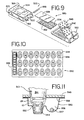
- FIG. 9 is an exploded perspective view of a blood glucose kit.
- FIG. 10 is a top perspective view of a sensor package used with the blood glucose meter of FIG. 9 .
- FIG. 11 is a partial cross-section view of a read-head of a blood glucose meter inserted into the sensor of FIG. 7 contained within a sensor package.
- FIG. 12 is a side perspective view of another sensor package.
- FIG. 13 is a cross-section view of the sensor package of FIG. 12 .
- FIG. 14 is a partial cross-section view of another blood glucose kit and the sensor package of FIG. 12 .
- FIG. 15 is a partial cross-section view of an alternate blood glucose instrument and the sensor package of FIG. 12 .
- FIG. 16 is a cross-section view of an array of the blood glucose sensors of FIG. 1 , illustrating a sequence of steps in the typical construction of the sensors with integral spacers.
- FIG. 17 is a cross-section view of an array of the blood glucose sensors in FIG. 3 , illustrating a sequence of steps in the typical construction of the sensors with spacers made by printing.
- a fluid sensor generally designated by the reference numeral 10 and embodying the present invention.
- the sensor 10 includes a body 12, a reagent 30, and a lid 40.
- the body 12 may be formed into a hollow frustum (such as a conical or pyramidal shape) shaped to mount on an optical read-head 510 of corresponding shape ( FIGS. 9 and 11 ).
- the read-head 510 can host two light guides, one for alight source and another for reflected light.
- Body 12 may be formed from impermeable plastic such as polypropylene, polyethylene terephthalate, or other plastic, using techniques known in the art, such as film forming, injection molding, etc.
- the frustum shaped body 12 has only one open end, with integral sidewalls 14 that extend downward from the periphery of a top face 16.
- a bottom face 18 is located on the inside of body 12, opposite top face 16.
- Body 12 may be sized with an overall height of 0.2 inches, although other heights that are sufficient to avoid contamination of a glucose meter 502 by sample blood may also be used.
- the engagement of body 12 with the read-head 510 can be facilitated by a first latch 24 located on the sidewall 14 of the sensor.
- the latch 24 may be formed using any technique known in the art and may comprise any number of shapes, such as indentations, holes, grooves, or embosses in the sidewall 14 of body 12.
- the top face 16 has a raised region forming a spacer 22 that surrounds an integral first surface 20, which may be formed into a concave or recessed surface for ergonomic sample loading.
- spacer 22 is depicted as an annulus, although other shapes may be used.
- Spacer 22 may be integrally formed with body 12. Alternately, spacer 22 may be formed as a separate molded spacer and attached to the top face 16 of body 12 through sonic welding, an adhesive, or other method of attachment.
- Lid 40 is mounted to spacer 22 on the top face 16 of body 12, forming a capillary chamber 50. As best seen in FIG. 1 , this arrangement has open sides formed by the gap between lid 40 and first surface 20 so as to provide access by a blood sample to the capillary chamber 50. Capillary chamber 50 allows for a controlled sample volume of blood to react with reagent 30.
- FIGS. 1 and 2 illustrate one embodiment where lid 40 is constructed of a rectangular strip of impermeable plastic, formed in a similar manner to body 12 described above. However, lid 40 is preferably colored to form an opaque barrier as described below. In addition, other shapes for lid 40, such as a circle, square, etc. may also be used. Similarly, spacer 22 may be formed such that it is only under the lid 40, and does not form a complete raised ring around top face 16 of body 12. Lid 40 may be attached to spacer 22 through sonic welding, an adhesive, or other attachment method.
- Reagent 30 is applied to the first surface 20 such that when a droplet of blood is applied to first surface 20, the blood reacts with the reagent 30.
- Reagent 30 causes a color change that can be detected by read-head 510 from bottom face 18.
- top face 16 of body 12 is colored to allow sufficient light to be transmitted from first surface 20 to bottom face 18.
- top face 16 may have a translucent or transparent coloring.
- reagent 30 may be applied directly to the plastic of body 12 through a coating, screen, or stencil-printing process. Alternatively, methods such as pipetting, pump deposition, or pin deposition can be used.
- Reagent 30 may also be membrane-based, however, in another embodiment.
- the reagent 30 may be made from any of a number of compositions that are capable of generating detectable specie that can be measured by a change in reflectance.
- One such reagent composition is a glucose dehydrogenase (GDH) - pyrroloquinoline quinone (PQQ) based system.
- GDH glucose dehydrogenase
- PQQ pyrroloquinoline quinone
- the sensor 10 is mounted to read-head 510 on the blood glucose meter 502.
- Blood glucose meter 502 (seen in FIG. 9 ) takes an initial reflectance reading on sensor 10 prior to the application of a blood sample to the sensor 10. This initial reading serves to correct for variations in background color and sensor positioning. A user is then prompted to apply a blood sample to lid 40. The blood sample is drawn by capillary action into capillary chamber 50 to react with reagent 30. After a predetermined period of time, blood glucose meter 502 then takes another reflectance reading of sensor 10. This reflectance reading of reagent 30 on sensor 10 measures the color change of formazan or other detectable specie, which indicates the glucose concentration in the blood/reagent mixture.
- Capillary chamber 50 is designed to serve as a reaction cell, providing a defined volume and surface on the side opposing the reagent 30.
- lid 40 preferably has an opaque coloration to provide a defined and consistent reflective background.
- FIGS. 16 and 17 illustrate two construction methods for an array of sensors 10 with capillary chambers 50 as described above.
- the spacer 22 is integrally molded with the body 12.
- the reagent 30 is then applied to the first surface 20, in the area between spacer 22, as described above.
- the lid 40 is applied next.
- the surface of the lid 40 that faces the inside of the capillary chamber can be optimized for rapid filling and may also be a heat-activated adhesive, such as U53 water dispersible polyurethane available from Bayer Corporation of Elkhart, Indiana, United States of America.
- This lid formulation is known as ROA.
- the lid is temporarily mounted to a backing adhesive 41 and die-cut in this form, through the ROA but leaving the temporary backing 41 intact. This structure is aligned over the tips as shown and heated through the temporary backing 41 to adhere the ROA adhesive to the spacers 22 of the sensor 10. Finally the temporary backing 41 is removed leaving completed sensors 10.
- FIG. 17 shows a variation of the construction method depicted in FIG. 16 .
- Body 12 is molded without an integral spacer 22.
- the flat top of the body 12 is advantageously suited for screen or stencil-printing the spacer 22.
- spacer 22 may be made in a printing step.
- a hydrophilic pressure-sensitive adhesive may be used instead.
- Sensor 60 includes body 12, reagent 30, and a sensor lid 45.
- Sensor lid 45 may be formed from impermeable plastic as a hollow frustum, similar to body 12, as described above.
- Sensor lid 45 may be attached to body through a second latch 48 located on a sidewall 49 of sensor lid 45.
- the second latch 48 may comprise any technique known in the art, such as indentations, holes, grooves, or embosses.
- sensor lid 45 may be attached to body 12 through sonic welding, an adhesive, or another attachment method.
- Vent holes 46 are formed in sensor lid 45 to allow a blood sample to flow into capillary chamber 51 and air to flow out of chamber 51 formed by the sensor lid 45 and the body 12.
- Other aspects of the sensor 60 are similar to the sensor 10 shown in FIGS. 1 and 2 and described above.
- FIGS. 5 and 6 Another embodiment of a sensor 70 is illustrated in FIGS. 5 and 6 .
- Sensor 70 is made up of a body 112 and reagent 30, but does not include a lid or sensor lid (as those components are described in connection with the embodiments of FIGS. 1-4 ). Although a significant fraction of light may be lost and the blood volume sample above the reagent 30 may not be defined, blood glucose meter 502 may be adapted to correct for this by taking additional reflectance readings or with some other correction.
- Other aspects of sensor 70 are similar to the sensor 10 shown in FIGS. 1 and 2 and described above.
- the body 90 comprises a porous plastic.
- the porous plastic of body 90 may be formed similarly to the impermeable plastic of body 12, as described above in connection with the embodiments of FIGS. 1 and 2 .
- the porous plastic is a sintered polymer such as polypropylene, polyvinylidene fluoride, polyethylenevinyl acetate, polystyreneacrylonitrite, polytetrafluoroethylene or related copolymers.
- the porous plastic may also be opaque, to reduce the amount of light transmitted through it and increase the amount of light reflected from the sample.
- the pore size may range from 5 to 100 microns, although other sizes may be used.
- the porous plastic is hydrophobic so that it resists sample flow unless first treated with a surfactant (not shown).
- Surfactant may be applied to a sample surface 94 on the outside tip surface 95 of the tip of body 90. Alternately, surfactant may be applied to the inside tip surface 96 of the body 90. To prevent uncontrolled sample flow within the body 90, however, only the reactive area is preferably treated with surfactant.
- Typical surfactants are derivatives of polyethylene glycol ester, polysorbate, or sorbitan ester.
- Sample surface 94 accepts a sample, and can be formed into a concave surface for ergonomic sample loading.
- a sidewall 97 may extend around the periphery of sample surface 94.
- a reagent 30, as described above, is applied to the body 90 such that when a droplet of blood reacts with the reagent 30, a color change is caused that can be detected from the inside tip surface 96 of body 90.
- the reagent 30 is affixed to the inside tip surface 96 of body 90, opposite sample surface 94.
- the reagent 30 may be affixed to sample surface 94, with surfactant applied to the inside tip surface 96 of body 90.
- Other aspects of the sensor 90 are similar to the sensor 10 shown in FIGS. 1 and 2 and described above.
- FIG. 9 illustrates a blood glucose sensor kit 500 comprising the blood glucose meter 502, a sensor package 550 containing the sensors 10 described above, an alignment guide 540, and an optional removable blood glucose meter cover 530.
- the blood glucose meter 502 comprises a housing 504, a display 506 for depicting the analyte concentration measured by the meter 502, an optical read-head 510 disposed on the housing 504, and a spring-loaded lancet mechanism 520.
- read-head 510 comprises a shape that corresponds to the shape of the sensor 10.
- An engagement mechanism such as a push-button ejection mechanism, is located on read-head 510 to detachably engage sensor 10 through first latch 24.
- the sensor package 550 comprises a base portion 552, a desiccant material 557, and a protective sheet 558.
- Sensor cavities 554 are formed as depressions in the base portion 552, with each of the sensor cavities 554 adapted to house an individual sensor 10.
- the sensor cavity 554 has an inclined or sloped support wall to position the sensor 10 while it is disposed within the sensor cavity 554.
- Each of the sensor cavities 554 is in fluid communication with a desiccant cavity 556 formed by a small depression in the base portion 552.
- Desiccant material 557 such as a 6mg sphere of Grace 10A molecular sieve desiccant, is disposed in each of the desiccant cavities 556 to maintain an appropriate humidity level to preserve the reagent 30 on the sensor 10.
- the sensor cavities 554 and desiccant cavities 556 may be aligned in rectangular arrays, allowing for reduced manufacturing and packaging costs.
- FIG. 11 illustrates a sensor package 550 design intended for aluminum foil as the protective sheet 558.
- the sensor cavity 554 is closed by heat-sealing an aluminum burst foil to the surface of the base foil.
- a typical configuration of this foil is a laminate consisting of a lacquer/8 ⁇ aluminium/10 ⁇ polypropylene heat-seal material, with an expected shelf life of one to two years for this configuration.
- One type of foil that can be used for the protective sheet 558 is AL-191-01 foil distributed by Alusuisse Flexible Packaging, Inc. With a tip height of 0.247 inches and a seal width of 0.088 inches, the maximum elongation of the foil is estimated to be 36%.
- a conductive calibration label 559 is also disposed on the sensor package 550.
- the conductive calibration label 559 can be located anywhere on sensor package 550 that space and size constraints allow, for example, on protective cover 558 or on base portion 552.
- the conductive calibration label 559 provides calibration and production information about the sensor package 550 that can be sensed by calibration circuitry in the blood glucose meter 502. Additional details regarding sensor package 550 are described in U.S. Patent No. 5,575,403, issued November 19, 1996 , and entitled Dispensing Instrument For Fluid Monitoring Sensors, the contents of which are hereby incorporated by reference.
- One example of such a sensor pack is the Ascensia® AUTODISC TM with ten test strips also available from Bayer Corporation of Elkhart, Indiana, United States of America.
- sensor package 550 may use a protective sheet 558 made from a thermoformed plastic barrier material. With a thermoformed plastic barrier material, a much greater degree of elongation or stretch is possible. This allows for a more compact package while also accommodating a taller sensor (approximately 0.2" tall).
- Formable packaging material is available from Klockner-Pentaplast, for example Pentapharm ACLAR PA 300/2.
- the product, containing ACLAR Ultrx3000 has a Moisture Vapor Transfer Rate (MVTR) of 0.005g/100sq in/day at 38°C and 90% Relative Humidity. With a 6mg desiccant bead having 15% of available moisture capacity, the expected lifetime of the sensor package 550 is about 45 days.
- alignment guide 540 is used because the sensors 10 are invisible behind the burst toil of the protective sheet 558.
- Alignment guide 540 serves to align the read-head 510 with the sensor 10.
- the read-head has two levels of taper, with a step between the two sections.
- the smaller diameter section 512 of the read-head engages directly with the sensor 10.
- the larger diameter section 514 is sized to interact with the holes 542 in alignment guide 540 to correctly position the read-head 510 over the sensor 10.
- a step between the two sections of the read-head 510, with the diameter at the top of the step being slightly larger than the diameter at the base of the sensor, serves to prevent or inhibit the sensor from being caught on the alignment guide as the read-head and attached sensor are withdrawn from the sensor package.
- Removable meter cover 530 detachably mounts to blood glucose meter 502, covering the read-head 510 and lancet mechanism 520.
- the removable meter cover 530 also has a recess adapted to contain the sensor package 550 and alignment guide 540.
- the sensor package 550 is stored in the removable meter cover 530 of the blood glucose meter 502 underneath the alignment guide 540 with the calibration label 559 exposed at one end.
- the sensor package 550 is keyed to ensure the correct orientation within the removable meter cover.
- the removable meter cover 530 is removed and the read-head 510 is pushed down through the alignment guide 540 into the sensor package 550 beneath to engage and pick up a sensor 10.
- the lancet mechanism 520 on the meter 502 is then used to draw a blood droplet that is subsequently applied to the integral first surface 20 of the sensor 10 to start the measurement sequence.
- the blood glucose measurement is displayed on the meter display 506, the sensor 10 is ejected, and the cover 530 is replaced. With the number of remaining sensors 10 being visible at a glance, an empty sensor package 550 can be easily replaced by raising the alignment guide 540 and removing it from the removable meter cover 530.
- FIG. 12 illustrates another embodiment of a sensor package 650 for storing a plurality of sensors 90.
- sensor package 650 comprises a container 652 with an inner surface 654, and a cap 656 capable of detachably sealing the container 652.
- An optional hinge 658 may be connected to the cap 656 and container 652 to allow the cap to open in a flip-top manner.
- the cap 656 can be fastened to container 652 as a push-on cap, a threaded cap, or by other known methods of attachment.
- cap 656 may be a heat sealed or other type of single use lid.
- a desiccant liner 662 is disposed inside container 652 to maintain an appropriate humidity level to preserve the reagent 30 on the sensor 90.
- desiccant liner 662 is applied to inner surface 654, but may be located anywhere within container 652.
- a friction liner 664 is also disposed within container 652 so that a plurality of stacked sensors 10 frictionally engages the friction liner 664.
- friction liner 664 is applied to the inner surface of desiccant liner 662 and may be made from any friction material, including any elastic, rubber-like material. Friction liner 664 is intended to exert gentle pressure on the edges of a sidewall 97 to prevent or inhibit movement of the sensors 90 while being engaged by read-head 510.
- the sensor package 650 depicted as a bottle in FIGS. 12 and 13 , may be relatively compact. The embodiment illustrated is sized to hold twenty sensors 90 in a nested array, with a 2 inch height and 0.46 inch diameter, but may be sized to house other numbers or sizes of sensors.
- FIG. 13 illustrates a plurality of sensor bodies 90 of FIGS. 7 and 8 positioned within sensor package 650.
- sensor body 90 has stepped sidewall 97 such that a shoulder 99 is formed.
- the shoulder 99 allows sensor body 90 to nest inside another sensor body 90, ultimately forming a nested vertical array of sensors.
- sensor package 650 may also be used to store the other sensor embodiments disclosed above.
- read-head 610, 710 is pushed down onto a stack of sensors 90 until the latch 98 on the sensor mates with the engagement means (not shown) on the read-head 510.
- the read-head 510 is then withdrawn with a sensor 90 loaded ready for inoculation with blood. Because of the downward pressure on the stack during mounting, there is a tendency for the sensors to stick together, with the conical outer surface of one sensor binding with the matching conical inner surface of the sensor below.
- the shoulder 99 of sensor body 90 rests on the top of the sensor body 90 below, and is designed to avoid this binding of successive sensors.
- FIG. 15 illustrates a meter 702 with read-head 710 and a cover (not shown) removed.
- the meter 702 is adapted to be used with sensor package 650.
- sensor package 650 is stored separately from meter 702.
- the meter 702 contains a bottle cavity 704 concentric with the read-head 710, allowing the read-head 710 to reach down to the bottom of the sensor package 650 and pick out the last sensor 10.
- a slot (not shown) may also be formed in meter 702 to run almost the length of the bottle cavity 704 to accept the hinge of the bottle.
- a scribe 706 is positioned on meter 702 to leave a mark on a label 670 that indicates the number of sensors remaining within sensor package 650. The scribe 706 provides for a convenient, instantly visible method of estimating the number of sensors remaining in sensor package 650.
- FIG. 14 illustrates another meter 602 with read-head 610 and a cover 630 adapted to store sensor package 650.
- the meter 602 has two recesses, a bottle cavity 604 concentric with the read-head 610 (described above), and a storage recess 606.
- sensor package 650 is stored within storage recess 606 of the meter 602.
- a spring-loaded cap (not shown) within the meter 602 seals to the open sensor package 650 to ensure a moisture-proof seal.
- the cover 630 is removed from meter 602, rotated 180 degrees and then replaced onto the meter 602, bringing the read-head 610 down into the sensor package 650.
- the sensor 10 is ejected and the cover 630 is replaced to seal the sensor package 650 in the storage recess 606.
- Meter 602 may also position a scribe 608 to leave a mark on a label 670 that indicates the number of sensors remaining within sensor package 650, as described above.
- the senor may be used for testing fluids other than blood glucose.
- the sensor can be used in connection with the analysis of any type of chemical fluid that can be analyzed by means of a reagent material.
- the sensors may use sizes, shapes, angles, etc. different than those described above.
- porous or impermeable plastic body designs may be used with any of the sensor shapes described in FIGS. 1-8 .
- a sensor lid or lid may also be used with porous designs.
- the coloration of the sensor body may be altered such that it is transparent, translucent, or opaque. It is therefore intended to include within the invention all such variations and modifications that fall within the scope of the appended claims and equivalents thereof.
- a fluid sensor comprising:
- the sensor of alternative embodiment G wherein said reagent is a glucose dehydrogenase and pyrroloquinoline quinone-based system.
- said reagent further comprises nicotinamide adenine dinucleotide, tetrazolium, and formazan.
- the sensor of alternative embodiment O further comprising a lid attached to said raised region.
- the sensor of alternative embodiment U wherein said formed plastic body has a pore size of from about 5 microns to about 100 microns.
- a fluid sensor comprising:
- the sensor of alternative embodiment EE further comprising a lid attached to said raised region.
- a blood glucose sensor kit comprising:
- the blood glucose sensor kit of alternative embodiment NN further comprising a lancet disposed on said housing of said blood glucose meter.
- the blood glucose sensor kit of alternative embodiment NN wherein said base portion has a plurality of sensor cavities and at least one desiccant cavity per sensor cavity in fluid communication with said sensor cavity arranged in a rectangular array.
- a blood glucose sensor kit comprising:
- the blood glucose sensor kit of alternative embodiment VV wherein said sensor package has a label affixed to an outer surface of said container, said blood glucose meter having a label marker disposed on said housing adapted to mark on said label the depth to which said read-head is inserted into said container.
- the blood glucose sensor kit of alternative embodiment VV further comprising a removable blood glucose meter cover detachably mounted to said blood glucose meter.
- a blood glucose sensor package comprising:
- the blood glucose sensor package of alternative embodiment CCC further comprising a second sensor located in said container, wherein said second sensor is stacked within said first sensor.
- a method of making a fluid sensor comprising the acts of:
Landscapes
- Health & Medical Sciences (AREA)
- Life Sciences & Earth Sciences (AREA)
- Engineering & Computer Science (AREA)
- Physics & Mathematics (AREA)
- Hematology (AREA)
- Biomedical Technology (AREA)
- Molecular Biology (AREA)
- General Health & Medical Sciences (AREA)
- Pathology (AREA)
- Surgery (AREA)
- Medical Informatics (AREA)
- Heart & Thoracic Surgery (AREA)
- Animal Behavior & Ethology (AREA)
- Biophysics (AREA)
- Public Health (AREA)
- Veterinary Medicine (AREA)
- Immunology (AREA)
- Chemical & Material Sciences (AREA)
- Urology & Nephrology (AREA)
- Manufacturing & Machinery (AREA)
- Analytical Chemistry (AREA)
- General Physics & Mathematics (AREA)
- Biochemistry (AREA)
- Medicinal Chemistry (AREA)
- Biotechnology (AREA)
- Microbiology (AREA)
- Cell Biology (AREA)
- Food Science & Technology (AREA)
- Optics & Photonics (AREA)
- Spectroscopy & Molecular Physics (AREA)
- Emergency Medicine (AREA)
- Dermatology (AREA)
- Chemical Kinetics & Catalysis (AREA)
- Plasma & Fusion (AREA)
- Diabetes (AREA)
- Investigating Or Analysing Biological Materials (AREA)
- Investigating Or Analysing Materials By The Use Of Chemical Reactions (AREA)
- Investigating Or Analyzing Materials By The Use Of Electric Means (AREA)
- Investigating Or Analyzing Non-Biological Materials By The Use Of Chemical Means (AREA)
Applications Claiming Priority (2)
| Application Number | Priority Date | Filing Date | Title |
|---|---|---|---|
| US64904605P | 2005-02-01 | 2005-02-01 | |
| EP06719997A EP1845839B1 (fr) | 2005-02-01 | 2006-01-31 | Capteur de fluide comprenant un corps en plastique moule ainsi qu'un assemblage contenant une pluralite desdits capteurs |
Related Parent Applications (1)
| Application Number | Title | Priority Date | Filing Date |
|---|---|---|---|
| EP06719997.6 Division | 2006-01-31 |
Publications (2)
| Publication Number | Publication Date |
|---|---|
| EP2281502A1 true EP2281502A1 (fr) | 2011-02-09 |
| EP2281502B1 EP2281502B1 (fr) | 2012-05-23 |
Family
ID=36570454
Family Applications (2)
| Application Number | Title | Priority Date | Filing Date |
|---|---|---|---|
| EP06719997A Expired - Lifetime EP1845839B1 (fr) | 2005-02-01 | 2006-01-31 | Capteur de fluide comprenant un corps en plastique moule ainsi qu'un assemblage contenant une pluralite desdits capteurs |
| EP20100175005 Expired - Lifetime EP2281502B1 (fr) | 2005-02-01 | 2006-01-31 | Capteur fluidique ayant un corps formé en plastique et un réactif, ainsi qu'un emballage comprenant une multiplicité desdits capteurs |
Family Applications Before (1)
| Application Number | Title | Priority Date | Filing Date |
|---|---|---|---|
| EP06719997A Expired - Lifetime EP1845839B1 (fr) | 2005-02-01 | 2006-01-31 | Capteur de fluide comprenant un corps en plastique moule ainsi qu'un assemblage contenant une pluralite desdits capteurs |
Country Status (6)
| Country | Link |
|---|---|
| US (4) | US20080159913A1 (fr) |
| EP (2) | EP1845839B1 (fr) |
| AT (1) | ATE488173T1 (fr) |
| DE (1) | DE602006018261D1 (fr) |
| TW (1) | TW200642655A (fr) |
| WO (1) | WO2006083892A2 (fr) |
Families Citing this family (66)
| Publication number | Priority date | Publication date | Assignee | Title |
|---|---|---|---|---|
| US6391005B1 (en) | 1998-03-30 | 2002-05-21 | Agilent Technologies, Inc. | Apparatus and method for penetration with shaft having a sensor for sensing penetration depth |
| US8641644B2 (en) | 2000-11-21 | 2014-02-04 | Sanofi-Aventis Deutschland Gmbh | Blood testing apparatus having a rotatable cartridge with multiple lancing elements and testing means |
| US8337419B2 (en) | 2002-04-19 | 2012-12-25 | Sanofi-Aventis Deutschland Gmbh | Tissue penetration device |
| US9226699B2 (en) | 2002-04-19 | 2016-01-05 | Sanofi-Aventis Deutschland Gmbh | Body fluid sampling module with a continuous compression tissue interface surface |
| AU2002315180A1 (en) | 2001-06-12 | 2002-12-23 | Pelikan Technologies, Inc. | Electric lancet actuator |
| US9795747B2 (en) | 2010-06-02 | 2017-10-24 | Sanofi-Aventis Deutschland Gmbh | Methods and apparatus for lancet actuation |
| DE60234598D1 (de) | 2001-06-12 | 2010-01-14 | Pelikan Technologies Inc | Selbstoptimierende lanzettenvorrichtung mit adaptationsmittel für zeitliche schwankungen von hauteigenschaften |
| US7025774B2 (en) | 2001-06-12 | 2006-04-11 | Pelikan Technologies, Inc. | Tissue penetration device |
| US7981056B2 (en) | 2002-04-19 | 2011-07-19 | Pelikan Technologies, Inc. | Methods and apparatus for lancet actuation |
| EP1404235A4 (fr) | 2001-06-12 | 2008-08-20 | Pelikan Technologies Inc | Procede et appareil pour un dispositif de lancement de lancette integre sur une cartouche de prelevement de sang |
| US9427532B2 (en) | 2001-06-12 | 2016-08-30 | Sanofi-Aventis Deutschland Gmbh | Tissue penetration device |
| US7892185B2 (en) | 2002-04-19 | 2011-02-22 | Pelikan Technologies, Inc. | Method and apparatus for body fluid sampling and analyte sensing |
| US7892183B2 (en) | 2002-04-19 | 2011-02-22 | Pelikan Technologies, Inc. | Method and apparatus for body fluid sampling and analyte sensing |
| US9314194B2 (en) | 2002-04-19 | 2016-04-19 | Sanofi-Aventis Deutschland Gmbh | Tissue penetration device |
| US7175642B2 (en) | 2002-04-19 | 2007-02-13 | Pelikan Technologies, Inc. | Methods and apparatus for lancet actuation |
| US8784335B2 (en) | 2002-04-19 | 2014-07-22 | Sanofi-Aventis Deutschland Gmbh | Body fluid sampling device with a capacitive sensor |
| US8267870B2 (en) | 2002-04-19 | 2012-09-18 | Sanofi-Aventis Deutschland Gmbh | Method and apparatus for body fluid sampling with hybrid actuation |
| US8360992B2 (en) | 2002-04-19 | 2013-01-29 | Sanofi-Aventis Deutschland Gmbh | Method and apparatus for penetrating tissue |
| US8702624B2 (en) | 2006-09-29 | 2014-04-22 | Sanofi-Aventis Deutschland Gmbh | Analyte measurement device with a single shot actuator |
| US7297122B2 (en) | 2002-04-19 | 2007-11-20 | Pelikan Technologies, Inc. | Method and apparatus for penetrating tissue |
| US8221334B2 (en) | 2002-04-19 | 2012-07-17 | Sanofi-Aventis Deutschland Gmbh | Method and apparatus for penetrating tissue |
| US7674232B2 (en) | 2002-04-19 | 2010-03-09 | Pelikan Technologies, Inc. | Method and apparatus for penetrating tissue |
| US7229458B2 (en) | 2002-04-19 | 2007-06-12 | Pelikan Technologies, Inc. | Method and apparatus for penetrating tissue |
| US7232451B2 (en) | 2002-04-19 | 2007-06-19 | Pelikan Technologies, Inc. | Method and apparatus for penetrating tissue |
| US7901362B2 (en) | 2002-04-19 | 2011-03-08 | Pelikan Technologies, Inc. | Method and apparatus for penetrating tissue |
| US7909778B2 (en) | 2002-04-19 | 2011-03-22 | Pelikan Technologies, Inc. | Method and apparatus for penetrating tissue |
| US7491178B2 (en) | 2002-04-19 | 2009-02-17 | Pelikan Technologies, Inc. | Method and apparatus for penetrating tissue |
| US9248267B2 (en) | 2002-04-19 | 2016-02-02 | Sanofi-Aventis Deustchland Gmbh | Tissue penetration device |
| US7547287B2 (en) | 2002-04-19 | 2009-06-16 | Pelikan Technologies, Inc. | Method and apparatus for penetrating tissue |
| US8579831B2 (en) | 2002-04-19 | 2013-11-12 | Sanofi-Aventis Deutschland Gmbh | Method and apparatus for penetrating tissue |
| US7331931B2 (en) | 2002-04-19 | 2008-02-19 | Pelikan Technologies, Inc. | Method and apparatus for penetrating tissue |
| US7976476B2 (en) | 2002-04-19 | 2011-07-12 | Pelikan Technologies, Inc. | Device and method for variable speed lancet |
| US7198606B2 (en) | 2002-04-19 | 2007-04-03 | Pelikan Technologies, Inc. | Method and apparatus for a multi-use body fluid sampling device with analyte sensing |
| US9795334B2 (en) | 2002-04-19 | 2017-10-24 | Sanofi-Aventis Deutschland Gmbh | Method and apparatus for penetrating tissue |
| US8574895B2 (en) | 2002-12-30 | 2013-11-05 | Sanofi-Aventis Deutschland Gmbh | Method and apparatus using optical techniques to measure analyte levels |
| DE602004028463D1 (de) | 2003-05-30 | 2010-09-16 | Pelikan Technologies Inc | Verfahren und vorrichtung zur injektion von flüssigkeit |
| WO2004107964A2 (fr) | 2003-06-06 | 2004-12-16 | Pelikan Technologies, Inc. | Procede et appareil d'echantillonnage de fluides anatomiques et d'examen de l'analysat |
| WO2006001797A1 (fr) | 2004-06-14 | 2006-01-05 | Pelikan Technologies, Inc. | Element penetrant peu douloureux |
| US8282576B2 (en) | 2003-09-29 | 2012-10-09 | Sanofi-Aventis Deutschland Gmbh | Method and apparatus for an improved sample capture device |
| EP1680014A4 (fr) | 2003-10-14 | 2009-01-21 | Pelikan Technologies Inc | Procede et appareil fournissant une interface-utilisateur variable |
| EP1706026B1 (fr) | 2003-12-31 | 2017-03-01 | Sanofi-Aventis Deutschland GmbH | Procédé et appareil permettant d'améliorer le flux fluidique et le prélèvement d'échantillons |
| US7822454B1 (en) | 2005-01-03 | 2010-10-26 | Pelikan Technologies, Inc. | Fluid sampling device with improved analyte detecting member configuration |
| WO2006011062A2 (fr) | 2004-05-20 | 2006-02-02 | Albatros Technologies Gmbh & Co. Kg | Hydrogel imprimable pour biocapteurs |
| WO2005120365A1 (fr) | 2004-06-03 | 2005-12-22 | Pelikan Technologies, Inc. | Procede et appareil pour la fabrication d'un dispositif d'echantillonnage de liquides |
| US9775553B2 (en) | 2004-06-03 | 2017-10-03 | Sanofi-Aventis Deutschland Gmbh | Method and apparatus for a fluid sampling device |
| US8989833B2 (en) | 2004-07-13 | 2015-03-24 | Dexcom, Inc. | Transcutaneous analyte sensor |
| US8652831B2 (en) | 2004-12-30 | 2014-02-18 | Sanofi-Aventis Deutschland Gmbh | Method and apparatus for analyte measurement test time |
| US8437828B2 (en) * | 2007-01-17 | 2013-05-07 | Panasonic Corporation | Blood inspection device |
| WO2008154225A2 (fr) * | 2007-06-06 | 2008-12-18 | Bayer Healthcare Llc | Système de microdépôt pour biocapteur |
| US11730407B2 (en) | 2008-03-28 | 2023-08-22 | Dexcom, Inc. | Polymer membranes for continuous analyte sensors |
| WO2009126900A1 (fr) | 2008-04-11 | 2009-10-15 | Pelikan Technologies, Inc. | Procédé et appareil pour dispositif de détection d’analyte |
| US9011670B2 (en) * | 2008-08-14 | 2015-04-21 | The Charles Stark Draper Laboratory, Inc. | Three-dimensional metal ion sensor arrays on printed circuit boards |
| US9375169B2 (en) | 2009-01-30 | 2016-06-28 | Sanofi-Aventis Deutschland Gmbh | Cam drive for managing disposable penetrating member actions with a single motor and motor and control system |
| US8721850B2 (en) * | 2010-02-02 | 2014-05-13 | Roche Diagnostics Operations, Inc. | Biosensor and methods for manufacturing |
| US8965476B2 (en) | 2010-04-16 | 2015-02-24 | Sanofi-Aventis Deutschland Gmbh | Tissue penetration device |
| GB2499838A (en) * | 2012-03-02 | 2013-09-04 | Smartsensor Telemed Ltd | Biological test device |
| AT512978B1 (de) * | 2012-06-08 | 2015-10-15 | Hagl Peter Dipl Ing | Abdeckkappe, Messgerät mit Abdeckkappe und Verfahren zur Herstellung einer Abdeckkappe |
| ITMI20130958A1 (it) * | 2013-06-11 | 2014-12-12 | Altergon Sa | Dispositivo e metodo di identificazione e monitoraggio di un kit di reagenti di un sistema analitico |
| WO2017142571A1 (fr) * | 2016-02-17 | 2017-08-24 | Field Forensics, Inc. | Dispositif universel d'échantillonnage et de transfert |
| DE102016005070A1 (de) | 2016-04-27 | 2017-11-02 | Fraunhofer-Gesellschaft zur Förderung der angewandten Forschung e.V. | Vorrichtung und Verfahren zur Temperaturüberwachung einer kryokonservierten biologischen Probe |
| DE102016005133A1 (de) * | 2016-04-27 | 2017-11-02 | Fraunhofer-Gesellschaft zur Förderung der angewandten Forschung e.V. | Verfahren und Vorrichtung zur Temperaturüberwachung einer kryokonservierten biologischen Probe |
| AU2018101602A4 (en) * | 2018-10-25 | 2018-12-13 | We Test Pty Ltd | EXPECTORATE DEVICE TEST FOR DEHYDRATION (SPECIFIC GRAVITY) We Test®: Dehydration The users expectorate on a reagent which changes colour dependent upon their hydration levels. |
| PL3650843T3 (pl) * | 2018-11-07 | 2022-05-02 | F. Hoffmann-La Roche Ag | Sposoby i urządzenia do wykonywania pomiaru analitycznego |
| JP7134569B2 (ja) * | 2018-12-10 | 2022-09-12 | 株式会社ディスコ | 試験装置 |
| CN114260201B (zh) * | 2021-11-04 | 2023-08-22 | 厦门东海洋食品有限公司 | 一种湿鱼籽筛分装置及其筛分方法 |
| TWI813304B (zh) * | 2022-05-23 | 2023-08-21 | 國立清華大學 | 按壓式流體傳輸暨檢測裝置及溶液比色分析檢測方法 |
Citations (6)
| Publication number | Priority date | Publication date | Assignee | Title |
|---|---|---|---|---|
| US5100620A (en) | 1989-05-15 | 1992-03-31 | Miles, Inc. | Capillary tube/gap reagent format |
| US5575403A (en) | 1995-01-13 | 1996-11-19 | Bayer Corporation | Dispensing instrument for fluid monitoring sensors |
| US5630986A (en) | 1995-01-13 | 1997-05-20 | Bayer Corporation | Dispensing instrument for fluid monitoring sensors |
| EP0877250A2 (fr) * | 1997-04-28 | 1998-11-11 | Bayer Corporation | Dispositif de distribution pour des détecteurs de contrÔle de fluides |
| EP1285695A2 (fr) * | 2001-08-20 | 2003-02-26 | Bayer Corporation | Système d'emballage de capteurs d'essais |
| US20030059350A1 (en) * | 1998-04-24 | 2003-03-27 | Klaus-Dieter Sacherer | Storage container for analytical devices |
Family Cites Families (7)
| Publication number | Priority date | Publication date | Assignee | Title |
|---|---|---|---|---|
| DE4041905A1 (de) * | 1990-12-27 | 1992-07-02 | Boehringer Mannheim Gmbh | Testtraeger-analysesystem |
| US5223219A (en) * | 1992-04-10 | 1993-06-29 | Biotrack, Inc. | Analytical cartridge and system for detecting analytes in liquid samples |
| US5427953A (en) * | 1993-11-08 | 1995-06-27 | The Detroit Medical Center | Blood testing method |
| US6099802A (en) * | 1996-08-09 | 2000-08-08 | Lifescan, Inc. | Hollow frustum reagent test device |
| US5902731A (en) * | 1998-09-28 | 1999-05-11 | Lifescan, Inc. | Diagnostics based on tetrazolium compounds |
| US6541216B1 (en) * | 1999-12-22 | 2003-04-01 | Roche Diagnostics Corporation | Amperometric biosensor test strip |
| US20030207454A1 (en) * | 2002-05-01 | 2003-11-06 | Eyster Curt R. | Devices and methods for analyte concentration determination |
-
2006
- 2006-01-27 TW TW095103612A patent/TW200642655A/zh unknown
- 2006-01-31 US US11/795,843 patent/US20080159913A1/en not_active Abandoned
- 2006-01-31 WO PCT/US2006/003435 patent/WO2006083892A2/fr not_active Ceased
- 2006-01-31 EP EP06719997A patent/EP1845839B1/fr not_active Expired - Lifetime
- 2006-01-31 AT AT06719997T patent/ATE488173T1/de not_active IP Right Cessation
- 2006-01-31 EP EP20100175005 patent/EP2281502B1/fr not_active Expired - Lifetime
- 2006-01-31 DE DE602006018261T patent/DE602006018261D1/de not_active Expired - Lifetime
-
2010
- 2010-09-03 US US12/875,310 patent/US8545768B2/en active Active
-
2013
- 2013-08-26 US US13/975,937 patent/US8715588B2/en not_active Expired - Lifetime
-
2014
- 2014-03-10 US US14/202,843 patent/US9134316B2/en not_active Expired - Lifetime
Patent Citations (6)
| Publication number | Priority date | Publication date | Assignee | Title |
|---|---|---|---|---|
| US5100620A (en) | 1989-05-15 | 1992-03-31 | Miles, Inc. | Capillary tube/gap reagent format |
| US5575403A (en) | 1995-01-13 | 1996-11-19 | Bayer Corporation | Dispensing instrument for fluid monitoring sensors |
| US5630986A (en) | 1995-01-13 | 1997-05-20 | Bayer Corporation | Dispensing instrument for fluid monitoring sensors |
| EP0877250A2 (fr) * | 1997-04-28 | 1998-11-11 | Bayer Corporation | Dispositif de distribution pour des détecteurs de contrÔle de fluides |
| US20030059350A1 (en) * | 1998-04-24 | 2003-03-27 | Klaus-Dieter Sacherer | Storage container for analytical devices |
| EP1285695A2 (fr) * | 2001-08-20 | 2003-02-26 | Bayer Corporation | Système d'emballage de capteurs d'essais |
Also Published As
| Publication number | Publication date |
|---|---|
| US20140193894A1 (en) | 2014-07-10 |
| US20100329951A1 (en) | 2010-12-30 |
| US9134316B2 (en) | 2015-09-15 |
| US20080159913A1 (en) | 2008-07-03 |
| WO2006083892A3 (fr) | 2006-11-09 |
| DE602006018261D1 (de) | 2010-12-30 |
| TW200642655A (en) | 2006-12-16 |
| WO2006083892A2 (fr) | 2006-08-10 |
| EP1845839B1 (fr) | 2010-11-17 |
| EP1845839A2 (fr) | 2007-10-24 |
| EP2281502B1 (fr) | 2012-05-23 |
| US8715588B2 (en) | 2014-05-06 |
| US8545768B2 (en) | 2013-10-01 |
| ATE488173T1 (de) | 2010-12-15 |
| US20130343963A1 (en) | 2013-12-26 |
Similar Documents
| Publication | Publication Date | Title |
|---|---|---|
| US8545768B2 (en) | Test sensor package | |
| CA2657265C (fr) | Systeme de mesure portatif d'encombrement optimal | |
| ES2254873T5 (es) | Sistema de recipiente para tiras reactivas | |
| EP1851539B1 (fr) | Distributeur de capteurs et méthode pour extraire un capteur. | |
| CA2853342C (fr) | Cartouche et instrument distributeur de capteurs | |
| MXPA03000334A (es) | Recipiente distribuidor de tiras de prueba. | |
| US20200300837A1 (en) | Sensor clip for stacked sensor dispensing system, and systems, methods and devices for making and using the same | |
| US9097699B2 (en) | Sensor storage and delivery system where the test sensors are individually foiled and arranged in a stack | |
| US20100282769A1 (en) | Reagent strip with removable tip | |
| US20100178703A1 (en) | Single-sensor meter system with no sensor handling and method of using the same | |
| EP1877778A1 (fr) | Conteneur d emballage pour capteurs d essai | |
| HK1135935B (en) | Storage container for analytical devices | |
| HK1135935A1 (en) | Storage container for analytical devices |
Legal Events
| Date | Code | Title | Description |
|---|---|---|---|
| PUAI | Public reference made under article 153(3) epc to a published international application that has entered the european phase |
Free format text: ORIGINAL CODE: 0009012 |
|
| AC | Divisional application: reference to earlier application |
Ref document number: 1845839 Country of ref document: EP Kind code of ref document: P |
|
| AK | Designated contracting states |
Kind code of ref document: A1 Designated state(s): AT BE BG CH CY CZ DE DK EE ES FI FR GB GR HU IE IS IT LI LT LU LV MC NL PL PT RO SE SI SK TR |
|
| RIN1 | Information on inventor provided before grant (corrected) |
Inventor name: DOSMANN, ANDREW Inventor name: CHARLTON, STEVEN Inventor name: JUNG, SUNG-KWON Inventor name: MARFURT, KAREN Inventor name: GEORGE, SUNY |
|
| 17P | Request for examination filed |
Effective date: 20110809 |
|
| REG | Reference to a national code |
Ref country code: DE Ref legal event code: R079 Ref document number: 602006029741 Country of ref document: DE Free format text: PREVIOUS MAIN CLASS: A61B0005000000 Ipc: A61B0005145000 |
|
| 17Q | First examination report despatched |
Effective date: 20111021 |
|
| GRAP | Despatch of communication of intention to grant a patent |
Free format text: ORIGINAL CODE: EPIDOSNIGR1 |
|
| RIC1 | Information provided on ipc code assigned before grant |
Ipc: A61B 5/145 20060101AFI20111110BHEP Ipc: G01N 33/487 20060101ALI20111110BHEP Ipc: G01N 33/52 20060101ALI20111110BHEP Ipc: A61B 5/1455 20060101ALI20111110BHEP |
|
| GRAS | Grant fee paid |
Free format text: ORIGINAL CODE: EPIDOSNIGR3 |
|
| GRAA | (expected) grant |
Free format text: ORIGINAL CODE: 0009210 |
|
| AC | Divisional application: reference to earlier application |
Ref document number: 1845839 Country of ref document: EP Kind code of ref document: P |
|
| AK | Designated contracting states |
Kind code of ref document: B1 Designated state(s): AT BE BG CH CY CZ DE DK EE ES FI FR GB GR HU IE IS IT LI LT LU LV MC NL PL PT RO SE SI SK TR |
|
| REG | Reference to a national code |
Ref country code: GB Ref legal event code: FG4D |
|
| REG | Reference to a national code |
Ref country code: CH Ref legal event code: EP |
|
| REG | Reference to a national code |
Ref country code: AT Ref legal event code: REF Ref document number: 558659 Country of ref document: AT Kind code of ref document: T Effective date: 20120615 |
|
| REG | Reference to a national code |
Ref country code: IE Ref legal event code: FG4D |
|
| REG | Reference to a national code |
Ref country code: DE Ref legal event code: R096 Ref document number: 602006029741 Country of ref document: DE Effective date: 20120719 |
|
| REG | Reference to a national code |
Ref country code: SE Ref legal event code: TRGR |
|
| REG | Reference to a national code |
Ref country code: NL Ref legal event code: VDEP Effective date: 20120523 |
|
| REG | Reference to a national code |
Ref country code: LT Ref legal event code: MG4D Effective date: 20120523 |
|
| PG25 | Lapsed in a contracting state [announced via postgrant information from national office to epo] |
Ref country code: CY Free format text: LAPSE BECAUSE OF FAILURE TO SUBMIT A TRANSLATION OF THE DESCRIPTION OR TO PAY THE FEE WITHIN THE PRESCRIBED TIME-LIMIT Effective date: 20120523 Ref country code: IS Free format text: LAPSE BECAUSE OF FAILURE TO SUBMIT A TRANSLATION OF THE DESCRIPTION OR TO PAY THE FEE WITHIN THE PRESCRIBED TIME-LIMIT Effective date: 20120923 Ref country code: LT Free format text: LAPSE BECAUSE OF FAILURE TO SUBMIT A TRANSLATION OF THE DESCRIPTION OR TO PAY THE FEE WITHIN THE PRESCRIBED TIME-LIMIT Effective date: 20120523 |
|
| REG | Reference to a national code |
Ref country code: AT Ref legal event code: MK05 Ref document number: 558659 Country of ref document: AT Kind code of ref document: T Effective date: 20120523 |
|
| PG25 | Lapsed in a contracting state [announced via postgrant information from national office to epo] |
Ref country code: PT Free format text: LAPSE BECAUSE OF FAILURE TO SUBMIT A TRANSLATION OF THE DESCRIPTION OR TO PAY THE FEE WITHIN THE PRESCRIBED TIME-LIMIT Effective date: 20120924 Ref country code: LV Free format text: LAPSE BECAUSE OF FAILURE TO SUBMIT A TRANSLATION OF THE DESCRIPTION OR TO PAY THE FEE WITHIN THE PRESCRIBED TIME-LIMIT Effective date: 20120523 Ref country code: GR Free format text: LAPSE BECAUSE OF FAILURE TO SUBMIT A TRANSLATION OF THE DESCRIPTION OR TO PAY THE FEE WITHIN THE PRESCRIBED TIME-LIMIT Effective date: 20120824 Ref country code: SI Free format text: LAPSE BECAUSE OF FAILURE TO SUBMIT A TRANSLATION OF THE DESCRIPTION OR TO PAY THE FEE WITHIN THE PRESCRIBED TIME-LIMIT Effective date: 20120523 |
|
| PG25 | Lapsed in a contracting state [announced via postgrant information from national office to epo] |
Ref country code: BE Free format text: LAPSE BECAUSE OF FAILURE TO SUBMIT A TRANSLATION OF THE DESCRIPTION OR TO PAY THE FEE WITHIN THE PRESCRIBED TIME-LIMIT Effective date: 20120523 |
|
| PG25 | Lapsed in a contracting state [announced via postgrant information from national office to epo] |
Ref country code: AT Free format text: LAPSE BECAUSE OF FAILURE TO SUBMIT A TRANSLATION OF THE DESCRIPTION OR TO PAY THE FEE WITHIN THE PRESCRIBED TIME-LIMIT Effective date: 20120523 Ref country code: EE Free format text: LAPSE BECAUSE OF FAILURE TO SUBMIT A TRANSLATION OF THE DESCRIPTION OR TO PAY THE FEE WITHIN THE PRESCRIBED TIME-LIMIT Effective date: 20120523 Ref country code: SK Free format text: LAPSE BECAUSE OF FAILURE TO SUBMIT A TRANSLATION OF THE DESCRIPTION OR TO PAY THE FEE WITHIN THE PRESCRIBED TIME-LIMIT Effective date: 20120523 Ref country code: DK Free format text: LAPSE BECAUSE OF FAILURE TO SUBMIT A TRANSLATION OF THE DESCRIPTION OR TO PAY THE FEE WITHIN THE PRESCRIBED TIME-LIMIT Effective date: 20120523 Ref country code: CZ Free format text: LAPSE BECAUSE OF FAILURE TO SUBMIT A TRANSLATION OF THE DESCRIPTION OR TO PAY THE FEE WITHIN THE PRESCRIBED TIME-LIMIT Effective date: 20120523 Ref country code: RO Free format text: LAPSE BECAUSE OF FAILURE TO SUBMIT A TRANSLATION OF THE DESCRIPTION OR TO PAY THE FEE WITHIN THE PRESCRIBED TIME-LIMIT Effective date: 20120523 Ref country code: NL Free format text: LAPSE BECAUSE OF FAILURE TO SUBMIT A TRANSLATION OF THE DESCRIPTION OR TO PAY THE FEE WITHIN THE PRESCRIBED TIME-LIMIT Effective date: 20120523 |
|
| PG25 | Lapsed in a contracting state [announced via postgrant information from national office to epo] |
Ref country code: IT Free format text: LAPSE BECAUSE OF FAILURE TO SUBMIT A TRANSLATION OF THE DESCRIPTION OR TO PAY THE FEE WITHIN THE PRESCRIBED TIME-LIMIT Effective date: 20120523 Ref country code: PL Free format text: LAPSE BECAUSE OF FAILURE TO SUBMIT A TRANSLATION OF THE DESCRIPTION OR TO PAY THE FEE WITHIN THE PRESCRIBED TIME-LIMIT Effective date: 20120523 |
|
| PLBE | No opposition filed within time limit |
Free format text: ORIGINAL CODE: 0009261 |
|
| STAA | Information on the status of an ep patent application or granted ep patent |
Free format text: STATUS: NO OPPOSITION FILED WITHIN TIME LIMIT |
|
| PG25 | Lapsed in a contracting state [announced via postgrant information from national office to epo] |
Ref country code: ES Free format text: LAPSE BECAUSE OF FAILURE TO SUBMIT A TRANSLATION OF THE DESCRIPTION OR TO PAY THE FEE WITHIN THE PRESCRIBED TIME-LIMIT Effective date: 20120903 |
|
| 26N | No opposition filed |
Effective date: 20130226 |
|
| REG | Reference to a national code |
Ref country code: DE Ref legal event code: R097 Ref document number: 602006029741 Country of ref document: DE Effective date: 20130226 |
|
| PG25 | Lapsed in a contracting state [announced via postgrant information from national office to epo] |
Ref country code: BG Free format text: LAPSE BECAUSE OF FAILURE TO SUBMIT A TRANSLATION OF THE DESCRIPTION OR TO PAY THE FEE WITHIN THE PRESCRIBED TIME-LIMIT Effective date: 20120823 |
|
| PG25 | Lapsed in a contracting state [announced via postgrant information from national office to epo] |
Ref country code: MC Free format text: LAPSE BECAUSE OF NON-PAYMENT OF DUE FEES Effective date: 20130131 |
|
| REG | Reference to a national code |
Ref country code: CH Ref legal event code: PL |
|
| REG | Reference to a national code |
Ref country code: IE Ref legal event code: MM4A |
|
| REG | Reference to a national code |
Ref country code: FR Ref legal event code: ST Effective date: 20130930 |
|
| PG25 | Lapsed in a contracting state [announced via postgrant information from national office to epo] |
Ref country code: CH Free format text: LAPSE BECAUSE OF NON-PAYMENT OF DUE FEES Effective date: 20130131 Ref country code: LI Free format text: LAPSE BECAUSE OF NON-PAYMENT OF DUE FEES Effective date: 20130131 |
|
| PG25 | Lapsed in a contracting state [announced via postgrant information from national office to epo] |
Ref country code: FR Free format text: LAPSE BECAUSE OF NON-PAYMENT OF DUE FEES Effective date: 20130131 |
|
| PG25 | Lapsed in a contracting state [announced via postgrant information from national office to epo] |
Ref country code: IE Free format text: LAPSE BECAUSE OF NON-PAYMENT OF DUE FEES Effective date: 20130131 |
|
| PG25 | Lapsed in a contracting state [announced via postgrant information from national office to epo] |
Ref country code: TR Free format text: LAPSE BECAUSE OF FAILURE TO SUBMIT A TRANSLATION OF THE DESCRIPTION OR TO PAY THE FEE WITHIN THE PRESCRIBED TIME-LIMIT Effective date: 20120523 |
|
| PG25 | Lapsed in a contracting state [announced via postgrant information from national office to epo] |
Ref country code: HU Free format text: LAPSE BECAUSE OF FAILURE TO SUBMIT A TRANSLATION OF THE DESCRIPTION OR TO PAY THE FEE WITHIN THE PRESCRIBED TIME-LIMIT; INVALID AB INITIO Effective date: 20060131 Ref country code: LU Free format text: LAPSE BECAUSE OF NON-PAYMENT OF DUE FEES Effective date: 20130131 |
|
| PGFP | Annual fee paid to national office [announced via postgrant information from national office to epo] |
Ref country code: DE Payment date: 20160127 Year of fee payment: 11 |
|
| PGFP | Annual fee paid to national office [announced via postgrant information from national office to epo] |
Ref country code: GB Payment date: 20160127 Year of fee payment: 11 Ref country code: SE Payment date: 20160127 Year of fee payment: 11 Ref country code: FI Payment date: 20160127 Year of fee payment: 11 |
|
| REG | Reference to a national code |
Ref country code: DE Ref legal event code: R119 Ref document number: 602006029741 Country of ref document: DE |
|
| GBPC | Gb: european patent ceased through non-payment of renewal fee |
Effective date: 20170131 |
|
| REG | Reference to a national code |
Ref country code: SE Ref legal event code: EUG |
|
| PG25 | Lapsed in a contracting state [announced via postgrant information from national office to epo] |
Ref country code: FI Free format text: LAPSE BECAUSE OF NON-PAYMENT OF DUE FEES Effective date: 20170131 |
|
| PG25 | Lapsed in a contracting state [announced via postgrant information from national office to epo] |
Ref country code: DE Free format text: LAPSE BECAUSE OF NON-PAYMENT OF DUE FEES Effective date: 20170801 Ref country code: GB Free format text: LAPSE BECAUSE OF NON-PAYMENT OF DUE FEES Effective date: 20170131 Ref country code: SE Free format text: LAPSE BECAUSE OF NON-PAYMENT OF DUE FEES Effective date: 20170201 |