EP2281589A2 - Ein in eine Körperhöhle einsetzbarer Artikel mit elektrisch verbundenen Elektrodenmaterialien - Google Patents
Ein in eine Körperhöhle einsetzbarer Artikel mit elektrisch verbundenen Elektrodenmaterialien Download PDFInfo
- Publication number
- EP2281589A2 EP2281589A2 EP10179973A EP10179973A EP2281589A2 EP 2281589 A2 EP2281589 A2 EP 2281589A2 EP 10179973 A EP10179973 A EP 10179973A EP 10179973 A EP10179973 A EP 10179973A EP 2281589 A2 EP2281589 A2 EP 2281589A2
- Authority
- EP
- European Patent Office
- Prior art keywords
- article
- cathode
- arrangement
- powder
- cathode material
- Prior art date
- Legal status (The legal status is an assumption and is not a legal conclusion. Google has not performed a legal analysis and makes no representation as to the accuracy of the status listed.)
- Withdrawn
Links
- 239000007772 electrode material Substances 0.000 title claims abstract description 50
- 239000010406 cathode material Substances 0.000 claims abstract description 101
- 239000010405 anode material Substances 0.000 claims abstract description 89
- 230000002401 inhibitory effect Effects 0.000 claims abstract description 65
- 150000002500 ions Chemical class 0.000 claims abstract description 47
- 210000001124 body fluid Anatomy 0.000 claims abstract description 22
- 239000010839 body fluid Substances 0.000 claims abstract description 22
- 241001465754 Metazoa Species 0.000 claims abstract description 11
- 239000004020 conductor Substances 0.000 claims abstract description 10
- 238000002360 preparation method Methods 0.000 claims abstract description 7
- 229910052709 silver Inorganic materials 0.000 claims description 54
- 239000000843 powder Substances 0.000 claims description 48
- OKTJSMMVPCPJKN-UHFFFAOYSA-N Carbon Chemical compound [C] OKTJSMMVPCPJKN-UHFFFAOYSA-N 0.000 claims description 38
- 238000000034 method Methods 0.000 claims description 34
- 229920000642 polymer Polymers 0.000 claims description 32
- 239000000463 material Substances 0.000 claims description 31
- 239000002245 particle Substances 0.000 claims description 28
- 230000008569 process Effects 0.000 claims description 24
- 229910002804 graphite Inorganic materials 0.000 claims description 21
- 239000010439 graphite Substances 0.000 claims description 21
- 210000002700 urine Anatomy 0.000 claims description 18
- SZVJSHCCFOBDDC-UHFFFAOYSA-N iron(II,III) oxide Inorganic materials O=[Fe]O[Fe]O[Fe]=O SZVJSHCCFOBDDC-UHFFFAOYSA-N 0.000 claims description 17
- 150000004767 nitrides Chemical class 0.000 claims description 16
- 238000007747 plating Methods 0.000 claims description 15
- -1 borides Chemical class 0.000 claims description 14
- 229920001940 conductive polymer Polymers 0.000 claims description 14
- 239000000203 mixture Substances 0.000 claims description 11
- 150000001875 compounds Chemical class 0.000 claims description 10
- 239000012530 fluid Substances 0.000 claims description 10
- 238000005240 physical vapour deposition Methods 0.000 claims description 10
- 229910052804 chromium Inorganic materials 0.000 claims description 9
- 230000005764 inhibitory process Effects 0.000 claims description 9
- 244000005700 microbiome Species 0.000 claims description 9
- 230000002485 urinary effect Effects 0.000 claims description 9
- 229910052799 carbon Inorganic materials 0.000 claims description 8
- 229910052742 iron Inorganic materials 0.000 claims description 8
- 229910052751 metal Inorganic materials 0.000 claims description 8
- 239000002184 metal Substances 0.000 claims description 8
- 150000001247 metal acetylides Chemical class 0.000 claims description 8
- 239000011230 binding agent Substances 0.000 claims description 7
- 229910052725 zinc Inorganic materials 0.000 claims description 6
- 229910052802 copper Inorganic materials 0.000 claims description 5
- 150000001768 cations Chemical class 0.000 claims description 4
- 230000007423 decrease Effects 0.000 claims description 4
- 238000001125 extrusion Methods 0.000 claims description 4
- 229910052748 manganese Inorganic materials 0.000 claims description 4
- 229920000123 polythiophene Polymers 0.000 claims description 4
- 238000007598 dipping method Methods 0.000 claims description 3
- 229910052749 magnesium Inorganic materials 0.000 claims description 3
- 238000010422 painting Methods 0.000 claims description 3
- 238000007639 printing Methods 0.000 claims description 3
- 229910021332 silicide Inorganic materials 0.000 claims description 3
- 229910052596 spinel Inorganic materials 0.000 claims description 3
- 239000011029 spinel Substances 0.000 claims description 3
- 230000006641 stabilisation Effects 0.000 claims description 3
- 238000007751 thermal spraying Methods 0.000 claims description 3
- HSFWRNGVRCDJHI-UHFFFAOYSA-N alpha-acetylene Natural products C#C HSFWRNGVRCDJHI-UHFFFAOYSA-N 0.000 claims description 2
- 229910052782 aluminium Inorganic materials 0.000 claims description 2
- 238000005229 chemical vapour deposition Methods 0.000 claims description 2
- 238000007772 electroless plating Methods 0.000 claims description 2
- 229920001467 poly(styrenesulfonates) Polymers 0.000 claims description 2
- 229920001197 polyacetylene Polymers 0.000 claims description 2
- 229920000767 polyaniline Polymers 0.000 claims description 2
- 210000003296 saliva Anatomy 0.000 claims description 2
- 239000000126 substance Substances 0.000 claims description 2
- 229910052727 yttrium Inorganic materials 0.000 claims description 2
- 229910003430 FeCr2O4 Inorganic materials 0.000 claims 1
- 230000003100 immobilizing effect Effects 0.000 claims 1
- 241000894006 Bacteria Species 0.000 abstract description 8
- 238000003780 insertion Methods 0.000 abstract description 7
- 230000037431 insertion Effects 0.000 abstract description 7
- 239000007769 metal material Substances 0.000 abstract description 6
- 230000002035 prolonged effect Effects 0.000 abstract description 2
- 238000013270 controlled release Methods 0.000 abstract 1
- 239000004332 silver Substances 0.000 description 49
- BQCADISMDOOEFD-UHFFFAOYSA-N Silver Chemical compound [Ag] BQCADISMDOOEFD-UHFFFAOYSA-N 0.000 description 45
- NRTOMJZYCJJWKI-UHFFFAOYSA-N Titanium nitride Chemical compound [Ti]#N NRTOMJZYCJJWKI-UHFFFAOYSA-N 0.000 description 15
- 239000003792 electrolyte Substances 0.000 description 15
- 239000011159 matrix material Substances 0.000 description 15
- 239000000758 substrate Substances 0.000 description 14
- 238000006243 chemical reaction Methods 0.000 description 13
- 239000010936 titanium Substances 0.000 description 13
- BASFCYQUMIYNBI-UHFFFAOYSA-N platinum Chemical compound [Pt] BASFCYQUMIYNBI-UHFFFAOYSA-N 0.000 description 12
- 238000000576 coating method Methods 0.000 description 11
- XLYOFNOQVPJJNP-UHFFFAOYSA-N water Substances O XLYOFNOQVPJJNP-UHFFFAOYSA-N 0.000 description 11
- 230000000845 anti-microbial effect Effects 0.000 description 9
- 239000011651 chromium Substances 0.000 description 9
- 239000011248 coating agent Substances 0.000 description 9
- 229910000510 noble metal Inorganic materials 0.000 description 9
- 239000010935 stainless steel Substances 0.000 description 9
- 229910001220 stainless steel Inorganic materials 0.000 description 9
- 239000008187 granular material Substances 0.000 description 8
- XEEYBQQBJWHFJM-UHFFFAOYSA-N iron Substances [Fe] XEEYBQQBJWHFJM-UHFFFAOYSA-N 0.000 description 8
- 229910052719 titanium Inorganic materials 0.000 description 8
- 239000010949 copper Substances 0.000 description 7
- 238000004090 dissolution Methods 0.000 description 7
- 208000015181 infectious disease Diseases 0.000 description 7
- 229920002635 polyurethane Polymers 0.000 description 7
- 239000004814 polyurethane Substances 0.000 description 7
- VHUUQVKOLVNVRT-UHFFFAOYSA-N Ammonium hydroxide Chemical compound [NH4+].[OH-] VHUUQVKOLVNVRT-UHFFFAOYSA-N 0.000 description 6
- CXOWYMLTGOFURZ-UHFFFAOYSA-N azanylidynechromium Chemical compound [Cr]#N CXOWYMLTGOFURZ-UHFFFAOYSA-N 0.000 description 6
- 239000000919 ceramic Substances 0.000 description 6
- 238000000151 deposition Methods 0.000 description 6
- 229910052697 platinum Inorganic materials 0.000 description 6
- RTAQQCXQSZGOHL-UHFFFAOYSA-N Titanium Chemical compound [Ti] RTAQQCXQSZGOHL-UHFFFAOYSA-N 0.000 description 5
- 230000008021 deposition Effects 0.000 description 5
- MTPVUVINMAGMJL-UHFFFAOYSA-N trimethyl(1,1,2,2,2-pentafluoroethyl)silane Chemical compound C[Si](C)(C)C(F)(F)C(F)(F)F MTPVUVINMAGMJL-UHFFFAOYSA-N 0.000 description 5
- UONOETXJSWQNOL-UHFFFAOYSA-N tungsten carbide Chemical compound [W+]#[C-] UONOETXJSWQNOL-UHFFFAOYSA-N 0.000 description 5
- QGZKDVFQNNGYKY-UHFFFAOYSA-N Ammonia Chemical compound N QGZKDVFQNNGYKY-UHFFFAOYSA-N 0.000 description 4
- LFQSCWFLJHTTHZ-UHFFFAOYSA-N Ethanol Chemical compound CCO LFQSCWFLJHTTHZ-UHFFFAOYSA-N 0.000 description 4
- WQZGKKKJIJFFOK-GASJEMHNSA-N Glucose Natural products OC[C@H]1OC(O)[C@H](O)[C@@H](O)[C@@H]1O WQZGKKKJIJFFOK-GASJEMHNSA-N 0.000 description 4
- FAPWRFPIFSIZLT-UHFFFAOYSA-M Sodium chloride Chemical compound [Na+].[Cl-] FAPWRFPIFSIZLT-UHFFFAOYSA-M 0.000 description 4
- 230000015572 biosynthetic process Effects 0.000 description 4
- 230000008878 coupling Effects 0.000 description 4
- 238000010168 coupling process Methods 0.000 description 4
- 238000005859 coupling reaction Methods 0.000 description 4
- 239000008103 glucose Substances 0.000 description 4
- 238000004544 sputter deposition Methods 0.000 description 4
- QYEXBYZXHDUPRC-UHFFFAOYSA-N B#[Ti]#B Chemical compound B#[Ti]#B QYEXBYZXHDUPRC-UHFFFAOYSA-N 0.000 description 3
- FOIXSVOLVBLSDH-UHFFFAOYSA-N Silver ion Chemical compound [Ag+] FOIXSVOLVBLSDH-UHFFFAOYSA-N 0.000 description 3
- 229910033181 TiB2 Inorganic materials 0.000 description 3
- 229910052946 acanthite Inorganic materials 0.000 description 3
- 229910052758 niobium Inorganic materials 0.000 description 3
- 239000010955 niobium Substances 0.000 description 3
- 235000016709 nutrition Nutrition 0.000 description 3
- 238000002203 pretreatment Methods 0.000 description 3
- 238000001878 scanning electron micrograph Methods 0.000 description 3
- 238000004626 scanning electron microscopy Methods 0.000 description 3
- FSJWWSXPIWGYKC-UHFFFAOYSA-M silver;silver;sulfanide Chemical compound [SH-].[Ag].[Ag+] FSJWWSXPIWGYKC-UHFFFAOYSA-M 0.000 description 3
- 239000002002 slurry Substances 0.000 description 3
- 210000002784 stomach Anatomy 0.000 description 3
- 150000004763 sulfides Chemical class 0.000 description 3
- 238000012360 testing method Methods 0.000 description 3
- DHCDFWKWKRSZHF-UHFFFAOYSA-L thiosulfate(2-) Chemical compound [O-]S([S-])(=O)=O DHCDFWKWKRSZHF-UHFFFAOYSA-L 0.000 description 3
- OFEAOSSMQHGXMM-UHFFFAOYSA-N 12007-10-2 Chemical compound [W].[W]=[B] OFEAOSSMQHGXMM-UHFFFAOYSA-N 0.000 description 2
- QIJNJJZPYXGIQM-UHFFFAOYSA-N 1lambda4,2lambda4-dimolybdacyclopropa-1,2,3-triene Chemical compound [Mo]=C=[Mo] QIJNJJZPYXGIQM-UHFFFAOYSA-N 0.000 description 2
- NLXLAEXVIDQMFP-UHFFFAOYSA-N Ammonia chloride Chemical compound [NH4+].[Cl-] NLXLAEXVIDQMFP-UHFFFAOYSA-N 0.000 description 2
- IJGRMHOSHXDMSA-UHFFFAOYSA-N Atomic nitrogen Chemical compound N#N IJGRMHOSHXDMSA-UHFFFAOYSA-N 0.000 description 2
- VYZAMTAEIAYCRO-UHFFFAOYSA-N Chromium Chemical compound [Cr] VYZAMTAEIAYCRO-UHFFFAOYSA-N 0.000 description 2
- XFXPMWWXUTWYJX-UHFFFAOYSA-N Cyanide Chemical compound N#[C-] XFXPMWWXUTWYJX-UHFFFAOYSA-N 0.000 description 2
- 241000588724 Escherichia coli Species 0.000 description 2
- UFHFLCQGNIYNRP-UHFFFAOYSA-N Hydrogen Chemical compound [H][H] UFHFLCQGNIYNRP-UHFFFAOYSA-N 0.000 description 2
- 229910039444 MoC Inorganic materials 0.000 description 2
- 206010034133 Pathogen resistance Diseases 0.000 description 2
- 229910021607 Silver chloride Inorganic materials 0.000 description 2
- 229910008066 SnC12 Inorganic materials 0.000 description 2
- 230000002776 aggregation Effects 0.000 description 2
- JEUVAEBWTRCMTB-UHFFFAOYSA-N boron;tantalum Chemical compound B#[Ta]#B JEUVAEBWTRCMTB-UHFFFAOYSA-N 0.000 description 2
- DDRJAANPRJIHGJ-UHFFFAOYSA-N creatinine Chemical compound CN1CC(=O)NC1=N DDRJAANPRJIHGJ-UHFFFAOYSA-N 0.000 description 2
- 238000013461 design Methods 0.000 description 2
- 230000000694 effects Effects 0.000 description 2
- 238000002848 electrochemical method Methods 0.000 description 2
- 238000001914 filtration Methods 0.000 description 2
- 239000011521 glass Substances 0.000 description 2
- 239000001257 hydrogen Substances 0.000 description 2
- 229910052739 hydrogen Inorganic materials 0.000 description 2
- 229920000126 latex Polymers 0.000 description 2
- 239000004816 latex Substances 0.000 description 2
- 239000007788 liquid Substances 0.000 description 2
- 230000007774 longterm Effects 0.000 description 2
- 229910021645 metal ion Inorganic materials 0.000 description 2
- UNASZPQZIFZUSI-UHFFFAOYSA-N methylidyneniobium Chemical compound [Nb]#C UNASZPQZIFZUSI-UHFFFAOYSA-N 0.000 description 2
- NFFIWVVINABMKP-UHFFFAOYSA-N methylidynetantalum Chemical compound [Ta]#C NFFIWVVINABMKP-UHFFFAOYSA-N 0.000 description 2
- 230000002906 microbiologic effect Effects 0.000 description 2
- 238000011169 microbiological contamination Methods 0.000 description 2
- 238000012986 modification Methods 0.000 description 2
- 230000004048 modification Effects 0.000 description 2
- 229910052750 molybdenum Inorganic materials 0.000 description 2
- 239000012299 nitrogen atmosphere Substances 0.000 description 2
- 230000036961 partial effect Effects 0.000 description 2
- 229920000307 polymer substrate Polymers 0.000 description 2
- 229920001296 polysiloxane Polymers 0.000 description 2
- HBMJWWWQQXIZIP-UHFFFAOYSA-N silicon carbide Chemical compound [Si+]#[C-] HBMJWWWQQXIZIP-UHFFFAOYSA-N 0.000 description 2
- HKZLPVFGJNLROG-UHFFFAOYSA-M silver monochloride Chemical compound [Cl-].[Ag+] HKZLPVFGJNLROG-UHFFFAOYSA-M 0.000 description 2
- SQGYOTSLMSWVJD-UHFFFAOYSA-N silver(I) nitrate Inorganic materials [Ag+].[O-]N(=O)=O SQGYOTSLMSWVJD-UHFFFAOYSA-N 0.000 description 2
- 239000011780 sodium chloride Substances 0.000 description 2
- GEHJYWRUCIMESM-UHFFFAOYSA-L sodium sulfite Chemical compound [Na+].[Na+].[O-]S([O-])=O GEHJYWRUCIMESM-UHFFFAOYSA-L 0.000 description 2
- 238000003756 stirring Methods 0.000 description 2
- 238000006467 substitution reaction Methods 0.000 description 2
- 229910003468 tantalcarbide Inorganic materials 0.000 description 2
- 229910052721 tungsten Inorganic materials 0.000 description 2
- 210000003708 urethra Anatomy 0.000 description 2
- QTBSBXVTEAMEQO-UHFFFAOYSA-M Acetate Chemical compound CC([O-])=O QTBSBXVTEAMEQO-UHFFFAOYSA-M 0.000 description 1
- 229910017611 Ag(NH3)2 Inorganic materials 0.000 description 1
- 229910017083 AlN Inorganic materials 0.000 description 1
- PIGFYZPCRLYGLF-UHFFFAOYSA-N Aluminum nitride Chemical compound [Al]#N PIGFYZPCRLYGLF-UHFFFAOYSA-N 0.000 description 1
- OYPRJOBELJOOCE-UHFFFAOYSA-N Calcium Chemical compound [Ca] OYPRJOBELJOOCE-UHFFFAOYSA-N 0.000 description 1
- 235000014653 Carica parviflora Nutrition 0.000 description 1
- ZAMOUSCENKQFHK-UHFFFAOYSA-N Chlorine atom Chemical compound [Cl] ZAMOUSCENKQFHK-UHFFFAOYSA-N 0.000 description 1
- 241000243321 Cnidaria Species 0.000 description 1
- RYGMFSIKBFXOCR-UHFFFAOYSA-N Copper Chemical compound [Cu] RYGMFSIKBFXOCR-UHFFFAOYSA-N 0.000 description 1
- 206010011409 Cross infection Diseases 0.000 description 1
- RWSOTUBLDIXVET-UHFFFAOYSA-N Dihydrogen sulfide Chemical compound S RWSOTUBLDIXVET-UHFFFAOYSA-N 0.000 description 1
- DGAQECJNVWCQMB-PUAWFVPOSA-M Ilexoside XXIX Chemical compound C[C@@H]1CC[C@@]2(CC[C@@]3(C(=CC[C@H]4[C@]3(CC[C@@H]5[C@@]4(CC[C@@H](C5(C)C)OS(=O)(=O)[O-])C)C)[C@@H]2[C@]1(C)O)C)C(=O)O[C@H]6[C@@H]([C@H]([C@@H]([C@H](O6)CO)O)O)O.[Na+] DGAQECJNVWCQMB-PUAWFVPOSA-M 0.000 description 1
- 229910017974 NH40H Inorganic materials 0.000 description 1
- 229910021626 Tin(II) chloride Inorganic materials 0.000 description 1
- XSQUKJJJFZCRTK-UHFFFAOYSA-N Urea Chemical compound NC(N)=O XSQUKJJJFZCRTK-UHFFFAOYSA-N 0.000 description 1
- DLKQMPVPBPYWQQ-UHFFFAOYSA-L [Ag+2].CC([O-])=O.CC([O-])=O Chemical compound [Ag+2].CC([O-])=O.CC([O-])=O DLKQMPVPBPYWQQ-UHFFFAOYSA-L 0.000 description 1
- CYKMNKXPYXUVPR-UHFFFAOYSA-N [C].[Ti] Chemical compound [C].[Ti] CYKMNKXPYXUVPR-UHFFFAOYSA-N 0.000 description 1
- 238000005054 agglomeration Methods 0.000 description 1
- 238000004220 aggregation Methods 0.000 description 1
- 229910045601 alloy Inorganic materials 0.000 description 1
- 239000000956 alloy Substances 0.000 description 1
- 230000004075 alteration Effects 0.000 description 1
- 229910021529 ammonia Inorganic materials 0.000 description 1
- 235000019270 ammonium chloride Nutrition 0.000 description 1
- 238000004458 analytical method Methods 0.000 description 1
- 230000000844 anti-bacterial effect Effects 0.000 description 1
- 230000008901 benefit Effects 0.000 description 1
- UHPOHYZTPBGPKO-UHFFFAOYSA-N bis(boranylidyne)chromium Chemical compound B#[Cr]#B UHPOHYZTPBGPKO-UHFFFAOYSA-N 0.000 description 1
- 239000008280 blood Substances 0.000 description 1
- 210000004369 blood Anatomy 0.000 description 1
- LGLOITKZTDVGOE-UHFFFAOYSA-N boranylidynemolybdenum Chemical compound [Mo]#B LGLOITKZTDVGOE-UHFFFAOYSA-N 0.000 description 1
- 229910052796 boron Inorganic materials 0.000 description 1
- 229910052791 calcium Inorganic materials 0.000 description 1
- 239000011575 calcium Substances 0.000 description 1
- 229940075397 calomel Drugs 0.000 description 1
- 239000004202 carbamide Substances 0.000 description 1
- 229910001567 cementite Inorganic materials 0.000 description 1
- 230000008859 change Effects 0.000 description 1
- 238000005234 chemical deposition Methods 0.000 description 1
- 239000003795 chemical substances by application Substances 0.000 description 1
- 239000000460 chlorine Substances 0.000 description 1
- 229910052801 chlorine Inorganic materials 0.000 description 1
- 230000001332 colony forming effect Effects 0.000 description 1
- 239000002322 conducting polymer Substances 0.000 description 1
- 238000010276 construction Methods 0.000 description 1
- 239000004035 construction material Substances 0.000 description 1
- 239000000356 contaminant Substances 0.000 description 1
- 238000011109 contamination Methods 0.000 description 1
- 238000005260 corrosion Methods 0.000 description 1
- 230000007797 corrosion Effects 0.000 description 1
- 229940109239 creatinine Drugs 0.000 description 1
- 230000003247 decreasing effect Effects 0.000 description 1
- 238000011161 development Methods 0.000 description 1
- 238000000502 dialysis Methods 0.000 description 1
- ZOMNIUBKTOKEHS-UHFFFAOYSA-L dimercury dichloride Chemical compound Cl[Hg][Hg]Cl ZOMNIUBKTOKEHS-UHFFFAOYSA-L 0.000 description 1
- BNIILDVGGAEEIG-UHFFFAOYSA-L disodium hydrogen phosphate Chemical compound [Na+].[Na+].OP([O-])([O-])=O BNIILDVGGAEEIG-UHFFFAOYSA-L 0.000 description 1
- 229910000397 disodium phosphate Inorganic materials 0.000 description 1
- 235000019800 disodium phosphate Nutrition 0.000 description 1
- 239000012153 distilled water Substances 0.000 description 1
- 238000002474 experimental method Methods 0.000 description 1
- 235000013305 food Nutrition 0.000 description 1
- 229910052733 gallium Inorganic materials 0.000 description 1
- XLYOFNOQVPJJNP-ZSJDYOACSA-N heavy water Substances [2H]O[2H] XLYOFNOQVPJJNP-ZSJDYOACSA-N 0.000 description 1
- 229910000037 hydrogen sulfide Inorganic materials 0.000 description 1
- 238000010348 incorporation Methods 0.000 description 1
- 238000001802 infusion Methods 0.000 description 1
- 230000001788 irregular Effects 0.000 description 1
- 230000000670 limiting effect Effects 0.000 description 1
- 230000005923 long-lasting effect Effects 0.000 description 1
- 239000011777 magnesium Substances 0.000 description 1
- 206010025482 malaise Diseases 0.000 description 1
- 238000007726 management method Methods 0.000 description 1
- 239000011572 manganese Substances 0.000 description 1
- 238000004519 manufacturing process Methods 0.000 description 1
- VNWKTOKETHGBQD-UHFFFAOYSA-N methane Chemical compound C VNWKTOKETHGBQD-UHFFFAOYSA-N 0.000 description 1
- GUCVJGMIXFAOAE-UHFFFAOYSA-N niobium atom Chemical compound [Nb] GUCVJGMIXFAOAE-UHFFFAOYSA-N 0.000 description 1
- 229910052757 nitrogen Inorganic materials 0.000 description 1
- JMANVNJQNLATNU-UHFFFAOYSA-N oxalonitrile Chemical compound N#CC#N JMANVNJQNLATNU-UHFFFAOYSA-N 0.000 description 1
- 238000005334 plasma enhanced chemical vapour deposition Methods 0.000 description 1
- 238000000623 plasma-assisted chemical vapour deposition Methods 0.000 description 1
- 229920000128 polypyrrole Polymers 0.000 description 1
- 229920000915 polyvinyl chloride Polymers 0.000 description 1
- 230000009467 reduction Effects 0.000 description 1
- 230000002829 reductive effect Effects 0.000 description 1
- 239000013535 sea water Substances 0.000 description 1
- 229910052710 silicon Inorganic materials 0.000 description 1
- 229910010271 silicon carbide Inorganic materials 0.000 description 1
- 229920002379 silicone rubber Polymers 0.000 description 1
- 239000011734 sodium Substances 0.000 description 1
- 229910052708 sodium Inorganic materials 0.000 description 1
- 235000010265 sodium sulphite Nutrition 0.000 description 1
- 238000004659 sterilization and disinfection Methods 0.000 description 1
- RCKBMGHMPOIFND-UHFFFAOYSA-N sulfanylidene(sulfanylidenegallanylsulfanyl)gallane Chemical compound S=[Ga]S[Ga]=S RCKBMGHMPOIFND-UHFFFAOYSA-N 0.000 description 1
- 239000002352 surface water Substances 0.000 description 1
- 238000013268 sustained release Methods 0.000 description 1
- 239000012730 sustained-release form Substances 0.000 description 1
- 230000002195 synergetic effect Effects 0.000 description 1
- 229910052715 tantalum Inorganic materials 0.000 description 1
- AXZWODMDQAVCJE-UHFFFAOYSA-L tin(II) chloride (anhydrous) Chemical compound [Cl-].[Cl-].[Sn+2] AXZWODMDQAVCJE-UHFFFAOYSA-L 0.000 description 1
- 208000019206 urinary tract infection Diseases 0.000 description 1
- 229910052720 vanadium Inorganic materials 0.000 description 1
- 238000009423 ventilation Methods 0.000 description 1
- 230000003245 working effect Effects 0.000 description 1
- 229910052726 zirconium Inorganic materials 0.000 description 1
Images



Classifications
-
- A—HUMAN NECESSITIES
- A61—MEDICAL OR VETERINARY SCIENCE; HYGIENE
- A61L—METHODS OR APPARATUS FOR STERILISING MATERIALS OR OBJECTS IN GENERAL; DISINFECTION, STERILISATION OR DEODORISATION OF AIR; CHEMICAL ASPECTS OF BANDAGES, DRESSINGS, ABSORBENT PADS OR SURGICAL ARTICLES; MATERIALS FOR BANDAGES, DRESSINGS, ABSORBENT PADS OR SURGICAL ARTICLES
- A61L29/00—Materials for catheters, medical tubing, cannulae, or endoscopes or for coating catheters
- A61L29/08—Materials for coatings
- A61L29/10—Inorganic materials
-
- A—HUMAN NECESSITIES
- A61—MEDICAL OR VETERINARY SCIENCE; HYGIENE
- A61L—METHODS OR APPARATUS FOR STERILISING MATERIALS OR OBJECTS IN GENERAL; DISINFECTION, STERILISATION OR DEODORISATION OF AIR; CHEMICAL ASPECTS OF BANDAGES, DRESSINGS, ABSORBENT PADS OR SURGICAL ARTICLES; MATERIALS FOR BANDAGES, DRESSINGS, ABSORBENT PADS OR SURGICAL ARTICLES
- A61L29/00—Materials for catheters, medical tubing, cannulae, or endoscopes or for coating catheters
- A61L29/14—Materials characterised by their function or physical properties, e.g. lubricating compositions
Definitions
- the present invention relates to an article to be inserted in a human or animal body cavity having a biologically inhibiting arrangement of electrically connected electrode materials on one or more surfaces of the article, which arrangement as electrode materials includes a metallic anode material and a cathode material, where the potential of the cathode material is higher than the potential of the anode material, which arrangement releases biological inhibiting ions of the metallic anode material or complexes of such ions when the biologically inhibiting arrangement is contacted with a body fluid, the use of an article having a biologically inhibiting arrangement on one or more surfaces for the inhibition of microorganisms and a process for the preparation of an article having a biologically inhibiting arrangement on one or more surfaces.
- WO 2004/045577 discloses a biologically inhibiting material having a surface with separated areas of anode material and cathode material. Both the anode material and the cathode material have a positive galvanic potential, and the potential of the cathode material is higher than the potential of the anode material. The distance between any point on the active surface and the adjacent cathode material and the adjacent anode material does not exceed 200 pm.
- This material is useable as a construction material in equipments for food preparations or in water systems and is able to inhibit microorganisms by a galvanic process without release of significant amounts of Ag * -ions to a contacting liquid (electrolyte).
- WO 99/46780 discloses a silver ion releasing material having a plurality of carbon granules and a plurality of silver granules each distributed in an electrically conducting base material. Being distributed separated in the base material the carbon and silver granules are not in direct contact with each other. This arrangement gives not a satisfactory release of the silver ions due to an insufficient electrical contact between the silver anode material and the graphite cathode material.
- the present invention relates to an article to be inserted in a human or animal body cavity having a biologically inhibiting arrangement of electrically connected electrode materials on one or more surfaces of the article, which arrangement as electrode materials includes a metallic anode material and a cathode material, where the potential of the cathode material is higher than the potential of the anode material, which arrangement releases biological inhibiting ions of the metallic anode material or complexes of such ions when the biologically inhibiting arrangement is contacted with a body fluid, characterised in, that the cathode material is an electrically conductive material selected among nitrides, borides, carbides, mixed nitrides, siticides, oxides with spinel structure, conductive polymers and combinations of two or more thereof and that the cathode and anode materials are in direct contact with each other.
- the inventive article to be inserted in a body cavity is as a catheter, a gastroenteral or endotracheal tube, or a part of a drainage or suction device.
- the invention also relates to the use of an article having a biologically inhibiting arrangement of electrically connected electrode materials on one or more surfaces of the article, which arrangement as electrode materials includes a metallic anode material and a electrically conductive cathode material, where the potential of the cathode material is higher than the potential of the anode material, which conductive cathode material is selected among nitrides, sulfides, borides, carbides, mixed nitrides, silicides, oxides, carbon, conductive polymers and combinations of two or more thereof, which cathode and anode materials are in direct contact with each other, and which arrangement releases biological inhibiting ions of the metallic anode material or complexes of such ions when the biologically inhibiting arrangement is contacted with a body fluid for the inhibition of microorganisms.
- the invention relates to a process for the preparation of an article having a biologically inhibiting arrangement on one or more surfaces of the article which by contact with a body fluid releases biological inhibiting ions of a metallic anode material or complexes of such ions, characterised by providing an arrangement of electrically connected electrode materials on one or more surfaces of the article, which arrangement as electrode materials includes a metallic anode material and a electrically conductive cathode material, where the potential of the cathode material is higher than the potential of the anode material, which conductive cathode material is selected among nitrides, sulfides, borides, carbides, mixed nitrides, silicider, oxides, carbon, conductive polymers and combinations of two or more thereof, and which cathode and anode materials are arranged in direct contact with each other.
- nitrides, sulfides, borides, carbides, mixed nitrides, silicider, oxides, carbon, conductive polymers or combinations of two or more thereof as an alternative to the expensive noble metal such as platinum as proposed by DeLaurentis et al in US patent No. 5,295,979 opens the possibility for the production of non-expensive disposable articles having biologically inhibiting surface arrangements. Furthermore, some of the proposed cathode materials are more easy to deposit as a layer on certain problematic substrates such as polymeric substrates and it can be more easy to cover such layer with an incomplete layer of a metallic anode material such as Zn, Ag or Cu.
- the electrically conductive material to be used as the cathode material in the biologically inhibiting arrangement on one or more surfaces of the inventive article can in principle be any electrically conductive material having a potential which is higher than the potential of the metallic anode material in the environment of a human or animal body cavity.
- Excluded from the present invention are the expensive noble metals disclosed by DeLaurentis et al in US patent No. 5,295,979 .
- cathode materials having a higher potential than for example silver can be found among .
- Suitable as the cathode material are also combinations of two or more of these materials.
- the cathode material Specially preferred as the cathode material are TiAlN, TiCN, SiC, CrN, TiB 2 , Fe 3 0 4 , TiN, Cr 2 N, TiC, and Fe 3 C including combinations of two or more thereof.
- the actual potential difference between the anode and the cathode depends on the selected cathode material, the selected anode material, the area and geometric shape of the electrodes and the composition of the electrolyte in question.
- the release rate of the biological inhibiting ions of the metallic anode material or complexes of such ions depends inter alia on this actual potential difference and the kinetic properties of the cathode material.
- the release rate may be adjusted or controlled by a proper selection of a cathode material having an appropriate potential.
- a suitable potential one of the above mentioned cathode materials or a combination of two or more thereof can be selected.
- a broad range of desirable release rates are available on the basis of the selected cathode material or materials as well as the selected geometric design of the electrodes.
- a further possibility for the adjustment of the release rate of the biological inhibiting ions can be obtained by improving the conductivity of the cathode material by doping thereof.
- non-conductive or sparingly conductive materials electrically conductive by doping.
- doping extends the selection of possible cathode materials for the inventive article.
- ceramics which are marketed with a content of contaminants improving their electrical conductivity are contemplated for use as cathode materials in the inventive article.
- the cathode material used in the inventive articles can be contemplated as the cathode material used in the inventive articles. Based on the present specification the skilled person is taught how to select and test a candidate material based on the price, the workability and the electrical conductivity of the material and its potential in the environment of the body cavity in question. Thus, although the materials disclosed in the present description and claims at present are considered as the preferred materials other materials and compositions are also contemplated as the cathode materials.
- An important feature of the present invention is the possibility to select among a great number of materials whereby the desired release rate of biological inhibiting ions to a great extent can be tailored.
- Preliminary tests have shown that granules of graphite deposited with Ag provide a relatively fast release rate of ions. This may be advantageous in articles to be inserted for a short time in a body cavity especially if the risk of infection is high.
- cathode materials having a potential with a smaller difference to that of the anode material are preferred.
- a first anode/cathode combination may be selected to obtain an initial high release rate to kill bacteria introduced during insertion of a catheter combined with a second anode/cathode combination with a slow release rate ensuring a long-term bactericidal effect.
- the arrangements in two or-more areas on the surface of the article may be provided with different release rates of biological inhibiting ions.
- the article may be tailored to meet the varying requirements for inhibition of microorganisms on the different surface areas of the article when inserted in a body cavity.
- the relevant potential of an electrode material is the actual potential when being in contact with a body fluid.
- the potential of silver will decrease relative to the standard hydrogen electrode (SHE) because the dissolved silver ions in the electrolyte are complex bound due to the formation of a complex with the ammonium ions in the urine.
- SHE standard hydrogen electrode
- the metallic anode material are Zn, Ag and Cu.
- the preferred anode material is Ag. It is also possible to use a combination of Zn, Ag and/or Cu either as alloys or distributed as a plurality of individual anode sections each connected electrically to the cathode material.
- a biological inhibiting arrangement based on such combinations will release a combination of biological inhibiting ions of each type of the metallic anode materials or complexes of such ions when the biologically inhibiting arrangement is contacted with a body fluid.
- Such release of different metal ions, for example of Ag and Cu is believed to have a synergistic biological inhibiting activity ( Yahya, M. T., Landeen, L. K., Messina, M. C., Kutz, S.
- the biological inhibiting arrangement on the inventive article includes the anode and cathode materials in an arrangement creating a galvanic couple, which drives antimicrobial ions or complexes thereof into a body fluid contacting the arrangement.
- the arrangement creates multiple small galvanic couples distributed throughout the arrangement.
- such arrangements are provided on those surfaces of an article susceptible to contamination with microorganisms.
- such multiple galvanic couples may be obtained with an arrangement wherein at least one of the electrode materials is distributed as a plurality of sections each in direct contact with the other electrode material.
- the sections of the relevant electrode material will be active as small electrodes when contacted with a body fluid.
- Typical sizes of such electrodes may be in the range from 1 nm up to 10 um or more.
- such multiple galvanic couples may be obtained with an arrangement wherein a layer of one of the electrode materials is covered with an incomplete layer of the other electrode material.
- such multiple galvanic couples may be obtained with an arrangement wherein particles or flakes of one of the electrode materials contaminated with the other electrode material are immobilized, for example on a non-conductive polymeric matrix.
- such particles may be incorporated in a matrix used as a coating on an article to be inserted in a body cavity such as a catheter, a gastroenteral or endotracheal tube, or a part of a drainage or suction device.
- the coating may be of the type having friction-reducing properties in wet condition conventionally used on catheters. Examples of such coatings are disclosed in EP 586 324 and EP 591 091 .
- such multiple galvanic couples may be obtained with an arrangement comprising a pattern of electrically connected and directly contacting layers of the anode material and the cathode material applied on separated surface areas.
- An example of the inventive article is a catheter tube provided with a biologically inhibiting arrangement such as a coating on the interior and exterior surfaces.
- the anode material and/or the cathode material have been applied on the article by a plating method, preferably by electroless plating, electrochemical plating, physical vapour deposition process (PVD-process), chemical vapour deposition process (CVD-process), thermal spraying or a combination of two or more of these processes.
- a plating method preferably by electroless plating, electrochemical plating, physical vapour deposition process (PVD-process), chemical vapour deposition process (CVD-process), thermal spraying or a combination of two or more of these processes.
- the anode material and/or the cathode material have been applied on one ore more surfaces of the article as a powder.
- the powder for example is it possible to apply the powder by a painting or printing method incorporated in a binder containing composition. Furthermore it is possible to apply the powder by co-extrusion of a mixture of a polymer and the powder. Moreover, the powder may be mixed with a polymer and applied by a dipping process.
- the anode and cathode materials arranged on one or more surfaces on the inventive article must, of course, be electrically connected for the establishment of a galvanic couple in a body fluid acting as an electrolyte. According to the present invention this is ensured by the fact that the cathode and anode materials are in direct contact with each other. In this way the electrical resistance is kept at a minimum ensuring an optimal efficiency of the biological inhibition.
- the graphite combined with silver as the anode provided the graphite and silver are in direct contact with each other.
- Such material differs from the material proposed in WO 99/46780 wherein graphite granules and silver granules are distributed separated from each other in a conductive base material.
- the silver may be combined directly with the graphite granules in a way in which both the graphite and the silver will be exposed to the surroundings. This provides silver ion releasing granules which also maintain the ion releasing ability when distributed in a non-conducting but ion permeable material.
- An example of such combination is direct depositing of the silver on the graphite granules as an incomplete layer leaving openings exposing the graphite.
- the present invention also relates to an article to be inserted in a human or animal body cavity having a biologically inhibiting arrangement of electrically connected electrode materials on one or more surfaces of the article, which arrangement as electrode materials includes a anode material of Ag and a cathode material of graphite, which arrangement releases biological inhibiting ions of the Ag anode material or complexes of such ions when the biologically inhibiting arrangement is contacted with a body fluid, characterised in, that the cathode and anode materials are in direct contact with each other.
- the combination Ag/graphite may in many cases be too efficient due to the high potential difference between Ag and graphite and the relatively good kinetically properties of graphite providing a high initial release of Ag ions.
- To obtain a sustained release over a prolonged period of time use of cathode materials having a potential closer to that of Ag are preferred.
- Articles to be inserted in a body cavity such as catheters, gastroenteral or endotracheal tubes and drainage or suction systems give as mentioned above a high risk for infections.
- articles can suitably be designed as an article according to the invention, which is an article of the mentioned type provided with the biologically inhibiting arrangement on those surfaces susceptible to microbiological contamination.
- TT tracheal tubes
- ET endotracheal tubes
- suction catheters gastro-entrology tubes
- the invention also relates to other articles for use in contact with a body fluid susceptible for microbiological infections including articles for wound care, infusion devices, drainages and dialysis devices and similar devices.
- indwelling urinary catheter is the conventional Foley catheter which is inserted into the bladder of an individual of either gender. This catheter extends upwardly through the urethra and the internal urethral orifice into the bladder. The end of the catheter includes an opening for drainage and an inflatable balloon to hold the opening in the bladder. As the indwelling catheter remains inserted for extended periods of time, for example up to one month, there is a very high risk for infections which risk can be controlled by the biologically inhibiting arrangement.
- an important embodiment of the inventive article is an intermittent or indwelling urinary catheter provided with the biologically inhibiting arrangement on those surfaces susceptible to microbiological contamination.
- the biologically inhibiting arrangement is situated on the inner and/or outer surface of the article.
- the present invention further relates to the use of the inventive article for the inhibition of microorganisms.
- the inventive article is especially useful for the inhibition of microorganisms in a body fluid containing one or more compounds being able to decrease the potential of the metallic anode material by stabilisation of ions of the anode metal in the fluid.
- This stabilisation may be a complex binding of the free metal ions whereby the free ions are depleted from the surrounding electrolyte.
- the result is that the formation of ions of the anode metal is further supported which in other words means that the potential of the anode metal decreases.
- This type of body fluids contains ammonia (as NH 4 0H) which binds ions of silver as a complex with the formula Ag(NH 3 ) 2 + .
- thiosulfate is a complex binder for silver ions.
- the compound Ag(S 2 O 3 )Z- 3 may be found on coral reefs ( Taylor, M., A. Demayo and S. Reeder. 1980. Guidelines for Surface Water Quality. Vol. 1. Inorganic Chemical Substances. Silver. IWD, Water Quality Branch, Ottawa ).
- the acetate ion is a weak complex binder.
- Ag(CH 3 COO) 2 - is termed silver diacetate. It occurs in biological environments.
- the galvanic potentials of the anode material p A and the cathode material p c referred to in the present description and in the claims are - unless else is indicated - the actual potentials when contacted with the electrolyte in question.
- the anode material may have a decreased potential relative to SHE even when the metallic anode material would have a positive potential in an electrolyte without complex binding ammonium ions.
- the biological inhibiting effect of the inventive arrangement requires a sufficient difference Ap between the respective potentials of the anode material p A and the cathode material p c .
- the cathode material has a positive galvanic potential relative to SHE but depending of the value of p A even p c may be a negative value relative to SHE.
- the rate with which the antimicrobial ions are driven into solution depends on the value of ⁇ p.
- the release rate for the antimicrobial ions can be controlled by a suitable choice of a cathode material having a p c giving a low, medium or high value of ⁇ p to obtain a corresponding low, medium or high release rate.
- the cathode material may be a single material or a combination of two ore more of the suggested electrically conductive non-metallic materials.
- the release rate may - as discussed above in the present specification - also depend on other factors.
- Fig. 1 shows an article according to the invention in the form of a conventional nutritional feeding tube comprising a longitudinal tube 2 having a front end 4 to be inserted into the stomach and a connection end 6. Adjacent to the front end 4 are a number of apertures 8 opening for the nutritional feed delivery from the tube 2 and supplied from the connection end 6.
- a feeding tube of the type shown in Fig. 1 may typically have a length of about 14 to 100 cm and an outer diameter of the tube of about 1.3 to 4 mm.
- the inner and outer surfaces of the feeding tube 2 can be provided with a biological inhibiting arrangement as illustrated schematically in Fig. 2 , which is a partial longitudinal section of the feeding tube 2 shown in Fig. 1 . It should be noted that the dimensions shown in Fig. 2 are not correct as the sections of cathode material are enlarged in the figure to illustrate the principle.
- the feeding tube 2 is provided with the biological inhibiting arrangement on the inner surface with a layer of an anode material 10 which again is partially covered with a plurality of sections of a cathode material 12, which sections 12 are electrically connected to the layer of anode material 10.
- the biological inhibiting arrangement is also provided on the outer surface of the feeding tube 2 in the form of a layer of an anode material 14 which again is partially covered with a plurality of sections of a cathode material 16, which sections 16 are electrically connected to the layer of anode material 14.
- the size of the sections 12 and 16 calculated as the diameter on the surface can be between 1 nm and 10 ⁇ m, preferably between 10 nm and 1 um.
- the distance between the sections 12 and 16 where the layers of anode material 10 and 14 will be exposed to the urine containing fluid acting as an electrolyte can similarly be between 1 nm and 10 ⁇ m, preferably between 10 nm and 1 um.
- the feeding tube shown in Fig. 1 is intended for relatively short time insertion into the stomach.
- the biological inhibiting arrangement can also be provided on feeding tubes intended for a long term insertion as well as on an indwelling urinary catheter such as a conventional Foley catheter or another comparable catheter which typically remains in and inhabits the bladder and urethra for extended periods of time.
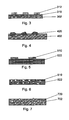
- FIG. 3 - 7 illustrated different embodiments of the biological inhibiting arrangement schematically.
- Fig. 3 illustrates in general the embodiment also illustrated in Fig. 2 .
- the biological inhibiting arrangement is provided on a non-conducting substrate 302.
- the substrate 302 can be of a non-conducting material such as a non-conductive polymeric material or ceramic or glass.
- the surface of the substrate 302 is coated or in another way covered with a layer of an anode material 310 which again is partially covered with a plurality of sections of a cathode material 312, which sections 312 are electrically connected to and in direct contact with the layer of anode material 310.
- the size of the sections 312 calculated as the diameter on the surface can be between 1 nm and 10 um, preferably between 10 nm and 1 ⁇ m.
- the distance between the sections 312 where the layer of anode material 310 will be exposed to the electrolyte can similarly be between 1 nm and 10 um, preferably between 10 nm and 1 um.
- An alternative embodiment of the biological inhibiting arrangement includes a construction similar to that shown in Fig. 3 but with the substrate covered with a layer of a cathode material which again is partially covered with sections of an anode material.
- any other structure partially covering the layer of the second electrode material is possible.
- An example is a net of the first material laid over the second material whereby the second material will be exposed to the electrolyte through the holes in the net.
- the biological inhibiting arrangement is in the form of particles or flakes 420 containing both electrode materials.
- These particles or flakes 420 may be prepared by incorporation of smaller particles (for example grains or clusters) of the first electrode material into a matrix of the second electrode material or by aggregation or agglomeration of a mixture of smaller particles (grains) of the first and second electrode materials.
- the particles or flakes 420 including both electrode materials may have a size between 1 and 40 um or even more, whereas the size of the smaller particles or grains or clusters of a single electrode material calculated as the diameter can be between 1 nm and 10 um, preferably between 10 nm and 1 um.
- the particles 420 are embedded partially in the surface of a substrate 402.
- This substrate 402 can be of a non-conducting material such as a polymeric material or ceramic or glass and may be a part of an inventive article to be inserted in a body cavity.
- the cathode material is an electrically conducting polymer 522 partially covered with sections 510 of anode material.
- the size of the sections 510 calculated as the diameter on the surface can be between 1 nm and 10 ⁇ m. preferably between 10 nm and 1 ⁇ m.
- the distance between the sections 510 where the electrical conductive polymeric cathode material 522 will be exposed to the electrolyte can similarly be between 1 nm and 10 um, preferably between 10 nm and 1 um.
- the partially covering anode material could also be provided as a net exposing the cathode material to the electrolyte through the holes in the net.
- other incompletely covering layers of the anode material are contemplated.
- the size of the particles 610 calculated as the greatest diameter can be between 1 nm and 10 ⁇ m, preferably between 10 nm and 1 ⁇ m.
- the distance between the particles 610 in the matrix 622 can similarly be between 1 nm and 10 um, preferably between 10 nm and 1 um.
- a further embodiment illustrated in Fig. 7 includes particles or flakes 720 similar to the particles or flakes 420 shown in Fig. 4 containing both electrode materials.
- the particles 720 are embedded in a substrate 702 of a non-conducting material wherein ions of the anode material will migrate out to the surface.
- the particles or flakes 720 may be exposed to the surface by wear of the substrate 702.
- this substrate 702 can be a coating of a polymeric material of the type having friction-reducing properties in wet condition conventionally used on catheters as disclosed in EP 586 324 and EP 591 091 .
- the particles or flakes 720 including both electrode materials may have a size between 10 nm and 40 um, whereas the size of the smaller particles or grains or clusters of a single electrode material calculated as the diameter can be between 1 nm and 10 um, preferably between 10 nm and 1 um.
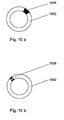
- Figs. 8, 9 and 10 show cross sections of tubes to be inserted in a body cavity prepared by co-extrusion of a first polymer 802, 902 and 1002 with a silver/cathode material in a matrix of a second polymer 824, 924, 926 and 1028.
- a tube 802 of the first polymer is provided with the biologically inhibiting arrangement exemplified with a powder of cathode material and silver in a matrix of the second polymer 824 as a layer on the outer surface of the tube.
- a tube 902 of the first polymer is provided with the powder of cathode material and silver in a matrix of the second polymer as layers 924 and 926, respectively, both on the outer and on the inner surface of the tube.
- a section 1028 of the tube cross section is provided with the biologically inhibiting powder whereas the remaining section 1002 is made of polymer without the powder. It is also possible to have more than one strand of the powder containing polymer.
- first and second polymers used in the above embodiments are PVC, PUR, silicone and other polymers acceptable for use in contact with the body.
- the first and second polymers may be of the same or different polymer types provided they are sufficient compatible to ensure that the materials will not delaminate.
- the electrochemical measurements were performed in a 400 ml electrochemical cell with a massive cylindrical working electrode with a length of 1 cm and a diameter of 1 cm.
- a cylindrical counter electrode of platinum was used, having a diameter of 6.5 cm and a length of 8 cm.
- a standard calomel electrode (SCE) was used as reference electrode.
- Table 2 shows the current density obtained by galvanic coupling of Ag with different cathode materials in a standard urine solution (EN 1616;:1997) at 37 °C.
- Table 2 Work ing elec- trode Counter electrode Description of counter electrode material Current density after 10 min Current density after 60 min Current density after 120 min Ag
- TiN Plasma Enhanced Chemical Vapour Deposition of titanium nitride on stainless steel AISI 304L 0.07 ⁇ A/cm 2 0.17 ⁇ A/cm 2 0.3 ⁇ A/cm 2 Ag CrN-LT Low temperature physical vapour deposited chromium nitride on Stainless steel, AISI 304L 0.209 ⁇ A/cm 2 0.073 ⁇ A/cm 2 0.035 ⁇ A/cm 2 Ag (Ti,Cr)N Physical vapour deposited (titan
- Table 3 shows the dissolution rate of silver as calculated from the above galvanic coupling experiments, assuming 100% current yield Table 3
- Working electrode Counter electrode Ag dissolution after 10 min Ag dissolution after 60 min Ag dissolution after 120 min Ag Graphite 0.97 ⁇ g/(h x cm 2 ) 0.2 ⁇ g/(h x cm 2 ) 0.16 ⁇ g1(h x cm 2 ) Ag TiN 0.28 ⁇ g/(h x cm 1 ) 0.68 ⁇ g/(h x cm 2 ) 1.2 ⁇ g/(h xcm 2 ) Ag CrN-LT 0.84 ⁇ g/(h x cm 2 ⁇ 0.29 ⁇ g/(h x cm 2 ) 0.14 ⁇ g/(h x cm 2 ) Ag (Ti,Cr)N 0.39 ⁇ g/(h x cm 2 ) 0.15 ⁇ g/(h x cm 2 ) 0.13 ⁇ g/(h x cm 2 ) Ag TiAIN-nano 0.04 ⁇
- the present example illustrates deposition of Ag on a fine powder of cathode material.
- a very fine powder is advantageous in order to obtain a maximal surface area.
- Fe 3 O 4 was dispersed in H 2 O, with concentration of approximately 600g/L.
- Glucose was dissolved in H 2 O, with concentration of approximately 125g/L, and subsequently added to the solution of dispersed Fe 3 O 4 using a volume ratio of 2:3.
- Aqueous ammonia was added to a solution of 80 g/L AgN0 3 , this solution was added to the powder/glucose solution using a volume ratio of 3:5 under continuously stirring in minimum 20 min.
- the powder was separated by filtration of the slurry, and washed with copious amounts of H 2 O/ethanol.
- the powder was dried in an oven at approx. 70-90°C.
- Fig. 11 shows a Scanning Electron Microscopy (SEM) image of the obtained powder.
- the present method for deposition of Ag on magnetite (Fe 3 0 4 ) powder is in most cases also usable on other types of powders of cathode material.
- it is advantageous to pre-treat the powder before the Ag deposition is described below in case of graphite powder. It should be noted that further processes for chemical deposition of Ag are well known from the literature.
- Aqueous ammonia is added to a solution of 80 g/L AgN0 3 , this solution was added to the powder/glucose solution using a volume ratio of 3:5 under continuously stirring in minimum 20 min.
- the powder was separated by filtration of the slurry, and wash with copious amounts of H 2 O/ethanol.
- the powder was dried in an oven at approx. 70-90°C.
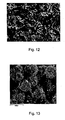
- Fig. 12 shows a SEM image of the obtained powder.
- tungsten carbide with a particle size of 30 - 100 ⁇ m were deposited with Ag in a way similar to example 2.
- Fig. 13 shows a SEM image of the obtained powder. Analyses on different points on the surface confirm sufficiently irregular silver content throughout the surface.
- 60 % weight of the magnetite powder coated with silver obtained in example 2 was mixed into commercial polyurethane (PUR) as the second polymer and coextruded with PVC as the first polymer into a tube with an outer diameter of 4 mm.
- PUR commercial polyurethane
- the matrix of PUR with the silver coated magnetite powder formed an outer layer on the inner PVC part of the obtained tube as shown in fig. 8 .
- the present example describes Physical Vapour Deposition, PVD, of TiN and Ag on various polymer samples.
- Suitable polymer substrates include silicone, PVC, siliconised latex and silicone elastomer coatet latex.
- the treatment of a substrate comprises
- Microbiological inhibiting samples with surface areas of 7mm x 4mm are placed into small containers under sterile conditions. 230 ⁇ l filtered human urine with bacteria culture of the concentration 10 5 -10 B bacteria/ml at 37 °C are added to each container. Regularly samples of 1ul of the solution are taken from the containers, and colony forming units, CFU, are counted.
- Table 4 shows CFU counts of samples in human urine with addition of Escherichia coli bacteria.
- the TiN and Ag was deposited on a catheter as described in example 6
- Table 4 Time/minutes CFU/ ⁇ L for catheter CFU/ ⁇ L for pure silver PVD deposited with TiN/Ag 0 above 500 above 500 30 above 500 above 500 60 above 500 above 500 90 above 500 above 500 120 above 500 above 500 150 above 500 above 500 180 approx 400 above 500 210 approx 400 above 500 240 270 above 500 270 135 above 500 300 60 above 500 330 50 above 500 360 55 above 500 390 55 above 500 420 30 above 500
- Table 5 shows CFU counts of samples in another batch of human urine, distinct from the human urine used in the example from table 4, with addition of Escherichia coli bacteria.
- the TiN and Ag was deposited on a catheter as described in example 6.
- Table 5 Time/minutes CFU/ ⁇ L for catheter CFU/ ⁇ L for pure silver PVD deposited with TiN/Ag 0 above 500 above 500 30 above 500 above 500 60 above 500 above 500 90 180 above 500 120 75 above 500 150 95 above 500 180 75 above 500 210 70 above 500 240 30 above 500 270 10 above 500 300 5 above 500 330 0 above 500 360 0 above 500 390 30 above 500 420 15 above 500
- the effect from the silver dissolution by the galvanic coupling of the PVD deposited cathode is convincing.
- the TiN is deposited by using a reactive PVD process followed by sputtering of silver (anodic material) on the top of the coating.
Landscapes
- Health & Medical Sciences (AREA)
- Epidemiology (AREA)
- Life Sciences & Earth Sciences (AREA)
- Animal Behavior & Ethology (AREA)
- General Health & Medical Sciences (AREA)
- Public Health (AREA)
- Veterinary Medicine (AREA)
- Chemical & Material Sciences (AREA)
- Inorganic Chemistry (AREA)
- Materials For Medical Uses (AREA)
- Infusion, Injection, And Reservoir Apparatuses (AREA)
Applications Claiming Priority (3)
| Application Number | Priority Date | Filing Date | Title |
|---|---|---|---|
| DKPA200500387 | 2005-03-17 | ||
| US66279505P | 2005-03-18 | 2005-03-18 | |
| EP06706124A EP1858564B1 (de) | 2005-03-17 | 2006-03-17 | In eine körperhöhle einzuführender artikel mit biologisch hemmenden oberflächen |
Related Parent Applications (2)
| Application Number | Title | Priority Date | Filing Date |
|---|---|---|---|
| WOPCT/DK2006/000154 Previously-Filed-Application | 2006-03-17 | ||
| EP06706124.2 Division | 2006-03-17 |
Publications (2)
| Publication Number | Publication Date |
|---|---|
| EP2281589A2 true EP2281589A2 (de) | 2011-02-09 |
| EP2281589A3 EP2281589A3 (de) | 2011-08-31 |
Family
ID=36917303
Family Applications (2)
| Application Number | Title | Priority Date | Filing Date |
|---|---|---|---|
| EP10179973A Withdrawn EP2281589A3 (de) | 2005-03-17 | 2006-03-17 | Ein in eine Körperhöhle einsetzbarer Artikel mit elektrisch verbundenen Elektrodenmaterialien |
| EP06706124A Expired - Lifetime EP1858564B1 (de) | 2005-03-17 | 2006-03-17 | In eine körperhöhle einzuführender artikel mit biologisch hemmenden oberflächen |
Family Applications After (1)
| Application Number | Title | Priority Date | Filing Date |
|---|---|---|---|
| EP06706124A Expired - Lifetime EP1858564B1 (de) | 2005-03-17 | 2006-03-17 | In eine körperhöhle einzuführender artikel mit biologisch hemmenden oberflächen |
Country Status (5)
| Country | Link |
|---|---|
| US (1) | US8708978B2 (de) |
| EP (2) | EP2281589A3 (de) |
| CA (1) | CA2646639A1 (de) |
| DK (1) | DK1858564T3 (de) |
| WO (1) | WO2006097109A2 (de) |
Cited By (1)
| Publication number | Priority date | Publication date | Assignee | Title |
|---|---|---|---|---|
| CN110093257A (zh) * | 2019-05-13 | 2019-08-06 | 重庆大学 | 可见光响应的新型微生物/光电耦合固碳产甲烷系统和方法 |
Families Citing this family (33)
| Publication number | Priority date | Publication date | Assignee | Title |
|---|---|---|---|---|
| US8864730B2 (en) | 2005-04-12 | 2014-10-21 | Rochester Medical Corporation | Silicone rubber male external catheter with absorbent and adhesive |
| WO2007050685A2 (en) | 2005-10-27 | 2007-05-03 | C.R. Bard, Inc. | Enhanced pre-wetted intermittent catheter with lubricious coating |
| DE102007030586A1 (de) * | 2007-06-27 | 2009-01-08 | Siemens Ag | Substrat mit einer katalytisch wirksamen Oberfläche und Verfahren zu dessen Herstellung |
| US7604662B2 (en) * | 2007-07-13 | 2009-10-20 | Boston Scientific Scimed, Inc. | Endoprostheses containing boride intermetallic phases |
| WO2011014201A1 (en) | 2009-07-29 | 2011-02-03 | C. R. Bard, Inc. | Catheter having improved drainage and/or a retractable sleeve and method of using the same |
| US9821139B2 (en) | 2009-08-13 | 2017-11-21 | C. R. Bard, Inc. | Catheter having internal hydrating fluid storage and/or catheter package using the same and method of making and/or using the same |
| ES2808155T3 (es) | 2009-10-02 | 2021-02-25 | Medtronic Xomed Inc | Aparato de tubo endotraqueal |
| ES2655824T3 (es) | 2009-12-23 | 2018-02-21 | C. R. Bard, Inc. | Envase/unidad de catéter que utiliza un manguito hidratante/de hidrogel |
| EP2542291B1 (de) | 2010-03-04 | 2026-04-29 | C. R. Bard, Inc. | Katheteranordnung/-verpackung mit einer hydratisierenden/hydrogelhülle und einer folienaussenschicht |
| JP5918236B2 (ja) | 2010-08-20 | 2016-05-18 | ロディア オペレーションズRhodia Operations | ポリマー組成物、ポリマーフィルム、ポリマーゲル、ポリマーフォーム、並びに当該フィルム、ゲル及びフォームを含有する電子デバイス |
| US9707375B2 (en) | 2011-03-14 | 2017-07-18 | Rochester Medical Corporation, a subsidiary of C. R. Bard, Inc. | Catheter grip and method |
| WO2012177807A1 (en) | 2011-06-20 | 2012-12-27 | Sri International | Electrochemical disinfection of implanted catheters |
| WO2012177803A1 (en) | 2011-06-20 | 2012-12-27 | Sri International | Self - sterilizing catheter with titanium dioxide photocatalyst thin film upon uv radiation |
| US9931079B2 (en) | 2012-01-04 | 2018-04-03 | Medtronic Xomed, Inc. | Clamp for securing a terminal end of a wire to a surface electrode |
| US10736995B2 (en) | 2012-05-02 | 2020-08-11 | Les Entreprises Nanostent Inc. | Bioresorbable medical devices and method of manufacturing the same |
| US10028847B2 (en) | 2012-05-02 | 2018-07-24 | Les Enterprises Nanostent Inc. | Bioresorbable medical devices and method of manufacturing the same |
| US10092728B2 (en) | 2012-11-20 | 2018-10-09 | Rochester Medical Corporation, a subsidiary of C.R. Bard, Inc. | Sheath for securing urinary catheter |
| US9872969B2 (en) | 2012-11-20 | 2018-01-23 | Rochester Medical Corporation, a subsidiary of C.R. Bard, Inc. | Catheter in bag without additional packaging |
| US9060744B2 (en) | 2012-11-29 | 2015-06-23 | Medtronic Xomed, Inc. | Endobronchial tube apparatus |
| US8998882B2 (en) | 2013-03-13 | 2015-04-07 | C. R. Bard, Inc. | Enhanced pre-wetted intermittent catheter with lubricious coating |
| US9913594B2 (en) | 2013-03-14 | 2018-03-13 | Medtronic Xomed, Inc. | Compliant electrode for EMG endotracheal tube |
| US9586381B1 (en) | 2013-10-25 | 2017-03-07 | Steriplate, LLC | Metal plated object with biocidal properties |
| CA2957085C (en) | 2014-08-26 | 2023-01-17 | C.R. Bard, Inc. | Packaging and hydrophilic coating of urinary catheter |
| US11274362B2 (en) | 2014-08-29 | 2022-03-15 | Toufic Azar | Bioresorbable materials, bioresorbable medical devices, bioresorbable coatings for implantable medical devices and method of manufacturing the same using vapor deposition |
| WO2016049243A1 (en) * | 2014-09-23 | 2016-03-31 | Sri International | Serial electrochemical measurements of blood components |
| US11110240B2 (en) | 2017-09-07 | 2021-09-07 | Medtronic Xomed, Inc. | Endotracheal tube with tube coating |
| EP3675779B1 (de) | 2017-09-19 | 2025-09-10 | C. R. Bard, Inc. | Vorrichtung zur überbrückung von harnkathetern, systeme und verfahren dafür |
| CN108587159B (zh) * | 2018-05-11 | 2020-08-14 | 东南大学 | 一种类石墨烯氮化碳/四氧化三铁/聚苯胺纳米复合吸波材料及其制备方法 |
| BR112021013471A2 (pt) * | 2019-01-11 | 2021-09-14 | Noxsano Inc. | Composições que geram gasotransmissor eletroquímico e células bimetálicas para a geração de gasotransmissores |
| KR102251462B1 (ko) * | 2019-04-30 | 2021-05-13 | 한국외국어대학교 연구산학협력단 | 생물오손 제거 기능성을 갖는 기관절개 튜브용 조성물 |
| EP4364777B1 (de) | 2020-08-03 | 2026-05-06 | C. R. Bard, Inc. | Intermittierende katheteranordnungen und verfahren dafür |
| US12611519B2 (en) | 2020-09-11 | 2026-04-28 | C. R. Bard, Inc. | Intermittent-catheter assembly and methods thereof |
| CN112716653A (zh) * | 2021-01-14 | 2021-04-30 | 东莞立德生物医疗有限公司 | 一种助修复可降解自发电场的神经支架 |
Citations (8)
| Publication number | Priority date | Publication date | Assignee | Title |
|---|---|---|---|---|
| EP0586324A1 (de) | 1992-06-10 | 1994-03-09 | Uno Plast A/S | Artikel mit einem Uberzug mit reibungsreduzierenden Eigenschaften im Nasszustand, sowie Verfahren zur Herstellung dieser Uberzogenen Artikel |
| US5295979A (en) | 1992-03-27 | 1994-03-22 | P & D Medical Coatings, Inc. | Urinary catheter and system |
| EP0591091A1 (de) | 1992-09-18 | 1994-04-06 | Uno Plast A/S | Verfahren zur Herstellung eines Artikels mit Friktions-reduzierender Beschichtung und die Beschichtungszusammensetzung |
| GB2287473A (en) | 1994-03-15 | 1995-09-20 | Dr Joseph Franks | Diamond coated polymer devices for biomedical applications |
| WO1998031420A1 (en) | 1997-01-16 | 1998-07-23 | Btg International Limited | Antibacterial medical devices |
| WO1999046780A1 (en) | 1998-03-09 | 1999-09-16 | Implemed, Inc. | Iontophoretic material |
| US6287484B1 (en) | 1992-11-12 | 2001-09-11 | Robert Hausslein | Iontophoretic material |
| WO2004045577A1 (en) | 2002-11-19 | 2004-06-03 | Danmarks Tekniske Universitet-Dtu | Biologically inhibiting material a method of producing said material as well as the use of said material for inhibiting live cells |
Family Cites Families (12)
| Publication number | Priority date | Publication date | Assignee | Title |
|---|---|---|---|---|
| US4569673A (en) * | 1984-01-12 | 1986-02-11 | Battelle Development Corporation | Bacterial barrier for indwelling catheters and other medical devices |
| CA2033107C (en) | 1990-12-24 | 2001-06-12 | Robert Edward Burrell | Actively sterile surfaces |
| US5520664A (en) * | 1991-03-01 | 1996-05-28 | Spire Corporation | Catheter having a long-lasting antimicrobial surface treatment |
| US5681575A (en) * | 1992-05-19 | 1997-10-28 | Westaim Technologies Inc. | Anti-microbial coating for medical devices |
| US5322520A (en) * | 1992-11-12 | 1994-06-21 | Implemed, Inc. | Iontophoretic structure for medical devices |
| US6861570B1 (en) * | 1997-09-22 | 2005-03-01 | A. Bart Flick | Multilayer conductive appliance having wound healing and analgesic properties |
| US6267782B1 (en) * | 1997-11-20 | 2001-07-31 | St. Jude Medical, Inc. | Medical article with adhered antimicrobial metal |
| US6273875B1 (en) | 1998-08-17 | 2001-08-14 | Edwards Lifesciences Corporation | Medical devices having improved antimicrobial/antithrombogenic properties |
| US6322588B1 (en) | 1999-08-17 | 2001-11-27 | St. Jude Medical, Inc. | Medical devices with metal/polymer composites |
| AU2002235694B2 (en) | 2001-02-28 | 2007-06-14 | Covalon Technologies Inc. | Method of making anti-microbial polymeric surfaces |
| US20060134313A1 (en) | 2002-09-10 | 2006-06-22 | Josef-Peter Guggenbichler | Methods for producing an anti-microbial plastic product |
| US20040199086A1 (en) | 2003-04-03 | 2004-10-07 | Crisp William E. | Urinary tract catheter |
-
2006
- 2006-03-17 EP EP10179973A patent/EP2281589A3/de not_active Withdrawn
- 2006-03-17 WO PCT/DK2006/000154 patent/WO2006097109A2/en not_active Ceased
- 2006-03-17 DK DK06706124.2T patent/DK1858564T3/da active
- 2006-03-17 EP EP06706124A patent/EP1858564B1/de not_active Expired - Lifetime
- 2006-03-17 US US11/886,449 patent/US8708978B2/en not_active Expired - Fee Related
- 2006-03-17 CA CA002646639A patent/CA2646639A1/en not_active Abandoned
Patent Citations (8)
| Publication number | Priority date | Publication date | Assignee | Title |
|---|---|---|---|---|
| US5295979A (en) | 1992-03-27 | 1994-03-22 | P & D Medical Coatings, Inc. | Urinary catheter and system |
| EP0586324A1 (de) | 1992-06-10 | 1994-03-09 | Uno Plast A/S | Artikel mit einem Uberzug mit reibungsreduzierenden Eigenschaften im Nasszustand, sowie Verfahren zur Herstellung dieser Uberzogenen Artikel |
| EP0591091A1 (de) | 1992-09-18 | 1994-04-06 | Uno Plast A/S | Verfahren zur Herstellung eines Artikels mit Friktions-reduzierender Beschichtung und die Beschichtungszusammensetzung |
| US6287484B1 (en) | 1992-11-12 | 2001-09-11 | Robert Hausslein | Iontophoretic material |
| GB2287473A (en) | 1994-03-15 | 1995-09-20 | Dr Joseph Franks | Diamond coated polymer devices for biomedical applications |
| WO1998031420A1 (en) | 1997-01-16 | 1998-07-23 | Btg International Limited | Antibacterial medical devices |
| WO1999046780A1 (en) | 1998-03-09 | 1999-09-16 | Implemed, Inc. | Iontophoretic material |
| WO2004045577A1 (en) | 2002-11-19 | 2004-06-03 | Danmarks Tekniske Universitet-Dtu | Biologically inhibiting material a method of producing said material as well as the use of said material for inhibiting live cells |
Non-Patent Citations (3)
| Title |
|---|
| S.L.PERCICAL; P.G. BOWLER; D. RUSSELL.: "Bacterial resistance to silver in wound care", JOURNAL OF HOSPITAL INFECTIONS, vol. 60, 2005 |
| TAYLOR, M.; A. DEMAYO; S. REEDER.: "Guidelines for Surface Water Quality", INORGANIC CHEMICAL SUBSTANCES. SILVER. IWD, WATER QUALITY BRANCH, vol. 1, 1980 |
| YA- HYA, M. T.; LANDEEN, L. K.; MESSINA, M. C.; KUTZ, S. M.; SCHULZE, R.; GERBA, C. P.: "Disinfection of bacteria in water systems by using electrolytically generated copper:silver and reduced levels of free chlorine", CANADIAN JOURNAL OF MICROBIOLOGY, vol. 36, 1990, pages 109 - 116 |
Cited By (2)
| Publication number | Priority date | Publication date | Assignee | Title |
|---|---|---|---|---|
| CN110093257A (zh) * | 2019-05-13 | 2019-08-06 | 重庆大学 | 可见光响应的新型微生物/光电耦合固碳产甲烷系统和方法 |
| CN110093257B (zh) * | 2019-05-13 | 2020-12-29 | 重庆大学 | 可见光响应的新型微生物/光电耦合固碳产甲烷系统和方法 |
Also Published As
| Publication number | Publication date |
|---|---|
| US8708978B2 (en) | 2014-04-29 |
| US20080140052A1 (en) | 2008-06-12 |
| EP1858564B1 (de) | 2012-07-11 |
| CA2646639A1 (en) | 2006-09-21 |
| EP2281589A3 (de) | 2011-08-31 |
| WO2006097109A3 (en) | 2006-12-28 |
| WO2006097109A2 (en) | 2006-09-21 |
| EP1858564A2 (de) | 2007-11-28 |
| DK1858564T3 (da) | 2012-10-15 |
Similar Documents
| Publication | Publication Date | Title |
|---|---|---|
| EP1858564B1 (de) | In eine körperhöhle einzuführender artikel mit biologisch hemmenden oberflächen | |
| CN101610679B (zh) | 具有抗菌作用的物质 | |
| US20220347355A1 (en) | Application of Antimicrobial Agents to Medical Devices | |
| AU2012272993B2 (en) | Electrochemical disinfection of implanted catheters | |
| KR101177104B1 (ko) | 항미생물성의 조합된 물질 | |
| Köller et al. | Antibacterial activity of microstructured sacrificial anode thin films by combination of silver with platinum group elements (platinum, palladium, iridium) | |
| EP1996744B1 (de) | Verfahren zur antimikrobiellen beschichtung | |
| MXPA04005332A (es) | Dispositivo medico resistente a microbios, revestimiento polimerico resistente a microbios y metodos para producir los mismos. | |
| EP2830698B1 (de) | Stickoxidfreisetzungsvorrichtungen | |
| US20230372592A1 (en) | Antimicrobial Catheter Assemblies and Methods Thereof | |
| WO2010106164A1 (en) | Medical-surgical devices with antibacterial coating for human or animal implant, and a method for their production | |
| Gotlib et al. | Investigation of Zinc-Silver Oxide-Thermoplastic Composite for Application in a Biofilm Retardant Urinary Catheter | |
| US20210322653A1 (en) | Antimicrobial implantable medical devices | |
| WO2020255079A1 (en) | Improved medical tubing and method for producing said tubing | |
| US20250205396A1 (en) | Apathogenic coating of an object, object having the apathogenic coating and method for arranging an apathogenic coating on an object | |
| Storey | Low temperature IPD AgO bacterial static/bactericidal coatings for medical applications |
Legal Events
| Date | Code | Title | Description |
|---|---|---|---|
| PUAI | Public reference made under article 153(3) epc to a published international application that has entered the european phase |
Free format text: ORIGINAL CODE: 0009012 |
|
| AC | Divisional application: reference to earlier application |
Ref document number: 1858564 Country of ref document: EP Kind code of ref document: P |
|
| AK | Designated contracting states |
Kind code of ref document: A2 Designated state(s): AT BE BG CH CY CZ DE DK EE ES FI FR GB GR HU IE IS IT LI LT LU LV MC NL PL PT RO SE SI SK TR |
|
| PUAL | Search report despatched |
Free format text: ORIGINAL CODE: 0009013 |
|
| AK | Designated contracting states |
Kind code of ref document: A3 Designated state(s): AT BE BG CH CY CZ DE DK EE ES FI FR GB GR HU IE IS IT LI LT LU LV MC NL PL PT RO SE SI SK TR |
|
| RIC1 | Information provided on ipc code assigned before grant |
Ipc: A61L 29/14 20060101AFI20110725BHEP |
|
| 17P | Request for examination filed |
Effective date: 20120228 |
|
| 17Q | First examination report despatched |
Effective date: 20120816 |
|
| STAA | Information on the status of an ep patent application or granted ep patent |
Free format text: STATUS: THE APPLICATION IS DEEMED TO BE WITHDRAWN |
|
| 18D | Application deemed to be withdrawn |
Effective date: 20150910 |