EP2283366B1 - Procédé pour la génération d'une analyse de peptide/protéine à haut rendement et analyses générées selon ce procédé - Google Patents
Procédé pour la génération d'une analyse de peptide/protéine à haut rendement et analyses générées selon ce procédé Download PDFInfo
- Publication number
- EP2283366B1 EP2283366B1 EP09749631.9A EP09749631A EP2283366B1 EP 2283366 B1 EP2283366 B1 EP 2283366B1 EP 09749631 A EP09749631 A EP 09749631A EP 2283366 B1 EP2283366 B1 EP 2283366B1
- Authority
- EP
- European Patent Office
- Prior art keywords
- peptide
- interest
- peptides
- proteins
- protein
- Prior art date
- Legal status (The legal status is an assumption and is not a legal conclusion. Google has not performed a legal analysis and makes no representation as to the accuracy of the status listed.)
- Active
Links
Images


Classifications
-
- G—PHYSICS
- G01—MEASURING; TESTING
- G01N—INVESTIGATING OR ANALYSING MATERIALS BY DETERMINING THEIR CHEMICAL OR PHYSICAL PROPERTIES
- G01N33/00—Investigating or analysing materials by specific methods not covered by groups G01N1/00 - G01N31/00
- G01N33/48—Biological material, e.g. blood, urine; Haemocytometers
- G01N33/50—Chemical analysis of biological material, e.g. blood, urine; Testing involving biospecific ligand binding methods; Immunological testing
- G01N33/68—Chemical analysis of biological material, e.g. blood, urine; Testing involving biospecific ligand binding methods; Immunological testing involving proteins, peptides or amino acids
- G01N33/6803—General methods of protein analysis not limited to specific proteins or families of proteins
- G01N33/6848—Methods of protein analysis involving mass spectrometry
Definitions
- the present invention relates to the field of the determination of SRM/MRM assays for the detection and/or quantification of peptides resulting from a protein sample of interest, such as for example of a group of proteins, an organelle or a whole proteome.
- the present invention furthermore relates to the use of such assays for the analysis of proteomes, for example for the comparison of wild-type and mutant or regulated proteome digests.
- proteomics While gene expression analysis is a very mature technology, quantitative proteomics thus still suffers substantial technical limitations.
- the currently most used proteomics approaches are non-targeted, i.e. in each measurement they quasi-randomly sample a fraction of the proteome.
- Each repeat analysis required for comparing a proteome at different states will sample only a subset of a set of proteins of interest, and not necessarily the same subset in each repeat, thus precluding the generation of complete datasets e.g. as when they are required for modelling biological systems.
- An additional limitation to a comprehensive proteomic analysis is the difficulty in detecting low abundant proteins. These limitations strongly affect the possibility to quantitatively measure key target proteins across different samples, e.g. in the context of biomedical, pharmacological or biological applications. Additionally they precluded so far the coverage of a whole proteome, in spite of the considerable efforts worldwide to identify complete proteomes.
- SRM/SRM Selected / Multiple Reaction Monitoring
- SRM Selected reaction monitoring
- m/z mass-over-charge
- the detector acts as counting device for the ions matching the selected transition thereby returning an intensity distribution over time.
- Multiple SRM transitions can be measured within the same experiment on the chromatographic time scale by rapidly toggling between the different precursor/fragment pairs (sometimes called multiple reaction monitoring, MRM).
- MRM multiple reaction monitoring
- the triple quadrupole instrument cycles through a series of transitions and records the signal of each transition as a function of the elution time.
- the method allows for additional selectivity by monitoring the chromatographic coelution of multiple transitions for a given analyte.
- the term multiple reaction monitoring to indicate the parallel acquisition of multiple SRM transitions might be in the future deprecated by the IUPAC nomenclature.
- SRM/MRM are occasionally used also to describe experiments conducted in mass spectrometers other than triple quadrupoles (e.g. in trapping instruments) where upon fragmentation of a specific precursor ion a narrow mass range is scanned in MS2 mode, centered on a fragment ion specific to the precursor of interest or in general in experiments where fragmentation in the collision cell is used as a means to increase selectivity.
- SRM and MRM or also SRM/MRM can be used interchangeably, since they both refer to the same mass spectrometer operating principle.
- SRM mass spectrometer operating principle.
- any analogous technique such as e.g. highly-selective reaction monitoring, hSRM, LC-SRM or any other SRM/MRM-like or SRM/MRM-mimicking approaches performed on any type of mass spectrometer and/or, in which the peptides are fragmented using any other fragmentation method such as e.g. CAD or ETD.
- Triple quadrupole instruments operated in SRM mode have been used for decades to detect and quantify small molecules (e.g. drugs or drug metabolites extracted from complex biological matrices).
- small molecules e.g. drugs or drug metabolites extracted from complex biological matrices.
- the first applications of SRM for the quantification of proteins were targeting one or few selected peptides.
- the object of the present invention is therefore to provide a method for the determination of an SRM assay for one or a multitude of peptides, a correspondingly determined assay as well as uses of such an assay.
- the present invention correspondingly proposes a method for the determination of an SRM assay for one or more peptides and thus for the corresponding protein(s) of interest including the following steps:
- the developed assays can then be applied to the detection and quantification of the peptide and/or protein(s) of in a sample(s) of interest
- any kind of biological samples comprising peptides can be the starting point and be analyzed in the above procedure.
- any protein/peptide containing sample can be used for and analyzed by the assays produced here (cells, tissues, body fluids, waters, food, terrain, synthetic preparations etc) just to make simple examples.
- the assays can also be applied to and/or based on any non-digested sample. E.g. if one is interested in screening small peptides already present in blood, is not necessary to digest/cleave the sample.
- this shall include any kind of cleavage strategies, be it enzymatic, chemical, physical or another mechanism of cleavage and combinations thereof.
- unpurified peptides can e.g. either be synthesized and/or recombinantly derived or generated by any other chemical/biological/physical method. It is for example possible to synthesize a library of low cost peptides (e.g. by SPOT technology) and then perform some minimal purification/enrichment of the synthetic peptides, even altogether (for example one can do a phosphopeptide-enrichment on the synthetic phosphopeptides) to increase the purity somewhat, this is however not necessary.
- a library of low cost peptides e.g. by SPOT technology
- some minimal purification/enrichment of the synthetic peptides even altogether (for example one can do a phosphopeptide-enrichment on the synthetic phosphopeptides) to increase the purity somewhat, this is however not necessary.
- unpurified peptide shall therefore include also mixtures of peptides in which all of them are of interest and which does essentially not comprise constituents which are not of interest. Each of these peptides in a mixture is however the result of a synthesis (or generally a generation process) essentially without subsequent purification, or a group of proteins of such a mixture is the result of a common synthesis again essentially without subsequent purification.
- unpurified peptide shall however not be understood as meaning a mixture of different peptides, all of them being of interest, and each of them being introduced into the mixture in a purified form.
- step (1) different experimental conditions are mentioned, the method is however also applicable to a situation where our is interested to have an assay for a peptide/protein that is not regulated e.g. to measure the content of a particular protein in waters/food.
- a protein sample of interest can then be analyzed in SRM mode, optionally in time-constrained SRM mode, using specifically determined liquid chromatography elution times to trigger acquisition of the set of selected SRM traces, thus drastically increasing the throughput.
- the analysis allows to detect and eventually even quantify the set of proteins of interest.
- This invention presents a method to develop sensitive and specific assays for proteins (in any case detected by means of peptides) or for peptides of interest. How one chooses the set of proteins/peptides of interest can vary. It can e.g. be a set of proteins that one wants to monitor in a sample because one knows from the literature to be functionally related (e.g.
- the invention is used to develop assays to specifically monitor quantitatively the set of proteins/peptides in samples of interest and e.g. to optionally confirm the biomarker with a large number of samples, test/design a drug, have an assays to monitor the marker at a clinical level etc.
- the different experimental conditions of step (1) can be given by different origin and/or derivation and/or disease and/or regulation of one single desired protein and/or group of proteins of interest or whole proteome wherein preferably the different regulation is that the single desired protein and/or group of proteins of interest or whole proteome is based on influenced, modified and/or diseased cells, tissues and/or body fluids of an organism, wherein preferably the single desired protein and/or group of proteins of interest or whole proteome is based on a proteome derived from a genome in which a gene was knocked-out or mutated, and/or is based on a proteome in which a gene was knocked down or over expressed, and/or is based on a proteome in which the single desired protein or the group of proteins of interest were inhibited or activated by a biological, physical or chemical means, preferably by means of inhibitors or activators and/or is based on a proteome from diseased cells or tissues in which any gene or protein affecting signalling pathways was mutated and
- the group of proteins of interest may comprise one or several specific classes or types of proteins or peptides which are preferably separated/isolated/enriched by using isolation/purification/separation/enrichment steps, wherein preferably such a separation involves the separation of a specific type of proteins or of modified proteins such as e.g. phosphoproteins and/or glycoproteins and/or sulphorylated proteins (or in case of peptides as the starting material selection of the corresponding types of peptides/modified peptides).
- modified proteins such as e.g. phosphoproteins and/or glycoproteins and/or sulphorylated proteins
- the method is further characterised in that the unpurified peptide is either synthesised in step (2) on a micro-scale, preferably by using solid-phase synthesis (e.g. the spot-synthesis technology, Hilpert K, et al. Nature Protocols 2, - 1333 - 1349 (2007 )) or recombinantly expressed or derived by digesting/cleaving recombinantly expressed proteins that contain the peptide sequence of interest without subsequent purification (e.g. by chromatographic methods). Proteins that contain parts or the whole target protein/peptide sequence can thus be recombinantly expressed for instance in bacterial hosts or mammalian cell lines.
- solid-phase synthesis e.g. the spot-synthesis technology, Hilpert K, et al. Nature Protocols 2, - 1333 - 1349 (2007 )
- recombinantly expressed or derived by digesting/cleaving recombinantly expressed proteins that contain the peptide sequence of interest without subsequent purification e.g
- Preparations of these recombinantly expressed proteins are then digested. Thereby a variety of peptides is released that can be used to derive SRM coordinates. Each of them is basically an unpurified peptide as previously discussed. Indeed the use of unpurified peptides astonishingly this is possible, in contrast to the expectation of the person skilled in the art, who would assume that optimisation and establishment of a specific assay is only possible by using the peptides of a sample of clean and specifically synthesised peptides. It is possible to use unpurified peptides for the establishment of the parameters for the assay.
- the extremely high specificity of the LC-SRM method used allows to determine the assay in spite of impurities being present in a correspondingly synthesised peptide as the impurities do not influence the determination process. This allows a determination process at much higher throughput using high-speed synthesis of peptides without the burdensome need of a cleaning processes for the peptides and at drastically reduced costs.
- the unpurified peptides are present in an amount of more than 0.1%, normally more than 5%, and preferably more than 10%. It is according to the invention to work with peptide of interest contents of below 80%.
- the further constituents of the unpurified peptide samples used in the steps can be e.g. side products of the synthesis, like for example different peptides not identical to the peptide of interest or derivatives of the peptide of interest with reactants of the synthesis if the peptide is synthesized, or a mixture of other peptides, intact proteins or other cellular components, if the peptides is derived from recombinant protein/peptide expression.
- fragmentation spectra can be additionally acquired to validate the assay or to select suitable peptide fragments.
- step (1) it is also possible that in step (1) indeed a specific protein of interest, group of proteins of interest or proteome is actually digested to generate the corresponding SRM assay. It is also possible to use the above approach just for the determination of an assay for a specific protein of which one already knows/predicts the corresponding peptide fragments. Correspondingly therefore in step (1) it is also possible that use is made of prior proteomics datasets or of bioinformatic prediction such as by screening large proteomics data repositories (such as PeptideAtlas, see e.g. Deutsch, E.W. et al. Human Plasma PeptideAtlas.
- PeptideAtlas see e.g. Deutsch, E.W. et al. Human Plasma PeptideAtlas.
- Proteomics 5, 3497-3500 (2005 ), literature or of computational prediction of the MS detectability, using algorithms for determining peptides/proteins of interest (such as PeptideSieve, see e.g. Mallick P, et al. Nat Biotechnol. 2007 Jan;25(1):125-31 .).
- step (4) at least one of the group of the following parameters of the assay is determined: best responding peptides, corresponding elution times of the liquid chromatography (inter alia depending on the corresponding stationary phase), best responding fragments, fragment intensity ratios, optimal collision energies/collision gas pressure, declustering potentials, so essentially all the optimal parameters to maximize sensitivity and/or specificity of the assays, to allow for an efficient timing of the detection process in the final detector and the three quadrupoles parameters of the SRM set up. Indeed the set of coordinates to detect and quantify the protein of interest defining the SRM assay is determined.
- the actual determination of the an individual assay does not necessarily have to be carried out for each peptide in a separate analysis, but can, according to a preferred embodiment, be determined in parallel, in a single analysis, starting from a mixture of peptides of interest, each of them or altogether resulting from an unpurified synthesis.
- step (4) a heavy-labelled analogue of the selected peptide is synthesised to be used as an internal standard to achieve absolute quantification of a protein of interest.
- step (5) when in step (5) mentioning digestion/cleavage, this shall include any kind of cleavage strategies, be it enzymatic, chemical, physical or another mechanism of cleavage and combinations thereof.
- step (2) mentioning that the protein/peptide of interest is synthesized/generated in a tagged form this shall include any kind of peptide/protein production: proteins/peptides can e.g. either be synthesized and/or recombinantly derived or generated by any other chemical/biological/physical method.
- the tag in step (5) can be a fluorophore and/or a short amino acid sequence which is added to the sequence of each peptide of interest, separated by a site of specific cleavage such as tryptic cleavage, other cleavage enzymes however also equivalently being possible the tag being adapted thereto.
- a plurality of assays each for individual peptides of interest can be determined according to steps (1)-(4). It is correspondingly possible to determine a complete overall assay for example for a proteome including a vast list of individual assays for individual peptides characterising uniquely individual proteins or a set of closely related proteins (e.g. protein isoforms).
- Unique characterisation can for example be understood in the sense that they are unique for a specific regulation of a protein, so it is for example possible that peptides are unique in that they are characterising in an unambiguous way, so without overlap with other signals, for one single protein and a modified or regulated form thereof. So the peptide is selected such as to be sensitive to a protein modification (mutant) or regulation (for example influencing by a pharmaceutical) and the corresponding SRM being sensitive to changes between these two types.
- Time-constrained/scheduled SRM acquisition is only one of the possibilities provided by the present invention, and is one (but not the only) way of sample analysis, but is a very efficient way to increase the number of assays measured in a single run (more than 1000 transitions can be measured in one run).
- a protein sample of interest (can also be a full proteome) is analysed using at least one, preferably a multitude of assays for peptides of interest as determined using a method as described above, wherein time-constrained SRM is used and adapted elution times according to the assays are used to trigger acquisition of the set of selected SRM traces according to the assays.
- time-constrained SRM is used and adapted elution times according to the assays are used to trigger acquisition of the set of selected SRM traces according to the assays.
- the time constrained-acquisition of SRM traces allows to increase the throughput by measuring a higher number of SRM transitions/analytes of interest (more than 1000) in a single LC-SRM analysis.
- the method is used for the analysis and/or comparison of protein samples of wild-type or physiological/healthy or unregulated origin with protein samples of mutant or pathological or regulated origin, wherein preferably regulation is induced by a pharmaceutically, chemically or biologically active substance.
- the method of analysis can be characterised in that for absolute quantification of a protein of interest
- SRM/MRM Selected / Multiple reaction monitoring
- SRM Selected reaction monitoring
- SRM experiments two mass analyzers are used as static mass filters, to monitor a pair of precursor/fragment ions characteristic of the analyte of interest.
- the selectivity resulting from the two filtering stages combined with the high duty cycle results in quantitative analyses with unmatched sensitivity.
- the specific pair of m/z values associated to the precursor and fragment ions selected is referred to as a "transition" and can be written as parent m/z > fragment m/z (e.g. 673.5 > 534.3).
- SRM experiments can be performed on all mass spectrometers capable of MS/MS experiments - e.g., on ion traps, by scanning a narrow mass range in MS2 mode, centered on a fragment ion specific to the precursor of interest.
- the full potential of SRM as described here is optimally tapped when the experiment is performed in triple quadrupole mass spectrometers.
- MRM multiple reaction monitoring
- SRM exploits the unique capabilities of triple quadrupole mass spectrometers for quantitative analysis.
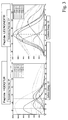
- the first and the third quadrupole of the mass spectrometer are operated as selective mass filters, that specifically isolate a peptide ion and a corresponding fragment ion, respectively, while the second quadrupole serves as linear collision cell ( Figure 1 ).
- the detector acts as counting device for the ions matching the criteria specified at the level offirst and third quadrupole thereby returning an intensity value over time.
- SRM based quantification performed on a triple quadrupole mass spectrometer is characterized by high selectivity for the targeted molecule (1), high sensitivity (2) and a linear response over a high dynamic range (3) of up to five orders of magnitude.
- the selectivity arises from the two stage narrow mass filtering at the level of precursor and fragment ions. In particular for the detection of proteins of low abundance in highly complex mixtures such an increased specificity is crucial for successful quantification.
- the sensitivity arises from (a) the high ion yield of triple quadrupole like mass spectrometers and (b) the high duty cycle - the fraction of time the detector spends on quantifying a particular ion - which results from the non scanning nature of SRM measurements.
- the high duty cycle also brings forward a high dynamic range which is not diminished by coeluting ions of a different m/z.
- the presented invention deals with such issues by providing a method for the high-throughput and cost-effective development and validation of quantitative SRM assays for a whole proteome or subproteome. It thus supports the use of SRM as a novel platform for high-throughput quantitative proteomics, allowing to exploit the drastically higher sensitivity and specificity of this technique for the analysis of thousands of proteins in a reasonable amount of time.
- the first step in a targeted experiment is the selection of the proteins of interest.
- the proteins selected can also be proteins which are functionally related, candidate biomarkers, drug targets etc, as outlined above. This list of proteins can be based on previous experiments or on the scientific literature. Databases combining protein-protein interaction data with other evidence are a good source to identify all proteins belonging to a pathway of interest. Alternatively, network expansion can be used to complement a set of proteins (as e.g. implemented in PhosphoPep, Bodenmiller B et al, Mol Syst Biol 3: 139). In addition to these proteins of interest several "housekeeping" proteins can be selected for normalization purposes, to be able to correct for uneven total protein amount in the samples. A few regulated proteins in this group do not interfere with normalization as long as the group is sufficiently large (>10 proteins) and outlier insensitive statistic is applied.
- Each of the targeted proteins yields tens to hundreds of peptides upon digestion. Only few representative peptides per protein are usually targeted to retrieve the protein quantity. For the success of the SRM experiment it is therefore essential to choose the well observable, unique peptides whose quantification is not impaired by unpredicted modifications.
- PTPs Proteotypic peptides
- Post translational modifications Modified peptides will not be detected by SRM unless specifically targeted. Quantitative differences may therefore be a result of differential modification and not differential protein abundance. The reproducible differential regulation of two peptides from the same protein is indicative for a posttranslational modification of one of the peptides.
- SRM can be used to specifically target and quantify peptides with posttranslational modifications like phosphorylation, methylation or acetylation.
- the m/z value of the first quadrupole is determined by the mass and the predominant charge state of the peptide ionIn the third quadrupole a particular fragment ion of the peptide is selected.
- the m/z value of the third quadrupole is determined by the mass and the predominant charge state of the fragment ion selected in the transition. Peptides with good MS signal response and the corresponding predominant, specific fragments are ideally selected, to maximize the sensitivity of the assay.
- the fragment ion masses of the target peptide can be calculated and experimentally tested in LC-SRM mode on a triple quadrupole instrument. This results in an overlay of SRM traces of different intensities, and with perfectly aligned intensity peaks in a retention time scale. The SRM transitions resulting in the most intense peaks can then be selected to be used as final assay for the peptide of interest, thus maximizing the sensitivity of the assay. However, if different ion series are taken into account, and more than one precursor charge state, this can result in more than 30 transitions per peptide to be tested.
- MS2 spectra are acquired to ensure the specificity of the transitions
- the acquired MS2 spectra are compared to the predicted peptide fragments to validate that the major MS2 peaks are matched.
- the retention time can be used as important additional constraint. Also, the monitoring of several peptide fragments which display a common intensity peak helps to assure specificity. Alternatively transitions can be validated by coelution with synthetic analogues of the peptide of interest.
- transitions used during the validation phase might not be performing at their maximum sensitivity transitions for a particular peptide.
- several parameters can be optimized as they influence signal intensity.
- Ion source parameters During the ionization process, single ions need to be generated.
- the declustering potential (DP) supports this process by dissociating ion clusters and solvent molecules. However, at too high DP peptides are fragmented. From plotting many experimentally determined DP optima, a positive linear correlation of precursor m/z value and DP optimum can be determined.
- the targeted proteins can be quantified by SRM analysis in multiple samples.
- the instrument can repeatedly cycle through a list of transitions spending a defined time, the dwelltime, for each transition. For example, targeting one peptide with 5 transitions of 200 ms dwelltime would result in a cycle time of 1 second (5 x 200 ms). Thus, every second an intensity value would be recorded for each of the transitions.
- Targeting 50 peptides with 3 transitions of 10 ms dwelltime each would result in a list of 150 transitions and a total cycle time of 1.5 seconds.
- the duty cycle Even when analyzing more than hundred transitions with dwelltimes of 10 ms or less, the fraction of time spent for each transition, the duty cycle, compares very favorable to full scanning mass spectrometric setups.
- the high duty cycle is one of the reasons for the unmatched sensitivity of SRM measurements.
- increasing the number of transitions decreases the respective dwelltimes at a fixed total cycle time.
- a successful strategy to increase the number of targeted peptides without decreasing individual dwelltimes and sensitivity is to restrict the acquisition of particular transitions to a window around the elution time of the targeted peptides.
- the full cycle time is deployed to detect and quantify the currently eluting peptides.
- Quantification using stable isotope labeling Quantification can be based on the ion current of the analyte or on the relative ion current of the analyte and an isotopically labeled internal standard. Quantification based on the ion current of the analyte alone can be used although it is sensitive to (1) drifts in spray efficiency over many runs or (2) matrix effects - ion suppression or enhancement due to coeluting substances. Therefore, the application of an isotopically labeled internal standard is generally recommended if precise quantitative results are aspired from the analysis of multiple samples. Most labeling approaches applicable for quantitative shotgun proteomics can likewise be used for SRM based quantitative experiments.
- heavy-labelled analogues facilitates the detection of low abundant peptides in highly complex mixtures. Endogenous peptides detectable only with minor, close to background signals can be accurately quantified if the elution profiles of several transitions from heavy and light version are aligned and if the ratio of the transitions is constant. This ensures that the quantitative results are not distorted by unspecific signals, for peptides detected close to the noise levels.
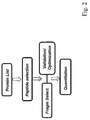
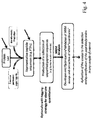
- the present invention provides a further improved method for the high-throughput and cost-effective development and validation of quantitative SRM assays for a whole proteome or subproteome as detailed above. It is based on the use of libraries of low-cost unpurified peptides, synthesized, generated or recombinantly derived, to be used as a reference for deriving the final coordinates of an SRM assay, validating and optimizing the assay and optionally achieving absolute quantitation of the protein of interest. This is schematically illustrated as a flow diagram in Figure 4 . Input of this Figure indicated by the arrows is any list of proteins/peptides for which specific and sensitive assays are required.
- trypsin is used (specifically cleaving after K or R residues; K indicates the heavy labeled amino acid (may also be another quantifiable tag such as a fluorophore), characterized by a mass difference of e.g. 8 Da):
- This tag is not labelled and not quantified.
- step (6) This is the result of the synthesis in step (6) and is the heavy-labelled tagged peptide of interest used in above step (7).
- the tag TAGK is used for each of the peptides of interest, in this case the tag TAGK.
- the quantification of the peptide of interest can be easily obtained by a comparison of the signal intensity of TAGK (unlabelled) with TAGK (labelled, resulting from the accurately quantified tag) measured in the mass spectrometry experiment.
- the assay peptides with between 8 and 24 amino acids are selected.
- the proposed strategy for quantification therefore cleverly makes use of an internal standard which can be universally used for many if not all peptides and makes use of indirect quantification of the peptides of interest which is possible as this internal standard can be attached to the peptide of interest and subsequently released in a stoichiometric amount.
- the gist of this aspect of the invention thus is the coupling of low-budget unpurified synthetic peptides to (1) a mass spectrometry technique that allows to selectively measure target peptides even in complex mixtures, without the need to purify them and (2) to a quantitation strategy that relieves from the typical requirement of using highly purified, accurately quantified labeled peptide standards, of prohibitive cost.
- the mass spectrometer was operated in multiple reaction monitoring mode, triggering acquisition of a full MS2 spectrum upon detection of an MRM trace (threshold 300 ion counts).
- MRM acquisition was performed with Q1 and Q3 operated at unit resolution (0.7 m/z half maximum peak width) with 200 or 300 transitions (dwell-time 10 or 7 ms/transition, respectively) per run.
- MS2 spectra were acquired in enhanced product ion (EPI) mode for the two highest MRM transitions, using dynamic fill time, Q1 resolution low, scan speed 4000 amu/s, m/z range 300-1400, 2 scans summed.
- EPI enhanced product ion
- Fragment ion spectra collected in the QQQ MS were used to validate peptide identities and to extract optimal fragment ions for SRM analysis.
- MS2 data were searched with Mascot (MatrixScience, Boston, MA) against a sub-set of the Uniprot/Swissprot protein database.
- the database consisted of sequences of all human kinases.
- a decoy database was generated from this sub-set by reverting amino acid sequences in between tryptic cleavage sites, and appended to the target database.
- Precursor mass tolerance was set to 2.0 Da and fragment mass tolerance to 1.0 Da.
- Data were searched allowing only fully tryptic termini, and no missed cleavages.
- the search results were validated and assigned probabilities using a cut-off for the Mascot ion score where the cut-off was defined by the proportion of assignments to decoy peptides.
- Spectral library creation A spectral library was created from the spectrum-peptide matches. The spectrum with the highest ion score was selected in cases where several spectra matched to a peptide. If more than one charge state was detected the highest scoring spectrum for both charge states were selected. These fragment ion spectra were used as a reference to derive the optimal coordinates of each SRM assay (e.g. best responding fragments, fragment relative intensities, peptide elution time). For each spectrum, the 5 most intense peaks were selected as optimal SRM transitions. Fragments due to neutral loss from precursor were excluded.
- the table given below is a list of peptides together with their sequence identification (SeqID) for the sequence listing and the corresponding shortened protein names for which the peptides are characteristic are named as defined according to the UniProt Consortium (www.uniprot.org), which is comprised of the European Bioinformatics Institute (EBI), the Swiss Institute of Bioinformatics (SIB), and the Protein Information Resource (PIR).
- EBI European Bioinformatics Institute
- SIB Swiss Institute of Bioinformatics
- PIR Protein Information Resource
- Table 1 provides SRM assay coordinates to be used for measuring indicated proteins in an SRM experiment. Transitions are selected from a full MS/MS spectrum.
Landscapes
- Life Sciences & Earth Sciences (AREA)
- Health & Medical Sciences (AREA)
- Engineering & Computer Science (AREA)
- Molecular Biology (AREA)
- Physics & Mathematics (AREA)
- Bioinformatics & Cheminformatics (AREA)
- Bioinformatics & Computational Biology (AREA)
- Chemical & Material Sciences (AREA)
- Urology & Nephrology (AREA)
- Immunology (AREA)
- Biomedical Technology (AREA)
- Hematology (AREA)
- Cell Biology (AREA)
- Medicinal Chemistry (AREA)
- Proteomics, Peptides & Aminoacids (AREA)
- Microbiology (AREA)
- Biophysics (AREA)
- Spectroscopy & Molecular Physics (AREA)
- Food Science & Technology (AREA)
- Biotechnology (AREA)
- Analytical Chemistry (AREA)
- Biochemistry (AREA)
- General Health & Medical Sciences (AREA)
- General Physics & Mathematics (AREA)
- Pathology (AREA)
- Other Investigation Or Analysis Of Materials By Electrical Means (AREA)
Claims (15)
- Un procédé pour la détermination d'un test de surveillance de réactions sélectionnées (Selected Reaction Monitoring, SRM) pour la détection et/ou quantification d'un/e ou plusieurs peptides et/ou protéines incluant les étapes suivantes :(1) un/e peptide/protéine d'intérêt, un groupe de protéines/peptides d'intérêt, un sous-protéome ou un protéome entier est clivé(e) et/ou digéré(e), optionnellement suivi d'un(e) purification/séparation/enrichissement, pour former un mélange de peptides, à partir duquel, dans un essai de spectrométrie de masse, au moins un peptide est essentiellement associé de manière unique avec la protéine d'intérêt ou une protéine ciblée dudit groupe de protéines d'intérêt ou dudit protéome entier, dans lequel il est associé en terme de comportement quantitatif différentiel sous de différentes conditions expérimentales ;(2) cet au moins un peptide est synthétisé sans purification ultérieure;(3) cet au moins un peptide non purifié est analysé par surveillance de réaction sélectionnée, optionnellement couplée à une chromatographie liquide;(4) un/e développement, validation et/ou optimisation du test correspondant du au moins un peptide avec une détermination des coordonnées SRM pour un/e peptide/protéine d'intérêt est obtenue,dans lequel dans la préparation de peptide non purifié effectuée dans l'étape (2) et/ou utilisée dans les étapes (3) et/ou (4) le peptide d'intérêt est présent dans une pureté dans le domaine de 0.1 à moins de 80% par poids de contenu solide.
- Un procédé selon la revendication 1, dans lequel les conditions expérimentales différentes de l'étape 1 sont données par une origine différente et/ou dérivation et/ou maladie et/ou régulation d'une protéine unique d'intérêt et/ou un groupe de protéines d'intérêt ou protéome entier, dans lequel préférablement la régulation différente est que la protéine unique d'intérêt et/ou groupe de protéines d'intérêt ou protéome entier est basé(e) sur des cellules influencées, modifiées et/ou malades, des tissus et/ou fluides corporels d'un organisme.
- Procédé selon la revendication 2, où préférablement la protéine unique d'intérêt et/ou groupe de protéines d'intérêt ou protéome entier est basé(e) sur un protéome dérivé d'un génome dans lequel un gène a été inactivé ou muté, et/ou est basé sur un protéome dans lequel un gène a été réduit ou surexprimé, et/ou est basé(e) sur un protéome dans lequel la protéine unique d'intérêt ou le groupe de protéines d'intérêt ont été inhibé(e)s ou activé(e)s par un moyen biologique, physique ou chimique, préférablement par un moyen d'inhibiteurs ou activateurs et/ou est basé(e) sur un protéome de cellules malades ou tissus ou fluides corporels dans lesquel(s) n'importe quel gène ou protéine affectant les voies biologiques a été muté(e) et/ou dérégulé(e).
- Un procédé selon la revendication 1, 2 ou 3, dans lequel un groupe de protéines d'intérêt ou peptides d'intérêt comprend une ou plusieurs classes spécifiques ou types de protéines ou peptides qui sont préférablement sélectionné(e)s/enrichi(e)s en utilisant des étapes de purification/séparation/enrichissement.
- Un procédé selon la revendication 4, dans lequel un(e) tel(le) séparation/enrichissement implique la séparation d'un type spécifique de protéines incluant les phosphoprotéines/phosphopeptides et/ou glycoprotéines/glycopeptides et/ou protéines sulforylées / peptides sulforylées.
- Un procédé selon une des revendications 1 à 5, dans lequel le peptide non-purifié est synthétisé dans l'étape 2, préférablement à micro-échelle en utilisant la synthèse en phase solide, sans purification ultérieure.
- Un procédé selon une quelconque des revendications précédentes, dans lequel dans l'étape (3) une validation du test est obtenue, ou bien par analogie avec les propriétés du standard à peptide, comme une co-élution sur à une échelle temporelle chromatographique, schéma de fragmentation analogue, qui est ou bien synthétique ou exprimé de manière recombinante, ou bien en acquérant des spectres de fragmentation ou bien où les spectres fragmentation sont d'avantage acquis pour sélectionner des fragments de peptide appropriés.
- Un procédé selon l'une quelconque des revendications précédentes, dans lequel dans l'étape (1), une utilisation est faite de jeux de données protéomiques antérieures, en incluant les spectres de fragmentation de peptides acquis antérieurement, ou de prédiction bio-informatique comme criblage de référentiels de données protéomiques vastes, de littérature ou de prédiction informatique de la détectabilité MS, en utilisant des algorithmes ou, où les peptides sont sélectionnés à base de la connaissance de la spécificité de clivage de l'agent enzymatique, chimique ou physique utilisé pour cliver les protéines en peptides.
- Un procédé selon l'une quelconque des revendications précédentes, dans lequel dans l'étape (4) au moins un du groupe des paramètres suivants du test SRM est déterminé: meilleurs peptides répondants, état de charge préféré et rapport masse sur charge (m/z) associé, temps d'élution correspondants, meilleurs fragments répondants et état de charge préféré et valeur m/z, intensités relatives de fragment/transition, paramètres de spectromètre de masse comme énergies de collision optimale et/ou pression de gaz de collision et/ou potentiel de déaggrégation, ou autre paramètres qui augmentent la spécificité, sensibilité, cadence de test(s).
- Un procédé selon l'une quelconque des revendications précédentes, dans lequel après l'étape (4) un analogue marqué lourd du peptide sélectionné et synthétisé pour être utilisé comme étalon interne pour obtenir une quantification absolue da la protéine d'intérêt.
- Un procédé selon l'une quelconque des revendications précédentes, dans lequel pour la quantification absolue de la protéine d'intérêt lors de l'étape (2), ou après l'étape (4), les étapes suivantes sont utilisées:(5) le(s)/la(les) peptide(s)/protéine(s) d'intérêt est (sont) synthétisé(e)(s) sans purification ultérieure en forme marquée préférablement avec un acide aminé marqué lourd à la terminaison C, et le peptide marqué non-purifié est alors soumis à une digestion enzymatique sous libération de la marque dans une quantité stoechiométrique par rapport au peptide d'intérêt;(6) addition d'un analogue marqué lourd quantifié de la marque à l'échantillon de peptide en une quantité connue et la marque, et de manière correspondante le peptide d'intérêt, est quantifié(e) par spectrométrie de masse, dans lequel l'analogue marqué lourd de la marque peut être ajouté à la digestion au préalable ou ultérieurement; et utilisation du peptide libéré pour optimiser/valider le test SRM ;(7) addition de peptide marqué lourd libéré, quantifié de manière exacte, à un échantillon de protéine et validation et/ou optimisation du test SRM pour les protéines correspondantes en utilisant les étapes supérieures (1) à (4) pour obtenir une quantification absolue des niveaux endogènes des protéines,dans lequel préférablement comme marque dans l'étape (5) un séquence d'acide aminé courte ou autre marque quantifiable telle que un fluorophore, est ajoutée à la séquence de chaque peptide d'intérêt, séparée par un site de clivage enzymatique spécifique, chimique ou physique tel que des groupes de clivage cryptiques ou autres groupes clivables incluant des linkers acido-labiles ou photo-clivables.
- Un procédé selon l'une quelconque des revendications précédentes, dans lequel une pluralité de tests, chacun pour des peptides individuels d'intérêt, est déterminée selon les étapes (1) à (4), et/ou où les étapes (3) et (4) sont conduites sur chaque préparation individuelle de peptide ou bien sur des mélanges de ceux-ci, ou sur des mélanges de peptides avec n'importe quel autre échantillon.
- Procédé d'analyse d'un échantillon de protéine d'intérêt dans lequel au moins un test SRM pour la détection et/ou quantification d'un ou plusieurs peptides et/ou protéines est déterminé en utilisant une méthode selon l'une quelconque des revendications précédentes, et dans lequel au moins un test déterminé, préférablement une multitude de test pour peptides d'intérêt est utilisé(e), préférablement utilisant au moins un, plus préférablement une multitude de tests basé(s) sur SEQ ID 4 à SEQ ID 179, dans lequel le SRM ou SRM à contrainte temporelle sont utilisés et des temps d'élution adaptés et possiblement d'avantage de paramètres selon les tests, sont utilisés pour déclencher l'acquisition de l'ensemble des traces de SRM sélectionnées selon les tests.
- Procédé selon la revendication 12, pour l'analyse et/ou comparaison d'échantillons de protéine d'origine sauvage ou physiologique ou non-régulé avec des échantillons de protéine d'origine mutante, défective/pathologique ou régulée, dans lequel préférablement la régulation est induite par une substance active pharmaceutique, chimique ou biologique.
- Un procédé selon la revendication 13, dans lequel pour la quantification absolue d'une protéine d'intérêt(5) le/la(les) peptide/protéine(s) d'intérêt est synthétisé(e)/généré(e) essentiellement sans purification ultérieure en forme marqué, préférablement avec un acide aminé marqué lourd à la terminaison C, et le peptide marqué non-purifié est alors soumis à un clivage/digestion enzymatique sous libération de la marque en une quantité stoechiométrique par rapport au peptide d'intérêt;(6) un analogue marqué lourd quantifié de la marque est ajouté à l'échantillon de peptide en une quantité connue, et la marque, et de manière correspondante le peptide d'intérêt, est quantifié, préférablement par spectrométrie de masse, dans lequel l'analogue marqué lourd de la marque peut être ajouté antérieurement ou ultérieurement à la digestion ; et(7) le peptide marqué lourd résultant, quantifié de manière exacte, est ajouté à l'échantillon de protéine pour obtenir une quantification absolue du(des) peptide(s) d'intérêt et ainsi indirectement les niveaux endogènes des protéines d'intérêt.
Priority Applications (1)
| Application Number | Priority Date | Filing Date | Title |
|---|---|---|---|
| EP09749631.9A EP2283366B1 (fr) | 2008-05-23 | 2009-05-20 | Procédé pour la génération d'une analyse de peptide/protéine à haut rendement et analyses générées selon ce procédé |
Applications Claiming Priority (3)
| Application Number | Priority Date | Filing Date | Title |
|---|---|---|---|
| EP08009454A EP2124060A1 (fr) | 2008-05-23 | 2008-05-23 | Procédé pour la génération d'une analyse de peptide/protéine à haut rendement et analyses générées selon ce procédé |
| EP09749631.9A EP2283366B1 (fr) | 2008-05-23 | 2009-05-20 | Procédé pour la génération d'une analyse de peptide/protéine à haut rendement et analyses générées selon ce procédé |
| PCT/EP2009/003611 WO2009141141A1 (fr) | 2008-05-23 | 2009-05-20 | Procédé de génération de dosage de peptide/protéine haut rendement et dosages générés par ce procédé |
Publications (2)
| Publication Number | Publication Date |
|---|---|
| EP2283366A1 EP2283366A1 (fr) | 2011-02-16 |
| EP2283366B1 true EP2283366B1 (fr) | 2016-08-10 |
Family
ID=39830372
Family Applications (2)
| Application Number | Title | Priority Date | Filing Date |
|---|---|---|---|
| EP08009454A Withdrawn EP2124060A1 (fr) | 2008-05-23 | 2008-05-23 | Procédé pour la génération d'une analyse de peptide/protéine à haut rendement et analyses générées selon ce procédé |
| EP09749631.9A Active EP2283366B1 (fr) | 2008-05-23 | 2009-05-20 | Procédé pour la génération d'une analyse de peptide/protéine à haut rendement et analyses générées selon ce procédé |
Family Applications Before (1)
| Application Number | Title | Priority Date | Filing Date |
|---|---|---|---|
| EP08009454A Withdrawn EP2124060A1 (fr) | 2008-05-23 | 2008-05-23 | Procédé pour la génération d'une analyse de peptide/protéine à haut rendement et analyses générées selon ce procédé |
Country Status (3)
| Country | Link |
|---|---|
| US (1) | US8501421B2 (fr) |
| EP (2) | EP2124060A1 (fr) |
| WO (1) | WO2009141141A1 (fr) |
Families Citing this family (21)
| Publication number | Priority date | Publication date | Assignee | Title |
|---|---|---|---|---|
| US20090326828A1 (en) * | 2008-06-27 | 2009-12-31 | Amol Prakash | Optimizing Selection of SRM Transitions for Analysis of Biomolecules by Tandem Mass Spectrometry |
| EP3260859B1 (fr) * | 2009-12-22 | 2020-02-05 | Expression Pathology, Inc. | Dosage srm/mrm de la protéine substrat du récepteur à l'insuline 1 (irs1) |
| EP2545384B1 (fr) * | 2010-03-12 | 2017-12-13 | JPT Peptide Technologies GmbH | Méthode permettant de déterminer la concentration d'un peptide |
| WO2012092302A1 (fr) * | 2010-12-27 | 2012-07-05 | Expression Pathology, Inc. | Essai srm/mrm sur protéine cmet |
| EP2663863A4 (fr) * | 2011-01-13 | 2015-07-22 | Expression Pathology Inc | Dosage par srm/mrm de la protéine 11 de type bcl-2 |
| JP2012197258A (ja) * | 2011-03-23 | 2012-10-18 | Tohoku Univ | 個別化治療診断のためのマーカータンパク質絶対量の定量方法 |
| US9506167B2 (en) | 2011-07-29 | 2016-11-29 | Ginkgo Bioworks, Inc. | Methods and systems for cell state quantification |
| AU2012311983B2 (en) * | 2011-09-22 | 2018-02-22 | Expression Pathology, Inc. | Multiplex MRM assay for evaluation of cancer |
| EP2971054A4 (fr) * | 2013-03-14 | 2017-04-12 | Otraces Inc. | Méthode d'amélioration du diagnostic d'une maladie par mesure d'analytes |
| KR101874501B1 (ko) * | 2013-03-15 | 2018-07-05 | 익스프레션 패톨로지, 인크. | 암 요법을 지시하는 srm 검정 |
| WO2015059760A1 (fr) * | 2013-10-22 | 2015-04-30 | 株式会社島津製作所 | Chromatographe-spectromètre de masse |
| US20150162175A1 (en) * | 2013-12-11 | 2015-06-11 | Thermo Finnigan Llc | Methods for Isolation and Decomposition of Mass Spectrometric Protein Signatures |
| JP6269810B2 (ja) * | 2014-03-05 | 2018-01-31 | 株式会社島津製作所 | 質量分析方法及び質量分析装置 |
| WO2016002046A1 (fr) * | 2014-07-03 | 2016-01-07 | 株式会社島津製作所 | Chromatographe/spectromètre de masse et programme |
| FR3024903A1 (fr) | 2014-08-14 | 2016-02-19 | Biomerieux Sa | Procede de quantification d'au moins un groupe de microorganismes par spectrometrie de masse |
| CA2999711A1 (fr) | 2014-09-26 | 2016-03-31 | Rajendra Sahai Bhatnagar | Inhibiteurs de l'activite de nf-kappa-b pour le traitement de certaines maladies et de certains troubles |
| US10620223B2 (en) * | 2015-05-14 | 2020-04-14 | Expression Pathology, Inc. | SRM/MRM assay for the fibroblast growth factor receptor 2 (FGFR2) protein |
| EP3405896A4 (fr) * | 2016-01-22 | 2019-09-25 | Otraces Inc. | Systèmes et procédés permettant d'améliorer un diagnostic de maladie |
| EP3430405B1 (fr) * | 2016-03-14 | 2023-08-09 | Pierce Biotechnology Inc. | Detection et quantification des proteines de la voie akt-mtor |
| CN113156133B (zh) * | 2020-09-11 | 2023-11-28 | 中国人民武装警察部队后勤学院 | 利用质谱多重反应监测技术检测5、7、55型腺病毒方法 |
| CN114573659B (zh) * | 2021-12-17 | 2024-07-02 | 南京谱利健生物技术有限公司 | 一类高通量蛋白质组定量试剂的固相合成方法 |
Family Cites Families (5)
| Publication number | Priority date | Publication date | Assignee | Title |
|---|---|---|---|---|
| US7300753B2 (en) * | 1998-09-04 | 2007-11-27 | John Rush | Immunoaffinity isolation of modified peptides from complex mixtures |
| US20060154318A1 (en) * | 2004-06-09 | 2006-07-13 | Anderson Norman L | Stable isotope labeled polypeptide standards for protein quantitation |
| WO2006026569A2 (fr) * | 2004-08-27 | 2006-03-09 | Northeastern University | Caracterisation complete de proteines complexes a l'etat de traces |
| EP1734367A1 (fr) | 2005-06-14 | 2006-12-20 | Cellzome Ag | Procédé pour identifier des nouveaux composés qui interagissent avec une enzyme |
| US20090053831A1 (en) | 2007-05-01 | 2009-02-26 | Cell Signaling Technology, Inc. | Tyrosine phosphorylation sites |
-
2008
- 2008-05-23 EP EP08009454A patent/EP2124060A1/fr not_active Withdrawn
-
2009
- 2009-05-20 US US12/994,093 patent/US8501421B2/en not_active Expired - Fee Related
- 2009-05-20 EP EP09749631.9A patent/EP2283366B1/fr active Active
- 2009-05-20 WO PCT/EP2009/003611 patent/WO2009141141A1/fr not_active Ceased
Also Published As
| Publication number | Publication date |
|---|---|
| EP2283366A1 (fr) | 2011-02-16 |
| US20110178273A1 (en) | 2011-07-21 |
| US8501421B2 (en) | 2013-08-06 |
| WO2009141141A1 (fr) | 2009-11-26 |
| EP2124060A1 (fr) | 2009-11-25 |
Similar Documents
| Publication | Publication Date | Title |
|---|---|---|
| US8501421B2 (en) | Method for high throughput peptide/protein assay generation and assays generated therewith | |
| Chen et al. | Quantitative proteomics using isobaric labeling: a practical guide | |
| Pan et al. | High throughput proteome screening for biomarker detection | |
| Mann et al. | Proteomic analysis of post-translational modifications | |
| US20210311072A1 (en) | Absolute Quantitation of Proteins and Protein Modifications by Mass Spectrometry with Multiplexed Internal Standards | |
| Lange et al. | Selected reaction monitoring for quantitative proteomics: a tutorial | |
| Aebersold et al. | Mass spectrometry-based proteomics | |
| US20100137151A1 (en) | Protein Expression Profile Database | |
| US8909481B2 (en) | Method of mass spectrometry for identifying polypeptides | |
| US20030129760A1 (en) | Mass intensity profiling system and uses thereof | |
| US20100311176A1 (en) | Method of mass analysis of target molecules in complex mixtures | |
| JP2010048825A (ja) | 迅速かつ定量的なプロテオーム解析および関連した方法 | |
| Liao et al. | Shotgun proteomics in neuroscience | |
| Rebak et al. | Characterizing citrullination by mass spectrometry-based proteomics | |
| Kelstrup et al. | Pinpointing phosphorylation sites: Quantitative filtering and a novel site-specific x-ion fragment | |
| CA2487821A1 (fr) | Base de donnees pour profil d'expression de proteine | |
| Cutillas | Quantification of polypeptides by mass spectrometry | |
| Romijn et al. | Mass Spectrometry: Proteomics | |
| Olsen et al. | Pathway-Level Protein Monitoring by LC-MS/MS 2 | |
| AU2002231271A1 (en) | Rapid and quantitative proteome analysis and related methods |
Legal Events
| Date | Code | Title | Description |
|---|---|---|---|
| PUAI | Public reference made under article 153(3) epc to a published international application that has entered the european phase |
Free format text: ORIGINAL CODE: 0009012 |
|
| 17P | Request for examination filed |
Effective date: 20101119 |
|
| AK | Designated contracting states |
Kind code of ref document: A1 Designated state(s): AT BE BG CH CY CZ DE DK EE ES FI FR GB GR HR HU IE IS IT LI LT LU LV MC MK MT NL NO PL PT RO SE SI SK TR |
|
| AX | Request for extension of the european patent |
Extension state: AL BA RS |
|
| RIN1 | Information on inventor provided before grant (corrected) |
Inventor name: MALMSTROEM, JOHAN Inventor name: AEBERSOLD, RUEDI Inventor name: RINNER, OLIVER Inventor name: PICOTTI, PAOLA |
|
| DAX | Request for extension of the european patent (deleted) | ||
| 17Q | First examination report despatched |
Effective date: 20140516 |
|
| GRAP | Despatch of communication of intention to grant a patent |
Free format text: ORIGINAL CODE: EPIDOSNIGR1 |
|
| INTG | Intention to grant announced |
Effective date: 20160225 |
|
| RAP1 | Party data changed (applicant data changed or rights of an application transferred) |
Owner name: ETH ZURICH |
|
| GRAS | Grant fee paid |
Free format text: ORIGINAL CODE: EPIDOSNIGR3 |
|
| GRAA | (expected) grant |
Free format text: ORIGINAL CODE: 0009210 |
|
| AK | Designated contracting states |
Kind code of ref document: B1 Designated state(s): AT BE BG CH CY CZ DE DK EE ES FI FR GB GR HR HU IE IS IT LI LT LU LV MC MK MT NL NO PL PT RO SE SI SK TR |
|
| REG | Reference to a national code |
Ref country code: GB Ref legal event code: FG4D |
|
| REG | Reference to a national code |
Ref country code: CH Ref legal event code: EP Ref country code: AT Ref legal event code: REF Ref document number: 819524 Country of ref document: AT Kind code of ref document: T Effective date: 20160815 |
|
| REG | Reference to a national code |
Ref country code: CH Ref legal event code: NV Representative=s name: ISLER AND PEDRAZZINI AG, CH |
|
| REG | Reference to a national code |
Ref country code: IE Ref legal event code: FG4D |
|
| REG | Reference to a national code |
Ref country code: DE Ref legal event code: R096 Ref document number: 602009040249 Country of ref document: DE |
|
| REG | Reference to a national code |
Ref country code: SE Ref legal event code: TRGR |
|
| REG | Reference to a national code |
Ref country code: LT Ref legal event code: MG4D |
|
| REG | Reference to a national code |
Ref country code: NL Ref legal event code: MP Effective date: 20160810 |
|
| REG | Reference to a national code |
Ref country code: AT Ref legal event code: MK05 Ref document number: 819524 Country of ref document: AT Kind code of ref document: T Effective date: 20160810 |
|
| PG25 | Lapsed in a contracting state [announced via postgrant information from national office to epo] |
Ref country code: NL Free format text: LAPSE BECAUSE OF FAILURE TO SUBMIT A TRANSLATION OF THE DESCRIPTION OR TO PAY THE FEE WITHIN THE PRESCRIBED TIME-LIMIT Effective date: 20160810 Ref country code: IS Free format text: LAPSE BECAUSE OF FAILURE TO SUBMIT A TRANSLATION OF THE DESCRIPTION OR TO PAY THE FEE WITHIN THE PRESCRIBED TIME-LIMIT Effective date: 20161210 Ref country code: NO Free format text: LAPSE BECAUSE OF FAILURE TO SUBMIT A TRANSLATION OF THE DESCRIPTION OR TO PAY THE FEE WITHIN THE PRESCRIBED TIME-LIMIT Effective date: 20161110 Ref country code: HR Free format text: LAPSE BECAUSE OF FAILURE TO SUBMIT A TRANSLATION OF THE DESCRIPTION OR TO PAY THE FEE WITHIN THE PRESCRIBED TIME-LIMIT Effective date: 20160810 Ref country code: FI Free format text: LAPSE BECAUSE OF FAILURE TO SUBMIT A TRANSLATION OF THE DESCRIPTION OR TO PAY THE FEE WITHIN THE PRESCRIBED TIME-LIMIT Effective date: 20160810 Ref country code: IT Free format text: LAPSE BECAUSE OF FAILURE TO SUBMIT A TRANSLATION OF THE DESCRIPTION OR TO PAY THE FEE WITHIN THE PRESCRIBED TIME-LIMIT Effective date: 20160810 Ref country code: LT Free format text: LAPSE BECAUSE OF FAILURE TO SUBMIT A TRANSLATION OF THE DESCRIPTION OR TO PAY THE FEE WITHIN THE PRESCRIBED TIME-LIMIT Effective date: 20160810 |
|
| PG25 | Lapsed in a contracting state [announced via postgrant information from national office to epo] |
Ref country code: AT Free format text: LAPSE BECAUSE OF FAILURE TO SUBMIT A TRANSLATION OF THE DESCRIPTION OR TO PAY THE FEE WITHIN THE PRESCRIBED TIME-LIMIT Effective date: 20160810 Ref country code: GR Free format text: LAPSE BECAUSE OF FAILURE TO SUBMIT A TRANSLATION OF THE DESCRIPTION OR TO PAY THE FEE WITHIN THE PRESCRIBED TIME-LIMIT Effective date: 20161111 Ref country code: ES Free format text: LAPSE BECAUSE OF FAILURE TO SUBMIT A TRANSLATION OF THE DESCRIPTION OR TO PAY THE FEE WITHIN THE PRESCRIBED TIME-LIMIT Effective date: 20160810 Ref country code: LV Free format text: LAPSE BECAUSE OF FAILURE TO SUBMIT A TRANSLATION OF THE DESCRIPTION OR TO PAY THE FEE WITHIN THE PRESCRIBED TIME-LIMIT Effective date: 20160810 Ref country code: PT Free format text: LAPSE BECAUSE OF FAILURE TO SUBMIT A TRANSLATION OF THE DESCRIPTION OR TO PAY THE FEE WITHIN THE PRESCRIBED TIME-LIMIT Effective date: 20161212 Ref country code: PL Free format text: LAPSE BECAUSE OF FAILURE TO SUBMIT A TRANSLATION OF THE DESCRIPTION OR TO PAY THE FEE WITHIN THE PRESCRIBED TIME-LIMIT Effective date: 20160810 |
|
| PG25 | Lapsed in a contracting state [announced via postgrant information from national office to epo] |
Ref country code: EE Free format text: LAPSE BECAUSE OF FAILURE TO SUBMIT A TRANSLATION OF THE DESCRIPTION OR TO PAY THE FEE WITHIN THE PRESCRIBED TIME-LIMIT Effective date: 20160810 Ref country code: RO Free format text: LAPSE BECAUSE OF FAILURE TO SUBMIT A TRANSLATION OF THE DESCRIPTION OR TO PAY THE FEE WITHIN THE PRESCRIBED TIME-LIMIT Effective date: 20160810 |
|
| REG | Reference to a national code |
Ref country code: DE Ref legal event code: R097 Ref document number: 602009040249 Country of ref document: DE |
|
| REG | Reference to a national code |
Ref country code: FR Ref legal event code: PLFP Year of fee payment: 9 |
|
| PG25 | Lapsed in a contracting state [announced via postgrant information from national office to epo] |
Ref country code: BE Free format text: LAPSE BECAUSE OF FAILURE TO SUBMIT A TRANSLATION OF THE DESCRIPTION OR TO PAY THE FEE WITHIN THE PRESCRIBED TIME-LIMIT Effective date: 20160810 Ref country code: DK Free format text: LAPSE BECAUSE OF FAILURE TO SUBMIT A TRANSLATION OF THE DESCRIPTION OR TO PAY THE FEE WITHIN THE PRESCRIBED TIME-LIMIT Effective date: 20160810 Ref country code: BG Free format text: LAPSE BECAUSE OF FAILURE TO SUBMIT A TRANSLATION OF THE DESCRIPTION OR TO PAY THE FEE WITHIN THE PRESCRIBED TIME-LIMIT Effective date: 20161110 Ref country code: CZ Free format text: LAPSE BECAUSE OF FAILURE TO SUBMIT A TRANSLATION OF THE DESCRIPTION OR TO PAY THE FEE WITHIN THE PRESCRIBED TIME-LIMIT Effective date: 20160810 Ref country code: SK Free format text: LAPSE BECAUSE OF FAILURE TO SUBMIT A TRANSLATION OF THE DESCRIPTION OR TO PAY THE FEE WITHIN THE PRESCRIBED TIME-LIMIT Effective date: 20160810 |
|
| PLBE | No opposition filed within time limit |
Free format text: ORIGINAL CODE: 0009261 |
|
| STAA | Information on the status of an ep patent application or granted ep patent |
Free format text: STATUS: NO OPPOSITION FILED WITHIN TIME LIMIT |
|
| 26N | No opposition filed |
Effective date: 20170511 |
|
| PG25 | Lapsed in a contracting state [announced via postgrant information from national office to epo] |
Ref country code: LU Free format text: LAPSE BECAUSE OF NON-PAYMENT OF DUE FEES Effective date: 20170531 Ref country code: SI Free format text: LAPSE BECAUSE OF FAILURE TO SUBMIT A TRANSLATION OF THE DESCRIPTION OR TO PAY THE FEE WITHIN THE PRESCRIBED TIME-LIMIT Effective date: 20160810 |
|
| PG25 | Lapsed in a contracting state [announced via postgrant information from national office to epo] |
Ref country code: MC Free format text: LAPSE BECAUSE OF FAILURE TO SUBMIT A TRANSLATION OF THE DESCRIPTION OR TO PAY THE FEE WITHIN THE PRESCRIBED TIME-LIMIT Effective date: 20160810 |
|
| REG | Reference to a national code |
Ref country code: IE Ref legal event code: MM4A |
|
| PG25 | Lapsed in a contracting state [announced via postgrant information from national office to epo] |
Ref country code: LU Free format text: LAPSE BECAUSE OF NON-PAYMENT OF DUE FEES Effective date: 20170520 |
|
| PG25 | Lapsed in a contracting state [announced via postgrant information from national office to epo] |
Ref country code: IE Free format text: LAPSE BECAUSE OF NON-PAYMENT OF DUE FEES Effective date: 20170520 |
|
| REG | Reference to a national code |
Ref country code: FR Ref legal event code: PLFP Year of fee payment: 10 |
|
| PG25 | Lapsed in a contracting state [announced via postgrant information from national office to epo] |
Ref country code: MT Free format text: LAPSE BECAUSE OF NON-PAYMENT OF DUE FEES Effective date: 20170520 |
|
| PG25 | Lapsed in a contracting state [announced via postgrant information from national office to epo] |
Ref country code: HU Free format text: LAPSE BECAUSE OF FAILURE TO SUBMIT A TRANSLATION OF THE DESCRIPTION OR TO PAY THE FEE WITHIN THE PRESCRIBED TIME-LIMIT; INVALID AB INITIO Effective date: 20090520 |
|
| PG25 | Lapsed in a contracting state [announced via postgrant information from national office to epo] |
Ref country code: CY Free format text: LAPSE BECAUSE OF NON-PAYMENT OF DUE FEES Effective date: 20160810 |
|
| PG25 | Lapsed in a contracting state [announced via postgrant information from national office to epo] |
Ref country code: MK Free format text: LAPSE BECAUSE OF FAILURE TO SUBMIT A TRANSLATION OF THE DESCRIPTION OR TO PAY THE FEE WITHIN THE PRESCRIBED TIME-LIMIT Effective date: 20160810 |
|
| PG25 | Lapsed in a contracting state [announced via postgrant information from national office to epo] |
Ref country code: TR Free format text: LAPSE BECAUSE OF FAILURE TO SUBMIT A TRANSLATION OF THE DESCRIPTION OR TO PAY THE FEE WITHIN THE PRESCRIBED TIME-LIMIT Effective date: 20160810 |
|
| P01 | Opt-out of the competence of the unified patent court (upc) registered |
Effective date: 20230606 |
|
| PGFP | Annual fee paid to national office [announced via postgrant information from national office to epo] |
Ref country code: GB Payment date: 20240521 Year of fee payment: 16 |
|
| PGFP | Annual fee paid to national office [announced via postgrant information from national office to epo] |
Ref country code: DE Payment date: 20240521 Year of fee payment: 16 |
|
| PGFP | Annual fee paid to national office [announced via postgrant information from national office to epo] |
Ref country code: CH Payment date: 20240602 Year of fee payment: 16 |
|
| PGFP | Annual fee paid to national office [announced via postgrant information from national office to epo] |
Ref country code: FR Payment date: 20240529 Year of fee payment: 16 |
|
| PGFP | Annual fee paid to national office [announced via postgrant information from national office to epo] |
Ref country code: SE Payment date: 20240521 Year of fee payment: 16 |
|
| REG | Reference to a national code |
Ref country code: DE Ref legal event code: R119 Ref document number: 602009040249 Country of ref document: DE |
|
| REG | Reference to a national code |
Ref country code: CH Ref legal event code: H13 Free format text: ST27 STATUS EVENT CODE: U-0-0-H10-H13 (AS PROVIDED BY THE NATIONAL OFFICE) Effective date: 20251223 |
|
| PG25 | Lapsed in a contracting state [announced via postgrant information from national office to epo] |
Ref country code: CH Free format text: LAPSE BECAUSE OF NON-PAYMENT OF DUE FEES Effective date: 20250531 |
|
| PG25 | Lapsed in a contracting state [announced via postgrant information from national office to epo] |
Ref country code: SE Free format text: LAPSE BECAUSE OF NON-PAYMENT OF DUE FEES Effective date: 20250521 |
|
| REG | Reference to a national code |
Ref country code: SE Ref legal event code: EUG |
|
| GBPC | Gb: european patent ceased through non-payment of renewal fee |
Effective date: 20250520 |
|
| PG25 | Lapsed in a contracting state [announced via postgrant information from national office to epo] |
Ref country code: GB Free format text: LAPSE BECAUSE OF NON-PAYMENT OF DUE FEES Effective date: 20250520 |
|
| PG25 | Lapsed in a contracting state [announced via postgrant information from national office to epo] |
Ref country code: DE Free format text: LAPSE BECAUSE OF NON-PAYMENT OF DUE FEES Effective date: 20251202 |
|
| PG25 | Lapsed in a contracting state [announced via postgrant information from national office to epo] |
Ref country code: FR Free format text: LAPSE BECAUSE OF NON-PAYMENT OF DUE FEES Effective date: 20250531 |