EP2283380B1 - Détection de cible dans une zone marine dont une image est réalisée par un radar à synthèse d'ouverture - Google Patents
Détection de cible dans une zone marine dont une image est réalisée par un radar à synthèse d'ouverture Download PDFInfo
- Publication number
- EP2283380B1 EP2283380B1 EP08789968.8A EP08789968A EP2283380B1 EP 2283380 B1 EP2283380 B1 EP 2283380B1 EP 08789968 A EP08789968 A EP 08789968A EP 2283380 B1 EP2283380 B1 EP 2283380B1
- Authority
- EP
- European Patent Office
- Prior art keywords
- target
- sar
- distribution
- sea area
- real
- Prior art date
- Legal status (The legal status is an assumption and is not a legal conclusion. Google has not performed a legal analysis and makes no representation as to the accuracy of the status listed.)
- Active
Links
Images



Classifications
-
- G—PHYSICS
- G01—MEASURING; TESTING
- G01S—RADIO DIRECTION-FINDING; RADIO NAVIGATION; DETERMINING DISTANCE OR VELOCITY BY USE OF RADIO WAVES; LOCATING OR PRESENCE-DETECTING BY USE OF THE REFLECTION OR RERADIATION OF RADIO WAVES; ANALOGOUS ARRANGEMENTS USING OTHER WAVES
- G01S7/00—Details of systems according to groups G01S13/00, G01S15/00, G01S17/00
- G01S7/02—Details of systems according to groups G01S13/00, G01S15/00, G01S17/00 of systems according to group G01S13/00
- G01S7/41—Details of systems according to groups G01S13/00, G01S15/00, G01S17/00 of systems according to group G01S13/00 using analysis of echo signal for target characterisation; Target signature; Target cross-section
- G01S7/414—Discriminating targets with respect to background clutter
-
- G—PHYSICS
- G01—MEASURING; TESTING
- G01S—RADIO DIRECTION-FINDING; RADIO NAVIGATION; DETERMINING DISTANCE OR VELOCITY BY USE OF RADIO WAVES; LOCATING OR PRESENCE-DETECTING BY USE OF THE REFLECTION OR RERADIATION OF RADIO WAVES; ANALOGOUS ARRANGEMENTS USING OTHER WAVES
- G01S13/00—Systems using the reflection or reradiation of radio waves, e.g. radar systems; Analogous systems using reflection or reradiation of waves whose nature or wavelength is irrelevant or unspecified
- G01S13/88—Radar or analogous systems specially adapted for specific applications
- G01S13/89—Radar or analogous systems specially adapted for specific applications for mapping or imaging
- G01S13/90—Radar or analogous systems specially adapted for specific applications for mapping or imaging using synthetic aperture techniques, e.g. synthetic aperture radar [SAR] techniques
- G01S13/9021—SAR image post-processing techniques
- G01S13/9027—Pattern recognition for feature extraction
Definitions
- the present invention relates to a target detection in a Synthetic-Aperture-Radar-imaged sea area.
- remote sensing is the science and art of obtaining information about an object, area, or phenomenon through the analysis of data acquired by a device that is not in contact with the object, area, or phenomenon under investigation. Based on the wavelength in which the system works, remote sensing is principally categorized into two different groups, i.e., optical and microwave.
- Optical remote sensing uses visible and infrared waves while microwave remote sensing uses radio waves.
- a Synthetic Aperture Radar (SAR) system comprises a radar signal transmitter and a radar signal receiver operating on a movable platform, such as an aeroplane or satellite, and a remote processing station connected over a radio channel to the movable platform.
- a movable platform such as an aeroplane or satellite
- the transmitter sends a radar signal into a monitored ground or sea area, and the receiver receives the radar echo back-scattered by the area, and transmits it to the remote processing station, which processes the radar echo to obtain a two-dimensional map of the monitored area.
- the transmitted radar signal comprises a succession of microwave-band electromagnetic pulses modulated by linear frequency, or so-called CHIRP, modulation and transmitted at regular time intervals.
- the processing station coherently combines the radar echoes corresponding to the transmitted pulses to obtain high-azimuth-resolution maps of extensive areas .
- CHIRP pulse modulation provides for achieving high resolution perpendicular to the range direction.
- an SAR system illuminates a scene with microwaves by means of the transmitter, and records both amplitude and phase of the back-scattered radiation by means of the receiver, making it a coherent imaging process.
- the received signal is sampled and converted into a digital image by the processing station.
- E (x) field recorded at pixel x
- the summation ranges over scatterers s, a (s) and ⁇ ( s ) are respectively amplitude and phase of the signal received from the scatterer s
- h (s,x) is instrument or point-spread function.
- Value of h(s,x) is near 1 when the scatterer s is in or near the resolving cell corresponding to the pixel x , and near zero otherwise.
- the instrument function is translation-invariant, i.e., it does not depend on x, then it can be written as a one-parameter function h (s-x) .
- the square of the modulus of the field E (x) is called detected intensity I (x) ; the square-root of the intensity I (x) is called envelope or amplitude. This is not the same as the amplitude of the received signal a (s) because the received field E(x) is perturbed by the instrument function h(s, x) .
- the amplitude of the received signal a (s) is called reflectivity, and its square is called surface cross-section.
- SAR imaging has some advantages. First, as an active system, it is a day/night data acquisition system. Second, considering the behavior of electromagnetic waves in the range of wavelengths used by SAR systems, it can be seen that atmospheric characteristics such as cloud, light rain, haze, and smoke has little effect on the capability of an SAR system. This makes SAR as an all-weather remote sensing system. Last but not least, as SAR signals partially penetrate into soil and vegetation canopy, in addition to surface information, it can provide subsurface information too.
- SAR imaging has some disadvantages too.
- SAR images are formed by coherent interaction of the transmitted microwave with targets.
- SAR imaging suffers from the effects of speckle noise which arises from coherent summation of the signals back-scattered by ground scatterers s distributed randomly within each pixel x.
- speckle noise arises from coherent summation of the signals back-scattered by ground scatterers s distributed randomly within each pixel x.
- an SAR image appears more noisy than an optical image.
- the waves emitted by the transmitter travel in phase and interact minimally on their way to the target area. After interaction with the target area, these waves are no longer in phase because of the different distances they travel from targets, or single versus multiple bounce scattering. Once out of phase, the back-scattered waves can interact to produce light and dark pixels. This effect is known as speckle noise.
- the speckle noise gives a grainy appearance to the SAR images, reduces SAR image contrast, and has a negative effect on texture based analysis. Moreover, as the speckle noise changes spatial statistics of the SAR images, it makes the classification process a difficult task to do.
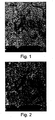
- Figure 1 shows an example of a typical grainy SAR image.
- the speckle noise is normally suppressed by applying a speckle removal filter on the digital image before display and further analysis.
- Figure 2 shows the grainy SAR image of Figure 1 filtered with a speckle removal filter.
- an SAR image is usually displayed as a gray scale image.
- the intensity I(x) of each pixel x represents the portion of microwave back-scattered by a corresponding target area on the ground which portion depends on a variety of factors: types, sizes, shapes and orientations of the scatterers s in the target area, moisture content of the target area, frequency and polarization of the radar pulses, as well as the incident angles of the radar beam.
- the pixel intensity values are often converted into a physical quantity called back-scattering coefficient or normalized radar cross-section, which is measured in dBsm units with values ranging from +5 dBsm for very bright objects to -40 dBsm for very dark surfaces.
- FIG. 3 shows schematically an example of specular reflection.
- a smooth surface 31 acts like a mirror for the incident radar pulse. Most of the incident radar energy is reflected away according to the law of specular reflection, i.e. the angle of reflection ⁇ ' is equal to the angle of incidence ⁇ . Very little energy is back-scattered to the SAR sensor.
- FIG. 4 shows schematically an example of diffused reflection in presence of a rough surface 41.
- calm sea surfaces appear dark in SAR images, while rough sea surfaces may appear bright, especially when the incidence angle is small and when the roughness of the sea surface is due to waves having wavelength shorter than the wavelength of the radar pulses.
- oil films smoothes out the sea surface. Under certain conditions when the sea surface is sufficiently rough, oil films can be detected as dark patches against a bright background.
- FIG. 5 shows schematically an example of double-bounce effect where the radar pulse bounces off a horizontal ground 51 towards a target 52, and then is reflected from one vertical surface 52a of the target 52 back to the SAR sensor.
- targets are ships on the sea, high-rise buildings and regular metallic objects such as cargo containers.
- Built-up areas and many man-made features usually appear as bright patches in an SAR image due to the corner-reflection effect.
- Figure 6 shows an SAR image of an area of the sea near a busy port wherein many ships can be seen as bright spots due to the corner-reflection effect.
- the sea is calm, and hence the ships can be easily detected against the dark background.
- brightness of areas covered by bare soil may vary from very dark to very bright depending on its roughness and moisture content. Typically, rough soil appears bright in the image. For similar soil roughness, the surface with a higher moisture content will appear brighter.
- Figure 7 shows schematically an example of radar pulse interaction with a dry soil 71, wherein some of the incident radar energy is able to penetrate into the soil surface 71a, resulting in a less back-scattered intensity.
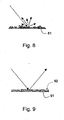
- Figure 8 shows schematically an example of radar pulse interaction with a wet soil 81, wherein the large difference in electrical properties between water and air results in a higher back-scattered radar intensity.
- Figure 9 shows schematically an example of radar pulse interaction with a flooded soil 91, wherein the radar pulses are specularly reflected off the water surface 92, resulting in low back-scattered intensity.
- the flooded area will appear dark in the SAR image.
- a known ship detection method based on SAR imagery of sea areas can be found in Knut Eldhuset, "An automatic ship detection and ship wake detection system for spaceborn SAR images in Coastal regions", IEEE Transactions on Geoscience and Remote Sensing, vol. 34, no.4, July 1996 .
- said article describes an automatic ship detection and ship wake detection system designed for coastal regions with eddies, fronts, waves and swells.
- Said system uses digital terrain models to simulate synthetic SAR images to mask out land areas. Then a search for ship targets is performed followed by weak search around detected ship candidates. Finally, a homogeneity test and wake up behavior test are performed which reduces the number of false alarms substantially.
- the Applicant has carried out an in-depth study in order to develop an innovative method for detecting targets in a SAR-imaged sea area which doesn't need any kind of pre-processing of the SAR image, such as speckle noise reduction or removal, and, moreover, any a priori knowledge of the ground conditions of the imaged sea area.
- the objective of present invention is then to provide a target detection method in a SAR-imaged sea area of the aforesaid type.
- This objective is achieved by the present invention in that it relates to a method, a system, a device, and a software program for detecting a target, such as a ship, an oil film, an iceberg, a semiflooded structure or any other possible object, in a SAR-imaged sea area, as defined in the appended claims.
- the present invention is implemented by means of a software program, loadable in a memory of an electronic processor, and comprising software code portions for implementing, when the software program is run on the processor, the target detection in an SAR-imaged sea area described hereinafter.
- the present invention stems from the observation made by the Applicant that in a SAR image of a sea area, where no target is present, magnitudes of pixels are distributed according to a Poisson distribution.
- the magnitude may be an intensity value, a back-scattering coefficient or any other type of pixel magnitude used in SAR imaging.
- the mode i.e., probabilistically the most probable value or statistically the most frequently occurring value, is equal to ⁇ - 1 , if ⁇ is an integer, or otherwise to ⁇ .
- Figure 10 shows a graphic representation of three Poisson discrete probability functions, each of them having a respective mean value A.
- Figure 11 shows a histogram of magnitudes of a typical SAR image of a sea area where no target is present.
- the abscissa-axis represents back-scattering coefficients measured in decibel ( dB ), while the ordinate-axis represents normalized occurrences, i.e., the occurrences divided by the highest occurrence value.
- the back-scattering coefficients are distributed according to a Poisson distribution characterized by a mean value of 5 dB and a mode of 4 dB.
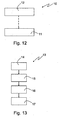
- Figure 12 shows schematically an electronic system 10 for detecting a target in a SAR-imaged sea area according to the present invention.
- the electronic system 10 comprises an electronic processor 11 coupled to a SAR system 12 to acquire data therefrom.
- the data acquired from the SAR system 12 are SAR images representing sea areas.
- a software program comprising software code portions for implementing the target detection in a SAR-imaged sea area described hereinafter.
- Figure 13 shows a flow chart of a target detection 13 in a sea area represented by a SAR image, according to the present invention.
- the target detection 13 comprises:
- computing a reference quantity comprises computing a reference quantity characterizing a Poisson distribution assumed for magnitudes that the pixels in the SAR image would have if the sea area were free of targets.
- computing a reference quantity comprises estimating a mean value I of the magnitudes I of the pixels in the SAR image, the SAR image made up of MxN pixels and representing the sea area. Accordingly, the reference quantity is the estimated mean value I .
- the magnitudes I of the MxN pixels would be distributed according to a no-target-reference statistical distribution which is a Poisson distribution characterized by an expected value equal to the estimated mean value I .
- the magnitude that occurs the most frequently i.e., the mode I * of the no-target-reference statistical distribution, is equal to I -1, if I is an integer, or otherwise to ⁇ I ⁇ .
- the standard deviation ⁇ of the no-target-reference statistical distribution is equal to I ⁇ .
- selecting pixels in the SAR image comprises selecting a sub-image of the SAR image, the sub-image made up of mxn pixels, with m ⁇ M and n ⁇ N , and representing a corresponding sea subarea of the sea area.
- selecting pixels in the SAR image may be conveniently performed using a selecting window movable inside the SAR image and comprising mxn pixels.
- computing a real quantity comprises computing a real quantity characterizing a real statistical distribution of the magnitudes of the selected pixels.
- computing a real quantity comprises:
- the real quantity is the identified mode.
- detecting comprises:
- comparing takes sensing error into account, the sensing error being due to non-ideal nature of the sensing system, i.e., the SAR system, and to many other causes, such as the Doppler shift due to relative motion of the SAR movable platform and possible targets on sea surface.
- comparing provides for the no-target-reference statistical distribution and the real statistical distribution to be considered equivalent if the respective modes I * and I M differ less than a detection threshold T representing the sensing error, while comparing provides for the no-target-reference statistical distribution and the real statistical distribution to be not considered equivalent, and then a target to be detected in the sea subarea represented by the selected pixels, if the respective modes I* and I M differ more than the detection threshold T representing the sensing error.
- the no-target-reference statistical distribution and the real statistical distribution are considered equivalent if it results that I * - I M ⁇ T while the no-target-reference statistical distribution and the real statistical distribution are not considered equivalent, and then a target is detected in the sea subarea represented by the selected pixels, if it results that I * - I M > T
- the detection threshold T may be set equal to ⁇ ⁇ 3 .
- the sensing error represented by the detection threshold T may be more reliably estimated considering several SAR images representing the same sea area and acquired very closely in time in order to have very correlated useful signals and uncorrelated speckle noise.
- ⁇ M M I
- the detection threshold T is set equal to ⁇ M 3 .
- computing a reference quantity may be also based on considering several SAR images representing the same sea area and acquired very closely in time. Therefore, in this case, the no-target-reference statistical distribution is a Poison distribution characterized by an expected value equal to the computed mean value M I . In this case, the mode M * of the no-target-reference statistical distribution is equal to M I -1, if M I is an integer, or otherwise to ⁇ M I ⁇ .
- the no-target-reference statistical distribution and the real statistical distribution are considered equivalent if it results that M * - I M ⁇ T while the no-target-reference statistical distribution and the real statistical distribution are not considered equivalent, and then a target is detected in the sea subarea represented by the selected pixels, if it results that M * - I M > T
- the detection threshold T is set equal to ⁇ M 3 .
- the present invention permits a reliable and performant detection of targets in SAR-imaged sea areas by means of a computationally-light processing without needing any kind of pre-processing of the SAR image, such as speckle noise reduction or removal, and any a priori knowledge of the ground conditions of the sea area imaged.
Landscapes
- Engineering & Computer Science (AREA)
- Remote Sensing (AREA)
- Radar, Positioning & Navigation (AREA)
- Physics & Mathematics (AREA)
- Computer Networks & Wireless Communication (AREA)
- General Physics & Mathematics (AREA)
- Artificial Intelligence (AREA)
- Computer Vision & Pattern Recognition (AREA)
- Electromagnetism (AREA)
- Radar Systems Or Details Thereof (AREA)
Claims (4)
- Procédé de détection d'une cible dans une zone maritime considérée en se basant sur une image donnée de radar à synthèse d'ouverture représentant ladite zone maritime considérée, le procédé comprenant :- le choix de pixels dans une seule et même sous-image de l'image donnée de radar à synthèse d'ouverture, ladite sous-image représentant une sous-zone de la zone maritime considérée,- le procédé étant caractérisé en ce qu'il comprend en outre :- la fourniture d'une distribution de référence sans cible pour les grandeurs de pixels dans une image de radar à synthèse d'ouverture d'une zone maritime exempte de cible, la distribution de référence sans cible étant une distribution de Poisson ;- le calcul d'une première quantité de référence représentative d'une valeur moyenne des grandeurs des pixels dans quelques images de radar à synthèse d'ouverture dont chacune représente la zone maritime considérée à un instant respectif, dans lequel la distribution de Poisson est caractérisée par une valeur escomptée basée sur la première quantité de référence ;- le calcul d'une seconde quantité de référence représentant la grandeur apparaissant le plus fréquemment dans la distribution de Poisson sur la base de la première quantité de référence ;- le calcul d'une distribution statistique réelle des grandeurs des pixels choisis en calculant un histogramme des grandeurs des pixels choisis, et en fournissant une quantité réelle représentative de la grandeur apparaissant le plus fréquemment dans la distribution statistique réelle sur la base de l'histogramme calculé ;- la comparaison de la distribution de référence sans cible et de la distribution statistique réelle en effectuant une comparaison de la seconde quantité de référence par rapport à la quantité réelle au moyen d'un seuil de détection lié à une erreur d'acquisition basé sur l'écart type de la distribution de Poisson ; et- la détection d'une cible dans la sous-zone si la seconde quantité de référence et la quantité réelle diffèrent de plus que le seuil de détection lié à l'erreur d'acquisition.
- Procédé selon la revendication 1, dans lequel le seuil de détection lié à l'erreur d'acquisition est égal à un tiers de l'écart type de la distribution de Poisson.
- Dispositif électronique constitué pour mettre en oeuvre le procédé selon l'une quelconque des revendications précédentes.
- Produit programme logiciel comprenant des parties formant du code logiciel mémorisable dans une mémoire d'un processeur et propres à faire en sorte, lorsqu'elles sont mémorisées, que le processeur devienne apte à mettre en oeuvre le procédé selon la revendication 1 ou 2.
Applications Claiming Priority (1)
| Application Number | Priority Date | Filing Date | Title |
|---|---|---|---|
| PCT/IT2008/000357 WO2009144754A1 (fr) | 2008-05-29 | 2008-05-29 | Détection de cible dans une zone marine dont une image est réalisée par un radar à synthèse d'ouverture |
Publications (2)
| Publication Number | Publication Date |
|---|---|
| EP2283380A1 EP2283380A1 (fr) | 2011-02-16 |
| EP2283380B1 true EP2283380B1 (fr) | 2014-08-06 |
Family
ID=40293623
Family Applications (1)
| Application Number | Title | Priority Date | Filing Date |
|---|---|---|---|
| EP08789968.8A Active EP2283380B1 (fr) | 2008-05-29 | 2008-05-29 | Détection de cible dans une zone marine dont une image est réalisée par un radar à synthèse d'ouverture |
Country Status (6)
| Country | Link |
|---|---|
| US (1) | US8665131B2 (fr) |
| EP (1) | EP2283380B1 (fr) |
| CN (1) | CN102144173B (fr) |
| ES (1) | ES2519469T3 (fr) |
| RU (1) | RU2472174C2 (fr) |
| WO (1) | WO2009144754A1 (fr) |
Families Citing this family (23)
| Publication number | Priority date | Publication date | Assignee | Title |
|---|---|---|---|---|
| DE102010001440B4 (de) * | 2010-02-01 | 2014-01-16 | Deutsches Zentrum für Luft- und Raumfahrt e.V. | Verfahren und Mess-System zur Messung des Wasserstands eines Gewässers |
| US8842035B2 (en) * | 2010-04-08 | 2014-09-23 | L-3 Communications Security And Detection Systems, Inc. | Sensor head |
| CN101894261B (zh) * | 2010-06-29 | 2012-05-02 | 武汉大学 | 一种多对比度模式直方图纹理描述子提取方法 |
| CN102565772B (zh) * | 2010-12-20 | 2013-07-24 | 中国科学院电子学研究所 | 基于sar子孔径序列图像的海洋动态信息提取方法 |
| US9110168B2 (en) * | 2011-11-18 | 2015-08-18 | Farrokh Mohamadi | Software-defined multi-mode ultra-wideband radar for autonomous vertical take-off and landing of small unmanned aerial systems |
| CN103164686B (zh) * | 2011-12-12 | 2017-05-17 | 中国科学院对地观测与数字地球科学中心 | 一种根据船只的高分辨率sar图像识别船只类型的方法 |
| BR102012010659B1 (pt) * | 2012-05-04 | 2022-04-12 | Oil-Finder - Serviços De Sensoriamento Remoto E Modelagem Computacional Ltda | Processo para identificação e classificação de áreas de exsudações de óleo no fundo do mar através de modelagem inversa |
| RU2536183C2 (ru) * | 2013-03-12 | 2014-12-20 | Федеральное государственное бюджетное учреждение науки Институт физического материаловедения Сибирского отделения Российской академии наук (ИФМ СО РАН) | Способ определения горизонтальной структуры древостоя |
| CN103308910B (zh) * | 2013-05-11 | 2015-02-04 | 国家海洋局第一海洋研究所 | 利用高频地波雷达检测海上非航行状态船只目标的方法 |
| CN104240183B (zh) * | 2013-06-08 | 2017-03-29 | 富士通株式会社 | 图像处理过程中的滤波方法和装置 |
| KR101526688B1 (ko) * | 2013-09-27 | 2015-06-05 | 현대자동차주식회사 | 초음파 시스템의 노이즈 제거 장치 및 방법 |
| CN103714339B (zh) * | 2013-12-30 | 2017-01-18 | 武汉大学 | 基于矢量数据的sar影像道路损毁信息提取方法 |
| CN104268429A (zh) * | 2014-10-15 | 2015-01-07 | 湖北大学 | 基于星载sar的近海岸海上风能资源遥感方法及系统 |
| US10088555B2 (en) * | 2014-12-15 | 2018-10-02 | Airbus Singapore Private Limited | Automated method for selecting training areas of sea clutter and detecting ship targets in polarimetric synthetic aperture radar imagery |
| WO2017058328A2 (fr) * | 2015-07-08 | 2017-04-06 | Conocophillips Company | Imagerie terrestre à l'aide d'un radar à ouverture synthétique multi-polarisation |
| CN107423705A (zh) * | 2017-07-21 | 2017-12-01 | 西安电子科技大学 | 基于多层概率统计模型的sar图像目标识别方法 |
| CN107862271B (zh) * | 2017-10-31 | 2021-05-25 | 西安电子科技大学 | 一种舰船目标的检测方法 |
| CN113205029B (zh) * | 2021-04-26 | 2023-04-07 | 中国科学院空天信息创新研究院 | 机载合成孔径雷达海面船只实时检测方法 |
| CN113759375B (zh) * | 2021-09-15 | 2024-02-09 | 云南师范大学 | 基于统计特性的sar图像非局部均值去噪方法 |
| CN114355349B (zh) * | 2022-01-17 | 2025-03-28 | 国家卫星海洋应用中心 | 星载sar海面影像与网格化海面风场产品时空匹配方法 |
| CN114415181B (zh) * | 2022-03-31 | 2022-07-12 | 南方海洋科学与工程广东省实验室(广州) | 一种合成孔径雷达的原始回波生成方法和装置 |
| CN114755654B (zh) * | 2022-06-14 | 2022-11-18 | 中达天昇(江苏)电子科技有限公司 | 一种基于图像拟态技术的残损雷达信号修复方法 |
| CN116047510B (zh) * | 2022-12-08 | 2026-03-10 | 中国科学院空天信息创新研究院 | Sar及水色遥感图像海洋涡旋动力参数提取方法及系统 |
Family Cites Families (6)
| Publication number | Priority date | Publication date | Assignee | Title |
|---|---|---|---|---|
| RU2166774C2 (ru) * | 1999-06-01 | 2001-05-10 | Тамбовский военный авиационный инженерный институт | Способ и устройство формирования поляризационного портрета земной или морской поверхности в двухчастотной цифровой рса |
| RU2194288C2 (ru) * | 2000-12-15 | 2002-12-10 | Открытое акционерное общество "Корпорация "Фазотрон - научно-исследовательский институт радиостроения" | Радиолокационная система |
| US7269538B1 (en) * | 2004-06-01 | 2007-09-11 | The United States Of America As Represented By The Secretary Of The Navy | Method for sparse data two-stage stochastic mensuration |
| WO2006073037A1 (fr) * | 2005-01-07 | 2006-07-13 | Niigata University | Procede de traitement d’image, dispositif de traitement d’image et support d’enregistrement contenant un programme de traitement d’image |
| JP5011817B2 (ja) * | 2006-05-18 | 2012-08-29 | 日本電気株式会社 | 合成開口レーダの画像処理装置及び方法 |
| CN100548027C (zh) * | 2007-10-11 | 2009-10-07 | 上海交通大学 | 基于独立成分分析基图像的合成孔径雷达图像消噪方法 |
-
2008
- 2008-05-29 US US12/994,538 patent/US8665131B2/en active Active
- 2008-05-29 WO PCT/IT2008/000357 patent/WO2009144754A1/fr not_active Ceased
- 2008-05-29 RU RU2010154096/07A patent/RU2472174C2/ru active
- 2008-05-29 EP EP08789968.8A patent/EP2283380B1/fr active Active
- 2008-05-29 ES ES08789968.8T patent/ES2519469T3/es active Active
- 2008-05-29 CN CN200880130470.2A patent/CN102144173B/zh active Active
Also Published As
| Publication number | Publication date |
|---|---|
| CN102144173B (zh) | 2014-08-20 |
| WO2009144754A1 (fr) | 2009-12-03 |
| RU2472174C2 (ru) | 2013-01-10 |
| RU2010154096A (ru) | 2012-07-10 |
| ES2519469T3 (es) | 2014-11-07 |
| EP2283380A1 (fr) | 2011-02-16 |
| US20110169686A1 (en) | 2011-07-14 |
| US8665131B2 (en) | 2014-03-04 |
| CN102144173A (zh) | 2011-08-03 |
Similar Documents
| Publication | Publication Date | Title |
|---|---|---|
| US8665131B2 (en) | Target detection in a SAR-imaged sea area | |
| Chew et al. | Estimating inundation extent using CYGNSS data: A conceptual modeling study | |
| Pulvirenti et al. | Use of SAR data for detecting floodwater in urban and agricultural areas: The role of the interferometric coherence | |
| US7916933B2 (en) | Automatic target recognition system for detection and classification of objects in water | |
| Bamler | Principles of synthetic aperture radar | |
| KR102067242B1 (ko) | 인공위성 sar 영상기반 인공신경망을 이용한 오일 유출 탐지 방법 | |
| Vespe et al. | SAR image quality assessment and indicators for vessel and oil spill detection | |
| Ouchi et al. | Ship detection based on coherence images derived from cross correlation of multilook SAR images | |
| Dierking et al. | Change detection for thematic mapping by means of airborne multitemporal polarimetric SAR imagery | |
| Vespe et al. | Radar target classification using multiple perspectives | |
| Liao et al. | Validation of TRMM precipitation radar through comparison of its multiyear measurements with ground-based radar | |
| Fitriani et al. | Fishing-vessel detection using synthetic aperture radar (SAR) Sentinel-1 (Case study: Java Sea) | |
| Kim et al. | Detection of inland open water surfaces using dual polarization L-band radar for the soil moisture active passive mission | |
| Zakhvatkina et al. | Detection of the leads in the Arctic drifting sea ice on SAR images | |
| Fiche et al. | Statistical analysis of low grazing angle high resolution X-band SAR sea clutter | |
| Pawar et al. | Spatial filter analysis for speckle reduction in synthetic aperture radar images | |
| Bouaraba et al. | Drastic improvement of change detection results with multilook complex SAR images approach | |
| Uemoto | Refinement of interferometric SAR parameters using digital terrain model as an external reference | |
| D'Hondt et al. | Towards a semantic interpretation of urban areas with airborne synthetic aperture radar tomography | |
| Blake et al. | High-resolution SAR clutter textural analysis and simulation | |
| DE102020208885A1 (de) | Verfahren zur Ermittlung einer Sichtweite eines LiDAR-Systems, Computerprogramm und LiDAR-System | |
| Vattulainen et al. | Amplitude distribution of low grazing angle G-band littoral sea clutter | |
| Gill | Ice cover discrimination in the Greenland waters using first-order texture parameters of ERS SAR images | |
| Mansourpour et al. | Radiometric and geometric correction methods for active radar and SAR imageries | |
| EP4575576A1 (fr) | Identification d'endommagement de structure à l'aide d'un radar à ouverture synthétique |
Legal Events
| Date | Code | Title | Description |
|---|---|---|---|
| PUAI | Public reference made under article 153(3) epc to a published international application that has entered the european phase |
Free format text: ORIGINAL CODE: 0009012 |
|
| 17P | Request for examination filed |
Effective date: 20101130 |
|
| AK | Designated contracting states |
Kind code of ref document: A1 Designated state(s): AT BE BG CH CY CZ DE DK EE ES FI FR GB GR HR HU IE IS IT LI LT LU LV MC MT NL NO PL PT RO SE SI SK TR |
|
| AX | Request for extension of the european patent |
Extension state: AL BA MK RS |
|
| DAX | Request for extension of the european patent (deleted) | ||
| 17Q | First examination report despatched |
Effective date: 20120924 |
|
| GRAP | Despatch of communication of intention to grant a patent |
Free format text: ORIGINAL CODE: EPIDOSNIGR1 |
|
| INTG | Intention to grant announced |
Effective date: 20140221 |
|
| GRAS | Grant fee paid |
Free format text: ORIGINAL CODE: EPIDOSNIGR3 |
|
| GRAA | (expected) grant |
Free format text: ORIGINAL CODE: 0009210 |
|
| AK | Designated contracting states |
Kind code of ref document: B1 Designated state(s): AT BE BG CH CY CZ DE DK EE ES FI FR GB GR HR HU IE IS IT LI LT LU LV MC MT NL NO PL PT RO SE SI SK TR |
|
| REG | Reference to a national code |
Ref country code: GB Ref legal event code: FG4D |
|
| REG | Reference to a national code |
Ref country code: CH Ref legal event code: EP Ref country code: AT Ref legal event code: REF Ref document number: 681276 Country of ref document: AT Kind code of ref document: T Effective date: 20140815 |
|
| REG | Reference to a national code |
Ref country code: IE Ref legal event code: FG4D |
|
| REG | Reference to a national code |
Ref country code: DE Ref legal event code: R096 Ref document number: 602008033732 Country of ref document: DE Effective date: 20140918 |
|
| REG | Reference to a national code |
Ref country code: RO Ref legal event code: EPE |
|
| REG | Reference to a national code |
Ref country code: ES Ref legal event code: FG2A Ref document number: 2519469 Country of ref document: ES Kind code of ref document: T3 Effective date: 20141107 |
|
| REG | Reference to a national code |
Ref country code: AT Ref legal event code: MK05 Ref document number: 681276 Country of ref document: AT Kind code of ref document: T Effective date: 20140806 |
|
| REG | Reference to a national code |
Ref country code: NL Ref legal event code: VDEP Effective date: 20140806 |
|
| REG | Reference to a national code |
Ref country code: LT Ref legal event code: MG4D |
|
| PG25 | Lapsed in a contracting state [announced via postgrant information from national office to epo] |
Ref country code: FI Free format text: LAPSE BECAUSE OF FAILURE TO SUBMIT A TRANSLATION OF THE DESCRIPTION OR TO PAY THE FEE WITHIN THE PRESCRIBED TIME-LIMIT Effective date: 20140806 Ref country code: BG Free format text: LAPSE BECAUSE OF FAILURE TO SUBMIT A TRANSLATION OF THE DESCRIPTION OR TO PAY THE FEE WITHIN THE PRESCRIBED TIME-LIMIT Effective date: 20141106 Ref country code: LT Free format text: LAPSE BECAUSE OF FAILURE TO SUBMIT A TRANSLATION OF THE DESCRIPTION OR TO PAY THE FEE WITHIN THE PRESCRIBED TIME-LIMIT Effective date: 20140806 Ref country code: GR Free format text: LAPSE BECAUSE OF FAILURE TO SUBMIT A TRANSLATION OF THE DESCRIPTION OR TO PAY THE FEE WITHIN THE PRESCRIBED TIME-LIMIT Effective date: 20141107 Ref country code: PT Free format text: LAPSE BECAUSE OF FAILURE TO SUBMIT A TRANSLATION OF THE DESCRIPTION OR TO PAY THE FEE WITHIN THE PRESCRIBED TIME-LIMIT Effective date: 20141209 Ref country code: NO Free format text: LAPSE BECAUSE OF FAILURE TO SUBMIT A TRANSLATION OF THE DESCRIPTION OR TO PAY THE FEE WITHIN THE PRESCRIBED TIME-LIMIT Effective date: 20141106 Ref country code: SE Free format text: LAPSE BECAUSE OF FAILURE TO SUBMIT A TRANSLATION OF THE DESCRIPTION OR TO PAY THE FEE WITHIN THE PRESCRIBED TIME-LIMIT Effective date: 20140806 |
|
| PG25 | Lapsed in a contracting state [announced via postgrant information from national office to epo] |
Ref country code: HR Free format text: LAPSE BECAUSE OF FAILURE TO SUBMIT A TRANSLATION OF THE DESCRIPTION OR TO PAY THE FEE WITHIN THE PRESCRIBED TIME-LIMIT Effective date: 20140806 Ref country code: AT Free format text: LAPSE BECAUSE OF FAILURE TO SUBMIT A TRANSLATION OF THE DESCRIPTION OR TO PAY THE FEE WITHIN THE PRESCRIBED TIME-LIMIT Effective date: 20140806 Ref country code: IS Free format text: LAPSE BECAUSE OF FAILURE TO SUBMIT A TRANSLATION OF THE DESCRIPTION OR TO PAY THE FEE WITHIN THE PRESCRIBED TIME-LIMIT Effective date: 20141206 Ref country code: PL Free format text: LAPSE BECAUSE OF FAILURE TO SUBMIT A TRANSLATION OF THE DESCRIPTION OR TO PAY THE FEE WITHIN THE PRESCRIBED TIME-LIMIT Effective date: 20140806 Ref country code: LV Free format text: LAPSE BECAUSE OF FAILURE TO SUBMIT A TRANSLATION OF THE DESCRIPTION OR TO PAY THE FEE WITHIN THE PRESCRIBED TIME-LIMIT Effective date: 20140806 Ref country code: NL Free format text: LAPSE BECAUSE OF FAILURE TO SUBMIT A TRANSLATION OF THE DESCRIPTION OR TO PAY THE FEE WITHIN THE PRESCRIBED TIME-LIMIT Effective date: 20140806 Ref country code: CY Free format text: LAPSE BECAUSE OF FAILURE TO SUBMIT A TRANSLATION OF THE DESCRIPTION OR TO PAY THE FEE WITHIN THE PRESCRIBED TIME-LIMIT Effective date: 20140806 |
|
| PG25 | Lapsed in a contracting state [announced via postgrant information from national office to epo] |
Ref country code: SK Free format text: LAPSE BECAUSE OF FAILURE TO SUBMIT A TRANSLATION OF THE DESCRIPTION OR TO PAY THE FEE WITHIN THE PRESCRIBED TIME-LIMIT Effective date: 20140806 Ref country code: CZ Free format text: LAPSE BECAUSE OF FAILURE TO SUBMIT A TRANSLATION OF THE DESCRIPTION OR TO PAY THE FEE WITHIN THE PRESCRIBED TIME-LIMIT Effective date: 20140806 Ref country code: DK Free format text: LAPSE BECAUSE OF FAILURE TO SUBMIT A TRANSLATION OF THE DESCRIPTION OR TO PAY THE FEE WITHIN THE PRESCRIBED TIME-LIMIT Effective date: 20140806 Ref country code: EE Free format text: LAPSE BECAUSE OF FAILURE TO SUBMIT A TRANSLATION OF THE DESCRIPTION OR TO PAY THE FEE WITHIN THE PRESCRIBED TIME-LIMIT Effective date: 20140806 |
|
| REG | Reference to a national code |
Ref country code: DE Ref legal event code: R097 Ref document number: 602008033732 Country of ref document: DE |
|
| PLBE | No opposition filed within time limit |
Free format text: ORIGINAL CODE: 0009261 |
|
| STAA | Information on the status of an ep patent application or granted ep patent |
Free format text: STATUS: NO OPPOSITION FILED WITHIN TIME LIMIT |
|
| 26N | No opposition filed |
Effective date: 20150507 |
|
| PG25 | Lapsed in a contracting state [announced via postgrant information from national office to epo] |
Ref country code: SI Free format text: LAPSE BECAUSE OF FAILURE TO SUBMIT A TRANSLATION OF THE DESCRIPTION OR TO PAY THE FEE WITHIN THE PRESCRIBED TIME-LIMIT Effective date: 20140806 |
|
| REG | Reference to a national code |
Ref country code: CH Ref legal event code: PL |
|
| PG25 | Lapsed in a contracting state [announced via postgrant information from national office to epo] |
Ref country code: LI Free format text: LAPSE BECAUSE OF NON-PAYMENT OF DUE FEES Effective date: 20150531 Ref country code: MC Free format text: LAPSE BECAUSE OF FAILURE TO SUBMIT A TRANSLATION OF THE DESCRIPTION OR TO PAY THE FEE WITHIN THE PRESCRIBED TIME-LIMIT Effective date: 20140806 Ref country code: CH Free format text: LAPSE BECAUSE OF NON-PAYMENT OF DUE FEES Effective date: 20150531 Ref country code: LU Free format text: LAPSE BECAUSE OF FAILURE TO SUBMIT A TRANSLATION OF THE DESCRIPTION OR TO PAY THE FEE WITHIN THE PRESCRIBED TIME-LIMIT Effective date: 20150529 |
|
| REG | Reference to a national code |
Ref country code: IE Ref legal event code: MM4A |
|
| PG25 | Lapsed in a contracting state [announced via postgrant information from national office to epo] |
Ref country code: IE Free format text: LAPSE BECAUSE OF NON-PAYMENT OF DUE FEES Effective date: 20150529 |
|
| REG | Reference to a national code |
Ref country code: FR Ref legal event code: PLFP Year of fee payment: 9 |
|
| PG25 | Lapsed in a contracting state [announced via postgrant information from national office to epo] |
Ref country code: BE Free format text: LAPSE BECAUSE OF FAILURE TO SUBMIT A TRANSLATION OF THE DESCRIPTION OR TO PAY THE FEE WITHIN THE PRESCRIBED TIME-LIMIT Effective date: 20140806 |
|
| PG25 | Lapsed in a contracting state [announced via postgrant information from national office to epo] |
Ref country code: MT Free format text: LAPSE BECAUSE OF FAILURE TO SUBMIT A TRANSLATION OF THE DESCRIPTION OR TO PAY THE FEE WITHIN THE PRESCRIBED TIME-LIMIT Effective date: 20140806 |
|
| REG | Reference to a national code |
Ref country code: FR Ref legal event code: PLFP Year of fee payment: 10 |
|
| PG25 | Lapsed in a contracting state [announced via postgrant information from national office to epo] |
Ref country code: HU Free format text: LAPSE BECAUSE OF FAILURE TO SUBMIT A TRANSLATION OF THE DESCRIPTION OR TO PAY THE FEE WITHIN THE PRESCRIBED TIME-LIMIT; INVALID AB INITIO Effective date: 20080529 |
|
| PG25 | Lapsed in a contracting state [announced via postgrant information from national office to epo] |
Ref country code: TR Free format text: LAPSE BECAUSE OF FAILURE TO SUBMIT A TRANSLATION OF THE DESCRIPTION OR TO PAY THE FEE WITHIN THE PRESCRIBED TIME-LIMIT Effective date: 20140806 |
|
| REG | Reference to a national code |
Ref country code: FR Ref legal event code: PLFP Year of fee payment: 11 |
|
| PGFP | Annual fee paid to national office [announced via postgrant information from national office to epo] |
Ref country code: DE Payment date: 20250528 Year of fee payment: 18 |
|
| PGFP | Annual fee paid to national office [announced via postgrant information from national office to epo] |
Ref country code: ES Payment date: 20250611 Year of fee payment: 18 |
|
| PGFP | Annual fee paid to national office [announced via postgrant information from national office to epo] |
Ref country code: IT Payment date: 20250508 Year of fee payment: 18 |
|
| PGFP | Annual fee paid to national office [announced via postgrant information from national office to epo] |
Ref country code: FR Payment date: 20250526 Year of fee payment: 18 |
|
| PGFP | Annual fee paid to national office [announced via postgrant information from national office to epo] |
Ref country code: RO Payment date: 20250520 Year of fee payment: 18 |
|
| PGFP | Annual fee paid to national office [announced via postgrant information from national office to epo] |
Ref country code: GB Payment date: 20260325 Year of fee payment: 19 |