EP2283635B1 - Fourniture d'un contexte de station et d'une mobilité dans un réseau local sans fil ayant une architecture mac fractionnée - Google Patents
Fourniture d'un contexte de station et d'une mobilité dans un réseau local sans fil ayant une architecture mac fractionnée Download PDFInfo
- Publication number
- EP2283635B1 EP2283635B1 EP09749875.2A EP09749875A EP2283635B1 EP 2283635 B1 EP2283635 B1 EP 2283635B1 EP 09749875 A EP09749875 A EP 09749875A EP 2283635 B1 EP2283635 B1 EP 2283635B1
- Authority
- EP
- European Patent Office
- Prior art keywords
- frame
- access controller
- address
- communication network
- destination address
- Prior art date
- Legal status (The legal status is an assumption and is not a legal conclusion. Google has not performed a legal analysis and makes no representation as to the accuracy of the status listed.)
- Active
Links
Images




Classifications
-
- H—ELECTRICITY
- H04—ELECTRIC COMMUNICATION TECHNIQUE
- H04L—TRANSMISSION OF DIGITAL INFORMATION, e.g. TELEGRAPHIC COMMUNICATION
- H04L61/00—Network arrangements, protocols or services for addressing or naming
- H04L61/09—Mapping addresses
- H04L61/25—Mapping addresses of the same type
- H04L61/2596—Translation of addresses of the same type other than IP, e.g. translation from MAC to MAC addresses
-
- H—ELECTRICITY
- H04—ELECTRIC COMMUNICATION TECHNIQUE
- H04L—TRANSMISSION OF DIGITAL INFORMATION, e.g. TELEGRAPHIC COMMUNICATION
- H04L12/00—Data switching networks
- H04L12/28—Data switching networks characterised by path configuration, e.g. LAN [Local Area Networks] or WAN [Wide Area Networks]
- H04L12/46—Interconnection of networks
- H04L12/4633—Interconnection of networks using encapsulation techniques, e.g. tunneling
-
- H—ELECTRICITY
- H04—ELECTRIC COMMUNICATION TECHNIQUE
- H04L—TRANSMISSION OF DIGITAL INFORMATION, e.g. TELEGRAPHIC COMMUNICATION
- H04L2101/00—Indexing scheme associated with group H04L61/00
- H04L2101/60—Types of network addresses
- H04L2101/618—Details of network addresses
- H04L2101/622—Layer-2 addresses, e.g. medium access control [MAC] addresses
Definitions
- the exemplary and non-limiting embodiments of this invention relate generally to wireless communication systems, methods, devices and computer programs and, more specifically, relate to wireless local area networks.
- WLAN has evolved from merely providing local area coverage from a single access point to providing a coverage area that encompasses many access points.
- a WLAN may span over a large enterprise campus or possibly even an entire metropolitan area.
- architecture development has included a "thin" access point concept. The idea is to have one central controller that manages many access points. This facilitates management of the access point(s) and the overall WLAN feature set.
- the thin access point concept is implemented by splitting the termination of the IEEE 802.11 MAC such that part is terminated on the access point itself, and another part is terminated on the access controller.
- a station (STA) 1 is associated with one access point (AP) 2.
- Each access point 2 can handle many stations 1.
- the operation of handling many stations 1 involves accommodating STA-AP association, STA authorization, and STA-AP confidentiality.
- the access point 2 is lost for any reason the service for the STA 1 is lost.
- This conventional approach presents a number of challenges as the size of the WLAN is increased to include multiple access points 2. For example, forming large IP subnets results in the presence of a significant amount of broadcast traffic over the WLAN caused by ARP (ARP flooding). To solve a mobility challenge and the ARP flooding challenge, one may use mobile IP and reduce the number of subnets.
- ARP flooding ARP flooding
- a disadvantage of this approach is that the STA 1 needs to have mobile IP implemented, and only IP-based communication is then usable. Once the connection between the STA 1 and the AP 2 is lost it needs to be reestablished from scratch, resulting in long handover time.
- the station 1 has a relationship to the access point 2 and indirectly to an access controller (AC) 3.
- the state of association, authorization and confidentiality can be shared between the access controller 3 and the access point 2, or it may be solely owned and managed by either the access controller 3 or the access point 2.
- the WLAN devolves to the conventional architecture of Figure 1A .
- Some split MAC implementations propose to at least partially alleviate the ARP flooding problem through the use of spooning, using the access controller 3 as the central point.
- One challenge presented by this approach relates to scalability, as each access controller 3 can handle only some maximum number of access points 2. Beyond this limit other techniques such as mobile IP need to be used.
- CAPWAP is focused on handling the access point 2 from a controller, and is related to the traditional split MAC approach discussed above.
- this invention provides a method according to claim 1.
- this invention provides a memory medium according to claim 3.
- this invention provides a wireless access node according to claim 5.
- th exemplary embodiments of this invention provides a method according to claim 7.
- this invention provides a memory medium according to claim 9.
- this invention provides an access controller according to claim 11.
- the exemplary embodiments of this invention provide a novel WLAN architecture.
- the exemplary embodiments extend the concept of the relation between the "access point” and “access controller” to a concept that focuses on the relationship between the "station” and “access controller”.
- Aspects of the exemplary embodiments of this invention provide the use of a function, such as a hashing function, between the station and the access point, provide access point clustering, and provide tunneling between the access point and access controller.
- a function such as a hashing function
- These aspects of the exemplary embodiments of this invention afford enhanced scalability and other benefits.
- the use of these exemplary embodiments enables larger WLAN domains to be realized with readily implemented network-related features, such as layer 2 mobility and end user traffic shaping, as non-limiting examples, in networks having many (e.g., thousands) of access points. This is accomplished while still maintaining fundamental IEEE 802.11 WLAN and IEEE 802.3 Ethernet characteristics.
- each AP 30 derives knowledge of which access controller 20 to forward the station 10 traffic to based on hashing the station 10 MAC identification (MAC ID). For this purpose each AP 30 may be assumed to include a MAC_ADDR hash function/table mapping function 31.
- the mapping function 31 maps the IEEE 802.11 source address of a given STA 10 (e.g., the MAC_ADDR 10A, 10B, ..., 10n) to one of the plurality of AC 20 addresses for use as a destination address for the IEEE 802.3 outer frame.
- the access controller 20 shares the association and the authentication state of the station 10 with the access point 30, but it is the access controller 20 that is the main owner of this information. While the access points 30 may change over a connection, one particular station 10 remains associated with the same access controller 20 during a connection. In some exemplary embodiments all access point-specific MAC functions reside with the access point 30, while station-oriented MAC functions are processed by the access controller 20.
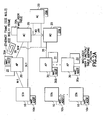
- Figure 2B shows one of the exemplary APs 30.
- the AP 30 includes a controller 100, such as one or more computers/microprocessors/digital signal processors, coupled with a memory 102.
- the memory 102 stores at least the MAC_ADDR (e.g., 30A) of the AP 30 as well as computer program instructions (program) 104 suitable for controlling operation of the AP 30 in accordance with these exemplary embodiments.
- the program 114 may include instructions/routines to implement the MAC_ADDR hash function/table mapping function 31, as well as to encapsulate a received IEEE 802.11 frame within an IEEE 802.3 frame as described herein.
- the AP 30 includes a suitable IEEE 802.11 wireless transceiver 106 for bidirectional communication with the STAs 10, and a suitable IEEE 802.3 transceiver 108 for bidirectional communication with the ACs 20.
- FIG. 2C shows one of the ACs 20.
- the AC 20 includes a controller 110, such as one or more computers/microprocessors/digital signal processors coupled with a memory 112.
- the memory 112 stores at least the physical MAC_ADDR 20B of the AC 20 as well as computer program instructions (program) 114 suitable for controlling operation of the AC 20 in accordance with these exemplary embodiments.
- the program 114 may include instructions/routines to implement the MAC_ADDR hash function/table mapping function, as well as to extract an encapsulated IEEE 802.11 frame from within an IEEE 802.3 frame, as well as to cooperate with other ACs 20 to allocate and reallocate (i.e., as needed) virtual MAC addresses (vMAC_ADDRs).
- the memory 114 also stores a MAC_ADDR table 20A, as well as at least one (and typically several) vMAC_ADDR associated with the AC 20 (referred to as vMAC_ADDRs 50A, 50B, etc. in Figures 2C , 8 and 9 ).
- the AC 20 includes a suitable IEEE 802.3 transceiver 116 for bidirectional communication with the APs 30, and a suitable transceiver 118 for bidirectional communication with other ACs 20 of an AC cluster 25 (see Figures 8 and 9 ) using VLAN 40.
- the transceiver 118 is also an IEEE 802.3 transceiver.
- the AC 20 also includes a separate bidirectional interface for communication with a WAN 60 (see Figures 8 and 9 ) .
- Each AP 30 may be assumed to have a unique MAC_ADDR 30A, 30B, ..., 30p).
- the ACs 20 are interconnected via a network, such as a local area network (LAN) 40 (see Figure 2A ), to enable AC-AC and other communications, as described below.
- LAN local area network
- the LAN 40 may be referred to as a virtual LAN (VLAN), and may'be based on, for example, an Ethernet link that supports broadcast transmissions between ACs 20.
- VLAN virtual LAN
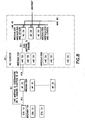
- the plurality of ACs 20 enable clustering, and, in some exemplary embodiments, they may be hosted in a data center of the network operator and interconnnected by the high speed LAN 40. As shown in Figure 8 , in further exemplary embodiments the ACs 20 may also be connected with a wide area network (WAN) 60 that provides access to, for example, the internet 46 (shown in Figure 4 ).
- WAN wide area network
- At least one of the programs 104, 114 is assumed to include program instructions that, when executed by the associated controller 100, 110, enable the respective electronic device 30, 20 to operate in accordance with the exemplary embodiments of this invention, as discussed herein.
- the various exemplary embodiments of the STA 10 can include, but are not limited to, mobile nodes, mobile stations, mobile phones, cellular phones, personal digital assistants (PDAs) having wireless communication capabilities, mobile routers, relay stations, relay nodes, portable computers having wireless communication capabilities, image capture devices such as digital cameras having wireless communication capabilities, gaming devices having wireless communication capabilities, music storage and playback appliances having wireless communication capabilities, Internet appliances permitting wireless Internet access and browsing, as well as portable units or terminals that incorporate combinations of such functions.
- PDAs personal digital assistants
- portable computers having wireless communication capabilities
- image capture devices such as digital cameras having wireless communication capabilities
- gaming devices having wireless communication capabilities
- music storage and playback appliances having wireless communication capabilities
- Internet appliances permitting wireless Internet access and browsing, as well as portable units or terminals that incorporate combinations of such functions.
- the various exemplary embodiments of the AP 30 can include, but are not limited to, similar devices.
- the exemplary embodiments of this invention may be implemented by computer software executable by one or more of the controllers 100, 110 of the AP 30 and/or the AC 20, or by hardware (e.g., circuitry), or by a combination of software and hardware.
- the memories 102, 112 may be of any type suitable to the local technical environment and may be implemented using any suitable data storage technology, such as semiconductor-based memory devices, flash memory, magnetic memory devices and systems, optical memory devices and systems, fixed memory and removable memory, as non-limiting examples.
- the controllers 100, 110 may be of any type suitable to the local technical environment, and may include one or more of general purpose computers, special purpose computers, processors, microprocessors, digital signal processors (DSPs) and processors based on a multi-core processor architecture, as non-limiting examples.
- these components may generally be seen to correspond to storage devices, storage circuits, storage components and/or storage blocks.
- these components may comprise one or more computer-readable mediums, one or more computer-readable memories and/or one or more program storage devices.
- controllers 100, 110 While described above in reference to controllers 100, 110, these components may generally be seen to correspond to processors, processing devices, processing components, processing blocks, circuits, circuit devices, circuit components, circuit blocks, integrated circuits and/or chips (e.g., chips comprising one or more circuits or integrated circuits).
- FIG 4 shows a non-limiting example of an overall network architecture having a plurality of STAs 10 (e.g., STA1, STA2) bidirectionally coupled with a wireless mesh that includes the APs 30.
- the APs 30 are coupled via a VLAN mesh, such as one implemented using Ethernet connections 35, to the ACs 20 (e.g., AC1, AC2).
- the ACs 20 are coupled to a VLAN 40 (e.g., a VLAN WAN) that in turn provides connectivity with various communication network entities, such as a DHCP service 42 and a router 44, as non-limiting examples.
- VLAN 40 e.g., a VLAN WAN
- the DHCP function is one that automatically assigns temporary IP addresses to client stations (e.g., the STAs 10) logging onto an IP network, and eliminates a need to manually assign permanent static IP addresses.
- the router 44 provides connectivity to the internet 46 having connected therewith various DNSs 48.
- Figure 5 shows the various interfaces and applicable standards for the system/network example shown in Figure 4 .
- Applicable standards and specifications may include, in addition to IP, for the wireless portion between the STAs (terminals) 10 and the APs 30 the IEEE 802.11 physical layer and MAC layer standards and specifications (IEEE Standard for Information technology, Telecommunications and information exchange between systems, Local and metropolitan area networks, Specific requirements Part 11: Wireless LAN Medium Access Control (MAC) and Physical Layer (PHY) Specifications), and for the VLAN mesh 35 and the VLAN 40 the IEEE 802.03 physical layer and MAC layer standards and specifications, (IEEE Standard for Information technology, Telecommunications and information exchange between systems, Local and metropolitan area networks Specific requirements, Part 3: Carrier sense multiple access with collision detection, (CSMA/CD) access method and physical layer specifications).
- Figure 5 shows the presence of the Ethernet switch 32 and an access gateway switch 22 that may form part of the AC 20.
- At least one IP server 50 is also shown, and it may be reachable via the ISP router 44 and the Internet 46.
- enhanced scaling can be achieved by providing multiple physical instances of the access controller 20 and/or by clustering the access controllers 20. The details of clustering for redundancy and load sharing are discussed in further detail below.
- each access point 30 there is a tunnel created towards the access controller 20 by encapsulating an IEEE 802.11 frame in an Ethernet frame (IEEE 802.3) with destination and source addresses being the access controller/access point, respectively.
- IEEE 802.3 Ethernet frame
- the use of this technique avoids a possibility to exhaust any MAC lookup table(s) on any intermediate Ethernet switch(es) 32 (shown in Figure 5 ) in the intermediate Ethernet network 35. For example, one may consider a large WLAN having 1,000,000 active stations 10 served by 50,000 access points 20.
- This method can reduce the capacity of the MAC switching tables to about, for example, 50,000-55,000 MAC addresses, which is well within a typical enterprise Ethernet switch 64K-128K MAC lookup table limit.
- an access controller 20 When an access controller 20 has no station 10 associated with a particular access point 30 it may release the relation to that access point 30.
- Each access controller 30 may be assumed, as shown in Figures 2A and 2C , to include a table 20A that stores MAC addresses of associated stations 10, as well as information descriptive of the state of each station 10. This state can include, but need not be limited to, association, authentication, security keys and authorization information, as non-limiting examples.
- Associated with the MAC address of a particular STA 10 is an identification of the AP 30 with which the STA 10 is currently associated.
- the access controller 20 can be fully utilized for carrying traffic and terminating part of the upper layer MAC.
- An aspect of these exemplary embodiments is that it provides a "single home" for each STA 10, i.e., the anchoring point for any station 10 in the WLAN can be determined at the access point 30 without distributing information, such as a custom mapping table. This is accomplished by enforcing the principle that the end user (STA 10) stays with one and only one access controller 20 throughout a particular session with the WLAN.
- the assignment as to which access controller 20 a particular station 10 belongs is deterministic, and is based on the MAC address (MAC_ADDR) (e.g., 10A) of the station 10.
- MAC_ADDR MAC address
- an access point 30 When an access point 30 receives a frame from a station 10 it may determine the address of the outbound tunnel described above by calculating a hash value of the source MAC address, which reduces the address space down to N values (i.e., the number of stations 10). This hash value may then be used as an offset in a preset MAC address range for the access controllers 20.
- the access point 30 sends, for a particular station 10, upper layer MAC traffic, control messages and user plane traffic frames to the access controller 20 by encapsulating these (IEEE 802.11) frames in an outer layer frame (or shim), such as the Ethernet frame (IEEE 802.03) shown in Figure 2A .
- This shim hides the actual addresses of the station 10 and the destination.
- the source address of the outer shim frame (the IEEE 802.3 frame) is the address of the access point 30, and the destination address is one of an N member set of addresses determined by the hash function described above.
- this technique makes it possible to preserve the state of the station 10 in the access controller 20.
- this state can include, but need not be limited to, association, authentication, security keys and authorization information, as non-limiting examples.
- This station 10-related data stays with the (same) access controller 20 throughout a session that the station 10 has with the WLAN.
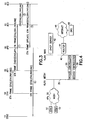
- FIG 3 is a flow diagram showing an example of data/message flow (inter-WLAN) from a first station 10 (STA1) to a second station 10 (STA2) via two access points 30 (AP1, AP2) and two access controllers 20 (AC1, AC2).
- inter-WLAN data/message flow
- AP1 receives a frame from STA1, encapsulates the received frame in an outer frame (shim) with a destination address equal to the hash(STA1) and a source address of AP1, and sends the frame to AC1.
- the shim frame is received by AC1, which extracts the encapsulated 802.11 frame and determines the existence of the association between AP1 and STA1.
- AC1 does not know STA2, so it sends the extracted frame to a network, such as the LAN 40 connecting the ACs 20.
- AC2 determines that it has knowledge of STA2 (the STA2 MAC address is maintained in the MAC address table 20A of AC2), and thus learns that STA2 was last located.at AP2.
- AC2 encapsulates the IEEE 802.11 frame in an outer (e.g., Ethernet) frame with a destination of AP2 and a source of AC2 and sends the frame to AP2.
- the AP2 extracts the frame from the encapsulation and sends it to STA2.
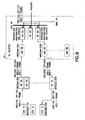
- FIG. 9 shows an AC cluster 25 (discussed below in greater detail with regard to Figure 8 ).
- STA 10 with MAC_ADDR 10A sends an IEEE 802.11 frame to AP30, with the destination address of STA 10 with MAC_ADDR 10B.
- the packet is conveyed through AP 30 having MAC_ADDR 30A, and is encapsulated in an IEEE 802.3 frame.
- the MAC_ADDR 10A is translated to the virtual MA_ADDR (vMAC_ADDR) 50A associated with a first virtual AC (vAC) 50.
- MA_ADDR 50A is used as the destination address of the outer frame (the IEEE 802.3 frame)
- MAC_ADDR 30A is used as the source address of the outer frame.
- the vAC 50 having virtual MA_ADDR 50A is instantiated in AC 20 having a physical MAC_ADDR 20A, which extracts the encapsulated IEEE 802.11 frame, checks if the frame destination address is one of the STA 10 associated with any vAC 50 instantiated on AC20, and if not, such as in this case, places the frame on the LAN 40 (with source address 10A and destination address 10B).
- the IEEE 802.11 frame is received by AC20 (MAC_ADDR 20B) that instantiates vAC 50 having vMAC_ADDR 50B, which recognizes the MAC_ADDR 10B as being an associated STA 10 (MAC_ADDR 10B).
- the IEEE 802.11 frame is encapsulated and forwarded to destination address of AP30 having MAC_ADDR 30B with a source address using vMAC_ADDR 50B.
- vMAC_ADDR 50B is derived either from the STA association table in AC20 (20B) or by using the mapping function 31 on the destination address of the STA, i.e., STA_MAC (MAC_ADDR) 10B.
- the AP 30 having MAC_ADDR 30B receives the encapsulated IEEE 802.11 frame, removes the other encapsulation, and forwards the frame to STA 10 with MAC_ADDR 10B.
- each access controller 20 may have one or more access controller addresses. That is, each access controller 20 may respond to one or more virtual MAC addresses (vMACAddr or vMAC_ADDR).
- vMACAddr virtual MAC addresses
- vMAC_ADDR virtual MAC addresses
- STA 10 and AP 30 see only the virtual MAC address of the AC 20 since the entirety of the AC cluster 25 appears as a "black box" to them.
- the dynamic mapping of virtual MAC addresses to physical AC instances within the AC cluster 25 is totally invisible outside of the AC cluster. This facilitates a clear demarcation of functionality.
- the distribution of virtual MAC addresses per physical instances may be determined by a voting procedure between the access controllers 20 based on, for example, the relative processing power (e.g., CPU speed/type, network, memory capacity, etc.) of the access controllers 20. That is, one particular AC 20 may respond to more vMAC_ADDRs than another AC 20. If one physical access controller 20 is intentionally or unintentionally disabled or taken offline, the other access controllers 20 can share the load of the lost access controller(s) by assuming zero, one or more of the virtual MAC addresses associated with the lost access controller(s). The communication between the clustered ACs 20 is conducted using the LAN 40.
- the relative processing power e.g., CPU speed/type, network, memory capacity, etc.
- Adding another access controller 20 to a cluster is straight forward as the existing population of access controllers 20 act to automatically redistribute one or more of the N vMAC addresses to the newly-added access controller 20.
- the stations 10 that have a relation to the specific access controller MAC addresses are disconnected from the network and then reconnected, unless the state of the station 10 has been previously shared. From the end user perspective, the service interruption, if any, is minimal, even if the current association is broken. This approach facilitates upgrades and downgrades of the WLAN capacity while maintaining a high level of service.
- the access controller 20 may operate in a mode wherein it functions in a manner analogous to a bridge (e.g., an Ethernet bridge). In this mode, broadcast frames are forwarded between the radio access network (between the STAs 10 and the APs 30) and the LAN 40.
- a bridge e.g., an Ethernet bridge.
- broadcast frames are forwarded between the radio access network (between the STAs 10 and the APs 30) and the LAN 40.
- the access controller 20 may operate in a mode wherein it functions in a manner analogous to a bridge (e.g., an Ethernet bridge).
- broadcast frames are forwarded between the radio access network (between the STAs 10 and the APs 30) and the LAN 40.
- the access controller 20 may operate in a mode wherein it functions in a manner analogous to a bridge (e.g., an Ethernet bridge).
- broadcast frames are forwarded between the radio access network (between the STAs 10 and the APs 30) and the LAN 40.
- One and only one access controller 20 has the right, and the obligation, to forward a specific broadcast frame to the radio access network (i.e., to the AP 30). All of the ACs 20 receive the broadcast frame from the LAN 40.
- the AC 20 that is to forward the broadcast traffic is determined by running the hash algorithm on the source address of the broadcast frame. If this process yields the virtual MAC address of the AC 20, the broadcast frame is encapsulated within the shim, with the destination address set to the broadcast address (recognized by the STAs 10 as such) and the source address the virtual MAC address of the AC 20, before sending it out to the radio access network.
- the access controller 20 forwards the frame to the LAN 40 and also determines if it needs to forward the frame back to the access controller network (i.e., the radio access network under control of the AC 20). Note that even though the station 10 sends a frame with a broadcast address, the frame is not broadcast until it reaches the access controller 20 so that user-specific policies can be applied.
- the access controller network i.e., the radio access network under control of the AC 20.
- the AC 20 functions as a layer 2 device, and that the intermediate network between the APs 30 and the ACs 20, which may be a mesh or an Ethernet switched network, simply conveys frames between the APs 30 and the ACs 20. No knowledge of station or other node addresses is needed.
- the isolation between the STA addresses and the AP/AC addresses is achieved through the use of tunneling (MAC in MAC), e.g., by encapsulating 802.11 frames within 802.3 frames.
- the AP 30 is enabled to always determine the correct AC 20 based on the MAC address 10A of the STA 10 using the mapping function 31. This enables a "lightweight" mobility to be achieved in the WLAN.
- the STA-AC pairing is achieved by use of the hash function from the STA MAC address 10A to one of a set of N (e.g., 256) "private" AC 20 MAC addresses (e.g., vMAC_ADDR 50A). Assuming the use of the same hash function by all of the APs 30, the association between the STA source MAC address 10A to the AC destination MAC address 50A is made deterministic.
- each AC 20 may typically have the physical MAC address 20B
- the use of the set of virtual MAC addresses 50A, 50B, etc. (which can be changed or reorganized as needed) enables such functions as the above-mentioned load sharing and load balancing between the ACs 20 based on, for example, their processing power and capacity, as well as the ability to configure and reconfigure the ACs 20 to accommodate the addition and loss of ACs 20.
- a new hash function is preferably distributed to those nodes needing the same.
- the system may be designed so that N is selected at design time such that the number of possible users can be readily accommodated by a set M of ACs 20, where N>M. This allows for some functional growth in the network.
- the base address for the "private" MAC address space may also be assumed to be fixed, or alternatively it may be loaded, as one example, from an operations and maintenance (O&M) system at system start.
- O&M operations and maintenance
- an exemplary method, and a result of execution of computer program instructions includes (Block 6A) receiving a first frame at a wireless access node, the first frame being received through a first communication network and comprising a source address; (Block 6B) applying a function to the source address to derive a destination address; (Block 6C) encapsulating the first frame in a second frame that comprises the destination address and a source address identifying the wireless access node; and (Block 6D) sending the second frame to a second communication network for receipt by a destination node having the destination address.
- the first communication network may be an IEEE 802.11 network
- the second communication network may be an IEEE 802.3 network
- the function may be a hash function.
- the destination node is an access controller that comprises part of an access controller cluster
- the access controller having at least one virtual MAC address
- the at least one virtual MAC address is derived by application of the function to the source address that comprises part of the first frame.
- the destination node is an access controller that comprises part of an access controller cluster
- the access controller having a plurality of MAC addresses one of which is derived by application of the function to the source address that comprises part of the first frame.
- the first frame is a broadcast frame.
- a further exemplary method and result of execution of computer program instructions includes (Block 7A) receiving a first frame at an access controller, the first frame being received through a first communication network and comprising a destination address that identifies one of a plurality of virtual MAC addresses associated with the access controller, the first frame further comprising a source address that identifies a wireless access node in a second communication network.
- Block 7B there is a step of extracting a second frame that is encapsulated in the first frame, the second frame comprising a source address identifying a station in the second communication network and a destination address.
- Block 7C there is a step of sending the second frame for receipt by a node having the destination address.
- the first communication network may be an IEEE 802.3 network
- the second communication network may be an IEEE 802.11 network
- At least one of the first frame and the third frame is a broadcast frame.
- the at least one criterion is comprised of at least one of an access controller becoming one or enabled for operation or disabled for operation and a processing capability of at least one access controller relative to' other ones of the plurality of access controllers.
- an apparatus comprising: means for receiving a first frame at a wireless access node, the first frame being received through a first communication network and comprising a source address; means for applying a function to the source address to derive a destination address; means for encapsulating the first frame in a second frame that comprises the destination address and a source address identifying the wireless access node; and means for sending the second frame to a second communication network for receipt by a destination node having the destination address.
- An apparatus as above where the means for receiving comprises a receiver, the means for applying and the means for encapsulating comprise a controller or a processor, and the means for sending comprises a transmitter.
- an apparatus comprising: means for receiving a first frame at an access controller, the first frame being received through a first communication network and comprising a destination address that identifies one of a plurality of virtual MAC addresses associated with the access controller, the first frame further comprising a source address that identifies a wireless access node in a second communication network; means for extracting a second frame that is encapsulated in the first frame, the second frame comprising a source address identifying a station in the second communication network and a destination address; and means for sending the second frame for receipt by a node having the destination address.
- An apparatus as above where the means for receiving comprises a receiver, the means for extracting comprises a controller or a processor, and the means for sending comprises a transmitter.
- the various blocks shown in Figures 6 and 7 may be viewed as method steps, and/or as operations that result from operation of computer program code, and/or as a plurality of coupled logic circuit elements constructed to carry out the associated function(s).
- the blocks depicted in Figures 6 and 7 may also be considered to correspond to one or more functions and/or operations that are performed by one or more components, apparatus, processors, computer programs, circuits, integrated circuits, application-specific integrated circuits (ASICs), chips and/or function blocks. Any and/or all of the above may be implemented in any practicable arrangement or solution that enables operation in accordance with the exemplary embodiments of the invention.
- the arrangement of the blocks shown in Figures 6 and 7 should be considered merely exemplary and non-limiting. It should be appreciated that the blocks depicted in Figures 6 and 7 may correspond to one or more functions and/or operations that may be performed in any order (e.g., any practicable, suitable and/or feasible order) and/or concurrently (e.g., as practicable, suitable and/or feasible) so as to implement one or more of the exemplary embodiments of the invention. In addition, one or more additional steps, functions and/or operations may be utilized in conjunction with those illustrated in Figures 6 and 7 so as to implement one or more further exemplary embodiments of the invention, such as those described in further detail herein.
- non-limiting, exemplary embodiments of the invention shown in Figures 6 and 7 may be implemented, practiced or utilized in conjunction with one or more further aspects in any combination (e.g., any combination that is practicable, suitable and/or feasible) and are not limited only to the blocks, steps, functions-and/or operations illustrated in Figures 6 and 7 .
- exemplary embodiments of the invention may be implemented as a computer program product comprising program instructions embodied on a tangible computer-readable medium. Execution of the program instructions results in operations comprising steps of utilizing the exemplary embodiments or steps of the method.
- exemplary embodiments of the invention may be implemented in conjunction with a program storage device (e.g., a computer-readable medium, a memory) readable by a machine (e.g., a computer, a mobile station, a mobile device, a mobile node), tangibly embodying a program of instructions (e.g., a program, a computer program) executable by the machine for performing operations.
- a program storage device e.g., a computer-readable medium, a memory
- a machine e.g., a computer, a mobile station, a mobile device, a mobile node
- the operations comprise steps of utilizing the exemplary embodiments or steps of the method.
- the various exemplary embodiments may be implemented in hardware or special purpose circuits, software, logic or any combination thereof.
- some aspects may be implemented in hardware, while other aspects may be implemented in firmware or software which may be executed by a controller, processor, microprocessor or other computing device, although the invention is not limited thereto.
- firmware or software which may be executed by a controller, processor, microprocessor or other computing device, although the invention is not limited thereto.
- While various aspects of the exemplary embodiments of this invention may be illustrated and described as block diagrams, flow charts, or using some other pictorial representation, it is well understood that these blocks, apparatus, systems, techniques or methods described herein may be implemented in, as non-limiting examples, hardware, software, firmware, special purpose circuits or logic, general purpose hardware or controller or other computing devices, or some combination thereof.
- the exemplary embodiments of the inventions may be practiced in various components such as integrated circuit chips and modules. It should thus be appreciated that the exemplary embodiments of this invention may be realized in an apparatus that is embodied as an integrated circuit, where the integrated circuit may comprise circuitry (as well as possibly firmware) for embodying at least one or more of a data processor, a digital signal processor, baseband circuitry and radio frequency circuitry that are configurable so as to operate in accordance with the exemplary embodiments of this invention.
- the exemplary embodiments have been described above in the context of the use of IEEE 802.11 and IEEE 802.3 physical and MAC protocols and networks, the exemplary embodiments are limited for use with only these particular specifications and standards, and that they may be used to advantage with other types of data communication specifications, standards, protocols and networks.
- a hash function has been discussed above, in other embodiments of this invention other suitable techniques may be used to transform a STA MAC address to an address of the AP that is associated with the STA.
- connection means any connection or coupling, either direct or indirect, between two or more elements, and may encompass the presence of one or more intermediate elements between two elements that are “connected” or “coupled” together.
- the coupling or connection between the elements can be physical, logical, or a combination thereof.
- two elements may be considered to be “connected” or “coupled” together by the use of one or more wire, cables and/or printed electrical connections, as well as by the use of electromagnetic energy, such as electromagnetic energy having wavelengths in the radio frequency region, the microwave region and the optical (both visible and invisible) region, as several non-limiting and non-exhaustive examples.
Landscapes
- Engineering & Computer Science (AREA)
- Computer Networks & Wireless Communication (AREA)
- Signal Processing (AREA)
- Power Engineering (AREA)
- Mobile Radio Communication Systems (AREA)
Claims (12)
- Procédé comprenant :la réception d'une première trame au niveau d'un noeud d'accès sans fil (30), la première trame étant reçue par l'intermédiaire d'un premier réseau de communication etcomprenant une adresse de source (10A) ;caractérisé en ce que le procédé comprend en outre :l'application d'une fonction de mappage (31) à l'adresse de source pour dériver une adresse de destination (10B) ;l'encapsulation de la première trame dans une deuxième trame qui comprend l'adresse de destination (50A) et une adresse de source (30A) qui identifie le noeud d'accès sans fil (30) ; etl'envoi de la deuxième trame à un deuxième réseau de communication pour réception par un noeud de destination ayant l'adresse de destination (50A),où le noeud de destination est un contrôleur d'accès qui fait partie d'un ensemble (25) de contrôleurs d'accès, ledit contrôleur d'accès ayant au moins une adresse MAC virtuelle (50A),où l'au moins une adresse MAC virtuelle (50A) est dérivée par application de la fonction de mappage (31) à l'adresse de source (10A) qui fait partie de la première trame.
- Procédé selon la revendication 1, où la première trame est une trame de radiodiffusion.
- Support mémoire qui stocke des instructions de programme informatique, dont l'exécution par un processeur de données résulte en des opérations qui comprennent :la réception d'une première trame au niveau d'un noeud d'accès sans fil, la première trame étant reçue par l'intermédiaire d'un premier réseau de communication et comprenant une adresse de source ;caractérisé en ce que les opérations comprennent en outre :l'application d'une fonction de mappage à l'adresse de source pour dériver une adresse de destination ;l'encapsulation de la première trame dans une deuxième trame qui comprend l'adresse de destination et une adresse de source qui identifie le noeud d'accès sans fil ; etl'envoi de la deuxième trame à un deuxième réseau de communication pour réception par un noeud de destination ayant l'adresse de destination,où le noeud de destination est un contrôleur d'accès qui fait partie d'un ensemble de contrôleurs d'accès, ledit contrôleur d'accès ayant au moins une adresse MAC virtuelle,où l'au moins une adresse MAC virtuelle est dérivée par application de la fonction de mappage à l'adresse de source qui fait partie de la première trame.
- Support mémoire selon la revendication 3, où la première trame est une trame de radiodiffusion.
- Noeud d'accès sans fil, comprenant : un récepteur configuré pour recevoir une première trame au niveau d'un noeud d'accès sans fil, la première trame étant reçue par l'intermédiaire d'un premier réseau de communication et comprenant une adresse de source (10A) ;
caractérisé en ce que le noeud comprend en outre :un contrôleur configuré pour appliquer une fonction de mappage (31) à l'adresse de source (10A) pour dériver une adresse de destination (10B) et pour encapsuler la première trame dans une deuxième trame qui comprend l'adresse de destination (50A) et une adresse de source (30A) qui identifie le noeud d'accès sans fil (30) ; etun émetteur configuré pour envoyer la deuxième trame à un deuxième réseau de communication pour réception par un noeud de destination ayant l'adresse de destination (50A),où le noeud de destination est un contrôleur d'accès qui fait partie d'un ensemble (25) de contrôleurs d'accès, ledit contrôleur d'accès ayant au moins une adresse MAC virtuelle (50A),où l'au moins une adresse MAC virtuelle (50A) est dérivée par application de la fonction de mappage (31) à l'adresse de source (10A) qui fait partie de la première trame. - Noeud d'accès sans fil selon la revendication 5, où la première trame est une trame de radiodiffusion.
- Procédé comprenant :la réception d'une première trame au niveau d'un contrôleur d'accès, la première trame étant reçue par l'intermédiaire d'un premier réseau de communication et comprenant une adresse de destination qui identifie une d'une pluralité d'adresses MAC virtuelles associées avec le contrôleur d'accès qui fait partie d'un ensemble de contrôleurs d'accès, la première trame comprenant en outre une adresse de source qui identifie un noeud d'accès sans fil dans le premier réseau de communication ;l'extraction d'une deuxième trame qui est encapsulée dans la première trame, la deuxième trame comprenant une adresse de source identifiant une station dans le deuxième réseau de communication et une adresse de destination ; etl'envoi de la deuxième trame pour réception par un noeud ayant l'adresse de destination de la deuxième trame ;caractérisé en ce que comprenant en outre :la réception d'une troisième trame au niveau du contrôleur d'accès, la troisième trame comprenant une adresse de destination identifiant une station dans le deuxième réseau de communication ;l'encapsulation de la troisième trame dans une quatrième trame qui comprend une adresse de destination d'un noeud d'accès sans fil dans le deuxième réseau de communication et une adresse de source identifiant le contrôleur d'accès ; etla transmission de la quatrième trame au premier réseau de communication.
- Procédé selon la revendication 7, où au moins une de la première trame et de la troisième trame est une trame de radiodiffusion.
- Support mémoire qui stocke des instructions de programme informatique, dont l'exécution par un processeur de données au niveau d'un contrôleur de données résulte en des opérations qui comprennent :la réception d'une première trame au niveau d'un contrôleur d'accès, la première trame étant reçue par l'intermédiaire d'un premier réseau de communication et comprenant une adresse de destination qui identifie une d'une pluralité d'adresses MAC virtuelles associées avec le contrôleur d'accès qui fait partie d'un ensemble de contrôleurs d'accès, la première trame comprenant en outre une adresse de source qui identifie un noeud d'accès sans fil dans le premier réseau de communication ;l'extraction d'une deuxième trame qui est encapsulée dans la première trame, la deuxième trame comprenant une adresse de source identifiant une station dans le deuxième réseau de communication et une adresse de destination ; etl'envoi de la deuxième trame pour réception par un noeud ayant l'adresse de destination de la deuxième trame ;caractérisé en ce que comprenant en outre des opérations de :réception d'une troisième trame au niveau du contrôleur d'accès, la troisième trame comprenant une adresse de destination identifiant une station dans le deuxième réseau de communication ;encapsulation de la troisième trame dans une quatrième trame qui comprend une adresse de destination d' un noeud d'accès sans fil dans le deuxième réseau de communication et une adresse de source identifiant le contrôleur d'accès ; ettransmission de la quatrième trame au premier réseau de communication.
- Support mémoire selon la revendication 9, où au moins une de la première trame et de la troisième trame est une trame de radiodiffusion.
- Contrôleur d'accès, comprenant :un récepteur configuré pour recevoir une première trame, la première trame étant reçue par l'intermédiaire d'un premier réseau de communication et comprenant une adresse de destination qui identifie une d'une pluralité d'adresses MAC virtuelles associées avec le contrôleur d'accès qui fait partie d'un ensemble de contrôleurs d'accès, la première trame comprenant en outre une adresse de source qui identifie un noeud d'accès sans fil dans le premier réseau de communication ;un contrôleur configuré pour extraire une deuxième trame qui est encapsulée dans la première trame, la deuxième trame comprenant une adresse de source identifiant une station dans le deuxième réseau de communication et une adresse de destination ; etun émetteur configuré pour envoyer la deuxième trame pour réception par un noeud ayant l'adresse de destination de la deuxième trame ;caractérisé en ce que ledit contrôleur configuré en outre, en réponse à la réception d'une troisième trame au niveau du contrôleur d'accès, la troisième trame comprenant une adresse de destination identifiant une station dans le deuxième réseau de communication, pour encapsuler la troisième trame dans une quatrième trame qui comprend une adresse de destination d'un noeud d'accès sans fil dans le deuxième réseau de communication et une adresse de source identifiant le contrôleur d'accès etenvoyer la quatrième trame au premier réseau de communication.
- Contrôleur d'accès selon la revendication 11, où au moins une de la première trame et de la troisième trame est une trame de radiodiffusion.
Applications Claiming Priority (2)
| Application Number | Priority Date | Filing Date | Title |
|---|---|---|---|
| US12/154,493 US8422513B2 (en) | 2008-05-23 | 2008-05-23 | Providing station context and mobility in a wireless local area network having a split MAC architecture |
| PCT/EP2009/056151 WO2009141385A2 (fr) | 2008-05-23 | 2009-05-20 | Fourniture d'un contexte de station et d'une mobilité dans un réseau local sans fil ayant une architecture mac fractionnée |
Publications (2)
| Publication Number | Publication Date |
|---|---|
| EP2283635A2 EP2283635A2 (fr) | 2011-02-16 |
| EP2283635B1 true EP2283635B1 (fr) | 2015-07-22 |
Family
ID=41340607
Family Applications (1)
| Application Number | Title | Priority Date | Filing Date |
|---|---|---|---|
| EP09749875.2A Active EP2283635B1 (fr) | 2008-05-23 | 2009-05-20 | Fourniture d'un contexte de station et d'une mobilité dans un réseau local sans fil ayant une architecture mac fractionnée |
Country Status (4)
| Country | Link |
|---|---|
| US (1) | US8422513B2 (fr) |
| EP (1) | EP2283635B1 (fr) |
| CN (2) | CN102037713B (fr) |
| WO (1) | WO2009141385A2 (fr) |
Families Citing this family (20)
| Publication number | Priority date | Publication date | Assignee | Title |
|---|---|---|---|---|
| US8036161B2 (en) * | 2008-07-30 | 2011-10-11 | Symbol Technologies, Inc. | Wireless switch with virtual wireless switch modules |
| JP5592887B2 (ja) * | 2008-09-02 | 2014-09-17 | コーニンクレッカ フィリップス エヌ ヴェ | メッシュ型ネットワークのプロキシ構造 |
| CN101771612B (zh) * | 2010-01-13 | 2012-07-04 | 华为技术有限公司 | 隧道建立方法、设备及网络系统 |
| JP5041035B2 (ja) * | 2010-06-04 | 2012-10-03 | 住友電気工業株式会社 | 無線装置及び無線基地局装置 |
| EP2521389A2 (fr) * | 2010-09-20 | 2012-11-07 | LG Electronics Inc. | Procédé et appareil adaptés pour désactiver un dispositif illégal dans un système lan sans fil |
| US20140050167A1 (en) * | 2010-11-22 | 2014-02-20 | Anyfi Networks Ab | Method, an access point, a server and a system for automatic remote access to ieee 802.11 networks |
| CN102118319B (zh) * | 2011-04-06 | 2013-09-18 | 杭州华三通信技术有限公司 | 流量负载均衡方法和装置 |
| US8539055B2 (en) * | 2011-06-30 | 2013-09-17 | Aruba Networks, Inc. | Device abstraction in autonomous wireless local area networks |
| CN105246171B (zh) | 2011-12-23 | 2018-08-21 | 华为技术有限公司 | 一种无线中继设备的中继方法及无线中继设备 |
| FI124297B (en) * | 2012-03-30 | 2014-06-13 | Tellabs Oy | A method and network element for content-based assignment in a communication network |
| US10039071B2 (en) * | 2012-09-07 | 2018-07-31 | Qualcomm Incorporated | Systems, apparatus, and methods for association in multi-hop networks |
| CN103260150B (zh) * | 2013-05-09 | 2016-06-22 | 中国联合网络通信集团有限公司 | 无线接入控制方法、无线接入点和无线接入控制器 |
| CN110212950B (zh) * | 2013-10-25 | 2021-06-29 | 华为技术有限公司 | 联合发送方法和设备 |
| US11070395B2 (en) * | 2015-12-09 | 2021-07-20 | Nokia Of America Corporation | Customer premises LAN expansion |
| WO2018000222A1 (fr) * | 2016-06-29 | 2018-01-04 | 北京小米移动软件有限公司 | Système de transmission de données, procédé de transmission de données, procédé et appareil d'agrégation de données |
| WO2018057518A1 (fr) * | 2016-09-20 | 2018-03-29 | Marvell World Trade Ltd. | Systèmes et procédés de transmission d'un signal radio de réveil à des dispositifs à faible puissance dans un système de communication sans fil |
| US10185550B2 (en) | 2016-09-28 | 2019-01-22 | Mcafee, Inc. | Device-driven auto-recovery using multiple recovery sources |
| US11196623B2 (en) | 2016-12-30 | 2021-12-07 | Intel Corporation | Data packaging protocols for communications between IoT devices |
| US11050746B2 (en) | 2019-01-29 | 2021-06-29 | Cisco Technology, Inc. | Media access control (MAC) address anonymization based on allocations by network controller elements |
| US11258888B2 (en) * | 2019-11-11 | 2022-02-22 | Cisco Technology, Inc. | Parallel redundancy protocol (PRP) using non-overlapping resource unit (RU) groupings on a radio |
Family Cites Families (35)
| Publication number | Priority date | Publication date | Assignee | Title |
|---|---|---|---|---|
| US5956335A (en) * | 1991-01-25 | 1999-09-21 | Cabletron Systems, Inc. | Many to few group address translation through a network bridge |
| US5790541A (en) * | 1996-04-01 | 1998-08-04 | Motorola, Inc. | Apparatus, method, system and system method for distributed routing in a multipoint communication system |
| US6018526A (en) * | 1997-02-20 | 2000-01-25 | Macronix America, Inc. | Bridge device with self learning between network media and integrated circuit and method based on the same |
| US6839348B2 (en) * | 1999-04-30 | 2005-01-04 | Cisco Technology, Inc. | System and method for distributing multicasts in virtual local area networks |
| US6643287B1 (en) * | 1999-11-24 | 2003-11-04 | Pluris, Inc. | Apparatus and method for forwarding encapsulated data packets on a network having multiple links between nodes |
| JP2001358756A (ja) * | 2000-06-09 | 2001-12-26 | Nec Corp | ルータ設定方法およびルータ設定装置 |
| JP4183379B2 (ja) * | 2000-11-27 | 2008-11-19 | 富士通株式会社 | ネットワーク及びエッジルータ |
| JP2002190824A (ja) * | 2000-12-21 | 2002-07-05 | Fujitsu Ltd | ルータ及びipパケットの転送方式 |
| US6618388B2 (en) * | 2001-01-05 | 2003-09-09 | Extreme Networks | Method and system for VMAN protocol |
| US7280540B2 (en) * | 2001-01-09 | 2007-10-09 | Stonesoft Oy | Processing of data packets within a network element cluster |
| JP4728511B2 (ja) * | 2001-06-14 | 2011-07-20 | 古河電気工業株式会社 | データ中継方法、その装置およびその装置を用いたデータ中継システム |
| KR100385996B1 (ko) * | 2001-09-05 | 2003-06-02 | 삼성전자주식회사 | 하나의 NIC(Network InterfaceCard)에 복수개의 IP 어드레스를 할당하는 방법 및이에 적합한 장치 |
| US6909713B2 (en) * | 2001-09-05 | 2005-06-21 | Intel Corporation | Hash-based data frame distribution for web switches |
| US7190695B2 (en) * | 2001-09-28 | 2007-03-13 | Lucent Technologies Inc. | Flexible application of mapping algorithms within a packet distributor |
| US6864489B2 (en) * | 2001-10-30 | 2005-03-08 | 3M Innovative Properties Company | Method of detecting wear on a substrate using a fluorescent indicator |
| JP3880404B2 (ja) * | 2002-01-18 | 2007-02-14 | 富士通株式会社 | Mplsネットワークシステム |
| US20030152075A1 (en) * | 2002-02-14 | 2003-08-14 | Hawthorne Austin J. | Virtual local area network identifier translation in a packet-based network |
| US6856991B1 (en) * | 2002-03-19 | 2005-02-15 | Cisco Technology, Inc. | Method and apparatus for routing data to a load balanced server using MPLS packet labels |
| EP1522174B1 (fr) * | 2002-07-16 | 2009-09-09 | Enterasys Networks, Inc. | Appareil et procede pour un reseau local hierarchique |
| US20050169270A1 (en) * | 2003-03-19 | 2005-08-04 | Ryoichi Mutou | Router, frame forwarding method, and lower layer frame virtual forwarding system |
| US7643424B2 (en) | 2003-03-22 | 2010-01-05 | At&T Intellectual Property L, L.P. | Ethernet architecture with data packet encapsulation |
| CN1323523C (zh) * | 2003-04-02 | 2007-06-27 | 华为技术有限公司 | 一种在无线局域网中生成动态密钥的方法 |
| US7701936B2 (en) * | 2003-09-05 | 2010-04-20 | Alcatel-Lucent Usa Inc. | Obtaining path information related to a bridged network |
| US20050220096A1 (en) * | 2004-04-06 | 2005-10-06 | Robert Friskney | Traffic engineering in frame-based carrier networks |
| KR100667783B1 (ko) * | 2004-09-14 | 2007-01-11 | 삼성전자주식회사 | 통신 어댑터 스위칭 방법 및 장치 |
| US20060184694A1 (en) | 2005-02-14 | 2006-08-17 | Sylvain Monette | Method and nodes for handling broadcast messages over an access domain |
| US8194656B2 (en) * | 2005-04-28 | 2012-06-05 | Cisco Technology, Inc. | Metro ethernet network with scaled broadcast and service instance domains |
| US7697528B2 (en) * | 2005-11-01 | 2010-04-13 | Nortel Networks Limited | Multilink trunking for encapsulated traffic |
| US7746892B2 (en) * | 2005-11-02 | 2010-06-29 | Nortel Networks Limited | Method and apparatus for transporting ethernet services |
| US8792497B2 (en) * | 2006-06-05 | 2014-07-29 | Tellabs Operations, Inc. | Method and apparatus for performing link aggregation |
| WO2008021372A2 (fr) * | 2006-08-11 | 2008-02-21 | Slt Logic Llc | Protocole ethernet amélioré destiné à des trames de données raccourcies à l'intérieur d'un voisinage restreint, fondé sur une identification unique |
| CN101127696B (zh) * | 2006-08-15 | 2012-06-27 | 华为技术有限公司 | 二层网络中的数据转发方法和网络及节点设备 |
| CN100542144C (zh) * | 2007-07-31 | 2009-09-16 | 杭州华三通信技术有限公司 | 基于安全设备的报文转发系统和方法以及安全设备 |
| US8166205B2 (en) * | 2007-07-31 | 2012-04-24 | Cisco Technology, Inc. | Overlay transport virtualization |
| CN101119315B (zh) * | 2007-09-17 | 2010-07-14 | 当代天启技术(北京)有限公司 | 控制网络中数据传输的方法、系统和网关 |
-
2008
- 2008-05-23 US US12/154,493 patent/US8422513B2/en active Active
-
2009
- 2009-05-20 WO PCT/EP2009/056151 patent/WO2009141385A2/fr not_active Ceased
- 2009-05-20 CN CN200980118706.5A patent/CN102037713B/zh active Active
- 2009-05-20 EP EP09749875.2A patent/EP2283635B1/fr active Active
- 2009-05-20 CN CN201510619353.4A patent/CN105208143B/zh active Active
Also Published As
| Publication number | Publication date |
|---|---|
| CN105208143A (zh) | 2015-12-30 |
| CN102037713B (zh) | 2015-11-25 |
| US8422513B2 (en) | 2013-04-16 |
| CN102037713A (zh) | 2011-04-27 |
| EP2283635A2 (fr) | 2011-02-16 |
| CN105208143B (zh) | 2019-03-29 |
| US20090290537A1 (en) | 2009-11-26 |
| WO2009141385A3 (fr) | 2010-01-28 |
| WO2009141385A2 (fr) | 2009-11-26 |
Similar Documents
| Publication | Publication Date | Title |
|---|---|---|
| EP2283635B1 (fr) | Fourniture d'un contexte de station et d'une mobilité dans un réseau local sans fil ayant une architecture mac fractionnée | |
| US8665871B2 (en) | Dynamic VLAN IP network entry | |
| JP4727126B2 (ja) | 近距離無線コンピューティング装置用のセキュア・ネットワーク・アクセスの提供 | |
| EP3162039B1 (fr) | Réseau mobile à très haut débit basé sur la commutation de niveau 2 | |
| US20080107077A1 (en) | Subnet mobility supporting wireless handoff | |
| US20100290391A1 (en) | Apparatus and method for accessing multiple wireless networks | |
| US20130182651A1 (en) | Virtual Private Network Client Internet Protocol Conflict Detection | |
| US8611358B2 (en) | Mobile network traffic management | |
| KR101342590B1 (ko) | 무선단말의 로밍(roaming)을 지원하는 AP기반의 무선 근거리 네트워크 시스템 | |
| US12095765B2 (en) | Cloud delivered access | |
| US9276768B2 (en) | Providing station context and mobility in a wireless local area network having a split MAC architecture | |
| US20160080318A1 (en) | Dynamic host configuration protocol release on behalf of a user | |
| WO2011032492A1 (fr) | Procédé d'identification d'identité, de communication en réseau et de migration de service, et architecture de réseau d'intercommunication d'informations | |
| US20230146807A1 (en) | Supporting dynamic host configuration protocol-based customer premises equipment in fifth generation wireline and wireless convergence | |
| CN116233953A (zh) | 数据传输方法、装置、设备及存储介质 | |
| US9231862B2 (en) | Selective service based virtual local area network flooding | |
| US11546222B2 (en) | Mapping between wireless links and virtual local area networks | |
| CN113973098A (zh) | 一种域名系统请求的发送方法及装置 | |
| US20130188625A1 (en) | Vlan pooling enhancement | |
| JP2019153965A (ja) | Ipネットワーク接続システム、ipネットワーク接続装置、ipネットワーク接続方法、及びプログラム | |
| CN121078488B (zh) | 网络数据处理方法及装置 | |
| EP4546722A1 (fr) | Fourniture d'un mécanisme d'accès sans fil fixe à une unité d'habitation multiple | |
| JP2011010284A (ja) | 無線中継装置 | |
| WO2023278774A1 (fr) | Système et procédé de sécurité de mise en réseau pour station de base virtualisée | |
| JP2004349834A (ja) | ユーザ端末の接続制御方法および接続制御サーバ |
Legal Events
| Date | Code | Title | Description |
|---|---|---|---|
| PUAI | Public reference made under article 153(3) epc to a published international application that has entered the european phase |
Free format text: ORIGINAL CODE: 0009012 |
|
| 17P | Request for examination filed |
Effective date: 20101223 |
|
| AK | Designated contracting states |
Kind code of ref document: A2 Designated state(s): AT BE BG CH CY CZ DE DK EE ES FI FR GB GR HR HU IE IS IT LI LT LU LV MC MK MT NL NO PL PT RO SE SI SK TR |
|
| AX | Request for extension of the european patent |
Extension state: AL BA RS |
|
| 17Q | First examination report despatched |
Effective date: 20110719 |
|
| DAX | Request for extension of the european patent (deleted) | ||
| RAP1 | Party data changed (applicant data changed or rights of an application transferred) |
Owner name: NOKIA SOLUTIONS AND NETWORKS OY |
|
| GRAP | Despatch of communication of intention to grant a patent |
Free format text: ORIGINAL CODE: EPIDOSNIGR1 |
|
| INTG | Intention to grant announced |
Effective date: 20150226 |
|
| GRAS | Grant fee paid |
Free format text: ORIGINAL CODE: EPIDOSNIGR3 |
|
| GRAA | (expected) grant |
Free format text: ORIGINAL CODE: 0009210 |
|
| AK | Designated contracting states |
Kind code of ref document: B1 Designated state(s): AT BE BG CH CY CZ DE DK EE ES FI FR GB GR HR HU IE IS IT LI LT LU LV MC MK MT NL NO PL PT RO SE SI SK TR |
|
| REG | Reference to a national code |
Ref country code: GB Ref legal event code: FG4D |
|
| REG | Reference to a national code |
Ref country code: CH Ref legal event code: EP |
|
| REG | Reference to a national code |
Ref country code: IE Ref legal event code: FG4D |
|
| REG | Reference to a national code |
Ref country code: AT Ref legal event code: REF Ref document number: 738443 Country of ref document: AT Kind code of ref document: T Effective date: 20150815 |
|
| REG | Reference to a national code |
Ref country code: DE Ref legal event code: R096 Ref document number: 602009032369 Country of ref document: DE |
|
| REG | Reference to a national code |
Ref country code: AT Ref legal event code: MK05 Ref document number: 738443 Country of ref document: AT Kind code of ref document: T Effective date: 20150722 |
|
| REG | Reference to a national code |
Ref country code: LT Ref legal event code: MG4D |
|
| REG | Reference to a national code |
Ref country code: NL Ref legal event code: MP Effective date: 20150722 |
|
| PG25 | Lapsed in a contracting state [announced via postgrant information from national office to epo] |
Ref country code: NO Free format text: LAPSE BECAUSE OF FAILURE TO SUBMIT A TRANSLATION OF THE DESCRIPTION OR TO PAY THE FEE WITHIN THE PRESCRIBED TIME-LIMIT Effective date: 20151022 Ref country code: GR Free format text: LAPSE BECAUSE OF FAILURE TO SUBMIT A TRANSLATION OF THE DESCRIPTION OR TO PAY THE FEE WITHIN THE PRESCRIBED TIME-LIMIT Effective date: 20151023 Ref country code: LT Free format text: LAPSE BECAUSE OF FAILURE TO SUBMIT A TRANSLATION OF THE DESCRIPTION OR TO PAY THE FEE WITHIN THE PRESCRIBED TIME-LIMIT Effective date: 20150722 Ref country code: LV Free format text: LAPSE BECAUSE OF FAILURE TO SUBMIT A TRANSLATION OF THE DESCRIPTION OR TO PAY THE FEE WITHIN THE PRESCRIBED TIME-LIMIT Effective date: 20150722 Ref country code: FI Free format text: LAPSE BECAUSE OF FAILURE TO SUBMIT A TRANSLATION OF THE DESCRIPTION OR TO PAY THE FEE WITHIN THE PRESCRIBED TIME-LIMIT Effective date: 20150722 |
|
| PG25 | Lapsed in a contracting state [announced via postgrant information from national office to epo] |
Ref country code: AT Free format text: LAPSE BECAUSE OF FAILURE TO SUBMIT A TRANSLATION OF THE DESCRIPTION OR TO PAY THE FEE WITHIN THE PRESCRIBED TIME-LIMIT Effective date: 20150722 Ref country code: HR Free format text: LAPSE BECAUSE OF FAILURE TO SUBMIT A TRANSLATION OF THE DESCRIPTION OR TO PAY THE FEE WITHIN THE PRESCRIBED TIME-LIMIT Effective date: 20150722 Ref country code: ES Free format text: LAPSE BECAUSE OF FAILURE TO SUBMIT A TRANSLATION OF THE DESCRIPTION OR TO PAY THE FEE WITHIN THE PRESCRIBED TIME-LIMIT Effective date: 20150722 Ref country code: PL Free format text: LAPSE BECAUSE OF FAILURE TO SUBMIT A TRANSLATION OF THE DESCRIPTION OR TO PAY THE FEE WITHIN THE PRESCRIBED TIME-LIMIT Effective date: 20150722 Ref country code: PT Free format text: LAPSE BECAUSE OF FAILURE TO SUBMIT A TRANSLATION OF THE DESCRIPTION OR TO PAY THE FEE WITHIN THE PRESCRIBED TIME-LIMIT Effective date: 20151123 Ref country code: SE Free format text: LAPSE BECAUSE OF FAILURE TO SUBMIT A TRANSLATION OF THE DESCRIPTION OR TO PAY THE FEE WITHIN THE PRESCRIBED TIME-LIMIT Effective date: 20150722 Ref country code: IS Free format text: LAPSE BECAUSE OF FAILURE TO SUBMIT A TRANSLATION OF THE DESCRIPTION OR TO PAY THE FEE WITHIN THE PRESCRIBED TIME-LIMIT Effective date: 20151122 |
|
| REG | Reference to a national code |
Ref country code: DE Ref legal event code: R097 Ref document number: 602009032369 Country of ref document: DE |
|
| PG25 | Lapsed in a contracting state [announced via postgrant information from national office to epo] |
Ref country code: IT Free format text: LAPSE BECAUSE OF FAILURE TO SUBMIT A TRANSLATION OF THE DESCRIPTION OR TO PAY THE FEE WITHIN THE PRESCRIBED TIME-LIMIT Effective date: 20150722 Ref country code: SK Free format text: LAPSE BECAUSE OF FAILURE TO SUBMIT A TRANSLATION OF THE DESCRIPTION OR TO PAY THE FEE WITHIN THE PRESCRIBED TIME-LIMIT Effective date: 20150722 Ref country code: CZ Free format text: LAPSE BECAUSE OF FAILURE TO SUBMIT A TRANSLATION OF THE DESCRIPTION OR TO PAY THE FEE WITHIN THE PRESCRIBED TIME-LIMIT Effective date: 20150722 Ref country code: EE Free format text: LAPSE BECAUSE OF FAILURE TO SUBMIT A TRANSLATION OF THE DESCRIPTION OR TO PAY THE FEE WITHIN THE PRESCRIBED TIME-LIMIT Effective date: 20150722 Ref country code: DK Free format text: LAPSE BECAUSE OF FAILURE TO SUBMIT A TRANSLATION OF THE DESCRIPTION OR TO PAY THE FEE WITHIN THE PRESCRIBED TIME-LIMIT Effective date: 20150722 |
|
| PLBE | No opposition filed within time limit |
Free format text: ORIGINAL CODE: 0009261 |
|
| STAA | Information on the status of an ep patent application or granted ep patent |
Free format text: STATUS: NO OPPOSITION FILED WITHIN TIME LIMIT |
|
| PG25 | Lapsed in a contracting state [announced via postgrant information from national office to epo] |
Ref country code: RO Free format text: LAPSE BECAUSE OF FAILURE TO SUBMIT A TRANSLATION OF THE DESCRIPTION OR TO PAY THE FEE WITHIN THE PRESCRIBED TIME-LIMIT Effective date: 20150722 |
|
| 26N | No opposition filed |
Effective date: 20160425 |
|
| PG25 | Lapsed in a contracting state [announced via postgrant information from national office to epo] |
Ref country code: BE Free format text: LAPSE BECAUSE OF NON-PAYMENT OF DUE FEES Effective date: 20160531 Ref country code: SI Free format text: LAPSE BECAUSE OF FAILURE TO SUBMIT A TRANSLATION OF THE DESCRIPTION OR TO PAY THE FEE WITHIN THE PRESCRIBED TIME-LIMIT Effective date: 20150722 |
|
| PG25 | Lapsed in a contracting state [announced via postgrant information from national office to epo] |
Ref country code: BE Free format text: LAPSE BECAUSE OF FAILURE TO SUBMIT A TRANSLATION OF THE DESCRIPTION OR TO PAY THE FEE WITHIN THE PRESCRIBED TIME-LIMIT Effective date: 20150722 Ref country code: LU Free format text: LAPSE BECAUSE OF FAILURE TO SUBMIT A TRANSLATION OF THE DESCRIPTION OR TO PAY THE FEE WITHIN THE PRESCRIBED TIME-LIMIT Effective date: 20160520 |
|
| REG | Reference to a national code |
Ref country code: CH Ref legal event code: PL |
|
| PG25 | Lapsed in a contracting state [announced via postgrant information from national office to epo] |
Ref country code: CH Free format text: LAPSE BECAUSE OF NON-PAYMENT OF DUE FEES Effective date: 20160531 Ref country code: LI Free format text: LAPSE BECAUSE OF NON-PAYMENT OF DUE FEES Effective date: 20160531 |
|
| REG | Reference to a national code |
Ref country code: IE Ref legal event code: MM4A |
|
| REG | Reference to a national code |
Ref country code: FR Ref legal event code: ST Effective date: 20170131 |
|
| PG25 | Lapsed in a contracting state [announced via postgrant information from national office to epo] |
Ref country code: FR Free format text: LAPSE BECAUSE OF NON-PAYMENT OF DUE FEES Effective date: 20160531 |
|
| PG25 | Lapsed in a contracting state [announced via postgrant information from national office to epo] |
Ref country code: IE Free format text: LAPSE BECAUSE OF NON-PAYMENT OF DUE FEES Effective date: 20160520 |
|
| PG25 | Lapsed in a contracting state [announced via postgrant information from national office to epo] |
Ref country code: NL Free format text: LAPSE BECAUSE OF FAILURE TO SUBMIT A TRANSLATION OF THE DESCRIPTION OR TO PAY THE FEE WITHIN THE PRESCRIBED TIME-LIMIT Effective date: 20150722 |
|
| PG25 | Lapsed in a contracting state [announced via postgrant information from national office to epo] |
Ref country code: CY Free format text: LAPSE BECAUSE OF FAILURE TO SUBMIT A TRANSLATION OF THE DESCRIPTION OR TO PAY THE FEE WITHIN THE PRESCRIBED TIME-LIMIT Effective date: 20150722 Ref country code: HU Free format text: LAPSE BECAUSE OF FAILURE TO SUBMIT A TRANSLATION OF THE DESCRIPTION OR TO PAY THE FEE WITHIN THE PRESCRIBED TIME-LIMIT; INVALID AB INITIO Effective date: 20090520 |
|
| PG25 | Lapsed in a contracting state [announced via postgrant information from national office to epo] |
Ref country code: MC Free format text: LAPSE BECAUSE OF FAILURE TO SUBMIT A TRANSLATION OF THE DESCRIPTION OR TO PAY THE FEE WITHIN THE PRESCRIBED TIME-LIMIT Effective date: 20150722 Ref country code: MK Free format text: LAPSE BECAUSE OF FAILURE TO SUBMIT A TRANSLATION OF THE DESCRIPTION OR TO PAY THE FEE WITHIN THE PRESCRIBED TIME-LIMIT Effective date: 20150722 Ref country code: TR Free format text: LAPSE BECAUSE OF FAILURE TO SUBMIT A TRANSLATION OF THE DESCRIPTION OR TO PAY THE FEE WITHIN THE PRESCRIBED TIME-LIMIT Effective date: 20150722 Ref country code: MT Free format text: LAPSE BECAUSE OF NON-PAYMENT OF DUE FEES Effective date: 20160531 |
|
| PG25 | Lapsed in a contracting state [announced via postgrant information from national office to epo] |
Ref country code: BG Free format text: LAPSE BECAUSE OF FAILURE TO SUBMIT A TRANSLATION OF THE DESCRIPTION OR TO PAY THE FEE WITHIN THE PRESCRIBED TIME-LIMIT Effective date: 20150722 |
|
| REG | Reference to a national code |
Ref country code: DE Ref legal event code: R081 Ref document number: 602009032369 Country of ref document: DE Owner name: NOKIA TECHNOLOGIES OY, FI Free format text: FORMER OWNER: NOKIA SOLUTIONS AND NETWORKS OY, ESPOO, FI |
|
| REG | Reference to a national code |
Ref country code: GB Ref legal event code: 732E Free format text: REGISTERED BETWEEN 20200402 AND 20200408 |
|
| REG | Reference to a national code |
Ref country code: DE Ref legal event code: R079 Ref document number: 602009032369 Country of ref document: DE Free format text: PREVIOUS MAIN CLASS: H04L0029120000 Ipc: H04L0067286900 |
|
| PGFP | Annual fee paid to national office [announced via postgrant information from national office to epo] |
Ref country code: DE Payment date: 20250402 Year of fee payment: 17 |
|
| PGFP | Annual fee paid to national office [announced via postgrant information from national office to epo] |
Ref country code: GB Payment date: 20250401 Year of fee payment: 17 |