EP2283762A2 - Wasserführendes Haushaltsgerät - Google Patents
Wasserführendes Haushaltsgerät Download PDFInfo
- Publication number
- EP2283762A2 EP2283762A2 EP10170429A EP10170429A EP2283762A2 EP 2283762 A2 EP2283762 A2 EP 2283762A2 EP 10170429 A EP10170429 A EP 10170429A EP 10170429 A EP10170429 A EP 10170429A EP 2283762 A2 EP2283762 A2 EP 2283762A2
- Authority
- EP
- European Patent Office
- Prior art keywords
- valve
- water
- storage container
- appliance according
- siphon
- Prior art date
- Legal status (The legal status is an assumption and is not a legal conclusion. Google has not performed a legal analysis and makes no representation as to the accuracy of the status listed.)
- Granted
Links
Images



Classifications
-
- A—HUMAN NECESSITIES
- A47—FURNITURE; DOMESTIC ARTICLES OR APPLIANCES; COFFEE MILLS; SPICE MILLS; SUCTION CLEANERS IN GENERAL
- A47L—DOMESTIC WASHING OR CLEANING; SUCTION CLEANERS IN GENERAL
- A47L15/00—Washing or rinsing machines for crockery or tableware
- A47L15/42—Details
- A47L15/4202—Water filter means or strainers
-
- A—HUMAN NECESSITIES
- A47—FURNITURE; DOMESTIC ARTICLES OR APPLIANCES; COFFEE MILLS; SPICE MILLS; SUCTION CLEANERS IN GENERAL
- A47L—DOMESTIC WASHING OR CLEANING; SUCTION CLEANERS IN GENERAL
- A47L15/00—Washing or rinsing machines for crockery or tableware
- A47L15/42—Details
- A47L15/4202—Water filter means or strainers
- A47L15/4208—Arrangements to prevent clogging of the filters, e.g. self-cleaning
-
- A—HUMAN NECESSITIES
- A47—FURNITURE; DOMESTIC ARTICLES OR APPLIANCES; COFFEE MILLS; SPICE MILLS; SUCTION CLEANERS IN GENERAL
- A47L—DOMESTIC WASHING OR CLEANING; SUCTION CLEANERS IN GENERAL
- A47L15/00—Washing or rinsing machines for crockery or tableware
- A47L15/42—Details
- A47L15/4214—Water supply, recirculation or discharge arrangements; Devices therefor
- A47L15/4219—Water recirculation
- A47L15/4221—Arrangements for redirection of washing water, e.g. water diverters to selectively supply the spray arms
-
- A—HUMAN NECESSITIES
- A47—FURNITURE; DOMESTIC ARTICLES OR APPLIANCES; COFFEE MILLS; SPICE MILLS; SUCTION CLEANERS IN GENERAL
- A47L—DOMESTIC WASHING OR CLEANING; SUCTION CLEANERS IN GENERAL
- A47L15/00—Washing or rinsing machines for crockery or tableware
- A47L15/42—Details
- A47L15/4214—Water supply, recirculation or discharge arrangements; Devices therefor
- A47L15/4223—Devices for water discharge, e.g. devices to prevent siphoning, non-return valves
-
- A—HUMAN NECESSITIES
- A47—FURNITURE; DOMESTIC ARTICLES OR APPLIANCES; COFFEE MILLS; SPICE MILLS; SUCTION CLEANERS IN GENERAL
- A47L—DOMESTIC WASHING OR CLEANING; SUCTION CLEANERS IN GENERAL
- A47L15/00—Washing or rinsing machines for crockery or tableware
- A47L15/42—Details
- A47L15/4291—Recovery arrangements, e.g. for the recovery of energy or water
-
- A—HUMAN NECESSITIES
- A47—FURNITURE; DOMESTIC ARTICLES OR APPLIANCES; COFFEE MILLS; SPICE MILLS; SUCTION CLEANERS IN GENERAL
- A47L—DOMESTIC WASHING OR CLEANING; SUCTION CLEANERS IN GENERAL
- A47L15/00—Washing or rinsing machines for crockery or tableware
- A47L15/0018—Controlling processes, i.e. processes to control the operation of the machine characterised by the purpose or target of the control
- A47L15/0057—Cleaning of machines parts, e.g. removal of deposits like lime scale or proteins from piping or tub
Definitions
- the invention relates to a water-conducting household appliance, in particular a dishwasher, with a storage container in which rinsing liquid is temporarily stored, and with a liquid line connecting a washing container of the water-conducting household appliance with the storage container, wherein in the liquid line, a valve is arranged, in the open state In a flow direction of rinsing liquid can be flowed through.
- dishwashers undergo wash programs consisting of a number of partial program steps, such as e.g. Pre-rinsing, cleaning, rinsing, rinsing and drying.
- wash programs consisting of a number of partial program steps, such as e.g. Pre-rinsing, cleaning, rinsing, rinsing and drying.
- valves are provided in the liquid circuit of a dishwasher, which open or close a fluid path.
- dirt particles in the liquid can block a valve.
- the object of the invention is to provide a domestic appliance, in particular a dishwasher, in which a reliable valve operation is ensured.
- the invention relates to a water-conducting domestic appliance, in particular a dishwasher, with a storage container in which rinsing liquid is temporarily stored, and with a liquid line which connects a washing container of the water-conducting household appliance with the storage container, wherein in the liquid line, a valve is arranged in the opened state can be flowed through in a flow direction of rinsing liquid
- the liquid line on a pre-stored in the flow direction of the dirt particles collecting dirt particle retention device may be, for example, a siphon or a filter.
- rinsing liquid can be cached, which is no longer needed after execution of a partial program step of a rinse cycle.
- the rinsing fluid that is no longer required is pumped from the washing compartment into the storage container by means of a circulating pump and when the storage container valve is open. Subsequently, the storage container valve is closed and, for example. Cached until the next rinse and used in the next rinse for pre-rinsing the items to be washed.
- a storage container valve is provided, with which a control device of the dishwasher can open or close the liquid path to the storage container.
- the valve remains largely free of at least larger dirt particles that could otherwise accumulate in the valve.
- the arrangement of the valve with associated siphon is therefore especially in the dirty and service water area of a water-conducting household appliance, in particular a dishwasher, used.
- the siphon can be designed, for example, as a tube siphon and have two substantially vertically aligned, mutually opposite line sections, one of which is directly connected to the valve.
- the two opposing pipe sections of the siphon are connected to each other via a siphon bottom, on which the dirt particles collect.
- the siphon can be connected upstream of the valve in the flow direction such that the siphon line section coupled to the valve can extend directly downwards from the valve with a predetermined angle of inclination down to the siphon bottom.
- the angle of inclination of the siphon line section may be variable, for example, become larger in the direction of the siphon bottom.
- the dirt particles collecting in the siphon line section can therefore migrate in the direction of the siphon bottom, that is to say away from the valve, owing to the line gradient.
- the siphon can open with its corresponding line section in a valve chamber of the valve.
- a valve element such as a Adjust the valve disc to open or close the fluid-filled valve chamber.
- the mouth of the valve may be bordered by a, with the valve element cooperating valve seat edge.
- the adjustable valve element In the closed state, the adjustable valve element can be pressed liquid-tight in contact with the valve seat.
- the valve element In the open state of the valve, however, the valve element can be adjusted by a valve lift away from the valve seat, whereby a flow gap is exposed to the mouth opening, which allows the flow of liquid through the valve.
- the resulting in the closed state of the valve sealing surface between the valve seat and the adjustable valve element must be substantially free of dirt particles to ensure proper operation of the valve. It has proven to be advantageous if the sealing surface is not aligned in a horizontal plane, but rather is inclined relative to such a horizontal plane, and in particular is aligned in a vertical plane. Dirt particles can thus permanently settle either on the sealing surface of the valve seat or on the sealing surface of the associated valve element and lead to a sticking of the valve element to the valve seat.
- the siphon bottom is arranged by a predetermined height difference below the valve, in particular below the above-mentioned orifice in the valve chamber.
- the height difference results from the flow conditions in the liquid line, in particular from the flow velocity of the liquid flow. If there is a large flow of liquid, the height difference between the valve and siphon bottom must be increased accordingly, so that the dirt particles collected at the siphon bottom can not be conveyed to the valve.
- the liquid line downstream of the valve is continued vertically downwards.
- the dirt particles can therefore additionally shift by gravity from the valve chamber of the valve.
- the valve space of the valve on the bottom side has a passage to which the liquid line can connect downstream of the valve.
- the storage tank valve is fluidically arranged between the washing compartment and the storage tank, that is to say in the dirty or service water area of the dishwasher.
- the storage tank valve can lead to a malfunction or leakage at the valve and thus to a malfunction of the storage container.
- the storage container valve For returning the cached rinsing liquid into the liquid circuit of the dishwasher, the storage container valve is opened, whereby the rinsing liquid can flow out of the storage container.
- the rinsing liquid can flow under gravity, that is, at low speed, from the storage tank into the washing compartment of the dishwasher.
- the siphon according to the invention can therefore be connected in particular fluidically between the storage container valve and the storage container in order to collect these dirt particles.
- the draining of the cached rinsing liquid from the storage container can, as already mentioned above, be carried out by gravity, that is with a correspondingly low flow rate.
- the geodetic height difference between the storage container valve and the siphon bottom can also be dimensioned.
- siphon instead of a tube siphon as a bottle, partition wall or bell siphon.
- the dirt particle retention device comprises a filter, can be retained with the dirt particles, which in particular have a disturbing the reliable operation of the valve minimum size.
- the filter can be cleaned by backwashing, so that clogging of the filter is reliably prevented.
- the backwashing can be effected by at least partially emptying a storage container in which rinsing liquid can be temporarily stored, and that the liquid line connects a rinsing container of the water-conducting household appliance with the storage container. It is generated with the emptying of the storage container, a liquid flow, which is opposite to the flow direction in which the filter is flowed through during the filling of the storage container. Subsequently, for example, by operation of the drain pump, this amount of liquid, which is mixed with dirt particles, can be conveyed from the domestic appliance into a domestic sewage disposal network.
- the dirt particle retention device has a centrifugal separator, with which a rotating liquid flow can be generated, can be separated by dirt particles.
- a rinsing liquid flow in the first flow direction of the storage container can be emptied.
- the valve is protected from being transported out of the full storage container dirt particles that, for example. Only by. have formed biological processes.
- the dirt particle retention device holds back dirt particles when filling the storage container.
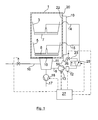
- Fig. 1 is schematically shown a dishwasher with a, a Spülraum limiting rinse tank 1.
- a washing compartment of the washing container 1 a not shown, to be cleaned dishes in dish racks 3, 5 are arranged.
- two spraying arms 7, 8 provided in different spraying levels are arranged by way of example, via which the items to be washed are supplied with washing liquid.
- a pump pot 11 is provided with a roughly indicated sieve assembly 10. From the sump 11, a recirculation line 9 is guided away with circulating pump 13 arranged therein.
- the circulation line 9 is fluidly connected via supply lines 14, 15 with the spray arms 7, 8.
- the circulating pump 13 is connected downstream, referred to as a water heater heating element 12th
- the sump 11 is also connected via connecting pieces to a, connected to the water supply network fresh water supply line 16 and a drain line 17 in conjunction, in which a drain pump 18 is arranged to pump out rinsing liquid from the washing compartment 1.
- the washing container 1 has at its in the Fig. 1 right side as a storage container 19 a so-called storage container, which is thermally coupled in the manner of a heat exchanger in contact with a side wall 20 of the washing compartment 1.
- rinsing liquid can be temporarily stored, which is no longer needed after execution of a partial program step of a rinse cycle.
- the storage tank 19 is in terms of flow in connection with the washing compartment in its upper area via a ventilation opening 22.
- the sump 11 with associated sieve arrangement 10 the recirculation line 9, the feed lines 14, 15 and the two spray arms 7, 8 are integrated in the liquid circuit.
- Downstream of the heating element 12 is provided in the circulation line 9 as a three-way switching valve 25 shown water diverter, at which a connecting line 23 branches off, leading to the storage tank 19.
- the three-way switching valve 25 connects in contrast in a in the Fig. 2 In this switch position can be pumped to purify the storage container 19, the rinsing liquid at a high flow rate in the storage tank 19 and fill this, until the rinsing liquid enters the rinsing container 1 via the ventilation opening 22 and is fed back along the rinsing container wall 20 past the racks 3, 5 into the sump 11 with associated sieve arrangement 10. In this way, dirt particles, fat residues, etc. can be guided out of the storage container 19.
- a storage tank valve 26 is provided.
- the valve 26 is arranged in the leading to the storage tank 19 connecting line 23 and the Example during the above-mentioned storage tank cleaning arranged in its open position.
- the rinse cycle can be started with a pre-rinse step, in which a rinse water quantity buffered in the storage container 19 from the previous rinse cycle is introduced into the sump area of the rinse container 1.
- a pre-rinse step in which a rinse water quantity buffered in the storage container 19 from the previous rinse cycle is introduced into the sump area of the rinse container 1.
- the storage tank valve 26 is opened and the three-way valve 25 in the in the Fig. 2 shown switched position.
- the cached rinse amount can therefore flow alone by gravity into the sump area of the rinse tank 1.
- the three-way switching valve 25 in his in the Fig. 1 shown switching position and the circulation pump 13 is started, whereby the discharged from the storage tank 19 rinse water can circulate.
- the rinsing liquid is pumped off by means of the drain pump 18 and then supplied fresh water for a subsequent cleaning step in the pump pot area.
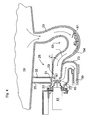
- the connecting line 23 via a mouth opening 29 with a valve chamber 31 of the storage container valve 26 in connection.
- the valve chamber 31 is bounded radially on the outside with a connecting piece 33.
- the nozzle 33 is connected via two stiffening ribs 35 with the bottom of the storage container 19 in connection.
- the valve chamber 31 also opens at its bottom side via a passage 37 in turn into the connecting line 23, which is connectable via a connecting piece 39 to the water distributor 25.
- the connecting line 23 is proceeding from the bottom-side passage 37 of the valve 26 via a U-shaped bend vertically downwards.
- valve space 31 delimiting pipe 33 is an actuator insert 41 of the storage tank valve 26 is inserted.
- the actuator insert part 41 can be a thermo-actuator by way of example, on whose valve tappet 43 a valve disk 45 is fastened.
- valve disk 45 In the Fig. 3 the valve disk 45 is shown in its closed position, in which the sealing points 47 of the valve disk 45 and the valve seat 49 are pressed in sealing engagement.
- the valve seat 49 is circumferentially pulled around the mouth opening 29.
- the valve disk 47 is according to the Fig. 3 integral part of a membrane element 51, which is formed as a substantially rotationally symmetrical silicone component.
- the rotationally symmetrical membrane element 51 is inserted with its open annular end in an annular gap between the connecting piece 33 and an inner pipe socket 55 of a housing part 57.
- the actuator insert 41 is therefore not used directly in the connecting piece 33, but with the interposition of the housing part 57th
- a siphon 59 which in the Fig. 3 indicated dirt particles 61 from the valve 26 holds.
- the siphon 59 is formed by two substantially vertically aligned line sections 62 and 63, which run in opposite directions to each other.
- the two line sections 62, 63 are connected directly to the mouth opening 29 of the valve 26 and to a passage opening of the storage container 19.
- the line section 62 of the siphon 59 extends directly from the valve 26 with an increasing angle of inclination ⁇ downwards and passes at the siphon bottom 64 into the line section 63 leading to the storage tank 19.
- the line section 62 of the siphon 59 is thus inclined starting from the mouth opening 29 always on the inclination angle ⁇ down, causing the dirt particles 61 can move under gravity away from the valve 26 to the siphon bottom 64.
- the siphon bottom 64 is arranged below the storage tank valve 26 by a height difference .DELTA.h.
- the storage tank valve 26 is shown in its closed position, whereby the previously pumped into the storage tank 19 rinsing liquid can be cached.
- the dirt particles 61 present in the storage container 19 and in the connecting line 23 therefore deposit over time at the bottom of the storage container 19 and / or on the siphon bottom 64.
- the Storage tank valve 26 remains largely free of dirt particles 61 in the area of the sealing surfaces 47.
- the storage tank valve 26 is shown in its open position, in which the valve disk 45 is displaced to the left by one valve lift. In this way, a flow gap between the valve disk 45 and the valve seat 49 is released.
- the rinsing liquid cached in the storage container 19 is thus discharged under gravity from the storage container 19 and passes back into the liquid circulation of the dishwasher.
- the buffered flushing liquid thus flows through the storage tank valve 26 in the flow direction I.
- the height difference ⁇ h between the storage tank valve 26 and the siphon bottom 64 is designed so that the dirt particles 61 collected at the siphon bottom 64 can not be entrained by the flow I up to the storage tank valve 26.
- the operating state during filling of the storage container 19 with rinsing liquid or the cleaning of the storage container 19 is illustrated with rinsing liquid.
- the rinsing liquid is pumped by means of the circulation pump 13 at high flow rate in the flow direction II into the storage container 19.
- the dirt particles 26 deposited on the siphon bottom 64 are again flushed back into the storage container 19, whereby clogging of the siphon 59 is avoided.
- the dirt particles 61 can then be discharged during a cleaning process from the storage tank 19 via the ventilation opening 22 in the washing compartment.
Landscapes
- Engineering & Computer Science (AREA)
- Water Supply & Treatment (AREA)
- Washing And Drying Of Tableware (AREA)
Abstract
Description
- Die Erfindung betrifft ein wasserführendes Haushaltsgerät, insbesondere eine Geschirrspülmaschine, mit einem Speicherbehälter, in dem Spülflüssigkeit zwischenspeicherbar ist, und mit einer Flüssigkeitsleitung, die einen Spülbehälter des wasserführenden Haushaltsgeräts mit dem Speicherbehälter verbindet, wobei in der Flüssigkeitsleitung ein Ventil angeordnet ist, das im geöffneten Zustand in einer Strömungsrichtung von Spülflüssigkeit durchströmbar ist.
- Während eines Spülgangs durchlaufen Geschirrspülmaschinen Spülprogramme, die aus einer Anzahl von Teilprogrammschritten bestehen, wie z.B. Vorspülen, Reinigen, Zwischenspülen, Klarspülen und Trocknen. Zur Verteilung von Flüssigkeit während eines Spülprogrammdurchlaufs sind im Flüssigkeitskreislauf einer Geschirrspülmaschine Ventile vorgesehen, die einen Flüssigkeitsweg öffnen oder schließen. Jedoch können Schmutzpartikel in der Flüssigkeit ein Ventil blockieren.
- Die Aufgabe der Erfindung besteht darin, ein Haushaltsgerät, insbesondere Geschirrspülmaschine, bereitzustellen, bei dem ein zuverlässiger Ventilbetrieb gewährleistet ist.
- Die Erfindung geht aus von einem wasserführendes Haushaltsgerät, insbesondere eine Geschirrspülmaschine, mit einem Speicherbehälter, in dem Spülflüssigkeit zwischenspeicherbar ist, und mit einer Flüssigkeitsleitung, die einen Spülbehälter des wasserführenden Haushaltsgeräts mit dem Speicherbehälter verbindet, wobei in der Flüssigkeitsleitung ein Ventil angeordnet ist, das im geöffneten Zustand in einer Strömungsrichtung von Spülflüssigkeit durchströmbar ist
- Gemäß dem kennzeichnenden Teil des Patentanspruches 1 weist die Flüssigkeitsleitung eine in der Strömungsrichtung dem Ventil vorgelagerte Schmutzpartikel auffangende Schmutzpartikelrückhalteeinrichtung auf. Hierbei kann es sich bspw. um einen Siphon oder ein Filter handeln.
- In dem Speicherbehälter kann Spülflüssigkeit zwischengespeichert werden, die nach Ausführung eines Teilprogrammschrittes eines Spülgangs nicht mehr benötigt wird. Die nicht mehr benötigte Spülflüssigkeit wird vom Spülraum mittels einer Umwälzpumpe sowie bei geöffnetem Speicherbehälterventil in den Speicherbehälter gepumpt. Anschließend wird das Speicherbehälterventil geschlossen und bspw. bis zum nächsten Spülgang zwischengespeichert und beim nächsten Spülgang zum Vorspülen des Spülgutes eingesetzt werden. Um das Befüllen und Entleeren des Speicherbehälters zu steuern, ist ein Speicherbehälterventil vorgesehen, mit dem eine Regeleinrichtung der Geschirrspülmaschine den Flüssigkeitsweg zum Speicherbehälter öffnen oder schließen kann.
- Durch die Schmutzpartikelrückhalteeinrichtung bleibt das Ventil weitgehend frei von zumindest größeren Schmutzpartikeln, die sich ansonsten im Ventil festsetzen könnten. Die Anordnung des Ventils mit zugeordnetem Siphon ist daher vor allem im Schmutz- und Brauchwasserbereich eines wasserführenden Haushaltsgerätes, insbesondere einer Geschirrspülmaschine, einsetzbar.
- Der Siphon kann als bspw. als Röhrensiphon ausgebildet sein und zwei im Wesentlichen vertikal ausgerichtete, zueinander gegenläufige Leitungsabschnitte aufweisen, von denen einer unmittelbar mit dem Ventil verbunden ist. Die beiden gegenläufigen Leitungsabschnitte des Siphons sind über einen Siphonboden miteinander verbunden, auf dem sich die Schmutzpartikel sammeln.
- Der Siphon kann dem Ventil in Strömungsrichtung derart vorgeschaltet sein, dass sich der mit dem Ventil gekoppelte Siphon-Leitungsabschnitt unmittelbar ausgehend von dem Ventil mit einem vorgegebenen Neigungswinkel nach unten bis zum Siphonboden erstrecken kann. Der Neigungswinkel des Siphon-Leitungsabschnittes kann dabei veränderlich sein, zum Beispiel in Richtung auf den Siphonboden größer werden. Die sich in dem Siphon-Leitungsabschnitt sammelnden Schmutzpartikel können daher aufgrund des Leitungsgefälles in Richtung auf den Siphonboden, das heißt weg von dem Ventil, wandern.
- Der Siphon kann mit seinem entsprechenden Leitungsabschnitt in einen Ventilraum des Ventils einmünden. Innerhalb des Ventilraums kann sich ein Ventilelement, etwa ein Ventilteller verstellen, um den flüssigkeitsdurchströmten Ventilraum zu öffnen oder zu schließen. Die Mündungsöffnung des Ventils kann von einem, mit dem Ventilelement zusammenwirkenden Ventilsitz randseitig begrenzt sein. Im geschlossenen Zustand kann das verstellbare Ventilelement flüssigkeitsdicht in Anlage mit dem Ventilsitz gedrückt sein. Im geöffneten Zustand des Ventils kann dagegen das Ventilelement über einen Ventilhub vom Ventilsitz weg verstellt sein, wodurch ein Strömungsspalt zur Mündungsöffnung freigelegt ist, der die Flüssigkeitsströmung durch das Ventil ermöglicht.
- Die sich im geschlossenen Zustand des Ventils ergebende Dichtfläche zwischen dem Ventilsitz und dem verstellbaren Ventilelement muss im Wesentlichen frei von Schmutzpartikeln sein, um eine einwandfreie Funktionsweise des Ventils zu gewährleisten. Hierbei hat es sich als günstig erwiesen, wenn die Dichtfläche nicht in einer horizontalen Ebene ausgerichtet ist, sondern vielmehr gegenüber einer solchen horizontalen Ebene geneigt ist, und insbesondere in einer vertikalen Ebene ausgerichtet ist. Schmutzpartikel können sich somit weder auf der Dichtfläche des Ventilsitzes noch auf der Dichtfläche des zugeordneten Ventilelementes dauerhaft absetzen und zu einem Verkleben des Ventilelementes am Ventilsitz führen.
- Um eine aufgabengemäße Wirkung des Siphons zu gewährleisten, ist es von Vorteil, wenn der Siphonboden um eine vorgegebene Höhendifferenz unterhalb des Ventils, insbesondere unterhalb der oben erwähnten Mündungsöffnung in den Ventilraum angeordnet ist. Die Höhendifferenz ergibt sich aus den Strömungsverhältnissen in der Flüssigkeitsleitung, insbesondere aus der Strömungsgeschwindigkeit der Flüssigkeitsströmung. Bei größerer Flüssigkeitsströmung ist die Höhendifferenz zwischen Ventil und Siphonboden entsprechend zu vergrößern, damit die am Siphonboden aufgefangenen Schmutzpartikel nicht bis zum Ventil gefördert werden können.
- Um ein Abführen von bereits innerhalb des Ventils befindlichen Schmutzpartikeln zu unterstützen, kann es von Vorteil sein, wenn die Flüssigkeitsleitung stromab des Ventils vertikal nach unten weitergeführt wird. Die Schmutzpartikel können sich daher zusätzlich durch Schwerkraftwirkung aus dem Ventilraum des Ventils verlagern. Vor diesem Hintergrund ist es besonders bevorzugt, wenn der Ventilraum des Ventils bodenseitig einen Durchlass aufweist, an dem sich die Flüssigkeitsleitung stromab des Ventils anschließen kann.
- Das Speicherbehälterventil ist strömungstechnisch zwischen dem Spülbehälter und dem Speicherbehälter, das heißt im Schmutz- oder Brauchwasserbereich der Geschirrspülmaschine, angeordnet. Hier besteht die Problematik, dass bei geöffnetem Ventil Schmutzpartikel innerhalb des Speicherbehälterventils hängenbleiben und sich dort festsetzen können. In diesem Fall kann es zu einer Störung oder Undichtheit am Ventil und somit zu einer Fehlfunktion des Speicherbehälters kommen.
- Zur Rückführung der zwischengespeicherten Spülflüssigkeit in den Flüssigkeitskreislauf der Geschirrspülmaschine wird das Speicherbehälterventil geöffnet, wodurch die Spülflüssigkeit aus dem Speicherbehälter strömen kann. Die Spülflüssigkeit kann dabei unter Schwerkraftwirkung, das heißt mit geringer Geschwindigkeit, vom Speicherbehälter in den Spülraum der Geschirrspülmaschine einströmen.
- Das Ablassen der zwischengespeicherten Spülflüssigkeit aus dem Speicherbehälter ist im Hinblick auf eine Störung des Speicherbehälterventils kritisch. In diesem Fall besteht nämlich die Gefahr, dass Schmutzpartikel aus dem Speicherbehälter mitgerissen werden und das Speicherbehälterventil zusetzen können. Der erfindungsgemäße Siphon kann daher insbesondere strömungstechnisch zwischen dem Speicherbehälterventil und dem Speicherbehälter geschaltet sein, um diese Schmutzpartikel aufzufangen.
- Das Ablassen der zwischengespeicherten Spülflüssigkeit aus dem Speicherbehälter kann, wie bereits oben erwähnt, unter Schwerkraft erfolgen, das heißt mit entsprechend geringer Strömungsgeschwindigkeit. Entsprechend reduziert kann auch der geodätische Höhenunterschied zwischen dem Speicherbehälterventil und dem Siphonboden bemessen sein.
- Demgegenüber wird beim Befüllen des Speicherbehälters Spülflüssigkeit mittels der Umwälzpumpe bei großer Geschwindigkeit in den Speicherbehälter gepumpt. Auf diese Weise wird der Siphonboden regelmäßig mit großer Flüssigkeitsgeschwindigkeit durchspült, wodurch ein Verstopfen des Siphons vermieden werden kann.
- Es ist aber auch möglich, den Siphon anstelle als Röhrensiphon als Flaschen-, Trennwand- oder Glockensiphon auszubilden.
- In einer weiteren Ausführungsform ist vorzugsweise vorgesehen, dass die Schmutzpartikelrückhalteeinrichtung ein Filter aufweist, mit dem Schmutzpartikel zurückgehalten werden können, die insbesondere eine den zuverlässigen Betrieb des Ventils störenden Mindestgröße aufweisen.
- In einer Weiterbildung ist vorgesehen, dass das Filter durch Rückspülen reinigbar ist, so dass ein Verstopfen des Filters zuverlässig unterbunden ist.
- Ferner ist in einer Weiterbildung vorgesehen, dass das Rückspülen durch wenigstens teilweises Entleeren eines Speicherbehälters bewirkbar ist, in dem Spülflüssigkeit zwischenspeicherbar ist, und dass die Flüssigkeitsleitung einen Spülbehälter des wasserführenden Haushaltsgeräts mit dem Speicherbehälter verbindet. Es wird mit dem Entleeren des Speicherbehälters eine Flüssigkeitsströmung erzeugt, die entgegengesetzt zu der Strömungsrichtung ist, in der das Filter beim Befüllen des Speicherbehälters durchströmt wird. Anschließend kann bspw. durch Betrieb der Laugenpumpe diese mit Schmutzpartikeln versetzte Flüssigkeitsmenge aus dem Haushaltsgerät in ein hausseitiges Abwasserentsorgungsnetz gefördert werden.
- In einer weiteren Ausführungsform ist vorzugsweise vorgesehen, dass die Schmutzpartikelrückhalteeinrichtung einen Fliehkraftabscheider aufweist, mit dem eine rotierende Flüssigkeitsströmung erzeugt werden kann, durch Schmutzpartikel abgetrennt werden können.
- Schließlich ist vorzugsweise vorgesehen, dass eine in der ersten Strömungsrichtung vorliegende Spülflüssigkeitsströmung der Speicherbehälter entleerbar ist. So wird das Ventil vor aus dem vollem Speicherbehälter herausgeförderten Schmutzpartikel geschützt, die sich bspw. erst durch z.B. biologische Prozesse gebildet haben. Es ist jedoch auch möglich, dass die Schmutzpartikelrückhalteeinrichtung Schmutzpartikel beim Füllen des Speicherbehälters zurückhält.
- Nachfolgend ist ein Ausführungsbeispiel der Erfindung anhand der beigefügten Figuren beschrieben.
- Es zeigen:
- Fig. 1
- in einem schematischen Blockdiagramm eine Geschirrspülmaschine mit einem Speicherbehälter;
- Fig. 2
- eine Ansicht entsprechend der
Fig. 1 , in der eine Reinigung des Speicherbehälters veranschaulicht ist; - Fig. 3
- in einer vergrößerten Seitenschnittdarstellung das Speicherbehälterventil mit zugeordnetem Siphon; sowie
- Fig. 4 und 5
- jeweils in Ansichten entsprechend der
Fig. 3 bei unterschiedlichen Betriebs- zuständen der Geschirrspülmaschine. - In der
Fig. 1 ist schematisch eine Geschirrspülmaschine mit einem, einen Spülraum begrenzenden Spülbehälter 1 gezeigt. Im Spülraum des Spülbehälters 1 kann ein nicht dargestelltes, zu reinigendes Spülgut in Geschirrkörben 3, 5 angeordnet werden. Im gezeigten Spülbehälter 1 sind beispielhaft zwei, in unterschiedlichen Sprühebenen vorgesehene Sprüharme 7, 8 angeordnet, über die das Spülgut mit Spülflüssigkeit beaufschlagt wird. Im Spülbehälterboden ist ein Pumpentopf 11 mit einer nur grob angedeuteten Siebanordnung 10 vorgesehen. Vom Pumpentopf 11 ist eine Umwälzleitung 9 mit darin angeordneter Umwälzpumpe 13 weggeführt. Die Umwälzleitung 9 ist über Zuleitungen 14, 15 strömungstechnisch mit den Sprüharmen 7, 8 verbunden. Der Umwälzpumpe 13 nachgeschaltet ist ein, als Wasserheizung bezeichnetes Heizelement 12. - Der Pumpentopf 11 ist außerdem über Anschlussstutzen mit einer, mit dem Wasserversorgungsnetz gekoppelten Frischwasser-Zuleitung 16 sowie mit einer Ablaufleitung 17 in Verbindung, in der eine Laugenpumpe 18 zum Abpumpen von Spülflüssigkeit aus dem Spülbehälter 1 angeordnet ist. Der Spülbehälter 1 weist an seiner, in der
Fig. 1 rechten Seite als Speicherbehälter 19 einen sogenannten Speicherbehälter auf, der nach Art eines Wärmetauschers thermisch gekoppelt in Anlage mit einer Seitenwand 20 des Spülbehälters 1 ist. - In dem Speicherbehälter 19 kann Spülflüssigkeit zwischengespeichert werden, die nach Ausführung eines Teilprogrammschrittes eines Spülganges nicht mehr benötigt wird. Der Speicherbehälter 19 ist in seinem oberen Bereich über eine Be- und Entlüftungsöffnung 22 strömungstechnisch in Verbindung mit dem Spülraum.
- Während der Durchführung eines Spülgangs sind im Flüssigkeitskreislauf unter anderem der Pumpentopf 11 mit zugeordneter Siebanordnung 10, die Umwälzleitung 9, die Zuleitungen 14, 15 sowie die beiden Sprüharme 7, 8 integriert.
- Stromab des Heizelementes 12 ist in der Umwälzleitung 9 eine als Drei-Wege-Schaltventil 25 dargestellte Wasserweiche vorgesehen, an der eine Verbindungsleitung 23 abzweigt, die zum Speicherbehälter 19 führt.
- In der in der
Fig. 1 gezeigten Schaltstellung des Drei-Wege-Schaltventils 25 ist die Verbindung zum Speicherbehälter 19 unterbrochen und die Umwälzleitung 9 mit den Zuleitungen 14, 15 verbunden. In dieser Schaltstellung des Drei-Wege-Schaltventils 25 kann daher die Spülflüssigkeit zur Durchführung des Spülgangs in der Geschirrspülmaschine zirkuliert werden. - Das Drei-Wege-Schaltventil 25 verbindet demgegenüber in einer in der
Fig. 2 gezeigten Schaltstellung die Umwälzleitung 9 mit der, zum Speicherbehälter 19 führenden Verbindungsleitung 23 und unterbricht den Strömungsweg zu den Zuleitungen 14, 15. In dieser Schaltstellung kann zur Reinigung des Speicherbehälters 19 die Spülflüssigkeit mit hoher Strömungsgeschwindigkeit in den Speicherbehälter 19 gepumpt werden und diesen füllen, bis die Spülflüssigkeit über die Be- und Entlüftungsöffnung 22 in den Spülbehälter 1 eintritt und entlang der Spülbehälterwand 20 vorbei an den Geschirrkörben 3, 5 wieder in den Pumpentopf 11 mit zugeordneter Siebanordnung 10 rückgeführt wird. Auf diese Weise können Schmutzpartikel, Fettrückstände, etc. aus dem Speicherbehälter 19 geführt werden. - Damit das Befüllen oder Entleeren des Speicherbehälters 19 mittels der Regeleinrichtung 27 gesteuert werden kann, ist ein Speicherbehälterventil 26 vorgesehen. Das Ventil 26 ist in der zum Speicherbehälter 19 führenden Verbindungsleitung 23 angeordnet und zum Beispiel während der oben genannten Speicherbehälter-Reinigung in seiner OffenStellung angeordnet.
- Beispielhaft kann der Spülgang mit einem Vorspülschritt gestartet werden, bei dem eine im Speicherbehälter 19 zwischengespeicherte Klarspülwassermenge vom vorangegangenen Spülgang in den Pumpentopfbereich des Spülbehälters 1 eingelassen wird. Hierzu wird das Speicherbehälterventil 26 geöffnet und das Drei-Wege-Ventil 25 in die in der
Fig. 2 gezeigte Stellung geschaltet. Die zwischengespeicherte Klarspülmenge kann daher alleine durch Schwerkraftwirkung in den Pumpentopfbereich des Spülbehälters 1 einströmen. - Anschließend wird das Drei-Wege-Schaltventil 25 in seine in der
Fig. 1 gezeigte Schaltstellung geschaltet sowie die Umwälzpumpe 13 gestartet, wodurch das vom Speicherbehälter 19 abgelassene Klarspülwasser zirkulieren kann. Nach Ausführung des Vorspülschrittes wird die Spülflüssigkeit mittels der Laugenpumpe 18 abgepumpt und anschließend Frischwasser für einen folgenden Reinigungsschritt in den Pumpentopfbereich zugeführt. - Wie aus der
Fig. 3 hervorgeht, ist die Verbindungsleitung 23 über eine Mündungsöffnung 29 mit einem Ventilraum 31 des Speicherbehälterventils 26 in Verbindung. Der Ventilraum 31 ist radial außenseitig mit einem Stutzen 33 begrenzt. Der Stutzen 33 ist über zwei Versteifungsrippen 35 mit der Unterseite des Speicherbehälters 19 in Verbindung. Der Ventilraum 31 mündet außerdem an seiner Bodenseite über einen Durchlass 37 wiederum in die Verbindungsleitung 23, die über einen Anschlussstutzen 39 an der Wasserweiche 25 anschließbar ist. Die Verbindungsleitung 23 ist dabei ausgehend vom bodenseitigen Durchlass 37 des Ventils 26 über eine U-förmige Biegung vertikal nach unten weitergeführt. - In den, den Ventilraum 31 begrenzenden Stutzen 33 ist ein Stelltrieb-Einsatzteil 41 des Speicherbehälterventils 26 eingesetzt. Das Stelltrieb-Einsatzteil 41 kann beispielhaft ein Thermoaktuator sein, an dessen Ventilstößel 43 ein Ventilteller 45 befestigt ist.
- In der
Fig. 3 ist der Ventilteller 45 in seiner Schließstellung gezeigt, in der die Dichtstellen 47 des Ventiltellers 45 und des Ventilsitzes 49 in Dichtanlage gedrückt sind. Der Ventilsitz 49 ist umfangsseitig um die Mündungsöffnung 29 gezogen. Dabei sind die Dichtstellen bzw. Dichtflächen 47 des Ventilsitzes 49 und des Ventiltellers 45 gemäß derFig. 3 in einer vertikalen Ebene ausgerichtet.
Der Ventilteller 47 ist gemäß derFig. 3 integraler Bestandteil eines Membranelementes 51, das als ein im Wesentlichen rotationsymmetrisches Silikonbauteil gebildet ist. Das rotationssymmetrische Membranelement 51 ist mit seinem offenen ringförmigen Ende in einem Ringspalt zwischen dem Anschlussstutzen 33 und einem innenliegenden Rohrstutzen 55 eines Gehäuseteils 57 eingesetzt. Das Stelltrieb-Einsatzteil 41 ist daher nicht unmittelbar in den Anschlussstutzen 33 eingesetzt, sondern unter Zwischenlage des Gehäuseteils 57. - Wie aus der
Fig. 3 weiter hervorgeht, weist die Flüssigkeitsleitung 23 zwischen dem Speicherbehälterventil 26 und dem Speicherbehälter 19 ein Siphon 59 auf, das die in derFig. 3 angedeuteten Schmutzpartikel 61 vom Ventil 26 zurückhält. Der Siphon 59 ist durch zwei im Wesentlichen vertikal ausgerichteten Leitungsabschnitten 62 und 63 gebildet, die zueinander gegenläufig verlaufen. Die beiden Leitungsabschnitte 62, 63 sind dabei unmittelbar jeweils an der Mündungsöffnung 29 des Ventils 26 sowie an einer Durchlassöffnung des Speicherbehälters 19 verbunden. Der Leitungsabschnitt 62 des Siphons 59 erstreckt sich dabei unmittelbar ausgehend vom Ventil 26 mit einem ansteigenden Neigungswinkel α nach unten und geht am Siphonboden 64 über in den zum Speicherbehälter 19 führenden Leitungsabschnitt 63. - Der Leitungsabschnitt 62 des Siphons 59 ist somit ausgehend von der Mündungsöffnung 29 stets über den Neigungswinkel α nach unten geneigt, wodurch die Schmutzpartikel 61 unter Schwerkraftwirkung weg vom Ventil 26 zum Siphonboden 64 wandern können. Der Siphonboden 64 ist dabei um eine Höhendifferenz Δh unterhalb des Speicherbehälterventils 26 angeordnet.
- Nachfolgend werden anhand der
Fig. 3 bis 5 unterschiedliche Betriebszustände der Geschirrspülmaschine beschrieben. So ist in derFig. 3 das Speicherbehälterventil 26 in seiner geschlossenen Stellung gezeigt, wodurch die vorher in den Speicherbehälter 19 gepumpte Spülflüssigkeit zwischengespeichert werden kann. Die im Speicherbehälter 19 sowie in der Verbindungsleitung 23 vorhandenen Schmutzpartikel 61 lagern sich daher im Laufe der Zeit am Boden des Speicherbehälters 19 und/oder am Siphonboden 64 ab. Das Speicherbehälterventil 26 bleibt dabei im Bereich der Dichtflächen 47 weitgehend frei von Schmutzpartikeln 61. - In der
Fig. 4 ist das Speicherbehälterventil 26 in seiner geöffneten Stellung gezeigt, in der der Ventilteller 45 um einen Ventilhub nach links verstellt ist. Auf diese Weise ist ein Strömungsspalt zwischen dem Ventilteller 45 und dem Ventilsitz 49 freigegeben. Die im Speicherbehälter 19 zwischengespeicherte Spülflüssigkeit wird somit unter Schwerkraftwirkung aus dem Speicherbehälter 19 abgelassen und gelangt zurück in den Flüssigkeitskreislauf der Geschirrspülmaschine. Die zwischengespeicherte Spülflüssigkeit durchströmt somit in der Strömungsrichtung I das Speicherbehälterventil 26. Der Höhenunterschied Δh zwischen dem Speicherbehälterventil 26 und dem Siphonboden 64 ist dabei so ausgelegt, dass die am Siphonboden 64 aufgefangenen Schmutzpartikel 61 durch die Strömung I nicht bis zum Speicherbehälterventil 26 mitgerissen werden können. - In der
Fig. 5 ist demgegenüber der Betriebszustand beim Befüllen des Speicherbehälters 19 mit Spülflüssigkeit bzw. die Reinigung des Speicherbehälters 19 mit Spülflüssigkeit veranschaulicht. In diesem Fall wird die Spülflüssigkeit mittels der Umwälzpumpe 13 unter großer Strömungsgeschwindigkeit in der Strömungsrichtung II in den Speicherbehälter 19 gepumpt. Auf diese Weise werden die am Siphonboden 64 abgelagerten Schmutzpartikel 26 wieder zurück in den Speicherbehälter 19 gespült, wodurch ein Verstopfen des Siphons 59 vermieden ist. Die Schmutzpartikel 61 können dann während eines Reinigungsvorganges aus dem Speicherbehälter 19 über die Be- und Entlüftungsöffnung 22 in den Spülraum ausgetragen werden. -
- 1
- Spülbehälter
- 3, 5
- Geschirrkörbe
- 7,8
- Sprüharme
- 9
- Umwälzleitung
- 10
- Siebanordnung
- 11
- Pumpentopf
- 12
- Heizelement
- 13
- Umwälzpumpe
- 14, 15
- Zuleitungen
- 16
- Frischwasser-Zuleitung
- 17
- Ablaufleitung
- 18
- Laugenpumpe
- 19
- Speicherbehälter
- 20
- Spülbehälter-Seitenwand
- 22
- Be- und Entlüftungsöffnung
- 23
- Verbindungsleitung
- 25
- Drei-Wege-Schaltventil
- 26
- Speicherbehälterventil
- 27
- Regeleinrichtung
- 29
- Mündungsöffnung
- 31
- Ventilraum
- 33
- Anschlussstutzen
- 37
- Durchlass
- 39
- Stutzen
- 41
- Stelltrieb-Einsatzteil
- 43
- Ventilstößel
- 45
- Schließelement
- 47
- Dichtstellen
- 49
- Ventilsitz
- 51
- Membranelement
- 55
- Rohrstutzen
- 57
- Gehäuseteil
- 59
- Siphon
- 61
- Schmutzpartikel
- 62, 63
- Leitungsabschnitte
- 64
- Siphonboden
- I, II
- Strömungsrichtungen
- Δh
- Höhenunterschied
- α
- Neigungswinkel
Claims (15)
- Wasserführendes Haushaltsgerät, insbesondere Geschirrspülmaschine, mit einem Speicherbehälter (19), in dem Spülflüssigkeit zwischenspeicherbar ist, und mit einer Flüssigkeitsleitung (23), die einen Spülbehälter (1) des wasserführenden Haushaltsgeräts mit dem Speicherbehälter (19) verbindet, wobei in der Flüssigkeitsleitung (23) ein Ventil (26) angeordnet ist, das im geöffneten Zustand in einer Strömungsrichtung (I) von Spülflüssigkeit durchströmbar ist, dadurch gekennzeichnet, dass die Flüssigkeitsleitung (23) eine in der Strömungsrichtung (I) dem Ventil (26) vorgelagerte Schmutzpartikel (61) auffangende Schmutzpartikelrückhalteeinrichtung aufweist.
- Wasserführendes Haushaltsgerät nach Anspruch 1, dadurch gekennzeichnet, dass Schmutzpartikelrückhalteeinrichtung ein Siphon (59) mit zwei im Wesentlichen vertikal ausgerichtete Leitungsabschnitte (62, 63) ist, von denen einer mit dem Ventil (26) verbunden ist.
- Wasserführendes Haushaltsgerät nach Anspruch 1 oder 2, dadurch gekennzeichnet, dass einer der Leitungsabschnitte (62) des Siphons (59) über eine Mündungsöffnung (29) in einen Ventilraum (31) des Ventils (26) mündet, der mit einem Ventilelement (45) schließbar ist.
- Wasserführendes Haushaltsgerät nach Anspruch 3, dadurch gekennzeichnet, dass die Mündungsöffnung (29) von einem mit dem Ventilelement (45) zusammenwirkenden Ventilsitz (49) begrenzt ist, wobei die Dichtflächen (47) des Ventilsitzes (49) und des Ventilelements (45) gegenüber einer horizontalen Ebene geneigt sind, und insbesondere im Wesentlichen in einer vertikalen Ebene ausgerichtet sind.
- Wasserführendes Haushaltsgerät nach einem der Ansprüche 2 bis 4, dadurch gekennzeichnet, dass der Leitungsabschnitt (62) des Siphons sich ausgehend von dem Ventil (26) mit einem Neigungswinkel (α) nach unten bis zum Siphonboden (64) erstreckt.
- Wasserführendes Haushaltsgerät nach einem der vorhergehenden Ansprüche, dadurch gekennzeichnet, dass der Siphonboden (64) um eine Höhendifferenz (Δh) unterhalb des Ventils (41), insbesondere unterhalb der Mündungsöffnung (29) des Ventils (41) angeordnet ist.
- Wasserführendes Haushaltsgerät nach einem der vorhergehenden Ansprüche, dadurch gekennzeichnet, dass die Flüssigkeitsleitung (23) in der Strömungsrichtung (I) stromab des Ventils (26) nach unten geführt ist, wobei der Ventilraum (31) des Ventils (26) über einen bodenseitigen Durchlass (37) mit der Flüssigkeitsleitung (23) stromab des Ventils (26) verbunden ist.
- Wasserführendes Haushaltsgerät nach einem der vorhergehenden Ansprüche, dadurch gekennzeichnet, dass ein zweiter Leitungsabschnitt (63) des Siphons (59) in den Speicherbehälter (19) mündet.
- Wasserführendes Haushaltsgerät nach einem der vorhergehenden Ansprüche, dadurch gekennzeichnet, dass in der ersten Strömungsrichtung (I) die im Speicherbehälter (19) zwischengespeicherte Spülflüssigkeit, insbesondere unter Schwerkraftwirkung, vom Speicherbehälter (19) in einen Spülraum der Geschirrspülmaschine einströmt.
- Wasserführendes Haushaltsgerät nach einem der vorhergehenden Ansprüche, dadurch gekennzeichnet, dass in einer entgegen gesetzten zweiten Strömungsrichtung (II) die Spülflüssigkeit mittels einer Umwälzpumpe (13) mit hoher Strömungsgeschwindigkeit in den Speicherbehälter (19) förderbar ist.
- Wasserführendes Haushaltsgerät nach einem der vorhergehenden Ansprüche, dadurch gekennzeichnet, dass die Schmutzpartikelrückhalteeinrichtung als Flaschen-, Trennwand- oder Glockensiphon ausgebildet ist.
- Wasserführendes Haushaltsgerät nach Anspruch 1, dadurch gekennzeichnet, dass die Schmutzpartikelrückhalteeinrichtung ein Filter aufweist.
- Wasserführendes Haushaltsgerät nach Anspruch 12, dadurch gekennzeichnet, dass das Filter durch Rückspülen reinigbar ist, wobei das Rückspülen durch wenigstens teilweises Entleeren eines Speicherbehälters (19) bewirkbar ist, in dem Spülflüssigkeit zwischenspeicherbar ist, und dass die Flüssigkeitsleitung (23) einen Spülbehälter (1) des wasserführenden Haushaltsgeräts mit dem Speicherbehälter (19) verbindet.
- Wasserführendes Haushaltsgerät nach Anspruch 1, dadurch gekennzeichnet, dass die Schmutzpartikelrückhalteeinrichtung einen Fliehkraftabscheider aufweist.
- Wasserführendes Haushaltsgerät nach einem der vorhergehenden Ansprüche, dadurch gekennzeichnet, dass durch eine in Strömungsrichtung (I) vorliegende Spülflüssigkeitsströmung der Speicherbehälter (19) entleerbar ist.
Applications Claiming Priority (1)
| Application Number | Priority Date | Filing Date | Title |
|---|---|---|---|
| DE102009028278A DE102009028278A1 (de) | 2009-08-06 | 2009-08-06 | Wasserführendes Haushaltsgerät |
Publications (3)
| Publication Number | Publication Date |
|---|---|
| EP2283762A2 true EP2283762A2 (de) | 2011-02-16 |
| EP2283762A3 EP2283762A3 (de) | 2014-01-15 |
| EP2283762B1 EP2283762B1 (de) | 2023-09-06 |
Family
ID=43402167
Family Applications (1)
| Application Number | Title | Priority Date | Filing Date |
|---|---|---|---|
| EP10170429.4A Active EP2283762B1 (de) | 2009-08-06 | 2010-07-22 | Wasserführendes Haushaltsgerät |
Country Status (3)
| Country | Link |
|---|---|
| EP (1) | EP2283762B1 (de) |
| DE (1) | DE102009028278A1 (de) |
| PL (1) | PL2283762T3 (de) |
Cited By (3)
| Publication number | Priority date | Publication date | Assignee | Title |
|---|---|---|---|---|
| EP2807971A1 (de) | 2013-05-28 | 2014-12-03 | Vestel Beyaz Esya Sanayi Ve Ticaret A.S. | Speichersystem |
| CN113494612A (zh) * | 2020-04-01 | 2021-10-12 | 青岛海尔洗碗机有限公司 | 一种水阀结构及洗碗机 |
| WO2024126429A1 (fr) * | 2022-12-16 | 2024-06-20 | Everever | Cuve de lave-vaisselle |
Families Citing this family (24)
| Publication number | Priority date | Publication date | Assignee | Title |
|---|---|---|---|---|
| US9119515B2 (en) | 2010-12-03 | 2015-09-01 | Whirlpool Corporation | Dishwasher with unitary wash module |
| US8667974B2 (en) | 2009-12-21 | 2014-03-11 | Whirlpool Corporation | Rotating filter for a dishwashing machine |
| US9918609B2 (en) | 2009-12-21 | 2018-03-20 | Whirlpool Corporation | Rotating drum filter for a dishwashing machine |
| US9687135B2 (en) | 2009-12-21 | 2017-06-27 | Whirlpool Corporation | Automatic dishwasher with pump assembly |
| US8627832B2 (en) | 2010-12-13 | 2014-01-14 | Whirlpool Corporation | Rotating filter for a dishwashing machine |
| US8746261B2 (en) | 2009-12-21 | 2014-06-10 | Whirlpool Corporation | Rotating drum filter for a dishwashing machine |
| US9668636B2 (en) | 2010-11-16 | 2017-06-06 | Whirlpool Corporation | Method and apparatus for dishwasher with common heating element for multiple treating chambers |
| US9113766B2 (en) | 2010-11-16 | 2015-08-25 | Whirlpool Corporation | Method and apparatus for dishwasher with common heating element for multiple treating chambers |
| US20120118336A1 (en) * | 2010-11-16 | 2012-05-17 | Whirlpool Corporation | Dishwasher with filter cleaning assembly |
| US9034112B2 (en) | 2010-12-03 | 2015-05-19 | Whirlpool Corporation | Dishwasher with shared heater |
| US8733376B2 (en) | 2011-05-16 | 2014-05-27 | Whirlpool Corporation | Dishwasher with filter assembly |
| US9107559B2 (en) | 2011-05-16 | 2015-08-18 | Whirlpool Corporation | Dishwasher with filter assembly |
| US9265401B2 (en) | 2011-06-20 | 2016-02-23 | Whirlpool Corporation | Rotating filter for a dishwashing machine |
| US20120318296A1 (en) | 2011-06-20 | 2012-12-20 | Whirlpool Corporation | Ultra micron filter for a dishwasher |
| US9861251B2 (en) | 2011-06-20 | 2018-01-09 | Whirlpool Corporation | Filter with artificial boundary for a dishwashing machine |
| US9005369B2 (en) | 2011-06-20 | 2015-04-14 | Whirlpool Corporation | Filter assembly for a dishwasher |
| US9010344B2 (en) | 2011-06-20 | 2015-04-21 | Whirlpool Corporation | Rotating filter for a dishwashing machine |
| US9301667B2 (en) | 2012-02-27 | 2016-04-05 | Whirlpool Corporation | Soil chopping system for a dishwasher |
| US9730570B2 (en) | 2012-05-30 | 2017-08-15 | Whirlpool Corporation | Reduced sound with a rotating filter for a dishwasher |
| US9237836B2 (en) | 2012-05-30 | 2016-01-19 | Whirlpool Corporation | Rotating filter for a dishwasher |
| US9451862B2 (en) | 2012-06-01 | 2016-09-27 | Whirlpool Corporation | Dishwasher with unitary wash module |
| US9833120B2 (en) | 2012-06-01 | 2017-12-05 | Whirlpool Corporation | Heating air for drying dishes in a dishwasher using an in-line wash liquid heater |
| US9532700B2 (en) | 2012-06-01 | 2017-01-03 | Whirlpool Corporation | Dishwasher with overflow conduit |
| US9554688B2 (en) | 2012-10-23 | 2017-01-31 | Whirlpool Corporation | Rotating filter for a dishwasher and methods of cleaning a rotating filter |
Family Cites Families (4)
| Publication number | Priority date | Publication date | Assignee | Title |
|---|---|---|---|---|
| DE3316716C2 (de) * | 1983-05-06 | 1985-11-07 | Bosch-Siemens Hausgeräte GmbH, 7000 Stuttgart | Verfahren zur Rückgewinnung von Abwärme bei einer Haushalt-Geschirrspülmaschine sowie derartige Maschine zur Durchführung des Verfahrens |
| JP2951136B2 (ja) * | 1992-12-22 | 1999-09-20 | 三洋電機株式会社 | 食器洗い機 |
| IT1296334B1 (it) * | 1997-10-27 | 1999-06-25 | Electrolux Zanussi Elettrodome | Lavatrice automatica con sistema di recupero energetico |
| DE102007041305B4 (de) * | 2007-08-31 | 2016-09-15 | BSH Hausgeräte GmbH | Wasserführendes Haushaltsgerät |
-
2009
- 2009-08-06 DE DE102009028278A patent/DE102009028278A1/de not_active Withdrawn
-
2010
- 2010-07-22 PL PL10170429.4T patent/PL2283762T3/pl unknown
- 2010-07-22 EP EP10170429.4A patent/EP2283762B1/de active Active
Cited By (4)
| Publication number | Priority date | Publication date | Assignee | Title |
|---|---|---|---|---|
| EP2807971A1 (de) | 2013-05-28 | 2014-12-03 | Vestel Beyaz Esya Sanayi Ve Ticaret A.S. | Speichersystem |
| CN113494612A (zh) * | 2020-04-01 | 2021-10-12 | 青岛海尔洗碗机有限公司 | 一种水阀结构及洗碗机 |
| WO2024126429A1 (fr) * | 2022-12-16 | 2024-06-20 | Everever | Cuve de lave-vaisselle |
| FR3143307A1 (fr) * | 2022-12-16 | 2024-06-21 | Everever | Cuve de lave-vaisselle |
Also Published As
| Publication number | Publication date |
|---|---|
| EP2283762A3 (de) | 2014-01-15 |
| DE102009028278A1 (de) | 2011-02-10 |
| EP2283762B1 (de) | 2023-09-06 |
| PL2283762T3 (pl) | 2024-04-08 |
Similar Documents
| Publication | Publication Date | Title |
|---|---|---|
| EP2283762B1 (de) | Wasserführendes Haushaltsgerät | |
| DE102007061038B4 (de) | Wasserführendes Haushaltsgerät | |
| DE102007060197B4 (de) | Wasserführendes Haushaltsgerät | |
| DE102012103434B4 (de) | Ultramikron-Filter für einen Geschirrspüler | |
| EP2478818B1 (de) | Geschirrspülmaschine mit Siebreinigungseinrichtung | |
| DE102008057178A1 (de) | Anlage zum Spülen von Spülgut und Verfahren zum Betreiben einer solchen Anlage | |
| WO2009077280A1 (de) | Wasserführendes haushaltsgerät | |
| DE102013103264A1 (de) | Geschirrspüler mit Überlaufkanal | |
| EP2312987A1 (de) | Wasserführendes haushaltsgerät, insbesondere geschirrspül- oder waschmaschine | |
| DE102007060196A1 (de) | Geschirrspülmaschine | |
| DE102015208212B3 (de) | Getränkeautomat mit Siebeinrichtung | |
| DE2323551A1 (de) | Geschirrspueler mit mitteln zum sammeln und abfuehren von speiseresten | |
| EP2072000A1 (de) | Geschirrspülmaschine in Form eines Programmautomaten und Verfahren zu deren Betrieb | |
| DE102011081246A1 (de) | Spülmaschine sowie Verfahren zum automatischen Reinigen einer Spülmaschine | |
| DE102011077083A1 (de) | Geschirrspülmaschine, insbesondere Haushaltsgeschirrspülmaschine | |
| DE102010063711A1 (de) | Spülmaschine mit automatischer Schmutzaustragung | |
| DE69735228T2 (de) | Filtereinrichtung mit automatischer Reinigungsvorrichtung für Geschirrspülmaschine | |
| EP2283763A2 (de) | Wasserführendes Haushaltsgerät | |
| DE1293424B (de) | Geschirrspuelmaschine | |
| DE202006020580U1 (de) | Gewerbliche Geschirrspülmaschine in Form eines Programmautomaten | |
| DE102009028280B4 (de) | Haushaltsgerät | |
| EP2461732B1 (de) | Wasserführendes haushaltsgerät | |
| DE9102957U1 (de) | Selbstreinigendes Siebsystem für Haushalt-Geschirrspülmaschinen | |
| DE102017116759A1 (de) | Ultrafeiner mikron-filter für einen geschirrspüler | |
| DE102008028304A1 (de) | Transportspülmaschine, insbesondere gewerbliche Korbtransportspülmaschine, und Verfahren zu deren Betrieb |
Legal Events
| Date | Code | Title | Description |
|---|---|---|---|
| PUAI | Public reference made under article 153(3) epc to a published international application that has entered the european phase |
Free format text: ORIGINAL CODE: 0009012 |
|
| AK | Designated contracting states |
Kind code of ref document: A2 Designated state(s): AL AT BE BG CH CY CZ DE DK EE ES FI FR GB GR HR HU IE IS IT LI LT LU LV MC MK MT NL NO PL PT RO SE SI SK SM TR |
|
| AX | Request for extension of the european patent |
Extension state: BA ME RS |
|
| PUAL | Search report despatched |
Free format text: ORIGINAL CODE: 0009013 |
|
| AK | Designated contracting states |
Kind code of ref document: A3 Designated state(s): AL AT BE BG CH CY CZ DE DK EE ES FI FR GB GR HR HU IE IS IT LI LT LU LV MC MK MT NL NO PL PT RO SE SI SK SM TR |
|
| AX | Request for extension of the european patent |
Extension state: BA ME RS |
|
| RIC1 | Information provided on ipc code assigned before grant |
Ipc: A47L 15/42 20060101AFI20131210BHEP |
|
| 17P | Request for examination filed |
Effective date: 20140715 |
|
| RBV | Designated contracting states (corrected) |
Designated state(s): AL AT BE BG CH CY CZ DE DK EE ES FI FR GB GR HR HU IE IS IT LI LT LU LV MC MK MT NL NO PL PT RO SE SI SK SM TR |
|
| RAP1 | Party data changed (applicant data changed or rights of an application transferred) |
Owner name: BSH HAUSGERAETE GMBH |
|
| 17Q | First examination report despatched |
Effective date: 20160425 |
|
| STAA | Information on the status of an ep patent application or granted ep patent |
Free format text: STATUS: EXAMINATION IS IN PROGRESS |
|
| REG | Reference to a national code |
Ref country code: DE Ref legal event code: R079 Free format text: PREVIOUS MAIN CLASS: A47L0015420000 Ipc: A47L0015000000 Ref country code: DE Ref legal event code: R079 Ref document number: 502010017059 Country of ref document: DE Free format text: PREVIOUS MAIN CLASS: A47L0015420000 Ipc: A47L0015000000 |
|
| GRAP | Despatch of communication of intention to grant a patent |
Free format text: ORIGINAL CODE: EPIDOSNIGR1 |
|
| STAA | Information on the status of an ep patent application or granted ep patent |
Free format text: STATUS: GRANT OF PATENT IS INTENDED |
|
| INTG | Intention to grant announced |
Effective date: 20230411 |
|
| RIC1 | Information provided on ipc code assigned before grant |
Ipc: A47L 15/42 20060101ALI20230324BHEP Ipc: A47L 15/00 20060101AFI20230324BHEP |
|
| GRAS | Grant fee paid |
Free format text: ORIGINAL CODE: EPIDOSNIGR3 |
|
| GRAA | (expected) grant |
Free format text: ORIGINAL CODE: 0009210 |
|
| STAA | Information on the status of an ep patent application or granted ep patent |
Free format text: STATUS: THE PATENT HAS BEEN GRANTED |
|
| AK | Designated contracting states |
Kind code of ref document: B1 Designated state(s): AL AT BE BG CH CY CZ DE DK EE ES FI FR GB GR HR HU IE IS IT LI LT LU LV MC MK MT NL NO PL PT RO SE SI SK SM TR |
|
| REG | Reference to a national code |
Ref country code: GB Ref legal event code: FG4D Free format text: NOT ENGLISH |
|
| REG | Reference to a national code |
Ref country code: CH Ref legal event code: EP |
|
| REG | Reference to a national code |
Ref country code: DE Ref legal event code: R096 Ref document number: 502010017059 Country of ref document: DE |
|
| REG | Reference to a national code |
Ref country code: IE Ref legal event code: FG4D Free format text: LANGUAGE OF EP DOCUMENT: GERMAN |
|
| REG | Reference to a national code |
Ref country code: LT Ref legal event code: MG9D |
|
| REG | Reference to a national code |
Ref country code: NL Ref legal event code: MP Effective date: 20230906 |
|
| PG25 | Lapsed in a contracting state [announced via postgrant information from national office to epo] |
Ref country code: GR Free format text: LAPSE BECAUSE OF FAILURE TO SUBMIT A TRANSLATION OF THE DESCRIPTION OR TO PAY THE FEE WITHIN THE PRESCRIBED TIME-LIMIT Effective date: 20231207 |
|
| PG25 | Lapsed in a contracting state [announced via postgrant information from national office to epo] |
Ref country code: SE Free format text: LAPSE BECAUSE OF FAILURE TO SUBMIT A TRANSLATION OF THE DESCRIPTION OR TO PAY THE FEE WITHIN THE PRESCRIBED TIME-LIMIT Effective date: 20230906 Ref country code: NO Free format text: LAPSE BECAUSE OF FAILURE TO SUBMIT A TRANSLATION OF THE DESCRIPTION OR TO PAY THE FEE WITHIN THE PRESCRIBED TIME-LIMIT Effective date: 20231206 Ref country code: LV Free format text: LAPSE BECAUSE OF FAILURE TO SUBMIT A TRANSLATION OF THE DESCRIPTION OR TO PAY THE FEE WITHIN THE PRESCRIBED TIME-LIMIT Effective date: 20230906 Ref country code: LT Free format text: LAPSE BECAUSE OF FAILURE TO SUBMIT A TRANSLATION OF THE DESCRIPTION OR TO PAY THE FEE WITHIN THE PRESCRIBED TIME-LIMIT Effective date: 20230906 Ref country code: HR Free format text: LAPSE BECAUSE OF FAILURE TO SUBMIT A TRANSLATION OF THE DESCRIPTION OR TO PAY THE FEE WITHIN THE PRESCRIBED TIME-LIMIT Effective date: 20230906 Ref country code: GR Free format text: LAPSE BECAUSE OF FAILURE TO SUBMIT A TRANSLATION OF THE DESCRIPTION OR TO PAY THE FEE WITHIN THE PRESCRIBED TIME-LIMIT Effective date: 20231207 Ref country code: FI Free format text: LAPSE BECAUSE OF FAILURE TO SUBMIT A TRANSLATION OF THE DESCRIPTION OR TO PAY THE FEE WITHIN THE PRESCRIBED TIME-LIMIT Effective date: 20230906 |
|
| PG25 | Lapsed in a contracting state [announced via postgrant information from national office to epo] |
Ref country code: NL Free format text: LAPSE BECAUSE OF FAILURE TO SUBMIT A TRANSLATION OF THE DESCRIPTION OR TO PAY THE FEE WITHIN THE PRESCRIBED TIME-LIMIT Effective date: 20230906 |
|
| PG25 | Lapsed in a contracting state [announced via postgrant information from national office to epo] |
Ref country code: IS Free format text: LAPSE BECAUSE OF FAILURE TO SUBMIT A TRANSLATION OF THE DESCRIPTION OR TO PAY THE FEE WITHIN THE PRESCRIBED TIME-LIMIT Effective date: 20240106 |
|
| PG25 | Lapsed in a contracting state [announced via postgrant information from national office to epo] |
Ref country code: ES Free format text: LAPSE BECAUSE OF FAILURE TO SUBMIT A TRANSLATION OF THE DESCRIPTION OR TO PAY THE FEE WITHIN THE PRESCRIBED TIME-LIMIT Effective date: 20230906 |
|
| PG25 | Lapsed in a contracting state [announced via postgrant information from national office to epo] |
Ref country code: SM Free format text: LAPSE BECAUSE OF FAILURE TO SUBMIT A TRANSLATION OF THE DESCRIPTION OR TO PAY THE FEE WITHIN THE PRESCRIBED TIME-LIMIT Effective date: 20230906 Ref country code: RO Free format text: LAPSE BECAUSE OF FAILURE TO SUBMIT A TRANSLATION OF THE DESCRIPTION OR TO PAY THE FEE WITHIN THE PRESCRIBED TIME-LIMIT Effective date: 20230906 Ref country code: IS Free format text: LAPSE BECAUSE OF FAILURE TO SUBMIT A TRANSLATION OF THE DESCRIPTION OR TO PAY THE FEE WITHIN THE PRESCRIBED TIME-LIMIT Effective date: 20240106 Ref country code: ES Free format text: LAPSE BECAUSE OF FAILURE TO SUBMIT A TRANSLATION OF THE DESCRIPTION OR TO PAY THE FEE WITHIN THE PRESCRIBED TIME-LIMIT Effective date: 20230906 Ref country code: EE Free format text: LAPSE BECAUSE OF FAILURE TO SUBMIT A TRANSLATION OF THE DESCRIPTION OR TO PAY THE FEE WITHIN THE PRESCRIBED TIME-LIMIT Effective date: 20230906 Ref country code: CZ Free format text: LAPSE BECAUSE OF FAILURE TO SUBMIT A TRANSLATION OF THE DESCRIPTION OR TO PAY THE FEE WITHIN THE PRESCRIBED TIME-LIMIT Effective date: 20230906 Ref country code: SK Free format text: LAPSE BECAUSE OF FAILURE TO SUBMIT A TRANSLATION OF THE DESCRIPTION OR TO PAY THE FEE WITHIN THE PRESCRIBED TIME-LIMIT Effective date: 20230906 Ref country code: PT Free format text: LAPSE BECAUSE OF FAILURE TO SUBMIT A TRANSLATION OF THE DESCRIPTION OR TO PAY THE FEE WITHIN THE PRESCRIBED TIME-LIMIT Effective date: 20240108 |
|
| PG25 | Lapsed in a contracting state [announced via postgrant information from national office to epo] |
Ref country code: IT Free format text: LAPSE BECAUSE OF FAILURE TO SUBMIT A TRANSLATION OF THE DESCRIPTION OR TO PAY THE FEE WITHIN THE PRESCRIBED TIME-LIMIT Effective date: 20230906 |
|
| REG | Reference to a national code |
Ref country code: DE Ref legal event code: R097 Ref document number: 502010017059 Country of ref document: DE |
|
| PG25 | Lapsed in a contracting state [announced via postgrant information from national office to epo] |
Ref country code: DK Free format text: LAPSE BECAUSE OF FAILURE TO SUBMIT A TRANSLATION OF THE DESCRIPTION OR TO PAY THE FEE WITHIN THE PRESCRIBED TIME-LIMIT Effective date: 20230906 |
|
| PLBE | No opposition filed within time limit |
Free format text: ORIGINAL CODE: 0009261 |
|
| STAA | Information on the status of an ep patent application or granted ep patent |
Free format text: STATUS: NO OPPOSITION FILED WITHIN TIME LIMIT |
|
| PG25 | Lapsed in a contracting state [announced via postgrant information from national office to epo] |
Ref country code: DK Free format text: LAPSE BECAUSE OF FAILURE TO SUBMIT A TRANSLATION OF THE DESCRIPTION OR TO PAY THE FEE WITHIN THE PRESCRIBED TIME-LIMIT Effective date: 20230906 Ref country code: SI Free format text: LAPSE BECAUSE OF FAILURE TO SUBMIT A TRANSLATION OF THE DESCRIPTION OR TO PAY THE FEE WITHIN THE PRESCRIBED TIME-LIMIT Effective date: 20230906 |
|
| 26N | No opposition filed |
Effective date: 20240607 |
|
| PG25 | Lapsed in a contracting state [announced via postgrant information from national office to epo] |
Ref country code: BG Free format text: LAPSE BECAUSE OF FAILURE TO SUBMIT A TRANSLATION OF THE DESCRIPTION OR TO PAY THE FEE WITHIN THE PRESCRIBED TIME-LIMIT Effective date: 20230906 |
|
| PG25 | Lapsed in a contracting state [announced via postgrant information from national office to epo] |
Ref country code: BG Free format text: LAPSE BECAUSE OF FAILURE TO SUBMIT A TRANSLATION OF THE DESCRIPTION OR TO PAY THE FEE WITHIN THE PRESCRIBED TIME-LIMIT Effective date: 20230906 |
|
| PG25 | Lapsed in a contracting state [announced via postgrant information from national office to epo] |
Ref country code: MC Free format text: LAPSE BECAUSE OF FAILURE TO SUBMIT A TRANSLATION OF THE DESCRIPTION OR TO PAY THE FEE WITHIN THE PRESCRIBED TIME-LIMIT Effective date: 20230906 |
|
| REG | Reference to a national code |
Ref country code: CH Ref legal event code: PL |
|
| PG25 | Lapsed in a contracting state [announced via postgrant information from national office to epo] |
Ref country code: LU Free format text: LAPSE BECAUSE OF NON-PAYMENT OF DUE FEES Effective date: 20240722 |
|
| GBPC | Gb: european patent ceased through non-payment of renewal fee |
Effective date: 20240722 |
|
| PG25 | Lapsed in a contracting state [announced via postgrant information from national office to epo] |
Ref country code: LU Free format text: LAPSE BECAUSE OF NON-PAYMENT OF DUE FEES Effective date: 20240722 |
|
| PG25 | Lapsed in a contracting state [announced via postgrant information from national office to epo] |
Ref country code: CH Free format text: LAPSE BECAUSE OF NON-PAYMENT OF DUE FEES Effective date: 20240731 Ref country code: BE Free format text: LAPSE BECAUSE OF NON-PAYMENT OF DUE FEES Effective date: 20240731 |
|
| PG25 | Lapsed in a contracting state [announced via postgrant information from national office to epo] |
Ref country code: FR Free format text: LAPSE BECAUSE OF NON-PAYMENT OF DUE FEES Effective date: 20240731 |
|
| PG25 | Lapsed in a contracting state [announced via postgrant information from national office to epo] |
Ref country code: GB Free format text: LAPSE BECAUSE OF NON-PAYMENT OF DUE FEES Effective date: 20240722 |
|
| REG | Reference to a national code |
Ref country code: BE Ref legal event code: MM Effective date: 20240731 |
|
| PG25 | Lapsed in a contracting state [announced via postgrant information from national office to epo] |
Ref country code: IE Free format text: LAPSE BECAUSE OF NON-PAYMENT OF DUE FEES Effective date: 20240722 |
|
| REG | Reference to a national code |
Ref country code: AT Ref legal event code: MM01 Ref document number: 1607365 Country of ref document: AT Kind code of ref document: T Effective date: 20240722 |
|
| PGFP | Annual fee paid to national office [announced via postgrant information from national office to epo] |
Ref country code: DE Payment date: 20250731 Year of fee payment: 16 |
|
| PGFP | Annual fee paid to national office [announced via postgrant information from national office to epo] |
Ref country code: PL Payment date: 20250711 Year of fee payment: 16 Ref country code: TR Payment date: 20250717 Year of fee payment: 16 |
|
| PG25 | Lapsed in a contracting state [announced via postgrant information from national office to epo] |
Ref country code: AT Free format text: LAPSE BECAUSE OF NON-PAYMENT OF DUE FEES Effective date: 20240722 |
|
| PG25 | Lapsed in a contracting state [announced via postgrant information from national office to epo] |
Ref country code: CY Free format text: LAPSE BECAUSE OF FAILURE TO SUBMIT A TRANSLATION OF THE DESCRIPTION OR TO PAY THE FEE WITHIN THE PRESCRIBED TIME-LIMIT; INVALID AB INITIO Effective date: 20100722 |
|
| PG25 | Lapsed in a contracting state [announced via postgrant information from national office to epo] |
Ref country code: HU Free format text: LAPSE BECAUSE OF FAILURE TO SUBMIT A TRANSLATION OF THE DESCRIPTION OR TO PAY THE FEE WITHIN THE PRESCRIBED TIME-LIMIT; INVALID AB INITIO Effective date: 20100722 |