EP2284340A2 - Verrou magnétique destiné à fermer une ouverture - Google Patents
Verrou magnétique destiné à fermer une ouverture Download PDFInfo
- Publication number
- EP2284340A2 EP2284340A2 EP09011489A EP09011489A EP2284340A2 EP 2284340 A2 EP2284340 A2 EP 2284340A2 EP 09011489 A EP09011489 A EP 09011489A EP 09011489 A EP09011489 A EP 09011489A EP 2284340 A2 EP2284340 A2 EP 2284340A2
- Authority
- EP
- European Patent Office
- Prior art keywords
- magnetic
- magnet
- switching
- sensor
- yoke
- Prior art date
- Legal status (The legal status is an assumption and is not a legal conclusion. Google has not performed a legal analysis and makes no representation as to the accuracy of the status listed.)
- Granted
Links
Images

Classifications
-
- E—FIXED CONSTRUCTIONS
- E05—LOCKS; KEYS; WINDOW OR DOOR FITTINGS; SAFES
- E05C—BOLTS OR FASTENING DEVICES FOR WINGS, SPECIALLY FOR DOORS OR WINDOWS
- E05C19/00—Other devices specially designed for securing wings, e.g. with suction cups
- E05C19/16—Devices holding the wing by magnetic or electromagnetic attraction
- E05C19/166—Devices holding the wing by magnetic or electromagnetic attraction electromagnetic
-
- H—ELECTRICITY
- H01—ELECTRIC ELEMENTS
- H01F—MAGNETS; INDUCTANCES; TRANSFORMERS; SELECTION OF MATERIALS FOR THEIR MAGNETIC PROPERTIES
- H01F7/00—Magnets
- H01F7/02—Permanent magnets [PM]
- H01F7/0231—Magnetic circuits with PM for power or force generation
- H01F7/0252—PM holding devices
- H01F7/0263—Closures, bags, bands, engagement devices with male and female parts
-
- E—FIXED CONSTRUCTIONS
- E05—LOCKS; KEYS; WINDOW OR DOOR FITTINGS; SAFES
- E05B—LOCKS; ACCESSORIES THEREFOR; HANDCUFFS
- E05B47/00—Operating or controlling locks or other fastening devices by electric or magnetic means
- E05B2047/0048—Circuits, feeding, monitoring
- E05B2047/0067—Monitoring
- E05B2047/0068—Door closed
-
- E—FIXED CONSTRUCTIONS
- E05—LOCKS; KEYS; WINDOW OR DOOR FITTINGS; SAFES
- E05C—BOLTS OR FASTENING DEVICES FOR WINGS, SPECIALLY FOR DOORS OR WINDOWS
- E05C19/00—Other devices specially designed for securing wings, e.g. with suction cups
- E05C19/16—Devices holding the wing by magnetic or electromagnetic attraction
Definitions
- the invention relates to a magnetic catch for closing an opening according to the preamble of claim 1.
- the object of the invention is therefore to provide a magnetic catch for closing an opening, the clamping force is adjustable.
- the magnetic catch for closing an opening including a movable part and a fixed part.
- the movable part is the door or the flap o. ⁇ ., And the fixed part of a wall or wall.
- the magnetic catch comprises a magnetic circuit.
- the magnetic circuit has a yoke and a lockable with the yoke magnet, wherein the magnetic effect of the magnet is changeable to the yoke.
- the yoke is attached to the movable part and the magnet is attachable to the fixed part.
- the magnet which can be closed with the yoke has at least two pole shoes on which the magnetic field lines can emerge in a defined shape. In addition, at least one switching magnet connecting the pole shoes is provided.
- connection of the pole pieces via the switching magnet is such that the switching magnet has a magnetization direction along the connection of the two pole pieces, wherein the orientation can be changed by 180 °.
- the direction of the magnetic field remains the same when the orientation changes. Illustrated in a vector represented by an arrow, in this illustration, the position of the arrowhead indicates the orientation of the vector and the arrow shaft indicates its direction. Since the magnetic field, the orientation of the field lines is defined by the position in which the north pole of a compass needle points, pivots an imaginary compass needle for displaying the magnetic field of the switching magnet in a Ummagnetmaschine same by 180 °.
- the switching magnet By the switching magnet, it is possible to change the course of the magnetic field lines in the pole pieces and in particular at the ends facing the yoke. In one of the two magnetization orientations of the switching magnet, magnetic field lines essentially do not emerge from the pole shoes, but the magnetic flux is "short-circuited" by the switching magnet in the magnet.
- the magnetic flux defined can be “switched off” and “switched off” from the pole shoes, so that the magnetic effect of the magnet can be switched “on” and “off”.
- the closable by the yoke magnet acts as a magnet system with permanent magnet and solenoid, which can exert a high clamping force on the yoke, which is time-independent, whereby the magnetic force of the magnet system can be switched on and off by the at least one switching magnet. For a change between a locking by the magnetic catch and the canceling of the locking only a remagnetization of the switching magnet or is required.
- the magnetization of the magnet system can be measured by means of a sensor, so that a reliable statement can be made with sufficient certainty as to which clamping force is exerted between the moving part and the stationary part.
- a feedback capability whereby an input signal may be given to a controller as a result of the determination of the magnetization configured as a function value to notify the controller with the input signal whether and which shadowing force is achieved.
- the advantage achieved with the magnetic catch according to the invention lies in the fact that a desired holding force is adjustable so that even in unstable doors they are not uncontrollably opened by vibrations during operation, but on the other hand at the intended opening it does not lead to such tension that the material of the doors or flaps can be damaged by the applied forces to open, with no further power is required to maintain the Schnäpperkraft, since the magnetic catch is outwardly resembles a permanent magnet.
- the permanent magnet and the switching magnet of the magnet or the magnet system are preferably substantially longitudinal in a first exemplary embodiment staggered to each other, and the pole pieces are configured as transversely extending body made of soft magnetic material.
- the pole pieces may be arranged between a permanent magnet and a switching magnet, so that they connect a permanent magnet and a switching magnet, wherein adjacent permanent magnets in the arrangement or sequence each have a different magnetization orientation, and the permanent magnets are arranged on a soft magnetic material for a magnetic return on the pole shoes opposite side, so that a simple magnetic field line is formed.
- the "switching off" of the magnetic flux is, for example in the further embodiment, the case when the solenoid is magnetized so that it has a magnetic north pole at the connected via the pole piece permanent magnet having a magnetic south pole at its end, and a magnetic South pole has on the permanent magnet connected via the pole piece, which has at its end a magnetic north pole.
- the magnetic field then substantially does not emerge from the pole pieces, that is, when the switching magnet is magnetized so that it has an opposite polarity at the ends to the permanent magnets.
- the situation is different if the switching magnet with the same polarity at the ends is magnetized to the permanent magnets connected via the pole shoes.
- the switching magnet has a magnetic south pole on the permanent magnet, the end of which forms a magnetic south pole and a magnetic north pole on the permanent magnet, whose end forms a magnetic north pole.
- the magnetic field lines are "pushed out of the switching magnet” and exit through the pole shoes.
- a yoke present can be attracted by the pole pieces in the opposite polarity.
- An electrical energy store for example a capacitor, is preferably provided for the remagnetization. Further preferred is the electrical Energy storage disposed in a housing in which the Umzumagnet are located.
- the permanent magnets on a rare or neodymium magnetic material.
- a hard magnetic material which has excellent properties as a permanent magnet.
- the magnetic material neodymium-iron-boron is used to generate strong magnetic fields in a small volume.
- the magnetic material has high coercive field strengths of 870 to 2750 kA / m at room temperature and is relatively inexpensive.
- the switching magnet comprises an AlNiCo magnetic material, which is surrounded by a current-carrying winding.
- an AlNiCo magnet material it is possible to use a magnetizable magnetizable material, which does not depend on the generation of very high magnetic fields.
- the AlNiCo magnetic material in the longitudinal direction surrounding current-carrying winding a simple way of remagnetization, which is structurally simple, compact and low maintenance.
- the senor can be configured as a coil which surrounds the magnet at least in one section.
- the magnetization of the magnet via saturation as a measure of the magnetic flux is measurable by detecting a frequency of the coil which is varied by the saturation of the portion of the magnet as the core of the coil.
- the frequency measurement of the coil surrounding the section of the magnet makes a reliable statement with sufficient certainty as to what locking force between the moving part and the stationary part is exercised.
- the coil whose frequency is measured is preferably designed as a frequency-determining component of an oscillator.
- the winding of the solenoid can be used, whereby the structure of the magnetic force adjustable magnetic latch is simplified and as few components are present, and also a wiring thereof is reduced.
- the sensor is arranged as a coil for detecting the saturation of the magnet in the region of the yoke facing the end of a pole piece.
- a further coil is provided in addition to the winding for the switching magnet, which makes the detection of saturation alternatively or in addition to a detection of saturation via the winding of a solenoid.
- the saturation is detected, which is a direct measure of the magnetic field line density exiting the magnet. Due to the symmetrical structure of the magnet system, the detection of the magnetic flux within a pole piece of the magnet system is sufficient; However, it may also be provided for reasons of redundancy to detect the magnetic flux on a plurality of pole shoes. If the iron is magnetized in the region of saturation, the frequency of the coil in this area of the magnetization changes so much that it is already possible to clearly detect a gap between magnet system and yoke of 10 ⁇ m. Even if such a gap of this magnitude is detected, the potential locking force is still far above the locking force that can be set for the magnetic catch.
- the senor is designed as a magnetically sensitive sensor.
- a Hall or GMR sensor is to be considered, which also allows the detection of a stray field.
- the Hall or GMR sensor is preferably adjacent to the (exposed) pole piece of the Magnet system arranged. When the magnet system is open, the Hall or GMR sensor detects the entire field and can thus also be used to detect a disturbing residual magnetization as well as to set a field for a defined holding force of the magnetic latch. When the activated magnet system is closed, a leakage flux can be measured by the Hall effect sensor or GMR sensor arranged on the pole piece, which also supplies information about the potential closing force of the magnet system.
- a strain gauge is used as sensor, which detects a deformation of the yoke remote from the end of the magnet due to the polarity of the pole pieces.
- the strain gauge can be attached to the yoke remote from the end of the magnet or magnet system.
- the strain gauge is attached to the soft magnetic material that is present for the magnetic return of the magnet.
- There will be a bending moment i. causes a deformation from which it is possible to determine how the pole shoes are "poled” and how strong the flux is through the adjoining yoke. If there is strong magnetic flux through the pole shoes towards the outside, ie if the magnetic catch stops, a force acting on the magnetic gap acts wants to drive apart both outer pole pieces. By contrast, if the magnetic catch is "switched off", it is pulled together by the magnetic field now flowing inside the magnet.
- a strain gauge provides an example, not disturbed by an external magnetic field, structurally compact way to determine the locking force of Magnetschnäppers.
- the control of a machine which can be accessed by means of the opening the signal of the measurement of the sensor - prepared or in its original form - is supplied, and with the control for the machine itself, the locking force of the magnetic latch is adjustable , It can Furthermore, it may be preferred that the controller and the magnetic catch are coupled via an AS-Interface.
- a non-safety-related path of a safety-related sensor for controlling the locking force of the magnetic latch can be used.
- the safety-related sensor can be designed, for example, as a mechanical switch or electronic sensor for determining whether the opening is closed with the door or flaps.
- the use of a non-safety-related path of a safety-related sensor is advantageous because the non-safety-related path of a safety component can be used, which is already in the area of the opening in many applications in the industry for implementing human-machine safety in the form of safety switches , And thus the magnetic catch exploits existing hardware.
- Fig. 1 shows an embodiment of a magnetic latch according to the invention. It is a section of a movable part 1 shown schematically, with which an opening is closed. Part 1 can be a flap, Door, lid or the like, which is relative to a likewise schematically illustrated fixed part 2 is relatively movable. The relative movement may be pivoting and / or shifting.
- a yoke 3 made of soft magnetic material is attached, which abuts when the opening is closed to a magnet 4 and this closes.
- the magnet 4 has a permanent magnet 5, which is elongated and pole pieces 6 of the magnet 4 connects, from which can escape magnetic field lines shown in dashed lines, which extend through the yoke 3 with the opening closed and can enter through a pole piece 6 in the magnet 4 again (please refer Fig. 2 ).
- the permanent magnet 5 is magnetized in the longitudinal direction in the connecting direction of the pole pieces 6.
- the permanent magnet 5 preferably has a magnetic material neodymium-iron-boron.
- the pole pieces 6 are formed of soft magnetic material.
- the switching magnet 7 is an easily magnetizable permanent magnet which is magnetized in the direction of connection of the pole pieces 6, wherein the orientation of the magnetic field is variable, however.
- the switching magnet 7 has an AlNiCo magnetic material.
- the permanent magnet 5 has a magnetic south pole "S” at the top and has a north magnetic pole "N” at the bottom.
- the magnetic field lines within the magnet 4 run in a kind of "short circuit". Essentially, no magnetic field lines occur on the pole shoes adjacent to the yoke 3 from the magnet 4. Due to the parallel magnetization of the permanent magnet 5 and the switching magnet 7 with different orientation, the magnetic field lines run inside the magnet 4, in the illustrated case in Fig. 1 clockwise to.
- the magnetization orientation of the switching magnet 7 is variable via a surrounding the magnetic material of the switching magnet 7 winding 8, by the switching magnet 7 can be reversed in its magnetic orientation by an external current pulse.
- the winding 8 is designed as a coil whose longitudinal axis with the longitudinal axis of the hard magnetic material of the switching magnet 7 runs side by side or coincides. A reversal or loading of the winding 8 with a current pulse is caused by the transition of Fig. 1 on Fig. 2 shown. After the brief application of a current pulse, there is no current or voltage from the outside at the winding 8 for exerting the clamping force.
- the magnetic field of the switching magnet 7 is in its magnetic orientation between the Fig. 1 and 2 been reversed.
- the switching magnet 7 is still magnetized transversely to the pole pieces 6 in the connecting direction between them, but the magnetization has rotated by 180 °. Unlike in the case in Fig. 1 in which the permanent magnet 5 and the switching magnet 7 were oriented opposite to each other, the permanent magnet 5 and the switching magnet 7 have the same magnetic orientation Fig. 2 on.
- the in Fig. 2 shown magnetic line course shows how the magnetic field lines from the pole pieces 6 of the magnet 4 escape; the magnetic field lines enter the yoke 3, extend in the yoke 3; and reenter the magnet 4 in the next pole piece 6.
- the magnet 4 acts with a force F.
- the magnetization of the magnet 4 or magnet system can be measured with its effect on the yoke 3 via the saturation as a measure of the magnetic flux.
- a winding or coil 9 is provided on a pole piece 6, whose frequency is detected. The frequency is a function of the saturation of the pole piece 6 as the core of the coil 9. The frequency is thus varied depending on the saturation of the pole piece 6.
- the frequency measurement of the pole piece 6 surrounding the coil 9 makes a reliable statement with reasonable certainty about whether the locking force of the magnetic latch is sufficient.
- the coil is used as a frequency-determining component of an oscillator. Due to the saturation in the iron, the inductance of the coil 9 and thus the frequency of the resonant circuit is varied. The frequency changes so much in the region of saturation that even a gap between pole piece 6 and yoke 3 of 10 ⁇ m can be clearly detected. The potential locking force is still far above the guaranteed locking force. If one sets a maximum current of 300 mA for the coil 9 and would like to have a clamping force of 500 N, the cut-off point is at a gap of approximately 50 ⁇ m.
- a magnetically sensitive sensor 11 in the region adjacent to a pole piece 6, which may be present as an alternative or in addition to the coil 9.
- the sensor 11 is designed as a Hall or GMR sensor 11.
- the sensor 11 detects the entire field and can also be used to detect a disturbing residual magnetization, as well as to set a field for a defined locking force of the magnetic latch.
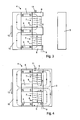
- Fig. 3 shows a further embodiment of the magnetic latch according to the invention.
- the movable part 1 and the fixed part 2 are not shown, however, the arrangement of the magnet 4 and the yoke 3 in the movable part and the fixed part is the same as in FIG Fig. 1 and 2 ,
- the pole pieces 6 of the magnet 4 are formed by soft magnetic material.
- the pole pieces 6 connect permanent magnets 5 and permanent magnets made of a hard magnetic magnetic material with switching magnets 7.
- the permanent magnets 5 are magnetized in the longitudinal direction or in the extension of the pole pieces 6.
- the permanent magnets 5 have as magnetic material neodymium-iron-boron.
- Adjacent permanent magnets 5 are magnetized in different orientations. While in the Fig. 3 5, the magnetic field lines run from left to right, ie that a magnetic north pole is formed at the end facing the pole shoe 6, a magnetic south pole is formed on the end of the adjacent middle permanent magnet 5 facing the pole shoe 6; the magnetic field lines through the middle permanent magnet 5 run from right to left. The lowermost permanent magnet 5 has again a magnetic north pole at the end facing the pole shoe 6.
- the permanent magnets 5 of the further embodiment are arranged on a plate-shaped soft magnetic material, which is formed by a steel plate 10 in the illustrated further embodiment.
- the three in Fig. 3 Accordingly, permanent magnets 5 are magnetized and arranged on the steel plate 10 such that the upper and the lower of the three permanent magnets 5 have the same orientation and direction.
- the middle permanent magnet 5 has a rotated by 180 ° orientation; the mean permanent magnet 5 is opposite to the lower and the upper permanent magnet 5 magnetized opposite.
- the switching magnets 7 are arranged, which connect the pole pieces 6 in the region of the yoke facing ends.
- the switching magnets 7 are easily ummagnetisierbare Permanent magnets which are magnetized in the direction of connection of the pole pieces 6, whose orientation is variable, however.
- the magnetization of the switching magnets 7 extends transversely to the magnetization of the permanent magnets 5.
- the switching magnets 7 have an AlNiCo magnetic material.
- Fig. 3 illustrated case can be seen in the magnetic field lines shown in dashed lines, that the upper switching magnet 7 has a magnetic south pole above and below a magnetic north pole.
- the lower switching magnet 7 has a magnetic north pole at the top and a magnetic south pole at the bottom.
- the magnetic field lines essentially do not emerge from the pole shoes 6.
- the in Fig. 3 shown magnetic field line course shows that substantially no magnetic field lines emerge from the pole pieces of the magnet 4 as a magnetic system that could exert a clamping force on the yoke 3.
- the magnetic catch has substantially no magnetic force on the yoke and the door, flap or the like can be opened.
- the magnetic field lines extend within the pole shoes 6 designed as permanent magnets and the switching magnets 7 with the conclusion about the steel plate 10; there is no force on the yoke 3.
- a magnetic field line closure is generated, which does not penetrate to the outside.
- FIG. 3 adjacent poles of the switching magnet 7 and permanent magnet 5 are oppositely poled, that is, the poles of the switching magnet 7 have different polarity for magnetizing the adjacent ends of the permanent magnets 5.
- the magnetization orientation of the solenoids 7 is variable over a surrounding the magnetic material of the switching magnet 7 winding 8, by a (short) outer current pulse of the solenoid 7 can be reversed in its magnetic orientation.
- the magnetic field of the switching magnet 7 is in its magnetic orientation between the 3 and 4 been reversed.
- the switching magnets 7 are still magnetized transversely to the permanent magnet 5 in the connecting direction between the pole pieces 6, however, the magnetization has rotated by 180 °. Unlike in the case in Fig. 3 , the adjacent poles of the switching magnets 7 and the permanent magnets 5 are homopolar to each other.
- the magnetic field lines emerge from the pole shoes 6, enter the yoke 3 and enter from the yoke 3 again in the next adjacent pole piece 6 a.
- the magnet 4 forms a magnet system from which the magnetic field lines can exit into the yoke 3 and reenter. Due to the alternating sequence with oppositely magnetized permanent magnets 5 reinforcing magnetic fluxes are created with different sense of circulation. In a pair of adjacent pole pieces 6 with associated switching magnet 7, there is another direction of circulation of the magnetic flux than in the next adjacent pair of pole shoes 6 and switching magnet 7.
- Fig. 4 The magnetic field lines flow in the upper pair of pole pieces 6 and the associated switching magnet 7 in the clockwise direction, while in the lower pair of pole pieces 6 and the associated switching magnet 7, the magnetic field lines flow in a counterclockwise direction.
- the coil 9 is provided on a pole piece 6, whose frequency is detected, so that a reliable statement can be made with sufficient certainty about whether the locking force of the magnetic latch is sufficient.
- a Hall or GMR sensor 11 is arranged at an open end of a pole shoe 6.
- a strain gauge 12 for detecting a deformation of the yoke 3 opposite end of the magnet 4 due to the polarity of the pole pieces 6 is present.
- the strain gauge 12 can be used as a sensor.
- the strain gauge 12 is attached to the steel plate 10 and measures due to the polarity of the pole pieces 6 occurring bending moments of the steel plate 10, which is a measure of the strength of the magnetic flux from the pole pieces 6 to the outside.
- the illustrated strain gauge 12 represents a possibility of a sensor for detecting the magnetization of the magnet 4, which may be provided alternatively to the detection of the change in frequency of the winding 8, the coil 9 or the Hall or GMR sensor 11. It should be noted that the representation of several sensors 8, 9, 11, 12 in the 3 and 4 has only explanatory simplifying character. The presence of only one of the sensors 8, 9, 11, 12 is possible.
- a strain gauge 12 is also possible, wherein the strain gauge 12 may be attached to the switching magnet 7. Again, the strain gauge 12 can detect due to the polarity of the pole pieces 6 occurring bending moments, which is a measure of the strength of the magnetic flux from the pole pieces 6 to the outside.
- the strain gauge 12 may be used instead of the sensors 8, 9 or 11.
- the hard magnetic material of the switching magnet 7 is not completely “magnetized” in the cancellation of the magnetic force of the magnetic latch, a magnet having an adjustable force can be realized.
- the hard magnetic material of the switching magnet 8 can be completely “magnetized” again in order to determine the residual magnetization of the magnet To prevent pole shoes,
- the magnetization of the switching magnets 7 is controlled by a controller, not shown in the figures, which is coupled, for example, with sensors which detect a standstill of the machine or system located in the room area or the presence of a risk potential for persons from the machine or the system and the switching magnets 7 magnetized accordingly, so that the magnetic catch blocks or releases.
- the controller can be transmitted by one or more corresponding detectors, whether the opening is closed. The controller then gives the system or machine a signal as to whether it can be started, or whether the controller does not release it because the opening is still open and the access or access of persons is still possible.
Landscapes
- Physics & Mathematics (AREA)
- Electromagnetism (AREA)
- Engineering & Computer Science (AREA)
- Power Engineering (AREA)
- Mechanical Engineering (AREA)
- Switches That Are Operated By Magnetic Or Electric Fields (AREA)
- Electromagnets (AREA)
- Burglar Alarm Systems (AREA)
- Lock And Its Accessories (AREA)
Applications Claiming Priority (1)
| Application Number | Priority Date | Filing Date | Title |
|---|---|---|---|
| DE102009037036A DE102009037036A1 (de) | 2009-08-13 | 2009-08-13 | Zuhaltung zum Verschließen einer Öffnung |
Publications (3)
| Publication Number | Publication Date |
|---|---|
| EP2284340A2 true EP2284340A2 (fr) | 2011-02-16 |
| EP2284340A3 EP2284340A3 (fr) | 2011-06-01 |
| EP2284340B1 EP2284340B1 (fr) | 2014-02-26 |
Family
ID=43302934
Family Applications (2)
| Application Number | Title | Priority Date | Filing Date |
|---|---|---|---|
| EP09011489.3A Active EP2284340B1 (fr) | 2009-08-13 | 2009-09-08 | Verrou magnétique destiné à fermer une ouverture |
| EP10008400.3A Active EP2284341B1 (fr) | 2009-08-13 | 2010-08-12 | Verrou destiné à fermer un ouvrant |
Family Applications After (1)
| Application Number | Title | Priority Date | Filing Date |
|---|---|---|---|
| EP10008400.3A Active EP2284341B1 (fr) | 2009-08-13 | 2010-08-12 | Verrou destiné à fermer un ouvrant |
Country Status (3)
| Country | Link |
|---|---|
| EP (2) | EP2284340B1 (fr) |
| DE (1) | DE102009037036A1 (fr) |
| ES (2) | ES2454271T3 (fr) |
Cited By (9)
| Publication number | Priority date | Publication date | Assignee | Title |
|---|---|---|---|---|
| EP2731119A1 (fr) * | 2012-11-07 | 2014-05-14 | Sony Corporation | Circuit magnétique et dispositif d'entrée de clé |
| WO2015065685A1 (fr) * | 2013-10-30 | 2015-05-07 | General Electric Company | Ensemble verrou |
| WO2015086333A1 (fr) * | 2013-12-10 | 2015-06-18 | BSH Hausgeräte GmbH | Appareil ménager comportant un moyen de fermeture |
| DE202014006319U1 (de) * | 2014-08-06 | 2015-11-11 | Bks Gmbh | Schließeinrichtung mit mindestens einem elektronischen Verbraucher |
| WO2016146089A3 (fr) * | 2015-09-22 | 2016-12-01 | Rawa Design S.R.O. | Joint magnétique |
| WO2019121000A1 (fr) * | 2017-12-19 | 2019-06-27 | Assa Abloy Ab | Actionneur comprenant un aimant électropermanent et procédé |
| FR3079126A1 (fr) * | 2018-03-26 | 2019-09-27 | Daan Technologies | Dispositif d’ouverture magnetique automatique pour lave-vaisselle. |
| SE2150100A1 (en) * | 2021-01-28 | 2022-07-29 | Assa Abloy Ab | Brake device, arrangement for controlling movements of access member, and access member system |
| DE102024122119A1 (de) * | 2024-08-02 | 2026-02-05 | Pierburg Gmbh | Stationäre Ladevorrichtung mit einer magnetischen Verriegelungsvorrichtung |
Families Citing this family (7)
| Publication number | Priority date | Publication date | Assignee | Title |
|---|---|---|---|---|
| DE202013103327U1 (de) * | 2013-07-24 | 2014-10-27 | BROSE SCHLIEßSYSTEME GMBH & CO. KG | Kraftfahrzeugschloss |
| WO2017201190A1 (fr) | 2016-05-18 | 2017-11-23 | Shanghai Yanfeng Jinqiao Automotive Trim Systems Co. Ltd | Ensemble console pour intérieur de véhicule |
| DE102017130837A1 (de) * | 2017-12-21 | 2019-06-27 | Rosenberger Hochfrequenztechnik Gmbh & Co. Kg | System, Messeinrichtung und Verfahren zur Erkennung eines Schließzustands |
| US11237231B2 (en) * | 2017-12-26 | 2022-02-01 | Robert Bosch Gmbh | Z-axis magnetic sensor with distributed flux guides |
| US11572723B2 (en) | 2019-02-27 | 2023-02-07 | Shanghai Yanfeng Jinqiao Automotive Triim Systems Co. Ltd. | Vehicle interior component |
| CN112392344B (zh) * | 2020-11-18 | 2025-05-16 | 深圳市兆威机电股份有限公司 | 一种旋转开关装置及开关门 |
| CN120961918B (zh) * | 2025-10-22 | 2026-01-27 | 山西金山磁材有限公司 | 一种双端面轴向海尔贝克磁场压机 |
Citations (1)
| Publication number | Priority date | Publication date | Assignee | Title |
|---|---|---|---|---|
| DE1802116U (de) | 1959-10-29 | 1959-12-10 | Friedrich Wilhelm Dipl Willach | Magnetverschluss fuer moebel- und zimmertueren, klappen u. dgl. verschlussorgane. |
Family Cites Families (8)
| Publication number | Priority date | Publication date | Assignee | Title |
|---|---|---|---|---|
| IT1022923B (it) * | 1974-10-16 | 1978-04-20 | Cardone Magneto Tecnica | Apparecchiatura magnetica di ancoraggio |
| WO1997003912A1 (fr) * | 1995-07-24 | 1997-02-06 | Railfix N.V. | Systeme pour manoeuvrer une charge magnetique, notamment une charge ferromagnetique |
| DE19953898C5 (de) | 1999-11-10 | 2004-07-01 | K.A. Schmersal Gmbh & Co | Zugangsschutzeinrichtung |
| GB0320950D0 (en) * | 2003-09-06 | 2003-10-08 | R W L Consulatants Ltd | Magnetic safety interlock and monitoring circuit |
| US7453341B1 (en) * | 2004-12-17 | 2008-11-18 | Hildenbrand Jack W | System and method for utilizing magnetic energy |
| US7654590B2 (en) * | 2005-01-04 | 2010-02-02 | Illinois Tool Works, Inc. | Magnetic appliance latch |
| DE102007047537A1 (de) * | 2007-10-04 | 2009-04-16 | Ebe Elektro-Bau-Elemente Gmbh | Vorrichtung zur auslösbaren Arretierung von relativ beweglichen Teilen |
| US8094017B2 (en) * | 2008-01-08 | 2012-01-10 | Securitron Magnalock Corporation | Electromagnetic lock monitoring system |
-
2009
- 2009-08-13 DE DE102009037036A patent/DE102009037036A1/de not_active Withdrawn
- 2009-09-08 ES ES09011489.3T patent/ES2454271T3/es active Active
- 2009-09-08 EP EP09011489.3A patent/EP2284340B1/fr active Active
-
2010
- 2010-08-12 ES ES10008400.3T patent/ES2452140T3/es active Active
- 2010-08-12 EP EP10008400.3A patent/EP2284341B1/fr active Active
Patent Citations (1)
| Publication number | Priority date | Publication date | Assignee | Title |
|---|---|---|---|---|
| DE1802116U (de) | 1959-10-29 | 1959-12-10 | Friedrich Wilhelm Dipl Willach | Magnetverschluss fuer moebel- und zimmertueren, klappen u. dgl. verschlussorgane. |
Cited By (17)
| Publication number | Priority date | Publication date | Assignee | Title |
|---|---|---|---|---|
| EP2731119A1 (fr) * | 2012-11-07 | 2014-05-14 | Sony Corporation | Circuit magnétique et dispositif d'entrée de clé |
| CN103809764A (zh) * | 2012-11-07 | 2014-05-21 | 索尼公司 | 磁气回路和键输入装置 |
| WO2015065685A1 (fr) * | 2013-10-30 | 2015-05-07 | General Electric Company | Ensemble verrou |
| US9347247B2 (en) | 2013-10-30 | 2016-05-24 | General Electric Company | Latch assembly |
| WO2015086333A1 (fr) * | 2013-12-10 | 2015-06-18 | BSH Hausgeräte GmbH | Appareil ménager comportant un moyen de fermeture |
| RU2650067C2 (ru) * | 2013-12-10 | 2018-04-06 | Бсх Хаусгерете Гмбх | Бытовой прибор с запирающим устройством |
| DE202014006319U1 (de) * | 2014-08-06 | 2015-11-11 | Bks Gmbh | Schließeinrichtung mit mindestens einem elektronischen Verbraucher |
| WO2016146089A3 (fr) * | 2015-09-22 | 2016-12-01 | Rawa Design S.R.O. | Joint magnétique |
| WO2019121000A1 (fr) * | 2017-12-19 | 2019-06-27 | Assa Abloy Ab | Actionneur comprenant un aimant électropermanent et procédé |
| CN111542901A (zh) * | 2017-12-19 | 2020-08-14 | 亚萨合莱有限公司 | 包括电永磁体的致动器及方法 |
| KR20200099534A (ko) * | 2017-12-19 | 2020-08-24 | 아싸 아브로이 에이비 | 영전자석을 포함하는 액추에이터 및 이의 작동 방법 |
| CN111542901B (zh) * | 2017-12-19 | 2022-02-01 | 亚萨合莱有限公司 | 包括软磁体的致动器及方法 |
| US11454049B2 (en) | 2017-12-19 | 2022-09-27 | Assa Abloy Ab | Actuator comprising electro permanent magnet and method |
| FR3079126A1 (fr) * | 2018-03-26 | 2019-09-27 | Daan Technologies | Dispositif d’ouverture magnetique automatique pour lave-vaisselle. |
| SE2150100A1 (en) * | 2021-01-28 | 2022-07-29 | Assa Abloy Ab | Brake device, arrangement for controlling movements of access member, and access member system |
| SE546080C2 (en) * | 2021-01-28 | 2024-05-14 | Assa Abloy Ab | Brake device, arrangement for controlling movements of access member, and access member system |
| DE102024122119A1 (de) * | 2024-08-02 | 2026-02-05 | Pierburg Gmbh | Stationäre Ladevorrichtung mit einer magnetischen Verriegelungsvorrichtung |
Also Published As
| Publication number | Publication date |
|---|---|
| ES2452140T3 (es) | 2014-03-31 |
| EP2284341A3 (fr) | 2011-06-08 |
| EP2284341B1 (fr) | 2014-02-26 |
| EP2284341A2 (fr) | 2011-02-16 |
| ES2454271T3 (es) | 2014-04-10 |
| EP2284340B1 (fr) | 2014-02-26 |
| DE102009037036A1 (de) | 2011-02-17 |
| EP2284340A3 (fr) | 2011-06-01 |
Similar Documents
| Publication | Publication Date | Title |
|---|---|---|
| EP2284340B1 (fr) | Verrou magnétique destiné à fermer une ouverture | |
| DE19736454A1 (de) | Kontaktloser Näherungsschalter | |
| EP3266963A1 (fr) | Système de verrouillage | |
| DE102009059050B4 (de) | Zuhaltesystem für einen Sicherheitsschalter und Sicherheitsschalter mit einem solchen Zuhaltesystem | |
| DE102013104001B3 (de) | Näherungssensor sowie Baugruppe | |
| DE3225499C2 (de) | Magnetischer Näherungssensor | |
| DE102004030362B4 (de) | Vorrichtung zum gesteuerten Arretieren einer sicherheitsrelevanten Einrichtung, wie beispielweise einer Schutztür oder dergleichen | |
| DE102013102276B4 (de) | Verdrehschutz | |
| EP1473511B1 (fr) | Dispositif de protection d'accès | |
| DE102019116541A1 (de) | Zuhaltung und ein Verfahren zum Betrieb einer Zuhaltung | |
| EP0073002B1 (fr) | Déclencheur électromagnétique | |
| DE69217739T2 (de) | Elektrischer Schalter | |
| DE3423469A1 (de) | Monostabiler betaetigungsmagnet | |
| EP1746371A2 (fr) | Aide d'ouverture de portes pour des appareils, de préférence réfrigérateur ou congélateur | |
| DE2365190B2 (de) | Elektromagnetsystem | |
| DE602005003818T2 (de) | Magnet-schalter-anordnung | |
| DE102019119873A1 (de) | Ventil mit energiesparendem elektrodynamischen Aktor | |
| DE2031015A1 (de) | Kontroll-, insbesondere Alarmanlage | |
| DE4020275C2 (de) | Stellenantrieb zur Einstellung von zwei selbsthaltenden Lagen | |
| DE3206687A1 (de) | Hubmagnetantriebe mit den an die jeweiligen antriebserfordernisse angepassten kennlinien | |
| EP1999534A1 (fr) | Dispositif de blocage pour bloquer au moins partiellement un mouvement relatif | |
| DE102004020808A1 (de) | Chirurgische Drückereinheit und chirurgische Antriebseinheit | |
| DE10311071B4 (de) | Magnetanordnung | |
| DE102019123078B4 (de) | Kompaktes bistabiles Kippsystem | |
| DE102012204322A1 (de) | Bidirektionale elektromagnetische Stellvorrichtung |
Legal Events
| Date | Code | Title | Description |
|---|---|---|---|
| PUAI | Public reference made under article 153(3) epc to a published international application that has entered the european phase |
Free format text: ORIGINAL CODE: 0009012 |
|
| AK | Designated contracting states |
Kind code of ref document: A2 Designated state(s): AT BE BG CH CY CZ DE DK EE ES FI FR GB GR HR HU IE IS IT LI LT LU LV MC MK MT NL NO PL PT RO SE SI SK SM TR |
|
| AX | Request for extension of the european patent |
Extension state: AL BA RS |
|
| PUAL | Search report despatched |
Free format text: ORIGINAL CODE: 0009013 |
|
| AK | Designated contracting states |
Kind code of ref document: A3 Designated state(s): AT BE BG CH CY CZ DE DK EE ES FI FR GB GR HR HU IE IS IT LI LT LU LV MC MK MT NL NO PL PT RO SE SI SK SM TR |
|
| AX | Request for extension of the european patent |
Extension state: AL BA RS |
|
| RIC1 | Information provided on ipc code assigned before grant |
Ipc: H01F 7/02 20060101ALI20110426BHEP Ipc: E05C 19/16 20060101AFI20101221BHEP Ipc: F16P 3/08 20060101ALI20110426BHEP |
|
| 17P | Request for examination filed |
Effective date: 20111201 |
|
| RIC1 | Information provided on ipc code assigned before grant |
Ipc: H01F 7/02 20060101ALI20130327BHEP Ipc: F16P 3/08 20060101ALI20130327BHEP Ipc: E05C 19/16 20060101AFI20130327BHEP |
|
| GRAP | Despatch of communication of intention to grant a patent |
Free format text: ORIGINAL CODE: EPIDOSNIGR1 |
|
| INTG | Intention to grant announced |
Effective date: 20131108 |
|
| GRAS | Grant fee paid |
Free format text: ORIGINAL CODE: EPIDOSNIGR3 |
|
| GRAA | (expected) grant |
Free format text: ORIGINAL CODE: 0009210 |
|
| AK | Designated contracting states |
Kind code of ref document: B1 Designated state(s): AT BE BG CH CY CZ DE DK EE ES FI FR GB GR HR HU IE IS IT LI LT LU LV MC MK MT NL NO PL PT RO SE SI SK SM TR |
|
| REG | Reference to a national code |
Ref country code: GB Ref legal event code: FG4D Free format text: NOT ENGLISH |
|
| REG | Reference to a national code |
Ref country code: CH Ref legal event code: EP |
|
| REG | Reference to a national code |
Ref country code: AT Ref legal event code: REF Ref document number: 653721 Country of ref document: AT Kind code of ref document: T Effective date: 20140315 |
|
| REG | Reference to a national code |
Ref country code: IE Ref legal event code: FG4D Free format text: LANGUAGE OF EP DOCUMENT: GERMAN |
|
| REG | Reference to a national code |
Ref country code: ES Ref legal event code: FG2A Ref document number: 2454271 Country of ref document: ES Kind code of ref document: T3 Effective date: 20140410 Ref country code: DE Ref legal event code: R096 Ref document number: 502009008829 Country of ref document: DE Effective date: 20140410 |
|
| REG | Reference to a national code |
Ref country code: NL Ref legal event code: VDEP Effective date: 20140226 |
|
| REG | Reference to a national code |
Ref country code: LT Ref legal event code: MG4D |
|
| PG25 | Lapsed in a contracting state [announced via postgrant information from national office to epo] |
Ref country code: IS Free format text: LAPSE BECAUSE OF FAILURE TO SUBMIT A TRANSLATION OF THE DESCRIPTION OR TO PAY THE FEE WITHIN THE PRESCRIBED TIME-LIMIT Effective date: 20140626 Ref country code: LT Free format text: LAPSE BECAUSE OF FAILURE TO SUBMIT A TRANSLATION OF THE DESCRIPTION OR TO PAY THE FEE WITHIN THE PRESCRIBED TIME-LIMIT Effective date: 20140226 Ref country code: NO Free format text: LAPSE BECAUSE OF FAILURE TO SUBMIT A TRANSLATION OF THE DESCRIPTION OR TO PAY THE FEE WITHIN THE PRESCRIBED TIME-LIMIT Effective date: 20140526 |
|
| PG25 | Lapsed in a contracting state [announced via postgrant information from national office to epo] |
Ref country code: FI Free format text: LAPSE BECAUSE OF FAILURE TO SUBMIT A TRANSLATION OF THE DESCRIPTION OR TO PAY THE FEE WITHIN THE PRESCRIBED TIME-LIMIT Effective date: 20140226 Ref country code: CY Free format text: LAPSE BECAUSE OF FAILURE TO SUBMIT A TRANSLATION OF THE DESCRIPTION OR TO PAY THE FEE WITHIN THE PRESCRIBED TIME-LIMIT Effective date: 20140226 Ref country code: SE Free format text: LAPSE BECAUSE OF FAILURE TO SUBMIT A TRANSLATION OF THE DESCRIPTION OR TO PAY THE FEE WITHIN THE PRESCRIBED TIME-LIMIT Effective date: 20140226 Ref country code: NL Free format text: LAPSE BECAUSE OF FAILURE TO SUBMIT A TRANSLATION OF THE DESCRIPTION OR TO PAY THE FEE WITHIN THE PRESCRIBED TIME-LIMIT Effective date: 20140226 Ref country code: PT Free format text: LAPSE BECAUSE OF FAILURE TO SUBMIT A TRANSLATION OF THE DESCRIPTION OR TO PAY THE FEE WITHIN THE PRESCRIBED TIME-LIMIT Effective date: 20140626 |
|
| PG25 | Lapsed in a contracting state [announced via postgrant information from national office to epo] |
Ref country code: HR Free format text: LAPSE BECAUSE OF FAILURE TO SUBMIT A TRANSLATION OF THE DESCRIPTION OR TO PAY THE FEE WITHIN THE PRESCRIBED TIME-LIMIT Effective date: 20140226 Ref country code: LV Free format text: LAPSE BECAUSE OF FAILURE TO SUBMIT A TRANSLATION OF THE DESCRIPTION OR TO PAY THE FEE WITHIN THE PRESCRIBED TIME-LIMIT Effective date: 20140226 |
|
| PG25 | Lapsed in a contracting state [announced via postgrant information from national office to epo] |
Ref country code: DK Free format text: LAPSE BECAUSE OF FAILURE TO SUBMIT A TRANSLATION OF THE DESCRIPTION OR TO PAY THE FEE WITHIN THE PRESCRIBED TIME-LIMIT Effective date: 20140226 Ref country code: CZ Free format text: LAPSE BECAUSE OF FAILURE TO SUBMIT A TRANSLATION OF THE DESCRIPTION OR TO PAY THE FEE WITHIN THE PRESCRIBED TIME-LIMIT Effective date: 20140226 Ref country code: EE Free format text: LAPSE BECAUSE OF FAILURE TO SUBMIT A TRANSLATION OF THE DESCRIPTION OR TO PAY THE FEE WITHIN THE PRESCRIBED TIME-LIMIT Effective date: 20140226 Ref country code: RO Free format text: LAPSE BECAUSE OF FAILURE TO SUBMIT A TRANSLATION OF THE DESCRIPTION OR TO PAY THE FEE WITHIN THE PRESCRIBED TIME-LIMIT Effective date: 20140226 |
|
| REG | Reference to a national code |
Ref country code: DE Ref legal event code: R097 Ref document number: 502009008829 Country of ref document: DE |
|
| PG25 | Lapsed in a contracting state [announced via postgrant information from national office to epo] |
Ref country code: PL Free format text: LAPSE BECAUSE OF FAILURE TO SUBMIT A TRANSLATION OF THE DESCRIPTION OR TO PAY THE FEE WITHIN THE PRESCRIBED TIME-LIMIT Effective date: 20140226 Ref country code: SK Free format text: LAPSE BECAUSE OF FAILURE TO SUBMIT A TRANSLATION OF THE DESCRIPTION OR TO PAY THE FEE WITHIN THE PRESCRIBED TIME-LIMIT Effective date: 20140226 |
|
| PLBE | No opposition filed within time limit |
Free format text: ORIGINAL CODE: 0009261 |
|
| STAA | Information on the status of an ep patent application or granted ep patent |
Free format text: STATUS: NO OPPOSITION FILED WITHIN TIME LIMIT |
|
| 26N | No opposition filed |
Effective date: 20141127 |
|
| REG | Reference to a national code |
Ref country code: DE Ref legal event code: R097 Ref document number: 502009008829 Country of ref document: DE Effective date: 20141127 |
|
| PG25 | Lapsed in a contracting state [announced via postgrant information from national office to epo] |
Ref country code: LU Free format text: LAPSE BECAUSE OF FAILURE TO SUBMIT A TRANSLATION OF THE DESCRIPTION OR TO PAY THE FEE WITHIN THE PRESCRIBED TIME-LIMIT Effective date: 20140908 Ref country code: MC Free format text: LAPSE BECAUSE OF FAILURE TO SUBMIT A TRANSLATION OF THE DESCRIPTION OR TO PAY THE FEE WITHIN THE PRESCRIBED TIME-LIMIT Effective date: 20140226 |
|
| REG | Reference to a national code |
Ref country code: CH Ref legal event code: PL |
|
| GBPC | Gb: european patent ceased through non-payment of renewal fee |
Effective date: 20140908 |
|
| PG25 | Lapsed in a contracting state [announced via postgrant information from national office to epo] |
Ref country code: SI Free format text: LAPSE BECAUSE OF FAILURE TO SUBMIT A TRANSLATION OF THE DESCRIPTION OR TO PAY THE FEE WITHIN THE PRESCRIBED TIME-LIMIT Effective date: 20140226 |
|
| REG | Reference to a national code |
Ref country code: IE Ref legal event code: MM4A |
|
| PG25 | Lapsed in a contracting state [announced via postgrant information from national office to epo] |
Ref country code: BE Free format text: LAPSE BECAUSE OF NON-PAYMENT OF DUE FEES Effective date: 20140930 |
|
| PG25 | Lapsed in a contracting state [announced via postgrant information from national office to epo] |
Ref country code: LI Free format text: LAPSE BECAUSE OF NON-PAYMENT OF DUE FEES Effective date: 20140930 Ref country code: GB Free format text: LAPSE BECAUSE OF NON-PAYMENT OF DUE FEES Effective date: 20140908 Ref country code: CH Free format text: LAPSE BECAUSE OF NON-PAYMENT OF DUE FEES Effective date: 20140930 |
|
| PG25 | Lapsed in a contracting state [announced via postgrant information from national office to epo] |
Ref country code: IE Free format text: LAPSE BECAUSE OF NON-PAYMENT OF DUE FEES Effective date: 20140908 |
|
| REG | Reference to a national code |
Ref country code: AT Ref legal event code: MM01 Ref document number: 653721 Country of ref document: AT Kind code of ref document: T Effective date: 20140908 |
|
| PG25 | Lapsed in a contracting state [announced via postgrant information from national office to epo] |
Ref country code: AT Free format text: LAPSE BECAUSE OF NON-PAYMENT OF DUE FEES Effective date: 20140908 |
|
| PG25 | Lapsed in a contracting state [announced via postgrant information from national office to epo] |
Ref country code: SM Free format text: LAPSE BECAUSE OF FAILURE TO SUBMIT A TRANSLATION OF THE DESCRIPTION OR TO PAY THE FEE WITHIN THE PRESCRIBED TIME-LIMIT Effective date: 20140226 |
|
| PG25 | Lapsed in a contracting state [announced via postgrant information from national office to epo] |
Ref country code: GR Free format text: LAPSE BECAUSE OF FAILURE TO SUBMIT A TRANSLATION OF THE DESCRIPTION OR TO PAY THE FEE WITHIN THE PRESCRIBED TIME-LIMIT Effective date: 20140527 Ref country code: BG Free format text: LAPSE BECAUSE OF FAILURE TO SUBMIT A TRANSLATION OF THE DESCRIPTION OR TO PAY THE FEE WITHIN THE PRESCRIBED TIME-LIMIT Effective date: 20140226 Ref country code: MT Free format text: LAPSE BECAUSE OF FAILURE TO SUBMIT A TRANSLATION OF THE DESCRIPTION OR TO PAY THE FEE WITHIN THE PRESCRIBED TIME-LIMIT Effective date: 20140226 |
|
| PG25 | Lapsed in a contracting state [announced via postgrant information from national office to epo] |
Ref country code: HU Free format text: LAPSE BECAUSE OF FAILURE TO SUBMIT A TRANSLATION OF THE DESCRIPTION OR TO PAY THE FEE WITHIN THE PRESCRIBED TIME-LIMIT; INVALID AB INITIO Effective date: 20090908 Ref country code: TR Free format text: LAPSE BECAUSE OF FAILURE TO SUBMIT A TRANSLATION OF THE DESCRIPTION OR TO PAY THE FEE WITHIN THE PRESCRIBED TIME-LIMIT Effective date: 20140226 |
|
| REG | Reference to a national code |
Ref country code: FR Ref legal event code: PLFP Year of fee payment: 8 |
|
| REG | Reference to a national code |
Ref country code: FR Ref legal event code: PLFP Year of fee payment: 9 |
|
| PG25 | Lapsed in a contracting state [announced via postgrant information from national office to epo] |
Ref country code: MK Free format text: LAPSE BECAUSE OF FAILURE TO SUBMIT A TRANSLATION OF THE DESCRIPTION OR TO PAY THE FEE WITHIN THE PRESCRIBED TIME-LIMIT Effective date: 20140226 |
|
| REG | Reference to a national code |
Ref country code: FR Ref legal event code: PLFP Year of fee payment: 10 |
|
| P01 | Opt-out of the competence of the unified patent court (upc) registered |
Effective date: 20230524 |
|
| PGFP | Annual fee paid to national office [announced via postgrant information from national office to epo] |
Ref country code: FR Payment date: 20240925 Year of fee payment: 16 |
|
| PGFP | Annual fee paid to national office [announced via postgrant information from national office to epo] |
Ref country code: IT Payment date: 20240924 Year of fee payment: 16 |
|
| PGFP | Annual fee paid to national office [announced via postgrant information from national office to epo] |
Ref country code: ES Payment date: 20241025 Year of fee payment: 16 |
|
| PGFP | Annual fee paid to national office [announced via postgrant information from national office to epo] |
Ref country code: DE Payment date: 20251126 Year of fee payment: 17 |