EP2284992B1 - Stromerfassung - Google Patents
Stromerfassung Download PDFInfo
- Publication number
- EP2284992B1 EP2284992B1 EP09251801A EP09251801A EP2284992B1 EP 2284992 B1 EP2284992 B1 EP 2284992B1 EP 09251801 A EP09251801 A EP 09251801A EP 09251801 A EP09251801 A EP 09251801A EP 2284992 B1 EP2284992 B1 EP 2284992B1
- Authority
- EP
- European Patent Office
- Prior art keywords
- pair
- pwm
- clock cycles
- voltage
- amplifier
- Prior art date
- Legal status (The legal status is an assumption and is not a legal conclusion. Google has not performed a legal analysis and makes no representation as to the accuracy of the status listed.)
- Not-in-force
Links
- 238000000034 method Methods 0.000 claims description 19
- 230000001419 dependent effect Effects 0.000 claims description 8
- 230000000630 rising effect Effects 0.000 claims description 3
- 238000005070 sampling Methods 0.000 description 11
- 238000010586 diagram Methods 0.000 description 7
- 239000003990 capacitor Substances 0.000 description 5
- 230000001939 inductive effect Effects 0.000 description 5
- 230000007704 transition Effects 0.000 description 3
- 238000001914 filtration Methods 0.000 description 2
- 230000005236 sound signal Effects 0.000 description 2
- 230000001960 triggered effect Effects 0.000 description 2
- 239000010752 BS 2869 Class D Substances 0.000 description 1
- 230000003321 amplification Effects 0.000 description 1
- 238000010276 construction Methods 0.000 description 1
- 230000003247 decreasing effect Effects 0.000 description 1
- 238000003199 nucleic acid amplification method Methods 0.000 description 1
Images


Classifications
-
- H—ELECTRICITY
- H03—ELECTRONIC CIRCUITRY
- H03F—AMPLIFIERS
- H03F3/00—Amplifiers with only discharge tubes or only semiconductor devices as amplifying elements
- H03F3/20—Power amplifiers, e.g. Class B amplifiers, Class C amplifiers
- H03F3/21—Power amplifiers, e.g. Class B amplifiers, Class C amplifiers with semiconductor devices only
- H03F3/217—Class D power amplifiers; Switching amplifiers
- H03F3/2173—Class D power amplifiers; Switching amplifiers of the bridge type
Definitions
- the invention relates to current sensing in switching audio amplifiers, and in particular to a method and system for measuring an output current in such amplifiers.
- Class D amplifiers operate by means of output transistors acting as switches. When a transistor is off, the current through the transistor is effectively zero. When a transistor is on, the voltage across the transistor is small, ideally zero. In each case, the power dissipation is very low. This increases the efficiency, thus requiring less power from the power supply and smaller heat sinks for the amplifier.
- a class-D audio amplifier typically uses two power transistors. One transistor switches the output to a positive voltage supply and the second transistor switches the output to a negative voltage supply. Some steering logic prevents a short circuit from being made by one transistor being switched on while the other transistor is still on.
- a square wave signal produced at an output of the amplifier as a result of this switching has a frequency of typically 350 kHz, i.e. considerably higher than the frequency range of an audio signal.
- the output amplitude of the amplifier can be modulated by altering the pulse width of the output signal. With a passive filter (usually LC-filter) the Pulse Width Modulated (PWM) output signal is filtered to remove high frequency components of the output signal cause by the switching operations.
- PWM Pulse Width Modulated
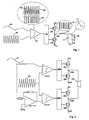
- FIG. 1 shows a typical straightforward solution for class D amplification, in which an input analog signal 101 is compared by a comparator 103 with a reference signal 102 having a triangular waveform.
- the comparator 103 provides an output that switches between two output values when the input signal 101 crosses the triangular waveform signal 102, resulting in an output signal 105 having a pulse width modulation that is dependent on the magnitude of the input signal 101.
- the output signal 105 from the comparator 103 is provided to a switch driver 104, which provides corresponding switching signals to a pair of power transistors M1, M2, switching transistor M1 on and transistor M2 off when the output signal 105 is high, and transistor M1 off and transistor M2 on when the output signal 105 is low.
- the transistors M1, M2 are connected in series between a pair of voltage supply lines, in this case between a positive supply line at V P and a negative supply line at V N .
- An output connection 106 between the transistors M1, M2 therefore varies between V P and V N (discounting any voltage drop across the transistors), resulting in a voltage output signal 107 having the form of the pulse width modulation signal 105.
- a combined resistive and inductive load in this case a conventional magnet-coil loudspeaker 108, is connected between the output connection 106 and ground 109.
- An LC circuit comprising inductor 110 and capacitor 111 provide a filter to suppress the high frequency switching components of the output signal from the switching amplifier.
- the current 112 passing through the loudspeaker 108 is then an accurate amplified representation of the original input signal 101.
- Such class D amplifiers can be designed to be highly efficient, a feature that is particularly advantageous in portable applications, where typical loudspeaker output powers may be up to around 3W.
- FIG 2 A variation on the above amplifier is illustrated in figure 2 , in which the amplifier incorporates a second pair of power switching transistors M1' M2'.
- the first pair of transistors M1, M2 are driven by a first switching circuit 204a as before by a signal dependent on the input signal 101 compared with a triangular waveform 102, in this case switching a first output connection 206a between the positive supply voltage V P and ground.
- the second pair of transistors M1', M2' are driven by a second switching signal 204b with a signal that is dependent on an inverted version of the input signal 101 compared with the same triangular waveform 102, and provides a voltage on a second connection 206b between the positive supply voltage V P and ground.
- This type of switching amplifier at least when driving a partially inductive load such as a magnet-coil loudspeaker, does not require additional filtering components.
- the required PWM switching pattern for such filterless operation is illustrated in reference [1] below.
- the maximum Sound Pressure Level (SPL) of a speaker connected to a class D amplifier in portable applications is mostly limited by the mechanical construction of the speaker. Particularly at low audio frequencies ( ⁇ 600 Hz) the speaker maximum input power is limited. For safety reasons, a high pass filter is typically added in the audio path. However, for short moments the speaker may be subjected to significantly more power than its rating.
- An algorithm that allows for the maximum speaker output power to be obtained under all conditions is described in reference [3] below. This algorithm reduces or increases the gain at certain frequencies dependent on the condition of the speaker. The algorithm requires as an input a measure of the current running through the speaker, which therefore needs to be sensed at the output of the class D amplifier.
- An example of a Class D amplifier with output current sensing can be found in patent application US 2009/0169022 .
- a switching amplifier comprising:
- the output load preferably comprises at least an inductive component, and is for example in the form of a magnet-coil based loudspeaker, providing a combined resistive and inductive load.
- the input signal to the switch driver circuit may be an analog signal, as in the switching amplifiers described above, or may be a digital signal from which the PWM signals are derived.
- the voltage sense circuit may comprise a PWM counter module and a track and hold circuit, the PWM counter module being configured to count a number of clock cycles of a positive portion of the first PWM signal and to trigger the track and hold circuit to sample the voltage across the current sensing resistor at the midpoint of a subsequent negative portion of the second PWM signal based on a subtraction of the number of clock cycles over a PWM period and the number of clock cycles of a positive portion of the first PWM signal.
- the PWM counter module may comprise:
- the PWM counter module may comprise a multiplier module configured to receive the number of clock cycles of the negative portion of the second PWM signal from the subtraction module and provide half the number of clock cycles in the negative portion of the second PWM signal to the second counter.
- the second counter may be configured to count the number of clock cycles in the subsequent negative portion of the second PWM signal at twice the rate of the first counter.
- the output driving circuit may comprise a first pair and a second pair of switching transistors, each pair of switching transistors connected in series between the pair of supply voltage lines.
- the pair of voltage lines may be a voltage supply line and a ground line, the current sensing resistor connected between a first one of the first pair of switching transistors and the ground line.
- the first one of each pair of switching transistors is preferably an N-MOS transistor.
- An advantage of sensing the current between N-MOS transistors and ground is that only low voltages are applied to the voltage sensing circuit.
- the amplifier may comprise a second current sensing resistor connected between a first one of the second pair of switching transistors and the ground line.
- the voltage sense circuit may be configured to sample a differential voltage across the first and second current sensing resistors.
- a method of sensing output current from a switching audio amplifier comprising an output driving circuit including a pair of switching transistors connected in series between a pair of supply voltage lines, the pair of switching transistors being driven by a switch driver circuit with first and second respective PWM signals dependent on an input signal, the method comprising triggering a track and hold circuit to sample a voltage across a current sensing resistor connected between a first one of the pair of transistors and an adjacent supply voltage line at a midpoint of the subsequent negative portion of the second PWM signal.
- the method may comprise:
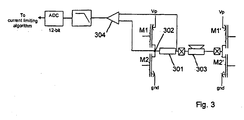
- a simple method to sense a speaker current is to place a series resistance 301 between an output 302 of a switching amplifier and the loudspeaker 303 to be driven. Measuring the voltage across this sense resistance 301 allows the actual current through the speaker 303 to be determined.
- the sense resistor 301 should be as small as possible to minimize the voltage loss over this resistor. The voltage loss reduces the maximum output power of the speaker 303.
- the sense resistance 301 cannot however be too small because the measured voltage across it needs to meet the various requirements for sensing current, such as the aforementioned SNR requirement.
- a voltage sense circuit 304 is connected across the sense resistance 301.
- the voltage sense circuit 304 therefore needs to suppress this large AC common mode voltage in order to fulfill the requirements of current sensing. This requirement is difficult to realize.
- This large voltage common mode swing is therefore a disadvantage of this method of current sensing.
- Another disadvantage of the method is that the power loss in the sense resistor 301 is significant. This can be compensated by decreasing of the on resistance of the power switches, but at the cost of increased chip area.
- both the N-MOS transistors M2, M2' and the P-MOS transistors M1, M1' would need to be increased in size to do this.
- P-MOS transistors M1, M1' would require an additional increase in chip area compared with the increase required for the N-MOS transistors M2, M2'.
- a further method of current sensing is described in reference [2] below, in which current is measured by copying the current in the power switches.
- This method also has disadvantages, in that the arrangement is complex and current has to be sensed in both upper and lower power switches.
- FIG. 4 An embodiment of an output stage of a switching amplifier 400 according to the invention, incorporating a current sensing circuit, is illustrated in figure 4 .
- current sensing resistors 401 a, 401 b are connected between each N-MOS transistor M2, M2' and ground.
- a voltage sense circuit 404 detects the voltage across each resistor 401 a, 401 b, and passes an output signal, via a low pass filter 405, to a 12-bit ADC 406.
- ADC As outlined above in relation to the background to the invention, other resolutions of ADC may be used, depending on the application and the algorithm used for processing the digital current signal.
- the output digital signal from the ADC 406 is provided to a module on which an current limiting algorithm is run, which limits the maximum current applied to the loudspeaker 403.
- FIG. 5 An alternative embodiment of an output stage of a switching amplifier 500 according to the invention is illustrated in figure 5 .
- current sensing resistors 501 a, 501 b are connected between each P-MOS transistor M1, M1' and the positive voltage supply V P .
- Operation of the voltage sensing circuit 404, low pass filter 405 and ADC 406 are otherwise the same as in the embodiment of figure 4 .
- the presence of the current sensing resistors 401 a, 401 b, 501a, 501 b can be compensated by adjusting the output resistances of the transistors to which they are connected.
- the N-MOS transistors M2, M2' can be made larger
- the P-MOS transistors M1, M1' can be made larger.
- the additional area taken up by the P-MOS transistors would need to be larger than that taken up by the N-MOS transistors when doing this. The embodiment in figure 4 is therefore preferred.
- the voltage sensing circuit 404 senses voltages close to ground, whereas the voltage sensing circuit 404 in the embodiment of figure 5 senses voltages close to V P .
- the voltage sensing circuit 404 in the figure 4 embodiment does not therefore need high voltage devices.
- a feature of either of the above described embodiments of the invention is that the speaker current is sampled by the voltage sensing circuit 404 when current is flowing through only the N-MOS transistors ( figure 4 ) or through only the P-MOS transistors ( figure 5 ).
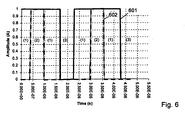
- the graph in figure 6 illustrates exemplary PWM signals used for driving a switching amplifier, the signals comprising a first PWM signal 601, hereinafter termed PWMA, and a second PWM signal 602, hereinafter termed PWMB.
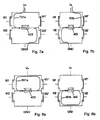
- the current flows through a loudspeaker connected across the output terminals of a switching amplifier for each of the four possible switching modes are illustrated in figures 7a and 7b for the positive and negative differential switching modes, and in figures 8a and 8b for the common switching modes.
- transistors M1 and M2' are open and transistors M1' and M2 are closed.
- transistors M1' and M2 are open and transistors M1 and M2' are closed.
- transistors M1 and M1' are closed and transistors M2 and M2' are open. Current flows in either direction through the loudspeaker 403, depending on the immediately preceding differential switching mode.
- transistors M1 and M1' are open and transistors M2 and M2' are closed.
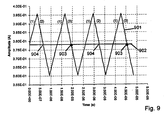
- the actual current 901 flowing through the output loudspeaker 403 over an exemplary PWM cycle is shown in figure 9 .
- the different regions 1-3 shown in figure 6 correspond with regions 1-3 shown in figure 9 .
- the loudspeaker presents an inductive and resistive load, the current has a triangular form.
- positive differential switching regions (1) the current is rising.
- regions (2) & (3) where there is common switching to either the power supply or to ground, respectively, the current is falling.
- An average current 902 which is representative of the actual power transferred to the loudspeaker, is given by the DC offset indicated by the triangular waveform of the current 901.
- the ideal moments to sample the current 901 is therefore when the current 901 is equal to this average current 902 and is flowing through both current sampling resistors.
- These points 903, 904 are indicated on figure 9 , and lie within the periods where there is common switching to ground (shown in figure 8b ) or common switching to the power supply (shown in figure 8a ), respectively.
- the sampled current is flowing through both N-MOS transistors.
- the ideal sampling moments 903 are in the middle of the common to ground switching period. These moments can therefore be calculated using a counter, which causes a sample and hold circuit to sample the voltage signal across each sampling resistor at the correct moment.
- the method of sampling requires that the load has some inductance, but this is always the case if a magnet-coil based loudspeaker is used.
- An exemplary embodiment of the voltage sensing circuit 404 ( figures 5 & 6 ) comprises two parts, being a track and hold circuit for sensing a voltage signal from the sense resistor, and a PWM counter for triggering the track and hold circuit at the correct moments.
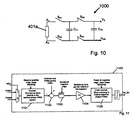
- An exemplary track and hold circuit 1000 is illustrated in figure 10
- an exemplary PWM counter is illustrated in block form in figure 11 .
- the Track & Hold circuit is typically implemented twice, once for each sense resistor in the output stage of a H-bridge amplifier.
- One of these circuits, connected to the sense resistor 401a ( figure 5 ) is shown in figure 10 .
- the track and hold circuit 1000 is operated in two stages, a first stage in which switches S A1 , S A2 are closed and switches S A3 , S A4 are open.
- a first capacitor C A1 is connected across the sampling resistor 401 a and the first capacitor C A1 tracks the voltage across the resistor 401 a.
- switches S A1 , S A2 open and switches S A3 , S A4 simultaneously close.
- the charge from the first capacitor C A1 passes to a second capacitor CA2, and a voltage is sampled between V A and the common mode voltage V CM (which in this case is ground).
- V CM common mode voltage
- V CM ground
- the sampled voltage VB will be of opposite sign to the voltage V A .
- the voltage signal on C A2 is refreshed each time during the transition between sampling and holding.
- the capacitance value of C A1 is preferably larger than that of C A2 , for example with a ratio between C A1 , C A2 being at least 10:1 (C A1 is the larger value).
- the outputs of both T&H circuits are connected to an ADC. Since V B is the opposite value of V A , the current can be measured differentially. It is also possible to sense only via one resistor, for example when implementing a single-ended switching amplifier. The signal is however then more sensitive to disturbances.
- a clock required to control switches S A1 , S A2 , S A3 , S A4 in the track and hold circuit 1000 can be generated in the digital domain.
- the two PWM patterns PWMA, PWMB can be used as an input to drive a PWM counter 1100 for triggering the track and hold circuit, as shown in figure 11 .
- the PWM counter 1100 is configured to calculate the mid-point of a period in the PWM cycle when there is common switching to ground (or, in an alternative embodiment, common switching to the power supply V P ).
- the mid-point can be calculated by prediction. First, the length of a positive phase of one of the PWM signals is counted and this value is subtracted from the known fixed PWM period length.
- this PWM period length is represented by 256 clock cycles. Subtracting the length of the positive phase from the PWM period length results in the length of the subsequent negative phase of the PWM signal. The midpoint of the negative phase is determined by counting down from the calculated value a factor of two faster than for counting up during the positive phase. When the counter reaches zero, the track and hold circuit is triggered to sample the voltage across the sampling resistor(s).
- Figure 12 illustrates a series of exemplary signals resulting from operation of the PWM counter 1100 in figure 11 , illustrating operation of the various blocks in figure 11 .
- the NEG signal indicates whether the input signal is positive or negative.
- the PWM pulse having the smaller duty-cycle, being PWMA in figure 12 is selected to calculate the middle of the period of common switching to ground. At the moment the signal PWMA rises from 0 to 1, the first counter 1101 starts counting down from the number of clock cycles representing the PWM period, in this case 256 cycles.
- the output from the first counter which is subtracted by a subtraction block1102 from the PWM period, triggers a sample and hold block 1103 to provide this subtracted count to a multiplier block 1104, which divides the subtracted count by two.
- the subtracted and divided count is then used as a starting point for a second counter 1105 to count down from, the second counter 1105 being reset by the falling edge of the PWMA signal.
- the sample and hold clock Clk_SH is triggered to transition to zero, causing switches S A1 , S A2 to close and S A3 , S A4 to open ( figure 10 ).
- the sample and hold clock Clk_SH transitions from zero to 1, causing switches S A1 , S A2 to open and S A3 , S A4 to close, and the voltage across the sampling resistor(s) to be sampled.
- a sampled voltage is provided to the ADC 406 ( figures 4, 5 ), which provides a digital output representing the current to a digital current limiting module.
- the sampling moment could instead be determined in the analog domain, for example by replacing the counters 1101, 1105 in figure 11 with integrators.
Landscapes
- Engineering & Computer Science (AREA)
- Power Engineering (AREA)
- Amplifiers (AREA)
Claims (12)
- Schaltverstärker aufweisend:einen Ausgangstreiberschaltkreis (400), welcher ein Paar von Schalttransistoren (M1, M2) beinhaltet, welche in Serie zwischen einem Paar von Versorgungsspannungsleitungen (VP, gnd) geschalten sind;einen Schalttreiberschaltkreis (204a), welcher konfiguriert ist zum Antreiben der Schalttransistoren (M1, M2) mit entsprechenden ersten und zweiten PWM-Signalen, welche von einem Eingangssignal (101) abhängig sind;eine Ausgangsverbindung zwischen dem Paar von Transistoren (M1, M2) zum Antreiben einer Ausgangslast (403); undeinen Ausgangsstrom-Abtastschaltkreis zum Messen eines Stroms durch die Ausgangslast, wobei der Ausgangsstrom-Abtastschaltkreis aufweist:einen Stromabtastwiderstand (401a), welcher zwischen einem Ersten (M2) von dem Paar von Transistoren und einer benachbarten Versorgungsspannungsleitung (gnd) geschalten ist; undeinen Spannungsabtastschaltkreis (404), welcher über den Stromabtastwiderstand geschalten ist,wobei der Spannungsabtastschaltkreis konfiguriert ist zum Abfragen einer Spannung über den Stromabtastwiderstand (401a) bei einem Mittelpunkt von sukzessiven korrespondierenden Anteilen von einem der PWM-Signale.
- Verstärker gemäß Anspruch 1, wobei der Spannungsabtastschaltkreis (404) ein PWM-Zählermodul (1100) und einen Track-and-Hold-Schaltkreis (1000) aufweist, wobei das PWM-Zählermodul (1100) konfiguriert ist zum Zählen einer Anzahl von Taktzyklen von einem positiven Anteil des ersten PWM-Signals (PWMA) und zum Triggern des Track-and-Hold-Schaltkreises (1000), um die Spannung über dem Stromabtastwiderstand (401a) bei dem Mittelpunkt von einem nachfolgenden negativen Anteil des zweiten PWM-Signals (PWMB) abzufragen, basierend auf einer Subtraktion von der Anzahl von Taktzyklen über einer PWM-Periode und der Anzahl von Taktzyklen von einem positiven Anteil des ersten PWM-Signals (PWMA).
- Verstärker gemäß Anspruch 2, wobei das PWM-Zählermodul (1100) aufweist:einen ersten Zähler (1101), welcher konfiguriert ist zum Zurücksetzen des ersten PWM-Signals (PWMA) bei jeder ansteigenden Flanke und zum Zählen der Anzahl von Taktzyklen von dem positiven Anteil des ersten PWM-Signals (PWMA);ein Subtraktionsmodul (1102), welches konfiguriert ist zum Subtrahieren der Anzahl von Taktzyklen, welche mittels des ersten Zählers von der Anzahl von Taktzyklen über der PWM-Periode gezählt wurden; undeinen zweiten Zähler (1105), welcher konfiguriert ist zum Zurücksetzen des ersten PWM-Signals (PWMA) an jeder fallenden Flanke und zum Zählen von der Hälfte von einer berechneten Anzahl von Taktzyklen in einem nachfolgenden negativen Anteil des zweiten PWM-Signals (PWMB),wobei der zweite Zähler (1105) konfiguriert ist zum Bereitstellen eines Taktsignals (Clk_SH) an den Track-and-Hold-Schaltkreis (1000), um die Spannung über dem Abtastwiderstand (401a) abzufragen, wenn die Hälfte der Anzahl von Taktzyklen in dem nachfolgenden negativen Anteil des zweiten PWM-Signals (PWMB) gezählt werden.
- Verstärker gemäß Anspruch 3, wobei das PWM-Zählermodul (1100) ein Verstärkermodul (1104) aufweist, welches konfiguriert ist zum Empfangen der Anzahl von Taktzyklen von dem negativen Anteil des zweiten PWM-Signals (PWMB) von dem Subtraktionsmodul (1102) und die Hälfte der Anzahl von Taktzyklen in dem negativen Anteil des zweiten PWM-Signals (PWMB) dem zweiten Zähler (1105) bereitzustellen.
- Verstärker gemäß Anspruch 3, wobei der zweite Zähler (1105) konfiguriert ist zum Zählen der Anzahl von Taktzyklen in dem nachfolgenden negativen Anteil des zweiten PWM-Signals (PWMB) bei dem Zweifachen der Rate des ersten Zählers (1101).
- Verstärker gemäß irgendeinem vorhergehenden Anspruch, wobei der Ausgangstreiberschaltkreis (400) ein erstes Paar (M1, M2) und ein zweites Paar (M1', M2') von Schalttransistoren aufweist, wobei jedes Paar von Schalttransistoren in Serie zwischen dem Paar von Versorgungsspannungsleitungen (VP, gnd) geschalten ist.
- Verstärker gemäß Anspruch 6, wobei das Paar von Spannungsleitungen eine Spannungsversorgungsleitung (VP) und eine Masseleitung (gnd) ist, wobei der Stromabtastwiderstand (401a) zwischen einem Ersten (M2) von dem ersten Paar von Schalttransistoren und der Masseleitung (gnd) geschalten ist.
- Verstärker gemäß Anspruch 6 oder 7, wobei der Erste von jedem Paar von Schalttransistoren ein N-MOS-Transistor ist.
- Verstärker gemäß Anspruch 7 oder 8, welcher einen zweiten Stromabtastwiderstand (401b) aufweist, welcher zwischen einem Ersten von dem zweiten Paar von Schalttransistoren und der Masseleitung geschalten ist.
- Verstärker gemäß Anspruch 9, wobei der Spannungsabtastschaltkreis konfiguriert ist zum Abfragen einer Differenzspannung über den ersten und zweiten Stromabtastwiderständen (401a, 401b).
- Verfahren zum Abtasten eines Ausgangsstroms von einem Schaltverstärker, welcher einen Ausgangstreiberschaltkreis (400) aufweist, welcher ein Paar von Schalttransistoren (M1, M2) beinhaltet, welche in Serie zwischen einem Paar von Versorgungsspannungsleitungen (VP, gnd) geschalten sind, wobei das Paar von Schalttransistoren mittels eines Schalttreiberschaltkreises (204a) mit entsprechenden ersten und zweiten PWM-Signalen angetrieben wird, welche von einem Eingangssignal (101) abhängen, wobei das Verfahren aufweist ein Triggern eines Track-and-Hold-Schaltkreises (1000), um eine Spannung über einem Stromabtastwiderstand (401a) abzufragen, welcher zwischen einem Ersten (M2) von dem Paar von Transistoren und einer benachbarten Versorgungsspannungsleitung (gnd) bei einem Mittelpunkt von dem nachfolgenden negativen Anteil des zweiten PWM-Signals geschalten ist.
- Verfahren gemäß Anspruch 11, aufweisend:Zählen einer Anzahl von Taktzyklen von einem positiven Anteil des ersten PWM-Signals (PWMA);Berechnen einer Anzahl von Taktzyklen in dem nachfolgenden negativen Anteil des zweiten PWM-Signals (PWMB) mittels Subtrahierens der Anzahl von Taktzyklen von dem positiven Anteil von einer Anzahl von Taktzyklen in einer Periode von den PWM-Signalen; undBerechnen des Mittelpunkts von den nachfolgenden negativen Anteilen des zweiten PWM-Signals mittels Halbierens der berechneten Anzahl von Taktzyklen in dem negativen Anteil des zweiten PWM-Signals (PWMB).
Priority Applications (2)
| Application Number | Priority Date | Filing Date | Title |
|---|---|---|---|
| EP09251801A EP2284992B1 (de) | 2009-07-15 | 2009-07-15 | Stromerfassung |
| US12/835,765 US8378745B2 (en) | 2009-07-15 | 2010-07-14 | Current sensing |
Applications Claiming Priority (1)
| Application Number | Priority Date | Filing Date | Title |
|---|---|---|---|
| EP09251801A EP2284992B1 (de) | 2009-07-15 | 2009-07-15 | Stromerfassung |
Publications (2)
| Publication Number | Publication Date |
|---|---|
| EP2284992A1 EP2284992A1 (de) | 2011-02-16 |
| EP2284992B1 true EP2284992B1 (de) | 2013-01-02 |
Family
ID=41395591
Family Applications (1)
| Application Number | Title | Priority Date | Filing Date |
|---|---|---|---|
| EP09251801A Not-in-force EP2284992B1 (de) | 2009-07-15 | 2009-07-15 | Stromerfassung |
Country Status (2)
| Country | Link |
|---|---|
| US (1) | US8378745B2 (de) |
| EP (1) | EP2284992B1 (de) |
Cited By (1)
| Publication number | Priority date | Publication date | Assignee | Title |
|---|---|---|---|---|
| US10516372B1 (en) | 2018-07-03 | 2019-12-24 | Nxp B.V. | Low cost LF driver current sense topology |
Families Citing this family (26)
| Publication number | Priority date | Publication date | Assignee | Title |
|---|---|---|---|---|
| EP2448115B1 (de) | 2010-10-28 | 2015-06-03 | Nxp B.V. | Audioverstärker |
| US8963634B2 (en) * | 2012-02-28 | 2015-02-24 | Qualcomm Incorporated | Load current sensing |
| TW201415913A (zh) * | 2012-10-08 | 2014-04-16 | Chi Mei Comm Systems Inc | 揚聲器系統及其檢測方法 |
| US9461589B2 (en) | 2014-09-03 | 2016-10-04 | Qualcomm Incorporated | Asymmetric H-bridge in a class D power amplifier |
| ITUB20156907A1 (it) * | 2015-12-07 | 2017-06-07 | St Microelectronics Srl | Amplificatore audio in classe d comprendente un circuito per leggere una corrente erogata dall'amplificatore al carico e relativo procedimento di lettura |
| US10272217B2 (en) * | 2015-12-08 | 2019-04-30 | Boyi Gao | Device for gripping and directing bougies for intubation |
| US10516955B2 (en) | 2017-03-31 | 2019-12-24 | Synaptics Incorporated | Correction of current measurement in an amplifier |
| US10573711B2 (en) * | 2017-07-13 | 2020-02-25 | Semiconductor Components Industries, Llc | Semiconductor device resistor including vias and multiple metal layers |
| US10085089B1 (en) * | 2017-11-17 | 2018-09-25 | Synaptics Incorporated | Load current sensing circuit for class-D amplifier |
| CN108600905A (zh) * | 2018-03-28 | 2018-09-28 | 惠州市德赛西威汽车电子股份有限公司 | 一种动态扬声器驱动电路 |
| US11698393B2 (en) * | 2019-01-15 | 2023-07-11 | Shanghai Awinic Technology Co., LTD | Current detection circuit for loudspeaker |
| CN109546979B (zh) * | 2019-01-15 | 2023-09-19 | 上海艾为电子技术股份有限公司 | 一种喇叭的电流检测电路 |
| ES3014051T3 (en) | 2019-12-15 | 2025-04-16 | Shaheen Innovations Holding Ltd | Mist inhaler devices |
| JP7583061B2 (ja) | 2019-12-15 | 2024-11-13 | シャヒーン イノベーションズ ホールディング リミテッド | 超音波ミスト吸入器 |
| US12233207B2 (en) | 2019-12-15 | 2025-02-25 | Shaheen Innovations Holding Limited | Mist inhaler devices |
| US12213516B2 (en) | 2019-12-15 | 2025-02-04 | Shaheen Innovations Holding Limited | Ultrasonic mist inhaler |
| US11911559B2 (en) | 2019-12-15 | 2024-02-27 | Shaheen Innovations Holding Limited | Ultrasonic mist inhaler |
| PL4292632T3 (pl) | 2019-12-15 | 2025-11-24 | Shaheen Innovations Holding Limited | Ultradźwiękowy inhalator mgiełki |
| US12538944B2 (en) | 2019-12-15 | 2026-02-03 | Shaheen Innovations Holding Limited | Nicotine delivery device with identification arrangement |
| KR102786545B1 (ko) * | 2020-03-04 | 2025-03-26 | 엘지전자 주식회사 | 영전압 스위칭 실패 감지 회로 |
| US11290071B2 (en) | 2020-05-01 | 2022-03-29 | Cirrus Logic, Inc. | Common-mode insensitive current-sensing topology in full-bridge driver |
| US11296663B2 (en) | 2020-05-01 | 2022-04-05 | Cirrus Logic, Inc. | Common-mode insensitive current-sensing topology in full-bridge driver with high-side and low-side energy matching calibration |
| GB2598995B (en) * | 2020-08-26 | 2022-12-28 | Cirrus Logic Int Semiconductor Ltd | Common-mode insensitive current-sensing topology in full-bridge driver |
| EP3961920B1 (de) | 2020-08-27 | 2024-11-06 | Nxp B.V. | Leseverstärkerschaltung |
| EP4199352A1 (de) * | 2021-12-14 | 2023-06-21 | Goodix Technology (HK) Company Limited | Spannungs- und strommessschaltungen zur messung einer mit einem leistungsverstärker verbundenen last |
| MX2024007391A (es) * | 2021-12-15 | 2024-08-14 | Shaheen Innovations Holding Ltd | Microchip para accionar un circuito resonante. |
Family Cites Families (5)
| Publication number | Priority date | Publication date | Assignee | Title |
|---|---|---|---|---|
| JP4502667B2 (ja) * | 2004-03-04 | 2010-07-14 | エドワーズ株式会社 | 磁気軸受装置及び該磁気軸受装置を搭載したターボ分子ポンプ |
| FR2890500B1 (fr) * | 2005-09-07 | 2008-04-04 | Vincent Jean Sebastie Tamisier | Dispositif d'amplification d'une tension representative d'une information audiophonique |
| TWI474612B (zh) * | 2007-12-31 | 2015-02-21 | Intersil Inc | 用於經改良的過電流截波之系統及方法 |
| US7705673B2 (en) * | 2008-01-07 | 2010-04-27 | Texas Instruments Incorporated | Over-current sensing during narrow gate drive operation of class D output stages |
| US7994857B2 (en) * | 2009-12-23 | 2011-08-09 | Rockford Corporation | Dynamic constant power amplifier |
-
2009
- 2009-07-15 EP EP09251801A patent/EP2284992B1/de not_active Not-in-force
-
2010
- 2010-07-14 US US12/835,765 patent/US8378745B2/en not_active Expired - Fee Related
Cited By (1)
| Publication number | Priority date | Publication date | Assignee | Title |
|---|---|---|---|---|
| US10516372B1 (en) | 2018-07-03 | 2019-12-24 | Nxp B.V. | Low cost LF driver current sense topology |
Also Published As
| Publication number | Publication date |
|---|---|
| US20110012677A1 (en) | 2011-01-20 |
| EP2284992A1 (de) | 2011-02-16 |
| US8378745B2 (en) | 2013-02-19 |
Similar Documents
| Publication | Publication Date | Title |
|---|---|---|
| EP2284992B1 (de) | Stromerfassung | |
| EP1578011B1 (de) | Leistungsverstärkungsvorrichtung | |
| US7646240B2 (en) | Class D amplifier | |
| US9019012B2 (en) | Amplifier circuit with offset control | |
| US7298209B1 (en) | Class D amplifier | |
| TWI477064B (zh) | A system and method for reducing distortion in an audio amplification system | |
| US11374544B2 (en) | Capacitive-coupled chopper instrumentation amplifiers and associated methods | |
| JP2009207242A (ja) | 電源装置 | |
| US7911273B2 (en) | Reduction of power consumption and EMI of a switching amplifier | |
| CN106059513B (zh) | 直流电流检测保护电路和应用其的d类放大器 | |
| US20160065134A1 (en) | Asymmetric h-bridge in a class d power amplifier | |
| JP2011091642A (ja) | 過電流検出回路及び信号増幅装置 | |
| KR20060094291A (ko) | 자가 발진형 펄스 폭 변조회로 및 펄스 폭 변조 방법 | |
| US6489840B2 (en) | Power amplification equipment | |
| JP2004180294A (ja) | 電力増幅装置 | |
| JP5903994B2 (ja) | 増幅器 | |
| US7388431B2 (en) | Switching amplifier and control method thereof | |
| KR20020034677A (ko) | 고효율 스위칭 증폭기 | |
| JP2009089289A (ja) | D級増幅器 | |
| CN109716647B (zh) | 包括补偿电路的放大装置 | |
| KR20240073058A (ko) | 멀티 레벨 펄스 폭 변조 시스템에서의 공통 모드 보상 | |
| JPH0832368A (ja) | 電力増幅回路 |
Legal Events
| Date | Code | Title | Description |
|---|---|---|---|
| PUAI | Public reference made under article 153(3) epc to a published international application that has entered the european phase |
Free format text: ORIGINAL CODE: 0009012 |
|
| AK | Designated contracting states |
Kind code of ref document: A1 Designated state(s): AT BE BG CH CY CZ DE DK EE ES FI FR GB GR HR HU IE IS IT LI LT LU LV MC MK MT NL NO PL PT RO SE SI SK SM TR |
|
| AX | Request for extension of the european patent |
Extension state: AL BA RS |
|
| 17P | Request for examination filed |
Effective date: 20110816 |
|
| GRAP | Despatch of communication of intention to grant a patent |
Free format text: ORIGINAL CODE: EPIDOSNIGR1 |
|
| GRAS | Grant fee paid |
Free format text: ORIGINAL CODE: EPIDOSNIGR3 |
|
| GRAA | (expected) grant |
Free format text: ORIGINAL CODE: 0009210 |
|
| AK | Designated contracting states |
Kind code of ref document: B1 Designated state(s): AT BE BG CH CY CZ DE DK EE ES FI FR GB GR HR HU IE IS IT LI LT LU LV MC MK MT NL NO PL PT RO SE SI SK SM TR |
|
| REG | Reference to a national code |
Ref country code: GB Ref legal event code: FG4D |
|
| REG | Reference to a national code |
Ref country code: CH Ref legal event code: EP Ref country code: AT Ref legal event code: REF Ref document number: 592078 Country of ref document: AT Kind code of ref document: T Effective date: 20130115 |
|
| REG | Reference to a national code |
Ref country code: IE Ref legal event code: FG4D |
|
| REG | Reference to a national code |
Ref country code: DE Ref legal event code: R096 Ref document number: 602009012414 Country of ref document: DE Effective date: 20130228 |
|
| REG | Reference to a national code |
Ref country code: AT Ref legal event code: MK05 Ref document number: 592078 Country of ref document: AT Kind code of ref document: T Effective date: 20130102 |
|
| REG | Reference to a national code |
Ref country code: NL Ref legal event code: VDEP Effective date: 20130102 |
|
| PG25 | Lapsed in a contracting state [announced via postgrant information from national office to epo] |
Ref country code: SI Free format text: LAPSE BECAUSE OF FAILURE TO SUBMIT A TRANSLATION OF THE DESCRIPTION OR TO PAY THE FEE WITHIN THE PRESCRIBED TIME-LIMIT Effective date: 20130102 |
|
| REG | Reference to a national code |
Ref country code: LT Ref legal event code: MG4D |
|
| PG25 | Lapsed in a contracting state [announced via postgrant information from national office to epo] |
Ref country code: LT Free format text: LAPSE BECAUSE OF FAILURE TO SUBMIT A TRANSLATION OF THE DESCRIPTION OR TO PAY THE FEE WITHIN THE PRESCRIBED TIME-LIMIT Effective date: 20130102 Ref country code: BE Free format text: LAPSE BECAUSE OF FAILURE TO SUBMIT A TRANSLATION OF THE DESCRIPTION OR TO PAY THE FEE WITHIN THE PRESCRIBED TIME-LIMIT Effective date: 20130102 Ref country code: SE Free format text: LAPSE BECAUSE OF FAILURE TO SUBMIT A TRANSLATION OF THE DESCRIPTION OR TO PAY THE FEE WITHIN THE PRESCRIBED TIME-LIMIT Effective date: 20130102 Ref country code: NO Free format text: LAPSE BECAUSE OF FAILURE TO SUBMIT A TRANSLATION OF THE DESCRIPTION OR TO PAY THE FEE WITHIN THE PRESCRIBED TIME-LIMIT Effective date: 20130402 Ref country code: AT Free format text: LAPSE BECAUSE OF FAILURE TO SUBMIT A TRANSLATION OF THE DESCRIPTION OR TO PAY THE FEE WITHIN THE PRESCRIBED TIME-LIMIT Effective date: 20130102 Ref country code: ES Free format text: LAPSE BECAUSE OF FAILURE TO SUBMIT A TRANSLATION OF THE DESCRIPTION OR TO PAY THE FEE WITHIN THE PRESCRIBED TIME-LIMIT Effective date: 20130413 Ref country code: CZ Free format text: LAPSE BECAUSE OF FAILURE TO SUBMIT A TRANSLATION OF THE DESCRIPTION OR TO PAY THE FEE WITHIN THE PRESCRIBED TIME-LIMIT Effective date: 20130102 Ref country code: BG Free format text: LAPSE BECAUSE OF FAILURE TO SUBMIT A TRANSLATION OF THE DESCRIPTION OR TO PAY THE FEE WITHIN THE PRESCRIBED TIME-LIMIT Effective date: 20130402 Ref country code: IS Free format text: LAPSE BECAUSE OF FAILURE TO SUBMIT A TRANSLATION OF THE DESCRIPTION OR TO PAY THE FEE WITHIN THE PRESCRIBED TIME-LIMIT Effective date: 20130502 |
|
| PG25 | Lapsed in a contracting state [announced via postgrant information from national office to epo] |
Ref country code: PL Free format text: LAPSE BECAUSE OF FAILURE TO SUBMIT A TRANSLATION OF THE DESCRIPTION OR TO PAY THE FEE WITHIN THE PRESCRIBED TIME-LIMIT Effective date: 20130102 Ref country code: PT Free format text: LAPSE BECAUSE OF FAILURE TO SUBMIT A TRANSLATION OF THE DESCRIPTION OR TO PAY THE FEE WITHIN THE PRESCRIBED TIME-LIMIT Effective date: 20130502 Ref country code: FI Free format text: LAPSE BECAUSE OF FAILURE TO SUBMIT A TRANSLATION OF THE DESCRIPTION OR TO PAY THE FEE WITHIN THE PRESCRIBED TIME-LIMIT Effective date: 20130102 Ref country code: NL Free format text: LAPSE BECAUSE OF FAILURE TO SUBMIT A TRANSLATION OF THE DESCRIPTION OR TO PAY THE FEE WITHIN THE PRESCRIBED TIME-LIMIT Effective date: 20130102 Ref country code: LV Free format text: LAPSE BECAUSE OF FAILURE TO SUBMIT A TRANSLATION OF THE DESCRIPTION OR TO PAY THE FEE WITHIN THE PRESCRIBED TIME-LIMIT Effective date: 20130102 Ref country code: GR Free format text: LAPSE BECAUSE OF FAILURE TO SUBMIT A TRANSLATION OF THE DESCRIPTION OR TO PAY THE FEE WITHIN THE PRESCRIBED TIME-LIMIT Effective date: 20130403 |
|
| PG25 | Lapsed in a contracting state [announced via postgrant information from national office to epo] |
Ref country code: HR Free format text: LAPSE BECAUSE OF FAILURE TO SUBMIT A TRANSLATION OF THE DESCRIPTION OR TO PAY THE FEE WITHIN THE PRESCRIBED TIME-LIMIT Effective date: 20130102 |
|
| PG25 | Lapsed in a contracting state [announced via postgrant information from national office to epo] |
Ref country code: RO Free format text: LAPSE BECAUSE OF FAILURE TO SUBMIT A TRANSLATION OF THE DESCRIPTION OR TO PAY THE FEE WITHIN THE PRESCRIBED TIME-LIMIT Effective date: 20130102 Ref country code: EE Free format text: LAPSE BECAUSE OF FAILURE TO SUBMIT A TRANSLATION OF THE DESCRIPTION OR TO PAY THE FEE WITHIN THE PRESCRIBED TIME-LIMIT Effective date: 20130102 Ref country code: DK Free format text: LAPSE BECAUSE OF FAILURE TO SUBMIT A TRANSLATION OF THE DESCRIPTION OR TO PAY THE FEE WITHIN THE PRESCRIBED TIME-LIMIT Effective date: 20130102 Ref country code: SK Free format text: LAPSE BECAUSE OF FAILURE TO SUBMIT A TRANSLATION OF THE DESCRIPTION OR TO PAY THE FEE WITHIN THE PRESCRIBED TIME-LIMIT Effective date: 20130102 |
|
| PLBE | No opposition filed within time limit |
Free format text: ORIGINAL CODE: 0009261 |
|
| STAA | Information on the status of an ep patent application or granted ep patent |
Free format text: STATUS: NO OPPOSITION FILED WITHIN TIME LIMIT |
|
| PG25 | Lapsed in a contracting state [announced via postgrant information from national office to epo] |
Ref country code: CY Free format text: LAPSE BECAUSE OF FAILURE TO SUBMIT A TRANSLATION OF THE DESCRIPTION OR TO PAY THE FEE WITHIN THE PRESCRIBED TIME-LIMIT Effective date: 20130102 |
|
| 26N | No opposition filed |
Effective date: 20131003 |
|
| PG25 | Lapsed in a contracting state [announced via postgrant information from national office to epo] |
Ref country code: IT Free format text: LAPSE BECAUSE OF FAILURE TO SUBMIT A TRANSLATION OF THE DESCRIPTION OR TO PAY THE FEE WITHIN THE PRESCRIBED TIME-LIMIT Effective date: 20130102 |
|
| REG | Reference to a national code |
Ref country code: DE Ref legal event code: R097 Ref document number: 602009012414 Country of ref document: DE Effective date: 20131003 |
|
| PG25 | Lapsed in a contracting state [announced via postgrant information from national office to epo] |
Ref country code: MC Free format text: LAPSE BECAUSE OF FAILURE TO SUBMIT A TRANSLATION OF THE DESCRIPTION OR TO PAY THE FEE WITHIN THE PRESCRIBED TIME-LIMIT Effective date: 20130102 |
|
| REG | Reference to a national code |
Ref country code: CH Ref legal event code: PL |
|
| REG | Reference to a national code |
Ref country code: IE Ref legal event code: MM4A |
|
| PG25 | Lapsed in a contracting state [announced via postgrant information from national office to epo] |
Ref country code: CH Free format text: LAPSE BECAUSE OF NON-PAYMENT OF DUE FEES Effective date: 20130731 Ref country code: LI Free format text: LAPSE BECAUSE OF NON-PAYMENT OF DUE FEES Effective date: 20130731 |
|
| PG25 | Lapsed in a contracting state [announced via postgrant information from national office to epo] |
Ref country code: IE Free format text: LAPSE BECAUSE OF NON-PAYMENT OF DUE FEES Effective date: 20130715 |
|
| PG25 | Lapsed in a contracting state [announced via postgrant information from national office to epo] |
Ref country code: SM Free format text: LAPSE BECAUSE OF FAILURE TO SUBMIT A TRANSLATION OF THE DESCRIPTION OR TO PAY THE FEE WITHIN THE PRESCRIBED TIME-LIMIT Effective date: 20130102 |
|
| PG25 | Lapsed in a contracting state [announced via postgrant information from national office to epo] |
Ref country code: MT Free format text: LAPSE BECAUSE OF FAILURE TO SUBMIT A TRANSLATION OF THE DESCRIPTION OR TO PAY THE FEE WITHIN THE PRESCRIBED TIME-LIMIT Effective date: 20130102 Ref country code: TR Free format text: LAPSE BECAUSE OF FAILURE TO SUBMIT A TRANSLATION OF THE DESCRIPTION OR TO PAY THE FEE WITHIN THE PRESCRIBED TIME-LIMIT Effective date: 20130102 |
|
| PG25 | Lapsed in a contracting state [announced via postgrant information from national office to epo] |
Ref country code: MK Free format text: LAPSE BECAUSE OF FAILURE TO SUBMIT A TRANSLATION OF THE DESCRIPTION OR TO PAY THE FEE WITHIN THE PRESCRIBED TIME-LIMIT Effective date: 20130102 Ref country code: LU Free format text: LAPSE BECAUSE OF NON-PAYMENT OF DUE FEES Effective date: 20130715 Ref country code: HU Free format text: LAPSE BECAUSE OF FAILURE TO SUBMIT A TRANSLATION OF THE DESCRIPTION OR TO PAY THE FEE WITHIN THE PRESCRIBED TIME-LIMIT; INVALID AB INITIO Effective date: 20090715 |
|
| REG | Reference to a national code |
Ref country code: FR Ref legal event code: PLFP Year of fee payment: 8 |
|
| REG | Reference to a national code |
Ref country code: FR Ref legal event code: PLFP Year of fee payment: 9 |
|
| REG | Reference to a national code |
Ref country code: FR Ref legal event code: PLFP Year of fee payment: 10 |
|
| PGFP | Annual fee paid to national office [announced via postgrant information from national office to epo] |
Ref country code: FR Payment date: 20230621 Year of fee payment: 15 |
|
| P01 | Opt-out of the competence of the unified patent court (upc) registered |
Effective date: 20230724 |
|
| PGFP | Annual fee paid to national office [announced via postgrant information from national office to epo] |
Ref country code: GB Payment date: 20230620 Year of fee payment: 15 |
|
| PGFP | Annual fee paid to national office [announced via postgrant information from national office to epo] |
Ref country code: DE Payment date: 20230620 Year of fee payment: 15 |
|
| REG | Reference to a national code |
Ref country code: DE Ref legal event code: R119 Ref document number: 602009012414 Country of ref document: DE |
|
| GBPC | Gb: european patent ceased through non-payment of renewal fee |
Effective date: 20240715 |
|
| PG25 | Lapsed in a contracting state [announced via postgrant information from national office to epo] |
Ref country code: DE Free format text: LAPSE BECAUSE OF NON-PAYMENT OF DUE FEES Effective date: 20250201 |
|
| PG25 | Lapsed in a contracting state [announced via postgrant information from national office to epo] |
Ref country code: FR Free format text: LAPSE BECAUSE OF NON-PAYMENT OF DUE FEES Effective date: 20240731 |
|
| PG25 | Lapsed in a contracting state [announced via postgrant information from national office to epo] |
Ref country code: GB Free format text: LAPSE BECAUSE OF NON-PAYMENT OF DUE FEES Effective date: 20240715 |