EP2286563B1 - Interferenzreduzierung zwischen ofdm-trägern durch trägerabstandoptimierung - Google Patents
Interferenzreduzierung zwischen ofdm-trägern durch trägerabstandoptimierung Download PDFInfo
- Publication number
- EP2286563B1 EP2286563B1 EP09763467.9A EP09763467A EP2286563B1 EP 2286563 B1 EP2286563 B1 EP 2286563B1 EP 09763467 A EP09763467 A EP 09763467A EP 2286563 B1 EP2286563 B1 EP 2286563B1
- Authority
- EP
- European Patent Office
- Prior art keywords
- carriers
- carrier
- spacing
- ofdm
- carrier spacing
- Prior art date
- Legal status (The legal status is an assumption and is not a legal conclusion. Google has not performed a legal analysis and makes no representation as to the accuracy of the status listed.)
- Active
Links
Images






Classifications
-
- H—ELECTRICITY
- H04—ELECTRIC COMMUNICATION TECHNIQUE
- H04L—TRANSMISSION OF DIGITAL INFORMATION, e.g. TELEGRAPHIC COMMUNICATION
- H04L27/00—Modulated-carrier systems
- H04L27/26—Systems using multi-frequency codes
-
- H—ELECTRICITY
- H04—ELECTRIC COMMUNICATION TECHNIQUE
- H04L—TRANSMISSION OF DIGITAL INFORMATION, e.g. TELEGRAPHIC COMMUNICATION
- H04L5/00—Arrangements affording multiple use of the transmission path
- H04L5/0001—Arrangements for dividing the transmission path
- H04L5/0003—Two-dimensional division
- H04L5/0005—Time-frequency
- H04L5/0007—Time-frequency the frequencies being orthogonal, e.g. OFDM(A) or DMT
-
- H—ELECTRICITY
- H04—ELECTRIC COMMUNICATION TECHNIQUE
- H04L—TRANSMISSION OF DIGITAL INFORMATION, e.g. TELEGRAPHIC COMMUNICATION
- H04L27/00—Modulated-carrier systems
- H04L27/26—Systems using multi-frequency codes
- H04L27/2601—Multicarrier modulation systems
- H04L27/2647—Arrangements specific to the receiver only
- H04L27/2655—Synchronisation arrangements
- H04L27/2657—Carrier synchronisation
-
- H—ELECTRICITY
- H04—ELECTRIC COMMUNICATION TECHNIQUE
- H04L—TRANSMISSION OF DIGITAL INFORMATION, e.g. TELEGRAPHIC COMMUNICATION
- H04L5/00—Arrangements affording multiple use of the transmission path
- H04L5/003—Arrangements for allocating sub-channels of the transmission path
- H04L5/0037—Inter-user or inter-terminal allocation
Definitions
- the following description relates generally to wireless communications, and more particularly to frequency offset between adjacent carriers.
- Wireless communication systems are widely deployed to provide various types of communication; for instance, voice and/or data can be provided via such wireless communication systems.
- a typical wireless communication system, or network can provide multiple users access to one or more shared resources (e.g., bandwidth, transmit power, ).
- shared resources e.g., bandwidth, transmit power, .
- a system can use a variety of multiple access techniques such as Frequency Division Multiplexing (FDM), Time Division Multiplexing (TDM), Code Division Multiplexing (CDM), Orthogonal Frequency Division Multiplexing (OFDM), and others.
- FDM Frequency Division Multiplexing
- TDM Time Division Multiplexing
- CDM Code Division Multiplexing
- OFDM Orthogonal Frequency Division Multiplexing
- wireless multiple-access communication systems can simultaneously support communication for multiple mobile devices.
- Each mobile device can communicate with one or more base stations via transmissions on forward and reverse links.
- the forward link (or downlink) refers to the communication link from base stations to mobile devices
- the reverse link (or uplink) refers to the communication link from mobile devices to base stations.
- Wireless communication systems oftentimes employ one or more base stations that provide a coverage area.
- a typical base station can transmit multiple data streams for broadcast, multicast and/or unicast services, wherein a data stream may be a stream of data that can be of independent reception interest to a mobile device.
- a mobile device within the coverage area of such base station can be employed to receive one, more than one, or all the data streams carried by the composite stream.
- a mobile device can transmit data to the base station or another mobile device.
- Orthogonal Frequency Division Multiplex systems use a set of individual frequency tones to carry modulated information.
- the tones are made orthogonal by a certain relationship between the time duration of the useful part of the OFDM symbol and the offset between the tone frequencies.
- the symbol duration, before the cyclic prefix insertion is typically chosen to be the reciprocal of the tone spacing, which is the frequency offset between adjacent tones. As long as two signals occupying different set of tones are received with small time offsets, the orthogonality between the composite signals can be maintained.
- the US patent application publication US 2005/0233752 relates to methods and apparatus for implementing a multi-carrier communications systems. Signals are transmitted on different carriers using different power levels in a given sector. In addition, signals transmitted on any particular carrier are transmitted at a different average power level in different sectors of a cell. The average power level may be the power over a time period including the transmission of multiple symbols. Frequency bands corresponding to different carriers each include a plurality of uniformly spaced tones with the frequency bands being contiguous or spaced by a positive integer multiple of the tone spacing of each carrier. In each sector of the same cell, OFDM symbols transmission time intervals are synchronized in symbol time among the carriers.
- a method that facilitates separating signals within a wireless communications environment.
- the method includes verifying an Orthogonal Frequency-Division Multiplexing (OFDM) symbol duration between two or more carriers associated with an OFDM network, wherein verifying ensures a matching between the OFDM symbol duration between two or more carriers. Further, the method includes employing a time synchronization to ensure signal receipt from the two or more carriers have a minimal time offset. Moreover, the method comprises receiving a tone spacing from the two or more carriers. The method additionally includes implementing a carrier spacing for the two or more carriers, wherein the carrier spacing is an integer multiple of the tone spacing.
- OFDM Orthogonal Frequency-Division Multiplexing
- the wireless communications apparatus includes at least one processor configured to verify an Orthogonal Frequency-Division Multiplexing (OFDM) symbol duration between two or more carriers, employ a time synchronization to ensure signal receipt from the two or more carriers have a minimal time offset, receive a tone spacing from the two or more carriers and implement a carrier spacing for the two or more carriers, wherein the carrier spacing is an integer multiple of the tone spacing.
- the wireless communications apparatus can include memory coupled to the at least one processor.
- the wireless communications apparatus includes means for verifying an Orthogonal Frequency-Division Multiplexing (OFDM) symbol duration between two or more carriers associated with an OFDM network. Additionally, the wireless communications apparatus comprises means for employing a time synchronization to ensure signal receipt from the two or more carriers have a minimal time offset. Further, the wireless communications apparatus comprises means for receiving a tone spacing from the two or more carriers. Moreover, the wireless communications apparatus comprises means for implementing a carrier spacing for the two or more carriers, wherein the carrier spacing is an integer multiple of the tone spacing.
- OFDM Orthogonal Frequency-Division Multiplexing
- Still another aspect relates to a computer program product comprising a computer-readable medium having stored thereon code for causing a computer to verify an Orthogonal Frequency-Division Multiplexing (OFDM) symbol duration between two or more carriers, employ a time synchronization to ensure signal receipt from the two or more carriers have a minimal time offset, receive a tone spacing from the two or more carriers, and implement a carrier spacing for the two or more carriers, wherein the carrier spacing is an integer multiple of the tone spacing.
- OFDM Orthogonal Frequency-Division Multiplexing
- the one or more embodiments comprise the features hereinafter fully described and particularly pointed out in the claims.
- the following description and the annexed drawings set forth in detail certain illustrative aspects of the one or more embodiments. These aspects are indicative, however, of but a few of the various ways in which the principles of various embodiments can be employed and the described embodiments are intended to include all such aspects and their equivalents.
- a component can be, but is not limited to being, a process running on a processor, a processor, an object, an executable, a thread of execution, a program, and/or a computer.
- an application running on a computing device and the computing device can be a component.
- One or more components can reside within a process and/or thread of execution and a component can be localized on one computer and/or distributed between two or more computers.
- these components can execute from various computer readable media having various data structures stored thereon.
- the components can communicate by way of local and/or remote processes such as in accordance with a signal having one or more data packets (e.g., data from one component interacting with another component in a local system, distributed system, and/or across a network such as the Internet with other systems by way of the signal).
- a signal having one or more data packets (e.g., data from one component interacting with another component in a local system, distributed system, and/or across a network such as the Internet with other systems by way of the signal).
- CDMA code division multiple access
- TDMA time division multiple access
- FDMA frequency division multiple access
- OFDMA orthogonal frequency division multiple access
- SC-FDMA single carrier-frequency division multiple access
- a CDMA system can implement a radio technology such as Universal Terrestrial Radio Access (UTRA), CDMA2000, etc.
- UTRA includes Wideband-CDMA (W-CDMA) and other variants of CDMA.
- CDMA2000 covers IS-2000, IS-95 and IS-856 standards.
- a TDMA system can implement a radio technology such as Global System for Mobile Communications (GSM).
- GSM Global System for Mobile Communications
- An OFDMA system can implement a radio technology such as Evolved UTRA (E-UTRA), Ultra Mobile Broadband (UMB), IEEE 802.11 (Wi-Fi), IEEE 802.16 (WiMAX), IEEE 802.20, Flash-OFDM, etc.
- E-UTRA Evolved UTRA
- UMB Ultra Mobile Broadband
- Wi-Fi IEEE 802.11
- WiMAX IEEE 802.16
- Flash-OFDM Flash-OFDM
- UTRA and E-UTRA are part of Universal Mobile Telecommunication System (UMTS).
- UMTS Universal Mobile Telecommunication System
- 3GPP Long Term Evolution (LTE) is an upcoming release of UMTS that uses E-UTRA, which employs OFDMA on the downlink and SC-FDMA on the uplink.
- SC-FDMA Single carrier frequency division multiple access
- SC-FDMA utilizes single carrier modulation and frequency domain equalization.
- SC-FDMA has similar performance and essentially the same overall complexity as those of an OFDMA system.
- a SC-FDMA signal has lower peak-to-average power ratio (PAPR) because of its inherent single carrier structure.
- PAPR peak-to-average power ratio
- SC-FDMA can be used, for instance, in uplink communications where lower PAPR greatly benefits access terminals in terms of transmit power efficiency. Accordingly, SC-FDMA can be implemented as an uplink multiple access scheme in 3GPP Long Term Evolution (LTE) or Evolved UTRA.
- LTE Long Term Evolution
- a mobile device can also be called a system, subscriber unit, subscriber station, mobile station, mobile, remote station, remote terminal, access terminal, user terminal, terminal, wireless communication device, user agent, user device, or user equipment (UE).
- a mobile device can be a cellular telephone, a cordless telephone, a Session Initiation Protocol (SIP) phone, a wireless local loop (WLL) station, a personal digital assistant (PDA), a handheld device having wireless connection capability, computing device, or other processing device connected to a wireless modem.
- SIP Session Initiation Protocol
- WLL wireless local loop
- PDA personal digital assistant
- a base station can be utilized for communicating with mobile device(s) and can also be referred to as an access point, Node B, or some other terminology.
- various aspects or features described herein can be implemented as a method, apparatus, or article of manufacture using standard programming and/or engineering techniques.
- article of manufacture as used herein is intended to encompass a computer program accessible from any computer-readable device, carrier, or media.
- computer-readable media can include but are not limited to magnetic storage devices (e.g., hard disk, floppy disk, magnetic strips, etc.), optical disks (e.g., compact disk (CD), digital versatile disk (DVD), etc.), smart cards, and flash memory devices ( e.g ., EPROM, card, stick, key drive, etc. ) .
- various storage media described herein can represent one or more devices and/or other machine-readable media for storing information.
- the term "machine-readable medium” can include, without being limited to, wireless channels and various other media capable of storing, containing, and/or carrying instruction(s) and/or data.
- System 100 comprises a base station 102 that can include multiple antenna groups.
- one antenna group can include antennas 104 and 106, another group can comprise antennas 108 and 110, and an additional group can include antennas 112 and 114.
- Two antennas are illustrated for each antenna group; however, more or fewer antennas can be utilized for each group.
- Base station 102 can additionally include a transmitter chain and a receiver chain, each of which can in turn comprise a plurality of components associated with signal transmission and reception (e.g., processors, modulators, multiplexers, demodulators, demultiplexers, antennas, etc.), as will be appreciated by one skilled in the art.
- Base station 102 can communicate with one or more mobile devices such as mobile device 116 and mobile device 122; however, it is to be appreciated that base station 102 can communicate with substantially any number of mobile devices similar to mobile devices 116 and 122.
- Mobile devices 116 and 122 can be, for example, cellular phones, smart phones, laptops, handheld communication devices, handheld computing devices, satellite radios, global positioning systems, PDAs, and/or any other suitable device for communicating over wireless communication system 100.
- mobile device 116 is in communication with antennas 112 and 114, where antennas 112 and 114 transmit information to mobile device 116 over a forward link 118 and receive information from mobile device 116 over a reverse link 120.
- mobile device 122 is in communication with antennas 104 and 106, where antennas 104 and 106 transmit information to mobile device 122 over a forward link 124 and receive information from mobile device 122 over a reverse link 126.
- forward link 118 can utilize a different frequency band than that used by reverse link 120
- forward link 124 can employ a different frequency band than that employed by reverse link 126, for example.
- forward link 118 and reverse link 120 can utilize a common frequency band and forward link 124 and reverse link 126 can utilize a common frequency band.
- Each group of antennas and/or the area in which they are designated to communicate can be referred to as a sector of base station 102.
- antenna groups can be designed to communicate to mobile devices in a sector of the areas covered by base station 102.
- the transmitting antennas of base station 102 can utilize beamforming to improve signal-to-noise ratio of forward links 118 and 124 for mobile devices 116 and 122.
- base station 102 utilizes beamforming to transmit to mobile devices 116 and 122 scattered randomly through an associated coverage
- mobile devices in neighboring cells can be subject to less interference as compared to a base station transmitting through a single antenna to all its mobile devices.
- Base station 102 (and/or each sector of base station 102) can employ one or more multiple access technologies (e.g., CDMA, TDMA, FDMA, OFDMA, ). For instance, base station 102 can utilize a particular technology for communicating with mobile devices (e.g., mobile devices 116 and 122) upon a corresponding bandwidth. Moreover, if more than one technology is employed by base station 102, each technology can be associated with a respective bandwidth.
- multiple access technologies e.g., CDMA, TDMA, FDMA, OFDMA, .
- base station 102 can utilize a particular technology for communicating with mobile devices (e.g., mobile devices 116 and 122) upon a corresponding bandwidth.
- mobile devices e.g., mobile devices 116 and 122
- each technology can be associated with a respective bandwidth.
- GSM Global System for Mobile
- GPRS General Packet Radio Service
- EDGE Enhanced Data Rates for GSM Evolution
- UMTS Universal Mobile Telecommunications System
- W-CDMA Wideband Code Division Multiple Access
- cdmaOne IS-95
- CDMA2000 Evolution-Data Optimized
- UMB Ultra Mobile Broadband
- WiMAX Worldwide Interoperability for Microwave Access
- DMB Digital Multimedia Broadcasting
- DVD-H Digital Video Broadcasting - Handheld
- Base station 102 can employ a first bandwidth with a first technology. Moreover, base station 102 can transmit a pilot corresponding to the first technology on a second bandwidth. According to an illustration, the second bandwidth can be leveraged by base station 102 and/or any disparate base station (not shown) for communication that utilizes any second technology. Moreover, the pilot can indicate the presence of the first technology (e.g ., to a mobile device communicating via the second technology). For example, the pilot can use bit(s) to carry information about the presence of the first technology. Additionally, information such as a SectorID of the sector utilizing the first technology, a CarrierIndex indicating the first frequency bandwidth, and the like can be included in the pilot.
- the pilot can be a beacon (and/or a sequence of beacons).
- a beacon can be an OFDM symbol where a large fraction of the power is transmitted on one subcarrier or a few subcarriers (e.g., small number of subcarriers).
- the beacon provides a strong peak that can be observed by mobile devices, while interfering with data on a narrow portion of bandwidth (e.g., the remainder of the bandwidth can be unaffected by the beacon).
- a first sector can communicate via CDMA on a first bandwidth and a second sector can communicate via OFDM on a second bandwidth.
- the first sector can signify the availability of CDMA on the first bandwidth (e.g ., to mobile device(s) operating utilizing OFDM on the second bandwidth) by transmitting an OFDM beacon (or a sequence of OFDM beacons) upon the second bandwidth.
- an OFDM beacon or a sequence of OFDM beacons
- the subject innovation can enhance signal separation within a wireless communications environment, and in general, any suitable OFDM-based network.
- the described systems and/or methods can generate a carrier spacing that can be employed in order to ensure orthogonality between tones from two or more carriers.
- the subject innovation can employ a carrier spacing that provides orthogonality between tones from different carriers substantially similar to the orthogonality among tones within a given carrier (e.g., one carrier).
- the claimed subject matter can evaluate a tone spacing from two or more carriers and utilize a carrier spacing that is an integer multiple of the tone spacing for the two or more carriers.
- the two or more carriers can be ensured to having substantially similar OFDM symbol durations as well as being time synchronized (e.g., having a minimal time offset).
- the claimed subject matter can leverage a carrier raster related to a network in order to calculate the carrier spacing, wherein a least common multiple of the carrier raster and the tone spacing can define the carrier spacing.
- the carrier raster can include a tolerance, wherein the least common multiple of the carrier raster and the tone spacing can be set in accordance with the tolerance.
- the subject innovation can be utilized with cellular networks, wireless networks, Wireless Local Area Network (WiLAN), WiFi, router-based networks, OFDM-based networks, peer-to-peer networks, OFDM-like systems, a network that splits bandwidth into tones, and/or any other suitable network that can employ OFDM techniques.
- the communications apparatus 200 can be a base station or a portion thereof, a mobile device or a portion thereof, a network, an OFDM network, a network that splits bandwidth using tones, or substantially any communications apparatus that receives/transmits data transmitted in a wireless communications environment.
- the communications apparatus 200 can include a synch component 202 that can time synchronize two or more carriers in order to ensure minimal time offsets therebetween.
- the synch component 202 can synchronize a carrier to an absolute time reference, wherein two carriers are synchronized can be employed. It is to be appreciated that the synch component 202 ensures that the OFDM symbols match between two or more carriers.
- the minimal time offsets can be a difference between the start of the OFDM symbols from the two or more carriers is not more than the length of the cyclic prefix.
- the synch component 202 can employ any suitable time synchronization technique.
- each carrier can be synchronized to a common or shared reference.
- the two or more carriers can be synchronized with a satellite navigation system such as Global Positioning System (GPS).
- GPS Global Positioning System
- the communications apparatus 200 can further include a calculate engine 204.
- the calculate engine 204 can generate a carrier spacing for the two or more carriers.
- the calculate engine 204 receives a tone spacing and identifies a carrier spacing that is an integer multiple of the tone spacing.
- the calculate engine 204 can receive a tone spacing and a carrier raster and define a carrier spacing that is a least common multiple of the tone spacing and the carrier raster.
- the carrier raster can include a tolerance, wherein the least common multiple of the carrier raster and the tone spacing can be set in accordance with the tolerance.
- the communication apparatus 200 can include a reduction module 206 that employs or implements the carrier spacing for the two or more carriers.
- the reduction module 206 can employ the carrier spacing to enable signal separation based upon the carrier spacing providing othogonality between tones from different carriers.
- communications apparatus 200 can include memory that retains instructions with respect to verifying an Orthogonal Frequency-Division Multiplexing (OFDM) symbol duration between two or more carriers, employing a time synchronization to ensure signal receipt from the two or more carriers have a minimal time offset, receiving a tone spacing from the two or more carriers, implementing a carrier spacing for the two or more carriers, wherein the carrier spacing is an integer multiple of the tone spacing, receiving the implemented carrier spacing with at least one of a base station, a serving base station, a target base station, a network, a server, a mobile device, a user equipment, an OFDM network, or an eNode B, and the like.
- communications apparatus 200 can include a processor that may be utilized in connection with executing instructions (e.g., instructions retained within memory, instructions obtained from a disparate source, ).
- a wireless communications system 300 that can implement a frequency offset between adjacent carriers based upon carrier tone(s).
- the system 300 includes a network 302 that communicates with a user equipment (UE) and/or base station 304 (and/or any number of disparate base stations and/or mobile devices (not shown)).
- Network 302 can transmit information to base station/UE 304 over a hard connection, a forward link channel; further network 302 can receive information from base station/UE 304 over a hard connection, a reverse link channel.
- system 300 can be a MIMO system.
- the system 300 can operate in an OFDMA wireless network, a 3GPP LTE wireless network, etc.
- the components and functionalities shown and described below in the network 302 can be present in the base station/UE 304 as well and vice versa, in one example; the configuration depicted excludes these components for ease of explanation.
- the network 302 can be any suitable network such as, but not limited to, cellular networks, wireless networks, WiLAN, WiFi, router-based networks, OFDM-based networks, peer-to-peer networks, OFDM-like systems, a network that splits bandwidth into tones, and/or any other suitable network that can employ OFDM techniques.
- Network 302 can include a synch component 306 that can verify OFDM symbol duration between two or more carriers.
- the synch component 306 can evaluate two or more carriers in order to determine whether the OFDM symbol duration is substantially similar between two or more carriers and/or whether compatible systems are deployed on adjacent carriers.
- the synch component 306 can further enforce time synchronization between the two or more carriers in order to produce a minimal or small time offset.
- the synch component 306 can utilize any suitable time synchronization technique such as, but not limited to, satellite synchronization (e.g., GPS, etc.), time/clock synchronization, etc.
- the network 302 can further include a receive module 308 that can collect a tone spacing from two or more carriers. Moreover, the receive module 308 can collect a carrier raster from any suitable network such as, but not limited to, an LTE network.
- the network 302 can include a calculate engine 310 that can identify a carrier spacing based at least in part upon the tone spacing, wherein the carrier spacing is an integer multiple of the tone spacing.
- the calculate engine 310 can define the carrier spacing (e.g., frequency offset between adjacent carriers, etc.) as a least common multiple of between the tone spacing and the carrier raster.
- the carrier raster can include a tolerance, wherein the least common multiple of the carrier raster and the tone spacing can be set in accordance with the tolerance.
- Base station/UE 304 includes a receive module 312.
- the receive module 312 can collect the defined or identified carrier spacing.
- the base station/UE 304 can further include a reduction module 314 that can utilize the carrier spacing in order to facilitate separating signals within a communications environment.
- the communications environment can be, but is not limited to being, an OFDM-based network, a WiLAN, WiFi, peer-to-peer network, a cellular network, a network that utilizes tones to split bandwidth, and the like.
- network 302 can include memory that retains instructions with respect to verifying an Orthogonal Frequency-Division Multiplexing (OFDM) symbol duration between two or more carriers, employing a time synchronization to ensure signal receipt from the two or more carriers have a minimal time offset, receiving a tone spacing from the two or more carriers, implementing a carrier spacing for the two or more carriers, wherein the carrier spacing is an integer multiple of the tone spacing, transmitting the implemented carrier spacing with at least one of a base station, a serving base station, a target base station, a network, a server, a mobile device, a user equipment, an OFDM network, or an eNode B, and the like.
- network 302 can include a processor that may be utilized in connection with executing instructions (e.g., instructions retained within memory, instructions obtained from a disparate source, ).
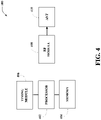
- FIG. 4 an example wireless communications system 400 is illustrated according to one or more aspects of the subject disclosure.
- Fig. 4 illustrates the system 400 that includes a transmitter 300 configured to operate in accordance the subject innovation.
- the principles used in traditional OFDM systems regarding carrier spacing can be applied to signals associated with different carrier frequencies.
- the carrier frequency referred to is the center (DC) frequency among the tones used for the signal transmission from a given transmission source, such as a base station.
- Carrier frequency is also sometimes referred to as RF or RadioFrequency carrier frequency or (RF) channel.
- RF RadioFrequency carrier frequency
- the user equipment may be receiving a weak desired signal in the presence of a strong signal from another carrier.
- the two signals occupying different carriers is essential for enabling the reception of the weaker desired signal.
- Condition 1 is often automatically satisfied by deploying compatible systems on adjacent carriers.
- Condition 2 can be achieved by time synchronization. An example is when the system time associated with each carrier is synchronized to a common reference, for example synchronized to a satellite navigation system, such as GPS. There are other time synchronization methods as well.
- Condition 3 can be achieved by an appropriate selection of the carrier spacing. Sometimes carrier spacing is dictated by air interface standards, but even in this case, fine carrier offset adjustment may be possible because of the allowed frequency range for frequency reference uncertainty.
- the method of carrier spacing optimization for the downlink (DL) has been discussed.
- the same benefit is also applicable to the uplink (UL).
- the optimum DL carrier spacing automatically ensures optimum UL carrier spacing as well.
- the deviations in the actual frequencies for base stations B & C is around 1.2ppm and therefore still within the allowed range of ⁇ 2ppm [2,3].
- a processor 402 contains hardware and/or software necessary to carry out the steps needed to perform the operations for providing orthogonality in an OFDM wireless communication system having a second transmitter using a different carrier frequency than the one used by transmitter 400 (e.g., also referred to as system 400).
- Processor 402 is typically coupled to memory 404, which provides computer-readable instructions for carrying out the afore-mentioned process.
- Memory 404 may also be used to store other pertinent information for transmitter 400 to operate.
- Timing module 406 comprises hardware and/or software needed to coordinate timing between transmitter 400 and a second transmitter.
- timing module 406 could comprise a GPS module for receiving timing information from a constellation of earth-orbiting satellites.
- Timing module 406 could alternatively comprise a timer that is periodically updated with an overall system time.
- the functionality of timing module 406 could be incorporated into processor 402 or any other functional block within transmitter 400.
- timing information from timing module 406 is sent to processor 402, so that processor 402 may coordinate transmission timing between it and a second transmitter.
- processor 402 is configured to process data for transmission by converting the data into OFDM symbols having a similar OFDM symbol duration to what is used in a second transmitter.
- processor 402 provides a frequency offset between OFDM tones used by its carrier frequency. This frequency offset is typically the same or similar to a frequency offset between OFDM tones used by the second transmitter.
- the two carrier frequencies relate to a reciprocal of the OFDM symbol duration.
- the OFDM modulated data is then transmitted using well-known RF techniques using RF module 408 and antenna(s) 410 within a predetermined time period from when a second signal is transmitted from the second base station.
- FIGs. 5-6 methodologies relating to providing uplink timing control while reducing overhead and power consumption are illustrated. While, for purposes of simplicity of explanation, the methodologies are shown and described as a series of acts, it is to be understood and appreciated that the methodologies are not limited by the order of acts, as some acts may, in accordance with one or more embodiments, occur in different orders and/or concurrently with other acts from that shown and described herein. For example, those skilled in the art will understand and appreciate that a methodology could alternatively be represented as a series of interrelated states or events, such as in a state diagram. Moreover, not all illustrated acts may be required to implement a methodology in accordance with one or more embodiments.
- a methodology 500 that facilitates calculating a carrier spacing in order to mitigate signal separation from two or more carriers.
- an Orthogonal Frequency-Division Multiplexing (OFDM) symbol duration is verified between two or more carriers, wherein the verification ensures matching between the OFDM symbols between two or more carriers.
- a time synchronization is employed to ensure signal receipt from two or more carriers has a minimal offset.
- a tone spacing is received from the two or more carriers.
- a carrier spacing for the two or more carriers is implemented, wherein the carrier spacing is an integer multiple of the tone spacing.
- the carrier spacing can further be calculated based upon a least common multiple of a carrier raster and the tone spacing.
- the carrier raster can include a tolerance, wherein the least common multiple of the carrier raster and the tone spacing can be set in accordance with the tolerance.
- the implemented carrier spacing can be received.
- a methodology 600 that facilitates identifying a frequency offset between adjacent carriers by utilizing an integer multiple of tone spacing.
- an Orthogonal Frequency-Division Multiplexing (OFDM) symbol duration is verified between two or more carriers, wherein the verification is a matching between OFDM symbols for two or more carriers.
- a time synchronization is employed to ensure signal receipt from two or more carriers has a minimal offset.
- a tone spacing is received from the two or more carriers.
- a carrier spacing for the two or more carriers is implemented, wherein the carrier spacing is an integer multiple of the tone spacing.
- the carrier spacing can further be calculated based upon a least common multiple of a carrier raster and the tone spacing.
- the carrier raster can include a tolerance, wherein the least common multiple of the carrier raster and the tone spacing can be set in accordance with the tolerance.
- the implemented carrier spacing can be transmitted.
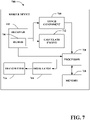
- Fig. 7 is an illustration of a mobile device 700 that facilitates signal separation utilizing carrier spacing in a wireless communication system.
- Mobile device 700 comprises a receiver 702 that receives a signal from, for instance, a receive antenna (not shown), performs typical actions on (e.g., filters, amplifies, downconverts, etc. ) the received signal, and digitizes the conditioned signal to obtain samples.
- Receiver 702 can comprise a demodulator 704 that can demodulate received symbols and provide them to a processor 706 for channel estimation.
- Processor 706 can be a processor dedicated to analyzing information received by receiver 702 and/or generating information for transmission by a transmitter 716, a processor that controls one or more components of mobile device 700, and/or a processor that both analyzes information received by receiver 702, generates information for transmission by transmitter 716, and controls one or more components of mobile device 700.
- Mobile device 700 can additionally comprise memory 708 that is operatively coupled to processor 706 and that can store data to be transmitted, received data, information related to available channels, data associated with analyzed signal and/or interference strength, information related to an assigned channel, power, rate, or the like, and any other suitable information for estimating a channel and communicating via the channel.
- Memory 708 can additionally store protocols and/or algorithms associated with estimating and/or utilizing a channel (e.g., performance based, capacity based, etc.).
- nonvolatile memory can include read only memory (ROM), programmable ROM (PROM), electrically programmable ROM (EPROM), electrically erasable PROM (EEPROM), or flash memory.
- Volatile memory can include random access memory (RAM), which acts as external cache memory.
- RAM is available in many forms such as synchronous RAM (SRAM), dynamic RAM (DRAM), synchronous DRAM (SDRAM), double data rate SDRAM (DDR SDRAM), enhanced SDRAM (ESDRAM), Synchlink DRAM (SLDRAM), and direct Rambus RAM (DRRAM).
- SRAM synchronous RAM
- DRAM dynamic RAM
- SDRAM synchronous DRAM
- DDR SDRAM double data rate SDRAM
- ESDRAM enhanced SDRAM
- SLDRAM Synchlink DRAM
- DRRAM direct Rambus RAM
- the memory 708 of the subject systems and methods is intended to comprise, without being limited to, these and any other suitable types of memory.
- Processor 706 can further be operatively coupled to at least one of a synch component 710 or a calculate engine 712.
- the synch component 710 ensures that various conditions are met in order to implement a carrier spacing. For instance, the synch component 710 verifies that OFDM symbol duration between two or more carriers is substantially similar. In addition, the synch component 710 ensures time synchronization between two or more carriers.
- the calculate engine 712 determines a carrier spacing, wherein the carrier spacing is an integer multiple of a tone spacing related to two or more carriers. In another example, the calculate engine 712 can determine the carrier spacing based on a least common multiple of the tone spacing and a carrier raster.
- Mobile device 700 still further comprises a modulator 714 and transmitter 716 that respectively modulate and transmit signals to, for instance, a base station, another mobile device, etc.
- a modulator 714 and transmitter 716 that respectively modulate and transmit signals to, for instance, a base station, another mobile device, etc.
- the synch component 710, calculate engine 712, demodulator 704, and/or modulator 714 can be part of the processor 706 or multiple processors (not shown).
- Fig. 8 is an illustration of a system 800 that facilitates employing orthogonality between tones in two or more carriers as described supra.
- the system 800 comprises a base station 802 (e.g ., access point, ...) with a receiver 810 that receives signal(s) from one or more mobile devices 804 through a plurality of receive antennas 806, and a transmitter 824 that transmits to the one or more mobile devices 804 through a transmit antenna 808.
- Receiver 810 can receive information from receive antennas 806 and is operatively associated with a demodulator 812 that demodulates received information. Demodulated symbols are analyzed by a processor 814 that can be similar to the processor described above with regard to Fig.
- Processor 814 is further coupled to a timing adjustment determiner 818 that can ascertain if mobile devices 804 require timing updates. Moreover, the processor 814 can be coupled to a timing adjustment evaluator 820 that can generate timing adjustment commands that update timing of mobile device 804 according to the identified need.
- a signal e.g ., pilot
- a disparate base station not shown
- the processor 814 can be coupled to at least one of a synch component 818 or a calculate engine 820.
- the synch component 710 ensures that various conditions are met in order to implement a carrier spacing. For instance, the synch component 710 verifies that OFDM symbol duration between two or more carriers is substantially similar. In addition, the synch component 710 ensures time synchronization between two or more carriers.
- the calculate engine 712 determines a carrier spacing, wherein the carrier spacing is an integer multiple of a tone spacing related to two or more carriers. In another example, the calculate engine 712 can determine the carrier spacing based on a least common multiple of the tone spacing and a carrier raster.
- the synch component 818, calculate engine 820, demodulator 812, and/or modulator 822 can be part of the processor 814 or multiple processors (not shown).
- Fig. 9 shows an example wireless communication system 900.
- the wireless communication system 900 depicts one base station 910 and one mobile device 950 for sake of brevity.
- system 900 can include more than one base station and/or more than one mobile device, wherein additional base stations and/or mobile devices can be substantially similar or different from example base station 910 and mobile device 950 described below.
- base station 910 and/or mobile device 950 can employ the systems ( Figs. 1-4 and 7-8), and/or methods ( Figs. 5-6 ) described herein to facilitate wireless communication there between.
- traffic data for a number of data streams is provided from a data source 912 to a transmit (TX) data processor 914.
- TX data processor 914 formats, codes, and interleaves the traffic data stream based on a particular coding scheme selected for that data stream to provide coded data.
- the coded data for each data stream can be multiplexed with pilot data using orthogonal frequency division multiplexing (OFDM) techniques. Additionally or alternatively, the pilot symbols can be frequency division multiplexed (FDM), time division multiplexed (TDM), or code division multiplexed (CDM).
- the pilot data is typically a known data pattern that is processed in a known manner and can be used at mobile device 950 to estimate channel response.
- the multiplexed pilot and coded data for each data stream can be modulated (e.g ., symbol mapped) based on a particular modulation scheme (e.g ., binary phase-shift keying (BPSK), quadrature phase-shift keying (QPSK), M-phase-shift keying (M-PSK), M-quadrature amplitude modulation (M-QAM), etc .) selected for that data stream to provide modulation symbols.
- BPSK binary phase-shift keying
- QPSK quadrature phase-shift keying
- M-PSK M-phase-shift keying
- M-QAM M-quadrature amplitude modulation
- the data rate, coding, and modulation for each data stream can be determined by instructions performed or provided by processor 930.
- the modulation symbols for the data streams can be provided to a TX MIMO processor 920, which can further process the modulation symbols (e.g., for OFDM). TX MIMO processor 920 then provides N T modulation symbol streams to N T transmitters (TMTR) 922a through 922t. In various embodiments, TX MIMO processor 920 applies beamforming weights to the symbols of the data streams and to the antenna from which the symbol is being transmitted.
- TX MIMO processor 920 applies beamforming weights to the symbols of the data streams and to the antenna from which the symbol is being transmitted.
- Each transmitter 922 receives and processes a respective symbol stream to provide one or more analog signals, and further conditions (e.g., amplifies, filters, and upconverts) the analog signals to provide a modulated signal suitable for transmission over the MIMO channel. Further, N T modulated signals from transmitters 922a through 922t are transmitted from N T antennas 924a through 924t, respectively.
- the transmitted modulated signals are received by N R antennas 952a through 952r and the received signal from each antenna 952 is provided to a respective receiver (RCVR) 954a through 954r.
- Each receiver 954 conditions (e.g., filters, amplifies, and downconverts) a respective signal, digitizes the conditioned signal to provide samples, and further processes the samples to provide a corresponding "received" symbol stream.
- An RX data processor 960 can receive and process the N R received symbol streams from N R receivers 954 based on a particular receiver processing technique to provide N T "detected" symbol streams. RX data processor 960 can demodulate, deinterleave, and decode each detected symbol stream to recover the traffic data for the data stream. The processing by RX data processor 960 is complementary to that performed by TX MIMO processor 920 and TX data processor 914 at base station 910.
- a processor 970 can periodically determine which precoding matrix to utilize as discussed above. Further, processor 970 can formulate a reverse link message comprising a matrix index portion and a rank value portion.
- the reverse link message can comprise various types of information regarding the communication link and/or the received data stream.
- the reverse link message can be processed by a TX data processor 938, which also receives traffic data for a number of data streams from a data source 936, modulated by a modulator 980, conditioned by transmitters 954a through 954r, and transmitted back to base station 910.
- the modulated signals from mobile device 950 are received by antennas 924, conditioned by receivers 922, demodulated by a demodulator 940, and processed by a RX data processor 942 to extract the reverse link message transmitted by mobile device 950. Further, processor 930 can process the extracted message to determine which precoding matrix to use for determining the beamforming weights.
- Processors 930 and 970 can direct (e.g., control, coordinate, manage, etc.) operation at base station 910 and mobile device 950, respectively. Respective processors 930 and 970 can be associated with memory 932 and 972 that store program codes and data. Processors 930 and 970 can also perform computations to derive frequency and impulse response estimates for the uplink and downlink, respectively.
- the embodiments described herein can be implemented in hardware, software, firmware, middleware, microcode, or any combination thereof.
- the processing units can be implemented within one or more application specific integrated circuits (ASICs), digital signal processors (DSPs), digital signal processing devices (DSPDs), programmable logic devices (PLDs), field programmable gate arrays (FPGAs), processors, controllers, micro-controllers, microprocessors, other electronic units designed to perform the functions described herein, or a combination thereof.
- ASICs application specific integrated circuits
- DSPs digital signal processors
- DSPDs digital signal processing devices
- PLDs programmable logic devices
- FPGAs field programmable gate arrays
- processors controllers, micro-controllers, microprocessors, other electronic units designed to perform the functions described herein, or a combination thereof.
- a code segment can represent a procedure, a function, a subprogram, a program, a routine, a subroutine, a module, a software package, a class, or any combination of instructions, data structures, or program statements.
- a code segment can be coupled to another code segment or a hardware circuit by passing and/or receiving information, data, arguments, parameters, or memory contents. Information, arguments, parameters, data, etc. can be passed, forwarded, or transmitted using any suitable means including memory sharing, message passing, token passing, network transmission, etc.
- the techniques described herein can be implemented with modules (e.g ., procedures, functions, and so on) that perform the functions described herein.
- the software codes can be stored in memory units and executed by processors.
- the memory unit can be implemented within the processor or external to the processor, in which case it can be communicatively coupled to the processor via various means as is known in the art.
- system 1000 that facilitates calculating a carrier spacing in order to mitigate signal separation from two or more carriers.
- system 1000 can reside at least partially within a base station, mobile device, network, OFDM network, user equipment, etc. It is to be appreciated that system 1000 is represented as including functional blocks, which can be functional blocks that represent functions implemented by a processor, software, or combination thereof ( e.g ., firmware).
- System 1000 includes a logical grouping 1002 of electrical components that can act in conjunction.
- System 1000 includes a logical grouping 1002 of electrical components that facilitate signal separation within a wireless communications network(s).
- Logical grouping 1002 includes an electrical component for verifying an Orthogonal Frequency-Division Multiplexing (OFDM) symbol duration between two or more carriers 1004. Moreover, logical grouping 1002 includes an electrical component for employing a time synchronization to ensure signal receipt from the two or more carriers have a minimal time offset 1006. Further, logical grouping 1002 comprises an electrical component for receiving a tone spacing from the two or more carriers 1008. In addition, logical grouping 1002 includes an electrical component for implementing a carrier spacing for the two or more carriers, wherein the carrier spacing is an integer multiple of the tone spacing 1010. The logical grouping 1002 can further include an electrical component for receiving the implemented carrier spacing 1012.
- OFDM Orthogonal Frequency-Division Multiplexing
- system 1000 can include a memory 1014 that retains instructions for executing functions associated with electrical components 1004, 1006, 1008, 1010, and 1012. While shown as being external to memory 1014, it is to be understood that one or more of electrical components 1004, 1006, 1008, 1010, and 1012 can exist within memory 1014.
- System 1100 that identifies a frequency offset between adjacent carriers by utilizing an integer multiple of tone spacing in a wireless communications network.
- System 1100 can reside within a base station, user equipment, network, OFDM network, mobile device, etc. , for instance.
- system 1100 includes functional blocks that can represent functions implemented by a processor, software, or combination thereof ( e.g ., firmware).
- System 1100 includes a logical grouping 1102 of electrical components that facilitate signal separation within a wireless communications network(s).
- Logical grouping 1102 includes an electrical component for verifying an Orthogonal Frequency-Division Multiplexing (OFDM) symbol duration between two or more carriers 1104.
- OFDM Orthogonal Frequency-Division Multiplexing
- logical grouping 1102 includes an electrical component for employing a time synchronization to ensure signal receipt from the two or more carriers have a minimal time offset 1106. Further, logical grouping 1102 comprises an electrical component for receiving a tone spacing from the two or more carriers 1108. In addition, logical grouping 1102 includes an electrical component for implementing a carrier spacing for the two or more carriers, wherein the carrier spacing is an integer multiple of the tone spacing 1110. The logical grouping 1102 can further include an electrical component for transmitting the implemented carrier spacing 1112. Additionally, system 1100 can include a memory 1114 that retains instructions for executing functions associated with electrical components 1104, 1106, 1108 1110, and 1112. While shown as being external to memory 1114, it is to be understood that electrical components 1104, 1106, 1108 1110, and 1112 can exist within memory 1114.
Landscapes
- Engineering & Computer Science (AREA)
- Signal Processing (AREA)
- Computer Networks & Wireless Communication (AREA)
- Mobile Radio Communication Systems (AREA)
- Digital Transmission Methods That Use Modulated Carrier Waves (AREA)
Claims (11)
- Verfahren (500), das das Trennen von Signalen innerhalb einer drahtlosen Kommunikationsumgebung (100) erleichtert, wobei das Verfahren von einer drahtlosen Kommunikationsvorrichtung ausgeführt wird, wobei das Verfahren umfasst:Verifizieren (502) einer Orthogonalen Frequenzmultiplex-, OFDM, Symboldauer zwischen zwei oder mehr Trägern, die einem OFDM-Netzwerk zugeordnet sind, wobei das Verifizieren ein Abgleichen zwischen der OFDM-Symboldauer zwischen zwei oder mehr Trägern sicherstellt;Verwenden (504) einer Zeitsynchronisation, um sicherzustellen, dass der Signalempfang von den zwei oder mehr Trägern einen minimalen Zeitversatz aufweist, wobei der minimale Zeitversatz definiert ist als die Differenz zwischen dem Beginn der OFDM-Symbole von den zwei oder mehr Trägern, die nicht mehr als die Länge des zyklischen Präfixes ist;Empfangen (506) einer Tonbeabstandung von den zwei oder mehr Trägern; und Berechnen einer Trägerbeabstandung, wobei die Trägerbeabstandung der Frequenzversatz zwischen benachbarten Trägerfrequenzen ist, durch Erhöhen oder Verringern mindestens einer der Trägerfrequenzen, so dass die Trägerbeabstandung ein ganzzahliges Vielfaches der Tonbeabstandung ist; undImplementieren (508) der Trägerbeabstandung für die zwei oder mehr Träger, wobei die Trägerbeabstandung ein ganzzahliges Vielfaches der Tonbeabstandung ist.
- Verfahren (500) nach Anspruch 1, ferner umfassend Empfangen (510) der implementierten Trägerbeabstandung mit mindestens einem von einer Basisstation, einer bedienenden Basisstation, einer Zielbasisstation, einem Netzwerk, einem Server, einer mobilen Vorrichtung, einer Benutzereinrichtung, einem OFDM-Netzwerk oder einem eNode B.
- Verfahren (500) nach Anspruch 1, ferner umfassend Verwenden der Trägerbeabstandung innerhalb des OFDM-Netzwerks, um Signale von zwei oder mehr Trägern zu trennen.
- Verfahren (500) nach Anspruch 1, ferner umfassend Verwenden der Trägerbeabstandung mit mindestens einem von einer Basisstation (802) oder einer Benutzereinrichtung, UE, (700), um Signale von zwei oder mehr Trägern zu trennen.
- Verfahren (500) nach Anspruch 1, wobei die Zeitsynchronisation eine Satellitennavigationssystemtechnik ist.
- Computerprogramm, umfassend maschinenausführbare Anweisungen, die, wenn das Programm von einem Computer ausgeführt wird, den Computer veranlassen, das Verfahren nach einem der Ansprüche 1-5 auszuführen.
- Drahtlose Kommunikationsvorrichtung (1000), die angepasst ist, um die Trennung von Signalen innerhalb einer drahtlosen Kommunikationsumgebung zu ermöglichen, umfassend:Mittel zum Verifizieren (1004) einer Orthogonalen Frequenzmultiplex-, OFDM, Symboldauer zwischen zwei oder mehr Trägern, die einem OFDM-Netzwerk zugeordnet sind, wobei das Verifizieren ein Abgleichen zwischen der OFDM-Symboldauer zwischen zwei oder mehr Trägern sicherstellt;Mittel zum Verwenden (1006) einer Zeitsynchronisation, um sicherzustellen, dass der Signalempfang von den zwei oder mehr Trägern einen minimalen Zeitversatz aufweist, wobei der minimale Zeitversatz definiert ist als die Differenz zwischen dem Beginn der OFDM-Symbole von den zwei oder mehr Trägern, die nicht mehr als die Länge des zyklischen Präfixes ist;Mittel zum Empfangen (1008) einer Tonbeabstandung von den zwei oder mehr Trägern;Mittel zum Berechnen einer Trägerbeabstandung, wobei die Trägerbeabstandung der Frequenzversatz zwischen benachbarten Trägerfrequenzen ist, durch Erhöhen oder Verringern mindestens einer der Trägerfrequenzen, so dass die Trägerbeabstandung ein ganzzahliges Vielfaches der Tonbeabstandung ist; undMittel zum Implementieren (1010) der Trägerbeabstandung für die zwei oder mehr Träger, wobei die Trägerbeabstandung ein ganzzahliges Vielfaches der Tonbeabstandung ist.
- Drahtlose Kommunikationsvorrichtung (1000) nach Anspruch 7, wobei die implementierte Trägerbeabstandung mit mindestens einem von einer Basisstation, einer bedienenden Basisstation, einer Zielbasisstation, einem Netzwerk, einem Server, einer mobilen Vorrichtung, einer Benutzereinrichtung, einem OFDM-Netzwerk oder einem eNode B empfangen wird.
- Drahtlose Kommunikationsvorrichtung (1000) nach Anspruch 7, wobei die Trägerbeabstandung innerhalb des OFDM-Netzwerks eingesetzt wird, um Signale von zwei oder mehr Trägern zu trennen.
- Drahtlose Kommunikationsvorrichtung (1000) nach Anspruch 7, wobei die Trägerbeabstandung mit mindestens einem von einer Basisstation (802) oder einer Benutzereinrichtung, UE, (700) verwendet wird, um Signale von zwei oder mehr Trägern zu trennen.
- Drahtlose Kommunikationsvorrichtung (1000) nach Anspruch 7, wobei die Zeitsynchronisation eine Satellitennavigationssystemtechnik ist.
Applications Claiming Priority (3)
| Application Number | Priority Date | Filing Date | Title |
|---|---|---|---|
| US5985908P | 2008-06-09 | 2008-06-09 | |
| US12/479,553 US8494065B2 (en) | 2008-06-09 | 2009-06-05 | Interference reduction between OFDM carriers by frequency offset optimization |
| PCT/US2009/046785 WO2009152177A2 (en) | 2008-06-09 | 2009-06-09 | Interference reduction between ofdm carriers by frequency offset optimization |
Publications (2)
| Publication Number | Publication Date |
|---|---|
| EP2286563A2 EP2286563A2 (de) | 2011-02-23 |
| EP2286563B1 true EP2286563B1 (de) | 2022-10-05 |
Family
ID=41400305
Family Applications (1)
| Application Number | Title | Priority Date | Filing Date |
|---|---|---|---|
| EP09763467.9A Active EP2286563B1 (de) | 2008-06-09 | 2009-06-09 | Interferenzreduzierung zwischen ofdm-trägern durch trägerabstandoptimierung |
Country Status (10)
| Country | Link |
|---|---|
| US (1) | US8494065B2 (de) |
| EP (1) | EP2286563B1 (de) |
| JP (1) | JP5204302B2 (de) |
| KR (1) | KR101227466B1 (de) |
| CN (1) | CN102057641B (de) |
| BR (1) | BRPI0914995A2 (de) |
| CA (1) | CA2724885A1 (de) |
| RU (1) | RU2471299C2 (de) |
| TW (1) | TWI385985B (de) |
| WO (1) | WO2009152177A2 (de) |
Families Citing this family (18)
| Publication number | Priority date | Publication date | Assignee | Title |
|---|---|---|---|---|
| US8144572B2 (en) | 2004-09-14 | 2012-03-27 | Qualcomm Incorporated | Detection and mitigation of interference and jammers in an OFDM system |
| US8254865B2 (en) * | 2006-04-07 | 2012-08-28 | Belair Networks | System and method for frequency offsetting of information communicated in MIMO-based wireless networks |
| US9137764B2 (en) * | 2009-03-17 | 2015-09-15 | Htc Corporation | Method of managing timing alignment functionality for multiple component carriers and related communication device |
| KR101624879B1 (ko) | 2009-12-23 | 2016-05-30 | 삼성전자주식회사 | 멀티 셀 환경에서의 기준신호 할당 방법, 관리 방법 및 상기 방법이 적용되는 네트워크 장치 및 단말 |
| WO2011098298A2 (en) | 2010-02-15 | 2011-08-18 | Lantiq Deutschland Gmbh | Overlapped frequency bands for multicarrier arrangements |
| US8971430B2 (en) | 2010-05-25 | 2015-03-03 | Kyocera Corporation | Receiving device, base station and wireless communication terminal |
| JP5496777B2 (ja) * | 2010-05-25 | 2014-05-21 | 京セラ株式会社 | 基地局 |
| WO2015109576A1 (zh) * | 2014-01-26 | 2015-07-30 | 华为技术有限公司 | 数据传输方法、装置和系统 |
| EP3132583B1 (de) * | 2014-04-16 | 2020-08-26 | NXP USA, Inc. | Längenangabe eines signalfeldes in einem hocheffizienten wireless local area network (wlan) |
| GB2527090B (en) * | 2014-06-11 | 2017-04-12 | Samsung Electronics Co Ltd | Identifying interference at a digital broadcasting receiver |
| US10333668B2 (en) * | 2015-10-05 | 2019-06-25 | Qualcomm Incorporated | Enhanced component carrier discovery reference signals |
| US10516510B2 (en) | 2015-11-11 | 2019-12-24 | Telefonaktiebolaget Lm Ericsson (Publ) | Method and apparatus for wireless communication |
| KR102178412B1 (ko) | 2016-07-15 | 2020-11-16 | 주식회사 케이티 | 새로운 무선 액세스 망에서 단말을 위한 동기화 신호 및 시스템 정보를 송수신하는 방법 및 장치 |
| US11916720B2 (en) * | 2016-09-30 | 2024-02-27 | Sony Group Corporation | Subcarrier spacing selection for synchronization signals |
| BR112019019471A2 (pt) * | 2017-03-24 | 2020-04-22 | Ericsson Telefon Ab L M | raster e numeração de canais |
| US10985964B2 (en) * | 2017-09-11 | 2021-04-20 | Qualcomm Incorporated | Techniques for selecting subcarrier spacing for signal detection |
| US11050598B2 (en) * | 2017-11-28 | 2021-06-29 | Qualcomm Incorporated | Carrier information signaling in a 5G network |
| CN110011027A (zh) * | 2018-12-28 | 2019-07-12 | 瑞声科技(新加坡)有限公司 | 一种天线、天线阵列和基站 |
Citations (2)
| Publication number | Priority date | Publication date | Assignee | Title |
|---|---|---|---|---|
| WO2009152657A1 (en) * | 2008-06-19 | 2009-12-23 | Huawei Technologies Co., Ltd. | Improved method and apparatus for carrier aggregation in radio communication system |
| EP2398202A2 (de) * | 2009-02-16 | 2011-12-21 | Samsung Electronics Co., Ltd. | Verfahren und vorrichtung zum übertragen und empfangen von downlink-signalen mit in einem zellulären funkkommunikationssystem zur unterstützung der bandskalierbarkeit konfiguriertem führungsband |
Family Cites Families (16)
| Publication number | Priority date | Publication date | Assignee | Title |
|---|---|---|---|---|
| JP3870573B2 (ja) * | 1998-08-24 | 2007-01-17 | ソニー株式会社 | 変調装置および方法、記録媒体、並びに復調装置および方法 |
| JP2000269917A (ja) * | 1999-03-12 | 2000-09-29 | Sony Corp | 送信装置および方法、並びに提供媒体 |
| US6891792B1 (en) * | 1999-05-14 | 2005-05-10 | At&T Corp. | Method for estimating time and frequency offset in an OFDM system |
| US20020145969A1 (en) | 2001-02-28 | 2002-10-10 | Zulfiquar Sayeed | Carrier frequency acquisition method and apparatus having improved reliability for detecting carrier acquisition or loss thereof |
| KR100754721B1 (ko) | 2002-04-26 | 2007-09-03 | 삼성전자주식회사 | 직교주파수분할다중화 통신시스템에서 다중화 데이터 송수신 장치 및 방법 |
| US7260054B2 (en) * | 2002-05-30 | 2007-08-21 | Denso Corporation | SINR measurement method for OFDM communications systems |
| US7941173B2 (en) * | 2003-10-17 | 2011-05-10 | Qualcomm Incorporated | Beacon signals facilitating signal detection and timing synchronization |
| CA2562705A1 (en) * | 2004-04-15 | 2005-11-17 | Qualcomm Flarion Technologies, Inc. | Multi-carrier communications methods and apparatus |
| KR100935042B1 (ko) | 2004-04-15 | 2009-12-31 | 콸콤 인코포레이티드 | 통신 시스템의 단계적 구축을 위한 방법 및 장치 |
| US7969858B2 (en) | 2004-10-14 | 2011-06-28 | Qualcomm Incorporated | Wireless terminal methods and apparatus for use in wireless communications systems supporting different size frequency bands |
| JP4732808B2 (ja) | 2005-06-14 | 2011-07-27 | 株式会社エヌ・ティ・ティ・ドコモ | 無線パラメータ群を生成する装置 |
| US7801227B2 (en) * | 2006-04-14 | 2010-09-21 | Qualcomm Incorporated | Methods and apparatus related to composite beacon and wideband synchronization signaling |
| US8489133B2 (en) * | 2006-06-09 | 2013-07-16 | Nec Corporation | Communication system, transmission device, reception device, and synchronization method |
| JP4910531B2 (ja) | 2006-07-18 | 2012-04-04 | 富士通株式会社 | 端末間のアドホック通信方法及び通信システム |
| WO2008096436A1 (ja) | 2007-02-08 | 2008-08-14 | Fujitsu Limited | 無線端末装置、基地局装置および無線通信方法 |
| CN101136894B (zh) | 2007-03-23 | 2012-11-28 | 中兴通讯股份有限公司 | 可扩展的ofdm及ofdma带宽分配的方法和系统 |
-
2009
- 2009-06-05 US US12/479,553 patent/US8494065B2/en active Active
- 2009-06-08 TW TW098119069A patent/TWI385985B/zh active
- 2009-06-09 KR KR1020117000566A patent/KR101227466B1/ko active Active
- 2009-06-09 RU RU2010154091/08A patent/RU2471299C2/ru active
- 2009-06-09 EP EP09763467.9A patent/EP2286563B1/de active Active
- 2009-06-09 BR BRPI0914995A patent/BRPI0914995A2/pt not_active IP Right Cessation
- 2009-06-09 WO PCT/US2009/046785 patent/WO2009152177A2/en not_active Ceased
- 2009-06-09 CA CA2724885A patent/CA2724885A1/en not_active Abandoned
- 2009-06-09 CN CN200980121259.9A patent/CN102057641B/zh active Active
- 2009-06-09 JP JP2011513641A patent/JP5204302B2/ja active Active
Patent Citations (2)
| Publication number | Priority date | Publication date | Assignee | Title |
|---|---|---|---|---|
| WO2009152657A1 (en) * | 2008-06-19 | 2009-12-23 | Huawei Technologies Co., Ltd. | Improved method and apparatus for carrier aggregation in radio communication system |
| EP2398202A2 (de) * | 2009-02-16 | 2011-12-21 | Samsung Electronics Co., Ltd. | Verfahren und vorrichtung zum übertragen und empfangen von downlink-signalen mit in einem zellulären funkkommunikationssystem zur unterstützung der bandskalierbarkeit konfiguriertem führungsband |
Non-Patent Citations (2)
| Title |
|---|
| HUAWEI: "Carrier aggregation in Advanced E-UTRA", 3GPP DRAFT; R1-082448, 3RD GENERATION PARTNERSHIP PROJECT (3GPP), MOBILE COMPETENCE CENTRE ; 650, ROUTE DES LUCIOLES ; F-06921 SOPHIA-ANTIPOLIS CEDEX ; FRANCE, vol. RAN WG1, no. Warsaw, Poland; 20080625, 25 June 2008 (2008-06-25), XP050110721 * |
| HUAWEI: "Carrier aggregation in LTE-Advanced", 3GPP DRAFT; R1-084346, 3RD GENERATION PARTNERSHIP PROJECT (3GPP), MOBILE COMPETENCE CENTRE ; 650, ROUTE DES LUCIOLES ; F-06921 SOPHIA-ANTIPOLIS CEDEX ; FRANCE, no. Prague, Czech Republic; 20081104, 4 November 2008 (2008-11-04), XP050317618 * |
Also Published As
| Publication number | Publication date |
|---|---|
| JP2011523331A (ja) | 2011-08-04 |
| WO2009152177A2 (en) | 2009-12-17 |
| EP2286563A2 (de) | 2011-02-23 |
| KR20110027775A (ko) | 2011-03-16 |
| JP5204302B2 (ja) | 2013-06-05 |
| US20090304100A1 (en) | 2009-12-10 |
| TWI385985B (zh) | 2013-02-11 |
| CN102057641B (zh) | 2014-08-27 |
| BRPI0914995A2 (pt) | 2015-10-27 |
| US8494065B2 (en) | 2013-07-23 |
| RU2010154091A (ru) | 2012-07-20 |
| WO2009152177A3 (en) | 2010-05-06 |
| CA2724885A1 (en) | 2009-12-17 |
| TW201014286A (en) | 2010-04-01 |
| CN102057641A (zh) | 2011-05-11 |
| RU2471299C2 (ru) | 2012-12-27 |
| KR101227466B1 (ko) | 2013-01-29 |
Similar Documents
| Publication | Publication Date | Title |
|---|---|---|
| EP2286563B1 (de) | Interferenzreduzierung zwischen ofdm-trägern durch trägerabstandoptimierung | |
| EP2425577B1 (de) | Pcfich-design für mehrträgerbetrieb | |
| US8948208B2 (en) | Conveying information through phase offset on PSS relative to DL-RS | |
| AU2011200722B2 (en) | Control channel format indicator frequency mapping | |
| AU2009293010B2 (en) | Reference signal design for LTE advanced | |
| US9438397B2 (en) | Pseudo-random sequence mapping in wireless communications | |
| EP2353341B1 (de) | Betriebsmittelauswahl des physischen direktzugriffskanals | |
| US8477699B2 (en) | Cross-carrier control for LTE-advanced multicarrier system | |
| EP2052472A2 (de) | Anfrage für uplink-zugriff in einer ofdm-kommunikationsumgebung | |
| CN103718524A (zh) | 用于单播和多播/广播信号的跟踪环设计 | |
| AU2014200865B2 (en) | Reference signal design for lte a | |
| HK1156444B (en) | Reference signal design for lte advanced |
Legal Events
| Date | Code | Title | Description |
|---|---|---|---|
| PUAI | Public reference made under article 153(3) epc to a published international application that has entered the european phase |
Free format text: ORIGINAL CODE: 0009012 |
|
| 17P | Request for examination filed |
Effective date: 20101216 |
|
| AK | Designated contracting states |
Kind code of ref document: A2 Designated state(s): AT BE BG CH CY CZ DE DK EE ES FI FR GB GR HR HU IE IS IT LI LT LU LV MC MK MT NL NO PL PT RO SE SI SK TR |
|
| AX | Request for extension of the european patent |
Extension state: AL BA RS |
|
| 17Q | First examination report despatched |
Effective date: 20110518 |
|
| DAX | Request for extension of the european patent (deleted) | ||
| STAA | Information on the status of an ep patent application or granted ep patent |
Free format text: STATUS: EXAMINATION IS IN PROGRESS |
|
| GRAP | Despatch of communication of intention to grant a patent |
Free format text: ORIGINAL CODE: EPIDOSNIGR1 |
|
| STAA | Information on the status of an ep patent application or granted ep patent |
Free format text: STATUS: GRANT OF PATENT IS INTENDED |
|
| INTG | Intention to grant announced |
Effective date: 20220425 |
|
| GRAS | Grant fee paid |
Free format text: ORIGINAL CODE: EPIDOSNIGR3 |
|
| GRAA | (expected) grant |
Free format text: ORIGINAL CODE: 0009210 |
|
| STAA | Information on the status of an ep patent application or granted ep patent |
Free format text: STATUS: THE PATENT HAS BEEN GRANTED |
|
| AK | Designated contracting states |
Kind code of ref document: B1 Designated state(s): AT BE BG CH CY CZ DE DK EE ES FI FR GB GR HR HU IE IS IT LI LT LU LV MC MK MT NL NO PL PT RO SE SI SK TR |
|
| REG | Reference to a national code |
Ref country code: GB Ref legal event code: FG4D |
|
| REG | Reference to a national code |
Ref country code: CH Ref legal event code: EP |
|
| REG | Reference to a national code |
Ref country code: AT Ref legal event code: REF Ref document number: 1523470 Country of ref document: AT Kind code of ref document: T Effective date: 20221015 |
|
| REG | Reference to a national code |
Ref country code: IE Ref legal event code: FG4D |
|
| REG | Reference to a national code |
Ref country code: DE Ref legal event code: R096 Ref document number: 602009064631 Country of ref document: DE |
|
| REG | Reference to a national code |
Ref country code: LT Ref legal event code: MG9D |
|
| REG | Reference to a national code |
Ref country code: AT Ref legal event code: MK05 Ref document number: 1523470 Country of ref document: AT Kind code of ref document: T Effective date: 20221005 |
|
| PG25 | Lapsed in a contracting state [announced via postgrant information from national office to epo] |
Ref country code: NL Free format text: LAPSE BECAUSE OF FAILURE TO SUBMIT A TRANSLATION OF THE DESCRIPTION OR TO PAY THE FEE WITHIN THE PRESCRIBED TIME-LIMIT Effective date: 20221005 |
|
| PG25 | Lapsed in a contracting state [announced via postgrant information from national office to epo] |
Ref country code: SE Free format text: LAPSE BECAUSE OF FAILURE TO SUBMIT A TRANSLATION OF THE DESCRIPTION OR TO PAY THE FEE WITHIN THE PRESCRIBED TIME-LIMIT Effective date: 20221005 Ref country code: PT Free format text: LAPSE BECAUSE OF FAILURE TO SUBMIT A TRANSLATION OF THE DESCRIPTION OR TO PAY THE FEE WITHIN THE PRESCRIBED TIME-LIMIT Effective date: 20230206 Ref country code: NO Free format text: LAPSE BECAUSE OF FAILURE TO SUBMIT A TRANSLATION OF THE DESCRIPTION OR TO PAY THE FEE WITHIN THE PRESCRIBED TIME-LIMIT Effective date: 20230105 Ref country code: LT Free format text: LAPSE BECAUSE OF FAILURE TO SUBMIT A TRANSLATION OF THE DESCRIPTION OR TO PAY THE FEE WITHIN THE PRESCRIBED TIME-LIMIT Effective date: 20221005 Ref country code: FI Free format text: LAPSE BECAUSE OF FAILURE TO SUBMIT A TRANSLATION OF THE DESCRIPTION OR TO PAY THE FEE WITHIN THE PRESCRIBED TIME-LIMIT Effective date: 20221005 Ref country code: ES Free format text: LAPSE BECAUSE OF FAILURE TO SUBMIT A TRANSLATION OF THE DESCRIPTION OR TO PAY THE FEE WITHIN THE PRESCRIBED TIME-LIMIT Effective date: 20221005 Ref country code: AT Free format text: LAPSE BECAUSE OF FAILURE TO SUBMIT A TRANSLATION OF THE DESCRIPTION OR TO PAY THE FEE WITHIN THE PRESCRIBED TIME-LIMIT Effective date: 20221005 |
|
| PG25 | Lapsed in a contracting state [announced via postgrant information from national office to epo] |
Ref country code: PL Free format text: LAPSE BECAUSE OF FAILURE TO SUBMIT A TRANSLATION OF THE DESCRIPTION OR TO PAY THE FEE WITHIN THE PRESCRIBED TIME-LIMIT Effective date: 20221005 Ref country code: LV Free format text: LAPSE BECAUSE OF FAILURE TO SUBMIT A TRANSLATION OF THE DESCRIPTION OR TO PAY THE FEE WITHIN THE PRESCRIBED TIME-LIMIT Effective date: 20221005 Ref country code: IS Free format text: LAPSE BECAUSE OF FAILURE TO SUBMIT A TRANSLATION OF THE DESCRIPTION OR TO PAY THE FEE WITHIN THE PRESCRIBED TIME-LIMIT Effective date: 20230205 Ref country code: HR Free format text: LAPSE BECAUSE OF FAILURE TO SUBMIT A TRANSLATION OF THE DESCRIPTION OR TO PAY THE FEE WITHIN THE PRESCRIBED TIME-LIMIT Effective date: 20221005 Ref country code: GR Free format text: LAPSE BECAUSE OF FAILURE TO SUBMIT A TRANSLATION OF THE DESCRIPTION OR TO PAY THE FEE WITHIN THE PRESCRIBED TIME-LIMIT Effective date: 20230106 |
|
| REG | Reference to a national code |
Ref country code: DE Ref legal event code: R097 Ref document number: 602009064631 Country of ref document: DE |
|
| PG25 | Lapsed in a contracting state [announced via postgrant information from national office to epo] |
Ref country code: RO Free format text: LAPSE BECAUSE OF FAILURE TO SUBMIT A TRANSLATION OF THE DESCRIPTION OR TO PAY THE FEE WITHIN THE PRESCRIBED TIME-LIMIT Effective date: 20221005 Ref country code: EE Free format text: LAPSE BECAUSE OF FAILURE TO SUBMIT A TRANSLATION OF THE DESCRIPTION OR TO PAY THE FEE WITHIN THE PRESCRIBED TIME-LIMIT Effective date: 20221005 Ref country code: DK Free format text: LAPSE BECAUSE OF FAILURE TO SUBMIT A TRANSLATION OF THE DESCRIPTION OR TO PAY THE FEE WITHIN THE PRESCRIBED TIME-LIMIT Effective date: 20221005 Ref country code: CZ Free format text: LAPSE BECAUSE OF FAILURE TO SUBMIT A TRANSLATION OF THE DESCRIPTION OR TO PAY THE FEE WITHIN THE PRESCRIBED TIME-LIMIT Effective date: 20221005 |
|
| PLBE | No opposition filed within time limit |
Free format text: ORIGINAL CODE: 0009261 |
|
| STAA | Information on the status of an ep patent application or granted ep patent |
Free format text: STATUS: NO OPPOSITION FILED WITHIN TIME LIMIT |
|
| PG25 | Lapsed in a contracting state [announced via postgrant information from national office to epo] |
Ref country code: SK Free format text: LAPSE BECAUSE OF FAILURE TO SUBMIT A TRANSLATION OF THE DESCRIPTION OR TO PAY THE FEE WITHIN THE PRESCRIBED TIME-LIMIT Effective date: 20221005 |
|
| 26N | No opposition filed |
Effective date: 20230706 |
|
| PG25 | Lapsed in a contracting state [announced via postgrant information from national office to epo] |
Ref country code: SI Free format text: LAPSE BECAUSE OF FAILURE TO SUBMIT A TRANSLATION OF THE DESCRIPTION OR TO PAY THE FEE WITHIN THE PRESCRIBED TIME-LIMIT Effective date: 20221005 |
|
| PG25 | Lapsed in a contracting state [announced via postgrant information from national office to epo] |
Ref country code: MC Free format text: LAPSE BECAUSE OF FAILURE TO SUBMIT A TRANSLATION OF THE DESCRIPTION OR TO PAY THE FEE WITHIN THE PRESCRIBED TIME-LIMIT Effective date: 20221005 |
|
| PG25 | Lapsed in a contracting state [announced via postgrant information from national office to epo] |
Ref country code: MC Free format text: LAPSE BECAUSE OF FAILURE TO SUBMIT A TRANSLATION OF THE DESCRIPTION OR TO PAY THE FEE WITHIN THE PRESCRIBED TIME-LIMIT Effective date: 20221005 |
|
| REG | Reference to a national code |
Ref country code: CH Ref legal event code: PL |
|
| REG | Reference to a national code |
Ref country code: BE Ref legal event code: MM Effective date: 20230630 |
|
| PG25 | Lapsed in a contracting state [announced via postgrant information from national office to epo] |
Ref country code: LU Free format text: LAPSE BECAUSE OF NON-PAYMENT OF DUE FEES Effective date: 20230609 |
|
| REG | Reference to a national code |
Ref country code: IE Ref legal event code: MM4A |
|
| PG25 | Lapsed in a contracting state [announced via postgrant information from national office to epo] |
Ref country code: LU Free format text: LAPSE BECAUSE OF NON-PAYMENT OF DUE FEES Effective date: 20230609 |
|
| PG25 | Lapsed in a contracting state [announced via postgrant information from national office to epo] |
Ref country code: IE Free format text: LAPSE BECAUSE OF NON-PAYMENT OF DUE FEES Effective date: 20230609 |
|
| PG25 | Lapsed in a contracting state [announced via postgrant information from national office to epo] |
Ref country code: IE Free format text: LAPSE BECAUSE OF NON-PAYMENT OF DUE FEES Effective date: 20230609 Ref country code: CH Free format text: LAPSE BECAUSE OF NON-PAYMENT OF DUE FEES Effective date: 20230630 |
|
| PG25 | Lapsed in a contracting state [announced via postgrant information from national office to epo] |
Ref country code: IT Free format text: LAPSE BECAUSE OF FAILURE TO SUBMIT A TRANSLATION OF THE DESCRIPTION OR TO PAY THE FEE WITHIN THE PRESCRIBED TIME-LIMIT Effective date: 20221005 Ref country code: BE Free format text: LAPSE BECAUSE OF NON-PAYMENT OF DUE FEES Effective date: 20230630 |
|
| PGFP | Annual fee paid to national office [announced via postgrant information from national office to epo] |
Ref country code: GB Payment date: 20240509 Year of fee payment: 16 |
|
| PGFP | Annual fee paid to national office [announced via postgrant information from national office to epo] |
Ref country code: DE Payment date: 20240326 Year of fee payment: 16 |
|
| PGFP | Annual fee paid to national office [announced via postgrant information from national office to epo] |
Ref country code: FR Payment date: 20240509 Year of fee payment: 16 |
|
| PG25 | Lapsed in a contracting state [announced via postgrant information from national office to epo] |
Ref country code: BG Free format text: LAPSE BECAUSE OF FAILURE TO SUBMIT A TRANSLATION OF THE DESCRIPTION OR TO PAY THE FEE WITHIN THE PRESCRIBED TIME-LIMIT Effective date: 20221005 |
|
| PG25 | Lapsed in a contracting state [announced via postgrant information from national office to epo] |
Ref country code: BG Free format text: LAPSE BECAUSE OF FAILURE TO SUBMIT A TRANSLATION OF THE DESCRIPTION OR TO PAY THE FEE WITHIN THE PRESCRIBED TIME-LIMIT Effective date: 20221005 |
|
| PG25 | Lapsed in a contracting state [announced via postgrant information from national office to epo] |
Ref country code: HU Free format text: LAPSE BECAUSE OF FAILURE TO SUBMIT A TRANSLATION OF THE DESCRIPTION OR TO PAY THE FEE WITHIN THE PRESCRIBED TIME-LIMIT; INVALID AB INITIO Effective date: 20090609 |
|
| PG25 | Lapsed in a contracting state [announced via postgrant information from national office to epo] |
Ref country code: CY Free format text: LAPSE BECAUSE OF FAILURE TO SUBMIT A TRANSLATION OF THE DESCRIPTION OR TO PAY THE FEE WITHIN THE PRESCRIBED TIME-LIMIT; INVALID AB INITIO Effective date: 20090609 |
|
| PG25 | Lapsed in a contracting state [announced via postgrant information from national office to epo] |
Ref country code: TR Free format text: LAPSE BECAUSE OF FAILURE TO SUBMIT A TRANSLATION OF THE DESCRIPTION OR TO PAY THE FEE WITHIN THE PRESCRIBED TIME-LIMIT Effective date: 20221005 |
|
| REG | Reference to a national code |
Ref country code: DE Ref legal event code: R119 Ref document number: 602009064631 Country of ref document: DE |
|
| GBPC | Gb: european patent ceased through non-payment of renewal fee |
Effective date: 20250609 |
|
| PG25 | Lapsed in a contracting state [announced via postgrant information from national office to epo] |
Ref country code: GB Free format text: LAPSE BECAUSE OF NON-PAYMENT OF DUE FEES Effective date: 20250609 |
|
| PG25 | Lapsed in a contracting state [announced via postgrant information from national office to epo] |
Ref country code: DE Free format text: LAPSE BECAUSE OF NON-PAYMENT OF DUE FEES Effective date: 20260101 |
|
| PG25 | Lapsed in a contracting state [announced via postgrant information from national office to epo] |
Ref country code: FR Free format text: LAPSE BECAUSE OF NON-PAYMENT OF DUE FEES Effective date: 20250630 |